


Introduction
Fungal pathogens cause serious opportunistic infections in immunocompromised solid organ transplant (SOT) recipients, Reference Shoham and Marr1,Reference Crabol and Lortholary2 however, it often remains challenging to confirm invasive fungal disease (IFD). Blood cultures to detect fungi using special media and/or processing techniques and extended incubation times are sometimes collected to gain additional diagnostic power. Many fungi are slow-growing and will not demonstrate growth during the short incubation period of bacterial blood cultures, necessitating monitoring of fungal-isolator blood cultures (FBCs) for up to 4–6 weeks. Reference Herrera, Khodadadi, Leal, Kulkarni, Pappas and McCarty3 However, this extended processing is effort-intensive and requires substantial financial and labor-related resources. Reference Steinbrink, Friedman and Thompson4 Additionally, FBCs are not appropriate for all fungal organisms or in all clinical circumstances. FBCs are most useful for recovery of dimorphic fungi, some disseminated hyphomycetes (eg, Fusarium, Scedosporium, Lomentospora, etc.), and Malassezia (owing to distinct lipid requirements). The most common pathogenic yeast grow well on conventional blood cultures, including Candida, Cryptococcus, and Saccharomyces. Reference Kosmin and Fekete5 Conversely, blood cultures have a lower yield for other fungi regardless of processing. Reference Kami, Murashige, Fujihara, Sakagami and Tanaka6 This is particularly true for Aspergillus, one of the most common opportunistic mold infections in SOT recipients, but rarely isolated from blood culture, even in the setting of disseminated infection. Reference Kami, Murashige, Fujihara, Sakagami and Tanaka6–Reference Hoellinger, Epailly, Vuotto, Loridant and Goeminne8
Multicenter diagnostic stewardship initiatives have demonstrated that bacterial blood culture utilization can be safely decreased without a corresponding increase in adverse outcomes. The DISTRIBUTE study demonstrated a blood culture decision algorithm reduced bacterial blood culture utilization by 18%–30% without affecting mortality or sepsis quality metrics. Reference Fabre, Klein, Salinas, Jones, Carroll and Milstone9 Similar findings have been identified with other high-risk populations, including a 36% reduction in cancer center blood culture utilization during the 2024 Becton Dickinson (BD) BACTEC™ bottle shortage, without adverse clinical outcomes. Reference She, Bender, Pullarkat and Dadwal10 Our own institutional data further confirm that bacterial blood culture collection in SOT recipients was inappropriate during 25% of events. Reference Steinbrink, Mehdiratta, Pena, Welsby, Seidenfeld and DeVore11 These data collectively demonstrate that diagnostic stewardship of blood cultures is safe and effective even in high-acuity populations.
In addition to bacterial blood cultures, the yield, utilization, and stewardship of FBCs have also been investigated in both adult and pediatric general and critically ill hospitalized patients. Reference Kosmin and Fekete5,Reference Chavez, Munigala, Burnham, Yarbrough, Squires and Fox12–Reference Babb, Clark, Gaffney, Abdelfattah and Prokesch14 These studies collectively demonstrate similar data, indicating low-yield results from FBCs with limited added value beyond what is provided from routine blood cultures. Specific stewardship interventions have been proposed that decrease inappropriate FBC collection without sacrificing culture positivity. Reference Chavez, Munigala, Burnham, Yarbrough, Squires and Fox12 However, similar efforts have not been exclusively investigated and described in the SOT population.
Therefore, we aimed to investigate FBCs specifically in SOT recipients at a high-volume transplant center. The primary objective of this study was to evaluate the frequency, clinical context, diagnostic yield, and appropriateness of FBC utilization in SOT recipients to test the hypothesis that FBCs are frequently ordered inappropriately in the SOT population in the absence of recommendations from infectious diseases (ID) consultants, and are of low yield even in this immunocompromised population.
Methods
Study design
This was a retrospective study of adult SOT recipients (age ≥ 18 yr) at a single academic medical center (Duke University Hospital, Durham, North Carolina, United States) from July 1, 2021, to January 16, 2025 (allowing for 12 months of follow-up), for whom at least one FBC was documented. Follow-up included both index transplant hospitalizations as well as later postoperative courses that remained within the study period. At our institution, FBCs are free-standing orders in the electronic medical record (EMR) and not embedded as part of a larger blood culture order-set. FBCs were collected during the study period into BD BACTEC™ Myco/F Lytic Medium bottles at a recommended volume of 10–15 milliliters (mL), and incubated for 28 days. This study was approved by the University Health System’s Institutional Review Board.
Data collection
FBCs at Duke University Hospital were identified using an existing surveillance blood culture database with patient-level data. Additional variables, including blood culture indication, antifungal treatment, vital signs and laboratory values on the calendar day of blood culture, mortality at 6- and 12 months after FBC, and transplant information were extracted by study team members from EMRs. FBC appropriateness was independently adjudicated through manual chart review by four ID physicians according to the criteria outlined in Supplemental Methods. FBCs were categorized as “appropriate,” if the indication for FBC was consistent with the predetermined criteria for culture collection, “inappropriate” if the indication for FBC was not consistent with the predetermined criteria for culture collection, or “potentially appropriate” if the indication for FBC did not fully meet either appropriate or inappropriate criteria. Adjudicators were not blinded to culture results.
Statistical analysis
Data was reported as percentages, median, and interquartile ranges (IQR). Descriptive statistics were performed through Microsoft Excel and GraphPad Prism.
Results
Demographics, FBC utilization rate
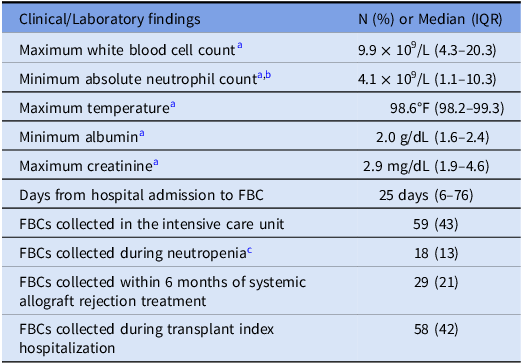
One hundred thirty-seven FBCs from 104 adult SOT recipients during 112 hospital encounters were included in the study. During the study period, adult SOT recipients at Duke University Hospital accounted for 186,986 National Healthcare Safety Network patient-days. The 137 FBCs collected therefore represent an overall utilization rate of 0.73 FBCs per 1,000 patient-days. Per-year utilization rates remained relatively stable during the study period, with a peak of 0.88 FBCs per 1,000 patient-days in 2023 and a nadir of 0.72 FBCs per 1,000 patient-days in 2024. Demographics and clinical findings among SOT recipients who had FBCs collected are outlined in Table 1.
Demographics and significant clinical findings among solid organ transplant recipients (N = 104) who had fungal blood cultures collected

Table 1. Long description
The table has 15 rows and 2 columns. The columns are labeled ‘Recipient Demographics’ and ‘N (%) or Median (IQR)’. The rows are labeled with various demographic and clinical categories. Row 1: Males, 69 (66). Row 2: Age, 56 years (45-62). Row 3: Heart, 37 (36). Row 4: Lung, 29 (28). Row 5: Liver, 16 (15). Row 6: Kidney, 7 (7). Row 7: Small bowel, 1 (1). Row 8: Multi-organ, 14 (13). Row 9: Number of FBCs per transplant recipient, 1 (1-1). Row 10: Days from transplant to FBC, 92 days (22-215). Row 11: Heart, 100 days (IQR 26-212). Row 12: Lung, 64 days (IQR 16-179). Row 13: Liver, 98 days (IQR 26-220). Row 14: Small bowel, 327 days (IQR 198-465). Row 15: Multi-organ, 236 days (IQR 211-427).
a At the time of first FBC collection, for those recipients who had more than one FBC during the study period.
b Multi-organ combinations included: heart/kidney, heart/liver, heart/lung, liver/lung, and kidney/pancreas.
FBC ordering patterns and indications
FBCs were most commonly collected in heart transplant recipients (37% [51/137]), followed by lung recipients (25% [34/137]) (Figure 1). Sixty-nine percent (94/137) of FBCs were collected without a specific suspected pathogen documented in the EMR. Additional clinical and laboratory findings associated with FBCs are outlined in Table 2. Amongst encounters with FBCs collected (N = 112 encounters), median hospitalization duration was 32 days (IQR 11–74) with a range of 2–610 days. Forty-two of these FBC encounters (38%) encompassed an index transplant hospitalization.
The number of fungal blood culture collections among solid organ transplant recipients, stratified by organ group.

Significant clinical and laboratory findings associated with fungal blood culture collection (N = 137)

Table 2. Long description
A table with 10 rows and 2 columns. The first column lists clinical and laboratory findings, and the second column provides corresponding values in terms of N (%) or Median (IQR). Row 1: Maximum white blood cell count, 9.9 x 10^9/L (4.3-20.3). Row 2: Minimum absolute neutrophil count, 4.1 x 10^9/L (1.1-10.3). Row 3: Maximum temperature, 98.6°F (98.2-99.3). Row 4: Minimum albumin, 2.0 g/dL (1.6-2.4). Row 5: Maximum creatinine, 2.9 mg/dL (1.9-4.6). Row 6: Days from hospital admission to FBC, 25 days (6-76). Row 7: FBCs collected in the intensive care unit, 59 (43). Row 8: FBCs collected during neutropenia, 18 (13). Row 9: FBCs collected within 6 months of systemic allograft rejection treatment, 29 (21). Row 10: FBCs collected during transplant index hospitalization, 58 (42).
a On the calendar day of FBC collection.
b Values represent the median (IQR) across FBCs of the minimum absolute neutrophil count recorded on the calendar day of FBC collection; individual values ranged below the neutropenia threshold, as reflected in the 13% of FBCs collected during neutropenia (ANC < 1.0 × 10⁹/L).
c Defined as absolute neutrophil count less than 1.0 x 10⁹/L.
FBCs were often ordered for more than one clinical indication (N = 35 FBCs), 5 of which were ordered for 3 simultaneous clinical indications (N = 178 indications). FBCs were most frequently (36/178, 20%) collected for sepsis/septic shock (Figure 2), although 38/178 (21%) FBCs were collected in recipients who already had a current or prior positive non-FBC fungal culture or biomarker, in many cases to assess for disseminated infection. (Supplemental Table 1) The third most common indication for FBC was radiographic evidence of pulmonary infection (29/178, 16%). Donor data further impacted FBC collection: Three percent (6/178) of FBCs were collected due to positive donor microbiologic data: 3 due to donor candidemia, 2 due to mold recovered from donor respiratory culture in lung transplant recipients, and 1 due to donor histoplasmosis.
Indications for 137 fungal blood culture collections (total N = 178); 35 fungal blood cultures were collected for multiple simultaneous indications.

Figure 2. Long description
A pie chart representing the distribution of indications for 137 fungal blood culture collections. The chart is divided into 13 segments, each representing a different indication. The segments are labeled with their respective categories and values. The largest segment is for Current or Positive Fungal Testing Elsewhere at 21 percent, followed by Sepsis/Septic shock at 20 percent, and Radiographic Pulmonary Pathology at 16 percent. Other segments include Cardiac/Endovascular Infection at 9 percent, Altered Mental Status and Isolated Fever/Hypothermia or Leukocytosis both at 7 percent, Abdominal Infection at 6 percent, Skin Pathology at 4 percent, Donor Infection at 4 percent, Unclear Indication at 2 percent, Radiographic Central Nervous System Pathology at 2 percent, Endophthalmitis at 1 percent, and Musculoskeletal Infection at 1 percent.
Thirty-nine percent (54/137) of FBCs occurred in the absence of other fungal diagnostic testing within 2 weeks prior to or postculture collection. Of those FBCs that occurred in proximity to additional fungal testing, the most frequently ordered assays were galactomannan (serum or bronchoalveolar lavage) and beta-d-glucan (both at 61%, 51/83), followed by cryptococcal antigen (48%, 40/83), Histoplasma/Blastomyces antigen (41%, 34/83), and Coccidioides antibody testing (1%, 1/83) – 70% (58/83) of these tests were done in combination with another fungal biomarker. Eight percent (11/137) of all FBCs occurred in proximity of four simultaneous fungal biomarkers.
Diagnostic yield of FBCs
Only one FBC (0.7%) grew a fungus: Histoplasma capsulatum var capsulatum in a neutropenic kidney/pancreas recipient, collected 165 days posttransplant. Five other FBCs grew bacterial pathogens (single growth in each culture): Pseudomonas putida, Enterococcus faecalis, Escherichia coli, Enterobacter cloacae complex and Stenotrophomonas maltophilia. For three of these five cultures, the same organisms were recovered from synchronous bacterial blood cultures; in one instance where the bacterial blood cultures did not grow the same pathogen (Enterococcus faecalis), the clinical significance of the positive FBC was determined to be unclear by the consulting ID team.
Appropriateness of FBCs, ID involvement
ID clinicians were consulted in the care of transplant recipients concurrent with 91% (124/137) of FBC collections. Of these, only 42% (52/124) of FBCs were recommended by ID specialists. Ultimately, 26% (36/137) of FBCs were appropriate, 58% (80/137) were inappropriate, and 15% (21/137) were potentially appropriate (Figure 3, Panel A). Of the inappropriate FBCs, 14% (11/80) were recommended by ID specialists, 85% (68/80) were collected by the primary team in the absence of recommendation by ID, and 1% (1/80) were unclear by documentation. Inappropriate FBCs were most commonly collected in heart transplant recipients (46%, 37/80) (Figure 3, Panel B) relative to other organ systems. Inappropriate FBCs by indication, most commonly for sepsis/septic shock, are demonstrated in Figure 4.
(A) Appropriateness of fungal blood culture collections along solid organ transplant recipients, total percentages. (B) Appropriateness of fungal blood culture collections along solid organ transplant recipients, stratified by organ group.

Appropriateness of fungal blood culture collections along solid organ transplant recipients, stratified by indication for fungal blood culture collection.

Antifungal exposure
Sixty-six percent (91/137) of FBCs were collected, although the transplant recipient was on antifungal medication, either for prophylaxis or treatment, for a median duration of 8 days prior to blood culture (IQR 2–25). Fifty-four percent (49/91) of these FBCs occurred, although the recipient was receiving monotherapy with one systemic antifungal (Supplemental Figure 1 ), 7% (6/91) although the recipient was on inhaled liposomal amphotericin prophylaxis only, and 40% (36/91) although the recipient was on combination antifungals with two or more different agents.
Discussion
Diagnosing and proving fungal disease in SOT recipients remains challenging. Reference De Pauw, Walsh, Donnelly, Stevens, Edwards and Calandra15 As part of this diagnostic process, FBCs are minimally invasive, but labor-intensive and frequently low-yield for many fungi. Reference Herrera, Khodadadi, Leal, Kulkarni, Pappas and McCarty3 It is well established that a negative FBC alone cannot rule out an IFD and a positive blood culture may reflect contamination. Reference Steinbrink, Friedman and Thompson4,Reference De Pauw, Walsh, Donnelly, Stevens, Edwards and Calandra15 However, their yield, utilization, and stewardship opportunities in the SOT population specifically remain under-studied. Given that the most common yeasts will grow on conventional blood cultures, Reference Kosmin and Fekete5 FBCs are most beneficial in specific scenarios when a disseminated fungal disease is postulated, particularly with dimorphic fungi or molds known to exhibit adventitial sporulation (eg, non-Aspergillus hyphomycete molds). Reference Nucci and Anaissie16 This is consistent with our data review, where the only fungal organism isolated on FBC was Histoplasma.
In our study, FBCs were rare events, even in a high-volume SOT program. Although approximately a quarter of cultures were collected in the clearly appropriate clinical scenario, the majority were collected for inappropriate indications (including suspicion for candidiasis or cryptococcosis, altered mental status, and isolated fever/leukocytosis without radiographic, clinical, or microbiologic evidence of IFD). Only 13% of FBCs were collected in the setting of neutropenia, a known risk factor for IFD, though a less common condition in SOT recipients than in those with hematologic malignancies. Reference Meije, Fortún and Roilides17
FBCs were most commonly collected in heart transplant recipients compared to other organ systems, yet most of FBCs in heart recipients were inappropriate. Previously published data show the incidence of IFD is highest in small bowel transplants (primarily Candida, which grows on conventional blood cultures), and the highest incidence of molds specifically is in lung transplant recipients (though predominantly Aspergillus, for which FBCs have low utility). Reference Pappas, Alexander and Andes18 The increased FBC utilization in heart transplant recipients parallels our prior bacterial blood culture data in SOT recipients, which also demonstrated peak usage in heart recipients. These data suggest the need for stewardship education targeting heart transplant care teams. Reference Steinbrink, Mehdiratta, Pena, Welsby, Seidenfeld and DeVore11
FBCs were most commonly collected later in the posttransplant course, epidemiologically at a time when mold and dimorphic fungal infections typically occur. 19 Lung transplant recipients had FBCs collected the most proximally to transplantation, and kidney recipients the most distally. Lung transplant recipients are at elevated risk of IFD, particularly during their index transplant hospitalization, due to the high degree of systemic immunosuppression as well as the constant exposure of surgical anastomoses. Interestingly, the one positive FBC for Histoplasma was in a kidney/pancreas recipient, an organ that typically has lower maintenance immunosuppression requirements than other organ systems, yet has the highest rate of histoplasmosis among SOT populations, typically beyond the first transplant year. Reference Phillips and Callaghan20,Reference Assi, Martin and Wheat21 In our recipient, the positive culture was collected approximately 5.5 months posttransplant and the risk for fungal disease was likely influenced by concomitant neutropenia.
Patients in whom FBCs were obtained had multiple features indicative of severe illness, demonstrated by prolonged hospitalizations and high mortality rates. Additionally, 21% of FBCs were collected within 6 months of allograft rejection treatment, a period of augmented immunosuppression and thus increased risk for infection. Most frequently, FBCs were collected when a patient was clinically deteriorating with evidence of septic shock without an identified etiology, corroborated by the fact that 38% of transplant recipients had both fungal and mycobacterial blood cultures ordered concurrently during the study period, and 8% of FBCs were collected in proximity to four additional fungal biomarkers. This may reflect diagnostic uncertainty or an effort to increase yield for an atypical pathogen. This ordering pattern is consistent with low-value, reflexive culture ordering: cultures obtained in response to clinical triggers without a targeted diagnostic hypothesis. This shotgun approach to blood culture collection has been shown to produce the lowest yields and highest contamination rates. Reference Steinbrink, Mehdiratta, Pena, Welsby, Seidenfeld and DeVore11,Reference Linsenmeyer, Gupta, Strymish, Dhanani, Brecher and Breu22,Reference Fabre, Sharara, Salinas, Carroll, Desai and Cosgrove23 Fabre, et al demonstrated that a substantial proportion of bacterial blood cultures in hospitalized patients are ordered without clear clinical indications, and that diagnostic stewardship interventions—including evidence-based algorithms guiding appropriate culture collections—can reduce blood culture utilization by up to 30% without adversely affecting mortality or sepsis quality metrics. Reference Fabre, Klein, Salinas, Jones, Carroll and Milstone9 The congruence with FBC ordering in transplant recipients is notable: just as indiscriminate bacterial blood culture ordering in immunocompetent patients leads to low-yield testing and downstream consequences (eg, unnecessary antibiotics, prolonged hospitalization, increased costs), reflexive FBC ordering in the setting of undifferentiated clinical decline may similarly represent an unnecessarily broad diagnostic approach rather than a targeted investigation guided by pretest probability. Reference Fabre, Sharara, Salinas, Carroll, Desai and Cosgrove23,Reference Liu, Rosen and Stohs24
A key concept from the diagnostic stewardship literature is that reducing unnecessary testing reduces unnecessary treatment. Excessive FBCs not only waste laboratory resources but may also perpetuate or escalate antifungal therapy without clear benefit. Two-thirds of FBCs were collected when the transplant recipient was already on antifungals, with a mean antifungal duration of 8 days prior to sample collection, potentially impacting culture yield. FBCs were not systematically categorized as diagnostic versus test-of-clearance; however, the 17% collected in the setting of current or prior positive fungal testing—more than half of which involved Candida or Aspergillus, both low-yield on FBC—suggest a subset represented surveillance of known infection rather than de novo diagnosis. Given that in these instances, an antifungal was already started and/or a fungal diagnosis was already made, this raises the question of whether the blood culture result would have changed management regardless of outcome, though understanding that not all antifungals cover all fungal pathogens and stewardship entails time to appropriate antifungal therapy.
ID consultants were involved in patient clinical care during almost all FBCs, but only recommended cultures be collected in 42% of cases. Additionally, over one-third of FBCs were collected in the absence of other fungal diagnostic tests. This suggests that the primary teams had clinical concerns of underlying infection and were appropriately engaging ID. However, this also demonstrates an area where diagnostic stewardship interventions can have a meaningful impact on decreasing inappropriate culture collection. At our institution, there are no restrictions or approvals necessary for FBC collection. The addition of order comments, an order alert, or an algorithm for when FBCs are suitable in SOT recipients in the EMR, in combination with direct provider education, can offer instruction on where FBCs are appropriate. Reference Steinbrink, Friedman and Thompson4,Reference Chavez, Munigala, Burnham, Yarbrough, Squires and Fox12 Figure 5 outlines a representative algorithm developed based on the test performance of FBCs in general and the data outlined in this manuscript. Additionally, restricting FBC orders to ID providers or requiring microbiology faculty approval for processing may further decrease inappropriate utilization, but such stewardship interventions can also be resource-intensive. Reference Colson, Kendall, Yamamoto and Mizusawa25 As 14% of inappropriate FBCs were requested by ID providers, interval education of ID providers as well as provider-specific feedback metrics regarding FBC ordering may further reduce inappropriate utilization.
Algorithm for fungal blood culture diagnostic stewardship guidance outlining appropriate, potentially appropriate, and inappropriate circumstances for fungal blood culture collection.

Limitations of the current study include the retrospective nature of the analyses, which did not allow us to make causative associations between outcomes data and FBC collection. Additionally, the single center investigation and modest sample size also restrict the ability to apply these results widely to other medical centers and geographic regions. The study was confined by the limitations of EMR review and reliant on provider documentation, thus some nuances in clinical care may have been missed if not sufficiently documented. This study approach additionally did not allow us to confirm specimen volume in FBCs to ensure adequacy, a known important variable in the performance characteristics of blood cultures. Reference Chang-Graham, Ghafghaichi and Banaei26
This manuscript reflects the impact and role of FBCs in the SOT population but does not necessarily reflect all immunocompromised populations. FBCs may be of more value in hematologic malignancy and hematopoietic stem cell transplant recipients, populations typically predisposed to prolonged periods of neutropenia and thus at increased risk for disseminated fungal infection. However, the strengths of this study are its focus specifically in the SOT population, including multiple organ transplants, at a large-volume academic center, where clear signals for diagnostic stewardship interventions for FBCs are evident.
In conclusion, FBCs had an extremely low yield in SOT recipients, with positivity in only a single culture. Most of cultures were collected without ID recommendation and without a targeted fungal pathogen, particularly in critically ill patients where there was significant evidence of diagnostic uncertainty. This represents an opportunity for diagnostic stewardship interventions to reduce unnecessary utilization and associated laboratory burden, as well as the impetus to explore the role of other types of adjunctive novel diagnostics for invasive fungal infection, given the presented limitations of FBC.
Supplementary material
The supplementary material for this article can be found at https://doi.org/10.1017/ash.2026.10953
Acknowledgements
None.
Financial support
JMS’s research is supported by the National Institute of Allergy and Infectious Diseases of the National Institutes of Health (K23-AI187748).
Competing interests
JMS: Basilea—site investigator for clinical trial; Patents for gene expression classifiers of fungal infection; Biomeme—Royalties; McGraw Hill—Royalties; Mycoses Study Group Education and Research Consortium—Poster award and support for travel to Biennial Meeting 2026 and Publications Committee Co-Chair
J Seidelman: UptoDate—royalties; Consulting fees—Osteal Therapeutics, BoneSupport; Payment or Honoraria for presentations/lectures: SPICE, SHEA, MSIS; Payment for Expert Testimony—DLA Piper, Nichol and Associates, Bendin Sumrall and Ladner LLC, Armbrecht Jackson LLP, Richardson Plowden, Drummond Woodsum, Faegre and Drinker; Member at Large for Musculoskeletal Infection Society.
JL: CareDx—MERIT Trial Steering Committee.
BDA: Karius—research grant to my institution; Basilea—site investigator for clinical trial; Biomeme—royalties; UptoDate—royalties; HealthTrackRx—consulting fees; DSMB or Advisory Board for Delve Bio, Anvil Diagnostics, F2G Pharmaceutical Company, Pulmocide, Scynexis/GSK.




 Open access

