Lies are a familiar part of life, beginning in childhood and continuing as parents. Due to the pervasiveness of deception throughout life and within various relational dynamics, deception has been investigated with regard to the types of lies told, motivations for lying, development of lying behaviours, and consequences of lying (Argo & Shiv, Reference Argo and Shiv2012; Bryant Reference Bryant2008; DePaulo, Kashy, Kirkendol, Wyer, & Epstein, Reference DePaulo, Kashy, Kirkendol, Wyer and Epstein1996; Peterson, Reference Peterson1996; Schweitzer, Hershey, & Bradlow, Reference Schweitzer, Hershey and Bradlow2006; Vrij, Reference Vrij2008). Deception occurs cross-culturally, with numerous countries holding beliefs about what lying behaviour entails (Global Deception Research Team, 2006).
Deception can be defined in many ways (see Vrij, Reference Vrij2008). Vrij (Reference Vrij2008) defined deception as ‘a successful or unsuccessful deliberate attempt, without forewarning, to create in another a belief which the communicator considers to be untrue’ (p. 15). This definition depicts deception as an intentional process of the deceiver and that any attempts may be discovered, revealing the process still being deemed as deception. This definition has been used widely in other research (e.g., Curtis, Reference Curtis2013; Curtis & Hart, Reference Curtis and Hart2015; Hart, Curtis, Williams, Hathaway, & Griffith, Reference Hart, Curtis, Williams, Hathaway and Griffith2014).
Deception takes on various forms, including blatant lies, omissions, distortions, half-truths, white lies, and failed deception (Peterson, Reference Peterson1996). Blatant lies are more commonly thought of as a type of deception as they consist of completely falsifying information. Omissions are intentionally removing information in part or in whole to foster a false belief in another person. Unlike blatant lies, distortions can be viewed as bending the truth or a misleading lie. Half-truths are lies that utilise some truth and other information or missing information to create a false belief in another person. White lies, sometimes referred to as altruistic lies or benevolent deception, are lies that are told with the intent to benefit the target of deception. Failed deceptions are an attempt to deceive that ends up becoming true.
Differing forms of deception are found in numerous relational contexts. People tell lies more frequently in social contexts where relationships are low in emotional closeness (Vrij, Reference Vrij2008). You may often tell acquaintances or a passerby that you are doing well when you are actually having a horrible day. On the other hand, fewer lies are told within emotionally close relationships, such as with a spouse (Vrij, Reference Vrij2000). When lies are told in intimate relationships, people report using white lies more often than other types of lies, and lies are often told with the intent to avoid conflict within a relationship (Peterson, Reference Peterson1996).
Lying is also evidenced in child-parent relationships. In examining theory of mind, children learn to successfully lie to others around the age of three and a half (Sodian, Reference Sodian1991). Children also tend to grasp that the concept of lying to hide a wrongdoing is immoral and that telling the truth is a better action to take (Lee, Reference Lee2013). Children between the ages of 3 to 7 learn to tell white lies or lies that are intended to benefit the target of deception (Talwar & Lee, Reference Talwar and Lee2002). Children are less likely to lie to a parent than to an unfamiliar adult (Williams, Kirmayer, Simon, & Talwar, Reference Williams, Kirmayer, Simon and Talwar2013). However, children do lie to their parents and may continue to do so as they grow older. For example, those in college may lie to their parents about skipping classes or attending parties (Vrij, Reference Vrij2008).
Lie-telling can be paradoxical for child-parent relationships because parents may teach children that lying is wrong while parents tell lies or encourage children to lie to uphold social norms (Williams et al., Reference Williams, Kirmayer, Simon and Talwar2013). Parents lie to their children even though they strongly promote honesty (Heyman, Luu, & Lee, Reference Heyman, Luu and Lee2009). Parental lies are commonly used to control behaviour and emotion (Heyman, Hsu, Fu, & Lee Reference Heyman, Hsu, Fu and Lee2013). Parents may say things such as “your teeth will fall out if you do not brush them” in attempts to encourage tooth-brushing behaviour. Parental deception is found to occur across cultures, in which parents lie to their children to influence behaviour (Heyman et al., Reference Heyman, Hsu, Fu and Lee2013). Heyman and colleagues (Reference Heyman, Hsu, Fu and Lee2013) found that parents in the United States and China used lies to control their child's behaviour, though it was found to be more common in parents from China than the United States. Further, parents in both countries stated that promoting honesty with children was an important aspect of child rearing in their respective cultures.
There is a dearth of research investigating parental deception. Literature suggests that lies have negative effects of relationships (Peterson, Reference Peterson1996). Peterson (Reference Peterson1996) found that blatant lies, half-truths, and failed deceptions predicted negative relational satisfaction in intimate relationships. Further, lies are less forgivable when they are told to conceal a transgression (Schweitzer et al., Reference Schweitzer, Hershey and Bradlow2006). Even when deception is not detected, it poses a threat to relationships (Sagarin, Rhoads, & Cialdini, Reference Sagarin, Rhoads and Cialdini1998). What remains unclear is how parental deception may affect the relationship between a child and parents.
Parents have an influence on their children and their children's wellbeing. Adolescents who reported having a close relationship with their parents reported more long-lasting, positive parenting styles with their children (Friesen & Woodward, Reference Friesen and Woodward2013). The need for support from both mothers and fathers is related to a child's wellbeing, and the need of support is related to autonomous self-regulation (Niemiec et al., Reference Niemiec, Lynch, Vansteenkiste, Berstein, Deci and Ryan2006). Parental deception may directly threaten the parent-child relationship, especially given the paradox of parents teaching that lying is wrong while encouraging lying behaviours. It has been suggested that parental deception may rupture trust within the relationship or may even be perceived as love withdrawal (Heyman et al., Reference Heyman, Hsu, Fu and Lee2013). On the one hand, parents are encouraging their children to be honest and on the other hand, sending different messages when deceiving their children. Thus, when discovered, deception may directly affect trust and satisfaction within the relationship. Further, perceived deception may be consequential in the relationship even if the lies go undetected.
We sought to investigate the perceived effects of parental deception. First, we wanted to investigate the frequency by which participants endorsed parental deception, in which we predicted that the majority of participants would indicate that their parents have lied to them. Second, we wanted to test whether reported parental deception negatively affects parent-child relationship satisfaction. Given Peterson's (Reference Peterson1996) findings with deception and intimate relationships, we predicted that there would be a negative correlation between the frequency of reported parental lies and parent-child relationship satisfaction. Third, we wanted to see what types of deception that participants report their parents most frequently using. Based on Peterson's (Reference Peterson1996) findings, we predicted that participants would report that their parents used more white lies than any other types of lies. Along with white lies, we also predicted that participants may report that their parents use lies of omission more than other types of lies, based on the reasoning that parents may keep things from children. Fourth, we wanted to explore how the differing types of lies told by parents may be perceived regarding measures of seriousness, affectiveness, blameworthiness, destructiveness, and honesty. Following Peterson's (Reference Peterson1996) findings, we predicted a difference in these variables for types of lies, with white lies being perceived as least serious, affective, blameworthy, destructive, and dishonest. Fifth, we wanted to examine participants’ reports of the morality of lying, in which we predicted that participants would report that deception was morally unacceptable. Lastly, we wanted to explore whether participants report being rewarded or punished for using deception, and we predicted that they would report that lying behaviour was punished.
Methods
Participants
The current study recruited 276 undergraduate students from a Southwestern university. Participants ranged in age from 18 to 57 years (M = 20.16, SD = 4.0). Most participants were women (71%) and largely identified as Caucasian (48%), Hispanic/Latina/Latino (31%), African American (9%), and Asian/Asian American/Pacific Islander (4%). Participants’ educational classification consisted of freshman (43%), sophomore (25%), junior (17%), and senior (14%). Participants reported a variety of academic majors, composed more of psychology students than other disciplines (29%). This was possibly due to participants being enrolled in general psychology courses that are required for all students.
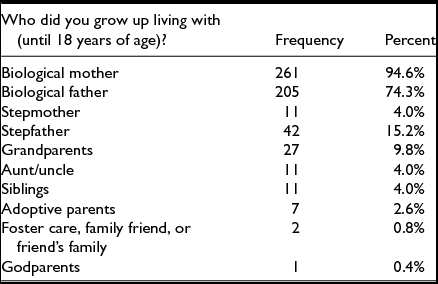
Within the demographics questionnaire, participants were asked to report who their guardian was that they lived with while growing up. This provided information regarding who the participants considered their parents to be (see Table 1). All participants were included in the analyses, as most indicated that they grew up with a biological parent, and of those who did not, they responded to questions based on the parent they grew up with (e.g., adoptive parent or grandparent).
Family Member(s) Who Participants Lived With Growing Up

Note: Percentages are based on those who selected the individual for each item.
The majority of participants indicated that they continue to have a relationship with their biological mother (88%) and biological father (74%). The majority of participants indicated that the highest level of their mother's education was high school (34%), followed by some college (30%), and a 4-year college degree (24%). A small percentage of participants reported their mother having a master's degree (8%), medical degree (2%), or doctoral degree (0.7%).
Reports of the father's education were similar to that of mothers. Most participants reported their father's highest level of education to be high school (39%), followed by some college (28%), and a 4-year college degree (19%). Again, a small percentage of participants reported their father having a master's degree (8%), medical degree (.4%), or a doctoral degree (2%). Of those who did not grow up with their mother or father, their care provider or guardian had mostly completed high school (33%), some college (25%), and a 4-year college degree (25%).
Materials
The current study used four instruments: Demographics Questionnaire, Perceptions of Parents Scales, Types of Parental Communications Questionnaire, and Frequencies and Perceptions of Deception Questionnaire.
Demographics questionnaire
The questionnaire asked participants to provide information about age, sex, gender, ethnicity and race, education, parents, and parental education. Subsequently, the questionnaire asked participants to indicate their satisfaction with their relationship to their parent(s) on a Likert-type rating scale (1 = extremely unsatisfied, 5 = extremely satisfied).
Perceptions of Parents Scales — The College Student Scale
The Perceptions of Parents Scales — The College Student Scale was developed by Robbins (Reference Robbins1994) to investigate parental involvement, autonomy support, and warmth. The measure consists of 42 items: 21 for mothers and 21 for fathers. The measure contains six subscales with fairly high internal consistency: (a) mother autonomy support (α = .89), (b) mother involvement (α = .86), (c) mother warmth (α = .90), (d) father autonomy support (α = .87), (e) father involvement (α = .90), and (f) father warmth (α = .88). Further, the three subscales totalled for mother (α = .89) and the three summed for father (α = .90) were highly reliable.
Types of Parental Communications Questionnaire
The Types of Parental Communications Questionnaire was adapted from Peterson (Reference Peterson1996) and consisted of participants being asked to read a series of scenarios and respond to questions regarding how often their parents have used or would use that type of communication and how they perceive the type of communication. The scenarios and questions were similar to those used in another study that explored deception in intimate relationships (Peterson, Reference Peterson1996). The scenarios retain the type of deception used but have been changed to reflect content of parental deceptions. Each vignette corresponds to a specific type of lie. The types of lies include omissions, failed deception, half-truths, white lies, distortions, and blatant lies (see Appendix).
Frequencies and Perceptions of Deception Questionnaire
The Frequencies and Perceptions of Deception Questionnaire is a nine-item questionnaire developed to assess participants’ perceptions of the frequencies of parental deceptions. The questionnaire begins with a statement indicating that the investigators do not condone or condemn deception. Then, participants are asked questions about whether their parents have ever lied to them and the frequency of use on a Likert-type rating scale (1 = never, 5 = often). Next, participants were asked to indicate their opinions on five items that asked about how morally acceptable lying was and the consequences that resulted from lying on a Likert-type rating scale with a no-difference anchor point (1 = significantly agree, 3 = no difference, 5 = significantly agree).
Procedure
The study was approved by the Institutional Review Board and was conducted completely online through a secure research host site. The study's link was then posted to a department research hosting site. Participants were able to select the study, if they chose to participate, as a research component of a course or for extra credit.
After participants selected the link to the study, they were presented with an informed consent. After giving consent, participants were asked to complete the Demographic Questionnaire. Participants were then provided with the Perceptions of Parents Scales — College Student Scale (Robbins, Reference Robbins1994) followed by the Parental Communications Questionnaire and the Frequencies and Perceptions of Deception Questionnaire. Lastly, participants were provided with a debriefing form.
Results
Descriptive statistics revealed that most participants indicated that their parents had lied to them (90%). A one-sample chi-square was conducted to examine the proportion of reported parental deception, revealing a statistically significant difference, χ2(1) = 197.89.4, p < .001. Thus, the first hypothesis was confirmed, that a majority of participants reported that their parents lied to them. A small percentage (5%) of participants reported that their parents lied often.
To test our second hypothesis related to the relationship between the perceived use of parental deception and reported parental satisfaction, we conducted a bivariate correlation. A negative correlation was found between reported parental satisfaction and perceived use of parental deception, r(268) = –.48, p < .001. This finding was present when analysing parental deception individually, for perceived mother deception, r(269) = –.40, p < .001, and father deception, r(263) = –.29, p < .001. Further, negative correlations were found between amount of deception perceived from the mother and the mother's involvement, r(258) = –.44, autonomy support, r(261) = –.49, and warmth, r(257) = –.48, p < .001. Also, negative correlations were found between amount of deception perceived from the father and the father's involvement, r(259) = –.45, autonomy support, r(257) = –.39, and warmth, r(260) = –.45; p < .001. Thus, the second hypothesis was corroborated in that perceived use of parental deception was negatively correlated with parent-child relationship satisfaction. Perceived use of parental deception was also negatively correlated with mother's and father's involvement, autonomy support, and warmth.
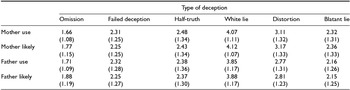
A repeated measures MANOVA was conducted to test types of lies, as a repeated measures variable, across the measures of parental use and the likelihood to use. The results showed a statistically significant difference between the types of lies across all measures, F(20, 224) = 34.94, p < .001, Wilk's Λ = 0.24, ɳp 2 = .76. A Greenhouse-Geisser correction was applied to univariate analyses as an acceptable correction by Field (Reference Field1998), as the sphericity assumption was not met. Univariate tests also indicated statistically significant differences among the type of lies used by mothers, F(4.74,243) = 155.24, p < .001, ɳp 2 = .39, and fathers, F(4.37,243) = 119.71, p < .001, ɳp 2 = .33. Also, the likelihood to use particular types of lies differed for mothers, F(4.68,243) = 155.62, p < .001, ɳp 2 = .39, and fathers, F(4.44,243) = 110.02, p < .001, ɳp 2 = .31. Pairwise comparisons revealed that participants indicated that their mothers and fathers used white lies more often than all other types of deception and omissions as the least used (p < .001; see Table 2). The findings regarding white lie use confirm our third hypothesis. However, the prediction of lies of omission being used more than other types of lies was not confirmed. In fact, lies of omission were perceived to be used less than all other types of lies.
Mean Frequencies of Perceived Parental Use and Likelihood to Use for Types of Deception

Note: Standard deviations are in parentheses.
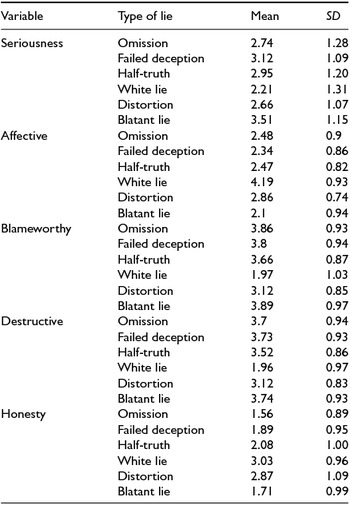
A repeated measures MANOVA was conducted to test types of lies, as a repeated measures variable, across the measures of seriousness, affective, blameworthy, destructive, and honest. The results showed a statistically significant difference between the types of lies across all measures, F(25, 216) = 37.40, p < .001, Wilk's Λ = 0.19, ɳp 2 = .81. Similarly, a Greenhouse-Geisser correction was used in reporting analyses. Univariate tests also indicated statistically significant differences among the type of lies used and their seriousness, F(4.61,240) = 42.58, p < .001, ɳp 2 = .15, how affective, F(4.53,240) = 199.67, p < .001, ɳp 2 = .45), blameworthy, F(4.27,240) = 181.34, p < .001, ɳp 2 = .43, destructive, F(4.27,240) = 167.01, p < .001, ɳp 2 = .41, and honesty, F(4.59,240) = 110.70, p < .001, ɳp 2 = .32. Also, the type of lies differed by preferred use of the lies, F(4.65,264) = 201.32, p < .001, ɳp 2 = .79, and preference to use instead of an argument, F(4.63,267) = 104.32, p < .001, ɳp 2 = .66. Pairwise comparisons revealed white lies were least serious, more positive, more praiseworthy, more helpful, more honest, more likely to be used, and preferred to an argument (see Table 3). Therefore, our fourth hypothesis was confirmed, in that white lies were perceived as the least serious, negative, blameworthy, destructive, and least dishonest type of lie use by parents.
Means of Types of Lies Perceived Effects

One-sample t tests were conducted to evaluate participants’ responses of acceptableness, morality, truthfulness, parent values, and parental consequences to determine whether responses would demonstrate a statistically significant difference from a no-difference anchor of 3. A Bonferroni adjustment (= .01) was used with the analyses to avoid an increased Type I error, due to running multiple t tests. Results revealed statistically significant differences for all items from the no-difference anchor. Lying was deemed unacceptable, M = 4.05, SD = 1.08), t(271) =16.08, p < .001, and morally wrong, M = 4.20, SD = 1.01, t(272) =19.54, p < .001. Participants were told to always be honest and truthful, M = 4.61, SD = 0.70, t(270) =37.92, p < .001, were punished for lying, M = 4.39, SD = 0.90), t(270) =25.39, p < .001, and were not rewarded for lying, M = 1.20, SD = 0.53), t(269) = –56.28, p < .001. Therefore, our last hypothesis was confirmed in that participants indicated that they were taught to be honest, lying was wrong, and that they were punished for telling lies.
Discussion
The current study found that most college students (90%) indicated that their parents have lied to them and that their parents are likely to lie to them. These findings from children's perspectives are similar to research that found that 92% of a U.S. sample of parents endorsed telling a lie to their children (Heyman et al., Reference Heyman, Hsu, Fu and Lee2013). Though participants indicated that their parents had lied to them, most participants did not indicate that their parents lied often. Only 5% of participants reported that their parents lied often. This finding also aligns with literature suggesting that although people lie daily, most social interactions involve more truthful interactions than lies (Vrij, Reference Vrij2000). Thus, though parents may lie to their children, they probably do not do so often. The smaller percentage (10%) of participants who indicated that their parents never lie may be an accurate account of parents who never lie, as Heyman and colleagues (Reference Heyman, Hsu, Fu and Lee2013) found about 8% of U.S. parents not endorsing any item of the parent lie measure, indicating that they had not told any lies to their children. The findings could also be due to participants’ unawareness of parental deceit or the halo effect (Nisbett & Wilson, Reference Nisbett and Wilson1977). Given that people tell lies daily (DePaulo & Kashy, Reference DePaulo and Kashy1998), the parents may have told children lies that they did not discover. Another possibility is that the small percentage of college students may assume that their parents are good people and would never lie, thus enacting the halo bias.
The perceived use of parental lies negatively correlated with parent-child relationship satisfaction. In other words, as perceived parental deception use increased, satisfaction with the parent relationship decreased. These findings parallel other research that examined deception within intimate relationships, in that the use of deception, even white lies, in relationships predicts dissatisfaction (Kaplar, Reference Kaplar2006; Peterson, Reference Peterson1996). Perceptions of the use of parental deception may negatively impact satisfaction due to deception affecting trust within interpersonal relationships (Schweitzer et al., Reference Schweitzer, Hershey and Bradlow2006). Further, a negative correlation was found between parental use of deception and parental involvement, autonomy support, and warmth. Therefore, the perception of parental use of deception is negatively related to various aspects of the parent-child relationship. This could be due to people not desiring to be on the receiving end of deception (Hart et al., Reference Hart, Curtis, Williams, Hathaway and Griffith2014). It could also be due to negative attitudes people have toward people who lie (Curtis & Hart, Reference Curtis and Hart2015). The negative relationship with satisfaction may also be a function of participants believing that lies are morally wrong and associations with punishment. However, the parent-child relationship satisfaction was not significantly related to the perceived severity of the lies. Thus, the perceived use of parental deception, and not perceived severity, was negatively correlated with parent-child relational satisfaction. As these findings did not identify causal mechanisms, the inverse is plausible, in that lower satisfaction with the parent-child relationship may have led to an increase in perceptions of parents as liars. The halo effect (Nisbett & Wilson, Reference Nisbett and Wilson1977) may account for the relationship between satisfaction and perceived lies, in that a perception of good parents may be viewed as honest or less likely to tell lies. Along with the consideration of directionality in the relationship, it may also be plausible that a third variable is mediating the relationship. For example, emotional closeness could be a third variable related to the process, as people tell fewer lies to those with whom they have a stronger emotional connection (Vrij, Reference Vrij2000).
Perceptions of the types of lies parents told differed, as participants reported that their parents told more white lies than any other type. This finding aligns with Peterson's (Reference Peterson1996) findings that people in intimate relationships report using white lies more frequently than other types of lies. Thus, perceptions of parents using these types of lies may reflect the actual practice of the types of lies parents use most frequently. However, this may be a function of children's perception that the lies told by their parents are primarily other-oriented (DePaulo & Bell, Reference DePaulo and Bell1996) or told with a benevolent intent. Heyman and colleagues (Reference Heyman, Luu and Lee2009) found that parents may tell, in addition to white lies, lies that are motivated by self-interest, or self-oriented lies (DePaulo & Bell, Reference DePaulo and Bell1996).
The majority of participants also believed that white lies affected them positively, were least serious, less blameworthy, least destructive, and the least dishonest type of lie used by parents. Participants stated that they would be more likely to use this kind of deception with their children than the other types. This was a counterintuitive finding because even though there was a negative correlation with parental deception and relationship satisfaction, participants rated white lies affecting them more positively. Perhaps this finding was related to a study that found children trust people who lie when the lie is used to benefit another person (Fu, Heyman, Chen, Liu, & Lee, Reference Fu, Heyman, Chen, Liu and Lee2015). This finding could also be a function of the perception of white lies being deemed more socially appropriate and acceptable to use (Kaplar & Gordon, Reference Kaplar and Gordon2004). Another possibility is that people may be unaware of the effects of white lies. People may intuit that white lies or altruistic lies, done with the intent to benefit another, are helpful and benefit relationships. However, Kaplar (Reference Kaplar2006) found that white lies were negatively correlated with romantic relationship satisfaction. In fact, people prefer to tell their intimate partner white lies rather than have their partner tell them white lies (Hart et al., Reference Hart, Curtis, Williams, Hathaway and Griffith2014). Thus, the findings in the current study may reveal an attitude toward white lies, in that they may be viewed positively due to beliefs about the intent to benefit another, due to being more socially acceptable or there being an unawareness of the effects of white lies.
In the current study, participants reported that parents encouraged honesty and punished lying behaviours, even though they were perceived to have told lies themselves. These findings parallel other research that found parents promoted honesty with their children but used lies to control their behaviour and influence their emotions (Heyman et al., Reference Heyman, Luu and Lee2009). This paradox (Williams et al., Reference Williams, Kirmayer, Simon and Talwar2013) may be the result of moral hypocrisy, in that a person's use of deception is more justified than when others employ deception (Batson, Thompson, Seuferling, & Strongman, Reference Batson, Thompson, Seuferling and Strongman1999; Batson & Thompson, Reference Batson and Thompson2001). Moral hypocrisy has been suggested as a reason that people in intimate relationships prefer telling white lies rather than be told them (Hart et al., Reference Hart, Curtis, Williams, Hathaway and Griffith2014). Therefore, parents may view their use of deception as more acceptable and for a greater outcome than their children's use. Parents may also not be aware of the dissonance generated from telling lies while simultaneously emphasising honesty (Heyman et al., Reference Heyman, Luu and Lee2009). On the other hand, it is unclear if parents deem their own use of deception as unacceptable and if they hold themselves to the same standards that they convey to their children.
The current study has implications for areas of parenting. Prior research has indicated that parental autonomy support is pivotal in the development of autonomous self-regulation in high school students and in decision-making (Niemiec et al., Reference Niemiec, Lynch, Vansteenkiste, Berstein, Deci and Ryan2006). Parents’ involvement and autonomy support have also been found to be related to children's wellbeing and psychological health (Niemiec et al., Reference Niemiec, Lynch, Vansteenkiste, Berstein, Deci and Ryan2006). The current results found perceived frequency of parents using deception was negatively correlated with mother's and father's involvement, autonomy support, and warmth. Therefore, parents may want to be aware of their children's perception of parents’ use of deception and attend to the relationship between their use of deception and their perceived involvement, autonomy support, and warmth.
There were a few limitations to this study, including that the participants were largely a university sample of students, meaning that participants were not young children. Perceptions of parental deceptions may be different for a college sample of adult children compared to younger children. Participants may be more removed from parental deceptions or some parental deceptions may be more salient. Recalled parental deceptions may be different than those that were employed by parents when children were at a younger age. Perhaps younger children or children in other developmental stages may report that their parents use different types of deception or deception at differing frequencies than college students. Future studies may consider investigating perceived parental deception among younger children. Also, participants may have forgotten times that their parents lied, not accurately recalled the deception, or discovered the deception. However, the reported use of parental deception in the current study is close to that reported by parents in another study (Heyman et al., Reference Heyman, Hsu, Fu and Lee2013).
Future research may examine the parental lie-telling paradox or the possible moral hypocrisy of parents lying to children while teaching them that lying is wrong. It may be a worthwhile pursuit to explore if parents deem their lies told to children as an acceptable approach to parenting or examine parental attitudes toward lying by parenting (Heyman et al., Reference Heyman, Luu and Lee2009). Along these lines, researchers may want to examine parental use of deception with their children and parental satisfaction within their child-parent relationship. Future research may also want to explore the role of mediating variables within child-parent relationships related to the perceived use of deception and its effect on parent-child relational satisfaction.
This study adds to the underdeveloped research area of parental deception. We found college-aged children perceive their parents to tell lies, often through white lies, and the perceived frequency of use is negatively correlated with the satisfaction of parent-child relationships and autonomy support, which has been shown to be related to overall wellbeing of children. Parents may want to consider this relationship when thinking about using a parenting-by-lying approach (Heyman et al., Reference Heyman, Luu and Lee2009). Children may want to think about how perceived deception may affect relational satisfaction with their parents or vice versa. There are a plethora of messages about parenting and how one should do it. Rather than conveying the way to parent, parents may want to deliberately reflect on the communication they use with their children and consider the beliefs and practices they teach about deception.
Funding Acknowledgment
Faculty Mentored Grant, Angelo State University.
APPENDIX
Scenario 1: A child leaves their toy airplane in the middle of the living room floor. Later that day their mother walks through the living room and steps on the airplane and breaks it. The child comes back in to get the toy and finds it broken. When the mother is asked what happened, she says, ‘Oh, I should have put the dog out’. (Omission)
Scenario 2: One morning a child asks his mother if they can go to the park that afternoon. His mother tells him that they cannot go today because she has to fill out some paper work her job. The child is disappointed, but decides to play in his room. The mother did not have any paper work, but later got an email from her boss saying that he needed her to do some work for him. (Failed deception)
Scenario 3: A father drops his daughter off at a friend's house for a sleepover. The next day he decides to go out for lunch with some friends after going grocery shopping. He forgets that he was supposed to pick up his daughter at noon. When he arrives late, his daughter asks him why he was late and he tells her that grocery shopping took longer than anticipated. (Half-truth)
Scenario 4: At school, a child decides to draw her mother a picture. She draws a circus tent with many different animals. When she gives it to her mother, the mother cannot tell what it is, but she says that it is the most beautiful picture she's ever seen because she knows her daughter worked hard on it. (White lie)
Scenario 5: A mother decides to leave her child with a babysitter while she buys them school supplies. Her child specifically asks for a certain kind of folder. The mother tells her child that she will find one and that she will be back soon. It takes her a while to find the folder, but she finally does and goes to check out. On her way out of the store, she runs into an old friend and decides to go get coffee with them. When she gets back home, her child is upset at how long the shopping trip took. The mother tells her child that she should be happy that she got the special folder because it took a long time to find. (Distortion)
Scenario 6: A child's favourite blanket is dirty and torn beyond repair. So, when the child is out with a friend, their mother throws the blanket out. Later, when the child returns, they are distraught because their blanket is missing. Their mother tells them that they must have taken it out with them and lost it. (Blatant lie)