Introduction
Currently, there is widespread concern regarding the previously neglected flora of limestone areas of South China. In response to this concern, botanical explorations over the last few years, led by the Guangxi Institute of Botany (GXIB), have focused on some secluded localities such as limestone caves, gorges and cliffs in this region. As a result, many new taxa of Gesneriaceae have been discovered and published in recent years, increasing our knowledge of the Guangdong flora.
Chirita has recently been revised (Wang et al., Reference Wang, Mao, Liu, Li, Dong, Li and Smith2011; Weber et al., Reference Weber, Middleton, Forrest, Kiew, Lim, Rafidah, Sontag, Triboun, Wei, Yao and Möller2011), and most species occurring in Guangdong were moved to Primulina (Zheng & Xia, Reference Zheng, Xia and Wu2005). Thus, including Primulina tabacum Hance and several newly published species, the number of species of Primulina in Guangdong is now more than 30 (Wang et al., Reference Wang, Pan, Li and Wang1990, Reference Wang, Pan, Li, Wu and Raven1998; Li & Wang, Reference Li and Wang2004; Zheng & Xia, Reference Zheng, Xia and Wu2005; Wei et al., Reference Wei, Wen, Möller, Monro, Zhang, Gao, Mou, Zhong and Cui2010; Wang et al., Reference Wang, Mao, Liu, Li, Dong, Li and Smith2011; Weber et al., Reference Weber, Middleton, Forrest, Kiew, Lim, Rafidah, Sontag, Triboun, Wei, Yao and Möller2011).
Five species of Primulina with yellow flowers have been reported, namely P. lutea (Yan Liu & Y.G.Wei) Mich.Möller & A.Weber (Fig. 1A), P. leprosa (Yan Liu & W.B.Xu) W.B.Xu & K.F.Chung (Fig. 1B), P. pteropoda (W.T.Wang) Yan Liu (Fig. 1C) (Wei et al., Reference Wei, Wen, Möller, Monro, Zhang, Gao, Mou, Zhong and Cui2010), P. danxiaensis (W.B.Liao, S.S.Lin & R.J.Shen) W.B.Liao & K.F.Chung (Fig. 1D) (Shen et al., Reference Shen, Lin, Yu, Cui and Liao2010; Xu et al., Reference Xu, Zhang, Wen, Liao, Pan, Chang and Chung2012; Zhang & Yu, Reference Zhang and Yu2012; Tian et al., Reference Tian, Kong, Du, Zhang and Yu2014) and P. jiangyongensis X.L.Yu & Ming Li (Fig. 1E) (Li et al., Reference Li, Yu and Ma2014).
Species of Primulina with yellow corollas. A, P. lutea; B, P. leprosa; C, P. pteropoda; D, P. danxiaensis; E, P. jiangyongensis. 1. Cymes and plant. 2. Corolla. 3. Habit (A–C, Photos by Fang Wen; D, Photos by Rui-Jiang Wang; E, Photos by Xun-Lin Yu).

Bing-Mou Wang and Bo Pan found two unknown yellow-flowered species of Primulina that share a similar leaf shape in Yingde city, Guangdong in 2009. They collected some specimens with flowers, took photographs and introduced some living plants and seeds to cultivation in the glasshouse of the Gesneriad Conservation Center of China (GCCC), Guangxi Institute of Botany. The following year, some students of Anhui Normal University re-discovered these plants in the wild and sent specimens to us for identification. After consulting the relevant literature and herbarium specimens from CDBI, HIB, HITBC, HN, IBK, IBSC, KUN, PE and VNM, we found one species to be morphologically similar to Primulina pteropoda and the other most similar to P. jiangyongensis. The two new collections can, however, be easily distinguished from these species by a number of characters, and the newly collected plants are described here with illustrations, conservation status and distribution.
Species Descriptions
Primulina versicolor F.Wen, B.Pan & B.M.Wang, sp. nov.
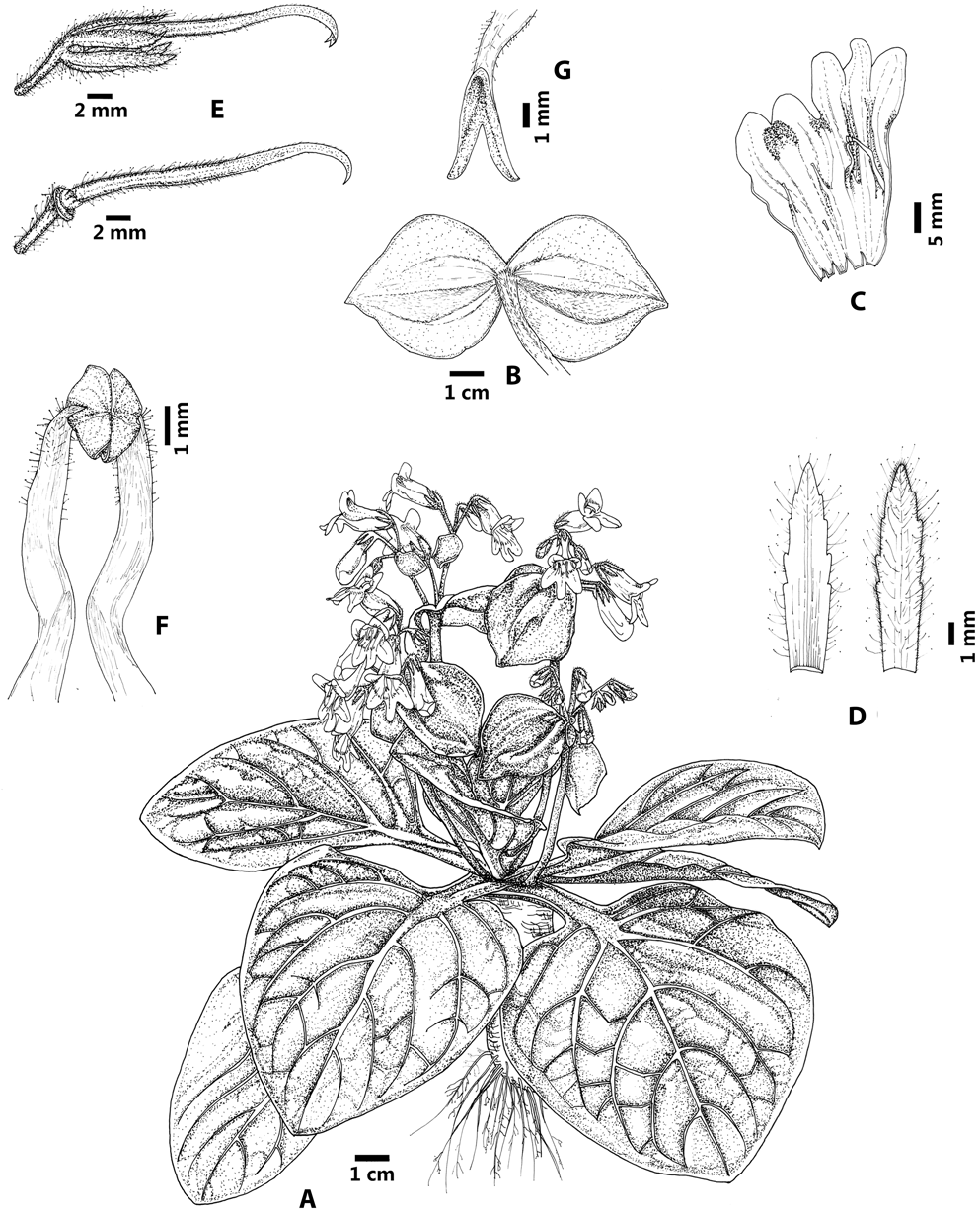
Similar to Primulina jiangyongensis X.L.Yu & Ming Li, but differs in leaf blade broadly oval or nearly cordate with 5–6 lateral veins on each side, bracts bigger, broadly oval or suborbicular (5–5.5 × 4.4–5 cm), canary yellow inside, nearly glabrous, calyx lobe margin 3–5-serrate, longer filaments (c.12.5 mm) and shorter pistil with densely eglandular puberulent hairs. – Type: China, Guangdong province, Yingde city, Xiniu Town, limestone hills, under subtropical evergreen broad-leaved forest, 24.172394°N, 113.12694°E, 118 m, 10 vii 2009, B.M. Wang & B. Pan 090704 (holo IBK; iso ANU, IBK). Figs 2,3.
Primulina versicolor F.Wen, B.Pan & B.M.Wang, sp. nov. A, habit; B, outside surface of bracts; C, opened corolla showing stamens and staminodes; D, inside and outside surfaces of calyx lobes; E, pistil with and without calyx lobes; F, anthers and filaments; G, stigma [from Pan & Wen 090704, holo IBK].
Primulina versicolor F.Wen, B.Pan & B.M.Wang, sp. nov. A, habit; B, cyme and frontal view of corolla; C, outside surface of bracts; D, top view of corolla; E, lateral view of corolla; F, opened corolla showing stamens, staminodes and colour variation of corolla; G, pistil with calyx lobes; H, pistil without calyx, showing disc; I, outside and inside surface of calyx lobes; J, stigma (Photos by Bi-Dan Lai).
Perennial herb. Rhizome short and stubby, somewhat succulent, 4–6 × 1.5–2.2 cm, internodes indistinct. Leaves 6–8, opposite at top of rhizome; lamina chartaceous, broadly oval or nearly cordate, 8–18 × 6.5–16.5 cm, base broadly cuneate to cordate, margin entire, apex obtuse to subacute with sparsely appressed pubescence on both sides, 5–6-nerved; petiole compressed, 2.5–5 × 1–1.5 cm. Cymes axillary, 4–8, 4–24-flowered or more; peduncle 8–18 cm long, densely pubescent; bracts 2, opposite, broadly oval or suborbicular, 5–5.5 × 4.4–5 cm, outside densely appressed pubescent, inside nearly glabrous, margin entire, apex acute; pedicel 1.2–1.7 cm long with dense, long, glandular hairs. Pedicel 1–2.2 cm, puberulent and glandular puberulent. Calyx 5-partite to the base, lobes nearly equal, lanceolate, c.8.5 × 2 mm, margin 3–5-serrate, apex acute, outside densely glandular-pubescent, inside nearly glabrous. Corolla 3.5–4.2 cm long, canary yellow, throat dark yellow with two brownish-purple stripes, border between adaxial and abaxial lips brown with a dark brown crescent-shaped swelling between the two adaxial lip lobes, tubular, orifice c.1.1 cm in diameter, tube swollen, 2.3–2.5 cm long, outer side of the upper half of corolla with erect glandular hairs, outer side of the bottom half of corolla sparsely pubescent, inner nearly glabrous; limb distinctly 2-lipped, adaxial lip bifid to the middle, lobes c.4.3–4.5 mm long, oblong; abaxial lip 3-lobed to two-thirds from the top, lobes oblong, 6.8–7.5 mm long. Stamens 2, adnate to 13–15 mm above the corolla base; anthers semicircular, 5–6 mm long, glabrous; filaments c.12.5 mm long, pale yellow, glabrous but the upper half of filament sparsely glandular puberulent, geniculate at one-third from the base; staminodes 3, two lateral ones adnate to 13.5–15 mm above the corolla base, straight, apex capitate, 6–7 mm long, glabrous, central one adnate to c.8 mm above the corolla base, capitate; disc annular, dark yellow, c.1 mm high, margin erose. Pistil 2.5–2.8 cm long, densely pubescent, eglandular; ovary linear; style 7–8 mm long. Stigma 2-lobed, 4–4.5 mm long, lobes 2.4–2.5 mm long. Capsule and seeds not seen.
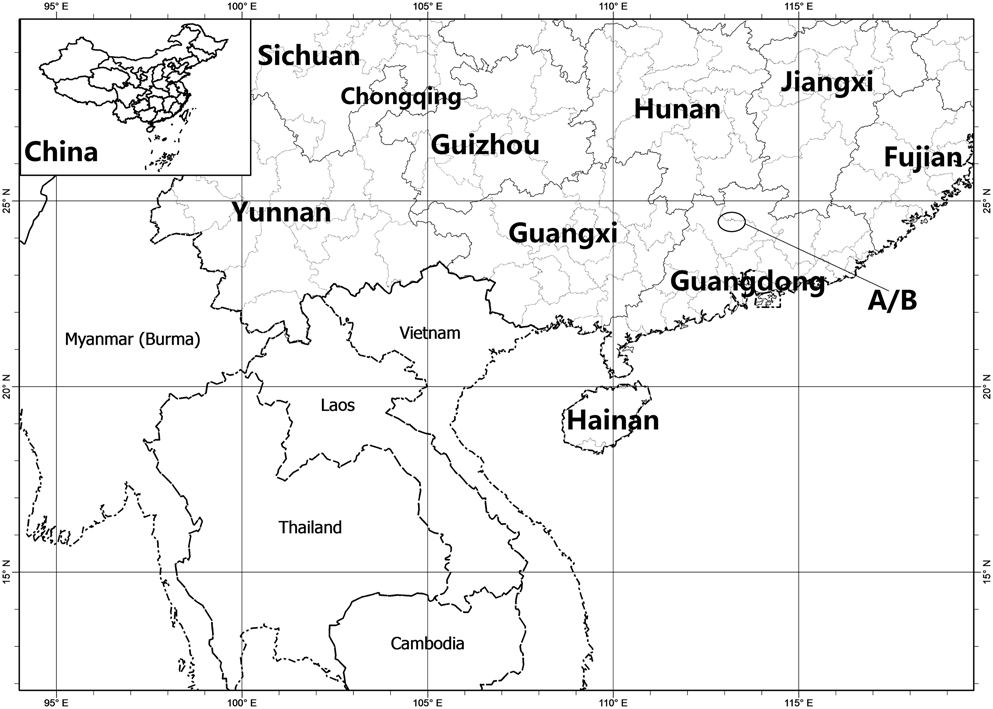
Distribution. Primulina versicolor was collected in Yingde, Qingyuan city of Guangdong province, China, and is known only from its type locality, Xiniu Town (Fig. 6).
Habitat. Primulina versicolor has only been collected at the entrance of a limestone cave, and generally tends to grow on the damp surface of limestone tufa at an elevation of 150–220 m.
Phenology. Flowering from late June to early July.
Etymology. The name of this new species is derived from its colourful corolla which is pale yellow, yellow, purple, and brown.
Proposed IUCN conservation category. Primulina versicolor is only found at its type locality at the entrance of a limestone cave in Xiniu Town, Yingde, North Guangdong. This location is not protected by any local government measures and is vulnerable to disturbance by human activity. This species is also only known from a single population of 60 mature individuals. Thus, considering its limited population and vulnerable habitat, the new species should be assessed as Critically Endangered (CR B2ab(iii)) (IUCN, 2010).
Primulina alutacea F.Wen, B.Pan & B.M.Wang, sp. nov.
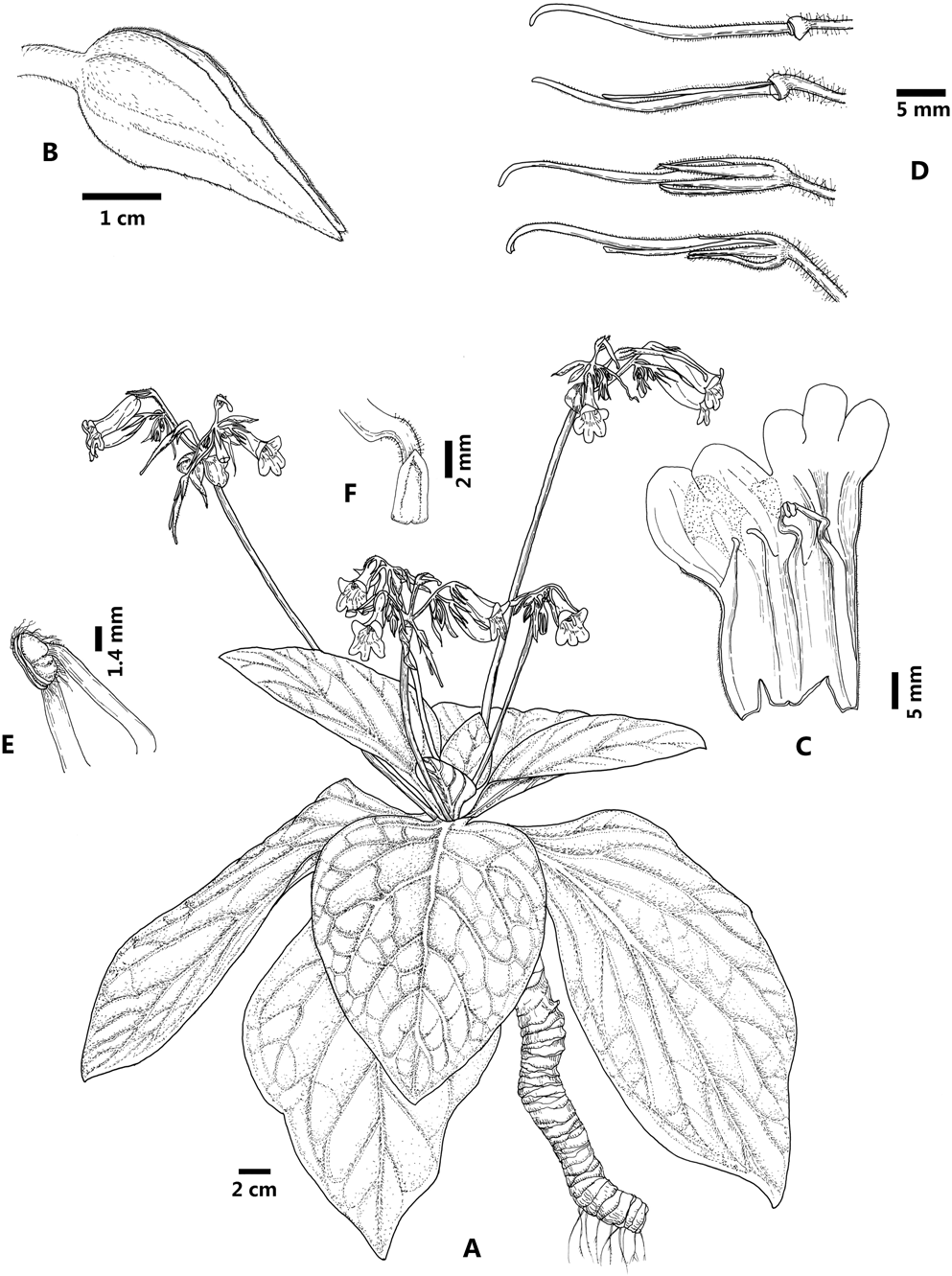
Similar to Primulina pteropoda (W.T.Wang) Yan Liu but differs in peduncle eglandular-pubescent, bracts bigger, lanceolate to broadly lanceolate (4–5 × 1.6–1.8 cm), corolla bigger (4–4.5 cm long), calyx lobes inside nearly glabrous, filaments shorter, c.9.5 mm long, anthers longer, 3.2–3.6 mm long and back of anthers with a beard of hairs, pistil longer, 2.8–3.2 cm long. – Type: China, Guangdong province, Yingde city, Yanziyan village, Baojinggong, limestone hills, under subtropical evergreen broad-leaved forest, 24.127148°N, 113.368894°E, 132 m, 5 viii 2009, B.M. Wang & B. Pan 090811 (holo IBK; iso ANU, IBK). Figs 4,5.
Primulina alutacea F.Wen, B.Pan & B.M.Wang, sp. nov. A, habit; B, bracts; C, opened corolla showing stamens and staminodes; D, pistil with and without calyx lobes showing appendage, degraded ovary; E, anthers; F, stigma [from Pan & Wen 090811, holo IBK].
Primulina alutacea F.Wen, B.Pan & B.M.Wang, sp. nov. A, habit; B, bracts; C, frontal view of corolla; D, lateral view of corolla; E, top view of corolla; F, opened corolla showing stamens and staminodes; G, normal pistil with calyx lobes; H, abnormal pistil with calyx lobes showing appendage, degraded ovary; I, comparison of normal and abnormal pistil; J, glandular hairs on the outside surface of calyx lobes and ovary; K, stigma and style; L, glandular hairs on the outside of calyx lobe; M, glandular hairs on the outside of corolla tube (Photos by Bi-Dan Lai).
Perennial herb. Rhizome long, 5–24 × 1.2–2.4 cm, internodes indistinct. Leaves 6–8, basal when plant young, or opposite arranged at the top of stem; lamina chartaceous, elliptic to oblong-elliptic, 9–27 × 10–18 cm, base slightly oblique or symmetrical, broadly attenuate, margin entire, apex obtuse to subacute, both sides appressed pubescent, 6-nerved on each side; petiole compressed, c.4.8 × 1.2–1.5 cm, appressed pubescent. Cymes axillary, 6, 4–12-flowered; peduncle 12–26 × 0.2–0.25 cm, pubescent; bracts 2, opposite, lanceolate to broadly lanceolate, 4–5 × 1.6–1.8 cm, pubescent outside, nearly glabrous inside, margin entire, apex acute; pedicel 1.6–2.4 mm long, densely glandular puberulent. Calyx with 5 lobes divided to the base, lobes equal, narrowly lanceolate, 10–13 × 1–1.2 mm, margin entire, apex acute, outside glandular puberulent, inside nearly glabrous. Corolla 4–4.5 cm long, orifice 12–14 mm in diameter, pale yellow, with a brownish-yellow swelling between the two adaxial lip lobes, tube tubular, 3.2–3.6 cm long, outside pink glandular puberulent, inner glabrous; limb distinctly 2-lipped, adaxial lip bifid to the middle, lobe 5.4–5.5 cm long, triangular, pale yellow to yellowish-white with three dark pink veins; abaxial lip 3-lobed to the base, lobes oblong, 8–10 mm long. Stamens 2, adnate to c.1.8 cm above the corolla base; anthers reniform, 3.2–3.6 mm long, slightly constricted at the middle, back with a beard of hairs; filaments c.9.5 mm long, glabrous, geniculate at the middle; staminodes 2, adnate to 1.6–1.7 cm above the corolla base, apex capitate, 6.3–6.5 mm long, glabrous; disc annular, yellowish-white, 0.8–1 mm high, margin undulate. Pistil 2.8–3.2 cm long, densely pubescent and glandular puberulent; ovary linear; style 5–7 mm long, glandular puberulent; over 50% of pistils with a linear appendage, attached at torus, glandular puberulent, 1.7–2 cm long. Stigma c.4 mm long, 2-lobed, lobes extremely short, 0.1–0.15 mm long or nearly truncate. Capsule and seeds not seen.
Additional specimen seen. China. Guangdong Province, Yingde city, Baojinggong, c.120 m, 19 x 1985, Liangguangdui 126 (PE).
Distribution. Primulina alutacea was collected in Yingde, Qingyuan city of Guangdong province, China and is known only from its type locality, Baojinggong of Yanziyan village. The type localities of the two new species described here are only c.40 km from each other (Fig. 6).
The distributions of Primulina versicolor and P. alutacea (A/B) in North Guangdong, China.
Habitat. Primulina alutacea grows in damp and shady places or crevices of limestone hills under subtropical evergreen broad-leaved forest at an elevation of 150–220 m. Primulina alutacea is relatively common at its type locality and seems to tolerate a slightly drier habitat so that it can successfully grow in limestone crevices.
Phenology. Flowering in August.
Etymology. The name of this species is derived from its pale yellow corolla.
Proposed IUCN conservation category. Primulina alutacea is only known from two populations at the type locality with a total of at least 5000 mature individuals. Considering that the fragile ecological balance of limestone hills is easily destroyed, we propose that the species be considered as Vulnerable (VU D2) according to IUCN Red List criteria (IUCN, 2010).
Note. It is worth mentioning that the corolla colour of Primulina pteropoda was described in the Flora of China (Wang et al., Reference Wang, Pan, Li and Wang1990, Reference Wang, Pan, Li, Wu and Raven1998) and Wei et al. (Reference Wei, Wen, Möller, Monro, Zhang, Gao, Mou, Zhong and Cui2010) as white to purplish with one purple spot on the adaxial lip. Before 2010, it was known only from cultivated plants in South China Botanical Garden, and was supposedly introduced from Guangxi, but without specified locality. These plants have exclusively pale yellow flowers. The species was also discovered to grow in Hainan (Baoting County) (Zheng Xi-Long pers. comm. 2009; Wei et al., Reference Wei, Wen, Möller, Monro, Zhang, Gao, Mou, Zhong and Cui2010). Four years later, Ms Xing-Er Ye collected Primulina pteropoda in May in Baocheng Town, Baoting County. These plants too show pale yellow flowers. Given these observations, the description of the corolla colour of Primulina pteropoda should be revised to pale yellow.
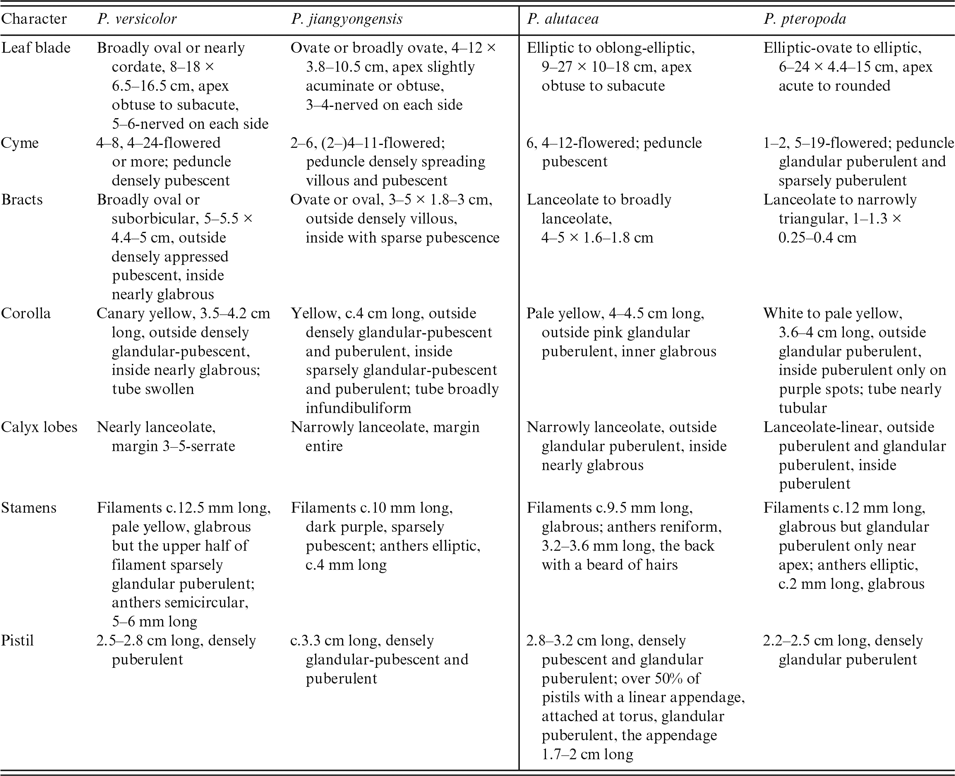
Vegetatively, one of the new species, Primulina versicolor, is similar to P. jiangyongensis, and the other, P. alutacea, looks more similar to P. pteropoda, but some characters, such as the colour and indumentum of the corolla and the indumentum of the peduncle, demonstrate that they are different. Vegetatively, these two new species are also similar to Primulina eburnea and P. lutea (Fig. 1A-3) and, without flowers, can be easily confused with them. They also grow in the same localities. Table 1 outlines characters that can be used to distinguish them.
A comparison of Primulina versicolor and P. alutacea to P. jiangyongensis and P. pteropoda respectively
Acknowledgements
We thank Dr Michael Möller for linguistic and professional comments on this manuscript, and Ms Xing-Er Ye, who collected specimens with flowers and took many photographs of Primulina pteropoda in flower in Hainan. This study was financially supported by the Guangxi Natural Science Foundation (2013GXNSFAA019071 & 2015GXNSFBB139004), the Science Research Foundation of Guangxi Academy of Sciences (no. 12YJ25ZW013), International S & T Cooperation Projects of Guangxi (Guikehe 1347004-4), Guilin (Shike [2013]79), Project of College Students Innovation of Anhui Normal University and the Karst plant garden construction in Guilin Botanical Garden (The first period) (11217028).