Neuroendocrine mechanisms such as the sympathetic nervous system, renin-angiotensin-aldosterone system, arginin–vasopressin, and some cytokines are targets of therapeutic interventions in cardiac failure and have a key role in determining prognosis.Reference Francis, Gassler and Sonnenblick1, Reference Jefferies and Chang2 Most of these markers are impractical for cardiac failure diagnosis because of the difficult assay characteristics, instability of markers, wide range, and influence of exercise and position of patient.
Brain natriuretic peptide is released from cardiac myocytes as a response to pressure and volume overload.Reference Valderheyden, Bartunek and Goethals3 N-terminal pro-brain natriuretic peptide and brain natriuretic peptide are formed from pro-brain natriuretic peptide by enzymatic cleavage.Reference Hall4 N-terminal pro-brain natriuretic peptide has a longer half-time than brain natriuretic peptide by virtue of its having a big molecule.Reference Hall4 N-terminal pro-brain natriuretic peptide has a longer half-life than brain natriuretic peptide and it can be stable for a long time at room temperature and in a refrigerator than brain natriuretic peptide.Reference Weber and Hamm5, Reference Ambrose6 Serum levels of brain natriuretic peptide and N-terminal pro-brain natriuretic peptide are measured easily, economically, and rapidly and are not influenced by exercise and position.Reference Cowie, Struthers and Wood7, Reference Mir, Marohn, Laer, Eiselt, Grollmus and Weil8
Respiratory distress is caused by both lung disease and cardiac failure. A number of studies report that brain natriuretic peptide and N-terminal pro-brain natriuretic peptideare useful in the differential diagnosis of cardiac failure from lung disease in adult patients who were admitted to the emergency department with dyspnoea.Reference Mueller, Gegenhuber, Poelz and Haltmayer9–Reference Moe11 Brain natriuretic peptide and N-terminal pro-brain natriuretic peptide levels correlate with the severity of cardiac failure, functional capacity of patient, and mortality in adults. Brain natriuretic peptide and N-terminal pro-brain natriuretic peptide levels can also be used for determining optimal treatment for patients with cardiac failure.Reference Weber and Hamm5 However, studies investigating the usefulness of N-terminal pro-brain natriuretic peptide and brain natriuretic peptide as markers for differentiating between cardiac and pulmonary aetiologies of dyspnoea in children are very scattered.Reference Koulouri, Acherman, Wong, Chan and Lewis12, Reference Cohen, Springer and Avital13
The results of adult cardiac failure studies evaluating brain natriuretic peptide and N-terminal pro-brain natriuretic peptide levels cannot be directly used in the case of children, because the aetiological factors of cardiac failure differ between children and adults, and the symptoms and physical findings change by age for children.Reference Dreyer and Fisher14, Reference James and Smith15 The relationship between brain natriuretic peptide and N-terminal pro-brain natriuretic peptide levels with age and gender also differs in children and adults.Reference Koch and Singer16, Reference Mir, Flato and Falkenberg17 In addition, brain natriuretic peptide and N-terminal pro-brain natriuretic peptide levels are elevated in some congenital cardiac diseases without cardiac failure.Reference Cowley, Bradley and Shaddy18, Reference Koch, Zink and Singer19 Severe pulmonary infections may also lead to cardiac failure in children without any cardiac disease.Reference Shann, MacGregor, Richens and Coakley20–Reference Wang, Liu and Jiang22
Our study aimed to determine whether N-terminal pro-brain natriuretic peptide can differentiate between cardiac and pulmonary aetiologies of dyspnoea, whether it can be used for evaluating the effect of treatment in children with cardiac failure, and for detecting severe pulmonary diseases that are complicated with cardiac failure. We also planned to determine the relationship between Ross score and N-terminal pro-brain natriuretic peptide.
Methods
Study groups
In this study, we enrolled 76 children, 43 female and 33 male, aged between 1 month and 17.5 years with dyspnoea – tachypnoea, intercostal and subcostal retractions, and flaring of alae nasi – who were admitted to the Pediatric Emergency Department of Medical Faculty of Eskisehir Osmangazi University from November, 2005 to May, 2007. Children were evaluated by history, physical examination, and chest X-ray on admission. The Eskisehir Osmangazi University Ethics Committee gave permission for this study. We also obtained written consents from the parents of children for blood sample collection for N-terminal pro-brain natriuretic peptide analysis on admission, N-terminal pro-brain natriuretic peptide 1. Patients were hospitalised for detailed investigation and treatment. There were no patients with chronic lung disease or renal disease.
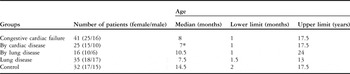
Patients were separated into two groups as having cardiac failure or lung disease without cardiac failure by history, physical examination, and radiological findings. Of these, 41 patients had cardiac failure, and 35 had lung disease without cardiac failure. Out of 41 patients who had cardiac failure, 25 patients had underlying congenital or acquired cardiac disease, but 16 patients with cardiac failure had no underlying cardiac disease and cardiacfailure had developed due to severe lung disease. There was no statistical difference between any groups for gender. Only the median age of the cardiac failure group due cardiac disease was lower than that of the control group. However, no statistical difference was found between the other groups for age (Table 1).
Age and gender distributions of the groups.

*p < 0.05 for the comparison between the group of cardiac failure due to cardiac disease and control group
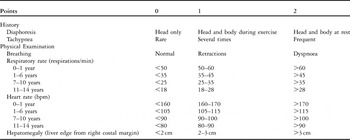
Patients with cardiac failure were graded from 0 to 12 with the Ross scoring system on admission (Ross 1). The Ross scoring system is shown in Table 2.Reference Ross, Bollinger and Pinsky23, Reference Laer, Mir and Behn24 Six patients from the cardiac failure group died. The second blood samples were obtained from 28 patients who had cardiac failure, 15 of 25 patients with cardiac failure due to cardiac disease and 13 of 16 patients with cardiac failure due to lung disease, for N-terminal pro-brain natriuretic peptide analysis, N-terminal pro-brain natriuretic peptide 2, at discharge and they were evaluated with Ross scoring, Ross 2.
Ross scoring system.

We evaluated 35 patients who had lung disease without cardiac failure by physical examination findings, acute phase reactants – leukocyte counts, erythrocyte sedimentation rates, C- reactive proteins – and chest X-ray such as having pneumonia, acute bronchiolitis, and bronchial asthma.
Control group
The control group included 32 children, 17 female and 15 male, who were admitted to the outpatient clinic or emergency department with mild upper respiratory tract infections, minor trauma, or with the suspicion of taking a little cleaning solution or drug. No one had renal or cardiac disease or electrolyte imbalance. We obtained written consents from the parents of children and collected N-terminal pro-brain natriuretic peptide samples on the occasion of a routine blood analysis.
N-terminal pro-brain natriuretic peptide measurement
We obtained an approximately 2 millilitres of blood sample from the peripheral vein and separated the serum by centrifugation at 3000 rates per minute for 15 minutes. Serum samples were stored at −80°C until analysis. N-terminal pro-brain natriuretic peptide concentrations were measured by the E170 electrochemiluminescence immunoassay autoanalyzer (Roche Diagnosis, Mannheim, Germany) using Elecsys N-terminal pro-brain natriuretic peptide kits. The N-terminal pro-brain natriuretic peptide assay was ranged between 5–35,000 picograms per millilitre.
Echocardiography
We performed echocardiography within the first 24 hours of admission to determine the underlying cardiac defect and to evaluate the left ventricular systolic functions. Echocardiographic examination was performed by Hewlett–Packard Sonos 5500 colour Doppler using 2–4 and 3–5 megahertz probes. Ejection fraction, fractional shortening, left ventricular internal dimension at end diastole, left ventricular internal dimension at and end systole, left ventricular diastolic mass, and left ventricular systolic mass were measured for the evaluation of left ventricular systolic functions.
Statistical analysis
We used SPSS for Windows 15.0, “Sigma stat 3.1”, and “Medcalc 6.15” software packages for statistical analysis. Normal distribution was tested with the Shapiro-Wilk test. Parametric tests were used for the variables that are normally distributed, while non-parametric tests were used for the variables that are not normally distributed. The Mann–Whitney U test or t-test was used for comparing two groups; however, multiple comparisons were performed by one-way analysis of variance if the variables were normally distributed or by Kruskal–Wallis test if not normally distributed. Differences between groups were determined by using Dunn’s test from post hoc tests. The cut-off value for the N-terminal pro-brain natriuretic peptide level was determined by receiver operating characteristiccurve. Correlations between variables were determined by Spearman’s test. The Wilcoxon’s t-test was used to compare Ross scores and N-terminal pro-brain natriuretic peptide levels on admission and at discharge. The results were reported as the mean, median, 25th and 5th percentile quartiles; p 0.05 was considered significant.
Results
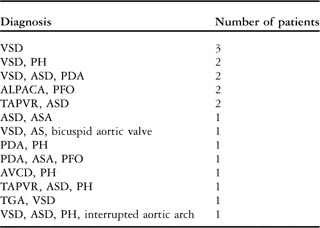
Out of 25 patients who had cardiac failure due to cardiac disease, 19 had congenital cardiac disease (Table 3), three had cardiomyopathy, two had myocarditis, and one had acute rheumatic carditis.
Underlying congenital cardiac diseases in the patients presented with cardiac failure.

ALCAPA, anomalous origin of the left coronary artery from the pulmonary artery; AS: aortic stenosis; ASA, atrial septal aneurysm; ASD, atrial septal defect; AVCD, complete atrioventricular canal defect; PDA: patent ductus arteriosus; PFO, patent foramen ovale; PH: pulmonary hypertension; TAPVR, total anomalous pulmonary venous return; TGA: transposition of the great arteries; VSD: ventricular septal defect
Of the 16 patients with cardiac failure due to pulmonary disease, 11 had acute bronchiolitis and five had pneumonia. Out of 35 patients with lung disease without cardiac failure, 27 had acute bronchiolitis, six had pneumonia, and two had asthma. We applied mechanical ventilation to seven patients with cardiac failure due to lung disease, and to one patient with lung disease without cardiac failure.
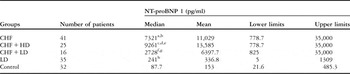
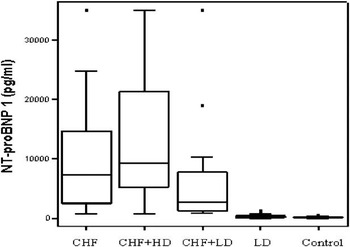
Children with cardiac failure showed significantly higher serum N-terminal pro-brain natriuretic peptide levels than did children with pulmonary disease and controls (p < 0.05). Patients with cardiac failure due to cardiac reasons showed higher serum N-terminal pro-brain natriuretic peptide levels than did patients with cardiac failure due to pulmonary diseases, but this difference was not statistically significant (p > 0.05). Serum N-terminal pro-brain natriuretic peptide levels were higher in children with cardiac failure due to pulmonary diseases than in children with pulmonary diseases without cardiac failure and the control group (p < 0.05). Serum N-terminal pro-brain natriuretic peptide levels were higher in patients with lung disease than in the control group, but this difference was not statistically significant (p > 0.05; Table 4 and Fig 1).
Serum N-terminal pro-brain natriuretic peptide 1 levels in the study and control groups.

CHF + HD, congestive cardiac failure due to cardiac disease; CHF + LD, congestive cardiac failure due to lung disease; CHF, congestive cardiac failure; NT-proBNP 1, N-terminal pro-brain natriuretic peptide level on admission
When Kruskal–Wallis test was used to compare the groups
aCHF between LD; p < 0.05
bCHF between control; p < 0.05
cCHF + HD between CHF + LD; p > 0.05
dCHF + HD between LD; p < 0.05
eCHF + HD between control; p < 0.05
fCHF + LD between LD; p < 0.05
gCHF + LD between control; p < 0.05
hLD between control; p > 0.05
Comparison of the study and control groups for N-terminal pro-brain natriuretic peptide 1 levels. The thick line in the boxes shows the median; the lower and upper limits of the boxes show 25% and 75% quartiles. The minimum and maximum concentrations at the outside of the quartiles are shown as separate points; NT-proBNP 1: N-terminal pro-brain natriuretic peptide analysis on admission. CHF, congestive cardiac failure; CHF+HD: congestive cardiac failure due to cardiac disease, CHF + LD, congestive cardiac failure due to lung disease; HD, cardiac disease; LD, lung disease.

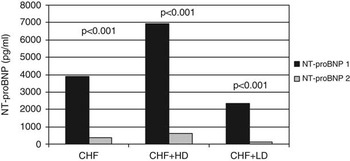
After treatment, the serum N-terminal pro-brain natriuretic peptide levels decreased significantly in comparison to N-terminal pro-brain natriuretic peptide levels on admission with cardiac failure (p < 0.001; Table 5 and Fig 2).
Serum N-terminal pro-brain natriuretic peptide levels in the patients with cardiac failure before and after treatment.

CHF + HD, congestive cardiac failure due to cardiac disease; CHF + LD, congestive cardiac failure due to lung disease; CHF, congestive cardiac failure; NT-proBNP 1, N-terminal pro-brain natriuretic peptide level on admission; NT-proBNP 2, N-terminal pro-brain natriuretic peptide analysis at discharge
Comparison of the serum N-terminal pro-brain natriuretic peptide levels before and after treatment in patients with heart failure; NT-proBNP: N-terminal pro-brain natriuretic peptide; NT-proBNP 1: N-terminal pro-brain natriuretic peptide analysis on admission; NT-proBNP 2: N-terminal pro-brain natriuretic peptide analysis at discharge.

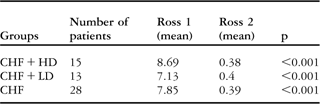
Ross scores of patients with cardiac failure also decreased significantly after treatment (Ross 2) in comparison to Ross scores evaluated on admission (Ross 1; p < 0.001; Table 6).
Ross scores of the patients with cardic failure before and after treatment.

CHF, congestive cardiac failure; CHF + HD: congestive cardiac failure due to cardiac disease; CHF + LD: congestive cardiac failure due to lung disease
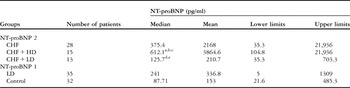
We compared serum N-terminal pro-brain natriuretic peptide 2 levels of the cardiac failure groups with serum N-terminal pro-brain natriuretic peptide 1 levels of the pulmonary disease and control groups (Table 7). Serum N-terminal pro-brain natriuretic peptide 2 levels of the patients with cardiac failure due to cardiac disease were significantly higher than N-terminal pro-brain natriuretic peptide 1 levels of both the pulmonary disease and control groups (p < 0.05). However, serum N-terminal pro-brain natriuretic peptide 2 levels of the patients with cardiac failure due to lung disease were not different from N-terminal pro-brain natriuretic peptide 1 levels of both the pulmonary disease and control groups (p > 0.05). In addition, serum N-terminal pro-brain natriuretic peptide 2 levels were higher in the group of cardiac failure with cardiac reason than in the group of cardiac failure due to pulmonary diseases (p < 0.05).
Comparison of the N-terminal pro-brain natriuretic peptide 2 levels of the patients with cardiac failure with N-terminal pro-brain natriuretic peptide 1 levels of the pulmonary disease and control groups.

CHF + HD, congestive cardiac failure due to cardiac disease; CHF + LD: congestive cardiac failure due to lung disease; CHF, congestive cardiac failure; NT-proBNP 1: N-terminal pro-brain natriuretic peptide analysis in admission; NT-proBNP 2, N-terminal pro-brain natriuretic peptide analysis at discharge
When Kruskal–Wallis test was used to compare the groups
aCHF + HD between CHF + LD; p < 0.05
bCHF + HD between LD; p < 0.05
cCHF + HD between control; p < 0.05
dCHF + LD between LD; p > 0.05
eCHF + LD between control; p > 0.05
Out of 41 patients with cardiac failure, six died. Serum N-terminal pro-brain natriuretic peptide 1 levels were higher in children who died from cardiac failure than in others who survived, median N-terminal pro-brain natriuretic peptide 1 levels 18,120 picograms per millilitre in the patients who died, 5217 picograms per millilitre in the patients who survived (p < 0.05). There was no significant difference, however, between the Ross 1 scores of the patients who died and those who survived – Ross score mean: 7.83 in the patients who died, 7.51 in the patients who survived (p > 0.05).
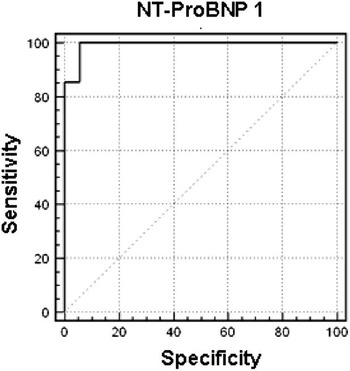
The cut-off level of N-terminal pro-brain natriuretic peptide for differentiating cardiac failure from pulmonary disease in patients who presented with dyspnoea was 726.8 picograms per millilitre – sensitivity, 100%; specificity, 94.3%; positive predictive value, 95%; negative predictive value, 100%; false negativity, 0%; false positivity, 4.6%, accuracy, 97% (Fig 3).
Receiver operating characteristic curve for serum N-terminal pro-brain natriuretic peptide level on admission for differentiation between heart failure and respiratory distress due to lung disease; NT-proBNP 1: N-terminal pro-brain natriuretic peptide level on admission.

Any patient’s N-terminal pro-brain natriuretic peptide was not below the 726.8 picograms per millilitre cut-off level in the cardiac failure group. Two patients in the lung disease group, however, had a N-terminal pro-brain natriuretic peptide level above the cut-off level, 1214 and 1309 picograms per millilitre. All of the children in the control group had an N-terminal pro-brain natriuretic peptide level below this cut-off level; the highest N-terminal pro-brain natriuretic peptide level in the control group was 485.3 picograms per millilitre.
We found no correlation between any of the echocardiographic measurements of left ventricular systolic functions and serum N-terminal pro-brain natriuretic peptide levels in all cardiac failure groups, separately or totally (p > 0.05). Similarly, there was no correlation either between N-terminal pro-brain natriuretic peptide 1 levels and Ross 1 scores or between N-terminal pro-brain natriuretic peptide 2 levels and Ross 2 scores (p > 0.05).
Discussion
There are very scattered studies investigating the usefulness of the concentrations of brain natriuretic peptide and N-terminal pro-brain natriuretic peptide for differentiating cardiac from pulmonary aetiologies of dyspnoea in children.Reference Koulouri, Acherman, Wong, Chan and Lewis12, Reference Koch and Singer16 Koulori et alReference Koulouri, Acherman, Wong, Chan and Lewis12 reported that patients with acute respiratory distress secondary to congestive cardiac failure had significantly higher plasma brain natriuretic peptide levels than did patients with primary respiratory distress (p < 0.001). Cohen et alReference Cohen, Springer and Avital13 found plasma N-terminal pro-brain natriuretic peptide levels in infants with congestive cardiac failure to be significantly higher than those in infants with acute lung disease and the control group (p < 0.001). An et alReference An, Zhang and Zhou25 also reported that serum brain natriuretic peptide levels in the congestive cardiac failure group were significantly higher than in the pneumonia group and the control group (p < 0.01). Our study shows that serum N-terminal pro-brain natriuretic peptide levels are significantly higher in children with cardiac failure than in children with pulmonary disease and the control group (p < 0.05).
The cardiovascular and respiratory systems should be considered to function as a single unit. Alterations in one of them will affect the other. The myocardium of neonates and young children generates low pressure. Even small changes in intrathoracic pressure can lead to large changes on the afterload of left and right ventricles and in the transmural pressure gradients.Reference Meliones and Cheifetz26 Pulmonary hypertension and right ventricular failure are common in children with severe pneumonia.Reference Shann, MacGregor, Richens and Coakley20 In addition, pneumonia may deteriorate cardiac function by causing myocarditis through direct invasion of the microorganism and the effect of hypoxia. All these changes lead to changes in the afterload and preload and electrocardiographic and echocardiographic changes, and the elevated creatine kinase and creatine kinase-muscle and brain (specific for cardiac muscle) levels can be observed in patients with severe pneumonia.Reference İlten, Şenocak, Zorlu and Teziç21, Reference Wang, Liu and Jiang22, Reference Seedat, Feldman, Skoularigis, Prommnitz, Smith and Zwi27 For this reason, brain natriuretic peptide and N-terminal pro-brain natriuretic peptide may be affected by respiratory disease. When we screened the related literature, we could find only one study that had researched whether brain natriuretic peptide levels could be used to differentiate if pneumonia was complicated by congestive cardiac failure in childen. In this study, An et alReference An, Zhang and Zhou25 reported that patients with pneumonia and congestive cardiac failure had significantly higher brain natriuretic peptide than either the pneumonia or control groups (p < 0.01). After treatment, brain natriuretic peptide levels decreased significantly in patients with pneumonia and congestive cardiac failure, which led them to conclude that brain natriuretic peptide levels are helpful in assessing whether severe pneumonia complicates with cardiac failure in children. We also show that N-terminal pro-brain natriuretic peptide levels are higher in children with cardiac failure due to pulmonary diseases than in children with pulmonary diseases without cardiac failure and the control group (p < 0.05). After treatment, N-terminal pro-brain natriuretic peptide levels decreased significantly (p < 0.01). After treatment, N-terminal pro-brain natriuretic peptide levels in patients with cardiac failure due to lung disease were not different in comparison to the initial N-terminal pro-brain natriuretic peptide levels of the lung disease group and control group. An et alReference An, Zhang and Zhou25found that brain natriuretic peptide levels in the congestive cardiac failure group with cardiac reason were significantly higher than pneumonia in the congestive cardiac failure group (p < 0.05). In our study, we also found that N-terminal pro-brain natriuretic peptide levels were higher in the cardiact failure with cardiac reason group than the cardiac failure due to pulmonary disease group, but this difference was not statistically significant (p > 0.05).
Adult studies investigating pre- and post-treatment N-terminal pro-brain natriuretic peptide levels also reported that N-terminal pro-brain natriuretic peptide could be used to evaluate the response to cardiac failure therapy.Reference Bayes-Genis, Santalo-Bel and Zapico-Muniz28, Reference Bettencourt29 Cohen et alReference Cohen, Springer and Avital13 found N-terminal pro-brain natriuretic peptide levels to be significantly decreased after treatment in patients with cardiac failure (p = 0.005). In our study, after cardiac failure treatment, the serum N-terminal pro-brain natriuretic peptide levels also decreased significantly in comparison with the N-terminal pro-brain natriuretic peptide levels collected on admission with cardiac failure (p < 0.001). Ross scores also decreased significantly after treatment (p < 0.001).
In our study, N-terminal pro-brain natriuretic peptide levels in children with cardiac failure due to lung disease decreased to the same level as in control subjects. However, N-terminal pro-brain natriuretic peptide levels in children with cardiac failure due to cardiac disease decreased significantly after treatment in comparison to the values before treatment, but remained higher than controls (p < 0.05). N-terminal pro-brain natriuretic peptide and brain natriuretic peptide levels have been found to be elevated in some congenital cardiac diseases without cardiac failure. Brain natriuretic peptide levels correlated with pulmonary-to-systemic flow ratio, right ventricular systolic pressure, and mean pulmonary artery pressure in left-to-right shunting cardiac diseases.Reference Koch, Zink and Singer19, Reference Suda, Matsumura and Matsumoto30 Therefore, the N-terminal pro-brain natriuretic peptide levels of patients with cardiac failure due to cardiac disease, which remained above those of the control group after clinic improvement, were considered to be related to the continuing pressure and volume overload due to the haemodynamic changes caused by various underlying congenital cardiac diseases.
In an adult study, 20 of the 176 patients who were admitted with cardiac failure died. The brain natriuretic peptide levels of the patients who died were higher than the levels of those who survived.Reference Maeda, Tsutamoto and Wada31 In adults with cardiac failure, it was shown that the correlation between N-terminal pro-brain natriuretic peptide levels and mortality is stronger than the correlation between mortality and age, New York Heart Association class, or systolic dysfunction. When we screened the related literature, we could not find any study evaluating correlation between brain natriuretic peptide or N-terminal pro-brain natriuretic peptide levels and mortality from cardiac failure in children. In our study, serum N-terminal pro-brain natriuretic peptide levels were higher in children who died from cardiac failure than in others who survived (p < 0.05). There was no significant difference, however, between the patients who died and those who survived for Ross scores (p > 0.05). Therefore, we conclude that although clinical findings are not helpful to estimate the prognosis, N-terminal pro-brain natriuretic peptide levels may be used as a prognostic factor in children who are admitted with cardiact failure. High N-terminal pro-brain natriuretic peptide levels indicate poor prognosis.
Weber and HammReference Weber and Hamm5 reported that cardiac failure is unlikely at brain natriuretic peptide levels below 100 picograms per millilitre or N-terminal pro-brain natriuretic peptide levels below 300 picograms per millilitre and is very likely at brain natriuretic peptide levels above 500 picograms per millilitre or N-terminal pro-brain natriuretic peptide levels above 450 picograms per millilitre. Koulouri et alReference Koulouri, Acherman, Wong, Chan and Lewis12 reported that brain natriuretic peptide may be used for differentiating cardiac from pulmonary aetiology of dyspnoea in children. The authors reported that sensitivity was 91%, specificity 77%, positive predictive value 77%, negative predictive value 95%, and accuracy 84% for a cut-off point of 40 picograms per millilitre for the plasma brain natriuretic peptide level to differentiate cardiac from pulmonary aetiology of dyspnoea in children. An et alReference An, Zhang and Zhou25 reported that sensitivity was 87.5%, specificity 95.8% for a cut-off point of 49 picograms per millilitre for serum brain natriuretic peptide levels to differentiate cardiac from pulmonary aetiology of dyspnoea in children. Cohen et alReference Cohen, Springer and Avital13 reported a cut-off point of 2940 picograms per millilitre for plasma N-terminal pro-brain natriuretic peptide level in children. This level was much higher than the cut-off level determined in our study. We think that this difference may not be originated by using plasma or serum samples. There are some studies investigating both brain natriuretic peptide and N-terminal pro-brain natriuretic peptide levels in the same patient population, but we could not find any study comparing plasma and serum samples for brain natriuretic peptide or N-terminal pro-brain natriuretic peptide in the same patients. An et al.Reference An, Zhang and Zhou25 used serum samples and Koulouri et alReference Koulouri, Acherman, Wong, Chan and Lewis12 used plasma samples for brain natriuretic peptide analysis, although both of them reported cut-off levels close to each other (49 picograms per millilitre and 40 picograms per millilitre, respectively). The underlying congenital cardiac diseases in patients presented with cardiac failure in our study are similar to those in the study of Cohen et al.Reference Cohen, Springer and Avital13 The age of the subjects who were included in Cohen et al’s study ranged between 1 and 36 months. The age range of our study population was larger, from 1 month to 17 years. The N-terminal pro-brain natriuretic peptide levels, however, show no significant age-related differentiation except for the neonatal period in healthy children,Reference Mir, Marohn, Laer, Eiselt, Grollmus and Weil8 and therefore we consider that the prominent difference between the cut-off levels reported by Cohen et alReference Cohen, Springer and Avital13 and us is not age-related, too. The cut-off level we determined for N-terminal pro-brain natriuretic peptide is similar to those in the adult studies mentioned above.Reference Weber and Hamm5, Reference Mueller, Gegenhuber, Poelz and Haltmayer9 Therefore, in our opinion, further studies are required for investigating the cut-off level for N-terminal pro-brain natriuretic peptide for differentiating cardiac from pulmonary aetiology of dyspnoea in children.
Adult cardiac failure is usually related to reduced ventricular function, and therefore N-terminal pro-brain natriuretic peptide levels in adult studies were significantly elevated with reduced ejection fraction, elevated left ventricular end-diastolic pressure, or elevated end-diastolic volume.Reference Pfister, Scholz, Wielckens, Erdmann and Schneider32, Reference Seino, Ogawa and Yamashita33 Mir et alReference Mir, Marohn, Laer, Eiselt, Grollmus and Weil8 found that children with cardiac failure due to dilated cardiomyopathy and hypoplastic left cardiac syndrome showed a negative correlation between the plasma N-terminal pro-brain natriuretic peptide value and the ejection fraction. However, this correlation was not found in children with ventricular septal defect and atrioventricular septal defect. Wu et alReference Wu, Chen, Huang, Zhang, Sun and Chen34 reported that plasma N-terminal pro-brain natriuretic peptide level correlated positively with left ventricular end-diastolic volume index and left ventricular end-systolic wall stress, but did not correlate with left ventricular ejection fraction and left ventricular fractional shortening in children with cardiac failure and ventricular septal defect. Koulori et alReference Koulouri, Acherman, Wong, Chan and Lewis12 reported that there was no correlation between brain natriuretic peptide level and left ventricular end-diastolic dimension in children with cardiac failure. The present study found no correlation between N-terminal pro-brain natriuretic peptide level and left ventricular systolic functions. This finding may be explained by the presence of a lot of different underlying cardiac diseases causing different haemodynamic changes in the group of cardiac failure due to cardiac disease.
Adult studies reported that the New York Heart Association class, which determines the severity of chronic cardiac failure, correlated positively with brain natriuretic peptide and N-terminal pro-brain natriuretic peptide levels.Reference Pfister, Scholz, Wielckens, Erdmann and Schneider32, Reference Maisel35 However, there is no scoring system that is universally accepted to determine the severity of cardiac failure in children. Only a few studies have searched for a correlation between brain natriuretic peptide/N-terminal pro-brain natriuretic peptide levels and modified Ross score that has been used in children with cardiac failure. Mir et alReference Mir, Marohn, Laer, Eiselt, Grollmus and Weil8 and Wu et alReference Wu, Chen, Huang, Zhang, Sun and Chen34 found a correlation between N-terminal pro-brain natriuretic peptide levels and Ross score in children with cardiac failure. We did not find any correlation between synchronous N-terminal pro-brain natriuretic peptide and Ross scores either on admission or after treatment in children with cardiac failure (p > 0.05). We thought that this may be explained by some reasons: the haemodynamic changes are different from each other in the various underlying cardiac diseases in children with cardiac failure; some of the underlying congenital cardiac diseases lead to elevated N-terminal pro-brain natriuretic peptide levels without cardiac failure due to volume or pressure overload;Reference Koch, Zink and Singer19, Reference Mir, Falkenberg and Friedrich36 and some patients may have developed acute cardiac failure over chronic cardiac failure.
Consequently, our study shows that N-terminal pro-brain natriuretic peptide can be used as a reliable and rapid marker for differentiating between cardiac and pulmonary aetiologies of dyspnoea. N-terminal pro-brain natriuretic peptide analysis can also be used for evaluating the effect of treatment in children with cardiac failure, for detecting severe pulmonary diseases that are complicated with cardiac failure, and for determining the prognosis of cardiac failure in children. A cut-off point for N-terminal pro-brain natriuretic peptide has been predicted for children with cardiac failure. Ours is the first study written in English that investigated N-terminal pro-brain natriuretic peptide levels in children with cardiac failure secondary to severe pulmonary diseases whom we frequently met in our routine clinical practice, besides those in the cardiac failure and lung disease groups.
Study limitations
The group of patients with cardiac failure due to cardiac reasons is not homogeneous. Therefore, N-terminal pro-brain natriuretic peptide levels might be affected by the different haemodynamic factors seen in various underlying cardiac diseases. Only six patients died from cardiac failure in our study. Hence, there is a need for larger study groups to evaluate the value of N-terminal pro-brain natriuretic peptide levels in prognosis of cardiac failure in children.
Acknowledgement
The Eskisehir Osmangazi University Scientific Research Projects Commission (Contract 200611022) supported this study. We thank Dr Jindou An for his valuable assistance in translating their article to English from Chinese. The study was funded by the Eskisehir Osmangazi University Scientific Research Projects Commission.