




No CrossRef data available.
Young children's sensitivity to listener knowledge and perceptual context in choosing referring expressions
Published online by Cambridge University Press: 01 November 2005
Abstract
Speakers use different types of referring expressions depending on what the listener knows or is attending to; for example, they use pronouns for objects that are already present in the immediate discourse or perceptual context. In a first study we found that 2.5- and 3.5-year-old children are strongly influenced by their interlocutor's knowledge of a referent as expressed in her immediately preceding utterance. Specifically, when they are asked a question about a target object (“Where is the broom?”), they tend to use null references or pronouns to refer to that object (“On the shelf” or “It's on the shelf”); in contrast, when they are asked more general questions (“What do we need?”) or contrast questions (“Do we need a mop?”) that reveal no knowledge of the target object they tend to use lexical nouns (“A broom” or “No, a broom”). In a second study we found that children at around their second birthday are not influenced by immediately preceding utterances in this same way. Finally, in a third study we found that 2.5- and 3.5-year-old children's choice of referring expressions is very little influenced by the physical arrangements of objects in the perceptual context, whether it is absent or needs to be distinguished from a close-by alternative, when they request a target object from a silent adult. These results are discussed in terms of children's emerging understanding of the knowledge and attentional states and other persons.
Information
- Type
- Articles
- Information
- Copyright
- © 2005 Cambridge University Press
Among children's earliest communicative attempts are acts indicating objects for other people, for example, pointing to an object or holding up an object to show it. Once language begins, children rapidly acquire a host of additional linguistic means for indicating objects, mainly in the form of various kinds of nominals (noun phrases). In English, these include proper names, mass nouns, count nouns plus determiners, pronouns, and, in the proper context, null references (e.g., when asked what the dog is doing, a speaker of English may simply say “Sleeping”).
In a particular context the speaker chooses a particular kind of nominal based mainly on its cognitive availability for the listener (accessibility, topicality, givenness; Ariel, 1988; Givón, 1993; Gundel, Hedberg, & Zacharski, 1993). This assessment is based on many factors, such as the perceptual availability of the referent in the immediate nonlinguistic context and the discourse availability of the referent in the immediate linguistic context. For example, in their hierarchy of availability Gundel et al. claim that stressed pronouns are used for referents that are already activated (or “in current awareness”), and unstressed pronouns and null references are used for referents that are not only activated but also in focus (or “at the current center of attention”) for the listener. Pragmatic assessments of this type obviously require some skills of social cognition on the part of the speaker as she assesses the knowledge states of a specific listener on a specific occasion.
The problem is that young children (before the age of 4 or 5) are notoriously poor at assessing the knowledge states of other persons, as evidenced by their relatively poor performance in tasks of perceptual perspective taking, conceptual perspective taking (referential communication), and false belief (see Flavell, 1992; Shatz, 1983, for reviews, with special relevance to issues of communication). They might therefore be expected to struggle with the pragmatically appropriate use of nominals as well. In contrast, these classic experimental tasks all require children to articulate explicit judgments and explanations about the mental states of other persons, which is arguably a different level of understanding than that required in reacting appropriately to the presumed mental states of others in spontaneous communicative interactions. It is thus possible that in their natural use of language young children might show more sophisticated skills of social cognition than in these kinds of tasks.
There is some evidence for this proposal from studies involving mainly nonlinguistic communication. O'Neill (1996) invited 2-year-old children to play a “find the object” game, but when they found it they had to ask their mothers for help in obtaining it (because it was out of reach). In one experimental condition the mother had witnessed the hiding event along with the child, whereas in the other experimental condition the mother had not witnessed the hiding event at all (she was either out of the room or had her eyes covered). The main finding was that these children were more informative, both verbally and with pointing gestures, when their mother had not witnessed the hiding event than when she had. This finding suggests that even if they cannot articulate their knowledge explicitly in language with an experimenter, young children do know some things about what particular persons on particular occasions do and do not know, which suggests the possibility that they may also be capable of following adultlike pragmatic conventions, at least to some extent, in their use of nominals. Similarly, Tomasello and Haberl (2003) found that when an adult excitedly requested an object from the child (ambiguously from an array of three), even prelinguistic children (12 and 18 months old) knew that she wanted the one that was new for her, not ones with which she had previously played.
Campbell, Brooks, and Tomasello (2000) looked at young children's choice of linguistic means of reference in different communicative situations. In a series of two experiments, an adult asked 2.5- and 3.5-year-old children about an event that had just happened. In some cases, the adult had just witnessed the event along with the child, whereas in other cases the adult had been out of the room for the event. In both cases, the adult then asked a question: for some children it was a specific question such as “What did X do?” (suggesting that she knew that X had done something, just not what), and for other children it was a general question such as “What happened?” (suggesting that she only knew that something happened, but neither the event nor the actor). The results were very clear. The younger children paid no attention to whether the adult was in the room or not in choosing their referring expression (nor were they affected by things such as the novelty or phonological complexity of the noun). The only factor affecting their choice was the immediately preceding question; in particular, they answered “What did the truck do?” by saying things like “Fell over,” or “It fell over,” whereas they answered the more general question by saying things like “The truck fell over.” Further analyses of children's choice of referring expressions in other experimental studies corroborated these results.
In the current studies we attempted to improve on the methods of Campbell et al. (2000) and to ask some different but related questions. One problem with that study was that the referent was always perceptually available to both adult and child at the moment the question was asked so that the question about what happened could be considered unnatural in those cases in which the adult had just seen the event (i.e., they were test questions, not real questions). In the current study, therefore, we had adults playing with children and asking for things whose identity or whereabouts the child knew but the adult did not, a much more natural discourse situation for the asking of real questions (not test questions). Also in the Campbell et al. study there were no conditions that actually pulled for nouns as the most appropriate referential choice, and so in the current study we added a contrast condition in which the adult asked something like “Do we need a mop?,” to which the most appropriate response was “No, a broom.” Finally, the 2.5-year-olds in the Campbell et al. study were already good at responding to questions in discourse appropriate ways, and so in the current study we tested younger children (2.0) to assess their skills as well.
The children who served as participants in the current studies were German speaking. For those aspects of referential choice relevant to the current study, German and English are highly similar, especially because we did not distinguish in any important ways between demonstratives and other inanimate pronouns, and we did not take account of how children attempted to mark case and gender on their determiners (see Bittner, 2002, for an analysis of German-speaking children's development of competence with the noun phrase more generally). In the first two studies we looked at factors in the discourse context that influenced children's choice of referring expression, and in the third study we looked at the effects of different types of perceptual availability and salience.
STUDY 1: DISCOURSE CONTEXT
In the first study we set up situations in which children and adults would need to go to some efforts to obtain missing objects. The main variable was the nature of the adult discourse prompting the child's act of linguistic reference, specifically the type of question the adult asked the child about the missing object: (a) specific (“What happened to the X”?), (b) general (“What do we need to get”?), and (c) contrast (“Did he have a Y”?). For adults, these questions imply, respectively, that the speaker (a) knows what object is needed, (b) does not know what object is needed, or (c) has a wrong idea about what object is needed.
Method
Participants
Twenty-four 2.5-year-old (range = 2 years, 4 months [2;4]–2;8) and 24 3.5-year-old (range 3;4–3;8) German-speaking children participated. Five additional children participated but were excluded from the analyses because of experimenter error (2 children), inability to reach onto a shelf (1 child), and inability to comprehend one of the experimenter questions (3 children). Children were recruited and tested at several kindergartens in a large city in Germany.
Materials and design
The experimental setup was as follows. There were two female experimenters, E1 and E2. The child sat next to E1 facing a shelf (spanning at least 1.5 m), on which target objects were placed at various points during the experiment. The target objects were always out of reach for children. Target objects were nine inanimate objects: toy replicas of common items (e.g., car, broom, lamp), the names of which are typically familiar to 2-year-old children. Children were asked to label each toy during a warm-up period, which almost all children did for almost all objects. When a child did not know the label for a toy, it was labeled for her and she was asked to repeat it, which they virtually always did.
The target objects were introduced in one of three toy environments, which were encountered in the same order for all children: a circus, a playground, and a living room. The experimental design was within subjects. Each child participated in each of the three experimental conditions (specific question, general question, contrast question) within each toy environment (same order for a given child across environments), with the order of conditions counterbalanced across children.
Testing procedure
Each child was individually tested in a separate room in her kindergarten. Sessions took about 15–20 min and were videotaped. Each session began with a warm-up period lasting a few minutes. During this period children were asked questions about objects generally similar to the ones they would get during testing, with no feedback from experimenters.
The experiment was framed as a series of three games in which a toy clown (manipulated by E1) showed the child activities that he performed in each of the three different environments (i.e., his circus, the playground, his living room). Within a given environment, each activity was performed with one particular target object that is naturally associated with the activity, for example, for cleaning the floor of the living room the clown used a broom, for putting his dog to sleep he had a pillow. The natural relation between activity and target object was designed to help children remember the objects and their names during elicitation of reference in the test phase. After demonstrating an activity (e.g., sweeping the floor), E1 remarked that the target object (the broom) can be put away now, because the clown wants to show the child another activity. Having said this, E1 put the target object up on the shelf, making sure that the child saw where she put it, and then went on to demonstrate the next activity with the next target object. Each environment had associated with it three activities and corresponding target objects. For the test, after E1 and the child had finished with the three activities/targets in a given environment, E2 came over and asked a single question about each of the activities in that environment in the same order that the activities had been engaged in (each representing one of the three experimental conditions; see below). After the first game and its testing phase were completed, play then moved on to the next two environments in turn.
In the test phase, it was most natural for E2 to be ignorant about either the existence or the location of the target objects. Therefore, during the play phase, she sat in a far corner of the room pretending that she did not notice anything of the games being played by E1 and the child (she was busily engaged in writing things down on the protocol sheet). After each environment, E2 entered the scene and started the test phase, for which she was the main interactant with the child. She immediately explained that she had not been able to watch (because she had to work, take notes, etc.), but that this all looked like fun. She asked the child whether she would like to play the game once more with her. Experimenter 2 then sat down with the child, mentioned the kind of activity necessary for eliciting reference to a particular object (e.g., “It's really dirty here, I bet the clown wants to clean the floor”), and then immediately asked one of test questions, depending on experimental condition (see below). If children named a target object before the actual test question had been asked (which happened infrequently), E2 would go on and ask the question, pretending she had not heard what the child just said (e.g., “Hmm? I did not get what you said, so, what happened to the car?”). Conversely, if a child did not answer a question immediately, E2 repeated it up to two times.
There were three types of test questions, representing the three experimental conditions. In the specific question condition, E2 indicated with her question knowledge about which object was needed, but ignorance about what happened to it (e.g., Was ist mit dem Besen? “What happened to the broom?”). A natural answer to this question involves use of a pronoun (Der/Er ist im Regal. “It is on the shelf,”) or null reference (Da oben, “Up there,”). In the general question condition, E2's question indicated that she knew that something was needed, but she did not know what (Was müssen wir holen? “What do we need to get?”). A likely response to this question involves use of a noun (Den Besen, “the broom”), although a pronoun (das, “this”) together with a pointing gesture is also possible. In contrast, null reference specifying only a location (da oben, “up there”) would mostly not be sufficiently informative here. In the contrast question condition, E2 also knew that something was needed, but she asked for the wrong thing: an object that one might typically expect in the given situation, that is, that is in the same semantic field as the target object (e.g., Hatte der Clown einen Staubsauger? “Did the clown have a vacuum cleaner?”). A natural answer here is to negate the question and mention the correct (target) object with a noun (Nein, einen/den Besen,“No, a/the broom”). Use of a pronoun/demonstrative is not so informative here, but a null reference would be much worse. The conditions and expected responses were thus as follows:

Scoring procedure
Following each of E2's question, each act of reference by the child aimed at the target object was placed into one of four categories. The linguistic form was coded as null reference, pronoun (including demonstratives), noun (with definite or indefinite or no determiner), or nonverbal only (pointing gesture with no language). In addition, all pointing and other clearly indicative gestures accompanying linguistic reference were also noted. Coding was done by the first author. Reliability was established by having an independent research assistant, blind to the hypotheses of the study, code a randomly selected 15% of the tapes. Cohen's kappa was .95.
Results
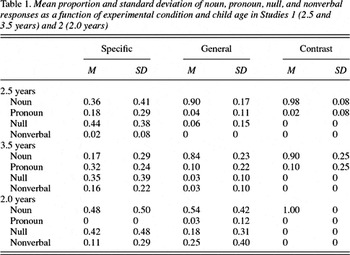
In the main analysis we looked at the nature of the nominal forms children used in the different conditions. Because children sometimes refused to answer or provided an irrelevant response, children had different numbers of scoreable responses; thus, proportions were used; that is, the value for a given child for a given response type (e.g., nouns in the contrast condition) was the number of responses of that type (e.g., nouns) over the total number of responses for that child in that condition (e.g., contrast condition). Children provided scoreable responses in about 80% of all trials (with fewest in the contrast condition, because they sometimes simply answered, incorrectly, “Yes”); if a child gave no scoreable responses in a condition, s/he is not included in the relevant analyses. Table 1 provides the basic results. Nouns with and without determiners were combined into one category, as were pronouns and demonstratives (numbers in the uncombined categories were sometimes very low). “Nonverbal” refers mostly to pointing gestures given with no verbal accompaniment.

For the main statistical analysis we performed a 2 (Age) × 3 (Condition) analysis of variance on the mean proportion of nouns used. Two-year-olds used a higher proportion of nouns overall than did 3-year-olds, F(1, 37) = 5.52, p < .05. There was also a significant effect for condition, F(2, 74) = 77.54, p < .001. Of most interest was the difference among the three conditions. Using Fisher least significant difference (LSD) tests, we found that children used proportionally fewer nouns in the specific condition (.26) than in either the general (.87) or contrast (.94) conditions (p < .001, in both cases). They used marginally fewer nouns in the general condition than in the contrast condition (p < .07). There was no interaction between age and condition.
Inspection of the values for the other reference types is consistent with this analysis (statistical analysis was not useful because of low frequencies). For both age groups children used more pronouns and null references, by several orders of magnitude, in the specific compared with the general and contrast question conditions. Indeed, there is not a single instance at either age of a child using a null reference in the contrast question condition, whereas this is children's most frequent response in the specific question condition, and they only use it infrequently in the general question condition. Using only nonverbal means of reference occurs almost exclusively in the specific question condition.
The specific question condition was thus very different from the other two conditions (less than one-third the number of nouns and three to five times the number of pronouns and null references), whereas the other two differed from one another only somewhat. One explanation for this pattern of results is that certain kinds of questions elicit from children certain kinds of grammatical constructions. For example, when children are asked a specific question such as “What happened to the broom?,” they are drawn to make some reference to the broom as the subject of their response. Because subjects are most often pronouns in the constructions children habitually use, they might simply choose the utterance “It's over there,” “It's on the X,” or something similar. On the other hand, when they are asked a more general question such as “What do we need?,” a natural response, because the target object is not specifically mentioned in the question, is to say something with reference to the target in object position such as “We need a broom” (or even just “A broom.”). This construction also has a pronoun subject, but it repeats the reference to “we” from the adult question, with the needed object specifically named postverbally. Contrast questions such as “Did the clown have a vacuum cleaner?” also elicit responses with a pronoun subject for clown and a noun for the target object postverbally, for instance, “No, he had a broom.” (or just “No, a broom.”).
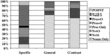
Figure 1 depicts how the target referent was indicated in the different conditions as a function of the nominal type (noun, pronoun, null) and its syntactic role in the child's utterance (subject, object). The overall picture is very clear. In accordance with the above analysis, in the general and contrast question conditions children used a noun by itself or a postverbal noun almost three-quarters of the time, whereas in the specific question condition they used a noun by itself or a postverbal noun only about 10% of the time. In contrast, in the specific question condition children used a null reference or pronoun in subject position about 65% of the time (noun as subject an additional 13% of the time), whereas in the general and contrast question conditions they used a null reference or pronoun in subject position less than 10% of the time. Thus, it is clear that the specific question pulls for target as subject (about three-quarters of the time), and children are obeying some kind of “light subject constraint” (Chafe, 1994) or “preferred argument structure” in which the argument is expressed with something other than a lexical noun (DuBois, 1987). In the other two conditions, the questions pull for nominal reference, often using lexical nouns, in something other than subject position (about three-quarters of the time).

Syntactic position (S, subject; O, direct object) and referential form (N, noun; Pro, pronoun; Null, null) of children's reference to target objects as a function of experimental condition in Study 1
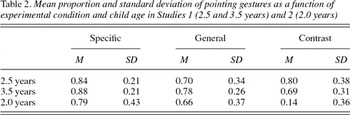
Table 2 shows the proportions of responses in which children used a nonverbal gesture (with or without language) in each of the experimental conditions: more than three-quarters of their responses overall. Children used gestures most often in the specific question condition, F(2, 74) = 3.45, p < .05, with this condition being higher than each of the other two (p < .05, Fisher LSD tests), which did not differ from one another. The effect was similar for children of both ages (no main effect of age or interaction of age and condition). This finding further supports the idea that the specific question condition is different from the other two.

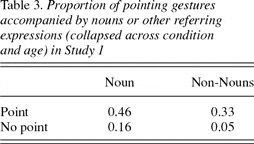
Finally, a related subject of interest is the question of whether children point equally when they are using different nominal types (see Table 3). The answer is that they do not. As can be seen in Table 3 (all ages and experimental conditions combined, proportion of total responses indicated), when they use a noun they point about three times more often than not. However, when they use a pronoun or null reference they point about six times more often. This result is statistically significant according to a binary logistic regression using repeated measures, eβ = 2.3, p < .01 (Mehta & Patel, 2002). Thus, although they pointed quite a bit overall, children pointed most often when they were not using a noun, perhaps suggesting that they understand that pronouns and null references need pointing more urgently than nouns.

Discussion
The most general finding of the current study is that specific questions (e.g., “What happened to the broom?”) elicit very different referential choices from young children than do more general questions (e.g., “What do we need?”) or contrast questions (e.g., “Do we need a mop?”). Prototypically, the child answers specific questions by placing the entity being asked about as the subject of the sentence in her answer (about three-quarters of the time), and this entity is indicated very infrequently with a noun but much more often with either a null reference or a pronoun (almost three-quarters of the time). In contrast, children tend to answer (again about three-quarters of the time) general questions either with (a) a lexical noun as a single word utterance (Q: “What do we need?” A: “A broom.”), or (b) a sentence with one of the interlocutors (either “we” or “the clown”) as subject and the target lexical noun in a postverbal position (Q: “What do we need?” A: “We need a broom.”). Contrast questions elicited somewhat similar referential choices, although perhaps for different reasons. Thus, when children were asked “Do we need a mop?,” they most often answered (again about three-quarters of the time) with something like “No, a broom,” or “No, we need a broom.”
This pattern of responding makes it quite clear that children at 2.5 and 3.5 years of age are in some ways sensitive to the knowledge states of their interlocutor. In the context of the game being played in the current study, if the adult asked a specific question it meant that she knew the object needed but simply did not know where it was. In her answer, the child thus made only fleeting reference to the object of joint discourse attention (null reference or pronoun, as topic) and then said where it was. On the other hand, in this same context if the adult asked a general question it meant that she did not know what object was needed, and so the children needed to inform her specifically with a lexical noun, which they mostly did. Finally, if the adult asked a contrast question, it meant that she had wrong information about what object was needed and so the child had to correct her by saying “No,” and then informing her of the correct object with a lexical noun. The specific question also elicited more pointing, but this is very likely due to the fact that children used more pronouns and null references in response to the specific question and they seem to know that pronouns and null references “need” indicative gestures more than nouns. That is, our analysis showed that across conditions children used more pointing in combination with pronouns and null references than with lexical nouns, a replication, at a younger age, of the findings of Tomasello, Anselmi, and Farrar (1985).
It is possible that these findings could be interpreted without crediting children with such deep knowledge of other people's knowledge, but it is not clear exactly how that would work. Presumably, the only possibility would be that children have learned some “mindless” discourse rules of the type “when someone asks about an object, begin your sentence with reference to that object” combined with some mindless grammatical rule of the type “begin sentences with pronouns or null references.” However, children make appropriate referential choices in a wide variety of discourse circumstances, for example, continuing a conversation on topic (when the adult is only making statements and not asking questions), using pronouns for topic and lexical nouns for nontopics (preferred argument structure; Clancey, 2002). Thus, a much more plausible view is that young children, at least from 2.5 years of age, know how to make referential choices appropriate for the knowledge states of the listener in many, although certainly not all, communicative contexts. This age range fits perfectly with O'Neill's (1996) findings that children use the pointing gesture differentially depending on the adult's knowledge states, a bit at 2.0 and much more consistently at 2.5. The fact that children cannot talk about knowledge states coherently in false belief and other theory of mind tasks only means that expressing knowledge explicitly in language is something different from expressing it implicitly in one's social and communicative interactions.
STUDY 2: FOLLOW UP WITH 24-MONTH-OLDS
The excellent, and perhaps surprising, skills of 2.5- and 3.5-year-old children in Study 1 immediately raises the question of whether even younger children might possess these same skills. In a second study, therefore, we simply replicated the experiment with 24-month-old children. Because of their more fragile attentional and memory skills (as determined by several pilot subjects), however, we modified the materials and procedures in several ways.
Method
Participants
Eighteen 2.0-year-old German-speaking children (range = 1;10–2;2) participated. Three additional children participated, but they were excluded from the analyses because either they turned out to be bilingual (one child) or they did not complete the procedure (two children). Children were recruited and tested in the same basic way as in Study 1.
Materials, design, and procedure
The experimental setup and procedures were like those of Study 1, with the following main changes. Most importantly, pilot subjects seemed to be distracted by the comings and goings of E2, so in this study the only human interactant was E1, who manipulated the clown (with the clown asking the questions). In addition, to lighten memory demands, each target object had associated with it a specific reference object (e.g., the target object pen had the reference object paper). This meant that E1 and the clown interacted with the child with, for example, the pen and paper and then placed the pen somewhere nearby, as in Study 1. To enact the experimental conditions, E1 and the clown then later found the paper and asked for the pen so they could draw. In addition, to make things easier the target objects were placed in more salient positions (e.g., on top of boxes) rather than always on a shelf. Finally, the test questions were simplified, to fit with 24-month-olds' language skills, as follows:

The wording of the test question was not changed in the specific question condition.
Scoring and reliability were done as in the first study, and Cohen's kappa was determined to be .91.
Results
The 24-month-old children provided scoreable responses on only 45% of the trials (compared with almost 80% for the older children in Study 1). They clearly did not have the same discourse skills as the older children.
Nevertheless, in the main analysis we again compared the proportion of lexical noun use across the three experimental conditions. Results are shown in Table 1. The younger children of this study responded to the altered contrast question as had the older children in Study 1, that is, almost exclusively with lexical nouns. However, in response to the other two kinds of questions, these younger children behaved very differently. Whereas the older children from Study 1 made a sharp distinction between the specific and general questions (providing nouns more than three times as often in response to general questions), the younger children made no such distinction. They responded with lexical nouns approximately half the time in both of these conditions. The statistical finding was thus a main effect for condition, F(2, 25) = 6.90, p < .01, with post hoc analyses (Fisher LSDs) showing that the contrast condition was different from the specific and general conditions (p < .05 in both cases), which did not differ from one another. However, it can also be seen in Table 1 that the children made many null references in the specific question condition, more than twice as many as in the general question condition. This would suggest (statistical analysis was not possible because of low frequencies) that they do differentiate the two kinds of questions, at least to some degree.
With regard to pointing, the younger children of this study again behaved differently from the older children of Study 1 (see Table 2). There was a statistical main effect for experimental condition, F(2, 25) = 6.01, p < .01, with the contrast condition differing from the other two, which did not differ from one another. These younger children only pointed about 14% of the time in the contrast question condition. However, this is very likely due to the nature of the question as modified for this study (viz., “Is this an X?”), which simply pulls for a yes or no answer (if the answer was no, children often pointed to the X on the shelf). In the general and specific question conditions, these younger children pointed 79 and 66% of the time, respectively, values that do not differ from one another reliably.
Discussion
The findings of this study clearly indicate that 2.0-year-old children do not take the knowledge states of their listener into account in the same way as do 2.5- and 3.5-year-old children. Although the contrast question again elicited almost all lexical nouns, it was a different question from the one used with the older children in Study 1, because pilot subjects could not deal with the form “Did the clown have a comb?” (they mostly just said “Yes,” which was factually incorrect). They answered the other two types of questions (specific and general) in very similar ways in terms of the proportion of nouns that were used. This was not true for the older children in Study 1, who differentiated these two sharply by answering general questions mostly with nouns but specific questions mostly with pronouns and null references. Although these younger children did seem to use more null references to specific questions than to general questions, children of this age quite often omit subjects from their utterances (Bloom, 1990). This might thus indicate that they knew that in their answer the mentioned noun should be the subject of the sentence in their response (although they did not make an active choice as to its form). The 24-month-old children used pronouns hardly at all in any of the three conditions. Perhaps this is because the pronoun needed would be the inanimate “it,” and young children only use that as subject in certain constructions, for example, “It's an X” (see Budwig, Stein, & O'Brien, 2001). The children also did not differentiate strongly in their pointing behavior between the general and specific question conditions as did the older children in the first study.
By comparison with the older children of Study 1, therefore, the 24-month-old children in this study seemed much less sensitive to the knowledge states of their interlocutor, at least those relevant for their choice of a referring expression. This conclusion must be taken with caution, however, because these barely 2-year-olds provided scoreable responses to less than half of the questions asked them. In contrast, this result itself could be taken as further evidence of the weaker discourse skills of children at their second birthday.
STUDY 3: PERCEPTUAL CONTEXT
In addition to discourse context, the choice of referring expressions is normally thought to be influenced by the immediate perceptual context in terms of the availability and distinguishability of potential referents. If the speaker and listener are jointly attending to some object visually, it is possible that the speaker might choose to refer to it with something less than a lexical noun (Allen & Schroder, 2003). Conversely, an object that is out of sight cannot be referred to felicitously with a pronoun or null reference (unless there is a strong discourse context), so presumably a noun is most appropriate. In the current study, therefore, we set up situations in which children asked an adult for out of reach objects that were perceptually available or unavailable in different ways. Thus, the object they asked for was either (a) alone on a shelf (visible), (b) on a shelf together with other objects (close enough so that pointing was not sufficient to single it out; alternatives), or (c) out of sight (in a box with other toys; not visible).
Method
Participants
Twenty-four 2.5-year-old (range = 2;4–2;8) and 24 3.5-year-old (range = 3;4–3;8) German-speaking children participated. One additional child participated but was excluded from the analyses because of experimenter error. Twenty-two 2.5-year-olds and 21 3.5-year-olds had participated in Study 1 first on a previous day (within 1 week). The additional 5 children were from the same kindergartens.
Materials, design, and procedure
The equipment, target objects, and general setup were basically the same as for Study 1, with a slightly different spatial arrangement. As in Study 1, the target objects were introduced in one of the three toy environments, and each child participated in each of the three experimental conditions within each environment, with the order of conditions counterbalanced across children. The play phase was similar to that of Study 1, with E1 and the clown associating each of the three target objects in each toy environment with a typical activity (e.g., cleaning the floor required a broom), and then placing the target object on the shelf, for this study in one of three special ways depending on experimental condition (visible, alternatives, not visible; see below). Again, testing occurred three times: once after each toy environment and its three target objects was finished.
After E1 had gone through the three activities of one environment with the child, the three target objects were all located on the shelf. Experimenter 2 then entered the scene and suggested that it was time to clean up. E1 agreed to this proposal, and asked the child to help her put the toys back in her bag. Experimenter 2 then went back to her chair, which in this study was in front of the shelf, and started writing things on her protocol sheet again, not attending to any further interaction between E1 and the child. Experimenter 1 cautioned the child that the cleaning up had to be done properly, in particular, to avoid getting the toys mixed up, they had to be put back in the order in which they were taken out. Thus, she followed a script for each object as follows:
Der Clown hat doch vorhin saubergemacht, nicht? Dafür hatte er einen Besen. Weisst du noch, wo der Besen ist? Geh doch mal zur Conny und lass dir den geben.
The clown cleaned the floor, didn't he. For this, he had a broom. Do you remember where the broom is? [Making sure that the child remembered the location. If not, E1 would point it out again]. Go over to Conny (E2) and have her give it to you.
Our main question was how the child would ask for the target object given its placement on the shelf. In the visible condition, the target object was placed alone on the shelf (with the other target objects at about 50-cm distance), making it possible to unambiguously identify this object with a pronoun or null reference together with a pointing gesture. In the alternatives condition, the target object was located next to two distractor objects (directly adjacent to one another), so that reference to this object with a pronoun or with a null form specifying its location was not sufficient, even with an accompanying pointing gesture, for unambiguous identification; only the use of a noun would guarantee unambiguous reference. In the not visible condition, the target object was placed in a box containing other toys and the box was closed. Again, and especially here, only use of a noun would guarantee unambiguous reference in this condition.
Coding was done by the first author. Reliability was established by having an independent research assistant, blind to the hypotheses of the study, code a randomly selected 15% of the tapes. Cohen's kappa was .98.
Results
The results of this study, also analyzed in terms of mean proportions, are very straightforward (see Table 4). Children used lexical nouns at high rates in all conditions, especially the older children. Statistically there was no effect of experimental condition, but there was an effect of age, F(1, 46) = 12.10, p = .001, such that older children produced more lexical nouns than younger children (about 96–76% overall). Children did use their pointing gesture differentially in the three conditions, however, F(2, 92) = 13.19, p < .001. Children of both ages pointed less when the object was not visible than when it was visible, either with or without alternatives present (p < .05 in both cases, Fisher LSD tests). Children pointed equally often in the visible and alternatives conditions.

Discussion
The basic finding of this study was that children did not use different kinds of nominals depending on the perceptual availability of the referent object. There are two important qualifications, however. The first is that the discourse situation in all experimental conditions was one that encouraged the use of lexical nouns. The child was instructed to go ask an adult for an object. Although we thought that children might relatively often request the object by simply pointing to it or saying “That!,” instead what they most often did, the older children on almost every occasion, was simply go over and say something like “We need the car” or “Could I have the car?” or even just “The car.” Presumably, what was going on here was that the child was supposed to ask someone with whom she had established no previous discourse context to retrieve a particular object. This is apparently a very strong discourse context in determining how children choose referring expressions; that is to say, it calls for nouns, regardless of the physical arrangement of the referent object. Children did point more nonverbally to the visible objects, both close to and not close to alternatives, but there are some fairly straightforward explanations for this in terms of perceptual salience; children are simply more inclined to point directly to the object they need than to the location in which it is hidden. The fact that there was no distinction between the visible and alternatives conditions argues for this interpretation not involving an assessment of the listener's knowledge states.
The second point is that we only manipulated perceptual availability in a physical sense: the object was in the open on a shelf, with alternatives on a shelf, or hidden from view. However, it is possible that we may have observed something different if we had manipulated more social aspects of the perceptual context, such as joint attention. Allen and Schroder (2003) have examined naturalistic uses of language by young Inuktitut children, and have found that they use something less specific than lexical nouns (often null references) when they and their interlocutor are both simultaneously looking at the target object. There was basically no joint attention in the current study, at least initially, because the objects were always on the shelf behind the adult when the child asked for them. Thus, it is possible that perceptual context plays an important role in the child's choice of referring expressions, but not perceptual context in a physical sense but rather in a social sense of things that she and her interlocutor are or are not perceiving together.
GENERAL DISCUSSION
The current studies have demonstrated experimentally some of the discourse factors that influence children's choice of referring expressions. In the first study, 2.5- and 3.5-year-old children were strongly influenced by the question the adult asked them. They answered contrast questions (“Do we need a mop?”) almost exclusively with lexical nouns (“No, a broom.”), and they also used nouns quite often to answer general questions (Q: “What do we need?” A: “Scissors”). But for specific questions (“What happened to the broom?”), they answered the vast majority of the time with pronouns and null references, as is appropriate, most often placing this reference in the syntactic position of subject (“It's over there”) and also pointing more often than in the other conditions as well. In the third study children of this same age were not asked any questions, but they were instructed to go request a particular object from an occupied adult. The target object was placed physically either alone, or alongside alternatives, or out of sight. However, none of this made any difference. In this situation, making a request to an adult with no previous discourse context, children mostly just used nouns regardless of how the target object was situated.
One interpretation of these findings is that discourse context is a more powerful influence on children's choice of referring expressions than is perceptual context, a finding that corroborates those of Campbell et al. (2001). However, of course, in the current studies we instantiated discourse context in some especially powerful ways. In the first study (and in Campbell et al., 2000) children were asked direct questions, which contain relatively clear information about exactly what the adult does and does not know, and in the third study they had to initiate linguistic interaction with an occupied adult who gave them no information at all about what she did and did not know. These are extreme situations in terms of information provided by the discourse. In other kinds of discourse contexts, for example, a conversational exchange on a topic without explicit questions, discourse context may provide different kinds of information about speaker knowledge and thus influence children's choice of referring expressions in more subtle ways. A more social definition of perceptual context, referring less to the spatial arrangement of a target object and more to whether it is an object of joint attention between interlocutors (Allen & Schroder, 2003), might make what the child visually perceives a more powerful factor in her choice of referring expressions as well.
However, regardless of its strength relative to other factors, in the situations explored in these studies discourse context clearly provided young children with the information they needed to make appropriate referential choices. Although more “mindless” explanations are also possible, presumably in terms of rote discourse rules the child could potentially learn, the most plausible explanation for the current findings is that young children can tell from an adult's question the degree to which a target referent is known to him. If the adult asks a specific question naming the target referent in the process, the child assumes the referent is known to him; if the adult asks a general question, the child can tell that the target referent is not known to him; and if the adult asks a question indicating that he has a wrong idea about what the target referent is, the child can correct him. If the child approaches an adult “out of nowhere,” as in the third study, she almost never requests an object with a pronoun or null reference. These skills would seem to indicate that by 2.5 years of age young children choose referring expressions in a way that is sensitive to listener knowledge in at least some communicative contexts.
The findings with the 24-month-old children in the paradigm of the first study are more difficult to interpret. They are more difficult to interpret mainly because quite often children did not respond to adult questions appropriately with a referring expression at all. One might take this reluctance to answer as evidence that these young children were not sure precisely how to answer the question. In line with this interpretation, when they did answer children at this tender age did not use lexical nouns differentially when asked either a general or a specific question, which the older children did quite strongly. The only hint that they did differentiate these questions was that they seemed to use null reference more to specific questions. However, of course, children of this age delete subjects quite often in all kinds of situations. Thus, perhaps specific questions do suggest to 24-month-olds that in their answer they should make the target referent the subject (topic) of their answer, but they still do not know which referential form to use. Therefore, it appears that 24–30 months is the age during which German- and English-speaking children become sensitive to the knowledge states of their listeners in the manner required to make appropriate choices of referring expression. This age range accords quite well with the findings of O'Neill (1996), who found that in their nonverbal gestures children at 2.5 years were very sensitive to the knowledge states of their listener, whereas children at 2.0 years were only somewhat sensitive. Presumably, children become more sensitive to the knowledge states of their listener by participating in discourse with an ever wider range of interactants in an ever wider range of linguistic contexts in which the mismatch between their own knowledge and expectations and those of others is made manifest in communication breakdowns, requests for clarification, conversational repair sequences, and the like (Tomasello, 1999).
The appropriate use of language in various discourse contexts requires children to, in some sense, read the mind of their listener. When studies such as the current ones establish experimentally some of the specifics of this process, we must credit children with much richer social cognitive knowledge than what they display in such things as false belief or appearance–reality tasks. In general, the pragmatics of children's linguistic interactions is an underexplored resource for discovering what children know about what other people know.
ACKNOWLEDGMENTS
We are grateful to the Leipzig kindergarten directors, teachers, parents, and children who were willing to participate in the study. We thank Angela Loose, Cornelia Koring, Katharina Haberl, and Jana Jurkat for help with the data collection and Daniel Stahl for statistical guidance.
References
Allen S., &
Schroder H.
2003.
Preferred argument structure in early Inuktitut spontaneous speech data.
In J. DuBois,
L. Kumpf, &
W. Ashby (Eds),
Preferred argument structure: Grammar as architecture for function.
Amsterdam:
John Benjamins.
Bittner D.
2002.
Emergence of verb and noun phrases in German.
In K. Dzinbalska (Ed.),
Future challenges for natural linguistics.
Warsaw:
Weckneith.
Bloom P.
1990.
Subjectless sentences in child language.
Linguistic Inquiry,
21,
491–
504.Google Scholar
Budwig N.,
Stein S., &
O'Brien C.
2001.
Non-agent subjects in early child language: A crosslinguistic comparison.
In K. Nelson,
A. Aksu-Koc, &
C. Johnson (Eds.),
Children's language
(Vol. 11).
Mahwah, NJ:
Erlbaum.
Campbell A.,
Brooks P., &
Tomasello M.
2000.
Factors affecting young children's use of pronouns as referring expressions.
Journal of Speech, Language, and Hearning Research,
43,
1337–
1349.Google Scholar
Chafe W.
1994.
Discourse, consciousness, and time: The flow and displacement of conscious experience in speaking and writing.
Chicago:
University of Chicago Press.
Clancy P.
2002.
The lexicon in interaction: Developmental origins of preferred argument structure in Korean.
In. J. DuBois (Ed.),
Preferred argument structure: Grammar as architecture for function.
Amsterdam:
John Benjamins.
Flavell J. H.
1992.
Perspectives on perspective taking.
In H. Beilin &
P. B. Pufall (Eds.),
Piaget's theory: Prospects and possibilities.
Hillsdale, NJ:
Erlbaum.
Givón T.
1993.
English grammar: A function-based introduction.
Amsterdam:
John Benjamins.
Gundel J.,
Hedberg N., &
Zacharski R.
1993.
Cognitive status and the form of referring expressions.
Language,
69,
274–
307.Google Scholar
Mehta C., &
Patel N.
2002.
LogXact5 Logistic Regression software featuring exact methods
[User manual].
Cambridge, MA:
Cytel Software Corporation.
O'Neill D. K.
1996.
Two-year-old children's sensitivity to a parent's knowledge state when making requests.
Child Development,
67,
659–
677.Google Scholar
Shatz M.
1983.
Communication.
In J. Flavell &
E. Markman (Eds),
Handbook of child psychology
(4th ed.,
Vol. 3).
Chichester:
Wiley.
Tomasello M.
1999.
The cultural origins of human cognition.
Harvard, MA:
Harvard University Press.
Tomasello M.,
Anselmi D., &
Farrar J.
1985.
Young children's coordination of gestural and linguistic reference.
First Language,
5,
199–
210.Google Scholar
Tomasello M., &
Haberl K.
2003.
Understanding attention: 12- and 18-month-olds know what's new for other persons.
Developmental Psychology,
39,
906–
912.Google Scholar
Mean proportion and standard deviation of noun, pronoun, null, and nonverbal responses as a function of experimental condition and child age in Studies 1 (2.5 and 3.5 years) and 2 (2.0 years)
Syntactic position (S, subject; O, direct object) and referential form (N, noun; Pro, pronoun; Null, null) of children's reference to target objects as a function of experimental condition in Study 1
Mean proportion and standard deviation of pointing gestures as a function of experimental condition and child age in Studies 1 (2.5 and 3.5 years) and 2 (2.0 years)
Proportion of pointing gestures accompanied by nouns or other referring expressions (collapsed across condition and age) in Study 1
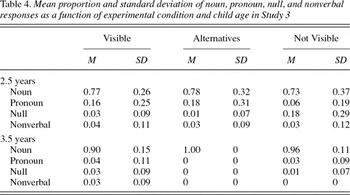
Mean proportion and standard deviation of noun, pronoun, null, and nonverbal responses as a function of experimental condition and child age in Study 3
 You have
Access
- 54
- Cited by