

Across the Mediterranean basin, the ways representation was thought about changed across the long eighth century. Beginning around 680, the transformation was more or less complete by c. 830. This paper is about why this happened, and what it meant, to the two dominant powers of the Mediterranean in the seventh, eighth and ninth centuries: the Islamic caliphates and, especially, the Byzantine empire. For comparative purposes, I will also look briefly at the Carolingian empire in the west, and the Christian population in Palestine, a region that from the mid-seventh century was ruled by the caliphate from Damascus and then, after 762, from Baghdad.
Talking about representation is complicated, because the word has multiple meanings, and multiple registers within each of these meanings. My focus here will be on only two forms of representation, but even within these two broad definitions we can – and in one case will – find multiple registers of meaning. What one might call social representation is, at the most basic level, about how people display or present or project themselves, both to themselves and to others. (This is the representation that anthropologists and socio-cultural historians talk about.) What one might call a cultural sense of representation is about how authors and artisans present themselves or usually, in the Middle Ages, others, to an audience. This type of representation is governed by what is traditionally called genre: the conventions ruling the particular type of text or image in question. (This is what literary and art historians, and some archaeologists, talk about.) Both understandings of representation – self presentation, on the one hand, and literary or visual images, on the other – are critical for our understanding of the long eighth century, because this is one of the few historical periods in which social and cultural representation, which of course often overlap in practice, were overtly linked, and seriously considered in relation to each other.
I will start with a brief consideration of representation in the Arab world. The ‘Islamic conquests’ (as they are often called by western historians) followed the death of Mohammed in 632, so that by the middle of the century, Syria, Palestine (including, of course, Jerusalem), the Jazira (between the middle Tigris and the Euphrates), Egypt and the bulk of the former Persian empire was under the control of the Islamic caliphate; by 715, the Arabs also dominated North Africa, Spain and eastward to the Indus valley.Footnote 1
Our main early text for this period, the Koran, maybe dating as a collection from the mid-seventh century and certainly in existence in some form by 690, barely mentions representation and certainly does not make any categorical statement about the right-ness or wrong-ness of literary or visual imagery. But the hadith – a collection of stories concerning the life of Mohammad, the various versions of which are extremely difficult to date with any precision – address the issue of visual representation, and condemn pictures and, especially, makers of pictures. The hadith include statements such as ‘the angels will not enter a house in which there is a picture or a dog’ or ‘those who will be most severely punished on the day of judgement are the murderer of a prophet, one who has been put to death by a prophet . . . and a maker of images or pictures’.Footnote 2
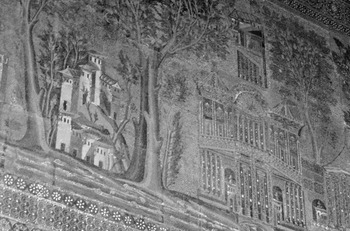
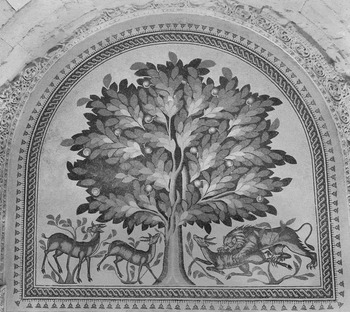
This verbal condemnation of imagery and image-makers is, however, moderated by the physical evidence. The early Islamic mosaic panels of unpopulated river landscapes with buildings from the Great Mosque of Damascus (Figure 1) – one of the earliest and most sacred buildings of Islam, dating to c. 715 – suggest that the real evil was not imagery per se, but representations of living creatures, including human beings. Even that was conditional: the material culture preserved from the long eighth century makes it very clear that it was only in the most holy areas of mosques that the prohibition was strictly applied. Baths (as, for example, in the eighth-century complex at Qusayr Amra) were exempt; animals and people certainly appear in the decoration of royal residences (as, for example, in the well-known floor mosaic of a lion attacking gazelles at Khirbat al-Mafjar, also of the eighth century: Figure 2); and images of animals (though not of people) appear in the more peripheral areas of several mosques, including those in the eighth-century complexes at (or formerly at) Mshatta and Qasr al-Hayr. And while the mosaics of the Dome of the Rock are dominated by decorative motifs, cityscapes and rural villa scenes, although unpeopled, appear a decade later, in the courtyard mosaics of the early eighth-century Great Mosque of Damascus, and look remarkably like contemporary and earlier Byzantine work.Footnote 3
Damascus, Great Mosque, mosaic of river landscape (photo, Mosaics on the West portico, eighth century The Bridgeman Art Library Nationality/copyright status: out of copyright).

Khirbat al-Mafjar, mosaic of lion attacking gazelles (photo courtesy of the Israel Antiquities Authority).

We may conclude that Arab attitudes toward visual representation discouraged the depiction of living beings, and particularly humans, in specific contexts, notably the mosque. This is a position that does not disdain imagery, but rather acknowledges and respects the ideological power of representation.
The Byzantines also acknowledged and respected the ideological power of representation, and this became particularly important in the late seventh and early eighth centuries, at more or less the same time as the Islamic monuments just noted were conceived.
Before this time, and more specifically, until c. 680, images made by human hands were only rarely – and usually problematically – ascribed power. From the fourth century onward, in both Byzantium and the Latin west, relics were believed to convey the real presence of a saint, and thus had miraculous powers to heal and protect, but in the Orthodox east sacred portraits – what we now usually call icons – remained largely commemorative, honouring the memory of the saint portrayed or, in the case of ex voto imagery, thanking the saint himself or herself for interceding with Christ on the donor's behalf.Footnote 4
The earliest references to a holy portrait addressed as if it were the saint himself was related by Arculf (who went on pilgrimage to the Holy Land in 683/4) to Adamnán (who recorded the account sometime before 688), as a story he had heard from story-tellers in Constantinople. In brief, a man about to set off on a great military expedition stood before a portrait of the confessor George, and ‘began to speak to the portrait as if it were George present in person’; he asked ‘to be delivered from all dangers by war’. Adamnán tells us that many died, but the soldier ‘was preserved from all misadventure by his commendation to the Christ-loving George, and by the grace of God came safely back. . .and spoke to St George as though he were present in person’ again.Footnote 5 This is a story, of course, and Arculf and Adamnán made no bones about it having been related by story-tellers. The point is not whether or not the man or the icon actually existed, but rather that this was evidently a story circulating in Constantinople in the 680s, by which time it was, for the first time, thinkable that a saint was actually present in his portrait – that is, that the ‘real presence’ of the saint reposed in his or her icon. Shortly thereafter, at the Council in Trullo of 691/2, the Orthodox church responded with the first canonical legislation concerning religious imagery;Footnote 6 and soon after that, around the year 700, Stephen of Bostra's Against the Jews – the earliest anti-Jewish polemic to mention images – notes that ‘Veneration is the outward sign by which honour is given’ to icons, the oldest secure reference to what appears to mean proskynesis (prostration) before images.Footnote 7 A generation later, in the 720s, various churchmen condemned the holy portraits, and, ultimately, the movement we call iconoclasm (the destruction of images) – but which the Byzantines called, more accurately, iconomachy (the struggle about images) – was officially declared in 754.Footnote 8 The critical issue is why sacred portraits became widely accepted as means of accessing the divine comparable to relics around the year 680. Why was 680 the tipping point?
The seventh century was not a happy period for the east Roman empire. Its first quarter was occupied with Persian and Avar invasions, culminating in the siege of Constantinople of 626, when a relic-icon of Christ was famously credited with saving the city.Footnote 9 Though the Constantinopolitan repulsion of the siege basically ended the Avar threat, the Persians continued to occupy the empire's military attention for another year, until Herakleios defeated them in 627/8. Seven years later, however, Syria and Palestine were in the hands of a new rival, the Arabs, and, with the battle of the Yarmuk in 636, the Arab conquests began seriously to affect the empire; within the next decade, Byzantium lost its richest province, Egypt. By 650, Byzantium was halved in size, had lost its major agricultural base and, with few financial or military resources in reserve and its infrastructure severely shaken, was presumably low in morale. All of this had, as one might expect, a profound impact on the empire, and it has been rightly argued by many that the seventh century witnessed a decisive shift in Byzantine social, political and cultural interests.Footnote 10 The impact of these socio-political events was accentuated – and rhetorically overshadowed – by the heresy (in Byzantine eyes) of the instigators of these problems, Islam.
The Byzantines saw the Arab invasions as God's punishment for their sins. In a sermon delivered in 634, for example, the patriarch of Jerusalem told his audience that ‘We have only to repent, and we shall blunten the Ishmaelite sword. . .and break the Hagarene bow, and see Bethlehem again.’Footnote 11 But by the end of the century, it was no longer possible to expect that Islam and the Arab threat was going to be overcome by force, diplomacy or an act of God.Footnote 12 Already in 686, John of Phenek wrote that ‘the end of the world has arrived’,Footnote 13 and this feeling was strengthened by the consolidation of Arab power under ‘Abd al-Malik in the years up to 692. Though the eastern front remained relatively secure across the last fifteen years of the century, the social and cultural instability of the last quarter of the century is clear, and is particularly well expressed in the Apocalypse of pseudo-Methodios (written in Syria, probably in 691),Footnote 14 and the records of the Council in Trullo of 691/2, which as we have just seen are also distinguished by the earliest canonical legislation about imagery.Footnote 15
The Apocalypse of pseudo-Methodios was written in the expectation and hope that the end of the world was about to begin with the fall of the Arabs. Sebastian Brock has compellingly argued that the Apocalypse was inspired, at least in part, by ‘Abd al-Malik's census (or rumours about it) preparatory to imposing a new taxation system in Mesopotamia; as Muslims, including newly converted former Christians, were exempt from the poll tax, the underlying fear seems to be that the church would lose considerable numbers to the mosque.Footnote 16 Gerrit Reinink has expanded this thesis in a number of articles, most recently concluding that ‘Undoubtedly this fear was rooted in the awareness that the recovery of Islamic power, going hand in hand with the frustration of apocalyptic hopes and greatly increased taxation of Christians, created circumstances highly favourable to conversion to Islam.’Footnote 17 In short, in areas under Arab control, the critical destabilising factors expressed by local Christians at the end of the century were eschatological, driven by fear of apostasy and financial insecurity.
The anxieties expressed by the churchmen who recorded the deliberations of the Trullan Council of 691/2 were somewhat different. In addition to providing the first Byzantine canonical legislation about religious images – which, as we have seen, appears to have been a response to the surge in the powers of sacred portraiture a decade earlier – many of the canons expressed concern for the first time about long-standing practices (for example, the ‘hellenic’ festival of Brumalia, condemned in canon 62) that had never before exercised the religious establishment.Footnote 18 What the canons seek above all is a means to purify the church, and like most purification rituals they are more symbolic than practical: the Brumalia, to return to the example just cited, continued to be observed in Constantinople until the twelfth century.Footnote 19
The attempt to regulate and cleanse is equally apparent in one of the canons about imagery, which is, oddly, rarely discussed by Byzantinists. Canon 100 instructed ‘that those things which incite pleasures (hēdonē) are not to be portrayed on panels’. After a paraphrased citation of Proverbs 4:23–5, it continued: ‘for the sensations of the body all too easily influence the soul. Therefore, we command that henceforth absolutely no pictures should be drawn which enchant the eyes, be they on panels or set forth in any other wise, corrupting the mind and inciting the flames of shameful pleasures.’Footnote 20 Canon 100 was overtly concerned with issues of corruption and purity; and it was particularly focused on the distinction between good and bad images. This same theme was the concern of the better-known canon 82, where the historical portrait of Christ was preferred to the symbolic lamb. In Canon 100, however, the distinction is not between the historical and the symbolic, but between images that incite pleasure and other, unspecified images. It is only in the eighth century that we will learn that the aim of good pictures, Orthodox pictures, is to elicit the tears of purifying sanctity, and to induce the emulation of saintly virtues.Footnote 21 In 691/2, this has not yet become a standard trope, and it was enough to stress that imagery had a distinct purpose, and that purpose was not aesthetic pleasure. It is clearer here than in any other section of the Trullan canons that the churchmen are using words about one thing (in this case, images) to talk about something else entirely (in this case, purity).Footnote 22 But it is also clear that they are interested in controlling what can be represented, a point to which we shall return shortly.
The attempts of the Trullan churchmen to standardise and cleanse Orthodox practice stemmed from a sense of uncertainty and anxiety that is continued in Anastasios of Sinai's Questions and Answers, probably composed at the very end of the seventh century,Footnote 23 where Anastasios writes quite plainly that the ‘present generation’ is enduring a period of spiritual crisis.Footnote 24 His work on struggles against demons (the Diēgēmata stēriktika, probably composed in its original formulation around 690) continues the purification theme.Footnote 25 Indeed, from the late seventh century, the need for internal purity becomes a constant theme of both theological and ‘state’ rhetoric.Footnote 26
In short, by the later seventh century, Islam and the Arabs had become a permanent fixture, and by the end of the century the surviving texts document the impact this had on the circumstances of Christian life.
It is in this context that we must understand the emergence of holy portraits as a means to access divine presence around the year 680. As we have seen, the earliest reference to a holy portrait addressed as if it were the saint is the story about the soldier and the icon of St George recorded by Adamnán. The soldier, we saw, asked ‘to be delivered from all dangers by war’, and Adamnán tells us that ‘It was a war full of danger, and there were many thousands of men who perished miserably. But he. . .was preserved from all misadventure by his commendation to the Christ-loving George, and by the grace of God came safely back.’Footnote 27 The unidentified war of the story can only have been against the Arabs, and so we find the first clear indication of the absorption of ‘normal’ icons into the cult of relics firmly located in the context of the Islamic conquests of the later seventh century.
To cut a long story short, the shift in the way sacred portraits were received in Byzantium was, I think, a product of late seventh-century insecurities. God was punishing the Byzantines, and the Arabs were not going to disappear anytime soon. The state, the church and the individual Orthodox believer – all in a state of spiritual crisis – needed help, in the form of new channels of access to divinity. Investing real presence into sacred portraits painted by living people allowed virtually limitless multiplication of direct intermediaries between humans and the holy, in the same way as, centuries earlier, contact relics had solved the problem of limited human remains of saints. The critical issue is the transference from physical presence (the power of relics) to representation (the power of icons), and to that we will now turn.
As noted earlier, social representation (self presentation) and cultural representation (visual imagery) were overtly linked in our period, and the connection between late seventh-century Byzantine self presentation – with all of its expressions of personal and institutional crisis – and changes in the role of visual imagery bring this out nicely. But just as in the Arab world, where as we saw earlier there was a kind of hierarchy of image appropriateness (human figures are fine in a bath house but not in a mosque), so too in Byzantium there are several registers of representation.
Indeed, the erudite Byzantine churchmen who have left us records of their thoughts were quite clear on the distinction between different types of representation, especially as they applied to the theological arguments of iconomachy. These theological arguments are important for understanding the intellectual history of the Byzantine empire, but they are largely beside the point for its social or even cultural history. Just as the Trullan Council followed and responded to a new role for the sacred portrait, so too the theology of the veneration of icons followed along and either codified changes in social practice or attempted to limit them. By systematising the role of sacred portraits in Orthodoxy, eighth- and ninth-century theologians created the cult and the theology of icons, but they did not create the desire to access the holy in a new way: they justified and codified existing realities. Legislation about images followed changes in custom; theory, in short, followed practice.
This takes us back to Canon 100 of the Trullan Council, where the churchmen instructed that ‘things which incite pleasures are not to be portrayed on panels’. As we have seen, this is about purification, but it is also an attempt to control sacred imagery, and to ensure that the newly powerful images were painted in an Orthodox manner. What is important here is that the churchmen did not yet know quite how to explain what ‘good’ painting was: this once again demonstrates that theology was responding to (rather than leading) changes in practice. But the Trullan churchmen were nonetheless well aware that the significance of representation was changing, and they wanted to ensure that representation remained Orthodox and that they maintained a level of control over it.
This hope was only partially fulfilled. The theology of icons that developed across the eighth and ninth centuries has been explored in considerable depth, and the major Byzantine players – particularly from the second Council of Nicaea in 787 onwards – have left lengthy accounts of the significance of representation in the Orthodox world that allow us to understand in some detail how the Byzantines saw.Footnote 28 But the problems with relying too heavily on the theology of icons for our understanding of issues of representation in Byzantium are well brought out by a recent analysis of the former patriarch Nikephoros's discussion of the relationship between a portrait and the one portrayed, written shortly after 815, which summarised Nikephoros's conclusions as follows: ‘Thus, when an icon is destroyed, it is an offence against the formal, that is to say, visible, properties of the one shown. One does not destroy Christ when one destroys his icon, rather one destroys the possibility of his becoming available to vision.’Footnote 29 What Nikephoros meant by this was that the icon, made by human hands, was a manufactured artefact, and the portrait was therefore distinct from its subject – this is a portrait of Christ, it is not Christ himself. When Orthodox viewers looked at the icon of Christ, they could then concentrate their minds on the contemplation of Christ himself. The icon – understood as a manufactured artefact – functioned as an aide-mémoire.
This argument, which demonstrates a good grasp of Aristotelian logic, was developed by Orthodox churchmen in the later eighth and ninth centuries to demonstrate that an image was an image, different from its subject, and not to be confused with it: that is, the two levels of representation involved were distinct. From this reasoning it followed that icons were acceptable – even ‘truthful’ – precisely because they were manufactured.Footnote 30 But comparison of this theologically correct passage with accounts of how people responded to icons in daily life also demonstrates the sharp contrast between the theology of learned churchmen (the ‘theory’ of icons) and the response to images considered appropriate in accounts of people in everyday situations (the ‘practice’ of icons).
For the properties of the sacred portrait so carefully distinguished in learned theological treatises disappear in other contexts, even in letters written by the same elevated churchmen who were careful to maintain an Aristotelian balance when writing icon theory. Theodore of Stoudion (759–826), for example, was as commited as was Nikephoros to the Orthodox theological position that expressed the relative relationship between a portrait and the person portrayed; but when writing a letter to the spatharios John, he nevertheless praised him for replacing a human godfather with an icon of St Demetrios for ‘here the bodily image took the place of its model’ and ‘the great martyr was spiritually present in his own image and so received the infant’.Footnote 31 Here, and even more visibly in hagiographies and miracle accounts, the icon was the person represented, and respect to the one was, directly, respect to the other.
On one level, this distinction simply exemplifies the importance of context: theological treatises require the careful formulation of image theory; letters to friends are less formal. But the contrast between the theological understanding of the sacred portrait and the day-to-day reception of the same image is not only about discrete registers of response: it is also, and more importantly, about different understandings of representation.
To Theodore of Stoudion and his fellow churchmen, an icon of St Demetrios could be both an artefact, an object made by human hands, differentiated from the saint, and sharing with Demetrios only likeness, not essence,Footnote 32 and a manifestation of the saint, standing in for the real Demetrios, who is ‘spiritually present in his own image’. The first, theological, understanding of the icon – the icon as artefact – kept holy portraits from being idols and gave the Byzantines arguments with which to counter the Islamic critique of Orthodox imagery, which claimed that the Christians venerated wood. The second understanding of the icon – the sacred portrait as a window to the saint – allowed the image to stand in for the saint pictured; this understanding of the icon presented the saint himself or herself to the worshipper and it is this icon that the faithful kiss when they enter a church, and which became part of Byzantine self-identity. The artefactual, theological icon is a panel painting; in Charles Barber's phrase, ‘a signpost whose insistent presence directs us elsewhere’ not ‘a self-effacing doorway that opens upon another place’.Footnote 33 The Byzantines did not interact with an icon understood in this way, they contemplated it. But the second way of understanding an icon – as an embodiment of real presence – is ‘a self-effacing doorway’, leading to the saint depicted; and the Byzantines collaborated with icons understood in this way, through veneration. Such collaboration with the image – through kissing or venerating it in other ways, through installing it as a godfather – allowed the Byzantines to interact on a deeply personal level with the icon/saint, so that even today the medium most commonly associated with the Byzantines is the icon. This level of representation was developed by practice, not by theological theory, which indeed never fully caught up with it.
The acceptance of sacred portraits as mediators between the earthly and the divine did not need this dual understanding of representation, it only required the second, a belief in the icon as real presence. The desire for additional and enhanced access to the holy was, as we have seen, a product of the serial crises of the seventh century. But, as at least some churchmen were quick to realise, accepting real presence in icons had the potential to unleash uncontrolled, and uncontrollable, rights to the sacred, for icons were infinitely reproducible. The Trullo Council began the process of regulating Orthodox imagery, but it was really only after the iconoclast backlash instigated in the 720s, and especially during the debates about imagery across the eighth and ninth centuries, that rules and regulations – the Orthodox theory of representation – were fully developed, and the theological icon was born.
Arab and Byzantine ideas about representation have, we can see, many differences, but some similarities. Most significantly, across the long eighth century, both Islam and Orthodox Christianity accepted the power of representation: this is why, in one way or another, both religions tried to regulate its use. Carolingian ideas about representation were very different, and we will briefly turn to these, with a focus on how the Carolingians presented themselves in relationship to what they understood about Byzantium.
I will concentrate on the Frankish response to the Byzantine Council of Nicaea, which in 787 temporarily restored icon veneration. Shortly thereafter, Frankish theologians drew up the Capitulare adversus synodum (preserved only in Pope Hadrian I's point-by-point refutation of it), which criticised the decisions taken at Nicaea. The Frankish theologians challenged the evidence adduced in support of icon veneration as an established and ancient Christian tradition, and insisted that the Bible never supported the making or veneration of images. In response to Pope Hadrian's denunciation of this critique, Charlemagne ordered a detailed review of the issues raised, which resulted in what was in effect an independent and autonomous Frankish theological position.Footnote 34
This was the Opus Caroli Regis contra synodum, better known as the Libri Carolini, compiled between 791 and 793 by the leading theologians at the Frankish court, predominantly Theodulf of Orléans. From the point of view of the theology of images, the Libri Carolini adopt a position quite similar to the iconoclast council of 754, with the same emphasis on the traditions of the Old Testament (though unlike any Byzantine commentary on images, the Libri Carolini follow the standard western view of images as texts for the illiterate, a tradition inaugurated roughly two centuries earlier by Pope Gregory the Great). According to the Libri Carolini, and the synod of Frankfurt which followed, the image held its status by virtue of its ability to recall, remind and instruct. But there should be no cultic practices associated with it: these were a novelty of recent times, an argument which is, again, very close to that of the iconoclast council of 754 (and which was, in fact, as we have seen, true).Footnote 35
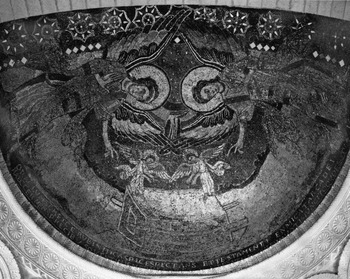
The arguments about representation in the Libri Carolini are embedded in more overtly political issues concerning the relationship between Aachen and Rome, and Theodulf's particular views about religious art were quickly dropped from Charlemagne's agenda. But we can see how they worked in practice in Theodulf's own oratory at Germigny-des-Prés, constructed in the 790s shortly after the Libri Carolini were written. The oratory is a small building with non-figural sculptural decoration and an apse mosaic focused on an image of the ark of the covenant (Figure 3).Footnote 36
Germigny-des-Prés, oratory of Theodulf, apse mosaic (photo, author).

The ark of the covenant is described several times in the Old Testament, and the salient passage is Exodus 25:18–20, where, despite the second commandment forbidding graven images, God ordered Moses to decorate the tabernacle with cherubim. To the Byzantines, God's command to produce and decorate the ark and the tabernacle was the ultimate defence of Christian imagery. Theodulf, in contrast, argued that the ark did not justify the mundane production of religious images because it was not a human commission: God commanded Moses to have it made. Against the Byzantine belief that the ark supplied a rationale for Christian representation, Theodulf understood the ark as a pale Old Testament prefiguration, now surpassed by the realities of the New.Footnote 37
Theodulf's mosaic shows two angels, mimicked by two smaller cherubim, actively gesturing toward the empty ark and, below that, toward the altar itself; a hand of God in the centre of the composition is marked by the stigmata of the risen Christ. Unlike Greek images of the ark of the covenant, which show the ark of Exodus, Theodulf's version demonstrates how the prophesies of the Old Testament, represented by the ark, have been replaced by the historical reality of Christ, whose incarnation fulfilled the promises of the old laws, and whose death and resurrection superseded them. The ark is now empty; Christ is present at the altar in the form of the eucharist.Footnote 38
Theodulf's ideas are striking, but they did not have a marked impact on Carolingian thought, perhaps because, apart from Claudius of Turin in the 820s, no one aside from a tiny handful of intellectuals – mostly of Spanish origin – thought that theories of representation were an urgent issue at all.Footnote 39 Images were not, and never became, integral to western theology. So while Theodulf's ideas are radically different from those we have seen in Islamic and Byzantine Orthodox circles, we cannot really generalise about Carolingian attitudes toward representation from them. The lack of attention paid to Theodulf's work, however, suggests that religious imagery simply did not have the potential to be as powerful in the Carolingian west as it did in the Arab and Byzantine worlds, and indeed in the hybrid world of Christian Palestine.
Palestine was part of the Roman and then the Byzantine empire, and was predominantly Christian when it was conquered by the Arabs. As one of the wealthier provinces of Byzantium, it had hundreds of well-built, lavishly decorated and large churches. The Christian inhabitants of what became Islamic Palestine were allowed to retain their churches and their religion, without any apparent restrictions, and probably remained a majority there for the whole period under consideration here. Nonetheless, figural decoration apparently died out in the churches used by Christians living under Islamic rule: the latest dated floors with figural mosaics seems to be those in St Stephen's church at Umm al-Rasas (718), the church on the Acropolis in Ma'in (719/20) and the church of St George at Deir al-‘Adas in southern Syria (722). All subsequent eighth-century churches in the region reveal only floral and geometric ornament.Footnote 40
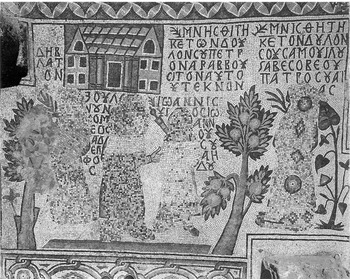
At the same time, we find a new phenomenon: during the second quarter of the eighth century, people and animals inhabiting church floor mosaics were replaced, or partially replaced, by non-representational motifs. A good example is provided by the mosaic floor of St Stephen's basilica at Kastron Mefaa (modern Umm al-Rasas), which is dated by an inscription to 718. The donors of the mosaic (Figure 4) were originally portrayed on either side of the inscription, and it is still evident where the donors were pictured – but the greater part of each figure has been reconstructed by removing the tesserae and replacing them at random This scrambled cube technique was also later applied to the animate motifs in the mosaics of the main body of the nave, which shows a vine scroll that was once filled with figures and animals. Around this is wrapped a river scene, also disfigured, but with intact representations of ten cities along the Jordan river.Footnote 41
Umm al-Rasas, St Stephen's church, donor mosaics (photo courtesy of †Michele Piccarillo).

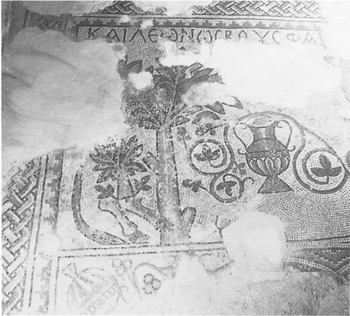
A second, and well-known, example was excavated in Ma'in, which is about 35 km away from Kastron Mefaa, where an inscription dated the floor mosaics of the church on the Akropolis to 719/20. Here a panel which once illustrated Isaiah 65:24, ‘And the lion shall eat chaff like the ox’ now shows a tree and an urn with bits of the ox protruding anarchically (Figure 5); the lion has not survived at all.Footnote 42
Ma'in, church on the Akropolis, mosaic (photo courtesy of †Michele Piccarillo).

Clearly, Palestinian responses to imagery were not the same as those within the Byzantine empire. Byzantine theories of representation focused on holy portraits while Palestinian Christians were concerned with representations of any living creature; and for this reason Susanna Ognibene has coined the label ‘iconophobia’ for the Palestinian phenomenon.Footnote 43 In fact, the Byzantine rulings against the veneration of images at the Council of Hieria in 754 were not accepted by the Christian church hierarchy in the east: the Council was condemned in 760, 764 and 767 by eastern synods and patriarchs, and two of the strongest voices against the Byzantine position were raised by the eastern monks John of Damascus and Theodore Abu Qurrah.Footnote 44 Iconophobia in Palestine was neither inspired by Byzantine anti-image legislation (or iconoclast beliefs) nor, it seems, was it spurred by any official Islamic policy: the edict against Christian images supposedly issued by the caliph Yazid II in 721 is now generally discounted as an anti-Islamic invention of later Christian writers (it is first mentioned in 787 at the seventh ecumenical Council of Nicaea).Footnote 45 Furthermore, many churches that were assuredly still in use in the mid-seventh century were not affected, and, most notably, there is no evidence of hostile destruction. As Robert Schick has argued forcefully, the disfigurement, when it appears, is so carefully done we must assume that the people who used and respected the buildings affected were responsible – in other words, the Christian congregations modified their own church floors.Footnote 46
In fact, Palestinian ‘iconophobia’ was more similar to Islamic prohibitions than to the imperial iconoclasm generated in Constantinople, and I have argued elsewhere that that the cultural to-and-fro between Palestinian Christians and their Islamic neighbours – local neighbourhood politics; peer pressure, really – inspired Palestinian Christians to remove (mostly) human, animals and birds from their church floors.
‘Mostly’ is the operative word here, for just as the Roman damnatio memoria (the cutting out of names of disgraced people on statuary) usually left the viewer with just enough information to identify the figure being damned, so too the Palestinian Christians often left just enough of the figure or animal to make it clear what had been removed. I would guess that this is because the process of accommodation (of their neighbours’ attitude toward images) was what was important here, rather than agreement with Islamic beliefs about representation.
To conclude: 680 was a turning point in attitudes toward representation in the Orthodox Christian world and, if we accept a date in the late seventh century for the emergence of the early hadith, also for Islam. The coincidence here is striking, especially given the absence of any evidence for a comparable shift in the Christian west. In is also significant that the impact of the turning point appears to enter another register when it hits the Palestinian Christian community – here practice continued to lead where theory (the words of John of Damascus and Theodore Abu Qurra) never follows – but the process of accommodation is quite distinct from either the hierarchy of representation we see in Islam or the two coexisting understandings of representation that we see in Byzantium.
And this takes us back to the beginning – to the two levels of representation with which we began: the social (self presentation) and the cultural (visual imagery). At the end of the seventh century, Byzantine self presentation was, as we have seen, dominated by a sense of personal and institutional crisis; by the end of the image struggle in 843 – indeed already by c. 800 – Byzantium had its self-confidence back. At the end of the seventh century, Byzantine attitudes toward images changed radically; by c. 800 these shifts had been codified and canonised. In the process, two registers – the theological icon and the icon as real presence – had been created and, in the Orthodox church, they still remain.