




No CrossRef data available.
Article contents
Correlates of memory function in community-dwelling elderly: The importance of white matter hyperintensities
Published online by Cambridge University Press: 01 May 2004
Abstract
We sought to identify magnetic resonance- (MR)-imaged structures associated with declarative memory in a community-dwelling sample of elderly Mexican–American individuals with a spectrum of cognitive decline. Measured structures were the hemispheric volumes of the hippocampus (HC), parahippocampal gyrus, and remaining temporal lobes, as well as severity of white matter signal hyperintensities (WMH). Participants were an imaged subsample from the Sacramento Area Latino Study of Aging (SALSA), N = 122. Individuals were categorized as normal, memory impaired (MI), cognitively impaired non-demented (CIND), or demented. We show that WMH was the strongest structural predictor for performance on a delayed free-recall task (episodic memory) in the entire sample. The association of WMH with delayed recall was most prominent in elderly normals and mildly cognitively impaired individuals with no dementia or impairment of daily function. However, the left HC was associated with verbal delayed recall only in people with dementia. The right HC volume predicted nonverbal semantic-memory performance. We conclude that WMH are an important pathological substrate that affects certain memory functions in normal individuals and those with mild memory loss and discuss how tasks associated with WMH may rely upon frontal lobe function. (JINS, 2004, 10, 371–381.)
Information
- Type
- Research Article
- Information
- Journal of the International Neuropsychological Society , Volume 10 , Issue 3 , May 2004 , pp. 371 - 381
- Copyright
- © 2004 The International Neuropsychological Society
INTRODUCTION
It has recently been argued that the study of memory-impaired groups, such as individuals with Alzheimer's disease (AD), can further our understanding of the prevailing pathology and perhaps also the organization of memory in the intact brain (de Toledo-Morrell et al., 2000; Köhler et al., 1998). It is uncertain, however, what neuropsychological relationships would be evident in a population sample displaying a spectrum of cognitive deficits, whose prevalent pathology may be different than the more commonly studied groups—namely, a higher prevalence of cardiovascular risk factors (Black et al., 1999). We had the opportunity to address this issue from individuals participating in the Sacramento Area Latino Study of Aging (SALSA), an ongoing study of cognitive impairment in a community-dwelling sample of Mexican–American individuals over the age of 60. In this report, we aim to show that this sample displays structural/memory relationships related to the known pathology.
Specifically, we were interested in the relationship between three declarative-memory tasks (episodic and semantic types of memory) and multiple-imaged, brain structures: the hemispheric volumes of the MR-imaged hippocampus, parahippocampal gyrus, and the remaining volume of the temporal lobe, as well as the severity of white matter signal hyperintensities, shown by hyperintense foci on proton-density MR images. We reasoned that measurement of these structures may be important for defining declarative-memory relationships in an elderly sample susceptible to the different disease processes of AD and vascular disease. Reduced hippocampal volume is a marker for AD (Jack et al., 1999; Juottonen et al., 1999) and is associated with episodic-memory impairment in these patients (Wilson et al., 1996). The temporal lobe volume may be important for semantic memory (Chan et al., 2001; Galton et al., 2001) and atrophy of the parahippocampal gyrus is associated with episodic memory in some studies (de Toledo-Morrell et al., 2000; Köhler et al., 1998; Libon et al., 1998). White matter signal hyperintensities (WMH) are commonly seen on magnetic resonance imaging (MRI) scans of elderly individuals and tend to be associated with cognitive tasks involving the frontal lobes (DeCarli et al., 1995; Swan et al., 2000), as well as with episodic memory in a recent meta-analysis (Gunning-Dixon & Raz, 2000). WMH are also associated with age (de Leeuw et al., 2001; Garde et al., 2000), cardiovascular risk factors (Breteler et al., 1994; Longstreth et al., 1996), and have been suggested as a marker for ischemic vascular dementia (Skoog, 1998).
Given our understanding of memory correlates in the studied groups we posed the following question. In community-dwelling elderly with a spectrum of cognitive decline, would episodic-memory performance as assessed by a delayed-recall task be more strongly associated with hippocampal volume, as expected, or another structural measure such as white matter signal hyperintensities (WMH), a marker of white matter disease? Here we answer that WMH are more strongly associated with a delayed-recall task in this sample and highlight the importance of white matter hyperintensities for studies of declarative memory in certain study groups. We also expected cognitive deficits and structural changes to differ between subgroups of this sample thus we classified individuals as normal, memory impaired (MI), cognitively impaired non-demented (CIND), or demented.
METHODS
Participant Sampling and Categorization
The SALSA project recruited 1789 Mexican–American individuals over age 60 in 1998–1999. Sampling was based on identification of predefined census tracts with a high density of Mexican–American residents in the California Central Valley. The imaging study reported here represents a substudy of the SALSA project in which 122 individuals were randomly sampled to provide a broad spectrum of cognitive impairment. Exclusionary criteria only limited participants with contraindication to MRI examination or a history of severe longstanding mental illness. This study was approved by the University of California at Davis, Institutional Review Board, and all participants gave informed consent to participate. Further details on participant sampling and categorization are reported in Wu et al. (2002).
A multistage screening approach was employed to classify individuals into four categories. The first stage employed two cognitive instruments: the Modified Mini-Mental State Exam (3MS) and the Delayed Recall Scale (DelRec) of the Spanish and English Verbal Learning Test (Gonzalez et al., 2001a)—a test of verbal episodic memory taken from the Spanish and English Neuropsychological Assessment Scales, the SENAS battery (Mungas et al., 2000). The SENAS battery (see below) is a multidimensional test battery for the assessment of cognitive functioning in elderly individuals that has psychometrically matched Spanish and English versions. The second stage of evaluation included administration of the five remaining scales from the SENAS battery, which included other memory and neuropsychological tests. In addition, the Informant Questionnaire on Cognitive Decline in the Elderly (IQCODE) (Del-Ser et al., 1997; Jorm & Korten, 1988) was administered. The IQCODE assesses functional ability in comparison to an earlier time point. Participants were selected for the third stage of evaluation that included a clinical examination (history and physical) by a neurologist: (1) if they scored below the 10th percentile on one or more of the SENAS scales and below the 20th percentile on the IQCODE, (2) if they scored below 10th percentile on four or more neuropsychological tests, or (3) below 5th percentile on IQCODE. This evaluation strategy resulted in the selection of the following four participant groups:
Normal
These 25 individuals scored above the 20th percentile on both the 3MS and DelRec (first stage, see above). A random 20% of those classified as normal underwent the full neuropsychological battery for validation (second stage).
Memory impaired (MI)
These 58 individuals were selected after the second stage was completed based on scores below the 20th percentile on the 3MS or DelRec but above the 20th percentile for the IQCODE. These individuals all had impaired memory but with unimpaired functional ability as assessed by the IQCODE. These participants also may have had other mild cognitive impairments, as assessed by the other scales in the SENAS battery, but did not meet the severe cognitive impairment criteria for the third stage of evaluation. This was the largest subgroup of the four and was oversampled from the larger population because we are particularly interested in exploring mechanisms of memory failure and predictors of progression to dementia in this population.
Cognitively impaired non-demented (CIND)
These 14 participants all received neurological examination (third stage) and therefore had performed poorly (<10th percentile) on one or more neuropsychological scales and the IQCODE (<20th percentile). After examination, these cases went to a case adjudication conference and were diagnosed as non-demented based on the nature and severity of cognitive and functional deficits.
Demented
These 25 participants were classified as demented after a neurological examination. Dementia was established based upon all available clinical information in a case adjudication. Operational criteria for dementia required clinically significant impairment in two or more cognitive domains and clinically significant impairment of independent function.
Neuropsychological Battery
Neuropsychological tests were taken from the SENAS battery, which contains seven scales for the assessment of cognitive functioning in elderly individuals. Language of test administration for bilinguals was determined algorithmically and all scales had previously been psychometrically matched in Spanish and English (Mungas et al., 2000). Details on scale content, test development, reliability, and validity are addressed in Mungas et al. (2000). The seven scales in the SENAS battery (see below) include tests of verbal conceptual thinking, verbal attention span, pattern recognition, and the following three scales for assessing episodic and semantic memory.
Delayed list recall (DelRec)
This was a word-list learning task that consisted of five learning trials using a fifteen-word list. Participants were tested on immediate recall for each trial and delayed recall was tested after reading a distracter list of words. The number of words recalled on the delayed recall trial was the primary dependent variable. This task was intended to measure verbal episodic memory.
Object naming (ObjNM)
This was a confrontation-naming task in which a participant was asked to name, in Spanish or English, colored pictures of objects. The number of objects correctly named was the dependent measure. This task was intended to assess verbal semantic memory.
Picture association (PictAssoc)
This task was intended as a measure of nonverbal semantic memory. The participant was presented with a stimulus on one page, and asked to indicate which of 5–10 targets on a second page it was most strongly associated with. For example, in one item the stimulus was a colored picture of a peach pit, and the participant's task was to select a picture of a peach from a page containing pictures of many different fruits.
Additional scales used
The 3MS is a modified version of the Mini-Mental State Exam (MMSE) designed to sample a broader range of global cognitive ability (Teng & Chui, 1987). It uses a 100-point scale instead of the 30-point scale of the MMSE. The Informant Questionnaire on Cognitive Decline in the Elderly (IQCODE) (Del-Ser et al., 1997; Jorm & Korten, 1988) is a scale of an individual's daily functional abilities as reported by a friend or family member. To assess depression in this sample we used the Center for Epidemiologic Studies Depression Scale (CES-D), which has been used to measure depressive symptoms in geriatric populations and in the SALSA study (Gonzalez et al., 2001b).
Imaging Methods
All Magnetic Resonance (MR) images were collected on a GE 1.5 T Signa Horizon LX NV/i System. Three scans were obtained: a sagittal fast spin echo locator T2-weighted pulse sequence (repetition time [TR]: 3000 ms; echo time [TE]: 94 ms; field of view [FOV]: 24 × 24 cm; slice thickness, 5 mm; slice gap, 1 mm; matrix, 256 × 224), an axial oblique spin echo T2-weighted/proton-density pulse sequence (TR: 2,420 ms; TE: 20 ms and 90 ms; FOV: 24 × 24 cm; 44 slices; slice thickness, 3 mm; matrix: 256 × 192), and a T1-weighted, coronal 3D spoiled gradient recalled echo, inversion recovery prepped pulse sequence (TE: 1.9 ms; flip angle: 20°; FOV: 24 × 24 × 18.6 cm; 124 contiguous slices; slice thickness 1.6 mm; matrix: 256 × 256).
Volume of Interest Analyses
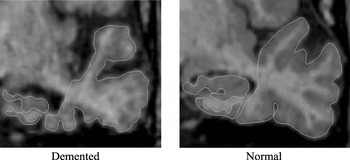
Using the program VIDA (Klein et al., 1997), a volume of interest (VOI) approach was used to delineate the boundaries of the right and left hippocampus (RHC, LHC), temporal lobe (RTL, LTL), and parahippocampal gyrus (RPHG, LPHG; see Figure 1). First the T1-weighted coronal dataset was resliced and aligned perpendicular to the long axis of the left hippocampus. The VOIs were manually traced on 1.6-mm contiguous coronal slices in the anterior to posterior direction. While the borders were traced on the coronal slices, the corresponding sagittal and axial views were used to verify boundaries. VOIs were computed from areas on adjacent slices as traced by raters blind to group membership. Intrarater and, where appropriate, interrater reliabilities were determined using the intraclass correlation coefficient (ICC) (Shrout & Fleiss, 1979), reported for each VOI below. To assess drift in volume measurements, intrarater reliability was determined on two occasions (the second ∼8 months later) for 14 hemispheres of the HC, PHG, and TL.

Example VOI tracings on T1-weighted MR images for two individuals classified as demented (left panel) and normal (right panel). VOIs traced were the hemispheric regions of the hippocampus (HC, middle left in panels), parahippocampal gyrus (PHG, lower left), and remaining temporal lobe (TL; which excluded the HC, PHG and white matter of the PHG).
Hippocampal volume
The hippocampal volume (HC) included the hippocampus proper (CA1–CA3 fields), dentate gyrus, and the subicular complex. The rostral end of the hippocampus was identified using the coronal slice on which the alveus (a white matter marker with high signal intensity) formed the border between the hippocampus and the dorsally located amygdala. In more posterior sections, the hippocampal (choroid) fissure and the superior portion of the inferior horn of the lateral ventricle were the superior boundary; the fimbria were excluded from the superior boundary of the hippocampus. The inferior and medial boundaries of the hippocampus were the white matter of the parahippocampal gyrus. The posterior boundary of the hippocampus was the first slice in which the fornices were completely distinct from the gray/white matter of the thalamus (where the collateral trigone joins the inferior horn of the lateral ventricle with the superior body of the lateral ventricle). A single rater traced the HC regions. ICCs assessed on two occasions were .98 and .94 for RHC and .96 and .95 for LHC.
Parahippocampal gyrus
The parahippocampal gyrus volume (PHG) included gray matter of the entorhinal (EC) and parahippocampal cortices (Amaral, 1999), which were traced separately but later combined. The anterior border of the parahippocampal gyrus started two slices caudal (∼3.2 mm) to the fronto-temporal junction (limen insulae) (Insausti et al., 1998). On more rostral sections where the parahippocampal gray matter could not be distinguished from hippocampus, the medial boundary was taken as a horizontal line drawn medially through the gray matter from the point where the white matter tract of the parahippocampal gyrus ended to the inferior horn of the lateral ventricle (Honeycutt et al., 1998). On more posterior sections the medial parahippocampal gyrus was distinct from the hippocampus and the white matter of the gyrus served as the medial boundary. The lateral border was the fundus of the collateral sulcus. The lateral boundary of the PHG, in sections anterior to the lateral geniculate nucleus (consisting mostly of the entorhinal cortex), depended on the depth of the collateral sulcus as based on methods by Insausti et al. (1995). In sections posterior to the lateral geniculate nucleus, consisting of the parahippocampal cortex, the fundus of the collateral sulcus was taken as the lateral boundary. The posterior border was defined as the first slice in which the gray matter of the calcarine sulcus was apparent on both banks of the sulcus. A single rater traced the PHG. ICCs assessed on two occasions were .84 and .80 for the RPHG and .91 and .94 for the LPHG.
Temporal lobes
The temporal lobe volume (TL) excluded the hippocampus and the gray matter of the parahippocampal gyrus, the other regions traced, and the white matter of the parahippocampal gyrus as in methods by Visser et al. (1999). Also regions of the temporal lobe more posterior to the end of the hippocampus (as defined above) were excluded which marked the posterior boundary for the TL volume. The anterior boundary was the first section in which the temporal lobe was seen. The uncus and amygdala, anterior to the hippocampus, were included in the TL volume. The medial boundary was the fundus of the collateral sulcus, from which a straight line was drawn to the temporal limb of the lateral ventricle; this line was continued vertically to the fundus of the lateral sulcus, excluding the insula, and served as the superior boundary. The TL was traced on every other coronal slice (3.2-mm spacing) by two raters. Interrater ICCs for the temporal lobe regions (RTL, LTL) were .89 and .87. Intrarater ICCs were .99 for the RTL and .90 for the LTL for the first rater and .92 and .98 for the RTL and .82 and .98 for the LTL for the second rater, who was assessed on two occasions.
Intracranial volume (ICV)
ICV was determined by manually outlining the margin of the inner skull on contiguous 10-mm axial slices. The superior boundary was the top of the skull and the inferior boundary was the most superior level of the cerebral peduncles. Two raters traced the ICV with an interrater reliability of .97.
White Matter Signal Hyperintensities
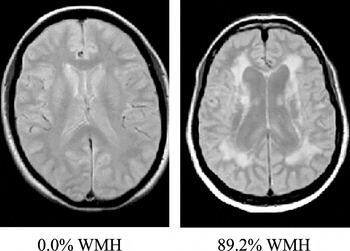
Severity of WMH was determined on proton-density MR images using a semiquantitative scale designed to measure the degree of WMH as a percentage of total white matter (see Figure 2). The scale was a 100-mm line from which the percentage of WMH was determined by measuring the distance from the origin of the scale to the marking placed by a single rater; the greater the severity of WMH the further the mark from the origin. The rater had high intrarater reliability, ICC = .97. An overall percentage rating was determined for each participant from eight equally spaced and contiguous 2.5-mm axial proton-density images. The validity of the scale was further tested by having the rater use the semiquantitative rating scale on a series of 20 brains that had been segmented, using a segmentation program (Fein et al., 2000), into gray and white matter, cerebrospinal fluid, and WMH. WMH percentage of total white matter as determined by the segmentation program and the rater were highly correlated, r = .94.

Axial proton-density MR images for two individuals with different percentages of white matter signal hyperintensities (WMH).
Statistics and Data Analyses
Analysis of variance (ANOVA) with Fisher's Protected Least Significance Difference (PLSD) post-hoc analyses determined group differences on cognitive tests and on demographic variables such as age and education. Chi-square analyses were used to determine group differences on language and gender.
Initially, we used a bivariate correlation matrix between VOIs and the memory scales (Pearson correlation coefficients, r) to identify imaged variables for further analysis. The VOIs used here were normalized to ICV [(VOI volume/ICV) * 100] to control for head size. The hemispheric volumes of the HC and TL were significantly correlated with the memory scales (P < .01) and were selected for further analysis. WMH were also significantly correlated with the memory scales (P < .01) excepting PictAssoc and were also further analyzed. However, the PHG and the entorhinal cortex (EC) were not associated with any of the memory scales (P > .05) and were not analyzed further.
For the population-based analyses, we used standard multivariate linear-regression models to determine whether imaged variables were associated with memory performance while accounting for potential confounds. Control variables such as age, education, language, gender, depression (CES-D) and intracranial volume (ICV) were selected based on their likelihood of either affecting performance on a memory scale or the volume of a VOI. Therefore, discrete models incorporated age, education, language, gender, CES-D, ICV, WMH, and a single Volume of Interest (VOI) as independent variables predicting performance on a memory scale, the dependent variable. The single VOI per model approach was used to avoid collinearities; because of the strong associations between the HC and the TL (R2 = .388), each hemispheric volume was entered independently in the model. The association between WMH and the VOIs was not as strong (R2 < .054). The effective sample size for the regression models was 101 because of missing data for ObjNM (N = 121), PictAssoc (N = 121), CES-D (N = 109), and WMH (N = 112).
Although we relied upon these models for the entire sample, we used bivariate correlations when reporting group effects since the group numbers were generally too small to enter into multivariate models. However, only hypothesis driven associations were analyzed based on the multivariate results.
RESULTS
Groups differed by age (ANOVA, P < .05) and education (ANOVA, P < .001; see Table 1). Participants in the demented group were significantly older than participants in the normal and MI groups (Fisher's PLSD, P < .05). Participants in the CIND group were significantly older than participants in the MI group (Fisher's PLSD, P < .05). Participants in the CIND and demented groups had significantly less education than participants in the MI group (Fisher's PLSD, P < .01 and P < .001, respectively). Groups did not differ on gender (Chi square, P = .18). More MI participants were evaluated in English, whereas more demented participants were evaluated in Spanish (Chi square, P < .05; see Table 1).
Subject demographics and cognitive characteristics

On the 3MS, normals and MI did not differ but the CIND and demented groups differed from all groups (Fisher PLSD, P < .05; see Table 1). On the CES-D, measuring depression, groups did not differ significantly (ANOVA, P = .07) although there was a trend for the more cognitively impaired groups to show higher CES-D scores. All groups differed on DelRec performance (ANOVA, P < .0001). The normal and MI, and CIND and demented groups did not differ on ObjNM and PictAssoc performance, but the CIND and demented groups performed worse than the normal and MI groups on these scales (Fisher's PLSD, P < .05).
Regression Analyses
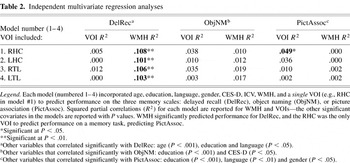
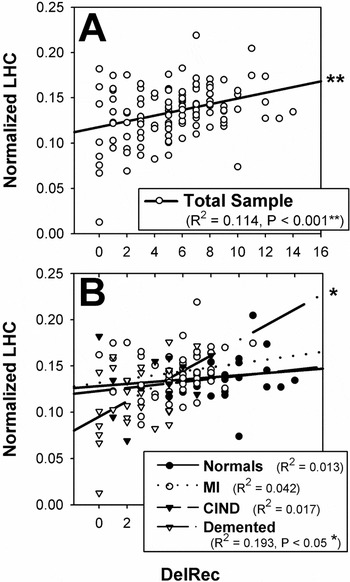
The results of standard multivariate regression models for the entire sample are shown in Table 2 as squared partial correlations (R2) for independent models incorporating single VOIs (hemispheric regions of the HC and TL). Results (R2) for WMH are also shown for each model; for all significant associations the direction was as predicted (greater WMH were associated with lower cognitive scores, greater VOIs were associated with higher cognitive scores). After including age, education, language, gender, CES-D, ICV, and WMH in the models, no VOI was significantly associated with DelRec or ObjNM. The RHC was associated with PictAssoc (R2 = .049, P < .05). Since we hypothesized that the HC volume would be associated with DelRec (an episodic-memory task), we conducted a by-group bivariate analysis to determine if any of the groups displayed this association. Figure 3 shows that the demented group had the only significant association (R2 = .193, P < .05) and appeared to be driving the overall bivariate correlation between LHC and DelRec, a relationship that was not significant in the multivariate analyses. Excluding outliers did not affect any of the analyses in this report.
Independent multivariate regression analyses


Scatter plots showing the strength of association between the ICV normalized LHC volume and delayed recall (DelRec). Panel A shows the overall bivariate association strength in the entire sample; Panel B shows the strength of the group correlations. For the association between the LHC and DelRec, the demented group showed the strongest association.
WMH were strongly associated with DelRec (P < .01) but not ObjNM or PictAssoc (see Table 2). The relationship between WMH and DelRec showed that WMH were associated with memory performance significantly in MI (R2 = .057, P < .05; see Figure 4) and strongly, but not significantly, in the normal group (R2 = .064, P = .121). Using a logarithmically transformed WMH variable (which was more normally distributed than WMH) did not change any of the results reported, except that the relationship of WMH with DelRec became significant for normals (R2 = .225, P < .05). Thus, white matter hyperintensities were associated with DelRec performance in the least cognitively impaired group and in normals.

Scatter plot showing the strength of association between DelRec and the logarithmically plotted WMH. The MI group had the strongest association between these two variables.
To determine the strength of the association of WMH and VOIs independently as predictors of the memory scales, we determined the R2 for a model with only the covariates of age, education, language, gender, CES-D, and ICV—which for DelRec was R2 = .362. Adding WMH to this model increased the R2 by .088 (R2 = .450) where WMH were significantly associated with DelRec (P < .01). However, adding only the LHC volume into the model with the named covariates only increased the R2 by .004 (whole model: R2 = .366). Here the LHC was not significantly associated with DelRec even without WMH in the model (P = .458). With both WMH and the LHC in the model (as in model #1 for DelRec in Table 2), the incremental R2 change was +.088 (R2 = .450). This analysis was also conducted with the other VOIs for DelRec and in entirety for the other two dependent variables (ObjNM and PictAssoc) and showed similar strength of association for WMH and the VOIs as those reported in Table 2. This suggests that the results of the multiple regression analyses could be thought of as independent associations of WMH and each VOI with the memory scales (see Table 2).
DISCUSSION
In this sample of Mexican–Americans, impaired groups tended to be less educated and older in age than normals. With age and education controlled, we found that WMH predicted delayed recall (DelRec) performance. The RHC volume was associated with picture association (PictAssoc) performance. Hypothesis driven bivariate correlations helped to identify groups with significant relationships and showed that WMH were associated with DelRec in the least cognitively impaired group, the memory impaired (MI), and in normals, while the LHC was significantly associated with DelRec in only the demented group. We discuss how these memory/structural relationships relate to the prevalent pathology of this sample and relate our findings to current studies on the organization of declarative memory.
A limitation of this study is that the results may not be generalizable to elderly populations from other ethnic groups because we limited our sample to Mexican–American individuals. Mexican–Americans generally have higher levels of cardiovascular disease and type II diabetes, which could influence the prevalence of WMH (Black et al., 1999). However, this sample is no less representative than many previous studies limited to individuals from a narrow range of ethnicities and because our sample may have had a higher prevalence of WMH this study offers an important contribution to the understanding of the neural correlates of memory function.
Brain Behavior Relationships
PHG volume and declarative memory
The PHG volumes, which excluded white matter, were not significantly associated with the memory scales in our initial analyses and were not analyzed further. Our data are consistent with similar studies that have not observed an association between the volume of the PHG and verbal, episodic-memory tasks related to the DelRec task used here (Köhler et al., 1998), even when the PHG volume included white matter (de Toledo-Morrell et al., 2000). Although some studies are supportive of these negative findings with verbal episodic memory, structural studies with semantic dementia patients (Chan et al., 2001; Galton et al., 2001; Simons et al., 2001) and a study of several cases with hippocampal damage (Vargha-Khadem et al., 1997) suggest that an association between the parahippocampal gyrus and semantic memory should be evident. The possibility exists that structure/memory relationships are difficult to detect in this region because of the difficulty of tracing a neocortical region with more ambiguous and individually varying landmarks (Juottonen et al., 1999; Xu et al., 2000) than the hippocampus, for example.
HC and TL volumes and declarative memory
The standard multivariate regression models were intended to determine how much of the variance in the dependent variables could be attributed to factors such as age, education, WMH, and VOIs. These analyses showed that education consistently played a role on memory performance and that other factors [e.g., age, language, depression (CES-D), gender] and pathology (e.g., WMH) were also contributing. The hemispheric volumes of the HC were significantly associated with the memory scales in preliminary bivariate analyses (see Methods)—which was the selection criterion for further analysis. However, in multivariate analyses the LHC was not significantly correlated with DelRec, a verbal delayed-recall task (episodic memory), although expected from other studies (de Toledo-Morrell et al., 2000; Köhler et al., 1998; Petersen et al., 2000; Wilson et al., 1996). The results suggest that WMH may be more important for episodic memory than the hippocampus, in a sample of participants with many cardiovascular risk factors (Black et al., 1999). We did note a significant bivariate association between the LHC and DelRec in the demented group, which is consistent with the literature involving AD patients (de Toledo-Morrell et al., 2000; Köhler et al., 1998; Petersen et al., 2000). This is in contrast to the relationship between WMH and DelRec which was not observed in dementia participants but in those with mild cognitive impairment (MI; see Figure 4) and possibly in normals (see Results).
In terms of the semantic-memory relationships with the imaged volumes, we showed that the RHC was associated with PictAssoc performance (a nonverbal semantic-memory task). Wilson et al. (1996) reported a significant association between the hippocampal volume and a verbal semantic-memory task (the Boston Naming Test), but the bulk of the evidence suggests that the hippocampal volume is associated with episodic memory: the RHC volume being associated with visual spatial, episodic memory (Abrahams et al., 1999; de Toledo-Morrell et al., 2000) and the LHC volume with verbal episodic memory (de Toledo-Morrell et al., 2000; Köhler et al., 1998). The finding of the RHC being associated with PictAssoc provides some support for a lateralization of function, namely, the right hemisphere being more involved in a nonverbal task of picture association. However, since hippocampal association with semantic memory is highly debated (Aggleton & Brown, 1999; Eichenbaum, 1998; Mishkin et al., 1998; Squire & Zola, 1998; Vargha-Khadem et al., 1997), these findings should be interpreted with caution.
It has been suggested that other brain structures like the temporal neocortex may also be involved with semantic memory (Aggleton & Brown, 1999; Fleischman & Gabrieli, 1999). Initially, the HC and TL volumes were significantly but nonspecifically correlated with the three memory tasks (see Methods). However, the hemispheric regions of the TL were not significantly associated with the memory tasks when other variables were incorporated in multivariate models making it difficult to assess the role of this imaged variable with memory.
WMH and declarative memory
WMH were associated with DelRec. Our results show an association between WMH and a verbal episodic-memory task in the entire sample and allow us to compare the prediction strength of WMH and the HC volume on memory performance. We show that WMH was a stronger predictor variable of DelRec performance than the HC volume, the expected structural predictor. In subgroup (bivariate correlation) analyses, we observed that WMH were not significantly associated with DelRec in the demented or CIND groups, but were most prominently associated in the MI and normal groups suggesting that WMH may be associated with DelRec performance independently of dementia and certain other age or disease-related pathologies.
It has been suggested that different pathogenic mechanisms may underlie the episodic-memory impairments of AD patients and those with subcortical stroke (Libon et al., 1998; Reed et al., 2000). Because of the vascular risks in our sample, the prevalence of WMH may be different than in other ethnic groups and appears to have contributed to a stronger association with memory. We have previously reported an association between a cardiovascular risk factor (systolic blood pressure) and white matter hyperintensities for the non-demented participants in this study (Wu et al., 2002). The non-demented participants with high WMH also had a higher prevalence of previous stroke than did non-demented participants with low WMH (but lower levels than demented individuals). Our prior findings (Wu et al., 2002), in combination with those reported here in the same sample, provide further support that white matter disease is associated with cardiovascular risk factors (Breteler et al., 1994; Longstreth et al., 1996) and memory (Gunning-Dixon & Raz, 2000). In that study, we also observed that WMH were significantly elevated only in these demented participants suggesting that WMH in the normal range may be sufficient to contribute to memory impairment; stressing the importance of white matter disease in episodic-memory impairment where vascular disease may be at risk.
It is interesting that the bivariate association between DelRec and the log-transformed WMH variable is significant in normals since some previous studies have also found significant associations between cognition and WMH in healthy elderly (DeCarli et al., 1995; Swan et al., 1998, 2000) while some have not (DeCarli et al., 1996; Kozachuk et al., 1990; O'Brien et al., 1997). A more limited range of WMH in normals may have contributed to these conflicting findings (Gunning-Dixon & Raz, 2000). However, the specific association between episodic memory and WMH is significant but rather weak in several studies (DeCarli et al., 1995; Libon et al., 1998; Ylikoski et al., 1993) and a recent meta-analysis (Gunning-Dixon & Raz, 2000) suggesting a weak association in the more commonly studied groups of AD patients and normals (DeCarli et al., 1996; Swan et al., 2000; Ylikoski et al., 1993).
The association between DelRec and WMH is, however, not unexpected given the cognitive correlates of WMH and the probable neural demands of the task. DeCarli and colleagues (DeCarli et al., 1995) showed that the neuropsychological scales associated with WMH tended to involve frontal lobe function, such as Trail Making and timed measures. Furthermore, it is thought that an uncued delayed-recall task such as the DelRec task used here may involve more of the frontal lobes than a delayed-recall task that provides participants with a cue, be it a word fragment, associated word, or a category label (Nolde et al., 1998). Interestingly, WMH were not associated with PictAssoc, a visually presented task of picture association, although the RHC was—suggesting that this nonverbal semantic-memory task might rely less upon the frontal lobes and more upon the hippocampus. These findings highlight the importance of white matter signal hyperintensities in studies of declarative memory.
Conclusions
We conclude that in a community-dwelling sample of Mexican–Americans white matter hyperintensities were the strongest structural predictor of verbal delayed-recall performance (episodic memory), particularly in elderly normals and mildly cognitively impaired individuals with no dementia or impairment of daily function. The left hippocampus was associated with verbal delayed recall only for demented individuals. Of the other imaged variables, only the right hippocampal volume was consistently associated with a visually presented picture-association task (nonverbal semantic memory) when confounding variables were controlled. Cognitive/structural relationships in this population may differ than those with a different prevalence of cerebrovascular disease.
ACKNOWLEDGMENTS
This research was supported by NIH grants AG10129 and AG12975.
References
REFERENCES
Abrahams, S.,
Morris, R.G.,
Polkey, C.E.,
Jarosz, J.M.,
Cox, T.C.S.,
Graves, M., &
Pickering, A.
(1999).
Hippocampal involvement in spatial and working memory: A structural
MRI analysis of patients with unilateral mesial temporal lobe
sclerosis.
Brain and Cognition,
41,
39–65.CrossRefGoogle Scholar
Aggleton, J.P. &
Brown, M.W.
(1999).
Episodic memory, amnesia, and the hippocampal-anterior thalamic
axis.
Behavioral and Brain Sciences,
22,
425–444.Google Scholar
Amaral, D.G.
(1999).
Introduction: What is where in the medial temporal lobe?
Hippocampus,
9,
1–6.Google Scholar
Black, S.A.,
Ray, L.A., &
Markides, K.S.
(1999).
The prevalence and health burden of self-reported diabetes in older
Mexican Americans: Findings from the Hispanic established populations
for epidemiologic studies of the elderly.
American Journal of Public Health,
89,
546–552.CrossRefGoogle Scholar
Breteler, M.M.,
van Swieten, J.C.,
Bots, M.L.,
Grobbee, D.E.,
Claus, J.J.,
van den Hout, J.H.,
van Harskamp, F.,
Tanghe, H.L.,
de Jong, P.T.,
van Gijn, J., &
Hofman, A.
(1994).
Cerebral white matter lesions, vascular risk factors, and cognitive
function in a population-based study: The Rotterdam Study.
Neurology,
44,
1246–1252.Google Scholar
Chan, D.,
Fox, N.C.,
Scahill, R.I.,
Crum, W.R.,
Whitwell, J.L.,
Leschziner, G.,
Rossor, A.M.,
Stevens, J.M.,
Cipolotti, L., &
Rossor, M.N.
(2001).
Patterns of temporal lobe atrophy in semantic dementia and
Alzheimer's disease.
Annals of Neurology,
49,
433–442.CrossRefGoogle Scholar
DeCarli, C.,
Murphy, D.G.,
Tranh, M.,
Grady, C.L.,
Haxby, J.V.,
Gillette, J.A.,
Salerno, J.A.,
Gonzales-Aviles, A.,
Horwitz, B.,
Rapoport, S.I., &
Schapiro, M.B.
(1995).
The effect of white matter hyperintensity volume on brain
structure, cognitive performance, and cerebral metabolism of glucose in
51 healthy adults.
Neurology,
45,
2077–2084.CrossRefGoogle Scholar
DeCarli, C.,
Grady, C.L.,
Clark, C.M.,
Katz, D.A.,
Brady, D.R.,
Murphy, D.G.,
Haxby, J.V.,
Salerno, J.A.,
Gillette, J.A.,
Gonzalez-Aviles, A., &
Rapoport, S.I.
(1996).
Comparison of positron emission tomography, cognition, and brain
volume in Alzheimer's disease with and without severe
abnormalities of white matter.
Journal of Neurology, Neurosurgery and Psychiatry,
60,
158–167.Google Scholar
de Leeuw, F.E.,
de Groot, J.C.,
Achten, E.,
Oudkerk, M.,
Ramos, L.M.,
Heijboer, R.,
Hofman, A.,
Jolles, J.,
van Gijn, J., &
Breteler, M.M.
(2001).
Prevalence of cerebral white matter lesions in elderly people: A
population based magnetic resonance imaging study. The Rotterdam Scan
Study.
Journal of Neurology, Neurosurgery and Psychiatry,
70,
9–14.Google Scholar
Del-Ser, T.,
Morales, J.M.,
Barquero, M.S.,
Cantón, R., &
Bermejo, F.
(1997).
Application of a Spanish version of the “Informant
Questionnaire on Cognitive Decline in the Elderly” in the
clinical assessment of dementia.
Alzheimer Disease and Associated Disorders,
11,
3–8.Google Scholar
de Toledo-Morrell, L.,
Dickerson, B.,
Sullivan, M.P.,
Spanovic, C.,
Wilson, R., &
Bennett, D.A.
(2000).
Hemispheric differences in hippocampal volume predict verbal and
spatial memory performance in patients with Alzheimer's
disease.
Hippocampus,
10,
136–142.3.0.CO;2-J>CrossRefGoogle Scholar
Eichenbaum, H.B.
(1998).
Amnesia, the hippocampus, and episodic memory [editorial].
Hippocampus,
8,
197.Google Scholar
Fein, G.,
Di Sclafani, V.,
Tanabe, J.,
Cardenas, V.,
Weiner, M.W.,
Jagust, W.J.,
Reed, B.R.,
Norman, D.,
Schuff, N.,
Kusdra, L.,
Greenfield, T., &
Chui, H.
(2000).
Hippocampal and cortical atrophy predict dementia in subcortical
ischemic vascular disease.
Neurology,
55,
1626–1635.Google Scholar
Fleischman, D.A. &
Gabrieli, J.
(1999).
Long-term memory in Alzheimer's disease.
Current Opinion in Neurobiology,
9,
240–244.CrossRefGoogle Scholar
Galton, C.J.,
Patterson, K.,
Graham, K.,
Lambon-Ralph, M.A.,
Williams, G.,
Antoun, N.,
Sahakian, B.J., &
Hodges, J.R.
(2001).
Differing patterns of temporal atrophy in Alzheimer's disease
and semantic dementia.
Neurology,
57,
216–225.Google Scholar
Garde, E.,
Mortensen, E.L.,
Krabbe, K.,
Rostrup, E., &
Larsson, H.B.
(2000).
Relation between age-related decline in intelligence and cerebral
white-matter hyperintensities in healthy octogenarians: A longitudinal
study.
Lancet, 356,
628–634.CrossRefGoogle Scholar
Gonzalez, H.M.,
Mungas, D.,
Reed, B.R.,
Marshall, S., &
Haan, M.N.
(2001a).
A new verbal learning and memory test for English- and
Spanish-speaking older people.
Journal of the International Neuropsychological Society,
7,
544–555.Google Scholar
Gonzalez, H.M.,
Haan, M.N., &
Hinton, L.
(2001b).
Acculturation and the prevalence of depression in older Mexican
Americans: Baseline results of the Sacramento Area Latino Study on
Aging.
Journal of the American Geriatric Society,
49,
948–953.Google Scholar
Gunning-Dixon, F.M. &
Raz, N.
(2000).
The cognitive correlates of white matter abnormalities in normal
aging: A quantitative review.
Neuropsychology,
14,
224–232.CrossRefGoogle Scholar
Honeycutt, N.A.,
Smith, P.D.,
Aylward, E.,
Li, Q.,
Chan, M.,
Barta, P.E., &
Pearlson, G.D.
(1998).
Mesial temporal lobe measurements on magnetic resonance imaging
scans.
Psychiatry Research,
83,
85–94.Google Scholar
Insausti, R.,
Tuñón, T.,
Sobreviela, T.,
Insausti, A.M., &
Gonzalo, L.M.
(1995).
The human entorhinal cortex: A cytoarchitectonic analysis.
Journal of Comparative Neurology,
355,
171–198.Google Scholar
Insausti, R.,
Juottonen, K.,
Soininen, H.,
Insausti, A.M.,
Partanen, K.,
Vainio, P.,
Laakso, M.P., &
Pitkänen, A.
(1998).
MR volumetric analysis of the human entorhinal, perirhinal, and
temporopolar cortices.
American Journal of Neuroradiology,
19,
659–671.Google Scholar
Jack, C.R., Jr.,
Petersen, R.C.,
Xu, Y.C.,
O'Brien, P.C.,
Smith, G.E.,
Ivnik, R.J.,
Boeve, B.F.,
Waring, S.C.,
Tangalos, E.G., &
Kokmen, E.
(1999).
Prediction of AD with MRI-based hippocampal volume in mild
cognitive impairment.
Neurology,
52,
1397–1403.Google Scholar
Jorm, A.F. &
Korten, A.E.
(1988).
Assessment of cognitive decline in the elderly by informant
interview.
British Journal of Psychiatry,
152,
209–213.Google Scholar
Juottonen, K.,
Laakso, M.P.,
Partanen, K., &
Soininen, H.
(1999).
Comparative MR analysis of the entorhinal cortex and hippocampus in
diagnosing Alzheimer disease.
American Journal of Neuroradiology,
20,
139–144.Google Scholar
Klein, G.J.,
Teng, X.,
Jagust, W.J.,
Eberling, J.L.,
Acharya, A.,
Reutter, B.W., &
Huesman, R.H.
(1997).
A methodology for specifying PET VOI's using multimodality
techniques.
IEEE Transactions on Medical Imaging,
16,
405–415.Google Scholar
Köhler, S.,
Black, S.E.,
Sinden, M.,
Szekely, C.,
Kidron, D.,
Parker, J.L.,
Foster, J.K.,
Moscovitch, M.,
Winocour, G.,
Szalai, J.P.,
Bronskill, M.J., &
Wincour, G.
(1998).
Memory impairments associated with hippocampal versus
parahippocampal-gyrus atrophy: An MR volumetry study in
Alzheimer's disease.
Neuropsychologia,
36,
901–914.Google Scholar
Kozachuk, W.E.,
DeCarli, C.,
Schapiro, M.B.,
Wagner, E.E.,
Rapoport, S.I., &
Horwitz, B.
(1990).
White matter hyperintensities in dementia of Alzheimer's type
and in healthy subjects without cerebrovascular risk factors. A
magnetic resonance imaging study.
Archives of Neurology,
47,
1306–1310.Google Scholar
Libon, D.J.,
Bogdanoff, B.,
Cloud, B.S.,
Skalina, S.,
Giovannetti, T.,
Gitlin, H.L., &
Bonavita, J.
(1998).
Declarative and procedural learning, quantitative measures of
hippocampus, and subcortical white alterations in Alzheimer's
disease and ischaemic vascular dementia.
Journal of Clinical and Experimental Neuropsychology,
20,
30–41.Google Scholar
Longstreth, W.T., Jr.,
Manolio, T.A.,
Arnold, A.,
Burke, G.L.,
Bryan, N.,
Jungreis, C.A.,
Enright, P.L.,
O'Leary, D., &
Fried, L.
(1996).
Clinical correlates of white matter findings on cranial magnetic
resonance imaging of 3301 elderly people. The Cardiovascular Health
Study.
Stroke,
27,
1274–1282.Google Scholar
Mishkin, M.,
Vargha-Khadem, F., &
Gadian, D.G.
(1998).
Amnesia and the organization of the hippocampal system.
Hippocampus,
8,
212–216.3.0.CO;2-L>CrossRefGoogle Scholar
Mungas, D.,
Reed, B.R.,
Marshall, S.C., &
Gonzalez, H.M.
(2000).
Development of psychometrically matched English and Spanish
language neuropsychological tests for older persons.
Neuropsychology,
14,
209–223.Google Scholar
Nolde, S.F.,
Johnson, M.K., &
Raye, C.L.
(1998).
The role of prefrontal cortex during tests of episodic memory.
Trends in Cognitive Sciences,
2,
399–406.CrossRefGoogle Scholar
O'Brien, J.T.,
Desmond, P.,
Ames, D.,
Schweitzer, I., &
Tress, B.
(1997).
Magnetic resonance imaging correlates of memory impairment in the
healthy elderly: Association with medial temporal lobe atrophy but not
white matter lesions.
International Journal of Geriatric Psychiatry,
12,
369–374.Google Scholar
Petersen, R.C.,
Jack, C.R., Jr.,
Xu, Y.C.,
Waring, S.C.,
O'Brien, P.C.,
Smith, G.E.,
Ivnik, R.J.,
Tangalos, E.G.,
Boeve, B.F., &
Kokmen, E.
(2000).
Memory and MRI-based hippocampal volumes in aging and AD.
Neurology,
54,
581–587.Google Scholar
Reed, B.R.,
Eberling, J.L.,
Mungas, D.,
Weiner, M.W., &
Jagust, W.J.
(2000).
Memory failure has different mechanism in subcortical stroke and
Alzheimer's disease.
Annals of Neurology,
48,
275–284.Google Scholar
Shrout, P.E. &
Fleiss, J.L.
(1979).
Intraclass correlations: Uses in assessing rater reliability.
Psychological Bulletin,
86,
420–428.Google Scholar
Simons, J.S.,
Graham, K.S.,
Galton, C.J.,
Patterson, K., &
Hodges, J.R.
(2001).
Semantic knowledge and episodic memory for faces in semantic
dementia.
Neuropsychology,
15,
101–114.Google Scholar
Skoog, I.
(1998).
Status of risk factors for vascular dementia.
Neuroepidemiology,
17,
2–9.CrossRefGoogle Scholar
Squire, L.R. &
Zola, S.M.
(1998).
Episodic memory, semantic memory, and amnesia.
Hippocampus,
8,
205–211.Google Scholar
Swan, G.E.,
DeCarli, C.,
Miller, B.L.,
Reed, T.,
Wolf, P.A.,
Jack, L.M., &
Carmelli, D.
(1998).
Association of midlife blood pressure to late-life cognitive
decline and brain morphology.
Neurology,
51,
986–993.Google Scholar
Swan, G.E.,
DeCarli, C.,
Miller, B.L.,
Reed, T.,
Wolf, P.A., &
Carmelli, D.
(2000).
Biobehavioral characteristics of nondemented older adults with
subclinical brain atrophy.
Neurology,
54,
2108–2114.CrossRefGoogle Scholar
Teng, E.L. &
Chui, H.C.
(1987).
The Modified Mini-Mental State (3MS) examination.
Journal of Clinical Psychiatry,
48,
314–318.Google Scholar
Vargha-Khadem, F.,
Gadian, D.G.,
Watkins, K.E.,
Connelly, A.,
Van Paesschen, W., &
Mishkin, M.
(1997).
Differential effects of early hippocampal pathology on episodic and
semantic memory.
Science,
277,
376–380.Google Scholar
Visser, P.J.,
Scheltens, P.,
Verhey, F.R.,
Schmand, B.,
Launer, L.J.,
Jolles, J., &
Jonker, C.
(1999).
Medial temporal lobe atrophy and memory dysfunction as predictors
for dementia in subjects with mild cognitive impairment.
Journal of Neurology,
246,
477–485.CrossRefGoogle Scholar
Wilson, R.S.,
Sullivan, M.,
deToledo-Morrell, L.,
Stebbins, G.T., &
Bennett, D.A.
(1996).
Association of memory and cognition in Alzheimer's disease
with volumetric estimates of temporal lobe structures.
Neuropsychology,
10,
459–463.CrossRefGoogle Scholar
Wu, C.C.,
Mungas, D.,
Petkov, C.I.,
Eberling, J.L.,
Zrelak, P.A.,
Buonocore, M.H.,
Brunberg, J.A.,
Haan, M.N., &
Jagust, W.J.
(2002).
Brain structure and cognition in a community sample of elderly
Latinos.
Neurology,
59,
383–391.CrossRefGoogle Scholar
Xu, Y.,
Jack, C.R., Jr.,
O'Brien, P.C.,
Kokmen, E.,
Smith, G.E.,
Ivnik, R.J.,
Boeve, B.F.,
Tangalos, R.G., &
Petersen, R.C.
(2000).
Usefulness of MRI measures of entorhinal cortex versus hippocampus
in AD.
Neurology,
54,
1760–1767.CrossRefGoogle Scholar
Ylikoski, R.,
Ylikoski, A.,
Erkinjuntti, T., &
Sulkava, R.
(1993).
White matter changes in healthy elderly persons correlate with
attention and speed of mental processing.
Archives of Neurology,
50,
818–824.Google Scholar
Example VOI tracings on T1-weighted MR images for two individuals classified as demented (left panel) and normal (right panel). VOIs traced were the hemispheric regions of the hippocampus (HC, middle left in panels), parahippocampal gyrus (PHG, lower left), and remaining temporal lobe (TL; which excluded the HC, PHG and white matter of the PHG).
Axial proton-density MR images for two individuals with different percentages of white matter signal hyperintensities (WMH).

Subject demographics and cognitive characteristics
Independent multivariate regression analyses
Scatter plots showing the strength of association between the ICV normalized LHC volume and delayed recall (DelRec). Panel A shows the overall bivariate association strength in the entire sample; Panel B shows the strength of the group correlations. For the association between the LHC and DelRec, the demented group showed the strongest association.
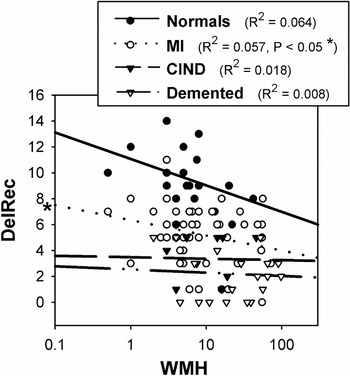
Scatter plot showing the strength of association between DelRec and the logarithmically plotted WMH. The MI group had the strongest association between these two variables.
 You have
Access
- 23
- Cited by