In May 2018, during a meeting with state and local leaders about immigration laws, President Donald Trump lashed out at undocumented immigrants. ‘These aren't people,’ he said. ‘These are animals, and we're taking them out of the country at a level and at a rate that's never happened before.’Footnote 1 Trump frequently used this type of animalistic rhetoric to characterize people of color. For instance, he publicly referred to one of his former aides, an African-American woman, as a dog. He described the predominantly Black city of Baltimore as ‘rat and rodent infested’.Footnote 2 Some of Trump's supporters have done the same. For example, at a Trump campaign rally in Louisville in 2016, multiple people called a Black reporter a ‘monkey’; as the reporter took notes about the rally, one an attendee said, ‘Look at the monkey write’.Footnote 3 At another Trump rally in Raleigh, North Carolina that same year, when Trump criticized President Barack Obama, a Trump supporter yelled ‘He's a monkey!’Footnote 4 Similar language was evident in Trump's 2020 campaign; on 20 June 2020, his son Eric Trump called Black Lives Matter protestors ‘animals’.Footnote 5 What is striking about this language is that it is dehumanizing; it likens people to animals, thereby denying their full humanity and treating them as if they were less than fully human.
To some scholars of race and politics, Trump's political success among non-Hispanic White voters, given the use of this dehumanizing language, ought to be surprising. Work in this domain has argued that more overt forms of prejudice have all but disappeared, and that in the post-Civil Rights era, the use of or association with racism, racialized language, or racial messages is only an acceptable or successful political strategy when employed subtly and covertly (Kinder and Sanders Reference Kinder and Sanders1996; Mendelberg Reference Mendelberg1997; Valentino, Hutchings and White Reference Valentino, Hutchings and White2002).Footnote 6 Here, however, we push back on these long-standing and dominant claims. We suggest that Trump was not necessarily politically successful despite his association with dehumanizing rhetoric, but for some White Americans, because of it. Specifically, we show that many White Americans hold explicitly dehumanizing views about Black people, and that these attitudes are strongly tied not only to Trump support, but also to opposition to Barack Obama.
Our findings depart from previous studies by demonstrating that today, a sizeable portion of White Americans hold attitudes that are not merely implicitly or subtly racist, but actually dehumanizing. As such, the findings presented here necessitate an important revision to a near consensus in the race and politics literature – the notion that overt forms of racism, such as beliefs about innate, immutable and biological differences between racial groups, are no longer widely held among the American public (see Hutchings Reference Hutchings2015 for a discussion).Footnote 7 We also argue that beliefs consistent with scientific racism (also referred to as old-fashioned racism) are only one form of a broader phenomenon of dehumanization. Furthermore, we show that these dehumanizing attitudes are more widely held among White Americans than many contemporary theories acknowledge.
Finally, we demonstrate that Whites who possess these beliefs carry them into the political world. These Whites overwhelmingly and uniquely favor Donald Trump over other Republican presidential candidates (Jardina, McElwee and Piston Reference Jardina, McElwee and Piston2016), and also tend to evaluate Barack Obama negatively. Drawing on four studies conducted among nationally diverse samples of non-Hispanic White Americans, we find that dehumanizing attitudes significantly predict Trump support and Obama opposition even after taking into account traditional measures of racial attitudes and other widely cited correlates of candidate support, including authoritarian attitudes, populism and immigration opinion. The relationship between dehumanizing attitudes and Trump support is substantial: in many instances dehumanizing attitudes rival party identification in their associations with Whites' attitudes toward Donald Trump.
What are Dehumanizing Attitudes?
While scholars have written about dehumanization for decades, social psychologists in particular have more recently begun to turn greater attention to the concept not only as a broad process but also as a measurable individual-level tendency to view a group as less than fully human (Haslam and Loughnan Reference Haslam and Loughnan2014; Kteily and Bruneau Reference Kteily and Bruneau2017b; Kteily et al. Reference Kteily2015). They have identified a number of different manifestations of this phenomenon, but we focus on animalistic dehumanizing attitudes. When individuals are dehumanized in an animalistic way, they are likened to animals and viewed as lacking refinement, self-control and rationality (Haslam Reference Haslam2006).
As a psychological phenomenon, animalistic dehumanizing attitudes are pervasive and widespread; they are often used as a psychological shortcut to ‘other’ an out-group for the purpose of justifying harmful behavior directed toward that group. History is filled with examples of one group dehumanizing another in an animalistic way. The Nazis described Jews as vermin. Immigrants are often described as pests. Recently, political scientists have found that many people harbor these type of dehumanizing attitudes toward Muslims (Lajevardi and Oskooii Reference Lajevardi and Oskooii2018) and immigrants (Utych Reference Utych2018). Dehumanizing attitudes may also be at play during partisan conflict (Cassese Reference Cassese2019).
Here we investigate a particular manifestation of animalistic dehumanizing attitudes: The way some Whites view Black people. Since before the nation's founding to the present day, Black people have often been likened to apes, monkeys and other animals (Panaitiu Reference Panaitiu2019). These portrayals have long shaped how people have understood fundamental concepts of race, the distinctions between humans and other animals, and human difference. For example, in Reference DuBois1940 W.E.B. DuBois observed, ‘I remember once in a museum, coming face to face with a demonstration: a series of skeletons arranged from a little monkey to a tall well-developed White man, with a Negro barely outranking a chimpanzee’ (98). These beliefs are deeply woven into the American psyche, often with great consequence. Consider, for instance, when a Los Angeles police officer in the 1990s infamously referred to a Black couple as ‘something right out of “Gorillas in the Mist”’ before participating in the Rodney King beating. His views were likely consistent with many others in his department; members of the Los Angeles Police Department were known to use the term NHI (No Humans Involved) to describe disturbances in Black communities.Footnote 8 More recently, a 2015 Department of Justice investigation of the Chicago Police Department (CPD) uncovered numerous reports of CPD officers referring to individuals in mostly Black neighborhoods as animals or subhuman.Footnote 9 Consistent with these reports, Black people in highly policed communities across the nation have informed researchers that police treat them as less than fully human and use slurs that compare them to animals (Lerman and Weaver Reference Lerman and Weaver2014; Weaver, Prowse and Piston Reference Weaver, Prowse and Piston2019). Here we argue that these associations are held among a much wider swath of White Americans than existing scholarship acknowledges.
Dehumanizing attitudes are positioned along a continuum, and the extent to which a group is viewed as less than fully human may vary. Such attitudes can be either implicit or explicit. Indeed, a number of studies have used implicit association tests to reveal subtle, unconscious forms of dehumanizing attitudes, including the association of Black people with monkeys or apes (Goff et al. Reference Goff2008). We build on the work of social psychologist Nour Kteily and his colleagues (Kteily and Bruneau Reference Kteily and Bruneau2017b; Kteily et al. Reference Kteily2015) to focus on explicit dehumanizing attitudes toward Black people – a phenomenon not often studied in nationally representative surveys of White Americans.Footnote 10
The Origins and Maintenance of Whites' Dehumanizing Attitudes Toward Black People
The dehumanization of Black people has a long history that dates back to the very origins of the concept of race. The idea that individuals could be sorted into distinct racial groups was instrumental in justifying European and American colonization and the enslavement of Africans. As Smedley and Smedley write, ‘In an era when the dominant political philosophy was equality, civil rights, democracy, justice, and freedom for all human beings, the only way Christians could justify slavery was to demote Africans to nonhuman status’ (Reference Smedley and Smedley2005, 19). In the nineteenth century, these sentiments became the foundation of scientific racism – or claims that some ‘races’ were less evolved than others. Proponents of scientific racism argued that different racial groups were higher or lower on an evolutionary spectrum ranging from ape to fully evolved human, a belief portrayed in the museum that DuBois visited and discussed above. These ideas became central to beliefs about race in America in the twentieth century.
In the post-Civil Rights era, many scholars of racial attitudes have argued that these beliefs about innate differences between racial groups largely disappeared from the public mind, and racial attitudes became more subtle, rooted primarily in resentment and the belief that Black people fail to subscribe to American individualism (Bobo et al. Reference Bobo and Marsden2012; Kinder and Sanders Reference Kinder and Sanders1996; Sears Reference Sears, Katz and Dalmas1988; Sears and Henry Reference Sears and Henry2005). But there are a few reasons why the vestiges of scientific racism may remain prevalent among White Americans. For one, scientific racism was not formally condemned until 1950 – within the lifetime of many Americans alive today (UNESCO 1950). Furthermore, while evolutionary biologists no longer consider human evolution to have occurred linearly along a spectrum beginning with apes, it remains true that evolution is still routinely depicted in this way. The famous ‘March of Progress’ illustration, depicting a sequence of evolution from an apelike creature to a human, was commissioned by Time Life Books for a 1965 anthropology volume and today is ‘the canonical representation of evolution’ (Gould Reference Gould1989, 30).
Depictions of Black people as apes or primates also remain a common feature of contemporary American and European culture, as noted above in the discussion of police. In recent years, celebrities and lay people alike have made news headlines for likening Black people to apes.Footnote 11 Michelle and Barack Obama were frequently referred to or depicted as apes or monkeys while Barack Obama served as US president (discussed further below). And soccer players of African descent are routinely assailed with monkey chants on the sports field, as recent incidents in Italy,Footnote 12 BulgariaFootnote 13 and the United KingdomFootnote 14 show. Social psychologists have demonstrated in numerous studies that the association between Black people and apes is stubbornly stuck in the subconscious minds of Whites. For instance, when primed with images of Black faces, White study participants were more quickly able to identify obscured images of apes than those primed with White faces (Goff et al. Reference Goff2008). Furthermore, White participants who were subliminally primed with ape words were disproportionately more likely to endorse the police beating someone – but only if that person was described as Black rather than White (Goff et al. Reference Goff2008). We extend this research by arguing that these associations between animals and Black people are prevalent in the conscious minds of many White Americans, not merely in the domain of the subconscious.
We also suspect that recent trends in the social and natural sciences are legitimizing beliefs about biological differences between racial groups in ways that reinforce a propensity to dehumanize Black people (for example, Winegard, Winegard and Anomaly Reference Winegard, Winegard and Anomaly2020). Perhaps the most notorious example is Herrnstein and Murray's The Bell Curve (1994), which argued that there are racial differences in intelligence rooted in biology. But other work, including a large and growing body of research in the natural sciences suggesting that genetic disorders are differentially distributed across racial groups, may be contributing to the belief that differences between Black people and White people are essential and immutable (Duster Reference Duster2003). Indeed, biologically essentialist definitions of race have been on the rise in science textbooks since the mid-twentieth century, increasingly exposing Americans to these ideas (Morning Reference Morning2008).
Academia is not immune to these trends. For instance, a recent article in the American Economic Review, the flagship journal of the American Economics Association, argues that the nature of genetic diversity in Africa has been ‘detrimental’ to the continent's economic development (Ashraf and Galor Reference Ashraf and Galor2013). This claim has been echoed by others, including former deputy editor of Nature and retired New York Times journalist Nicholas Wade in his recent book A Troublesome Inheritance (Reference Wade2014) and by Harvard professor of genetics David Reich in a New York Times op-ed in Reference Reich2018.
We suspect that the growing acceptability of genetic explanations for racial differences in human disease, human behavior and socioeconomic outcomes (Evans Reference Evans2018) legitimizes biological racism, and the propensity to hold dehumanizing attitudes about Black people, in the public mind. For example, in a survey conducted by sociologists Byrd and Ray (Reference Byrd and Ray2015), their White respondents, on average, reported that genes exert more influence over the traits and behaviors of Black people than White people. Phelan, Link and Feldman (Reference Phelan, Link and Feldman2013) find that exposure to a news story reporting racial differences in heart attack risk caused study subjects to believe more strongly in essential racial differences. Thus there is some evidence already that the resurgence of genetics in elite conversations about race and human behavior undermines political efforts to reach a more racially egalitarian society. As Byrd and Hughey write, ‘This dangerous synthesis of beliefs limits policy redress of racial inequality, as the fact that inequality is the result of man-made efforts is dispensed for a supposedly scientific answer: Inequality is a genetic reality.’Footnote 15
Alongside the proliferation of genetic explanations of racial differences in elite academic circles, another insidious force is gaining traction: the rise of White supremacists in contemporary American politics. Indeed, White supremacists are notoriously some of Donald Trump's strongest supporters. These groups explicitly condone the belief that Whites are inherently superior to non-Whites, and they often turn to academic research to provide evidence to bolster these beliefs.Footnote 16 Furthermore, White supremacists are not merely becoming more visible at the grassroots level, as we have seen with the high-profile protests from group members in Charlottesville, Virginia. Many Whites with ideological beliefs consistent with White supremacist groups held top political positions in the Trump administration, including Steven Bannon (President Trump's former chief strategist), Sebastian Gorka (Trump's former deputy assistant) and Stephen Miller (Trump's senior policy advisor). Other public figures associated with the alt-right, including Richard Spencer and Milo Yiannopoulos, have increasingly brought claims of immutable racial differences back into the mainstream. They have received substantial media attention from mainstream news outlets like The New York Times and NPR.Footnote 17 We suspect that increased coverage of these groups, particularly stories that are normalizing in nature, legitimizes erroneous beliefs about racial differences among White Americans.
Indeed, many Americans reacting to the significance of Obama's election and the increasing diversity of the United States seem to share many of the views of bona fide White supremacists while denying any association with these groups (Jardina Reference Jardina2019; Jardina Reference Jardina2020). What is more, the widespread White backlash to the nation's changing demographics (Abrajano and Hajnal Reference Abrajano and Hajnal2015), and the perceived threat many Whites feel as a result, may also mean that many Whites in the United States are especially receptive to dehumanizing rhetoric, especially if it serves the psychological function of distinguishing their racial group from others and reinforcing beliefs about the inherent superiority of their group.
The Consequences of Dehumanization
Dehumanization has serious consequences. It places the targets of these attitudes outside of moral consideration, reduces feelings of empathy, increases social distance, and fosters the perception that group members are dangerous and unworthy of support or fair treatment (Bandura Reference Bandura2002; Kteily and Bruneau Reference Kteily and Bruneau2017b; Opotow Reference Opotow1990). Dehumanizing attitudes can allow for the denial of basic rights and protections for a group. At their most extreme, such attitudes can be used to condone violence and gross harm toward their targets (Haslam and Loughnan Reference Haslam and Loughnan2014; Moller and Deci Reference Moller and Deci2010). We also suspect that dehumanizing attitudes can lead White Americans to accept explicitly racist rhetoric from political candidates and to support candidates who use such rhetoric. Therefore, we predict that Whites who hold dehumanizing attitudes toward Black people were relatively untroubled by Trump's dehumanizing rhetoric or the support he received from White supremacists; instead, these Whites were likely more supportive of Trump, all else equal. In addition, we suspect that like Whites with more racially resentful attitudes (Tesler Reference Tesler2016a), Whites with dehumanizing attitudes toward Black people express less support for Black politicians such as Barack Obama.
Dehumanizing Attitudes and the Limits of Old-Fashioned Racism
Scholars of White racial attitudes generally agree that during the era of Jim Crow racial segregation, White Americans' racial attitudes were mainly expressed as a constellation of beliefs that is now often referred to as old-fashioned or scientific racism (Feldman and Huddy Reference Feldman and Huddy2010; Jardina and Piston Reference Jardina and Piston2019; Kinder and Sanders Reference Kinder and Sanders1996). As Michael Tesler (Tesler Reference Tesler2013, 113) summarizes, old-fashioned racism is comprised of the following three elements: ‘(1) desire for social distance between the races, (2) beliefs in the biological inferiority of Blacks, and (3) support [for] public policies [ensuring] racial segregation and formalized discrimination’. There are some elements of old-fashioned racism that we think comport with the concept of dehumanization.
But old-fashioned racism as discussed in political science is not uniformly conceived in this way, and it has important limitations. For one, while it is often (although not always) defined as a belief that Black people are inferior, it does not always account for the association with animals – an association that we argue has important consequences for the specific and untrue beliefs some White people have about how Black people behave and how they should be treated. For example, one might think that Black people are less intelligent – a false charge associated with scientific racism – but nonetheless see them as fully human and worthy of policies that help their group, of equal treatment by police, and of full access to rights and protections under the law. A person who holds specifically dehumanizing attitudes toward Black people, however, ought to be less willing to extend these rights.
In political science, old-fashioned racism is often operationalized as opposition to interracial dating or marriage – a fairly rough and imprecise proxy for either a preference for social distance or beliefs about inferiority (Tesler Reference Tesler2013).Footnote 18 We argue that a White person might indeed oppose a family member marrying a person of a different race because they have some degree of antipathy to racial outgroups. Such opposition might also be due to opinions about the biological inferiority of Black people and a distaste for ‘race mixing,’ But some White people might oppose it for reasons that are still problematic and paternalistic, but nevertheless wholly different, like beliefs about cultural differences, a person's inability to fully understand the experiences of discrimination faced by the person of color, the likelihood that the couple will experience harassment, or the potential for children of ‘mixed race’ to experience discrimination. In other words, opposition to dating and marriage across racial groups may have a variety of underlying motivations that the measure is not able to distinguish. The concept of dehumanizing attitudes, and our process for assessing them, avoids conflating the many inconsistent views that are potentially confounded by conventional measures of old-fashioned racism.
Dehumanizing Attitudes and Electoral Politics
While dehumanizing attitudes toward Black people may have effects on a range of political preferences, here we are concerned with their impact on evaluations of political figures. We first focus on evaluations of Donald Trump. We have highlighted the ways in which he has signaled that he is comfortable with extreme and virulent forms of racism (Hutchings and Jardina Reference Hutchings and Jardina2009). Whites who hold dehumanizing attitudes toward Black people may see Trump not as inappropriately violating a norm of racial equality, but instead as simply acknowledging what they (incorrectly) believe are real differences between racial groups. We therefore expect that dehumanizing attitudes influenced voters’ evaluations of Trump in the 2016 election, even after accounting for traditional measures of racial prejudice. We do not, however, anticipate that these attitudes were as strongly connected to support for other Republican presidential candidates, since these candidates did not invoke old-fashioned forms of racism to the same degree as Trump.
We also argue that Whites with dehumanizing attitudes toward Black people may penalize Black politicians such as Barack Obama. As we noted above, Obama has been subject to dehumanizing rhetoric and political opponents have often depicted him as a primate. For instance, during Obama's first presidential election campaign in 2008, chimp dolls were seen at Republican political rallies.Footnote 19 A 2009 editorial cartoon in The New York Post infamously portrayed Obama as an ape.Footnote 20 And in 2016, a Kentucky Republican state House candidate was criticized after he refused to apologize for posting pictures online that showed President Obama and the first lady as monkeys.Footnote 21 We expect, however, that these instances were not isolated to a few disgruntled political opponents. Instead, we posit that a wide swath of Whites makes these associations, and that those who do are likely to be far less supportive of Obama, all else equal.
Methods and Empirical Analyses
If we are correct that dehumanizing views of Black people are an important component of public thinking that shapes Whites' evaluations of public figures, then our argument has several empirical implications. First, notable proportions of White American respondents should endorse dehumanizing propositions about Black people. Secondly, it should be possible to reliably measure these dehumanizing attitudes, and they should be related to (but also distinct from) standard political variables. Thirdly, dehumanizing attitudes toward Black people should be positively associated with White support for Trump but less strongly associated with support for other candidates in the 2016 Republican presidential primary. Fourthly, dehumanizing attitudes toward Black people should be positively associated with warmth toward Trump as the general election approached and with Whites' vote choice for Trump over Clinton in the 2016 presidential election. Finally, Whites who view Black people in dehumanizing ways should be disproportionately more likely to harbor negative views of Barack Obama. We now subject these propositions to empirical scrutiny.
Measuring Dehumanizing Attitudes
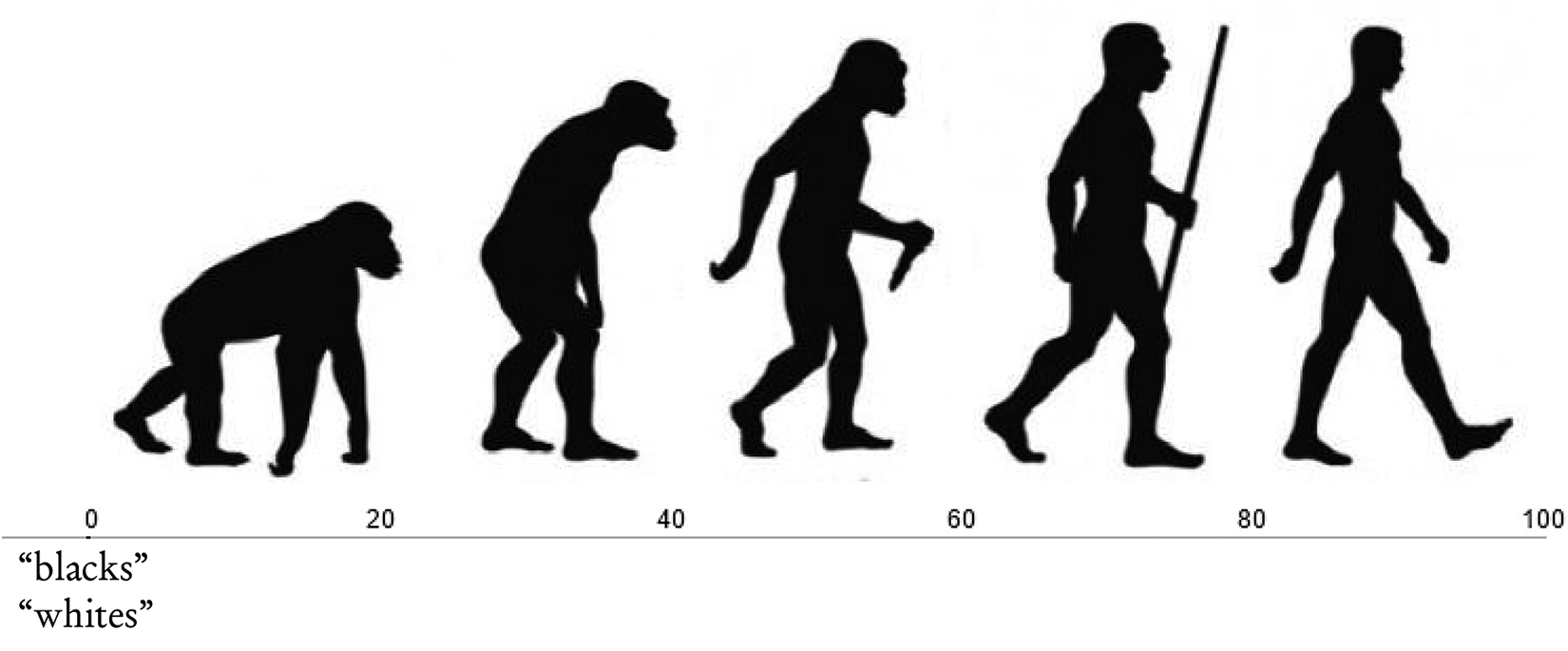
We employ two measures of dehumanizing attitudes, both of which were originally developed by social psychologists but have thus far only been administered to convenience samples (cf., Forscher and Kteily Reference Forscher and Kteily2020). We build on prior research by analyzing the extent of dehumanizing attitudes and their association with evaluations of presidential candidates among a nationally representative sample of White Americans. The first measure relies on the iconic ‘Ascent of Man’ scale (Kteily et al. Reference Kteily2015), which presents respondents with various silhouettes that reflect popular perceptions of the evolution of humans, beginning with a distant ancestor reminiscent of an ape, moving to a Cro-Magnon type figure and concluding with a modern human. Under this figure is an instruction asking subjects to rate ‘how evolved’ Whites and Blacks are on a 0–100 scale. We recognize that this measure may be jarring, but we note that it has a number of important traits. First, it clearly taps explicit dehumanizing attitudes. It also reflects the legacy of scientific racism by asking respondents to indicate the degree to which they think some racial groups are more or less evolved than others. While some scholars have argued that such beliefs have largely disappeared from the public mind, this measure allows us to assess the extent to which they persist among the mass public.
We complement the Ascent of Man measure with a second measure of dehumanizing attitudes, in which we ask respondents how well three ‘Dehumanizing Characteristics’ describe Black people. The first two of these characteristics, ‘savage’ and ‘barbaric’, are often ascribed by survey respondents to apes, monkeys or gorillas (Goff et al. Reference Goff2008). The third, ‘lacking self-restraint, like animals’ is taken from previous research in psychology on animalistic dehumanization (Bastian, Denson and Haslam Reference Bastian, Denson and Haslam2013; Kteily et al. Reference Kteily2015). We construct a three-item battery from these questions, and present both of our measures of dehumanizing attitudes in Figure 1. In many of the analyses that follow, we employ both of these measures to demonstrate the robustness of our results, and to ensure that they are not driven by an unforeseen defect in measurement.
Measures of dehumanizing attitudes
(a) Ascent of Man measure. People can vary in how human-like they seem. Using the image below, please indicate using the sliders how evolved you consider the average member of each group to be:’
‘Blacks’
‘Whites’
(b) Dehumanizing characteristics measure
‘How well do you think each of the following characteristics tend to describe most Blacks?’
‘Barbaric’
‘Savage’
‘Lacking self-restraint, like animals’
Response options run along a 1–7 scale from ‘Not at all well’ to ‘Extremely well’.

Data
We employ five data sources to subject our theoretical propositions to empirical scrutiny. The primary dataset, which we analyze to examine our expectation that White dehumanizing attitudes toward Black people are widespread and linked to vote choice in the 2016 general election, is an original survey that we refer to here as the 2016bFootnote 22 YouGov survey. This survey is a two-wave panel study of 600 non-Hispanic White adults. In the first wave (October 2016), respondents were asked questions about their political preferences and racial attitudes, which allows us to control for a wide range of alternative explanations for any relationship we might observe between dehumanizing attitudes and vote choice. In the second wave (November 2016), respondents were asked how they voted in the 2016 presidential election.Footnote 23 Critically, there was nothing in the first wave to suggest that the study might continue, and participants were invited to take part in the second wave as they would be invited to take part in any new study. We adopted this approach to reduce demand effects, so that respondents would not link the two waves of this survey.
We supplement this primary dataset with three additional original surveys. First, to examine associations between dehumanizing attitudes toward Black people and White support for Republican primary candidates, we analyze a 2016 Qualtrics Survey that was fielded on a nationally diverse, convenience sample of 500 non-Hispanic White adults in March 2016. Secondly, we analyze the associations between dehumanizing attitudes and evaluations of Obama and Trump using a 2016 GfK survey, an original survey of 2,000 non-Hispanic White adults conducted in June 2016. This study used address-based sampling to construct a high-quality national probability sample; respondents were selected to participate (they could not volunteer), and those without Internet access were provided with a web-enabled computer. Thirdly, we analyze associations between dehumanizing attitudes toward Black people and a wider range of evaluations of political figures through another YouGov survey (which we refer to as the 2016a YouGov Survey), which is also a two-wave panel survey comprised of 600 non-Hispanic White adults but was conducted earlier in 2016 (August–September) than the 2016b study. These additional datasets also allow us to include a wide range of racial attitude control variables in order to assess our contention that dehumanizing attitudes have unique explanatory power. Analyses of all survey datasets except the Qualtrics dataset include weights for national representativeness unless otherwise indicated; question wording for these studies is presented in Appendix A.
How Many Whites Hold Dehumanizing Attitudes Toward Black People?
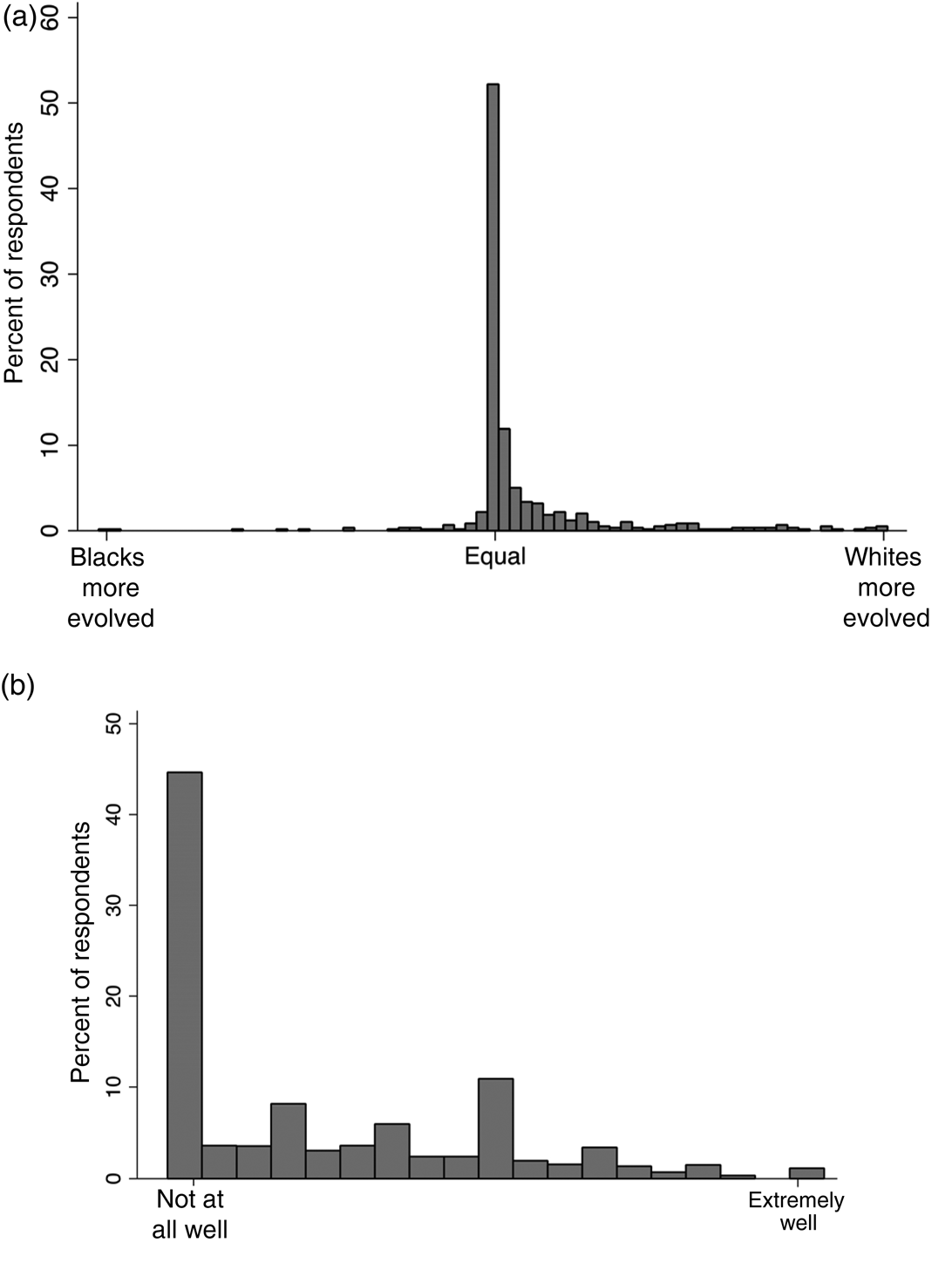
In this section we investigate the prevalence of dehumanizing attitudes toward Black people among Whites today. We begin with responses to the Ascent of Man questions on the 2016b YouGov Survey. The general tendency is to rate both Whites and Blacks at the high end of the scale: 72 per cent of our respondents rated Whites at 90 or above on the 0–100 scale, while 57 per cent rated Blacks at 90 or above.Footnote 24 The modal value of this variable is an equivalent rating for both Whites and Blacks; 44 per cent of respondents rated these two groups identically on the evolution scale. Strikingly, however, 42 per cent of respondents rated Whites as more evolved than they rated Blacks.Footnote 25 What is more, we see substantial variation in how much less evolved Blacks are perceived to be than Whites.Footnote 26 We demonstrate below that this variation is consequential for Whites' voting decisions in the 2016 presidential election.Footnote 27
We construct the key independent variable of interest, Dehumanizing Attitudes, through a difference measure, following previous research in political science examining racial stereotypes (Hutchings Reference Hutchings2009; Kinder and Mendelberg Reference Kinder and Mendelberg1995). We subtract the score each respondent gave Blacks from the score they gave Whites, allowing us to measure whether, and the extent to which, the respondent believes Blacks are less evolved than Whites. Figure 2 presents the distribution of this measure.Footnote 28 In the analyses to follow, we transform the coding of this variable, and all others, into a 0–1 scale to facilitate interpretation of the regression output.
The distribution of dehumanizing attitudes among Whites
(a) Ascent of Man Differential: evolutionary rating of Whites minus evolutionary rating of Blacks.
(Source: 2016b YouGov Survey).
(b) Dehumanizing Characteristics Index (items averaged, weighted equally):
how well the terms ‘barbaric,’ ‘savage,’ and ‘lacking self-restraint, like animals’ describe Blacks
Source: 2016 GfK Survey

Validating the Measurement of Dehumanizing Attitudes
Because we are introducing a concept to racial attitudes scholarship in political science, we take some time here to address potential concerns regarding measurement. First, a skeptic might wonder whether patterns of non-response are driving the patterns reported here; it could be that only respondents with dehumanizing attitudes toward Black people answer the blatantly racist Ascent of Man question. Fortunately, non-responsiveness is quite low: 596 out of 600 respondents answered the Ascent of Man question.Footnote 29
Another possibility is that the pictures accompanying the Ascent of Man scale are contaminating the results in some way. For example, the second-to-last picture appears to show a bigger, stronger figure than that shown in the final picture. Perhaps, then, higher ratings for Whites simply reflect a perception that Black people are commonly perceived to be stronger and more athletic than White people. We tested this possibility in the 2016 Qualtrics Survey by creating two additional versions of the Ascent of Man scale in which the pictures are excluded. We find that White respondents still, on average, rated Blacks as less fully human than they rated Whites; the percentage of Whites that did so ranges from 33 to 41 per cent across the three versions of the measure (Appendix C). If anything, the tendency for White respondents to rate Blacks as less human than Whites is exacerbated when the Ascent of Man scale does not include pictures.
Another way to assess whether the Ascent of Man scale captures dehumanizing attitudes is simply to ask respondents how they understand the question. To do so, we examine findings from a pilot study of 922 respondents in a Mechanical Turk survey we conducted in October 2016. In this study, immediately after answering the Ascent of Man question, respondents were asked an open-ended probe, ‘What kinds of things came to mind as you were answering the previous question?’ Consider the following excerpts from responses from each of the following individuals, all of whom had rated Blacks lower on the scale than Whites (all responses reproduced verbatim): ‘Just how well an architype for each group fit my perception of being human’; ‘i consider Blacks to be closer to the animal kingdom’; ‘i was responding to how human like i feel people of various races were’; ‘I thought about the theory of evolution and gorillas’ (additional responses in Appendix D). Replies to this open-ended probe consistently suggest that respondents interpret the Ascent of Man question to refer to their perception of the humanity of different racial groups.
Our primary concern with the Ascent of Man scale is that it may lead us to underestimate the extent to which Whites dehumanize Black people. For one thing, the obviously racist wording of the question might lead some to falsely report their attitudes, an issue we return to in the concluding section. Additionally, the scale adopts the language of evolution, and many Americans do not believe in evolution (Newport Reference Newport2014). Indeed, in response to the open-ended probes, many respondents pushed back against the premise that evolution occurs. Interestingly, all of these respondents who expressed disbelief in evolution rated both racial groups equally, perhaps as a means of registering their opposition to the question (Appendix E). It is therefore possible that some of these respondents would have expressed dehumanizing views of Black people had the premise of the question not conflicted with their views about evolution.
To address such limitations, we now turn to our second measure of dehumanizing attitudes (2016 GfK Survey, also included on the 2016 Qualtrics Survey). This measure consists of questions about how well the terms ‘savage’, ‘barbaric’ and ‘lacking self-restraint, like animals’ describe Blacks.Footnote 30 Figure 2 presents the distribution of the Dehumanizing Characteristics battery, in which these three items are averaged and transformed into an index ranging from 0 to 1 (Cronbach's α = 0.93), with higher values indicating the belief that these characteristics describe Blacks well. As the figure shows, 44 per cent of Whites responded at the lowest possible value, indicating that each of the three terms describe Black people ‘not at all well.’ Nevertheless, 56 per cent of Whites reported that some, if not all, of these characteristics describe Blacks to some degree. As the figure reveals, there is significant variation across the remainder of the scale.
Finally, it is important to establish that dehumanizing views of Black people are related to standard political predispositions in predictable ways – but are also independent of these variables. To do so, we examine bivariate correlations between dehumanizing attitudes and a host of variables that influence public opinion. The results (reported in Appendix F) indicate that dehumanizing attitudes toward Black people are not reducible to standard conceptions of racial prejudice, partisanship, ideology or demographics: they represent a unique outlook on social and political life.
These findings shed light on how the stage was set for a Republican nominee who would be running against the party of a Black presidential incumbent. This nominee had important raw material to work with: the prevalence of dehumanizing views of Black people among many White Americans.
The Republican Primary
Racial attitudes have become a central feature of American electoral politics. Scholars employing traditional measures of racial attitudes have demonstrated that more racially prejudicial Whites are more likely to vote for Republican politicians even after taking individual-level partisanship into account (Tesler Reference Tesler2016a). An important component of our argument, however, is that Trump, by way of his explicitly racist and dehumanizing rhetoric, was more likely to appeal uniquely to Whites with dehumanizing attitudes. That is, we suspect Trump had a distinct advantage among Whites with dehumanizing attitudes toward Black people. This advantage stems from a key difference between Trump and the other Republican primary candidates: Trump chose to associate himself with explicitly racist statements on a routine basis throughout his campaign.Footnote 31 Therefore, we expect dehumanizing attitudes to predict more positive evaluations of Trump compared to other Republican presidential candidates during the presidential primaries, when voters had a choice between many candidates.
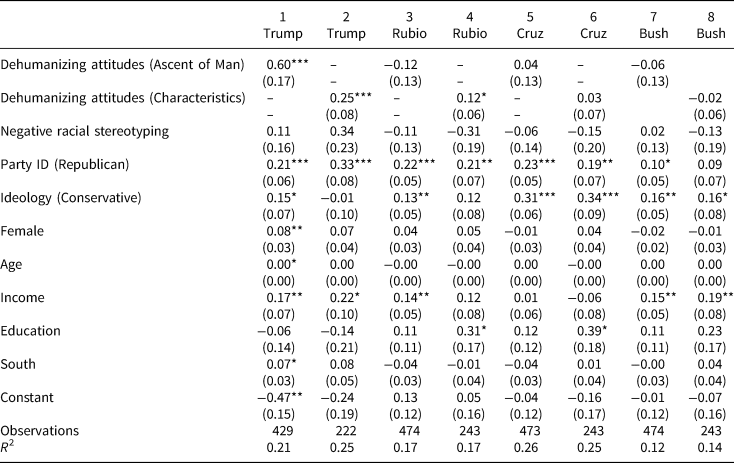
To examine our expectation that Trump's campaign uniquely activated dehumanizing attitudes toward Black people, we conducted a series of ordinary least squares regressions, relying on the 2016 Qualtrics Survey. This survey was conducted in March 2016, during the Republican primaries. Here the dependent variables across the different models are warmth toward Donald Trump, Marco Rubio, Ted Cruz and Jeb Bush – four of the front-running Republican candidates at the time – on a standard 101-point feeling thermometer. The independent variable of interest is dehumanizing attitudes toward Black people, and the control variables are negative stereotypes about Black people, partisanship, ideology and demographics. Table 1 reports the results.
Whites’ dehumanizing attitudes toward Blacks are associated with warmth toward Trump but not other Republicans

Note: cell entries are ordinary least squares regression coefficients (standard errors in parentheses). All variables are transformed onto a 0 to 1 scale. Higher values of the dependent variable indicate greater warmth toward the Republican primary candidate indicated by the column heading. Negative Racial Stereotyping is based on a two-question battery about laziness and unintelligence; see Appendix A for additional details. Associations between dehumanizing attitudes and warmth toward Trump persist after including a wide range of alternative measures of racial attitudes as control variables (Appendix I). The sample size is smaller in the models with the Dehumanizing Characteristics index because only half of the respondents were randomly assigned to answer these questions. *** p < 0.001; ** p < 0.01; * p < 0.05
Source: 2016 Qualtrics Survey
Many of the coefficients in the table tell a familiar story. Unsurprisingly, for example, White Republicans and White self-identified conservatives tend to feel more warmly toward each of the Republican candidates. But one factor is consistently associated with warmth toward Trump and not with warmth toward the other candidates: dehumanizing attitudes toward Black people. Across both the Ascent of Man scale and the Dehumanizing Characteristics index, Whites who held dehumanizing views of Black people were more positively disposed toward Trump, net of racial prejudice, partisanship, ideology and demographics.
The magnitude of the association between dehumanizing attitudes and favorable evaluations of Trump is strong. Because so few Whites give responses below the neutral point of the dehumanizing attitudes scale, we examine the estimated effect of movement from the neutral point of the Ascent of Man scale, where Blacks and Whites are rated equally, to the highest point on the scale, holding other variables constant. This effect is represented by one-half of the Ascent of Man coefficient in Table 1, Model 1 (Column 1): 0.30, or an increase in warmth toward Trump of 30 points on the 0–100 feeling thermometer.Footnote 32 This association is comparable in size to the association between partisanship and evaluations of Trump: movement from a Strong Democrat to a Strong Republican is associated with an increase of 21 points in warmth toward Trump on the feeling thermometer.Footnote 33
We also find in supplementary analyses that this pattern of positive associations between dehumanizing attitudes toward Black people and warmth toward Trump persists when any of the following alternative racial attitude control variables are included in place of the stereotype measure: racial resentment, an index of racial stereotypes that includes perceptions of Black violence, opposition to interracial marriage, support for neighborhood racial segregation, the belief that racial groups have inborn differences in their ability to learn and perceptions of discrimination against Black people (Appendix I).
Turning to the other Republican candidates, we find that one of the measures of dehumanizing attitudes, the Dehumanizing Characteristics index, does exhibit a positive association with warmth toward Rubio. But the magnitude of this association is less than half of the association between the same measure of dehumanizing attitudes and warmth toward Trump. Furthermore, the Ascent of Man measure of dehumanizing attitudes is negatively associated with warmth toward Rubio, although this relationship is not statistically significant. Finally, neither measure of dehumanizing attitudes is associated with warmth toward Cruz or Bush.Footnote 34
Trump's rhetorical strategy of making a series of explicitly racist statements marked a critical departure from a subtler strategy in which politicians use racial code words rather than talk about race directly (Kinder and Sanders Reference Kinder and Sanders1996; Mendelberg Reference Mendelberg2001). In contrast to other Republican candidates in the primary, Trump did not seem to have many reservations about appearing overtly racist. As columnist Jamelle Bouie (Reference Bouie2016) observed, Trump is showing his dedicated following of White supremacists that you can deny the humanity of other people and still thrive in mainstream politics.’ Our results are consistent with Bouie's contention that Trump's explicitly racist statements differentiated him from the rest of the Republican field – and that, among Whites who view Black people as less than fully human, Trump reaped the benefits of this strategy.Footnote 35
The General Election Approaches
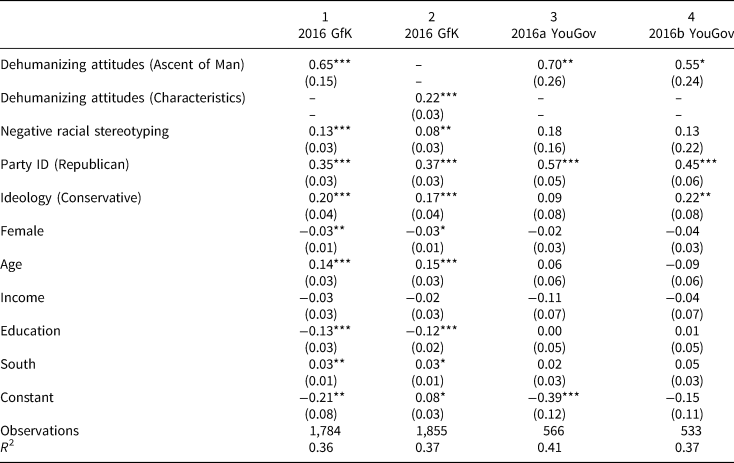
To determine whether associations between dehumanizing views of Black people and positive evaluations of Trump persisted after the primary, we analyze three sources of original survey data collected at different points in the run-up to the 2016 election: June (2016 GfK Survey), September (YouGov 2016a Survey) and October (YouGov 2016b Survey). As in previous analyses, we conduct ordinary least squares regressions. The dependent variable is warmth toward Trump on a standard 101-point feeling thermometer scale, the independent variables of interest are measures of dehumanizing attitudes toward Black people, and control variables are negative racial stereotypes, partisanship, ideology and demographics. The coefficient estimates are presented in Table 2.
Whites' dehumanizing attitudes toward Black people are positively associated with warmth toward Trump in the general election

Note: cell entries are ordinary least squares regression coefficients (standard errors in parentheses). All variables are transformed onto a 0 to 1 scale. Models 1 and 2 analyze data from the 2016 GfK Survey, Model 3 analyzes data from the 2016a YouGov Survey, and Model 4 analyzes data from the 2016b YouGov Survey; analyses of all three datasets are weighted for national representativeness. Higher values of the dependent variable indicate greater warmth toward Trump on the 101-point feeling thermometer. Measures of Negative Racial Stereotyping vary across the two datasets. The 2016 GfK Survey uses a single question about unintelligence, whereas the 2016a YouGov Survey uses a two-question battery about laziness and unintelligence; see Appendix A for additional details. Associations between dehumanizing attitudes and warmth toward Trump persist after including a wide range of alternative measures of racial attitudes as control variables (Appendix J). *** p < 0.001; ** p < 0.01; * p < 0.05
These results show that throughout 2016, Whites who harbor dehumanizing attitudes toward Black people tend to view Trump more positively than Whites who do not, after taking standard political variables into account. This pattern of results persists across three separate national datasets and both measures of dehumanization.
As in previous analyses, the magnitude of the association between dehumanizing attitudes toward Black people and warmth toward Trump is strong. The estimated effect of moving from the neutral point to the highest point on the Ascent of Man scale, holding other variables constant, is one-half of the coefficient on the Ascent of Man variable in Table 2, Model 1: 0.325, or an increase in warmth toward Trump of 32.5 points on the 0–100 feeling thermometer.Footnote 36 This association is again comparable in magnitude to that between partisanship and warmth toward Trump. Movement from a strong Democrat to a strong Republican, holding all other variables constant, is associated with an increase of 35 points in warmth toward Trump on the feeling thermometer.Footnote 37
We also conduct supplementary analyses that once again show that this pattern of positive associations between dehumanizing attitudes toward Black people and warmth toward Trump persists after including alternative racial attitude control variables. The additional survey datasets analyzed here allow us to examine a range of such variables in addition to those analyzed already: sympathy for Black people, the belief that disparities in arrest rates across racial groups result from Black violence, White identity and White guilt about racial inequality (Appendix J).
In sum, these results speak to the robustness of the association between dehumanizing attitudes toward Black people and support for Trump. It appears from these findings that among Whites who view Black people as less than fully human, Trump was well positioned as the general election approached.
Trump or Clinton? Whites' Voting Decisions in 2016
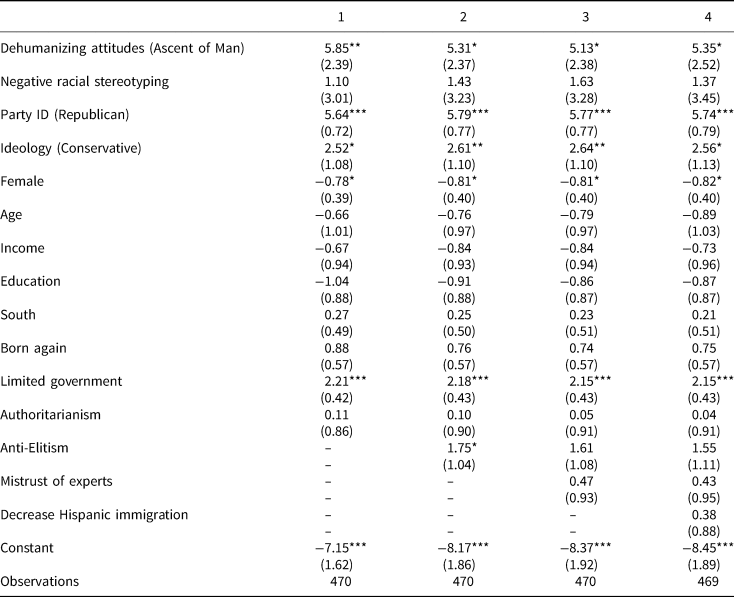
We now examine associations between Whites' dehumanizing attitudes toward Black people and their voting decisions in the 2016 election. To do so, we analyze the 2016b YouGov survey, conducting a logistic regression in which the dependent variable is coded 1 (voted for Trump) or 0 (voted for Clinton); all others are excluded. The independent variable of interest is dehumanizing attitudes toward Black people, as measured by the Ascent of Man scale. Table 3 presents the results of our estimations. Many control variables are similar to those in previous models – such as racial stereotyping, partisanship, ideology and demographics – but this survey also included a range of additional variables that we use as controls across a variety of models. Model 1 includes an indicator of whether the respondent is a born-again Christian, as well as core values or principles of limited government and authoritarianism; Model 2 adds an index of anti-elitism, Model 3 adds a measure of mistrust of experts and Model 4 adds respondent opposition to Hispanic immigration. These variables are included because they are likely to predict support for Trump and may also be associated with dehumanizing attitudes toward Black people.
The results show that net of other factors, Whites with dehumanizing views of Black people were disproportionately likely to vote for Trump over Clinton in 2016. This result persists across all four models; in all cases, the positive relationship between dehumanizing attitudes toward Black people and the probability of voting for Trump is statistically significant.
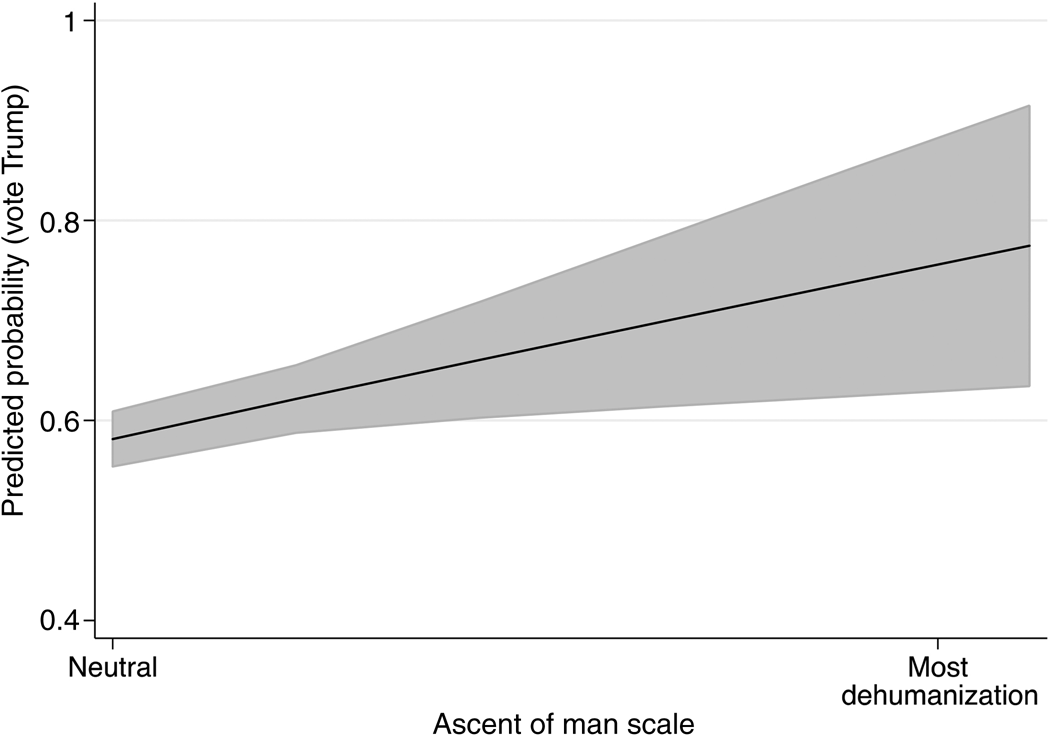
The magnitude of the relationship between dehumanizing attitudes toward Black people and White vote choice is difficult to determine from logistic regression coefficients. We therefore present a predicted probability plot in Figure 3, based on the regression presented in Table 3, Model 1. The y-axis presents the predicted probability of voting for Trump at a given level of dehumanizing attitudes, setting all other variables at their means. The x-axis of the figure ranges from the neutral point to the highest point on the Ascent of Man scale. In this case the magnitude of this association is not as large as the association between partisanship and vote choice.Footnote 38 But it is strong nonetheless; movement from the neutral point to the highest point of the Ascent of Man scale is associated with an increase of 19 percentage points in the likelihood of voting for Trump. This relationship persists once again after including a wide range of alternative measures of racial attitudes (Appendix K). White voters who view Black people as less than fully human were especially likely to support Trump in the 2016 election.
Whites’ predicted probability of voting for Trump in 2016, by dehumanizing attitudes
Note: based on Table 4, Model 4.
Source: 2016b YouGov survey.

Dehumanization of Black people is positively associated with White voting for Trump over Clinton in the 2016 presidential election

Note: cell entries are logistic regression coefficients (standard errors in parentheses). All variables are transformed onto a 0 to 1 scale. Analyses weighted for national representativeness. Higher values of the dependent variable indicate greater warmth toward Trump on the 101-point feeling thermometer. Negative Racial Stereotyping is based on a two-question battery about laziness and unintelligence; see Appendix A for additional details. Associations between dehumanizing attitudes and vote choice persist after including a wide range of alternative measures of racial attitudes as control variables (Appendix K). *** p < 0.001; ** p < 0.01; * p < 0.05
Source: 2016b YouGov Survey.
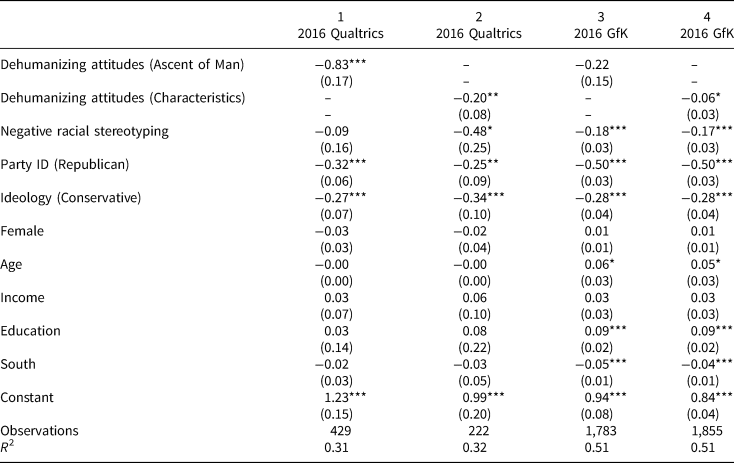
Dehumanizing attitudes toward Black people are negatively associated with White warmth toward Obama

Note: cell entries are ordinary least squares regression coefficients (standard errors in parentheses). All variables are transformed onto a 0 to 1 scale. Models 1 and 2 analyze data from the 2016 Qualtrics Survey, while Models 3 and 4 analyze data from the 2016 GfK Survey; analyses of the GfK dataset are weighted for national representativeness. Higher values of the dependent variable indicate greater warmth toward Obama on the 101-point feeling thermometer. Measures of Negative Racial Stereotyping vary across the two datasets. The 2016 Qualtrics Survey uses a two-question battery about laziness and unintelligence, whereas the 2016 GfK Survey uses a single question about unintelligence; see Appendix A for additional details. Associations between dehumanizing attitudes and warmth toward Obama persist after including a wide range of alternative measures of racial attitudes as control variables (Appendix K). The sample size is smaller in Model 2 than in Model 1 because only half of the respondents were randomly assigned to answer the ‘Dehumanizing Characteristics’ questions. *** p < 0.001; ** p < 0.01; * p < 0.05
Dehumanizing Attitudes and Whites' Evaluations of Barack Obama
We motivated our analysis with the expectation that Donald Trump's unusually explicit rhetoric appealed to dehumanizing attitudes of White voters that previous scholarship in political science has largely ignored. But we also expect the same attitudes to predict animosity toward Barack Obama. Thus, we examine associations between Whites' dehumanizing views of Black people and their attitudes toward the nation's first Black president. To do so, we conduct a series of ordinary least squares regressions in which warmth toward Obama, as measured using a standard 101-point feeling thermometer, is regressed on dehumanizing attitudes toward Black people as well as theoretically relevant control variables: negative stereotypes of Black people, partisanship, ideology and demographics. Many of the results, which are presented in Table 4, tell a story that is consistent with our understanding of White evaluations of Obama. Whites with negative stereotypes about Black people feel less warmth toward Obama, on average, than Whites who identify as Republicans or conservatives.
What is new here is the role of dehumanizing attitudes toward Black people. The results reveal negative associations between Whites' dehumanizing views of Black people and warmth toward Obama.Footnote 39 This pattern holds across both the Qualtrics sample (Models 1 and 2) and the GfK sample (Models 3 and 4). It also holds across two different measures of dehumanizing attitudes: the Ascent of Man scale (Models 1 and 3) and the Dehumanizing Characteristics index (Models 2 and 4). In three of the four models this relationship is statistically significant – the exception is Model 3, which uses the Ascent of Man scale in the GfK sample.
The magnitude of the association is represented by one-half of the Ascent of Man coefficient in Table 4, Model 1: −0.415. Those with the highest degree of dehumanizing attitudes toward Black people relative to Whites are estimated to score lower on warmth toward Obama than those who rate the two groups equally at 41.5 points on the 0–100 feeling thermometer scale.Footnote 40 The size of this association rivals that of partisanship: holding all other variables constant, the estimated effect of movement from a Strong Democrat to a Strong Republican is associated with a 32-point decrease in warmth toward Obama.Footnote 41
This pattern of negative associations between dehumanizing attitudes and warmth toward Obama persists when any of the following alternative racial attitude control variables are included in place of the stereotype measure used here: racial resentment, an index of racial stereotypes that includes perceptions of Black violence, opposition to interracial marriage, support for neighborhood racial segregation, the belief that racial groups have inborn differences in their ability to learn and perceptions of discrimination against Black people (Appendix K).
Prior research has shown that among Whites, prejudice against Black people is negatively associated with positive views of Obama (for example, Tesler Reference Tesler2016a; Tesler Reference Tesler2016b). While this is a troubling finding, our results are more disturbing still. Even after taking prejudice and other political variables into account, we show that Whites who view Black people as less than fully human tend to view Obama relatively unfavorably.
Discussion and Conclusion
Our findings suggest that political science scholarship has been soft pedaling the study of racial attitudes. Political scientists have generally viewed the electoral role of racism as an undercurrent, effective only when it was subtle and covert – or at least plausibly denied (Kinder and Sanders Reference Kinder and Sanders1996; Mendelberg Reference Mendelberg2001). But an overt and blatant, if often-ignored, form of racism is far from being a relic of the past; it is alive and well among the White electorate in the United States, in the form of animalistic dehumanizing attitudes toward Black people. Moreover, dehumanizing attitudes can be a powerful political force: Trump activated such attitudes toward Black people and reaped the benefits on Election Day.
We find, across a number of survey datasets collected at different points in time throughout the 2016 presidential race, that substantial proportions of White respondents rate Blacks as less human-like than they rate Whites. Whites with dehumanizing attitudes toward Black people hold disproportionately negative views of the nation's first Black president and disproportionately positive views of the man who ran one of the most racially inflammatory campaigns in modern times. We find that Whites who dehumanize Black people were disproportionately more likely to vote for Trump over Clinton, after holding constant partisanship, ideology, standard conceptions of racial prejudice and an array of other factors.
We believe our study is the beginning of an important line of scholarship examining the potential causes and consequences of dehumanizing attitudes in the United States. For example, future research might analyze more recent data to examine whether Trump's presidency has legitimized the expression of dehumanizing attitudes. We also believe that dehumanizing attitudes toward Black people are not the only dehumanizing beliefs implicated in American politics. Many Americans demonstrate hostile and dehumanizing attitudes toward groups like Muslims and immigrants, and these views likely guide their opinion about the treatment of these groups (Kteily and Bruneau Reference Kteily and Bruneau2017a; Kteily et al. Reference Kteily2015; Markowitz and Slovic Reference Markowitz and Slovic2020; Utych Reference Utych2018). Trump has also, in all likelihood, capitalized on these attitudes as well, particularly those about immigrants. Indeed, in describing immigrants, he has used dehumanizing animalistic language by arguing that they ‘infest’ our country.Footnote 42 Dehumanizing attitudes toward immigrants may not only be associated with electoral support for Trump, but also for his draconian policies at the US–Mexican border. While we argue that the measure of dehumanizing attitudes we employ here is best suited to capture Whites' attitudes toward Black people, an important avenue for future work will be to develop more group-specific measures of dehumanizing attitudes and to examine their role in support for Trump and in other public opinion domains.
We also posit that dehumanizing attitudes have been, and can be, made salient by other politicians in other electoral and policy contexts. In particular, references to crime, demands for law and order, or the condemnation of racial protests in urban areas – all of which have long been a popular ploy by political candidates – may activate many of the dehumanizing attitudes that lead Whites to associate Black Americans with an inherent sense of criminality or violence. For instance, we might have found that Hillary Clinton activated dehumanizing attitudes in 1996 when she referred to some gang members as ‘superpredators’ with ‘no conscience’ or ‘empathy’.Footnote 43 More recently, several Republican candidates in the 2018 mid-term elections may have appealed to dehumanizing attitudes when they echoed Trump's dehumanizing language toward racial and ethnic minorities and immigrants. For example, a Republican candidate for the US House of Representatives in 2018 who aligned herself with Trump publicly defended his reference to immigrants as ‘animals’.Footnote 44 And most recently, some police department employees have referred to Black Americans protesting police brutality as ‘animals’ – a sentiment that quite troublingly might reflect the attitudes of many White Americans who do not condone the protests.Footnote 45 We suspect that dehumanizing attitudes were activated in many of these contexts.
However, we are not proposing that dehumanizing attitudes are the most relevant beliefs brought to bear in all racialized contexts. Indeed, part of our aim here is to suggest that dehumanizing attitudes are likely implicated in contexts in which Whites condone the especially hostile, violent or harsh treatment of out-groups. Dehumanizing attitudes are likely most politically relevant when politicians are especially disparaging of particular groups. Specifically, Whites' dehumanizing attitudes toward Black people may be most closely associated with Whites' support for the harsh treatment or punishment of Black people and with indifference to police violence. Other racial attitudes, however, are likely more relevant in different domains. Racial resentment, for example, ought to be more implicated in policy domains, such as affirmative action and social welfare, that tap beliefs about work ethic, fairness and special treatment rather than beliefs about the humanity of a group. Yet another avenue for future research, therefore, is untangling the various places in which some racial attitudes are more significantly associated with racialized political preferences than others.
Finally, our findings serve as a warning about the nature of Whites' racial attitudes in the contemporary United States. Not only have politicians like Trump associated themselves with explicit racial messaging with little penalty, but there are also a number of factors that may be working in congruence to legitimize dehumanizing beliefs. The rise of genetic explanations for racial outcomes in the social and natural sciences may be reinforcing dehumanizing beliefs about innate differences between Black people and Whites. White supremacist groups use these academic studies to buttress ideologies of racial superiority. Trump's success suggests that dehumanizing views of Black people are gaining legitimacy, and politicians can activate them to win votes.
Supplementary material
Online appendices are available at https://doi.org/10.1017/S0007123421000089.
Data availability statement
Data replication files can be found on Harvard Dataverse at: https://doi.org/10.7910/DVN/A3XIFC.
Acknowledgements
We thank Vincent Hutchings and Ted Brader for their support of this project and their invaluable assistance with data collection.
Financial support
Support for this research was provided by Duke University and Boston University.
Conflicts of interest
None.
Ethical standards
The research was conducted in accordance with the protocols approved by the institutional review boards at the University of Michigan, Duke University, Syracuse University, and Boston University. All participants on our studies were provided with written consent and were compensated for their participation.