


Introduction
Preslaughter stunning is a requirement in the UK and most countries for the humane killing of food animals with minimal pain or suffering (EU 2009; WATOK 2015). Effective stunning induces unconsciousness and insensibility, which is maintained until the death of the animal. Poultry processors with higher throughputs generally use controlled atmosphere stunning systems (CAS). In contrast, mainly due to the lower capital costs and economic viability, head-only electrical stunning devices are commonly used by small-scale seasonal producers/processors in the UK to stun turkeys (Meleagris gallopavo domesticus), ducks (Anas platyrhynchos domesticus), geese (Anser anser domesticus), and in limited numbers chickens (Gallus gallus domesticus) (FAWC 2009; HSA 2020).
The systems commercially available for head-only electrical stunning of domestic poultry consist predominantly of dry electrodes on mains-powered constant voltage hand-held rigid stunning tongs. Electrode designs vary between devices and operators, varying from single electrodes to arrangements of multiple pins on a rosette. The design of electrodes can influence the level of parting of feathers, skin/surface contact, and the resulting effectiveness of the stunning (Gibson et al. Reference Gibson, Taylor and Gregory2016).
Limited literature currently exists on small-scale producer/processor slaughter practices and the effectiveness of commercially available head-only electrical stunning systems for turkeys in the UK. Current EU regulations stipulate that the minimum electrical current for an effective head-only stunning of turkeys is 400 mA, followed by an immediate cut of both carotid arteries and jugular veins. It has been suggested that application of current should be continuous for over 7 s (or until cessation of wing flapping) (EFSA 2004), to ensure that there is sufficient current reaching the brain to induce generalised epileptiform activity. However, it has been reported for chickens that low voltage head-only electrical stunning using commercially available constant voltage devices can struggle to ramp up effective electrical current passing across the brain and can be ineffective in inducing a sufficiently lasting period of unconsciousness to prevent recovery prior to, during and after exsanguination (Gibson et al. Reference Gibson, Taylor and Gregory2016).
Electrophysiological assessment of brain function during poultry stunning can be based on spontaneous electroencephalographic (EEG) activity or by evoked potentials (e.g. visual, laser, somatosensory and auditory evoked potentials). Evoked potentials are time-locked recordings of brain electrical activity in response to a defined peripheral stimulus. Spontaneous EEG is commonly used to confirm the induction of generalised epileptiform activity and subsequent suppression or quiescence. However, the assessment of the recovery of spontaneous brain activity and derived spectral indices can be complicated by electrical noise, movement artefact and variability in waveform interpretation (Raj & O’Callaghan Reference Raj and O’Callaghan2004; Gibson et al. Reference Gibson, Taylor and Gregory2016). Evoked potentials provide a complementary, stimulus-locked measure that can be enhanced through signal averaging. Somatosensory evoked potentials (SEPs) have previously been used to assess the integrity of ascending sensory pathways and processing in the higher brain structures in poultry (Gregory & Wotton Reference Gregory and Wotton1991; Mouchoniére et al. Reference Mouchoniére, Le Pottier and Fernandez2000; Raj & O’Callaghan Reference Raj and O’Callaghan2004), whereas visual evoked potentials (VEPs) measure the response of the optic lobe to a controlled, non-contact light stimulus. Although the presence of a VEP does not itself demonstrate conscious perception, the absence of VEPs indicates brain dysfunction incompatible with consciousness, while their return identifies the recovery of sensory processing that could support consciousness (Daly et al. Reference Daly, Kallweit and Ellendorf1988; Gibson et al. Reference Gibson, Taylor and Gregory2016). As VEPs may return before spontaneous EEG, behavioural and reflex indicators (e.g. rhythmic breathing and eye reflexes), they provide a sensitive and conservative endpoint for estimating the duration of stun-induced brain dysfunction incompatible with consciousness (Gibson et al. Reference Gibson, Taylor and Gregory2016).
The overall aim of the study was to evaluate the humaneness of commercially used head-only electrical stunning systems for turkeys. This aim was achieved via two objectives: (1) a survey of small-scale seasonal UK turkey, duck and geese producer/processors was conducted to determine industry slaughter practices and particularly electrodes and parameters used; and (2) informed by the data from objective 1, the humaneness or otherwise of the three most used head-only systems for stunning of turkeys was assessed using visual evoked potentials (VEPs), behavioural indices/reflexes, current profiles and recorded electrical parameters.
Materials and methods
Objective 1: Survey of slaughter practices
A paper-based questionnaire for structured interviews was constructed with questions focused on technical aspects of the current stunning practice used by small-scale producers/processors of turkeys, ducks and/or geese, including equipment, parameters, maintenance, handling, and operation (for the full survey, see Supplementary material). The survey received ethical approval from the RVC Clinical Research Ethical Review Board (URN 2015 1410). Prior to carrying out the interviews, the questionnaire design was tested with colleagues with experience in stunning and slaughtering, to assess for readability, structure and duration of completion. A total of 120 producer/processors were contacted through industry contacts and snowball sampling, with 20 small-scale UK poultry and waterfowl producer/processing plants recruited to a mix of in-person (n = 6) and over the phone (n = 14) interviews.
Data were compiled and analysed using Microsoft Excel® 2016, they were collated by individual questionnaire item. Closed-ended and open-text responses, the latter coded into categories where appropriate, were summarised quantitatively using counts, frequencies, means, standard deviations and ranges. Interviews were not transcribed. Further statistical analysis was not performed due to the low number of responses per variable.
Objective 2: Assessment of stunning effectiveness
Thirty-nine ex-breeding standard white turkeys (females, age 25 weeks, mean weight 14.0 [± 1.1] kg, range; 11.58–16.24 kg) were transported from a commercial breeding unit to the research unit and were kept in accordance with normal industry husbandry practices, with standard ventilation and lighting. Birds were housed in a pen (13.5 × 4.0 m; length × width), which was bedded with sawdust and straw, with perching and resting areas provided. The birds received 10 days to acclimatise to the new environment prior to experimentation. Feed (via floor-based hoppers) and water (via bell drinkers) were provided ad libitum. All procedures were carried out under the provisions of the Animals (Scientific Procedures) Act 1986 (PPL 70/8864).
The birds were randomly allocated into three head-only electrical stunning treatment groups based on the three most frequently used electrical stunning systems for turkeys in the questionnaire data: (1) single solid copper pin electrodes (built by Solutions for Research Ltd, Silsoe, Bedford, UK and designed to mimic those seen in the survey), cone-shaped to maintain rigidity; (2) pointed copper pin electrodes, arranged in a rosette of 12 needles; and (3) solid copper three-pin electrodes (Fosseway Engineering Services Ltd, Radstock, UK) (Figure 1).
The three head-only electrical stunning electrodes tested in turkeys. (A) single solid copper pin electrodes, cone shape to maintain rigidity; (B) pointed copper pin electrodes, arranged in a rosette of 12 needles; and (C) solid copper three-pin electrodes.

Treatment and animal order were randomised. Sixty minutes prior to restraint and implanting electrodes, the skin over the head (cranial and frontal area) was desensitised with EMLA cream (lidocaine 2.5% and prilocaine 2.5%; AstraZeneca UK Ltd, UK). To minimise movement artefact during experimentation, the birds were individually restrained in a commercially available cone (Sedgbeer Processing Supplies, Wanstrow, UK). A padded clamp was used to further restrain the bird’s legs (across tarsometatarsus) prior to placement of the recording electrodes and electrical stunning, to reduce movement artefact. Two optical cameras (Canon LEGRIA HF S10, Panasonic HC-V380EG-K Full HD Camcorder, Ota City, Tokyo, Japan) and one night vision camera (Besteker Portable HD 1080p IR Night Vision Digital Camera F301, Guangdong Bestek E-Commerce Co Ltd, Shenzhen, China) were positioned to record bird behaviour prior to, during and after stunning.
Recording of VEP was performed in a darkened room to prevent light artefact on VEP recordings. One channel of VEP was recorded with a three-electrode montage using three 27-gauge stainless steel subdermal needle electrodes (Neuroline Subdermal, Ambu Inc, Glen Burnie, MD, USA). The tips of each electrode were placed as follows: active (non-inverting) ≈ 6 mm right of midline, ≈ 3 mm rostral of bregma over the right optic lobe; reference (inverting), over the right rostral aspect of the forebrain ≈6 mm right of midline, ≈20 mm rostral of bregma; and ground electrode caudal to the back-of-the head, respectively. Mean interelectrode impedance was 1.5 (± 0.4) and ranged between 0.5 and 2.7 kΩ (MkIII Checktrode, UFI, Morro Bay, CA, USA).
A Grass photic stimulator (PS33-PLUS, Grass Technologies, Natus Neurology Inc, Warwick, RI, USA) was laterally positioned 200 mm from the bird’s head and was triggered and synchronised with the VEP recordings by the data acquisition software package LabChart Pro 8.1.10 via a 8/35 PowerLab analogue to digital converter (ADInstruments Ltd, Sydney, Australia). A 100 ms pre-stimulus (light) followed by a 200 ms post-stimulus period was recorded, with a flash every 600 ms. VEP signals were amplified and filtered with an analogue filter (dual Bio Amp, ADInstruments Ltd, Sydney, Australia) with band pass of 0.1–100 Hz, respectively. The VEP signals were digitalised (2 kHz) with the 8/35 PowerLab and recorded on a Dell laptop for off-line analysis. VEPs were recorded and assessed for a 1-min pre-treatment period and for five minutes following the end of the electrical stunning treatments.
All birds in each treatment group were electrically stunned with a head-only constant voltage electrical stunner (Whitehead Engineering Ltd, Bath, UK) delivering a 50 Hz sine wave AC for 4 s. This exposure period was selected based on previous studies (Mouchoniere et al. Reference Mouchoniere, Le Pottier and Fernandez1999; Wilkins et al. Reference Wilkins, Wotton, Parkman, Kettlewell and Griffiths1999; Mouchoniére et al. Reference Mouchoniére, Le Pottier and Fernandez2000; Fernandez et al. Reference Fernandez, Lahirigoyen, Auvergne, Molette and Bouillier-Oudot2010) and prior experience of the research team (including a licenced slaughterman). Although EFSA suggests a 7 s exposure period (EFSA 2004), this is not representative of the realities seen commercially. Anecdotally the commercial exposure period is only between 1–3 s, which was also reported in the survey for objective 1. From a welfare perspective an effective stun should be delivered within 100–150 ms of onset of current to prevent perception of pain prior to unconsciousness (Wotton Reference Wotton1996), with longer exposure periods used to reduce convulsive activity.
The stunning electrodes were positioned on either side of the head, spanning the brain between the eyes and the ears. This corresponded to the lateral aspects of the frontal bone and extended to the squamosal bone. Current was recorded with a i30s AC/DC current clamp around a stunning live lead and the 199C Fluke Scope meter (Fluke Corporation, Everett, WA, USA). Voltage was recorded with a 179 Fluke multimeter (Fluke Corporation, Everett, WA, USA).
After stunning, birds were repeatedly assessed every 30 s for time to return of rhythmic breathing (assessed by auscultation and presence of rhythmic movements of the vent related to respiration), gaping, nictitating membrane reflex (left and right eyes separately) and head shaking/movement that could be associated with movement artefact in the recorded waveforms (Table 1). These were recorded as present or absent and converted to latency to return. This was defined as the time from the end of electrical stunning to the first assessment in which the behaviour or reflex had returned, with subsequent assessments used to confirm its maintenance.
Behaviour and brainstem indicators recorded in turkeys (Meleagris gallopavo domesticus) after head-only electrical stunning. Brainstem/behaviours were assessed every 30 s in the same order

Table 1. Long description
The table consists of two columns titled Behaviour and Description.
* Nictitating Membrane Reflex: The exposed corneal and corner of eye are stimulated with a probe to elicit a nictitating membrane reflex, checked separately for each eye.
* Gaping: Abnormal slow, repeated opening and closing of the beak.
* Rhythmic Breathing: Palpation of the posterior aspect of the abdominal cavity for signs of rhythmic air sac filling.
* Tonic convulsion: Involuntary stiffening or rigidity of the body and limbs, characterized by non-purposeful extension of the legs.
* Clonic convulsion: Repeated, uncontrolled involuntary movements following the tonic phase, characterized by kicking or leg paddling and attempted wing flapping.
* Head shaking/movements: Any spontaneous lateral shaking, rotation, raising, lowering or jerking of the head or neck following stunning, including convulsions. A footnote indicates this specific indicator is used to identify movement that might contaminate V E P waveforms rather than for assessment of recovery.
* Used for determination of movement that might contaminate VEP waveforms. Not used for assessment of recovery.
Contaminated waveforms were excluded from further analysis. To reduce movement artefact, no other behavioural indices were routinely recorded, however the birds were monitored continuously. All birds were allowed to recover consciousness. After recovery, all birds were shot with a captive-bolt gun (Turkey Euthanasia Device [TED], Bock Industries Inc, Philipsburg, PA, USA) as the final dispatch method in accordance with the Home Office Project Licence. Immediately afterwards, animals were bled by bilateral severance of the carotid arteries and jugular veins. After bleeding, the carcases were weighed using a digital scale (Kern DE 6K1D, Kern & Sohn GmbH, Balingen, Germany).
After stunning current profiles were downloaded and assessed on a PC, using FlukeView software for Windows (version 5.4.0.1) (Fluke Corporation, Everett, WA, USA). Peak current, current profile morphology, stun exposure period and time to reach 400 mA were calculated for all animals with the FlukeView software. All current and voltage recordings were calculated post hoc as root mean squared (RMS) values. Current profiles could not be collected from 9 birds due to sampling issues and for some samples full sets of parameters could not be collected. Consequently, sample sizes varied for some of the parameters. Each current profile was analysed (by visual examination) and assigned to one of four categories (based on Gregory Reference Gregory2001 and Limon et al. Reference Limon, Gonzales-Gustavson and Gibson2016): (1) Climbing satisfactory, current raising rapidly (< 1 s) to 400 mA; (2) Failure to maintain current flow, current towards the end of the stunning episode declined considerably before the current supply was switched off; (3) Poor initial contact, the current did not rise promptly, with the turkeys experiencing low current levels (< 400 mA) for at least 1 s; (4) Interrupted current, break in the current during the stunning episode; and (5) Spiking, surging at the start or end of the current application. Climbing satisfactory and poor initial contact were mutually exclusive.
Analysis of VEPs was conducted offline after the completion of experimentation. Initial VEP averages (pre- and post-stunning) were calculated from 10 consecutive sweeps (0.6 s per sweep, 6.0 s total), where individual sweeps contaminated by noise were removed from analysis. Where possible, the number of sweeps averaged was refined to determine the time to return of VEP activity more precisely. The presence of genuine-evoked potentials was assessed by comparison of positive and negative potential latencies with baseline (pre-stunning) and subsequent averaged evoked potentials. Signal averaging was performed with LabChart Pro software. All birds acted as their own controls.
Analysis was performed using SPSS Statistics® 24 (IBM Corporation, Chicago, IL, USA) and Prism 11 (GraphPad Software Incorporated®, San Diego CA, USA). A Shapiro-Wilk test was used to determine the distributions of the data. Between group comparisons for peak current, peak voltage, carcase weight, time to 400 mA, time to peak current, time to return of VEP and overall duration of stun were made using one-way analyses of variance (ANOVA) and the Tukey post hoc test. Simple linear regressions were performed to assess the relationship between stunning current and impedance for each treatment. For behavioural and reflex indices between treatment group comparisons were performed for durations of convulsions (tonic and clonic), time to onset of gaping, and time to return of rhythmic breathing and the left and right nictitating membrane reflexes using one-way ANOVA followed by Tukey’s post hoc test. A bivariate Pearson’s correlation was used to examine potential relationships in behavioural data and between stunning parameters within electrode types. Kruskal-Wallis H tests with Bonferroni correction for multiple tests were used to examine for differences between treatment groups in peak current, peak voltage and time to reach 400 mA. For all analyses, P < 0.05 was used as the significance threshold.
Results
Objective 1: Survey of slaughter practices
Of 120 producer/processors contacted, 20 agreed to participate in the survey (response rate 17%). Thirteen of the producer/processors in this study were approved only to slaughter turkeys, two were approved to slaughter turkeys and geese, one site was approved to slaughter ducks, and four were approved to slaughter all three species involved in this questionnaire (turkeys, ducks and geese). On average, they slaughtered a mean (± SD) of 8,477 ± (22,621) turkeys (n = 19, range: 263–100,000), 48,716 (± 104,489) ducks (n = 5, range: 100–235,560) and 425 (± 222) geese (n = 4, range: 100–600) according to their data over the previous year of production.
When asked which make/model of stunning equipment each producer/processor used (n = 20), five (25%) reported the Whitehead Engineering Ltd (constant voltage) stunners. Five (25%) did not know the equipment’s manufacturer, whilst two (10%) responded “Gewiss” which was the maker of the plastic enclosure covering the electrical components. Sedgebeer was reported by two (10%), with Himel (5%) being used by one of the producer/processors. Five (25%) producer/processors reported the use of homemade stunning devices.
Four producer/processors answered that the minimum current for electrical stunning of turkeys was under the 400 mA (150 mA [n = 1], 200 mA [n = 2], 300 mA [n = 1]), while one responded that the minimum current used is 500 mA (Table 2). The remaining were not sure what the minimum current was, while two other mentioned values stated on their equipment, however these were not indicators of current levels. The only producer/processors that used different equipment for ducks reported they did not know the minimum output of current, since the homemade stunner was manufactured by an electrician. Minimum voltage reported by each producer/processor was 110 V (n = 6), 130 V (n = 2), 240 V (n = 2), 450 V (n = 1) and > 450 V (n = 3). Six producer/processors did not know the answer to this question. Stunning frequency was reported as 50 Hz by six producer/processors, while the remaining ones (n = 14) said they did not know. For the five producers/processors approved for ducks and geese, the mean minimum voltage reported was 153 (± 60) V (range: 110–240 V). The reported exposure period for electrical stunning ranged from a minimum of 1 s to a maximum of 36 s.
Producer/processors reported electrical stunning parameters and electrode types for head-only electrical stunners for turkeys (Meleagris gallopavo domesticus), ducks (Anas platyrhynchos domesticus), geese (Anser anser domesticus)
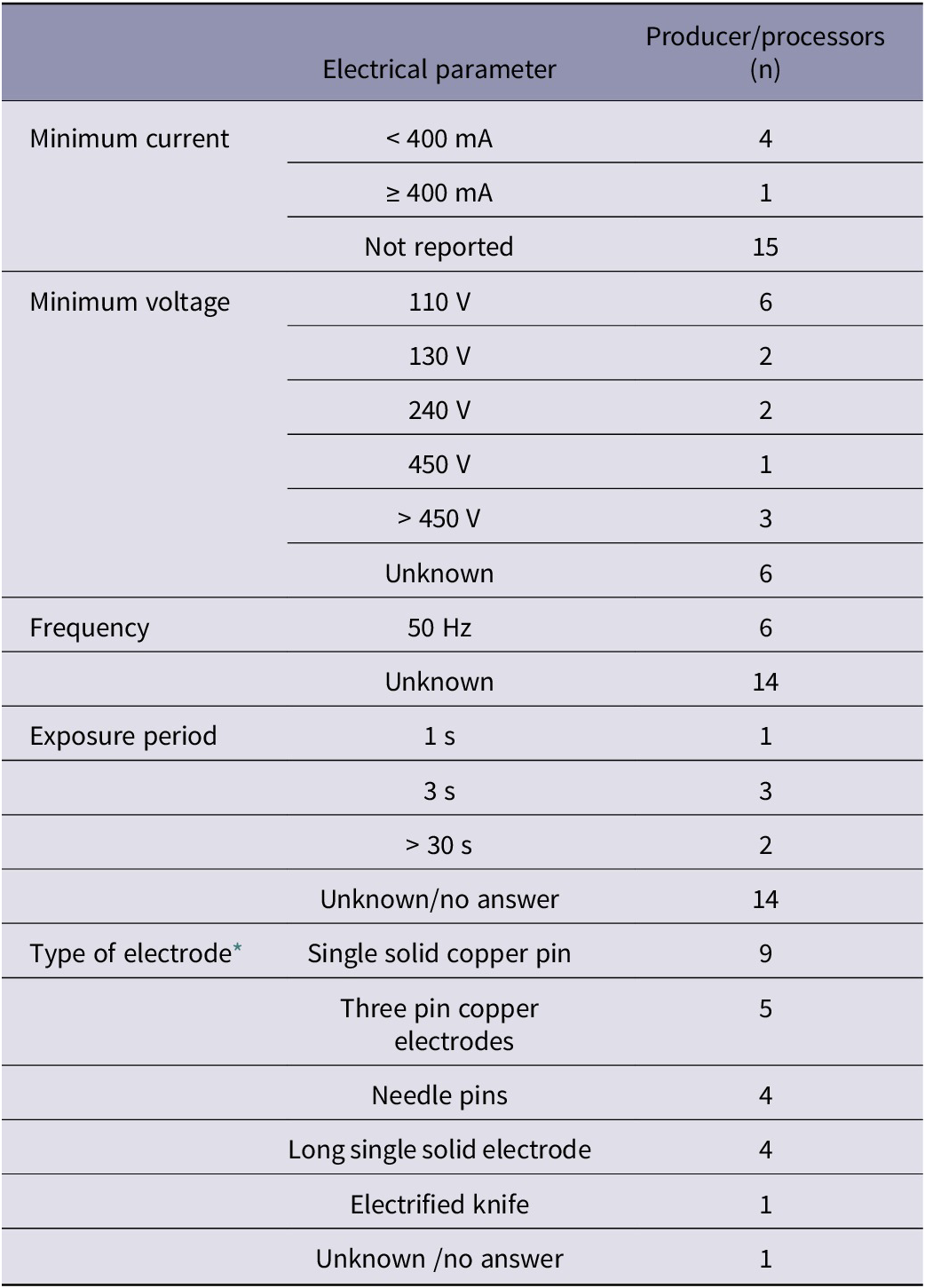
Table 2. Long description
The table consists of three columns: Category, Electrical parameter, and Producer/processors (n).
* Minimum current: less than 400 m A (4 producers); greater than or equal to 400 m A (1 producer); Not reported (15 producers).
* Minimum voltage: 110 V (6 producers); 130 V (2 producers); 240 V (2 producers); 450 V (1 producer); greater than 450 V (3 producers); Unknown (6 producers).
* Frequency: 50 H z (6 producers); Unknown (14 producers).
* Exposure period: 1 s (1 producer); 3 s (3 producers); greater than 30 s (2 producers); Unknown or no answer (14 producers).
* Type of electrode: Single solid copper pin (9 producers); Three pin copper electrodes (5 producers); Needle pins (4 producers); Long single solid electrode (4 producers); Electrified knife (1 producer); Unknown or no answer (1 producer).
* Note some producer/processors had several stunning electrode systems.
The most used electrode type reported was a single solid copper pin electrode on each side of the head, followed by three pin copper electrodes (commonly referred to as turkey pads) and needle pin/single solid electrodes (Table 2).
Part 2: Assessment of stunning effectiveness
Electrical parameters
A total of 30 current profiles were analysed (single pin [n = 11], needle pin [n = 9] and three-pin [n = 10] electrode treatment groups; nine were excluded due to sampling issues). No interrupted stuns were registered, and only one stun was shorter than 4 s (range: 1.2–5.6 s).
There were no significant correlations between carcase weight and peak voltage, peak current, stun duration, time to reach 400 mA or time to peak current for any electrode treatment. However, the strongest associations trending towards significance were a negative association between carcase weight and peak voltage for the single pin treatment (r = −0.615, n = 10; P = 0.058) and a positive association between carcase weight and peak current for the needle-pin treatment (r = 0.603, n = 9; P = 0.086).
Four current profile types were identified (Figure 2): climbing satisfactory (single pin 9%, needle pin 89% and three pin 60%), failure to maintain current flow (single pin 82%, needle pin 44% and three-pin 50%), poor initial contact (single pin 91%, needle pin 11% and three pin 50%), and interrupted current (single pin 9%, needle pin 0% and three pin 0% electrodes). Time to reach peak current was descriptively shorter for climbing satisfactory than poor initial contact profiles with single-pin electrodes (0.96 vs 3.94 s) and three-pin electrodes (0.77 vs 2.41 s), but not with needle-pin electrodes (0.66 vs 0.40 s). Statistical comparisons were not undertaken because two profile by electrode groups contained only one observation.
Examples of current profiles identified: (A) climbing satisfactory; (B) failure to maintain current flow; (C) poor initial contact; (D) interrupted current, note the short period of interruption at the beginning of profile D.
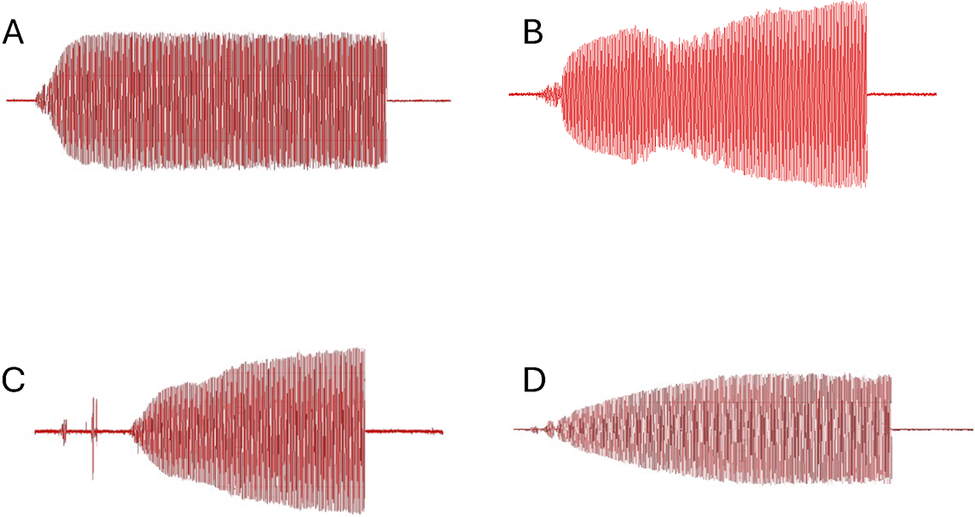
Figure 2. Long description
The figure consists of four panels, each showing a red oscillating current waveform against a neutral background.
* Panel A, top-left: The waveform begins with a flat baseline, followed by a rapid, steep increase in amplitude that stabilizes into a consistent, dense rectangular block of current before returning to the baseline.
* Panel B, top-right: The waveform shows an initial small burst, followed by a larger increase in amplitude that fails to stabilize, instead showing a gradual, irregular widening or swelling of the current envelope toward the end of the pulse.
* Panel C, bottom-left: The waveform starts with several thin, isolated vertical spikes or erratic pulses before a delayed, gradual climbing of the main current envelope begins.
* Panel D, bottom-right: The waveform shows a very brief interruption or gap immediately after the initial onset, followed by a steady, tapered increase in amplitude that eventually levels off into a sustained current flow.
The mean peak voltage was significantly higher for single-pin and three-pin electrodes compared to needle-pin electrodes (P = 0.001 and P = 0.041, respectively) (Table 3). There was no significant difference in peak voltage between single-pin and three-pin electrodes (P = 0.274). Mean peak current conveyed was significantly higher when using the needle-pin electrodes (P = 0.001) and three-pin (P = 0.002) compared to single-pin electrodes. But did not significantly differ between needle-pin and three-pin electrodes (P = 0.912) (Table 3).
Electrical stunning parameters recorded during head-only electrical stunning of turkeys (Meleagris gallopavo domesticus) with single pin, needle pin and three pin electrodes
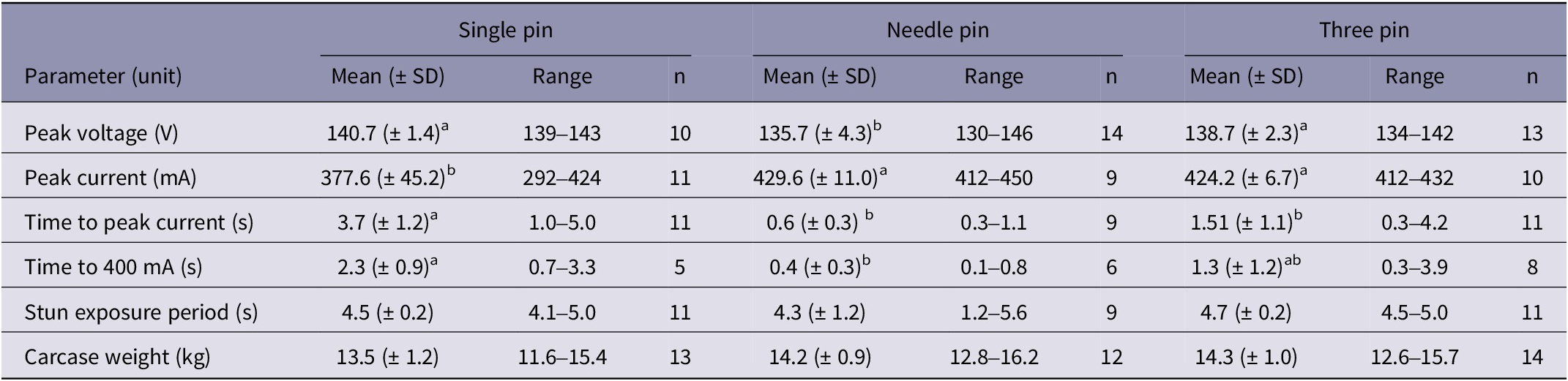
Table 3. Long description
The table consists of 11 columns and 8 rows. The header row identifies the Parameter unit followed by three main categories: Single pin, Needle pin, and Three pin. Each category is subdivided into Mean plus or minus S D, Range, and n.
* Peak voltage in V: Single pin 140.7 plus or minus 1.4, range 139 to 143, n 10. Needle pin 135.7 plus or minus 4.3, range 130 to 146, n 14. Three pin 138.7 plus or minus 2.3, range 134 to 142, n 13.
* Peak current in m A: Single pin 377.6 plus or minus 45.2, range 292 to 424, n 11. Needle pin 429.6 plus or minus 11.0, range 412 to 450, n 9. Three pin 424.2 plus or minus 6.7, range 412 to 432, n 10.
* Time to peak current in s: Single pin 3.7 plus or minus 1.2, range 1.0 to 5.0, n 11. Needle pin 0.6 plus or minus 0.3, range 0.3 to 1.1, n 9. Three pin 1.51 plus or minus 1.1, range 0.3 to 4.2, n 11.
* Time to 400 m A in s: Single pin 2.3 plus or minus 0.9, range 0.7 to 3.3, n 5. Needle pin 0.4 plus or minus 0.3, range 0.1 to 0.8, n 6. Three pin 1.3 plus or minus 1.2, range 0.3 to 3.9, n 8.
* Stun exposure period in s: Single pin 4.5 plus or minus 0.2, range 4.1 to 5.0, n 11. Needle pin 4.3 plus or minus 1.2, range 1.2 to 5.6, n 9. Three pin 4.7 plus or minus 0.2, range 4.5 to 5.0, n 11.
* Carcase weight in kg: Single pin 13.5 plus or minus 1.2, range 11.6 to 15.4, n 13. Needle pin 14.2 plus or minus 0.9, range 12.8 to 16.2, n 12. Three pin 14.3 plus or minus 1.0, range 12.6 to 15.7, n 14.
Footnote: Different superscripts denote a significant difference between stunning groups where P is less than 0.05.
Different superscripts denote a significant difference between stunning groups (P < 0.05)
The time to peak current was significantly shorter with needle-pin electrodes (P < 0.001) and the three-pin (P < 0.001) when compared to single-pin electrodes. But did not significantly differ between needle-pin and three-pin electrodes (P = 0.139). Single-pin electrodes took a significantly longer time to reach 400 mA compared to needle pins (P = 0.010). However, there was no significant difference between the single-pin and three-pin electrodes (P = 0.165), or between needle-pin and three-pin electrodes (P = 0.218). All stuns (100%) using needle- and three-pin electrodes reached 400 mA, whilst only 45% of the single-pin stuns were able to reach this threshold. Of the needle-pin electrodes stuns reaching 400 mA (n = 6), all accomplished it in ≤ 1 s, whilst with the other electrodes those proportions were lower (20% single pin, 64% three pin). The mean stun exposure period across all treatment groups was 4.5 (± 0.7) s. There was no significant difference between groups regarding the overall exposure period of the stun (F2,28 = 0.589; P = 0.562) or carcase weight (F2,36 = 1.932; P = 0.160).
Impedance was significantly higher in the single-pin electrode group (532 [± 75] Ω) compared to needle pin (453 [± 18] Ω); P = 0.002) and three pin (462 [± 9] Ω); P = 0.01). There was a strong significant positive relationship between stunning current and impedance for both single-pin (R² = 0.989; P < 0.001) and three-pin (R² = 0.619; P = 0.007) electrodes. For needle pin there was a trend towards a weak significant relationship (R² = 0.372; P = 0.081).
Brainstem and behavioural indices
There was a significant difference in duration of clonic convulsions with single-pin compared to needle-pin electrodes (P = 0.012), and between three-pin and needle-pin (P = 0.032) electrodes (Table 4). No difference was found between single pin and three pin (P = 0.871). There was no significant difference in time to onset of gaping (F2,25 = 1.633; P = 0.215), or return of rhythmic breathing (F2,22 = 0.628; P = 0.543), nictitating membrane reflex left eye (F2,16 = 0.934; P = 0.413) and right eye (F2,20 = 3.271; P = 0.059) or duration of tonic convulsions (F2,31 = 0.246; P = 0.784) between groups.
Duration of convulsions, and time to return of brainstem/behavioural indices after head-only electrical stunning of turkeys (Meleagris gallopavo domesticus) with single pin, needle pin and three pin electrodes. Brainstem/behaviours were assessed every 30 s
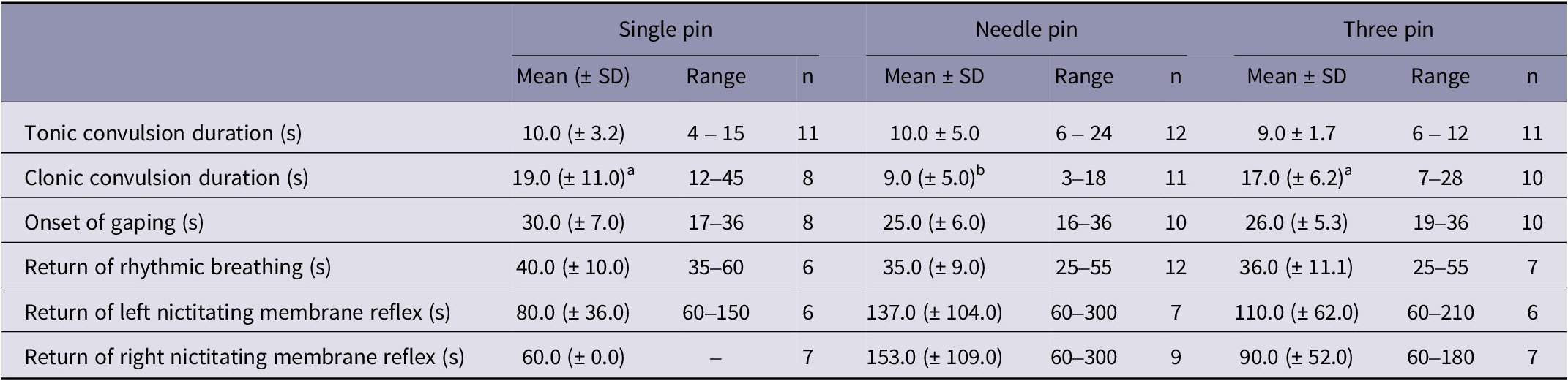
Table 4. Long description
The table compares Single pin, Needle pin, and Three pin electrodes across six physiological indices. For each electrode, it lists the Mean plus or minus S D, Range, and sample size n.
* Tonic convulsion duration (s): Single pin 10.0 plus or minus 3.2 (range 4 to 15, n=11); Needle pin 10.0 plus or minus 5.0 (range 6 to 24, n=12); Three pin 9.0 plus or minus 1.7 (range 6 to 12, n=11).
* Clonic convulsion duration (s): Single pin 19.0 plus or minus 11.0 (range 12 to 45, n=8); Needle pin 9.0 plus or minus 5.0 (range 3 to 18, n=11); Three pin 17.0 plus or minus 6.2 (range 7 to 28, n=10). Note: Needle pin is significantly different from the others.
* Onset of gaping (s): Single pin 30.0 plus or minus 7.0 (range 17 to 36, n=8); Needle pin 25.0 plus or minus 6.0 (range 16 to 36, n=10); Three pin 26.0 plus or minus 5.3 (range 19 to 36, n=10).
* Return of rhythmic breathing (s): Single pin 40.0 plus or minus 10.0 (range 35 to 60, n=6); Needle pin 35.0 plus or minus 9.0 (range 25 to 55, n=12); Three pin 36.0 plus or minus 11.1 (range 25 to 55, n=7).
* Return of left nictitating membrane reflex (s): Single pin 80.0 plus or minus 36.0 (range 60 to 150, n=6); Needle pin 137.0 plus or minus 104.0 (range 60 to 300, n=7); Three pin 110.0 plus or minus 62.0 (range 60 to 210, n=6).
* Return of right nictitating membrane reflex (s): Single pin 60.0 plus or minus 0.0 (n=7); Needle pin 153.0 plus or minus 109.0 (range 60 to 300, n=9); Three pin 90.0 plus or minus 52.0 (range 60 to 180, n=7).
Different superscripts denote a significant difference between stunning groups (P < 0.05)
Visual Evoked Potentials
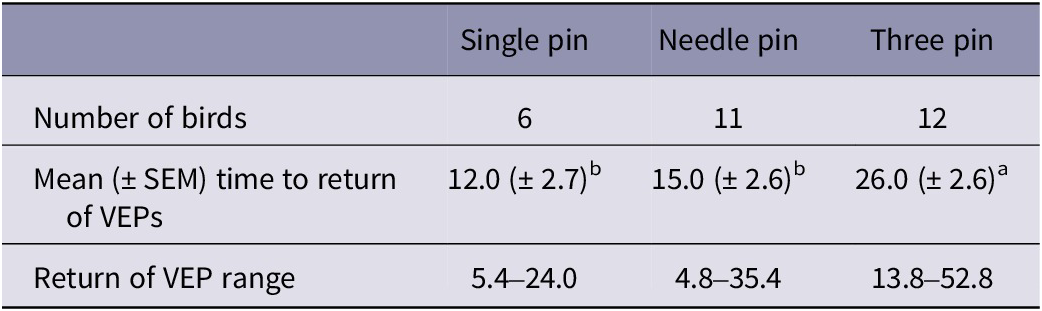
A total of 29 VEPs were analysed (single-pin; n = 6, needle-pin; n = 11 and three-pin; n = 12 electrodes). Ten birds were rejected from VEP analysis due to electrical noise and movement artefact. Examples of VEPs from three turkeys that received head-only electrical stunning with either single-pin, needle-pin or three-pin electrodes are shown in Figure 3. The bird that was stunned with three-pin electrodes took the longest to recover VEPs (20–26 s), whereas the birds stunned with needle-pin and single electrodes recovered activity by 16–22 s and 15–22 s, respectively. There was a significant difference between stunning groups (F2,26 = 5.971; P = 0.008) regarding mean return of VEPs. Initially, following electrical stunning, VEPs were abolished in all turkeys in each treatment group. VEPs returned latest in the three-pin electrode treatment group compared to needle (P = 0.025) and single-pin (P = 0.020) groups (Table 5). There was no significant difference between single-pin and needle-pin stunning groups (P = 0.801).
Example of visual evoked potential (VEP) from three turkeys after head-only electrical stunning with three-pin, needle-pin, and single-pin electrodes. Latencies of positive and negative deflections are indicated on the VEP waveform. Each waveform is the average of ≈10 traces (6.0 s), excluding traces with artefact. There was a stimulus delay of 100 (50 ms shown) with the stimulus delivered at 0 ms (dashed line). Time after treatment is from the end of the electrical stun plus the delay between stun to the start of VEP recordings. The * waveform is where VEP activity first returned.
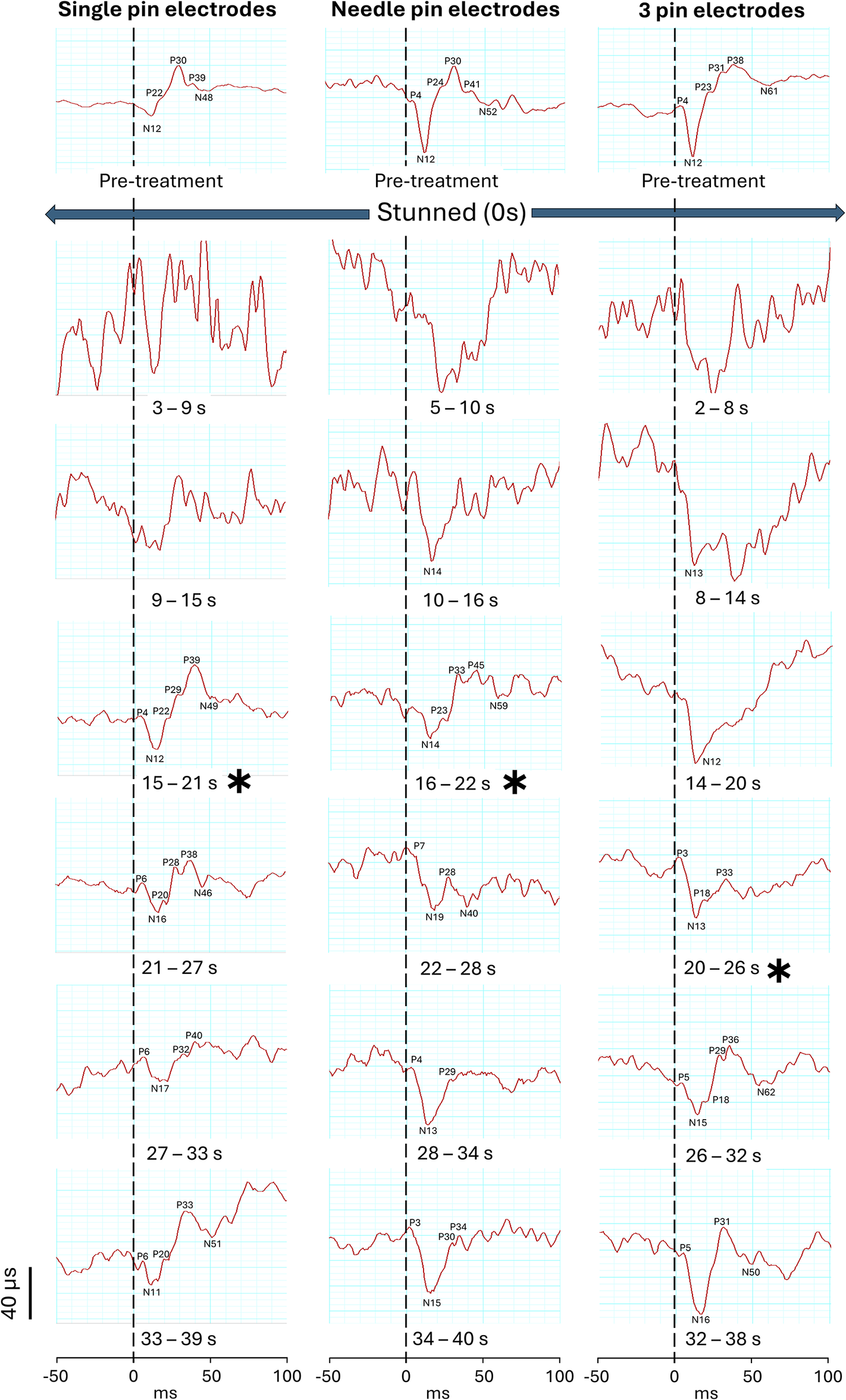
Figure 3. Long description
The figure consists of 21 line graphs arranged in a 3 by 7 grid. The columns are labeled from left to right as Single pin electrodes, Needle pin electrodes, and 3 pin electrodes. The X-axis for all plots represents time in milliseconds from minus 50 to 100, with a vertical dashed line at 0 milliseconds indicating the stimulus. The Y-axis scale bar indicates 40 micro-V.
Row 1 shows Pre-treatment baselines with distinct peaks and troughs.
- Single pin: N 12, P 22, P 30, P 39, N 48.
- Needle pin: P 4, N 12, P 24, P 30, P 41, N 52.
- 3 pin: P 4, N 12, P 23, P 31, P 38, N 61.
A horizontal blue arrow labeled Stunned 0 s separates the first row from the subsequent rows.
Rows 2 and 3 show suppressed or chaotic activity.
- Single pin: 3 to 9 s and 9 to 15 s.
- Needle pin: 5 to 10 s and 10 to 16 s with N 14 labeled.
- 3 pin: 2 to 8 s and 8 to 14 s with N 13 labeled.
Rows 4 through 7 show the return of V E P activity. An asterisk indicates the first return of activity.
- Single pin: Activity returns at 15 to 21 s (asterisk) with peaks P 4, N 12, P 22, P 29, P 39, N 49. Subsequent intervals 21 to 27 s, 27 to 33 s, and 33 to 39 s show stabilizing waveforms.
- Needle pin: Activity returns at 16 to 22 s (asterisk) with N 14, P 23, P 33, P 45, N 59. Subsequent intervals 22 to 28 s, 28 to 34 s, and 34 to 40 s show recovery.
- 3 pin: Activity returns at 20 to 26 s (asterisk) with P 3, P 18, N 13, P 33. Subsequent intervals 26 to 32 s and 32 to 38 s show recovery.
Mean ± SEM and range time to return of VEPs (s) after head-only electrical stunning of turkeys (Meleagris gallopavo domesticus) with single-pin, needle-pin and three-pin electrodes
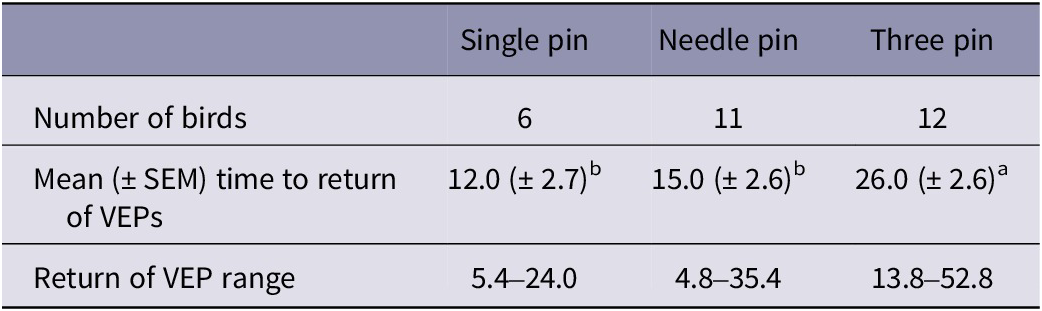
Table 5. Long description
The table consists of four columns and four rows.
Column headers from left to right are: Empty, Single pin, Needle pin, and Three pin.
Row 1: Number of birds. Single pin has 6. Needle pin has 11. Three pin has 12.
Row 2: Mean plus or minus S E M time to return of V E P s in seconds. Single pin is 12.0 plus or minus 2.7 with superscript b. Needle pin is 15.0 plus or minus 2.6 with superscript b. Three pin is 26.0 plus or minus 2.6 with superscript a.
Row 3: Return of V E P range in seconds. Single pin is 5.4 to 24.0. Needle pin is 4.8 to 35.4. Three pin is 13.8 to 52.8.
A footnote indicates that different superscripts denote a significant difference between stunning groups where P is less than 0.05.
Different superscripts denote a significant difference between stunning groups (P < 0.05)
Fifty eight percent of turkeys in the three-pin electrode group had VEP activity returning within 26 s. Meanwhile 91 and 100% of turkeys in needle- and single-pin electrode groups, respectively, recovered VEP activity by 26 s. There was no significant relationship between current and time to return of VEPs (single pin R² = 0.050; P = 0.670; needle pin R² = 0.156; P = 0.292; three pin R² = 0.001; P = 0.938). The time to return of rhythmic breathing generally followed the return of VEPs in all but two cases (8%), but there was no significant correlation in any of the groups (single pin R² = 0.001; P = 0.949; needle pin R² = 0.003, P = 0.865; three pin R² = 0.256; P = 0.246). There was no correlation between return of VEP activity and return of nictitating membrane reflex (left or right) or gaping in the treatment groups.
Discussion
Survey of slaughter practices
Due to the small sample size, the results of the survey cannot be generalised as being representative of wider UK practice. However, this survey confirmed several previously unverified assumptions, notably the substantial variation in both stunning methods and equipment across producers. All reported systems were constant-voltage devices. Although waveform data could not be collected from these stunners, the commercially available systems identified (Whitehead and Sedgebeer) are constant-voltage stunners using a sinusoidal alternating current (AC) waveform (reported output 130 V, 50 Hz).
Four producer/processors reported using devices that were ‘homemade’ or produced for them by electrical engineers. In the UK, there is currently no kitemark, approval scheme, or register for electrical stunning equipment. Furthermore 75% (n = 15/20) of the producer/processors reported they did not know what the legal minimum current was for head-only electrical stunning was (400 mA turkeys and no published minimum for ducks or geese) (EU 2009) and 20% (n = 4/20) incorrectly believing it was below 400 mA for turkeys. This represents a significant welfare risk for birds produced in small-scale systems, as suboptimal current delivery may result in ineffective stunning. The lack of formal regulations may contribute to the high variability in stunners used and to the substantial proportion of responses reporting electrical parameters below legal minimum standards. Almost half of the producer/processors either did not know which stunner they were using or reported operating a home-made device. Together, these findings suggest potential gaps in regulation and inspection of small-scale UK turkey, duck and goose processing.
Several electrode types were reported as being employed for the stunning of turkeys, ducks and geese. The most reported electrode type was a set of single solid copper pin (38%; n = 9/24) electrodes on ridged tongs, that were placed on either side of the cranium. The next most reported were sets of three solid copper pins (21%; n = 5/24) or rosettes of needle-pin (17%; n = 4/24) electrodes, that were again mounted on ridged tongs that were placed on either side of the cranium for stunning. Five (21%) of the producer/processors interviewed stunned their birds using an electrical head to body stunning method with an electrified solid rod (wand) (n = 4) or electrified knife (n = 1), which is placed on the head with the bird earthed by a shackle. These single-electrode systems compared to two-electrode head-only tongs can result in more variable contact resistance at both the point of contact on the head and shackle/earth point and may not span the brain sufficiently, which can cause stun failures, inadequate current flow through the brain and incomplete induction of unconsciousness (FAWC 2009).
Assessment of stunning effectiveness
Head-only electrical stunning is a reversible stunning method, where the bird can resume consciousness if not killed by exsanguination. Resumption of VEP activity was used in this study to assess duration of induced brain dysfunction following stunning and the time to return of activity that could support consciousness. VEPs are time-locked responses of the brain (optic lobe) to a light stimulus delivered to the eyes. They do not represent conscious awareness of the stimulus since they can occur in both the conscious and unconscious state (Gibson et al. Reference Gibson, Taylor and Gregory2016). Rather they represent the rudimentary brain processing of the external stimulus below the level of conscious perception (Daly et al. Reference Daly, Kallweit and Ellendorf1988). In terms of stunning and slaughter, the absence of VEPs represents a degree of brain dysfunction that is inconsistent with the maintenance of consciousness, while their recovery characterises a state that could support consciousness. Some authors consider the absence of evoked potentials to be a conservative proxy of insensibility/unconsciousness (Verhoeven et al. Reference Verhoeven, Gerritzen, Hellebrekers and Kemp2015), however their advantage is that they can be more robust and reliable in determining the time to resumption of brain function (sensory processing) than spontaneous EEG activity (both waveform morphology and spectral indices), particularly in the presence of electrical noise and movement artefact. Generally, evoked potentials return earlier than spontaneous EEG activity and as such are generally an early indicator of the return of brain function that could support consciousness. Their conservative nature is an advantage in stun duration studies, where a precautionary principle approach is taken to protect animal welfare.
Overall, single-pin electrodes had the lowest performance, with the shortest time to return of VEP activity (12 s) and the poorest electrical performance (peak current, time to peak current and time to 400 mA). Three-pin electrodes produced the longest time to return of VEP activity (26 s), while both needle-pin and three-pin electrodes generally produced more favourable electrical parameters than single-pin electrodes. Factors that may have contributed to this could have included the single point of contact and the lower surface area of contact compared to the other electrode types. When there is only a single point of contact at the surface of the head, it can result in localised heating, which in turn enhances the build-up of carbon deposits on the electrodes and therefore increases resistance and reduces current flow (Sparrey & Wotton Reference Sparrey and Wotton1997). Although not significant, needle-pin electrodes had the highest recorded peak current and the shortest time to reach peak current, they were also more consistent in reaching the 400 mA setting (100% of the analysed stuns reaching that value), with 100% of the stuns reaching that threshold before 1 s. The needle-pin electrodes are designed to both part the feathers, increase surface contact area and grip/puncture the epidermis to decrease resistance and increase current flow (Gibson et al. Reference Gibson, Taylor and Gregory2016). However, needle-pin electrodes are more prone to bending, breakage and are more difficult to clean, which can reduce electrode contact and subsequent current flow (Gibson et al. Reference Gibson, Taylor and Gregory2016; Nielsen et al. Reference Nielsen, Alvarez, Bicout, Calistri, Depner, Drewe, Garin-Bastuji, Gonzales Rojas, Gortázar Schmidt, Miranda Chueca, Roberts, Sihvonen, Spoolder, Stahl, Velarde Calvo, Viltrop, Winckler, Candiani, Fabris, Van der Stede and Michel2019). In contrast, the time to return of VEPs was significantly longer when using three-pin electrodes (26 s) compared with the other two stunning groups. The three-pin electrodes have increased electrode contact on the surface of the skin compared to single pin, are less prone to deformation and simpler to clean compared to needle pin. Anecdotally, the three-pin electrodes were found to accumulate less carbon and organic matter than the other two electrode types. Compared to chickens, turkeys have less feather coverage over their craniums, making the benefit of needle-pin electrodes in parting feathers less important, compared to preserving electrode integrity.
Constant voltage electrical stunning systems as reported in the survey and used empirically in this study are commonly used by seasonal small-scale producer/processors for the stunning of turkeys prior to slaughter. These systems are generally limited to an output voltage of 130 V. These systems despite their widespread use are widely recognised as being less effective than constant current systems (Wilkins et al. Reference Wilkins, Wotton, Parkman, Kettlewell and Griffiths1999; Raj & O’Callaghan Reference Raj and O’Callaghan2004). Wotton et al. (Reference Wotton, Grist, O’Callaghan and van Klink2021) reported that effective induction of brain dysfunction as assessed with presence or absence of epileptiform activity in the EEG, could be achieved in turkeys with 125 V 50 Hz AC, which is similar to set voltage of the commercial stunning system tested in the current study. However, Wotton et al. (Reference Wotton, Grist, O’Callaghan and van Klink2021), only used induction of epileptiform activity to indicate if the bird was stunned and did not assess the duration of induced unconsciousness or return of brain function. Both of which are essential in determining the effectiveness or otherwise of a reversible stunning method. During electrical stunning, it is the electrical current passing through the brain that induces unconsciousness/insensibility by disrupting normal brain activity and evoking an epileptiform state (Gregory Reference Gregory1998). Effective electrical stunning depends on adequate electrical contact between the electrodes and the head, together with sufficient applied voltage to overcome heads impedance, thereby allowing enough current to pass through the brain to induce unconsciousness (Wotton & O’Callaghan Reference Wotton and O’Callaghan2002; Wotton et al. Reference Wotton, Grist, O’Callaghan and van Klink2020). The output voltages of constant voltage systems as used in this study are limited to 130 V to reduce the potential harm to operators, however this causes operational issues as it can increase the time to effective stunning current, especially when electrodes are contaminated.
There was no significant difference between groups regarding the carcase weight of the birds, and weight was not a determining factor regarding the amount of current or voltage necessary to convey the electrical stun. After stunning, all surviving turkeys displayed a tonic phase characterised by head raising, extension of legs and interruption of rhythmic breathing, followed by a clonic phase during which the turkeys exhibited distinctive uncontrolled movements (kicking and wing flapping). Reducing the number and intensity of convulsions may aesthetically be more appealing to the public. However, because effective electrical stunning is normally associated with tonic and clonic seizure activity, a reduction in these movements may also indicate inadequate stun performance, emphasising the need for reassessment of other indicators of insensibility/unconsciousness (Erasmus et al. Reference Erasmus, Turner and Widowski2010; Verhoeven et al. Reference Verhoeven, Gerritzen, Hellebrekers and Kemp2015; Comin et al. Reference Comin, Barbieri, Minero and Dalla Costa2023).
The minimum legal current for turkeys of 400 mA was achieved for all birds in the needle- and three-pin treatment groups, and only 45% of birds in the single-pin group. Despite reaching this legal minimum threshold, the mean duration of induced brain dysfunction (12, 15 and 26 s for single-, needle- and three-pin electrodes, respectively) was less than that previously 30 s reported by Gregory & Wotton (Reference Gregory and Wotton1991). These periods of induced brain dysfunction were, in some cases, equal to or shorter than the time required for exsanguination alone to induce unconsciousness. Consequently, a bird could begin recovering consciousness during bleeding before exsanguination resulted in irreversible loss of consciousness leading to death. This is particularly relevant in situations where there are delays in the stun/cut interval, as these birds might begin recovering consciousness during the bleeding process, experiencing pain and distress (Gibson et al. Reference Gibson, Taylor and Gregory2016). According to Barnett et al. (Reference Barnett, Cronin and Scott2007), some chickens may remain conscious for a period of 26 s following neck cutting without stunning, whilst Gregory and Wotton (Reference Gregory and Wotton1988) reported 30 (± 3) s for turkeys. Even the best performing electrode-type in this study (three-pin) could only guarantee that 25% of the stunned animals surpassed the 30-s threshold. These findings raise concerns about the ability of head-only constant voltage stunning systems to maintain unconsciousness until exsanguination induces irreversible unconsciousness. They also demonstrate that achieving the legal minimum current of 400 mA alone did not guarantee a sufficient duration of brain dysfunction.
Study limitations
One limitation of this study was that a substantial proportion of current profiles had the sine waves clipped due to recording range issues. This constrained the interpretation of certain aspects of the profiles, like peak current and time to 400 mA. Insensibility and effective stunning can generally be recognised by the absence of eye reflexes, such as the nictitating membrane or corneal reflex, and the absence of breathing (Erasmus et al. Reference Erasmus, Turner and Widowski2010). Whilst assessing the effectiveness of stunning, resumption of rhythmic breathing is one of the first indications of return of medullary function and the resumption of supply of oxygenated blood to the brain provides the potential for resumption of consciousness (Erasmus et al. Reference Erasmus, Turner and Widowski2010). However, the experimental environment in this study comprising darkened conditions to reduce light artefact on VEP traces, made determination of time of onset and rate of respiration difficult. Consequently, where rhythmic breathing could not be directly observed, posterior movements indicative of hind air sac filling was assessed by palpation to confirm whether rhythmic respiration had returned. Time to return of nictitating membrane reflex was later when using needle-pins electrodes compared to the other treatments. However, the position of three-pins electrodes on the bird’s head led to occasional placement of electrodes on the bird’s eye, which likely affected the time to return of eye reflexes. Previous studies have found little direct correlation between electrophysiological and behavioural indices commonly used to assess stun performance (Sandercock et al. Reference Sandercock, Auckburally, Flaherty, Sandilands and McKeegan2014; Gibson et al. Reference Gibson, Taylor and Gregory2016; Verhoeven et al. Reference Verhoeven, Gerritzen, Hellebrekers and Kemp2016). Such findings perhaps suggest that the latter may not in isolation be valid measures, or at best may be conservative indicators of brain dysfunction, highlighting the importance of not relying on just one indicator. However, it is important to note that due to the current study’s design the frequency of behavioural/reflexes was assessed only every 30 s to limit movement contamination of the VEP waveforms, this meant that the exact time to return of behaviours/reflexes could not be accurately determined, so care must be taken to not overinterpret the lack of correlation. Finally, a potential limitation of the study was that the presence of metallic subdermal recording electrodes may have influenced current flow during electrical stunning. Although their use was unavoidable and consistent across all treatments, the electrodes would be expected to facilitate rather than impede current flow. Nevertheless, a possible effect on the recorded outcomes cannot be excluded.
Animal welfare implications and conclusion
In conclusion, head-only electrical stunning with all three of the most commonly used electrode types in small-scale production/processing induced a period of brain dysfunction, which did not consistently exceed the time it would take to lose consciousness following exsanguination alone. This could result in turkeys recovering consciousness prior to or during the neck cut. Of the electrodes tested, the three-pin electrodes produced the greatest period of induced dysfunction. Despite this, these results raise concerns about the effectiveness of head-only constant voltage stunning systems and demonstrate that achieving the legal minimum current of 400 mA alone did not guarantee a sufficient period of unconsciousness. Further research is needed to refine the electrode design, improve stunning performance and determine how current and other electrical parameters influence the duration of induced insensibility and unconsciousness in turkeys.
Supplementary material
The supplementary material for this article can be found at http://doi.org/10.1017/awf.2026.10128.
Data-availability statement
The data that support the findings of this study are available from the corresponding author upon reasonable request.
Acknowledgements
This study was funded by Humane Slaughter Association. The authors wish to thank John and Pete Richards for engineering support, and Christopher Davies for assistance in animal management.
Competing interests
None.




 Open access

