Introduction
Based on the developmental origins of health and disease hypothesis,Reference Barker1 which postulates that diseases originate in the fetal period, significant research has been conducted on the prenatal starvation environment during pregnancy and its effects on offspring.Reference Knop, Geng and Gorny2 Epigenetic change is active around fertilization and early pregnancy, and offspring are significantly affected by maternal nutritional status during this period,Reference Li3 suggesting that the maternal nutritional status before and after conception may be crucial for offspring health. There are many studies of child health, but none at scale examining sex ratio.
Offspring sex ratio is considered a good indicator of maternal nutritional status before and around pregnancy and its effect on offspring, as it is related to maternal nutritional status in the peri-conception period.Reference Rosenfeld and Roberts4–Reference Green, Spate and Parks6 Moreover, it does not depend on the maternal nutritional status during pregnancy. The sex ratio at birth is typically stable at approximately 1.06 (male/female).Reference Terrell, Hartnett and Marcus7 However, this balance may be affected by extreme maternal nutritional conditions, as observed during large-scale famines such as the Dutch Hunger Winter, where the likelihood of male births increased significantly (OR: 1.31; 95% CI: 1.09–1.58).Reference Stein, Zybert and Lumey8 Studies on mice have shown that extreme pre-pregnancy maternal fat intake significantly affects the offspring sex ratio.Reference Rivers and Crawford9,Reference Rosenfeld, Grimm, Livingston, Brokman, Lamberson and Roberts10 As nutritional balance is expected to skew in extreme conditions, it is possible that distortion of the offspring sex ratio during starvation in humans observed in previous reports was not caused by a lack of energy but an imbalance in nutrients, mainly fat.
Moreover, high maternal stress levels skew offspring sex ratio.Reference Trivers and Willard11 Studies have reported an association between offspring sex ratio and maternal starvation; however, these studies were conducted in times of warReference Stein, Zybert and Lumey8 or during unstable political conditions,Reference Song12 which raise stress levels. Therefore, whether the skewed sex ratio is solely a result of the nutritional status remains unclear. Japan is the only nation among the countries in the Organization for Economic Co-operation and Development in which the proportion of women aged 20–29 years with a body mass index (BMI) <18.5 kg/m2 has exceeded 20% for over two decades.13 Although a low BMI affects the offspring sex ratio,Reference Boutari, Pappas and Mintziori14 it does not necessarily indicate malnutrition or illness; this characteristic provides a unique opportunity to examine associations between maternal nutritional status and offspring characteristics in a stable, high-income setting, without the confounding influences of famine, war, or political instability. We hypothesized that maternal nutritional intake in the peri-conception period may influence offspring sex. As testing this hypothesis requires an environment in which the maternal nutritional status affects offspring sex, we planned an analysis using an eligible large birth cohort in Japan. Our hypothesis, if confirmed, would contribute to a better understanding of how peri-conceptional maternal nutritional conditions influence offspring sex, offering new perspectives on maternal health and early developmental biology. As nutrition and conception are closely related, optimizing nutritional balance could support the maintenance of natural sex ratio homeostasis.
Methods
Study design
This prospective cohort study included data from the Japan Environment and Children’s Study (JECS), a large-scale prospective birth cohort study (UMIN Clinical Trial Registry number, UMIN000030786). The study protocol, study design, and baseline profiles of the participants in the JECS have been described previously.Reference Kawamoto, Nitta and Murata15,Reference Michikawa, Nitta and Nakayama16 The recruitment of pregnant women was conducted nationally, and the cohort population was representative of the population of all pregnant women in Japan during the study period.
Setting
Pregnant women living in Japan were recruited from 15 regional centers between January 2011 and March 2014. Our aim was to include participants from a wide range of areas of Japan, including urban and rural areas. Self-administered questionnaires collecting data on biological and environmental factors were completed during the first trimester. The questionnaires included items regarding dietary intake, demographic and psychosocial factors, medical and obstetric history, lifestyle, occupation, and socioeconomic status. The dataset “jecs-ta-20190930” was used in this study.
Participants
All pregnant women and offspring pairs who participated in the JECS were included in this study. Participants who withdrew their consent or were lost to follow-up were excluded from this study. Additionally, participants were excluded if offspring sex was unknown at birth or if the mother had evident outlier data, such as a daily calorie intake of >20,000 kcal, or missing data regarding age, BMI, or calorie intake.
Variables
In this study, the outcome of interest was offspring sex, the data of which were obtained from medical record transcripts. Moreover, the exposure was maternal nutritional intake from 1 year prior to conception to immediately after conception. These data were collected using the Japan Public Health Center-based Prospective Study for the Next GenerationReference Yokoyama, Takachi and Ishihara17 food frequency questionnaire (FFQ) that has been validated for estimating long-term food intake. Although the details of the FFQ and the method of measuring food intake have already been reported,Reference Ishitsuka, Sasaki and Yamamoto-Hanada18 the average daily intake of each nutrient was calculated based on food intake, eating out, and food behavior questionnaires. Maternal total fat, saturated fatty acid (SFA), polyunsaturated fatty acid (PUFA), n–3 PUFA, n–6 PUFA, protein, and energy content data were all obtained in this study. For calories and nutrients, data were converted logarithmically, as it was expected that data distribution would display a long skew to the right. Furthermore, the SFA/total energy and n–6/n–3 ratios were analyzed.
Confounding factors believed to affect human sex, based on previous reports,Reference Rivers and Crawford9,Reference Rosenfeld, Grimm, Livingston, Brokman, Lamberson and Roberts10,Reference Williams and Gloster19–Reference Douhard22 were used to create a directed acyclic graph. Adjustments for age, BMI, household income, alcohol consumption, and region of residence were made. Given the strong correlation among fat, protein, and total energy intakes, we applied the residual method as follows: fat intake was adjusted for both protein and energy intakes using multiple linear regression; protein intake was adjusted for total energy intake using simple linear regression; and total energy intake was adjusted for protein intake using simple linear regression. In each case, the residuals from these regressions were used as exposure variables in the models. Data on maternal age at the time of delivery were extracted from medical record transcripts, and BMI was calculated using the pre-pregnancy maternal height and weight. Household income and alcohol consumption data were obtained using the participant questionnaire. Alcohol consumption was classified into categories according to the amount consumed. The participant’s residence before and after pregnancy was classified into eight region categories, based on the area of participant registration. In the early stages of pregnancy, pregnant women were considered to reside in the region of the 15 regional centers from which they were recruited, and the 15 regional centers were further classified into eight regional categories (Hokkaido, Tohoku, Kanto, Chubu, Kansai, Chugoku, Shikoku, and Kyusyu/Okinawa), officially distinguished according to the Japanese history, customs, climate, and geography.
Ethical considerations
The JECS protocol was reviewed and approved by the Ministry of the Environment’s Institutional Review Board (approval no.: 100910001; approval date: September 10, 2010) on Epidemiological Studies and the Ethics Committees of all participating institutions. All participants provided written informed consent to participate. This study was conducted following the guidelines of the Declaration of Helsinki.
Sample size
To ensure the generalizability for the Japanese population based on the JECS results, 15 regional centers were selected to homogeneously cover a large geographic area, with the aim of including half of all births in the target area. Depending on the number of births in the selected regional centers, 3,000–9,000 pregnant women in 3 years were required to be recruited, yielding a total of 100,000 participants at 15 regional centers. The relevant details of the study design and rationale have been reported previously.Reference Kawamoto, Nitta and Murata15 Based on previous reports, we hypothesized that the sex ratio, which was strictly maintained in this study,Reference Terrell, Hartnett and Marcus7 changed by 1%, and as the sample size was 5,730 participants with a coefficient alpha value of 0.05 and a power of 0.95, we concluded that hypothesis testing was sufficiently precise for examination in the entire cohort of participants.
Statistical analyses
The baseline characteristics of the mothers were summarized according to offspring sex. A logistic regression model was used to evaluate the relationship between exposure factors on the proportion of male offspring after adjusting for maternal age (continuous), BMI (continuous), household income (<2, 2–3.9, 4–5.9, 6–7.9, 8–9.9, 10–11.9, 12–14.9, 15–19.9, and >20 million JPY), alcohol consumption (non-drinker, ≤20 g/day, and >20 g/day), and region of residence (Hokkaido, Tohoku, Kanto, Chubu, Kansai, Chugoku, Shikoku, or Kyusyu/Okinawa).
To verify each factor, we meticulously assessed their validity and reliability within our study framework. A subgroup analysis based on maternal pre-pregnancy BMI, energy intake in the peri-conception period, and age was further performed. Pre-pregnancy BMI was grouped into four categories using the World Health Organization’s classifications (underweight, BMI < 18.5 kg/m2; normal, 18.5 kg/m2 ≤ BMI < 25.0 kg/m2; overweight, 25.0 kg/m2 ≤ BMI < 30.0 kg/m2; obese, BMI ≥ 30.0 kg/m2). Energy intake was classified as very low (<667 kcal),Reference Bates23 low (667 kcal ≤ energy <1,000 kcal),Reference Lumey and Stein24 middle (1,000 kcal ≤ energy <4,000 kcal), and high (≥4,000 kcal). Maternal ages were classified into three categories (<20 years, 20–34 years, and ≥35 years) based on epidemiological classifications used in prior research examining age-related reproductive outcomes.Reference Ahn, Kim and Kang25
As a sensitivity analysis, we repeated the primary analysis excluding stillborn offspring to assess the robustness of our findings. We also performed a sensitivity analysis limited to participants with plausible energy intake, defined as 1.20–2.40 times the basal metabolic rate, which was estimated using the Schofield equation, following FAO/WHO/UNU guidelines.26 This corresponded to approximately 1,400–3,400 kcal/day in adolescent females.
Data of participants with outliers and missing data were excluded from the analyses. In terms of outliers, those who consumed >20,000 kcal per day and had an extremely high intake of all nutritional items were excluded.
All statistical analyses were performed using SAS 9.4 (SAS Institute, Cary, NC, USA) and JMP PRO 16.2.0 (SAS Institute).
Results
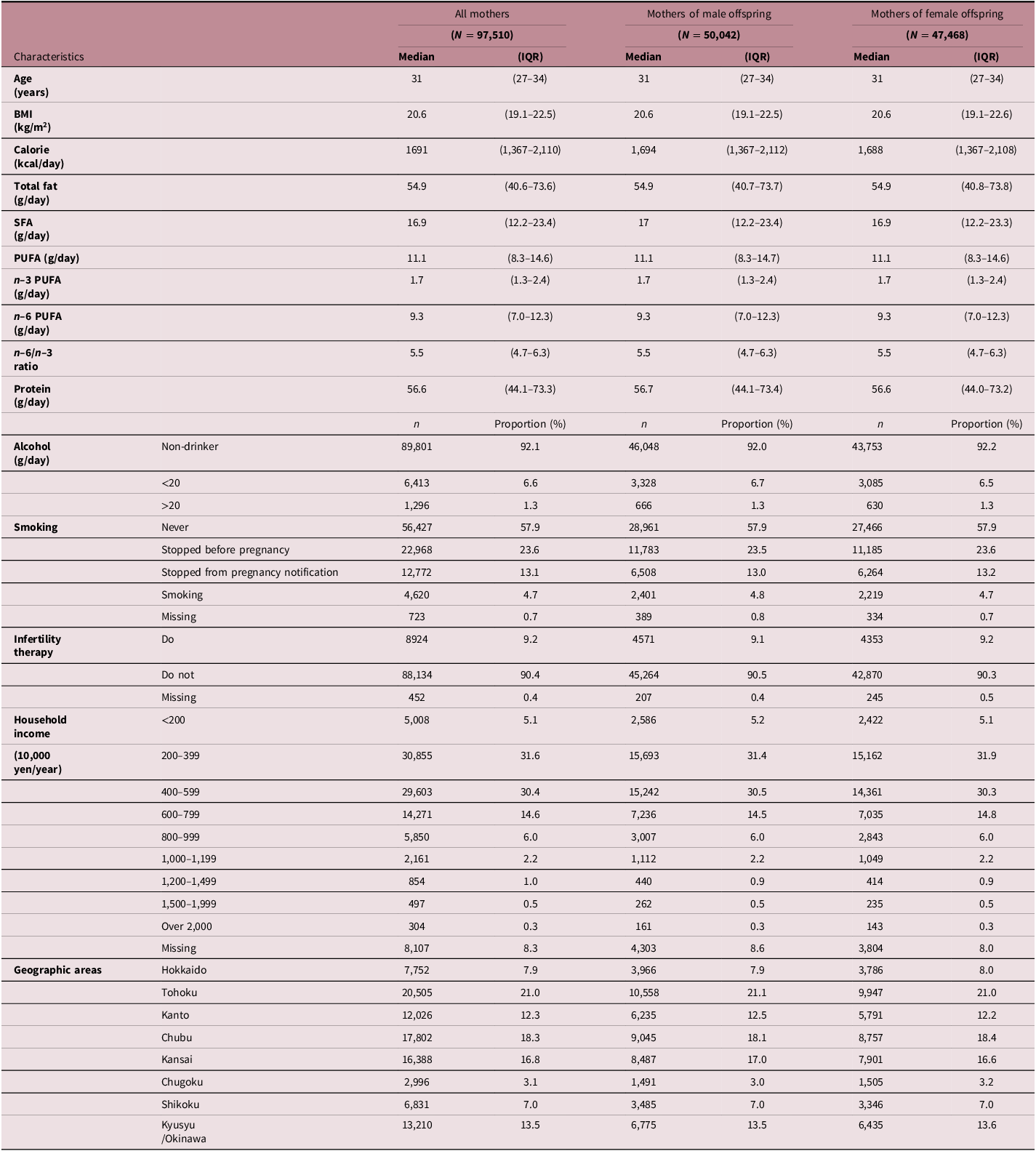
Data from 104,062 fetuses and 103,060 pregnancies were eligible for inclusion in this study. In total, 535 fetuses of unknown sex and 2,540 with missing data were excluded. Seven mother–child pairs with an average maternal daily calorie intake of >20,000 kcal were excluded, as were 3,470 pairs with missing data regarding maternal age, BMI, and/or calories. Therefore, the final analysis included 97,510 mother–offspring pairs (50,042 male [51.3%] and 47,468 female [48.7%] offspring; stillborn offspring were included if their sex was known) (Figure 1). Maternal demographic data were not significantly different between mothers of male and female offspring (Table 1).
Selection process of participants.

Preconception maternal characteristics of all mothers, mothers of male offspring, and mothers of female offspring

Abbreviations: BMI, body mass index; IQR, interquartile range; PUFA, polyunsaturated fatty acid; SFA, saturated fatty acid.
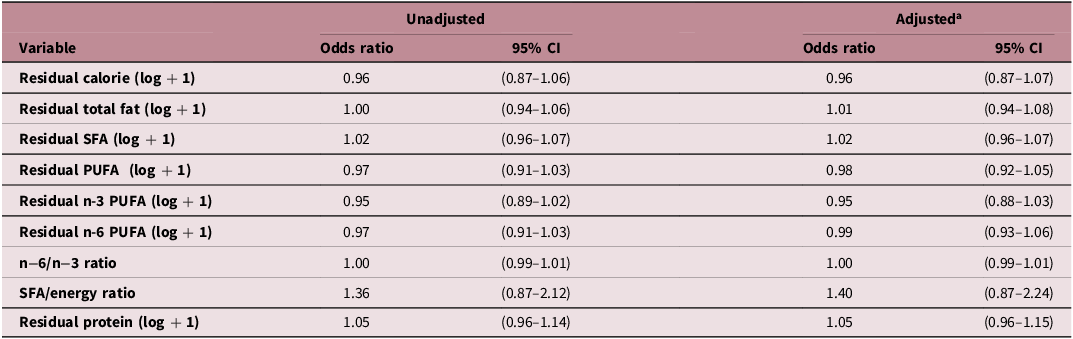
There was no evidence that any of the following maternal nutritional factors were related to offspring sex: residual calorie intake (adjusted odds ratio [aOR], 0.96; 95% confidence interval [CI], 0.87–1.07), residual total fat (aOR, 1.01; 95% CI, 0.94–1.08), residual SFA (aOR, 1.02; 95% CI, 0.96–1.07), n–6/n–3 ratio (aOR, 1.00; 95% CI, 0.99–1.01), SFA/energy ratio (aOR, 1.40; 95% CI, 0.87–2.24), residual protein (aOR, 1.05; 95% CI, 0.96–1.15), residual PUFA (aOR, 0.98; 95% CI, 0.92–1.05), residual n-3 PUFA (aOR, 0.95; 95% CI, 0.88–1.03), and residual n–6 PUFA (aOR, 0.99; 95% CI, 0.93–1.06) (Table 2).
Effects of maternal fat and nutrient intake on offspring sex, evaluated with the unadjusted and adjusted odds ratio of each fat and nutritional variable

Abbreviations: CI, confidence interval; PUFA, polyunsaturated fatty acid; SFA, saturated fatty acid.
a Adjusted for age, BMI, alcohol consumption, household income, and area.
In the subgroup analysis, we observed the following results (Supplementary Table S1 and S2). When maternal pre-pregnancy BMI was controlled, no nutritional factors were found to be associated with offspring sex. In the maternal pre-pregnancy energy subgroup, a total of 889 mothers had an average calorie intake of less than 667 kcal. In the group of mothers with energy levels ≥4,000, the likelihood of having male offspring significantly increased with increased residual protein (OR, 1.74; 95% CI, 1.15–2.64; aOR, 1.87; 95% CI, 1.17–2.98). Additionally, in mothers aged <20 years, the likelihood of having male offspring increased with greater residual n–3 PUFA in the adjusted analysis (aOR, 2.4; 95% CI not estimable due to model instability). However, in the same group of mothers aged <20 years, the likelihood of having male offspring decreased in the adjusted analysis as the n–6/n–3 ratio increased (aOR, 0.89; 95% CI not estimable). In mothers aged 20–35 years, the likelihood of having male offspring decreased as the n–3 PUFA intake increased (OR, 0.90; 95% CI, 0.83–0.98; aOR, 0.89; 95% CI, 0.82–0.98).
The sensitivity analysis excluding stillborn offspring (n = 97,080) showed results consistent with the primary analysis, with no notable changes in associations (Supplementary Table S3). Additionally, we conducted a sensitivity analysis restricted to participants with plausible energy intake (1,400–3,400 kcal/day), which was defined using the Schofield equation. In this analysis, the association between maternal residual n-3 PUFA intake and lower odds of having male offspring remained statistically significant among mothers aged 20–35 years (aOR, 0.94; 95% CI, 0.84–0.96), and the association between a higher n–6/n–3 ratio and lower odds of having male offspring remained significant among mothers aged <20 years (aOR, 0.77; 95% CI, not shown) (Supplementary Table S4). These associations remained significant after Bonferroni correction for multiple comparisons (n = 2).
Discussion
This study examined the association between maternal nutritional intake during the peri-conception period and offspring sex using a large, nationally representative birth cohort in Japan. In the overall analysis, no significant association was observed between maternal nutrient intake before pregnancy and offspring sex. However, subgroup analyses indicated that higher protein intake in overnourished mothers and higher n–3 PUFA intake in mothers under 20 years of age were associated with a higher likelihood of male offspring. Conversely, in mothers under 20, a higher n–6/n–3 ratio, as well as higher n–3 PUFA intake in women aged 20–35 years, were associated with a higher likelihood of female offspring.
In sensitivity analyses restricted to biologically plausible energy intake levels, the associations between a higher n–6/n–3 ratio in mothers under 20 and higher n–3 PUFA intake in women aged 20–35 years with female offspring remained statistically significant after correction for multiple testing with Bonferroni correction.
To our knowledge, this is the first large-scale cohort study to evaluate the association between preconception nutritional status and offspring sex ratio.
Previous studies have suggested that maternal starvation may influence offspring sex in humans,Reference Stein, Zybert and Lumey8,Reference Song12,Reference Andersson and Bergström27,Reference Cramer and Lumey28 although findings are inconsistent, potentially due to confounding from extreme environmental factors such as war or famine. Changes in sex ratios have also been reported following maternal stress, depression, natural disasters, terrorist events, and both World Wars.Reference James and Grech20,Reference Navara21 According to the Trivers–Willard hypothesis, suboptimal maternal conditions are associated with an increased probability of female offspring.Reference Trivers and Willard11 Therefore, stable social environments are essential for isolating the effects of maternal nutritional status on sex ratio.
Japan presents with a unique situation: unlike many OECD countries facing obesity epidemics, it maintains a consistently high proportion of underweight women, exceeding 20% for decades. Among women aged 20–29 years, the average daily energy intake is 1,694 kcal.13 In our cohort, a notable proportion of women reported intakes below 667 kcal, likely reflecting actual dietary practices as a result of financial constraints, such as breakfast skipping and reliance on low-calorie convenience foods (e.g., pasta salad [300–500 kcal] and coffee for lunch and rice [250 kcal] and miso soup [70 kcal] for supper), which have been reported as contributing factors in national surveys. Importantly, Japan’s absence of war or political instability since World War II allows a relatively unbiased examination of maternal starvation and its potential effects. Participants in this cohort were recruited early in pregnancy and thus were minimally affected by external stressors.
Maternal dietary intake was assessed using a validated FFQ.Reference Yokoyama, Takachi and Ishihara17 Efforts to reduce selection and reporting bias, such as the tendency for health-conscious individuals or those with higher socioeconomic status to participate more actively in surveys, as well as handling of missing data, have been previously described.Reference Yokoyama, Takachi and Ishihara17,Reference Sekiyama, Yamazaki and Michikawa29,Reference Iwai-Shimada, Nakayama and Isobe30 Thus, the primary finding – that maternal nutritional intake prior to pregnancy does not strongly influence offspring sex – can be generalized to similar populations.
Notably, the subgroup analysis revealed that both a higher n–6/n–3 ratio in mothers under 20 and higher n–3 PUFA intake in women aged 20–35 years were significantly associated with a greater likelihood of female offspring, even after correction for multiple comparisons. These findings suggest that fatty acid balance may affect sex ratio under age-specific physiological conditions.
A previous report linked higher n–6 PUFA intake to increased female births,Reference Fountain, Mao and Whyte31 and elevated n–6/n–3 ratios are associated with inflammatory responses,Reference Shrestha, Sleep and Cuffe32 supporting the Trivers–Willard hypothesis. On the other hand, increased n–3 PUFA intake has been associated with higher male birth rates,Reference Austad and Sunquist33 possibly through improved preconception conditions.Reference Akerele, Manning and Dixon34 Our finding of increased male offspring with higher n–3 PUFA intake in mothers under 20 is consistent with this, but the reversal in women aged 20–35 remains unexplained. Animal studies have also shown age-dependent effects of n–3 PUFA on offspring sex,Reference Rivers and Crawford9,Reference Rosenfeld, Grimm, Livingston, Brokman, Lamberson and Roberts10 suggesting a potential threshold effect. Unmeasured age-related confounders may also contribute.
Several JECS-based studies have addressed sex ratio, implicating factors such as paternal chemical exposure,Reference Adachi, Sawaki and Tokuda35 maternal lead exposure,Reference Tatsuta, Nakai and Nakayama36 and blastocyst transfer in assisted reproductive technology (ART).Reference Hattori, Kitamura and Takahashi37 These were not treated as confounders in our main analysis for the following reasons: (1) Paternal exposure to chemicals such as insecticides and disinfectants was considered in sensitivity analyses, with no change in findings (data not shown); (2) Maternal blood lead levels represent intermediate variables, and additional sensitivity analysis including lead did not alter results; (3) ART effects on preconception diet remain unclear, and its inclusion also did not affect outcomes (data not shown).
This study has several limitations. Despite prior validation,Reference Yokoyama, Takachi and Ishihara17 the FFQ may be prone to recall and reporting bias, particularly at intake extremes. It was also validated mainly in middle-aged and elderly populations,Reference Yokoyama, Takachi and Ishihara17 which may limit applicability to younger women. Additionally, energy intake was likely underestimated; however, no lower cutoff was applied due to the difficulty in distinguishing underreporting. In addition, very early pregnancy losses were excluded, and cases with unknown or missing sex likely reflect miscarriages or stillbirths, limiting evaluation of primary sex ratio effects. Given the number of nutrients assessed based on prior studies and expert input, the possibility of spurious associations in subgroup analyses cannot be ruled out.
In conclusion, this study found no substantial effect of maternal nutritional intake during the peri-conception period on offspring sex in the general population. Nonetheless, n–3 PUFA intake and the n–6/n–3 ratio may influence sex ratio under specific, age-dependent physiological conditions. Ensuring balanced maternal nutrition, including essential fatty acids, may be important for maintaining reproductive homeostasis.
Supplementary material
The supplementary material for this article can be found at https://doi.org/10.1017/S2040174425100251.
Data availability statement
The data that support the findings of this study are available from the JECS but restrictions apply to the availability of these data, which were used under license for the current study and so are not publicly available. However, data are available from the Koji Kawakami upon reasonable request and with permission of the JECS and Ministry of the Environment.
Acknowledgements
This study was conducted as part of the JECS, which was funded by the Ministry of the Environment. The results and conclusions of this paper do not represent the official position of the Japanese government and are the sole responsibility of the authors.
Members of the JECS group as of 2022 who provided technical or editorial inputs: Michihiro Kamijima (principal investigator, Nagoya City University, Nagoya, Japan), Shin Yamazaki (National Institute for Environmental Studies, Tsukuba, Japan), Yukihiro Ohya (National Center for Child Health and Development, Tokyo, Japan), Reiko Kishi (Hokkaido University, Sapporo, Japan), Nobuo Yaegashi (Tohoku University, Sendai, Japan), Koichi Hashimoto (Fukushima Medical University, Fukushima, Japan), Chisato Mori (Chiba University, Chiba, Japan), Shuichi Ito (Yokohama City University, Yokohama, Japan), Zentaro Yamagata (University of Yamanashi, Chuo, Japan), Hidekuni Inadera (University of Toyama, Toyama, Japan), Takeo Nakayama (Kyoto University, Kyoto, Japan), Tomotaka Sobue (Osaka University, Suita, Japan), Masayuki Shima (Hyogo Medical University, Nishinomiya, Japan), Hiroshige Nakamura (Tottori University, Yonago, Japan), Narufumi Suganuma (Kochi University, Nankoku, Japan), Koichi Kusuhara (University of Occupational and Environmental Health, Kitakyushu, Japan), and Takahiko Katoh (Kumamoto University, Kumamoto, Japan).
We would like to thank Editage (www.editage.jp) for the English language editing. The authors are entirely responsible for the scientific content of the paper.
Author contribution
R.M., S.TM., M.N, S.Y., and M.T. designed the study; R.M. and S.TM. performed formal analysis; R.M. conducted the investigation; R.M. developed the methodology; R.M., S.I., and K.K. managed the project; R.M. created visualizations; C.K. and S.I. curated data; C.K. and S.I. acquired funding; C.K., S.I., and K.K. provided resources; R.M.,S.TM., M.N., S.Y., C.K., S.I., M.T., and K.K. wrote the manuscript; C.K., M.T., and K.K. validated the study. All authors meet the ICMJE criteria for authorship and have read and approved the final manuscript.
Financial support
This research received no specific grant from any funding agency, commercial or not-for-profit sectors.
Competing interests
Disclosure statement: Koji Kawakami has received research funds from AstraZeneca K.K., Eisai Co., Ltd., Kyowa Kirin Co., Ltd., OMRON Corporation, and Toppan Inc.; consulting fees from Advanced Medical Care Inc., JMDC Inc., LEBER Inc., Ubicom Holdings, Inc., Santen Pharmaceutical Co., Ltd., and Shin Nippon Biomedical Laboratories Ltd.; executive compensation from Cancer Intelligence Care Systems, Inc. and Mytreya Inc.; honoraria from Kyoto University Original Co., Ltd., Pharma Business Academy Ltd., Shionogi & Co., Ltd., Taisho Pharmaceutical Co., Ltd., and SANSHO Co., Ltd; and held stock in Real World Data Co., Ltd Rie Matsushita, Sachiko Tanaka-Mizuno, Misaki Nakahata, Satomi Yoshida, Masato Takeuchi, Chihiro Kawakami, and Shuichi Ito declare no conflicts of interest associated with this manuscript.ds
Trial registration: UMIN Clinical Trial Registry, UMIN000030786.