


In a federal state, transfers from the central government to local governments are crucial ingredients both for the efficient provision of public goods and for political competition. Several theoretical and empirical studies have documented that the allocation of intergovernmental transfers responds to the incentives of politicians. Although federations usually adopt rules aimed at sheltering the distribution of central transfers from political distortions, elected officials have significant discretion in using transfers to cultivate swing voters, reward core supporters, or build political alliances.Footnote 1
Theoretical models provide contrasting explanations for politically motivated transfers. On one hand, politicians may use transfers to increase their reelection probability by targeting swing voters (see Lindbeck and Weibull Reference Lindbeck and Weibull1987). On the other hand, politicians may use transfers to reward core supporters (see Cox and McCubbins Reference Cox and McCubbins1986).Footnote 2 Yet, as far as local governments can claim some political credit for the resources they receive, the central government may also use transfers to favor (political) friends or to punish (political) enemies at the local level. As a result, political alignment between higher and lower layers of government can be expected to increase the amount of transfers.
We frame this intuition into a simple model, where the central government (or president) allocates transfers to municipal governments with a twofold goal: (i) to directly please voters and (ii) to increase the winning probability of aligned candidates who, once elected, can be important allies, either for rent seeking or vote seeking in future presidential elections. If voters are partly unable to distinguish the source of transfers and political credit spillovers occur in favor of municipal governments, aligned municipalities end up receiving more transfers, as the president attempts to either help aligned mayors get re-elected or hamper the reelection prospects of unaligned mayors. Moreover, among aligned municipalities, those for which the incumbent won by a narrow margin receive more because in such municipalities, larger municipal revenues can make a difference for future electoral outcomes. Similarly, unaligned municipalities whose incumbent won by a narrow margin receive less because the president wants to tie the hands of his or her political enemies in the next electoral race.
Our framework differs in two main ways from standard models of resource allocation across multiple districts. First, most models envision candidates promising benefits in the runup to an election (e.g., see Dixit and Londreagan Reference Dixit and Londreagan1998, Myerson Reference Myerson1993). In contrast, we focus on the actual allocation of benefits to incumbent mayors before the next election. Second, our model assumes that delivered benefits simultaneously affect two levels of electoral competition, both the reelection campaigns of local mayors and—eventually—the president's reelection campaign. Given that the allocation of transfers occurs with the knowledge of the past outcomes of mayoral races, the central government can discriminate against municipalities where the president's coalition has narrowly lost, in a way that is not possible in the models focusing on promised benefits.
From an empirical perspective, every attempt to estimate the causal impact of political alignment on the amount of federal transfers is clearly complicated by endogeneity issues. Without a credible source of exogenous variation in political alignment, the empirical correlation between alignment and transfers (if any) can be completely driven by socio-economic factors influencing both dimensions. To solve this problem, we use Brazilian data and adapt the regression discontinuity (RD) design in close electoral races pioneered by Lee (Reference Lee2008). We identify the impact of “political alignment” between the local mayor and the Brazilian president on the amount of federal transfers allocated to each municipality by comparing places where the candidate aligned with the president barely won with places where the candidate aligned with the president barely lost.Footnote 3
As shown by Caughey and Sekhon (Reference Caughey and Sekhon2011) and others for the U.S., close elections are sometimes prone to manipulation by incumbents, or by (ex ante) strong candidates who are more likely to win by a narrow margin than other candidates. In our setup, however, aligned and unaligned candidates have the same probability to be the incumbent, and statistical tests on the density and covariate balance in close races show that neither aligned nor unaligned candidates are able to manipulate narrow victories. As a result, in our setting, the RD design delivers a clean source of exogenous variation in political alignment for mixed-candidate elections decided by a narrow margin of victory.
Our empirical results show that, in razor-close elections, municipalities with a mayor affiliated with the coalition of the Brazilian president receive about one-third larger (discretionary) transfers for infrastructure during the last two years of the mayoral term, that is, when the next municipal elections are approaching. During the first two years of the term, when federal elections are approaching, no evidence exists of political distortions in the allocation of transfers. This result is consistent with the notion that political credit spillovers exist: As opportunistic transfers take place in proximity to municipal rather than federal elections, local politicians seem to appropriate a sizable share of the political credit accruing from increased municipal revenues.Footnote 4 We also show that political alignment has a positive impact on the incumbent mayor's reelection and on the president's future share of votes, but these results are less robust.
Although we are not the first to estimate the impact of political alignment on the allocation of transfers, our RD design improves internal validity by controlling for omitted factors that are likely to interact with previous results. Furthermore, by comparing close versus safe electoral races, our setup offers additional insights into the interaction between the degree of political competition and politically motivated transfers. Of course, the relationship between the margin of victory of the aligned candidate and the amount of transfers is potentially correlated with omitted factors as we move away from elections decided by a margin close to zero. This caveat notwithstanding, our results show that the effect of political alignment on transfers in close races is driven primarily by a sizable cut in transfers to unaligned municipalities. In other words, evidence exists that the federal government penalizes municipalities ruled by mayors who belong to the opposition coalition and won by a narrow margin (what we call the “tying hands” effect). Instead, we find no evidence that the federal government targets the aligned municipalities with a mayor who won by a narrow margin. On the contrary, among aligned municipalities, the political strongholds of the president's coalition tend to receive larger transfers. Thus our results show a strategic component of distributive politics that has received less attention in the previous literature, namely, the fact that (common) central resources are used to punish political enemies and not just to reward political friends at the local level.
LITERATURE REVIEW
Our study contributes to a large body of empirical literature that has attempted to estimate the impact of political alignment on the allocation of central transfers. Most early studies tackled the endogeneity issue mentioned in the previous section with a “selection on observables” assumption; that is, they control for different measures of the normative and political determinants of transfers. In the U.S., Grossman (Reference Grossman1994) finds that the similarity of party affiliation between federal and state politicians increases grants to a state; Levitt and Snyder (Reference Levitt and Snyder1995) show that the share of democratic voters is an important predictor of federal transfers to a district, especially in years of democratic control in Congress. In Australia, Worthington and Dollery (Reference Worthington and Dollery1998) also detect some tactical distribution of grants. However, this approach is likely to suffer from the problem of omitted bias.
Recent studies improved on the previous literature by using panel estimators that control for time-invariant confounding factors at the local level. For the U.S., Berry, Burden, and Howell (Reference Berry, Burden and Howell2010) use a large panel data set of federal outlays and, in a fixed-effect setup, show that districts and counties receive more money when their legislators are affiliated with the president's party.Footnote 5 For Spain, Solé-Ollé and Sorribas-Navarro (Reference Solé-Ollé and Sorribas-Navarro2008) implement a difference-in-differences strategy across both time and grantors, and show that municipalities aligned with the two upper-tier governments receive more grants than unaligned municipalities. For India, Arulampalam et al. (Reference Arulampalam, Dasgupta, Dhillon and Dutta2009) find that aligned states receive larger central transfers, especially if they are swing states. For Portugal, Veiga and Pinho (Reference Veiga and Pinho2007) find evidence of distortions favoring municipalities ruled by the prime minister's party during the early years of democracy, but not afterwards.
Yet, unobservable confounding factors might be time varying as well. For example, the occurrence of an international economic crisis could swing a large fraction of voters in export-oriented regions toward a given political party and, at the central level, the same party could decide to favor these regions because of its policy preferences rather than tactical motivations. In this respect, the RD strategy of our study improves internal validity with respect to the existing literature because it accommodates for both time-invariant and time-varying confounding factors.
Our study also relates to recent empirical literature on the political economy of local public finance in Brazil. Sakurai and Menezes-Filho (Reference Sakurai and Menezes-Filho2008) show that larger capital expenditures in the years preceding elections (and current expenditures in election years) favor an incumbent's reelection chances. Accordingly, Sakurai and Menezes-Filho (Reference Sakurai and Menezes-Filho2011) detect larger municipal outlays (and lower taxes) in election years. Brollo et al. (Reference Brollo, Nannicini, Perotti and Tabellini2010) and Litschig and Morrison (Reference Litschig and Morrison2010) find that federal transfers decided by a deterministic rule based on population size increase an incumbent's reelection probability. Caselli and Michaels (n.d.) and Monteiro and Ferraz (Reference Monteiro and Ferraz2010) find that oil windfalls produce a positive incumbency advantage at the municipal level. Mattos and Franca (Reference Mattos and Franca2011) find that local public employment fosters income concentration.
Regarding the potential determinants of the allocation of federal transfers, some studies emphasized the notion that such benefits may help build coalitions in congress (e.g., see Alston and Mueller Reference Alston and Mueller2006; Ames Reference Ames2001; Figueiredo and Limongi Reference Figueiredo and Limongi2000; Pereira and Mueller Reference Pereira and Mueller2002) or the notion that members of parliament may use them strategically to reinforce their political career prospects (e.g., see Samuels Reference Samuels1998). Our findings are consistent with these previous results, as we focus on one additional determinant of distributive politics, namely, partisan alignment between different layers of government.
THEORETICAL PRELIMINARIES
To set the stage for the empirical analysis, we develop a simple model in which a central government allocates transfers to local governments to maximize both citizens’ goodwill toward itself and the political capital represented by aligned mayors, who are valuable allies in terms of vote seeking during federal elections and rent seeking on behalf of the party at the local level. Our model does not develop a general theory of the political allocation of transfers in a federal state; nonetheless, it provides the following: (i) a sharp theoretical definition of the causal effect identified by the RD design (that is, the impact of political alignment on transfers in close elections) and (ii) a nonexhaustive theoretical framework for the interpretation of the correlation between transfers and the degree of political competition between aligned and unaligned candidates.
A Simple Model
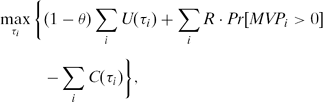
Consider the (political) maximization problem of a central government (or president) that must choose the amount of federal transfers τi to allocate to each local government i=1, . . ., N. The president's objective function is made up of two (political) benefits. First, the general goodwill of the citizens in every municipality i toward the central government: U(τi), where U′>0, U′′<0. Second, the likelihood that municipality i is run by a mayor aligned with the central government, because either local politicians are important opinion leaders and may be useful allies in the next presidential campaign or they may engage in rent-seeking activities for the president (such as collecting money to finance the party or developing established relationships with organized interests). Thus, if the future margin of victory of the mayoral candidate aligned with the president is positive, the central government increases its political capital by a positive (fixed) amount R.Footnote 6 However, the relative weight of the two benefits depends on whether voters give political credit for the increased municipal revenues to the central government or to the mayor. Accordingly, we define θ∈[0, 1] as the political credit spillovers accruing to the incumbent mayor: If θ=0, then the central government can claim full credit for τi; if θ=1, then all of the credit goes to the municipal government.
The president's objective function can be expressed as
 \begin{eqnarray}
\max _{\tau _i} \bigg \lbrace (1-\theta )\sum _i U(\tau _i) + \sum _i R \cdot Pr[MVP_i>0]\nonumber\\
\qquad-\sum _i C(\tau _i) \bigg \rbrace ,
\end{eqnarray}
The crucial mechanism is that, in Equation (1), federal transfers also affect the margin of victory of the aligned candidate. In particular, we assume that transfers increase the electoral prospects of the incumbent mayor's political party. Thus, if the incumbent is aligned with the president (Pi=1), τi will increase the future margin of victory of the aligned candidate, and vice versa if the incumbent is unaligned (Pi=0):
 \begin{equation}
MVP_i=\rho MVP_i^0+\epsilon _i+\theta (2P_i-1)f(\tau _i),
\end{equation}
 \begin{eqnarray}
Pr[MVP_i>0]=\Phi \bigg [ \frac{\rho MVP_i^0+\theta (2P_i-1)f(\tau _i)}{\sigma } \bigg ], \nonumber\\
\end{eqnarray}
Equilibrium transfers
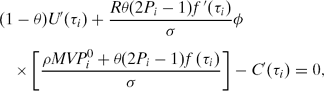
The first-order condition of the president's maximization is
 \begin{eqnarray}
&&(1-\theta )U^{\prime }(\tau _i)+\frac{R\theta (2P_i-1)f^{\prime }(\tau _i)}{\sigma } \phi \nonumber \\
&&\quad\times\, \bigg [\frac{\rho MVP_i^0+\theta (2P_i-1)f(\tau _i)}{\sigma }\bigg ]-C^{\prime }(\tau _i)=0,
\end{eqnarray}
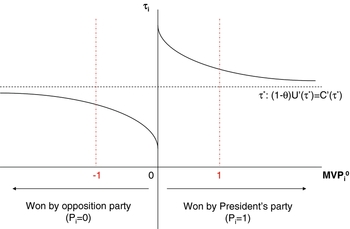
If no political credit spillovers exist (θ=0) or if transfers cannot affect elections (because MVP 0i tends to either +∞ or −∞), the central government simply weighs the marginal benefit of citizens’ goodwill against the marginal cost of τi, resulting in the (politically) optimal amount of transfers τ* in the absence of tactical redistribution, such that (1−θ)U′(τ*i)=C′(τ*i). Things change if θ>0 and MVP 0i∈[−1, 1]. In this case, the central government chooses τi by looking at the additional marginal benefit or cost of influencing the next municipal election. The second term on the left-hand side of Equation (4) is either positive if Pi=1 or negative if Pi=0. In other words, at the zero threshold (MVP 0i=0), a sharp jump occurs in the maximization problem of the president, as the marginal cost of sending money to an unaligned incumbent suddenly becomes the marginal benefit of sending money to an aligned incumbent. This phenomenon implies a strong and positive impact of political alignment on transfers in close races.
Proposition 1.The local average treatment effect (ATE) of political alignment on transfers is positive at MVP 0i=0. That is,  $\lim _{_{MVP_i^0 \downarrow 0}} \tau _i - \lim _{_{MVP_i^0 \uparrow 0}} \tau _i >0$.Footnote 10
Proposition 1 highlights the peculiar theoretical content of the causal effect of political alignment on transfers in razor-close elections, which represents an upper bound for the average effect in all races. Furthermore, it is easy to show that politically motivated transfers are a decreasing function of the past margin of victory of the aligned candidate on both sides of the zero threshold.
Proposition 2.The amount of politically motivated transfers is a decreasing function of MVP 0ion either side of the threshold MVP 0i=0. That is, ∂τi/∂MVP 0i<0.Footnote 11
The intuition for this result follows from the persistence of electoral outcomes: When MVP 0i<0, the president penalizes unaligned municipalities lost by a narrow margin because, especially there, transfers will make a difference in the next election. Similarly, when MVP 0i>0, the president favors aligned municipalities won by a narrow margin.Footnote 12
Comparative statics
The model also delivers comparative statics results, as the size of the causal impact of political alignment on transfers in close elections depends on the model's parameters. The local ATE at zero increases if the value of political capital (R) increases. In fact, by the implicit function theorem, ∂τi/∂R>0 if Pi=1; and ∂τi/∂R<0 if Pi=0. Similarly, it is easy to see that the ATE increases if the variance of the random shock (σ2) decreases. With a slight abuse of notation, we can also state that the ATE increases if the marginal impact of transfers on votes, i.e., their effectiveness f′(τi), increases. Assuming f(.) to be linear, for instance, delivers the same comparative statics result obtained on R for the political effectiveness of transfers. The impact of political credit spillovers, as captured by θ, is instead unclear, because the relationship between θ and the optimal transfers turns out to be ambiguous.
Identification
The close-race RD design setup (Lee Reference Lee2008) is particularly suited to take the previous predictions to the data and estimate the causal effect of political alignment on the amount of (discretionary) federal transfers. Define τit(1) as the potential transfers received by municipality i during term t if the mayor is politically aligned with the president, and τit(0) as the potential transfers of the same municipality if the mayor is not aligned with the president. The variable Pit defines political alignment. The observed outcome is thus τit=Pit·τit(1)+(1−Pit)·τit(0). The estimand of interest is the ATE, E[τit(1)−τit(0)], defined over some subpopulation of interest.
Define Wi as municipality-specific covariates (including state fixed effects), Xit as (time-varying) mayoral characteristics, and δt as term fixed effects. In the ordinary least squares (OLS) model,
 \begin{equation}
\tau _{it}=\alpha +\pi P_{it}+W_{i}^{\prime }\beta +X_{it}^{\prime }\phi +\delta _{t}+\varepsilon _{it},
\end{equation}
 $\hat{\pi}$ generally provides a biased estimate of the ATE as long as towns with different unobservables that affect federal transfers self-select into political alignment.
Instead, a difference-in-differences estimator can control for time-invariant confounding factors through municipality fixed effects γi:
 \begin{equation}
\tau _{it}=\alpha +\pi P_{it}+X_{it}^{\prime }\phi +\gamma _i+\delta _{t}+\varepsilon _{it}.
\end{equation}
$\hat{\pi}$ may also fall short of providing an unbiased estimate of the ATE because unobservable confounding factors may also vary over time.
To address the presence of both time-invariant and time-varying confounding factors, we implement an RD strategy in the spirit of Lee (Reference Lee2008) and compare municipalities for which the aligned candidate barely won with municipalities for which the aligned candidate barely lost.Footnote 13 Specifically, we calculate the margin of victory of the mayoral candidate aligned with the president in each municipality i and term t (MVPit): At the threshold MVPit=0, political alignment Pit sharply changes from 0 to 1.Footnote 14
MVPit is viewed as a random variable depending on both observable and unobservable political factors, as well as on random events on election day (the shock εi in our model). Lee (Reference Lee2008) shows that identification requires that, for each political candidate, (i) the probability of winning is never equal to 0 or 1 and (ii) the probabilities of winning or losing the election by a narrow margin are identical.Footnote 15 All factors that are crucial in deciding electoral outcomes (such as campaign financing, ideology, or the unobservable valence of candidates) are not a threat to identification, as long as random events also play a minor role. In other words, electoral outcomes depend on both predictable elements and random chance, but the latter is crucial only when the race is close. Thus the ATE in close elections is defined as
 \begin{eqnarray}
E[\tau _{it}(1)&-&\tau _{it}(0)|MVP_{it}=0]=\lim _{\epsilon \downarrow 0} E[\tau _{it}|MVP_{it}=\epsilon ]\nonumber\\
&-&\lim _{\epsilon \uparrow 0} E[\tau _{it}|MVP_{it}=\epsilon ].
\end{eqnarray}
Recent empirical literature shows that elections for U.S. Congress do not always meet these conditions. In particular, Caughey and Sekhon (Reference Caughey and Sekhon2011) show that close U.S. House elections during 1944–2008 are prone to manipulation, as bare winners and bare losers are significantly different from each other.Footnote 17 However, this criticism of the close-race RD design does not directly apply to our setup. Unlike in the original framework, the running variable of our strategy is not the margin of victory per se, but the margin of victory of the aligned candidate. As a result, we do not compare winners and losers but instead municipalities in which the aligned versus unaligned candidate won. For instance, the validity of our identification strategy is not affected by the possibility that incumbents are more successful in close races, as long as incumbents aligned with the president have the same probability of running for reelection as incumbents from the opposition coalition. This phenomenon is indeed the case in Brazil, as we discuss in the section devoted to the empirical results.Footnote 18
Nonetheless, the U.S. literature points to the fact that every close-race RD design must be validated on a case-by-case basis to show that no political actor is able to sort just above the zero threshold defined by the relevant margin of victory. In our case, we need to show that neither aligned nor unaligned candidates have a higher probability to win in close elections. In the section devoted to the empirical results, we present a vast array of density and balance tests of covariates to support this claim.
Estimation
Various methods are available to estimate the local ATE expressed in Equation (7). We first apply a spline polynomial approximation of order p in MVPit:
 \begin{eqnarray}
\tau _{it} = \sum _{k = 0}^{p}\left(\rho _k MVP^{k}_{it}\right) + P_{it} \sum _{k = 0}^{p}\left(\pi _k MVP^{k}_{it}\right)+\delta _t + v_s + \eta _{it}, \!\!\nonumber\\
\end{eqnarray}
$\hat{\pi}$0 identifies the ATE at zero, and we expect $\hat{\pi}$0>0 to validate Proposition 1.
An additional advantage of Equation (8) is that the shape of the polynomial to the left of zero (captured by the estimated  $\hat{\rho }_k$) and to the right of zero (captured by the estimated $\hat{\pi}$k) can indirectly test Proposition 2, shedding light on the relationship between the level of political competition and discretionary transfers to the president's (political) friends or enemies. However, because the assignment to political alignment is endogenous as we move away from zero, this evidence ought to be interpreted with caution (that is, keeping in mind alternative mechanisms that might interact with the relationship between MVPit and τit). The endogeneity of transfers away from zero does not affect the identification of the ATE in close races as long as the conditions previously stated are met.
As an alternative estimation method, we apply local linear regression, which restricts the sample to municipalities in the interval MVPit∈[−h, +h] and estimates the model:
 \begin{eqnarray}
\tau _{it}&=&\rho _0+ \rho _1 MVP_{it}+ \pi _0 P_{it} + \pi _1 P_{it} \cdot MVP_{it}\nonumber\\
&& +\, \delta _t + v_s + \eta _{it},
\end{eqnarray}
Note that with the above estimators, close races do not need to be defined because we estimate the boundary points of two regression functions on either side of zero and the ATE is identified as the difference between these two points. As a result, close races are those with a margin of victory approaching zero at the limit. For the sake of transparency, we also show results for two alternative estimators, namely OLS in close intervals around zero: [−10; +10] and [−5; +5].Footnote 19 Here, close races are defined as elections for which the margin of victory is lower than 5% or 10% in absolute terms, respectively.
INSTITUTIONS AND DATA
Brazilian Political System
Brazil is a federal presidential democracy and has a multiparty system. The Brazilian territory is divided into 26 states and one federal district (Brasilia). Municipalities are the lowest layer of administrative division and are ruled by an elected mayor (Prefeito) and an elected city council (Camara dos Vereadores). Municipal governments are in charge of a relevant share of the provision of public goods and services related to education, health, and infrastructure projects. The president, governors, and mayors of municipalities with more than 200,000 eligible voters are directly elected through (runoff) majority rule, whereas mayors of municipalities with under 200,000 eligible voters are directly elected through plurality rule. The elections of the president, governors, and members of Congress all take place at the same time every four years, whereas all municipal elections are staggered by two years and also take place every four years.
The Brazilian party system is highly fragmented, and the composition of coalition governments at the federal level has constantly changed over time. In particular, the fragmentation of the party system increased in the late 1980s because of new legislation that eased the requirements for party organization and because of an exodus from the two largest parties at that time, PMDB (Partido do Movimento Democrático Brazileiro) and PFL (Partido da Frente Liberal). Currently, Brazil has 27 officially registered parties. In addition to PMDB and PFL, PT (Partido dos Trabalhadores) and PSDB (Partido da Social-Democracia Brasileira) are the most important of the parties.
The current president is Dilma Vana Rousseff Linhares, elected in October 2010 and affiliated with PT. After the 2010 parliamentary election, PT became the largest party in the Congress, and it rules some states and major cities. Former presidents were Luiz Inácio Lula da Silva, also affiliated with PT, elected in October 2002 and re-elected in October 2006, and Fernando Henrique Cardoso, from PSDB, elected in October 1994 and re-elected in October 1998. PSDB rules the two largest Brazilian states, Sao Paulo and Minas Gerais. However, PMDB was the largest party measured by number of mayors and by parliamentary seats in the 1990s and 2000s. Because of its relevance and median position, PMDB usually supports the federal government; indeed, it is a member of the current government coalition, also the case in both of Cardoso's mandates and in the second of Lula's mandates.
Brazil has a weakly institutionalized party system, with high electoral volatility, low levels of party identification in the electorate, fragmentation, and lack of strong ideological platforms. However, following the Constitution of 1988, all presidents have been able to build reasonably stable postelectoral government coalitions through several discipline devices, such as veto power on the main issues, special prerogatives on budget allocation (including federal transfers), and the strong power for parties’ leaderships (see Figueiredo and Limongi Reference Figueiredo and Limongi2000, Pereira and Mueller Reference Pereira and Mueller2002). Although partisanship is relatively weak, most Brazilians who claim to identify with a party refer to either PT, which is Lula's party, or to PSDB, which is Cardoso's party (see Samuels Reference Samuels2006).
Role of the President in Allocating Federal Transfers
The resources of Brazilian municipalities come from (i) local revenues, such as service taxes, residential property taxes, and fines, and (ii) transfers from the federal, state, or other municipal governments. The most important source of municipal revenues is represented by federal transfers, which amount to an average of 65% of the municipal budget. Basically, two types of federal transfers exist: (i) constitutional automatic transfers, mostly unrestricted (Fundo de Participação do Municipios, FPM) or tied to education and health programs, and (ii) discretionary transfers (CONVÊNIO), mostly related to infrastructure projects. Municipal governments depend strongly on these federal transfers for their budgets, as tax revenues average only 5.5% of municipal total revenues. The remaining share of municipal revenues is from state transfers.
This study focuses on discretionary federal transfers devoted to infrastructure projects, which amount to approximately 15% of total municipal expenditure in infrastructures. The data source for these transfers is the Finbra data set from the Brazilian National Treasury (Tesouro Nacional), which codes them as transferências de capital. Infrastructure transfers are related to budget items that involve the construction of buildings or bridges, the paving of roads, the improvement of water and sewer systems, the purchase of ambulances, and so on. We focus on these transfers because the bulk of the other revenues are largely nondiscretionary.Footnote 20 Furthermore, these transfers are used to finance highly visible projects, that is, they are an ideal target for politicians willing to woo voters.
Although mayors must make some effort to apply for these discretionary transfers, the legislative and the executive play an important role in defining their precise allocation. The support of a federal deputy and the final consent of the president are crucial ingredients of the allocation mechanism. Effectively, the executive first drafts the annual budget law (Lei Orçamentária Anual), which is then subject to (individual or collective) amendments by legislators. In most cases, the municipalities receiving discretionary transfers are chosen by legislators attempting to bring the pork home, as the bulk of the proposed amendments include targeted benefits to local areas. However, there are limits to the number and value of the amendments that legislators can propose. The budget committee is in charge of authorizing the bill. After a period of discussion, congress votes for the budget law, which is then sent back to the president for the final decision. As the budget law is not mandatory in Brazil, legislators cannot use the threat of not approving it to force the executive to accept any type of request. Thus the president has a major role in deciding the exact allocation of discretionary transfers. Municipal governments must also make some effort because a budgetary amendment can be executed only when an agreement between the municipality and the central government is signed.
At the end of the day, voters in a given municipality will receive discretionary infrastructure transfers depending on three factors: (i) the effort of their municipal administration; (ii) the interest of a federal deputy; and (iii) the interest of the president in executing the budget amendment. The president has the last word in the decision process and has many opportunities to influence the geographic allocation of infrastructure transfers, both in the construction of the budget law and in the implementation process. Therefore we follow the approach of Berry, Burden, and Howell (Reference Berry, Burden and Howell2010) for the U.S. and focus on the role of the president in the game of distributive politics.
Sample Selection and Variables of Interest
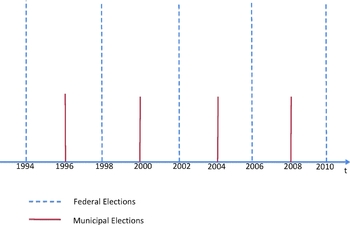
Brazil holds elections every two years. Federal elections and municipal elections take place separately; Figure 2 illustrates their exact timing. Our study encompasses federal governments in office during the three four-year terms from 1999 to 2002, from 2003 to 2006, and from 2007 to 2010, as well as municipal governments in office during the three four-year terms from 1997 to 2000, from 2001 to 2004, and from 2005 to 2008. Our baseline results consider federal transfers in the last two years of each mayoral term, that is, the per-capita amount of infrastructure transfers for the periods 1999–2000, 2003–2004, and 2007–2008. For transfers in 1999 and 2000, the president was Fernando Henrique Cardoso, whereas for transfers since 2003, the president was Luis Inácio Lula da Silva. The choice of the timing is motivated by the fact that we want to capture opportunistic transfers in proximity to municipal elections. Indeed, aggregate data show that, in the years of municipal elections, transfers are larger by about 75% with respect to their average value.Footnote 21 However, as a second step, we also check whether opportunistic transfers take place in proximity to federal rather than municipal elections. Thus we build an alternative measure of federal transfers, referring to the first two years of each municipal term: 1997–1998, 2001–2002, and 2005–2006. In our data, federal transfers are measured in per-capita real values expressed in 2000 Brazilian reais.
Politically Motivated Transfers
Notes: Politically motivated transfers as a function of the past margin of victory of the candidate aligned with the president.

Timing of Brazilian Elections
Notes: Timing of federal and municipal elections over the sample period.

For the treatment, we define two different variables capturing whether or not the municipality is politically aligned with the president. The first measure indicates whether the mayor belongs to a party in the federal government coalition, and the second measure indicates whether the mayor belongs to the president's party. Supplemental Online Appendix Table A1 (available at http://www.journals.cambridge.org/psr2012016) provides details on the political parties included in the government coalition year by year.
To implement our strategy in the Brazilian multiparty system, we must restrict the sample to municipalities for which only two (or at most three) candidates ran for mayor and one of them was politically aligned with the president. This restriction results from the fact that treatment assignment is considered as good as random only if the mayoral candidate aligned with the president had a fair chance of winning the election. In principle, one could also implement the RD strategy in all races in which one of the first two (or three) candidates was aligned with the president (irrespective of the total number of candidates). However, in this case, the sample selection depended on the electoral outcome of the aligned candidate and, therefore, on the RD running variable.Footnote 22 Instead, in our RD design, sample selection only depends on pre-electoral variables, and races with the same margin of victory share the same total number of candidates.
Our sample selection procedure improves internal validity but comes at the price of lower external validity. Races with only two candidates amount to 51% of the total, whereas races with only three candidates amount to 31%, indicating that races with at most three candidates represent 82% of all municipal elections. If we further restrict the sample to elections in which the aligned mayor belonged to the best candidates, we end up with a sample of two-candidate races that covers 42% (19%) of the total when we look at the president's coalition (party). With three-candidate races, we end up with a sample that covers 55% (28%) of the total when we look at the president's coalition (party). This means that, starting from the entire sample of 22,287 elections, we can implement our RD strategy in four distinct subsamples: (i) two-candidate races with respect to the president's coalition (5,723); (ii) two-candidate races with respect to the president's party (2,612); (iii) three-candidate races with respect to the president's coalition (12,245); and (iv) three-candidate races with respect to the president's party (6,248).Footnote 23
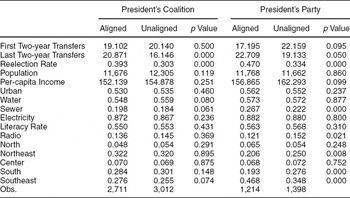
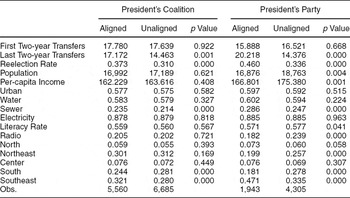
Focusing on the RD samples of two-candidate and three-candidate races, we can preliminarily check whether significant differences exist between municipalities with aligned versus unaligned mayors. According to the descriptive statistics reported in Table 1 and Table 2, municipalities aligned with the president's coalition (or the president's party) receive larger per-capita transfers when municipal elections are approaching (i.e., in the last two years of the term), whereas no significant difference emerges with respect to the first two-year transfers. The reelection probability of aligned mayors is also higher. Instead, the census characteristics show that no evidence exists of “selection on observables” in our samples; that is, municipalities that are politically aligned with the president do not differ from the others in terms of development indicators. This finding is not particularly relevant for our identification strategy, which accommodates for selection on both observables and unobservables, but represents additional information on Brazilian politics.
Descriptive Statistics, Aligned versus Unaligned Municipalities in Two-candidate Races

Notes: Two-candidate races only. Aligned municipalities are those where the winner is affiliated with the president's coalition or party. Unaligned municipalities are those where the winner is not affiliated with the president's coalition or party. All columns except those with p value report the average values in the respective subsamples; p value refers to the statistical significance of the difference between means. First two-year transfers (last two-year transfers) are the average infrastructure transfers from the federal government to municipalities in the first (last) two years of the mayoral term (per-capita real values in 2000 Brazilian reais for both variables). Reelection rate captures whether the incumbent mayor is reelected or not. Population is the number of resident inhabitants in 2000. Per-capita income refers to monthly income in 2000 and is measured in Brazilian reais. The following variables refer to the 2000 census and are expressed in percentage terms: urban population is the fraction of people living in urban areas; water access; sewer, and electricity; literacy rate is the fraction of people above 20 who are literate; are the fraction of houses with access to water supply, sewer, and electricity, respectively; radio captures whether there is at least one local radio station in the municipality. North, northeast, center, south, and southeast are macroregions.
Descriptive Statistics, Aligned versus Unaligned Municipalities in Three-candidate Races

Notes: Three-candidate races only. Aligned municipalities are those where the winner is affiliated with the president's coalition or party. Unaligned municipalities are those where the winner is not affiliated with the president's coalition or party. All columns except those with p value report the average values in the respective subsamples; p value refers to the statistical significance of the difference between means. First two-year transfers (last two-year transfers) are the average infrastructure transfers from the federal government to municipalities in the first (last) two years of the mayoral term (per-capita real values in 2000 Brazilian reais for both variables). Reelection rate captures whether the incumbent mayor is reelected or not. Population is the number of resident inhabitants in 2000. Per-capita income refers to monthly income in 2000 and is measured in Brazilian reais. The following variables refer to the 2000 census and are expressed in percentage terms: urban population is the fraction of people living in urban areas; water access; sewer, and electricity; literacy rate is the fraction of people above 20 who are literate; are the fraction of houses with access to water supply, sewer, and electricity, respectively; radio captures whether there is at least one local radio station in the municipality. North, northeast, center, south, and southeast are macroregions.
EMPIRICAL RESULTS
Effect of Political Alignment on Federal Transfers
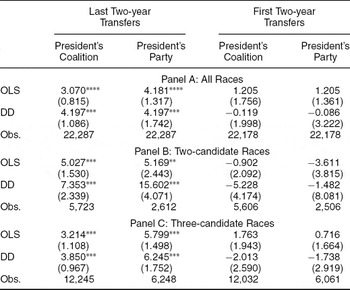
In this section, we present results on the impact of political alignment on federal transfers both in all elections and in razor-close races. As a benchmark, Table 3 shows OLS and difference-in-differences (DD) estimates. Instead, Table 4 shows the main results with different RD estimators. For the reasons previously discussed, we look at two outcomes: In the first two columns of both tables, the dependent variable represents the transfer amounts during the last two years of the mayoral term (when the next municipal election is approaching); in the last two columns, the dependent variable represents the transfer amounts during the first two years of the term (when the next federal election is approaching). For both variables, we have two separate columns because we measure political alignment that refers to both the president's coalition and the party: In the first case, the control group includes parties from the opposition coalition; in the second case, the control group includes all parties but the president's party. To ease comparisons, we implement OLS and DD in both the sample of all municipal elections and our RD samples of two-candidate and three-candidate races.
The Impact of Political Alignment on Federal Transfers, OLS and DD Estimates

Notes: Dependent variables: last two-year transfers, i.e., the average infrastructure transfers from the federal government to municipalities in the last two years of the mayoral term; first two-year transfers, i.e., the average infrastructure transfers from the federal government to municipalities in the first two years of the mayoral term (per-capita real values in 2000 Brazilian reais). Two-candidate (three-candidate) races are those where only two (three) candidates run for mayor and one of them is affiliated with the president's coalition or party. Estimation methods: OLS and DD (i.e., difference-in-differences) specifications as in Equations (5) and (6), respectively. Robust standard errors clustered at the municipality level are in parentheses. Significance at the 10% level is represented by *, at the 5% level by **, and at the 1% level by ***.
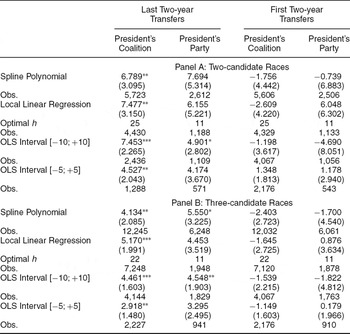
The Impact of Political Alignment on Federal Transfers, RD Estimates

Notes: Dependent variables: last two-year transfers, i.e., the average infrastructure transfers from the federal government to municipalities in the last two years of the mayoral term; first two-year transfers, i.e., the average infrastructure transfers from the federal government to municipalities in the first two years of the mayoral term (per-capita real values in 2000 Brazilian reais). Two-candidate (three-candidate) races are those where only two (three) candidates run for mayor and one of them is affiliated with the president's coalition or party. Estimation methods: RD specifications with third-order spline polynomial approximation as in Equation (8); local linear regression with optimal bandwidth as in Equation (9); OLS in restricted intervals around the threshold of zero margin of victory, i.e., [−10; +10] and [−5; +5] as specified. Robust standard errors clustered at the municipality level are in parentheses. Significance at the 10% level is represented by *, at the 5% level by **, and at the 1% level by ***.
According to the cross-sectional and panel evidence reported in Table 3, politically aligned municipalities receive more infrastructure transfers during the last two years of the term, whereas estimates on the transfers received during the first two years are never statistically significant. The results in the all sample and in two-candidate (or three-candidate) races are similar to each other, which reaffirms the external validity of the RD sample restriction. For all municipalities (panel A), with respect to the average level, transfers increase by 18.4% or 24.1% when the mayor belongs to the coalition or party of the president, respectively. In two-candidate (panel B) and three-candidate races (panel C), the OLS estimates, respectively, point to a 27.3% or 20.5% effect of coalition alignment, and to a 24.9% or 35.8% effect of party alignment. The size of the DD estimates is in the same ballpark, with just one exception, but the DD estimates tend to be slightly larger than OLS. Although the discrepancy might arise from downward bias in the OLS coefficients, the DD results might suffer from (time-varying) omitted bias.
Table 4 reports the main RD results. We implement four specifications: spline polynomial approximation with full bandwidth as in Equation (8); local linear regression with optimal bandwidth as in Equation (9); and two OLS estimations as in Equation (5) but in close intervals around the zero threshold, [−10; +10] and [−5; +5], which test for the difference in means in close elections defined by a margin of victory lower than 10% and 5% in absolute value, respectively.
In the two-candidate sample (panel A), according to the baseline estimation with spline polynomial, being affiliated with the coalition of the president increases per-capita infrastructure transfers by approximately 36.9%.Footnote 24 Instead, the effect of being affiliated with the president's party is not statistically significant. In the three-candidate sample (panel B), being affiliated with the president's coalition increases transfers by approximately 26.3%. The effect of being affiliated with the president's party amounts to 34.3%, although significant only at the 10% level. Based on local linear regression, being affiliated with the president's coalition entails an increase in per-capita infrastructure transfers by 40.7% (two-candidate) or by 32.9% (three-candidate).Footnote 25 The estimates on the president's party are never statistically significant. The OLS specifications in close intervals confirm these results in terms of both size and statistical significance.
On the whole, the RD results on the president's coalition are a direct confirmation of Proposition 1 in our model. The fact that the results on the president's party are less robust could receive a twofold explanation: From a political point of view, the president might be forced to please political allies even more than his or her own party to keep the government coalition united; from a statistical point of view, as the point estimates on the president's party are fairly similar to those on the president's coalition, the lower significance might be a problem of accuracy induced by the smaller sample size.Footnote 26
Table 4 also confirms that no effect exists of political alignment on the infrastructure transfers received in the first two years of the municipal term. Consistent with the aggregate evidence discussed in the section devoted to the data description, no evidence exists of opportunistic transfers in proximity to federal elections. This result also reinforces the notion that mayors can claim the lion's share of the political credit from larger transfers (i.e., that the parameter θ in our model is greater than zero) because tactical redistribution takes place only in proximity to the elections for mayor and not to the elections for the Brazilian president.Footnote 27
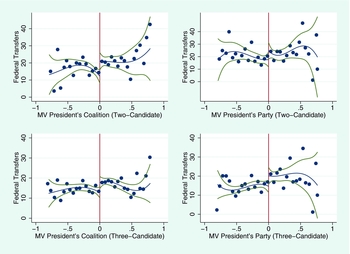
Figure 3 shows the estimated spline polynomial in MVPit to highlight not only the jump in transfers at MVPit=0 but also the shape of the relationship between transfers and political competition for aligned municipalities (on the right of zero) and unaligned municipalities (on the left of zero). With respect to the president's coalition, Figure 3 clearly shows that the ATE at zero is driven by a sizable cut in transfers to unaligned municipalities close to zero. In other words, the central government penalizes municipalities ruled by mayors of the opposition coalition, especially if they won by a narrow margin, thereby tying the hands of its (political) enemies for the next election. This evidence on the left of zero is consistent with Proposition 2 in our model.
Political Alignment and Federal Transfers
Notes: The central line is a spline third-order polynomial in the margin of victory of the president's coalition or the president's party, fitted over the interval [−0.80, +0.80]; the lateral lines represent the 95% confidence interval. Scatter points are averaged over five-unit intervals. Two-candidate (three-candidate) races are those where only two (three) candidates run for mayor and one of them is affiliated with the president's coalition or party.

However, the evidence on the right of zero shows no increase in transfers to aligned municipalities that won by a narrow margin. In contrast, some evidence exists that shows that the federal government gives more money to its strongholds (where MVPit is large), although we do not know whether the endogenous characteristics of these municipalities or political motivations (as predicted by Cox and McCubbins Reference Cox and McCubbins1986) drive this phenomenon. Moreover, one possible explanation for the asymmetry in the findings might be incumbency advantage, which is not incorporated in our model. In fact, a slight incumbency advantage might make close losses on the left of zero an even more important target for the president (the “tying hands” effect), and might make close victories on the right of zero less of a target (because the aligned candidate could count on some incumbency advantage at the party level in the next election).
Politics of Opportunistic Transfers
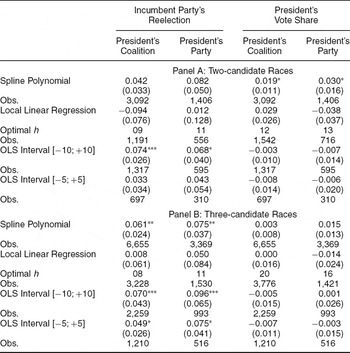
Our model assumes that federal transfers improve the reelection prospects of the incumbent. Others have estimated the effect of transfers on electoral outcomes using Brazilian data (e.g., Brollo et al. Reference Brollo, Nannicini, Perotti and Tabellini2010, Litschig and Morrison Reference Litschig and Morrison2010) and our RD design does not allow us to credibly identify such an effect. Yet, identifying the effect of political alignment per se on the reelection of the incumbent political party is interesting, keeping in mind that many factors besides politically motivated transfers may drive this differential incumbency advantage (if any). For instance, a positive impact of political alignment on reelection might capture a “bandwagon” effect on the side of voters and interest groups prone to support politicians connected with the national leader who won the last presidential election. In the first two columns of Table 5, we repeat our RD specifications with the incumbent party's reelection as a dependent variable.
The Impact of Political Alignment on Electoral Outcomes, RD Estimates

Notes: Dependent variables: incumbent party's reelection, i.e., the probability that the mayor's political party wins the next election; president's vote share, i.e., the incumbent president's vote share in a given municipality at the next presidential election. Two-candidate (three-candidate) races are those where only two (three) candidates run for mayor and one of them is affiliated with the president's coalition or party. Estimation methods: RD specifications with third-order spline polynomial approximation as in Equation (8); local linear regression with optimal bandwidth as in Equation (9); OLS in restricted intervals around the threshold of zero margin of victory, i.e., [−10; +10] and [−5; +5] as specified. Robust standard errors clustered at the municipality level are in parentheses. Significance at the 10% level is represented by *, at the 5% level by **, and at the 1% level by ***.
Being aligned with the president increases the chances for reelection, although point estimates are precisely estimated only in the (larger) three-candidate sample or with OLS in close intervals. Under the additional hypothesis that the reelection effect of transfers is first order with respect to other motivations and given that, on average, political alignment increases transfers by approximately one-third and reelection by approximately 25%, the elasticity of reelection with respect to transfers should be slightly less than 1.
Our model also assumes that aligned mayors are valuable assets for the president. This assumption may be related to electoral advantages (if mayors seek votes for their preferred presidential candidate), rent seeking (such as collecting funds on behalf of the party), or mere policy congruence. To assess the plausibility of the first channel, we repeat our RD estimations with the municipal vote share of the president (or the candidate of the same party) in the future presidential election as a dependent variable in the last two columns of Table 5. The baseline estimates with spline polynomial approximation point to a gain of about 2 (coalition) or 3 (party) percentage points for presidential candidates who can count on aligned mayors. Yet, the results are not robust for three-candidate races or for the use of alternative estimators. However, some evidence exists that at least part of the political capital associated with aligned mayors might arise from electoral advantages.
The results presented above disclose a strong effect of political alignment on federal transfers in razor-close elections, which our model identifies as an upper bound of tactical redistribution. To shed more light on the politics of opportunistic transfers and to assess the comparative statics predictions of our model, we now evaluate the heterogeneity of this treatment effect. In other words, we interact our baseline RD spline polynomial specification with different (binary) heterogeneity dimensions to assess whether the estimated ATE is statistically different in some respects. In particular, we focus on two dimensions: (i) whether or not the value of political capital for the central government is high (see Table 6); and (ii) whether or not transfers are expected to have a strong impact on the electoral outcome (see Table 7).
Last Two-year Transfers and Political Capital, RD Heterogeneity

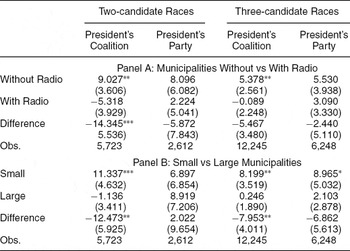
Notes: Dependent variable: last two-year transfers, i.e., the average infrastructure transfers from the federal government to municipalities in the last two years of the mayoral term (per-capita real values in 2000 Brazilian reais). Panel A compares municipalities without and with a radio station. Panel B compares municipalities below and above the median population. Panel C compares municipalities where the president obtained more than the median vote share in the past presidential election (president's strongholds) versus the others (opposition strongholds). Estimation methods: RD specifications with third-order spline polynomial in different subsamples as in Equation (8). Robust standard errors clustered at the municipality level are in parentheses. Significance at the 10% level is represented by *, at the 5% level by **, and at the 1% level by ***.
Last Two-year Transfers and Effectiveness, RD Heterogeneity

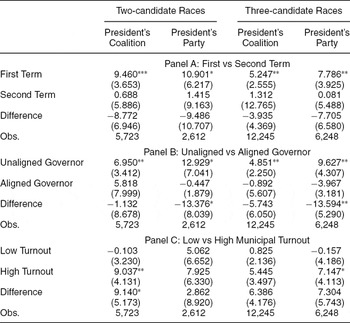
Notes: Dependent variable: last two-year transfers, i.e., the average infrastructure transfers from the federal government to municipalities in the last two years of the mayoral term (per-capita real values in 2000 Brazilian reais). Panel A compares first-term and second-term mayors, where the latter face a binding term limit. Panel B compares states where the governor is unaligned and aligned with the president. Panel C compares municipalities with turnout below and above the median level at municipal elections. Estimation methods: RD specifications with third-order spline polynomial in different subsamples as in Equation (8). Robust standard errors clustered at the municipality level are in parentheses. Significance at the 10% level is represented by *, at the 5% level by **, and at the 1% level by ***.
As empirical proxies for the first dimension, we use two measures: (i) the population size of the municipality; and (ii) whether or not there is a local radio station. The intuition behind these measures is that, in small municipalities or municipalities without radio stations, local politicians play a strong role in influencing the public opinion; therefore they are valuable allies for the president. Table 6 shows that the effect of political alignment on federal transfers is significantly greater in places without a radio station and in small municipalities (i.e., with a population size below the median).
However, we are aware that the previous findings should be interpreted with caution because other unobservable characteristics at the city level might interact with population size. Therefore we look at political factors as additional heterogeneity dimensions. We use three measures as empirical proxies for the political effectiveness of transfers: (i) whether the incumbent mayor is allowed to run for reelection or faces a binding term limit; (ii) whether or not the incumbent mayor is aligned with the state governor; and (iii) whether the turnout in municipal elections is high or low (based on the median turnout of the last municipal election). The intuition is that mayors who run for reelection or who may have difficulty obtaining resources from other sources will put more effort into using transfers for political purposes.Footnote 28 Moreover, irrespective of the mayor's effort, increased municipal revenues are expected to be more effective in terms of electoral outcomes when turnout is high.Footnote 29 The results in Table 7 show that the effect of political alignment on transfers is significantly greater for first-term mayors, for mayors unaligned with the state governor, and in municipalities with high turnout. These results support the notion that transfers are diverted exactly to where they are more politically effective.
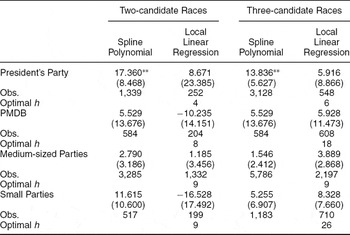
Finally, Table 8 provides additional heterogeneity results based on the nature and structure of political parties in Brazil. We estimate our baseline RD specifications using a spline polynomial approximation and a local linear regression; however, we leave in the treatment group only specific subsets of parties, namely, the president's party (i.e., PSDB under Cardoso and PT under Lula); the pivotal party PMDB; medium-size parties; and small parties. The control group only includes parties in the opposition coalition at the federal level. Note that this estimation with the president's party in the treatment group is different from the estimations presented in Table 4 because, for Table 4, the control group includes all remaining parties (both in the government and in the opposition coalition).
Last Two-year Transfers and the Role of Political Parties, RD Estimates

Notes: Dependent variable: last two-year transfers, i.e., the average infrastructure transfers from the federal government to municipalities in the last two years of the mayoral term (per-capita real values in 2000 Brazilian reais). Two-candidate (three-candidate) races are those where only two (three) candidates run for mayor and one of them is affiliated with some of the parties of the president's coalition: the president's party, PMDB, medium-sized parties, or small parties, as specified. Estimation methods: RD specifications with third-order spline polynomial approximation as in Equation (8); local linear regression with optimal bandwidth as in Equation (9). Robust standard errors clustered at the municipality level are in parentheses. Significance at the 10% level is represented by *, at the 5% level by **, and at the 1% level by ***.
The estimates in Table 8 show that the effect of being aligned with the president's coalition is primarily driven by the president's party. This result should also be interpreted based on the nature of Cardoso's and Lula's parties. Indeed, PSDB and PT are established parties under the spotlight at all levels of electoral competition, and for them partisan affiliation is fairly stable (as discussed in the section devoted to Brazilian institutions). Therefore the effect of political alignment on opportunistic transfers is more relevant for structured parties, and our findings are more likely to generalize to political environments with strong party structures. Instead, no evidence exists that medium-size and small parties, which in turn are also less structured and prone to party switching by local politicians, drive our results. Furthermore, we find that strategic considerations such as the incentive to woo coalition switching and pivotal parties are second order, as we find no effect for PMDB.
Validity Tests
For our RD strategy to be internally valid, political parties must not be able to sort above the threshold of zero margin of victory. In other words, neither aligned nor unaligned candidates should be able to systematically win close races. To check for the absence of manipulative sorting, Online Appendix Table A4 shows estimates of discontinuities in the lagged margin of victory of the aligned candidate, in the geographic location of the municipality, and in the 2000 census variables at 0. In particular, we run tests of the difference in means between aligned versus unaligned municipalities in close intervals near zero, namely [−10; +10] and [−5; +5]. Because most of these variables are predetermined with respect to the treatment (political alignment), we should observe no discontinuity as long as no manipulative sorting occurs around zero.Footnote 30 This is indeed the case, as all of the variables are balanced around the threshold, excluding a few exceptions for geographical location in three-candidate races with respect to the president's party.Footnote 31
The result from balancing the lagged margin of victory is particularly reassuring regarding the validity of the RD setup, as it implies that predetermined electoral outcomes are not deciding close races between aligned and unaligned candidates. This result is also consistent with the descriptive evidence that incumbents (shown to be over-represented in close victories in the U.S.) belonging to the government coalition are not more likely to run for reelection than incumbents belonging to the opposition coalition. In fact, the probability that aligned versus unaligned incumbents run for reelection is 23.3% versus 23.5% (two-candidate with coalition dummy); 21.8% versus 22.0% (two-candidate with party dummy); 23.5% versus 24.8% (three-candidate with coalition dummy); and 21.8% versus 22.5% (three-candidate with party dummy). In addition, these differences are never statistically significant.
To further check for the absence of manipulative sorting, in the Online Appendix we show the results of (i) visual inspection of the histograms of MVPit in Figure A1; and (ii) formal tests of the continuity of the density at MVPit=0, in the spirit of McCrary (Reference McCrary2008), in Figure A2. The latter procedure tests the null hypothesis of continuity of the density of the margin of victory at zero and is implemented by running separately kernel local linear regressions of the log of the density on both sides of zero. These procedures do not show any evidence of manipulative sorting around zero. Municipalities in which the aligned candidate barely won are not over- or under-represented with respect to municipalities in which the aligned candidate barely lost. Therefore random shocks rather than choice variables such as federal transfers or campaigning effort and ability decide (ex post) close races between aligned and unaligned politicians.Footnote 32
CONCLUSION
In this article, we document the existence of (sizable) tactical motivations in the allocation of federal transfers by the central government in a federal state, aimed at penalizing unaligned municipalities in which mayors belonging to the opposition coalition won by a narrow margin. Our RD estimates, which accommodate for the presence of both time-invariant and time-varying confounding factors, show that mayors politically aligned with the Brazilian president receive larger federal transfers in razor-close races by an amount that varies from 26% to 41%, according to the estimation method or the measure of political alignment. The results are statistically significant only for federal transfers received in the last two years of the mayoral term (indicating the existence of a relevant budget cycle in politically motivated revenues) and for federal transfers for infrastructure (which are largely discretionary and linked to projects that are highly visible to voters).
We also detect some effect of political alignment—and therefore transfers—on the future electoral outcome at the municipality level, although these results are less robust and more volatile. However, under the additional hypothesis that the reelection effect of transfers is first order with respect to the reelection effect of political alignment per se, we find that the elasticity of the incumbent party's reelection with respect to federal transfers is only slightly smaller than 1.
We believe that our results could extend to the politics of intergovernmental transfers in every federal system for which (i) the central government has some discretionary power in sharing central revenues among lower-level layers of government; (ii) political credit spillovers exist between central and local governments in claiming credit for the transfers; and (iii) political parties are not extremely weak and partisan affiliation shapes electoral competition at the local and national level. In particular, our heterogeneity results show that the effect of political alignment on transfers is larger when parties are more structured and partisanship is stronger.
Our RD evidence shows that discretionary transfers in a federal system, especially when political competition is tight, are allocated on political grounds more than for efficiency and equity reasons. Thus the normative implications of the empirical findings call for a financing system of infrastructure projects that should emphasize the fiscal responsibility of local governments rather than central transfers, as they appear to be strongly influenced by political considerations.
From a more general perspective, our study emphasizes that (i) many polities feature multiple levels of electoral competition layered on top of one another and (ii) whoever allocates benefits may care about electoral outcomes at all levels. This emphasis allows us to disclose a systematic intergovernmental pattern, namely, the punishment of local (political) enemies by reducing federal transfers. Hence our approach suggests that various “single-level” models, such as models of political business cycles or distributive politics, may benefit from taking a multilevel view.




Comments
No Comments have been published for this article.