Implications
Inbred mice are basic tools for multiple research fields. Despite their relevance, their genetic architecture was overlooked for decades and recent research evidenced their genetic fragility, and even instability. Within this context, this review revisits several hot topics for current inbred strains, discussing the latest cutting-edge results on mutation and genetic drift, and characterizing other sources of genetic heterogeneity such as heterozygote selection or contamination. Far from invalidating the usefulness of inbred mice in research, this review was an attempt to describe the different sources of allogenicity and warns about potential consequences on the genetic stability of mice.
Introduction
The origin of inbred strains can be related to an inbreeding experiment on guinea pigs (Cavia porcellus) initiated in 1906 by G. M. Rommel (Wright, Reference Wright1960), Chief of the Animal Husbandry of the Bureau of Animal Industry of the United States Department of Agriculture. Two of the 23 guinea pig strains involved in that experiment, strains 2 and 13, remain available for research purposes and must be considered as the oldest inbred animal models. That experiment was the starting point for the intensive generation of inbred strains during the 20th century, providing a plethora of inbred animal models from mammals (dog, ferret, mouse, pig, rabbit, rat, Syrian hamster), birds (chicken, duck, quail), fish (guppy, trout, zebra fish), reptiles (rattlesnake) and amphibians (Xenopus sp.), as well as invertebrates (Caenorhabditis elegans, Daphnia sp., Drosophila sp.). The laboratory mouse played a central role in this process and the first inbred mouse strain (i.e. DBA, also known as diluted, brown and non-agouti) was created by C. C. Little in 1909 (Holmes, Reference Holmes2003). Other well-known mouse inbred strains (e.g. A/J, BALBc, C3H, C57BL/6 and CBA) also originated during the early 1920s (Festing, Reference Festing1996), contributing to the large number of currently available inbred strains of mouse (Beck et al., Reference Beck, Lloyd, Hafezparast, Lennon-Pierce, Eppig, Festing and Fisher2000).
Inbred strains are an interesting and useful animal resource with relevance in several research fields. These animal models are commonly involved in biomedical and behavioral experiments, and they have contributed substantially to the knowledge and understanding of multiple biological mechanisms and metabolic pathways (Festing, Reference Festing1979). Among others, the explosion of animal and human genetics during recent decades would have been inconceivable without the participation of hundreds of inbred strains from different species. This animal material has a number of properties that make it particularly useful in research (see ‘Standard definition of an inbred strain’ section), isogenicity being the most important property (Festing, Reference Festing1979). Note that the term isogenic characterizes the genotypic status of a locus at which all individuals of an inbreeding generation are homozygous for the same identical-by-descent allele (Bailey, Reference Bailey1982). Following Festing (Reference Festing1981), members of an inbred strain should be isogenic at >98% of the chromosomal loci that originally segregated from the founder population. Nevertheless, this assumption has been weakened by recent research in which the genetic homogeneity and stability of inbred strains were partially refuted (Keightley, Reference Keightley1998; Hill, Reference Hill2000; Casellas and Medrano, Reference Casellas and Medrano2008). These results do not invalidate the usefulness of inbred strains in biomedical and behavioral frameworks, although they revealed an unexpected degree of genetic variability with potential consequences for the analysis of experimental data. Within this context, the genetic homogeneity and stability of inbred strains are topics of major concern that must be appropriately revisited. An accurate knowledge about their genetic properties becomes the starting point for the current and future contribution of inbred mice in cutting-edge research, inbred strains providing less genetic heterogeneity than outbred populations.
Standard definition of an inbred strain
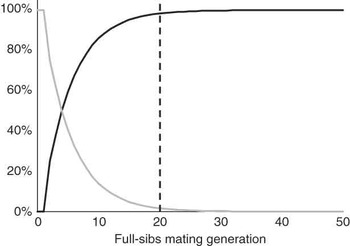
By convention, the standard definition of an inbred strain assumes two basic requirements: (i) 20 or more consecutive generations of full-sib mating (or its genetic equivalent in terms of other relationships); and (ii) all members of the strain derived from a single breeding pair of individuals in the 20th or a later generation (Committee on Standardized Genetic Nomenclature for Mice, 1952). These criteria theoretically assure a minimum level of inbreeding of 98.6% or, alternatively, <2% of the genetic variance existing in the base generation (Figure 1). It is important to highlight that this widely accepted definition of an inbred strain accounts for a minimum, although not null, level of genetic variability, with more than 200 polymorphic loci in the 20th generation according to Bailey (Reference Bailey1982). Inbreeding theoretically reduces genetic variability asymptotically to zero (Wright, Reference Wright1934), a plausible hypothesis for the majority of the current inbred strains that have greatly surpassed 20 generations of inbreeding. Take, for example, the C57BL/6J mouse strain from the Jackson Laboratory (Bar Harbor, ME, USA), which had 226 generations as of January 2010 (http://jaxmice.jax.org/000664.html). Such evidence suggests that inbreeding is theoretically complete in the majority of inbred strains.
Predicted evolution of inbreeding (black line) and genetic variance (gray line) across full-sib mating generations. The discontinuous vertical line highlights the lower boundary for inbred strain consideration (Festing, Reference Festing1979 and Reference Festing1981).

Omitting the small, or perhaps null, genetic variability inherited from the founder generation, a given inbred strain must ideally be characterized as isogenic and homozygous, phenotypically uniform, stable over the long term, different from every other strain, and identifiable by its genetic profile (Festing, Reference Festing1979). These characteristics are essential for assuring the reproducibility of research experiments, one of the main principles of the scientific method (Godfrey-Smith, Reference Godfrey-Smith2003). Unfortunately, these assumptions are not completely true and several studies have reported a variable degree of genetic heterogeneity in inbred strains from different species (Lynch, Reference Lynch1988; Smits et al., Reference Smits, van Zutphen, Plasterk and Cuppen2004; Guryev et al., Reference Guryev, Koudijs, Berezikov, Johnson, Plasterk, van Eeden and Cuppen2006). Heterozygote selection and mutation (and contamination) are biological (and human) phenomena that impair the utopic assumption of isogenicity and genetic stability in inbred mice. Indeed, recent studies have provided new insights about this hot topic for several research fields. Although they do not invalidate the usefulness of inbred strains in research, an accurate review of their potential consequences on the genetic stability of our laboratory mice has become mandatory.
Heterozygote selection
Under a full-sib mating design and assuming that only one couple mates per generation, the within-generation average inbreeding evolves as shown in Figure 1. This negative and asymptotic trend was predicted by assuming that the reproductive fitness of all individuals involved in the full-sib mating process was homogeneous, at least within each generation (Fisher, Reference Fisher1949). Nevertheless, this hypothesis must not be viewed as more than a rough approximation to the real framework, characterizing the upper boundary for within-generation average inbreeding. When the breeding stock involves more than one couple per generation, individuals with higher heterozygosis could benefit from better reproductive fitness, and therefore, they must contribute more breeding stock to the next generation. This phenomenon is known as heterozygote selection, that is, the reproductive advantage of heterozygotes over homozygotes, and has been postulated to be a powerful mechanism fighting against homozygote fixation due to inbreeding (Bailey, Reference Bailey1982). Indeed, several examples of heterozygote selection have already been reported in mammals (Chai, Reference Chai1969; Gemmell and Slate, Reference Gemmell and Slate2006) and even humans (Weatherall and Clegg, Reference Weatherall and Clegg2002), weakening the assumption of the within-generation homogeneity of reproductive performance. These genetic mechanisms could have a substantial impact during the generation of new inbred strains as well as when new mutations arise in a long-term inbred strain. Although all members of a strain must derive from a single breeding pair of individuals in the 20th or a later generation (Committee on Standardized Genetic Nomenclature for Mice, 1952), this assumption does not restrict the number of breeding couples during the following generations, that is, heterozygote selection becomes possible. On the contrary, a strict scenario with a unique couple per generation should prevent us from heterozygote selection but maximizing the potential impact of genetic drift (see ‘Polygenic mutational variance’ section). Several major rodent breeders use this kind of restricted design, although the inescapable expansion from the founder couple to generate enough individuals for commercial purposes requires one of a few generations with several couples each, allowing for heterozygote selection once again.
Taking Wright’s (Reference Wright1931 and Reference Wright1937) theoretical developments as a reference, both retardation of allele fixation in the absence of mutation and conservation of heterozygosis under recurrent mutation can be mathematically demonstrated. The allelic frequencies p (allele A 1) and q = 1−p (allele A 2) of a biallelic locus would reach an equilibrium stage without changes in allelic frequencies from generation to generation in large populations when p = 1, 0 (fixation of one of both alleles) and, more interestingly, when p = [s 2/(s 1 + s 2)] (Wright, Reference Wright1931). Note that the selective values for genotypes A 1A 1, A 1A 2 and A 2A 2 were assumed to be 1−s 1, 1 and 1−s 2, respectively, and the genotypic frequencies converged to p 2(1−s 1)/π, 2pq/π and q 2(1−s 2)/π, respectively, after a few generations (π = 1−p 2s 1−p 2s 2; Wright, Reference Wright1934). Obviously, this is a mathematical demonstration for large populations that cannot be directly extrapolated from the small effective population sizes involved in the majority of inbred strains, although it gives us an idea about the potential contribution of unconscious heterozygote selection. Robertson (Reference Robertson1962) suggested that heterozygote selection cannot be considered as being powerful enough to indefinitely preserve the genetic variance in laboratory populations, although its contribution could substantially slow down the process of gene fixation. Indeed, this kind of residual heterozygosity has been postulated as one of the plausible sources for the genetic differences between DBA substrains, without ignoring the contribution of new mutations (Festing, Reference Festing1998). In this context, we could anticipate substantial genetic variability in recently originated inbred strains after 20 generations of full-sib mating, clearly larger than the 1.4% of the founders’ genetic variance as hypothesized according to the standard definition of an inbred strain (Committee on Standardized Genetic Nomenclature for Mice, 1952). This genetic variability must be attenuated with further generations of inbred mating (Robertson, Reference Robertson1962), although additional sources of genetic variance (i.e. mutation) could also interact with heterozygote selection mechanisms in any generation.
Single-gene mutations
Mutation can be defined as the process by which a change occurs in a chromosome, either through an alteration in the nucleotide sequence of the DNA coding for a gene or through a change in the physical arrangement of a chromosome. Mutation is the ultimate source of genetic variation inherent to all biological organisms (Hill, Reference Hill1982), and inbred strains are not exempt from this biological phenomenon. As ironically suggested by Bailey (Reference Bailey1982), entropy is inescapable, even for genes. The importance of new mutations in experimental species has been suggested by several investigators in recent decades, with reports of new mutations with large effects (Yoo, Reference Yoo1980; Bradford and Famula, Reference Bradford and Famula1984) and infinitesimal polygenic mutation variances (Caballero et al., Reference Caballero, Toro and López-Fanjul1991; Keightley, Reference Keightley1998). As a whole, mutation is a powerful source of allogenicity in inbred strains.
Single mutations with large phenotypic effects in inbred strains of mice provided the first evidence of their vulnerability to mutation (Lord and Gates, Reference Lord and Gates1929; Yoo, Reference Yoo1980) and, controversially, they have been a major source of new inbred strains. Taking mouse coat color as an example, reports of new mutants were common in the scientific literature during the mid-20th century (Cloudman and Bunker, Reference Cloudman and Bunker1945; Dickie, Reference Dickie1954 and Reference Dickie1962; Loosli, Reference Loosli1963; Pierro and Chase, Reference Pierro and Chase1963; Wolfe and Coleman, Reference Wolfe and Coleman1964), and they are still arising in experimental stocks worldwide (see Table 1). Both large and small body size mutations are other classic examples of single-gene mutations that modify the genetic background of inbred and outbred populations of mice. The little mutation, an Asp to Gly substitution in the growth hormone-releasing hormone receptor gene (Lin et al., Reference Lin, Lin, Gukovsky, Lusis, Sawchenko and Rosenfeld1993), spontaneously arose in the C57BL/6J inbred colony from the Jackson Laboratory (Eicher and Beamer, Reference Eicher and Beamer1976), and originated one of the first dwarf animal models along with the Snell (Li et al., Reference Li, Crenshaw, Rawson, Simmons, Swanson and Rosenfeld1990) and Ames (Brown-Borg et al., Reference Brown-Borg, Borg, Meliska and Bartke1996) dwarf mutations. The same phenomenon arose in a synthetic outbred population originating from a four-way experimental cross (AKR/J × C3H × C57BL/6J × DBA/2; Bradford, Reference Bradford1971; Bünger et al., Reference Bünger, Laidlaw, Bulfield, Eisen, Medrano, Bradford, Pirchner, Renne, Schlote and Hill2001) in the University of California (Davis, CA, USA), although the phenotypic output relied on the opposite effect. Mutant mice suffered 30% to 50% postweaning overgrowth due to a spontaneous 500-kb deletion involving the Socs2 gene (Horvat and Medrano, Reference Horvat and Medrano2001; Wong et al., Reference Wong, Islas-Trejo and Medrano2002). Overall, these are no more than an indication of the contribution of large single-gene mutations to easy-to-evaluate phenotypic traits and provide a warning about the potential impact of major mutations on less evident phenotypic characters. An example of these partially hidden mutations is given by the genetic basis of the vaginal septa in several inbred strains of mice, this being a dorsoventral vaginal fibrous partition that is covered by the normal epithelium in BALB/cJ (Cunliffe-Beamer and Feldman, Reference Cunliffe-Beamer and Feldman1976) and C57BL/6J backgrounds (Shire, Reference Shire1984) among others. Although causal mutations have never been characterized, a polygenic recessive inheritance pattern was reported (Cunliffe-Beamer and Feldman, Reference Cunliffe-Beamer and Feldman1976; Shire, Reference Shire1984). It is important to note that this anatomical anomaly still appears at low rates of incidence in current C57BL/6J females (J.F. Medrano, personal communication), more than 30 years after the first studies suggesting its genetic basis. Nevertheless, the persistence of vaginal septa in current breeding stocks must not be viewed as a biological or genetic abnormality. Whatever the genetic basis for vaginal septa may be, one or more recessive mutations (Cunliffe-Beamer and Feldman, Reference Cunliffe-Beamer and Feldman1976) with low penetrance (Shire, Reference Shire1984) would be very difficult to remove from a mouse population, even under phenotypic selection against affected females or breeding stock producing affected offspring (Falconer and Mackay, Reference Falconer and Mackay1996).
List of recently developed inbred strains due to spontaneous mutations affecting coat color in mice (adapted from Mouse Mutant Resource Website, The Jackson Laboratory, Bar Harbor, ME, USA (http://mousemutant.jax.org, retrieved January 22, 2009)

The Hiomt (hydroxyindole O-methyltransferase) gene must be viewed as another relevant example of persistent single-gene mutations in inbred mice. This gene maps in the pseudoautosomal region of the sex chromosomes (Kasahara et al., Reference Kasahara, Abe, Mekada, Yoshiki and Kato2010) and transcripts for a key enzyme involved in the endogenous production of melatonin (Coon et al., Reference Coon, del Olmo, Young and Klein2002). This is a highly polymorphic gene, even in inbred mice (Kasahara et al., Reference Kasahara, Abe, Mekada, Yoshiki and Kato2010), and its remarkable mutability could be due to the high recombination rate holding in the pseudoautosomal region of the sex chromosomes (Soriano et al., Reference Soriano, Keitges, Schorderet, Harbers, Gartler and Jaenisch1987). Defective alleles impair the production of melatonin and have a favorable impact on testis development of mice, they being likely to support selection pressure rather than genetic drift during development of inbred strains of mice (Kasahara et al., Reference Kasahara, Abe, Mekada, Yoshiki and Kato2010).
In any case, major single-gene mutations are not rare in current inbred strains. Table 1 illustrates this continuous uploading of new polymorphisms with drastic effects on the phenotype (i.e. coat color). Although some mutants can be detected easily (i.e. overgrowth or abnormal coat color) and removed from the breeding stock, there is a plethora of less evident mutations that cannot be discovered without very specific research and, sometimes, an extra dose of luck; for example, the mini-muscle mutation (Hartmann et al., Reference Hartmann, Garland, Hannon, Kelly, Muñoz and Pomp2008) reduces the hind limb muscle mass in mice and was observed by chance during the detailed dissection of several individuals from the 14th generation of selection for voluntary wheel running (Houle-Leroy et al., Reference Houle-Leroy, Guderley, Swallow and Garland2003). We must be conscious about the possibility of these hidden mutations and discard from the breeding stock mice showing any kind of departure from the expected phenotypic pattern.
Polygenic mutational variance
Within the context of the infinitesimal model (Fisher, Reference Fisher1918), the mutational load of inbred mice can also be evaluated as the joint contribution of multiple mutations with small (additive) effects. Nevertheless, its real contribution to current inbred strains has been systematically ignored until recently. Both experimental (i.e. generation of reliable data) and statistical (i.e. appropriate analytical models and computational requirements) limitations have led to the small number of estimates of additive mutational variance (σ m2) in experimental species during recent decades, a few of them obtained from populations of inbred mice (Keightley and Hill, Reference Keightley and Hill1992; Caballero et al., Reference Caballero, Keightley and Hill1995; Casellas and Medrano, Reference Casellas and Medrano2008). The magnitude of this new source of additive genetic variability was reviewed by Lynch (Reference Lynch1988) and Houle et al. (Reference Houle, Huges, Hoffmaster, Ihara, Assimacopoulos, Canada and Charlesworth1994), and they have reported a narrow range of values accounting for between 0.05% and 1% of the phenotypic variability. Although these values could be small enough to be considered as a residual disturbance to the genetic stability of inbred mice, their real impact after a few generations is far from being ‘residual’ or negligible. Note that σ m2 is typically defined by a zygote (Wray, Reference Wray1990), that is, the distribution of the joint effect of all new mutations in any individual can be described by a normal density with mean 0 and variance σ m2. Of course, the contribution of one or a few new mutations in a single individual would be small or even null, but these new polymorphisms can accumulate generation by generation, maintaining a certain degree of genetic variability in our inbred strains until they are fixed or dropped off due to mating between relatives. This mainframe idea was not investigated until a recent study was carried out by Casellas and Medrano (Reference Casellas and Medrano2008) in C57BL/6J mice, which showed that ∼4.5% of the total phenotypic variability for litter size was accounted for by new mutations that had accumulated during the last few generations. This result showed an astonishing amount of genetic variability, clearly impairing the genetic stability of our inbred strains. Moreover, existing studies about mutational variance have mainly been restricted to pure additive mutations, whereas new dominance and epistatic effects can also be generated by mutation (Lynch et al., Reference Lynch, Blanchard, Houle, Kibota, Schultz, Vassilieva and Willis1999; Peripato et al., Reference Peripato, De Brito, Matioli, Pletscher, Vaughn and Cheverud2005) and contribute an additional source of genetic heterogeneity.
New genetic variability originating by polygenic mutation can lead to involuntary (i.e. genetic drift) and voluntary (i.e. selection) changes in the genetic background of our inbred strains. Indeed, involuntary genetic divergence between sublines has been reported in AKR (Acton et al., Reference Acton, Balankenhorn, Douglas, Owen, Hilgers, Hoffman and Boyse1973), BALB/c (Ciaranello et al., Reference Ciaranello, Lipsky and Axelrod1974), C3H (Glode and Rosenstreich, Reference Glode and Rosenstreich1976; Whitmore and Whitmore, Reference Whitmore and Whitmore1985), CBA (Whitmore and Whitmore, Reference Whitmore and Whitmore1985) and C57BL/6J (Silvers and Gasser, Reference Silvers and Gasser1973; Niu and Liang, Reference Niu and Liang2009) populations among others. In a similar way, inbred strains have effectively responded to selection (Caballero et al., Reference Caballero, Keightley and Hill1995; Keightley, Reference Keightley1998). These results show that inbred strains are fragile from a genetic point of view and that they can genetically evolve with subsequent generations. Current mice would be similar to their ancestors born several generations ago, although they would be far from being identical from a genetic point of view. In a similar way, different sublines must not be considered as more than related genetic backgrounds, with their differences increasing with the number of divergent generations. These are relevant problems for science when contradictory results from two independent studies on the (theoretically) same inbred strain could be due to the genetic divergence occurring between two populations of the same inbred strain. In order to limit genetic drift and assure a high degree of genetic stability, cryopreservation initiatives have been launched recently (Taft et al., Reference Taft, Davisson and Wiles2006; Wiles et al., Reference Wiles, Taft and Eicher2009). However, it is important to note that these endeavors will not prevent changes in current genetic variability or new mutations but will prevent relevant genetic drift on the basis of the genetic variability held in the frozen breeding stocks. In any case, cryopreservation programs will delay the natural evolution of our inbred strains and provide comparable individuals for longer periods of time.
Contamination
Although current breeding stocks of inbred mice are controlled to a very high extent, the possibility of contamination by uncontrolled mating between individuals from different strains cannot be completely ruled out. This artificial introgression of genetic heterogeneity in inbred mouse populations must not be considered more than an involuntary human error, although with relevant consequences if the resulting abnormal mice are used for research. Several studies have revealed contamination in experimental breeding stocks of mice (West et al., Reference West, Lyon, Peters and Selby1985; Marshall et al., Reference Marshall, Mu, Cheah, Nesbitt, Frankel and Paigen1992; Nandakumar and Holmdahl, Reference Nandakumar and Holmdahl2005; Nitzky et al., Reference Nitzky, Kruger, Reifenberg, Wojnowsky and Hahn2007), leading to an additional source of allogenicity.
The degree of heterozygosity originating from uncontrolled mating can range from a single nucleotide position to thousands of genes spread along all mouse chromosomes. It depends on the genetic differences between the two strains involved in the contamination process. In a similar way, these differences become the basis for a proper identification of possible sources of contamination in current breeding stocks. Fairly different strains would originate offspring with relevant departures from the expected phenotype (i.e. coat color, size and incidence of pathologies, among others). This evidences the usefulness of accurate control and registration of all individuals born in our colony. Nevertheless, when contamination was done several generations ago (i.e. phenotypic evidences diluted in the current breeding stock) or between similar strains, the phenotypic control of the offspring becomes insufficient. At this point, contamination can only be detected by performing a genome scan. Several major rodent breeders have developed specific single-nucleotide polymorphism panels to routinely check breeding stocks for uncontrolled contamination.
Conclusion
Current inbred strains of mice are essential animal models for laboratory research with unquestionable contributions to many research fields. Nevertheless, they are not as simple as we would like from a genetic point of view. Although one of their main properties is the expected genetic homogeneity between individuals of the same strain, and they are clearly less heterogeneous than their wild relatives, the utopic idea of almost-clonic mice must be revised and clarified. Inbred mice are remarkably isogenic, guaranteeing the reproducibility of research experiments in several cases. Nevertheless, new mutations are continuously uploading into our inbred populations and this source of new genetic variability can be favored by heterozygote selection. Without excluding involuntary contamination, mutation and heterozygote selection must be viewed as two powerful forces in the fight against genetic homogeneity, providing enough material for relevant genetic drift in a few generations. Are these phenomena enough to invalidate inbred mice for further research? Of course, they are not! However, they must be viewed as a warning about the genetic fragility and relative instability of inbred populations. Such populations will contribute decisive scientific results during future decades, although we will need to start appropriate initiatives to minimize the impact of new mutations and avoid or delay genetic drift. Within the short term, this review shows that it is not only the name of the strain that has to be specified to guarantee the reproducibility of research experiments, but also the origin and generation number of the mice used.
Acknowledgments
The research contract of J. Casellas was partially financed by Spain’s Ministerio de Ciencia e Innovación (program Ramón y Cajal, reference RYC-2009-04049).