INTRODUCTION
Island species are particularly vulnerable to the impacts of introduced parasites and diseases because they have typically evolved in isolated environments with low pathogen diversity (Hochberg & Møller Reference HOCHBERG and MØLLER2001, Murray Reference MURRAY2001, Wikelski et al. Reference WIKELSKI, FOUFOPOULOS, VARGAS and SNELL2004). Elevated islands can favour the establishment of invasive parasites, diseases and their vectors by providing contrasting habitats and microclimates at different altitudes (Loope et al. Reference LOOPE, HOWARTH, KRAUS and PRATT2001). Certain pathogens such as the introduced avian pox-virus (Poxvirus avium), for example, have higher prevalence in the lowlands of the Galapagos Islands (Kleindorfer & Dudaniec Reference KLEINDORFER and DUDANIEC2006). The prevalence of the introduced avian ectoparasite Philornis downsi Dodge & Aitken, however, differs across islands of the Galapagos (Wiedenfeld et al. Reference WIEDENFELD, JIMÉNEZ, FESSL, KLEINDORFER and VALAREZO2007), but is similar between habitats on the central island of Santa Cruz (Dudaniec et al. Reference DUDANIEC, KLEINDORFER and FESSL2007). Adult P. downsi flies are non-parasitic, but its larvae reside in the nest base and feed on the blood and tissues of nestlings (Fessl et al. Reference FESSL, SINCLAIR and KLEINDORFER2006a, O'Connor et al. in press, a). The parasite causes significant mortality (16–95% across years) in Darwin's finch nestlings (Fessl & Tebbich Reference FESSL and TEBBICH2002, Fessl et al. Reference FESSL, KLEINDORFER and TEBBICH2006b, O'Connor et al. in press, b) and is in the highest risk category for invasive species affecting endemic Galapagos biota (Causton et al. Reference CAUSTON, PECK, SINCLAIR, ROQUE-ALBELO, HODGSON and LANDRY2006).
A survey of the 13 main islands in the Galapagos archipelago found more P. downsi parasites in nests from elevated islands (maximum elevation > 400 m) containing forested highlands compared to low-elevation islands (< 200 m), however, intra-island site effects and site-specific variables were not evaluated (Wiedenfeld et al. Reference WIEDENFELD, JIMÉNEZ, FESSL, KLEINDORFER and VALAREZO2007). The wet, elevated highlands of the Galapagos are predicted to provide more favourable conditions for P. downsi, with abundant year-round resources for the fly's persistence within and across years (Dudaniec et al. Reference DUDANIEC, KLEINDORFER and FESSL2007, Kleindorfer & Dudaniec Reference KLEINDORFER and DUDANIEC2009, Kleindorfer et al. Reference KLEINDORFER, SULLOWAY and O'CONNOR2009, Wiedenfeld et al. Reference WIEDENFELD, JIMÉNEZ, FESSL, KLEINDORFER and VALAREZO2007). The arid lowlands are predicted to be less suitable for reproduction and survival of P. downsi as the habitat is drier and host nesting density is lower. Dudaniec et al. (Reference DUDANIEC, KLEINDORFER and FESSL2007) found no significant difference in the number of P. downsi in nests across lowland and highland habitats on Santa Cruz Island. Santa Cruz Island has the largest human settlement in the archipelago and is a busy central port for tourists and shipped supplies from the mainland. It is suspected that P. downsi was initially introduced to Santa Cruz Island where it established a large population due to the abundance of resources for both the adult and larval stages (artificial water sources, fruits and vegetables, nesting birds). Here we examine the difference in numbers of P. downsi parasites in Darwin's finch nests across lowland and highland habitats on Floreana Island, which may have been more recently colonized by P. downsi (Dudaniec et al. Reference DUDANIEC, GARDNER, DONELLAN and KLEINDORFER2008). Geographic variation in habitat characteristics may also influence the distribution and impacts of avian predators on islands (Martin et al. Reference MARTIN, THIBAULT and BRETAGNOLLE2000, Wiles et al. Reference WILES, BART, BECK and AGUON2003). Such patterns may cause local declines or extinctions of endemic island birds that may be dependent upon prey life history or body size (Martin et al. Reference MARTIN, THIBAULT and BRETAGNOLLE2000, Wiles et al. Reference WILES, BART, BECK and AGUON2003).
In this study, we investigate habitat-specific effects of predation on Geospiza fuliginosa Gould, in relation to clutch-size variation and examine the number of P. downsi parasites in G. fuliginosa nests across lowland and highland habitats on Floreana Island. We predict that the impact and number of parasites will be higher in highland nests than lowland nests due to increased host nesting density (including multiple avian host species), rainfall and resources for adult P. downsi flies. We compare our findings on parasite intensity for Floreana Island with those of Dudaniec et al. (Reference DUDANIEC, KLEINDORFER and FESSL2007) for Santa Cruz Island. We also examine patterns of clutch size, nesting outcome and nest predation in G. fuliginosa across habitats and predict that larger broods will be depredated more frequently due to greater behavioural conspicuousness.
METHODS
Study species
In this study, we use the small ground finch, G. fuliginosa as an ‘indicator’ species of current parasite pressure (Galligan & Kleindorfer, in press) across elevational habitats on Floreana Island. Geospiza fuliginosa is a small-bodied (~13 g) finch that is found on most islands in the Galapagos archipelago (Grant Reference GRANT1999) in both lowland and highland habitats (Kleindorfer & Mitchell Reference KLEINDORFER, MITCHELL, Kleindorfer and Wind2009, Kleindorfer et al. Reference KLEINDORFER, CHAPMAN, WINKLER and SULLOWAY2006). After sufficient rains males will build display nests within their territories and sing to attract mates (Kleindorfer Reference KLEINDORFER2007a). Clutch sizes range from 2–5 eggs, the incubation phase is 10–12 d, and nestlings fledge from the nest after approximately 12–14 d (Kleindorfer Reference KLEINDORFER2007a).
Study site
Floreana Island (1°17′S, 90°26′W) has a maximum elevation of 600 m and an area of 170 km2 (Wiedenfeld et al. Reference WIEDENFELD, JIMÉNEZ, FESSL, KLEINDORFER and VALAREZO2007). Approximately 95% of Floreana Island is protected by National Parks (Edwin Egas, Galapagos National Parks, pers. comm.). We collected data on nesting outcome in G. fuliginosa across habitats (lowlands, highlands) during three breeding seasons: February 2004, February 2005 and February–April 2006. The highland study area (1°17′S, 90°27′W) was located at the base of Cerro Pajas; the lowland study area (1°16′S, 90°29′W) was located adjacent to the town of Puerto Velasco Ibarra (human population ~100). We sampled from an area of approximately 6 km2 in the lowlands (at elevations of 0–100 m asl) where nesting density was low, and in four 200 × 200-m study plots within a 2.5-km2 patch of highland forest where nesting density was high (at elevations of 300–400 m asl).
The lowlands and highlands on Floreana Island are ecologically distinct habitats (described in Dudaniec et al. Reference DUDANIEC, GARDNER, DONELLAN and KLEINDORFER2008). Rainfall is much lower in the lowlands than highlands of the Galapagos islands in general (Dudaniec et al. Reference DUDANIEC, KLEINDORFER and FESSL2007), although no quantitative rainfall data are available for Floreana Island across habitats for the years of 2004, 2005 or 2006, which were all years of very low rainfall (Edwin Egas pers. comm.). We first collected rainfall data across both habitats on Floreana Island in 2008: within our highland study site at an elevation of 343 m (1°17′48.4″S, 90°27′07.0″W), and within our lowland site at an elevation of 5 m (1°16′37.8″S, 90°29′18.4″W). Rainfall data were collected daily with a rain gauge for 50 d between 26 February and 7 April 2008 and showed that the highlands received over twice as much rain (388 mm) as the lowlands (182 mm). We collected 13 mm of rainfall from the same location in our highland site in 2006 over 38 d (2 March–8 April 2006).
Nest monitoring
Geospiza fuliginosa nests were located by systematically searching study plots for evidence of singing males, nest-building behaviour, or pair activity at a nest. Nesting activity was monitored using 20-min continuous focal sampling, or by visually checking inside nests every 2 d to determine the status of the nest. In 2004 and 2005, we inferred clutch size either from the onset of nest activity, or from the maximum number of eggs or nestlings recorded during nest monitoring. In 2006, we monitored nests from the onset of rain and nest building, and clutch size was checked daily or after incubation was first observed. We checked clutch size again on day 7–10 of the incubation phase or until egg hatching. The sample size was 34 nests in the lowlands and 37 nests in the highlands.
Nesting outcome was categorized into five possible outcomes at the end of the nesting event: (1) abandoned (no parental activity, but the nest still contains eggs or nestlings); (2) fledged; (3) depredated; (4) partial or total brood loss; (5) unknown outcome. Fledging was either observed directly (fledglings present near nest) or inferred when all of the following conditions were met: (1) nests were empty with no signs of predation or parasitism, (2) there was evidence of parental activity, and (3) nestlings had reached at least the ninth day from hatching. Predation was inferred when nests were empty, there was no sign of parental activity, and where nestlings had not reached an age of possible fledging (≤ 8 d old). Finches were not observed to re-nest in the current study, though on Santa Cruz Island highland birds were found to re-nest after 11 d, whereas lowland birds were never observed to do so during drought years (Kleindorfer Reference KLEINDORFER2007a).
Parasites
The intensity of P. downsi per nest was examined using methods established by Fessl & Tebbich (Reference FESSL and TEBBICH2002) and Dudaniec et al. (Reference DUDANIEC, FESSL and KLEINDORFER2006). All larvae, pupae and pupae cases were counted to quantify the total P. downsi nest intensity and were preserved in 95% ethanol. Total intensity refers to the number of P. downsi per nest, whereas mean intensity refers to the number of P. downsi per nestling in each nest. These definitions are based on those proposed by Bush et al. (Reference BUSH, LAFFERTY, LOTZ and SHOSTAK1997), and have been modified to incorporate the nest as the unit containing parasites. Total parasite intensity is a function of nestling age (Fessl & Tebbich Reference FESSL and TEBBICH2002): nests with older nestlings have higher parasite intensity than those with younger nestlings (Fessl et al. Reference FESSL, SINCLAIR and KLEINDORFER2006a). In accordance with previous studies (Dudaniec et al. Reference DUDANIEC, FESSL and KLEINDORFER2006, Fessl et al. Reference FESSL, KLEINDORFER and TEBBICH2006b), we analyse parasite intensity (total and mean) for nests at which nestling survival was ≥ 6 d post hatching.
Predators
Introduced nest predators on Floreana Island include the black rat, Rattus rattus (L.), house mouse Mus musculus (L.), cat Felis catus (L.), dog Canis lupus familiaris (L.) and smooth-billed ani Crotophaga ani (L.). Approximately 30 cats and 20 dogs are kept as pets in both the town of Puerto Velasco Ibarra and the highland agricultural zone and have free roam of the areas (J. O'C. pers. obs.). The diurnal Galapagos short-eared owl Asio flammeus galapagoensis (Gould) is the only known native predator left on Floreana Island following local extinctions of native predators such as the Galapagos hawk, Buteo galapagoensis (Gould), and Floreana mockingbird Mimus trifasciatus (Gould). The barn owl, Tyto alba punctatissima (G.R. Gray), feeds mostly on rodents and not birds (Curio Reference CURIO1969).
Statistical analysis
We analysed data for 2004 and 2006 only and provide descriptive data for 2005 due to low sample size caused by drought conditions. All analyses were performed using SPSS 14.0 for Windows. Summary statistics are presented as mean ± SE. Analyses were conducted on nests rather than nestlings to avoid pseudoreplication. We used ANOVA to examine inter-habitat and inter-annual variation in clutch size, fledging success, P. downsi intensity, and predation. Fledging success was arcsine square root-transformed for analyses. Chi- square analyses were used to examine the stage of nest predation (i.e. eggs or nestlings) in relation to clutch size across highlands and lowlands on Floreana Island for 2004 and 2006.
RESULTS
Philornis downsi parasitism
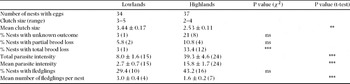
In highland nests, P. downsi total intensity was approximately four times greater than in lowland nests, and this was independent of clutch size (Table 2) (ANOVA: habitat: F 1,43 = 21.5, P < 0.001; clutch size: F 3,43 = 1.5, P > 0.2; interaction term: F 1,43 = 0.8, P > 0.3). Mean P. downsi intensity was also significantly higher in highland than lowland nests and did not differ across clutch sizes (Table 1, 2) (ANOVA: habitat: F 1, 40 = 15.9, P < 0.001; clutch size: F 3,40 = 0.4, P > 0.7; interaction term: F 1, 40 = 0.3, P > 0.5). In the lowlands, total P. downsi intensity was not significantly related to fledging success and did not vary across years (ANOVA: fledging category F 2, 6 = 3.6, P = 0.09; year F 1, 6 = 0.03, P = 0.86). We found the same pattern for mean P. downsi intensity (ANOVA: fledging category F 1, 6 = 0.13, P = 0.73; year F 1, 6 = 0.02, P = 0.97). In the highlands, total and mean P. downsi intensity were related to fledging success: higher P. downsi intensity resulted in fewer fledglings. We found no significant effect of year on total or mean P. downsi intensity, but an effect of the interaction term fledging category × year (total P. downsi: fledging category: F 2,23 = 6.4, P = 0.008; year: F 1,23 = 1.1, P > 0.7; interaction term: F 2, 23 = 3.4, P = 0.056; mean P. downsi: fledging category: F 2, 23 = 4.3, P = 0.030; year: F 1, 23 = 0.52, P > 0.8; interaction term: F 2, 23 = 4.6, P = 0.024).
Overview of Geospiza fuliginosa nesting outcome on Floreana Island (2004 and 2006). Brood loss refers to nestlings found dead in the nest. The causes of partial or total brood mortality are unknown, although indirect evidence suggests mortality due to Philornis downsi. Nests in which some or all nestlings fledged are within ‘% nests with fledglings’. Sample size is shown in parentheses, and percentages were calculated in relation to the number of nests with eggs with known outcomes in each habitat. Means are shown ± SE. P-values are reported from either: Student's t-test analyses (t-test) or chi-squared analyses (χ2) (Likelihood ratio), and are denoted as ** P < 0.01, *** P < 0.001, or ns (not significant).

Mean Philornis downsi intensity (defined as the number of P. downsi per nestling) and range in total P. downsi intensity (defined as the number of P. downsi per nest) in Geospiza fuliginosa for each clutch size (with nestlings ≥ 6 d old) observed across habitats (lowlands, highlands) for 2004 and 2006 (sample size). N = sample size of nests.

Nest predation and brood loss
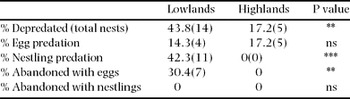
Nest predation was two-fold higher in the lowlands than highlands (Table 3) (Likelihood ratio = 23.8, df = 1, P < 0.001). Patterns of egg predation were comparable between habitats (Likelihood ratio = 0.094, df = 1, P = 0.76), but nestling predation was only observed in the lowlands (42.3% of all nests were depredated during the nestling phase) (Likelihood ratio = 12.8, df = 1, P < 0.001) (Table 3). Lowland nests with large clutch size had higher nest predation than nests with small clutch size (Likelihood ratio = 7.14, df = 2, P = 0.028). Nest predation at highland nests was not significantly related to clutch size (ANOVA: F 1, 27 = 0.29, P = 0.60). The proportion of nests that were depredated did not differ across years in the lowlands (Likelihood ratio = 1.67, df = 1, P = 0.20) or highlands (Likelihood ratio = 0.06, df = 1, P = 0.81).
Type of nest predation in Geospiza fuliginosa across the lowlands and highlands on Floreana Island for 2004 and 2006. Sample size is shown in parentheses, and percentages were calculated in relation to the number of nests with eggs with known outcomes in each habitat (23 nests in the lowlands; 17 nests in the highlands). P-values are reported from chi-squared analyses (Likelihood ratios) to test for differences between habitats. Significance is denoted as: ** P < 0.01, *** P < 0.001.

Clutch size and fledging success
Lowland clutch size (mean ± SE) was significantly larger (3.4 ± 0.2 eggs) than highland clutch size (2.5 ± 0.1 eggs) and did not differ significantly across years (ANOVA: year: F 1, 67 = 0.12, P > 0.7; habitat: F 1, 67 = 26.0, P < 0.001; interaction term: F 1, 67 = 6.21, P = 0.015) (Table 1). The range for clutch size was 3–5 eggs in the lowlands and 2–4 eggs in the highlands. The percentage of nests to produce fledglings was comparable between the lowlands and highlands (t = −1.3, P > 0.1, df = 54) (Table 1). However, on average, the number of fledglings produced per nest was higher in the lowlands (3.0 ± 0.4) than highlands (1.6 ± 0.2) (t = 3.7, P < 0.002, df = 16) (Table 1).
Descriptive results for 2005
Fledging success was 0% in 2005, presumably due to prevailing drought conditions. No nests were found with eggs in the lowlands, but 16 highland nests had eggs (nine nests had two eggs; seven nests had three eggs). We have data on nesting outcome for 12 out of these 16 nests: four nests were depredated, three were abandoned with eggs, one had partial brood loss (dead nestling) followed by predation, and four nests contained dead nestlings (mortality due to P. downsi suspected). Total P. downsi intensity for three G. fuliginosa nests in which nestlings survived ≥ 6 d was 24, 31 and 51 respectively.
DISCUSSION
We demonstrate that environmental variation within the range of a single species can affect mortality impacts from both parasites and predators in an island ecosystem. Variation in the causes of habitat-specific mortality point to trade-offs between contrasting selection pressures that may shape reproductive investment strategies in birds (Garant et al. Reference GARANT, KRUUK, MCCLERY and SHELDON2007).
Parasitism across habitats
Parasites may be more successful under particular abiotic or biotic conditions. For example, many endemic Hawaiian birds are now restricted to parts of high-elevation forest where cooler temperatures and a lack of water pools limit the mosquito vector for both malaria and pox-virus (Freed et al. Reference FREED, CANN, GOFF, KUNTZ and BODENR2005, van Riper et al. Reference VAN RIPER, VAN RIPER, GOFF and LAIRD1986). On Floreana Island, lowland host nesting density and parasite intensity were low, while climatic conditions were hot and dry. This was in contrast to the highlands, where host nesting density and parasite intensity were high and conditions were wet and humid. Philornis downsi abundance may be limited in the lowlands due to lower host breeding density. This is supported by Dudaniec et al. (Reference DUDANIEC, GARDNER and KLEINDORFER2009) who found a reduced number of ovipositing female P. downsi and higher genetic relatedness of larvae in lowland versus highland nests on Floreana Island. Molecular evidence suggests some genetic divergence in P. downsi on Floreana Island, possibly indicating restricted gene flow between other islands, a recent colonization event, or a distinct founding population (Dudaniec et al. Reference DUDANIEC, GARDNER, DONELLAN and KLEINDORFER2008).
Anthropogenic habitat change (e.g. agriculture) may alter parasite distribution and impact in wild bird populations (Chasar et al. Reference CHASAR, LOISEAU, VALKIUNAS, LEZHOVA, SMITH and SEHGAL2009). We observed higher P. downsi intensity in the highlands, where an agricultural zone was present, than in the lowlands (agricultural zone absent). On Santa Cruz Island, there was no difference in parasite intensity across habitats (Dudaniec et al. Reference DUDANIEC, KLEINDORFER and FESSL2007). However this island has an extensive agricultural ‘belt’ across its mid-elevations (100–500 m) that may provide consistent nutritional resources and water for adult flies and may facilitate parasite dispersal between the lowlands and highlands. Agricultural areas on Floreana Island are restricted to the inner highland plains (~300 m elevation), therefore a connecting area containing adult fly resources is not present to aid P. downsi inter-habitat dispersal. The influence of habitat alteration on host-parasite interactions in wildlife raises many mechanistic questions (Chasar et al. Reference CHASAR, LOISEAU, VALKIUNAS, LEZHOVA, SMITH and SEHGAL2009), while our findings point towards a potential relationship between habitat alteration and fly dispersal in the P. downsi–Darwin's finch system. Future studies could measure P. downsi intensity and habitat variables across a wider range of elevational gradients to identify the individual and combined effects of rainfall, habitat type, agricultural crops, elevation and nesting density.
Nest predation across habitats
The abundance and impact of predators can vary according to habitat and prey distributions (Martin et al. Reference MARTIN, THIBAULT and BRETAGNOLLE2000, Wiles et al. Reference WILES, BART, BECK and AGUON2003), potentially altering selection pressures on prey reproductive investment (Garant et al. Reference GARANT, KRUUK, MCCLERY and SHELDON2007). Nest predation in Geospiza fuliginosa occurred more frequently in the lowlands (Table 2), where clutch size was larger, while clutches of 4–5 eggs were more frequently depredated than those with 3 eggs. Predation may be higher at nests with larger clutch size due to greater nest or nestling conspicuousness from auditory or visual cues (Skutch Reference SKUTCH1985, Slagsvold Reference SLAGSVOLD1982). Our results support an effect of clutch size on susceptibility to predation across two contrasting habitats.
The visibility and accessibility of a nest to predators is generally associated with predation rates in birds, and has been shown to be important in Darwin's finches that inhabit highland forest (Kleindorfer Reference KLEINDORFER2007b). Kleindorfer (Reference KLEINDORFER2007b) showed that males that built well-concealed nests in Darwin's small tree finch (Camarhynchus parvulus) had higher pairing success, higher fledging success and lower nest predation in the highlands of Santa Cruz. On Santa Cruz, the lowland Opuntia cactus is a preferred nesting substrate for ground finches and appears to confer protection from predators (Kleindorfer Reference KLEINDORFER2007a, Table 4). Opuntia cacti are now rare on Floreana Island, most likely because of destruction by introduced mammals and rodents (Curry Reference CURRY1986, Hicks & Mauchamp Reference HICKS and MAUCHAMP1995). As a result of the scarcity of Opuntia cacti, we found just 9% (3/34 nests) of active lowland G. fuliginosa nests in Opuntia. All hatchlings from nests in Opuntia fledged, despite high overall lowland nest predation (44%). Loss of Opuntia cacti on Floreana Island may contribute to lower finch nesting density from increased predation in the lowlands, and lower host nesting density may be linked with reduced P. downsi prevalence (Kleindorfer & Dudaniec Reference KLEINDORFER and DUDANIEC2009).
Overview of clutch size and nesting success in Geospiza fuliginosa in the lowlands and highlands of Santa Cruz Island (from Kleindorfer Reference KLEINDORFER2007a) from 2000 to 2004, and Floreana Island in 2004 and 2006. Data for Santa Cruz Island parasite intensity in G. fuliginosa (1998–2005) are from Dudaniec et al. (Reference DUDANIEC, KLEINDORFER and FESSL2007). For some nests, nesting outcome was unknown.

As is common throughout island ecosystems (Loope et al. Reference LOOPE, HOWARTH, KRAUS and PRATT2001, Martin et al. Reference MARTIN, THIBAULT and BRETAGNOLLE2000), predation pressure on Floreana Island finches is largely from a suite of introduced fauna. The largely intact condition of nests following predation suggests that the predators were introduced rats, mice or smooth-billed anis because native short-eared owls rip and/or remove entire nests. Smooth-billed anis are known to be voracious predators of all life stages of birds (Gill & Stokes Reference GILL and STOKES1971, Olivares & Munves Reference OLIVARES and MUNVES1973) and cause mortality by attacking adult Darwin's finches in groups (Edwin Egas pers. comm.). Floreana did not historically support a native rat population, hence the avifauna are likely more vulnerable to the impacts of introduced black rats (Curry Reference CURRY1986), which are common on Floreana and have been implicated in the local extinction of the Florena mockingbird (Curry Reference CURRY1986). Our results show that lowland birds on Floreana are at greater risk from introduced predators than highland birds, which are more vulnerable to parasitism.
Clutch-size variation
Conspecifics may show variation in reproductive investment across habitats subject to differing selection pressures (Garant et al. Reference GARANT, KRUUK, MCCLERY and SHELDON2007). Nest predation and ectoparasites are recognised as major selective factors that shape clutch-size variation in birds (Richner & Heeb Reference RICHNER and HEEB1995, Slagsvold Reference SLAGSVOLD1982). Smaller clutch sizes may confer several advantages in habitats with high nest predation as they have decreased visual and auditory conspicuousness due to reduced parental feeding visits (Skutch Reference SKUTCH1985, Slagsvold Reference SLAGSVOLD1982). A larger clutch size should be advantageous in habitats with high parasite intensity as the impact of nest ectoparasites is diluted across larger broods (Fessl & Tebbich Reference FESSL and TEBBICH2002, Richner & Heeb Reference RICHNER and HEEB1995). We document habitat-specific patterns of reproductive investment in nests of G. fuliginosa. Clutch size followed the same pattern across habitats on both Floreana and Santa Cruz Islands (small in the highlands, large in the lowlands) despite significant inter-island variation in parasite intensity and rates of nest predation. The comparable pattern of clutch size may reflect similar evolutionary pressures for phenotypic clutch size variation or shared ancestry, although habitat-mediated selection may also be at play. The high levels of nestling mortality caused by introduced predators and parasites may be a sufficient selective pressure to influence changes in clutch size in future generations of Darwin's finches.
CONCLUSION
Island species are particularly vulnerable to the effects of invasive species because they typically existed in predator- and parasite-sparse environments prior to human settlement. Darwin's finches are known to show remarkable phenotypic plasticity in life-history traits due to climatic and habitat variation, but are not adapted to current conditions of increased predator risk or nestling parasitism. The establishment and range expansion of P. downsi parasites in the Galapagos Islands appear to be mediated by both biotic factors (e.g. host density) and landscape features (e.g. availability of water and agricultural crops). The impacts of parasitism are more severe for birds nesting in highland areas that support both the larval and adult stages of P. downsi. Furthering our understanding of how and why spatial variation in ecological factors affects invasion success on islands will assist current efforts to conserve threatened ecosystems.
ACKNOWLEDGEMENTS
We thank the Galápagos National Park Service and the Charles Darwin Research Station (CDRS) for the opportunity to work on the Galápagos Archipelago, and TAME airlines for reduced airfares. We thank the community of Floreana Island for their invaluable support. We also thank Jasmani Fernando, Rebekah Christensen, David Wiedenfeld and Jeremy Robertson for field assistance, and Birgit Fessl for helpful discussion and collaboration. Comments from three anonymous reviewers greatly improved the manuscript. All procedures followed the Guidelines for the Use of Animals in Research (Flinders University, Charles Darwin Research Station, Galapagos National Parks), and were approved by the Animal Welfare Committee of Flinders University (permit E189). This study was funded by the Max Planck Institute for Ornithology, Winifred Violet Scott Trust, the American Bird Conservancy, Conservation International and a Flinders University Establishment Grant to SK, Zoos SA, and the Australian Federation of University Women with awards to JO'C.