

Introduction
Owls of the genus Strix include 21 nominal species distributed worldwide (Köning et al., Reference Köning, Weick and Becking1999). In South America there are three endemic species of the genus: Strix chacoensis Cherrie et Reichenberger, Strix hylophila Temminck, and Strix rufipes King; all of them are present in Argentina (Narosky and Yzurieta, Reference Narosky and Yzurieta2010). Strix rufipes, the rufous-legged owl, inhabits the area from central Chile and western Argentina to Tierra del Fuego in the temperate montane and semi-open lowland forest (Narosky and Yzurieta, Reference Narosky and Yzurieta2010). Its diet includes small mammals, birds, and insects (Figueroa et al., Reference Figueroa2006).
Species of the genus Centrorhynchus parasitize birds and mammals as final hosts, terrestrial arthropods as intermediate hosts, and occasionally amphibians, reptiles and insectivorous mammals as paratenic hosts (Crompton and Nickol, Reference Crompton and Nickol1985). This genus accommodates c. 100 nominal species around the world (Amin, Reference Amin2013; Smales, Reference Smales2013; Amin et al., Reference Amin2015; Soomro et al., Reference Soomro2016). In Central and South America the following species were originally described from birds: Centrorhynchus albidus Meyer, 1932; Centrorhynchus crotophagicola Schmidt & Neiland, 1966; Centrorhynchus geranoaeti Smales 2013; Centrorhynchus giganteus Travassos, 1919; Centrorhynchus guira Lunaschi & Drago, 2010; Centrorhynchus kuntzi Schmidt & Neiland, 1966; Centrorhynchus polymorphus Travassos, 1926; Centrorhynchus microcephalus (Bravo Hollis, 1947) Golvan, 1956; Centrorhynchus millerae Smales 2013; Centrorhynchus nicaraguensis Schmidt & Neiland, 1966; Centrorhynchus opimus (Travassos, 1921); Centrorhynchus pitangi Smales 2013; Centrorhynchus simplex Meyer, 1932; Centrorhynchus tumidulus (Rudolphi, 1819); and Centrorhynchus viarius Smales 2013 (Smales, Reference Smales2013). Centrorhynchus spinosus Kaiser, 1893 was recently recovered from Bubo maguellanicus (Lesson) in Chile (Grandón-Ojeda et al., Reference Grandón-Ojeda2018). In Argentina, specimens of C. guira were found parasitizing Guira guira (Gmelin) (the guira cuckoo) and Theritiscus caudatus (Boddaert) (the buff-necked ibis) (Lunaschi and Drago, Reference Lunaschi and Drago2010; Lunaschi et al., Reference Lunaschi, Drago and Draghi2015). Also recently one immature male specimen of Centrorhynchus sp. was found in Athene cunicularia (Molina) (the burrowing owl) (Drago et al., Reference Drago2015).
The species of Centrorhynchus described from members of Strix are Centrorhynchus aluconis (Müller, 1780) Lühe, 1911 recorded from Strix aluco Linnaeus; Centrorhynchus spinosus (Kaiser, 1893) Van Cleave, 1924 and Centrorhynchus conspectus Van Cleave & Pratt, 1940 recorded from Strix varia Barton; Centrorhynchus robustus (Datta, 1928) Golvan, 1994 recorded from Strix occidentalis (Xantus de Vesey); and Centrorhynchus elongatus Yamaguti, 1935 recorded from Strix uralensis Pallas (Meyer, Reference Meyer and Bronns1932; Van Cleave and Pratt, Reference Van Cleave and Pratt1940; Yamaguti, Reference Yamaguti and Yamaguti1963; Nickol, Reference Nickol1983; Dimitrova et al., Reference Dimitrova, Murai and Genov1995; Richardson and Nickol, Reference Richardson and Nickol1995). The objective of the present paper is to describe a new species of Centrorhynchus from the intestine of S. rufipes in Argentinean Patagonia. Morphological and molecular data are presented.
Materials and methods
Twelve recently dead specimens of rufous-legged owls were found in five localities: La Rinconada (1 specimen), Villa la Angostura (1 specimen), Llao Llao (1 specimen), Bariloche City (2 specimens), and Villa Mascardi (7 specimens) between 2002 and 2018 (fig. 1). The intestinal tracts of the owls were examined under binocular microscope. Acanthocephalans were collected, and fixed in 4% formalin solution for morphology and 96% ethanol for molecular studies. Specimens for morphological studies were cleared in Aman's lactophenol. Proboscis was micro-dissected transversally in order to facilitate the count of longitudinal hook rows. Measurements of the first, third and fifth true hooks, the first, second and fourth transitional hooks, and the first, third and sixth spiniform hooks are given. Mean measurements followed by range in parentheses are presented in micrometres, unless otherwise stated. The uterine bell was drawn from one micro-dissected female specimen. Drawings were made using a camera lucida. Two males and two females were dehydrated in a graded ethanol series, critical point dried, sputtered with palladium 60% and gold 40% at 540 A, and examined under a scanning electron microscope (SEM – Philips – XL Series 30) from the Laboratorio de Microscopía Electrónica de Barrido del Museo Argentino de Ciencias Naturales Bernardino Rivadavia, Buenos Aires, and photographed.
Collection localities of Strix rufipes in Patagonia Argentina. Sample size per locality is indicated. Black dots correspond to positive for owls, and the white dot indicates negative for owls.

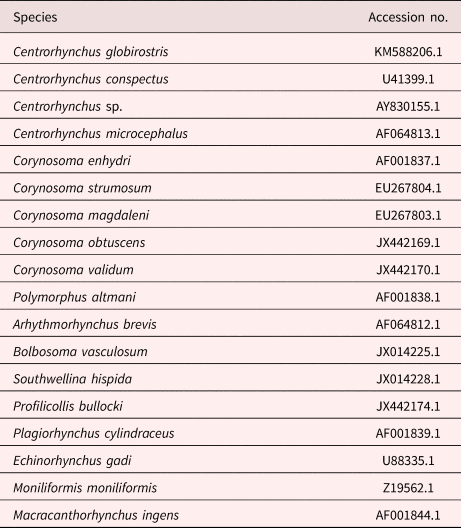
Specimens stored in ethanol were washed in deionized water, and genomic DNA extraction was carried out using the E.Z.N.A.® Tissue DNA Kit (Omega Bio-tek, Norcross, Georgia, USA) according to the manufacturer's instructions. Polymerase chain reaction (PCR) was used to amplify part of the SSU using primers from Braicovich et al. (Reference Braicovich2014) (AGATTAAGCCATGCATG and CAAAGGGGGACTTAATC), and part of the LSU was amplified using two sets of primers: CACCCGCTGAAYTTAAG and CCAGCGCCATCCATTTTCA (Lockyer et al., Reference Lockyer2003) and ACCCGAAAGATGGTGAACTATG and CTTGGAGACCTGTTGCGG (Braicovich et al., Reference Braicovich2014). PCR amplification was performed in 15 μl PCR reaction following the manufacturer's instructions (GoTaq®, Promega, Wisconsin), with the following thermocycling protocol: initial denature at 94°C for 3 minutes; 35 cycles of 94°C for 1 minute, 50°C annealing for 30 s, and 72°C for 45 s; and a final extension step at 72°C for 7 minutes. The samples were visualized along with negative controls on a 1.7% agarose gel and positive samples were purified with the E.Z.N.A.® Cycle Pure kit (Omega Bio-tek, Norcross, Georgia, USA) and submitted to GenScript (Piscataway, New Jersey, USA) for sequencing. We performed a phylogenetic analysis using only the SSU sequences, as this molecule had the best taxon representation. Currently, only four other members of Centrorhynchus (out of c. 100) are represented in GenBank, and unfortunately no other genera of the Family Centrorhynchidae are represented. Phylogenetic analysis included other members of the Order Polymorphida and Echinorhynchus gadi Zoega in Müller, 1776, Moniliformis moniliformis Bremser, 1811, and Macracanthorhynchus ingens (Linstow, 1879) Meyer, 1932 as outgroup taxa (table 1). Silva SINA Aligner v1.2.11 (https://www.arb-silva.de/aligner/) (Pruesse et al., Reference Pruesse, Peplies and Glöckner2012) was used to align the sequences. We produced a maximum likelihood analysis using a TIM2 + G evolutionary model as indicated by the AIC criterion of jModeltest 2.1.7 (Darriba et al., Reference Darriba2012). We performed a heuristic search with tree bisection and reconnection (TBR) branch swapping and 1000 random-addition-sequence replicates using PAUP*4.0 b 10 (Swofford, Reference Swofford2003). Branch support was estimated with 1000 bootstrap replicates with 100 random-addition-sequence replicates per bootstrap replicate.
Species and GenBank accession numbers of the acanthocephalan species included in the phylogenetic analysis.

Voucher specimens of C. nahuelhuapensis n. sp. were deposited in the Colección Nacional de Parasitología, Museo Argentino de Ciencias Naturales Bernardino Rivadavia, Buenos Aires, Argentina (MACN–Pa), and in the Museum of Southwestern Biology, Division of Parasites, University of New Mexico. The resulting sequences were deposited in GenBank.
Results
Centrorhynchus nahuelhuapensis n. sp. (figs 2–5; table 2)
Description
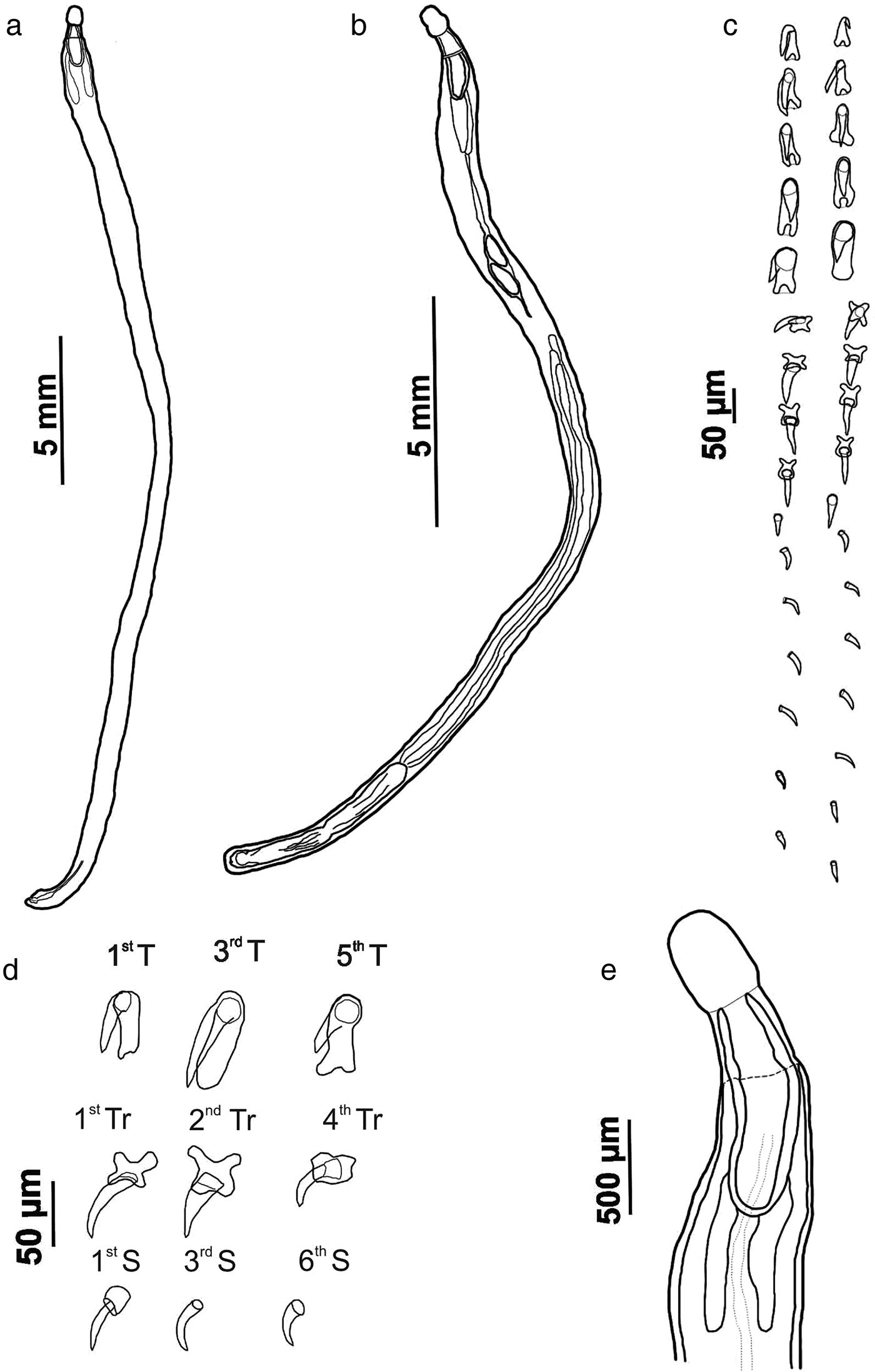
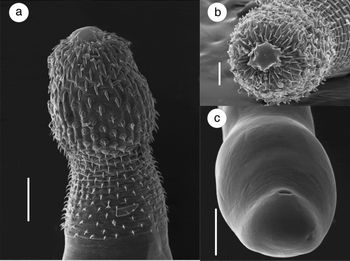
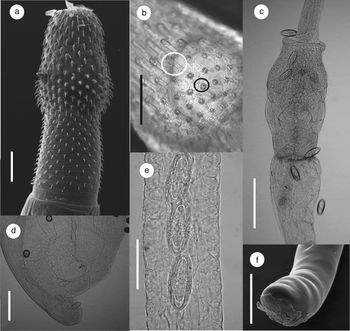
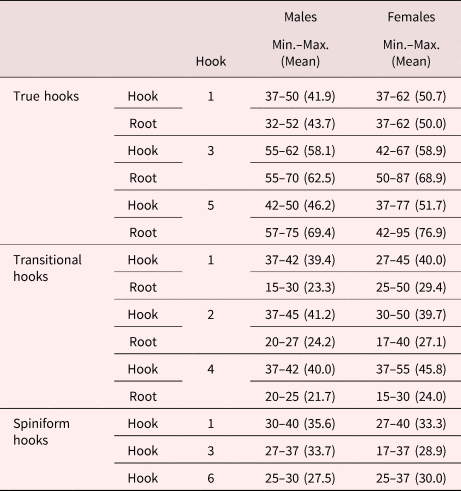
General (based on four males and seven gravid females obtained from naturally infected S. rufipes). Centrorhynchidae, with the characteristics of the genus Centrorhynchus: trunk aspinose, cylindrical, filiform, without inflation or constriction (fig. 2a, b). Proboscis, without apical organ (fig. 4b), pyriform anteriorly and cylindrical posteriorly, divided by a constriction at level of proboscis receptacle insertion (figs 2e, 4a and 5a). Neck short. Proboscis receptacle double walled. Lemnisci short, slightly longer than proboscis receptacle (fig. 2a, b, e). Proboscis with 31–33 longitudinal rows of 16–17 hooks each: 5 true hooks, 4 transitional and 7–8 spiniform hooks (figs 2c, d, 4a, b and 5a). True hooks bigger, with roots directed posteriorly, divided at base forming two processes (fig. 5b). Transitional hooks with four lateral processes, two directed anteriorly and two directed posteriorly, more noticeable in first two hooks, and spiniform hooks smaller, without root (fig. 2d). Hook and root length are given in table 2.
Line drawings of Centrorhynchus nahuelhuapensis n. sp. from Strix rufipes in Patagonia. (a) Lateral view of entire female specimen, (b) lateral view of entire male specimen, (c) male proboscis armature, (d) detail of measured hooks, and (e) anterior end of male. Abbreviations: S, spiniform hooks; T, true hooks; Tr, transitional hooks.

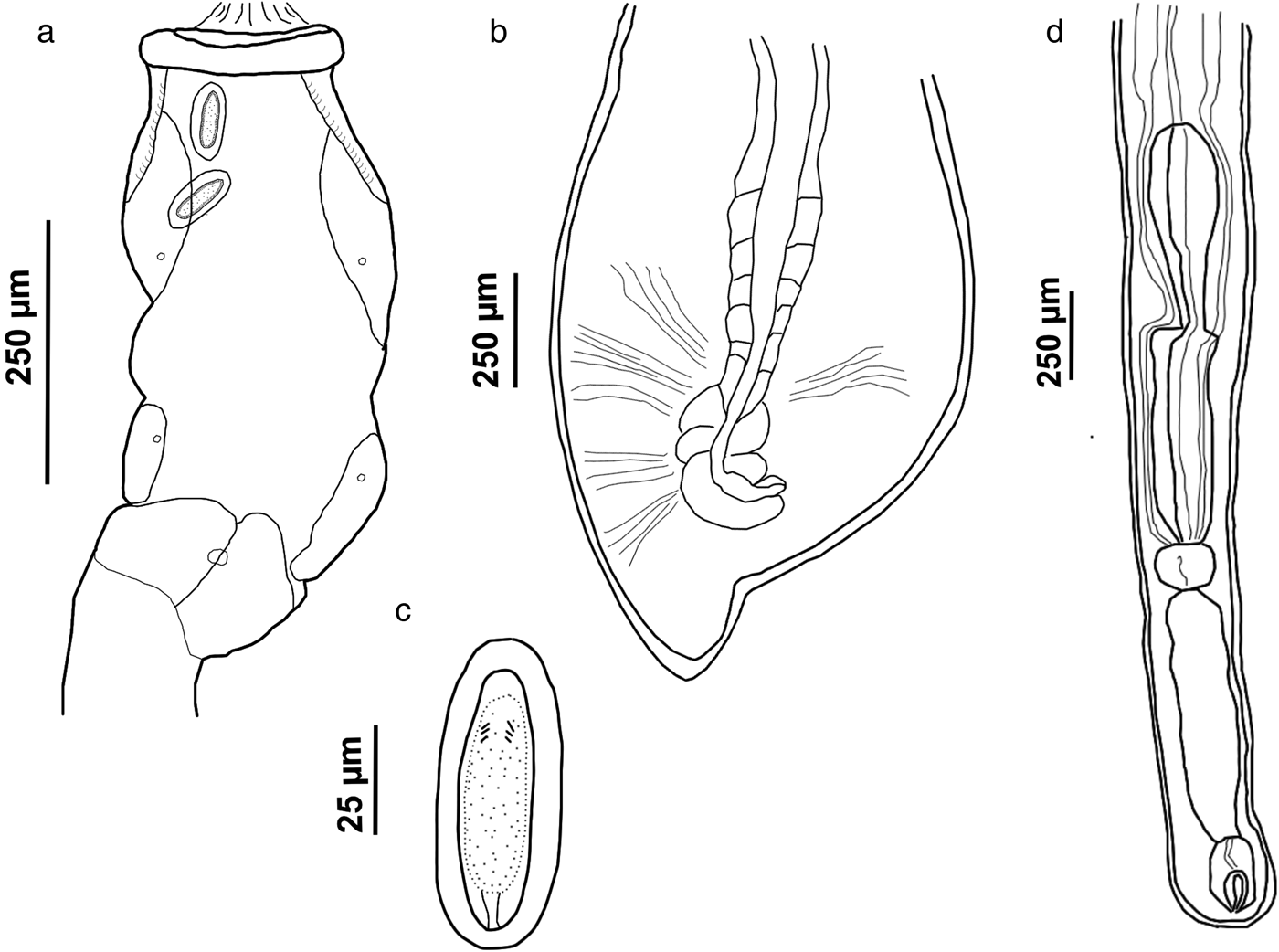
Line drawings of genitalia of Centrorhynchus nahuelhuapensis n. sp. from Strix rufipes in Patagonia. (a) Uterine bell, (b) vagina, (c) mature egg, and (d) male posterior end.

SEM micrographs from a male of Centrorhynchus nahuelhuapensis n. sp. from Strix rufipes in Patagonia. (a) Anterior end, (b) proboscis in apical view, and (c) posterior end, showing a subterminal gonopore. Scale bars represent 200 μm.

Micrographs from a female of Centrorhynchus nahuelhuapensis n. sp. from Strix rufipes in Patagonia. (a) Anterior end, (b) proboscis, showing true hooks (white circle) and transitional hooks (black circle), (c) uterine bell, (d) vagina, (e) uterus with mature eggs, and (f) posterior end. Scale bars represent 200 μm.

Hook measurements of males and females of Centrorhynchus nahuelhuapensis n. sp. recovered from Strix rufipes in Patagonia.

Males (figs 2–4). Trunk 10.8–28.0 (18.5) mm long, 700–800 (756) wide. Proboscis 1000–1100 (1037) long, 450–500 (487) wide at middle of anterior region, 375–375 (375) wide at constriction, 450–500 (475) wide at base. Neck 75–75 (75) long, 450–550 (487) wide. Cerebral ganglion 115–125 (120) long, 96–115 (106) wide. Proboscis receptacle 625–1250 (937) long by 225–450 (369) wide. Lemnisci unequal; short lemniscus 925–1800 (1369) long, 125–250 (194) wide; long lemniscus 1050–1875 (1500) long, 200–250 (225) wide (fig. 2e). Reproductive system occupies almost posterior 80% of body cavity, testes oval, pre-equatorial, similar in size, in tandem (fig. 2b). Anterior testis 425–875 (631) long, 250–500 (356) wide, posterior testis 500–925 (712) long, 250–625 (400) wide. Three elongate cement glands similar in size, 7.6–16.3 (10.6) mm long. Saefftigen's pouch 1212–2626 (1878) long (fig. 3c). Bursa invaginated 1313–2626 (1843) long (fig. 3c). Gonopore subterminal (figs 3c and 4c).
Females (figs 2, 3 and 5). Trunk 30–41 (32.8) mm long, 0.82–1.15 (0.97) mm wide. Proboscis 1000–1250 (1132) long, 500–575 (546) wide at middle of anterior region, 350–450 (411) wide at constriction, 425–625 (543) wide at base. Neck 75–125 (105) long, 425–625 (543) wide. Proboscis receptacle 900–1575 (1232) long, 425–550 (496) wide. Short lemniscus 1625–2125 (1837) long, 250–350 (292) wide, long lemniscus 1700–2125 (1960) long, 200–300 (270) wide (fig. 2a). Uterine bell with few cells 505–606 (559) long, 232–323 (273) wide, without lateral cells (figs 3a and 5c). Uterus 2727–3485 (3117) long (fig. 5e). Vagina complex; connected to body wall with thick branching fibres, 300–375 (328) long, 125–222 (164) wide (fig. 3b). Gonopore ventral subterminal (fig. 5f). Eggs (n = 15) elongated without filaments, outer membrane 50–59 (55) long, 14–17 (14) wide (figs 3d and 5d, e).
Taxonomic summary
Type host. Rufous-legged owl, Strix rufipes King (Strigidae).
Site of infection. Intestine.
Type locality. Villa la Angostura (40°42′17.66′′S, 71°42′11.45′′W), Neuquén Province, Argentina.
Other localities. La Rinconada (39°59′55.45′′S, 70°50′19.54′′W), Neuquén Province, Bariloche City (41°08′31.02′′S, 71°18′49.74′′W) and Villa Mascardi (41°21′10.94′′S, 71°30′39.19′′W), Río Negro Province, Argentina (fig. 1).
Prevalence and intensity. One infected of one examined from Villa la Angostura with 48 worms, one infected of one examined with three worms from La Rinconada, one infected of two examined with one worm from Bariloche City, and one infected of seven examined with three worms from Villa Mascardi.
Specimens deposited. MACN – Pa holotype male No. 658, allotype female No. 659, paratypes Nos 660 (male) and 661 (female). Paratypes No. MSB:Para:28709 in Museum of Southwestern Biology, Division of Parasites, University of New Mexico. MK411249 and MK411250 sequences deposited in GenBank.
Etymology. The name of the new species refers to Nahuel Huapi Lake, where type material was collected (see location of Villa La Angostura in fig. 1).
DNA sequencing
Sequencing resulted in 1410 bp of the SSU and 1427 bp of the LSU, which were identical from two separate specimens. Nucleotide BLAST® search of the SSU indicated strong similarity to 96–98% and complete overlap with four of the other species of Centrorhynchus: Centrorhynchus sp. (AY830155.1), C. conspectus (U41999.1), C. microcephalus (AF064813.1), and Centrorhynchus globirostris Amin, Heckmann, Wilson, Keele & Khan, 2015 (KM588206.1). All other acanthocephalan SSU sequences in GenBank were < 90% similar. Nucleotide BLAST® search of the LSU consensus sequence also indicated highest similarity to the sole member of Centrorhynchus in GenBank (90% similarity to Centrorhynchus sp. AY829104.1). All other LSU sequences from Acanthocephala were 86% or less similar. Maximum likelihood analysis resulted in a single most likely topology with a monophyletic clade of Centrorhynchus, with 100% bootstrap support (fig. 6). Of the few species of Centrorhynchus represented in GenBank, C. globirostris, a parasite of the pheasant crow from Pakistan, was estimated to be the sister taxon to C. nahuelhuapensis. These results support our hypothesis that these new specimens are members of Centrorhynchus.
Maximum likelihood phylogenetic tree of 19 acanthocephalan species, including Centrorhynchus nahuelhuapensis n. sp., based on SSU ribosomal DNA. Bootstrap support values are indicated at nodes. Results indicate that the new species fits within the genus Centrorhynchus.

Taxonomic remarks and comparisons
Centrorhynchus nahuelhuapensis n. sp. conforms to the diagnosis of the genus given by Yamaguti (Reference Yamaguti and Yamaguti1963), and has 31–33 longitudinal hook rows with 16–17 hooks, with a formula distributed as follows: 5 + 4 + 7 – 8, showing the transitional hooks with four alate processes in both sexes. Comparing specimens of C. nahuelhuapensis with the key of all Neotropical species of Centrorhynchus (Smales, Reference Smales2013), the new species resembles C. kuntzi and C. guira by having transitional hooks with alate processes. Centrorhynchus kuntzi differs from the new species by having 24 hooks per row, and a different proboscis hook formula (7 – 8 + 2 + 16 – 17). Furthermore, C. kuntzi has a shorter proboscis (870 μm in C. kuntzi vs 1000–1250 μm in C. nahuelhuapensis) (Schmidt and Neiland, Reference Schmidt and Neiland1966; Nickol, Reference Nickol1983). Centrorhynchus guira differs from C. nahuelhuapensis by having a larger body (26.1–50.4 mm in C. guira vs 10.8–41 mm in the new species), a shorter proboscis (790–1000 μm in C. guira), a larger proboscis receptacle (1400–1770 μm in C. guira vs 625–1575 μm in C. nahuelhuapensis), more hooks per row (18–19), a different proboscis hook formula (8 – 9 + 4 – 6 + 6), and shorter true hooks (males 24–48 μm, females 31–48 μm in C. guira vs males 37–62 μm, females 37–77 μm in C. nahuelhuapensis), and shorter spiniform hooks (14–26 μm in C. guira vs 17–40 μm in the new species). It also differs by having a bigger egg (53–64 μm long by 24–29 μm wide in C. guira vs 50–59 μm long by 14–17 μm wide in C. nahuelhuapensis) (Lunaschi and Drago, Reference Lunaschi and Drago2010; Smales, Reference Smales2013).
In relation to the acanthocephalan species found infecting Strix around the world, the new species resembles C. spinosus by having 7–11 rooted hooks per row (true + transitional) followed by spiniform hooks, and also by the proboscis length (806–1018 μm) (Richardson and Nickol, Reference Richardson and Nickol1995). But C. spinosus differs from the new species by having a greater number of hooks per row (22–27), a different hook formula (8 – 11 + 1 + 13 – 17), and a shorter proboscis (806–1018 μm) (Nickol, Reference Nickol1983). The remaining species (e.g. C. aluconis, C. conspectus, C. robustus and C. elongatum) have fewer longitudinal hook rows (26–31) and fewer transitional hooks (ranging from 0 in C. robustus to three in C. conspectus) than C. nahuelhuapensis (31–33 longitudinal hooks and four transitional). In addition, C. nahuelhuapensis has smaller eggs than C. robustus (50–79 μm long by 18–27 μm wide), and C. elongatum (72–81 μm long by 27–30 μm wide) (Meyer, Reference Meyer and Bronns1932; Van Cleave and Pratt, Reference Van Cleave and Pratt1940; Yamaguti, Reference Yamaguti and Yamaguti1963; Nickol, Reference Nickol1983; Dimitrova et al., Reference Dimitrova, Murai and Genov1995; Richardson and Nickol, Reference Richardson and Nickol1995). Moreover, C. spinosus, C. conspectus and C. robustus differ from the new species by having four cement glands rather than three (Van Cleave and Pratt, Reference Van Cleave and Pratt1940; Nickol, Reference Nickol1983; Richardson and Nickol, Reference Richardson and Nickol1995).
With respect to the species that have molecular sequences deposited in GenBank, i.e. C. conspectus (see comparison above), C. microcephalus, and C. globirostris, they differ from C. nahuelhuapensis by the absence of transitional hooks, higher number of longitudinal hook rows (30–38), and smaller eggs (36–56 μm long by 14–24 μm wide) (Richardson et al., Reference Richardson2010). Centrorhynchus globirostris differs by the absence of spiniform hooks, and fewer longitudinal hook rows (24–25) (Amin et al., Reference Amin2015). In the case of Centrorhynchus sp. recorded from Falco peregrinus in Mexico (GenBank accession: DQ089716), no morphological data are available (García-Varela and Nadler, Reference García-Varela and Nadler2005).
The percentage divergence among SSU sequences of C. nahuelhuapensis and those species of Centrorhynchus in GenBank was 96–98%, which is slightly more than, but similar to species-level differences in other genera of Acanthocephala represented in GenBank (Echinorhynchus 99%, Rhadinorhynchus 99%, Corynosoma 99%, Pomphorhynchus 98–99%). Divergence in the LSU sequences (90%) was also slightly more than, but similar to other genera of Acanthocephala (Acanthocephalus 94%, Echinorhynchus 93–99%, Corynosoma 97–99%, Polymorphus 92–99%). However, it should be noted that the genus Centrorhynchus is highly diverse, with a larger number of recognized species than most other genera. Also, Acanthocephala are not well represented in GenBank, with most genera having fewer than three or four representative specimens.
Discussion
The genus Centrorhynchus is distributed worldwide and has c.100 species (Amin, Reference Amin2013). Recently, new species have been described from South America and Asia (Smales, Reference Smales2013; Amin et al., Reference Amin2015; Smales et al., Reference Smales2017). The species recorded from South America parasitize a wide range of birds in different families, e.g. Ardeidae, Cuculidae, Accipitridae, Falconidae, Furnariidae, Trudidae, Tyrannydae, Thamnophillidae and Strigidae (Lunaschi and Drago, Reference Lunaschi and Drago2010; Smales, Reference Smales2013; Drago et al., Reference Drago2015; Grandón-Ojeda et al., Reference Grandón-Ojeda2018). The only species of Centrorhynchus reported from Argentina is C. guira, described from the intestine of the guira cuckoo (G. guira) from northern Argentina (Lunaschi and Drago, Reference Lunaschi and Drago2010) and from Crotophaga ani (Linnaeus) recorded in Paraguay (Smales, Reference Smales2013). Specimens of Centrorhynchus sp. were reported from a burrowing owl (A. cunicularia) in Argentina; however, no morphological data were reported (Drago et al., Reference Drago2015). Cystacanths have been reported from colubrids, anurans and carnivores in Argentina, e.g. encysted larvae in mesenteries of the colubrids Clelia rustica (Cope) and Lepthovis ahaetulla (Linnaeus) (Vizcaíno, Reference Vizcaíno1993; Lamas and Lunaschi, Reference Lamas and Lunaschi2009). The larvae recorded from C. rustica had a proboscis with 30 rows of 17–19 hooks, 8–9 true hooks and the others were spiniform hooks (Vizcaíno, Reference Vizcaíno1993). The larvae from L. ahaetulla had 28–30 rows of 18–19 hooks (8 + 3 + 7 – 8) (Lamas and Lunaschi, Reference Lamas and Lunaschi2009). None is consistent with the hook characteristics of C. nahuelhuapensis n. sp. Several other reports of larvae of Centrorhynchus from the mesenteries of diverse anuran species from the same geographical area appear in the literature but without morphological descriptions. These include in Corrientes Province from Pseudopaludicola boliviana Parker (Duré et al., Reference Duré2004), Leptodactylus latinausus Jiménez de la Espada (Hamann et al., Reference Hamann, González and Kehr2006a), Leptodactylus chaquensis Cei (Hamann et al., Reference Hamann, Kehr and González2006b; Schaefer et al., Reference Schaefer2006), Leptodactylus bufonicus Boulenger (Hamann et al., Reference Hamann, Kehr and González2012), Scinax nasicus (Cope) (Haman et al., Reference Hamann2009, Reference Hamann, Kehr and González2010), and Rhinella fernandazae (Gallardo) (Hamann et al., Reference Hamann, Kehr and González2013); and in Chaco Province from Melanophryniscus klappenbachi (Prigioni & Langone) (Hamann et al., Reference Hamann, Kehr and González2014). In northern Argentina, cystacanths were found in the intestine of the carnivore aguará guazú (Chrysocyon brachyurus Smith); however, the species and morphological characteristics remain unknown (González et al., Reference González, Milano and Lunaschi2013). The high richness of intermediate hosts parasitized with Centrorhynchus larvae and birds present in South America is indicative that many species in this genus still need to be described.
Considering that only five out of 100 species of the genus Centrorhychus have been described molecularly, it is difficult to make a hypothesis about the phylogenetic relationships of these species. We present the first molecular study for a species of Centrorhynchus from South America. Centrorhynchus nahuelhuapensis is the second species of the genus described in Argentina, and the first species of a terrestrial acanthocephalan from a bird in Patagonia. Moreover, it is the first species of Centrorhynchus described from one of the three endemic Strix species from South America.
Author ORCIDs
C. Rauque, 0000-0001-7355-9532
Acknowledgements
Samples were collected with the permission of Administración de Parques Nacionales (Argentina). Thanks are given to F. Tricárico from de Laboratorio de Microscopía Electrónica de Barrido del MACN Bernardino Rivadavia for the help with SEM photographs.
Financial support
This study was funded by CONICET (PIP 112.201501.00477) and Universidad Nacional del Comahue (B225).
Conflict of interest
None.