INTRODUCTION
In England and Wales, Section 136 (S136) of the Mental Health Act 1983 (MHA 1983) gives a police constable the power to detain an individual that they find to be mentally disordered in a public place and in need of care and control. The individual is conveyed to a place of safety (POS) to allow for further assessment by a medical practitioner and an approved mental health professional (AMHP) to ascertain whether admission to hospital is warranted either voluntarily or compulsorily.
The nature of the POS is not specified in the Act and is a matter for local agreement. Historically it has usually been police cells, sometimes a psychiatric hospital, or rarely an emergency department in a general hospital. Although hospital settings are increasingly being used, a study in 2005 showed that 34% of areas in England and Wales still only had access to police cells as a POS (NACRO, 2005). Similarly, a recent study by the Independent Police Complaints Commission (IPCC; Docking et al., Reference Docking, Grace and Bucke2008) compared police and Department of Health (DoH) data, showing that two thirds of S136 detainees were held in police cells with only a third being taken to a hospital POS.
The current Code of Practice for the MHA 1983 (Department of Health, 2008) states that police cells should only be used as a POS on an ‘exceptional basis’ under S136. However the IPCC study shows that the use of police cells as a POS is far from ‘exceptional’.
National policy supports the development of alternatives to using police cells as a POS. As part of an initiative to improve provision of psychiatric intensive care units (PICUs) and develop alternatives to police cells as POSs, the DoH made £130 million available to Mental Health Trusts in 2006. The Royal College of Psychiatrists has also recently published updated guidance on standards for the use of S136 (Royal College of Psychiatrists, 2008).
S136 IN GLOUCESTERSHIRE
Gloucestershire is a rural English county with a population of approximately 585000. In Gloucestershire the only POS was, for many years, police cells. Previously the local psychiatric hospital had also been used as a POS, but this ceased around 1992 following a dispute between the mental health services and the police. Anecdotally this dispute centred around a perception, on the part of psychiatric staff, that the police were on occasions using S136 inappropriately to drop off people causing a public nuisance, usually intoxicated, at the hospital.
In 2006 our local specialist mental health trust initiated an ultimately successful bid to the DoH for funding the capital costs of developing a ‘health based’ POS against the £130 million fund on offer from the DoH. Our local health service commissioners (NHS Gloucestershire) drew this opportunity to our attention and encouraged the bid. The DoH funding was for both S136 POS and psychiatric intensive care unit (PICU) development. However, the DoH funding for PICU development was conditional upon trusts already providing an alternative POS to the police cells (or bidding for funds to develop such a service). Our trust’s ultimately successful bid was for capital costs for both a health based POS and pre-providing Greyfriars Ward, our aging PICU.
The S136 POS bid was informed by an ongoing piece of local research investigating the use of S136 in Gloucestershire involving one of us (JL). As well as measuring S136 activity levels, this research included an assessment of the attitudes and beliefs of the professionals involved: doctors (psychiatric, emergency department and forensic physicians), nurses (psychiatric and emergency department), approved social workers (now AMHPs) and police. In addition, the views of users and carers were obtained.
The results of this research highlighted potential difficulties in developing an alternative POS to the police cells. There were differing views between the professional groups on the necessity, benefits and risks of such a venture as well as differing views on the appropriateness of various potential settings as alternatives to police cells. However, the view of users was clearer. The majority had found their experience of being detained under S136 in the police cells a distressing experience although they had generally found the police to be caring as individuals.
This research helped to shape discussions within our trust about where a health based POS could be provided. From a national perspective, stigma was one of the reasons why police cells were felt to be unsuitable as a POS. Our research supported this, finding that detainees objected to the cells as they felt they were being viewed ‘as a criminal’ even though they had committed no crime. However, we were also mindful that using the psychiatric hospital might also cause stigma, as detainees might feel they were being treated as ‘mentally ill’ before any assessment had taken place, especially as our research showed that two thirds of detainees were, after assessment, released rather than admitted to hospital.
A list of the desirable characteristics for a health based POS arose out of discussions:
• Available 24 hours a day
• Easily accessible from the main population centres in Gloucestershire
• ‘Neutral’ non-stigmatising setting
• Suitable for rare occasions when there is an extended period of stay (S136 can last up to 72 hours)
• Comfortable and safe
• Adequately staffed with access to extra staff in case of behavioural disturbance.
A number of existing facilities were assessed against these criteria: the general hospital emergency department, primary care out-of-hours access centre, Hope House (a facility used for various purposes including medical examination of victims of sexual offences) and the local psychiatric hospital. None were suitable and, for a variety of reasons, it was not possible to adapt any of the existing facilities to make them suitable.
Option appraisals were carried out and the proposal for a new-build adjacent to the existing psychiatric hospital in Gloucester was selected. It was felt that this met the ‘neutral’ setting requirement (see above) as it was adjacent to rather than an integral part of the psychiatric hospital.
Although funding for S136 POS and PICU development were linked by the DoH we opted not to build a joint POS/PICU facility. This was because we believed that such a facility would not provide a ‘neutral’ setting, the site limitations precluded a building of that size and our research suggested that the frequency of behavioural disturbance in S136 detainees in Gloucestershire didn’t warrant a POS intimately linked to a PICU.
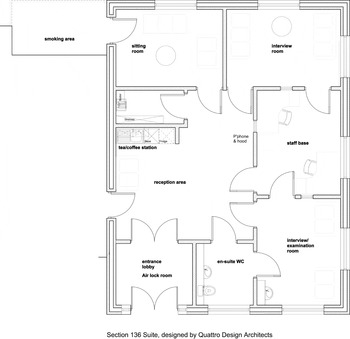
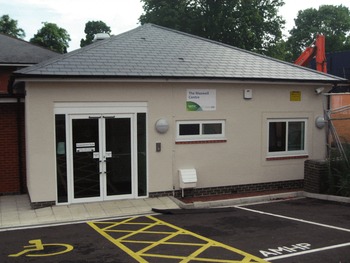
A firm of architects (Quattro Design Ltd), in consultation with local clinicians, developed a design (Fig. 1). Planning permission was obtained and the building, named the Maxwell Centre, opened in early 2009 (Fig. 2).
Maxwell Centre floor plan

Maxwell Centre summer 2009

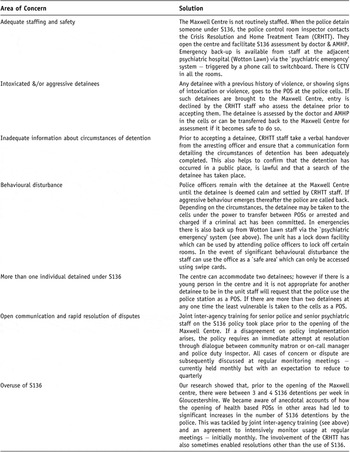
An inter-agency working party, including user representation, drafted a revised and updated version of the existing Gloucestershire S136 Policy (available from the authors) to cover the changes to S136 law arising from the revised MHA and the new Code of Practice (Department of Health, 2008). The main developments that the new policy addressed were: the operation of two POSs within the county (police cells and the Maxwell Centre) and the new power to transfer between POSs. Negotiation and compromise, from both police and psychiatric staff, led to a policy being agreed and ratified by the management boards of the various agencies involved. Key areas of concern that the policy addressed are detailed in Table 1.
Key areas of concern regarding the operation of the POS

CONCLUSION
The opening of the Maxwell Centre is a positive development that has brought the use of S136 in Gloucestershire into line with national policy and accepted good practice. The well-being of S136 detainees is better protected by access to an alternative health based POS, in addition to the existing POS in the police cells.
The existence of local contemporaneous research on S136 was useful in guiding the development of the Maxwell Centre and the revised S136 Policy. The research was particularly helpful in its epidemiological findings and its demonstration of differences in attitudes and perceptions of how S136 was (and should) be implemented. Despite these differences in opinion it is encouraging that the various agencies and professional groups were willing to negotiate and compromise in order to achieve a common goal. However, it is probable that the development of a health based POS in Gloucestershire would not have happened without the injection of new funds and a management regime that recognised that the status quo wasn’t acceptable.
Successful implementation of the new POS has been facilitated by the appointment of a local manager with a specific mandate and commitment to make it work rather than emphasise difficulties. The presence of accessible and speedy conflict resolution mechanisms has also been important in addressing difficulties before they escalate and positions become entrenched. Longer term success will require ongoing inter-agency training and opportunities for police and NHS staff to understand each others priorities and perspectives.
It has also been helpful that the Crisis Resolution and Home Treatment Team (CRHTT) assist in staffing the Maxwell Centre; their involvement, as well as allowing alternatives to admission to be explored, highlights on an ongoing basis the possibility of alternatives to S136 detention.
ACKNOWLEDGEMENTS
We gratefully acknowledge the assistance of NHS Gloucestershire, Gloucestershire Constabulary and Quattro Design Ltd.