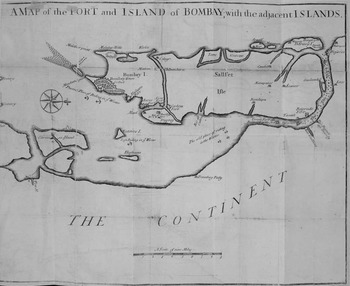
The proximity of the Indian rock-cut temples on Elephanta Island and at Kanheri, in the north of Salsette island, to the Portuguese, and subsequently British, settlement at Bombay on the west coast of India meant that they were among the first Indian antiquities to attract European attention (fig 1).Footnote 1 Not all of this was necessarily beneficial, for the piety of the Portuguese led them to deface some of what they regarded as heathen idols. Following the marriage of the Portuguese princess, Catherine of Braganza, to King Charles ii, in 1662, the seven small islands south of Salsette, including what was then the island of Bombay, passed to the English Crown as part of her dowry. However, the Portuguese retained the much larger northern island of Salsette as well as Elephanta island, about six miles to the south east across Bombay harbour, until their conquest by the Mahrattas between 1737 and 1739. They were acquired by the British in 1774 for supporting one side in a power struggle within the Mahratta Empire and formally acquired by the Treaty of Salbai, in 1782, which concluded the First Mahratta War. It was only after this that the British began the process of joining together the seven smaller islands by embankments, or ‘vellards’, completed in 1838, and then linking them to their northern neighbour, which has created the much larger island of Salsette, of which the modern city of Bombay now occupies the southern part.
A map of Bombay and its surroundings from A Description of the port and island of Bombay: and an historical account of the transactions between the English and Portugueze concerning it, from the year 1661, to this present time, London: 1724 (BL, 10055.c.37). The map is orientated with north to the right. Kanheri is at or near the place described as ‘Ecanor’ in the north of Salsette. Elephanta lies in the channel between Bombay and the mainland. Photograph: © British Library

Even if the British did not originally control Salsette, this did not preclude frequent visits by them to the temples at Kanheri, though these seem to have been less easy after the Mahratta conquest when, unlike at Elephanta, a passport was needed.Footnote 2 By the early eighteenth century, one of the structures at Kanheri was already known as the English Lodge (see fig 4). However, most of the visits to both sites appear to have been no more than pleasure excursions. In the mid-eighteenth century, J H Grose commented on how Elephanta afforded the English at Bombay ‘not only an opportunity of gratifying their curiosity, in visiting so remarkable a spot, but occasionally of a very agreeable party of pleasure’, frequently dining in the cave itself to escape the heat outside.Footnote 3 Thus, Lieutenant Colonel Barry's description of the temple at Elephanta that appeared in the Gentleman's Magazine in 1785 was the result of ‘one of the most agreeable parties I was ever on’, given by Mr and Mrs Hull for General Macleod, and ends with Barry's poem to Mrs Hull: ‘To thee, bright lamp, that lum'd El'phanta's cave’.Footnote 4 This tradition was still alive and well when the future Edward vii was guest of honour at a banquet in the caves during his tour of India as Prince of Wales in 1875.Footnote 5 Indeed, the caves near Bombay were so well known in Britain that in 1839 ‘Salsette and Elephanta’ was set as the subject of the Newdigate Prize Poem at Oxford, a competition won that year by John Ruskin.Footnote 6
Given the growing predominance of the British in India, especially after Plassey, it has often seemed curious that, during this period, the most important studies of Indian art and culture were undertaken by continental Europeans.Footnote 7 In 1771 Abraham Hyacinthe Anquetil-Duperron had published the ground-breaking Zend-Avesta, the fruit of his travels in India between 1755 and 1761, the date when the British captured the French colony of Pondicherry. This contained a life of Zoroaster and some of the Parsee scriptures, but Anquetil-Duperron was also greatly interested in Sanskrit and had visited some of the cave temples, including Ellora, Elephanta and Kanheri, from which, indeed, he carried away a piece of sculpture. Equally important was Carsten Niebuhr, the sole survivor of a Danish expedition of 1761–7 to the East. Denmark at this period still had colonial outposts in India, governed from Tranquebar, on the south-east coast. These territories included the Nicobar Islands and Frederiksnagore (the modern Serampore), a trading post established on the Hooghly, upriver from Calcutta, as recently as 1755. Partly in consequence, the Danish government exhibited a marked interest in the East. Thus, for example, the French translation from Persian by the future Sir William Jones of an account of the life of the Persian monarch Nadir Shah (d 1747), published as the Histoire de Nader Chah in 1770, was commissioned by, or at least in the name of, King Christian vii of Denmark, in 1768. However, the impetus of the 1761 expedition had been the suggestion of the famous Göttingen professor and biblical scholar, Johann David Michaelis, to the Danish minister, Baron Bernstorff, that Arabia might throw much light on the philology of the Old Testament. Niebuhr's Beschreibung von Arabien was published at Copenhagen in 1772 and Reisebeschreibung nach Arabien und andern umliegenden Ländern, between 1774 and 1778.Footnote 8 They included fine drawings he had made of the antiquities at Elephanta. Because relations with the Mahrattas were troubled at the time he was in Bombay, he did not, however, visit Kanheri.Footnote 9
Reflecting on all this, Richard Gough, Director of the Society of Antiquaries, was led to declare: ‘It gives me pain to reflect how little concern our countrymen have given themselves to teach or learn civilisation in their East Indian pursuits … In comparing the accounts of foreigners with those of our own people, is not one shockt at the careless and slovenly recitals of the latter, while the former are all attention and minuteness?’Footnote 10 Gough was sensitive on the subject of the superiority of foreign scholarship. His own great survey, Sepulchral Monuments in Great Britain,Footnote 11 was, after all, partly inspired by a desire to provide for the British Isles what Bernard de Montfaucon (1655–1741) had already undertaken for France.Footnote 12 Indeed, it appears, this time in respect of learning, to be another instance of a phenomenon remarked on by Sir Joshua Reynolds when considering the fine arts in Britain, namely ‘that slow progression of things, which naturally makes elegance and refinement the last effect of opulence and power’.Footnote 13
Contrasting with the supposed general tardiness of Indian studies in Britain, the apparent surge of interest shown by the Society of Antiquaries in the early 1780s, both in the subcontinent in general and in the temples of Salsette and Elephanta in particular, has attracted scholarly comment. Three papers on the subject appeared in the Society's journal, Archaeologia, in 1785 and a further one in 1787.Footnote 14 Their publication has been seen as a belated response to the work of foreign scholars.Footnote 15 In fact, the Society's publications slightly compress the time-scale of this response. Two of the papers had been read at meetings in 1780, the third in 1784 and the fourth in 1786. Nor does Archaeologia necessarily give the full story, because not all subjects discussed at meetings reached its pages. Of the four papers, the two presented to the Society in 1780 are of particular interest because some of the manuscripts on which they are based still survive. The remainder of this paper will be devoted to discussing these and seeing if any more general conclusions can be drawn from them.
On 10 February 1780, the Society heard an ‘Account of a curious Pagoda near Bombay, drawn up by Captain Pyke, who was afterwards Governor of St Helena’. The term ‘pagoda’ in this period referred to any oriental temple, not yet having narrowed its meaning to a multi-tiered Chinese tower, possibly as a result of the pagoda at Kew designed by Sir William Chambers. This account of the cave temple of Elephanta was itself an historical document. Isack Pyke had been Governor of St Helena in 1714–19 and 1731–8,Footnote 16 and his narrative was taken from his journal as Captain of the East Indiaman Stringer in 1712.Footnote 17 Two things might be noted of this account. The tour of Elephanta was viewed as a leisure pursuit and it was also seen very much as a second best to a visit to the ruins at Kanheri: ‘I had been here [Bombay] now many days Constantly Employed in vulivering [sic] the Ship So yt I had noe time for Divertion of any kind but at length made a holliday to see a famous Pagoda on the Island Elephanta Occasioned by haveing heard much of ye Stupendous Works on ye Island Sallsett & that Pagoda on Elephanta was Somewhat of that nature the little time I had to stay Stay there not permitting me to goe & see ye Wonderful pagodas on Sall-sett I resolved to take to my Self one day at least in order to view Somewhat w.ch might give me an Idea of the Rest.’Footnote 18 This account had itself been transcribed from the original manuscript, now in the British Library,Footnote 19 by Alexander Dalrymple, and included a number of striking if inaccurate drawings.Footnote 20 Dalrymple, who about this time also presented to the Society views and a map of India,Footnote 21 was hydrographer to the East India Company. The manuscript is supposed to have come to the East India Company from Dalrymple's estate in 1809, the year after his death,Footnote 22 but presumably had been extracted by him from the Company's archives, which also contain Pyke's sailing logs.Footnote 23
In sending the transcription to the Society, Dalrymple was clearly motivated by the publication of Niebuhr's Travels. He remarked that there was an account of Elephanta in the last volume of these, ‘but that Description was taken at a time when the Building was less perfect than when this Acct was made’ and was ‘moreover … in a Language very little understood here [i.e. German], & has not been translated’.Footnote 24 In fact, by the time the paper was read, and long before it appeared in Archaeologia, this latter statement was no longer accurate. A number of French translations of Niebuhr had already appeared, the first in 1773.Footnote 25 Certainly, Niebuhr's Travels were by no means unknown to the Society by 1780. At a meeting on 28 May 1778, a communication citing his work had been read from its Honorary Fellow, Johann Reinhold Forster, and Niebuhr's fame was to grow in Britain, even though an English edition of his work did not appear until 1792 (in a translation by the hack writer Robert Heron).Footnote 26 However, when Niebuhr's son, the famous classicist and statesman Barthold Georg Niebuhr, spent a year studying at Edinburgh at the end of the century, he discovered that his father's works, ‘at least in Heron's abridgement, were so extensively circulated that I have myself found them in the possession of many country people, and an acquaintance met with them even in the Isle of Mull’.Footnote 27 The young Niebuhr was further flattered to find a desire in Britain that the unfinished fourth volume of his father's Travels should be printed there in English. In fact, it was published in Hamburg in 1837.
Given the role of J R Forster in helping to spread knowledge of Niebuhr's seminal work, it is worth pausing to examine his relationship with the Society of Antiquaries, for this casts a revealing light on the intellectual interests of the age. Forster was a remarkable figure in his own right. A native of Danzig, he had first come to England in 1766, teaching for a time at the Dissenting Academy in Warrington. With his son, Georg, he had, in 1772, accompanied Cook on his second voyage to the South Seas aboard the Resolution, after Sir Joseph Banks withdrew as naturalist to the expedition.Footnote 28 From 1779, until his death in 1798, he was Professor of Natural History and Mineralogy at Halle. As early as 1767, he had provided the Society with comments on a letter of Paul Demidoff describing the barrows and tombs discovered during the construction of a road across Siberia. Languages were one of Forster's many interests. He remarked that the Mongols had no writing until the time of Genghis Khan but subsequently had two scripts, one of which – Delbergin – was confined to religious texts and probably came, like their religion itself, from Tibet. He observed that Professor Bayer of St Petersburg had shown that the Tibetan alphabet was derived from ‘Brahmine’.Footnote 29 Consequently, it should come as no surprise that Forster was intensely interested in Niebuhr's Reisebeschreibung and, in 1778, should send the Society copies of alphabets that had appeared in volume ii.Footnote 30 Niebuhr was perhaps most famous for the copies he had made of the inscriptions at Persepolis, where he had spent four months, but the alphabets forwarded by Forster included those of the Banians (i.e. merchants) of Gujerat, the Multanee Hindoos, the Hindoos at Diu, the alphabet of Pelivi, and those of Dgian-Shâw (Anquetil's Zend), and of the Sabæans at Basra.
Indeed, curious scripts and comparative philology, albeit at a basic level, were obviously of interest to the Society and when the Kufic inscription on Joseph Ames's Arabic pillar was discussed by the Antiquaries in 1781, Niebuhr's Travels was naturally one of the works referred to.Footnote 31 A few weeks after the reading of Pyke's account of Elephanta, the Society heard ‘Remarks on the Sumatran Languages by Mr [William] Marsden’ addressed to Sir Joseph Banks.Footnote 32 Marsden also contributed ‘Observations on the Language of the people commonly called Gypsies. In a Letter to Sir Joseph Banks, Bart. P.R.S.’, read on 3 February 1785, commenting on the striking and ‘evident correspondence’ of many Romany words with those in ‘the Hindostanic’.Footnote 33 This provoked ‘Collections on the Zingara, or Gypsey Language; by Jacob Bryant, Esq. transmitted to O. Salusbury Brereton, Esq. in a Letter from the Rev. Dr. Douglas’, read on 7 April 1785.Footnote 34
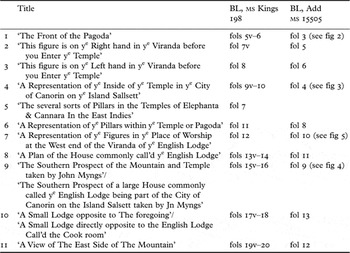
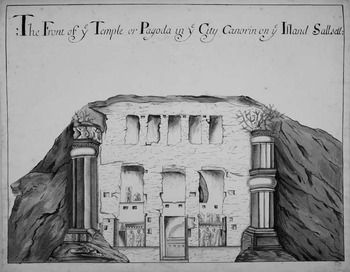
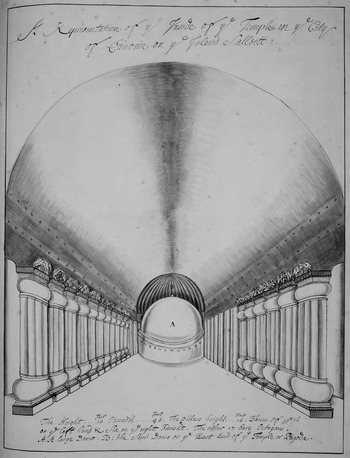
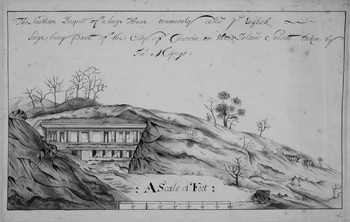
On 17 February 1780, at the Society's meeting the week after Pyke's account of Elephanta had been read, ‘the Secretary communicated an Account from the Papers of the late Smart Lethieullier Esqr of the great Pagoda on the Island of Salset, the two subjects being intimately connected’.Footnote 35 In fact, this ‘Account’ had already been presented to the Society over fifty years before and its description of the temple of Kanheri was only slightly less ancient than that of Elephanta in Pyke's journal. It owed its existence to Charles Boone, Governor of Bombay from 1715 to 1722.Footnote 36 At some time during his period of office, Boone commissioned a survey and a series of drawings to be made of the monuments at Kanheri. This suggests a somewhat more professional undertaking than was, in fact, the case. If not the survey, then certainly the drawings were executed by John Myngs or Mings. In the surviving copies, only one of the drawings, ‘The Southern Prospect’, is actually ascribed to Myngs (see table 1), but the text accompanying one of the sets of copies makes clear that he executed them all: ‘Mr Mings … went with us, and being skilfull in taking prospects, & Plans, is preparing curious draughts of some of the Principall parts for his Honour’.Footnote 37 Myngs is not recorded as either an amateur or professional draughtsman in Mildred Archer's definitive catalogue of British artists in the subcontinent.Footnote 38 Though unattested by Farrington,Footnote 39 he was in fact a Lieutenant in the East India Marine.Footnote 40 It is tempting to think he may have been the ‘Lieutt John Myngs’ who was buried at Bombay on 9 December 1737.Footnote 41 If so, he died intestate for, on 18 January 1738, letters of administration of his estate were granted at the Mayor's Court in Bombay Town Hall to ‘Cursettjee Monockjee of Bombay Persee, Vackellor att:y for Monockjee Nowrojee of Surat Broker … a Creditor of John Mings Late of Bombay Mariner decd’.Footnote 42 Sailors often needed to be draughtsmen, not least because the drawings they made of the coastline and landmarks ashore were invaluable guides to navigation. Some sailors were remarkably skilful but by no means all. Of Myngs’ work, as it survived in 1780, the Secretary of the Antiquaries commented: ‘The Drawings are said to be but sadly copied; however, the original ones are said to be ill done.’Footnote 43
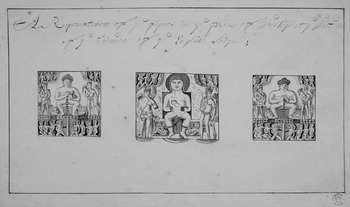
Drawings of Kanheri. The titles are taken from BL, ms King's 198, except for those for numbers 5 and 6 which, being more extensive, are from BL, Add ms 15505. Variants from BL, Add ms 15505 are given for numbers 9 and 10

The rock-cut temple at Kanheri (BL, Add ms 15505, fol 3). Photograph: © British Library

The interior of one of the rock-cut shrines at Kanheri (BL, Add ms 15505, fol 4). Photograph: © British Library

The ‘English Lodge’ at Kanheri (BL, Add ms 15505, fol 9). Photograph: © British Library

Carvings in the ‘English Lodge’ at Kanheri (BL, Add ms 15505, fol 10). Photograph: © British Library

After Boone returned to London, he asked Smart Lethieullier to go through his papers relating to Kanheri and draw up a narrative account to accompany Myngs’ drawings. Why, one might ask, did he make this choice? Lethieullier was a young man still in his twenties. Born in 1701, he had only graduated from Oxford (he was a member of Trinity) in 1723. His family, of Huguenot descent, were rich merchants who furnished directors of the East India Company and of the Bank of England. A great-grandfather, Sir William Hooker, had been Lord Mayor of London. His own father had an estate at Aldersbrook, near Ilford.Footnote 44 His youth had not prevented his election as a Fellow of the Royal Society in 1724 and he had the inclination and fortune to indulge his interests as a scholar and collector. Though he subsequently withdrew from it, he was to be a prominent member of the Society of Antiquaries. It was to the Society that he first read his ‘Account of Kanheri’ on 26 April 1727.Footnote 45 A copy of it, dated 19 June 1735, exists in the Register Book compiled by Alexander Gordon, the Society's Secretary from 1736 to 1741.Footnote 46 As well as giving an account of Kanheri, Lethieullier exhibited Myngs’ handiwork, ‘a book of Drawings of it taken by the Order of Governour Bohun on ye Spot’.Footnote 47
Curiously, when Lethieullier's Account came to be published in Archaeologia, it was prefaced by two dates, 17 February and 1 June 1780.Footnote 48 This was misleading. What was read on the second occasion, and remained unpublished, was ‘from some Papers in the possession of Mrs Boone, (widow of the late Governor of that name) an Extract of a Letter, giving a Description of Canorin, on the Island Salset’.Footnote 49 The extract is transcribed in the Antiquaries’ Minute Book,Footnote 50 with the comment ‘this was all the Account that was copied, and it is thought is all that was left that was not damaged’.Footnote 51 The letter is presumably one of the original sources of Lethieullier's Account. It was communicated by Sir William Musgrave, a Fellow of the Society, who wrote to the Society's Secretary, William Norris, a few weeks later asking for the return of the papers ‘because Sr Wm is engaged to return them to Boone’.Footnote 52 There was an obvious link between Musgrave and the Boone family;Footnote 53 Musgrave was a Commissioner of the Customs and Thomas Boone (a son of Governor Charles Boone of Bombay, born about five years before his father's death in 1735) was appointed a fellow Commissioner in 1769 after a notably unsuccessful term as Governor of South Carolina.
The fate of Boone's papers is not known. When Sir Henry Englefield and General Melvill sought to borrow them from Mrs Boone in 1785, so that the drawings could be reproduced in volume 7 of Archaeologia, they were told that they had been ‘since disposed of and [were] out of her possession and Power’.Footnote 54 The same year Gough commented that they ‘are not now to be recovered’.Footnote 55 However, two copies of the drawings do survive; both are now in the British Library, one set having been acquired by Sir Hans Sloane. At some subsequent date David Guerin had sent him an account of Kanheri to ‘explain the Copys of some drafts, wch you had some time agoe from Governour Boones’.Footnote 56 This ‘Part of a Letter giving a Description of Canorine on the Isle Salset’ is the same as the text read out at the Antiquaries’ Meeting on 1 June 1780 and copied in the Society's Minute Book. Confusingly, Sloane's set is not now amongst the Sloane Manuscripts but forms part of Add ms 15505.Footnote 57 As containing drawings, this volume was sent to the Print Room of the British Museum and only moved to the Manuscripts Department in 1845.Footnote 58 To add to the confusion, its spine proclaims, quite erroneously, that the volume was bequeathed by Sir Joseph Banks.
The second set is that which belonged to Smart Lethieullier himself and, appropriately, the text that accompanies them is that drawn up by the antiquary from Boone's papers and first read by him to the Antiquaries in 1727. After Lethieullier's death in 1760 his collections were dispersed. Amongst the items he bequeathed to the British Museum was a sculpture from Elephanta, presented to him by his neighbour, Sir Charles Raymond of Valentines.Footnote 59 The bulk of his library, which was put up for auction in February and March 1761, reveals a catholic taste. For example, it included a number of Arabic manuscripts, including two Korans and a treatise on moral philosophy. His Account of Salsette, with its copies of Myngs' drawings, was purchased for George iii's Library.Footnote 60 In 1823 George iv presented this to the nation, retaining only thirty-three printed books and two manuscripts.Footnote 61 Curiously, one of these was ‘The Vedams in the Sanskrit language copied at Benares in 1776’.Footnote 62 Nothing of the history of Lethieullier's copy is given either in the Catalogue of the King's Library,Footnote 63 nor by Warner and Gilson in their otherwise exemplary description of its manuscripts.Footnote 64
The drawings of Kanheri are executed in ink and grey wash. Both sets, and, therefore, presumably the originals on which they were based, are at maximum 400 mm × 520 mm, but usually under half this. Lethieullier's account states there were seven drawings.Footnote 65 As they survive now (in the King's and Additional Manuscripts; see table 1), there are at least ten.
From this discussion of Pyke's text and the copies of Boone's manuscripts some tentative conclusions are possible. In the 1780s, influential members of the Antiquaries were clearly eager to mine the resources of the Society to bring before the scholarly world accounts of antiquities from earlier in the century where these were still thought of value. Thus the 1785 volume of Archaeologia, in which three of the Indian papers appeared, opened with a discussion of the Arabic pillar from Alexandria, which had been owned by Joseph Ames, the unofficial secretary of the Antiquaries (d 1759).Footnote 66 If this is the case, why should Indian material be selected? Was there someone at the Antiquaries who felt a special affinity with the subcontinent and its antiquities? Indeed, there was, and none other than its Director, Richard Gough.Footnote 67 ‘My early connection with the interests of that people … makes me consider it a tribute to the memory of that near and respected relation who awakened my curiosity, and led my attention to Indian affairs, and to whose honest industry in the service of the East India Company I owe my all.’Footnote 68 Gough's family had made a fortune from the East India trade. His father, Henry, who died in 1751, was a Director of the East India Company; as a youth he had travelled to China with his uncle, the great East India merchant Sir Richard Gough, and had gone on to command the merchantman Streatham. Though his friend John Nichols observed ‘of his father Mr. Gough was proud, and justly proud’,Footnote 69 this paternal influence on the antiquary has, perhaps, not been sufficiently remarked. The contents of Archaeologia were selected by a subcommittee of the Council, of which Gough was a member. In fact, the publication of Lethieullier's account seems never to have been formally approved, but was perhaps subsumed in the approval given for Captain Pyke's account of Elephanta on 14 January 1785.Footnote 70 It is tempting to detect here the guiding hand of Gough. What is more, his interest in the subcontinent found expression the same year as the publication of volume 7 of Archaeologia, in his study entitled A Comparative view of the Antient Monuments of India, particularly those in the island of Salset near Bombay, as described by different writers, illustrated with prints.Footnote 71 This sets the Archaeologia articles in context. It also includes Gough's translation of Niebuhr's description of Elephanta,Footnote 72 as well as reproducing Niebuhr's figures. That these two volumes should appear more or less together was clearly not a coincidence.
However, the limitations of the accounts in Archaeologia as against the work of scholars such as Niebuhr cannot be denied. It was not so much that they lacked the philosophical background of much European writing on India, since the philosophy was often mistaken. It was, for instance, common to identify Brahma with Bacchus/Dionysus, whom some classical sources claimed had journeyed to India. Many also divined an ‘Indian Trinity’ of Brahma, Vishnu and Siva, as represented by the famous three-headed statue of Śiva Maheśamūrti at Elephanta. These were errors which convinced even Niebuhr,Footnote 73 and were copied by Gough from D'Ancarville.Footnote 74 Nor can the accounts be criticized for failing to realize that the first- to ninth-century ad temples at Kanheri were Buddhist, while the fifth- to eighth-century ones at Elephanta were Hindu, for in the eighteenth century Buddhism was largely unknown; even once it was recognized, it was to take decades for its Indian origins to be fully understood. Indeed, their historical speculations were largely limited to whether or not these ancient temples had been constructed by the army of Alexander the Great, a proposition coming to seem increasingly dubious in the early eighteenth century. The real problem with the Archaeologia accounts is that they largely comprise the incidental observations of travellers and traders, rather than forming part of a dedicated campaign of scholarship.
However, all this was soon to change. In September 1783, Sir William Jones arrived in Calcutta to sit as a judge in the High Court there. In January 1784, he founded the Asiatick Society of Bengal. Almost at once, under the direction of this prodigious scholar, that Society became the focus for British research into Indian antiquities.Footnote 75 Jones's greatest triumph, a towering intellectual achievement, remains his demonstration that Sanskrit and most European languages belonged to the same family, deriving from a common ancestor. Around him gathered a brilliant circle of Orientalists, of whom one of the most distinguished was Sir Charles Wilkins, remembered today for his translation of the Bhagavad gita, published in 1785. Amongst those influenced by Jones and Wilkins was Edward Moor, whose Hindu Pantheon of 1810 was, for half a century, the standard introduction to Hinduism. Moor was one of the original members of the Royal Asiatic Society, founded in London in 1823. He was elected a Fellow of the Society of Antiquaries in 1818. The occasional paper on Indian antiquities had continued to be given there after the early 1780s,Footnote 76 but the impetus for such studies had shifted decisively away from the Antiquaries by the early nineteenth century to the more specialized scholarly societies that were now being established to promote them.
Acknowledgements
I am greatly indebted to the learning and encouragement of a number of scholars for their generous and invaluable assistance in the preparation of this paper. I particularly wish to thank Peter Barber, FSA, Richard Bingle, David Blake, John Falconer, Catherine Pickett, Felicity Myrone, Bernard Nurse, FSA, and Barry Taylor.
ABBREVIATIONS AND BIBLIOGRAPHY
- Abbreviations
- BL
British Library, London
- GM
Gentleman's Magazine
- SAL
Society of Antiquaries of London