Introduction
One important reason to explore the causal link between social capital and health is the potential to promote better population health (Borgonovi, Reference Borgonovi2010). If there is indeed a positive effect of social capital on health, an argument could be developed for investments that increase social capital, especially if such investments proved cost-effective compared with other preventive or curative health interventions.
This article contributes to the literature by exploring the causal link between social capital and two dimensions of health status – general and mental health – in the Former Soviet Union (FSU). This region provides a valuable opportunity to study this phenomenon, as the disintegration of formal social support systems and deterioration of the health care system in the early 1990s left many people in dire need of help from alternative sources, such as reliance on various informal networks (Cockerham, Reference Cockerham1999; Rose, Reference Rose2000). At the same time, adult health in many FSU countries is comparatively poor by international standards, especially among men (Suhrcke et al., Reference Suhrcke, Rocco, McKee, Mazzuco, Urban and Steinherr2007).
The concept of social capital, initially developed by Jacobs (Reference Jacobs1961), Loury (Reference Loury1977), Bourdieu (Reference Bourdieu2002), and further operationalized by Coleman (Reference Coleman1988), has been defined in various ways, but is commonly understood to encompass a combination of norms, trust and social support (d'Hombres et al., Reference d'Hombres, Rocco, Suhrcke, Haerpfer and McKee2011) that smooth the social interaction of individuals in a community, and thus contribute to economic growth and development. There are several potential mechanisms through which social capital can contribute to better health. For example, it may promote the spread of information on healthy behaviors, encourage collective action to accumulate health-related resources through political channels, as well as help reduce stress through more active social participation and the provision of psychological support (Kawachi and Berkman, Reference Kawachi and Berkman2000; Giordano and Lindstrom, Reference Giordano and Lindstrom2011).
Currently, three main forms of social capital are distinguished: bonding, bridging and linking. The bonding type reflects horizontal ties between similar people. It promotes health by enhancing social support and trust, thus facilitating sharing of information on healthy behaviors (Kawachi et al., Reference Kawachi, Kennedy and Glass1999). On the other hand, bridging social capital reflects ties that exist between people who do not judge themselves to be very similar, and may contribute to better health through solidarity and collective action (Powell-Jackson et al., Reference Powell-Jackson, Basu, Balabanova, McKee and Stuckler2011). Finally, linking social capital constitutes ties between groups at different hierarchical levels. Again, it may benefit health through better mobilization of health-promoting resources (Habibov and Afandi, Reference Habibov and Afandi2011).
At the same time, some researchers have suggested scenarios in which social capital may have an ambiguous or even negative effect on health. For example, some homogeneous communities may score highly on a number of social capital measures, yet their members may either be intolerant of deviant behaviors, or of people from other ethnic or religious groups (McKenzie et al., Reference McKenzie, Whitley and Weich2002; Almedom, Reference Almedom2005). As a result, only people belonging to the majority group may take advantage of greater social capital stock.
Some of the more widely used measures of social capital include trust and membership in certain organizations. In general, trust was consistently found to have significant positive association with self-assessed health. Thus, Poortinga (Reference Poortinga2006) found that in England, the effect of aggregate social trust on self-reported health remained positive even after controlling for socio-demographics and individual levels of social support. Subramanian et al. (Reference Subramanian, Kim and Kawachi2002) found that community-level aggregate trust was associated with lower probability of having poor health. Controlling for individual characteristics, baseline self-rated health and individual social trust, Snelgrove et al. (Reference Snelgrove, Pikhart and Stafford2009) found that, in Britain, there was association between area-level social trust and self-rated health.
The second frequently used proxy for social capital is membership in various associations, usually of a voluntary nature. It is usually hypothesized that involvement in such associations can lead to higher participation in community affairs, and thus greater ability of individuals to defend their interests (Lee et al., Reference Lee, Chen and Weiner2004). This measure of social capital appears to have a much weaker association with health than the trust indicator, particularly when measured on an individual level. For example, d'Hombres et al. (Reference d'Hombres, Rocco, Suhrcke and McKee2010) found that being a member of a ‘Putnamesque’ organization was not usually significantly related to good health. In addition, there have been several attempts to measure the effect of community-level membership on various outcomes. Thus, Poortinga (Reference Poortinga2006) defined a measure of community social capital by estimating a proportion of respondents who regularly joined two or more clubs or organizations. They did not find a significant association between aggregate civic participation and self-reported health in England when controlling for various measures of social support. In several papers, community social capital was also assessed separately from the individual survey responses. For example, the Petris Social Capital Index (PSCI), inspired by Robert Putnam's Social Capital Community Benchmark Survey (Putnam, Reference Putnam2000), was defined as a proportion of the population in a community working as paid employees in community voluntary organizations (Brown et al., Reference Brown, Scheffler, Seo and Reed2006; Scheffler et al., Reference Scheffler, Brown and Rice2007, Reference Scheffler, Brown, Syme, Kawachi, Tolstykh and Iribarren2008; Scheffler and Brown, Reference Scheffler and Brown2008). It was found that a statistically significant association between a one standard deviation increase in PSCI and the decrease in recurrence of acute coronary syndrome only held for low-income individuals (Scheffler et al., Reference Scheffler, Brown, Syme, Kawachi, Tolstykh and Iribarren2008). Brown et al. (Reference Brown, Scheffler, Seo and Reed2006) concluded that while the overall PSCI measure had little association with the prevalence of smoking in the community, its religious group component was strongly associated with a number of cigarettes smoked. Using a similar approach to defining community social capital, Iversen (Reference Iversen2008) found that community-level membership in sports organizations had in fact a negative association with self-reported health in a cross-sectional survey in Norway. Finally, Miller et al. (Reference Miller, Scheffler, Lam, Rosenberg and Rupp2006) found evidence for a positive association between the number of organizations in a community and self-reported health.
The evidence on the relationship between social capital and mental health has not been as extensive as for general self-reported health outcomes (Giordano and Lindstrom, Reference Giordano and Lindstrom2011). In general, the association between individual-level cognitive social capital variables (e.g., trust) and mental health has been considerably stronger than between structural measures (such as organizational membership) and mental health (De Silva et al., Reference De Silva, McKenzie, Harpham and Huttly2005). Thus, Borgonovi (Reference Borgonovi2010) found trust to have significant negative effect on the likelihood of depression, while membership and voting participation had no significant association with this outcome. On the other hand, Scheffler et al. (Reference Scheffler, Brown and Rice2007) found that a lagged PSCI measure was significantly negatively related to non-specific psychological distress among individuals whose income was below median level. Some researchers, however, have concluded that overall there is no sufficient basis to either support or refute social capital interventions as a means to promote better mental health (Henderson and Whiteford, Reference Henderson and Whiteford2003). Therefore, more studies on this topic are warranted.
The great majority of studies on this topic are descriptive in nature. The are several exceptions, such as two studies by D'Hombres et al. (Reference d'Hombres, Rocco, Suhrcke and McKee2010) and D'Hombres et al. (Reference d'Hombres, Rocco, Suhrcke, Haerpfer and McKee2011). Using the 2001 Living Conditions, Lifestyles and Health (LLH) data from FSU countries, they identified the effect of individual trust, membership and social isolation on health by instrumenting them with community averages of these variables, calculated for each individual as the mean of all other individuals living in the same community. They found that trust and isolation were significantly related to self-reported good health in the predicted direction, while they mostly found insignificant association between membership and self-reported good health. Similarly, applying a Granger causality approach, Sirven and Debrand (Reference Sirven and Debrand2011) concluded that the effect of organizational membership on health was significantly weaker than the other way around. Ronconi et al. (Reference Ronconi, Brown and Scheffler2010) found a significant and positive association between social capital (defined by a measure of informal social interactions) and health in Argentina, arguing that access to transportation was a valid instrumental variable for social capital. Folland (Reference Folland2007) established that social capital was significantly correlated with a number of health measures, and that this finding was robust to the implementation of the instrumental variable model, where employment rate, geographical latitude and state governmental contributions to colleges per capita were used as instruments for health. Finally, Kim et al. (Reference Kim, Baum, Ganz, Subramanian and Kawachi2011) found that the country-level social capital, when instrumented with country-level corruption, the logarithm of population density as well as religious fractionalization scores, had significant positive association with individual self-rated health.
In addition to the studies by D'Hombres et al. (Reference d'Hombres, Rocco, Suhrcke and McKee2010) and D'Hombres et al. (Reference d'Hombres, Rocco, Suhrcke, Haerpfer and McKee2011), several articles were specific to FSU countries. Using 1998 Russian survey data, Rose (Reference Rose2000) found that trust in other people was significantly related to both self-rated and mental health, and that there was no consistent association between membership of trade unions and political organizations and self-rated health. On the other hand, Roberts et al. (Reference Roberts, Abbott and McKee2010) found a significant association between lack of trust in people and psychological distress among adults living in countries of the FSU. As noted above, Habibov and Afandi (Reference Habibov and Afandi2011) has also examined the situation in the transitional countries of the South Caucasus region.
Methods
In this study, we use data from nationally representative household surveys with a total of 18,000 adult respondents (aged ⩾18 yr) in Armenia, Azerbaijan, Belarus, Georgia, Kazakhstan, Kyrgyzstan, Moldova, Russia and Ukraine in 2010 as part of the Health in Times of Transition (HITT) study (www.hitt-cis.net). The HITT survey followed up on the 2001 LLH survey which was conducted in the same countries as the HITT study (but not Azerbaijan). These surveys used standardized questionnaires on a range of health outcomes, health behaviors, and demographic, socio-economic and environmental characteristics. In HITT, individual observations were supplemented by structured community-level observations in a sub-sample of 333 communities. The full details on the data sources can be found in the online Appendix.
We started with the most basic, linear probability ordinary least squares (OLS) specifications:
 $$Y_{{isc}}^{j} \, = \,{{\alpha }_{\rm{0}}}\, + \,{{\alpha }_{\rm{1}}}S{{C}_{isc}}\, + \,{{\alpha }_{\rm{2}}}Z_{{isc}}^{{}} \, + \,{{\alpha }_{\rm{3}}}{{C}_{sc}}\, + \,{{\eta }_c}\, + \,{{e}_{isc}}$$
We ran this specification separately for two outcome variables: a good health dummy for person i living in community s located in country c  $$)(--><$>(Y_{{isc}}^{{\rm{1}}} )<$><!--$$
and a good mental health dummy
 $$)(--><$>(Y_{{isc}}^{{\rm{2}}} )<$><!--$$
. Good health was defined as an indicator, with one assigned to people who reported that they had good or very good health (on a five-point scale), and 0 otherwise. To define our good mental health outcome variable, we used responses to a self-reported mental health symptom questionnaire with 12 items. A score of 1 was assigned to people who reported no distressing mental health symptoms, and 0 to all those declaring at least one mental health symptom (further details are provided in online Appendix).
On the right-hand side, our model includes a vector of three individual social capital variables SCisc – individual trust dummy, a dummy for membership in voluntary organizations, as well as a social isolation dummy. Social capital is a contextual phenomenon that cannot be directly observed or quantified (Giordano and Lindstrom, Reference Giordano and Lindstrom2011), so multiple proxies for it are necessary. Again, further details on the variable definitions are provided in online Appendix.
Next, Zisc is a vector of individual and household-level control variables that are likely to be determinants of both social capital and health status, including age, gender, three education categories (primary: primary, incomplete secondary or without education; secondary: completed secondary education including vocational and secondary special college; and tertiary: completed and incomplete higher education), religious affiliation, household economic situation, household size, as well as the number of household members working; Csc is a vector of community-level controls which may proxy for local infrastructure conditions, including dummies for living in the capital, in a village, as well as the distance from the nearest medical facility. This specification also includes country dummies ηc.
Next, the logit model version for equation (1) was run, with odds ratios reported. Both OLS and logit models served as initial benchmark specifications, making the most restrictive assumption, that the variables on the right-hand side of the model were uncorrelated with the error term eisc in specification (1) above. After that, community-fixed effects (CFE) were added to the linear probability model to control for any factors that do not vary inside a specific community. Indeed, the omission of these factors may confound results: for instance the omission of community-specific infrastructure, which may affect both the outcome of interest and the main independent variables, could create a spurious correlation between the two.
Finally, we dealt with the complication that social capital may be endogenously determined (e.g., because of health affecting social capital, or because there may be unobservable factors affecting both health and social capital that are not accounted for by the control variables and CFE). We instrumented for individual social capital indicators, using a similar approach to d'Hombres et al. (Reference d'Hombres, Rocco, Suhrcke, Haerpfer and McKee2011). The three instruments for three endogenous variables are the community averages of these variables, calculated for each individual as the mean over all other individuals living in the same community. This approach increases confidence that the correlation between the instruments and endogenous variables is not spurious (d'Hombres et al., Reference d'Hombres, Rocco, Suhrcke and McKee2010).
The justification for the use of these instruments was discussed in detail for the papers using the 2001 LLH data (d'Hombres et al., Reference d'Hombres, Rocco, Suhrcke, Haerpfer and McKee2011), but in short, their appropriateness will depend on two main assumptions: that they are correlated with the endogenous individual social capital variables, and that, when a large set of community controls or CFE are included into the model, they will affect the outcome variables only through their effect on individual social capital indicators, and will not have an autonomous effect on individual health.Footnote 1 The first assumption is intuitive and easily testable. Thus, it is natural to expect that the greater the level of aggregate trust in the community, the greater the probability of cooperative behavior, which will in turn reinforce the feeling of individual trust. Likewise, a greater supply of organizations in the community (reflected in a larger aggregate membership level) should make it easier for willing individuals to join them. Finally, greater average level of feeling socially isolated is likely to reflect the general lack of community cohesion (d'Hombres et al., Reference d'Hombres, Rocco, Suhrcke and McKee2010), and therefore also leads to a higher probability of feeling lonely.
Next, we expanded the list of instruments, by adding some additional variables. This approach allows us to conduct further checks on instrument validity by testing for over-identifying restrictions within a generalized method of moments (GMM) framework. The additional instruments are community averages for the following variables: ‘are you worried about suffering abuse because of your nationality?’ for the good heath outcome variable, and ‘during the past 12 months, have you been a victim of physical violence?’ for the mental distress outcome specification. Again, it is highly plausible to expect that people living in communities suffering from a higher level of abuse and violence will be less likely to communicate with each other, and therefore more of them can be expected to feel isolated and suspicious of others. Furthermore, we instrumented for being trustful and lonely with two community-level variables (thus not derived from the individual social capital measures): the amount of graffiti and litter on the streets – two measures of underlying social disorder, as well as of neighborhood quality and safety (Ferguson, Reference Ferguson2004). The logic here is similar to the one we used for the community-level perception of abuse and violence: a greater amount of litter on the streets and of graffiti on the walls may be indicative of run down and dangerous communities, where people may be less likely to socialize, and therefore feel more lonely, and less likely to trust each other. Note that these instruments were not used in the previous papers, and thus represent an additional robustness check.Footnote 2
Finally, we simultaneously controlled for any community-level unobserved variables, as well as for additional confounders using GMM-regional fixed effects approach (GMM-RFE). This is the most robust specification, which should help to control for any residual regional-level confounding.Footnote 3
The HITT data set provides a uniquely rich set of social capital variables. Therefore, we are also in a position to explore simultaneously the effect of three different types of social capital together – linking, bridging and bonding. Specifically, we expanded model (1) by adding the following variables: being trustful of government on a 10-point scale, with value of one assigned to those who rated it from 6 to 10, and 0 otherwise; past participation in demonstrations, meetings and strikes; being afraid of being harassed or threatened on the street; and being afraid to suffer abuse because of nationality. For each outcome variable, we ran two specifications: simple OLS followed by CFE model. We intentionally decided not to explicitly split these variables into linking, bonding and bridging groups, as such a classification may be controversial (e.g., participation in strikes may be viewed as either bonding or bridging social capital proxy, depending on one's perspective).
Finally, we checked if association between social capital variables and health differs by several socio-demographic characteristics. Specifically, we interacted every social capital variable with being female, living in a village, as well as having higher education dummies. We also interacted being trustful of other people with living in a community where the average proportion of people who are trustful of each other is >60%; and interacted being lonely with living in a community where a proportion of people who are lonely is >60%.
Main results
Descriptive statistics
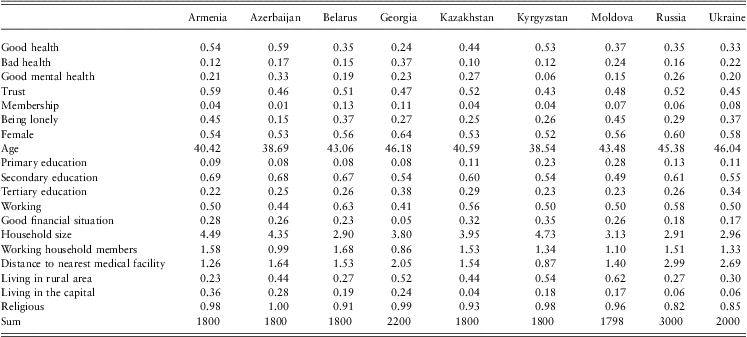
In Table 1 we present the main descriptive statistics. The proportion of people reporting good health is the highest in Azerbaijan (59%), and the lowest in Georgia (24%). Direct comparison of this variable with LLH data is not possible, as its definition used in the latter data set was somewhat different.
Average variable values, by country (2010)

Source: Health in Times of Transition (HITT) data set, 2010.
The proportion of people with good mental health (i.e., those with no distress symptoms) varied from about 6% in Kyrgyzstan, to about 33% in Azerbaijan. People were the most trustful in Armenia (59%), and the least in Kyrgyzstan (43%). Membership in Putnamesque organizations was the highest in Belarus (13%), and the lowest in Azerbaijan (1%). The greatest proportion of socially isolated people lived in Moldova and Armenia (45%), and the smallest in Azerbaijan (15%). Again, direct comparison with LLH data is not possible because of the difference in variable definition, but in 2001, Armenia also was the top country in terms of people who are socially isolated.
Social capital and general health
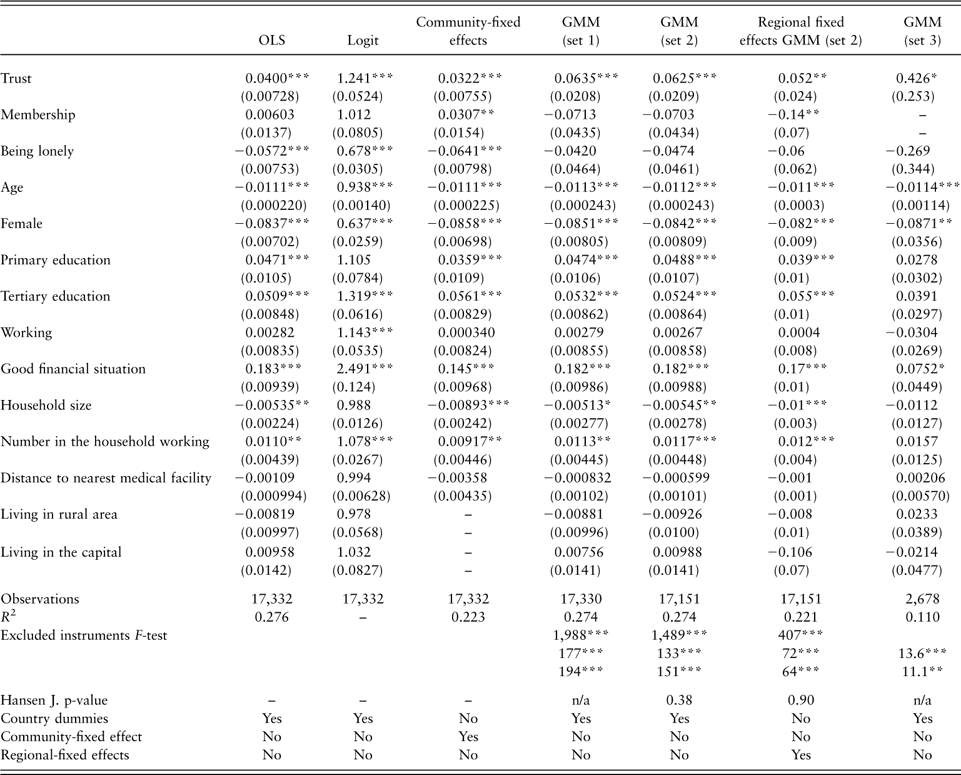
In Table 2, we can see that our measure of trust is strongly and positively related to good self-assessed health across all specification.
Social capital and good general health
GMM = generalized method of moments
Column 2: odds ratios reported.
IV set (1): community-averaged trust, membership, loneliness.
IV set (2): community-averaged trust, membership, loneliness, being worried about suffering abuse because of nationality.
IV set (3): community-level instruments used (amount of litter and graffiti on the streets).
In addition, the following community control variables used in column 7, for IV set (3): proportion of homes that have electricity, hot and cold water, garbage collection by authorities, central heating, as well as the number of derelict homes and quality of roads in the neighbourhood.
Excluded instrument F statistic refers to each of the three endogenous social capital variables in turn.
*Significant at 10%, **significant at 5%, ***significant at 1%.
The outcome variable is good self-assessed health. Cluster-robust standard errors reported.
Source: Health in Times of Transition (HITT) data set (2010).
Thus, a person who agrees that the majority of people can be trusted (giving a score of 6 or more on 10-point scale) is up to 6% more likely to report that they have good health, even controlling for education and other socio-demographic factors. The size of the effect is quite close to the one reported in the earlier paper using the 2001 LLH data (d'Hombres et al., Reference d'Hombres, Rocco, Suhrcke and McKee2010), where the estimate was around 6%, although they defined trust slightly differently.
Similar to the findings of LLH analysis by d'Hombres et al. (Reference d'Hombres, Rocco, Suhrcke and McKee2010), being a member of Putnamesque organizations was found to be insignificantly related to good health in most specifications. Note that when being a member was restricted only to active membership, the association between this form of social capital and good health became positive in the OLS specification (not shown here), with around 6% higher probability of having good health for active participants in Putnamesque organizations.
Finally, being lonely was found to be negatively and significantly related to good health in OLS, logit and CFE specifications, although the parameters are now about half the size of the ones estimated by d'Hombres et al. (Reference d'Hombres, Rocco, Suhrcke and McKee2010). Moreover, they became insignificant in all three GMM models.
As far as other parameters presented in Table 2 are concerned, we can highlight the significance of education. The difference with d'Hombres et al.'s (Reference d'Hombres, Rocco, Suhrcke and McKee2010) paper is that now education has U-shaped relationship with health, as those with primary and tertiary education are more likely to have better health than those with secondary education. This finding was not robust to including the squared age term, as the parameter on primary education became insignificant, and on tertiary education was positive and marginally significant.
As in the paper that used the 2001 LLH data, women are less likely to report good health, with the size of the coefficient being very similar, at about 8–9%. This is well recognized and, in large part, reflects selective survival (Andreev et al., Reference Andreev, McKee and Shkolnikov2003). Being employed is mostly unrelated to good health (except in the logit model), which is different from the positive association found in the previous paper. Reporting good economic status continues to have positive relationship with health, with the size of the parameter being very similar in two papers. Household size has small but significant negative association with good health, implying that each additional household member decreases the probability of having good health by up to 1% (note this is different from the previous paper, where no significant association was found). The number of working household members is positively associated with good health, with the size of the parameter very similar in both papers. Finally, distance from the nearest medical facility, living in the capital, as well as the village dummy, have mostly no association with health, which was also found in the previous paper.
Social capital and mental health
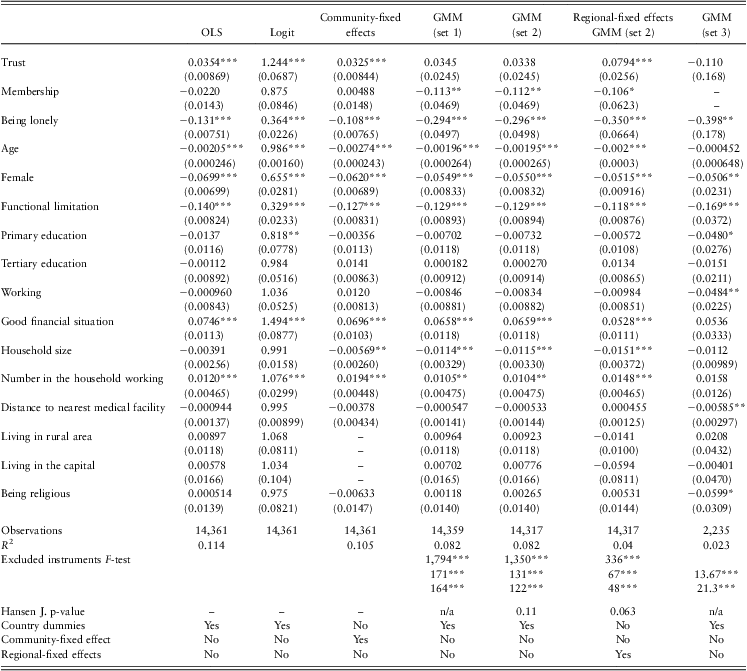
In Table 3, we see the results for the next outcome variable: good mental health. People who are trustful of others are up to 8% more likely to report no distressing symptoms.
Social capital and good mental health
GMM = generalized method of moments
The outcome variable is good self-assessed mental health. Cluster-robust standard errors reported.
Column 2: odds ratios reported.
IV set (1): community-averaged trust, membership, loneliness.
IV set (2): community-averaged trust, membership, loneliness, being victim of physical violence in the last 12 months.
IV set (3): community-level instruments used (amount of litter and graffiti on the streets).
In addition, the following community control variables used in column 7, for IV set (3): proportion of homes that have electricity, hot and cold water and garbage collection by authorities, central heating, as well as the number of derelict homes and quality of roads in the neighbourhood.
Excluded instrument F statistic refers to each of the three endogenous social capital variables in turn.
*Significant at 10%, **significant at 5%, ***significant at 1%.
Source: Health in Times of Transition (HITT) data set (2010).
Moreover, people who trust others also have 4% lower probability of experiencing 10 or more mental distress symptoms (not shown here). Being lonely is even more strongly negatively related to having good mental health: lonely people are up to 40% less likely to report no psychological symptoms than the reference group. Unlike the results in Table 2, being a member is now significantly negatively related to good mental health in three GMM specifications, which is a rather surprising finding. Age, being female, having a functional limitation, having only primary education and household size, are all more or less consistently negatively associated with good mental health, while reporting good economic situation and the number of working household members are positively associated with good mental health. Distance to nearest medical facility, being religious, working status, village dummy, as well as living in the capital, are mostly unrelated to good mental health. The social capital parameters were also relatively insensitive to alternative choices of cut-offs for the good mental health outcome (e.g., zero; no more than one; no more than two, etc. distressing symptoms – results not shown here).
Using the results presented in the previous two tables, we can also test whether social and human capital have effects that are independent of each other. Indeed, we see that the parameters on social capital indicators and on education are significant in general health model, and that the parameters on these variables change little across specifications. Incidentally, this finding supports the so-called composite theory, which posits that both human and social capital are important determinants of health (Rose, Reference Rose2000).
One potential criticism of our instruments is that they are constructed from individual data, rather than sampled independently, and therefore any first stage correlation may be spurious to a certain degree (d'Hombres et al., Reference d'Hombres, Rocco, Suhrcke and McKee2010). To deal with this issue, we used two alternative instruments for two individual social capital indicators – being trustful and being lonely. Specifically, we took advantage of community-level data on such variables as the amount of graffiti and litter in the community (the value of 1 was assigned to people living in communities where a lot of graffiti or a lot of litter was present, on a four-point scale). One potential concern here is that community-level instruments such as the amount of litter and graffiti on the streets may have an independent association with health, and the problem arises because we cannot include CFE in specifications where instruments have no community-level variation. However, we deal with this by including a number of community-level variables that reflect availability of infrastructure, amenities and quality of life in general.
In the seventh column of Tables 2 and 3 we present our findings. Our results indicate that trust had a significant and positive association with good general health, but its relationship with good mental health became insignificant. Although the size of the association of trust with good health appears too large, the fact that the association still remains of the predicted sign as well as statistically significant is reassuring. On the other hand, being lonely is not significant (although negative in sign) when the outcome is good health, but is significant and has predicted negative sign in the specification when the outcome is good mental health.
Additional checks
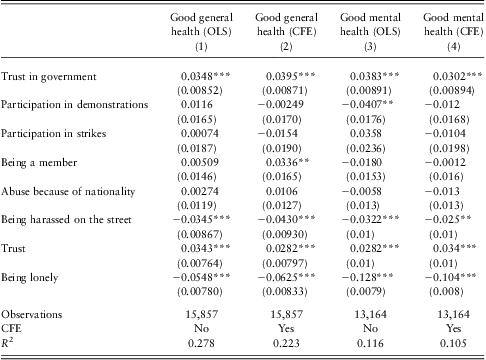
In Table 4, we explore the effect of different types of social capital on self-reported general and mental health, simultaneously.
Linking, bridging and bonding social capital
CFE = community-fixed effects.
Columns 1 and 3 refer to OLS specification, and 2 and 4 to CFE.
*Significant at 10%, **significant at 5%, ***significant at 1%. Cluster-robust standard errors reported.
Main parameters presented only. All specifications also contain the same control variables as in previous
specifications.
Source: Health in Times of Transition (HITT) data set (2010).
Columns 1 and 3 refer to OLS specifications, and 2 and 4 to CFE. For easiness of interpretation, we only present results of the main parameters. We can see that most indicators related to networks that facilitate interaction between people who want to protect their economic and political interests (participation in strikes, demonstrations, being a member) have little to no relationship with either general, or mental good health. However, this is not true when the variables of interest proxy for social capital of a more intimate type: trust, loneliness, fear of abuse because of nationality and of being harassed on the street – all of them have (except abuse of nationality) a consistently strong association with both health outcomes.
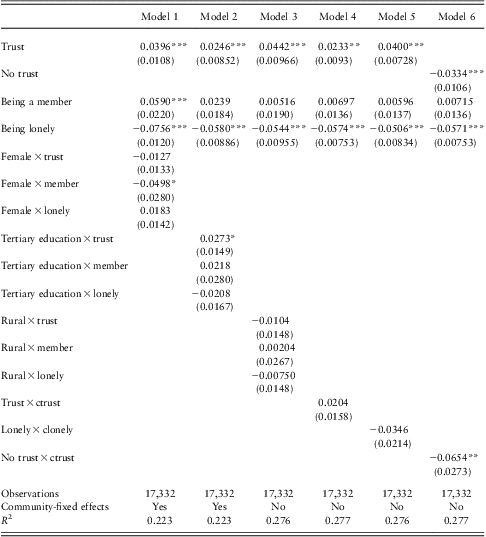
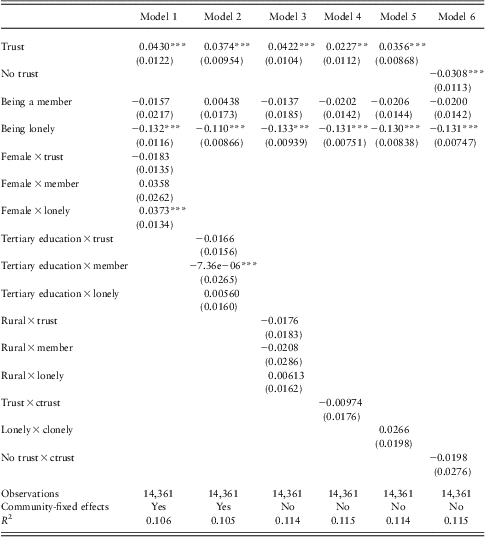
Finally, in Tables 5.1 and 5.2, we test for interactions between social capital indicators and five other variables (all specifications include CFE, unless indicated otherwise).
Effect of interaction parameters on good general health
Main parameters and interactions presented only. All specifications also contain the same control variables as in previous specifications.
Ctrust has a value of 1 for people living in communities where average proportion of people who are trustful of each other is >60% and zero where it is <60%; clonely has a value of 1 for people living in communities where the average proportion of people who feel lonely is >60% and zero where it is <60%.
*Significant at 10%, **significant at 5%, ***significant at 1%.
Source: Health in Times of Transition (HITT) data set (2010). Cluster-robust standard errors reported.
From Table 5.1, we see that there is an interaction between gender and the membership dummy: the non-significant association between membership and good health found previously appears to be driven by the fact that this association is significant and positive among men, and is much weaker and mostly insignificant among women. There is also an interaction between education and being trustful: the effect of a trust dummy on good health is significantly stronger for people who have higher education, than for those with secondary and primary education. The negative association between being distrustful of others and good health is significantly stronger in communities where the majority of people are trustful of each other. It should be stressed that all these three interactions were only weakly significant, and therefore these findings should be treated with caution. There is no difference in effects of social capital indicators between rural and urban areas. In Table 5.2, the same interactions are tested for the case when the outcome is mental health. This time, we see that the effect of being lonely is significantly weaker for women than for men (although it still remains negative).
Effect of interaction parameters on good mental health
Main parameters and interactions presented only. All specifications contain community fixed effects. All specifications also contain the same control variables as in previous specifications.
Ctrust has a value of 1 for people living in communities where average proportion of people who are trustful of each other is >60% and zero where it is <60%; clonely has a value of 1 for people living in communities where the average proportion of people who feel lonely is >60% and zero where it is >60%.
*Significant at 10%, **significant at 5%, ***significant at 1%.
Source: Health in Times of Transition (HITT) data set (2010). Cluster-robust standard errors reported.
Discussion and conclusions
Our paper makes several contributions to the literature on the association between health and social capital. First, it updates the earlier paper for the same region that used 2001 data (although, as good health was defined slightly differently, the difference in results should be interpreted with caution). We found that between the two studies there was little difference in the association between trust and membership indicators on the one hand, and good health on the other. At the same time, the association between social isolation and good health was cut by half in the newspaper. Whether this reflects a genuine reduction in the probability of poor health for lonely people (which could be due, for example, to a reduction in potentially harmful coping behaviors, such as excessive alcohol consumption or better organized welfare services) is difficult to tell, but the finding is nevertheless encouraging. We have also added new evidence to a small set of studies examining the association between social capital and mental health [being one of very few papers that attempt to find a causal association between social capital and mental health (De Silva et al., Reference De Silva, McKenzie, Harpham and Huttly2005), and even of a smaller subset of studies that did this in the context of the FSU]. Our findings on an apparently causal relationship between cognitive dimensions of social capital and mental health are especially important, given the lack of evidence on this issue (Henderson and Whiteford, Reference Henderson and Whiteford2003; Giordano and Lindström, Reference Giordano and Lindström2011). Uniquely in this region, the study also includes objectively assessed measures of the environments in which people live, adding to the growing literature on environmental determinants of health. Using this information, we found that the relationship between social capital indicators and health can be moderated by several individual and community characteristics, which may have potentially important policy implications.
The main finding of the paper is that there indeed seems to be a causal association running from several dimensions of individual social capital to health, although this finding does not exclude the possibility that health may also affect various dimensions of individual social capital. For example, it may be the case that sicker people may be less likely to actively interact with others, which may increase probability of their social isolation. However, the use of instrumental variable approach increases our confidence that social capital affects health, even taking into account the possibility of reverse causality.
The finding that individual trust was positively related to good health (both general and mental) even after controlling for socio-economic characteristics was consistent with most of the previous literature on the topic (Rose, Reference Rose2000; Poortinga, Reference Poortinga2006). The causal interpretation received particular support from instrumental variable specifications, which was also consistent with findings from a paper that used data collected in 2001 in FSU countries (d'Hombres et al., Reference d'Hombres, Rocco, Suhrcke and McKee2010).
At the same time, in contrast to the findings of Subramanian et al. (Reference Subramanian, Kim and Kawachi2002), being trustful of others is not more strongly related to general health in communities with higher aggregate level of trust. However, similar to their findings, untrusting people who lived in communities with higher aggregate level of trust were even less likely to experience good health than untrusting people living in the reference communities. The reasons for this finding will require more research, but one possible explanation is that in more socially cohesive communities, a lack of individual trust may indicate a particularly high level of social isolation. In turn, this may lead to both psychological problems leading to deterioration in health, as well as to exclusion from a network that may provide access to health-related resources. One important policy implication could be that interventions to strengthen social capital can potentially cause some unintended negative consequences for people who may feel excluded from the communities they live in. Therefore, any expansion of community-level social capital should take into account potential concerns of socially marginalized groups, such as vulnerable minorities.
The relationship between membership and general health was mostly similar to the one reported in the study by d'Hombres et al. (Reference d'Hombres, Rocco, Suhrcke and McKee2010). However, a significant interaction between gender and membership was found: for women, the association between membership and self-reported good health was significantly weaker than for men (and this difference in effects was the most pronounced at ages 30–40 and 50–60). One hypothetical explanation for this finding is that greater availability of these community organizations may offer opportunities for men to spend less of their time drinking alcohol, and to engage in enriching and satisfying activities. On the other hand, as most women living in the FSU follow a traditional gender role of taking care of their children and family as a whole, absence or presence of these organizations may make little difference for their health. It is interesting that in another study conducted in Scotland (Ellaway and Macintyre, Reference Ellaway and Macintyre2001), a stronger link between the perception of community cohesion and mental health was found for men then for women. Contrary to the study by Rojas and Carlson (Reference Rojas and Carlson2006), no interaction between education and membership was found for either outcome variable. Also, when membership was restricted to active participation only, it became significant in the OLS specification for the good health outcome.
Interestingly, the association between membership and good psychological health was mostly negative across specifications. A similar finding was made in relation to impoverished urban community dwellers living in Alabama, USA (Mitchell and LaGory, Reference Mitchell and LaGory2002), which the authors ascribed as potentially due to the greater burden of distress associated with an increased number of obligations for active community participants (which can be particularly burdensome for people living in poorer environments). Although the use of an instrumental variable approach reduces the plausibility of reverse causality explaining this finding (e.g., depressed people seeking company of other people), we should emphasize that the parameters are insignificant not only in OLS, but also CFE models, and therefore treat our finding with caution.
Being lonely was consistently negatively associated with either outcome variable, although the relationship between loneliness and good general health was substantially weaker in the HITT than in the LLH survey. It is also notable that for men, the effect of being lonely on mental health was significantly stronger than for women, especially among 30–40- and 50–60-year-olds. Lonely men also appear more likely to suffer from general health problems then women at around the age of 50 years (see detailed results in the Appendix). Thus, the health of lonely middle-aged men may be particularly vulnerable to a lack of social capital.
The finding that trust in government is strongly related to good general and mental health is interesting, and is consistent with a recent paper that used another data set from three FSU countries: Azerbaijan, Georgia and Armenia (Habibov and Afandi, Reference Habibov and Afandi2011). The mechanism for this association is unclear, but it can be hypothesized that a higher level of political trust can contribute to better interaction between people living in the same area, to better information about community-wide health problems (Islam et al., Reference Islam, Merlo, Kawachi, Lindstrom, Burstrom and Gerdtham2006), as well as, in some countries, to a higher level of participation in the political process.
Our findings also suggest that in the FSU countries, social capital primarily operates through social support and trust, participation, information-sharing and stress-reducing attributes. On the other hand, dimensions of social capital that may facilitate solidarity and collective action appear to play a much lesser role for better health, at least in these countries. Both social and human capital variables played independent roles in the model, which supports the composite theory (Rose, Reference Rose2000; Habibov and Afandi, Reference Habibov and Afandi2011). We also found that more educated people are more likely to benefit from trusting others, and that they are also less likely to suffer mental distress as a result of being lonely. Thus, it seems that human and social capitals complement each other, which further supports the composite theory. It also appears that the cognitive dimension of social capital (referring to the perception of trust, support and reciprocity) plays a more important role for general health than the structural one, although this has to be qualified by the finding that important interaction between gender and such structural variable as membership was found. Similarly, consistent with previous research (Borgonovi, Reference Borgonovi2010; Roberts et al., Reference Roberts, Abbott and McKee2010; Giordano and Lindström, Reference Giordano and Lindström2011) the relationship between mental health and cognitive dimensions of social capital (e.g., being trustful and lonely) was considerably stronger than between mental health and structural measures (e.g., membership).
One limitation of our paper is that our constructed ‘community’ instruments (i.e., special community averages of individual-level social capital variables) may play an independent effect on health, even after controlling for individual social capital. However, we have dealt with this complication by including region-level fixed effects, and it is reassuring that the parameters on most variables of interest did not change very much. An additional concern with using CFE with region-level instruments is that they can be weak. However, as all of our F-tests of excluded instruments were not only highly significant, but also of considerable size, again this is not a serious issue here.
In conclusion, the findings from our study suggest a causal association running from several dimensions of individual social capital to general health and to mental health. Our findings are also robust to a range of different specifications, including the use of instrumental variables. It appears that not all social capital is equally important to health. Thus, individual trust appears to be more strongly related to general health, while social isolation to mental health. In addition, social support and trust seem to be more important determinants of health than the social capital dimensions that facilitate solidarity and collective action. The next step in the research agenda is to explore the (cost-)effectiveness of actual interventions aimed at improving social capital.
Acknowledgements
The authors are grateful to all members of the Health in Times of Transition Project (HITT) study teams who participated in the co-ordination and organization of data collection for this paper. We also acknowledge support from the WHO Regional Office for Europe for the contribution of Marc Suhrcke to this study.
Role of the funding source
The HITT Project was funded by the European Union's 7th Framework Program; project HEALTH-F2-2009-223344. The European Commission cannot accept any responsibility for any information provided or views expressed.
Supplementary materials
For supplementary material referred to in this article, please visit http://dx.doi.org/10.1017/S1744133113000121