Lactation is a highly demanding process for lipid synthesis. Mammary epithelial cells are endowed with an enormous capacity to synthesise and secrete fatty acids (FA) with the involvement of many enzymes, encoded from the respective genes. More specifically, acetyl-Co A carboxylase (ACC) and fatty acid synthetase (FAS) are involved in the metabolic pathways for the de- novo synthesis of FA in the mammary gland, whereas lipoprotein lipase (LPL) is responsible for FA uptake from the plasma. These FA can be desaturated by stearoyl-Co A desaturase (SCD), resulting in synthesis of cis-9 unsaturated FA (Bernard et al. Reference Bernard, Leroux and Chilliard2008).
In addition, recent evidence suggests that several transcription factors, such as sterol regulatory element binding protein-1 (SREBP-1) and peroxisome proliferator activated receptor γ (PPARγ), are also associated with milk FA synthesis (Rudolph et al. Reference Rudolph, Monks, Burns, Phistry, Marians, Foote, Bauman, Anderson and Neville2010; Ma & Corl, Reference Ma and Corl2012; Shi et al. Reference Shi, Luo, Yao, Zhu, Xu, Shi and Loor2013). More specifically, the isoform c of SREBP-1 (SREBP-1c) gene is involved in triglycerides synthesis (Rudolph et al. Reference Rudolph, Monks, Burns, Phistry, Marians, Foote, Bauman, Anderson and Neville2010; Ma & Corl, Reference Ma and Corl2012) while the isoform γ2 of PPARγ (PPARγ2) alter lipogenic gene networks in goat mammary epithelial cells (Shi et al. Reference Shi, Zhao, Luo, Yao, Sun, Li, Shi and Loor2014).
Further to that, new data also confirm the involvement of hormone sensitive lipase (HSL) gene on lipid and energy metabolism in bovine mammary epithelial cells in vitro (Yonezawa et al. Reference Yonezawa, Haga, Kobayashi, Katoh and Obara2008) as well as in goat (Lin et al. Reference Lin, Luo, Zhang, Wang and Gou2013) and rat (Martín-Hidalgo et al. Reference Martín-Hidalgo, Huerta, Alvarez, Alegría, Del Val Toledo and Herrera2005) mammary tissue in vivo but its role is still largely unknown.
However, despite the involvement these genes in milk FA metabolism, little is known concerning their nutritional regulation in the mammary gland. Until now, the majority of the nutritional studies have been done in lactating cows and have focused mainly on a few main lipogenic genes (Bernard et al. Reference Bernard, Leroux and Chilliard2013). Taking into account that small ruminants, particularly in the Mediterranean basin, exhibit sequences of feed shortage (under-feeding) or surplus (over-feeding) due to a number of reasons such as climatic conditions, seasonality of vegetation growth etc. (Chilliard et al. Reference Chilliard, Bocquier and Doreau1998), the aim of the present study was to determine the effects of long term under- and over-feeding on the expression of genes (ACC, FAS, LPL, SCD, PPARγ2, SREBP-1c and HSL) related to fatty acids metabolism in sheep mammary tissue (MT).
Materials and methods
The experiment was conducted according to guidelines of the Agricultural University of Athens for the care and use of farm animals by the use of proper management in order to avoid any unnecessary discomfort to the animals. Twenty-four Friesian cross-bred dairy sheep, 3 years old and at 90–98 d in milk, were divided into three homogeneous sub-groups (n=8) based on their mean body weight (59±4·1 kg) and their mean daily milk yield (1·01±0·197 kg). Each sheep of each group was fed individually throughout the experimental period which lasted 60 d. The three sub-groups (treatments) were fed with a diet which covered the 70% (under-feeding), 100% (control), and 130% (over-feeding) of their daily individual energy and crude protein requirements respectively. The quantities of food offered to the animals were adjusted on experimental days 0, 12, 24, 31, 39 and 52 in order to meet 70, 100 and 130% of the animal's requirements of each group respectively throughout the experimental period. At the end of the experimental period the underfed sheep lost on average 8 kg body weight while the overfed gained 10 kg.
The diet given to sheep consisted of alfalfa hay and concentrates with a forage/concentrate ratio of 50/50. The full experimental design has been described in details in Tsiplakou et al. (Reference Tsiplakou, Chadio and Zervas2012).
Sample collection
Mammary tissue (MT) samples were taken on experimental days 30 and 60 of each dietary treatment by biopsy after the morning milking. Before the biopsy, the udder of the animals was shaved and cleaned and received a local anaesthetic. Biopsy samples were taken from the right udder using a human Bard® Magnum® Biopsy instrument (BARD, Covington GA, USA) and a core tissue biopsy needle (14 G) (BARD). The length of the sample notch was about 1·9 cm of up to approximately 15 mg tissue from a depth of 3–5 cm. The MT samples were immediately frozen in liquid nitrogen and stored at −80 °C until RNA extraction. After the MT samples were taken, the site of sampling received a prophylactic treatment with a disinfecting chlorhexidine powder and then covered with plaster by spraying.
Determination of transcript levels using real-time RT-qPCR assay
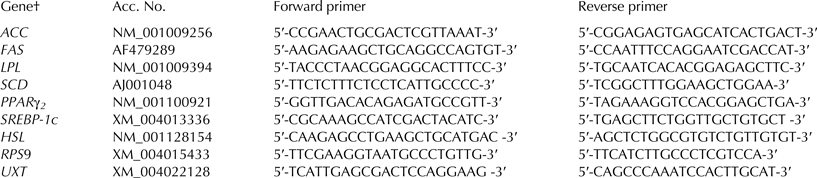
Total RNA was isolated from 15 mg of MT using Trizol reagent (Invitrogen, Paisley, UK) according to the manufacturer's protocol. Prior to RT-PCR, the total RNA samples were treated with DNase I (Promega, Madison WI, USA) at 37 °C for 60 min. Complete digestion of genomic DNA was confirmed by real-time PCR reaction using our gene specific primers. First-strand cDNA was reverse transcribed from 2 μg of DNase-treated total RNA, using SuperScript II reverse transcriptase (Invitrogen), according to standard protocols. The resulting first-strand cDNA was diluted to a final volume of 100 μl, and SYBR green-labelled PCR fragments were amplified using gene-specific primers (Table 1) designed from the transcribed region of each gene using Primer Express 1.5 software (Applied Biosystems, Darmstadt, Germany). RT-PCR reactions were performed on the Stratagene MX3005P real-time PCR apparatus using iTaq Fast SYBR Green Supermix with ROX (BioRad, Hercules CA, USA) at a final volume of 15 μl, gene-specific primers at a final concentration of 0·2 μm each and 1 μl of the cDNA as template. PCR cycling started at 95 °C for 10 min, followed by 40 cycles of 95 °C for 15 s and 60 °C for 1 min. The primer specificity and the formation of primer-dimmers were monitored by dissociation curve analysis and agarose gel electrophoresis. The geometrical average of the expression levels from genes ribosomal protein S9 (RPS9) and ubiquitously expressed transcript protein (UXT) was used as internal standard based on the study of Bionaz & Loor (Reference Bionaz and Loor2007). Relative transcript levels of the gene of interest (X) were calculated as a ratio to the geometrical average of RPS9 and UXT (C), as (1+E)−ΔCt, where ΔCt was calculated as (CtX−CtC) (Vandesompele et al. Reference Vandesompele, De Preter, Pattyn, Poppe, Van Roy, De Paepe and Speleman2002). PCR efficiency (E) for each amplicon was calculated employing the linear regression method on the Log (Fluorescence) per cycle number data, using the LinRegPCR software (Ramakers et al. Reference Ramakers, Ruijter, Deprez and Moorman2003).
Primers used for real-time RT-Qpcr

† ACC, acetyl-CoA carboxylase; 2FAS, fatty acid synthase; 3LPL, lipoprotein lipase; 4SCD, stearoyl-CoA desaturase; 5PPARγ2, peroxisome proliferator activated receptor γ2; SREBF-1c, sterol regulatory element binding protein-1c; 7HSL, hormone sensitive lipase; 8RPS9, ribosomal proteinS9; 9UXT, ubiquitously expressed transcript.
Statistical analysis
The experimental data were analysed using the SPSS statistical package (version 16.0) using a general linear model (GLM) for repeated measures analysis of variance (ANOVA) with dietary treatments (T=under-feeding=70%; control=100%; over-feeding=130%) and sampling time (S) as fixed effects and their interactions (T×S) according to the model:
 $$Y_{ijk} = {\rm \mu} + T_i + S_j + (T \times S)_{ij} + A_K + e_{ijk} $$
where Υ ijk is the dependent variable, μ the overall mean, T i the effect of dietary treatment (i=3), S j the effect of sampling time (j=2), (T×S)ij the interaction between dietary treatments and sampling time, A K is the ewe's effect and e ijk the residual error. Significance was set at 0·05.
Results and discussion
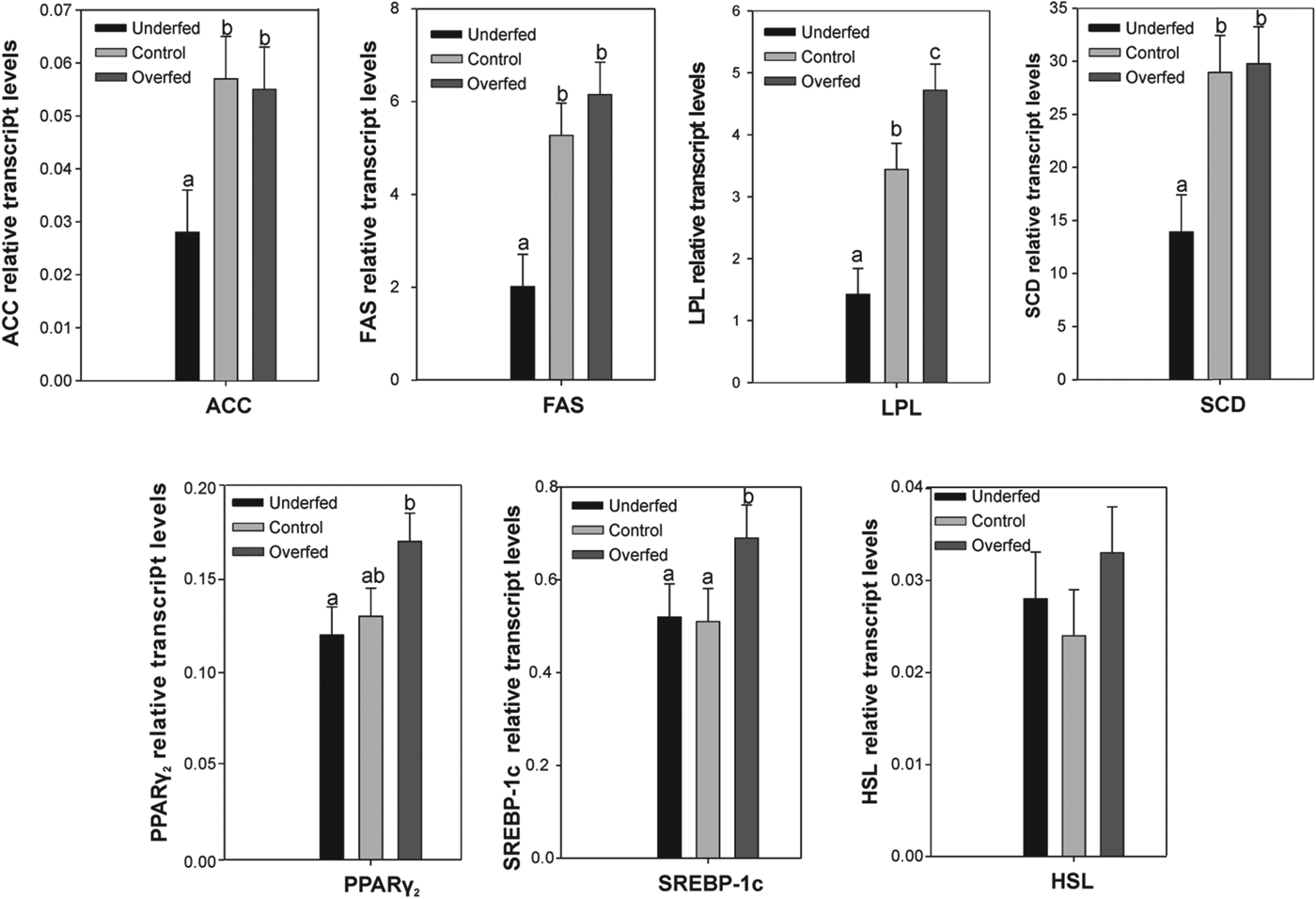
In the present study a significant reduction on mRNA of ACC and FAS in the MT of underfed sheep, compared with the respective control and overfed, was observed (Fig. 1). The same has been found by Ollier et al. (Reference Ollier, Robert-Granié, Bernard, Chilliard and Leroux2007) on the mRNA of FAS on the mammary gland of goats after 48 h of food deprivation. On the contrary, Nørgaard et al. (Reference Nørgaard, Nielsen, Theil, Sørensen, Safayi and Sejrsen2008) did not find any effect on the mRNA of ACC in mammary gland of cows fed with a low, compared with a normal feeding level, even though their milk yield was significantly affected. The results of this study, as the mRNA of ACC and FAS are concerned, are in accordance with the sharp decrease of the FA synthesised de novo (short- and medium-chain FA) in milk of the underfed sheep, compared with the respective control and overfed, as has already been found by Tsiplakou et al. (Reference Tsiplakou, Chadio and Zervas2012). The same relationship between the mRNA of FAS of the mammary gland of goats and the medium-chain FA in their milk has been found by Ollier et al. (Reference Ollier, Robert-Granié, Bernard, Chilliard and Leroux2007) when the animals were subjected to 48 h of food deprivation. The close relationship between mRNA of ACC and FAS and short- and medium-chain FA has already been observed in cows by Piperova et al. (Reference Piperova, Teter, Bruckental, Sampugna, Millis, Yurawecz, Fritsche, Ku and Erdman2000), using a milk-fat depressing diet (25/70 forage/concentrate, supplemented with 5% soybean oil) and Ahnadi et al. (Reference Ahnadi, Beswick, Delbecchi, Kennely and Lacasse2002), using diet supplemented with fish oil, and in goats by Bernard et al. (Reference Bernard, Rouel, Leroux, Ferlay, Faulconnier, Legrand and Chiliard2005) using hay- based diet supplemented with formaldehyde-treated linseed. Additionally, analysing the results from already published nutritional studies, found that the accumulation of ACC and FAS transcripts and the 4 : 0–16 : 0 milk FA were positively related (r=+0·66 and r=+0·73 respectively). All the above results suggest a regulation of the de-novo FA biosynthesis in the mammary gland at a transcriptional level by the nutritional status of the animal.
Relative transcript accumulation of genes involved in FA biosynthesis: Acetyl-CoA carboxylase (ACC), Fatty acid synthase (FAS), Lipoprotein lipase (LPL), Stearoyl-CoA desaturase (SCD), sterol regulatory element binding protein-1c (SREBP-1c), peroxisome proliferator activated receptor γ2 (PPARγ2) and hormone-sensitive lipase (HSL). Bars show means ±sem of both experimental days 30 and 60. Superscripts without a common letter (a,b,c) between the three dietary treatments (underfeeding/control/overfeeding) differ significantly (P⩽0·05).
A significant reduction of mRNA of LPL in MT of underfed sheep compared with the respective control and overfed, was also observed in our study (Fig. 1). These results agree with those of Jensen et al. (Reference Jensen, Gavigan, Sawicki, Witsell, Eckel and Neville1994), who showed that underfeeding down-regulates the expression of LPL gene in mouse mammary gland. The significant role of LPL is to provide the mammary gland with long-chain fatty acids (LCFA) derived from dietary lipids (Bauman & Griinari, Reference Bauman and Griinari2003; Shingfield et al. Reference Shingfield, Bonnet and Scollan2013). These LCFA are anchored to mammary endothelium by LPL which then hydrolyses triglycerides to release FA (Fielging & Frayn, Reference Fielging and Frayn1998). The concentration of LCFA was significantly higher in the milk of the underfed sheep compared with the overfed, as has already been observed by Tsiplakou et al. (Reference Tsiplakou, Chadio and Zervas2012). This increase may be due to the incorporation of adipose derived-LCFA in milk of the underfed animals. Additionally, the down-regulation in the LPL mRNA expression is rather expected since underfeeding reduces the circulation of triglycerides. So, both the reduction in the LPL transcript and the increase of LCFA in milk fat of the underfed sheep confirms the role of adipose-derived NEFA.
The SCD mRNA level was reduced significantly in MT of the underfed sheep, compared with the overfed ones (Fig. 1). The large SCD mRNA abundance, relative to the other classical lipogenic genes (e.g. ACC, FAS etc.) agrees with results in bovine MT by Bionaz & Loor (Reference Bionaz and Loor2008) and proves that SCD plays a critical role in triglyceride synthesis.
In this study a significant decrease in the PPARγ2 gene expression in the MT of the underfed sheep compared with the overfed ones was observed (Fig. 1) despite the significantly higher concentrations of NEFA which were found in their plasma (Tsiplakou et al. Reference Tsiplakou, Chadio and Zervas2012). Nutrient restriction in dairy cows causes a concomitant increase in blood NEFA, and enhances PPARα and PPARβ/δ genes expression in liver (Loor et al. Reference Loor, Everts, Bionaz, Dann, Morin, Oliveira, Rodriguez-Zas, Drackley and Lewin2007) and PPARγ expression in the hypothalamus (Kuhla et al. Reference Kuhla, Gors and Metges2011). Similarly, a 60-d period of body weight loss in beef cows was associated with greater expression of all three PPAR isotypes in biceps femoris muscle and several PPAR target genes, compared with animals that maintained their body weight (Brennan et al. Reference Brennan, Michal, Ramsey and Johnson2009). Overall, Bionaz et al. (Reference Bionaz, Chen, Khan and Loor2013) in a recent review, discussed all these data and indicated that the negative energy balance, with a consequent increase in NEFA, appears to induce expression and activation of all PPAR isotypes in cows. The discrepancy between our results and those in dairy cows may be due to the fact that the PPARγ gene expression has been examined in other tissue types than MT, since specific studies for PPARγ2 in bovine mammary gland are lacking (Bionaz et al. Reference Bionaz, Chen, Khan and Loor2013). This discrepancy may also indicate a species differences between sheep and cows.
In line with the results concerning PPARγ2, there was also a significant higher SREBP-1c gene expression in the MT in the overfed sheep, compared with the underfed ones in this study (Fig. 1). It is remarkable that the activation of PPARγ by rosiglitazone in goat mammary epithelial cells was accompanied by a significant increase in the expression of SREBP-1 gene, demonstrating that SREBP-1 is a PPARγ target gene in ruminants (Shi et al. Reference Shi, Luo, Yao, Zhu, Xu, Shi and Loor2013). Recently, Carcangiu et al. (Reference Carcangiu, Mura, Daga, Luridiana, Bodano, Sanna, Diaz and Cosso2013) suggests that the SREBP-1 gene is required for the milk fat synthesis, since a positive relationship between SREBP-1 gene expression in the milk somatic cells and the milk fat yield of ewes was observed. Indeed, the overfed sheep in our study produced higher milk fat yield compared with the underfed ones (Tsiplakou et al. Reference Tsiplakou, Chadio and Zervas2012). In our study, the HSL transcript level in sheep MT did not differ between the three dietary treatments (Fig. 1) despite the fact that the insulin concentration in blood plasma was higher in the overfed animal compared with the underfed (Tsiplakou et al. Reference Tsiplakou, Chadio and Zervas2012). It has been shown that treatment with insulin suppresses HSL mRNA accumulation in bovine mammary epithelial cells in vitro (Yonezawa et al. Reference Yonezawa, Haga, Kobayashi, Katoh and Obara2008).
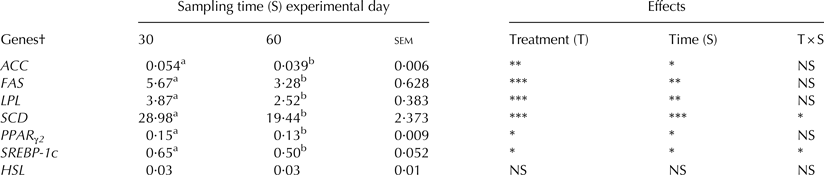
Finally, ACC, FAS, LPL, SCD, PPARγ2 and SREBP-1c mRNA levels in MT of sheep were reduced significantly throughout the experimental period (Table 2). In agreement with these findings, Bionaz & Loor (Reference Bionaz and Loor2008) found that in contrast with murine, bovine mammary lipogenic genes (ACC, FAS, LPL, SCD, PPARγ2 and SREBP-1c) expression pattern were remarkably similar to the lactation curve, which might be indicative of an important role for these genes in maintenance of milk synthesis. A significant reduction was also observed by Miller et al. (Reference Miller, Delbecchi, Petitclerc, Wagner, Talbot and Lacasse2006) on the mRNA of SCD in MT of multiparous cows from peak to late lactation. To the best of our knowledge apart from the studies of Bionaz & Loor (Reference Bionaz and Loor2008) and Miller et al. (Reference Miller, Delbecchi, Petitclerc, Wagner, Talbot and Lacasse2006) in dairy cows, there is no other published work on the effect of the lactation stage on lipogenic gene expression in the MT.
The mean relative transcript accumulation of genes in sheep mammary gland at the two sampling times (experimental days 30 and 60), the main effects (treatment-sampling time) and their interaction
† ACC, acetyl-CoA carboxylase; 2FAS, fatty acid synthase; 3LPL, lipoprotein lipase; 4SCD, stearoyl-CoA desaturase; 5PPARγ2, peroxisome proliferator activated receptor γ2; SREBF-1c, sterol regulatory element binding protein-1c; 7HSL, hormone sensitive lipase; 8RPS9, ribosomal proteinS9; 9UXT, ubiquitously expressed transcript.
*P<0·05, **P<0·01, ***P<0·001.
Means with different superscript (a,b) in each row (between sampling time) for each gene differ significantly (P⩽0·05).
Conclusions
Underfeeding in comparison with overfeeding causes a significant reduction in mRNA levels of ACC, FAS, LPL, SCD, PPARγ2 and SREBP-1c in sheep MT, which indicates that the decrease in nutrient availability may lead to a lower rate of lipid synthesis. The decrease in the PPARγ2 gene expression in the MT of underfed sheep is in contrast to what has already been observed in cows in other tissue samples, which may also indicate animal species differences. There is a concerted action between the PPARγ2 and SREBP-1c genes as proven by the same trend in their expression in the MT of sheep. However, the expression of the genes with well-defined roles in mammary lipid metabolism, except that of HSL, followed the lactation curve pattern which proves its significant role in maintenance of milk. Additionally, SCD was the most abundant transcript in sheep MT which proves also its pivotal role in milk fat synthesis. Finally, there is a positive relationship between the mRNA levels of ACC and FAS in MT of sheep and the short– and medium-chain fatty acids of their milk.