Introduction
Echinacea purpurea (EP) is one of the most widely used medicinal herbs that has attracted researchers due to its valuable immuno-stimulatory, antioxidant, antibacterial, anti-inflammatory and antiviral properties, and could be a potential alternative to antimicrobial growth promoters for the broiler production industry (Manayi et al., Reference MANAYI, VAZIRIAN and SAEIDNIA2015). Echinacea has a long history as a medicinal plant for treating many ailments, especially in developing countries (Nilanthi et al., Reference NILANTHI, CHEN, ZHAO, YANG and WU2009). It has been one of the consistent, best-selling products in the American herbal market (Qu et al., Reference QU, CHEN, WANG, SCALZO and DAVIS2005). EP species contain caffeic acid derivatives, polysaccharides and lipophilic alkamides, which form the active compound for various medicinal remedies (Wills and Stuart Reference WILLS and STUART1999).
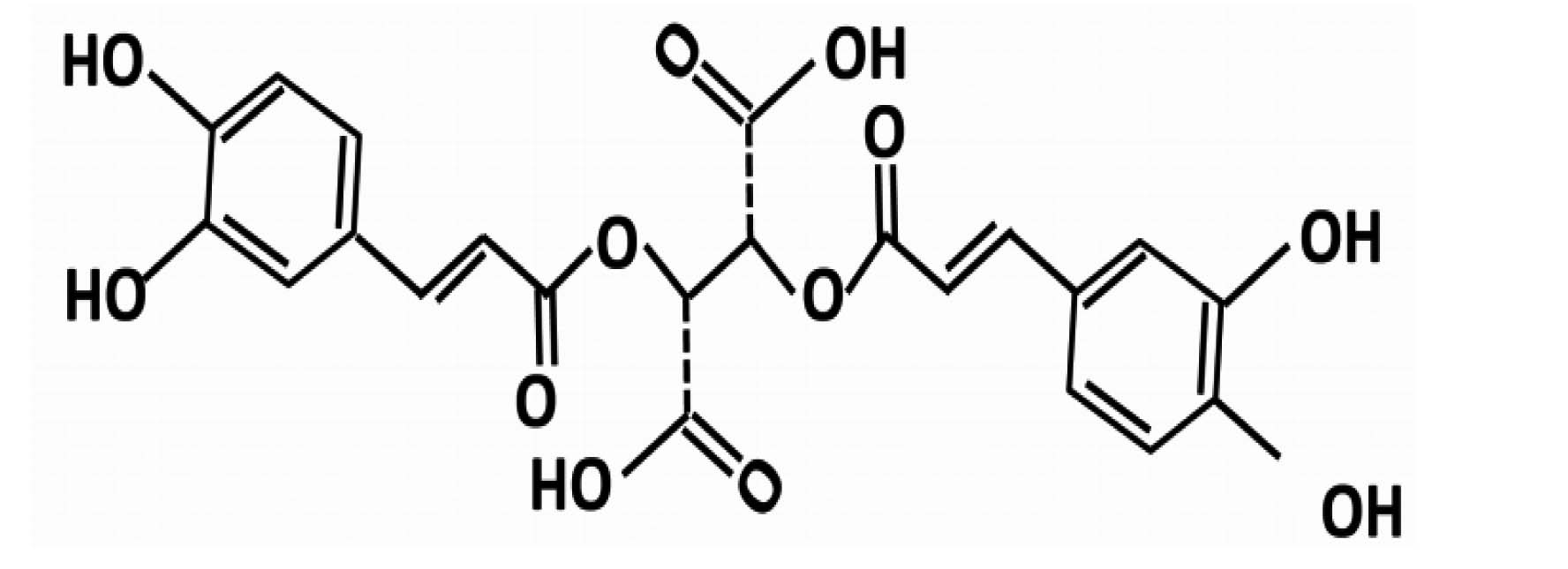
Chicoric acid (CA) is a major active constituent of EP. The CA content in roots ranges between 16.80-24.30 mg/g (Mølgaard et al., Reference MØLGAARD, JOHNSEN, CHRISTENSEN and CORNETT2003). CA is a derivative of caffeic acid ( Figure 1 ) and has been considered as an immunologically active ingredient in Echinacea purpurea, plants (Barnes et al., Reference BARNES, POWELL-GRINER, MCFANN and NAHIN2004; Nuissier et al., Reference NUISSIER, REZZONICO and GRIGNON-DUBOIS2010). Published pharmacological studies have reported that CA is a powerful free radical scavenger, the basis of its antioxidant properties (Ou et al., Reference OU, SCHMIERER, RADES, LARSEN and MCDOWELL2013; Tsai et al., Reference TSAI, KAO, HUNG, CHENG, LIN and CHU2017). Moreover, CA has showed anti-bacterial, anti-inflammatory, anti-HIV, hypoglycemic and hepatocyte protective activities (Landmann et al., Reference LANDMANN, KANURI, SPRUSS, STAHL and BERGHEIM2014). As a result, it has gained renown as an immuno-modulatory agent in the USA and Europe (Kour et al., 2011). One study reported that CA consumption was related to increased glucose uptake, improve insulin resistance, and thus attenuate glucosamine-induced inflammation, suggesting that CA is an efficacious natural nutraceutical with anti-inflammatory impacts and anti-diabetic activities (Zhu et al., Reference ZHU, WANG, DU, LIU and LIU2015). Echinacea preparations are known to activate various non-specific variables such as phagocytosis or the activity of lymphocytes (Wagner, 1986). All these biological effects are partly attributable to the content of CA and alkamids (Bauer and Wagner, Reference BAUER and WAGNER1991).
The chemical structure of Chicoric acid.

As characterised by Lee et al. (Reference LEE, CHEN, WANG and YU2012) dried EP can be used as a feed additive to improve the oxidative status and enhance meat quality in Arbor Acres broilers. In another study by Liu et al. (Reference LIU, CHEN, SHEN, XIAO, WANG, LIU and LIU2017) fed supplemental CA to chickens which protected against systemic inflammation which causes immuno-memory impairment and amyloidogenesis through the inactivation of NF-κB, and this indicated that CA can have a positive effect on the management of different chronic systemic diseases, as described by Ahmed et al. (Reference AHMED, KAMEL, EL-SABEIY and ZEITOUNY2008). However, the effect of supplementing poultry diets with EP extract CA on growth performance and healthy gut function without antimicrobial growth promoters have rarely been discussed in the broiler production industry. As of current, there has been a lack of published scientific evidence on CA regarding poultry nutrition. The aim of this study is to compile evidence about EP and concentrating on its main active ingredient, CA.
Chemical analysis of Echinacea purpurea plant
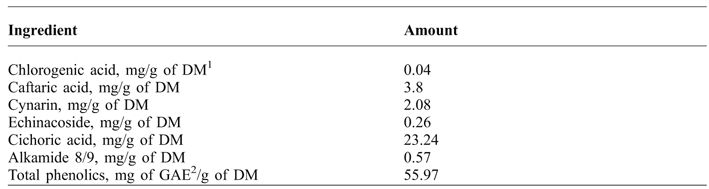
Percival (Reference PERCIVAL2000) reported that EP contains chlorogenic acid, caftaric acid, cynarin, echinacoside, CA and alkamide at 0.04, 3.8, 2.08, 0.26, 23.24, 0.57% (dry matter basis) respectively. The CA content in EP roots ranges between 16.80-23.30 mg/g (Mølgaard et al., Reference MØLGAARD, JOHNSEN, CHRISTENSEN and CORNETT2003) ( Table 1 ).
Chemical analysis of Echinacea purpurea.

1Dry weight; 2GAE = gallic acid equivalent (Percival, Reference PERCIVAL2000).
Mechanisms of action
Extracts of EP activate many elements of the immune system, via the stimulus of both specific and non-specific immunity. The primary and direct mechanisms are to stimulate phagocytosis, boost the macrophages antibacterial activity, and prevent the production of both endo- and exogenous hyaluronidase, thereby limiting the spread of inflammation and infection (Barnes et al., Reference BARNES, ANDERSON, GIBBONS and PHILLIPSON2005; Matthias et al., Reference MATTHIAS, BANBURY, BONE, LEACH and LEHMANN2008). It may stimulate T-lymphocytes, cytotoxic cells and cytokines production including interferons, TNF-α, IL-1 and others (Laasonen et al., Reference LAASONEN, WENNBERG, HARMIA-PULKKINEN and VUORELA2002). Another probable mechanism is the activation of complement system via increasing the production of the ‘P-factor’ (properdin), or by inhibiting lipooxygenesis, that may stimulate the production of antibodies, and intensify the immunological angiogenesis, which could be of high significance in the treatment of heart diseases or myocardial infarctions (Hartwich, Reference HARTWICH2010).
Biological effects of Echinacea purpurea plant and its main active ingredient chicoric acid
antioxidant effects
Hu and Kitts (Reference HU and KITTS2000) have discussed the free-radical scavenging and antioxidant activities, which includes the suppression of oxidation in human low-density lipoprotein (oxLDL). The radical-scavenging activities of the medicinal plant extracts were tested by Manayi et al. (Reference MANAYI, MIRNEZAMI, SAEIDNIA and AJANI2012) and were compared with the CA and alkamides that are the active compounds of Echinacea. Free radical-scavenging is related to CA contents. (Orhan et al., Reference ORHAN, SENOL, GULPINAR, KARTAL, SEKEROGLU, DEVECI, KAN and SENER2009), and the root extract is the main source of this activity (Tsai et al., Reference TSAI, CHIOU, CHAN, SUNG and LIN2012) attributed to CA levels (Hu et al., 2000). CA has efficient radical-scavenging activity toward 2,2-diphenyl-1picrylhydrazyl (DPPH), at an equivalent level to flavonoids and rosmarinic acid (Thygesen et al., Reference THYGESEN, THULIN, MORTENSEN, SKIBSTED and MOLGAARD2007). As described by Tsai et al. (Reference TSAI, KAO, HUNG, CHENG, LIN and CHU2017) CA may diminish apoptotic features caused by oxidised low-density lipoprotein (oxLDL) such as the subsequent break down of mitochondrial transmembrane potential and the activation of Bax, which promote DNA strand breaks and activate caspase-3. Another study by Liu et al. (Reference LIU, CHEN, SHEN, XIAO, WANG, LIU and LIU2017) determined that CA protects against systemic inflammation resulted memory impairment and amyloidogenesis through the inactivation of NF-κB, thus indicating that CA has positive impacts on the management of different chronic systemic diseases ( Figure 2 ).
Schematic diagram showing cytoprotective effect of chicoric acid. ROS (Reactive oxygen species), oxLDL (Oxidized low density lipoprotein), eNOS (Endothelial nitric oxide synthase), NF-κB (Nuclear factor-kappaB), Bax (BCL2-associated X Protein), Bcl-2 (B-cell lymphoma 2).
Note: The (→) indicates activation or induction, and (┤) indicates inhibition or blockade.

anti-inflammatory effects
According to Bauer (Reference BAUER1996), CA is the most potent compound of Echinacea in terms of anti-hyaluronidase inhibition. Wagner (Reference WAGNER1989) reported that the lipoxygenase-inhibiting anti-inflammatory activity was attributable to one of E. purpurea isobutylamides i.e., dodecatetraenoic acid. The inhibition of cyclooxygenase and 5-lipoxygenase by alkamide-rich Echinacea extracts lends mechanistic credibility to anti-inflammatory effects (Muller-Jakic et al., Reference MULLER-JAKIC, BREU, PROBSTLE, REDL, GREGER and BAUER1994). An EP preparation revealed anti-inflammatory impacts in experiments measuring rat paw oedema responses to formalin, serotonin, hyaluronidase, and trypsin (Voitenko et al., Reference VOITENKO, VARCHENKO, LIPKAN, OLINICHENKO, MYASOYEDOV, MHITARIAN, KUTNIAK, OBEDKOVA, KUKHAR and YAKOVLEVA1996). Many other experiments using extracts derived from EP have reported anti-inflammatory activity (Tragni et al., Reference TRAGNI, TUBARO, MELIS and GALLI1985). CA and a 2,4-diene alkamide, showed a significant increase in the levels of NF-κB - which is a nuclear transcription factor that stimulates the expression of genes regulating key factors of inflammation, e.g., TNF-α, IL-1, adhesion molecules, chemokines and COX-2. The study demonstrated that, a 2‑ene alkamide, another metabolite of EP, exhibited significant inhibition in NF-κB levels; thus, indicating considerable diversity in the bioactivity of the Echinacea plant (Matthias et al., Reference MATTHIAS, BANBURY, BONE, LEACH and LEHMANN2008).
immuno-modulatory effects
The EP plant has a reputation for its immuno-modulatory and anti-inflammatory activities that are able to modulate the immune system. There are different classes of secondary metabolites in the plant demonstrating such activity, including glycoproteins, alkamides, polysaccharides, and CA derivatives of caffeic acid (Binns et al., Reference BINNS, HUDSON, MERALI and ARNASON2002).
There have been several in vivo studies on the immuno-modulatory effect of EP that suggest that innate immunity is boosted by the utilisation of EP and that the immune system is strengthened against many pathogenic infections through the activation of macrophages, Polymorphonuclear leukocytes (PMN), the neutrophils, and natural killer (NK) cells (Barnes et al., Reference BARNES, ANDERSON, GIBBONS and PHILLIPSON2005). Thereby it can be appropriate for prevention and therapy against various diseases such as infections of the upper and lower respiratory systems, chronic pelvic and wound infections. Other studies on oral dosing of EP showed improvements in spleen cell monocyte proliferation, boosted antibody response, and had improved levels of IL-1, IL-6, TNF and IFN (Bodinet and Freudenstein Reference BODINET and FREUDENSTEIN1999). Exposure to a root extract led to higher levels of induction of IL-1, IL-6, TNF and IFN in vivo and in-vitro and antibody production seen with extracts of E. angustifolia and E. pallida. In another trial where a 30% ethanolic EP extract was used, it induced IFN in virally infected animal cell cultures (Skwarek et al., Reference SKWAREK, TYNECKA, GLOWNIAK and LUTOSTANSKA1996). It has been observed that the oral supplementation of the root extract of EP elevated the level of the NK cells in leukemic, normal and aging mice as well as neutrophils and eosinophils in rabbits (Dussault et al., 1993). Purified alkamides derived from EP have shown mosquitocidal activity against Aedes aegypti larvae. The alkamides with an isobutyl amide moiety had stronger mosquitocidal activity as compared with a 2-methylbutylamide moiety, suggesting that isobutyl plays an important role in this and other pharmacological activities (Clifford et al., Reference CLIFFORD, NAIR, RANA and DEWITT2002; Saeidnia et al., Reference SAEIDNIA, GOHARI, MOKHBER-DEZFULI and KIUCHI2011).
antiviral activity
The aqueous extract of EP used in an in vitro study was active against acyclovir-susceptibility and acyclovir-resistant strains of both herpes simplex virus 2 (HSV-2) and 1 (HSV-1) (Thompson, Reference THOMPSON1998). The hexane extract of EP root and CA inhibited HSV-1 (Binns et al., Reference BINNS, HUDSON, MERALI and ARNASON2002). Moreover, CA inhibited human immunodeficiency virus type 1 (HIV-1) integrase (Robinson, Reference ROBINSON1998). The incubated mouse embryonic fibroblasts with the plant juice and alcoholic root extract of this plant were resistant to herpes, influenza A2 virus and vesicular stomatitis virus infection for 24 h (Wacker et al., 1978). From a poultry viral perspective, preparation of EP extracts showed potent inhibition against the influenza viruses A/Victoria/75 (H3N2) and A/Puerto Rico/8/1934 (H1N1), avian strains A/Thailand/1(KAN-1)/2004 (H5N1) and A/FPV/Dutch/1927 (H7N7) (Pleschka et al., Reference PLESCHKA, STEIN, SCHOOP and HUDSON2009).
Beneficial uses of Echinacea purpurea plant, focusing on its active ingredient cichoric acid in poultry
According to the current literature, only a few published data are available, regarding the usage of EP extract, focusing on its main active ingredient CA in broiler production.
Currently, several immunostimulating preparations produced from the roots of EP or angustifolia are available in the market. They contain various bio-active substances that several groups of those compounds have been studied in the process of immunostimulation in different animal models (Woelkart et al., Reference WOELKART, MARTH, SUTER, SCHOOP, RAGGAM, KOIDL, KLEINHAPPL and BAUER2006). Some studies have shown that the titre of specific antibodies increased and the mortality of broilers chickens decreased with the appropriated dosage of EP (Ma et al., Reference MA, NIU and ZHONG2013; Fard et al., Reference FARD, FEIZI and BIJANZAD2010). According to Gurbuz et al. (Reference GURBUZ, BALEVI, KURTOGLU, COSKUN, OZNURLU, KAN and KARTAL2010) and Sahin et al. (2012), who supplemented CA at 5 mg/kg in the diet, reported positive effects regarding, feed utilisation rate, live weight gain and final body weight at 60 days of age. Higher Newcastle disease titres at 45days in layer birds were indicated (Gurbuz et al., Reference GURBUZ, BALEVI, KURTOGLU, COSKUN, OZNURLU, KAN and KARTAL2010). Another study (Iji et al., Reference IJI, SAKI and TIVEY2001) reported an enhancement in villus height, leading to larger absorptive surface area for the available nutrients in the gut.
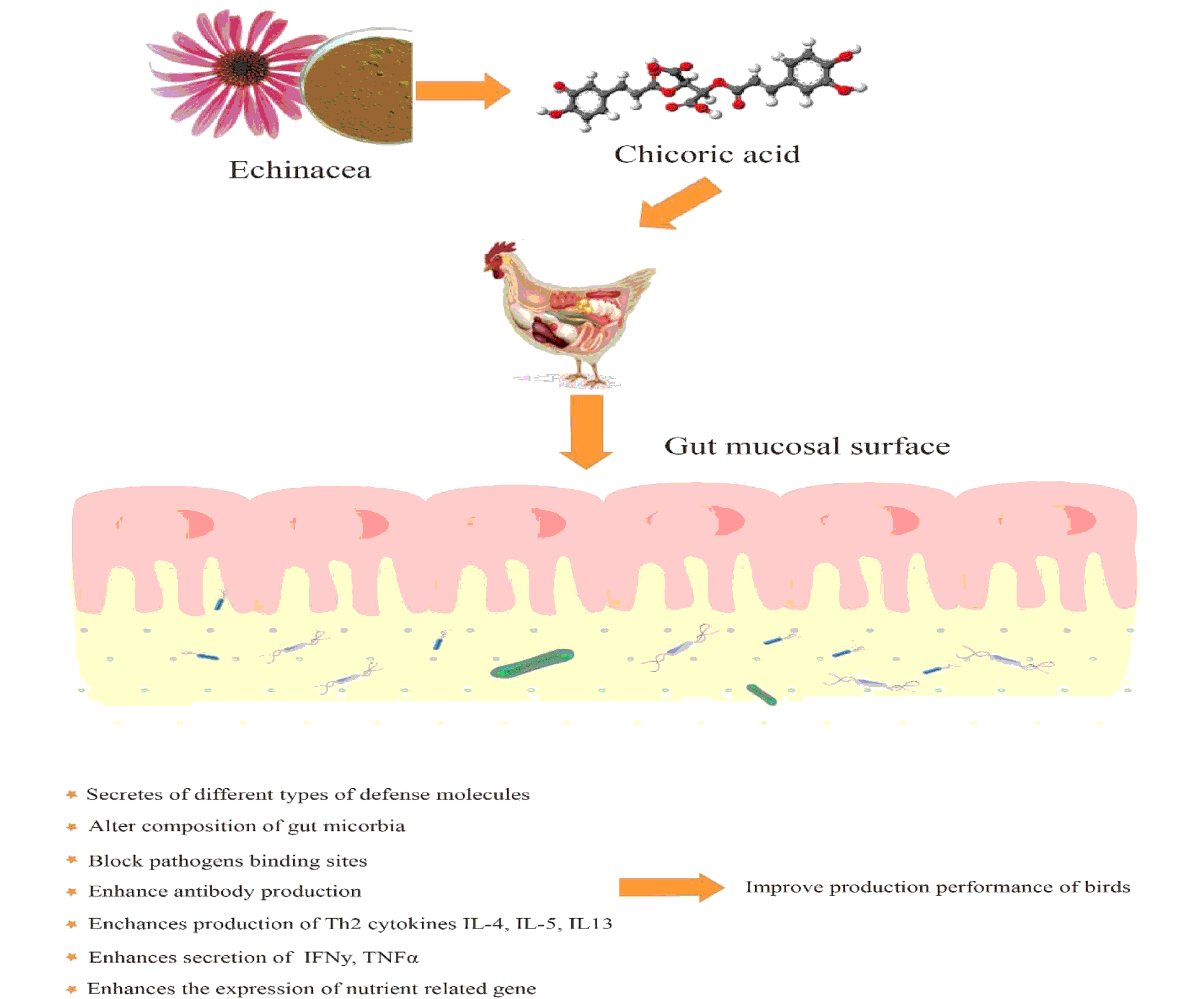
Yaodi et al. (Reference YAODI, ZHONG, NIU, LI, WEI and CHEN2008) and Lee et al. (Reference LEE, CHEN, WANG and YU2012) determined that the powder form of EP can be used as a suitable feed additive to improve the feed conversion and antioxidant activity of broiler chicken. EP extract supplementation has clear effects on the cardiovascular system in fast-growing broilers (Nasir et al., 2010) and significantly increased IL-2 and tumour necrosis factor-α production and antibody titres against the infectious bursal disease after vaccination (Aituan et al., Reference AITUAN, SHI, NIU, WANG and ZHONG2009; Zadeh et al., Reference ZADEH, RAHIMI, TORSHIZI and OMIDBAIGI2009). The possible biological and immune-modulatory effects of CA in poultry are shown in Figure 3 .
Flow diagram illustrating the biological and immunomodulatory effects of chicoric acid in poultry species.

Conclusions
Echinacea purpurea is a well-studied medicinal herb in mammals, although poultry data is scarce and there are still many scientific aspects that need to be studied in the future. It is thought to activate the immune system by inhibiting hyaluronidase enzyme secretion, stimulating T-cell production, cellular respiration, lymphocytic activity, and phagocytosis. The active ingredient CA is a major active constituent of EP which has many biological effects including anti-diabetic, antioxidant, immune stimulant, anti-inflammatory, immuno-modulatory and growth promoting properties. Notwithstanding, there have been few studies regarding its benefits in poultry diets. The CA could be useful as a poultry feed supplement to enhance welfare, prevent disease and promote performance. However, CA needs to be used in further poultry experiments to demonstrate and promote its useful biological functions for application in the poultry industry, especially for in vivo data and elucidating its involvement in avian metabolic pathways.
Conflict of interests
The authors have no conflict of interests.
Acknowledgment
The authors of the manuscript thank and acknowledge their respective Universities and Institutes.