Introduction
The pathobiology of depression is complex. It has been suggested that endothelial dysfunction (ED), low-grade inflammation (LGI) and oxidative stress (OxS) are involved, as these phenomena may interfere with neurotransmitter metabolism, the hypothalamic–pituitary–adrenal (HPA) axis and the homeostatic process of neurogenesis in the brain (Belmaker & Agam, Reference Belmaker and Agam2008; Dantzer et al. Reference Dantzer, O'Connor, Freund, Johnson and Kelley2008; Miller et al. Reference Miller, Maletic and Raison2009; Krishnan & Nestler, Reference Krishnan and Nestler2010). However, these observations derive primarily from studies in animals. In humans, the study of these phenomena in the pathobiology of depression is more complicated. One approach is to study ED, LGI and OxS through the determination of biomarkers in peripheral blood, which assumes that ED, LGI and OxS are generalized phenomena and that each of these phenomena represents ED, LGI or OxS either directly or indirectly in the brain.
The concepts of ED (Aird, Reference Aird2007a ,Reference Aird b ), LGI (Miller et al. Reference Miller, Maletic and Raison2009) and OxS (Maes et al. Reference Maes, Galecki, Chang and Berk2011) are heterogeneous in nature. These concepts can be defined individually in many different ways without it being clear that one definition necessarily favours the other in relation to depression. For example, ED has been defined as brachial artery impaired flow-mediation (Sherwood et al. Reference Sherwood, Hinderliter, Watkins, Waugh and Blumenthal2005), but also by an increased level of circulating biomarkers [e.g. soluble vascular cell adhesion molecule 1 (sVCAM-1), soluble endothelial selectin (sE-selectin), soluble thrombomodulin (sTM)] (Do et al. Reference Do, Dowd, Ranjit, House and Kaplan2010; Thomas et al. Reference Thomas, Morris, Davis, Jackson, Harrison and O'Brien2007). In addition, many different circulating biomarkers have been used to assess LGI [e.g. C-reactive protein (CRP), interleukin 6 (IL-6) and IL-1, and tumour necrosis factor-α (TNF-α)] (Tiemeier et al. Reference Tiemeier, Hofman, van Tuijl, Kiliaan, Meijer and Breteler2003; Howren et al. Reference Howren, Lamkin and Suls2009) and OxS [e.g. myeloperoxidase (MPO) and oxidized low density lipoprotein (oxLDL)] (Kupper et al. Reference Kupper, Gidron, Winter and Denollet2009; Maes et al. 2010). Furthermore, some studies have used a single biomarker to define the concepts of ED/LGI/OxS (Lesperance et al. Reference Lesperance, Frasure-Smith, Theroux and Irwin2004; Sherwood et al. Reference Sherwood, Hinderliter, Watkins, Waugh and Blumenthal2005) whereas others have used multiple markers (Tiemeier et al. Reference Tiemeier, Hofman, van Tuijl, Kiliaan, Meijer and Breteler2003; Do et al. Reference Do, Dowd, Ranjit, House and Kaplan2010). The different definitions of the concepts of ED/LGI/OxS are exemplified by the fact that studies on the association between biomarkers of ED (Thomas et al. Reference Thomas, Morris, Davis, Jackson, Harrison and O'Brien2007; Pizzi et al. Reference Pizzi, Manzoli, Mancini and Costa2008), LGI (Tiemeier et al. Reference Tiemeier, Hofman, van Tuijl, Kiliaan, Meijer and Breteler2003; Lesperance et al. Reference Lesperance, Frasure-Smith, Theroux and Irwin2004) and/or OxS (Forlenza & Miller, Reference Forlenza and Miller2006; Kupper et al. Reference Kupper, Gidron, Winter and Denollet2009) and depression have yielded inconsistent results (Ford & Erlinger, Reference Ford and Erlinger2004; Panagiotakos et al. Reference Panagiotakos, Pitsavos, Chrysohoou, Tsetsekou, Papageorgiou, Christodoulou and Stefanadis2004; Empana et al. Reference Empana, Sykes, Luc, Juhan-Vague, Arveiler, Ferrieres, Amouyel, Bingham, Montaye, Ruidavets, Haas, Evans, Jouven and Ducimetiere2005; Sherwood et al. Reference Sherwood, Hinderliter, Watkins, Waugh and Blumenthal2005; Rybakowski et al. Reference Rybakowski, Wykretowicz, Heymann-Szlachcinska and Wysocki2006; Narita et al. Reference Narita, Murata, Hamada, Takahashi, Omori, Suganuma, Yoshida and Wada2007; Elovainio et al. Reference Elovainio, Aalto, Kivimaki, Pirkola, Sundvall, Lonnqvist and Reunanen2009; Schott et al. Reference Schott, Kamarck, Matthews, Brockwell and Sutton-Tyrrell2009; Cooper et al. Reference Cooper, Milic, Tafur, Mills, Bardwell, Ziegler and Dimsdale2010; Do et al. Reference Do, Dowd, Ranjit, House and Kaplan2010; Maes et al. 2010; Paranthaman et al. Reference Paranthaman, Greenstein, Burns, Cruickshank, Heagerty, Jackson, Malik, Scott and Baldwin2010). In addition, these inconsistent results may be explained by the manner in which biomarkers of ED, LGI and/or OxS were determined (e.g. different laboratory techniques), the manner in which depression was assessed (e.g. interview versus questionnaire) and the populations investigated (e.g. clinical- versus population-based studies).
Nevertheless, and taken together, many studies (Tiemeier et al. Reference Tiemeier, Hofman, van Tuijl, Kiliaan, Meijer and Breteler2003; Ford & Erlinger, Reference Ford and Erlinger2004; Lesperance et al. Reference Lesperance, Frasure-Smith, Theroux and Irwin2004; Panagiotakos et al. Reference Panagiotakos, Pitsavos, Chrysohoou, Tsetsekou, Papageorgiou, Christodoulou and Stefanadis2004; Elovainio et al. Reference Elovainio, Aalto, Kivimaki, Pirkola, Sundvall, Lonnqvist and Reunanen2009; Howren et al. Reference Howren, Lamkin and Suls2009) have found a positive association between LGI and depression, particularly for the LGI biomarkers CRP and the interleukins IL-6 and IL-1, most notably in clinical-based sampled studies and in studies in which depression was assessed by interview (Howren et al. Reference Howren, Lamkin and Suls2009). For ED the evidence is less clear. In relatively small and/or selected populations (Sherwood et al. Reference Sherwood, Hinderliter, Watkins, Waugh and Blumenthal2005; Rybakowski et al. Reference Rybakowski, Wykretowicz, Heymann-Szlachcinska and Wysocki2006; Narita et al. Reference Narita, Murata, Hamada, Takahashi, Omori, Suganuma, Yoshida and Wada2007; Pizzi et al. Reference Pizzi, Manzoli, Mancini and Costa2008; Cooper et al. Reference Cooper, Milic, Tafur, Mills, Bardwell, Ziegler and Dimsdale2010) in particular, flow-mediated dilatation (FMD) was associated with depression to such an extent that a smaller FMD response was associated with more severe depressive symptoms. With regard to OxS, no clear picture emerges. Previous studies (Forlenza & Miller, Reference Forlenza and Miller2006; Kupper et al. Reference Kupper, Gidron, Winter and Denollet2009; Maes et al. Reference Maes, Galecki, Chang and Berk2011) have defined OxS in many different ways and have yielded contradictory results. Importantly, most of these studies examined ED, LGI and OxS in isolation whereas these processes are biologically inter-related and may therefore be interdependent (Stehouwer et al. Reference Stehouwer, Gall, Twisk, Knudsen, Emeis and Parving2002).
In view of these considerations, we investigated comprehensively, in a population-based study, the relationship between ED, LGI and OxS on the one hand and depressive symptoms on the other. In addition, we investigated whether any such associations were independent of diabetes, prior cardiovascular disease (CVD), physical activity, dietary habits and socio-economic status. Finally, we investigated whether ED, LGI and OxS were associated with depressive symptoms independently of each other.
Method
Study design
For the current study, we used cross-sectional data from the 2000 Hoorn Study. The Hoorn Study, which started in 1989, is a population-based cohort study of glucose metabolism in relation to CVD risk factors (Mooy et al. Reference Mooy, Grootenhuis, de Vries, Valkenburg, Bouter, Kostense and Heine1995; Spijkerman et al. Reference Spijkerman, Adriaanse, Dekker, Nijpels, Stehouwer, Bouter and Heine2002; Henry et al. Reference Henry, Kostense, Spijkerman, Dekker, Nijpels, Heine, Kamp, Westerhof, Bouter and Stehouwer2003). In brief, 2484 men and women, aged 50–75 years, from the population register of the medium-sized Dutch town of Hoorn participated in the baseline examination. In 1996–1998 (visit 2), 1513 (73%) of all surviving participants agreed to participate in the first follow-up. In 2000 (visit 3), all of those who were diagnosed as having diabetes during the previous examinations (n = 176) and random samples of individuals with normal glucose metabolism (n = 705) and impaired glucose metabolism (n = 193) were invited, of whom 648 (60%) participated. The local ethics committee approved the study and all participants gave their written informed consent.
Depressive symptoms
Depressive symptoms were assessed by a validated Dutch version of the 20-item Center for Epidemiologic Studies Depression Scale (CES-D; Beekman et al. Reference Beekman, Deeg, Van Limbeek, Braam, De Vries and Van Tilburg1997). Scores on the CES-D range from 0 to 60. Higher scores on this scale indicate the presence of more (severe) depressive symptoms. In the present study, the CES-D was used both as a continuous and as a dichotomous variable with a predefined cut-off level of 16 (Beekman et al. Reference Beekman, Deeg, Van Limbeek, Braam, De Vries and Van Tilburg1997). The latter represents the presence of clinically relevant depressive symptoms.
ED, LGI and OxS
ED was assessed by FMD of the brachial artery according to the guidelines of the International Brachial Artery Reactivity Task Force (Corretti et al. Reference Corretti, Anderson, Benjamin, Celermajer, Charbonneau, Creager, Deanfield, Drexler, Gerhard-Herman, Herrington, Vallance, Vita and Vogel2002), as described previously (Henry et al. Reference Henry, Ferreira, Kostense, Dekker, Nijpels, Heine, Kamp, Bouter and Stehouwer2004). In addition, ED was assessed by the quantification of the following circulating biomarkers: sVCAM-1, sE-selectin, sTM, soluble intercellular adhesion molecule 1 (sICAM-1) and von Willebrand factor (vWF). LGI was assessed by the quantification of high-sensitivity CRP, serum amyloid A (SAA), IL-6, IL-8, TNF-α, MPO and sICAM-1. OxS was determined by the quantification of oxLDL and MPO.
In brief, serum biomarkers of ED (sVCAM-1, sE-selectin, sTM, sICAM-1) and LGI (CRP, SAA, IL-6, IL-8, TNF-α) were assessed by a multi-array detection system based on electrochemiluminescence technology (SECTOR Imager 2400, Meso Scale Discovery, USA); details have been described elsewhere (van Bussel et al. Reference van Bussel, Henry, Schalkwijk, Ferreira, Feskens, Streppel, Smulders, Twisk and Stehouwer2011a ). In addition, vWF was determined in citrated plasma by means of an enzyme-linked immunosorbent assay (ELISA) (van Bussel et al. Reference van Bussel, Henry, Schalkwijk, Ferreira, Feskens, Streppel, Smulders, Twisk and Stehouwer2011a ), plasma oxLDL by competitive ELISA (Mercodia, Sweden) (van der Zwan et al. Reference van der Zwan, Teerlink, Dekker, Henry, Stehouwer, Jakobs, Heine and Scheffer2009) and MPO in ethylenediaminetetraacetic acid (EDTA) plasma by a sandwich ELISA (Mercodia) (Van der Zwan et al. Reference Van der Zwan, Scheffer, Dekker, Stehouwer, Heine and Teerlink2010a ).
In our laboratory, intra- and inter-assay coefficients of variation (CVs) were respectively: 2.8% and 5.6% for sVCAM-1, 2.6% and 6.7% for sE-selectin, 2.1% and 6.9% for sTM, 2.4% and 4.9% for sICAM-1, 2.8% and 4.0% for CRP, 2.7% and 11.6% for SAA, 5.6% and 13.0% for IL-6, 5.6% and 12.2% for IL-8, and 3.9% and 8.8% for TNF-α. In addition, the intra- and inter-assay CVs were respectively 3.4% and 7.9% for vWF (van Bussel et al. Reference van Bussel, Henry, Schalkwijk, Ferreira, Feskens, Streppel, Smulders, Twisk and Stehouwer2011a ), 6.7% and 7.0% for oxLDL (van der Zwan et al. Reference van der Zwan, Teerlink, Dekker, Henry, Stehouwer, Jakobs, Heine and Scheffer2009) and 3.9% and 5.0% for MPO (Van der Zwan et al. Reference Van der Zwan, Scheffer, Dekker, Stehouwer, Heine and Teerlink2010a ).
Other measurements
We determined medical history, education level, current medication use, anthropometrical (body height, weight, waist and hip circumference) and biological [blood pressure, total, high density lipoprotein (HDL) and LDL cholesterol, triglyceride and glucose levels, creatinine, albuminuria] variables as described elsewhere (Spijkerman et al. Reference Spijkerman, Adriaanse, Dekker, Nijpels, Stehouwer, Bouter and Heine2002; Henry et al. Reference Henry, Kostense, Spijkerman, Dekker, Nijpels, Heine, Kamp, Westerhof, Bouter and Stehouwer2003). For assessment of glucose status, all participants, except those with previously diagnosed diabetes, underwent a standard 75-g oral glucose tolerance test and were classified as having normal glucose metabolism (NGM), impaired glucose metabolism (IGM; impaired fasting glucose and/or impaired glucose tolerance) or type 2 diabetes according to the 1999 World Health Organization criteria (Unwin et al. Reference Unwin, Shaw, Zimmet and Alberti2002). Smoking habits were categorized as current, former and non-smokers. Hypertension was defined as a systolic blood pressure (BP) ⩾140 mmHg and/or diastolic BP ⩾90 mmHg and/or the current use of antihypertensive medication. Estimated glomerular filtration rate (eGFR in ml/min/1.73 m2) was calculated according to the Modification of Diet in Renal Disease (MDRD) short formula (without assay calibration): 186 × (serum creatinine)−1.154 × (age)−0.203 × 1.212 (if black) × 0.742 (if female) (Levey et al. Reference Levey, Coresh, Greene, Marsh, Stevens, Kusek and Van Lente2007). Education level was dichotomized as low (secondary school or less) versus higher education. Physical activity, expressed as metabolic equivalent of task (MET) h/week, was assessed by the Short Questionnaire to Assess Health-Enhancing Physical Activity (SQUASH; Wendel-Vos et al. Reference Wendel-Vos, Schuit, Saris and Kromhout2003). Diet was assessed by a validated self-administered Food Frequency Questionnaire (FFQ; Ocke et al. Reference Ocke, Bueno-de-Mesquita, Goddijn, Jansen, Pols, van Staveren and Kromhout1997a ,Reference Ocke, Bueno-de-Mesquita, Pols, Smit, van Staveren and Kromhout b ; Du et al. Reference Du, van der A, van Bakel, van der Kallen, Blaak, van Greevenbroek, Jansen, Nijpels, Stehouwer, Dekker and Feskens2008). In the FFQ, participants were asked to report habitual diet over the previous year (Ocke et al. Reference Ocke, Bueno-de-Mesquita, Goddijn, Jansen, Pols, van Staveren and Kromhout1997a ,Reference Ocke, Bueno-de-Mesquita, Pols, Smit, van Staveren and Kromhout b ). Based on the FFQ, we calculated the alternative Mediterranean diet (aMED) score as described by Fung et al. (Reference Fung, McCullough, Newby, Manson, Meigs, Rifai, Willett and Hu2005). The aMED score quantifies ‘diet quality’ and is based on the dietary intake of vegetables, legumes, fruit, nuts, whole grains, meat, fish, unsaturated and saturated fat and ethanol.
Statistical analysis
All analyses were performed with PASW Statistics 18 (IBM, USA).
FMD was analysed as a functional marker of ED. For descriptive purposes, FMD values were reversed, that is multiplied by −1 (higher values indicating worse endothelial function), and an FMD Z score was calculated according to the formula: (individual value – population mean)/[population standard deviation (s.d.)]. In all statistical analyses, the FMD Z score was adjusted for baseline diameter, flow increase after cuff release and nitroglycerin-mediated dilatation (NMD).
For reasons of statistical efficiency and to reduce the influence of the biological variability of each measure, a circulating biomarker Z score was determined for the individual circulating biomarkers of ED, LGI and OxS according to predefined clusters of conceptually related biomarkers (Jager et al. Reference Jager, van Hinsbergh, Kostense, Emeis, Yudkin, Nijpels, Dekker, Heine, Bouter and Stehouwer1999; Yudkin et al. Reference Yudkin, Stehouwer, Emeis and Coppack1999; van Bussel et al. Reference van Bussel, Schouten, Henry, Schalkwijk, de Boer, Ferreira, Smulders, Twisk and Stehouwer2011b ). The circulating biomarker Z scores were calculated as follows: for each individual circulating biomarker, a Z score was calculated. The resulting Z scores were then averaged into the circulating biomarker Z score for ED, LGI and OxS. The ED circulating biomarker Z score consisted of scores for sVCAM-1, sE-selectin, sTM, sICAM-1 and vWF. In addition, we combined the FMD Z score and the ED circulating biomarker Z score into a ‘total ED’ score. The LGI circulating biomarker Z score consisted of scores for CRP, SAA, IL-6, IL-8, TNF-α, MPO and sICAM-1. As both monocytes and the endothelium express sICAM-1 (Schram & Stehouwer, Reference Schram and Stehouwer2005), sICAM-1 was included in the Z score of both LGI and ED. The OxS circulating biomarker Z score consisted of oxLDL and MPO. As MPO is a measure of both oxidative stress and inflammation (Schindhelm et al. Reference Schindhelm, van der Zwan, Teerlink and Scheffer2009), it was included in the Z score of OxS and LGI. Linear and logistic regression analyses were used to evaluate the associations between, on the one hand, the total ED score, the FMD Z score and the circulating biomarker Z scores of ED, LGI and OxS and, on the other, depressive symptoms (CES-D score; the analyses were performed for both the continuous and the dichotomous CES-D score). We first adjusted, in all models, for the stratification variables of the Hoorn Study cohort: age, sex and glucose metabolism status (model 1). These associations were then additionally adjusted for the following sets of potential confounders (Panagiotakos et al. Reference Panagiotakos, Pitsavos, Chrysohoou, Tsetsekou, Papageorgiou, Christodoulou and Stefanadis2004; Empana et al. Reference Empana, Sykes, Luc, Juhan-Vague, Arveiler, Ferrieres, Amouyel, Bingham, Montaye, Ruidavets, Haas, Evans, Jouven and Ducimetiere2005; Pizzi et al. Reference Pizzi, Manzoli, Mancini and Costa2008): conventional CVD risk factors [prior CVD, hypertension, waist-to-hip ratio (WHR), triglycerides and total/HDL cholesterol (model 2)], lifestyle factors [education level, physical activity, smoking status and aMED score (model 3)] and the use of antihypertensive and/or lipid-lowering medication and/or metformin (model 4). In models 5–7, mutual adjustments were made for each of the individual Z scores.
The association between ED, LGI or OxS and depression might be different according to sex (Ford & Erlinger, Reference Ford and Erlinger2004; Krishnan & Nestler, Reference Krishnan and Nestler2010) or glucose metabolism status (Musselman et al. Reference Musselman, Betan, Larsen and Phillips2003). For instance, the hyperglycaemic state may amplify the effect of ED, LGI and/or OxS on depressive symptoms/depression, even though the hyperglycaemic state itself enhances these processes. In addition, some studies have shown an association between LGI in men but not in women (Penninx et al. Reference Penninx, Kritchevsky, Yaffe, Newman, Simonsick, Rubin, Ferrucci, Harris and Pahor2003; Ford & Erlinger, Reference Ford and Erlinger2004); this may be due to the effect of gonadal hormones on the level of plasma biomarkers (Ford & Erlinger, Reference Ford and Erlinger2004). To investigate these possible interactions, we added to our models interaction terms between sex and ED/LGI/OxS and between glucose metabolism status and ED/LGI/OxS.
A p value < 0.05 was considered statistically significant, except for the interaction analyses, where p values < 0.10 were used. Interaction analyses are handicapped in that they compare smaller subsets of study subjects and therefore have less power than the primary study analysis (Rothman et al. Reference Rothman, Greenland and Lash2008). The use of a higher p value is recommended (Selvin, Reference Selvin1996) to enable the detection of any potentially important interaction, even though such a greater p value enhances the possibility of a type 1 error.
Results
Participants
Of the 648 participants, 84 had missing CES-D data and 14 had incomplete glucose data. In the remaining 550 participants, full data on circulating biomarkers of ED, LGI and OxS were available in 493 participants (study population), of whom 357 had FMD measurements of sufficient quality (i.e. clear visual definition of the arterial wall throughout the entire measurement; Henry et al. Reference Henry, Ferreira, Kostense, Dekker, Nijpels, Heine, Kamp, Bouter and Stehouwer2004). Participants with missing biomarker data were older (72 v. 69 years) and more often had type 2 diabetes (40% v. 20%; p for all <0.05). Participants with missing FMD data were older (72 v. 68 years), more often had type 2 diabetes (35% v. 17%) and had a higher CES-D score (9 v. 6; p for all <0.05). In addition, these participants had a worse CVD risk factor pattern (data not shown).
Clinical characteristics
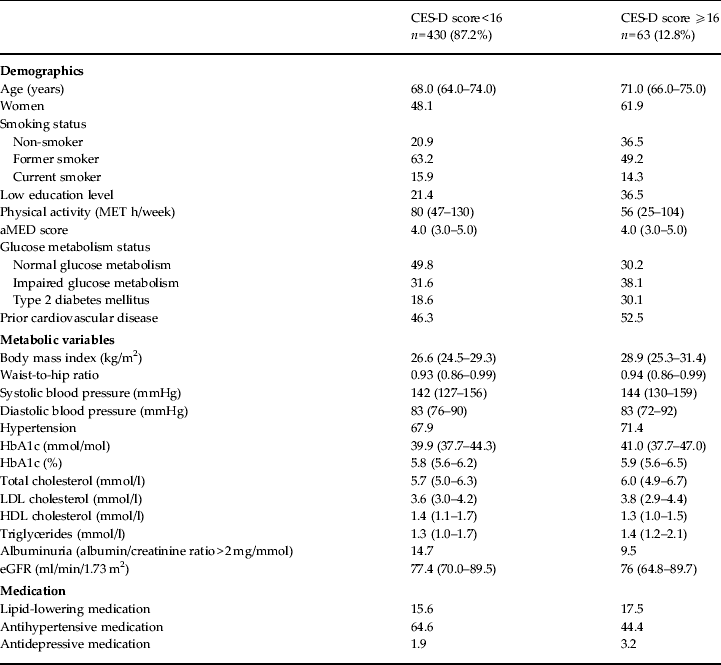
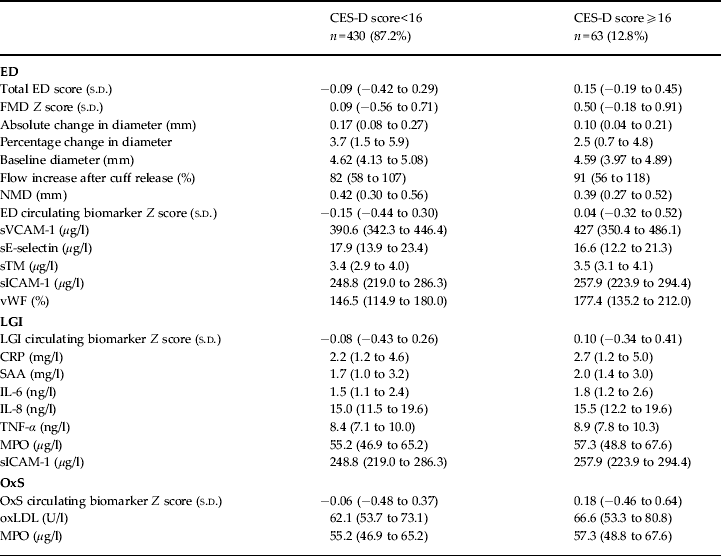
Tables 1 and 2 show the characteristics of the study population according to the presence of clinically relevant depressive symptoms (i.e. CES-D score ⩾16). According to the CES-D cut-off level, 63 participants (12.8%) had clinically relevant depressive symptoms. In persons with clinically relevant depressive symptoms compared to those without, the total ED score, the FMD Z score and the circulating biomarker Z scores of ED, LGI and OxS were higher.
Clinical characteristics of the study population according to the presence of clinically important depressive symptoms (CES-D ⩾16)

CES-D, Center for Epidemiologic Studies Depression Scale; MET, metabolic equivalent of task; aMED, alternative Mediterranean diet; HbA1c, glycosylated haemoglobin; LDL, low density lipoprotein; HDL, high density lipoprotein; eGFR, estimated glomerular filtration rate.
Data are presented as percentage or median (interquartile range).
Markers of endothelial dysfunction (ED), low-grade inflammation (LGI) and oxidative stress (OxS) according to the presence of clinically important depressive symptoms (CES-D ⩾16)

CES-D, Center for Epidemiologic Studies Depression Scale; FMD, flow-mediated dilatation; NMD, nitroglycerin-mediated dilatation; sVCAM-1, soluble vascular adhesion molecule 1; sE-selectin, soluble endothelial selectin; sTM, soluble thrombomodulin; sICAM-1, soluble intracellular adhesion molecule 1; vWF, von Willebrand factor; CRP, C-reactive protein; SAA, serum amyloid A; IL-6, interleukin 6; IL-8, interleukin 8; TNF-α, tumour necrosis factor α; MPO, myeloperoxidase; oxLDL, oxidized low density lipoprotein; s.d., standard deviation.
Data are presented as medians (interquartile range).
Association between ED, LGI and OxS and depressive symptoms
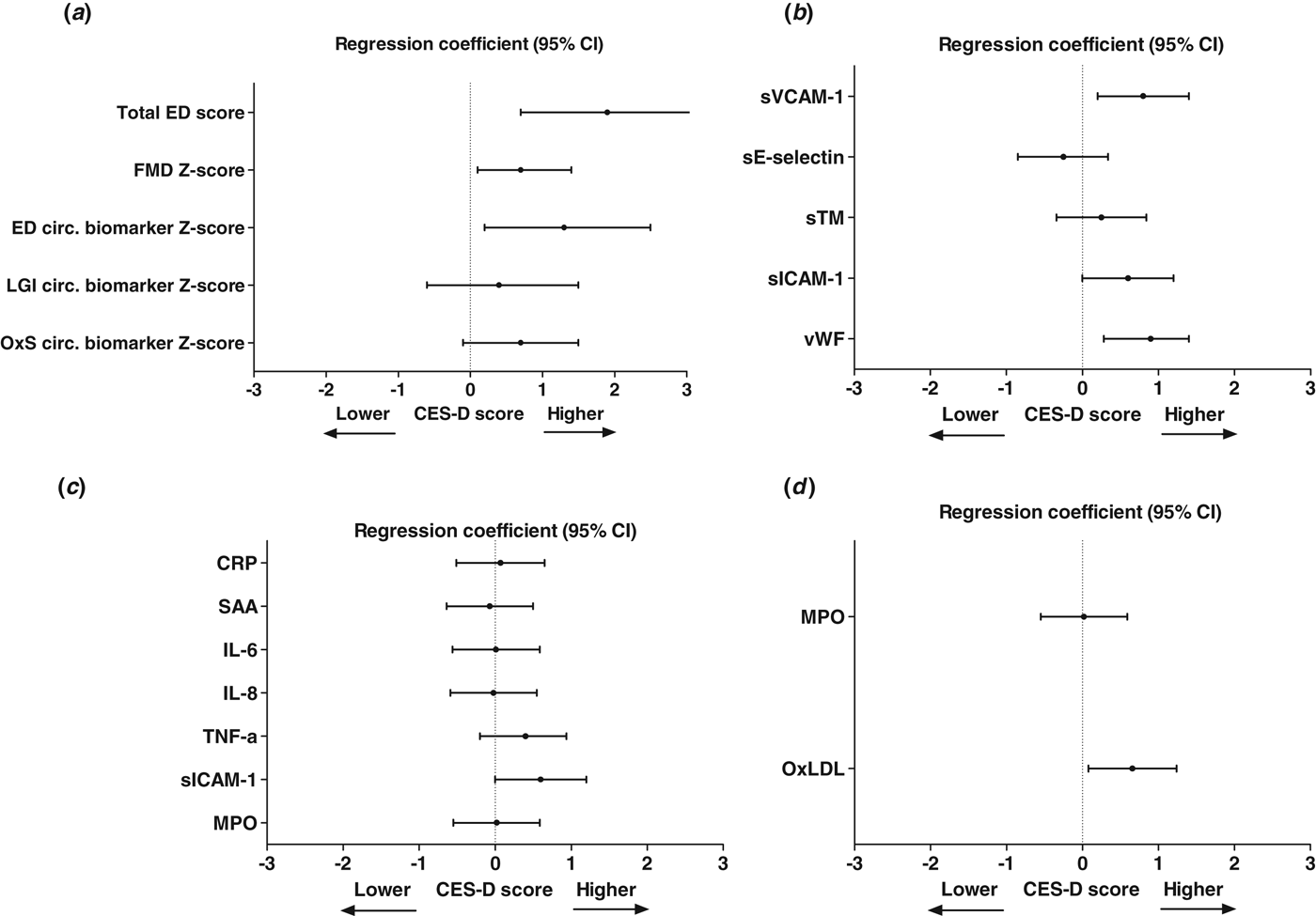
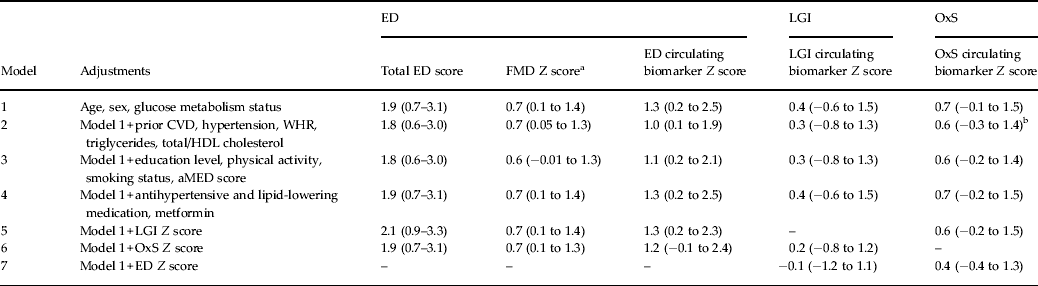
The results of the linear regression analyses (CES-D expressed on a continuous scale) show that, after adjustment for age, sex and glucose metabolism status, 1 s.d. increase in the total ED score was associated with a higher CES-D score with a regression coefficient of 1.9 [95% confidence interval (CI) 0.7–3.1] (Table 3, model 1; also illustrated in Fig. 1 a). The LGI and OxS circulating biomarker Z scores were not significantly associated with a higher CES-D score [regression coefficients 0.4 (95% CI −0.6 to 1.5) and 0.7 (95% CI −0.1 to 1.5) respectively] (Table 3, model 1, and Fig. 1 a). Further adjustments for prior CVD, hypertension, WHR, total/HDL cholesterol, triglycerides, educational level, physical activity, smoking, aMED score and the use of antihypertensive and lipid-lowering medication, and metformin did not materially alter these results (models 2–4). Furthermore, the associations for the total ED score and the OxS circulating biomarker Z score did not materially change if model 1 was additionally adjusted for each of the other biomarkers scores (models 5–7). When we adjusted the LGI circulating biomarker Z score for the ED circulating biomarker Z score, the regression coefficient changed from 0.4 (95% CI −0.6 to 1.5) to −0.1 (95% CI −1.2 to 1.1) (model 7). This change in the point estimate should nevertheless be interpreted with caution, as the CI of both point estimates incorporates the value zero.
Associations of endothelial dysfunction (ED), low-grade inflammation (LGI) and oxidative stress (OxS) with depressive symptoms [continuous Center for Epidemiologic Studies Depression Scale (CES-D) score]. (a) Regression coefficients [95% confidence intervals (CIs)] expressed per standard deviation (s.d.) increase in total ED score, flow-mediated dilatation (FMD) Z score and ED, LGI and OxS circulating biomarker Z scores. The FMD Z score was reversed, that is multiplied by −1, higher values indicating worse function. Also shown are individual circulating biomarkers (per s.d.) of (b) ED, (c) LGI and (d) OxS. All results are adjusted for age, sex and glucose metabolism status. sVCAM-1, Soluble vascular cell adhesion molecule 1; sE-selectin, soluble endothelial selectin; sTM, soluble thrombomodulin; sICAM-1, soluble intercellular adhesion molecule 1; vWF, von Willebrand factor; CRP, C-reactive protein; SAA, serum amyloid A; IL-6, interleukin 6; IL-8, interleukin 8; TNF-α, tumour necrosis factor α; MPO, myeloperoxidase; oxLDL, oxidized low density lipoprotein.

Associations of endothelial dysfunction (ED), low-grade inflammation (LGI) and oxidative stress (OxS) with depressive symptoms (continuous CES-D score)

CES-D, Center for Epidemiologic Studies Depression Scale; FMD, flow-mediated dilatation; CVD, cardiovascular disease; WHR, waist-to-hip ratio; HDL, high density lipoprotein; aMED, alternative Mediterranean diet.
Values are given as regression coefficients (95% confidence interval) expressed per standard deviation increase in total ED score (n = 357), FMD Z score (n = 357), ED circulating biomarker Z score (n = 493), LGI circulating biomarker Z score (n = 493) and (OxS) circulating biomarker Z score (n = 493) on the CES-D.
a The FMD Z score was reversed, that is multiplied by −1; higher values indicating worse endothelial function. In all analyses the FMD Z score was adjusted for baseline diameter, flow increase after cuff release and nitroglycerin-mediated dilatation (NMD).
b The OxS circulating biomarker Z score was not adjusted for triglycerides and total/HDL cholesterol as this was considered an overadjustment, as oxidized low density lipoprotein (oxLDL) is a component of the OxS circulating biomarker Z score.
Association between ED, LGI and OxS and clinically important depressive symptoms
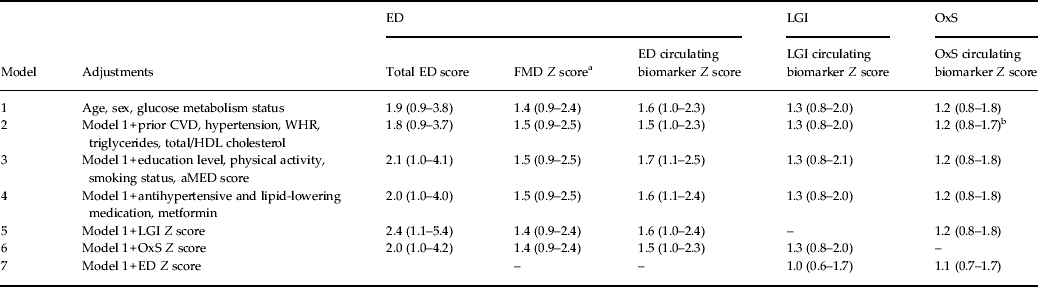
The results of the logistic regression analyses (CES-D expressed on a dichotomous scale) show that, after adjustment for age, sex and glucose metabolism status, a 1 s.d. increase in the total ED score was associated with clinically important depressive symptoms with an odds ratio (OR) of 1.9 (95% CI 0.9–3.8) (Table 4, model 1). The LGI and OxS circulating biomarker Z scores were associated with clinically important depressive symptoms with an OR of 1.3 (95% CI 0.8–2.0) and 1.2 (95% CI 0.8–1.8) respectively (Table 4, model 1). Further adjustments for prior CVD, hypertension, WHR, total/HDL cholesterol, triglycerides, educational level, physical activity, smoking, aMED score and the use of antihypertensive and lipid-lowering medication, and metformin did not materially change these results (models 2–4). If we adjusted the total ED score for the LGI circulating biomarker Z score, the OR changed from 1.9 (95% CI 0.9–3.8) to 2.4 (95% CI 1.1–5.4) (model 5). If we adjusted the results of the LGI and OxS circulating biomarker Z scores for each of the other biomarker scores, the results did not materially change (models 5–7).
Associations of endothelial dysfunction (ED), low-grade inflammation (LGI) and oxidative stress (OxS) with clinically relevant depression (CES-D ⩾16)

CES-D, Center for Epidemiologic Studies Depression Scale; FMD, flow-mediated dilatation; CVD, cardiovascular disease; WHR, waist-to-hip ratio; HDL, high density lipoprotein; aMED, alternative Mediterranean diet.
Values are given as odds ratios (95% confidence interval) expressed per standard deviation increase in total ED score (n = 357), FMD Z score (n = 357), ED circulating biomarker Z score (n = 493), LGI circulating biomarker Z score (n = 493) and OxS circulating biomarker Z score (n = 493). Sixty-three (12.8%) of the study participants had clinically relevant depressive symptoms (CES-D score ⩾16).
a The FMD Z score was reversed, that is multiplied by −1, higher values indicating worse endothelial function. In all analyses the FMD Z score was adjusted for baseline diameter, flow increase after cuff release and nitroglycerin-mediated dilatation (NMD).
b The OxS circulating biomarker Z score was not adjusted for triglycerides and total/HDL cholesterol as this was considered an overadjustment, as oxidized low density lipoprotein (oxLDL) is a component of the OxS circulating biomarker Z score.
Additional analyses
Analyses of the associations between the individual elements of the ED, LGI and OxS circulating biomarker Z scores and the CES-D score on a continuous scale show that all individual circulating biomarkers, except sE-selectin and MPO, were associated with the CES-D score (statistically significant for sVCAM-1, vWF and oxLDL; see Fig. 1 b–d). Previous studies (Ridker et al. Reference Ridker, Hennekens, Buring and Rifai2000; Brevetti et al. Reference Brevetti, Martone, de Cristofaro, Corrado, Silvestro, Di Donato, Bucur and Scopacasa2001) have suggested that sICAM-1 may be a marker of both ED and LGI. When the analyses were repeated with sICAM-1 left out of either the ED or the LGI circulating biomarker Z score, the results did not materially change (data not shown). In addition, we considered MPO as a marker of both LGI and OxS (Brennan et al. Reference Brennan, Penn, Van Lente, Nambi, Shishehbor, Aviles, Goormastic, Pepoy, McErlean, Topol, Nissen and Hazen2003; van der Zwan et al. Reference van der Zwan, Teerlink, Dekker, Henry, Stehouwer, Jakobs, Heine and Scheffer2010b ). When the analyses were repeated leaving MPO out of the LGI circulating biomarker Z score, the results did not materially change (data not shown). Finally, it is unclear whether a high or a low concentration of sTM reflects ED (Wu, Reference Wu2003). The results did not materially change when we performed the analysis with either the reversed value of sTM or leaving sTM out of the total ED score (data not shown).
To determine whether the association between FMD and depression was due to impaired ED or smooth muscle cell function (Henry et al. Reference Henry, Ferreira, Kostense, Dekker, Nijpels, Heine, Kamp, Bouter and Stehouwer2004), we repeated the analyses with endothelium-independent NMD as the primary determinant. These analyses showed that NMD was not associated with (clinically relevant) depressive symptoms (data not shown).
The associations between ED, LGI and OxS on the one hand and depressive symptoms on the other may differ according to sex or glucose metabolism status (Musselman et al. Reference Musselman, Betan, Larsen and Phillips2003; Krishnan & Nestler, Reference Krishnan and Nestler2010). Overall, we found no such interactions (p interaction >0.10), except that stratified analysis showed a stronger association between the LGI biomarker Z score and depressive symptoms in persons with impaired glucose metabolism compared to persons with normal glucose metabolism (p interaction = 0.03). In addition, the association between the OxS biomarker Z score and depressive symptoms was stronger in persons with impaired glucose metabolism (p interaction = 0.01) and in persons with type 2 diabetes (p interaction = 0.07), compared to persons with normal glucose metabolism (data not shown).
When the statistical analyses were repeated on those participants (n = 357) who had full data on both circulating biomarkers and FMD, the results did not materially change (data not shown). Finally, when we repeated the analyses with clinically relevant depressive symptoms defined as a CES-D score ⩾16 and/or medication use for a depressive disorder (n = 67, 13.6%) as the outcome variable instead of clinically relevant depressive symptoms only (CES-D ⩾16), the results did not materially change (data not shown).
Discussion
The present investigation is the first population-based study that simultaneously assessed the association of ED, LGI and OxS with depressive symptoms in one study. The study had three main findings. First, ED, as quantified by FMD and circulating biomarkers, was associated with a higher level of (clinically relevant) depressive symptoms. This association was independent of age, sex, diabetes, CVD risk factors, physical activity, dietary intake and education level. Second, circulating biomarkers for LGI and OxS were not statistically significantly associated with depressive symptoms. Third, adjustments for LGI or OxS did not affect the association between ED and depressive symptoms, which suggests that ED is associated with depressive symptoms/depression, independently of LGI and OxS.
A key concept underlying this study is that ED, LGI and OxS are generalized phenomena and that each of these phenomena represents either directly or indirectly ED, LGI or OxS in the brain. Currently, literature on this topic is limited. Nevertheless, it can be hypothesized that the impaired cerebral circulatory function seen in depression, as determined by transcranial Doppler ultrasonography (Direk et al. Reference Direk, Koudstaal, Hofman, Ikram, Hoogendijk and Tiemeier2012), may be the consequence of decreased endothelium-dependent vasodilation. In addition, it has been shown that the process of neurogenesis (i.e. the process by which neural progenitors divide and form new neurons and neuronal networks) is disturbed in depression (Belmaker & Agam, Reference Belmaker and Agam2008; Krishnan & Nestler, Reference Krishnan and Nestler2010) and that this disturbance may, at least partially, be the consequence of ED (Shen et al. Reference Shen, Goderie, Jin, Karanth, Sun, Abramova, Vincent, Pumiglia and Temple2004; Zhao et al. Reference Zhao, Deng and Gage2008).
On aggregate, most studies thus far (Lesperance et al. Reference Lesperance, Frasure-Smith, Theroux and Irwin2004; Empana et al. Reference Empana, Sykes, Luc, Juhan-Vague, Arveiler, Ferrieres, Amouyel, Bingham, Montaye, Ruidavets, Haas, Evans, Jouven and Ducimetiere2005; Sherwood et al. Reference Sherwood, Hinderliter, Watkins, Waugh and Blumenthal2005; Rybakowski et al. Reference Rybakowski, Wykretowicz, Heymann-Szlachcinska and Wysocki2006; Narita et al. Reference Narita, Murata, Hamada, Takahashi, Omori, Suganuma, Yoshida and Wada2007; Pizzi et al. Reference Pizzi, Manzoli, Mancini and Costa2008; Schott et al. Reference Schott, Kamarck, Matthews, Brockwell and Sutton-Tyrrell2009; Cooper et al. Reference Cooper, Milic, Tafur, Mills, Bardwell, Ziegler and Dimsdale2010; Paranthaman et al. Reference Paranthaman, Greenstein, Burns, Cruickshank, Heagerty, Jackson, Malik, Scott and Baldwin2010) have shown that ED and depression seem to be associated. However, conflicting results in the literature do exist. For instance, Thomas et al. (Reference Thomas, Morris, Davis, Jackson, Harrison and O'Brien2007) did not observe any association between ED and depression in a small and select population of patients diagnosed with major depressive disorder. In their study, however, it is unclear how potential confounders were taken into account (e.g. anti-inflammatory medication). An alternative explanation for the reported heterogeneous results may lie in the fact that endothelial function can be defined in many ways as its functions are multi-dimensional and heterogeneous (Aird, Reference Aird2007a ,Reference Aird b ). This is exemplified by Paranthaman et al. (Reference Paranthaman, Greenstein, Burns, Cruickshank, Heagerty, Jackson, Malik, Scott and Baldwin2010) who did report an association between ED and depression but quantified ED as the vasodilatory response to acetylcholine of biopsied small gluteal arteries. Do et al. (Reference Do, Dowd, Ranjit, House and Kaplan2010) quantified ED by multiple circulating biomarkers and reported an association between ED and, specifically, hopelessness, which reflects, as argued by the authors, a distinct and unique component of depression only. Pizzi et al. (Reference Pizzi, Manzoli, Mancini and Costa2008) quantified ED by FMD and showed an association between FMD and depressive symptoms; however, in their study no adjustments were made for important confounders, such as physical activity and dietary habits.
The present investigation extends previous observations because of its population-based design, the extensive assessment of ED, LGI and OxS, and the detailed clinical characterization of its participants, which enabled us to adjust for a series of potential confounders.
Apart from a causal association between ED and depression, other underlying mechanisms might explain the observed association. First, ED is involved in the pathophysiology of CVD (Aird, Reference Aird2007a ,Reference Aird b ) and depression is common in persons with CVD (Belmaker & Agam, Reference Belmaker and Agam2008). Therefore, it is possible that ED might lead to depression through the development of CVD. However, the association of ED with depressive symptoms remained after adjustment for prior CVD and several CVD risk factors. Second, depressive symptoms by themselves might initiate or promote ED (reverse causality), as depressive symptoms/depression are associated with unfavourable lifestyle habits, such as physical inactivity, unhealthy dietary habits, smoking and obesity, which are by themselves associated with ED. The association between ED and depressive symptoms, however, remained after adjustment for unfavourable lifestyle habits. Third, other mechanisms may underlie both ED and depression. For instance, abnormal HPA axis function (Broadley et al. Reference Broadley, Korszun, Abdelaal, Moskvina, Deanfield, Jones and Frenneaux2006) and deficits in omega-3 fatty acids (Parker et al. Reference Parker, Gibson, Brotchie, Heruc, Rees and Hadzi-Pavlovic2006) have been associated with both ED and depression. In the current study, cortisol and omega-3 fatty acids levels were not available and this issue needs further study. Fourth, ED, LGI and OxS are, from a biological point of view, closely linked and these concepts are difficult to separate (Stehouwer et al. Reference Stehouwer, Gall, Twisk, Knudsen, Emeis and Parving2002). Therefore, any association of ED with depressive symptoms may be confounded by LGI and/or OxS. However, when we adjusted the association between ED and depression for LGI or OxS, ED and depression remained associated. This suggests that ED may affect the brain through a pathway independent of LGI and OxS. For instance, it might be possible that ED directly affects the process of neurogenesis (Shen et al. Reference Shen, Goderie, Jin, Karanth, Sun, Abramova, Vincent, Pumiglia and Temple2004; Zhao et al. Reference Zhao, Deng and Gage2008), or ED might directly impair cerebral circulatory function (Lemke et al. Reference Lemke, de Castro, Schlattmann, Heuser and Neu2010).
In our study, the LGI and the OxS Z scores were associated with clinically relevant depressive symptoms, with effect sizes comparable to the results reported in the literature (Ford & Erlinger, Reference Ford and Erlinger2004; Lesperance et al. Reference Lesperance, Frasure-Smith, Theroux and Irwin2004; Panagiotakos et al. Reference Panagiotakos, Pitsavos, Chrysohoou, Tsetsekou, Papageorgiou, Christodoulou and Stefanadis2004; Empana et al. Reference Empana, Sykes, Luc, Juhan-Vague, Arveiler, Ferrieres, Amouyel, Bingham, Montaye, Ruidavets, Haas, Evans, Jouven and Ducimetiere2005; Forlenza & Miller, Reference Forlenza and Miller2006; Miller et al. Reference Miller, Maletic and Raison2009). However, in our study these associations did not reach statistical significance. We cannot exclude the possibility that this may be due to a lack of statistical power. Indeed, a meta-analysis by Howren et al. (Reference Howren, Lamkin and Suls2009) did show a significant association between different markers of LGI (CRP, IL-1 and IL-6) and depression/depressive symptoms. With regard to OxS in particular, we only assessed two biomarkers (MPO and oxLDL); there is also an ongoing debate how OxS could best be defined.
We explored whether the relationship between ED, LGI and OxS and depression differed according to glucose metabolism status. Our findings show that the association between the LGI biomarker Z score and depressive symptoms was stronger in persons with impaired glucose metabolism than in those with normal glucose metabolism. A plausible underlying pathobiological explanation for this observation is lacking. In addition, our results show that the association between the OxS biomarker Z score and depressive symptoms was stronger in persons with impaired glucose metabolism and in those with type 2 diabetes. We could speculate that the hyperglycaemic state may indeed amplify the effect of OxS on depressive symptoms/depression, even though the hyperglycaemic state itself enhances OxS. Fully stratified analyses, however, were hampered by lack of power and further studies of this issue are needed.
Our study has some limitations. First, the cross-sectional design of our study precludes any conclusions about causality and it is possible that other factors may explain the association between ED and depressive symptoms/depression. Nevertheless, in our study the association between ED and depressive symptoms remained even after adjustment for glucose metabolism status, CVD, obesity, physical inactivity, poor dietary habits, smoking and education level. Second, the construction of the Z scores assumes that its components are equally important in the pathobiology of depression, which is not necessarily true. This might have caused us to underestimate the reported associations. However, the use of the composite Z score has the important merit of statistical efficiency. Third, a relatively large number of statistical tests were performed (we tested three ED scores and one each of LGI and OxS); however, the associations between ED and depressive symptoms were consistent across the different ED scores. It is therefore unlikely that these findings result by chance. Fourth, data were obtained in an elderly white population and it therefore remains to be established whether these results can be generalized to other populations.
In conclusion, the present population-based study shows that ED, quantified by an array of peripherally circulating biomarkers and FMD, is associated with depressive symptoms. Our data thereby support the hypothesis that ED plays an important role in the pathobiology of depression.
Acknowledgements
The Hoorn Study has been supported over the years by the VU University Medical Centre, and by the Dutch Diabetes Research Foundation, the Dutch Organization for Scientific Research, The Netherlands Heart Foundation and the Health Research and Development Council of The Netherlands.
Declaration of Interest
None.