





Introduction
Puebla-Tlaxcala represents a key region for understanding the social, cultural, and economic dynamics of highland Mesoamerica. Its abundant natural resources supported the establishment of communities during the Early Formative period (1500–900 b.c.) and facilitated the development of complex societies and state-level polities throughout the Classic (a.d. 100–600) up to the Postclassic (a.d. 1250–1519) periods (García Cook Reference García Cook, Sabloff and Bricker1981:245; Lesure et al. Reference Lesure2014:318). Among these resources, one of the most significant was obsidian, a volcanic glass characterized by its conchoidal fracture properties, which was widely used in the production of cutting tools for daily activities as well as in the crafting of specialized objects for ritual purposes.
The production-distribution network of specialized obsidian blades in the Puebla-Tlaxcala Valley was crucial to the region’s socioeconomic development. The innovation of pressure blades during the Formative period was a significant development in the technological evolution of Mesoamerican societies (Clark Reference Clark1988; Darras Reference Darras, Gonzalez and Mirambell2005). This technology not only allowed artisans to use the raw materials more efficiently but also transformed the Mesoamerican economy. The skill and knowledge required to produce these pressure-based tools, mainly during the Formative period, meant that households depended on specialists to make these artifacts (Hirth and Cyphers Reference Hirth and Cyphers2020). Populations exchanged goods for prismatic blades, creating a significant link between skilled artisans and local and regional economies (Hirth Reference Hirth, Hirth and Pillsbury2013b; Hirth and Cyphers Reference Hirth and Cyphers2020).
El Paredón, one of central Mexico’s most significant obsidian deposits, located north of the valley between the states of Puebla and Hidalgo (Figure 1), was a quarry continuously exploited from the Formative period through the Early Colonial period (Carballo et al. Reference Carballo, Carballo and Neff2007; Millhauser et al. Reference Millhauser, Fargher, Espinoza and Blanton2015; Vicencio et al. Reference Vicencio, Corral, Mitrani, Arciniega and Carballo2023). As such, it serves as a key research focus for understanding the socioeconomic role of essential products, such as pressure blades, and the organization of regional systems for resource exploitation, use, exchange, commercialization, and access, along with their potential fluctuations over time.
Map with the sites used for this research and the El Paredón subsources.

Figure 1 Long description
Central Mexico map highlighting El Paredón and Tres Cabezas obsidian subsources. El Paredón subsource is marked with a red diamond, the Tres Cabezas subsource with a green diamond . Other obsidian sources are marked with black diamonds. Archaeological sites are categorized by historical periods: Postclassic sites with green triangles, the Epiclassic site with a dark green triangle, the Classic site with a blue triangle, Formative sites with red triangles and other sites with black triangles. The map includes a scale bar indicating distances in kilometers and a compass for orientation. An inset map shows the location within the Trans-Mexican Volcanic Belt. The spatial distribution of sites is concentrated around El Paredón and Tres Cabezas, with sites like Tepeticpac, Tetel, and Xochitecatl-Cacaxtla marked. The map provides a detailed view of the region′s archaeological significance and resource distribution.
Recent evidence of subsources in this quarry has provided further insights into regional obsidian dynamics, supporting investigations within a diachronic framework. The supply patterns of obsidian blades from El Paredón likely fluctuated between the Middle Formative (900–500 b.c.) and Early Colonial (sixteenth-century) periods at different sites across the Puebla-Tlaxcala Valley. This variation becomes particularly evident with the identification of at least two subsources (Vicencio et al. Reference Vicencio, Corral, Mitrani, Arciniega and Carballo2023). The first, known as El Paredón, generally consists of coarse-grained material with abundant inclusions, making it less suitable for tool production, specifically prismatic blades. The second, known as Tres Cabezas, located in the western section of the El Paredón deposit, appears to have been the primary—if not the exclusive—source of obsidian used by Formative-period artisans due to its superior quality for manufacturing prismatic blades (Vicencio et al. Reference Vicencio, Corral, Mitrani, Arciniega and Carballo2023:1228). However, it remains unclear whether Tres Cabezas obsidian became the predominant material in later periods and what procurement strategies were employed to acquire it.
This study integrates data from multiple projects to develop a diachronic analysis of the exploitation system at the El Paredón deposit. The objective is to better understand the procurement and production of obsidian blades in the Puebla-Tlaxcala Valley, with a particular focus on the socioeconomic dynamics among the various groups involved in the industry’s production and distribution. In particular, we aim to determine whether procurement was conducted independently or through more centralized and cooperative models, and how these strategies may have evolved.
Our hypotheses are twofold. First, the supply of obsidian from Tres Cabezas in the Puebla-Tlaxcala region fluctuated depending on its accessibility and competition with other regional and extra-regional supply networks. Under these conditions, procurement would cycle between direct acquisition and more complex trade networks. Second, there may have been a model involving itinerant artisans who worked independently of political affiliations yet organized within a structured system to supply pressure blades across a broad region. This would suggest an inter-artisan commercial network of crafters, possibly connected through cultural ties, who managed a formalized system that provisioned the Puebla-Tlaxcala Valley for millennia, adapting to shifting circumstances and alternating between independent and cooperative supply strategies.
To evaluate these hypotheses, we analyzed obsidian artifacts from nine sites in the Puebla-Tlaxcala Valley, representing regional settlements spanning from the Middle Formative to the Late Postclassic periods (Figure 1, Table 1). For the Middle and Late/Terminal Formative (1200 b.c. to a.d. 100), the materials came from Amomoloc, Tetel, La Laguna, Las Mesitas, Tetimpa, and the early occupation of Xochitecatl-Cacaxtla (Lesure Reference Lesure2014; Plunket and Uruñuela Reference Plunket and Uruñuela1998; Vicencio et al. Reference Vicencio, Corral, Mitrani, Arciniega and Carballo2023). For the Classic period (a.d. 100–600), a sample from Quimicho, a settlement within the Teotihuacan Corridor, provided key insights into larger extra-regional commercial systems (Santacruz and López Corral Reference Santacruz and López Corral2021). The Epiclassic period (a.d. 600–900) is represented by a domestic complex from the late occupation of Xochitecatl-Cacaxtla, where residents engaged in small-scale ceramic and obsidian production (Gómez Reference Gómez2016; Serra Puche and Lazcano Reference Serra Puche and Lazcano2011). Finally, for the Late Postclassic period (a.d. 1250–1519), the objects were obtained from two significant contexts: Tepeticpac, one of the principal altepetl (state-level polities) of the Tlaxcallan confederation, and an obsidian workshop at Metepec, a site located on the outskirts of this urban center (López Corral et al. Reference López Corral, Vicencio, Santacruz-Cano, Gentil and Arciniega2021).
General chronological representation of the different sites used in this study (the specific dates for the material used in this research are shown in Table 3)
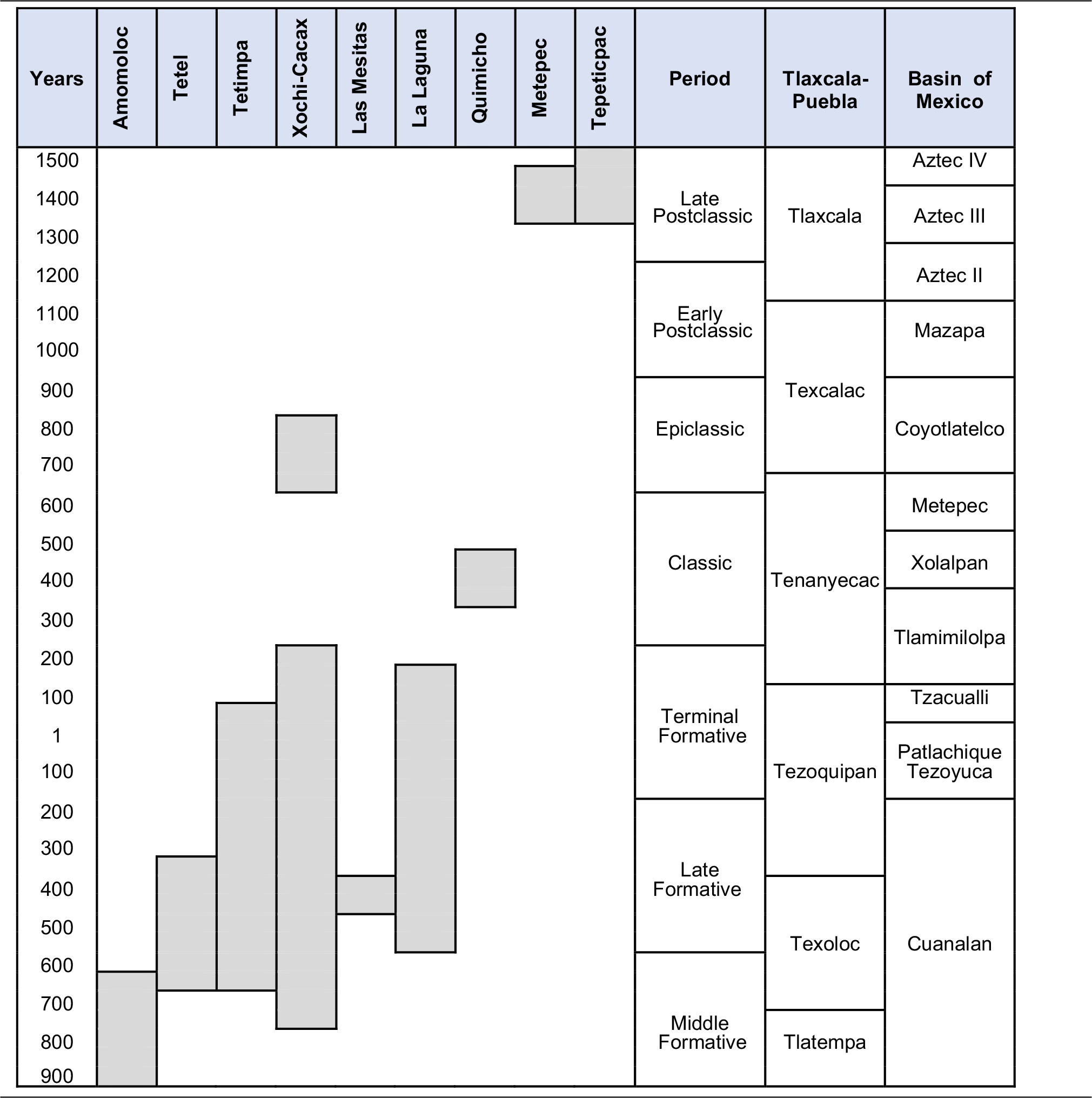
Table 1 Long description
Amomoloc was occupied during the Middle Formative period, from 900 to 600 B.C.Tetel was occupied during the Late Formative period, from 650 to 300 B.C.Tetimpa was occupied from 650 to 100 B.C., spanning the Late Formative and Terminal Formative periods.Xochitecatl-Cacaxtla was occupied from 750 to 200 B.C., spanning the Middle and Late Formative periods.Las Mesitas was occupied during the Late Formative period, from 450 to 350 B.C.La Laguna was occupied during the Late Formative period, from 600 to 200 B.C.Quimicho was occupied during the Classic period, from A.D. 350 to 500.Metepec was occupied during the Late Postclassic period, from A.D. 1300 to 1450.Finally, Tepeticpac was occupied during the Late Postclassic period, from A.D. 1300 to 1450..
To investigate the origin of the obsidian and the processes by which it reached its place of consumption, 1,089 artifacts were analyzed using portable X-ray fluorescence (pXRF) and technological analysis (Hirth Reference Hirth2003, Reference Hirth2006b). Our goal was to determine the provenance of the material and identify the procurement strategies involved in its distribution to different consumption sites.
Craft specialization and material procurement
Obsidian procurement systems offer valuable insights into regional socioeconomic dynamics. They involved the participation of artisans, merchants, and consumers who, through their interactions, left evidence of specific economic, social, and even political ties. One key research question related to assessing the accessibility of essential resources, such as obsidian, is whether certain sources were managed either by local populations or by larger political entities (Clark Reference Clark and Johnson1987; Hirth et al. Reference Hirth, Bondar, Glascock, Vonarx, Daubenspeck and Hirth2006; Pastrana Reference Pastrana, Hirth and Andrews2002, Reference Pastrana2007; Pastrana and Domínguez Reference Pastrana and Domínguez2009; Santley Reference Santley and Hirth1984). Some quarries were likely exploited by nearby inhabitants who sought to keep control over these sources (Hirth Reference Hirth, Bondar, Glascock, Vonarx, Daubenspeck and Hirth2006:131).
The production of obsidian tools is a means of identifying socioeconomic processes associated with their manufacture and the broader crafting systems of which they formed a part. Various obsidian industries existed in Mesoamerica, some more specialized than others (Clark Reference Clark and Johnson1987, Reference Clark1988; Healan Reference Healan2009; Hirth and Cyphers Reference Hirth and Cyphers2020). The percussion flake industry, centered on creating irregular, sharp flakes, was relatively simple and did not require extensive knowledge or expertise (Hirth and Cyphers Reference Hirth and Cyphers2020:60–62). Bifacially worked artifacts could be more specialized, sometimes controlled or sponsored by state institutions, and required specific skills for manufacturing fine, detailed pieces (Carballo Reference Carballo2011; Pastrana Reference Pastrana2007; Santley Reference Santley and Hirth1984). For less elaborate bifaces (like basic dart points), common artisans, or even people with limited abilities, could reproduce them. Eccentrics (or silhouettes), on the other hand, required highly specialized artisans, thereby becoming a highly restricted item that very few craftspeople could reproduce (Aoyama Reference Aoyama, Levine and Carballo2014:146).
The production of prismatic, or final-series blades required skill, regular practice, and specialized training. Studies of blade manufacture have identified two main production strategies (Hirth and Cyphers Reference Hirth and Cyphers2020). The progressive sequence, more evident in Early Formative periods, involved a nonlinear removal of blades using percussion and pressure techniques simultaneously. Meanwhile, the sequential strategy, more dominant during the Classic and Postclassic periods, followed a more linear process in which percussion reduction generally preceded pressure flaking until final (third series) blades were produced (Hirth and Cyphers Reference Hirth and Cyphers2020:84–87; see supplementary material). Because blade production required specialized knowledge, access to raw materials, and extensive practice, it was likely carried out by a limited number of skilled artisans, especially during early periods (Clark Reference Clark1988; Darras Reference Darras, Gonzalez and Mirambell2005). Although the craft may have become more widespread sometime during the Classic period, the technical expertise involved remained largely restricted to specialists (Healan Reference Healan2009:104; Hirth and Cyphers Reference Hirth and Cyphers2020:79).
Current studies of obsidian sources, production strategies, and exchange networks have developed important frameworks for understanding the populations involved in producing and circulating this material. The widespread presence of pressure blades across settlements in central Mexico raises important questions about how communities acquired these essential tools and what supply strategies were available to them. Addressing these issues requires examining the relationships among those involved in the procurement of obsidian blades. Investigating these interactions is therefore critical for reconstructing the organization of production, exchange, and access to obsidian resources in central Mexico.
Determining whether obsidian was acquired through individual efforts or a centralized supply strategy is essential for understanding procurement organization. Obsidian economies encompass the socioeconomic relationships between those who extracted the raw material, those specialized artisans who manufactured the finished blades, and the distribution networks that connected them to consumers (Hirth Reference Hirth1998, Reference Hirth2008). These processes could have been managed directly by individuals or collectively as part of indirect procurement, but they often operated within complex systems linking multiple communities. Hirth and colleagues (Reference Hirth, Bondar, Glascock, Vonarx, Daubenspeck and Hirth2006) propose four models for how local workshops at Epiclassic Xochicalco obtained raw materials, frameworks that may also apply to other consumer sites: direct procurement, direct procurement by itinerant producers, a trade/merchant model, and indirect trade through itinerant artisans.
The first model, direct procurement, involves artisans traveling to quarries to obtain raw material either through independent extraction or by acquiring already-mined obsidian from local inhabitants. They would then transport it back to their localities for artifact production. Expected archaeological evidence for this model includes lithic remains associated with the early stages of artifact manufacture, such as macro-cores and polyhedral cores, as well as the predominance of a single obsidian source selected by the craftspeople for exploitation (Hirth Reference Hirth2008:441; Hirth et al. Reference Hirth, Bondar, Glascock, Vonarx, Daubenspeck and Hirth2006:131).
An alternative form of direct procurement with itinerant production involves local artisans functioning as itinerant traders, who obtain raw materials directly from the source and manufacture artifacts for various groups along their return route. This model offered certain advantages, allowing artisans to engage in broader trade networks and gain access to a wider range of nonlocal commodities. The expected archaeological evidence would be similar to that of direct procurement; however, in this case, traveling specialists would primarily work with obsidian in more advanced stages of production, with minimal initial reduction through percussion flaking. Additionally, due to their mobility across a larger region, these artisans would likely utilize obsidian from more than one source (Hirth et al. Reference Hirth, Bondar, Glascock, Vonarx, Daubenspeck and Hirth2006:132–133).
The third model, indirect procurement through trade networks, involves the acquisition of obsidian via established exchange systems. While interregional exchange networks in Mesoamerica were active as early as the Formative period, the mechanisms of obsidian exchange evolved significantly over time (Cassiano and Alvarez Reference Cassiano and Alvarez2005; Clark Reference Clark and Johnson1987; Darras Reference Darras, Gonzalez and Mirambell2005). By the Epiclassic period, specialized merchants operated more freely and consistently across central Mexico (Hirth et al. Reference Hirth, Bondar, Glascock, Vonarx, Daubenspeck and Hirth2006:133). However, it is important to consider alternative models of systematized exchange networks that may have been in place as early as the Formative and Classic periods. These early systems likely served as precursors to the more standardized and organized market networks that became prominent during the Epiclassic period and beyond (see also Clayton Reference Clayton2021).
Obsidian procurement through trade involved an indirect supply system that included both specialized merchants and peddlers, who exchanged secondhand material (Hirth et al. Reference Hirth, Bondar, Glascock, Vonarx, Daubenspeck and Hirth2006:133). Archaeological evidence for this model would encompass a diverse range of assemblages, from the exchange of finished prismatic blades to the distribution of macro-cores. This system would result in variability in production stages across settlements, as well as a wide diversity of obsidian sources present at each consumption site.
Another form of indirect procurement may have involved systematized collective strategies for distributing obsidian from its source to consumers. This could have included political institutions overseeing the distribution of the material, but it may also have functioned through nonpolitical organizational systems, reflecting an institutional economy versus a more commercial one. Institutional involvement in obsidian procurement may have been linked to taxation or tribute payments. Alternatively, distribution could have been managed by an organized, nonpolitical network of artisans and merchants who formed caravans to acquire raw materials (Hirth Reference Hirth2008:444). The central Mexican Nahuatl calpolli (big or large house), a socioeconomic institution documented in the Postclassic period, provides a socioeconomic framework for craft production that may have facilitated the collective organization of certain economic activities (Carballo and Feinman Reference Carballo and Feinman2024; Hirth et al. Reference Hirth, Bondar, Glascock, Vonarx, Daubenspeck and Hirth2006). This could be reflected in a cooperative system of merchants or specialized artisans working in a structured manner to supply a large population.
The fourth model involves indirect trade through nonlocal itinerant artisans, who produced artifacts at each consumption site while supplying cores to local craftspeople. A significant portion of obsidian artifact production in Mesoamerica was carried out by itinerant artisans who traveled with obsidian cores, crafting tools as needed at their destinations (De León et al. Reference De León, Hirth and Carballo2009:118; Hirth Reference Hirth, Hirth and Pillsbury2013b:100; Hirth et al. Reference Hirth, Bondar, Glascock, Vonarx, Daubenspeck and Hirth2006:134). Archaeological evidence has found that the trade of finished pressure blades was predominant in early societies around 1100 b.c., while the trade of blade cores emerged later in most regions of Mesoamerica (Clark Reference Clark and Johnson1987). Trade linked to itinerant crafting enabled specialized workers to distribute obsidian artifacts more efficiently and profitably, meeting the demands of a broad population, from domestic users to institutionalized organizations (De León et al. Reference De León, Hirth and Carballo2009; Hirth Reference Hirth2008, Reference Hirth, Hirth and Pillsbury2013b; Hirth et al. Reference Hirth, Bondar, Glascock, Vonarx, Daubenspeck and Hirth2006). Itinerant blade crafting, therefore, would have been a highly profitable activity for those close to obsidian sources (Boksenbaum et al. Reference Boksenbaum, Tolstoy, Harbottle, Jerome and Neivens1987:72).
Evidence for itinerant artisans is found in the remains of low-scale manufacturing processes at consumption sites, as well as in specific reduction debris. Debitage, considered secondary evidence of production (De León et al. Reference De León, Hirth and Carballo2009:114), is represented by flakes and unusable material, reflecting the remnants of local obsidian reduction. Additionally, itinerant artisans carried prismatic cores, which were gradually reduced to produce prismatic blades until the core was exhausted. As a result, cores—considered primary archaeological evidence—would be absent or scarce in assemblages, as crafters transported them elsewhere to continue blade production at other locations (De León et al. Reference De León, Hirth and Carballo2009:118). Together, these indicators, along with low-scale production for local consumption, provide crucial evidence for the presence of itinerant craftspeople at a site.
The itinerant crafting model has been a key mechanism for the dissemination of prismatic blade production and technology from the Formative to the Postclassic periods. Archaeological evidence from Formative-period contexts in the Basin of Mexico and Tlaxcala proposes the presence of itinerant obsidian artisans working within various household assemblages (De León et al. Reference De León, Hirth and Carballo2009). By the Epiclassic period, they likely supplied domestic workshops at Xochicalco with reduced obsidian cores (Hirth Reference Hirth2008). Ethnohistoric sources from the Late Postclassic and Early Colonial periods further indicate that itinerant obsidian crafting remained a continuous feature of central Mexico’s economic landscape (Anderson et al. Reference Anderson, Berdan and Lockhart1976; Hirth Reference Hirth, Hirth and Pillsbury2013b).
Itinerant crafting likely functioned as an alternative procurement strategy alongside both independent and more formalized models. The provisioning methods employed by different populations, whether direct or indirect, must be understood as adaptive responses to specific socioeconomic conditions (Hirth Reference Hirth2008:444). Within this diachronic framework, we propose a model in which provisioning shifted between independent and cooperative systems. This approach suggests an inter-artisan commercial network of semi-independent itinerant artisans who were possibly connected through cultural ties and worked together in an organized manner to distribute prismatic blades across a vast region. Over generations, this would have developed into a well-established network that effectively supplied the Puebla-Tlaxcala Valley for millennia.
El Paredón and the Tres Cabezas subsource
Populations in central Mexico utilized a diverse range of lithic resources provided by the Trans-Mexican Volcanic Belt. This geological region spans the entire central Mexican area and contains several calderas, including Tulancingo-Acoculco, La Primavera, Huichapan, Los Azufres, and Los Humeros (López-Hernández et al. Reference López-Hernández, García, Aguirre, González, Palma and Quijano2009:279). Research on the characterization of these sources seeks to determine the provenance of lithic materials, contributing to a better understanding of ancient populations’ exploitation and supply strategies. These studies have provided archaeologists with valuable information related to economic, social, political, and collaborative dynamics of the societies that used these resources.
The El Paredón deposit is part of the larger Tulancingo-Acoculco Caldera Complex. The rocks in this region are calc-alkaline in composition and date from the Pliocene to the Pleistocene (López-Hernández et al. Reference López-Hernández, García, Aguirre, González, Palma and Quijano2009:281). The characterization of the El Paredón deposit began in the early twentieth century with Bretón (Reference Bretón1905), followed by Charlton and others (Reference Charlton, Grove and Hopke1978). More recently, Millhauser and colleagues (Reference Millhauser, Bloch, Golitko, Fargher, Heredia, Xiuhtecutli and Glascock2017) conducted a geochemical analysis using Instrumental Neuron Activation Analysis (INAA) and XRF on geological artifacts from El Paredón, providing an initial framework for identifying subsources in the area. Last, Vicencio and his colleagues (Reference Vicencio, Corral, Mitrani, Arciniega and Carballo2023) were able to identify two clear subsources as part of the El Paredón volcanic area. In this study, we aim to further explore the social implications that can be derived from subsource characterization in regions such as the Puebla-Tlaxcala Valley.
The data collected so far show the presence of at least two subsources within the larger El Paredón deposit area. Geochemical characterization using pXRF, combined with statistical and geospatial analyses (Figures 2 and 3), has enabled their classification: one is associated with the locality of El Paredón, while the other is located near the modern town of Tres Cabezas, in the western part of the deposit (Vicencio et al. Reference Vicencio, Corral, Mitrani, Arciniega and Carballo2023). The Tres Cabezas subsource spans approximately 23 square kilometers on the border between Puebla and Hidalgo (Figure 3), where much of the material was found as small to medium nodules (around 10 centimeters in diameter), located in ravines and close to the surface. Specifically, a high concentration of obsidian debris (mainly percussion flakes and blades) exposed the existence of a large quarry workshop. However, no architectural remains have been identified, making it difficult to confirm the presence of permanent settlements (Vicencio et al. Reference Vicencio, Corral, Mitrani, Arciniega and Carballo2023:1222). These findings raise questions about which communities consumed this obsidian and the procurement strategies employed to supply the inhabitants of the Puebla-Tlaxcala Valley with El Paredón and the Tres Cabezas material.
Bivariate analysis with grouping ellipses at 95 percent probability, made with the 10 trace elements (above) and the two trace elements with the greatest variation: Sr and Zr (below).
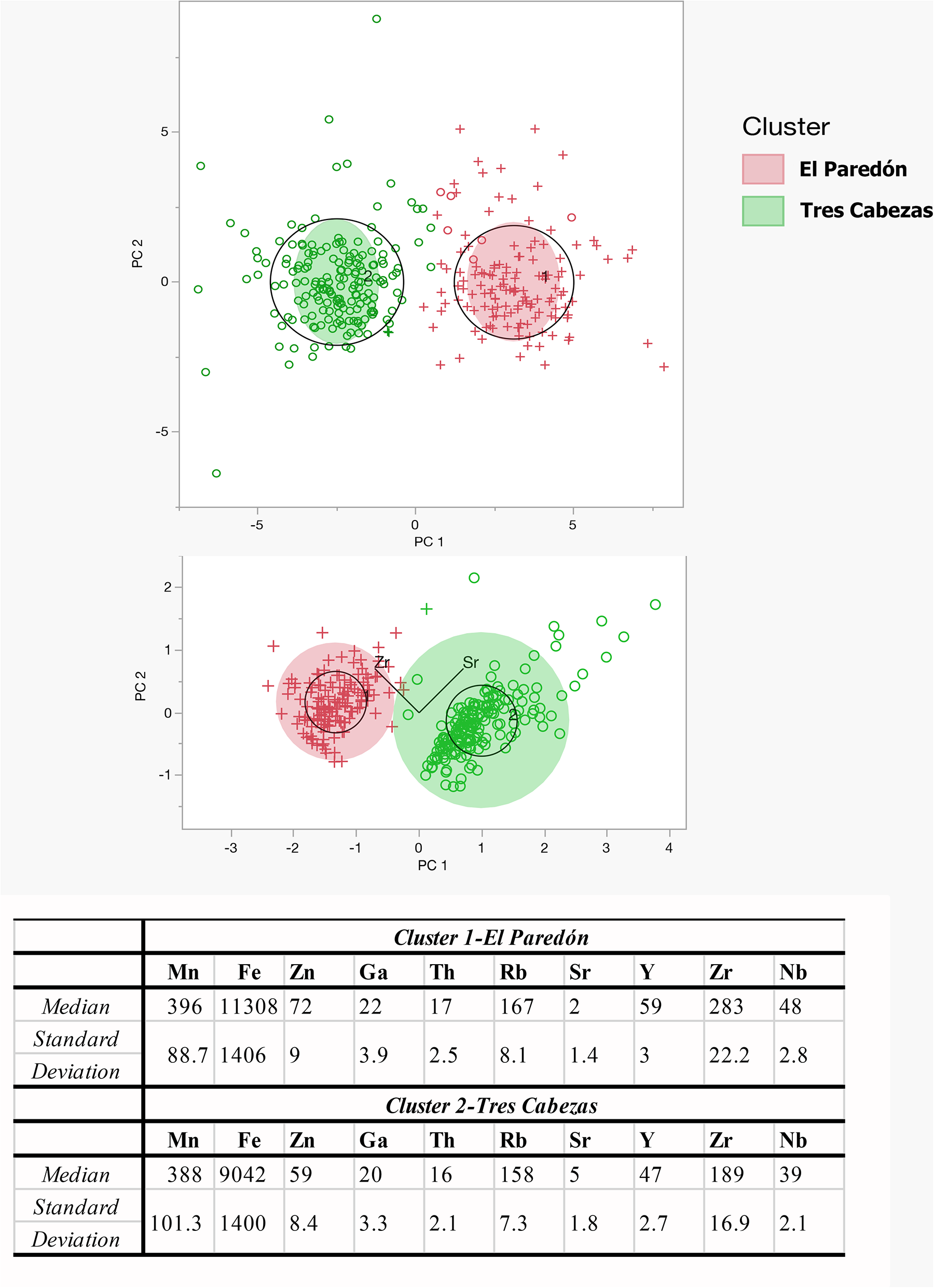
Figure 2 Long description
Two scatter plots and one table. The image A showing a scatter plot with the horizontal axis labeled, PC 1 and the vertical axis labeled, PC 2. The horizontal axis shows tick labels at negative 5, 0 and 5. The vertical axis shows tick labels at negative 5, 0 and 5. A legend labeled, Cluster, lists, El Paredón and, Tres Cabezas. Two point groups are shown, each enclosed by an outlined ellipse. The two ellipses are separated along PC 1, with one ellipse centered at negative PC 1 values and the other ellipse centered at positive PC 1 values. The image B showing a scatter plot with the horizontal axis labeled, PC 1 and the vertical axis labeled, PC 2. The horizontal axis shows tick labels at negative 3, negative 2, negative 1, 0, 1, 2, 3 and 4. The vertical axis shows tick labels at negative 1, 0, 1 and 2. Two point groups are shown, each enclosed by a filled ellipse. One ellipse contains the text, Zr and the other ellipse contains the text, Sr. The Zr labeled ellipse encloses one cluster of points and the Sr labeled ellipse encloses the other cluster of points. The image C showing a table with two sections labeled, Cluster 1 El Paredón and, Cluster 2 Tres Cabezas. Each section has column headers, Mn, Fe, Zn, Ga, Th, Rb, Sr, Y, Zr, Nb and row labels, Median and, Standard Deviation. The table summarizes the same two clusters named in the scatter plot legend. Cluster 1 El Paredón values. Median: Mn 396, Fe 11308, Zn 72, Ga 22, Th 17, Rb 167, Sr 2, Y 59, Zr 283, Nb 48. Standard Deviation: Mn 88.7, Fe 1406, Zn 9, Ga 3.9, Th 2.5, Rb 8.1, Sr 1.4, Y 3, Zr 22.2, Nb 2.8. Cluster 2 Tres Cabezas values. Median: Mn 388, Fe 9042, Zn 59, Ga 20, Th 16, Rb 158, Sr 5, Y 47, Zr 189, Nb 39. Standard Deviation: Mn 101.3, Fe 1400, Zn 8.4, Ga 3.3, Th 2.1, Rb 7.3, Sr 1.8, Y 2.7, Zr 16.9, Nb 2.1.
Spatial distribution of the outcrops related to each subsource that comprises the El Paredón deposit area, based on Vicencio and colleagues (Reference Vicencio, Corral, Mitrani, Arciniega and Carballo2023). The Tres Cabezas subsource, from which most of the archaeological material comes, is located west of the source, spanning approximately 23 square kilometers.
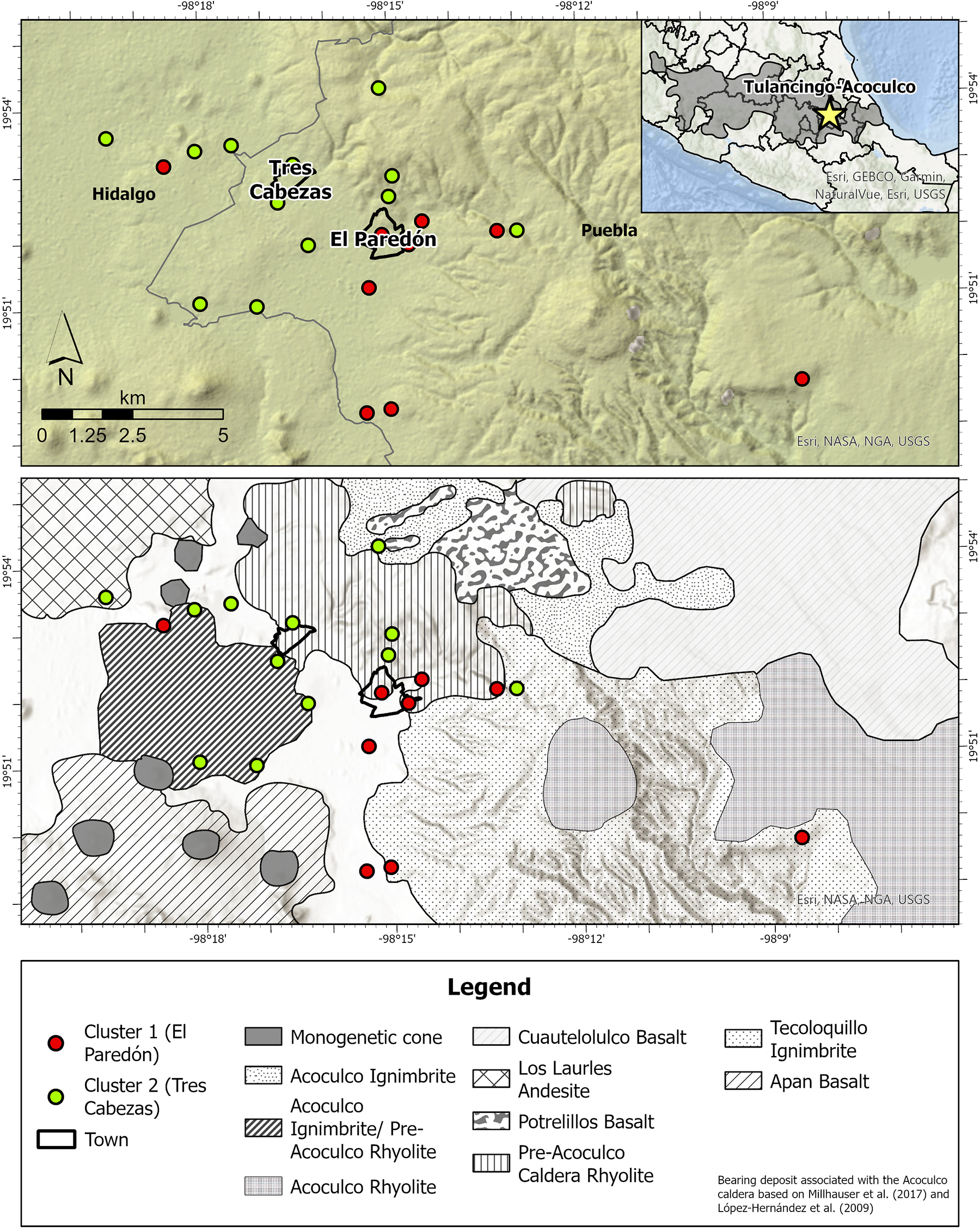
Figure 3 Long description
A) The top map displays the spatial distribution of geological clusters and towns in the El Paredoón deposit area. Cluster 1 (El Paredon) is marked with red dots and Cluster 2 (Tres Cabezas) with green dots. Towns are marked with black circles, including Hidalgo, Tres Cabezas, El Paredn and Puebla. An inset map shows the location of Tulancingo-Acoculco. B) The bottom map illustrates geological formations with various patterns. Monogenetic cones are shaded in gray, Cuautelulco Basalt in light gray, Tecoloquillo Ignimbrite in medium gray and Apan Basalt in dark gray. Other formations include Acoculco Ignimbrite, Los Laureles Andesite, Protellois Basalt, Pre-Acoculco Rhyolite and Acoculco Rhyolite, each represented by distinct patterns. The legend explains the symbols and patterns used for clusters and geological formations.
Portable X-ray fluorescence analysis: Methodology
The recent identification of obsidian subsources through geochemical analysis has significantly advanced research in this field (e.g., Argote et al. Reference Argote, Solé, López and Sterpone2010; Glascock et al. Reference Glascock, Geoffrey, Robert and Shackley1998; Knight et al. Reference Knight, Heng, Glascock and Nelson2017; Millhauser et al. Reference Millhauser, Bloch, Golitko, Fargher, Heredia, Xiuhtecutli and Glascock2017). These analyses have enabled a more precise differentiation of obsidian subsources, which represent compositional variations linked to volcanic formations and can be quantitatively and geospatially mapped within the same deposit (Millhauser et al. Reference Millhauser, Bloch, Golitko, Fargher, Heredia, Xiuhtecutli and Glascock2017:1; Vicencio et al. Reference Vicencio, Corral, Mitrani, Arciniega and Carballo2023:1217). This methodological advancement has provided a deeper understanding of the exchange networks that connected quarrying groups to the broader socioeconomic systems of the communities that relied on obsidian from specific sources.
For this study, we analyzed a diverse set of obsidian artifacts from nine archaeological sites, along with geological samples. To ensure comparability, the analytical method was standardized. All artifacts were examined using a Bruker Tracer III-V+ SD spectrometer equipped with an X-ray tube, a rhodium target, and a silicon drift detector with a resolution of approximately 145 eV FWHM at 5.9 keV X-rays (at 200,000 counts per second) on a detection surface of 10 mm2. Samples were measured at 40 kV and 30 µA with a filter composed of 12 mil Al, 1 mil Ti, and 6 mil Cu placed in the X-ray path during a 60-second live count. A total of 10 elements were analyzed: Mn, Fe, Zn, Ga, Th, Rb, Sr, Y, Zr, and Nb. For the initial identification of deposits, the trace element values obtained (measured in parts per million) were compared with published data (e.g., Argote et al. Reference Argote, Solé, López and Sterpone2010; Carballo et al. Reference Carballo, Carballo and Neff2007; Cobean Reference Cobean2002; Ebert et al. Reference Ebert, Dennison, Hirth, McClure and Kennett2014; Millhauser et al. Reference Millhauser, Rodríguez Alegría and Glascock2011, Reference Millhauser, Fargher, Espinoza and Blanton2015). The comparison between archaeological and geological specimens from the El Paredón deposit area was conducted using the results from Vicencio and colleagues (Reference Vicencio, Corral, Mitrani, Arciniega and Carballo2023). In their research, the authors collected a significant sample of material (323 geological specimens), including nodules and flakes recovered from various outcrops identified in the El Paredón and Tres Cabezas area (Figure 3).
A series of statistical methods were employed for data analysis. K-means clustering and discriminant analysis were applied to geological samples (n = 323) and archaeological artifacts associated with El Paredón (n = 708) to determine the subsource of origin for the latter. The results show that nearly all artifacts matched the geochemical signature of the Tres Cabezas subsource, with a few exceptions from the Postclassic workshop at Metepec, which corresponded to the El Paredón subsource (Figure 4).
Discriminant analysis using the geological and archaeological samples, including all the El Paredón obsidian found in all the sites used in this study.
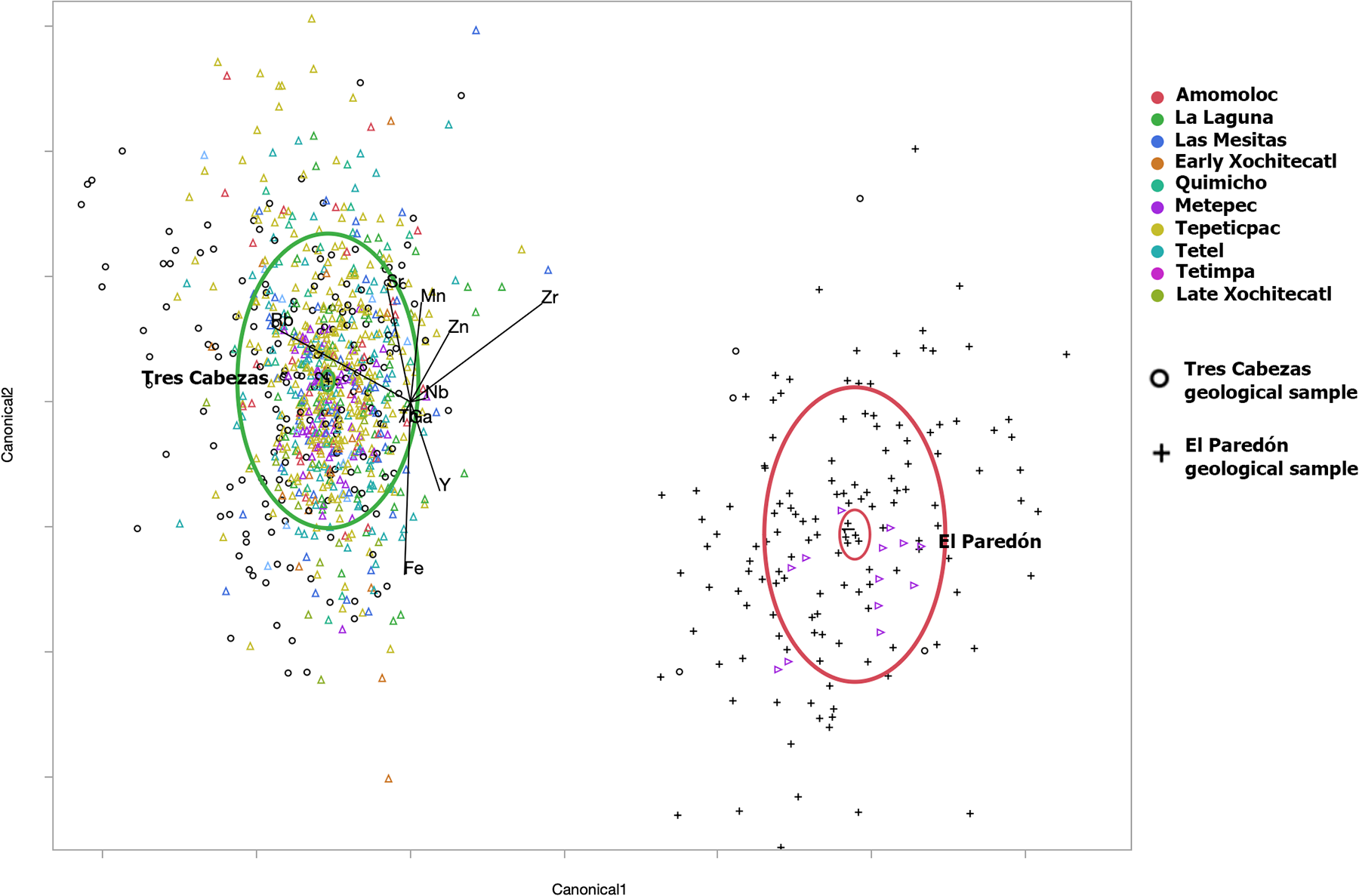
Figure 4 Long description
The scatter plot illustrates geological samples from two sources: Tres Cabezas and El Paredón. The horizontal axis is labeled ′Canonical 1′ and the vertical axis is labeled ′Canonical 2′, representing canonical discriminant analysis scores. The plot reveals two distinct clusters corresponding to the two sources, with Tres Cabezas samples enclosed in a green ellipse and El Paredón samples in a red ellipse. There is limited overlap between the clusters, indicating clear separation. Various colored markers represent different sites, including Amomoloc, La Laguna, Las Mesitas, Early Xochitecatl, Quimicho, Metepec, Tepeiticpac, Tetelpa and Late Xochitecatl. The legend explains the color-coding for each site. Black circles denote Tres Cabezas geological samples, while black plus signs denote El Paredón geological samples. The distribution shows dense clustering within the ellipses, with sparse points outside. No notable outliers are evident. The plot aims to demonstrate the distinct geochemical signatures of the two sources.
The Puebla-Tlaxcala sites
Initial research on subsource identification aimed to determine whether different Formative populations in the Tlaxcala region utilized these materials. Vicencio and colleagues (Reference Vicencio, Corral, Mitrani, Arciniega and Carballo2023) found that the Tres Cabezas subsource was the only source used in this region. The present study expands the chronological scope to assess whether later populations also relied on the same subsource for raw material (Table 2, Figure 5).
Distribution of the obsidian material from each site used in this research.
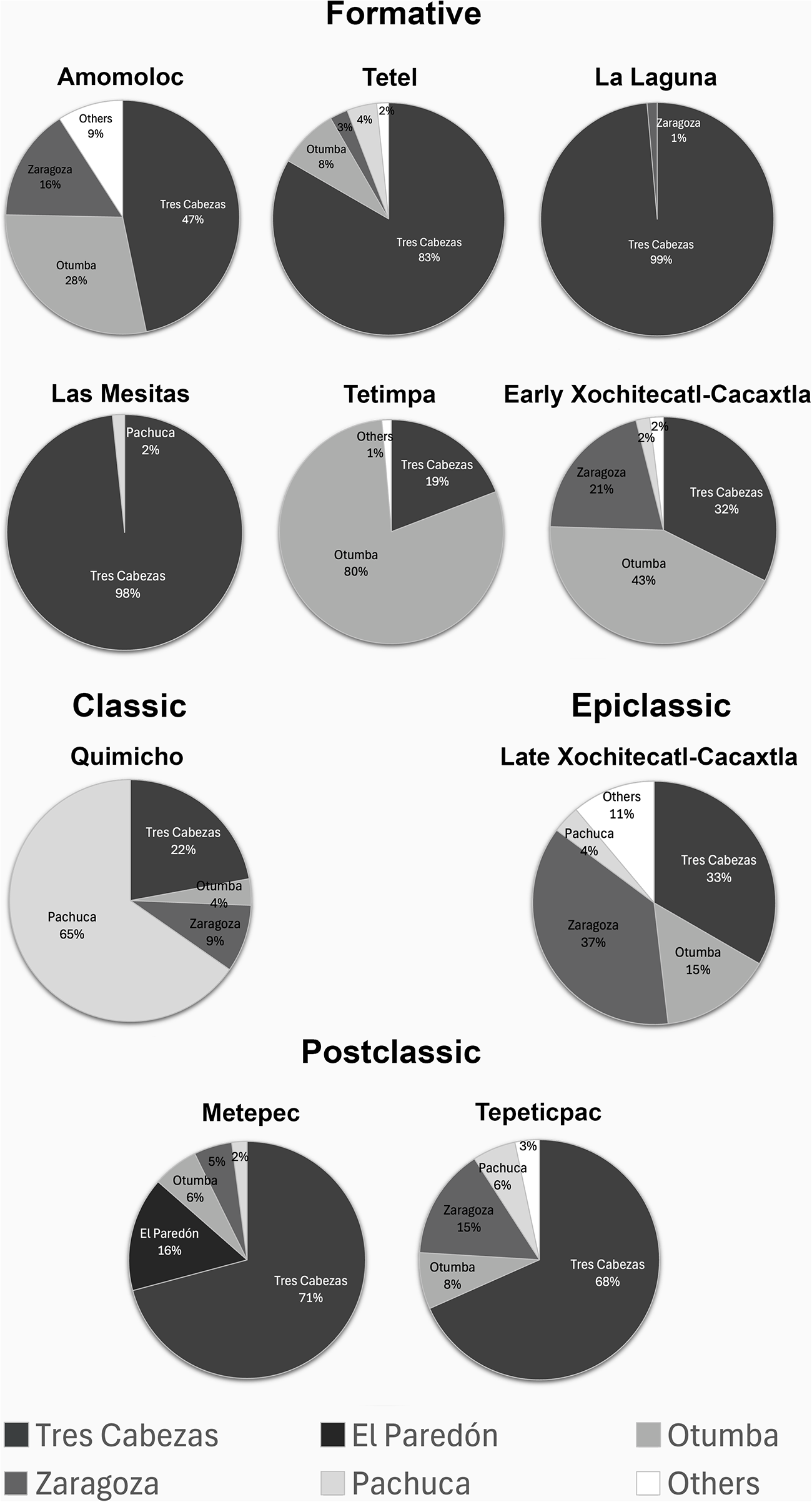
Figure 5 Long description
Formative. Amomoloc: Tres Cabezas 47 percent, Otumba 29 percent, Zaragoza 16 percent, Others 8 percent. Tetel: Tres Cabezas 83 percent, Otumba 8 percent, Pachuca 4 percent, Zaragoza 3 percent, Others 2 percent. La Laguna: Tres Cabezas 99 percent, Zaragoza 1 percent. Las Mesitas: Tres Cabezas 98 percent, Pachuca 2 percent. Tetimpa: Otumba 80 percent, Tres Cabezas 19 percent, Others 1 percent. Early Xochitecatl-Cacaxtla: Otumba 47 percent, Tres Cabezas 32 percent, Zaragoza 21 percent. Classic. Quimicho: Pachuca 65 percent, Tres Cabezas 22 percent, Zaragoza 9 percent, Otumba 4 percent. Epiclassic. Late Xochitecatl-Cacaxtla: Zaragoza 37 percent, Tres Cabezas 33 percent, Otumba 15 percent, Pachuca 2 percent, Others 13 percent. Postclassic. Metepec: Tres Cabezas 71 percent, El Paredón 16 percent, Otumba 6 percent, Zaragoza 5 percent, Pachuca 2 percent. Tepeticpac: Tres Cabezas 68 percent, Zaragoza 15 percent, Otumba 8 percent, Pachuca 6 percent, Pico de Orizaba 3 percent.
General distribution of obsidian analyzed by pXRF from each site used for this research
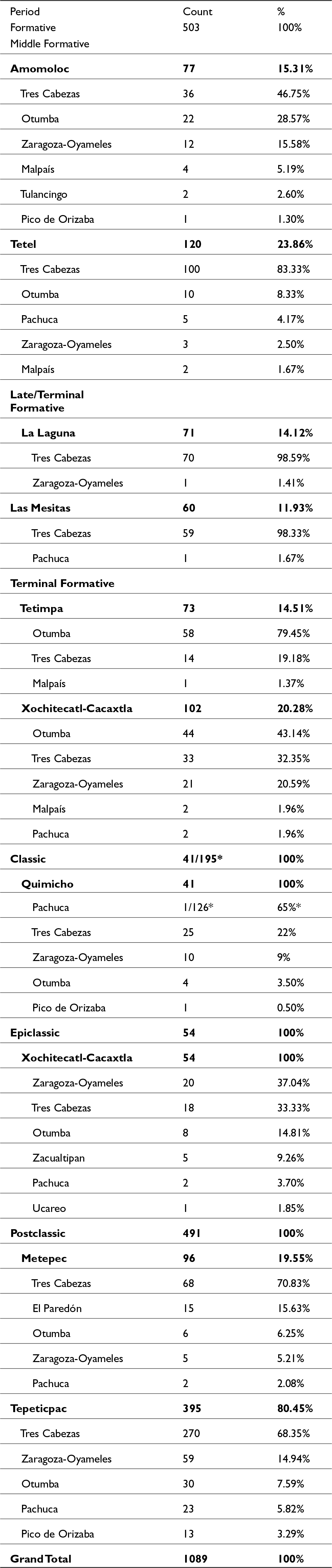
Table 2 Long description
Counts and percentages are listed for obsidian by period, then by site within each period, with a grand total of 1089 and 100 percent. Formative totals 503 and 100 percent, with Amomoloc at 77 and 15.31 percent and Tetel at 120 and 23.86 percent; within Amomoloc, sources include Tres Cabezas 36 at 46.75 percent and Otumba 22 at 28.57 percent, and within Tetel, Tres Cabezas 100 at 83.33 percent with smaller counts from Otumba, Pachuca, Zaragoza Oyameles, and Malpais. Late or Terminal Formative includes La Laguna 71 at 14.12 percent and Las Mesitas 60 at 11.93 percent, each dominated by Tres Cabezas at 70 of 71 and 59 of 60, with one item from Zaragoza Oyameles at La Laguna and one from Pachuca at Las Mesitas. Terminal Formative includes Tetimpa 73 at 14.51 percent, mostly Otumba 58 at 79.45 percent, and Xochitecatl Cacaxtla 102 at 20.28 percent split across Otumba 44 at 43.14 percent, Tres Cabezas 33 at 32.35 percent, and Zaragoza Oyameles 21 at 20.59 percent, plus Malpais and Pachuca at 2 each. Classic is shown as 41 out of 195 with 100 percent, with Quimicho 41 at 100 percent; a separate Classic entry lists Pachuca as 1 out of 126 at 65 percent, followed by Tres Cabezas 25 at 22 percent, Zaragoza Oyameles 10 at 9 percent, Otumba 4 at 3.50 percent, and Pico de Orizaba 1 at 0.50 percent. Epiclassic totals 54 and 100 percent, all from Xochitecatl Cacaxtla, with sources led by Zaragoza Oyameles 20 at 37.04 percent and Tres Cabezas 18 at 33.33 percent, then Otumba 8, Zacualtipan 5, Pachuca 2, and Ucareo 1. Postclassic totals 491 and 100 percent, with Metepec 96 at 19.55 percent and Tepeticpac 395 at 80.45 percent; Metepec is mostly Tres Cabezas 68 at 70.83 percent, and Tepeticpac is mostly Tres Cabezas 270 at 68.35 percent with Zaragoza Oyameles 59, Otumba 30, Pachuca 23, and Pico de Orizaba 13.
* Based on macroscopic general counts
Formative-period sites
The analysis of Formative-period sites is based on the research project led by Lesure (Reference Lesure2014), which focused on four settlements in the Apizaco region of present-day Tlaxcala. Additionally, we included samples from Xochitecatl-Cacaxtla in Tlaxcala and Tetimpa in Puebla, two well-documented sites whose inhabitants participated in a commercial system heavily reliant on obsidian from Otumba (Plunket and Uruñuela Reference Plunket and Uruñuela1998; Plunket et al. Reference Plunket, Uruñuela, Glascock, Neff and Powis2005; Serra Puche and Lazcano Reference Serra Puche and Lazcano2011; Vicencio et al. Reference Vicencio, Corral, Mitrani, Arciniega and Carballo2023). These sites reveal the commercial strategies of populations connected to a distinct regional exchange network that nonetheless acquired material from El Paredón. This study, therefore, focuses on six archaeological sites occupied during the Middle to Late/Terminal Formative period (1200 b.c. to a.d. 100), representing different settlement sizes and exchange networks within the region. A total of 503 obsidian artifacts were analyzed from Amomoloc, Tetel, La Laguna, Las Mesitas, Tetimpa, and the early occupation of Xochitecatl-Cacaxtla, encompassing diverse Formative-period contexts (Table 2).
Apart from Tetimpa, where artifacts were recovered from floors and features in use during the first century a.d., the analyzed material primarily came from bell-shaped pits excavated into the bedrock and chronologically sealed once filled. Ceramic typology, figurine styles, and radiocarbon dates were considered to establish precise chronological assessments for these contexts (Borejsza and Carballo Reference Borejsza, Carballo and Lesure2014; Carballo and Carballo Reference Carballo, Carballo and Lesure2014; Carballo and Lesure Reference Lesure2014; Lesure and Carballo Reference Lesure, Carballo and Lesure2014; Plunket and Uruñuela Reference Plunket and Uruñuela1998, Reference Plunket and Uruñuela2008; Serra Puche and Lazcano Reference Serra Puche and Lazcano2011) (Table 3). Of the 503 obsidian samples analyzed using pXRF, 62 percent (n = 312) were sourced from the El Paredón deposit area.
Earlier research on Formative-period obsidian procurement in the Puebla-Tlaxcala Valley shows the simultaneous operation of multiple exchange networks. In the northcentral portion of Tlaxcala, within the Tlaxcala Corridor (Carballo and Pluckhahn Reference Carballo and Pluckhahn2007; García Cook Reference García Cook, Sabloff and Bricker1981), supply patterns shifted from sourcing obsidian from multiple locations during the Middle Formative to an almost exclusive reliance on El Paredón in the Late Formative (Carballo et al. Reference Carballo, Carballo and Neff2007; Vicencio et al. Reference Vicencio, Corral, Mitrani, Arciniega and Carballo2023). El Paredón, particularly the Tres Cabezas subsource, played a crucial role in the Tlaxcala region. During the Middle Formative, it accounted for approximately 50 percent of the total obsidian used. By the Late Formative, reliance on Tres Cabezas material increased dramatically, representing about 95 percent of the obsidian recovered from Tlaxcala sites (Vicencio et al. Reference Vicencio, Corral, Mitrani, Arciniega and Carballo2023) (Table 2, Figure 5).
In contrast, research on Formative-period settlements such as Tetimpa and Xochitecatl-Cacaxtla, located in the southwestern valley, suggests that these populations were integrated into a commercial exchange network in which the Otumba quarry played a key role. Although these two sites were inhabited from the Middle to the Terminal Formative period, the material analyzed here corresponds to the Late/Terminal Formative period (100 b.c. to a.d. 215) (see Table 3). During the Middle Formative, obsidian data from Xochitecatl-Cacaxtla indicate a slight preference for the El Paredón source (38 percent) over Otumba (33 percent) (Vicencio et al. Reference Vicencio, Corral, Mitrani, Arciniega and Carballo2023:1220). However, this trend shifts in the Late/Terminal Formative period, with Otumba emerging as the dominant source, accounting for 43 percent of the site’s obsidian assemblage (Table 2, Figure 5).
This late-period supply pattern aligns with broader trends observed at western sites such as Tetimpa, Moyotzingo, and Acatepec, where Otumba served as the primary obsidian source during the Late Formative period (Pires-Ferreira Reference Pires-Ferreira and Flannery1976:305; Plunket et al. Reference Plunket, Uruñuela, Glascock, Neff and Powis2005:185). In the present study, Otumba accounts for nearly 80 percent of the obsidian at Tetimpa and 43 percent at Xochitecatl-Cacaxtla, while El Paredón remains a secondary source, contributing 19 percent and 32 percent, respectively (Table 2). These findings are consistent with earlier research at Tetimpa, which reported that between 700–100 b.c, 86 percent of its obsidian was sourced from Otumba, compared to just 8 percent from El Paredón (Plunket et al. Reference Plunket, Uruñuela, Glascock, Neff and Powis2005:185). Together, these patterns hint at a regionally diverse set of procurement strategies during the Formative period. While communities in the southwestern valley increasingly relied on Otumba, groups in the northern region appear to have maintained stronger ties to El Paredón, suggesting a complex and differentiated exchange network across the Puebla-Tlaxcala region.
Classic-period sites
Far less research has been conducted on the Classic period in Tlaxcala. However, one of the most recently excavated sites is Quimicho, located in central Tlaxcala within the Teotihuacan Corridor. This natural communication route, extending from the northwest to the southeast of the Puebla-Tlaxcala Valley, connected various settlements heavily influenced by Teotihuacan. The corridor integrated diverse groups into an extra-regional exchange network, facilitating the dissemination of ideas and cultural innovations across a vast area. As part of this system, Quimicho exhibited several Teotihuacan-related features, including the triadic patio-group, Thin Orange pottery, and two theater-type censers; additionally, substantial quantities of green obsidian from Sierra de Pachuca, Hidalgo—a source strongly associated with Teotihuacan—were recovered at the site (Santacruz and López Corral Reference Santacruz and López Corral2021).
The obsidian assemblage from Quimicho provides a valuable point of comparison with other sites analyzed in this study. Radiocarbon dates associated with an altar indicate an occupation between a.d. 315 and 436, placing Quimicho in the second half of the Classic period (Santacruz and López Corral Reference Santacruz and López Corral2021:23) (Table 3). Although only one distinctive green obsidian sample was included as a control point for geochemical analysis, macroscopic examination revealed that approximately 65 percent of the assemblage exhibited the characteristic green hue of the Sierra de Pachuca deposits (126 out of 195 artifacts recovered). The remaining 35 percent (n = 69) consisted of gray-toned obsidian, of which 41 artifacts were analyzed using pXRF. The combined results of macroscopic and geochemical studies confirmed that while Pachuca was by far the primary source, El Paredón was the second most significant supplier, accounting for 22 percent (n = 25), followed by Zaragoza-Oyameles at 9 percent (n = 10), Otumba at 3.5 percent (n = 4), and Pico de Orizaba at 0.5 percent (n = 1) (Table 2, Figure 5). These findings reveal a procurement system markedly different from those seen in other periods within the region.
Obsidian from Classic-period sites in the Puebla-Tlaxcala Valley provides evidence of the region’s relationship with the Teotihuacan Corridor. Previous studies at Nealtican, a rural Classic-period settlement located 11 km west of Cholula, as well as excavations in Cholula itself, indicate a predominance of Sierra de Pachuca obsidian in this area (Edelstein Reference Edelstein1995:168; Hirth Reference Hirth2013a:139; Hudson Reference Hudson2011:53–57; Uruñuela and Plunket Reference Uruñuela, Plunket, Hirth and Arroyo2020:296). Green obsidian from Pachuca made up approximately 50 to 85 percent of the lithic assemblages at Nealtican and Cholula. At Nealtican specifically, Pachuca obsidian was followed by material from Otumba (18.7 percent) and El Paredón (15.3 percent) (Hirth Reference Hirth2013a:135–136, 139).
The analyzed data from Quimicho reveal a similar pattern, though with notable regional distinctions. Here, El Paredón served as a secondary source to the Sierra de Pachuca deposit. The strong presence of Teotihuacan elements at Quimicho underscores this Tlaxcalan site’s integration into the cultural and economic corridor while keeping distinct regional characteristics. Although Pachuca obsidian was the most extensively used at Quimicho, the evidence also reflects regional procurement patterns that diverged from the typical Teotihuacan supply system. The Teotihuacan procurement model was dominated by Pachuca and Otumba obsidian, with El Paredón playing only a minor role (Carballo Reference Carballo, Hirth and Pillsbury2013:122). During the early phases, El Paredón accounted for approximately 17 percent of the obsidian supply at Teotihuacan (Gazzola Reference Gazzola2009), while in later phases, its presence declined to 2 to 5 percent (Carballo et al. Reference Carballo, Carballo and Neff2007; Glascock and Neff Reference Glascock and Neff1993). At Quimicho, despite Teotihuacan’s substantial influence, the site’s population continued to take part in local exchange networks, maintaining a modest yet meaningful reliance on El Paredón obsidian.
Epiclassic-period sites
Much of what is known about the Epiclassic period in the Puebla-Tlaxcala region comes from Xochitecatl-Cacaxtla during its second occupation. The technological analysis of Epiclassic materials at that site is based on Hirth’s study (Reference Hirth2005), which identifies debitage from a workshop near Cerro Xochitécatl, along with cache deposits in Building 1 (Hirth Reference Hirth2005:11). However, the material analyzed in the present study does not come from the monumental area, but rather from a residential district 4 km east of Xochitecatl, in the present-day town of Nativitas. This area comprises domestic complexes where production activities took place, including ceramic production, small-scale obsidian artifact manufacture, and ritual practices involving obsidian lancets and punches (Gómez Reference Gómez2016; Serra Puche and Lazcano Reference Serra Puche and Lazcano2011; Serra Puche et al. Reference Serra Puche, Lazcano, Blanco, Levine and Carballo2014).
The obsidian analyzed in this study was recovered from bell-shaped pits similar to those found in the Formative period but containing Epiclassic markers and radiocarbon samples dating to a.d. 685 (Serra Puche and Lazcano Reference Serra Puche and Lazcano2011:64) (Table 3). A total of 54 artifacts were examined, identifying six different obsidian sources: Zaragoza-Oyameles was the most represented, accounting for 37 percent (n = 20), followed by El Paredón with 33 percent (n = 18), Otumba with 15 percent (n = 8), Zacualtipan with 9 percent (n = 5), Pachuca with 4 percent (n = 2), and Ucareo with 2 percent (n = 1) (Table 2, Figure 5).
Specific context description associated with the material used in this research, with their radiocarbon dates
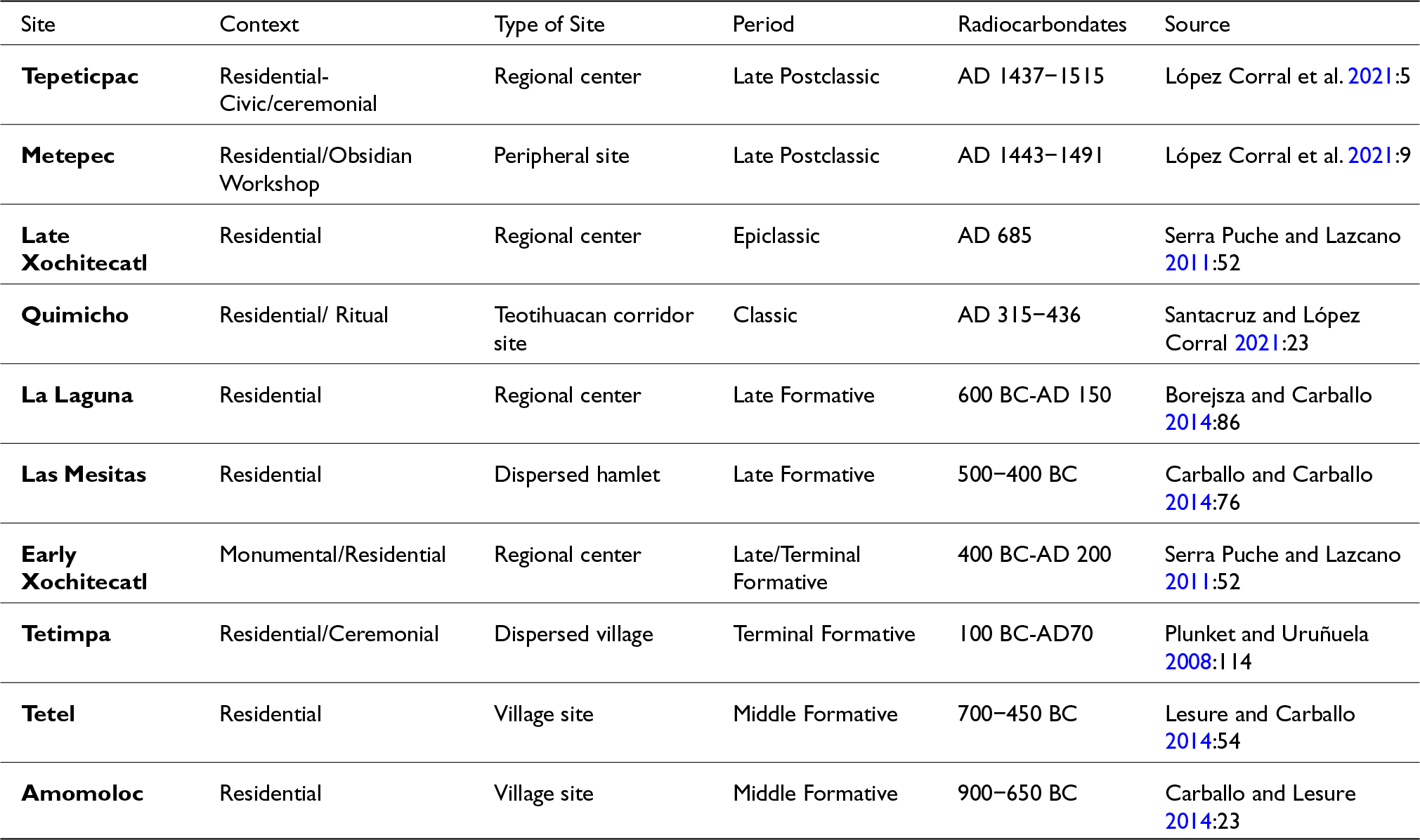
Table 3 Long description
Columns list Site, Context, Type of Site, Period, Radiocarbon dates, and Source for ten entries. Tepeticpac is a residential and civic or ceremonial regional center in the Late Postclassic with radiocarbon dates AD 1437 to 1515. Metepec is a residential and obsidian workshop peripheral site in the Late Postclassic with radiocarbon dates AD 1443 to 1491. Late Xochitecatl is residential, a regional center in the Epiclassic with a radiocarbon date AD 685, and Quimicho is residential and ritual, a Teotihuacan corridor site in the Classic with radiocarbon dates AD 315 to 436. La Laguna is residential, a regional center in the Late Formative with radiocarbon dates 600 BC to AD 150, and Las Mesitas is residential, a dispersed hamlet in the Late Formative with radiocarbon dates 500 to 400 BC. Early Xochitecatl is monumental and residential, a regional center in the Late or Terminal Formative with radiocarbon dates 400 BC to AD 200, and Tetimpa is residential and ceremonial, a dispersed village in the Terminal Formative with radiocarbon dates 100 BC to AD 70. Tetel is residential, a village site in the Middle Formative with radiocarbon dates 700 to 450 BC, and Amomoloc is residential, a village site in the Middle Formative with radiocarbon dates 900 to 650 BC.
The Epiclassic period was marked by significant shifts in settlement patterns and exchange systems. The decline of Teotihuacan and the emergence of new regional centers had profound effects on the Mexican Basin, reshaping trade networks alongside sociopolitical transformations (Parsons and Sugiura Reference Parsons and Sugiura2012). The transition from a predominant reliance on Otumba obsidian during the Formative period to a procurement strategy centered on Zaragoza-Oyameles in the Epiclassic may be linked to the rise of Cantona, a major urban center in northcentral Puebla (García Cook Reference García Cook2019). The proximity of Cantona to the Zaragoza-Oyameles quarry likely made it a key trade hub, integrating both state-controlled systems and local exchange networks (Gazzola Reference Gazzola2005; Knight Reference Knight, Patton and Manion2016). Although Cantona’s influence over the Puebla-Tlaxcala region likely impacted the obsidian supply strategies of Xochitecatl-Cacaxtla (Gazzola Reference Gazzola2005:62–63; Plunket and Uruñuela Reference Plunket and Uruñuela2012:16), El Paredón remained a consistent secondary source for the inhabitants of this prominent settlement.
Postclassic-period sites
The Postclassic material analyzed here comes from two major settlements within the Tlaxcallan conurbated area. One sample originates from the altepetl of Tepeticpac, one of the principal polities of the Tlaxcallan confederacy; the other comes from an obsidian workshop excavated at Metepec, a site located on the outskirts of the urban Tlaxcallan core (López Corral et al. Reference López Corral, Vicencio, Santacruz-Cano, Gentil and Arciniega2021:1).
Tepeticpac, situated in the northern sector of Tlaxcallan, is considered the founding site of the first Teochichimeca, who settled in the region between the twelfth and thirteenth centuries a.d. It consists of a series of terraced sectors with extensive architecture, plazas, and small temples, indicating a civic-ceremonial center primarily inhabited by high-status individuals (López Corral and Santacruz Reference López Corral and Santacruz2011; López Corral et al. Reference López Corral, Vicencio, Santacruz-Cano, Gentil and Arciniega2021).
Metepec, approximately nine kilometers south of Tepeticpac, was in a peripheral region under the direct control of Ocotelulco, another of Tlaxcallan’s major founding settlements (López Corral et al. Reference López Corral, Vicencio, Santacruz-Cano, Gentil and Arciniega2021:2; Rojas Reference Rojas1987:4–5). Evidence from Metepec shows a secondary settlement of lower rank compared to the urban polities. Its obsidian workshop appears to have functioned as part of a commercial system, where peripheral inhabitants served as intermediaries between sources, merchants, and consumers (López Corral et al. Reference López Corral, Vicencio, Santacruz-Cano, Gentil and Arciniega2021). Similar production areas have been identified elsewhere in Tlaxcala, such as Cinco Santos II, a Postclassic rural obsidian workshop north of Tlaxcallan, which supplied artifacts to a broader region (Gentil et al. Reference Gentil, Castellanos and Hirth2021).
A total of 491 obsidian samples were analyzed from both contexts, including 395 from Tepeticpac and 96 from Metepec. Of these, approximately 72 percent (n = 353) originated from the El Paredón deposit. Chronologies based on ceramic materials and radiocarbon dating provided well-defined temporal contexts for both sites. The material from Tepeticpac dates to its main occupation, between a.d. 1437 and 1515, while Metepec was established between a.d. 1443 and 1491 (Table 3). These dates indicate the contemporaneity of both contexts during the Late Postclassic period and highlight the importance of El Paredón obsidian for the Tlaxcallan population (López Corral et al. Reference López Corral, Vicencio, Santacruz-Cano, Gentil and Arciniega2021).
The geochemical analysis revealed patterns consistent with those identified by López Corral and colleagues (Reference López Corral, Vicencio, Santacruz-Cano, Gentil and Arciniega2021), showing a predominance of El Paredón obsidian in both settlements. At Tepeticpac, 68 percent (n = 270) of the obsidian originated from El Paredón, followed by Zaragoza-Oyameles (15 percent), Otumba (8 percent), Pachuca (6 percent), and Pico de Orizaba (3 percent) (Table 2, Figure 5). In contrast, Metepec had obsidian from four sources, with El Paredón being the most significant supplier, accounting for close to 87 percent (n = 83) (which includes both El Paredón and Tres Cabezas subsources), while the remaining material came from Otumba (6 percent), Zaragoza-Oyameles (5 percent), and Pachuca (2 percent).
The Tres Cabezas source and the Puebla-Tlaxcala valley sites
Tres Cabezas in the Formative
The diversity of Formative-period sites attests to the various obsidian procurement strategies in the Puebla-Tlaxcala region. Settlements near the Tlaxcala Corridor primarily relied on El Paredón as their main source from the Middle to Late Formative periods, with its use increasing significantly in the latter. In contrast, Late/Terminal Formative Tetimpa and Xochitecatl-Cacaxtla, located in the southwestern part of the valley, were integrated into a trade network centered on the Otumba deposit. This pattern suggests the existence of at least two distinct regional supply networks, as noted by other researchers (Carballo and Pluckhahn Reference Carballo and Pluckhahn2007; Plunket and Uruñuela Reference Plunket and Uruñuela2012).
According to the statistical analysis, both the Tlaxcala Corridor system and the southwestern sites exclusively relied on Tres Cabezas, with no evidence of the El Paredón subsource. Settlements along the Tlaxcala Corridor, including Amomoloc, Tetel, La Laguna, and Las Mesitas, relied on Tres Cabezas obsidian, similar to groups in the southwest, such as Tetimpa and Xochitecatl-Cacaxtla, which primarily obtained their material from Otumba. This could indicate that Tres Cabezas obsidian was traded widely across settlements, independent of political or commercial affiliations.
The technological analysis of Tres Cabezas obsidian reveals the supply strategies used by the sites examined in this study (Table 4). Within the Tlaxcala Corridor, the material arrived semi-processed, primarily as asymmetrical prismatic cores, following the progressive production strategy (Hirth and Cyphers Reference Hirth and Cyphers2020:92). This means that the obsidian was initially modified (possibly close to the source) into transportable nodules with a prepared platform. Later, at the consumption site, percussion and prismatic techniques were used simultaneously to manufacture final prismatic blades (Hirth and Cyphers Reference Hirth and Cyphers2020:98).
Technological categories for the El Paredón material found in each site
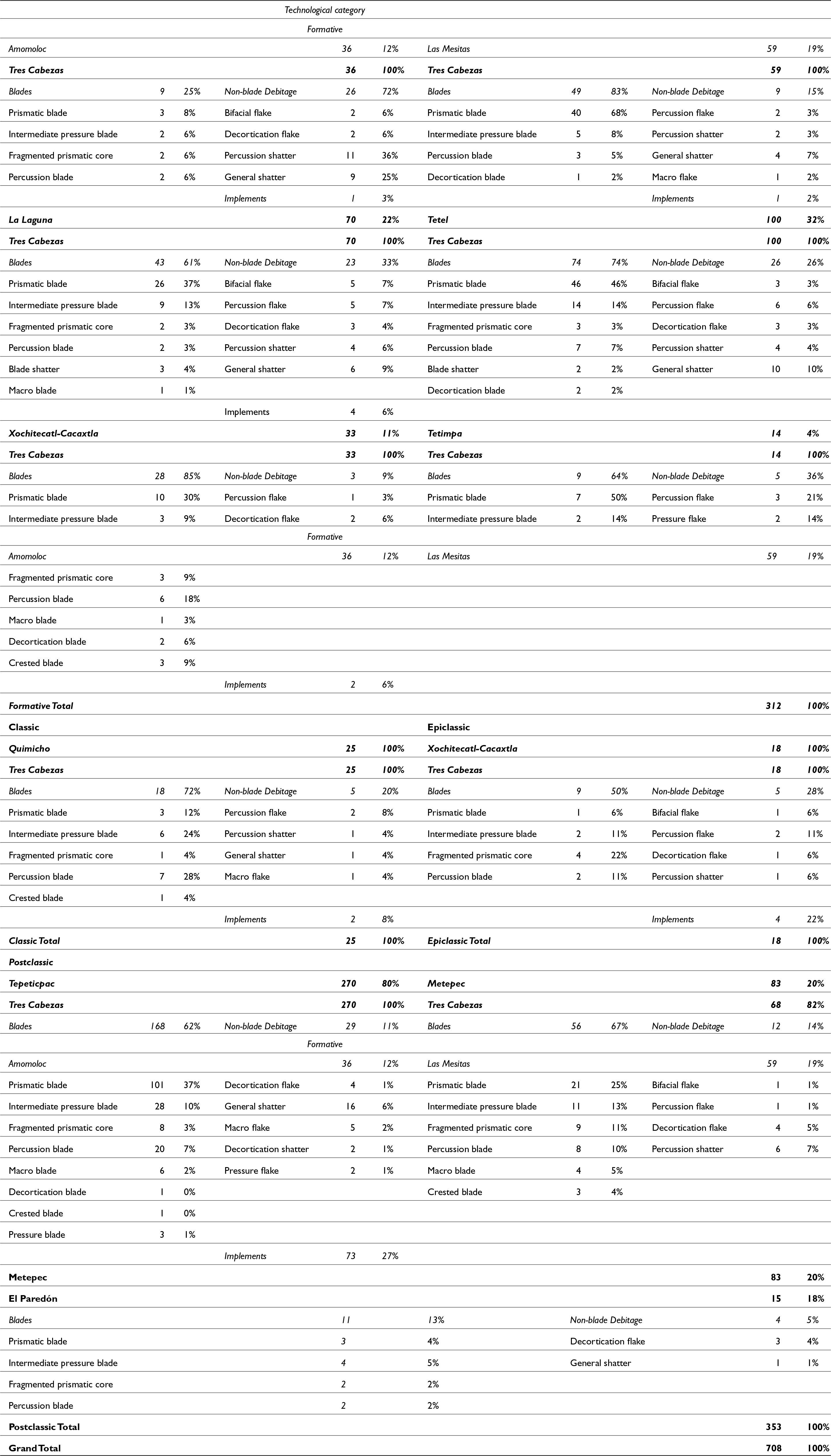
Table 4 Long description
Counts and percentages are listed for technological categories by period and site, with each site tied to the source label, Tres Cabezas. Formative totals 312 items, Classic totals 25, Epiclassic totals 18, and Postclassic totals 353, for a Grand Total of 708 items. In the Formative period, site totals are Amomoloc 36, Las Mesitas 59, La Laguna 70, Tetel 100, Xochitecatl Cacaxtla 33, and Tetimpa 14. Formative category shares by site include Blades at 25 percent in Amomoloc, 83 percent in Las Mesitas, 61 percent in La Laguna, 74 percent in Tetel, 85 percent in Xochitecatl Cacaxtla, and 64 percent in Tetimpa, with Non blade Debitage at 72 percent, 15 percent, 33 percent, 26 percent, 9 percent, and 36 percent respectively. Classic is Quimicho with Blades 18 at 72 percent, Non blade Debitage 5 at 20 percent, and Implements 2 at 8 percent, with blade subcategories including Intermediate pressure blade 6 at 24 percent and Percussion blade 7 at 28 percent. Epiclassic is Xochitecatl Cacaxtla with Blades 9 at 50 percent, Non blade Debitage 5 at 28 percent, and Implements 4 at 22 percent, and a blade subcategory of Fragmented prismatic core 4 at 22 percent. Postclassic includes Tepeticpac with 270 items and Metepec with 83 items, and within Tepeticpac Blades are 168 at 62 percent while Implements are 73 at 27 percent; within Metepec Blades are 56 at 67 percent and Non blade Debitage is 12 at 14 percent. A separate Postclassic block lists Metepec with El Paredón 15 at 18 percent, with Blades 11 at 13 percent and Non blade Debitage 4 at 5 percent, and blade subcategories including Intermediate pressure blade 4 at 5 percent and Prismatic blade 3 at 4 percent.
The presence of debitage and prismatic blades at each site was highly consistent, indicating local blade production for a limited number of consumers (Vicencio et al. Reference Vicencio, Corral, Mitrani, Arciniega and Carballo2023:1227, Walton and Carballo Reference Walton and Carballo2016:127). It is also possible that, alongside the blade industry, there was an expedient percussion flake industry by unskilled craftspeople aimed at producing irregular flakes. The constant presence of percussion flakes, accounting for 3 to 21 percent of the material, could indicate a small production of expedient flakes at the consumption sites. In any case, regardless of the industry, each site received material from Tres Cabezas primarily for local use.
These findings align with previous technological analyses of more than 36,000 obsidian artifacts from La Laguna (Walton and Carballo Reference Walton and Carballo2016). Researchers identified a localized production system aimed at supplying each household independently with a diverse range of tools, without elite sponsorship. This body of evidence reveals a standardized blade-production system at each site within the Tlaxcala Corridor, carried out autonomously to meet the needs of individual consumption groups.
The small number of obsidian artifacts from Tres Cabezas at Tetimpa (n = 14) and Xochitecatl-Cacaxtla (n = 33) shows technological similarities with the northern settlements (Table 4). As observed in previous research, these materials entered the site as macro-cores and polyhedral cores from which pressure blades were extracted (Plunket et al. Reference Plunket, Uruñuela, Glascock, Neff and Powis2005:184). The assemblages include percussion and pressure flakes, pressure blades from intermediate stages, and prismatic blades as the final product. It is possible that the inhabitants of Tetimpa, and even Xochitecatl-Cacaxtla, acquired some finished blades through workshops in the Apan plains, as described by Plunket and colleagues (Reference Plunket, Uruñuela, Glascock, Neff and Powis2005:187). However, they may have also employed procurement strategies like those of the Tlaxcala Corridor sites, potentially involving itinerant artisans with connections to Tres Cabezas.
During the Formative period, direct procurement and visits by local and itinerant artisans to the Tres Cabezas subsource may have been a practical strategy for obtaining obsidian. This scenario is particularly plausible for settlements closer to the source along the Tlaxcala Corridor. This interpretation supports the expected archaeological evidence for this model, including debitage from initial and intermediate production processes and the low frequency of exhausted prismatic cores at each site. Additionally, the overwhelming reliance on Tres Cabezas as the primary source among Late Formative populations indicates that local artisans deliberately selected it as their primary raw material.
The consistency of production processes using Tres Cabezas obsidian across different sites shows that, in addition to local specialists, itinerant craftsmen operated within a broader regional network. The high demand for Tres Cabezas obsidian in northern Tlaxcala required frequent visits to the source to supply the growing population. While this pattern may reflect local artisans regularly traveling to obtain material, a more regional model suggests that both local and nonlocal itinerant artisans played a role in distributing obsidian throughout the Puebla-Tlaxcala Valley. These could have obtained obsidian directly from the source or, in some cases, acquired preshaped cores from Tres Cabezas vendors. They would then travel across extensive areas, supplying nearby regions such as the Tlaxcala Corridor as well as more distant sites like Tetimpa and Xochitecatl-Cacaxtla. The uniformity of production techniques seen in these Formative settlements aligns with this interpretation, proposing that specialized itinerant craftspeople followed a standardized manufacturing process, possibly following a progressive reduction strategy (Hirth and Cyphers Reference Hirth and Cyphers2020:84).
Tres Cabezas in the Classic
Classic-period Quimicho offers important insights into interregional exchange patterns distinct from all the other sites yet still preserving regional connections. All documented El Paredón material at the site originated from the Tres Cabezas subsource. The typical Teotihuacan obsidian procurement model was dominated by Pachuca and Otumba, with only minor imports from El Paredón (Carballo Reference Carballo, Hirth and Pillsbury2013:122; Carballo et al. Reference Carballo, Carballo and Neff2007:37). Although Quimicho was part of the Teotihuacan Corridor, its inhabitants maintained ties to local economies, consistently using Tres Cabezas as a secondary source. Apparently, despite Teotihuacan’s strong influence, Quimicho remained integrated into a regional exchange network established during the Formative period. The continued availability of Tres Cabezas obsidian during the Classic period shows that this commercial system operated openly and without direct political control.
The Tres Cabezas material revealed a diverse range of technological sequences. At Quimicho, obsidian included early-stage blade reduction products such as crested blades (lamacrete), percussion blades, macro-flakes, and percussion flakes. Additionally, intermediate-stage pressure blades, prismatic blades, and fragments of exhausted prismatic cores were found. This data shows that the material also arrived at the site, possibly as macro-cores, from which percussion and pressure blades were produced. It is still possible that artisans followed a progressive production sequence to reduce the Tres Cabezas material, as evidenced by irregular blades and percussion and pressure-produced pieces that could have been manufactured simultaneously. However, it is also likely that a sequential strategy for blade production was already in place, based on the two-step, sequential process (Hirth and Cyphers Reference Hirth and Cyphers2020:84). Either way, the material from Tres Cabezas arrived at Quimicho in less processed forms, needing more percussion practices before moving on to pressure techniques.
Evidence from the Classic period argues for a more extensive network of simultaneous exchange systems. The presence of artifacts from Tres Cabezas at Quimicho, including pieces from intermediate reduction stages and only one exhausted core, may indicate the involvement of independent itinerant artisans who may have obtained obsidian through direct visits to the source or via indirect procurement.
The obsidian trade model seen in the southwestern part of the valley, at sites such as Cholula and Nealtican, hints that artisans supplied blades to consumers through local markets. However, it remains uncertain whether this system was fully established during the Classic period, as it becomes more evident in the Epiclassic (Hirth Reference Hirth2013a:139). Additionally, green obsidian from Pachuca was likely obtained through a more systematized, state-sponsored model (Hirth Reference Hirth2008; Spence Reference Spence, McClung and Rattray1987), while itinerant artisans supplying Tres Cabezas material may have operated independently, engaging in direct trade with consumers. These patterns suggest the existence of a specialized group of artisans connected to the Tres Cabezas source who provided material to various sites despite Teotihuacan’s commercial dominance.
Tres Cabezas in the Epiclassic
Although the Epiclassic period was marked by social, political, and economic transformations, Tres Cabezas remained the only identified subsource from the El Paredón deposit. Data from the residential area of Xochitecatl-Cacaxtla during its second occupation demonstrate a shift in obsidian procurement compared to the Formative period, when Otumba was the primary source. During the Epiclassic, the Zaragoza-Oyameles quarry became the main supplier, while Tres Cabezas remained a secondary source. Despite changes in the region’s primary suppliers, material from El Paredón continued to come exclusively from Tres Cabezas. Thus, it would appear that specialized merchants with strong ties to the subsource consistently distributed obsidian to the region despite shifting social and commercial dynamics.
The technological analysis of Tres Cabezas material from the residential spaces of Epiclassic Xochitecatl-Cacaxtla aligns with procurement models seen in earlier periods. The technological characteristics indicate local blade production from preshaped cores. The presence of decortication flakes, macro-flakes, blades, and percussion flakes indicates that crafters employed percussion and pressure techniques to produce prismatic blades. Additionally, the proportion of fragmented prismatic cores (22 percent, n = 4) is notable compared to other sites. The obsidian recovered from refuse-filled pits appears to be discarded production debris rather than finished products, such as prismatic blades, which are scarce (only one out of 18 pieces related to this subsource). Nevertheless, the evidence signals small-scale local blade production from partially processed cores. Furthermore, given the consistent identification of percussion flakes, it is also possible to observe a local production of percussion flakes, possibly made by nonspecialized individuals, as seen in the other sites discussed here (Table 4). The Tres Cabezas percussion cores were likely acquired through indirect, down-the-line procurement strategies.
The data presented here point to the involvement of itinerant or local artisans in supplying obsidian artifacts to the Puebla-Tlaxcala population. During the Epiclassic period (a.d. 650–900), itinerant artisans and resident crafters are known to have produced blades for domestic consumption in marketplaces, as observed at Xochicalco, Morelos (Hirth Reference Hirth1998, Reference Hirth2008, Reference Hirth2009). This indicates the presence of artisans who may have continued the tradition of itinerant obsidian production near residential areas. However, obsidian exchange through market systems, like those at Xochicalco, suggests that local crafters may have obtained obsidian cores through trade and then produced blades and percussion flakes locally. The increasing diversification of procurement strategies attests to a gradual evolution of commercial exchange from the Classic period, culminating in the advanced market networks seen in Tlaxcallan during the Postclassic period.
Tres Cabezas in the Postclassic
One of the most significant pieces of evidence regarding the supply patterns from El Paredón to the Puebla-Tlaxcala Valley emerges during this period. While previous data indicate that the Tres Cabezas subsource was the only one utilized by populations thus far, the El Paredón subsource is documented exclusively at the Metepec workshop. This site represents the only known context where both subsources are present, providing a better understanding of the procurement strategies employed by artisans to sustain a densely populated area. Notably, this settlement was reportedly subject to a trade embargo imposed by the Aztec Empire in the final years of the Late Postclassic period (Gentil et al. Reference Gentil, Castellanos and Hirth2021; López Corral et al. Reference López Corral, Vicencio, Santacruz-Cano, Gentil and Arciniega2021).
Unlike earlier times, obsidian in the Postclassic arrived in a less refined state. The technological analysis of the Metepec assemblage, which includes both Tres Cabezas and El Paredón obsidian, shows clear production sequences associated with prismatic blade manufacture (Table 4). The presence of percussion traces demonstrates that local artisans played a more active role in processing the material. Overall, the technological evidence reflects that the obsidian arrived as macro-cores and polyhedral cores, some showing signs of decortication and percussion, requiring further reduction before blade production. In the workshop, these cores were processed to produce prismatic blades for export to nearby towns. The material from Tres Cabezas aligns with this pattern, as it includes decortication flakes, macro-blades, and a considerable number of intermediate pressure and prismatic blades (see Table 4). The obsidian from the El Paredón subsource at the Metepec workshop, though limited in quantity (only 15 pieces), exhibits similar characteristics to those of Tres Cabezas. The production sequence includes decortication flakes, percussion blades, intermediate pressure blades, prismatic blades, fragments of exhausted prismatic cores, and general shatter. Thus, El Paredón obsidian might also have arrived as macro-cores and polyhedral cores, which local artisans processed into prismatic blades for regional distribution.
The data from Metepec uncover the commercial dynamics of the Postclassic period. The substantial presence of percussion techniques on obsidian from both subsources suggests that Metepec was not supplied by itinerant artisans but rather by specialized merchants associated with the broader El Paredón quarry area. Unlike itinerant artisans, who typically transported highly reduced pressure cores (Hirth Reference Hirth and Hirth2006a, Reference Hirth2008), Postclassic merchants moving around the Puebla-Tlaxcala Valley appear to have moved obsidian without significant reduction processes. This indirect procurement strategy allowed workshops to maximize the use of raw material, processing it into prismatic cores, blades, and other artifacts, such as dart points (López Corral et al. Reference López Corral, Vicencio, Santacruz-Cano, Gentil and Arciniega2021).
The obsidian recovered from the urban site of Tepeticpac presents a very different scenario from that seen at Metepec. All the obsidian associated with the El Paredón deposit area came exclusively from the Tres Cabezas subsource. It was imported at intermediate stages of reduction, but the presence of exhausted prismatic cores and debitage indicates small-scale, in situ production of prismatic blades. This small-scale blade production was likely carried out by itinerant artisans or by local blademakers. However, the high prevalence of prismatic blades, compared to percussion and intermediate pressure blades, could suggest the presence of itinerant craftspeople who traveled with polyhedral cores in advanced reduction sequences from which prismatic blades were made. It seems that the population of Tepeticpac acquired obsidian at intermediate and final production stages, likely through indirect procurement strategies. These may have included supply chains involving intermediate workshops such as Metepec, marketplace exchanges with artisans from local workshops, or itinerant craftspeople producing artifacts near consumption areas.
The Postclassic sites illustrate the range of options available to the populations for acquiring obsidian artifacts. This offers valuable data into the commercial and production dynamics of the period, as well as the procurement strategies employed by local and itinerant artisans in the Tlaxcallan region. The roles of Tepeticpac and Metepec, as very distinctive socioeconomic scenarios, help clarify the strategies communities in the Puebla-Tlaxcala Valley used to obtain essential goods, such as cutting tools.
Obsidian procurement and distribution in the Puebla-Tlaxcala region
Based on the information presented in this article and earlier research (Vicencio et al. Reference Vicencio, Corral, Mitrani, Arciniega and Carballo2023), the diachronic results from nine sites spanning the Middle Formative to the Late Postclassic periods show that most obsidian attributed to the El Paredón deposit area originated specifically from its Tres Cabezas subsource. The material is associated with a local production sequence of percussion and pressure blades. Technological analysis of the Tres Cabezas material indicates that Formative blademakers may have followed a progressive reduction sequence, combining percussion and pressure flaking to produce prismatic blades (Hirth and Cyphers Reference Hirth and Cyphers2020:84). By the Classic period, artisans might have moved to the more common sequential production strategy, based on percussion techniques, followed by pressure flaking in order to produce prismatic blades (see supplementary material). However, the presence of irregular percussion-pressure blades and half-cylindrical exhausted cores at sites like Tepeticpac (Hirth and Cyphers Reference Hirth and Cyphers2020:113; Vicencio Reference Vicencio2015:51) might suggest that the progressive sequence persisted into later periods.
The consistent evidence of non-blade debitage at each site, along with the blade industry, suggests a smaller-scale production focused on creating expedient percussion flakes. This industry may have been carried out not by specialized artisans but by agents with basic obsidian skills. This Tres Cabezas material could have been acquired indirectly, via market or down-the-line exchange. However, the evidence shows that this was a complementary enterprise to the blade acquisition and was held on a much smaller scale.
Evidence of blade production at each site clarifies the distribution processes undergone by artisans using Tres Cabezas obsidian, which was primarily transported as macro-cores and polyhedral cores and subsequently reduced into prismatic blades at each location. The presence of percussion and intermediate pressure blades at all sites supports this pattern. Additionally, manufacturing remained at a small scale (except for the Metepec workshop), showing a focus on local consumers rather than large-scale production for long-distance trade. These findings imply that the technological processes associated with Tres Cabezas remained relatively stable from the Formative to the Late Postclassic periods. However, maintaining this continuity required ongoing adaptations in supply patterns across different regions.
Much of what is examined in this article relates to socioeconomic dynamics between the populations near the El Paredón deposit area and the various communities that relied on its material. The Tres Cabezas subsource, covering approximately 23 square kilometers, could have been easily controlled by local groups, making it essential to understand how access to this resource was managed. The technological evidence, combined with the economic diversity of the Puebla-Tlaxcala region, indicates that procurement strategies evolved from independent methods to more complex systems involving cooperation between local groups for production and distribution.
The strongest evidence for independent procurement through direct source visitation comes from Formative contexts, particularly those in the Tlaxcala Corridor. The proximity of these settlements to Tres Cabezas implies a direct relationship between suppliers and consumers, with each population establishing secure networks based on distance and accessibility. For populations in the Tlaxcala Corridor, Tres Cabezas was the most viable option, provisioning up to 96 percent of the obsidian during the Late Formative period. This proximity may have fostered strong relationships between the inhabitants of Tlaxcala and those settled near Tres Cabezas. In contrast, more distant settlements such as Tetimpa and Xochitecatl-Cacaxtla likely relied on indirect procurement systems, including nonlocal itinerant artisans who functioned as full-time traders supplying more remote areas of the valley.
By the Classic period, procurement strategies appear to have shifted from direct acquisition to more structured exchange networks. The dominance of Teotihuacan over the Tlaxcala Corridor influenced regional trade, reducing Tres Cabezas to a secondary source. However, its obsidian remained more prevalent than that from Otumba, a quarry adjacent to the Teotihuacan Valley. This could indicate a supply network of itinerant artisans producing pressure blades with obsidian from Tres Cabezas still active despite Teotihuacan’s interregional influence.
During the Epiclassic and Postclassic periods, obsidian procurement became increasingly organized through indirect exchange systems. The evidence from Metepec shows how obsidian workshops functioned as intermediaries between deposits and consumers, importing raw materials from multiple sources. This scenario suggests the involvement of specialized merchants rather than itinerant artisans. These merchants supplied workshops with minimally shaped cores, macro-cores, and polyhedral cores, a process that would not have been feasible for itinerant traders. Supplying less processed material allowed artisans greater flexibility in shaping the raw material to meet the specific demands of regional consumers. While similar workshops may have existed in earlier periods, the available data indicate that the tradition of itinerant artisans moving through the region to produce specialized obsidian blades, first established during the Formative period, persisted into the Late Postclassic.
The technological consistency across the diachronic framework shows that apparently itinerant artisans with strong ties to the Tres Cabezas subsource continued operating beyond the Formative period, adapting alongside evolving mercantile systems. This would explain the persistent presence of Tres Cabezas obsidian despite shifting socioeconomic conditions. As more complex exchange networks developed, a cooperative system of itinerant crafters and merchants from Tres Cabezas likely emerged, working in an organized manner to reduce time costs associated with direct source visitations and ensuring a steady supply to a broader region. The systematic trade routes established by these itinerant artisans across the Puebla-Tlaxcala Valley may have also facilitated long-term interactions between traders and local populations, reinforcing the prolonged use of Tres Cabezas obsidian.
The information presented in this article provides new lines of data for understanding the commercial and sociopolitical relationships within the Puebla-Tlaxcala Valley. The results align with a commercial system based on a semi-independent yet cooperative relationship between merchants, artisans, and consumers. This crafting and exchange system also offers insight into the political dynamics between regional and extra-regional centers. Additionally, the evidence highlights the role of market exchange in facilitating obsidian distribution, particularly in later periods. Recognizing the participation of artisans and merchants throughout this region’s history sheds light on exchange systems that fluctuated in response to social preferences and economic transformations. Despite political shifts, these procurement networks remained functional in the Puebla-Tlaxcala Valley for millennia.
Conclusion
This study looks to clarify the procurement and production strategies of obsidian blade artifacts in the Puebla-Tlaxcala Valley, tracing the evolution of socioeconomic dynamics from the Formative to the Postclassic periods. The analysis confirms the two hypotheses established in this study. First, the procurement strategies for Tres Cabezas material varied according to accessibility and the broader socioeconomic transformations occurring in the valley. Within the four models established by Hirth (Reference Hirth, Bondar, Glascock, Vonarx, Daubenspeck and Hirth2006), consumers employed different approaches, including direct and indirect procurement models, using trade networks to obtain high-quality materials in a consistent and reliable manner. Additionally, the evidence supports an alternative procurement strategy involving an inter-artisan system of semi-independent itinerant crafters with strong ties to the Tres Cabezas subsource. These artisans, possibly linked by cultural affiliations, managed a formalized exchange network that allowed them to supply the region for millennia, adapting their strategies to changing circumstances.
The results demonstrate that most obsidian attributed to the El Paredón deposit area actually originated from its Tres Cabezas subsource. The persistence of Tres Cabezas material across various periods proves its pivotal role in the region’s obsidian economy. The continuous supply of this material, facilitated by both direct quarry visitation and trade networks, underscores the complex and adaptive nature of procurement strategies. This dynamic system, characterized by a combination of independent and cooperative efforts, reveals the intricate commercial and sociopolitical relationships that sustained economic stability in the Puebla-Tlaxcala Valley despite the challenges posed by competing exchange networks and political changes over time.
Supplementary material
The supplementary material for this article can be found at https://doi.org/10.1017/S0956536126101060.
Funding statement
Sistema Nacional de Investigadores (Grant/Award No: CB239609, INFRA-CONACyT 2014-225845, LN314846, LN315853); Dirección General de Asuntos del Personal Académico, Universidad Nacional Autónoma de México (Grant/Award No: UNAM PAPIIT IN113224).


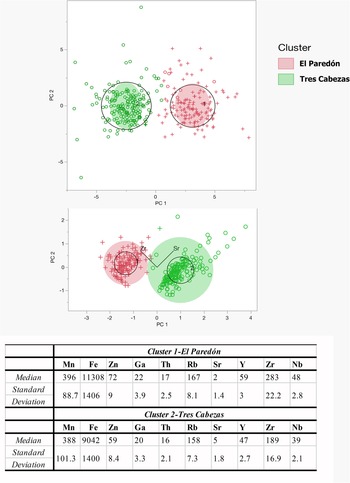


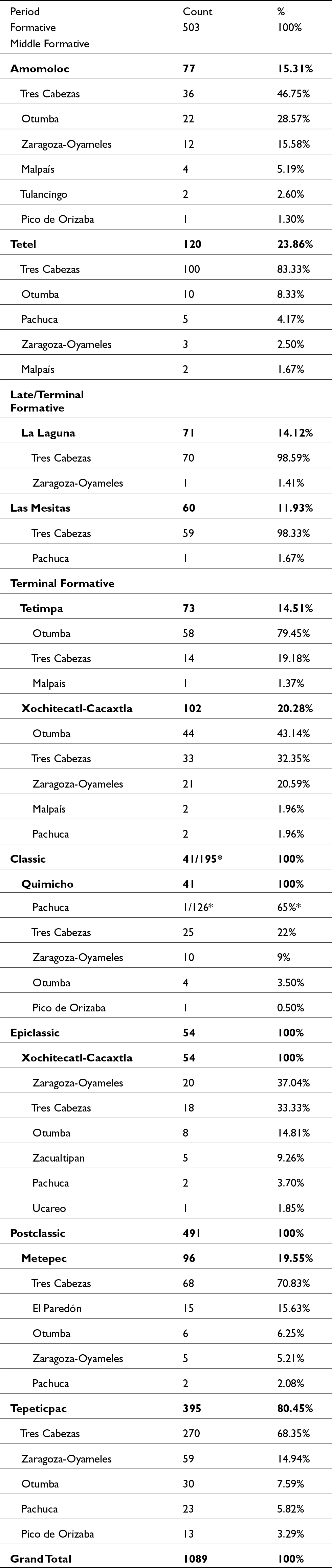
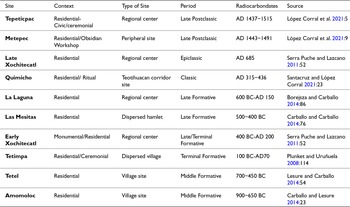
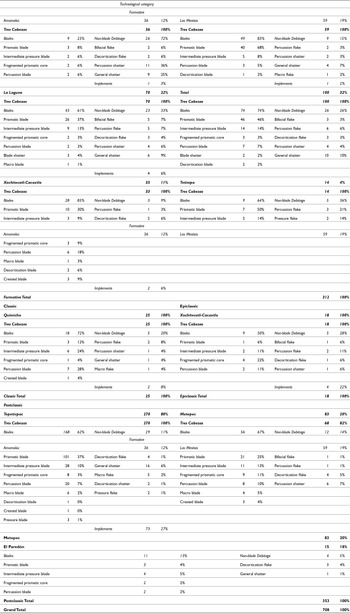


 Open access

