What is the impact of library instruction on creative work?
Finding an authentic measure for the impact of library instruction on studio learning is challenging. Even in traditional classroom environments, learning may not be not evident until the end of the semester when the final work is reviewed and assigned a grade. Post instruction testing at the end of library instruction often yields shallow results. While it may show evidence of student recall of the material presented (remembering), it cannot measure any subsequent impact on the student's creative and cognitive processes such as understanding, applying, analyzing, evaluating, and creating, which extends through the completion of the course and includes the final critique.
The library's instruction program includes a post-instruction survey sent to faculty at the end of the semester in which students receive library instruction. The survey asks for a response to the amount of improvement in student learning based on three qualitative choices: student learning showed little or no improvement, some improvement, or significant improvement. Annually, over half the responses report student learning improved significantly due to the inclusion of a library research workshop. While this validates the value of library instruction from the faculty perspective, how might librarians take a deeper and more direct qualitative measure of how research and information literacy affect student learning? How might librarians impact and contribute to a culture of research on campus?
In Fall 2014, Rhode Island School of Design began preparing for accreditation. Within the library, instruction assessment was being discussed and the draft of the ACRL Framework for Higher Education had just been distributed online. These events prompted the graduate library instruction coordinator to formulate a way to talk about and show evidence of research and the impact of research concepts in the studio critique setting. She set out to describe, track, and assess evidence of learning and instances of research in the transliterate, multimodal, self-reflective environment of the studio critique. As a practicing artist as well as librarian, the author's experience includes participating in studio critiques as an undergraduate, an MFA candidate, college art instructor, guest critic and finally, art librarian. The studio critique is a dynamic social, learning environment in which work is discussed and examined; transliterate, multimodal communication is at the core of the experience.
Transliteracy, multimodality, and self-reflection in the studio critique
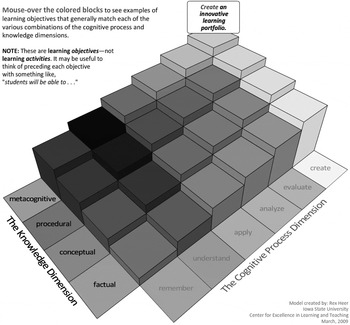
Bloom's revised taxonomy illustrates the intersection of the cognitive and knowledge dimensions of learning. (figure 1) Creation is the learning objective situated at the peak of Bloom's revised taxonomy, at the intersection of metacognition and creation. Art students have an affinity for bringing together all manner of materials, peer participation, concepts, skills, and sources in the service of their art. This ability to draw inspiration from disparate, transliterate sources is critical to the creative process. The studio critique is an extended discussion, visual exploration, and reflection upon the creative processes which culminate in a work of art. The student whose work is being critiqued may cite artistic precedents or be asked to what other artists she looks for inspiration. The student may reference another artist's technique, methods, composition, subject matter, materials, media, or readings as critical to her own development. Advanced studio work engages questions of larger context, situating one's work in relation to genre, art historical movements, socio-political positions, the spectrum of personal identity, aesthetic sensibilities, or a philosophical stance. Advanced students show evidence of a holistic conceptual development as realized in the artwork itself. The art concept may combine multimodal elements: visual, spoken, time-based, performative or written forms. During the critique the student may reflect upon her research process in pursuit of the finished work and insights that may have occurred.
Rex Heer. Revised Bloom's Taxonomy, 2009. Flash version. Iowa State University, Center for Excellence in Learning and Teaching.

The term transliteracy is defined as “the ability to read, write and interact across a range of platforms, tools and media from signing and orality through handwriting, print, TV, radio and film, to digital social networks.”Footnote 1 Transliteracy accurately describes the fluency with which artists and designers work with and across multiple formats, platforms, media, and methods. Transliteracy does not privilege text over other media and provides a holistic framework in which to think about the roles art students expect to play in using, developing and interacting with library collections, and, with information in all its forms. In her role as research and instruction librarian, the author recognizes and facilitates art students’ transliterate approach to resources- library and otherwise- to create meaning and communicate their ideas. This knowledge continually guides and informs her teaching and individual research meetings with students.
Multimodality is defined as “encompassing a number of different delivery formats, presented cohesively and synchronously, as images, videos, sound, and text”.Footnote 2 Multimodality supports diverse learning styles including visual learning, while offering art students an opportunity to choose, experiment with, and combine diverse modes of communication.
The ACRL Framework discusses core ideas which anchor the concepts in the Framework including metaliteracy and meta-cognition or “critical, self-reflection”. They are key to understanding and supporting self-directed student learning.Footnote 3
Identifying Transliteracy, Multimodality, and Self-Reflection in the Post Research Workshop Assessment Criteria Chart
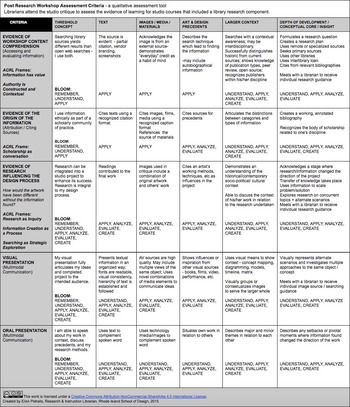
The chart (figure 2) guides the librarian to look for parallels in cognitive expressions connecting the research processes included in the library research workshop to aspects of a self-reflective studio practice as articulated by studio critique criteria. The librarian's presence in the critique is a form of action research eliciting meta-cognition about the studio critique as an authentic site for qualitative art research assessment and self-reflection on one's teaching practice for studio courses.
Post Research Workshop Assessment Criteria Chart, 2015. Fleet Library, Rhode Island School of Design.

The chart incorporates elements from two descriptive educational objectives systems: cognitive processes from Bloom's Revised Taxonomy of Educational ObjectivesFootnote 4 , and information literacy threshold concepts from the ACRL Framework for Higher Education. ACRL introduced six information literacy threshold concepts in its Framework for Information Literacy in Higher Education. The six concepts are: authority is constructed and contextual, information creation as a process, information has value, research as inquiry, scholarship as a conversation, and searching as strategic exploration.Footnote 5 Threshold concepts describe learning experiences in which a student's practice is significantly transformed. Further, threshold concepts are described as having five characteristics: they are integrative, transformative, irreversible, bounded (by discipline) and troublesome.Footnote 6 ACRL's information literacy threshold concepts guide librarians to think broadly about literacy, learning, and habits of mind. They describe a spectrum of knowledge practices and attitudinal dispositions.
The chart combines the multimodality of visual, text, media, and oral communication as well as advanced contextual and conceptual development addressed in studio critique. Criteria include the use of text, images, multimedia, materials, identifying art and design precedents, setting the work in a larger context, depth of conceptual development, insight (self-reflection), oral communication, and visual communication. Five first-person statements have been incorporated into the chart under the heading, threshold concept. These statements describe what the concept would look like in a student who embodies the combined information literacy concept and cognitive state. An example is the statement: I use information ethically as part of a scholarly community of practice. A student who has crossed through this particular threshold has internalized the ethical use information (ACRL Frame: Scholarship as conversation) and has remembered, understood, and applied (Bloom) this concept to her working habits. Ideally, those habits would include the ethical use of text, images, media, citing art precedents, and situating her work within a larger context while also demonstrating a substantial depth of development and insight about her work and creative processes which correspond to Bloom's higher cognitive dimensions of analysis, evaluation, and creation. Advanced studio critique criteria include art and design precedents, larger context, and depth of development in core concepts which contribute to insights into one's creative process.
Using the Post Research Workshop Assessment Criteria Chart
The studio critique can take many forms. Faculty define specific parameters and etiquette for the critique to follow. These may include any of the following: the time each student is given to discuss her work, the order in which works are discussed, assigning a note-taker for the student whose work is being critiqued, and general guidelines about how the critique will progress.Footnote 7 To attend a critique is to step into a specialized space which requires a respectful presence. At RISD, the author brings the assessment chart to the critique for reference and takes notes in a blank notebook during the presentations and discussion. The survey is filled out after leaving the critique. The chart's detailed descriptions and examples prompt the librarian to reflect upon and draw parallels from her critique notes to form a holistic, qualitative assessment.
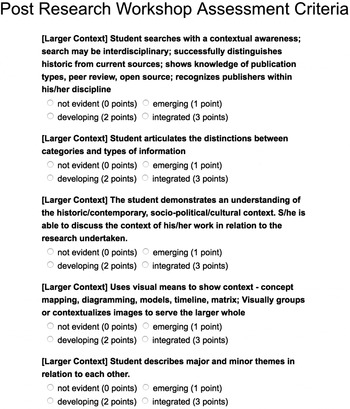
The post research workshop assessment criteria chart can be used as a printed or online, mobile survey (figure 3). The survey's four-point scale designates the degree to which each criterion is apparent in the student's work itself and/or presentation. While the categories are qualitative in nature, by assigning a numeric value to each of the four descriptors on a scale from 0–3, the survey includes a quantitative dimension. The four categories are: Not Evident (0 points), Emerging (1 point), Developing (2 points), and Integrated (3 points).
Post Research Workshop Assessment Online Survey, 2016. Fleet Library, Rhode Island School of Design.

Findings and Conclusion
The Post Research Workshop Assessment Criteria tool has been used for four semesters in studio critiques at RISD and is considered a work in progress. Using the chart enables the author to form a response to questions of what constitutes art and design research in studio environments at her institution. Its use begins to capture and document the complex and nuanced impact of library research workshop content on studio work. The chart has been used to assess upper-level undergraduates and first and second year graduate students. Thus far two undergraduate students showed evidence of full integration in multiple categories. These are the outstanding students whose work, thought, and processes are fully realized and articulated across a range of media and through visual and oral presentation. As the coordinator of graduate library instruction, the author has had more opportunity to work with students in individual research appointments and to attend the critiques and final presentations of graduate students. The chart has proven most useful at the graduate level; in each critique one or two students meet the fully integrated standard in several categories.
The chart has created a starting point for discussion between librarians, faculty, and administration by giving them a template to talk in more concrete ways about the impact of library instruction on art and design research and studio practice and to qualify that impact. By sharing this assessment experiment with the international art libraries community the author hopes a wider discussion around studio-based research and qualitative assessment may develop.
Acknowledgements
The author would like to express her appreciation to RISD research and instruction colleagues, Marc Calhoun and Alice Whiteside, for the generative discussions around teaching and research and their suggestions as the assessment criteria document was being developed. Thank you to RISD Writing Center Director, Jennifer Liese, for her insightful contributions to and editorial expertise of the assessment criteria document.