



1. Introduction
Originating in Elliott's work in the 1970s, the endeavor to classify simple  $C^{*}$-algebras via K-theory provided increasingly sophisticated classification and structural results, which have led to fruitful applications in dynamical systems and group theory. One such application is the classification of multivariable Cantor minimal systems [Reference Giordano, Matui, Putnam and SkauGMPS10] by Giordano, Matui, Putnam, and Skau. In a recent breakthrough due to Tikuisis, White, and Winter [Reference Tikuisis, White and WinterTWW17], Elliott's classification program is now nearly completed, and Rosenberg's conjecture on quasi-diagonality of
 $C^{*}$-algebras of discrete, amenable groups has been verified.
In broad terms,  $C^{*}$-rigidity is the concept that objects can be recovered (up to some equivalence) from associated
 $C^{*}$-algebraic data. This was established for
 $C^{*}$-algebras arising from various structures such as dynamical systems [Reference Giordano, Putnam and SkauGPS95, Reference KriegerKri76, Reference RørdamRør95], groupoids [Reference Carlsen, Ruiz, Sims and TomfordeCRST17, Reference RenaultRen08], number fields [Reference LiLi14, Reference LiLi16], and more.
On the other hand, non-self-adjoint operator algebras are subalgebras of  $C^{*}$-algebras and provide invariants for irreversible objects such as multivariable one-sided dynamical systems [Reference Davidson and KatsoulisDK11a], analytic varieties [Reference Davidson, Ramsey and ShalitDRS11], and Markov chains [Reference Dor-On and MarkiewiczDM14]. The study of such operator algebras is motivated from single operator theory and complex analysis, partly in hope of resolving the unyielding invariant subspace problem.
Non-self-adjoint classification started with a paper of Arveson [Reference ArvesonArv67] on classification of operator algebras associated to measure-preserving automorphisms. It was later realized that classification problems for many algebras can be put in the unified context of tensor algebras of  $C^{*}$-correspondences [Reference Muhly and SolelMS00], and in many concrete cases such problems were resolved [Reference Davidson and KatsoulisDK08, Reference Davidson and KatsoulisDK11a, Reference Dor-OnDor18, Reference Katsoulis and KribsKK04].
Operator algebras arising from graphs form one of the most important classes for classification of self-adjoint and non-self-adjoint operator algebras. In forthcoming work with Ruiz and Sims, the second named author has observed that graph  $C^{*}$-algebras of amplified finite graphs (so that all edges have infinite multiplicity), as in [Reference Eilers, Ruiz and SørensenERS12], together with their diagonal and gauge action can recover the amplified graph. On top of this, by using classification of Kubo–Martin–Schwinger (KMS) states on Toeplitz graph algebras of finite graphs, it was recently shown in [Reference Brownlowe, Laca, Robertson and SimsBLRS20, Theorem 3(1)] that the vertex diagonal and gauge action completely recovers the graph.
Alternatively, recovering graphs from their non-self-adjoint graph tensor algebras is possible for arbitrary graphs by the work of Solel [Reference SolelSol04] or for weaker notions of isomorphisms by the work of Katsoulis and Kribs [Reference Katsoulis and KribsKK04]. From such concrete cases we see that invariants produced by classification of  $C^{*}$-algebras with additional structure are drawing close to those produced by classification of non-self-adjoint operator algebras. Thus, a natural question is to ask for an exact connection between these seemingly separate rigidity-type results. In this paper, we show that it is more than just a coincidence that directed graphs can be recovered from both their irreversible algebra and their reversible algebra together with additional structure.
A central study that connects  $C^{*}$-algebras with non-self-adjoint operator algebras is Arveson's non-commutative boundary theory, which he developed and applied in several papers [Reference ArvesonArv69, Reference ArvesonArv72, Reference ArvesonArv98]. Classical boundaries of function algebras were the subject of intense research in the 1950s and 1960s, and are related to convexity and approximation theory via Choquet theory [Reference Choquet and MeyerCM63]. The non-commutative generalization of the Shilov boundary is called the
 $C^{*}$-envelope, and was first shown to exist through Hamana's injective envelope [Reference HamanaHam79]. The
 $C^{*}$-envelope is defined to be the smallest
 $C^{*}$-algebra containing the given operator algebra in a reasonable sense and provides a fruitful connection between
 $C^{*}$-algebras and non-self-adjoint operator algebras (see [Reference Dor-On and KatsoulisDK20, Reference KatsoulisKat17]). In this paper, we apply ideas from Arveson's non-commutative boundary theory to uncover a precise hierarchy between classification of irreversible algebras and classification of reversible algebras with additional structure.
For what follows, we assume familiarity with the theory of Hilbert  $C^{*}$-modules as presented in [Reference LanceLan95, Reference Manuilov and TroitskyMT05].
Definition 1.1 A  $C^{*}$-correspondence over a
 $C^{*}$-algebra
 ${{\mathcal {A}}}$ is a right Hilbert
 ${{\mathcal {A}}}$-module
 $E$ together with a *-representation
 $\phi _E: {{\mathcal {A}}}\to {{\mathcal {L}}}(E)$, where
 ${{\mathcal {L}}}(E)$ denotes the
 $C^{*}$-algebra of adjointable operators on
 $E$.
A  $C^{*}$-correspondence
 $E$ over
 ${{\mathcal {A}}}$ comes equipped with the operator space structure it inherits as a subspace of the linking
 $C^{*}$-algebra
 \[ {{\mathcal{D}}}_E=\begin{bmatrix} {{\mathcal{A}}} & E^{*}\\ E & {{\mathcal{K}}}(E) \end{bmatrix} \subseteq {{\mathcal{L}}}({{\mathcal{A}}}\oplus E), \]
for a more detailed discussion on linking algebras, see [Reference Brown, Green and RieffelBGR77]. When the context is clear, we write  $a \xi$ to mean
 $\phi _E(a) \xi$ for
 $a\in {{\mathcal {A}}}$ and
 $\xi \in E$. To define our algebras universally, we need the following notions of representations of
 $C^{*}$-correspondences from [Reference Muhly and SolelMS98]. We note immediately that what we call a rigged representation here is often referred to as an isometric representation in the literature. The reason for choosing this term is that a representation of
 $E$ can be isometric (or completely isometric) as a map on
 $E$ with its given operator space structure without being rigged.
Definition 1.2 Let  $E$ be a
 $C^{*}$-correspondence over
 ${{\mathcal {A}}}$ and let
 ${{\mathcal {B}}}$ be some
 $C^{*}$-algebra. A (completely contractive) representation of
 $E$ is a pair
 $(\pi , t)$ such that
 $\pi : {{\mathcal {A}}} \rightarrow {{\mathcal {B}}}$ is a *-homomorphism and
 $t : E \rightarrow {{\mathcal {B}}}$ is a completely contractive linear map such that:
(1)
 $\pi (a)t(\xi ) \pi (b) = t(a \cdot \xi \cdot b)$ for $a,b\in {{\mathcal {A}}}$ and $\xi \in E$.



We say that  $(\pi ,t)$ is a rigged representation if additionally:
(2)
$t(\xi )^{*}t(\eta ) = \pi (\langle \xi ,\eta \rangle )$.

We say that  $(\pi , t)$ is injective if
 $\pi$ is an injective *-homomorphism. We denote by
 $C^{*}(\pi ,t)$ and
 $\overline {\operatorname {Alg}}(\pi ,t)$ the
 $C^{*}$-algebra and the norm-closed operator algebra, respectively, generated by the images of
 $\pi$ and
 $t$ inside
 ${{\mathcal {B}}}$.
The Toeplitz algebra  ${{\mathcal {T}}}(E)$ is then the universal
 $C^{*}$-algebra generated by rigged representations of
 $E$, and the tensor algebra
 ${{\mathcal {T}}}_+(E)$ is the universal operator algebra generated by all representations of
 $E$. For each
 $n\in \mathbb {N}$, denote by
 $t^{(n)}: E^{\otimes n}\to {{\mathcal {B}}}$ the map uniquely determined on simple tensors by
 $t^{(n)}(\xi _1 \otimes \cdots \otimes \xi _n) = t(\xi _1) \circ \cdots \circ t(\xi _n)$ (See § 2.2 for more details). Suppose now that
 $(\pi ,t)$ is a rigged representation such that
 ${{\mathcal {T}}}(E) \cong C^{*}(\pi ,t)$. In this case, we say that
 $(\pi ,t)$ is universal. It then follows from the definition of rigged representation that
 \[ \mathcal{T}(E)=\overline{\operatorname{span}}\big\{t^{(n)}(\xi) t^{(m)}(\eta)^{*}: \xi\in E^{{\otimes} n},\ \eta\in E^{{\otimes} m},\ m,n\geq 0\big\}. \]
Moreover, universality of  ${{\mathcal {T}}}(E)$ implies that it comes equipped with a point-norm continuous circle action
 $\gamma : \mathbb {T} \to \operatorname {Aut}({{\mathcal {T}}}(E))$ given by
 \[ \gamma_z(\pi(a))= \pi(a), \quad \text{and}\quad \gamma_z(t(\xi))=z \cdot t(\xi), \quad \text{for} \ z\in \mathbb{T},\ \xi\in E,\ a\in {{\mathcal{A}}}. \]
Definition 1.3 Let  $E$ be a
 $C^{*}$-correspondence over
 ${{\mathcal {A}}}$. Denote by
 $\gamma$ the circle action on
 ${{\mathcal {T}}}(E)$. For each
 $n\in \mathbb {Z}$, the
 $n$-spectral subspace for
 $\gamma$ is defined by
 \[ {{\mathcal{T}}}(E)_n=\big\{ T \in {{\mathcal{T}}}(E): \gamma_z(T)=z^{n} \cdot T \ \text{for}\ z\in \mathbb{T} \big\}. \]
The circle action  $\gamma$ provides
 ${{\mathcal {T}}}(E)$ with Fourier coefficients
 $\Phi _n$ given by
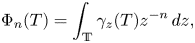 \[ \Phi_n(T)=\int_{\mathbb{T}} \gamma_z(T)z^{{-}n}\,dz, \]
where  $dz$ denotes normalized Haar measure on
 $\mathbb {T}$. Using these Fourier coefficients, for each
 $T\in {{\mathcal {T}}}(E)$ the Cesàro sums
 $\sum _{k=-n}^{n} (1 - {|k|}/{n})\Phi _n(T)$ converge in norm to
 $T$. In particular, we see that
 $T=0$ if and only if
 $\Phi _n(T) = 0$ for all
 $n\in \mathbb {Z}$. Note further that
 $\Phi _n$ is an idempotent, and for a universal rigged representation
 $(\pi ,t)$ the image of
 $\Phi _n$ contains
 $\overline {\operatorname {span}}\{ t^{(k)}(\xi )t^{(l)}(\eta )^{*} : \xi \in E^{\otimes k},\ \eta \in E^{\otimes l},\ k-l = n \}$. Hence, by Cesàro approximation we get that
 \[ {{\mathcal{T}}}(E)_n = \overline{\operatorname{\operatorname{span}}}\big\{ t^{(k)}(\xi) t^{(l)}(\eta)^{*} : \xi \in E^{{\otimes} k},\ \eta \in E^{{\otimes} l},\ k-l = n \big\}. \]
It then follows that  $\{ {{\mathcal {T}}}(E)_n \}_{n\in \mathbb {Z}}$ is a topological grading for
 ${{\mathcal {T}}}(E)$ in the sense of Exel [Reference ExelExe17, Definition 19.2], where
 $\Phi _0$ is the conditional expectation that indicates that the grading is topological.
As the tensor algebra  ${{\mathcal {T}}}_+(E)$ is naturally a subalgebra of
 ${{\mathcal {T}}}(E)$ (see § 2.2), it is invariant under the circle action
 $\gamma$ as a subalgebra of
 ${{\mathcal {T}}}(E)$, and there are spectral subspaces defined for
 ${{\mathcal {T}}}_+(E)$ as well. For each
 $n \in \mathbb {N}$, the
 $n$-spectral subspace for
 ${{\mathcal {T}}}_+(E)$ is given by
 \[ {{\mathcal{T}}}_+(E)_n=\big\{ T \in {{\mathcal{T}}}_+(E): \gamma_z(T)=z^{n} \cdot T \text{ for } z\in \mathbb{T} \big\}. \]
We say that 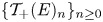 $\{ {{\mathcal {T}}}_+(E)_n \}_{n\geq 0}$ is the grading for
 ${{\mathcal {T}}}_+(E)$, and by [Reference Dor-OnDor18, Proposition 4.2] we have concretely, when
 $(\pi ,t)$ is universal, that
 \[ {{\mathcal{T}}}_+(E)_n= \big\{ t^{(n)}(\xi): \xi\in E^{{\otimes} n} \big\}. \]
Toeplitz–Pimsner algebras have a canonical quotient, also known as the Cuntz–Pimsner algebra originally defined by Pimsner in [Reference PimsnerPim95] and refined by Katsura in [Reference KatsuraKat04b]. These algebras generalize many constructions of operator algebras in the literature.
Definition 1.4 For a  $C^{*}$-correspondence
 $E$ over
 ${{\mathcal {A}}}$, we define Katsura's ideal
 $J_E$ in
 ${{\mathcal {A}}}$ by
 \[ J_E := \big\{a\in {{\mathcal{A}}}: \phi_E(a)\in {{\mathcal{K}}}(E)\ \text{and}\ ab=0 \ \text{for all}\ b\in \ker \phi_E \big\}. \]
For a rigged representation,  $(\pi ,t)$ of a
 $C^{*}$-correspondence
 $E$ over
 ${{\mathcal {A}}}$, it is a standard fact that there is a well-defined *-homomorphism
 $\psi _t: {{\mathcal {K}}}(E)\to {{\mathcal {B}}}$ given by
 $\psi _t(\theta _{\xi ,\eta })=t(\xi )t(\eta )^{*}$ for
 $\xi ,\eta \in E$.
Definition 1.5 A rigged representation  $(\pi ,t)$ is said to be covariant if
 $\pi (a)=\psi _t(\phi _E(a))$, for all
 $a\in J_E$.
The Cuntz–Pimsner algebra  ${{\mathcal {O}}}(E)$ is defined as the universal
 $C^{*}$-algebra generated by covariant representations of
 $E$. Thus,
 ${{\mathcal {O}}}(E)$ is the quotient of
 ${{\mathcal {T}}}(E)$ by the ideal of relations
 ${{\mathcal {J}}}_E$ generated by
 $\{ \psi _T(\phi _E(a))-a: a\in J_E \}$. The following notions of isomorphisms between tensor and Toeplitz algebras are essential to our paper.
Definition 1.6 Let  $E, F$ be
 $C^{*}$-correspondences over
 ${{\mathcal {A}}}$ and
 ${{\mathcal {B}}}$, respectively.
(1) A base-preserving isomorphism between
${{\mathcal {T}}}(E)$ and ${{\mathcal {T}}}(F)$ is an isomorphism:
\[ \varphi: {{\mathcal{T}}}(E)\to {{\mathcal{T}}}(F) \text{ s.t. } \varphi({{\mathcal{A}}})={{\mathcal{B}}}. \](2) A base-preserving isomorphism between
${{\mathcal {T}}}_+(E)$ and ${{\mathcal {T}}}_+(F)$ is an isomorphism:
\[ \varphi: {{\mathcal{T}}}_+(E)\to {{\mathcal{T}}}_+(F) \text{ s.t. } \varphi({{\mathcal{A}}})={{\mathcal{B}}}. \](3) A graded isomorphism between
${{\mathcal {T}}}(E)$ and ${{\mathcal {T}}}(F)$ is an isomorphism:
\[ \varphi: {{\mathcal{T}}}(E)\to {{\mathcal{T}}}(F) \text{ s.t. } \varphi({{\mathcal{T}}}(E)_n)={{\mathcal{T}}}(F)_n \quad \text{for all } n\in \mathbb{Z}. \](4) A graded isomorphism between
${{\mathcal {T}}}_+(E)$ and ${{\mathcal {T}}}_+(F)$ is an isomorphism:
\[ \varphi: {{\mathcal{T}}}_+(E)\to {{\mathcal{T}}}_+(F) \text{ s.t. } \varphi({{\mathcal{T}}}_+(E)_n)={{\mathcal{T}}}_+(F)_n \quad \text{for all } n\in \mathbb{N}. \]












By [Reference RaeburnRae18, Theorem 3] we see that there is a bijective correspondence between topologically  $\mathbb {Z}$-graded
 $C^{*}$-algebras, with graded *-homomorphisms and
 $C^{*}$-algebras equipped with a circle action, together with equivariant *-homomorphisms. In particular, an isomorphism
 $\varphi :{{\mathcal {T}}}(E)\to {{\mathcal {T}}}(F)$ is graded, if and only if it is equivariant in the sense that
 $\varphi \circ \gamma ^{E}_z=\gamma ^{F}_z\circ \varphi$, for all
 $z\in \mathbb {T}$.
Definition 1.7 Let  $E$ and
 $F$ be
 $C^{*}$-correspondences over
 ${{\mathcal {A}}}$ and
 ${{\mathcal {B}}}$, respectively. We say that
 ${{\mathcal {T}}}(E)$ and
 ${{\mathcal {T}}}(F)$ are short exact sequence (s.e.s.) isomorphic if there is a *-isomorphism
 $\varphi : {{\mathcal {T}}}(E) \rightarrow {{\mathcal {T}}}(F)$ such that
 $\varphi$ restricts to a *-isomorphism from
 ${{\mathcal {J}}}_E$ onto
 ${{\mathcal {J}}}_F$. In this case, we call
 $\varphi$ an s.e.s. isomorphism.
Clearly the existence of an s.e.s. isomorphism is equivalent to having an isomorphism of the short exact sequences
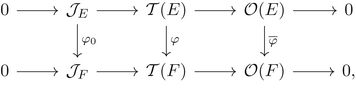
where  $\varphi _0$ is the restriction of
 $\varphi$ to
 ${{\mathcal {J}}}_E$, and
 $\bar {\varphi }$ is the induced map on the Cuntz–Pimsner algebras. Given
 $C^{*}$-correspondences
 $E$ and
 $F$ over
 $C^{*}$ algebras
 ${{\mathcal {A}}}$ and
 ${{\mathcal {B}}}$, consider the following notions of isomorphisms:
(1)
$E$ and $F$ are unitarily isomorphic $C^{*}$-correspondences;(2)
${{\mathcal {T}}}_+(E)$ and ${{\mathcal {T}}}_+(F)$ are graded completely isometrically isomorphic;(3)
${{\mathcal {T}}}_+(E)$ and ${{\mathcal {T}}}_+(F)$ are completely isometrically isomorphic;(4)
${{\mathcal {T}}}(E)$ and ${{\mathcal {T}}}(F)$ are base-preserving graded isomorphic;(5)
${{\mathcal {T}}}(E)$ and ${{\mathcal {T}}}(F)$ are base-preserving s.e.s. isomorphic.


The first achievement in our paper is Corollary 3.5, which establishes the following hierarchy.
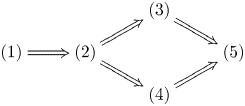
This allows us to investigate completely isometric isomorphism problems for tensor algebras via structure-preserving isomorphisms on Toeplitz–Pimsner algebras.
In § 4 we study the graded and base-preserving picture, and when our  $C^{*}$-correspondences are over compact operator subalgebras we show in Corollary 4.7 that item
 $(4)$ implies item
 $(1)$.
K-theory techniques from [Reference KatsuraKat04b] are employed in § 5 to determine how isomorphism of short exact sequences as in diagram (1.1) promotes to isomorphisms of associated K-groups. More specifically, in Theorem 5.2 we show that stable base-preserving s.e.s. isomorphisms induce isomorphisms of associated six-term exact sequences in K-theory that only involve the coefficient algebras, Katsura ideals and the Cuntz–Pimsner algebras. In Proposition 5.3, when  $E$ and
 $F$ are
 $C^{*}$-correspondences over compact operator subalgebras, we are able to compute a natural connecting map between
 $K_0$ of Katsura ideals that is useful for later computations.
We apply our techniques in the context of graph tensor and Toeplitz–Cuntz–Krieger (TCK) algebras in § 6. We first use Corollary 4.7 to get a quick extension of [Reference Brownlowe, Laca, Robertson and SimsBLRS20, Theorem 3(1)] to arbitrary graphs. More specifically, for any two graphs  $G$ and
 $G'$, and their associated
 $C^{*}$-correspondences
 $E=X(G)$ and
 $F=X(G')$ we show that items
 $(1)$,
 $(2)$, and
 $(4)$ are all equivalent to
 $G$ and
 $G'$ being isomorphic. Thus, Corollary 4.7 can be viewed as a further generalization of [Reference Brownlowe, Laca, Robertson and SimsBLRS20, Theorem 3(1)] to
 $C^{*}$-correspondences over compact operator subalgebras.
For operator algebras associated to row-finite directed graphs we completely resolve the hierarchy of isomorphism problems. We show that every base-preserving isomorphism of Toeplitz–Cuntz–Krieger algebras of row-finite graphs is automatically an s.e.s. isomorphism, even after stabilization. Hence, item  $(5)$ and its stable analogue in our hierarchy have simpler descriptions. Our main result for graph algebras of row-finite graphs is Theorem 6.4 where we show for row-finite graphs
 $G$ and
 $G'$ that not only all of items (1)–(5), but also that stable isomorphisms versions of items
 $(3)$ and
 $(5)$ are all equivalent to
 $G$ and
 $G'$ being isomorphic directed graphs. The stable completely isometric isomorphism problem for tensor algebras was impervious to standard methods from classification of non-self-adjoint operator algebras because these often relied on finite-dimensional representation techniques. It is clear that all (completely contractive) representations of stabilized tensor graph algebras are on infinite dimensions so that finite-dimensional representation techniques normally cannot be applied.
Together with Corollary 3.5, this clearly shows that the classification of non-self-adjoint algebras goes hand in hand with classification of  $C^{*}$-algebras with additional structure, and that previously intractable problems from non-self-adjoint classification can now be resolved by using classification techniques from
 $C^{*}$-algebra theory.
Finally, in Example 6.5 we show the limitations of our techniques in resolving general tensor algebra classification problems. More precisely, there exist two non-isomorphic amplified graphs  $G$ and
 $G'$ (amplified in the sense that all edges have infinite multiplicity) such that their Toeplitz–Cuntz–Krieger algebras are base-preserving s.e.s.isomorphic. Together with [Reference Katsoulis and KribsKK04, Theorem 2.11], this shows that items
 $(5)$ and
 $(3)$ in our hierarchy are generally not equivalent without some regularity assumption on the
 $C^{*}$-correspondences.
This paper contains six sections, including this introduction section. In § 2 we give some necessary material on dilation extreme representations, as well as Toeplitz–Pimsner, Cuntz–Pimsner, and tensor algebras. In § 3 we establish the main hierarchy of isomorphism problems. In § 4 we focus on graded isomorphisms and deduce rigidity results when the  $C^{*}$-correspondences are over subalgebras of compact operators. In § 5 we make essential connections between K-theory isomorphisms and stable base-preserving s.e.s. isomorphisms. Finally in § 6 we apply our techniques to resolve graded isomorphism problems for tensor and Toeplitz–Cuntz–Krieger algebras, and conclude with the resolution of the hierarchy for operator algebras associated to row-finite graphs.
2. Preliminaries
2.1 Dilation extremity and $C^{*}$-envelope

We explain how to define the notions of dilation extremity (normally called maximality in the literature) and the unique extension property (UEP) for representations of not-necessarily unital operator algebras, in a way that yields the same theory as in the unital case. We refer the reader to [Reference Dor-On and SalomonDS18, § 2.2] for more details. For an operator algebra  ${{\mathcal {A}}}$, by a representation of
 ${{\mathcal {A}}}$ we shall henceforth mean a completely contractive homomorphism
 $\rho : {{\mathcal {A}}} \rightarrow B({{\mathcal {H}}})$. When
 $\rho : {{\mathcal {A}}} \rightarrow B({{\mathcal {H}}})$ is a representation, a dilation
 $\pi : {{\mathcal {A}}} \rightarrow B({{\mathcal {K}}})$ is a representation such that
 ${{\mathcal {H}}} \subseteq {{\mathcal {K}}}$ and
 $\rho (a) = P_{{{\mathcal {H}}}} \pi (a)|_{{{\mathcal {H}}}}$.
If  ${{\mathcal {A}}}$ is an operator algebra and
 $\iota :{{\mathcal {A}}} \rightarrow {{\mathcal {B}}}$ is a completely isometric homomorphism such that
 ${{\mathcal {B}}} = C^{*}({{\mathcal {A}}})$, we say that the pair
 $(\iota ,{{\mathcal {B}}})$ is a
 $C^{*}$-cover. The
 $C^{*}$-envelope is defined as the smallest
 $C^{*}$-cover
 $(\kappa , C^{*}_\textrm {e}({{\mathcal {A}}}))$ among all
 $C^{*}$-covers in the sense that for any
 $C^{*}$-cover
 $(\iota ,{{\mathcal {B}}})$ we have a natural quotient map
 $q_\textrm {e} : {{\mathcal {B}}} \rightarrow C^{*}_\textrm {e}({{\mathcal {A}}})$ such that
 $\kappa = q_\textrm {e} \circ \iota$. The
 $C^{*}$-envelope for unital operator algebras was first proven to exist by Hamana [Reference HamanaHam79], and a dilation theoretic proof was later given by Dritschel and McCullough [Reference Dritschel and McCulloughDM05]. When discussing the
 $C^{*}$-envelope and other
 $C^{*}$-covers we will often suppress the maps
 $\iota$ and
 $\kappa$ and think of them as inclusions.
If  ${{\mathcal {A}}} \subseteq B({{\mathcal {H}}})$ is a non-unital operator algebra generating a
 $C^{*}$-algebra
 ${{\mathcal {B}}}$ then by Meyer's theorem [Reference MeyerMey01, § 3] every representation
 $\varphi : {{\mathcal {A}}} \rightarrow B({{\mathcal {K}}})$ extends to a unital representation
 $\varphi ^{1}$ on the unitization
 ${{\mathcal {A}}}^{1}={{\mathcal {A}}} \oplus \mathbb {C}I_{{{\mathcal {H}}}}$ of
 ${{\mathcal {A}}}$ by setting
 $\varphi ^{1}(a+\lambda I_{{{\mathcal {H}}}}) = \varphi (a) + \lambda I_{{{\mathcal {K}}}}$. This shows that there is a unique operator algebra structure on the unitization of
 ${{\mathcal {A}}}$, and yields the following Arveson extension theorem for not-necessarily unital operator algebras.
Corollary 2.1 Let  ${{\mathcal {A}}} \subseteq B({{\mathcal {H}}})$ be an operator algebra generating a
 $C^{*}$-algebra
 ${{\mathcal {B}}}$, and let
 $\varphi : {{\mathcal {A}}} \rightarrow B({{\mathcal {K}}})$ be a representation of
 ${{\mathcal {A}}}$. Then there is a completely positive contractive map
 $\tilde {\varphi } : {{\mathcal {B}}} \rightarrow B({{\mathcal {K}}})$ such that
 $\tilde {\varphi }|_{{{\mathcal {A}}}} = \varphi$.
We then define the UEP and dilation extremity (maximality) for not-necessarily unital operator algebras, in a way that extends the same definitions for unital operator algebras and requiring that the maps are also unital.
Definition 2.2 Let  ${{\mathcal {A}}} \subseteq B({{\mathcal {H}}})$ be an operator algebra generating a
 $C^{*}$-algebra
 ${{\mathcal {B}}}$. Let
 $\rho : {{\mathcal {A}}} \rightarrow B({{\mathcal {K}}})$ be a representation.
(1) We say that
$\rho$ has the UEP if every completely positive contractive map $\pi : {{\mathcal {B}}} \rightarrow B({{\mathcal {K}}})$ extending $\rho$ is a *-representation.(2) We say that
$\rho$ is dilation extreme (or maximal) if whenever $\pi$ is a representation dilating $\rho$, then $\pi = \rho \oplus \psi$ for some representation $\psi$.




Using these definitions, it was shown in [Reference Dor-On and SalomonDS18, Proposition 2.4] that dilation extremity and the UEP are equivalent, and that a representation is dilation extreme if and only if its unitization is dilation extreme [Reference Dor-On and SalomonDS18, Proposition 2.5]. The  $C^{*}$-envelope
 $C^{*}_\textrm {e}({{\mathcal {A}}})$ of a non-unital algebra
 ${{\mathcal {A}}}$ coincides with the
 $C^{*}$-algebra generated by
 ${{\mathcal {A}}}$ inside
 $C^{*}_\textrm {e}({{\mathcal {A}}}^{1})$, and the theorem of Dritschel and McCullough (see [Reference Dritschel and McCulloughDM05]) holds in the possibly non-unital context. That is, every representation of an operator algebra dilates to a dilation extreme representation. Hence, even in the non-unital setting, we have that
 $C^{*}_\textrm {e}({{\mathcal {A}}})$ is the
 $C^{*}$-algebra generated by the image of any dilation extreme completely isometric representation. Hence, whether
 ${{\mathcal {A}}}$ is unital or not, the
 $C^{*}$-envelope
 $C^{*}_\textrm {e}({{\mathcal {A}}})$ of
 ${{\mathcal {A}}}$ coincides with the universal
 $C^{*}$-algebra generated by dilation extreme representations of
 ${{\mathcal {A}}}$.
One of the most important properties of dilation extreme representations of operator algebras is their invariance under completely isometric isomorphisms. More precisely, if  $\theta :{{\mathcal {A}}} \rightarrow {{\mathcal {B}}}$ is a completely isometric isomorphism, then a representation
 $\rho : {{\mathcal {B}}} \rightarrow B({{\mathcal {H}}})$ is dilation extreme for
 ${{\mathcal {B}}}$ if and only if
 $\rho \circ \theta$ is dilation extreme for
 ${{\mathcal {A}}}$. We require the following weak versions of dilation extremity which were originally defined in the work of Muhly and Solel [Reference Muhly and SolelMS98] in the language of Hilbert modules.
Definition 2.3 Let  ${{\mathcal {A}}}$ be an operator algebra, and
 $\rho : {{\mathcal {A}}} \rightarrow B({{\mathcal {H}}})$ a representation. We say that a dilation
 $\pi : {{\mathcal {A}}} \rightarrow B({{\mathcal {K}}})$ of
 $\rho$ is:
(1) an e-dilation if
${{\mathcal {H}}}$ is invariant for $\pi ({{\mathcal {A}}})$;(2) a c-dilation if
${{\mathcal {H}}}$ is co-invariant for $\pi ({{\mathcal {A}}})$.


Definition 2.4 Let  ${{\mathcal {A}}}$ be an operator algebra, and
 $\rho : {{\mathcal {A}}} \rightarrow B({{\mathcal {H}}})$ a representation. We say that
 $\rho$ is:
(1) e-dilation extreme if whenever
$\pi : {{\mathcal {A}}} \rightarrow B({{\mathcal {K}}})$ is e-dilation of $\rho$, then in fact $\pi = \rho \oplus \psi$ for some representation $\psi$;(2) c-dilation extreme if whenever
$\pi : {{\mathcal {A}}} \rightarrow B({{\mathcal {K}}})$ is c-dilation of $\rho$, then in fact $\pi = \rho \oplus \psi$ for some representation $\psi$.






These notions were called ‘extension extreme’ and ‘coextension extreme’ by Davidson and Katsoulis in [Reference Davidson and KatsoulisDK11b]. By a theorem of Sarason [Reference PaulsenPau02, Exercise 7.6], it follows that  $\rho$ is dilation extreme if and only if it is both e-dilation extreme and c-dilation extreme. In fact, it follows from the work of Dritschel and McCullough that every representation of an operator algebra admits either an e-dilation that is e-dilation extreme or a c-dilation that is c-dilation extreme. The following is the analogue of Arveson's ‘invariance of UEP’ for c-dilation and e-dilation extremal representations.
Theorem 2.5 Let  ${{\mathcal {A}}}$ and
 ${{\mathcal {B}}}$ be operator algebras, let
 $\theta : {{\mathcal {A}}} \rightarrow {{\mathcal {B}}}$ an isomorphism, and let
 $\rho : {{\mathcal {B}}} \rightarrow B({{\mathcal {H}}})$ be a representation. Then:
(1)
$\rho$ is e-dilation extreme if and only if $\rho \circ \theta$ is e-dilation extreme;(2)
$\rho$ is c-dilation extreme if and only if $\rho \circ \theta$ is c-dilation extreme.


Proof. An inverse of a completely isometric isomorphism between operator algebras is again a completely isometric isomorphism. Hence, it is enough to prove one direction in each claim. We show the forward direction for item (2), and the proof for the forward direction of item (1) is similar. Assume  $\rho$ is c-dilation extreme and let
 $\pi :{{\mathcal {A}}}\to B({{\mathcal {K}}})$ be a c-dilation of
 $\rho \circ \theta$. Then
 $\rho (b)=P_{{{\mathcal {H}}}}\pi (\theta ^{-1}(b))|_{{{\mathcal {H}}}}$ for all
 $b\in {{\mathcal {B}}}$. Thus,
 $\pi \circ \theta ^{-1}:{{\mathcal {B}}}\to B({{\mathcal {K}}})$ is a c-dilation of
 $\rho$ as
 ${{\mathcal {H}}}$ is coinvariant for
 $\pi \circ \theta ^{-1}({{\mathcal {B}}}) = \pi ({{\mathcal {A}}})$. By our assumption,
 $\pi \circ \theta ^{-1}=\rho \oplus \psi$ for some representation
 $\psi$. Thus,
 $\pi =(\rho \circ \theta ) \oplus (\psi \circ \theta )$, as required.
Throughout the paper, we denote by  ${{\mathcal {A}}} \otimes {{\mathcal {B}}}$ the spatial tensor product of the operator algebras
 ${{\mathcal {A}}}$ and
 ${{\mathcal {B}}}$ as defined in [Reference Blecher and Le MerdyBL04, § 2.2.2]. When
 ${{\mathcal {A}}}$ and
 ${{\mathcal {B}}}$ are both C*-algebras,
 $\otimes$ coincides with the minimal tensor product of C*-algebras.
Lemma 2.6 Let  ${{\mathcal {A}}}$ be an operator algebra generating a
 $C^{*}$-algebra
 ${{\mathcal {C}}}$ and
 ${{\mathcal {B}}}$ a
 $C^{*}$-algebra. Assume
 $\tau : {{\mathcal {A}}} \rightarrow B({{\mathcal {H}}})$ is a representation, and
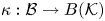 $\kappa : {{\mathcal {B}}} \rightarrow B({{\mathcal {K}}})$ a *-representation. Then
 $\tau$ is dilation extreme if and only if
 $\tau \otimes \kappa$ is dilation extreme.
Proof. We may assume, perhaps after unitization, that  ${{\mathcal {A}}}$ and
 ${{\mathcal {B}}}$ are both unital, and that
 $\tau$ and
 $\kappa$ are unital. It will suffice to show that
 $\tau$ has the UEP if and only if
 $\tau \otimes \kappa$ does.
Thus, assume  $\tau$ has the UEP. Let
 $\pi : {{\mathcal {C}}} \otimes {{\mathcal {B}}} \rightarrow B({{\mathcal {H}}} \otimes {{\mathcal {K}}})$ be a unital completely positive extension of
 $\tau \otimes \kappa$. Then
 $\pi |_{{{\mathcal {C}}} \otimes I}$ is (up to multiplicity) a unital completely positive extension of
 $\tau$, so that
 $\pi$ is multiplicative on
 ${{\mathcal {C}}}$. As
 $\pi |_{{{\mathcal {B}}}}$ is (up to multiplicity) just
 $\kappa$, we see that
 $\pi$ is also multiplicative on
 ${{\mathcal {B}}}$. Thus, by [Reference PaulsenPau02, Theorem 3.18] we have that
 $\pi$ is multiplicative, and
 $\tau \otimes \kappa$ has the UEP. Conversely, if
 $\tau \otimes \kappa$ has the UEP, let
 $\pi : {{\mathcal {C}}} \rightarrow B({{\mathcal {H}}})$ be a unital completely positive extension of
 $\tau$. Then clearly
 $\pi \otimes \kappa$ is a unital completely positive extension of
 $\tau \otimes \kappa$, so that
 $\pi \otimes \kappa$ is multiplicative. In particular,
 $\pi$ is multiplicative, so that
 $\tau$ has the UEP.
Corollary 2.7 Let  ${{\mathcal {A}}}$ be an operator algebra and
 ${{\mathcal {B}}}$ a
 $C^{*}$-algebra. Then
 \[C^{*}_\textrm {e}({{\mathcal {A}}} \otimes {{\mathcal {B}}}) \cong C_\textrm {e}^{*}({{\mathcal {A}}}) \otimes {{\mathcal {B}}}.\]
Proof. Let  $\tau : {{\mathcal {A}}} \rightarrow B({{\mathcal {H}}})$ be a dilation extreme completely isometric representation, and
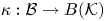 $\kappa : {{\mathcal {B}}} \rightarrow B({{\mathcal {K}}})$ an injective
 $*$-representation. By injectivity of minimal tensor product, we see that
 $\tau \otimes \kappa$ is completely isometric and by Lemma 2.6 we get that
 $\tau \otimes \kappa$ is dilation extreme. Thus, because the
 $C^{*}$-algebra generated by the image of
 $\tau \otimes \kappa$ is
 $C^{*}_\textrm {e}({{\mathcal {A}}}) \otimes {{\mathcal {B}}}$, and as any
 $C^{*}$-algebra generated by the image of a dilation extreme completely isometric representation is the
 $C^{*}$-envelope, we get that
 $C^{*}_\textrm {e}({{\mathcal {A}}} \otimes {{\mathcal {B}}}) \cong C^{*}_\textrm {e}({{\mathcal {A}}}) \otimes {{\mathcal {B}}}$.
2.2 Toeplitz and tensor algebras of $C^{*}$-correspondences

For the basic theory of Hilbert  $C^{*}$-modules and
 $C^{*}$-correspondences we recommend [Reference LanceLan95, Reference Manuilov and TroitskyMT05]. For
 $C^{*}$-correspondences
 $E$ and
 $F$ over a
 $C^{*}$-algebra
 ${{\mathcal {A}}}$, we can form the interior tensor product
 $E\otimes _{{{\mathcal {A}}}} F$ of
 $E$ and
 $F$ as follows. Let
 $E\otimes _{\operatorname {alg}} F$ denote the quotient of the algebraic tensor product, by the subspace generated by elements of the form:
 \[ xa\otimes y-x\otimes \phi_F(a)y, \quad \text{for} \ x\in E,\ y\in F,\ a\in {{\mathcal{A}}}. \]
Define an  ${{\mathcal {A}}}$-valued inner product, left and right
 ${{\mathcal {A}}}$-actions by
 \begin{gather*}\langle x_1\otimes y_1, x_2\otimes y_2\rangle = \langle y_1, \phi_F(\langle x_1,x_2\rangle)y_2\rangle, \quad \text{for} \ x_1,x_2\in E,\ y_1,y_2\in F,\\ (x\otimes y)a=x\otimes (ya), \quad \text{for} \ x\in E,\ y\in F,\\ \phi_{E\otimes F}(a)(x\otimes y) = (\phi_E(a)x)\otimes y, \quad \text{for} \ x\in E,\ y\in F,\ a\in {{\mathcal{A}}}.\end{gather*}
Here  $E\otimes _{{{\mathcal {A}}}} F$ is the completion of
 $E\otimes _{\operatorname {alg}} F$ with respect to the
 ${{\mathcal {A}}}$-valued semi-inner product defined previously. One can check that
 $E\otimes _{{{\mathcal {A}}}} F$ is a
 $C^{*}$-correspondence over
 ${{\mathcal {A}}}$. We often abuse notation and write
 $E \otimes F$ for
 $E \otimes _{{{\mathcal {A}}}} F$ when the context is clear.
Hypothesis 2.8 We assume throughout the paper that every  $C^{*}$-correspondence
 $E$ over
 ${{\mathcal {A}}}$ is non-degenerate in the sense that
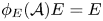 $\phi _E({{\mathcal {A}}})E=E$.
Let  $E$ be a C*-correspondence over
 ${{\mathcal {A}}}$. Set
 $E^{\otimes 0 }={{\mathcal {A}}}$ and
 $E^{\otimes n}=E\otimes E \otimes \cdots \otimes E$, for the
 $n$-fold tensor product when
 $n>0$. Note that we have natural isomorphisms
 $E^{\otimes n}\otimes E^{\otimes m}\cong E^{\otimes {(n+m)}}$ for
 $n> 0$ and
 $m\geq 0$. Note also that
 $E^{\otimes 0}\otimes _{{\mathcal {A}}}E^{\otimes n}\cong E^{\otimes n}$ for
 $n\geq 0$ by non-degeneracy. There is a special injective representation for
 ${{\mathcal {T}}}(E)$ called the Fock space representation of
 $E$. We denote
 ${{\mathcal {F}}}(E)$ the C*-correspondence over
 ${{\mathcal {A}}}$ defined by
 ${{\mathcal {F}}}(E)=\oplus _{n =0}^{\infty } E^{\otimes n}$. As
 $\phi _{{{\mathcal {F}}}(E)}$ acts on the
 $0$th summand by left multiplication, it is clear that
 $\phi _{{{\mathcal {F}}}(E)}$ is injective, so we often identify
 ${{\mathcal {A}}}$ as a subalgebra of
 ${{\mathcal {L}}}({{\mathcal {F}}}(E))$ via
 $\phi _{{{\mathcal {F}}}(E)}$. We define Fock space representation
 $(\iota ,T)$ as follows. We let
 $\iota := \phi _{{{\mathcal {F}}}(E)}$, and for each
 $\xi \in E$ we set
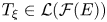 $T_{\xi } \in {{\mathcal {L}}}({{\mathcal {F}}}(E))$ by
 \[ T_{\xi} (a)=\xi a \quad \text{and}\quad T_{\xi}(\xi_1\otimes\cdots\otimes \xi_n)=\xi\otimes \xi_1\otimes\cdots\otimes \xi_n \]
for  $a\in {{\mathcal {A}}},\ \xi ,\xi _1,\ldots \xi _n\in E$. For each
 $n\in \mathbb {N}$, denote by
 $T^{(n)}: E^{\otimes n}\to {{\mathcal {L}}}({{\mathcal {F}}}(E))$ the map uniquely determined on simple tensors by
 $T^{(n)}_{\xi _1 \otimes \cdots \otimes \xi _n} = T_{\xi _1} \circ \cdots \circ T_{\xi _n}$. When we have
 $\xi \in E^{\otimes n}$ we occasionally abuse notation and write
 $T_{\xi }$ to mean
 $T^{(n)}_{\xi }$ and the degree will be clear from context.
By [Reference Muhly and SolelMS98, Theorem 2.12] the representation  $(\iota ,T)$ is universal in the sense that
 ${{\mathcal {T}}}(E) \cong C^{*}(\iota , T)$. Similarly, by [Reference Muhly and SolelMS98, Theorem 3.10] the tensor algebra of
 $E$ coincides with
 $\overline {\operatorname {Alg}}(\iota ,T)$, the norm-closed operator algebra generated by Fock creation operators. Hence, we identify
 ${{\mathcal {T}}}_+(E)$ as the norm-closed operator subalgebra of
 ${{\mathcal {T}}}(E)$ generated by the image of
 $\iota$ and
 $T$.
We may also use Fock space representation to obtain another description of the ideal of relations  ${{\mathcal {J}}}_E$ generated by
 $\{ \psi _T(\phi _E(a))-\iota (a): a\in J_E \}$, which yields the Cuntz–Pimsner algebra
 ${{\mathcal {O}}}(E)$ of
 $E$. Let
 $\sigma : {{\mathcal {L}}}({{\mathcal {F}}}(E))\to {{\mathcal {L}}}({{\mathcal {F}}}(E))/{{\mathcal {K}}}({{\mathcal {F}}}(E)J_E)$ be the canonical quotient map. By [Reference KatsuraKat04b, Proposition 6.5] we get that
 ${{\mathcal {O}}}(E)\cong C^{*}(\sigma \circ \iota , \sigma \circ T)$. Thus,
 ${{\mathcal {O}}}(E)\cong {{\mathcal {T}}}(E)/{{\mathcal {K}}}({{\mathcal {F}}}(E)J_E)$ so that
 ${{\mathcal {J}}}_E$ is identified with
 ${{\mathcal {K}}}({{\mathcal {F}}}(E)J_E)$ and we can describe
 ${{\mathcal {J}}}_E$ as
 \[ \overline{\operatorname{span}}\big\{T_{\xi} a T^{*}_{\eta} : \xi\in E^{{\otimes} n}, \ \eta \in E^{{\otimes} m}, \ a\in J_E, \ n,m\in \mathbb{N} \big\}. \]
Definition 2.9 Let  $E$ and
 $F$ be
 $C^{*}$-correspondences over
 ${{\mathcal {A}}}$ and
 ${{\mathcal {B}}}$, respectively. We say that
 $E$ and
 $F$ are unitarily isomorphic if there exist a surjective, isometric map
 $U: E\to F$ and a *-isomorphism
 $\rho : {{\mathcal {A}}}\to {{\mathcal {B}}}$, s.t.
 $U(a\cdot \xi \cdot b)=\rho (a)\cdot U(\xi )\cdot \rho (b)$ for all
 $a,b\in {{\mathcal {A}}},\ \xi \in E$.
See [Reference Dor-OnDor18, § 2.1] for more on isomorphisms of  $C^{*}$-correspondences. For a
 $C^{*}$-correspondence over
 ${{\mathcal {A}}}$, we denote by
 $P_0\in {{\mathcal {L}}}({{\mathcal {F}}}(E))$ the orthogonal projection onto
 $E^{\otimes 0} = {{\mathcal {A}}}$, and we let
 $\Psi : {{\mathcal {T}}}(E)\to {{\mathcal {A}}}$ be the compression given by
 $\Psi (x)=P_0xP_0$, for all
 $x\in {{\mathcal {T}}}(E)$. Note that for
 $a\in {{\mathcal {A}}}$, if
 $\Psi (a)=0$, then
 $a=0$. The following folklore result is a strengthening of [Reference Brown and OzawaBO08, Lemma 4.6.24],which we obtain by using
 $C^{*}$-envelope techniques.
Proposition 2.10 Let  $E$ be a
 $C^{*}$-correspondence over
 ${{\mathcal {A}}}$ and let
 ${{\mathcal {B}}}$ be any
 $C^{*}$-algebra. Then
 $(\iota \otimes {{\operatorname {id}}}_{{{\mathcal {B}}}}, T\otimes {{\operatorname {id}}}_{{{\mathcal {B}}}})$ is a rigged representation which induces an isomorphism
 $\rho : {{\mathcal {T}}}(E\otimes {{\mathcal {B}}}) \rightarrow {{\mathcal {T}}}(E)\otimes {{\mathcal {B}}}$. The isomorphism
 $\rho$ maps
 ${{\mathcal {T}}}_+(E \otimes {{\mathcal {B}}})$ onto
 ${{\mathcal {T}}}_+(E) \otimes {{\mathcal {B}}}$ and induces an isomorphism between
 ${{\mathcal {O}}}(E \otimes {{\mathcal {B}}})$ and
 ${{\mathcal {O}}}(E) \otimes {{\mathcal {B}}}$. In particular,
 $\rho$ maps
 ${{\mathcal {J}}}_{E\otimes {{\mathcal {B}}}}$ to
 ${{\mathcal {J}}}_E \otimes {{\mathcal {B}}}$.
Proof. It is standard to verify that  $(\iota \otimes {{\operatorname {id}}}_{{\mathcal {B}}}, T\otimes {{\operatorname {id}}}_{{\mathcal {B}}})$ is a rigged representation of the
 $C^{*}$-correspondence
 $E\otimes {{\mathcal {B}}}$ over
 ${{\mathcal {A}}} \otimes {{\mathcal {B}}}$. By universality of
 ${{\mathcal {T}}}(E\otimes {{\mathcal {B}}})$, we have a surjection
 $\rho : {{\mathcal {T}}}(E\otimes {{\mathcal {B}}})\to {{\mathcal {T}}}(E)\otimes {{\mathcal {B}}}$ given by
 $\rho (T_{\xi \otimes b}) = T_{\xi } \otimes b$ for
 $\xi \in E$ and
 $b\in {{\mathcal {B}}}$. As
 ${{\mathcal {T}}}(E)\otimes {{\mathcal {B}}}$ admits the gauge action
 $z \mapsto \gamma _z\otimes {{\operatorname {id}}}_{{\mathcal {B}}}$, we know from theorem [Reference KatsuraKat04a, Theorem 6.2] that
 $\rho$ is an isomorphism if and only if
 \[ I_{(\iota\otimes {{\operatorname{id}}}_{{\mathcal{B}}}, T\otimes{{\operatorname{id}}}_{{\mathcal{B}}})}' := \big\{x\in {{\mathcal{A}}}\otimes{{\mathcal{B}}} \mid (\iota\otimes{{\operatorname{id}}}_{{\mathcal{B}}})(x)\in B_1\big\} \]
is trivial, where
 \[ B_1=\overline{\operatorname{span}} \big\{(T\otimes {{\operatorname{id}}}_{{\mathcal{B}}})(x)(T\otimes{{\operatorname{id}}}_{{\mathcal{B}}})(y)^{*} \mid x,y\in E\otimes {{\mathcal{B}}}\big\}. \]
Thus, we show that 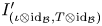 $I_{(\iota \otimes {{\operatorname {id}}}_{{\mathcal {B}}}, T\otimes {{\operatorname {id}}}_{{\mathcal {B}}})}'$ is trivial. Indeed, let
 $x \in ({{\mathcal {A}}} \otimes {{\mathcal {B}}}) \cap B_1$. We clearly have that
 $(\Psi \otimes {{\operatorname {id}}}_{{\mathcal {B}}})(x)=0$ as
 $x\in B_1$, whereas
 $(\Psi \otimes {{\operatorname {id}}}_{{\mathcal {B}}})(x) = x$ as
 $x \in {{\mathcal {A}}} \otimes {{\mathcal {B}}}$. Thus,
 $x = 0$ and
 $\rho$ is an isomorphism.
By injectivity of the minimal tensor product of operator algebras, it follows that the natural isomorphism  ${{\mathcal {T}}}(E)\otimes {{\mathcal {B}}}\cong {{\mathcal {T}}}(E\otimes {{\mathcal {B}}})$ restricts to an isomorphism of operator algebras
 ${{\mathcal {T}}}_+(E)\otimes {{\mathcal {B}}}\cong {{\mathcal {T}}}_+(E\otimes {{\mathcal {B}}})$. Thus, by Corollary 2.7 and [Reference Katsoulis and KribsKK04] we have the following chain of isomorphisms
 \begin{align*}{{\mathcal{O}}}(E \otimes {{\mathcal{B}}}) &\cong C^{*}_\textrm{e}({{\mathcal{T}}}_+(E \otimes {{\mathcal{B}}})) \cong C^{*}_\textrm{e}({{\mathcal{T}}}_+(E) \otimes {{\mathcal{B}}})\\ &\cong C^{*}_\textrm{e}({{\mathcal{T}}}_+(E)) \otimes {{\mathcal{B}}} \cong {{\mathcal{O}}}(E) \otimes {{\mathcal{B}}}.\end{align*}
This yields an isomorphism  $\tilde {\rho } : {{\mathcal {O}}}(E \otimes {{\mathcal {B}}}) \rightarrow {{\mathcal {O}}}(E) \otimes {{\mathcal {B}}}$ that sends
 $S_{\xi \otimes b}$ to
 $S_{\xi } \otimes b$ for every
 $\xi \in E$ and
 $b \in {{\mathcal {B}}}$ where
 $(\iota ,S)$ is a rigged covariant representation such that
 ${{\mathcal {O}}}(E) \cong C^{*}(\iota ,S)$. Let
 $q_E \otimes {{\operatorname {id}}}_{{{\mathcal {B}}}} : {{\mathcal {T}}}(E) \otimes {{\mathcal {B}}} \rightarrow {{\mathcal {O}}}(E) \otimes {{\mathcal {B}}}$ and
 $q_{E \otimes {{\mathcal {B}}}} : {{\mathcal {T}}}(E \otimes {{\mathcal {B}}}) \rightarrow {{\mathcal {O}}}(E \otimes {{\mathcal {B}}})$ denote the canonical quotient maps. As this occurs on generators, we see that
 $(q_E \otimes {{\operatorname {id}}}_{{{\mathcal {B}}}}) \circ \rho = \tilde {\rho } \circ q_{E \otimes {{\mathcal {B}}}}$. Hence, it follows that
 ${{\mathcal {J}}}_{E\otimes {{\mathcal {B}}}}$ is identified with
 ${{\mathcal {J}}}_E \otimes {{\mathcal {B}}}$ via
 $\rho$.
Corollary 2.11 Let  $E$ be a
 $C^{*}$-correspondence over
 ${{\mathcal {A}}}$, and let
 ${{\mathcal {B}}}$ be an exact
 $C^{*}$-algebra. Then the natural isomorphism
 $\rho : {{\mathcal {T}}}(E\otimes {{\mathcal {B}}}) \rightarrow {{\mathcal {T}}}(E)\otimes {{\mathcal {B}}}$ of Proposition 2.10 maps
 $J_{E\otimes {{\mathcal {B}}}}$ to
 $J_E\otimes {{\mathcal {B}}}$.
Proof. First note that because  $\phi _{E \otimes {{\mathcal {B}}}} = \phi _E \otimes {{\operatorname {id}}}_{{{\mathcal {B}}}}$ under the identification
 ${{\mathcal {K}}}(E \otimes {{\mathcal {B}}}) \cong {{\mathcal {K}}}(E) \otimes {{\mathcal {B}}}$, we see that
 $\ker (\phi _{E\otimes {{\mathcal {B}}}}) = \ker (\phi _E) \otimes {{\mathcal {B}}}$.
Next, if  $a \in J_E$, then
 $\phi _E(a) \in {{\mathcal {K}}}(E)$ and
 $ac = 0$ for all
 $c \in \ker \phi _E$. Thus, for any
 $b \in {{\mathcal {B}}}$ we have that
 $\phi _{E \otimes {{\mathcal {B}}}}(a \otimes b) = \phi (a) \otimes b \in {{\mathcal {K}}}(E) \otimes {{\mathcal {B}}} \cong {{\mathcal {K}}}(E \otimes {{\mathcal {B}}})$. Furthermore, by exactness of
 ${{\mathcal {B}}}$ we get that
 $\ker (\phi _E \otimes {{\operatorname {id}}}_{{{\mathcal {B}}}}) = \ker (\phi _E) \otimes {{\mathcal {B}}}$. Thus, by verifying this on simple tensors we get for any
 $c \in \ker (\phi _E \otimes {{\operatorname {id}}}_{{{\mathcal {B}}}})$ that
 $(a \otimes b) c = 0$. Hence, we see that
 $J_E \otimes {{\mathcal {B}}} \subseteq J_{E \otimes {{\mathcal {B}}}}$.
Conversely, again by the exactness of  ${{\mathcal {B}}}$, we get the following short exact sequence:

Thus,  ${{\mathcal {J}}}_E \otimes {{\mathcal {B}}}$ is the ideal generated by
 \[ \big\{(\psi_{T^{E}} \otimes {{\operatorname{id}}}_{{{\mathcal{B}}}})((\phi_E \otimes {{\operatorname{id}}}_{{{\mathcal{B}}}})(c)) - (\iota^{E} \otimes {{\operatorname{id}}}_{{{\mathcal{B}}}})(c) \mid c \in J_E \otimes {{\mathcal{B}}}\big\}. \]
From Proposition 2.10, as  ${{\mathcal {J}}}_E \otimes {{\mathcal {B}}}$ is corresponds bijectively to
 ${{\mathcal {J}}}_{E \otimes {{\mathcal {B}}}}$ via
 $\rho$, we get that
 ${{\mathcal {J}}}_{E \otimes {{\mathcal {B}}}}$ is the ideal generated by
 \[ \big\{\psi_{T^{E \otimes {{\mathcal{B}}}}}(\phi_{E \otimes {{\mathcal{B}}}}(c)) - (\iota^{E\otimes {{\mathcal{B}}}})(c) \mid c \in J_{E} \otimes {{\mathcal{B}}}\big\}. \]
Hence, we see that the surjection from the relative Cuntz–Pimsner algebra  ${{\mathcal {O}}}(E \otimes {{\mathcal {B}}}, J_E \otimes {{\mathcal {B}}})$ (see [Reference KatsuraKat07, § 11]) onto
 ${{\mathcal {O}}}(E \otimes {{\mathcal {B}}})$ is injective. From [Reference KatsuraKat07, Corollary 11.8] we deduce that
 $J_E \otimes {{\mathcal {B}}} = J_{E \otimes {{\mathcal {B}}}}$.
3. Hierarchy of isomorphism problems
In this section we establish the aforementioned hierarchy between different notions of isomorphisms of Toeplitz and tensor algebras.
Theorem 3.1 Let  $E$ and
 $F$ be
 $C^{*}$-correspondences over
 ${{\mathcal {A}}}$ and
 ${{\mathcal {B}}}$, respectively. Suppose that
 $\varphi : {{\mathcal {T}}}(E) \rightarrow {{\mathcal {T}}}(F)$ is a base-preserving graded *-isomorphism. Then
 $\varphi$ is a base-preserving s.e.s. isomorphism.
Proof. Suppose  $\varphi : {{\mathcal {T}}}(E) \rightarrow {{\mathcal {T}}}(F)$ is a base-preserving graded *-isomorphism. Let
 $q_E : {{\mathcal {T}}}(E) \rightarrow {{\mathcal {O}}}(E)$ and
 $q_F : {{\mathcal {T}}}(F) \rightarrow {{\mathcal {O}}}(F)$ be the canonical quotient maps. As
 $\varphi$ is graded, it follows by the discussion after Definition 1.6 that
 $\varphi$ is equivariant.
The map  $\psi := q_E\circ \varphi ^{-1}: {{\mathcal {T}}}(F)\rightarrow {{\mathcal {O}}}(E)$ then restricts to an injective rigged representation
 $(\psi \circ \iota _B, \psi \circ T^{F})$ that admits a gauge action, where
 $(\iota _B, T^{F})$ denotes the Fock representation. Note that
 $C^{*}(\psi \circ \iota _B,\psi \circ T^{F})={{\mathcal {O}}}(E)$. By [Reference KatsuraKat07, Proposition 7.14] there is an induced surjective *-homomorphism
 $\rho : {{\mathcal {O}}}(E) \rightarrow {{\mathcal {O}}}(F)$ such that
 $\rho \circ \psi = q_F$, namely
 $\rho \circ q_E=q_F\circ \varphi$. This implies that
 $\varphi ( {{\mathcal {K}}}({{\mathcal {F}}}(E)J_E))\subseteq {{\mathcal {K}}}({{\mathcal {F}}}(F)J_F)$. The symmetric argument with
 $\varphi$ instead of
 $\varphi ^{-1}$ then shows the reversed inclusion.
Let  $F$ be a
 $C^{*}$-correspondence over a
 $C^{*}$-algebra
 ${{\mathcal {B}}}$ and assume that
 $\rho : {{\mathcal {A}}}\to {{\mathcal {B}}}$ is a *-isomorphism. Then
 $F$ can be realized naturally, as a
 $C^{*}$-correspondence
 $F_{\rho }$ over
 ${{\mathcal {A}}}$, via
 $\rho$. The new operations are given by
 ${\langle \xi ,\eta \rangle }_{\rho } := \rho ^{-1}({\langle \xi ,\eta \rangle }_{{\mathcal {A}}}), \text { for } \xi ,\eta \in E; \ a \cdot \xi = \rho (a)\cdot \xi ;$ and
 $ \xi \cdot a := \xi \cdot \rho (a), \text { for all } \xi \in F \text { and } a\in {{\mathcal {A}}}$. The identity map
 $U:F \to F_{\rho }$ is then a unitary isomorphism.
This leads to the following simple reduction for base-preserving isomorphisms. Suppose  $F$ is a
 $C^{*}$-correspondence over
 ${{\mathcal {A}}}$ and
 $\rho : {{\mathcal {A}}} \rightarrow {{\mathcal {B}}}$ is a *-isomorphism. Then we have that:
(1)
${{\mathcal {T}}}_+(F)$ and ${{\mathcal {T}}}_+(F_{\rho })$ are base-preserving graded isomorphic;(2)
${{\mathcal {T}}}(F)$ and ${{\mathcal {T}}}(F_{\rho })$ are base-preserving graded isomorphic;(3)
${{\mathcal {T}}}(F)$ and ${{\mathcal {T}}}(F_{\rho })$ are base-preserving s.e.s. isomorphic.


Hence, when  $E$ and
 $F$ are
 $C^{*}$-correspondences over
 ${{\mathcal {A}}}$ and
 ${{\mathcal {B}}}$, respectively, and
 $\phi$ is a base-preserving isomorphism from an algebra of
 $E$ to an algebra of
 $F$, after composing with one of the isomorphisms described previously, we may assume that
 $\phi$ is the identity on the base algebra. For more details, we refer the reader to the discussion after [Reference Dor-OnDor18, Definition 2.1]. We next recall some definitions and results from Muhly and Solel [Reference Muhly and SolelMS98]. The following is [Reference Muhly and SolelMS98, Definition 3.1].
Definition 3.2 Let  $(\pi , t)$ be a completely contractive representation of a
 $C^{*}$-correspondence
 $E$ over a
 $C^{*}$-algebra
 ${{\mathcal {A}}}$ on a Hilbert space
 ${{\mathcal {H}}}$. A rigged dilation of
 $(\pi ,t)$ is a rigged representation
 $(\sigma ,s)$ of
 $E$ on a Hilbert space
 ${{\mathcal {K}}}\supseteq {{\mathcal {H}}}$, s.t.:
(1)
$\sigma$ dilates $\pi$, that is, $\pi (a)=P_{{{\mathcal {H}}}}\sigma (a)|_{{{\mathcal {H}}}}$, for all $a\in {{\mathcal {A}}}$;(2)
$s$ dilates $t$, that is, $t(\xi )=P_{{{\mathcal {H}}}}s(\xi )|_{{{\mathcal {H}}}}$, for all $\xi \in E$; and(3)
${{\mathcal {H}}}$ is co-invariant under each $s(\xi )$, $\xi \in E$.








As  $\sigma$ is a
 $*$-homomorphism that dilates
 $\pi$, it is easy to see that
 $\sigma$ must be of the form
 $\pi \oplus \psi$ for some
 $*$-representation
 $\psi$. In [Reference Muhly and SolelMS98, Theorem 3.3], Muhly and Solel provided a generalization of Nagy–Foias dilation to representations of
 $C^{*}$-correspondences. This theorem shows that every completely contractive representation of
 $E$ admits a rigged dilation. As a consequence, we have a one-to-one correspondence between completely contractive representations of
 $E$ and representations of
 ${{\mathcal {T}}}_+(E)$ as shown in [Reference Muhly and SolelMS98, Theorem 3.10]. More precisely, to every completely contractive representation
 $(\pi ,t)$ of a correspondence
 $E$ over a
 $C^{*}$-algebra
 ${{\mathcal {A}}}$, there is a unique completely contractive representation
 $\rho$ of
 ${{\mathcal {T}}}_+(E)$, satisfying:
(1)
$\rho (T_{\xi })=t(\xi )$, for $\xi \in E$; and(2)
$\rho (a)=\pi (a)$, for $a\in {{\mathcal {A}}}$.


The map  $(\pi ,t)\mapsto \rho$ is then bijective onto all the representations of
 ${{\mathcal {T}}}_+(E)$.
Thus, for a representation  $\rho : {{\mathcal {T}}}_+(E)\to B({{\mathcal {H}}})$ let
 $(\pi ,t)$ be the associated completely contractive representation of
 $E$ given by
 $\pi = \rho \circ \iota$ and
 $t = \rho \circ T$. Then
 $(\pi ,t)$ has a rigged dilation
 $(\sigma ,s)$. Thus,
 $(\sigma , s)$ induces a representation
 $\tilde {\rho } :{{\mathcal {T}}}_+(E)\to B({{\mathcal {K}}})$ such that
 $\tilde {\rho }(a)=\sigma (a)$ for
 $a\in {{\mathcal {A}}}$, and
 $\tilde {\rho }(T_{\xi })=s(\xi )$ for
 $\xi \in E$. It follows by Definition 3.2 and the succeeding discussion that
 ${{\mathcal {H}}}$ is co-invariant for
 $\tilde {\rho }$. That is,
 $\tilde {\rho }$ is a c-dilation of
 $\rho$. The following can be obtained by combining [Reference Muhly and SolelMS98, Proposition 4.2] and [Reference Muhly and SolelMS98, Corollary 4.7] using the language of orthoprojective modules. For the sake of posterity we provide a direct proof.
Proposition 3.3 Let  $E$ be a
 $C^{*}$-correspondence over a
 $C^{*}$-algebra
 ${{\mathcal {A}}}$, and let
 $\rho :{{\mathcal {T}}}_+(E)\to B({{\mathcal {H}}})$ be a representation. Then
 $\rho$ is c-dilation extreme if and only if
 $(\rho \circ \iota ,\rho \circ T)$ is a rigged representation of
 $E$.
Proof.  $(\Rightarrow ):$ Let
 $\tilde {\rho }: {{\mathcal {T}}}_+(E)\to B({{\mathcal {K}}})$ be the completely contractive representation described previously. As
 $\tilde {\rho }$ is a c-dilation of
 $\rho$ and
 $\rho$ is c-dilation extreme,
 $\tilde {\rho }=\rho \oplus \psi$ for some representation
 $\psi$. Moreover, we know that
 $\tilde {\rho }$ is induced by a rigged representation,
 $(\sigma , s)=(\tilde {\rho }\circ \iota , \tilde {\rho }\circ T)$ of
 $E$. Thus,
 $(\rho \circ \iota ,\rho \circ T)$ is also a rigged representation of
 $E$.
 $(\Leftarrow ):$ Assume
 $(\rho \circ \iota ,\rho \circ T)$ is a rigged representation of
 $E$. We want to show that
 $\rho$ is c-dilation extreme, so let
 $\tilde {\rho }:{{\mathcal {T}}}_+(E)\to B({{\mathcal {K}}})$ be a c-dilation of
 $\rho$. By the previous discussion, there exists a c-dilation of
 $\tilde {\rho }$, denoted
 $\hat {\rho }: {{\mathcal {T}}}_+(E)\to B(\widehat {{{\mathcal {K}}}})$, s.t.
 $(\hat {\rho } \circ \iota , \hat {\rho } \circ T)$ is a rigged representation of
 $E$. Viewing
 ${{\mathcal {H}}}\subseteq {{\mathcal {K}}} \subseteq \widehat {{{\mathcal {K}}}}$, one can check that
 $\hat {\rho }$ is also a c-dilation of
 $\rho$. Thus, without loss of generality we assume that
 $(\sigma ,s) = (\tilde {\rho } \circ \iota , \tilde {\rho } \circ T)$ is rigged.
We claim that  $\tilde {\rho }=\rho \oplus \psi$, for some representation
 $\psi$. Indeed, view
 $\tilde {\rho }$ as a
 $2\times 2$ block matrix acting on
 ${{\mathcal {H}}}\oplus {{\mathcal {H}}}^{\perp }$. For
 $\xi \in E$, as
 ${{\mathcal {H}}}$ is co-invariant for
 $\tilde {\rho }({{\mathcal {T}}}_+(E))$ and
 $\rho$ is a rigged representation, we may write
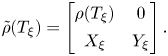 \[ \tilde{\rho}(T_{\xi}) = \begin{bmatrix} \rho(T_\xi) & 0\\ X_{\xi} & Y_{\xi}\end{bmatrix}. \]
Thus,
 \[ \tilde{\rho}(T_{\xi})^{*}\tilde{\rho}(T_{\xi}) = \begin{bmatrix} \rho(\langle \xi,\xi\rangle)+X_{\xi}^{*}X_{\xi} & * \\ * & * \end{bmatrix}. \]
On the other hand, using that  $(\tilde {\rho } \circ \iota ,\tilde {\rho }\circ T)$ is a rigged representation of
 $E$, we get that
 \[ \tilde{\rho}(T_{\xi})^{*}\tilde{\rho}(T_{\xi})=\tilde{\rho}(\langle \xi, \xi\rangle)= \begin{bmatrix} \rho(\langle \xi, \xi\rangle) & 0\\ * & * \end{bmatrix}. \]
Combining both equations, we get  $X_{\xi }^{*}X_{\xi }=0$, and so
 $X_{\xi }=0$. Therefore, for all
 $\xi \in E$, one has
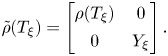 \[ \tilde{\rho}(T_{\xi})=\begin{bmatrix} \rho(T_\xi) & 0\\ 0 & Y_{\xi}\end{bmatrix}. \]
Moreover, because  $\tilde {\rho } \circ \iota$ is a *-homomorphism that dilates the *-representation
 $\rho \circ \iota$, we know that
 $\rho \circ \iota$ is a direct summand of
 $\tilde {\rho } \circ \iota$. Hence, as
 ${{\mathcal {H}}}$ is reducing for
 $\tilde {\rho }(a)$ and
 $\tilde {\rho }(T_{\xi })$ for every
 $a \in {{\mathcal {A}}}$ and
 $\xi \in E$, and as the image of
 ${{\mathcal {T}}}_+(E)$ under
 $\tilde {\rho }$ is generated by such elements, we see that
 $\tilde {\rho }$ has
 ${{\mathcal {H}}}$ as a reducing subspace. Therefore,
 $\tilde {\rho }$ must be of the form
 $\tilde {\rho }=\rho \oplus \psi$, for some representation
 $\psi$. This shows that
 $\rho$ is c-dilation extreme.
Theorem 3.4 Let  $E$ and
 $F$ be
 $C^{*}$-correspondences over
 $C^{*}$-algebras
 ${{\mathcal {A}}}$ and
 ${{\mathcal {B}}}$, respectively. Let
 $\phi : {{\mathcal {T}}}_+(E)\to {{\mathcal {T}}}_+(F)$ be a completely isometric isomorphism. Then
 $\phi$ extends to a base-preserving s.e.s. isomorphism
 $\varphi$ of
 ${{\mathcal {T}}}(E)$ and
 ${{\mathcal {T}}}(F)$. Furthermore, if
 $\phi$ is graded, then
 $\varphi$ is also graded.
Proof. If  $\varphi$ extends a graded isomorphism
 $\phi : {{\mathcal {T}}}_+(E) \rightarrow {{\mathcal {T}}}_+(F)$ to a *-isomorphism between
 ${{\mathcal {T}}}(E)$ and
 ${{\mathcal {T}}}(F)$, it is easy to see on *-monomials that
 $\varphi$ is also graded.
Now assume  $\phi : {{\mathcal {T}}}_+(E)\to {{\mathcal {T}}}_+(F)$ is a completely isometric isomorphism. We use Meyer's theorem [Reference MeyerMey01] to extend, if necessary, to a unital complete isometry
 $\phi ^{1} : {{\mathcal {T}}}_+(E)^{1} \rightarrow {{\mathcal {T}}}_+(F)^{1}$. Then [Reference PaulsenPau02, Proposition 2.12] shows that
 $\phi ^{1}$ extends to a unital complete isometry
 $\tilde {\phi }$ between
 $({{\mathcal {T}}}_+(E)^{1})^{*} + {{\mathcal {T}}}_+(E)^{1}$ and
 $({{\mathcal {T}}}_+(F)^{1})^{*} + {{\mathcal {T}}}_+(F)^{1}$. We then note that
 $\Delta ({{\mathcal {T}}}_+(E)) := \{ T \in {{\mathcal {T}}}_+(E) \mid T^{*} \in {{\mathcal {T}}}_+(E)\}$ must equal the base algebra
 ${{\mathcal {A}}}$, and similarly we have that
 $\Delta ({{\mathcal {T}}}_+(F)) = {{\mathcal {B}}}$. As
 $\tilde {\phi }$ preserves involution and sends
 ${{\mathcal {T}}}_+(E)$ to
 ${{\mathcal {T}}}_+(F)$, it must map
 $\Delta ({{\mathcal {T}}}_+(E))$ to
 $\Delta ({{\mathcal {T}}}_+(F))$. In other words,
 $\phi$ must be base-preserving. It is then clear that any extension of
 $\phi$ will also be base-preserving.
Next, we show that  $\phi$ extends to an s.e.s. isomorphism. We let
 $\{\rho ^{E}_i\}_{i\in I}$ be all c-dilation extreme representations for
 ${{\mathcal {T}}}_+(E)$ up to unitary equivalence and for sufficiently large Hilbert space. Then, we set
 $\rho ^{F}_i := \rho ^{E}_i \circ \phi ^{-1}$ so that by Theorem 2.5 we have that
 $\{\rho ^{F}_i\}_{i\in I}$ are all c-dilation extreme representations of
 ${{\mathcal {T}}}_+(F)$ up to unitary equivalence. By Proposition 3.3, we have that
 $C^{*}(\oplus _{i\in I}\rho _i^{E})$ and
 $C^{*}(\oplus _{i\in I}\rho _i^{F})$ are universal with respect to rigged representations of
 $E$ and
 $F$, respectively. Hence, that there are *-isomorphisms
 $\pi _E: C^{*}(\oplus _{i\in I}\rho _i^{E}) \rightarrow {{\mathcal {T}}}(E)$ and
 $\pi _F: C^{*}(\oplus _{i\in I}\rho _i^{F}) \rightarrow {{\mathcal {T}}}(F)$. Thus, due to the above construction,
 $C^{*}(\oplus _{i\in I}\rho _i^{E})= C^{*}(\oplus _{i\in I}\rho _i^{F})$, a straightforward verification shows that
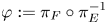 $\varphi := \pi _F \circ \pi _E^{-1}$ is a *-isomorphism between
 ${{\mathcal {T}}}(E)$ and
 ${{\mathcal {T}}}(F)$ that extends
 $\phi$.
Next, let  $\{\rho ^{E}_i\}_{i\in J}$ be those c-dilation extreme representations of
 ${{\mathcal {T}}}_+(E)$ that are dilation extreme. By invariance of dilation extreme representations we get that
 $\{\rho ^{F}_i\}_{i\in J}$ are all dilation extreme representations of
 ${{\mathcal {T}}}_+(F)$ up to unitary equivalence. By (the possibly non-unital version of) Dritschel and McCullough [Reference Dritschel and McCulloughDM05] we have
 $C^{*}(\oplus _{i\in J}\rho _i^{E}) = C^{*}_\textrm {e}({{\mathcal {T}}}_+(E))$ and
 $C^{*}(\oplus _{i\in J}\rho _i^{F}) = C^{*}_\textrm {e}({{\mathcal {T}}}_+(F))$. Furthermore, by [Reference Katsoulis and KribsKK06] we know that
 $C^{*}_\textrm {e}({{\mathcal {T}}}_+(E)) \cong {{\mathcal {O}}}(E)$ and
 $C^{*}_\textrm {e}({{\mathcal {T}}}_+(F)) \cong {{\mathcal {O}}}(F)$. Hence, there *-isomorphisms
 $\tau _E : C^{*}_\textrm {e}({{\mathcal {T}}}_+(E)) \rightarrow {{\mathcal {O}}}(E)$ and
 $\tau _F : C^{*}_\textrm {e}({{\mathcal {T}}}_+(F)) \rightarrow {{\mathcal {O}}}(F)$. As before,
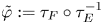 $\tilde {\varphi } := \tau _F \circ \tau _E^{-1}$ is a *-isomorphism between
 ${{\mathcal {O}}}(E)$ and
 ${{\mathcal {O}}}(F)$ that extends
 $\phi$.
Furthermore, by construction, we have that the natural quotient maps  $q_E : C^{*}(\oplus _{i\in I}\rho _i^{E}) \rightarrow C^{*}_\textrm {e}({{\mathcal {T}}}_+(E))$ and
 $q_F : C^{*}(\oplus _{i\in I}\rho _i^{F}) \rightarrow C^{*}_\textrm {e}({{\mathcal {T}}}_+(F))$ are equal, so we get that the identified quotient maps
 $q_E : {{\mathcal {T}}}(E) \rightarrow {{\mathcal {O}}}(E)$ and
 $q_F : {{\mathcal {T}}}(F) \rightarrow {{\mathcal {O}}}(F)$ satisfy
 $q_F \circ \varphi = \tilde {\varphi } \circ q_E$. Hence, we see that
 $\varphi$ is a base-preserving s.e.s. isomorphism.
To conclude, we have obtained the following hierarchy of isomorphism problems for  $C^{*}$-correspondences, tensor algebras, and Toeplitz algebras.
Corollary 3.5 Let  $E$ and
 $F$ be
 $C^{*}$-correspondences over
 $C^{*}$-algebras
 ${{\mathcal {A}}}$ and
 ${{\mathcal {B}}}$, respectively. Consider the following:
(1)
$E$ and $F$ are unitarily isomorphic $C^{*}$-correspondences;(2)
${{\mathcal {T}}}_+(E)$ and ${{\mathcal {T}}}_+(F)$ are graded completely isometrically isomorphic;(3)
${{\mathcal {T}}}_+(E)$ and ${{\mathcal {T}}}_+(F)$ are completely isometrically isomorphic;(4)
${{\mathcal {T}}}(E)$ and ${{\mathcal {T}}}(F)$ are base-preserving graded isomorphic;(5)
${{\mathcal {T}}}(E)$ and ${{\mathcal {T}}}(F)$ are base-preserving s.e.s. isomorphic.


Then  $(1) \implies (2)$,
 $(2) \implies (3)$ and
 $(4)$, and each of
 $(3)$ and
 $(4)$ separately imply
 $(5)$.
Proof. Clearly  $(1) \implies (2)$ and
 $(2) \implies (3)$. By Theorem 3.4 we see that
 $(2) \implies (4)$ and
 $(3) \implies (5)$. Finally, an application of Theorem 3.1 shows that
 $(4) \implies (5)$.
Remark 3.6 In case  $\phi : {{\mathcal {T}}}_+(E) \rightarrow {{\mathcal {T}}}_+(F)$ is a graded (not necessarily completely) isometric isomorphism, because
 $\phi |_{{{\mathcal {A}}}} : {{\mathcal {A}}} \rightarrow {{\mathcal {B}}}$ is an isometric isomorphism it is automatically a *-isomorphism by invoking [Reference GardnerGar65, Corollary 4.2]. Hence, the proof of [Reference Dor-OnDor18, Theorem 4.3 item (2)] can be carried out to show that the
 $C^{*}$-correspondences
 $E$ and
 $F$ are unitarily isomorphic. Thus, items
 $(1)$ and
 $(2)$ in the above theorem are both equivalent to the existence of a graded isometric isomorphism between
 ${{\mathcal {T}}}_+(E)$ and
 ${{\mathcal {T}}}_+(F)$.
4. Graded isomorphisms
In this section, we investigate graded base-preserving isomorphisms of Toeplitz algebras under additional assumptions on the  $C^{*}$-correspondence.
Following the notation of [Reference KatsuraKat04b], we recall the construction of core subalgebras of Fock representation and their properties.
Definition 4.1 We define the core  $C^{*}$-subalgebras
 $B_n\subseteq {{\mathcal {T}}}(E)$ by
 \[ B_0 := \phi_{{{\mathcal{F}}}(E)}({{\mathcal{A}}}), \quad \text{and}\quad B_n := \overline{\operatorname{span}}\big\{ T^{(n)}_{\xi}T^{(n)*}_{\eta}: \xi,\eta \in E^{{\otimes} n} \big\}. \]
We define  $B_{[n,m]} = B_n + \cdots + B_m$ for
 $m\geq n$. And then set
 $B_{[n,\infty )}= \overline {{\bigcup} _{m\geq n} B_{[n,m]}}$. We note that
 $B_{[n,\infty )}$ is a decreasing sequence of ideals. By [Reference KatsuraKat04b, § 5] we see that
 $B_n$ is identified with
 ${{\mathcal {K}}}(E^{\otimes n})$ by the *-isomorphism
 \[ {{\mathcal{K}}}(E^{{\otimes} n})\to B_n, \quad \theta_{\xi, \eta}\mapsto T^{(n)}_{\xi}T^{(n)*}_{\eta}. \]
Proposition 4.2 We have a short exact sequence
 \[ 0\to B_{[n+1,\infty)}\to B_{[n,\infty)}\to B_{n}\to 0, \]
which splits naturally.
Proof. We first show that  $B_{[n+1,\infty )}\cap B_n=\{0\}$. Let
 $T\in B_{[n+1,\infty )}\cap B_n$. Observe that
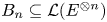 $B_n\subseteq {{\mathcal {L}}}(E^{\otimes n})$. However,
 $T(E^{\otimes n})=0$, because
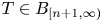 $T\in B_{[n+1,\infty )}$. Hence, by the third isomorphism theorem, we obtain
 \[ \frac{B_{[n,\infty)}}{B_{[n+1,\infty)}}=\frac{B_n+B_{[n+1,\infty)}}{B_{[n+1,\infty)}}\cong \frac{B_n}{B_n\cap B_{[n+1,\infty)}}\cong B_n. \]
Finally, the natural inclusion 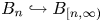 $B_n\hookrightarrow B_{[n,\infty )}$ gives the splitting map for the short exact sequence.
Proposition 4.3 Let  $E$ be a
 $C^{*}$-correspondence over
 ${{\mathcal {A}}}$. Then for each
 $n\in \mathbb {N}$ we have
 $B_{[n,\infty )}={{\mathcal {T}}}(E)_n {{\mathcal {T}}}(E)_n^{*}$. That is,
 \[ B_{[n,\infty)}= \overline{\operatorname{span}}\{TS^{*}: T,S\in {{\mathcal{T}}}(E)_n \}. \]
Proof.  $(\subseteq ):$ Let
 $\xi _1\in E^{\otimes k_1}$,
 $\xi _2\in E^{\otimes k_2}$,
 $\eta _1\in E^{\otimes l_1}$, and
 $\eta _2\in E^{\otimes l_2}$ be such that
 $k_1-l_1=n=k_2-l_2$. Then up to approximation by tolerance
 $\epsilon$, we have
 \[ T^{(k_1)}_{\xi_1}T^{(l_1)*}_{\eta_1}T^{(l_2)}_{\eta_2}T^{(k_2)*}_{\xi_2} \sim_{\epsilon} \begin{cases} T^{(k_1)}_{\xi_1}T^{(l_2 - l_1)}_{\zeta} T^{(k_2)*}_{\xi_2} & \text{if } l_2\geq l_1,\\ T^{(k_1)}_{\xi_1}T^{(l_1 - l_2)*}_{\zeta'} T^{(k_2)*}_{\xi_2} & \text{if } l_2 < l_1, \end{cases} \]
for some 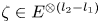 $\zeta \in E^{\otimes (l_2-l_1)}$ and
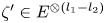 $\zeta ' \in E^{\otimes (l_1-l_2)}$. Thus,
 $T^{(k_1)}_{\xi _1}T^{(l_1)*}_{\eta _1}T^{(l_2)}_{\eta _2}T^{(k_2)*}_{\xi _2} \in B_{k_1}+B_{k_2}\subseteq B_{[n,\infty )}$, as required.
 $(\supseteq ):$ It is enough to show that
 $T^{(n+m)}_{\xi } {T^{(n+m)*}_{\eta }}\in {{\mathcal {T}}}(E)_n {{\mathcal {T}}}(E)_n^{*}$, for
 $\xi , \eta \in E^{\otimes (n+m)}$ and
 ${m\geq 0}$. From the grading, we get
 \begin{align*} T^{(n+m)}_{\xi} {T^{(n+m)*}_{\eta}} &\in {{\mathcal{T}}}(E)_n {{\mathcal{T}}}(E)_m {{\mathcal{T}}}(E)_m^{*} {{\mathcal{T}}}(E)_n^{*} \\ &\,\subseteq\,{{\mathcal{T}}}(E)_n{{\mathcal{T}}}(E)_0{{\mathcal{T}}}(E)_n^{*} \subseteq {{\mathcal{T}}}(E)_n{{\mathcal{T}}}(E)_n^{*}, \end{align*}
so we are done.
Corollary 4.4 Let  $E$,
 $F$ be
 $C^{*}$-correspondences over
 ${{\mathcal {A}}}$ and
 ${{\mathcal {B}}}$, respectively. Let
 $\varphi : {{\mathcal {T}}}(E)\to {{\mathcal {T}}}(F)$ be a graded *-isomorphism. Then
 $\varphi (B^{E}_{[n,\infty )})=B^{F}_{[n,\infty )}$.
For what follows, we denote by  $\Psi _n: B_{[n,\infty )}\to {B}_n$ the quotient map by
 ${{\mathcal {B}}}_{[n+1,\infty )}$ as in Proposition 4.2.
Corollary 4.5 Let  $E$,
 $F$ be
 $C^{*}$-correspondences over
 ${{\mathcal {A}}}$ and
 ${{\mathcal {B}}}$, respectively. Let
 $\varphi : \mathcal {T}(E)\to \mathcal {T}(F)$ be a graded *-isomorphism. Then
 $\varphi _n := \Psi _n \circ \varphi |_{B_n}$ is a *-isomorphism.
Proof. By Corollary 4.4 we have that  $\varphi$ restricts to an isomorphism between
 $B^{E}_{[n,\infty )}$ and
 $B^{F}_{[n,\infty )}$ for all
 $n \in \mathbb {N}$. By Proposition 4.2 we get that
 $\varphi _n$ is the induced isomorphism between the quotient algebras
 $B^{E}_n$ and
 $B^{F}_n$.
When  $E$ is a general Hilbert
 $C^{*}$-module, by [Reference LanceLan95, p. 10] we know that operators in
 ${{\mathcal {K}}}(E)$ may fail to be compact operators as bounded operators the Banach space
 $E$. Thus, we make a distinction and say that a
 $C^{*}$-algebra
 ${{\mathcal {A}}}$ is a compact operator subalgebra if
 ${{\mathcal {A}}}$ is a subalgebra of
 ${{\mathcal {K}}}({{\mathcal {H}}})$ on some Hilbert space
 ${{\mathcal {H}}}$.
Proposition 4.6 Let  $E$,
 $F$ be
 $C^{*}$-correspondences over
 ${{\mathcal {A}}}$ and
 ${{\mathcal {B}}}$, respectively, such that
 ${{\mathcal {A}}}$ (or
 ${{\mathcal {B}}}$) is a subalgebra of compact operators. Let
 $\varphi : {{\mathcal {T}}}(E)\to {{\mathcal {T}}}(F)$ be a base-preserving graded *-isomorphism. Then, there exists a unitary isomorphism
 $U:E\to F$ implemented by the *-isomorphism
 $\rho := \varphi |_{{{\mathcal {A}}}}: {{\mathcal {A}}} \rightarrow {{\mathcal {B}}}$.
Proof. As  ${{\mathcal {A}}} \cong {{\mathcal {B}}}$ via
 $\varphi |_{{{\mathcal {A}}}}$, without loss of generality we may assume that
 ${{\mathcal {A}}} = {{\mathcal {B}}}$ and that
 $\varphi |_{{{\mathcal {A}}}} = {{\operatorname {id}}}_{{{\mathcal {A}}}}$. By Corollary 4.5 we have a *-isomorphism
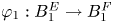 $\varphi _1 : B_1^{E} \rightarrow B_1^{F}$ induced from
 $\varphi$ via
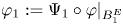 $\varphi _1 := \Psi _1 \circ \varphi |_{B_1^{E}}$. After we identify
 $B^{E}_1$ and
 $B^{F}_1$ with
 ${{\mathcal {K}}}(E)$ and
 ${{\mathcal {K}}}(F)$, respectively, and since
 ${{\mathcal {A}}}$ and
 ${{\mathcal {B}}}$ are subalgebras of compact operators, we may appeal to [Reference AsadiAsa08, Corollary 1] to see that the *-isomorphism
 $\varphi _1: {{\mathcal {K}}}(E)\to {{\mathcal {K}}}(F)$ is of the form
 $\operatorname {Ad}_U$ for some unitary operator
 $U:E\to F$ such that
 $U(\xi \cdot a)=U(\xi )\cdot a$ for
 $\xi \in E,\ a\in {{\mathcal {A}}}$.
It is left to show that  $U(a\cdot \xi )= a \cdot U(\xi )$ for
 $\xi \in E,\ a\in A$. Let
 $\Psi _1: B_{[1,\infty )}\to B_1$ be the quotient map as in Proposition 4.2. We first show that
 $\Psi _1(a \cdot T)= a \cdot \Psi _1(T)$ for all
 $a\in {{\mathcal {A}}}$ and
 $T \in B_{[1,\infty )}$. Indeed, write
 $T=S+W$, with
 $S \in B_1$ and
 $W \in B_{[2,\infty )}$. Clearly,
 $a \cdot S \in B_1$ and
 $a \cdot W \in B_{[2,\infty )}$. Thus,
 $\Psi _1(a T)=\Psi _1(aS+aW)=a S=a \Psi _1(T)$. Next, let
 $\xi ,\eta \in E$ and
 $a\in {{\mathcal {A}}}$ be given. Then we have
 \[ \varphi_1(T^{(1)}_{a\cdot \xi}T^{(1)*}_\eta)=T^{(1)}_{U(a\cdot \xi)}T^{(1)*}_{U(\eta)}. \]
On the other hand,
 \begin{align*}\varphi_1(T^{(1)}_{a\cdot \xi}T^{(1)*}_\eta)&=\Psi_1\ {\big(\varphi} \big(a \cdot T^{(1)}_{\xi}T^{(1)*}_\eta \big)\big)=\Psi_1 \big(a \cdot \varphi \big(T^{(1)}_\xi T^{(1)*}_{\eta} \big )\big)\\ &= a \cdot \varphi_1 \big(T^{(1)}_{\xi} T^{(1)*}_{\eta}\big)=a \cdot T^{(1)}_{U(\xi)}T^{(1)*}_{U(\eta)}.\end{align*}
In particular, it follows that  $T^{(1)}_{U(a\cdot \xi )} \langle x,y \rangle =T^{(1)}_{a \cdot U(\xi )} \langle x,y \rangle$, for all
 $x,y\in F$.
By [Reference LanceLan95, p. 5], we have that  $F \langle F, F \rangle$ is dense in
 $F$ so that by an
 ${\epsilon }/{2}$-argument we get that
 $U(a\cdot \xi )=a \cdot U(\xi )$, as required.
Corollary 4.7 Let  $E$ and
 $F$ be
 $C^{*}$-correspondences over
 ${{\mathcal {A}}}$ and
 ${{\mathcal {B}}}$, respectively. Suppose that
 ${{\mathcal {A}}}$ (or
 ${{\mathcal {B}}}$) is a subalgebra of compact operators. Then the following are equivalent:
(1) the
$C^{*}$-correspondences $E$ and $F$ are unitarily isomorphic;(2)
$\mathcal {T}_+(E)$ and $\mathcal {T}_+(F)$ are graded completely isometrically isomorphic;(3)
${{\mathcal {T}}}(E)$ and ${{\mathcal {T}}}(F)$ are base-preserving graded *-isomorphic.


Proof. It is easy to show see that condition (1) implies condition (2) (see, for instance, the proof of [Reference Dor-OnDor18, Theorem 4.3 item (1)], which works verbatim even when  ${{\mathcal {A}}}$ and
 ${{\mathcal {B}}}$ are non-commutative), and by Corollary 3.5 we have that condition (2) implies condition (3). Hence, we need only show that condition (3) implies condition (1). When
 ${{\mathcal {A}}}$ is a
 $C^{*}$-subalgebra of compact operators this follows from Proposition 4.6.
5. K-theory
In this section we show how stabilized base-preserving s.e.s. isomorphisms induce isomorphisms of six-term short exact sequences of K-groups that only involve the coefficient algebras, Katsura ideals, and Cuntz–Pimsner algebras. For the basics of K-theory, we refer the reader to [Reference RørdamRør00]. In this section we rely on K-theory computations in the context of Cuntz–Pimsner algebras from [Reference KatsuraKat04b, § 8]. Recall that for a  $C^{*}$-correspondence
 $E$ we denote by
 ${{\mathcal {J}}}_E$ the ideal of relations in
 ${{\mathcal {T}}}(E)$ that coincides with
 ${{\mathcal {K}}}({{\mathcal {F}}}(E)J_E)$.
Let  $E$ be a
 $C^{*}$-correspondence over
 ${{\mathcal {A}}}$. Denote by
 $\phi _0 : J_E \rightarrow {{\mathcal {K}}}(E^{\otimes 0}J_E) \subseteq {{\mathcal {K}}}({{\mathcal {F}}}(E)J_E)$ the left action of the
 $C^{*}$-correspondence
 $E^{\otimes 0}$. By [Reference KatsuraKat04b, Proposition 8.1] we see that
 $(\phi _0)_* : K_*(J_E) \rightarrow K_*({{\mathcal {J}}}_E)$ is an isomorphism. Now let

be the short exact sequence with embedding  $j : {{\mathcal {J}}}_E \rightarrow {{\mathcal {T}}}(E)$. We denote by
 $i : J_E \rightarrow {{\mathcal {A}}}$ the natural embedding. Now let
 $\iota _{{{\mathcal {A}}}} : {{\mathcal {A}}} \rightarrow {{\mathcal {D}}}_E$ and
 $\iota _{{{\mathcal {K}}}({{\mathcal {E}}})} : {{\mathcal {K}}}({{\mathcal {E}}}) \rightarrow {{\mathcal {D}}}_E$ be the
 $(1,1)$ and
 $(2,2)$ embedding into the linking algebra, which induce isomorphisms in K-theory. We define
 $[E] : K_*(J_E) \rightarrow K_*({{\mathcal {A}}})$ via the composition of
 $(\phi _E)_* : K_*(J_E) \rightarrow K_*({{\mathcal {K}}}(E))$ and
 $E_* : K_*({{\mathcal {K}}}(E)) \rightarrow K_*({{\mathcal {A}}})$, where
 $\phi _E$ is the left action on
 $E$ and
 $E_* = (\iota _{{{\mathcal {A}}}})_*^{-1}(\iota _{{{\mathcal {K}}}(E)})_*$. Then by the discussion preceding [Reference KatsuraKat04b, Theorem 8.6] we obtain the following commutative diagram.

Hence, when  $F$ is another
 $C^{*}$-correspondence over
 ${{\mathcal {B}}}$ such that
 $\psi : {{\mathcal {T}}}(E) \rightarrow {{\mathcal {T}}}(F)$ is a base-preserving s.e.s. isomorphism, we denote by
 $\psi _0$ the restriction of
 $\psi$ to
 ${{\mathcal {J}}}_E$, by
 $\rho$ its restriction to
 ${{\mathcal {A}}}$, and by
 $\bar {\psi } : {{\mathcal {O}}}(E) \rightarrow {{\mathcal {O}}}(F)$ the induced *-isomorphism on the quotients. Denote by
 $\tau _* : K_*(J_E) \rightarrow K_*(J_F)$ the isomorphism given by
 $(\phi _0^{F})_*^{-1} (\psi _0)_* (\phi _0^{E})_*$. We hence obtain the following commutative diagram.

We denote by  $\pi _E$ the composition of the embedding
 $\phi _{{{\mathcal {F}}}(E)} : {{\mathcal {A}}} \rightarrow {{\mathcal {T}}}(E)$ with the quotient map of
 ${{\mathcal {T}}}(E)$ to
 ${{\mathcal {O}}}(E)$. Let
 $e$ denote the natural inclusion of any
 $C^{*}$-algebra inside its stabilization, by tensoring with a fixed rank-one projection. It is standard that the induced map
 $e_*$ between associated K-groups is an isomorphism.
Lemma 5.1 Let  $E$ be a
 $C^{*}$-correspondence over
 ${{\mathcal {A}}}$. Then
 \[ e_*^{{-}1}\circ\big(i^{E}_*-[E]\big)\circ e_*=i_*^{E\otimes {{\mathcal{K}}}}-[E\otimes{{\mathcal{K}}}]. \]
Proof. It is readily verified that  $e \circ i^{E} = i^{E \otimes {{\mathcal {K}}}} \circ e$, and that
 $e \circ \phi _E = (\phi _E \otimes {{\operatorname {id}}}_{{{\mathcal {K}}}}) \circ e = \phi _{E \otimes {{\mathcal {K}}}} \circ e$. Thus, from the definitions of
 $[E]$ and
 $[E\otimes {{\mathcal {K}}}]$, it suffices to show that
 $E_* = e_*^{-1} \circ (E \otimes {{\mathcal {K}}})_* \circ e_*$. Similarly to before we have that
 $e \circ \iota _{{{\mathcal {A}}}} = \iota _{{{\mathcal {A}}} \otimes {{\mathcal {K}}}} \circ e$ and
 $e \circ \iota _{{{\mathcal {K}}}(E)} = \iota _{{{\mathcal {K}}}(E) \otimes {{\mathcal {K}}}} \circ e$. Thus, we get that
 \begin{align*}E_* = (\iota_{{{\mathcal{A}}}})_*^{{-}1} \circ (\iota_{{{\mathcal{K}}}(E)})_* &= e_*^{{-}1} \circ (\iota_{{{\mathcal{A}}} \otimes {{\mathcal{K}}}})_*^{{-}1} \circ (\iota_{{{\mathcal{K}}}(E \otimes {{\mathcal{K}}})})_* \circ e_*\\ & = e_*^{{-}1} \circ (E \otimes {{\mathcal{K}}})_* \circ e_*,\end{align*}
and the proof is complete.
Theorem 5.2 Let  $E$ and
 $F$ be
 $C^{*}$-correspondences over
 ${{\mathcal {A}}}$ and
 ${{\mathcal {B}}}$, respectively. Assume
 $\psi : {{\mathcal {T}}}(E \otimes {{\mathcal {K}}}) \rightarrow {{\mathcal {T}}}(F \otimes {{\mathcal {K}}})$ is a base-preserving s.e.s. isomorphism. Then we have the following commutative diagram.

Proof. By Proposition 2.10, at the level of K-theory we that
 \begin{gather*} K_*({{\mathcal{T}}}(E)) = K_*({{\mathcal{T}}}(E \otimes K)), \quad K_*({{\mathcal{O}}}(E)) = K_*({{\mathcal{O}}}(E\otimes {{\mathcal{K}}})),\quad K_*({{\mathcal{J}}}_E) = K_*({{\mathcal{J}}}_{E\otimes {{\mathcal{K}}}}).\end{gather*}
Furthermore, by Corollary 2.11 and exactness of  ${{\mathcal {K}}}$ we have that
 $K_*(J_E) = K_*(J_{E \otimes {{\mathcal {K}}}})$. These identifications via
 $e_*$ are obtained so that
 \[(\phi_{{{\mathcal{F}}}(E)})_* = (\phi_{{{\mathcal{F}}}(E \otimes {{\mathcal{K}}})})_*, \quad (j_E)_* = (j_{E \otimes {{\mathcal{K}}}})_*, \quad (\phi_0^{E})_* = (\phi_0^{E \otimes {{\mathcal{K}}}})_*, \quad (\pi_E)_* = (\pi_{E \otimes {{\mathcal{K}}}})_*.\]
Moreover, by Lemma 5.1 we also have  $i_*^{E} - [E] = i_*^{E\otimes {{\mathcal {K}}}} - [E \otimes {{\mathcal {K}}}]$. Clearly, the same also holds for
 $F$ instead of
 $E$.
Thus, from the discussion preceding Lemma 5.1 combined with [Reference KatsuraKat04b, Theorem 8.6] applied to the  $C^{*}$-correspondences
 $E \otimes {{\mathcal {K}}}$ and
 $F \otimes {{\mathcal {K}}}$, we obtain the desired diagram.
When  $E$ and
 $F$ are
 $C^{*}$-correspondences over subalgebras of compact operators
 ${{\mathcal {A}}}$ and
 ${{\mathcal {B}}}$, we are able to compute
 $\tau _*$. In this case, both
 $J_E$ and
 $J_F$ are subalgebras of compacts, and must hence be direct sums of algebras of compact operators. From additivity of
 $K_1$, we get that
 $K_1(J_E) = K_1(J_F) = \{0\}$ and, hence,
 $\tau _1 = 0$. Thus, we need only compute
 $\tau _0$.
For a  $C^{*}$-algebra
 ${{\mathcal {C}}}$ we use the standard picture of
 $K_0$ from [Reference RørdamRør00, Proposition 4.2.2] to express
 $K_0({{\mathcal {C}}})$ as differences of equivalence classes
 $[q]_0 - [s(q)]_0$ for
 $q \in {{\mathcal {P}}}_{\infty }({{\mathcal {C}}}^{1})$ where
 ${{\mathcal {C}}}^{1}$ is the unitization of
 ${{\mathcal {C}}}$ (even if it is unital), and
 $s : {{\mathcal {C}}}^{1} \rightarrow {{\mathcal {C}}}^{1}$ is the scalar map (see [Reference RørdamRør00, Subsection 4.2]). Recall also that if
 $\varphi : {{\mathcal {A}}} \rightarrow {{\mathcal {B}}}$ is a *-homomorphism, we denote its unitization by
 $\varphi ^{1}$.
Proposition 5.3 Let  $E$ and
 $F$ be
 $C^{*}$-correspondences over
 ${{\mathcal {A}}}$ and
 ${{\mathcal {B}}}$, respectively, and assume that
 ${{\mathcal {A}}}$ (or
 ${{\mathcal {B}}}$) are subalgebras of compact operators. If
 $\psi : {{\mathcal {T}}}(E) \rightarrow {{\mathcal {T}}}(F)$ is a base-preserving s.e.s. isomorphism, then
 $\psi (J_E) = J_F$ and
 $\tau _0 = (\psi |_{J_E})_0$.
Proof. Without loss of generality, we assume that  ${{\mathcal {A}}}={{\mathcal {B}}}$ and
 $\rho = \psi |_{{{\mathcal {A}}}} = {{\operatorname {id}}}_{{{\mathcal {A}}}}$. As
 $\psi _0 : {{\mathcal {J}}}_E \rightarrow {{\mathcal {J}}}_F$ is a *-isomorphism, by [Reference AsadiAsa08, Corollary 1] there is an
 ${{\mathcal {A}}}$-unitary
 $U : {{\mathcal {F}}}(E)J_E \rightarrow {{\mathcal {F}}}(F)J_F$ such that
 $\psi _0 = \operatorname {Ad}_U$. In particular,
 \[ J_E = \langle {{\mathcal{F}}}(E)J_E, {{\mathcal{F}}}(E)J_E \rangle = \langle {{\mathcal{F}}}(F)J_F, {{\mathcal{F}}}(F)J_F \rangle = J_F \]
so that the first part is proven.
Next we show that  $\tau _0 = ({{\operatorname {id}}}_{J_E})_0 = {{\operatorname {id}}}_{K_0(J_E)}$. Let
 $P_0^{F}: {{\mathcal {F}}}(F)J_E\to J_E$ be the projection onto
 $F^{\otimes 0}J_E=J_E=E^{\otimes 0}J_E\subseteq {{\mathcal {F}}}(F)J_E$. As
 $\tau _0 = (\phi _0^{F})_0^{-1} \circ (\psi _0)_0 \circ (\phi _0^{E})_0$, it suffices to show that
 $(\operatorname {Ad}_U)_0 \circ (\phi _0^{E})_0 = (\phi _0^{F})_0$. Here, we abuse notation and simply write
 $P_0^{F}$ and
 $U$ to mean the
 $n$-direct sums
 $(P_0^{F})^{(n)}$ and
 $U^{(n)}$ for
 $n\in \mathbb {N}$.
Suppose 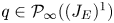 $q \in {{\mathcal {P}}}_{\infty }((J_E)^{1})$ is of size
 $n\times n$. Then
 \begin{align*}\big(\big(\operatorname{Ad}_U\big)_0 \circ (\phi_0^{E})_0\big)\big([q]_0 - [s(q)]_0 \big) &= \big(\operatorname{Ad}_U\big)_0 \big(\big[P_0^{F} q P_0^{F}\big]_0 - \big[s(q)P_0^{F}\big]_0 \big)\\ & = \big[UP_0^{F} q P_0^{F} U^{*}\big]_0 - \big[U(s(q)P_0^{F})U^{*}\big]_0.\end{align*}
Now, because  $UP_0^{F} q P_0^{F} U^{*} =UP_0^{F} q P_0^{F} P_0^{F} q U^{*}$ and
 $UP_0^{F} q P_0^{F}$ is in the unitization
 ${{\mathcal {K}}}({{\mathcal {F}}}(F)J_E)^{1}$, we see that
 \[ \big[UP_0^{F} q P_0^{F} U^{*}\big]_0 = \big[P_0^{F} q P_0^{F}U^{*} UP_0^{F} q P_0^{F}\big]_0 = \big[P_0^{F} q P_0^{F}\big]_0 = \big((\phi_0^{F})^{1}\big)_0\big([q]_0\big), \]
and because  $s(q)$ is a projection that commutes with
 $(P_0^{F})^{(n)}$ and
 $U^{(n)}$, we have that
 $Us(q)P_0^{F}U^{*} = Us(q) P_0^{F} P_0^{F} s(q) U^{*}$ and
 $s(q)UP_0^{F}$ is in the unitization
 ${{\mathcal {K}}}({{\mathcal {F}}}(F)J_E)^{1}$. Hence, we also get that
 \[ \big[U(s(q)P_0^{F})U^{*}\big]_0 = \big[U s(q)P_0^{F} P_0^{F} s(q) U^{*}\big]_0 = \big[s(q)P_0^{F}\big]_0 = \big((\phi_0^{F})^{1}\big)_0\big([s(q)]_0\big). \]
Hence, it follows from the standard picture of  $K_0$ that
 $(\operatorname {Ad}_U)_0 \circ (\phi _0^{E})_0 = (\phi _0^{F})_0$, and we are done.
6. Hierarchy for graph algebras
We briefly recall the construction of the self-adjoint algebras associated to a directed graph. For more details, we refer the reader to [Reference RaeburnRae05] and [Reference Drinen and TomfordeDT02]. Let  $G=(V,E,r,s)$ be a directed graph with range and source maps
 $r,s: E \rightarrow V$. We denote by
 $A_G$ the adjacency matrix for
 $G$ given by
 \[ A_G(v,w) = | \{ e \in E \mid r(e) =v ,\ s(e) =w \}| \]
and by  $E^{\bullet }$ the collection of all finite paths
 $\lambda$ in
 $G$. We also denote by
 $V^{\operatorname {reg}}$ those vertices
 $v\in V$ such that
 $0 < |r^{-1}(v)| < \infty$ and by
 $V^{\operatorname {fin}}$ the vertices
 $v \in V$ such that
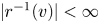 $|r^{-1}(v)| < \infty$. We say that
 $G$ is a row-finite graph if
 $V= V^{\operatorname {fin}}$.
A family  $S = (S_v,S_e)_{v\in V,e\in E}$ of operators on Hilbert space
 $\mathcal {H}$ is a TCK family if:
(1)
$\{S_v\}_{v\in V}$ is a set of pairwise orthogonal projections;(2)
$S_e^{*}S_e = S_{s(e)}$ for every $e\in E$;(3)
$\sum _{e\in F} S_eS_e^{*} \leq S_v$ for every finite subset $F\subseteq r^{-1}(v)$.




We say that  $S$ is a Cuntz–Krieger (CK) family if, in addition:
(4)
$\sum _{e \in r^{-1}(v)}S_eS_e^{*} = S_v$ for every $v\in V^{\operatorname {reg}}$.


We denote by  $\mathcal {T}(G)$ and
 $\mathcal {O}(G)$ the universal
 $C^{*}$-algebras generated by TCK and CK families, respectively. When
 $G$ is finite with no sinks or sources,
 $\mathcal {O}(G)$ is the celebrated Cuntz–Krieger algebra of
 $G$, which is intimately related to the subshift of finite type determined by
 $G$ (see [Reference Cuntz and KriegerCK80]).
A natural way to realize  ${{\mathcal {T}}}(G)$ is by using the left regular TCK family. Let
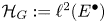 ${{\mathcal {H}}}_G := \ell ^{2}(E^{\bullet })$ be the Hilbert space with orthonormal basis
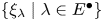 $\{\xi _{\lambda } \mid \lambda \in E^{\bullet }\}$. For each
 $v\in V$ and
 $e \in E$ we define
 \[ L_v(\xi_{\mu}) = \begin{cases} \xi_{\mu} & \text{if } r(\mu) = v \\ 0 & \text{if } r(\mu) \neq v \end{cases} \quad \text{and} \quad L_e(\xi_{\mu}) = \begin{cases} \xi_{e \mu} & \text{if } r(\mu) = s(e) \\ 0 & \text{if } r(\mu) \neq s(e). \end{cases} \]
Then  $L=(L_v,L_e)$ is a TCK family and we call it the left regular TCK family. By universality of
 ${{\mathcal {T}}}(G)$ we have a surjective
 $*$-isomorphism
 $\pi _L : {{\mathcal {T}}}(G) \rightarrow C^{*}(L)$ that turns out to be injective. Hence,
 ${{\mathcal {T}}}(G) \cong C^{*}(L)$, and we henceforth identify these algebras without further mention.
For  $v\in V$ denote by
 ${{\mathcal {H}}}_{G,v}$ the Hilbert space with orthonormal basis
 $\{ \xi _{\lambda } \mid s(\lambda ) = v \}$. Note that
 ${{\mathcal {H}}}_{G,v}$ is reducing for
 $L = (L_v,L_e)$, so we denote by
 $\pi _v : {{\mathcal {T}}}(G) \rightarrow B({{\mathcal {H}}}_{G,v})$ the restriction to this subspace. It is easily verified that for any
 $v\in V$ we have that
 $L_v - \sum _{e\in r^{-1}(v)}L_e L_e^{*}$ is the rank-one projection onto
 $\mathbb {C} \xi _v$. Hence, the ideal generated by
 $L_v - \sum _{e\in r^{-1}(v)}L_e L_e^{*}$ for
 $v \in V^{\operatorname {fin}}$ is
 $\oplus _{v\in V^{\operatorname {fin}}} {{\mathcal {K}}}({{\mathcal {H}}}_{G,v})$, and we denote it by
 ${{\mathcal {I}}}_G$.
Proposition 6.1 Let  $G = (V,E)$ be a row-finite directed graph. Then
 ${{\mathcal {I}}}_G$ is a minimum essential ideal in
 ${{\mathcal {T}}}(G)$.
Proof. We first show that  ${{\mathcal {I}}}_G$ is essential. Let
 ${{\mathcal {I}}}$ be an ideal of
 ${{\mathcal {T}}}(G)$ such that
 ${{\mathcal {I}}} \cap {{\mathcal {I}}}_G = \{0\}$. Then we have a natural quotient map
 $q : {{\mathcal {T}}}(G) \rightarrow {{\mathcal {T}}}(G) / {{\mathcal {I}}}$. However, because
 ${{\mathcal {I}}}$ does not intersect
 ${{\mathcal {I}}}_G = \oplus _{v\in V} {{\mathcal {K}}}({{\mathcal {H}}}_{G,v})$, we see that
 $q(T_v - \sum _{v \in V}T_eT_e^{*}) \neq 0$ for any
 $v\in V$. Hence, by [Reference Dor-On and SalomonDS18, Theorem 3.2 & Corollary 3.3] we see that
 $q \cong {\bigoplus} _{v\in V} \pi _v^{(\alpha _v)} \oplus \pi _b = \pi _L \oplus \pi _b$ with
 $\alpha _v \geq 1$ where
 $\pi _b$ is a representation associated to a CK family. Thus, we get that
 $q$ is injective, and we must then have that
 ${{\mathcal {I}}} = \{0\}$.
Next we show that  ${{\mathcal {I}}}_G$ is a minimum essential ideal. If
 ${{\mathcal {I}}}$ is another essential ideal for
 ${{\mathcal {T}}}(G)$, then
 ${{\mathcal {I}}} \cap {{\mathcal {K}}}({{\mathcal {H}}}_{G,v}) \neq \{0 \}$ for all
 $v\in V$. Hence, we must actually have that
 ${{\mathcal {K}}}({{\mathcal {H}}}_{G,v}) \subseteq {{\mathcal {I}}}$. Thus,
 ${{\mathcal {I}}}_G \subseteq {{\mathcal {I}}}$ and
 ${{\mathcal {I}}}_G$ is minimum essential.
Let  $G=(V, E)$ be an arbitrary directed graph. From [Reference RaeburnRae05, Chapter 8] we know that
 $\mathcal {T}(G)$ and
 $\mathcal {O}(G)$ arise as the Toeplitz–Pimsner and Cuntz–Pimsner algebras of a
 $C^{*}$-correspondence over
 $c_0(V)$. Indeed, define a right pre-Hilbert
 $c_0(V)$-module structure on finitely supported functions
 $c_f(E)$ by
 \[ (x\cdot a)(e)=x(e)a(s(e)),\quad \text{for all } x\in c_f(E),\ a\in c_0(V),\ e\in E , \]
and
 \[ {\langle x,y \rangle} (v)= \sum_{ e\in s^{{-}1}(v)} \overline{x(e)}y(e), \quad \text{for all } x,y\in c_f(E),\ v\in V. \]
We denote by  $X(G)$ the completion of
 $c_f(E)$ with respect to the induced norm
 $\|x \|^{2} = \| \langle x , x \rangle \|$ defined for
 $x \in c_f(E)$. Then
 $X(G)$ becomes a
 $C^{*}$-correspondence over
 $c_0(V)$ by defining the left action
 $\phi _{X(G)}$ to be
 \[ \phi(a)(x)(e)= a(r(e))x(e), \quad \text{for all } x\in c_f(E),\ e\in E, \]
which uniquely extends to a left action on the completion  $X(G)$. The
 $C^{*}$-correspondence
 $X(G)$ is called the graph correspondence associated to
 $G$. In [Reference RaeburnRae05, Chapter 8] it is shown that rigged representations of
 $X(G)$ are in bijective correspondence with TCK families of
 $G$ and that rigged covariant representations of
 $X(G)$ are in bijective correspondence with CK families of
 $G$. Thus, we see that
 ${{\mathcal {T}}}(G) \cong {{\mathcal {T}}}(X(G))$ and that
 ${{\mathcal {O}}}(G) \cong {{\mathcal {O}}}(X(G))$, and we treat these realizations interchangeably without mention from now on. The following then generalizes [Reference Brownlowe, Laca, Robertson and SimsBLRS20, Theorem 3(1)] to arbitrary graphs.
Theorem 6.2 Let  $G = (V,E)$ and
 $G' = (V',E')$ be directed graphs. The following are equivalent:
(1)
$G$ and $G'$ are isomorphic directed graphs;(2)
$X(G)$ and $X(G')$ are unitarily isomorphic $C^{*}$-correspondences;(3)
${{\mathcal {T}}}_+(G)$ and ${{\mathcal {T}}}_+(G')$ are graded completely isometrically isomorphic;(4)
${{\mathcal {T}}}(G)$ and ${{\mathcal {T}}}(G')$ are base-preserving graded *-isomorphic.


Proof. Observe that in the case of a graph correspondence  $X(G)$, the base algebra
 ${{\mathcal {A}}}=c_0(V)$ is a
 $C^{*}$-subalgebra of diagonal compact operators in
 $B(\ell ^{2}(V))$. Therefore, we can apply Corollary 4.7 to conclude that items (2)–(4) are equivalent. Clearly
 $(1) \implies (2)$ and the converse is proven as follows. If
 $U : X(G) \rightarrow X(G')$ is a unitary isomorphism of
 $C^{*}$-correspondences, implemented by a bijection
 $\rho : c_0(V) \rightarrow c_0(V')$, then the map
 $\hat {\rho } : V \rightarrow V'$ between the spectra is given by
 $\hat {\rho }(v) = v'$ where
 $v' \in V'$ is the unique vertex such that
 $\rho (p_v) = p_{v'}$. Given
 $v,w\in V$, note that the subspace
 $\{ x \in X(G) \mid x = p_v x p_w \}$ has dimension exactly
 $A_G(v,w)$, and is mapped under
 $U$ to the subspace
 $\{ y \in X(G') \mid y = p_{v'} y p_{w'} \}$, which is of dimension
 $A_{G'}(v',w')$. Hence, we see that
 $A_G(v,w) = A_{G'}(v',w')$ so that
 $G$ and
 $G'$ are isomorphic graphs via
 $\hat {\rho }$.
From [Reference RaeburnRae05, Chapter 8] we know that  $J_{X(G)} = c_0(V^{\operatorname {reg}})$ and that
 ${{\mathcal {J}}}_G := {{\mathcal {K}}}({{\mathcal {F}}}(X(G))J_{X(G)}) = {{\mathcal {J}}}_{X(G)}$ is the ideal generated by
 $T_v - \sum _{e\in r^{-1}(v)}T_e T_e^{*}$ with
 $v \in V^{\operatorname {reg}}$. Hence, we see that
 ${{\mathcal {J}}}_G = {\bigoplus} _{v\in V^{\operatorname {reg}}} {{\mathcal {K}}}({{\mathcal {H}}}_{G,v})$ under the identification with
 ${{\mathcal {T}}}(G)$ as the
 $C^{*}$-algebra generated by
 $L = (L_v,L_e)$.
Proposition 6.3 Let  $G$ be a row-finite graph. Then
 ${{\mathcal {J}}}_G$ is the maximum ideal
 ${{\mathcal {J}}}$ of
 ${{\mathcal {T}}}(G)$ contained in
 ${{\mathcal {I}}}_G$ such that
 $L_v \notin {{\mathcal {J}}}$ for any
 $v\in V$.
Proof. We already know that  $L_v \notin {{\mathcal {J}}}_G$ for all
 $v\in V$. Next, if
 ${{\mathcal {J}}}$ is an ideal contained in
 ${{\mathcal {I}}}_G$ such that
 $L_v \notin {{\mathcal {J}}}$ for all
 $v\in V$, as
 ${{\mathcal {J}}} \subseteq {{\mathcal {I}}}_G = \oplus _{v\in V}{{\mathcal {K}}}({{\mathcal {H}}}_{G,v})$ we must have that
 ${{\mathcal {J}}} = \oplus _{v \in V'} {{\mathcal {K}}}({{\mathcal {H}}}_{G,v})$ for some subset
 $V' \subseteq V$. However, when
 $v\in V$ is a source we have that
 ${{\mathcal {K}}}({{\mathcal {H}}}_{G,v})$ is the ideal generated by
 $L_v$. As
 $L_v \notin {{\mathcal {J}}}$ we must have that
 ${{\mathcal {K}}}({{\mathcal {H}}}_{G,v}) \cap {{\mathcal {J}}} = \{0\}$ so that
 $V' \subseteq V^{\operatorname {reg}}$ and hence
 ${{\mathcal {J}}} \subseteq {{\mathcal {J}}}_G$.
In what follows, we refer the reader to [Reference Drinen and TomfordeDT02] for additional details. It is clear  $K_0({{\mathcal {A}}}) \cong {\bigoplus} _{v\in V} \mathbb {Z}$ and
 $K_0(J_{X(G)}) \cong {\bigoplus} _{v\in V^{\operatorname {reg}}} \mathbb {Z}$. Let
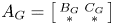 $A_G =\big [ \begin {smallmatrix} B_G & C_G \\ * & * \end {smallmatrix}\big ]$ denote the
 $2\times 2$ block decomposition of
 $A_G$ according to
 $V^{\operatorname {reg}}$ and
 $V^{\operatorname {sing}} := V \setminus V^{\operatorname {reg}}$. By [Reference Drinen and TomfordeDT02, Theorem 3.1], the map
 $i_0 -[X(G)] : K_0(J_{X(G)}) \rightarrow K_0({{\mathcal {A}}})$ is identified with the matrix
 $\big [\begin {smallmatrix} B_G^{t} - I\\ C_G^{t} \end {smallmatrix}\big ]$. Note that when
 $G$ is row-finite, we get that
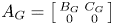 $A_G = \big [\begin {smallmatrix} B_G & C_G \\ 0 & 0 \end {smallmatrix}\big ]$, so that
 $G$ is completely determined by the map
 $i_0 -[X(G)]$.
We next prove a substantial strengthening of Theorem 6.2 in the row-finite case. This showcases the strength of applying the hierarchy established in Corollary 3.5 to resolve stable isomorphism problems for non-self-adjoint algebras via techniques from K-theory.
Theorem 6.4 Let  $G=(V,E)$ and
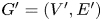 $G' = (V',E')$ be row-finite directed graphs. The following are equivalent:
(1)
$G$ and $G'$ are isomorphic directed graphs;(2)
${{\mathcal {T}}}_+(G)$ and ${{\mathcal {T}}}_+(G')$ are completely isometrically isomorphic;(3)
${{\mathcal {T}}}_+(G) \otimes {{\mathcal {K}}}$ and ${{\mathcal {T}}}_+(G') \otimes {{\mathcal {K}}}$ are completely isometrically isomorphic;(4)
${{\mathcal {T}}}(G)$ and ${{\mathcal {T}}}(G')$ are base-preserving *-isomorphic;(5)
${{\mathcal {T}}}(G) \otimes {{\mathcal {K}}}$ and ${{\mathcal {T}}}(G') \otimes {{\mathcal {K}}}$ are base-preserving *-isomorphic.


Proof. It is clear that condition  $(1)$ implies any one of conditions (2)–(5), that
 $(2) \implies (3)$ and that
 $(4) \implies (5)$. By Corollary 3.5 we also have that
 $(2) \implies (4)$ and that
 $(3)\implies (5)$ with the addition of Proposition 2.10. Hence, it will suffice to show that
 $(5) \implies (1)$.
Suppose  $\varphi : {{\mathcal {T}}}(G)\otimes {{\mathcal {K}}} \rightarrow {{\mathcal {T}}}(G')\otimes {{\mathcal {K}}}$ is a base-preserving *-isomorphism. By Proposition 2.10 we may identify
 $\varphi$ with an isomorphism of the Toeplitz algebras
 ${{\mathcal {T}}}(X(G)\otimes {{\mathcal {K}}})$ and
 ${{\mathcal {T}}}(X(G')\otimes {{\mathcal {K}}})$. Hence, without loss of generality, we may assume that
 $V= V'$, that
 $c_0(V)\otimes {{\mathcal {K}}}=c_0(V')\otimes {{\mathcal {K}}}$ as subalgebras of
 ${{\mathcal {T}}}(X(G)\otimes {{\mathcal {K}}})$ and
 ${{\mathcal {T}}}(X(G')\otimes {{\mathcal {K}}})$, and that
 $\varphi |_{c_0(V)\otimes {{\mathcal {K}}}}={{\operatorname {id}}}_{c_0(V)\otimes {{\mathcal {K}}}}$.
By Propositions 6.1 and 6.3 we see that  ${{\mathcal {J}}}_G$ (and
 ${{\mathcal {J}}}_{G'}$) is a maximum ideal
 ${{\mathcal {J}}}$ contained in a minimum essential ideal such that
 $L_v \notin {{\mathcal {J}}}$ for all
 $v\in V$. As
 $\varphi |_{c_0(V)\otimes {{\mathcal {K}}}}={{\operatorname {id}}}_{c_0(V)\otimes {{\mathcal {K}}}}$ and tensoring with
 ${{\mathcal {K}}}$ preserves the lattice of ideals, we see that
 $\varphi$ must map
 ${{\mathcal {J}}}_G \otimes {{\mathcal {K}}}$ to
 ${{\mathcal {J}}}_{G'} \otimes {{\mathcal {K}}}$. Thus, it follows that
 $\varphi$ is an s.e.s. base-preserving *-isomorphism.
By Theorem 5.2 and the discussion preceding our theorem we have that 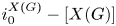 $i_0^{X(G)}-[X(G)]$ equals
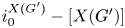 $i_0^{X(G')}-[X(G')]$. As these two maps determine
 $A_G$ and
 $A_{G'}$, respectively, it follows that
 $G$ and
 $G'$ must be isomorphic directed graphs.
The next example shows that the implications  $(5) \implies (3)$ and
 $(4) \implies (2)$ in Theorem 6.4 can fail for graphs that are not row-finite.
Example 6.5 Consider the two graphs  $G$ and
 $G'$ given by adjacency matrices
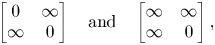 \[ \begin{bmatrix}0 & \infty\\\infty & 0\end{bmatrix}\quad \text{and}\quad \begin{bmatrix}\infty & \infty\\\infty & 0\end{bmatrix}, \]
respectively. We visualize these graphs as

where double edges have infinite multiplicity. We remark that these graphs differ by the so-called ‘move (T)’ as described in [Reference Eilers, Ruiz and SørensenERS12]. As all vertices are singular, their associated graph  $C^{*}$-algebras coincide with their associated Toeplitz–Cuntz–Krieger algebras, and are isomorphic due to [Reference Eilers, Ruiz and SørensenERS12, Lemma 3.6]. Tracing through the
 $*$-isomorphisms that are concretely given in [Reference Eilers, Ruiz and SørensenERS12, Lemmas 3.1 and 3.6], we see that they send
 $S_v$ to
 $S_{v'}$ and
 $S_w$ to
 $S_{w'}$, so that
 ${{\mathcal {T}}}(G)$ and
 ${{\mathcal {T}}}(G')$ are base-preserving
 $^{*}$-isomorphic.
This shows the necessity of requiring the graphs be row-finite in Theorem 6.4. Furthermore, note that the isomorphism is trivially s.e.s. because  ${{\mathcal {O}}}(G)={{\mathcal {T}}}(G)$ and
 ${{\mathcal {O}}}(G')={{\mathcal {T}}}(G')$. As these are Toeplitz–Pimsner and Cuntz–Pimsner algebras, this example also shows that conditions
 $(4)$ and
 $(5)$ in Corollary 3.5 are not equivalent. Lastly, by [Reference Katsoulis and KribsKK04, Theorem 2.11] we see that conditions
 $(5)$ and
 $(3)$ in Corollary 3.5 are also not equivalent.
Acknowledgements
The third author would like to express her gratitude to her supervisors Prof. Ilan Hirshberg and Prof. Wilhelm Winter for their helpful advice and generous support. She is especially thankful for the various operator algebras seminars, courses, and discussions held in Münster during her time spent there.



