Political leaders often use good-versus-evil rhetoric to mobilize their citizens for military competition and war. The most common explanation is that demonization makes enemies appear more dangerous. For example, according to a top speechwriter for President George W. Bush, Bush's “Axis of Evil” metaphor “made clear that September 11 and Saddam Hussein were linked after all and that for the safety of the world, Saddam Hussein must be defeated rather than deterred.”1
Calling Iraq “evil” implied a link between Iraq and al Qaeda, the terrorist group infamous for its terrorist attacks of 11 September 2001. “Evil” also implied an irrational belligerence, and hence the futility of a deterrence strategy against Iraq. These implications dovetailed with Bush's central argument for war: the necessity for U.S. security of eliminating an aggressive regime that sought weapons of mass destruction and might give them to terrorists. The Bush administration's success in building domestic support for war, in this view, can be readily explained by the public's prudence or rationality, or at least its susceptibility to elite persuasion, a model of foreign policy opinion that has lately predominated among political scientists.2For example, see Eichenberg 2005; Gelpi, Feaver, and Reifler 2005/2006; Herrmann, Tetlock, and Visser 1999; Jentleson 1992; Jentleson and Britton 1998; Larson 1996; and Page and Shapiro 1992.
However, the prospect of war against evil regimes arouses moral feelings as well as prudential calculation. Even skeptics about the influence of morality on national security policies admit that idealistic rhetoric is often needed to convince a moralistic public to support realpolitik policies.3
Moral values and feelings have received relatively little attention in foreign policy opinion research. But a few previous studies suggest that humanitarian aversion to killing and punitive responses to aggression significantly shape public support for war. Hurwitz and Peffley found that views on the morality of killing in war influence public hawkishness.4Hurwitz and Peffley 1987.
For example, see McFarland 2005. On the effects of moral traditionalism and religious fundamentalism, see Hurwitz and Peffley 1990.
For clarifying the role of punitive predispositions in public opinion on war, it is helpful to draw on the extensive body of research on the psychology of domestic punitiveness. Social psychologists have shown that laypeople's attitudes about criminal punishment, particularly toward the death penalty, are more heavily shaped by retributive and humanitarian feelings and values than by instrumental concerns for public safety. These moral responses, moreover, tend to be emotionally charged and intuitive, rather than the product of thoughtful reflection. It therefore seems likely that retributiveness and humanitarianism should also influence citizens' support for wars against foreign “evildoers.”
In this article, I infer several hypotheses on attitudes about punitive wars from relevant findings in social and cognitive psychology. I then conduct initial tests by analyzing U.S. public opinion on the 1991 and 2003 Persian Gulf Wars, using archived data. Moral logic should be evident in both cases, which featured a fiendish adversary but uncertain and contested net strategic incentives for intervention.
Contemporaneous data permits the analysis of opinion at a pivotal moment in time, under conditions that can be hard to replicate with survey scenarios. The data analyzed here unfortunately lack direct measures of retributiveness and humanitarianism, so my analysis relies on a surrogate measure, death penalty support, which is closely related to these moral predispositions. This approach requires caution about construct validity and omitted variable bias. Ideology, partisanship, trust in government, hierarchy-promoting social values, race and racism, gender, and instrumental beliefs about the utility of punishment could all plausibly account for consistency between death penalty and war attitudes. I control, directly or indirectly, for all of these rival explanations in the analysis of opinion on the first Gulf War, and a subset of them in the analysis of the second.
The results are consistent with a “moral-punitiveness” effect. Otherwise typical strong death penalty supporters were 12 percent more likely than strong opponents to favor the immediate use of force against Iraq in late 1990, and 36 percent more likely to favor war in 2003. Several other predictions involving war aims, emotional reactions to war, judgments about the morality of war, casualty tolerance, and threat perceptions are also borne out by the analysis. Under the right conditions, it seems, a distinct moral logic appears to affect public attitudes about punitive wars.
These findings contribute to a better understanding of public opinion about war, as well as to broader theoretical debates. Retributive and humanitarian values vary across individuals but are rarely completely absent, so public awareness of foreign evildoing and suffering should result in predictable collective responses. This helps explain the impact of enemy images, demonizing rhetoric, and expected death tolls on support for war.
The findings also provide insight into the structure of mass opinion. Because previous research has found little horizontal constraint among the attitudes of average citizens, most mass belief-system research has focused on the consistency of attitudes and beliefs within narrowly circumscribed issue domains. Thus public opinion research within the foreign policy domain has generally focused on domain-specific beliefs and values such as nationalism, patriotism, militancy, internationalism, enemy images, and moral views about war. More abstract values, beliefs, and ideology have been found to have much less influence on foreign policy issues.7
For example, see Feldman 1988; Goren 2004; Holsti 2004; Hurwitz and Peffley 1987; and Wittkopf 1990.
For example, see Brewer et al. 2004; Hurwitz and Peffley 1992; Kinder 2003; McFarland 2005; and Pratto et al. 1994.
Punitiveness, Murderers, and Evil States
A brief review of research on the psychology of punitiveness reveals the central role of moral reactions to wrongdoing and suffering. Under certain conditions, these moral responses are likely to apply to foreign states and peoples, rather than just to fellow citizens. While in some respects the impact of moral intuitions and values on war attitudes may resemble the effects of abstract instrumental beliefs about punishment, there are important differences between the logics and effects of moral and utilitarian punitiveness.
Moral Motives for Punishing Criminals
Among punitive attitudes, opinion about the death penalty should be particularly relevant to opinion about war because both involve the lethal use of force by the state. Extensive survey research on American death penalty attitudes over the past thirty years has found that they tend to be individually stable, strongly held, and closely related to moral values about retribution and the sanctity of human life.9
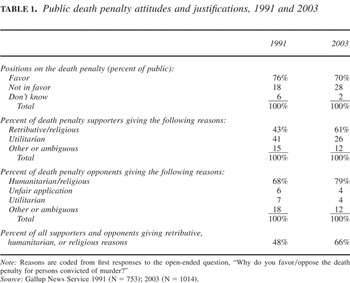
Moral reasons dominate average citizens' justifications for their death penalty views. When death penalty supporters were asked to explain their position in a 2003 Gallup poll, for example, 61 percent gave a retributive or religious justification as their first response, whether couched as “a life for a life” (33 percent), “they deserve it” (12 percent), “fair punishment” (4 percent), “biblical reasons” (4 percent), “serve justice” (3 percent), or “can't be rehabilitated” (2 percent). In contrast, utilitarian justifications, such as deterrence (10 percent), reducing prison costs (9 percent), or “keep them from repeating their crime” (8 percent), were mentioned by only about a quarter of supporters (see Table 1).Public death penalty attitudes and justifications, 1991 and 2003

Social psychological research has also found retributive justice beliefs to have strong effects on death penalty support.10
See Bohm, Clark, and Aveni 1991; Pratto, Stallworth, and Conway-Lanz 1998; Tyler and Weber 1982; and Vidmar 1974.
Correlations across time and place between crime rates and death penalty support have also been interpreted as evidence of instrumental motivations, but moral or other symbolic reactions could also explain these patterns; see Rucker et al. 2004; and Tyler and Boeckmann 1997.
Ellsworth and Ross 1983.
Death penalty opponents are also motivated largely by moral feelings. More than three quarters of opponents in the 2003 Gallup survey offered humanitarian reasons, such as “wrong to take a life” (40 percent), “persons may be wrongly convicted” (25 percent), “punishment should be left to God” (11 percent), or “possibility of rehabilitation” (3 percent). While nearly all opponents claim that the death penalty does not deter murder, more than three quarters say they would hold firm even if the death penalty were demonstrated to be a much better deterrent than life imprisonment.14
Ibid.
The moral motives expressed for and against the death penalty are not opposite poles of a single, unidimensional construct. Retribution is a negative reaction to wrongdoing, and its opposite is forgiveness. Humanitarianism is a sensitivity to human suffering and death; its opposite might be best described as “toughmindedness.”15
Humanitarianism is also important to public social welfare positions; see Feldman and Steenbergen 2001.
Tyler and Weber 1982. Deterrence beliefs had a comparable impact, but the percentage of Americans believing that the death penalty deters has fallen dramatically since then, from about 60 percent in the 1970s to 51 percent in 1991, to 35 percent in 2004; see Ellsworth and Gross 1994, 28.
Retributive and humanitarian responses to evil and suffering are powerful in part because they are freighted with emotion. One-third of death penalty supporters say that executions give them “a sense of personal satisfaction,” and four-fifths report feeling “a sense of personal outrage” when convicted murderers avoid execution.18
Ellsworth and Ross 1983, 149–57.
Darley, Carlsmith, and Robinson 2000.
See Goldberg, Lerner, and Tetlock 1999; Lerner, Goldberg, and Tetlock 1998; Nadler and Rose 2003; Ogloff and Vidmar 1994; and Small and Loewenstein 2005.
Recent research has shown that moral judgments are more intuitive and emotional than previously thought. They can occur without conscious inferences or reasoning, and what is typically taken for moral reasoning often turns out to be post hoc, motivated rationalization.23
Brain imaging research has provided neural evidence for the old observation, going back at least to Aristotle, that revenge is sweet. The mere anticipation of administering punishment for relatively minor offences stimulates the striatum, a subcortical region of the brain associated with pleasure. Subjects gaining more pleasure from punishment also tend to punish more frequently, more severely, and at greater cost to themselves.24de Quervain et al. 2004.
Moral emotions reinforce and shape more explicit values.25
Batson et al. 1995.
Skitka, Bauman, and Sargis 2005.
Moral emotions also shape attitudes through motivated biases and carryover effects. Because one tends to see what one wants to see, one's factual and causal beliefs are often biased by desires and aversions.27
See Hochschild 2001; Kunda 1990; and Taber, Lodge, and Glather 2001. Moral outrage may also directly bias factual appraisals and secondary moral judgments through an automatic affective mechanism, without altering information processing; see Mullen and Skitka 2006.
Ellsworth and Ross 1983.
Punitiveness and Support for War
Moral principles are generally cast in abstract and universal terms, such as “those who hurt others deserve to be hurt in return,” or “killing is all right if the right people do it and think they have a good reason for doing it.”31
In addition, the intuitive, emotional nature of moral judgment implies that the vividness and severity of the moral stimuli are critical. On these grounds, one should expect core moral predispositions to influence attitudes about the punishment of foreign as well as domestic villains, at least when strategic incentives seem ambiguous and images of evil and suffering are vivid and gut-wrenching.The public's prudence, nationalism, and habitual inattention to foreign affairs should all limit the role of morality in foreign policy attitudes. Prudence is evident in the public's preference for using force in the pursuit of national interests, especially when the costs are limited and the mission has good prospects for success.32
For example, see Eichenberg 2005; Gelpi, Feaver, and Reifler 2005/2006; Herrmann, Tetlock, and Visser 1999; Jentleson 1992; Jentleson and Britton 1998; Larson 1996; and Page and Shapiro 1992.
Herrmann and Shannon 2001.
Nationalism also limits the relevance of moral values to foreign affairs. Research on national and other kinds of social identity have found that they moderate moral feelings.34
For example, individuals' perceived similarity to a victim of an offense magnifies their anger and unhappiness about the injury.35Gordijn, Wigboldus, and Yzerbyt 2001.
Baldus and Woodworth 1998.
Dower 1986, 54–55.
A third constraint on the morality of foreign policy opinion is the public's habitual inattention to foreign affairs. But inattention, as well as social identity, can be overcome and exploited by framing and intensive media coverage. Portraying foreign victims as kin and adversaries as alien, using analogies to notorious evildoers, or to familiar crimes such as bullying, rape, and robbery, can help overcome nationalistic indifference.38
National debates over the use of military force typically generate extensive media coverage; the Persian Gulf crises were among the most closely followed news stories in the United States during the past two decades.39Kohut 2005.
See Entman 2004.
Retributiveness and humanitarianism are negatively correlated and cannot be differentiated with the data analyzed below. I thus use “moral punitiveness” as shorthand for a bidimensional construct combining these two moral predispositions. In other words, the morally punitive are retributive and tough-minded (that is, lacking in humanitarianism), while those low in moral punitiveness are generally forgiving and humanitarian.
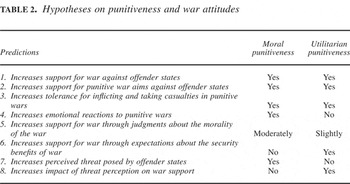
Moral punitiveness, so defined, should increase support for war and for punitive war aims against offender states. Humanitarianism heightens revulsion against the human costs of war, while retributiveness increases the desire to make wrongdoer states “pay.” Retributiveness should also have indirect effects on war attitudes, because of the moral outrage it generates. Those with a strong urge to punish will tend to overlook dissonant information about the costs and risks of war. Moreover, outrage at the guilty should carry over into punitiveness against others, such as civilians vulnerable to “collateral damage.”
Since emotion plays a large role in moral judgment, moral punitiveness also should be evident in feelings of anger, gratification, pride, sadness, or shame about punitive wars, just as the execution of murderers gratifies death penalty supporters while mortifying abolitionists. Motivated biases should amplify these effects by filtering out the depressing and shameful aspects of war for retributive individuals, and filtering out its satisfying aspects for humanitarians.
Moral punitiveness should affect support for particular wars to a significant degree through judgments about their legitimacy. The retributive will tend to view punitive wars as legitimate, while humanitarians will tend to see them as immoral, and these judgments in turn should shape support or opposition to war. Evidence on the intuitive nature of moral judgment, however, suggests that moral positions on war do not necessarily require intermediate steps of moral reasoning.
Moral punitiveness should also affect threat perceptions, via motivated biases. Desires for retribution should prompt rationalizations about the need to neutralize a serious danger, while aversion to the use of violence should lead humanitarians to downplay the threat. The tendency of anger to heighten attributions of blame, distrust, and prejudice may also exaggerate threat perceptions. It is unclear, however, whether morally driven threat perceptions actually heighten support for war, or merely rationalize such support.
Retributive and humanitarian values are not the only conceivable type of punitive predispositions. Individuals might also reason from instrumental beliefs such as “violence unpunished encourages more violence” (hence a need for general deterrence) or “once a bully, always a bully” (hence a need for incapacitation) to more specific positions about the utility of force in international conflicts, as well as in criminal punishment.41
See Holsti 2004, 156–57.
As with moral punitiveness, utilitarian punitiveness could heighten support for war, for severe war aims, and for the sacrifice of lives to punish offender states. War, destruction, and regime change can stop outlaw states from doing more harm while signaling a warning to others. Those believing in the efficacy of force for incapacitation and deterrence will also accept a greater death toll to achieve these security benefits.
Unlike moral punitiveness, however, utilitarian punitiveness should not trigger emotional reactions to war. Expectations of successful versus futile punishment would arouse positive or negative emotions only insofar as one feels strongly about the ultimate goal. But the benefits of preventing future aggression, whether through deterrence or incapacitation, are inherently hypothetical and distant in time. The expectation of such theoretical benefits will generally evoke weaker emotional responses than the gratification caused by certain and immediate retribution against a particular offender, or the sadness felt about recent or imminent human death and suffering.
It follows from the “cool” instrumental logic of utilitarian punitiveness that it should not give rise to the kind of motivated biases and carryover effect expected from moral convictions. Believing that force vanquishes threats should result in hawkish responses to perceived threats, but should not heighten threat perceptions in the first place.
Another difference is that moral judgments about war play at most a slight role in the utilitarian-punitiveness model. Belief in the utility of force should heighten support for military intervention regardless of one's ultimate goals. While it could lead some to favor a punitive war for the moral purpose of strengthening future peace, it would also affect the support of those uninterested in a war's legitimacy.42
On general deterrence as a moral goal of military punishment, see Walzer 1991, 62–63, 115–17.
The common and divergent predictions of the moral- and utilitarian-punitiveness models are summarized in Table 2. The divergent predictions are particularly useful for guarding against the contamination of death penalty support—the only punitiveness measure in the data analyzed below—by traces of utilitarian punitiveness. If the relationships between death penalty support and war attitudes cannot be explained by utilitarian punitiveness, this leaves moral punitiveness as a more persuasive explanation. Of course, such findings would not disconfirm the utilitarian-punitiveness model in its own right, because death penalty support is not a good measure of utilitarian punitiveness, as noted above.
Hypotheses on punitiveness and war attitudes

The 1990–91 Persian Gulf Conflict
Saddam's sudden invasion and annexation of Kuwait on 2 August 1990 presented the American public with somewhat ambiguous strategic incentives for intervention. Control over Kuwaiti oil combined with a progressing Iraqi nuclear weapons program could tilt the regional balance of power in favor of Iraq. Additional conquests, particularly of Saudi Arabia, would give Iraq extraordinary influence over the world oil market. Allowing naked aggression to go unpunished would also set a dangerous precedent in the new post–Cold War era, encouraging Iraq and other “rogue states” to prey on weaker neighbors. On the other hand, the United States and other powers might have contained Iraq from further expansion without going to war. The costs of war were also hard to predict, with the media reporting U.S. casualty estimates ranging from a few hundred up to 15,000. As political elites were extremely divided over the wisdom of intervention, the strategic pros and cons were probably even less compelling to average citizens.43
President George H. W. Bush initially tried making balance-of-power and energy-supply arguments for intervention, but these gained little traction with the public. Equipped with extensive polling and focus group analysis, Bush quickly shifted to the twin themes that naked aggression had to be reversed for the sake of deterrence, and that Saddam was an evil aggressor who must be punished. Bush almost daily reinforced the latter theme by comparing Saddam to Adolf Hitler and denouncing Iraqi atrocities in Kuwait. He often recounted an apocryphal story about Iraqi troops pulling hundreds of premature infants from incubators in a Kuwaiti maternity hospital and “leaving them scattered like firewood across the floor.”44
Bush also used metaphors of violent burglary and rape to bring home to the public Iraq's iniquity and the necessity of punishment. For example, in January 1991 he argued that “if armed men invaded a home in this country, killed those in their way, stole what they wanted and then announced that the house was now theirs—no one would hesitate about what must be done.”45Quoted in Rohrer 1995, 120; see also 124, 133.
The news media disseminated these frames through its intense coverage of the confrontation; the New York Times and Washington Post together published more than 200 pieces invoking the Saddam-as-Hitler analogy. Public awareness of the conflict was extraordinarily high, with 85 percent of the public saying they followed news about the crisis closely, rising to 97 percent when the war began.46
Dorman and Livingston 1994, 71–72.
Mueller 1994, 27–29.
Collectively, the public seemed to prefer punitive and moral justifications for war to geopolitical ones. In January 1991, more Americans felt that intervention was justified as a means to prevent “Iraqi troops from continuing to kill or mistreat the Kuwaiti people” (81 percent) than to prevent Iraq from either controlling Persian Gulf oil (74 percent) or obtaining nuclear weapons (69 percent). Americans were especially supportive of war if Iraq had killed U.S. civilians in Kuwait and Iraq (79 percent favoring war in an August 1990 poll) or attacked U.S. forces in the Gulf (94 percent).48
Ibid., 37–42, 242–60.
Data and Measures
A 1990–91–92 American National Election Studies (NES) panel study collected data on a wide range of attitudes about the Gulf War, as well as a variety of variables useful as controls.49
Miller, Kinder, and Rosenstone 1992. For more details on the construction of measures, see the Appendix.
Question wording had substantial effects; see Mueller 1994, 29–37, 205–36.
The other war attitudes were measured in the second wave, taken June to July 1991. I scored topple positively for those saying that the “United States and its allies should have continued to fight Iraq until Saddam was driven from power” (44 percent), and 0 if the coalition was deemed “right to stop fighting after Kuwait was liberated.” Concerns about killing Iraqi noncombatants are reflected in bombing, coded = 0 for those who felt that “there should be no bombing of targets near where civilians live because it is immoral to risk innocent lives,” and coded = 1 for agreement that “such bombing may be necessary in wartime.” Emotional reactions were tapped more directly by the variables sympathy and pride. I coded sympathy as being high for those who recalled that during the war they felt “sympathy for the Iraqi people” strongly; as medium for those who felt sympathy “not so strongly”; and as low for those who felt no sympathy at all. pride was scored positively for those saying that they “felt pride strongly” during the war (60 percent), and 0 otherwise.51
The raw data permits more finely graded ordinal categories for bombing and pride, but using all the categories failed to meet the parallel ordinal regression assumption; see Long 1997.
The role of moral punitiveness in death penalty support makes the latter a valuable if imperfect proxy measure for the former. dps is the sum of identical 1990 and 1992 ordinal items asking for the respondent's position (favor or oppose, strongly or not so strongly) on the death penalty for persons convicted of murder. Combining the items enhances reliability (Cronbach's alpha = .80), and using the 1992 item also helps control for elite-led polarization (elite differences narrowed that year, with both Democratic and Republican presidential candidates endorsing the death penalty).
The NES data permits direct measures and controls for political ideology, trust in government, authoritarianism, and several demographics, and indirect controls for social dominance orientation (SDO), right-wing authoritarianism (RWA), and utilitarian punitiveness. Turning to the last of these first, I assume that if an individual's belief in the efficacy of “sticks” increased his or her support for war, it did so by fostering a more specific intermediate belief that war would buttress international deterrence. Because general deterrence was the main strategic argument for war emphasized by President Bush, belief in the deterrence benefit of the war should largely mediate utilitarian punitiveness's impact on support for the war. I constructed a measure of perceived deterrence benefits from an open-ended 1991 question (with repeated probes) about the Gulf War's positive consequences for the United States. Those who mentioned that the war would deter other aggressors, increase respect for the United States, demonstrate U.S. resolve, or demonstrate U.S. military capability were scored positively on deterrence (40 percent).52
To avoid losing cases, I coded = 0 those who thought no good came of the war at all for the United States (25 percent of all 1991 respondents).
Political attitudes and partisanship might also explain punitive consistency. Trust in government should increase faith in the state's ability to use lethal force judiciously at home and abroad. trust is based on a single 1990 item asking: “How much of the time do you think you can trust the government in Washington to do what is right—just about always, most of the time, or only some of the time?” Conservative ideology and Republican party identification have been linked to tough law-and-order and military positions.53
I use two 1990 measures of ideology, a left/right self-identification scale, conservative, and—because ideological self-identification is difficult for average citizens—a domestic policy preference scale, domestic (alpha = .75; correlation with conservative, r = 0.26).SDO is “the degree to which individuals desire and support group-based hierarchy and the domination of ‘inferior’ groups by ‘superior’ groups.”54
Sidanius and Pratto 1999, 48.
Although SDO was not specifically measured in the 1990–91–92 NES, measures for anti-egalitarianism, patriotism, conservatism, and racial stereotypes should control for much of its effects. SDO is closely related to antiegalitarianism, measured in the NES with six items concerning the desirability of equality, equal opportunity, equal rights, and equal treatment.56
The fourteen-item SDO scale used in studies of war attitudes included three items that are virtually identical to NES egalitarianism items, and six more measuring similar values; see Pratto et al. 1994. Three other items, specifically about the inequality of groups and one on the inferiority of “some people,” can be captured to some extent by measures of patriotism and racial stereotypes.
On the variables mediating SDO's impact on military hawkishness, see Pratto, Stallworth, and Conway-Lanz 1998; and McFarland 2005.
There is no 1990 scale, and the 1991 scale is biased by a war-induced (and hence endogenous) rally effect. RWA's effect should be at least partially captured because its impact on support for war is mediated largely by blind patriotism; see McFarland 2005.
RWA is also related to attitudes about both criminal punishment and war.60
This could be because of the similarity between moral punitiveness and authoritarian aggression, one of RWA's three dimensions, and the one that mainly accounts for RWA's impact on criminal punishment attitudes.61A third of RWA questionnaire items ask for levels of agreement with statements such as, “What our country really needs is a strong, determined leader who will crush evil, and take us back to our true path;” from Altemeyer 1998. For an analysis of the constituent dimensions of RWA, see Funke 2005.
Finally, in addition to controlling for race, gender, age, income, and education, I also control for region. Some have argued that southern Whites share a culture of honor that is similar to moral punitiveness.62
For example, see Nisbett and Cohen 1996.
The NES panel study interviewed 1,980 respondents in November–December 1990, 1,383 of these in June–July 1991, and 1,250 of the original sample in a 1992 pre- and postelection survey. Panel attrition, my use of variables from different waves, a split-questionnaire egalitarianism scale, and item nonresponse reduce the number of complete-case observations to 267–330, depending on the model. To avoid the efficiency losses and selection bias effects of listwise deletion, I replaced missing data by multiple imputation, generating five complete data sets and combining regression estimates with appropriate standard-error corrections.64
The program Amelia was used for imputation, and the STATA module Clarify for was used for estimating models and generating predicted probabilities; Honaker et al. 2001; Tomz, Wittenberg, and King 2003. See also King et al. 2001.
I thank Craig Enders for suggesting this method. The D2 statistic yields a conservative p-value estimate (50–100 percent of the calculated value) when missingness is under 20 percent; see Schafer 1997, 112–18. Because the average missingness here is <10 percent, the p-values in the tables are conservative estimates.
Results
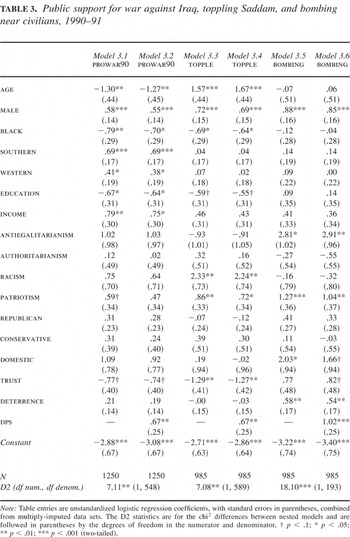
In late 1990, 35 percent of those who strongly supported the death penalty favored tougher military action against Iraq, compared to only 21 percent of all others. To further explore the sources of this gap, I estimated logistic regression models of prowar90 with a set of baseline control variables and then with the addition of dps (Models 3.1 and 3.2 in Table 3). The significant coefficient for dps indicates that consistency between dps and support for war is not a spurious byproduct of the baseline covariates. Moreover, improvement in overall fit of Model 3.2 over Model 3.1, indicated by the significant D2 statistic, reveals an exogenous causal effect of dps, or rather the underlying moral punitiveness it reflects.
Public support for war against Iraq, toppling Saddam, and bombing near civilians, 1990–91

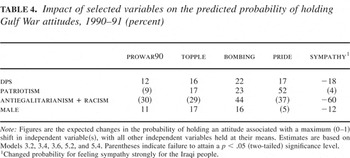
Substantively, a maximum increase in dps—from consistently strong opposition to the death penalty to consistently strong support—heightened the probability that otherwise typical citizens supported tougher military action from 18 percent to 30 percent, or by 12 percent (with a 95 percent confidence interval of a 3–20 percent increase). This was roughly the same impact as being male or residing in the South or West, which—all else held constant—increased the likelihood of favoring force by 11 percent, 14 percent, and 8 percent respectively. The region terms were scarcely affected by the addition of dps, indicating that southern hawkishness is not due to a more punitive culture, as some have argued. Table 4 contains a summary of substantive effects for dps and a few of the other independent variables on the likelihood of holding particular attitudes or feelings about the Gulf War.66
All probabilities and probability changes are estimated with the remaining independent variables held at their means. While conservative and domestic each had significant effects on one or two of the war attitudes, their joint effect was not statistically significant on any of them, and so are not included in the table.
Impact of selected variables on the predicted probability of holding Gulf War attitudes, 1990–91 (percent)

Despite a quick rout of Iraqi army positions in Kuwait and southern Iraq, President Bush decided to end the war without marching to Baghdad. A defiant Saddam, though militarily beaten and saddled with reparations and disarmament obligations, remained in power. As predicted, dps heightened the probability of wanting to topple Saddam by an average of 16 percent (based on Model 3.4). Death penalty supporters also disproportionately approved bombing that risked killing Iraqi civilians. Based on the parameters of Model 3.6, a maximum increase in dps heightened the likelihood that otherwise typical citizens endorsed bombing by 22 percent.
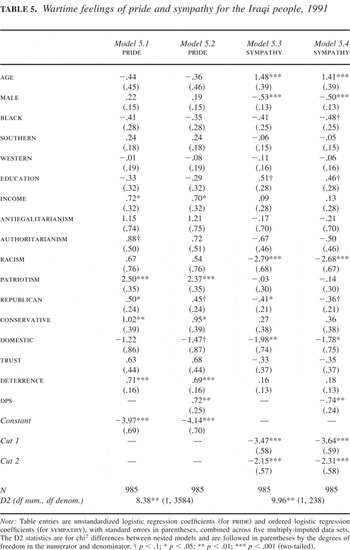
The public's emotional reactions to the Gulf War were also consistent with the moral-punitiveness model, as can be seen in Table 5. A shift from consistently strong opposition to consistently strong support of the death penalty heightened the likelihood that otherwise typical citizens said they felt pride strongly during the war by 17 percent (based on Model 5.2). patriotism had a much stronger effect, increasing the likelihood of strong pride by 52 percent, but patriotism may have been influenced by pride rather than vice versa. If so, that would bias downward the estimated impact of dps on pride, and on the other war attitudes as well.67
The significant effect of deterrence on pride is probably due to deterrence being contaminated somewhat by general approval of the war (see note 52 above). Confining the analysis to those who thought something good came of the war (N = 703) reduces the effect of deterrence on pride to substantive and statistical insignificance, while leaving the effect of dps somewhat increased. Applying the same procedure to the models of the other war attitudes, though reducing the size of the sample and the variance of the dependent variables, did not substantially alter the estimated effect of dps.
Wartime feelings of pride and sympathy for the Iraqi people, 1991

Complete-case analysis, using the full-form 1992 antiegalitarianism scale to retain cases, resulted in similar dps effects on prowar90, and substantially stronger effects on bombing, topple, and pride. Including measures for moral traditionalism, economic individualism, Catholicism, religious fundamentalism, church attendance, and social cynicism in the models did not alter any of the main findings.
The 2003 Persian Gulf Conflict
In autumn 2002 President George W. Bush sought to convince the American people to support another war against Iraq, this time to terminate Saddam's regime. The strategic arguments had changed; instead of emphasizing general deterrence, as had his father, the younger Bush focused on the need to eliminate an armed and dangerous foe. Saddam's purported development of weapons of mass destruction (WMD) threatened the region and, especially if transferred to anti-American terrorists, the United States itself. On the other hand, the case that Saddam could not be contained, was building WMDs, and had ties to al Qaeda was disputable, and had to be weighed against the costs and dangers of war, occupation, and an anti-American backlash. As in 1990–91, the strategic incentives were not so clear as to unify the public in favor of war.
The moral impulses had also changed since the first Gulf War. It had been more than a decade since Iraq had invaded a small, helpless neighbor. President Bush excoriated Saddam for his past aggressions but now placed greater emphasis on his crimes against the Iraqi people:
The dictator who is assembling the world's most dangerous weapons has already used them on whole villages—leaving thousands of his own citizens dead, blind, or disfigured. Iraqi refugees tell us how forced confessions are obtained—by torturing children while their parents are made to watch. International human rights groups have catalogued other methods used in the torture chambers of Iraq: electric shock, burning with hot irons, dripping acid on the skin, mutilation with electric drills, cutting out tongues, and rape. If this is not evil, then evil has no meaning.68
Bush 2003.
Such atrocities, though horrific, probably appeared less immediate and vivid to average citizens in 2003 than they had in 1990, when Iraqi forces were terrorizing occupied Kuwait. However, the September 11, 2001, terror attacks on the United States appear to have significantly intensified public desires to punish Saddam.
Because of nationalism, moral outrage and demands for retribution are likely to be much stronger after attacks on fellow citizens than on unfamiliar foreigners, as had been the case in 1990–91. Americans were immediately suspicious of Iraqi involvement in the terrorist attacks, with 27 percent already believing in late September that Saddam was “second most responsible” after Osama bin Laden.69
Foyle 2004, 272.
Kaufmann 2004, 16–19.
We know that Iraq and al Qaeda have had high-level contacts that go back a decade … And we know that after September 11th, Saddam Hussein's regime gleefully celebrated the terrorist attacks on America … Terror cells and outlaw regimes building weapons of mass destruction are different faces of the same evil.
By January 2003, 68 percent of the public was convinced that Iraq had played an important role in the attacks. Fifty-six percent of this group favored war even without UN Security Council authorization, compared to only 9 percent of those who doubted Iraqi involvement.72
Skitka, Bauman, and Sargis found a correlation of r = .45 (p < .001) between a moral outrage scale and an item on support for expanding the war on terror; personal correspondence from Linda J. Skitka, 12 April 2006. See Skitka, Bauman, and Sargis 2005; as well as Sadler et al. 2005.
Lingering anger could have heightened punitiveness even against those not consciously blamed for the 2001 attacks. Bin Laden's public video and audio messages provided a nagging reminder that the attack's mastermind and his top lieutenants remained at large. A carryover effect could help explain the correlation, just noted, between outrage over the attacks and punitiveness against countries merely “suspected of harboring or encouraging terrorists.” Carryover is more obviously evident in findings that anger heightened Americans' intolerance for foreigners, immigrants, Arab Americans, and Muslims.74
Harris Interactive 2003; N = 1,010 (excluding a female oversample). For more details on the construction of measures, see the Appendix.
Thus, whether motivated by revenge or indiscriminate fury, retributive Americans should have been particularly likely to favor war to destroy the Iraqi regime. Humanitarians, on the other hand, were probably less impressed with Saddam's threat to human life in 2003 than in 1990–91. Given the expected human costs entailed in toppling Saddam, principled humanitarian opposition to the second Gulf War was probably greater than to the first.
The destruction of Saddam's regime and his capture by coalition forces should have sated desires for retribution. Thus retributive individuals should have been much less enthusiastic about a protracted military occupation than they had been about invading Iraq. At the same time, by taking control of Iraq, the United States had assumed a moral duty to keep it from sliding into a bloody civil war. As a consequence, humanitarian opposition to the occupation should have been weaker than humanitarian opposition to the invasion. Thus while moral punitiveness should have polarized opinion on invading Iraq, it should have had little influence on support for a prolonged stabilization effort.
Data and Measures
I use Harris Interactive survey data from mid-January 2003 to analyze opinion about starting a new war against Iraq.75
Initial analyses showed that region and income had no impact on the results so these were excluded from the analyses below.
A death penalty support scale, dps, was constructed using items on “the death penalty for individuals convicted of serious crimes, such as murder”; on the recent commutation of all Illinois death sentences due to concerns about miscarriages of justice; on a “temporary moratorium or halt in the death penalty … to prevent the execution of innocent people”; and on perceptions of the fairness or unfairness of “the criminal justice system in death penalty cases” (alpha = .72). To see whether death penalty support heightened threat perceptions and whether it interacted positively with them, I created a threat scale by summing items on the seriousness of the Iraqi threat to the United States and on the likelihood that Iraq possessed nuclear weapons, chemical weapons, and biological weapons (alpha = .65).
The Harris data included standard measures for ideological self-identification, partisanship, gender, race, age, and education.76
ABC News/Washington Post 2005 (N = 1004). For the items on the occupation and the death penalty, response options were rotated by interviewers, and “don't know/no opinion” responses were few (<4 percent).
Opinion about the military stabilization effort in Iraq two years later was drawn from a June, 2005 ABC/Washington Post survey, which asked, “Do you think the number of U.S. military forces in Iraq should be increased, decreased, or kept about the same?”77
A Sobel-Goodman mediation test is significant (p < .001) and indicates that 16 percent of the effect of dps is mediated by threat.
Results
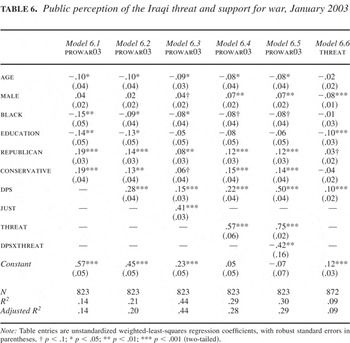
Positions on the death penalty and on going to war against Iraq were even more consistent before the second Gulf War than they had been before the first. In January 2003, 72 percent of death penalty supporters, but only 42 percent of opponents, favored war. As Model 6.2 (on Table 6) shows, this was not simply an artifact of partisanship, ideology, or demographics. A maximum increase in death penalty support increased otherwise typical citizens' enthusiasm for the war by .28 on a 0–1 scale, or about three quarters of a standard deviation. This effect was equivalent to that of a simultaneous shift from very liberal to very conservative and from Democrat to Republican. The addition of dps, while attenuating somewhat the effects of partisanship, ideology, and race, also substantially increased total explained variance over the baseline Model 6.1.
Public perception of the Iraqi threat and support for war, January 2003

American judgments on the morality of war were also closely related to support for war, as can be seen when just is added in Model 6.3. The reduction in the dps term is consistent with the expectation that moral punitiveness would affect support for war in large part through judgments about its moral legitimacy. This reduction would not be expected, though, if the dps effect had been a result of utilitarian punitiveness.
Consistent with biases motivated by retributive and humanitarian emotions, death penalty supporters were more inclined to believe that Iraq posed “a very serious threat” than opponents, 63 percent versus 48 percent. A multivariate regression model of threat perception (Model 6.6 on Table 6) shows that dps had a significant effect on threat after controlling for ideology, partisanship, and demographics. Adding threat as an independent variable in the model of support for war substantially heightens explained variance, and slightly reduces the dps term (from b = .28 to b = .22; contrast Models 6.4 and 6.2). Thus threat appears to mediate some of dps' impact on support for war.78
Gross and Ellsworth 2003.
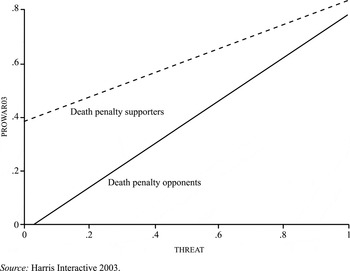
If dps reflected utilitarian rather than moral punitiveness, this would be reflected in a positive interaction between dps and threat. This is because belief in the utility of force for dealing with threats should magnify the impact of perceived threats on support for war. But adding a dpsxthreat cross-product term in Model 6.5 reveals a negative interaction between dps and threat. This can also be observed in Figure 1, which plots the impact of threat on predicted values of prowar03, for those ranking in the highest and lowest thirds of the dps scale, with all other variables held at their means. The fact that strong death penalty supporters were less sensitive to perceived threat than death penalty opponents is inconsistent with utilitarian punitiveness as a cause of dps/prowar03 consistency.

Impact of perceived Iraqi threat on predicted support for war against Iraq among death penalty supporters and opponents
While this leaves moral punitiveness as a more likely explanation of punitive consistency, the negative dpsxthreat interaction also indicates a boundary condition of the moral-punitiveness effect. As Figure 1 illustrates, those perceiving a grave Iraqi threat strongly supported war regardless of their death penalty position; punitive predispositions mattered mainly insofar as the apparent threat receded. This finding is consistent with previous research showing that clear security incentives trump moral considerations in opinion about the use of force.
Even with the limiting effect of threat perceptions, the moral punitiveness effect for average citizens was greater in 2003 than it had been in 1991. Substituting more similar measures from the two data sets clarifies this difference. Using a dichotomous measure of death penalty support indicates that typical death penalty supporters were 23 percent more likely than opponents to favor using “ground troops to attempt to remove Saddam Hussein from power in Iraq” in 2003. Excluding control variables from the NES models that were not available in the Harris data, the corresponding change in death penalty positions (also using a dichotomous measure) increased the likelihood of favoring war in late 1990 by only 7 percent, and of favoring the removal of Saddam in mid-1991 by 9 percent.
One plausible explanation for this difference is that the circumstances were more morally polarizing in 2003 than in 1990–91. Iraq's perceived complicity in the 2001 attacks probably aroused stronger retributive support for war among a generally nationalistic citizenry than did the Iraqi invasion of Kuwait. Also, the humanitarian crisis seemed less dire in Iraq in 2003 than it had in occupied Kuwait, and the human costs of toppling Saddam probably seemed greater. A second possible explanation is that death penalty attitudes reflected moral punitiveness more closely in 2003 than in the early 1990s. As shown in Table 1, the proportions of death penalty supporters giving retributive justifications, and of opponents giving humanitarian reasons, increased between 1991 and 2003. This was probably due to growing public recognition of the fallibility of the judicial system and its inefficacy as a deterrent.79
Death penalty supporters were a nonsignificant 2 percent more likely to favor maintaining or increasing forces in Iraq (with a 95-percent confidence interval of −10 to 6 percent). Estimates based on a logistic regression model with controls for ideology, party, gender, race, income, age, and southern residence, and using listwise deletion of missing data (N = 824).
Did moral punitiveness affect support for a prolonged occupation as much as it influenced support for the invasion? The mid-2005 ABC/Washington Post survey data reveals that it did not. More than two years after the coalition's initial attack on Iraq, otherwise typical death penalty supporters remained more likely (by 25 percent) to believe that the “United States did the right thing in going to war with Iraq.” But they were neither more nor less likely than death penalty opponents to favor keeping U.S. military forces in Iraq.80
Moral punitiveness no longer offered a compass for policy in Iraq once the evil enemy had been vanquished.Conclusion
In this article I have argued that the moral predispositions of retributiveness and humanitarianism have predictable consequences for attitudes about the use of military force. Retributiveness heightens support for the military punishment of states perceived as criminal or evil, while humanitarianism increases opposition to the use of lethal violence, except when necessary to avert humanitarian disasters. The evidence for these effects presented here is circumstantial, using death penalty support as a proxy measure of retributiveness and humanitarianism. But the diversity and multiplicity of observable implications tested, combined with controls or tests for other plausible explanations for punitive consistency, lend considerable credibility to the conclusion that moral intuitions and values influencing desires to execute murderers account for significant cross-sectional variation in support for punitive war.
In two conflicts with Iraq there was substantial consistency between support for the death penalty and support for war. In addition, death penalty support was related to approval of bombing near civilians, feelings of pride, and indifference to the Iraqi people in 1991. In 2003 death penalty support heightened perceived threat. In neither case was interattitudinal constraint reducible to ideology, party identification, or standard demographics. Additional measures in the NES data permit controls on trust in government, antiegalitarianism, patriotism, authoritarianism, and racial stereotypes. While SDO and RWA were not specifically measured in the data, controls on close covariates and known mediators in the NES data strongly suggest that they too do not explain the effects observed. Utilitarian punitiveness is also an improbable explanation, because utilitarian motives play a weak role in death penalty support. Moreover, the 1990–91 analysis controlled for a utilitarian mediator variable, and the 2003 case revealed no positive interaction between death penalty support and perceived threat when modeling support for war.
These findings do not imply that moral logic outweighed instrumental logic in determining public support for each war. Even in 2003, when death penalty support explained the greatest variation in support for war, perceived threat had about twice the impact, and as perceived threat grew, the effects of moral punitiveness shrank. But the findings here do show that moral intuitions and values have a stronger impact than generally recognized, at least for conflicts framed in stark moral terms and lacking obvious strategic incentives.
Just because citizens are susceptible to moralistic and emotional impulses does not mean that governments are so as well. National decisions for hawkish policies or war have sometimes been attributed to retributive or honor motives, or more broadly to support for international norms.81
The difficulty with this literature is that leaders' statements about the need to make opposing states “pay” for transgressing norms could reflect calculations about upholding reputations or deterrence rather than representing moral convictions or emotion.82Liberman forthcoming.
On the influence of public opinion on military policy more generally, see Foyle 1999; and Sobel 2001.
Even if officials are rarely swayed by their moral feelings, they must contend with moral punitiveness in public opinion. Democratic governments need popular support, which explains why they resort so often to moralistic framing when campaigning for war.84
Mueller 1994, chap. 6.
More research is needed to test and elaborate the effects of moral punitiveness. Direct measures of retributiveness and humanitarianism, rather than using death penalty support as a surrogate measure, are needed to better identify their joint and relative effects. Investigating the roles of emotion, motivated biases, and carryover effects would help clarify the moral-punitiveness mechanism, as has been the case in research on criminal punishment attitudes. It would also be worthwhile to explore further moderating and boundary conditions, such as elite framing, social identity, the identifiability of villains and victims, strategic incentives, and expertise.
Further work also might usefully investigate attitudes about a wider variety of conflicts. Research on enemy images in the Cold War showed that Americans who believed that communism was malignant and that the Soviet Union was an “Evil Empire” were more supportive of hawkish military policies. This literature has generally supposed that diabolical enemy images are moral self-justifications for combating strategic rivals.86
But my findings suggest that moral outrage may have shaped perceptions of the Soviet threat as well as increased support for Cold War policies more directly. Moral punitiveness might help explain, for example, why American hawkishness was heightened by Moscow's self-defeating 1979 invasion of Afghanistan and then was undermined by Mikhail Gorbachev's withdrawal and renunciation of expansionism prior to any strategically significant Soviet retrenchment.87See Paris 2002; and Western 2005, chap. 5. For a related argument on support for intervention in Somalia in 1992–94, see Burk 1999.
The lack of a moral punitiveness effect in opinion on the post-2003 stabilization effort in Iraq raises doubts about the relevance of moral punitiveness to support for humanitarian intervention. Humanitarians' wish to protect victims is typically tempered by their aversion to the violent means required, and retributive impulses are likely to be weak in conflicts perceived as the result of faceless “ancient hatreds” or civil wars. But retributive impulses should be stronger against identifiable, diabolical tyrants. For example, laying blame on Serbian President Slobodan Milosovic for atrocities committed in the former Yugoslavia heightened U.S. support for intervention.88
On the public's preference for intervening against cross-border aggressions over intervening in civil wars, see Jentleson 1992; and Jentleson and Britton 1998.
The moral punitiveness effect undoubtedly occurs in other nations besides the United States, given the universality of retributiveness and humanitarianism, but there may be significant variation as well. Religious beliefs, honor norms, and other culturally shaped beliefs and values have been linked to variations in punitiveness towards criminals and in interpersonal relations.90
Bush 2002.
Measures Appendix
All measures scaled to range from 0–1, with hawkish and punitive positions (or positions positively associated with these) scored highest, except for sympathy. “Don't know,” “depends,” and “other” responses omitted (and missing values imputed for the NES data), unless otherwise noted below. Correlations and descriptive and reliability statistics in the text and appendix are based on nonimputed data. For the NES study, the original variable numbers are provided in brackets.
NES 1990–91–92 Measures
prowar90. A dichotomous recoding of a 1990 item asking, “Which of the following do you think we should do now in the Persian Gulf: pull out U.S. forces entirely; try harder to find a diplomatic solution; tighten the economic embargo; or take tougher military action?” [900358]. Those who mentioned “tougher military action” singly or in combination with alternatives were coded = 1 (28 percent), and all others = 0.
topple. Based on a dichotomous 1991 item that asked whether the “U.S. and its allies should have continued to fight Iraq until Saddam Hussein was driven from power” (44 percent coded = 1), or were “right to stop fighting after Kuwait was liberated” [912556].
pride. A dichotomous recoding of 1991 items asking whether the respondent ever felt proud during the Gulf War, and if so strongly or not so strongly [912516-7]. Those who felt pride strongly were coded = 1 (60 percent).
bombing. A dichotomous measure based on a 1991 question: “Some people say there should be no bombing of targets near where civilians live because it is immoral to risk innocent lives. Others say such bombing may be necessary in wartime. Which of these is closest to your position?” [912548]. Those approving the necessity of bombing near civilians were coded = 1 (70 percent), all others = 0.
sympathy. A three-level ordinal item constructed from 1991 questions asking, “During the war, did you ever feel sympathy for the Iraqi people?” and, if so, strongly or not so strongly [912520-1]. Those who felt no sympathy were coded = 0 (25 percent), those who felt some sympathy = 1 (27 percent), and those who felt sympathy strongly = 2 (48 percent).
dps. The average of two identical four-level ordinal items from 1990 and 1992, asking if respondents favor or oppose, strongly or not strongly, the death penalty for persons convicted of murder [900478, 925934]. Mean = .76; standard deviation (SD) = .32; alpha = .80.
deterrence. A dichotomous variable built from an open-ended question, posed to those who agreed that some good came of the war for the United States, asking, “What did you have in mind?” Respondents were probed up to four times, but only 4 percent gave more than one response [912535-9]. I coded deterrence = 1 (40 percent) for any responses matched by the interviewers to at least one of the following categories, and = 0 for those giving none of these responses, or saying that nothing good came of the war for the United States:
- Military victory—“We won; proved we are capable of winning a war; showed that we could go into a war to win; demonstrated that we could win a war quickly/with minimum casualties.” (Mentioned by 3 percent.)
- Respect—“Other nations have more respect for us; it made the U.S. well-liked; demonstrated U.S. leadership in world; showed the world that we are powerful; strengthened our position in the world; will make other countries think twice before tangling with us.” (Mentioned by 23 percent.)
- Resolution—“Showed we are willing to back up our words with actions/that we mean what we say/that we keep our promises.” (Mentioned by 9 percent.)
- New world order—“Showed we will stand up to aggression/will protect our interests/are willing to fight for what is right; shows we will protect weaker countries from aggression by big countries/that we will defend freedom and democracy throughout the world; brought the U.S. recognition as a peace-keeping nation/force; might deter other dictators from trying the same thing in the future; increased the chances/opportunity for world peace.” (Mentioned by 11 percent.)
trust. A four-point ordinal scale based on the 1990 question, “How much of the time do you think you can trust the government in Washington to do what is right—just about always, most of the time, or only some of the time?” [900504]. Mean = .43; SD = .18.
conservative. A seven-point 1990 self-identification scale ranging from extremely liberal to extremely conservative [900406]. Mean = .53; SD = .22.
republican. A seven-point party identification scale from strong Democrat to strong Republican [900320]. Mean = .43; SD = .34.
domestic. The sum of fourteen 1990 items about federal spending on environmental protection, illegal drug use, AIDS, social security, food stamps, homelessness, child care, and services to blacks [900377, 900379-82, 900384-6], about governmental responsibility for the welfare of blacks and of all citizens [900446-7, 900452], about protecting women against job discrimination [900460], and on affirmative action [900464, 900466]. Mean = .34; SD = .12; alpha = .75.
antiegalitarianism. The sum of responses to six 1990 Likert-type items on agreement or disagreement with the following statements: “Our society should do whatever is necessary to make sure that everyone has an equal opportunity to succeed”; “We have gone too far in pushing equal rights in this country” (reversed); “One of the big problems in this country is that we don't give everyone an equal chance”; “This country would be better off if we worried less about how equal people are” (reversed); “It is not really that big a problem if some people have more of a chance in life than others” (reversed); and “If people were treated more equally in this country, we would have many fewer problems” [900426-31]. Mean = .41; SD = .75; alpha = .61.
patriotism. Sum of two 1992 items: “When you see the American flag flying does it make you feel extremely good, very good, somewhat good, or not very good?” and “How strong is your love for your country … extremely strong, very strong, somewhat strong, or not very strong?” [926130-1]. Mean = .76; SD = .23; alpha = .76.
racism. The summed differences between separate ratings of whites and blacks as hard-working/lazy, intelligent/unintelligent, and peaceful/violent [926221-2; 926225-6; 926229-30]. Mean = .59; SD = .11; alpha = .75.
authoritarianism. The sum of four 1992 items on the importance for children to have independence or respect for elders, obedience or self-reliance, curiosity or good manners, and being considerate or well behaved [926019-22]. Mean = .65; SD = .34; alpha = .70.
education. Summary 1990 measure of highest educational attainment, ranging from elementary school to advanced degree [900557]. Mean = .43; SD = .28.
income. A twenty-three-point scale of reported family income in 1990 [900663]. Mean = .55; SD = .29.
age. Age in 1990 divided by 100 [900552]. Observed range = .18-.94, Mean = .45; SD = .18.
male. Males coded = 1 (45 percent) [900547].
black. African Americans coded = 1 (13 percent); all others coded 0 [900549].
south and west. Indicator variables for region of interview, with south coded = 1 for the solid South and Border states, and west coded = 1 for Mountain and Pacific states [900012].
Harris 2003 Measures
prowar03. A summative scale of responses to three items: “Do you think the U.S. should or should not use military action involving ground troops to attempt to remove Saddam Hussein from power in Iraq?” (four-level strength of support or opposition); “If you could choose, how long would you wait until the U.S. took action against Iraq—the end of January, not until March, sometime during the summer, sometime during the winter, longer than that, or never?”; and “Do you think President Bush is moving too quickly toward a war with Iraq, or don't you think so?” Mean = .59; SD = .37; alpha = .79.
just. A dummy measure, scoring positively those who said that war would be morally justified (68 percent), in response to the question, “Regardless of whether you think the U.S. should or should not use ground troops to remove Saddam Hussein from power, do you think the U.S. would be morally justified or morally unjustified if it sends troops into Iraq to remove Saddam Hussein from power?”
threat. A scale summing four four-level ordinal items on the seriousness of the threat Iraq poses to the United States, and on the likelihood that Iraq possessed nuclear weapons, “chemical weapons, such as poisonous gas,” and “biological weapons, such as anthrax or smallpox.” Mean = .65; SD = .20; alpha = .65.
dps. A scale summing four equally weighted items: “Do you favor or oppose the death penalty for individuals convicted of serious crimes, such as murder?”; “Based on what you have read or heard, do you think the criminal justice system in death penalty cases is generally fair or unfair?”; agreement with the decision of Illinois Governor George Ryan to commute “death sentences of Illinois prisoners on death row to life in prison” out of procedural justice concerns; and agreement with “a temporary moratorium or halt in the death penalty to allow government to reduce the chances that an innocent person will be put to death.” Mean = .53; SD = .36; alpha = .72.
education. A six-level measure of level of education, from “8th grade or less” to “Postgraduate study.” Mean = .62; SD = .24.
conservative. A seven-level scale, from “very liberal” to “very conservative,” constructed from a five-level scale and a follow-up prompt asking self-identified moderates whether they felt closer to liberals or conservatives. Affirmative responses were coded just below and just above the middle moderate position, while those responding neither were kept as moderate. Mean = .50; SD = .31.
republican. A five-level ordinal variable, with those identifying as Republican coded at the highest level (30 percent), followed by independents who “feel closer to the Republican Party” (11 percent), followed by independents feeling closer to neither party (12 percent), independents closer to the Democratic Party (14 percent), and Democrats (33 percent).
income. A five-level ordinal measure, ranging from < $20,000 to > $75,000.
black. African Americans coded = 1 (8.5 percent), all others = 0.