


Multiple sclerosis (MS) is a degenerative disease of the central nervous system that destroys the fatty tissue called myelin that surrounds white matter tracts (i.e., axons) in multiple locations in the brain and along the spinal cord (Fraser, Kraft, Ehde, & Johnson, Reference Davis and Tyry2006). The function of the myelin is to facilitate the axons' conduction of electrical impulses back and forth from the brain to the rest of the body via the spinal cord (Schapiro, Reference Schapiro2003). The demyelination that occurs in MS is described as similar to the disruption of an impulse or message that would occur if the rubberised coating surrounding a telephone or electrical wire were torn or cut (Smith & Schapiro, Reference Smith, Schapiro and Kalb2004). In areas where the myelin is destroyed or compromised, these electrical impulses, which co-ordinate all mental and physical processes, are not conveyed effectively. As patches of myelin deteriorate, they are replaced by hardened scar tissue (DeLuca & Nocentini, Reference DeLuca and Nocentini2011) and become lesions or plaques. These lesions or plaques further interrupt the conduction of nerve impulses and interfere with the transmission of information and/or electricity.
The MS disease process is typically characterised by an unpredictable cycle of relapses and remissions and wide-ranging symptoms. MS symptoms vary from person to person, depending on the location and size of the lesions in a person's brain and spinal cord (Fraser et al., Reference Fraser, Kraft, Ehde and Johnson2006; Herndon, Reference Herndon, Burks and Johnson2000). For example, lesions in the frontal and parietal lobe often result in cognitive and emotional effects, whereas lesions in the cerebrum, brain stem and spinal cord tend to result in problems related to the physical functioning of the extremities (Fraser, Clemmons, & Bennett, Reference Fraser, Clemmons and Bennett2002). Direct damage to the optic nerve or the occipital lobe often leads to visual impairments.
No two people with MS experience the exact same type and pattern of symptoms and symptoms vary widely even within the individual with MS over time. Symptoms of MS may appear in isolation, present in various combinations and/or change in intensity in a seemingly random pattern (Kalb, Reference Kalb2012). The slowed or blocked conduction of information in the central nervous system can have a disruptive influence on virtually every physical, sensory, mental, emotional and social activity. Common physical symptoms of MS include fatigue, mobility problems, spasticity, numbness and tingling in the extremities, tremors, diminished strength and co-ordination, chronic pain, hypersensitivity to heat, visual impairments, bowel and bladder dysfunction, and sexual dysfunction. In addition to the physical accompaniments of MS, the illness often results in negative effects on one's cognitive abilities, affective responses and coping skills. It is estimated that 60–65 per cent of people with MS experience cognitive deficits related to attention, conceptual reasoning, executive functioning, social judgement and memory (Polman et al., Reference Polman, Thompson, Murray, Bowling and Noseworthy2006). The degree of cognitive impairment varies from person to person depending on the location and size of lesions in the brain.
For many people with MS the most devastating consequences of the disease are diminished independence and control of one's life. With its typical onset occurring between the ages of 20 and 40, MS attacks people in the prime of adult life, and it can have profound effects on family roles, social activities, employment, economic self-sufficiency and mobility inside and outside of the home (Kalb, Reference Kalb2012). Maintaining independence and safety in the home has become a topic of increased research attention in recent years, as it is increasingly recognised to be a major concern among adults with multiple sclerosis (Finlayson, Reference Finlayson2004; Finlayson & Van Denend, Reference Finlayson and Denend2003; Iezzoni & Ngo, Reference Iezzoni and Ngo2007).
According to the Centers for Disease Control and Prevention (CDC), independent living is defined as the individual's ability to live in his or her own residence with limited or no help from outside agencies (CDC, 2014). The physical, cognitive and psychological impairments associated with MS can affect the person's ability to manage his or her affairs; to move about the home and in the community; to perform activities of daily living and to work (Bishop et al., Reference Bishop, Roessler, Rumrill, Sheppard-Jones, Frain, Waletich and Umeasiegbu2013; Fraser et al., Reference Fraser, Kraft, Ehde and Johnson2006; Lemelle, Guillemin & Aubert, Reference Lemelle, Guillemin, Aubert, Guys, Lottmann, Lortat-Jacob, Mouriquand, Ruffion, Moscovici and Schmitt2006; Klingbeil, Baer & Wilson, Reference Klingbeil, Baer and Wilson2004). In addition, people with MS have been found to experience significant barriers in obtaining accessible housing, accessing public transportation and utilizing assistive technology (Bishop et al., Reference Bishop, Roessler, Rumrill, Sheppard-Jones, Frain, Waletich and Umeasiegbu2013; Rumrill, Fraser, & Johnson, Reference Rumrill, Fraser and Johnson2013).
Previous research has shown that the severity of MS symptoms is closely associated with an individual's capacity to complete daily living tasks and maintain an independent living situation (Beatty, Blanco, Wilbanks, Paul, & Hames, Reference Beatty, Blanco, Wilbanks, Paul and Hames1995). Roessler and Gitchel (Reference Roessler and Gitchel2013) found that self-perceived overall severity of MS symptoms had a statistically significant effect on not only the level of functioning in the home and in the community, but also the person's confidence in his or her ability to live independently in the future. Further, Roessler, Gitchel and Bishop Reference Roessler and Gitchel(2013) found that perceived level of functioning in daily life, confidence in ability to live independently and confidence in the ability to meet the costs of independent living were significant predictors of quality of life (QOL). Gulick (Reference Gulick1997) reported similar findings in her research with adults with MS in which the inability to perform in life roles was related to lower QOL levels. However, it is not clear what specific cognitive, psychological and physical symptoms of MS are most strongly associated with the person's perceived prospects for independent living over time.
The purpose of this study was to examine the extent to which the severity of disease-related physical, cognitive and psychological symptoms predicts self-reported independent living optimism. We sought to examine symptom-related predictors at the individual item level. Specifically, we sought to develop a prediction model to identify the key symptoms that explain a significant proportion of variability in perceived independent living optimism scores among a large contemporary sample of adults with MS drawn from across the United States. MS-related symptoms identified from two existing self-report survey instruments were entered directly into the model as predictor variables, rather than being compressed into composite variables. Findings from this study may help rehabilitation and community living professionals develop targeted interventions to assist people with MS in living as independently as possible for as long as possible.
Method
Participants
Participants in this study were 5,082 people with MS recruited as part of a larger analysis of the specialised housing needs of Americans with MS (females = 77.8%, Whites = 96.1%, mean age = 54.11 years, SD = 10.17 years). These individuals were from the membership lists of the North American Research Committee on Multiple Sclerosis (NARCOMS) patient registry and chapters of the National Multiple Sclerosis Society (NMSS) in four Southeastern and Midwestern states using a combination of random and random cluster sampling. The sample included people with MS from each US state, the District of Columbia and Puerto Rico. The sample size of 5,082 participants represents approximately 1.27 per cent of the estimated 400,000 Americans with MS.
Over half the participants reported having completed either college (33.3%) or graduate or professional school (25.8%). Thirty-six per cent (36%, n = 1,833) of the study sample reported being employed for pay, with 3,249 (64%) being unemployed. Ninety-five per cent (95%, n = 4,653) indicated that they had health insurance coverage, whereas only 5 per cent did not. Few respondents (16%, n = 831) reported living alone at the time of the study. As for functional characteristics of the study sample, participants indicated an average of 7.35 (SD = 3.83) MS symptoms when considering all items checked from a list of commonly reported MS symptoms and most (52%, n = 2,627) indicated that they do not use any type of supportive device in the home.
Instrument
Participants completed a questionnaire incorporating a wide range of demographic, functional and housing-related issues facing people with MS. They also completed the MS Impact Scale-29 (MSIS-29; Hobart, Lamping, Fitzpatrick, Riazi, & Thompson, Reference Hobart, Lamping, Fitzpatrick, Riazi and Thompson2001), Perceived Deficits Questionnaire – 5-Item Version (PDQ-5: Ritvo et al., Reference Ritvo, Fischer, Miller, Andrews, Paty and LaRocca1997; Sullivan, Edgley, & Dehoux, Reference Sullivan, Edgley and Dehoux1990) and the Independent Living Optimism Scale, developed for this study by the research team (Bishop et al., Reference Bishop, Roessler, Rumrill, Sheppard-Jones, Frain, Waletich and Umeasiegbu2013). These scales are described below.
Functional Abilities and Symptom Severity
This measure, specifically designed for this study, was for gathering data on demographic and housing-related statuses, participants' experience of MS symptoms, current MS severity and functioning in the home.
MS Impact Scale-29
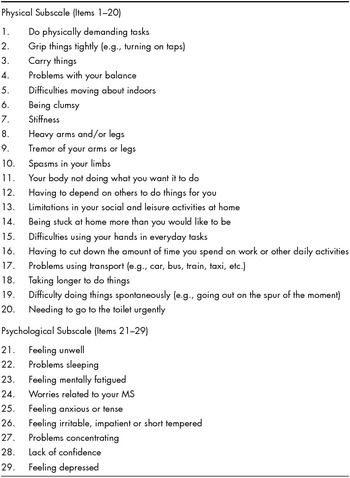
The MS Impact Scale-29 (MSIS-29; Hobart, Lamping, Fitzpatrick, Riazi, & Thompson, Reference Hobart, Lamping, Fitzpatrick, Riazi and Thompson2001) assesses a range of physical, physical, cognitive and emotional symptoms and provides a physical/physical impact and a psychological impact score (see Table 1). The MSIS-29 contains 29 items, each scored on a five-point Likert-type scale (1 – ‘Not at All’, 2 – ‘A Little’, 3 – ‘Moderately’, 4 – ‘Quite a Bit’, and 5 – ‘Extremely’). Higher scores on the items indicate a higher level of difficulty or severity of the symptoms caused by MS. Subscale scores on the MSIS-29 were not computed nor used in the analysis in this study. Rather, individual items on the scale were entered into the model at the item level as symptom predictor variables. Scores from the MSIS-29 have been found to be valid for evaluating the physical and mental impact of MS (Gray, McDonell, & Hawkins, Reference Gray, McDonnell and Hawkins2009; Hobart, Riazi, Lamping, Fitzpatrick, & Thompson, Reference Hobart, Riazi, Lamping, Fitzpatrick and Thompson2004; Hobart, Riazi, Lamping, Fitzpatrick, & Thompson, Reference Hobart, Riazi, Lamping, Fitzpatrick and Thompson2005). Reliability analysis of the MSIS-29 in the current study revealed high levels of internal consistency for both the physical subscale (Cronbach's alpha = 0.97) and the psychological subscale (Cronbach's alpha = 0.93).
Multiple Sclerosis Impact Scale-29 Items

Perceived Deficits Questionnaire – 5-Item Version (PDQ-5)
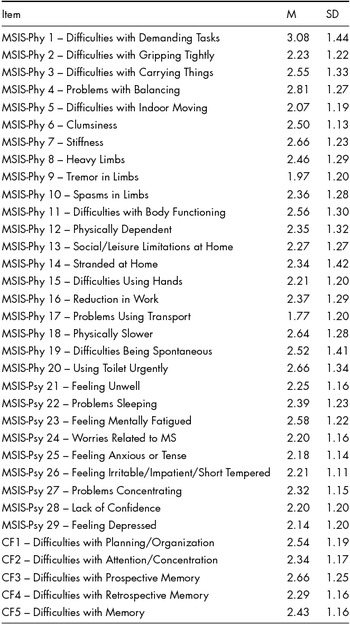
Cognitive functioning was measured using the five-item abbreviated version of the Perceived Deficits Questionnaire (PDQ) (Ritvo et al., Reference Ritvo, Fischer, Miller, Andrews, Paty and LaRocca1997; Sullivan, Edgley, & Dehoux, Reference Sullivan, Edgley and Dehoux1990). The PDQ-5 includes the five items from the 20-item version that correlated most strongly with the 20-item PDQ score. These five items came from the four subscales associated with the longer version (Attention/Concentration, Retrospective Memory, Prospective Memory and Planning/Organization) (Ritvo et al., Reference Ritvo, Fischer, Miller, Andrews, Paty and LaRocca1997). These items are briefly described in Table 2. The scale asks participants to identify level of cognitive functioning difficulties using a five-point scale ranging from 1 ‘Almost Never’ to 5 ‘Always’, with higher scores reflecting more significant cognitive functioning difficulties. Scores from the PDQ-5 within the present study achieved a high level of internal consistency (Cronbach's alpha = 0.91).
Cognitive Functioning Scale Items

Independent Living Optimism Scale
A five-point, fully anchored, single-item scale was constructed as a measure of independent living optimism. Participants were asked to assess their level of confidence in their ability to live independently in the next two years. Scores on the scale ranged from 1 (‘Not at all confident’) to 5 (‘Very confident’).
Procedures
As noted in the Participants sub-section, data utilised in this study emerged from a combination of random and random cluster sampling that yielded a representative group of American adults with MS with regard to geographic, gender, age, racial/ethnic, income, educational and living situation characteristics. The sample was randomly selected from the NARCOMS patient registry and from members of NMSS chapters in several states in which the NARCOMS registry had relatively few enrolees. Designed to follow adults with MS over a long period of time, NARCOMS is a national MS research project maintained by voluntary enrolee participation. Twice a year, participants with MS complete updates on their statuses by mail or a secure online survey. The data are used to expedite further research on MS by notifying participants about clinical trials and MS research projects and by conducting research studies using the data collected since 1996. The NARCOMS MS Patient Registry includes self-report data for approximately 34,000 enrolees.
Although the NARCOMS database is not population-based and thus may not be completely representative of the total MS population in the United States, the general characteristics of the Registry population are comparable to those typically reported for people with MS (Tyry, Reference Tyry2009). Approximately 73% of NARCOMS enrollees are female. Most enrollees (about 55%) are in the 40–60 age range. Almost 90% of enrolees are White (not Hispanic) and the majority of enrollees report having at least one type of health insurance coverage at the time of enrolment (Davis & Tyry, Reference Davis and Tyry2008; Tyry, Reference Tyry2009). The Registry has active participants in all 50 US states and over 200 active participants outside the US.
Participants in the NARCOMS registry were recruited through an e-mailed or mailed letter (depending on participant preference) to 15,000 active registrants. The letter of invitation provided information for participants on completing either a web-based or toll-free telephone survey. The response rate for the NARCOMS phase of the sampling was 30.4%, resulting in a subsample of 4,467.
Participants were also recruited through the National Multiple Sclerosis Society's mailing lists of chapters in four Southeastern and Midwestern states (some of which had mailing list members in multiple states in the region). The researchers provided participating chapter staff members with research packets for distribution to 500 randomly selected mailing-list members. Each packet contained informed consent information, a paper survey with a business-reply envelope and a web address for participants wishing to complete the survey via the web. To increase response rates for mail survey campaigns, the research team followed procedures suggested by Dillman, Smyth and Christian Reference Dillman, Smyth and Melani Christian(2009). Chapter service directors sent a pre-notice letter to those selected for the sample (N = 2,000) two weeks prior to mailing the survey; the pre-notice letter explained the purpose of the study and the importance of completing and returning the survey. The research team then mailed the survey packet with another explanatory cover letter. In a final effort to improve survey return rates, the individual chapters mailed ‘reminder/thank you’ postcards four weeks after the survey had been mailed. One hundred and fifteen surveys were returned as having incorrect addresses, resulting in 1,885 verified, mailed surveys. The mail survey distributed to the NMSS chapters' mailing list members produced a subsample of 615, resulting in a 32.6% response rate.
Data analysis
Descriptive analyses assessing the relationship between each predictor variable and the outcome variable were completed using simple, zero-order correlations. To test the hypothesis that the set of predictor variables would be collectively and significantly related to the outcome measure, the Independent Living Optimism Scale, we conducted a backward multiple regression analysis. Utilising this approach, all predictors assumed to be related to the outcome were included in the model in the first stage of the analysis. Predictor variables not contributing to the overall explanatory power of the model were removed in a series of steps resulting in an overall model that contains only those items or variables that collectively explained a significant proportion of the variability in the model. The Statistical Package for the Social Sciences (SPSS Version 21) was used to analyse these data and all analyses were conducted using α = 0.05 as the level of significance.
Results
Descriptive summaries of study variables
Participants with missing data were removed from the data file and the sample size in the final analytical model was 4,070. Means and standard deviations for each item on the Multiple Sclerosis Impact Scale-Physical, the Multiple Sclerosis Impact Scale-Psychological and the PDQ-5 (i.e., cognitive functioning scale) are presented in Table 3. The item with the lowest mean was MSIS-Physical Item 17 (i.e., ‘In the past two weeks, how much have you been bothered by problems using transportation, such as car, bus, train, taxi, etc.?’; M = 1.77, SD = 1.20) and the item with the highest mean was MSIS-Physical Item 1 (i.e., ‘In the past two weeks, how much has your MS limited your ability to do physically demanding tasks?’; M = 3.08, SD = 1.44). The average level of the outcome measure, the confidence in one's ability to live independently in two years, was 3.98 (SD = 1.14).
Descriptive Statistics for Study Variables (N = 4,070)

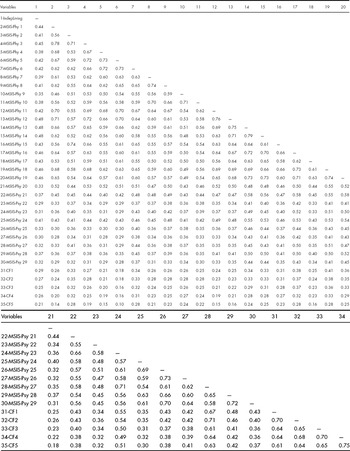
Correlation coefficients were computed to determine the relationships among all study variables. Table 4 presents the zero-order intercorrelations. The intercorrelations ranged from a high of 0.79 for MSIS-Physical Item 13 and MSIS-Physical Item 14 to a low of 0.10 for the relationship between MSIS-Physical Item 5 and PDQ-5 (i.e., cognitive functioning) Item 5.
Intercorrelations among Study Variables

Regression analysis
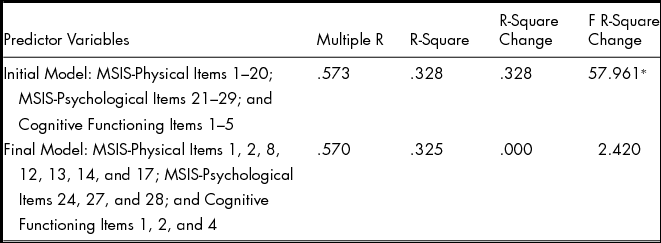
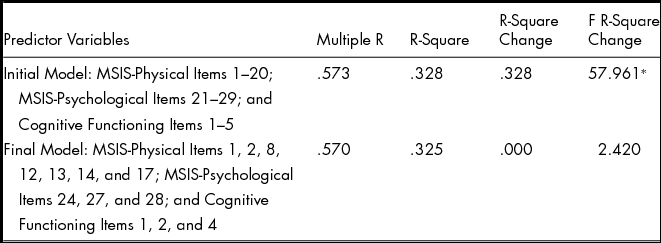
To assess the complex relationships among predictor and outcome variables in this study, a backward, stepwise multiple regression analysis was conducted, with the results presented in Table 5. The initial model included all predictor variables that were hypothesised to be related to independent living optimism. The multiple R-square for this model was 0.328, indicating that approximately 33% of the variability in independent living optimism could be explained by this set of predictors. However, several predictor variables failed to explain significant and unique proportions of the variability in independent living optimism. The model that resulted, after removing those variables that failed to explain significant and unique proportions of the variability, included: MSIS-Physical Items 1, 2, 8, 12, 13, 14 and 17; MSIS-Psychological Items 24, 27 and 28; and Cognitive Functioning Items 1, 2 and 4. Variables that did not explain unique proportions of the variability in the independent living optimism measure after considering the simultaneous relationships among the variables in the final model included: MSIS-Physical Items 3, 4, 5, 6, 7, 9, 10, 11, 15, 16, 18, 19 and 20; MSIS-Psychological Items 21, 22, 23, 25, 26 and 29; and Cognitive Functioning Items 3 and 5.
Multiple Regression Analysis of Independent Living Optimism
* p < .001.
Although removal of these variables did reduce the overall multiple R-square for the final model slightly (i.e., from 0.328 for the initial model with all variables to 0.325 for the model with 13 variables), this reduction was not a statistically significant reduction in the proportion of the variability explained (F-Change (1, 4,055) = 2.42, p > 0.05). The multiple R-square for the final model (R2 = 0.325) did explain a significant proportion of the variability in independent living optimism (F (13, 4,056) = 150.44, p < 0.001). For the variables that remained in the model, only MSIS-Psychological Item 27 (B = 0.09) was positively related to independent living optimism, whereas MSIS-Physical Item 1 (B = −0.09), MSIS-Physical Item 2 (B = −0.08), MSIS-Physical Item 8 (B = −0.04), MSIS-Physical Item 12 (B = −0.10), MSIS-Physical Item 13 (B = −0.05), MSIS-Physical Item 14 (B = −0.08), MSIS-Physical Item 17 (B = −0.10), MSIS-Psychological Item 24 (B = −0.11), MSIS-Psychological Item 28 (B = −0.06), Cognitive Functioning Item 1 (B = −0.08), Cognitive Functioning Item 2 (B = −0.04), Cognitive Functioning Item 4 (B = −0.05) were negatively related to independent living optimism.
Discussion
Participants who reported physical limitations to participation including experiencing ‘heavy arms and/or legs’ and more problems in gripping things tightly tended to have significantly lower confidence in their capability for living independently in the next two years. The results of this study support previous findings regarding the relationship between the disease-related symptoms and the difficulties that people with MS encounter in living independently (Gulick, Reference Gulick1997; Roessler & Gitchel, Reference Roessler and Gitchel2013). The findings in this study offer a more specific understanding than was previously available of the symptoms associated with reduced confidence and optimism about living independently in the near future.
The significant indicators of independent living optimism reported by the participants are in some ways self-evident. For example, it has been reported that about three-quarters of people with MS experience reduced unilateral or bilateral manual dexterity (Johansson et al., Reference Johansson, Ytterberg and Claesson2007; Ytterberg et al., Reference Ytterberg, Johansson and Andersson2008) and more than one-third of people with MS have leg weakness (Newland et al., Reference Newland, Flick, Thomas and Shannon2014). Impairment in the strength and dexterity of the hands, arms and legs can cause enormous limitations and restrictions in the ability and participation level of people with MS in their daily activities (Kierkegaard et al., Reference Kierkegaard, Einarsson and Gottberg2012).
The current findings also indicate that greater difficulty in doing physically demanding tasks and using transportation, and the needs to depend on others to do things were significantly associated with lower independent living optimism. A previous study that compared people with MS to age- and sex-matched healthy controls reported that the most frequently affected daily activities of people with MS were those that are physically demanding, such as household maintenance, heavy housework, gardening and outdoor transportation (Einarsson et al., Reference Einarsson, Gottberg, Fredrikson, von Koch and Holmqvist2006). Two psychological indicators, including worries related to one's own MS and the lack of confidence contributed significantly to the variation in the independent living optimism of people with MS. Although people with MS are more susceptible to depression and anxiety than the general population (Michalski et al., Reference Michalski, Liebig, Thomae, Singer and Hinz2010), the depressive and anxiety symptoms of people with MS in this study were not significant predictors of confidence in the ability to live independently in the near future. This finding may suggest that confidence in one's own ability to live independently is not a direct result of one's own psychological symptoms, but a cognitive appraisal process that is influenced by concerns about disease progression and negative consequences thereof.
With respect to cognitive functioning, people with MS who encountered more difficulties in planning/organising, attention/concentration and retrospective memory had significantly lower confidence in their ability to maintain an independent living status. The results of this study are consistent with previous research. For example, it has previously been reported that people with MS were found to require longer planning time in problem solving when compared to matched, healthy controls and the length of planning time became longer when the difficulty level of problems increased (Denney et al., Reference Denney, Lynch, Parmenter and Horne2004, Reference Denney, Gallagher and Lynch2011, Reference Denney, Hughes, Owens and Lynch2012). People with MS often have working memory impairments and attention deficits that may impact on a wide range of abilities needed for daily functioning (e.g., Gmeindl & Courtney, Reference Gmeindl and Courtney2012; Jonides et al., Reference Jonides, Lewis, Nee, Lustig, Berman and Moore2008), which in turn could result in decreased independent living optimism.
It is not surprising that ‘being stranded at home’ was another significant indicator for independent living optimism. Finally, the fact that limitations in social and leisure activities at home were associated significantly with lower independent living optimism seems a natural extension of previous research. For example, Einarsson et al. (Reference Einarsson, Gottberg, Fredrikson, von Koch and Holmqvist2006) found that only one-third of people with MS in their study were able to perform their social and lifestyle activities at a normal frequency (Einarsson et al., Reference Einarsson, Gottberg, Fredrikson, von Koch and Holmqvist2006).
The most important contribution of the present findings to the overall understanding of the independent living issues facing people with MS lies in the specific, item-level consideration of disease-related and functional predictors. Previous studies that have documented the explanatory power of the physical, psychological and cognitive MS symptoms which are determinants of labour force participation, quality of life and other important outcomes. We contend that the approach taken in this study allows for a more sensitive evaluation of the influence of specific symptoms and functional areas on the criterion variable of independent living optimism. This approach, pending replication of the results among additional samples, may enable the use of targeted and tailored rehabilitation interventions to promote independence in the home.
Limitations of the study
If the study had included people without MS as a comparison group, the multiple R-square would have been much larger. Also, the problem of the less optimal multiple R-square may arise due to the fact that the symptom predictor variables had a restricted range of variability. This would constrain the capacity of each predictor variable to explain the dependent variable. However, it is worth noting that the multiple R-square in the current study is considered a medium effect size according to Cohen's Reference Cohen(1988) standard. This implies that these disease-related symptoms are practically meaningful in their relationship with the independent living optimism.
Other limitations of this study are the complete reliance on self-reported measures of physical, cognitive and psychological symptoms; the use of a single-item measure of independent living optimism as the criterion variable; and the underrepresentation of African Americans and Hispanic/Latinos in the study sample. Future investigations should address these limitations to determine the extent to which the findings reported here are generalisable.
Implications for Rehabilitation Counselors
Given the symptoms and functional difficulties that were identified as significant indicators for independent living optimism among people with MS, one implication of the findings in this study is that confidence in keeping one's independent living status may be influenced and improved through a variety of approaches in which rehabilitation counselors can have a direct role. For example, when people with MS are confronted with mobility limitations, removal of barriers to independent living in the home and community can be promoted, advocated for and conducted (Bishop et al., Reference Bishop, Roessler, Rumrill, Sheppard-Jones, Frain, Waletich and Umeasiegbu2013; Sheppard-Jones et al., Reference Sheppard-Jones, Bishop, Kinyanjui, Roessler, Rumrill, Waletich and Umeasiegbu2013). Housing modifications and devices specially designed for the needs of people with MS can greatly enhance housing accessibility, which in turn may help extend the time those people with MS can maintain their independent living status and increase their confidence in doing so. Finally, rehabilitation counselors can pay careful attention to the physical, psychological and cognitive symptoms and experiences of those with MS with whom they are working, and assist in recognising symptoms that appear, in this study, likely to lead to decreased independence in the home.
Conclusion
Findings from this investigation underscore the complexity involved in predicting how confident people living with MS are in their abilities to live independently while coping with the associated physical, cognitive, psychological and support system challenges. Independent living optimism among those with MS would be maximised with collaborative support by multi-disciplinary teams to help people with MS manage their symptoms and maintain their general health as a means of continuing their self-reliance and participation in all aspects of community life. Given that MS is often progressive over time and that there is a significant relationship between age and functional disability among people with MS, early interventions aimed at health promotion, prevention of secondary complications, leveraging available social supports and promoting accessibility in the home should begin immediately after diagnosis to help people with MS live as independently as possible for as long as possible.