Over the past three decades, China has undergone a spectacularly successful transition to a market economy. Though far from complete, this transition has been remarkable for sustaining a high rate of economic growth that is virtually unprecedented in world history, bringing structural adjustments to the economy, raising productivity and living standards in all regions and sectors, and transforming China from “sick man of Asia” to economic powerhouse.Footnote 1
This record of achievement is marred, however, and the government faces significant challenges ahead. Inequality has risen sharply across regions, sectors and social groups.Footnote 2 Corruption is rampant. During the 1990s popular protests grew in size and frequency, as citizens (mostly farmers) protested against excessive fees and levies and, increasingly, illegal land takings and evictions. While many of these may be reflections of social dislocations of China's rapid growth and urbanization, the country has also been rocked by a series of scandals in recent years, of which the long-running saga of tainted milk powder from Sanlu during 2007–08, then the largest and most reputable milk producer in the country, was only the latest in a string that went from fake infant formula causing the death of hundreds of babies in 2004,Footnote 3 the 2005 chemical spills into the Songhuajiang that contaminated water supplies to major population centres in the north-east,Footnote 4 to the mislabelling of exported chemicals that turned toothpastes, pet food and pharmaceuticals into deadly poisons, and so on. These are worrying signs of government weakness and outright failure to perform the core functions of ensuring fairness, public safety and consumer protection. Some observers have pointed to the recent trend of violent protests as indicative of a growing “crisis of confidence,” where the public is increasingly distrustful of government and public institutions.Footnote 5
To the government's credit, it is responding. Premier Wen Jiabao has admitted “the government was partly responsible for the tainted milk scandal,” and vowed to take corrective action.Footnote 6 Strengthening public sector performance is clearly seen as a critical component of the reforms needed to ensure an effective and credible government leading China into the 21st century.
In fact, since 2000 the government has implemented numerous programmes of public sector reform, including budget reform, treasury reform, procurement reform and streamlining of rural government. These have brought improvements and made government more transparent. New programmes under the call to build a “harmonious society,” such as the drive to provide free rural education, the new rural co-operative medical scheme and the introduction of the rural minimum living stipends (nongcun dibao 农村低保), are transferring substantial new resources to funding services at the grassroots levels and improving fairness.
In this article I assess the prospects of these public sector reforms in China, drawing from two decades of studying China's fiscal system, and especially from several World Bank studies in which I participated during 2003–08.Footnote 7 The first section reviews the retrenchment of government during the 1980s and 1990s, highlighting the highly constrained nature of the process which precluded substantial downsizing of government, services or departments. The following sections trace the roots of the current problems of inequality and weak governance to the legacies of the incremental cutbacks and concessions made by the government during this period. They include discussions of the impact of this retrenchment, both the direct, measurable changes on the economy and the longer-term impact on the shape of economic system and incentives. In conclusion I highlight the difficulties of imposing a top-down reform of the public sector under the present intergovernmental structure and system of incentives facing local governments, public service providers and civil servants.
Withdrawal of Government: 1980s–1990s
By definition, market reform means reducing the reach of government and turning economic management over to market forces. In the process, the government share of GDP shrinks, as more resources are left in private hands. In China market reforms had been preceded by more than a decade of political strife and economic stagnation caused by the ultra-leftist policies of the Cultural Revolution. Dissatisfaction with centralized management and state control was rife, and the relaxation of administrative controls and curtailing of government was welcomed. In fact, however, the government's control over resources fell more swiftly and further than expected, and revenue constraints began to dictate the pace and depth of reform from the mid-1980s onward.
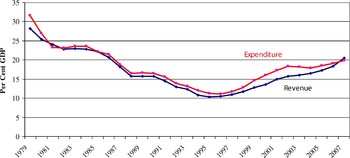
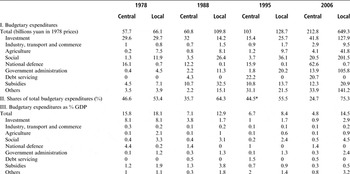
From the start of market reforms, dismantling the planning apparatus had led quickly to an erosion of the government's main revenue mechanism – state-owned enterprise (SOE) profits – and government revenues went into a steep decline, falling from 35 per cent of GDP in 1978 to less than 20 per cent by the end of the 1980s. This decline continued into the 1990s, and indeed accelerated from the mid-1980s onward, reaching a nadir of just 11 per cent in 1996. Throughout this decline, the government appears to have exercised remarkable fiscal discipline by cutting expenditures largely in line with revenues and keeping deficits small, as shown in Figure 1. (However, it should also be noted that the painful adjustment was ameliorated by rapid economic growth, as the budget grew in absolute terms throughout the 1980s and 1990s even as its share in GDP plunged: see Table 1.)
Trends in Budgetary Revenues and Expenditures

Changes in Central and Local Budgets, 1978–2006

Note:
* The central share in 1995 was inflated by exceptionally large outlays in debt servicing, which absorbed more than one-fifth of central revenues.
Sources:
CSY (various years), New China 55 Years Statistics, and Ministry of Finance dataset for 2007.
This discipline was illusory, however. In fact, the retrenchment was implemented with neither a clear strategy nor a consensus for redrawing the public–private divide in the new market economy that China would become. A perusal of official documents from the 1980s and early 1990s revealed no sustained discussion of how to identify areas or services where the government's role could or should be reduced. In the 1980s nearly all discussion was centred on reviving the profitability of SOEs. By the early 1990s, the focus turned to reining in local governments to prevent them giving unauthorized tax concessions to local SOEs and thus depressing tax collections. Throughout these two decades, nearly all attention was focused on the revenue side of the budget, of how to revive collection.Footnote 8 There was, at least in the public finance literature, little discussion of opening up public services such as education, health, and even sports and research, to private participation. Privatization of public service providers was not proposed until the late 1990s.
This was not surprising under the gradualist approach adopted in China's transition, which depended on building support for market reforms by proceeding incrementally while preserving the status quo – protecting vested interests and avoiding creating “losers.” In the absence of a clear strategy, the retrenchment proceeded without cutting personnel or government departments.Footnote 9 Instead, the government sought to defer spending on maintenance and new investments, and select cuts that inflicted the least pain. After those were exhausted, cuts were distributed more or less across-the-board. The resultant changes can be seen in Table 1.
First to go was investment spending, especially for new projects. The budgetary items of capital construction, working capital, technological upgrading, geological prospecting, and urban maintenance and construction are grouped together in Table 1 under the heading “investment spending”; this category had accounted for a combined total of 16.2 per cent of GDP in 1978 in the central and local government budgets. Between 1978 and 1988 the government shed 11 per cent of GDP from budgetary expenditures by requiring SOEs to borrow from the banks for investment as well as for working capital, and deferring new investments.Footnote 10 National defence spending was also cut during this period, from 4.6 per cent of GDP to 1.4 per cent, saving another 3 per cent. These cuts were relatively easy because they were mostly congruent with reform objectives. For example, moving enterprise investment expenditures off the budget was consistent with reforms that sought to wean SOEs from direct government control. Similarly, cutting defence spending was acceptable given the implied friendlier international climate that had underpinned the Open Door policy, a core part of market reform in China.
For other expenditure items, not only were cuts harder to implement but, on the contrary, there were great pressures to increase spending. For example, the demand for social services and safety net programmes had greatly increased under market reforms as many economic risks were being transferred from the state and enterprises to individuals. Price and enterprise loss subsidies rose rapidly during the early and mid-1980s, as government tried to cushion the impact of price liberalization and keep SOEs afloat. Even government administration had to expand: not only did costs rise with the wage increases that followed the redistribution of factor incomes under market reform, but the market also imposed new administrative requirements. For example, a whole new layer of government was added when the 1985 State Council decision called for setting up township governments to take over administrative tasks formerly performed by the agricultural people's communes and their subordinate brigades and teams. As these costs were shifted from the agricultural collectives – which had financed them through “taxing” their members – to the public sector, the budgetary implications were substantial. The task of collecting agricultural taxes alone had expanded from a taxpayer roll of 6 million production teams to one with more than 200 million rural households. As can be seen in Table 1, through the fiscal decline, social spending fell from 3.7 per cent of GDP in 1978, to 3.5 per cent in 1988 and 2.6 per cent in 1995. Government administration increased, but only slightly, from 1.3 per cent to 1.6 per cent in 1988 and 1.4 per cent in 1995.
Outcomes of Retrenchment
The cost of retrenchment was felt everywhere. Pushing capital spending off the budget but keeping SOEs from bankruptcy created contingent liabilities in the financial sector that necessitated a huge clean-up some 20 years later through the creation of asset management companies to mop up bad debts. This section highlights four outcomes that followed directly from the long fiscal decline and expenditure cuts: the collapse of redistribution; decentralization by default that fundamentally de-linked revenue and expenditure assignments; the underprovision of social services; and the growing reliance of the public sector on user charges and “business incomes.”
Collapse of redistribution
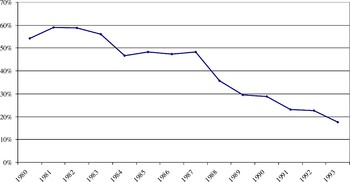
Fiscal decline during the 1980s and early 1990s obviously eroded the central government's ability and willingness to provide assistance to local governments in poor regions. The first significant policy decision on the reduction of support came in 1987, when the government announced that budgetary transfers to poor provinces (then called quota subsidies) would for the next few years remain frozen at the 1986 level of 8.6 billion yuan.Footnote 11 Because of the high rates of inflation then prevalent, by holding the subsidies constant in nominal terms the government in effect allowed them to be quickly eroded in value. In constant 1986 yuan, the subsidies were worth 8.0 billion in 1987, 6.8 billion in 1988 and 5.7 billion in 1989. By 1994, they were equivalent to only 3.5 billion in constant 1986 yuan.Footnote 12 The effect of this on Guizhou, the poorest province in per capita GDP terms, can be seen in Figure 2, where the share of provincial expenditures financed by transfers is shown to fall from 60 per cent at the outset of transition to only 18 per cent in 1993.
The Share of Provincial Expenditures Financed by Transfers in Guizhou

Nationwide, data available for all transfers are shown in Figure 3, revealing a steep decline that followed the trend for central revenues. At the nadir, net transfers had fallen to 1 per cent of GDP in 1994, and remained at that level for several years of the mid-1990s.Footnote 13 The upturn started only after 1997, when central revenues began their recovery.
Trends in Central Revenues and Transfers (as % GDP)

In reality, the collapse of transfers was far more drastic than that depicted above, since measured transfers were only a small part of the redistribution that took place under the previous regime, and the definition of transfers had changed with the revenue-sharing system introduced under the Tax Sharing System reform in 1994. Previously, most transfers were hidden under the system of negotiated revenue sharing, where poor provinces were allowed to keep a higher proportion of revenues collected in their regions, while rich provinces were obliged to turn over more to the central government. For example, Shanghai, the richest provincial unit, annually remitted 80–85 per cent of its collections. In 1987, Jiangsu remitted 55 per cent, Zhejiang 39 per cent and Guangdong only 8 per cent, even though the three provinces had roughly comparable per capita incomes.Footnote 14 These different remittance rates were the net results of different policy considerations or hidden transfers made to the three provinces. Under the revenue sharing system, only eight provinces regularly received what were called “subsidies,” since they could not meet minimum expenditure needs even after being assigned 100 per cent of their collected revenues.Footnote 15 The other transfers – “earmarked subsidies” and “final account subsidies” – were designed to implement central programmes and compensate for policy changes. They were not tied to equalization concerns, and were in the aggregate not equalizing.Footnote 16
The Tax Sharing System introduced in 1994 brought two significant changes to revenue sharing between central and local governments: a reassignment of revenues that saw the central share rise from 22 per cent to more than 50 per cent of the total, and a shift from the sharing of general revenues to a system of tax assignment and tax sharing. Under the new system, central and local governments each had clearly assigned “own revenues,” and all transfers became explicit. This expanded the scope of “transfers” and, ceteris paribus, should have substantially increased transfers. Indeed, from 1994 onward, all provincial units, including Shanghai and Beijing, became recipients of central “transfers.”Footnote 17 In this light, the collapse of redistribution towards poor regions can be seen as precipitous.
Decentralization by default and the de-linking of revenue and expenditure assignments
Judging by expenditure shares, China was already quite decentralized at the outset of reform in 1978, with local (subnational) governments accounting for 53 per cent of budgetary expenditures. As shown by figures in Table 1 (panel II), the process of ad hoc retrenchment described above had produced a further decentralization of expenditures throughout the 1980s and 1990s, and by 2006 local governments accounted for three-quarters of the total. I call this process decentralization by default, because it had occurred by incremental, reactive changes on the revenue and expenditure sides that were largely unco-ordinated.
On the expenditure side, under the current division of assignments, the central government is mainly responsible for economic development (including investment expenditures), national defence and diplomacy; local governments are mainly responsible for day-to-day administration and the provision of social services. This division of labour meant that in the 1980s, most of the easy expenditure cuts were made in the central government budget, while most of the pressures for expenditure increases fell on local governments, which also had to absorb the additional burden of services being devolved from SOEs, including pensions, schools and health institutions.Footnote 18 This dynamic drove the fiscal system toward decentralization, as expenditure shares shifted to local governments, even as expenditures were falling for both central and local governments in terms of GDP shares.
On the revenue side, worry over the erosion of central control over resources led to a progressive de-linking of revenue assignments from expenditure needs considerations. Through the early and mid-1980s, the government had interpreted its fiscal problems as being problems of SOEs, so reviving SOEs' profitability and finding more efficient means of taxing them were the focus of reform efforts.Footnote 19 When this proved ineffectual, the government began to suspect local governments, especially in rich regions, of colluding with SOEs to avoid remittances to the centre.Footnote 20 To stop the haemorrhage and lock in revenues for central coffers, in 1988 the central government retreated to a system of fiscal contracts for revenue sharing with the provinces. The contracts stipulated a lump sum remittance (or subsidy) for each province, to increase annually by an agreed rate that left a progressively higher portion to local governments. In exchange, these contracts turned over responsibility for meeting expenditure requirements to the provinces, to be financed from their “own,” retained revenues. When this failed to halt the decline in revenues, especially in central government revenues, the government finally pushed through a drastic recentralization of revenues under the Tax Sharing System reform in 1994.
Through this process of expenditure decentralization and de-linking of revenue assignments from expenditure needs considerations, the Chinese fiscal system was altered fundamentally. By severing the link between revenue and expenditure assignments, it turned the system from one based on a delegation of responsibilities to real decentralization. That this fundamental change to the fiscal system was slipped through without public comment is a clear indication that it was an ad hoc, reactive reform made with little deliberation.
Underprovision of social services
In the initial years of the transition, the government increased spending on public services, designating as priorities education, health, poverty alleviation, environmental protection and social insurance. In education, public spending on recurrent expenditures rose from 1.8 per cent of GDP in 1978 to 2.2 per cent in 1982. In health, it rose from 1 per cent to 1.3 per cent during the same period. As fiscal decline took hold, however, this effort to increase public spending on social sectors became a lost cause: even as the proportion of budgetary resources devoted to education more than doubled from 5.8 per cent to 13.1 per cent during 1978–95, its share in gross domestic product fell, to 1.5 per cent in 1995.Footnote 21 Public health spending showed a similar trend, declining to 0.64 per cent of GDP in 1995.Footnote 22 Elsewhere, while China strove hard to increase spending on pollution control, from 0.4 per cent of GDP in 1980 to 0.67 per cent in 1992, this was far from adequate in the face of rapid industrialization.Footnote 23
As a result of these funding problems, China's public spending on social services is low. Compared to other Asian countries, or even to other lower-middle income countries, its expenditure on education, hovering around 2–2.5 per cent of GDP throughout the 1980s and most of the 1990s, was far below the levels of its Asian neighbours, and below the average for lower-middle income countries worldwide.Footnote 24 It also fell short of the goals set in the Education Law (1986), which had called for reaching 4 per cent of GDP by 2000. Likewise, China's public spending on health, at 1.9 per cent of GDP, is one-quarter below the “predicted value” of 2.4 per cent based on international comparisons, where a strong correlation between per capita GDP and health spending is commonly observed.Footnote 25 In a 1996 report, the World Bank estimated that China faced a spending gap in critical social services that was equal to nearly 5 per cent of GDP.Footnote 26
Increased reliance on user charging and “business incomes”
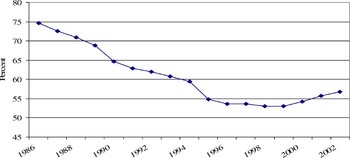
With budgetary resources dwindling, and with government unwilling to cut services, departments or employees, the only solution was to allow local governments and service providers to seek supplementary income by levying user charges and using their assets creatively. Even today, the vast majority of public services in China are provided by publicly owned entities that are attached to government at various levels, known as public service units (shiye danwei 事业单位, PSUs). They include schools, agro-technical extension stations, cultural centres, health clinics and hospitals. Budgetary support for public services is channelled through PSUs, and available data show that the share of public funding fell sharply across all services. Figure 4 illustrates the situation for education, where budgetary resources in total funding fell from the mid-1980s throughout the 1990s, to just 53 per cent of the total. Yet, there was little or no discussion of privatizing the PSUs. Since private providers and NGOs were prohibited until very recently, PSUs are monopoly providers in many services including education, hospitals and agricultural services.
Share of Budgetary Resources in Total Funding for Education

Today all PSUs are only partially funded by the budget. On average, budget allocations account for roughly one-half of their total funding, and they raise the other half from fees and “other incomes.”Footnote 27 The budgetary portion varies across sectors and types of institution, though none is 100 per cent budget-financed, not even the police or fire departments.Footnote 28 For health institutions, in 1998 government subsidies covered only 8 per cent of operating revenues for public hospitals nationwide. The rest came from user charges and drug revenues. Even for public health institutions such as epidemic prevention stations (later renamed centres for disease control) and maternal child health centres, in the late 1990s government appropriations covered only 40 and 30 per cent of operating revenues, respectively.Footnote 29 Passing along costs to users and charging for services is so universal that in a 2004 field visit to one of China's poorest villages in the south-west, I was astonished to find that not a single public service was offered free of charge to the residents, not schooling, health care or even police services.Footnote 30
Long-Term Legacies
The long period of fiscal decline had forced many adjustments on China's public finances, some with long-lasting and negative effects. This section discusses four of the most salient: the large fiscal disparities across localities; the breakdown of the intergovernmental fiscal system; the growth of extra-budgetary activities; and the commercialization of the public sector.
Growing disparities across regions
Over the past quarter of a century, China's economic growth has been regionally unbalanced, with much higher growth rates in the coastal provinces than in inland provinces. This, by itself, would have expanded the already large income differences among provinces. The disparities grew worse with the collapse of transfers in the 1980s and 1990s, as the government abrogated its vital responsibility in redistributing incomes. As a result, especially after the shift to the Tax Sharing System in 1994, the distribution of fiscal resources increasingly followed that of regional incomes.
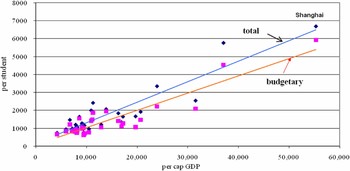
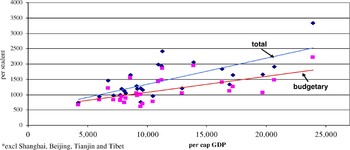
During the 1990s disparities in fiscal resources grew across provinces, and these differences were transmitted directly to spending on social services.Footnote 31 Citizens in rich localities enjoyed more and higher quality services, while those in poor regions faced low quality services, and often went without. To illustrate, data in Figure 5 show that in 2004, Shanghai spent 6,700 yuan per student in primary school, nearly 6,000 of it from budgetary appropriations. At the low end, the poorest province, Guizhou, spent only 745 yuan per student, of which 670 came from the budget – about one-ninth as much as Shanghai. Even when the three provincial-level municipalities are excluded, Figure 6 shows the richest province, Zhejiang, spending 3,300 yuan, still 4.5 times the Guizhou level, and 3.3 times its budgetary expenditure per student. These disparities are unusually large, especially considering that they represent average figures for very large units, as provinces in China have on average more than 45 million inhabitants and the largest have nearly 100 million. Data are not publicly available at the county level to do a comparable analysis. In field work conducted in Liaoning province, a World Bank team found even larger disparities. In 2003, on average counties spent 1,229 yuan per student, but the range was from 182 to 2,556 yuan among the 40 county-level units.Footnote 32
Per Student Expenditure in Primary Schools, by Province (yuan, 2004)

Per Student Expenditure in Primary Schools, by Province (yuan, 2004)

Breakdown of the intergovernmental fiscal system
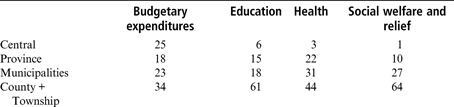
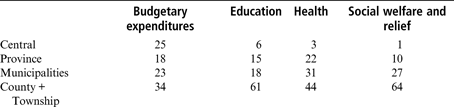
In China fiscal decentralization goes below the provinces downward to all levels of the five-level system of government, with each level of local government assigned important roles in service delivery. In 2006, governments at the county and township levels together accounted for one-third of national budgetary expenditures, and municipalities accounted for nearly one-quarter. The high expenditure shares of these sub-provincial governments are because of the important and costly functions for which they are assigned responsibility – basic education, health care and social security. For example, the large numbers of students means that the provision of basic education is costly, and explains why the county and township governments (responsible for education in grades 1 to 9) account for 61 per cent of the national budgetary outlays for education. Table 2 shows the high shares of subnational governments in the major social expenditures.
Distribution of Budgetary Expenditures by Level of Government, 2006 (%)
Source:
Ministry of Finance, Finance Yearbook of China (Beijing: China Finance and Economic Press, 2008), pp. 147–48.
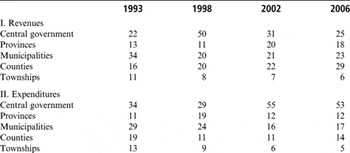
In a recent paper,Footnote 33 I called the intergovernmental system “broken,” by which I meant it is not able to support national policy implementation: the Chinese system depends on local governments to implement social policies, but lacks mechanisms for ensuring that they have adequate financial resources to carry this out. Through the transition period, the piecemeal, incremental reforms had steadily chipped away the coherence of the intergovernmental fiscal system, and the recentralization of revenues under the Tax Sharing System reform in 1994 greatly exacerbated the mismatch between revenue and expenditure assignments. This is shown in Table 3, where, in 1998 counties and townships had a combined 20 per cent of total revenues but 28 per cent of expenditures. Although the gap – in the aggregate – was met by transfers, the assistance provided by transfers to poor localities was far from adequate to enable them to meet their responsibilities.Footnote 34
Fiscal Trends for Government, by Level (%)

Sources:
Wong, Financing Local Government; World Bank, National Development and Sub-national Finance; Ministry of Finance, Compendium of Local Fiscal Statistics (Beijing: China Finance and Economic Press, various years).
Moreover, the intergovernmental fiscal system has been characterized by distrust and mutual blame. Earlier I pointed to the central government's distrust of local governments to implement tax policy. During the long fiscal decline, local officials often complained of higher level governments “grabbing” revenues and “pushing down” expenditures. Data in Table 3 offer evidence in support of the local government complaints: while revenues were increasingly concentrated at higher levels, expenditures were going in the opposite direction. The growing vertical imbalances suggest that rural governments (that is, counties and townships), which are located at the lowest levels of the administrative hierarchy, were especially disadvantaged in their struggle for resources. This is a major cause of the glaring urban–rural inequalities that exist in China today.
As the system of redistribution withered and then collapsed during the 1980s and 1990s, localities in the lower half of the income spectrum (where virtually all rural local governments are situated) were in chronic deficit. A growing number of them defaulted on their responsibilities and were unable to provide services mandated by law or regulation. As a result, the intergovernmental system increasingly became a bottleneck to policy implementation: with local funding problems limiting services, the government has been unable to deliver on some priority programmes such as universal basic education.Footnote 35
The rise of extra-budgetary activities
Another aspect of the breakdown of the intergovernmental fiscal system is the growth of off-budget financing of government, especially at local levels.Footnote 36 The rapid growth of extra-budgetary funds during the 1990s can also be attributed to the fiscal decline and especially the recentralization of revenues under the Tax Sharing System: allowing local governments to tap off-budget revenues was driven by the need for them to carry out their assigned functions. In the aggregate, in the late 1990s off-budget resources used by government and public agencies may have amounted to as much as between 19 and 27 per cent of GDP (in addition to the formal budget).Footnote 37 Reforms in the past few years have abolished many fees and levies – including, most famously, all rural levies under the Rural Fee Reform; others have been brought into the budget.Footnote 38 As fees and levies are abolished, however, local governments have grown increasingly dependent on revenues from land development, and these revenues were, during the 1990s, reported in neither budgetary nor extra-budgetary accounts. Since 1997 the government has required provinces to report land revenues in the “fund budget,” but compliance with this reporting requirement is spotty.
While the extra-budgetary revenues had undoubtedly played a positive role in aiding the provision of services during the period of fiscal decline, they also opened a “back door” financing channel outside the purview of the Ministry of Finance, providing local governments, especially in rich regions, with real autonomy. This too has contributed to “breaking” the intergovernmental fiscal system by weakening the central government's ability to affect fiscal outcomes. As off-budget resources are generally more plentiful in rich regions than poor ones – whether “management fees” collected on enterprise gross turnover or profits, revenues from land transfers or user charges – this reliance on off-budget finance probably exacerbates regional disparities since, unlike budgetary revenues, they are not subject to redistribution through the intergovernmental fiscal system.
Commercialization of the public sector
During the 1980s and 1990s, the financing (though not the providers) of public services was increasingly privatized, with an increasing share of the costs passed to citizens and users. This applied to government bodies as well as PSUs, as they too came to rely increasingly on extra-budgetary resources.
While the original impetus for user charging and seeking other revenues came from budgetary shortfalls, their continuation into the 21st century appears to be driven increasingly by the self-interests of the PSUs and government agencies. Strong evidence for this was found in a 2005 World Bank study in which I participated.Footnote 39 First, we found that despite large additional injections of funds by the government in recent years, the collection of fees and other incomes continued. For the 2000–02 period, for example, budget appropriations for PSUs were raised from 362 billion to 659 billion yuan, an increase of 82 per cent.Footnote 40 However, during the same period, “self-raised revenues” and “service revenues” grew by 43 per cent and 53 per cent, respectively. As a result, the overall proportion of PSU financing from budgetary resources rose only from 42 to 48 per cent; in the key sectors of education and health the effect was even smaller. More importantly, the additional budgetary inputs were more than wholly absorbed by personnel expenditures, which increased by 91 per cent, as a result of a combination of higher salaries and increased employment. The outcome was that the additional injections had little effect on reducing user fees except in a few sectors where fee reductions were administratively mandated.
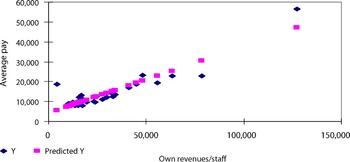
Seeking to explain what drove fee and other revenue collections at PSUs, we performed a series of regression analyses. Pooling PSUs by sector, by province and by tier of government, on a per employee basis, we found no correlation between budgetary inputs and the share of budgetary inputs, nor with total inputs. The only significant relationship was a very strong correlation between PSU “own” revenues (fees and other incomes) and average pay per employee.Footnote 41 The tight linkage between own revenues and staff remuneration is shown in Figure 7, revealing that, on average, provinces with PSUs that collected more “own revenues” paid higher salaries than those collecting less.
Fitted Plot of Average Pay on “Own Revenues” by Province, 2002

These high-powered incentives for revenue-seeking were created when the budget was providing declining support to the PSUs, and a reform was implemented to “push PSUs into the market.” This reform gave PSUs greater managerial autonomy to expand the scope of services and permitted them to link managerial and staff remuneration to the revenues they raised. These concessions were made at a time when civil service salaries were low and there was widespread acceptance of the need to raise them. Over time, however, “topping up salaries” has become institutionalized and built into the remuneration structure, and they in turn influence how services are provided to the public. A notorious illustration can be seen in the “performance-based” remuneration system for doctors in a Chinese traditional medical hospital reported in 2003:
A local newspaper reported that a Chinese traditional medicine hospital implemented a new compensation system. Under this system, doctors receive on average 30 per cent of their regular salary as base pay. The remainder is made flexible and dependent on “performance.” A doctor in a “poorly performing” department receives 700 yuan per month while those in “better performing” departments may earn as much as 10,000 yuan. The best performing department turns out to be the Department of Occupational Injury Verification. Doctors also get a part of their pay based on the value of drugs and services they prescribe. For example, a doctor receives 11 per cent of the value of Chinese herbal medicines, 2 per cent for Western medicines, 10 per cent for chemical and physical tests, 13 per cent for injections, 17 yuan for each CT test, and 10 yuan for each Ultra Sound test.Footnote 42
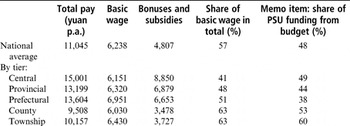
Table 4 shows that in 2002, nationwide the “basic wage,” as stipulated by the civil service pay scale, accounted for only a little more than half of take-home pay for public employees. The rest was made up of “bonuses and subsidies” financed largely from own revenues. In fact, comparing the share of basic wage in total remuneration in PSUs across levels of government reveals another key feature of the current system: the lower-tier PSUs in the counties and townships drew a higher share from basic wages than higher-tier PSUs. This was surely not because budgetary resources were more plentiful at those levels, but that the lower-tier institutions had less authority and fewer opportunities to impose fees and levies on their clients, and had fewer state assets with which to generate income.
Composition of Remuneration of PSU Employees, 2002

Source:
World Bank, Deepening Public Service Unit Reform, Table 1.2.
By “commercialization of the public sector,” I mean the (own) revenue-seeking orientation of both PSUs and government agencies, all of which are doing whatever they can to earn money. This is the motivation behind museums renting out space to advertising and product displays, libraries setting up photocopying centres and even pinball parlours, and the like. It is also the motive for public health institutions such as the centres for disease control and maternal child health stations vying to provide fee-paying services, despite receiving full budgetary funding, so that they can augment staff salaries. Following the Cultural Revolution legacy of educating students through hands-on labour, schools set up factories and workshops to earn extra income, and were given tax exemptions as added incentives. In 2002, these workshops and factories earned 5.4 billion yuan to contribute towards financing education.Footnote 43
Revenue-seeking behaviour is not confined to PSUs, but characterizes government agencies at the central and local levels as well, and it is driven by the same incentives.Footnote 44 Xiaobo Lu has reported on abuses by government agencies imposing fines and fees to finance supplementary pay.Footnote 45 In the 1990s, government agencies also created money-making entities such as development companies and tourism “spots.”Footnote 46 Central ministries, too, were adding money-making activities to their portfolios: the Ministry of Finance had an investment trust company, the then-State Planning Commission established New China Airlines, and the then-State Statistical Bureau had a for-profit Information Centre that sold data and provided data-processing services. Virtually all ministries created new journals, magazines and yearbooks, for which subscription was often compulsory for subordinate units. An official report from the Fujian provincial Organization Department found that government departments at the sub-provincial levels were routinely using much, if not all, of their discretionary incomes from fees, levies and business ventures to top up cadre salaries, and that their unequal opportunities for generating their own revenues explained the large variation in average pay.Footnote 47 More recently, Yu Xie and Xiaogang Wu found in surveys conducted in Shanghai, Wuhan and Xian that “profitability” of the danwei 单位 is a key determinant of incomes in urban China, for both public and private sectors.Footnote 48
Conclusions
After three decades of spectacular economic successes, China is facing a significant challenge in strengthening its government apparatus to manage the increasingly decentralized, complex economy. The string of recent scandals – environmental degradation, lapses in public health, violations of safety standards, the prevalence of fake drugs and chemicals – have all pointed to the government's weaknesses in protecting public safety, exposing an enormous gap between China's growing economic prowess and its capacity to govern. This gap threatens to undermine the government's legitimacy.
Are these simply “growing pains” of China's extremely rapid economic transformation and integration into the global economy? With the leadership now focused on the need to improve its regulatory regime, will China finally “catch up” and build the public institutions necessary to govern a modern economy? The analysis presented in this article leads me to a pessimistic view that is substantially at variance with those of many scholars. Most notably, Dali Yang has argued that changes since the mid-1990s have led to a “reconstitution of the sinews of central control [that] promised not only to furnish the fiscal prowess for the central state but also to provide the foundations for the pursuit of the American Progressive's ideal of the regulatory state.”Footnote 49 Wang Shaoguang and Hu Angang are similarly optimistic in their recent assessments. Wang argues that after a “brief nightmare” in the 1990s, a flourishing counter-current has emerged in China to push towards a “social market,” where the government, through its redistribution mechanisms, is “decommodifying 去商品化” services related to people's livelihood, such as education, health care and social protection, to ensure that they reach all groups in society. He points to the emergence of the current social policies, though they need to be strengthened, as “a historic turning point … [whose] importance cannot be overestimated.”Footnote 50 Hu traces the transformation of government from an “economic construction-oriented government” (jingji jianshe xing zhengfu 经济建设型政府) to a “public service-oriented government” (gonggong fuwu xing zhengfu 公共服务型政府), and concludes that: “the 11th Five-Year Plan marked a decisive step … Although the process is not yet complete, we are confident that the Chinese government will by 2020 become a truly service-oriented government.”Footnote 51
In this article, I have retraced the history of China's fiscal decentralization, much of which has also been covered by other scholars.Footnote 52 What is new in this article is that I have focused on the process of this evolution, highlighting the reactive, incremental retrenchment of government in the 1980s and 1990s to draw conclusions about the adverse long-term legacies of these changes. The ad hoc devolution of authorities and an unwillingness to shrink the scope and reach of government, combined with inadequate finance, led to a laissez-faire orientation that produced large distortions in the incentive structure facing government agencies and PSUs. These, I argue, are the roots of the current problems of weak governance, regulatory failures and growing inequality in China.
In the first decade of the 21st century, the constraints in China to improving public services and consumer and environmental protection are, unlike the previous two decades, no longer a shortage of money. Since the Tax Sharing System reform introduced a broad-based VAT and enterprise income tax, and revamped tax administration in 1994, the government's revenue mechanisms have been restored. The recent growth spurt has brought annually double-digit increases in revenue that have filled government coffers to overflowing, especially at the central government. Indeed, the Harmonious Society programmes have grown out of this prosperity and the recognition that more can and should be done for the less fortunate. The main challenges today are how to channel resources effectively to where they are needed, and motivate government agencies and PSUs to implement policies and enforce existing laws and regulations.
At present, the capacity of the central government to direct economic and social change is constrained by: the large regional disparities in economic development and human resources; a broken intergovernmental fiscal system that is unable to support national policy implementation; accountability mechanisms that are weak or non-existent throughout the administrative structure, having been severely eroded by long periods of inadequate finance during which local governments and public institutions could not be held accountable for results; an information system that is very weak from disuse; and a bloated bureaucracy where authorities are fragmented, and the transmission of policies and resources are complex and unreliable.Footnote 53 Most of all, the government is hobbled throughout the whole administrative apparatus by agents whose (own) revenue hunger dominates decision-making. The frenzied response by both central agencies and local governments to the fiscal stimulus programme in 2009 is both symptomatic of the revenue orientation of public bodies and indicative of the central government's uphill struggle to reorient China's development path.Footnote 54 The rush of local infrastructural (especially transport) projects stands in marked contrast to the wait-and-see posture of many local governments to the recent social spending programmes.
The problems of the intergovernmental fiscal system and distorted incentives were created when China muddled through the brutal fiscal decline without a strategy for reshaping the public sector. The structure and incentives are now hardened and deeply embedded, and undoing them will take time and a determined effort. A programme of comprehensive reforms will be required to eliminate the constraints listed above: building new accountability mechanisms and information systems, reorganizing and streamlining government, and, most of all, repairing the intergovernmental fiscal system. These are large and politically difficult reforms. Until revenue and expenditure assignments are realigned, and the revenue-driven orientation of government agencies and PSUs is fundamentally altered, pushing more money through the system will not solve the problems of weak governance, and is likely to have only limited effect on improving the government's capacity to ensure fairness, public safety and consumer protection.