Exclusion and support
Workplace incivility is a growing and costly problem in organizations (Pearson & Porath, Reference Pearson and Porath2009). One type of incivility that is particularly troublesome is co-worker exclusion, which manifests as a non-violent form of social sanction (ignoring, avoiding, and not including) against those who fail to adhere to commonly held norms and expectations and threaten social stability (Ferris, Brown, Berry, & Lian, Reference Ferris, Brown, Berry and Lian2008). Exclusion leads to an array of negative outcomes for employees and organizations alike (e.g., Ferris, Chen, & Lim, Reference Ferris, Chen and Lim2017; Hitlan, Cliffton, & DeSoto, Reference Hitlan, Cliffton and DeSoto2006a; Hitlan, Kelly, Schepman, Schneider, & Zárate, Reference Hitlan, Kelly, Schepman, Schneider and Zárate2006b) because it threatens employees' belongingness needs (Baumeister & Leary, Reference Baumeister and Leary1995). Exclusion is a vexing problem because it is pervasive, is not easily detected by those in authority, and typically does not result in punishment until it escalates (Williams, Reference Williams2001).
However, recent research suggests that ameliorating the effects of workplace exclusion may be even more difficult than anticipated because many workplace relationships are perceived to be simultaneously positive and negative (ambivalent relationships; Ashforth, Rogers, Pratt, & Pradies, Reference Ashforth, Rogers, Pratt and Pradies2014; Methot, Melwani, & Rothman, Reference Methot, Melwani and Rothman2017; Rothman, Pratt, Rees, & Vogus, Reference Rothman, Pratt, Rees and Vogus2017). Prior research has typically assumed that negative relationships, such as those characterized by exclusion, lack positive qualities, such as support, and vice versa (Cropanzano, Anthony, Daniels, & Hall, Reference Cropanzano, Anthony, Daniels and Hall2017). This has led researchers to measure employees' views of their relationships with key entities, such as co-workers, in a largely unidimensional fashion, which presents an incomplete picture (Methot, Melwani, & Rothman, Reference Methot, Melwani and Rothman2017; Rothman et al., Reference Rothman, Pratt, Rees and Vogus2017).
Reviews by Methot and Rosado-Solomon (Reference Methot, Rosado-Solomon, Brass and Borgatti2020) and Methot, Melwani, and Rothman (Reference Methot, Melwani and Rothman2017) suggest that ambivalent relationships are common in organizations. Examples include employees perceived to be likable but incompetent or competent but unlikable (Casciaro & Lobo, Reference Casciaro and Lobo2005) and team members who are engaged in relationship conflict with other team members they consider to be their friends (Hood, Cruz, & Bachrach, Reference Hood, Cruz and Bachrach2017). An example particularly relevant to our study is Duffy, Ganster, and Pagon's (Reference Duffy, Ganster and Pagon2002) argument and finding that perceived co-worker undermining was most strongly associated with some outcomes when employees perceived both high levels of undermining and support. We seek to extend this by investigating how perceptions of co-worker exclusion and support interact to influence employee performance. Performance encapsulates behaviors formally required by the organization as well as those that employees voluntarily engage in toward the organization and/or other employees, such as citizenship and deviance (Rotundo & Sackett, Reference Rotundo and Sackett2002). We specifically focus on interpersonal deviance because these behaviors are more likely to be observed by others than are other types of negative discretionary behaviors (Carpenter, Rangel, Jeon, & Cottrell, Reference Carpenter, Rangel, Jeon and Cottrell2017). We also investigate how support outside of the workplace domain, via perceived support from family and friends, might serve as an important substitute for lost belongingness needs resulting from lower co-worker support (Baumeister & Leary, Reference Baumeister and Leary1995).
Our study offers a number of important contributions by building upon opportunities to extend our understanding of workplace relationships recently identified in the literature. First, Cropanzano et al. (Reference Cropanzano, Anthony, Daniels and Hall2017) suggest the need to take a more nuanced perspective of social exchange by considering both the desirability and activity levels of real or perceived actions and responses, rather than assuming actions will always result with in-kind responses. We do just that by considering how simultaneous perceptions of co-worker exclusion and support influence employees' behavioral responses (i.e., performance outcomes). Second, Rothman et al. (Reference Rothman, Pratt, Rees and Vogus2017) suggest that the exploration of simultaneous positive and negative perceptions of the same entity will help us to better understand both positive and negative outcomes. Our expectation is that employees' performance will be worse when they feel excluded and supported by their co-workers rather than when they just feel excluded by their co-workers. Third, Methot, Melwani, and Rothman (Reference Methot, Melwani and Rothman2017) called for research that identifies the boundary conditions concerning the outcomes resulting from relationships that are perceived to be both positive and negative. Our expectation is that the degree to which employees feel supported from a domain outside of work, friends and family, is important to understanding the interaction of perceptions of co-worker exclusion and support on employees' performance. As a whole, we expect that some forms of social support may be helpful and other forms may be hurtful to the performance outcomes that may result from perceptions of co-worker exclusion.
Theory and hypothesesFootnote 1
Perceptions of co-worker exclusion and performance outcomes
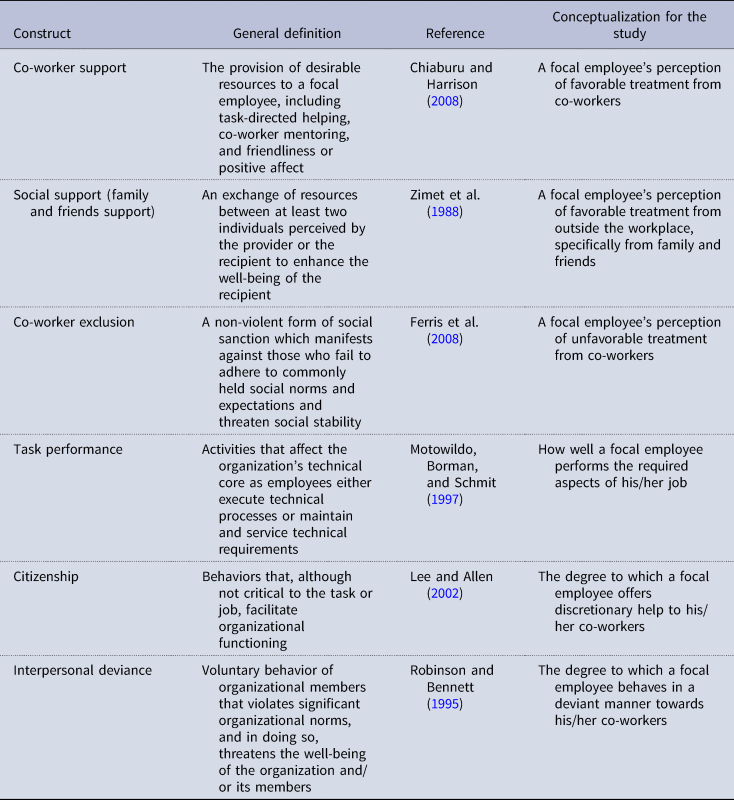
Table 1 provides a summary of definitions and conceptualizations for the constructs we focus on in our study. Belongingness theory asserts that humans have a fundamental need to build and maintain relationships that are positive, strong, and enduring (Baumeister & Leary, Reference Baumeister and Leary1995). Co-worker relationships are important because employees rely upon them for aid in completing their work and for social support (Chiaburu & Harrison, Reference Chiaburu and Harrison2008; Viswesvara, Sanchez, & Fisher, Reference Viswesvara, Sanchez and Fisher1999). However, co-worker exclusion threatens employees' belongingness needs, resulting in lower job satisfaction, organization-based self-esteem, and perceived organizational support, and greater depression, deviance, and turnover intentions (Ferris et al., Reference Ferris, Brown, Berry and Lian2008), and potentially having a negative impact on profitability. In line with past research, we suggest that co-worker exclusion will be negatively related to task performance because employees who perceive exclusion from co-workers will have lower self-efficacy, less access to information, and unfulfilled belongingness needs (Baumeister, DeWall, Ciarocco, & Twenge, Reference Baumeister, DeWall, Ciarocco and Twenge2005; Ferris et al., Reference Ferris, Brown, Berry and Lian2008; Scott, Zagenczyk, Schippers, Purvis, & Cruz, Reference Scott, Zagenczyk, Schippers, Purvis and Cruz2014). We therefore predict:
Hypothesis 1a: Co-worker exclusion is negatively related to task performance.
Construct definitions and conceptualizations

We draw on social exchange theory to argue that co-worker exclusion is also related to employees' discretionary performance (e.g., citizenship and deviance). Social exchange theory is particularly relevant here because it considers the exchange of socioemotional resources (Cropanzano et al., Reference Cropanzano, Anthony, Daniels and Hall2017; Shore, Tetrick, Lynch, & Barksdale, Reference Shore, Tetrick, Lynch and Barksdale2006). From this view, when the treatment provided by an individual or organization signals to the other party in the exchange relationship that they care for their well-being or value their contributions, it creates an obligation, based on the reciprocity norm, for the second party to return the favorable treatment that they received. It is important for individuals to fulfill exchange obligations because doing so helps them to maintain a positive self-image, avoid the disapproval of others, and encourage favorable future treatment (Eisenberger & Stinglhamber, Reference Eisenberger and Stinglhamber2011). The repayment of favorable treatment, on an undefined timeline, establishes trust between social exchange partners (Coyle-Shapiro & Shore, Reference Coyle-Shapiro and Shore2007; Cropanzano & Mitchell, Reference Cropanzano and Mitchell2005) (Table 1).
The reciprocity norm has provided a widely accepted explanation of how reciprocal exchange results in strong social exchange relationships (e.g., Cropanzano et al., Reference Cropanzano, Anthony, Daniels and Hall2017). The reciprocity norm, as articulated by Gouldner (Reference Gouldner1960), is a generalized moral norm that dictates individuals help (and do not harm) those who help them. In the context of relationships between co-workers, employees who receive favorable treatment from co-workers (material and/or socioemotional benefits) are obligated to reciprocate with commensurate helping behaviors (Blau, Reference Blau1964; Homans, Reference Homans1958). In consideration of negative treatment, social exchange suggests that employees should be less inclined to help those who exclude them relative to others who do not exclude them or actively help them (e.g., Ferris et al., Reference Ferris, Brown, Berry and Lian2008; Hitlan, Kelly, Schepman, Schneider, & Zárate, Reference Hitlan, Kelly, Schepman, Schneider and Zárate2006b; Scott, Tams, Schippers, & Lee, Reference Scott, Tams, Schippers and Lee2015). We therefore predict:
Hypothesis 1b: Co-worker exclusion is negatively related to citizenship.
However, it is also likely that employees will perceive that being excluded by co-workers threatens their belongingness needs and chances of achieving their goals. Under such circumstances, employees may be motivated to respond in a manner that creates equity or avenges perceived harm through negative reciprocity, or retaliation (Tripp, Reference Tripp and Cropanzano2001). Retaliation (or negative reciprocity) is defined as ‘retaliation where the emphasis is placed not on the return of benefits but on the return of injuries’ (Gouldner, Reference Gouldner1960, p. 172). Recent meta-analytic evidence provides support for the prevalence of negative reciprocity, suggesting that employees generally respond to negative treatment with negative behavior of similar severity, and in some instances even retaliate more strongly (Greco, Whitson, O'Boyle, Wang, & Kim, Reference Greco, Whitson, O'Boyle, Wang and Kim2019). In this vein, co-worker exclusion is related to interpersonal deviance (e.g., Hitlan & Noel, Reference Hitlan and Noel2009; Twenge & Baumeister, Reference Twenge, Baumeister, Abrams, Hogg and Margues2005) and negative reciprocity can be directed toward individuals who are not the perceived instigators of exclusion. For example, Sommer and Bernieri (Reference Sommer and Bernieri2015) found that individuals who felt rejected held negative attitudes even toward those who were not the sources of rejection, and Twenge, Baumeister, Tice, and Stucke (Reference Twenge, Baumeister, Tice and Stucke2001) demonstrated that those who felt excluded acted negatively towards those who were not the sources of exclusion. As a whole, research on negative reciprocity suggests that employees who feel excluded by their co-workers are likely to engage in negative discretionary behaviors towards their co-workers, irrespective of whether they are the perpetrators of exclusion or not. We therefore hypothesize:
Hypothesis 1c: Co-worker exclusion is positively related to interpersonal deviance.
The moderating role of co-worker support
Researchers have sought to identify individual differences (e.g., Xu, Huang, and Robinson, Reference Xu, Huang and Robinson2017) and relational mechanisms (e.g., Scott et al., Reference Scott, Zagenczyk, Schippers, Purvis and Cruz2014) that may mitigate the negative effects of co-worker exclusion. To this end, Scott et al. (Reference Scott, Zagenczyk, Schippers, Purvis and Cruz2014) argued that different forms of support have the potential to serve as partial or full substitutes for the thwarted belongingness needs stemming from co-worker exclusion (Baumeister & Leary, Reference Baumeister and Leary1995), finding that organizational support buffered the negative effects of co-worker exclusion. However, like much of the research investigating social exchange and social support more generally (Cropanzano et al., Reference Cropanzano, Anthony, Daniels and Hall2017), a limitation of Scott et al.'s (Reference Scott, Zagenczyk, Schippers, Purvis and Cruz2014) research is that it only considered the negative side of co-worker relationships and not their potential benefits.
With this said, social exchange does not currently have a mechanism in place to account for ambivalent relationships. This is important because treating workplace relationships as exclusively positive or negative is a rather narrow perspective. Gibney, Zagenczyk, and Masters (Reference Gibney, Zagenczyk and Masters2009) argued and demonstrated that low levels of organizational support (your organization does not support you) were distinct from organizational obstruction, a perception that the organization was actively working against employees. Eby, Butts, Lockwood, and Simon (Reference Eby, Butts, Lockwood and Simon2004, p. 415) noted that ‘negative relational experiences should not be conceptualized simply as a deviation from the positive, but (rather) a phenomenon that also composes the totality of relational experience’ (see also Cropanzano et al., Reference Cropanzano, Anthony, Daniels and Hall2017; Methot, Melwani, & Rothman, Reference Methot, Melwani and Rothman2017). Similarly, Duffy, Ganster, and Pagon (Reference Duffy, Ganster and Pagon2002) showed that co-worker relationships are not exclusively negative, but positive as well, by finding an insignificant relationship between undermining and support, suggesting that these constructs were not orthogonal. Accordingly, workplace relationships can be characterized as ambivalent, defined as ‘simultaneously oppositional positive and negative orientations toward an object’ (Ashforth et al., Reference Ashforth, Rogers, Pratt and Pradies2014, p. 1455).
Duffy, Ganster, and Pagon (Reference Duffy, Ganster and Pagon2002, p. 337) argued that ambivalent co-worker relationships would be more detrimental than purely negative relationships because they cause ‘feelings of relationship insecurity as well as in feelings of lack of control, trust, and predictability in the relationships.’ Furthermore, ambivalent relationships require ‘more emotional energy and coping resources to deal with individuals who are inconsistent in their provision of support and undermining behaviors.’ In support, they found that the negative outcomes of undermining were consistently worse for employees who also had high levels of support from their supervisors, and, depending on the outcome, worse for employees with high levels of undermining and support from their co-workers. These results are in line with research on the health outcomes of ambivalent relationships, which suggest it is actually worse to have ambivalent relationships than purely negative relationships (see Methot, Melwani, and Rothman, Reference Methot, Melwani and Rothman2017, for a review).
We believe a similar effect will be observed for employees who feel both excluded and supported by their co-workers. Rothman et al. (Reference Rothman, Pratt, Rees and Vogus2017) suggest that cognitive/behavioral inflexibility (e.g., indecision and paralysis) results from ambivalence because it can be confusing (Duffy, Ganster, & Pagon, Reference Duffy, Ganster and Pagon2002) and cause individuals to ruminate (Emmons & King, Reference Emmons and King1988). This is true irrespective of whether the inconsistent behavior is from the same co-worker or from different co-workers. The rumination resulting from the confusion is especially important because it costs employees time and resources that could be used for task completion. We therefore hypothesize:
Hypothesis 2a: Co-worker support moderates the negative relationship between co-worker exclusion and task performance such that the negative relationship is stronger for employees who perceive higher co-worker support.
The negative outcomes of rumination may also affect citizenship and interpersonal deviance. Social exchange suggests that employees help others who help them through the provision of citizenship behavior and retaliate against those who oppose them with deviant behavior. This begs the question of whether employees will respond to ambivalent relationships with citizenship or deviance. The rationale underlying the substitution hypothesis (Baumeister & Leary, Reference Baumeister and Leary1995) and social support theory (Cohen & Wills, Reference Cohen and Wills1985) suggest that co-worker support reduces the strength of the negative relationship between co-worker exclusion and citizenship by providing employees additional resources that may allow them to engage in citizenship behavior despite being excluded. However, an extensive body of research from psychology suggests that individuals often focus on negative events to a greater degree than positive ones (Baumeister, Bratslavsky, Finkenauer, & Vohs, Reference Baumeister, Bratslavsky, Finkenauer and Vohs2001) and that this effect can be exacerbated for dysphoric individuals engaged in ruminative thinking (Lyubomirsky, Caldwell, & Nolen-Hoeksema, Reference Lyubomirsky, Caldwell and Nolen-Hoeksema1998). Individuals who feel both excluded and supported by their co-workers, irrespective of whether the inconsistent behavior is from the same co-worker or from different co-workers, will likely focus more on the exclusion during their ruminative thinking. In line with this reasoning, Rothman et al. (Reference Rothman, Pratt, Rees and Vogus2017) suggest that employees are likely to disengage from ambivalent relationships. Thus, we expect that employees will be less likely to respond to ambivalent relationships with citizenship behaviors. We therefore hypothesize:
Hypothesis 2b: Co-worker support moderates the negative relationship between co-worker exclusion and citizenship such that the negative relationship is stronger for employees who perceive higher co-worker support.
Rothman et al. (Reference Rothman, Pratt, Rees and Vogus2017) suggest that disengagement resulting from ambivalent relationships may result in negative outcomes as well (e.g., deviance). We reason that this occurs for two reasons. First, employees may engage in interpersonal deviance because they feel compelled to retaliate for the negative treatment that they experience (Greco et al., Reference Greco, Whitson, O'Boyle, Wang and Kim2019). Second, rumination that occurs as a result of uncertainty may leave employees without the resources necessary to cope with negative emotions and control their behavior in the workplace and, as a result, engage in deviance (Folger & Skarlicki, Reference Folger, Skarlicki, Griffin, O'Leary-Kelly and Collins1998). We therefore hypothesize:
Hypothesis 2c: Co-worker support moderates the positive relationship between co-worker exclusion and interpersonal deviance such that the positive relationship is stronger for employees who perceive higher co-worker support.
The moderating role of family and friends support
Support from a source from a different domain, such as family and friends, could help substitute for the loss of belongingness associated with co-worker exclusion (Baumeister & Leary, Reference Baumeister and Leary1995). The key tenets of social support theory are: (1) informational support helps individuals to understand and effectively cope with difficult problems; (2) instrumental support makes relevant material resources available to help cope; (3) emotional support provides an outlet for self-expression; and (4) appraisal support provides self-evaluative information that provides confidence one can overcome the perceived difficulty. We argue that family and friends support can provide several or all of these functions and will, therefore, help employees as they cope with co-worker exclusion.
Support for our argument can be gleaned from Eby, Casper, Lockwood, Bordeaux, and Brinley's (Reference Eby, Casper, Lockwood, Bordeaux and Brinley2005) review of work and family research in industrial organizational psychology and organizational behavior, which indicates that family and friends support can have beneficial effects on employees. Madjar, Oldham, and Pratt (Reference Madjar, Oldham and Pratt2002) found that family and friends support was more important than support from supervisors and co-workers (with respect to creative performance) for those with lower creative personality characteristics. Family and friends support is an avenue through which employees can express their negative emotions stemming from exclusion. Expression of negative emotions with family and friends can prevent the emotions from building up and spilling out in an extreme fashion within the workplace, thereby decreasing the negative impact those emotions might have on task performance (Diefendorff & Greguras, Reference Diefendorff and Greguras2009). In other words, family and friends provide opportunities to help ‘extinguish the fire’ caused by feelings of exclusion, rather than ‘fan the flames.’ We therefore hypothesize:
Hypothesis 3a: Family and friends support moderates the negative relationship between co-worker exclusion and task performance such that the negative relationship is weaker for employees who perceive higher family and friends support.
Family and friends support can also help employees to replenish their resources, and thus may reduce the strength of the negative relationship between co-worker exclusion and citizenship. Although employees may experience strong emotions as a result of the situation, informational support from family and friends can help them to reframe the situation in a manner that is more positive. For example, Tremmel and Sonnentag's (Reference Tremmel and Sonnentag2018) daily diary investigation of how conversations at home can help employees reframe negative treatment towards them suggests that family and friends can be particularly important to how employees respond to exclusion because they can provide alternative points of view about the perceived exclusion or can identify and encourage strategies that may mend negative relationships with co-workers. We therefore hypothesize:
Hypothesis 3b: Family and friends support moderates the negative relationship between co-worker exclusion and citizenship such that the negative relationship is weaker for employees who perceive higher family and friends support.
The fact that family and friends support can help mitigate the negative outcomes of ambivalent relationships is in line with the view that social support can act as a buffer of the relationships between stressors and strain (Cohen & Wills, Reference Cohen and Wills1985) and thus reduce employees' tendency to engage in interpersonal deviance as a result of ambivalent relationships. For example, Duffy, Ganster, and Pagon (Reference Duffy, Ganster and Pagon2002) found that supervisor support buffered the effects of co-worker undermining on passive counterproductive behaviors, whereas co-worker support buffered the effects of supervisor undermining on somatic complaints. We expect to find similar effects for family and friends support on the relationship between co-worker exclusion and interpersonal deviance. We therefore hypothesize:
Hypothesis 3c: Family and friends support moderates the positive relationship between co-worker exclusion and interpersonal deviance such that the positive relationship is weaker for employees who perceive higher family and friends support.
Co-worker exclusion, co-worker support, and family and friends support
Consistent with research on ambivalence (Methot, Melwani, & Rothman, Reference Methot, Melwani and Rothman2017) and Baumeister and Leary's (Reference Baumeister and Leary1995) substitution hypothesis, we have thus far argued that co-worker support exacerbates, whereas family and friends support mitigates, the negative outcomes of co-worker exclusion. In other words, the negative outcomes of co-worker exclusion are worse for employees who perceive higher levels of co-worker support and lower levels of family and friends support and better for employees who perceive lower levels of co-worker support and higher levels of family and friends support. This suggests that the moderating effects of co-worker support and family and friends support do not operate independently of one another. Rather, they may jointly affect the relationships between the perceptions of co-worker exclusion and performance outcomes (i.e., a three-way interaction). We expect that family and friends support should allow employees to better cope with and develop strategies to manage ambivalent relationships with co-workers. In the context of task performance, we expect that family and friends support will allow for employees to vent negative emotions that stem from uncertainty related to ambivalence. This emotional support would enable employees to concentrate more effectively on task performance, thus mitigating the effects of high co-worker exclusion and high coworker support. We therefore hypothesize:
Hypothesis 4a: A three-way interaction exists between co-worker exclusion, co-worker support, and family and friends support such that the negative relationship between co-worker exclusion and task performance is strongest for employees who perceive higher co-worker support and lower family and friends support.
We also expect that family and friends support should provide employees with opportunities to vent negative emotions as well as information that can help them to develop strategies to better cope with ambivalent relationships. In contrast, employees with lower levels of family and friends support will have limited opportunities for emotional support and will not benefit from the wisdom of others in developing strategies to cope with ambivalence at work. The lack of resources and frustration that ensue will lead them to engage in lower levels of citizenship and higher levels of interpersonal deviance. We therefore hypothesize:
Hypothesis 4b: A three-way interaction exists between co-worker exclusion, co-worker support, and family and friends support such that the negative relationship between co-worker exclusion and citizenship is strongest for employees who perceive higher co-worker support and lower family and friends support.
Hypothesis 4c: A three-way interaction exists between co-worker exclusion, co-worker support, and family and friends support such that the positive relationship between co-worker exclusion and interpersonal deviance is strongest for employees who perceive higher co-worker support and lower family and friends support.
Method
Data and sample
We tested our hypotheses using an online sample of subordinates from StudyResponse in an effort to achieve a greater degree of external validity than could be obtained by surveying employees in a single or a few organizations. Online samples have very similar data properties to those of ‘traditional’ samples (Porter, Outlaw, Gale, & Cho, Reference Porter, Outlaw, Gale and Cho2019; Walter, Seibert, Goering, & O'Boyle, Reference Walter, Seibert, Goering and O'Boyle2019). StudyResponse (housed at Syracuse University) is a non-profit academic service that matches researchers with individuals employed within various occupations, organizations, and industries that are willing to participate in research studies. All study protocol and sampling techniques are subject to the same requirements as standard US-based survey research (e.g., IRB approval, response checks during the survey completion process). It is a service that has been used in prior research (e.g., Lin, Kain, & Fritz, Reference Lin, Kain and Fritz2013; Piccolo & Colquitt, Reference Piccolo and Colquitt2006) by researchers aiming to collect multi-source data (Porter et al., Reference Porter, Outlaw, Gale and Cho2019). StudyResponse e-mailed potential subordinates (US-based employees aged 18 or older employed across a wide range of occupational positions and industries) a link to our survey along with a cover letter that vaguely explained the objectives of the research and assured confidentiality. Subordinates were asked to forward a survey link provided by StudyResponse to their supervisors in order to collect supervisor responses. Both subordinates and supervisors submitted their responses to a secure Internet database.
We received data from 148 supervisor–subordinate dyads (each supervisor supervised only one subordinate in the sample). We removed 13 supervisor–subordinate dyads from the sample because the subordinates did not include values, or included unrealistic values, for our control variables (e.g., errors in the reporting of variables). In addition, 16 of the remaining 135 supervisor–subordinate dyads had missing data for some scale items in our multi-item scales. Recommendations for how to handle missing data in multi-item scales have ranged from keeping respondents whose responses to specific scales have no more than 50% missing data (e.g., Graham, Reference Graham2009) to keeping respondents who respond to only one item on a multi-item scale (e.g., Newman, Reference Newman2014). Following Cruz and Pinto (Reference Cruz and Pinto2019), we chose a more conservative approach by using a method in which missing values for each scale item were replaced with the mean of the respective remaining scale items for the respective respondents if 25% or less of the scale items were missing. The 16 supervisor–subordinate dyads with missing data had 25% (or less) missing data for each multi-item scale. Thus, our final sample consists of 135 supervisor–subordinate dyads. The 13 excluded supervisor–subordinate dyads were not significantly different from our final sample in terms of task performance (p = .721), interpersonal citizenship (p = .190), or family and friends support (p = .447). However, they had higher levels of organizational citizenship (p = .023), interpersonal deviance (p = .002), co-worker exclusion (p = .001), and co-worker support (p = .015).
Our final sample is neither representative nor intended to be representative of a definable population. The subordinates ranged in age from 24 to 68 years old; .7% completed some high school, 4.4% completed high school or a GED, 17.8% completed some college or technical training beyond high school, 55.6% completed college, 5.2% completed some graduate school, and 16.3% completed a graduate degree. With respect to ethnicity, 1.5% of our sample is American Indian/Alaskan Native, 9.6% is Asian/Pacific Islander, 4.4% is Hispanic, 6.7% is Black/non-Hispanic, and 76.3% are White/non-Hispanic. Subordinates are employed in a wide range of industries and positions. Examples of industries include business services, construction, consulting, education, energy, engineering, entertainment, finance, government, healthcare, hospitality, information technology, legal, manufacturing, retail, transportation, and wholesale. Examples of positions include administrative assistant, air traffic controller, analyst, carpenter, cashier, casino security, computer programmer, controller, cook, engineer, flight attendant, graphic artist, human resources manager, paralegal, program administrator, project manager, receptionist, senior care provider, senior manager, and systems administrator.
Our final sample was also large enough for us to detect a medium effect size or larger (i.e., f 2 = .15 or larger) with 80% power in the models we were testing (Cohen, Reference Cohen1988). An a priori power analysis indicated that a sample size of 123 or larger would be needed to accomplish this goal. A post hoc power analysis indicated that we achieved 85% power to detect a medium effect size or larger with our final sample size.
Measures
Similar to the work of others who have explored the performance outcomes of negative workplace experiences (e.g., Mao, Chang, Johnson, and Sun, Reference Mao, Chang, Johnson and Sun2019), we asked subordinates to rate the independent variables and supervisors to rate the dependent variables. This approach helps reduce the potential effects of common method bias that might exist between independent and dependent variables that are rated by the same source (Podsakoff, MacKenzie, & Podsakoff, Reference Podsakoff, MacKenzie and Podsakoff2012; Podsakoff, MacKenzie, Lee, & Podsakoff, Reference Podsakoff, MacKenzie, Lee and Podsakoff2003). We also adopted the procedural recommendations of Podsakoff et al. (Reference Podsakoff, MacKenzie, Lee and Podsakoff2003) and Podsakoff, MacKenzie, and Podsakoff (Reference Podsakoff, MacKenzie and Podsakoff2012) for minimizing common method bias. These procedures included proximal separation of variables (e.g., co-worker support items were physically separated from family and friends support items), psychological separation (i.e., instructions were provided to respondents in such a way that the instructions did not indicate any questions were more important than the others), reducing evaluation apprehension (e.g., asking respondents to thoughtfully respond to the survey items), reducing common-scale properties (e.g., co-worker support and family and friends support items had a different number of scale points and scale labels), and using established scales. Except for our control variables, we used multi-item scales for all of our measures and we used the mean of the respective items for each measure in our regression analyses. However, as noted in the respective measures, we did not use the full scales for some of our measures to help reduce the length of the surveys. This approach of using reduced scales is consistent with others (e.g., Scott et al., Reference Scott, Zagenczyk, Schippers, Purvis and Cruz2014).
Task performance
Supervisors rated subordinates' task performance using seven items similar to Marineau, Hood, and Labianca's (Reference Marineau, Hood and Labianca2018) seven-item employee performance scale (1 = Strongly disagree to 5 = Strongly agree). The seven items used were ‘This employee is performing his/her total job the way I would like it performed,’ ‘I am satisfied with the total contribution this employee has made to the organization,’ ‘This employee has met all of expectations in terms of his/her roles and responsibilities,’ ‘I respect this employee's judgment,’ ‘If I had my way, I would change the manner in which this person is doing his/her job’ (reverse scored), ‘This employee demonstrates a strong ability to perform his/her job tasks’ and ‘This employee is very knowledgeable about his/her job tasks.’ Cronbach's alpha for this scale is .80.
Interpersonal citizenship
Empirical research on citizenship behaviors does not clearly indicate whether respondents distinguish between interpersonal and organizational citizenship (cf. Bateman & Organ, Reference Bateman and Organ1983; Lee & Allen, Reference Lee and Allen2002). Based on these mixed findings, we took a conservative approach by treating citizenship as two theoretically distinct constructs. We asked supervisors to rate subordinates' interpersonal citizenship (Carpenter, Berry, & Houston, Reference Carpenter, Berry and Houston2014) using five items adapted from Lee and Allen's (Reference Lee and Allen2002) eight-item interpersonal citizenship scale (1 = Strongly disagree to 5 = Strongly agree). We primarily adapted the items to make the language correspond to supervisor (as opposed to self) ratings, by using an agreement scale rather than a frequency scale, reducing the number of scale points from seven to five, and slightly modifying the wording of the items (e.g., to make the items past tense rather than present tense and to shorten the length of some items). The five items used were ‘Shared personal property with others to help their work,’ ‘Gone out of their way to help an employee,’ ‘Treated other employees courteously, even under trying conditions,’ ‘Given up time to help others who have work or non-work problems,’ and ‘Willingly assisted other employees with their work duties.’ This reduced scale is highly correlated with the full scale that we have in another dataset, r = .93, p = .000. Cronbach's alpha for this scale is .80.
Organizational citizenship
Supervisors rated employees' organizational citizenship using four items adapted from Lee and Allen's (Reference Lee and Allen2002) eight-item organizational citizenship scale (1 = Strongly disagree to 5 = Strongly agree). The adaptions noted for the interpersonal citizenship measure apply to this measure as well. The four items used were ‘Taken action to protect the organization from potential problems,’ ‘Expressed loyalty to the organization,’ ‘Demonstrated concern about the image of the organization,’ and ‘Offered ideas to improve the functioning of the organization.’ The correlation between our shortened scale and the full scale was again quite strong, r = .91, p = .000. Cronbach's alpha for this scale is .74.
Interpersonal deviance
We asked supervisors to rate subordinates' interpersonal deviance using eight items adapted from Duffy, Ganster, and Pagon's (Reference Duffy, Ganster and Pagon2002) 13-item co-worker undermining scale (1 = Strongly disagree to 5 = Strongly agree), which includes verbal and physical behaviors that are generally representative of the interpersonally deviant behaviors Carpenter et al. (Reference Carpenter, Rangel, Jeon and Cottrell2017) found were most likely observed by others. We adapted the wording of the items so that they were appropriate for supervisor (and not self) ratings. In addition, we did not explicitly ask supervisors whether they believed subordinates' behaviors were intentional or not (which is a key aspect of undermining; Duffy, Ganster, and Pagon, Reference Duffy, Ganster and Pagon2002). We also used the items in statement form rather than in question form, used an agreement scale rather than a frequency scale, reduced the number of scale points from six to five, and slightly modified the wording of the items (e.g., to make the items past tense rather than present tense and to shorten the length of some items). The eight items used were ‘Given a coworker the “silent” treatment,’ ‘Insulted another employee,’ ‘Belittled another co-worker's ideas,’ ‘Given incorrect or misleading information about work-related issues,’ ‘Not helped a coworker as much as they had promised,’ ‘Talked badly about a coworker behind their back,’ ‘Criticized another employee,’ and ‘Spread rumors about another employee at work.’ This reduced scale is highly correlated with the full scale, r = .97, p = .000. Cronbach's alpha for this scale is .95.
Co-worker exclusion
We measured co-worker exclusion using an adapted version of Scott's (Reference Scott2007) eight-item co-worker exclusion scale in which she used a time referent of the past few months to reduce the likelihood that employees considered co-workers with whom they no longer worked. The adaptations we made included using a frequency scale rather than an agreement scale and increasing the number of scale points from five to seven. Thus, we asked respondents to rate how often they felt excluded in the past few months by their co-workers with whom they interacted most frequently (1 = Never to 7 = Always). The eight items used were ‘Gave sentiments of appreciation to others but not to me,’ ‘Walked out of the room when I entered,’ ‘Did not invite me to socialize (e.g., lunch, coffee breaks, office pools),’ ‘Whispered things to others, from which I was excluded, right in front of me,’ ‘Did not encourage me to participate in work-related activities,’ ‘Recognized the personal events of others (e.g., birthday) but not mine,’ ‘Did not sit near me during work-related activities (e.g., meetings, breaks),’ and ‘Did not introduce me when an introduction would have been appropriate.’ In total, 85.9% of subordinates perceived at least a minimal degree of exclusion. Cronbach's alpha for this scale is .92.
Co-worker support
Following Scott's (Reference Scott2007) development of her co-worker exclusion scale, we measured co-worker support using nine items adapted from Barrera, Sandler, and Ramsay's (Reference Barrera, Sandler and Ramsay1981) 40-item social support scale (1 = Never to 7 = Always). The adaptations noted for the co-worker exclusion measure apply to this measure as well. The nine items used were ‘Pitched in to help me do something that needed to be done,’ ‘Listened to my concerns about work,’ ‘Backed me up in front of my supervisor,’ ‘Gave me good work advice,’ ‘Expressed an interest in my well-being,’ ‘Helped me handle stressful days at work,’ ‘Expressed respect for a personal quality/characteristic of mine,’ ‘Were willing to loan or give me things I needed,’ and ‘Gave me information to help me do something.’ Cronbach's alpha for this scale is .95.
Family and friends support
In comparison with co-workers, employees' family and friends and the support that they provide are relatively more stable (Chung, Reference Chung2017). We therefore did not believe adding a time referent was necessary for accurately measuring family and friends support. Following Scott et al. (Reference Scott, Zagenczyk, Schippers, Purvis and Cruz2014), employees rated the degree to which they felt supported by their family and friends using the eight-item scale of Zimet, Dahlem, Zimet, and Farley (Reference Zimet, Dahlem, Zimet and Farley1988; 1 = Strongly disagree to 5 = Strongly agree). The eight items used were ‘I have friends with whom I can share my joys and sorrow,’ ‘I can talk about my problems to my family,’ ‘My family is willing to help me make decisions,’ ‘My friends really try to help me,’ ‘I can turn to my friends when things go wrong,’ ‘My family really tries to help me,’ ‘I get the emotional help and support I need from my family,’ and ‘I can talk about my problems to my friends.’ Cronbach's alpha for this scale is .90.
Control variables
Based on meta-analytic findings, we controlled for several subordinate attributes that might affect our hypothesized relationships (Bernerth & Aguinis, Reference Bernerth and Aguinis2016). We controlled for gender (reference group is male) because Roth, Purvis, and Bobko (Reference Roth, Purvis and Bobko2012) found that, on average, job performance ratings for women are slightly higher than for men. We controlled for age (in years) because Ng and Feldman (Reference Ng and Feldman2008) showed that older employees engage in more productive behaviors than younger employees. Similarly, we controlled for education (1 = some high school to 6 = graduate degree) because education is positively associated with productive behaviors (Ng & Feldman, Reference Ng and Feldman2009). Finally, we controlled for whether subordinates supervised other employees (reference group is not a supervisor) because supervisory status may influence supervisors' perceptions of task performance and engagement in discretionary behaviors of those subordinates who do supervise others.Footnote 2
Results
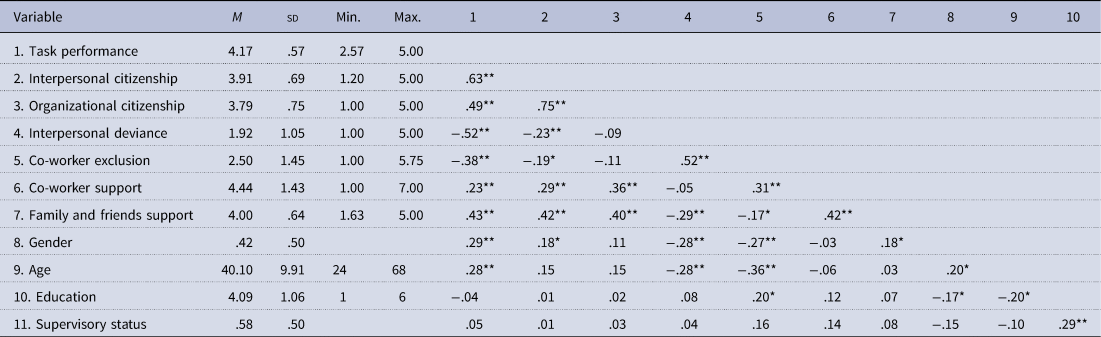
Descriptive statistics and correlations are reported in Table 2. We conducted several confirmatory factor analyses of our supervisor- and subordinated-rated constructs (results from all analyses are available upon request). For the constructs rated by supervisors, a four-factor model, χ2(246) = 535.31, CFI = .87, RMSEA = .09, and a three-factor model (with interpersonal and organizational citizenship combined), χ2(249) = 541.22, CFI = .87, RMSEA = .09, fit our data better than alternative models with fewer latent constructs. The fit indices for these two models were identical, suggesting that supervisors did not empirically distinguish between subordinates' interpersonal and organizational citizenship. We therefore chose to test our hypotheses using the more parsimonious three-factor model with interpersonal and organizational citizenship combined. For the constructs rated by subordinates, a three-factor model, χ2(272) = 702.80, CFI = .85, RMSEA = .11, fit better than alternative models with fewer latent constructs. This confirms that subordinates distinguished between co-worker exclusion, co-worker support, and family and friends support. Iacobucci's (Reference Iacobucci2010) simulation study examining how sample size impacts fit indices suggests that our fit indices are sufficient given our sample size.
Descriptive statistics and correlations

*p ⩽ .05, **p ⩽ .01.
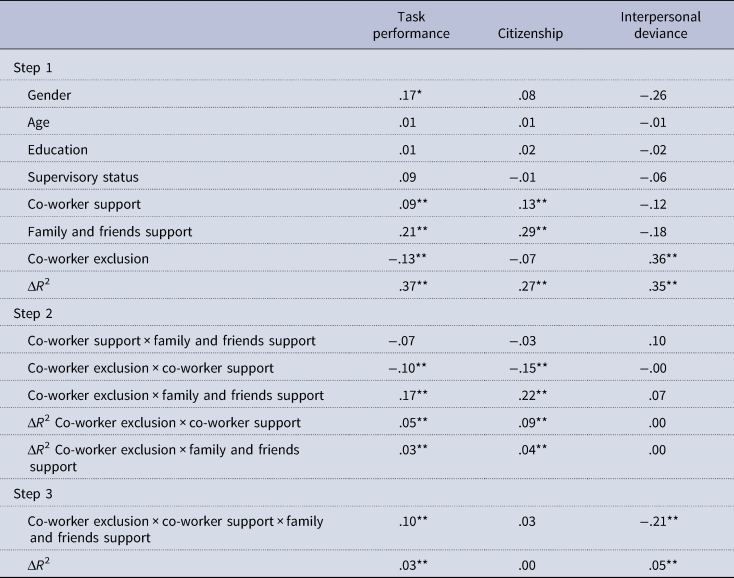
Results of our hierarchical regression analyses are reported in Table 3. All variables, except for the dichotomous gender and supervisory status variables and the interaction variables, are mean centered (Dawson, Reference Dawson2014). Unstandardized coefficients are reported. Step 1 includes all main effects and consequently tests our main effect hypotheses. The models in step 2, which tests our two-way interaction hypotheses, and step 3, in which our three-way interaction hypotheses are tested, were completed using Hayes's (Reference Hayes2018) PROCESS 3.0.
Hierarchical regression results predicting supervisor-rated performance outcomes from co-worker exclusion, co-worker support, and family and friends support

Note. All variables are mean centered except for the dichotomous gender and supervisory status variables and the interaction variables. Unstandardized coefficients are reported.
*p < .05, **p < .01.
Perceptions of co-worker exclusion and performance outcomes
Our first set of hypotheses is concerned with supervisor-rated performance outcomes. In step 1, we find that co-worker exclusion is negatively associated with task performance, b = −.13, p = .000, and citizenship, b = −.07, p = .098. In contrast, we find that co-worker exclusion is positively and significantly associated with interpersonal deviance, b = .36, p = .000. Thus, hypotheses 1a and 1c are supported, whereas hypothesis 1b is not supported. These results suggest that not only does subordinates' task performance decline as subordinates perceive higher levels of co-worker exclusion, but also that they engage in more interpersonal deviance as well.
The moderating role of co-worker support
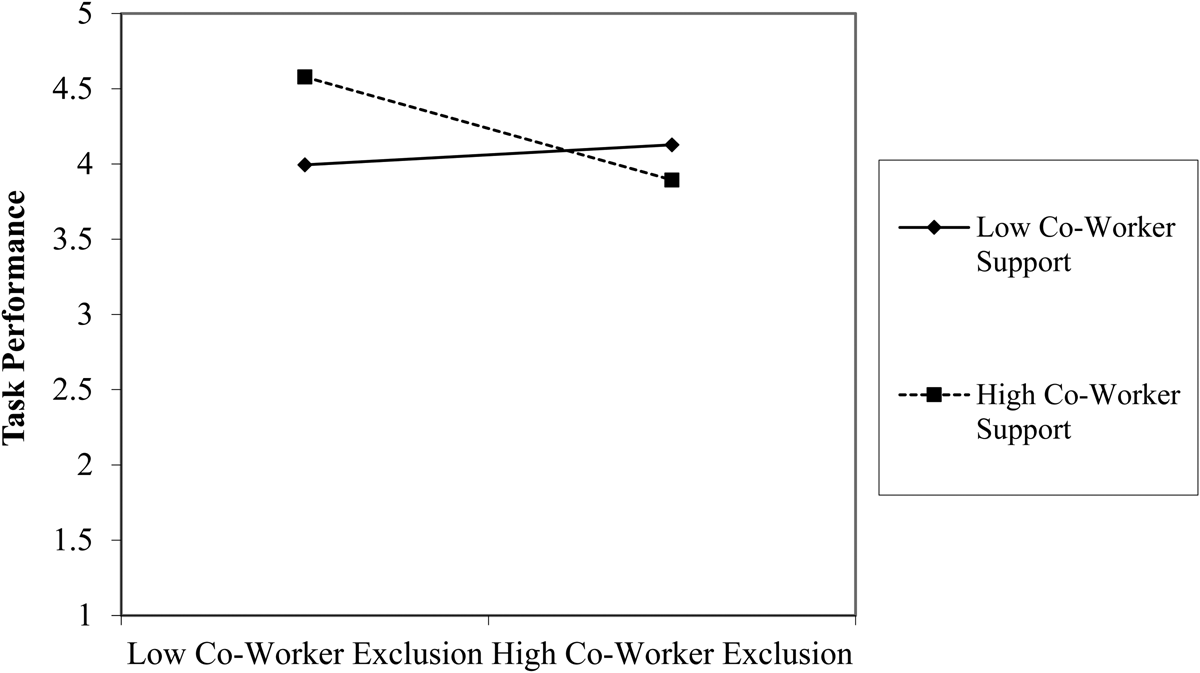
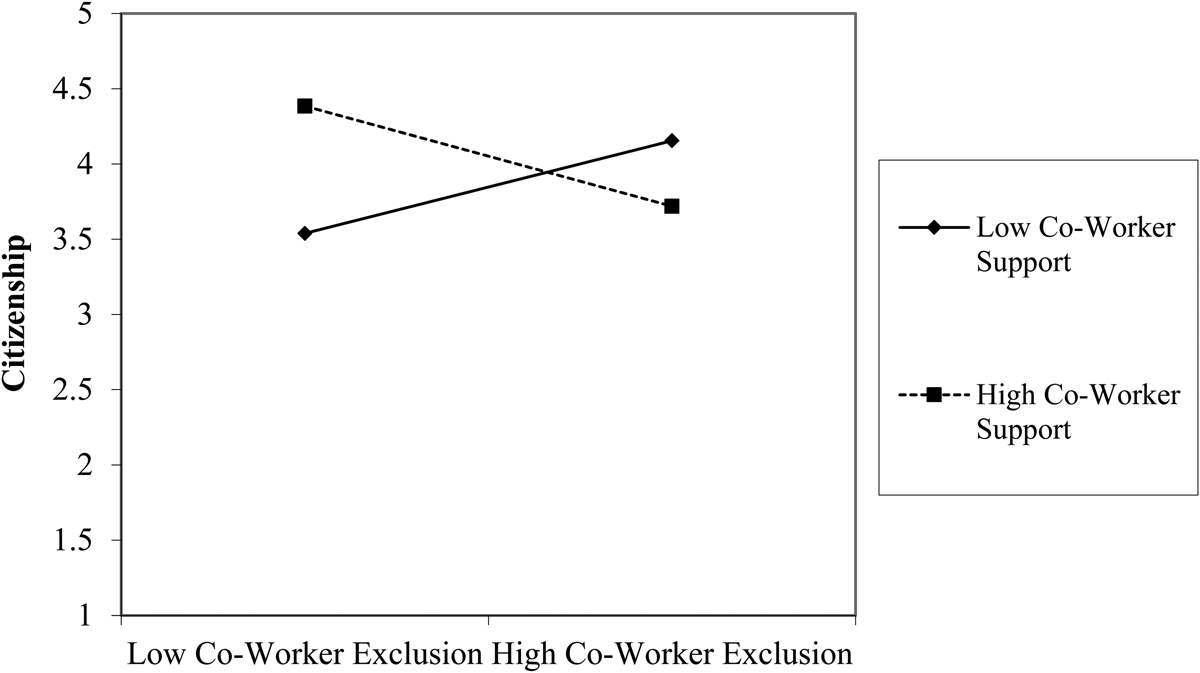
Our second set of hypotheses focused on the moderating role of co-worker support. In step 2, we find that the interaction between co-worker exclusion and co-worker support is significantly associated with task performance, b = −.10, p = .001, and citizenship, b = −.15, p = .000. Figures 1 and 2 present the plots of the interaction between co-worker exclusion and co-worker support for each of these performance outcomes, using ±1 standard deviation (sd) for each variable included in the interaction (Dawson, Reference Dawson2014). For task performance, a simple slope analysis indicates that the slope for employees 1 sd below the mean for co-worker support is non-significant, b = .05, p = .464, whereas the slope for employees 1 sd above the mean for co-worker support is negative and significant, b = −.24, p = .000. These simple slope analyses suggest that the perceptions of co-worker exclusion have a stronger negative impact on subordinates' task performance as subordinates perceive higher levels of co-worker support. Hypothesis 2a is therefore supported. For citizenship, a simple slope analysis indicates that the slope for employees 1 sd below the mean for co-worker support is positive and significant, b = .21, p = .007, whereas the slope for employees 1 sd above the mean for co-worker support is negative and significant, b = −.23, p = .000. These simple slope analyses suggest that subordinates who perceive higher levels of exclusion and lower levels of support by their co-workers engage in more citizenship behaviors, whereas subordinates who perceive higher levels of exclusion and support by their co-workers engage in less citizenship behaviors. Hypothesis 2b is therefore supported. In contrast to task performance and citizenship behavior, we do not find that the interaction between co-worker exclusion and co-worker support is significantly associated with interpersonal deviance, b = −.00, p = .983. This suggests that perceptions of co-worker support do not impact the relationship between co-worker exclusion and interpersonal deviance. Hypothesis 2c is therefore not supported.
Interaction between co-worker exclusion and co-worker support on task performance.

Interaction between co-worker exclusion and co-worker support on citizenship.

The moderating role of family and friends support
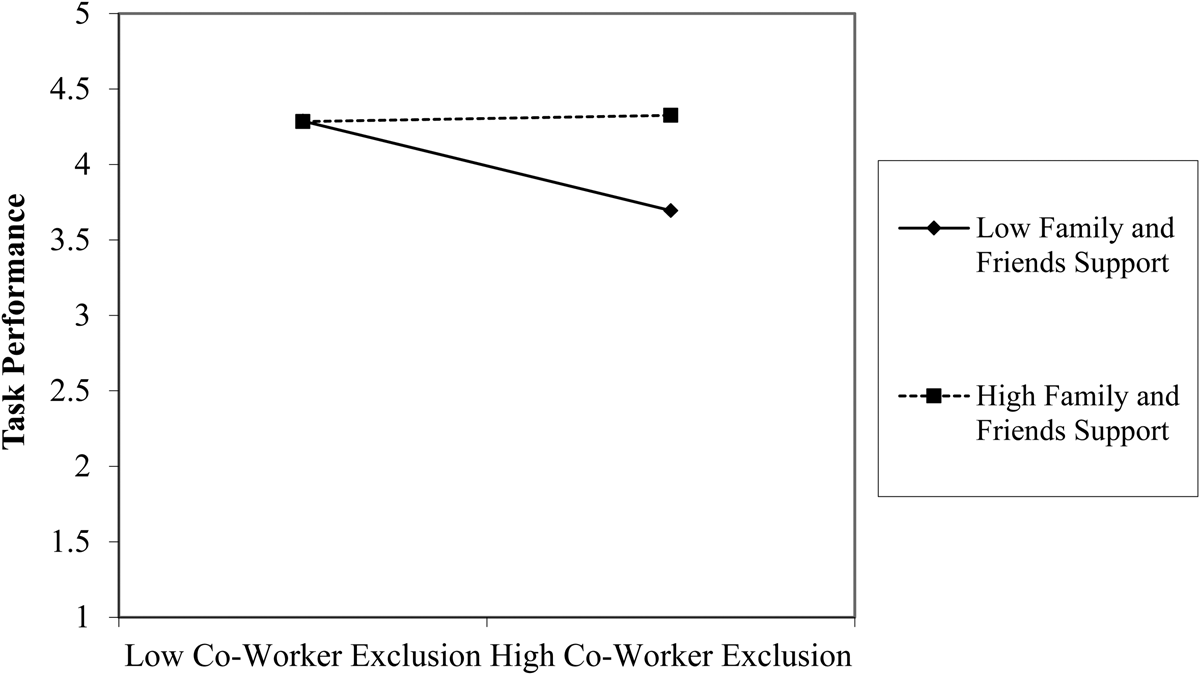
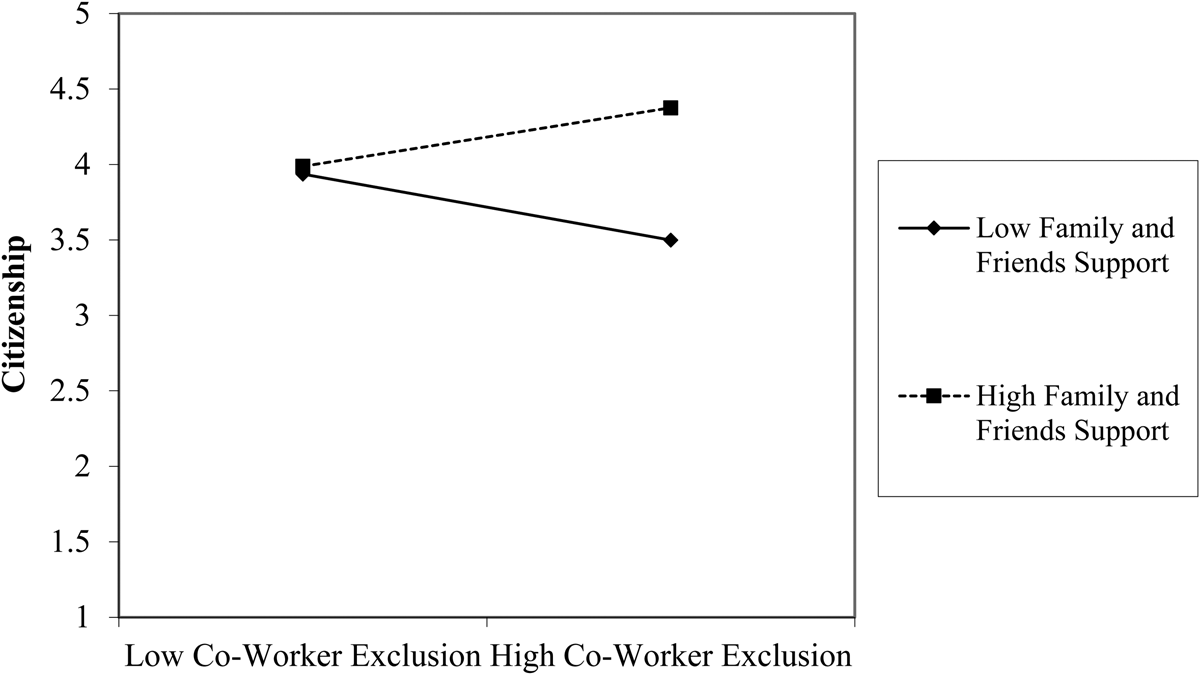
Our third set of hypotheses focus on the moderating role of family and friends support. In step 2, we find that the interaction between co-worker exclusion and family and friends support is significantly associated with task performance, b = .17, p = .010, and citizenship, b = .22, p = .007. The plots for the interaction between co-worker exclusion and family and friends support for each of these performance outcomes, using ±1 sd for each variable included in the interaction (Dawson, Reference Dawson2014), are presented in Figures 3 and 4. For task performance, a simple slope analysis indicates that the slope for employees 1 sd below the mean for family and friends support is negative and significant, b = −.20, p = .000, whereas the slope for employees 1 sd above the mean for family and friends support is non-significant, b = .01, p = .817. In contrast to the perceptions of co-worker support, these simple slope analyses suggest that the perceptions of co-worker exclusion have a stronger negative effect on subordinates' task performance as subordinates perceive lower levels of support from their family and friends. Hypothesis 3a is therefore supported. For citizenship, a simple slope analysis indicates that the slope for employees 1 sd below the mean for family and friends support is negative and significant, b = −.15, p = .009, whereas the slope for employees 1 sd above the mean for family and friends support is non-significant, b = .13, p = .083.Footnote 3 These simple slope analyses suggest that subordinates' citizenship behaviors are more negatively affected by their perceptions of co-worker exclusion as they perceive lower levels of support from their family and friends. Hypothesis 3b is therefore supported. Like with co-worker support, we find that the interaction between co-worker exclusion and family and friends support is not significantly associated with interpersonal deviance, b = .07, p = .574. This suggests that perceptions of family and friends support do not impact the relationship between co-worker exclusion and interpersonal deviance. Hypothesis 3c is therefore not supported.
Interaction between co-worker exclusion and family and friends support on task performance.

Interaction between co-worker exclusion and family and friends support on citizenship.

Three-way interaction between co-worker exclusion, co-worker support, and family and friends support
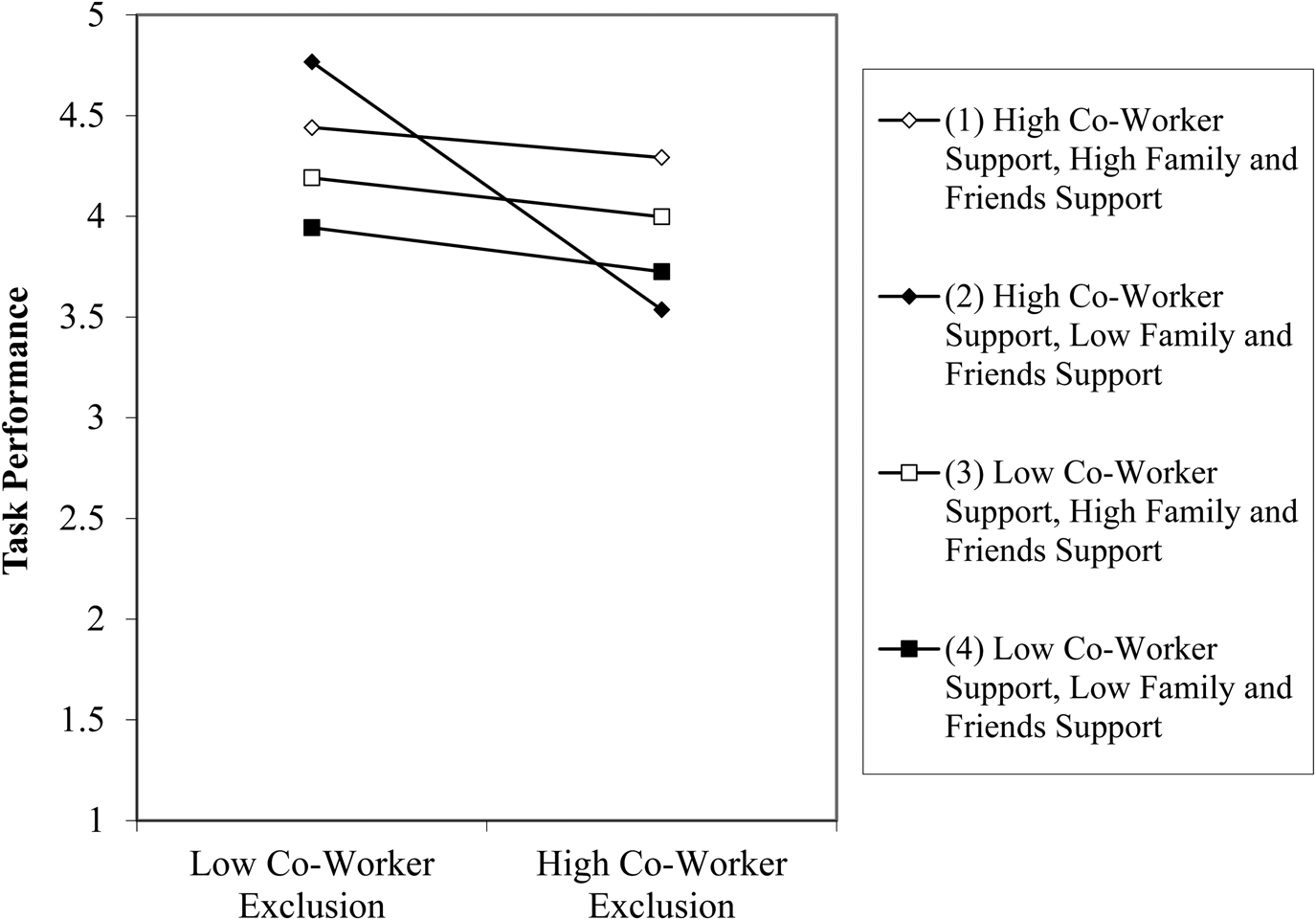
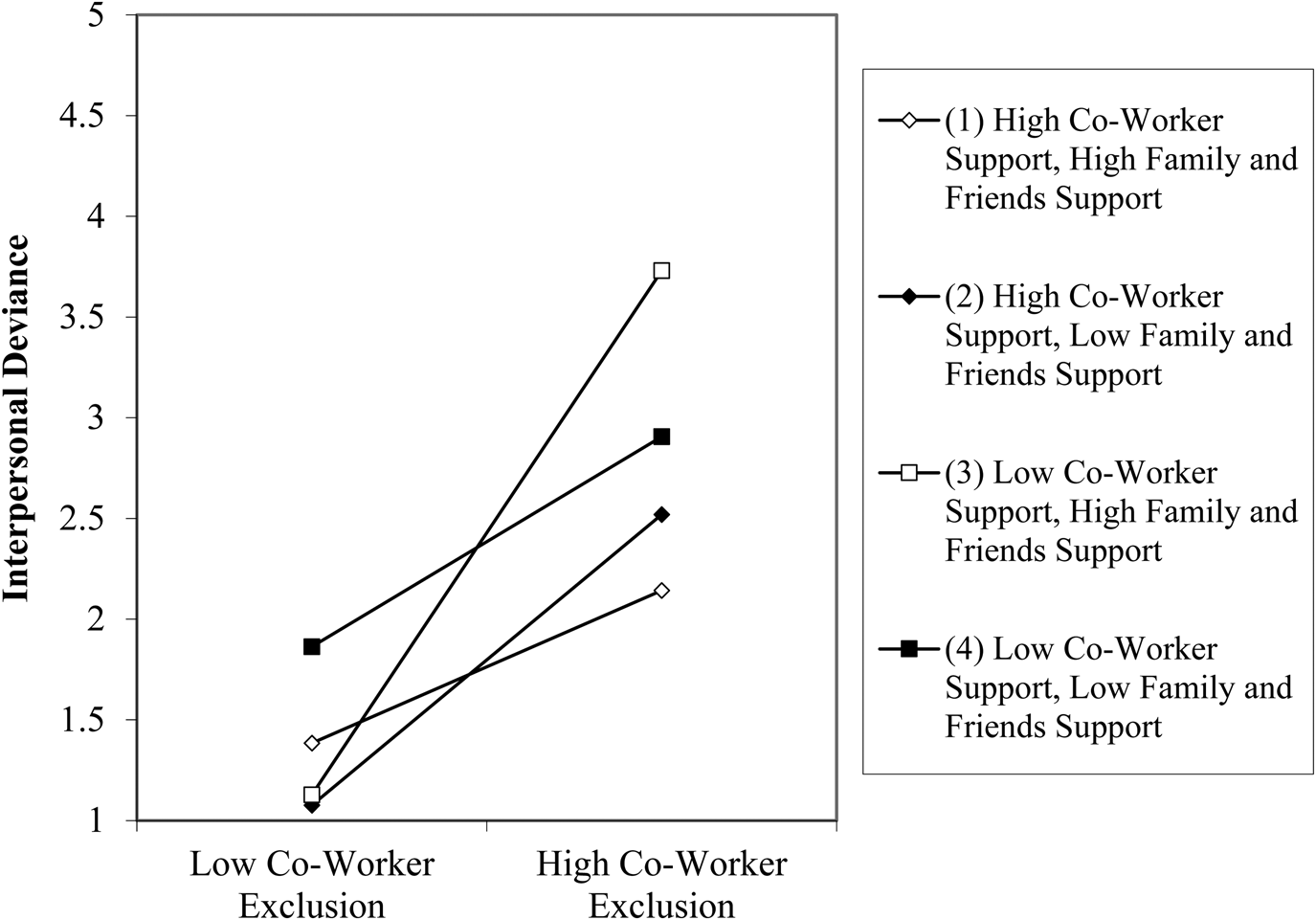
The combined moderating roles of co-worker support and family and friends support (i.e., a three-way interaction) are the focus of our fourth set of hypotheses. In step 3, we find that the interaction between co-worker exclusion, co-worker support, and family and friends support is significantly associated with task performance, b = .10, p = .006, and interpersonal deviance, b = −.21, p = .003. Figures 5 and 6 present the plots of the three-way interaction for each of these performance outcomes, using ±1 sd for each variable included in the interaction (Dawson, Reference Dawson2014). Slope 2 in Figure 5, representing high co-worker support and low family and friends support, is our slope of interest because this is the slope that directly corresponds to hypothesis 4a. Slope difference tests indicate that slope 2 is significantly different from slope 1 (i.e., high co-worker support and high family and friends support), p = .000, slope 3 (i.e., low co-worker support and high family and friends support), p = .021, and slope 4 (i.e., low co-worker support and low family and friends support), p = .000 (Dawson & Richter, Reference Dawson and Richter2006). The remaining slope difference tests are non-significant. These results suggest that subordinates' perceptions of co-worker exclusion have a stronger negative impact on their task performance as their perceptions of co-worker support increase and their perceptions of family and friends support decrease. Thus, hypothesis 4a is supported.
Three-way interaction between co-worker exclusion, co-worker support, family and friends support, on task performance.

Three-way interaction between co-worker exclusion, co-worker support, family and friends support, on interpersonal deviance.

In contrast to hypothesis 4a, we find that the three-way interaction between co-worker exclusion, co-worker support, and family and friends support is not significantly associated with citizenship, b = .03, p = .534. Thus, hypothesis 4b is not supported.
Similar to Figure 5, slope 2 in Figure 6, representing high co-worker support and low family and friends support, is our slope of interest because this is the slope that directly corresponds to hypothesis 4c. Slope difference tests indicate that slope 2 is not significantly different from slope 1 (i.e., high co-worker support and high family and friends support), p = .216, slope 3 (i.e., low co-worker support and high family and friends support), p = .186, or slope 4 (i.e., low co-worker support and low family and friends support), p = .398 (Dawson & Richter, Reference Dawson and Richter2006). Slope difference tests do indicate that slope 3 is significantly different from slope 1, p = .016, and slope 4, p = .014. The remaining slope difference tests are non-significant. These results suggest that the conditions under which subordinates' perceptions of co-worker exclusion, co-worker support, and family and friends support, most strongly impact subordinates' interpersonal deviance do not correspond to our hypothesized conditions. Thus, hypothesis 4c is not supported.
Discussion
We expected that employees who had ambivalent relationships with co-workers (i.e., high levels of co-worker exclusion and support) would have less favorable performance outcomes than those who had non-ambivalent relationships (high exclusion and low support, or low exclusion and high support). In addition, we expected that family and friends support would attenuate the relationships between co-worker exclusion, co-worker support, and performance outcomes. We generally found support for the relationships that we hypothesized. Perceptions of co-worker exclusion were significantly associated with negative employee performance outcomes: decreased task performance and increased interpersonal deviance. Additionally, we found that different forms of support attenuated or exacerbated the relationships between perceived co-worker exclusion and performance outcomes. Our results suggest that task performance and citizenship for employees who perceive high levels of exclusion suffer the most with high levels of perceived co-worker support and suffer the least with high levels of perceived family and friends support. Our results also suggest that the perceptions of co-worker exclusion, co-worker support, and family and friends support interact with one another in such a way that task performance is lowest for employees who perceive high co-worker exclusion, high co-worker support, and low family and friends support. We believe these results have a variety of theoretical and practical implications.
Theoretical implications
Cropanzano et al. (Reference Cropanzano, Anthony, Daniels and Hall2017) argued that research on social exchange has taken an overly simplistic approach in understanding reciprocity in interpersonal relationships (that employees return help with help and harm with harm), which has resulted in imprecise theoretical predictions. Using this traditional social exchange framework, one would expect that employees who feel excluded by their co-workers would engage in exclusionary or similar behaviors in response. Research has indeed documented reciprocal interpersonal mistreatment (e.g., Scott, Restubog, and Zagenczyk, Reference Scott, Restubog and Zagenczyk2013) and, as previously mentioned, that targets' responses may not even be directed to just those engaging in the mistreatment (e.g., Sommer & Bernieri, Reference Sommer and Bernieri2015; Twenge et al., Reference Twenge, Baumeister, Tice and Stucke2001). Similarly, we found perceptions of co-worker exclusion to be positively and significantly associated with interpersonal deviance.
However, one would also expect these same individuals to engage in significantly fewer citizenship behaviors, which we did not find in our data. This supports Cropanzano et al.'s (Reference Cropanzano, Anthony, Daniels and Hall2017) contention that individuals can respond to actors' treatment with varying degrees of activity and hedonic value. Our results suggest that employees respond to perceptions of co-worker exclusion by engaging in undesirable behavior (i.e., interpersonal deviance), as the traditional social exchange perspective would suggest, but also that employees do not significantly administer or withhold desirable behavior (i.e., citizenship) as a response. Our results support Cropanzano et al.'s (Reference Cropanzano, Anthony, Daniels and Hall2017) contention that a more nuanced perspective of social exchange is warranted. We encourage future research to more fully consider what might motivate individuals within specific social exchange relationships to engage in specific forms of behavior toward one another, as well as the role that third parties, such as family and friends, play in social exchange.
We start to provide an answer to Rothman et al.'s, (Reference Rothman, Pratt, Rees and Vogus2017) call for more work on understanding the conditions under which positive and negative outcomes result from ambivalent relationships. Duffy, Ganster, and Pagon (Reference Duffy, Ganster and Pagon2002) contributed to our relatively limited knowledge base in this area (Rothman et al., Reference Rothman, Pratt, Rees and Vogus2017) by finding that ambivalent relationships can lead to negative employee outcomes, but they did not find this to be consistently true. For example, they found a significant interaction between co-worker undermining and support predicting self-efficacy, but not for organizational commitment, active workplace deviance, passive workplace deviance, or somatic complaints. These results support the idea that the outcomes of ambivalent relationships may not always be negative (Rothman et al., Reference Rothman, Pratt, Rees and Vogus2017). Indeed, we found that the interaction between perceptions of co-worker exclusion and co-worker support was not significantly associated with interpersonal deviance, but that it was significantly associated with task performance and citizenship.
Whether ambivalent relationships are damaging or not depends on a number of different factors (Rothman et al., Reference Rothman, Pratt, Rees and Vogus2017). One such factor may be the specific positive and negative qualities of the relationships being examined. For example, Duffy, Ganster, and Pagon (Reference Duffy, Ganster and Pagon2002) focused on co-worker support as a positive quality of co-worker relationships, just as we did, but they focused on undermining as the negative quality, and we focused on exclusion. Another factor may include the specific outcomes being examined. We focused on a specific form of workplace deviance as well as task performance and citizenship. The totality of our findings suggests that there are important nuances in understanding the outcomes of ambivalent relationships and we therefore encourage future research to build upon the relative dearth of knowledge in this area (Rothman et al., Reference Rothman, Pratt, Rees and Vogus2017). Cropanzano et al.'s, (Reference Cropanzano, Anthony, Daniels and Hall2017) discussion of homeomorphic reciprocity in social exchange relationships may serve as a framework that enhances our understanding of these nuances and provides more precise predictions of the outcomes resulting from ambivalent relationships.
In order to help better understand the possible nuances concerning the outcomes of ambivalent relationships, we followed the recommendation of Methot, Melwani, and Rothman (Reference Methot, Melwani and Rothman2017) to identify possible boundary conditions, such as the domain of the relationships (work vs. home). Much of the research on social support and work outcomes has focused on social support within the workplace. For example, family and friends support represented a small percentage of studies in Viswesvara, Sanchez, and Fisher's (Reference Viswesvara, Sanchez and Fisher1999) meta-analysis examining the role of social support on work stress, and was not even included in the Ng and Sorensen's (Reference Ng and Sorensen2008) meta-analysis of support and work attitudes. The work–family conflict literature has naturally taken a more proactive approach to examining family and friends support (see French, Dumani, Allen, and Shockley, Reference French, Dumani, Allen and Shockley2018, for a recent meta-analysis) and shown that this variable does have important implications for workplace outcomes (e.g., Madjar, Oldham, and Pratt, Reference Madjar, Oldham and Pratt2002).
Building on the work–family conflict literature's emphasis on family and friends support, we explored three-way interactions between perceptions of co-worker exclusion, co-worker support, and family and friends support. Our results suggest that family and friends support is an important boundary condition for ambivalent co-worker relationships and task performance. Task performance suffers the most when ambivalent co-worker relationships marked by high exclusion and support are combined with low family and friends support. However, although we find a significant three-way interaction for interpersonal deviance, it is not in the direction that we hypothesized. Employees engaged in deviance most frequently when co-worker exclusion was high, co-worker support was low, and support from family and friends was high. It could be that support from family and friends emboldens employees to exact revenge against their unsupportive co-workers through interpersonal deviance. This finding, although unanticipated, underscores our point that it is important to consider the domains of positive and negative treatment in conjunction with the outcome of interest. This view is bolstered further by the fact that high family and friends support, in conjunction with high co-worker exclusion and low co-worker support, fosters deviance, but does not motivate citizenship when co-worker exclusion is high and support is low. Perhaps there are some unidentified processes that are at play that can explain the three-way interactions, or lack thereof, for discretionary performance. Future research exploring mediators, such as experienced ambiguity or frustration stemming from ambivalent relationships, may help to better explain the results of our three-way interaction tests. Nevertheless, our results suggest that support found outside of the workplace, in terms of family and friends support, may be an important boundary condition of ambivalent relationships within the workplace.
Practical implications
The social support literature generally suggests that social support is beneficial, but our results suggest that co-worker support can actually make the situation worse, rather than better, when employees feel excluded by their co-workers. Although our results suggest that family and friends support may be beneficial, Scott et al.'s (Reference Scott, Zagenczyk, Schippers, Purvis and Cruz2014) findings indicate that family and friends support can make self-reported outcomes of exclusion even worse, potentially as a result of rumination that occurs when employees experience negative emotions while discussing experiences of exclusion with family and friends. We therefore believe encouraging co-worker or family and friends support is not a viable recommendation for managers and organizations if they suspect co-workers are feeling excluded. What we do believe our findings suggest is that perhaps the best way to address problems related to co-worker exclusion is to address exclusion head-on. Co-worker behaviors that lead to the perceptions of exclusion, such as being ignored or avoided (Ferris et al., Reference Ferris, Brown, Berry and Lian2008), can be characterized as low intensity and ambiguous behavior (Ferris, Chen, & Lim, Reference Ferris, Chen and Lim2017). This can make it difficult for managers to know whether employees are being excluded. To help ensure that employees do not feel excluded, organizations should focus on developing an inclusive climate, inclusive leadership, and inclusive practices (Shore, Randel, Chung, Dean, Ehrhart, & Singh, Reference Shore, Randel, Chung, Dean, Ehrhart and Singh2011). For example, given that exclusion can be considered a violation of norms (Robinson, O'Reilly, & Wang, Reference Robinson, O'Reilly and Wang2013), recommendations from the workplace incivility literature suggests that managers and organizations set expectations about norms of respect (e.g., Pearson and Porath, Reference Pearson and Porath2009) to promote inclusion.
Limitations and directions for future research
Although we believe our results are theoretically and practically important, they need to be considered in light of some limitations. First and foremost, our methodology precluded us from establishing causality. It is possible that low task performance, low citizenship behavior, and high deviance may cause employees to be excluded by their co-workers. For example, the results of Scott, Restubog, and Zagenczyk (Reference Scott, Restubog and Zagenczyk2013) suggest that employees who behave in an uncivil manner are excluded by their co-workers. It may therefore be the case that employees who perform better on their tasks, engage in more citizenship behaviors, and/or engage in fewer deviant behaviors, are seen to have more value to co-workers and co-workers exclude them less as a result.
A second limitation concerns the variables we did and did not choose to investigate. There are various other manifestations of performance, beyond our IVs, that may be more important to organizations, supervisors, or co-workers. Second, we did not empirically test our proposed theoretical mechanisms (i.e., belongingness and rumination). Third, we did not control for contextual features of employees' work environments, such as how many co-workers employees have, the amount of time employees spend with their co-workers, or the degree to which employees are dependent on their co-workers to complete their work. Future research that can establish causality and considers additional DVs and contextual features has the potential to provide a more nuanced picture of the relationships we examined in our study.
Additionally, we chose to examine only two forms of social support: co-workers and family and friends. Supervisor support has been found to be important to employees work-related attitudes (Ng & Sorensen, Reference Ng and Sorensen2008), and as a result, it can potentially buffer the relationships between perceptions of co-worker exclusion and various performance outcomes (Duffy, Ganster, & Pagon, Reference Duffy, Ganster and Pagon2002). Perhaps more importantly, future research should attempt to investigate how various sources of exclusion and support (e.g., co-workers, supervisors, and family and friends) combine together to affect employees' performance. This would provide a more realistic picture of the workplace compared to prior research, which has treated sources of support as having independent moderating effects (e.g., Scott et al., Reference Scott, Zagenczyk, Schippers, Purvis and Cruz2014). With this said, we also encourage future research to focus on specific forms of support from these different entities. Although we followed others in our theory and operationalizations by focusing on social support in a general sense (e.g., Cruz, Zagenczyk, & Hood, Reference Cruz, Zagenczyk and Hood2020; Scott et al., Reference Scott, Zagenczyk, Schippers, Purvis and Cruz2014), prior research has found that specific forms of support can have differential effects on outcomes (e.g., Tews, Michel, and Stafford, Reference Tews, Michel and Stafford2019).
Conclusion
Our results suggest that research on social exchange needs to take a more nuanced perspective (Cropanzano et al., Reference Cropanzano, Anthony, Daniels and Hall2017) and that relational ambivalence in the workplace deserves more attention than it has previously received (Methot, Melwani, & Rothman, Reference Methot, Melwani and Rothman2017). Social support has the potential to help reduce the negative effects of co-worker exclusion, but may also exacerbate them in some instances. By considering whether or not the source of support is from the same source as exclusion, and the different types of support that exist both within and outside of the workplace, we can develop a better understanding of the benefits and consequences of social support.
Appendix
Sample of prior studies related to the focus of our study

Kevin S. Cruz's research has appeared or is forthcoming in European Journal of Work and Organizational Psychology, Group & Organization Management, Human Relations, International Journal of Human Resource Management, Journal of Applied Psychology, Journal of Business and Psychology, Journal of Management Studies, Journal of Work and Organizational Psychology, and Occupational Health Science.
Thomas J. Zagenczyk's research has appeared or is forthcoming in European Journal of Work and Organizational Psychology, Group & Organization Management, Human Resource Management Journal, International Journal of Human Resource Management, Journal of Applied Psychology, Journal of Business and Psychology, Journal of Management, Journal of Management Studies, Journal of Occupational and Organizational Psychology, Leadership Quarterly, and Organizational Behavior and Human Decision Processes, among others.
Kristin L. Scott's research has appeared or is forthcoming in Academy of Management Journal, European Journal of Work and Organizational Psychology, Human Resource Management, Journal of Applied Psychology, Journal of Business and Psychology, Journal of Management Studies, Journal of Occupational and Organizational Psychology, Journal of Organizational Behavior, Leadership Quarterly, Organizational Behavior and Human Decision Processes, and Personnel Psychology, among others.
Russell L. Purvis's research has appeared or is forthcoming in International Journal of Human Resource Management, Journal of Business and Psychology, Journal of Management Studies, and MIS Quarterly, among others.