Over the past few decades, sociolinguistic research has concentrated on the structured heterogeneity inherent in all speech and how this variation is conditioned by both internal and external linguistic constraints (e.g., Weinreich, Labov, & Herzog, 1968). The predominant focus of this research has been on adolescent and adult speech1
There have also been a number of studies on acquisition of variation in primary school children (e.g., Gleason & Perlmann 1985, Houston, 1969, Purcell, 1984, Romaine, 1984).

Chambers (2003:174) made the common-sense observation that “when children acquire their mother tongues, they evidently acquire the local variants and the norms of their usage too.” Moreover, Roberts and Labov (1995:101) suggested that form/function asymmetries such as those in (1) are not inherently difficult to deal with as “children acquire variable rules at about the same time as they are acquiring related categorical rules.” Chambers (2003:174) went even further, stating that, “There are no studies indicating a time gap between the acquisition of grammatical competence and the development of sociolinguistic competence.” This suggests that not only does a child learn that there are, say, two forms for the word butter—

and

—but at the same time also “knows” when it is appropriate to use one or the other depending on the social context of use. The question is how do they acquire such knowledge? Labov implicated the primary caregiver in this process when he stated that “Linguistic variation is transmitted to children as stylistic differentiation on the formal/informal dimension … formal speech variants are associated by children with instruction and punishment, informal speech with intimacy and fun” (Labov, 2001:437). Although these claims seem intrinsically right, the situation may be more complex. Kerswill (1996:199) pointed out that “exactly when a child acquires a feature of his or her first dialect depends on the linguistic level, the complexity of the conditioning, and the child's age.” In other words, not all linguistic variables will be acquired at the same time and in the same way.
With these observations in mind, we set out to contribute to the question of how and when children acquire the complex patterns of variation witnessed in adolescent and adult speech through the analysis of caregiver and child talk in a Scottish dialect. The study aims to assess the impact of different influences on the acquisition schedule, including external effects such as caregiver input, as well as dialect specific linguistic constraints on the variation. This may shed light on the “initial state” in language variation and hence the patterns seen in later life. We first turn to previous research in this field.
PREVIOUS RESEARCH
In the vast majority of the literature on acquisition studies, variation in child speech is considered to be merely a developmental stage, wherein variable forms will be “corrected” as the acquisition process progresses towards categoricity (e.g., Brown, 1973). The speech of the caregiver is characterized by modifications at the syntactic, semantic, and phonetic level (e.g., Cross, 1977; Fernald & Simon, 1984; Ferguson, 1964; Grieser & Kuhl, 1988; Snow, 1994), and is said to be “a simpler, cleaner corpus from which to learn language” (Snow, 1995:180).2
But see Davis & Lindblom, 2001; Newport, Gleitman, & Gleitman, 1977, for a different analysis of caregiver talk.
Roberts (1994; 1997a; 1997b; 2002) examined acquisition of a number of phonetic/phonological variables by children aged 3;2 to 4;11 in South Philadelphia. For (–t, d) deletion, she reported, “children as young as three have acquired the phonological and grammatical constraints … [however] their mastery of the social constraints on this variable rule is far less complete” (Roberts, 1997a:358). With (-ing) on the other hand, both linguistic and social constraints were evident in 3 and 4 year olds. In contrast, Labov (1989) reported that social and stylistic constraints are acquired before articulatory and grammatical constraints with (-ing). Kovac and Adamson (1981) in their study of finite be deletion found that although five-year-olds had the deletion phenomenon evident in adult speech, they had not yet mastered the linguistic constraints on use. Youssef (1991:96) in a longitudinal study of verbal marking in a child (age 2;4 to 4;9) exposed to Trinidadian Creole and Standard English, found that both social and linguistic constraints are acquired at the same time. The child used Trinidadian Creole and Standard English forms from the outset, but crucially, these were “specialised to differential usage with particular addressees.” She concluded that “the acquisition of stylistic awareness and the specification of appropriate linguistic behaviour to accommodate it is associated with the acquisition of forms per se” (Youssef, 1991:96, see also Youssef, 1990, 1993, 1996).
Foulkes, Docherty, and Watt (1999, 2005) looked at the speech of 40 children aged 2 to 4 in Tyneside, England, focusing on the realizations of word-medial intersonorant and word-final prevocalic (t), which is “the locus of a particularly complex pattern of sociolinguistic and phonetic variation” (Foulkes et al., 2005:185). They found that “the children demonstrate a sophisticated mastery of many aspects of the adult patterns, producing qualitatively different phonetic variants in appropriate phonological contexts” and show sensitivity to lexically restricted variants (Foulkes et al., 1999:15). However, “in order to assess how the children acquire variable forms we must take account of variability in the actual input the children receive, as well as that which characterizes the mature dialect” (Foulkes et al., 2005:178). Caregiver analysis revealed that their speech to children displays a dramatic decrease in vernacular variants compared to adult–adult speech. Moreover, higher rates of the vernacular variants were used when talking to boys rather than girls.
Roberts (2002) reported similar findings for caregiver talk from a pilot study of the pronunciation of (ay) in words such as kite in Memphis, Tennessee. In southern United States dialects the vernacular variant is often a long monophthong,

, and the more standard variant is

. Roberts found that all four caregivers used higher rates of the standard diphthong

when talking to their children, in comparison to when they are talking to another adult. In fact, one of the mothers was “especially straightforward in using C[hild] D[irected] S[peech] to instruct her child in the pronunciation of new vocabulary containing long (ay)” (Roberts, 2002:342). She concludes that in doing so, the caregivers are “taking the role of teachers of language seriously” (Roberts 2002:343), in this case by teaching their children the sociolinguistic constraints on variability from the earliest stage of language development.
Kerswill and Williams (2000) also considered both caregiver and child speech in their study of 48 children in three age groups (4, 8, 12) and their principal caregiver from Milton Keynes. They examined three variables whose sociolinguistic patterning in the south and east of England is well known: th-fronting, h-dropping, and t-glottaling. These showed more style shifting with the older children compared to the younger ones, leading them to the tentative conclusion that “children slowly gain sociolinguistic maturity in a manner that involves a gradual increase in the number of styles that are perceived and treated in an adult way” (Kerswill & Williams, 2000:105). Moreover, caregiver influence is much greater for 4-year-olds than among the older children (Kerswill & Williams, 2000:106). For example, in their later analysis (Kerswill & Williams, 2005:1030) they found a strong correlation between caregiver and the youngest children in the use of the (ou) vowel. These findings led them to the conclusion that “it is here that we might find clues to the initial transmission of dialect features and sociolinguistic competence” (Kerswill, 1996:181).
Henry, McLaren, Wilson, and Finlay (1997) proposed that neither caregiver input nor sociolinguistic factors could account for the different ages of acquisition of some syntactic structures. Instead, the child is sensitive to “subtle grammatical differences” (Henry et al., 1997:269), which have an impact on when a variable is acquired. Their research on negative concord showed that although rates of the vernacular form in the caregiver input were the same across two nonstandard dialects, the periods of acquisition differed substantially. With one dialect, the child simply has to learn new lexical items to acquire negative concord, and does so at around the age of 3;3. With the other dialect, the child must acquire optional parameter settings for the standard and nonstandard forms, as the variable input triggers underlying representations in the grammar that allows the child to formulate high-level rules governed by internal constraints. In this case, the child acquires the rules of negative concord much later, at around age 4;6, and only then does the child begin to match the frequencies of caregiver use.
These studies clearly demonstrate that “a complete acquisitional model demands the inclusion of all forms of language, those which are variable and those which are categorical” (Roberts, 1997a:354). However, the differing results regarding how and when variables are acquired lead to a number of specific questions:
- Does caregiver input differ from more general community norms across all linguistic variables?
- Are variable forms in evidence from the start of the acquisition process, that is, learned at the same time as categorical forms?
- What effect does caregiver input have on the child's acquisition of forms, not only in terms of frequency of use but also external and internal constraints on the variability?
- Is sociolinguistic competence acquired at the same time as grammatical competence?
- Are all linguistic variables acquired at the same time and in the same way?
In this article we attempt to address these questions with an analysis of two linguistic variables from different areas of the grammar in a Scottish dialect. Following Foulkes et al. (2005), a further dimension will come from comparison with the adult community norms. We thus have a three-way triangular comparison of community, caregiver, and child across two different variables during a crucial stage of acquisition.
THE DATA
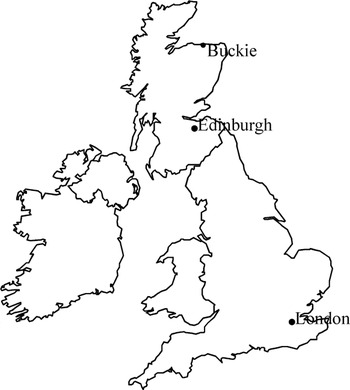
The data come from a small fishing town, Buckie (population 8,000), which is situated on the northeast coast of Scotland, as shown in Figure 1 (see detail in Smith, 2000a). The dialect spoken in this area exhibits a plethora of variable, but highly structured, grammatical forms (Smith, 2000a, 2000b, 2001; Smith & Tagliamonte, 1998; Tagliamonte & Smith, 2003). As the dialect is relatively isolated, both in geographical and sociocultural grounds, the speech community forms a linguistically homogeneous group that provides a highly controlled environment for tracking the emergence of structured variation in child language.

Map showing location of Buckie.
Caregiver/child corpus
The caregiver/child corpus contains 24 dyads aged between 2;6 and 4;0 (Smith, 2003–2005). This age group was specifically targeted because it has been claimed that “the 3- to 4-year old level is a critical period for the acquisition of dialectal norms of the speech community” (Roberts & Labov, 1995:110). In addition, the effects from standard norms in the classroom context and other potential outside inputs are minimized (e.g., Kerswill, 1996). In addition, children by these ages are at a stage where full clauses are used, allowing for the analysis of morphosyntactic variation, such as agreement phenomena, negation, and tense formation.
To control the sample as much as possible, the participant selection process was guided by the following criteria: (1) both parents must have been born and raised in the community, (2) there were no referrals for speech or language therapy, (3) the mother was the main caregiver (i.e., there was no substantial time with extended family, childminders, etc.), and (4) no child was in formal nursery education.3
No child was in formal schooling, but most went twice weekly to a locally run play group.
Data collection
Collection of naturalistic data from young children poses two major problems. The first is the amount of data required. For example, Roberts (2002:336) estimated that 8–14 hours of young children's speech is required to collect data comparable to that found in 1–2 hours of adult speech. The second problem is the elicitation of vernacular data. The Observer's Paradox (Labov, 1972) is exacerbated in the case of young children, where the presence of an outsider in the home can render the child literally “speechless.” To mitigate these problems, the caregivers themselves were requested to undertake a series of recorded sessions with their child, in a variety of situations in which interaction takes place, such as mealtimes, trips in the car, walks, and even visits to the bathroom (!). Lightweight minidisc recorders (Sony MZ-R700) and lapel microphones (Sony ECM-T145) were provided to allow freedom of movement and to be as unintrusive as possible. Although there are obvious disadvantages in terms of quality of sound, this data collection technique has proven to be extremely successful in eliciting large amounts of highly vernacular, interactional speech, as evidenced in the following extract between Lucy, age 3;4 (child) and her mother Lesley (caregiver). A gloss is provided in the Appendix.

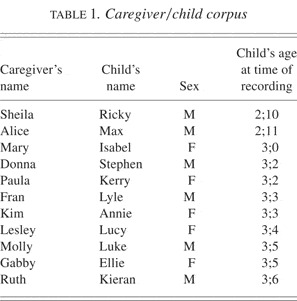
Recordings for each child/caregiver dyad amounted to ten hours of data, five hours of which are fully transcribed. The corpus currently stands at approximately 500,000 words. In this article we use a subset of the data, with 11 dyads, shown in Table 1, in which the children are arrayed from youngest to oldest.
Caregiver/child corpus

Adult-to-adult corpus
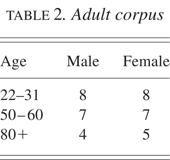
A fully transcribed corpus of adult-to-adult community speech is stratified by age and sex, and amounts to approximately 300,000 words. This corpus was collected using sociolinguistic interviews by the first author who comes from the community in question. The data is highly informal in nature, containing narratives from the past and local gossip (see detail in Smith, 2000a). The sample is shown in Table 2.
Adult corpus

These two data sets differ. The caregiver/child corpus represents a range of situational contexts, both formal and informal. The adult corpus, on the other hand, represents one context of use—an informal style as close to vernacular norms as can be possibly achieved within the sociolinguistic interview situation. In this case, the adult sample represents the norms of usage in everyday conversation from which caregiver/child interaction can be directly compared.4
A more direct comparison with the caregivers would be to include the young female community members only. However, with both variables, the patterns of use were the same across age and sex in the community data, thus the entire data set was used.
THE HOOSE VARIABLE
The first variable is the alternation between the diphthong

and the monophthong /u:/ as in (2), herein referred to as the hoose variable.

This lexically conditioned variable belongs to the OUT (au) class (Wells, 1982) in words that have the orthographical form 〈ow〉 or 〈ou〉 as in now, house, and down (e.g., Johnston, 1997:474). It is neither phonetic nor phonological in any accepted sense; instead, it involves the variable use of two phonemes in a restricted lexical set. The alternation in present day varieties has its roots in diachrony as it “results from an important difference in the direction taken by the fifteenth century Great Vowel Shift in the north from that taken in the midlands and south of England” (Robinson, Concise Scots Dictionary, 1987:xiv). More northern areas retained the original monophthong, while in the south it became a diphthong. Thus, the monophthongal variant is in fact a relic, which is considered stereotypical of Scots or more northern varieties of English (e.g., Stuart-Smith, 2003).
Previous research on the hoose variable
With synchronic studies of this variable, particular attention is paid to class stratification, style-shifting, age, and lexical conditioning. Macaulay and Trevelyan (1973)5
Macaulay and Trevelyan (1973) distinguished four different variants in their study of different social groups in Glasgow (but see Romaine (1975:121) for criticism of this approach). In Macaulay's 1991 study, the variable is divided between monophthong and diphthong only.
Eremeeva and Stuart-Smith's (2003:1208) findings generally replicate these results. The use of the monophthong “is still a vigorous feature of working-class speech, and in particular working-class boys,” which has remained stable over the last 30 years. It also shows stylistic stratification, as the monophthong was not present in the reading list data.
Romaine's (1975, 1979) study of Edinburgh schoolchildren also revealed that males use higher rates of the local form. She too found age differentiation. The younger children—6-year-olds—used the monophthongal variant more frequently than older children. Moreover, “the younger speaker does not maintain stylistic consistency and thus both standard and non-standard forms occurs side by side” (Romaine, 1979:57).
Macafee (1994) focused on the lexical distribution of the variable in Glasgow working-class speech. She reported that seven different words—about, our, round, down, out, now, house—showed over 50% use of the monophthongal variant. An additional eight words were found to be variable—mouth, crown, hour, Townhead, Southside, count, powder, gown—although the monophthong was used much less with these words. In other words, the variability is subject to lexical constraints.
These findings demonstrate that this variable is stratified by class, sex, and style—it is used most by working-class males in spontaneous informal speech. It exhibits the patterning of a sociolinguistic marker (Labov, 1994:196). This, in tandem with its lexical constraints on use, make the hoose variable a good test site for gauging the acquisition of (socio)linguistic competence.
Circumscribing the variable context
As stated earlier, this variable belongs to the out class, realized orthographically as 〈ow〉 or 〈ou〉. However, as with many other lexically conditioned variables, this orthography “cannot be used as an infallible guide to membership” (Johnston, 1997:474), hence, particular lexical items do not participate in the variation. These include shout, row (an argument), allowed, clown, cloud, bounce, tower, mountain, mount, loud.6
Various explanations can be offered as to why these items do not show the “expected” alternation. Some words entered the language after the Great Vowel Shift (e.g., clown, row, allowed), thus they would never have been pronounced with the high back monophthong. Others are borrowings from French (e.g., tower, mountain), whereas others form a separate group (e.g., found, ground) in which the variation occurs between the standard

and the local variant

, that is,

in this dialect, at least. Others may simply be the result of “lexical erosion” (Johnston, 1997:474). As Stuart-Smith (2003:123) pointed out “the consequences of lexical drain on the phonology of Urban Scots are difficult to predict, though we would assume that it can only increase the rarity of alternation and gradually pull lexical incidence towards that of Scottish Standard English.”
In those cases in which enough data were available, the first 150 tokens from the variable context were extracted from each caregiver and child. Although these numbers subsequently changed because of exclusions and/or lack of data, most speakers still have over 100 tokens. The data were then coded for a number of social and linguistic constraints that are specifically designed to shed light on the questions we put forth earlier.
Results for the hoose variable
We turn to the first question posed earlier: Does caregiver talk differ from general community norms, and if so, in what way?
Overall distribution of the hoose variable
Use of this variable in the adult-to-adult data revealed near categorical use of the local form. From a sample of 200 tokens, only 2 appeared with the diphthong. This suggests that the monophthong represents the community norm, despite the fact that it is a relic form, which may in fact be somewhat stigmatized with certain groups of speakers. Diphthong use is restricted to, for example, representation of “outsider” speech, and thus can be hypothesized to represent a true code switch to the standard.7
This may lend support to Macafee's (1997:521) claim that these two different phonemes belong to different dialect systems.
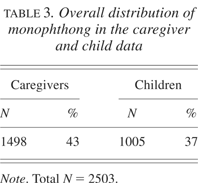
Overall distribution of monophthong in the caregiver and child data

When compared to the adult-to-adult categorical results, an entirely different picture emerges. There is robust variability in both caregiver and child speech, with 43% and 37%, respectively, of the local variant. This is in line with the findings of Foulkes et al. (2005), and Roberts (2002) detailed earlier, who showed that caregiver speech differs quite considerably from adult-to-adult talk. Moreover, in these data, the children's speech is very close to, and may therefore reflect, caregiver input.
Individual speaker pairs
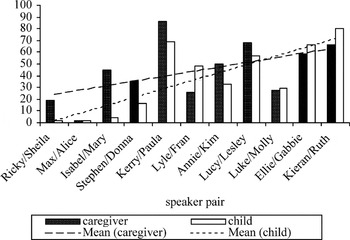
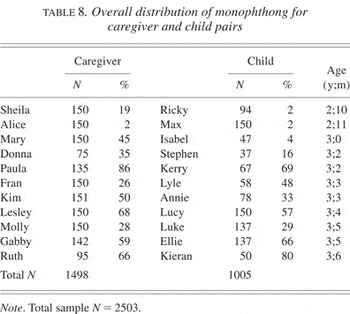
We now divide the data by individual speaker pairs in order to see whether all children use the variable forms and how closely the child matches the caregiver in terms of frequency of nonstandard use. This will allow us to go some way toward answering the main research questions. Figure 2 provides the overall distributions by individual caregiver/child pairs. The Ns and percentages are shown in the Appendix, Table 8.

Overall distribution of monophthong by caregiver/child pairs.
Two main points emerge once the data are divided in this way. First, not all children are variable: Ricky, Max, and Isabel are near-categorical in their use of the standard form. Note that these are the youngest children in the sample. However, the older children use more of the local variant. Second, this pattern is generally matched by the caregivers—the older the child, the more the caregiver uses the local monophthongal form. These findings are in line with Foulkes et al. (2005:201) in that caregiver talk “gradually becomes more similar in character to that of interadult mode as the children get older.” The same is true of the children's speech in these data. The mean lines on Figure 2 highlight these trends.
Sex is said to affect the use of one variant or the other (Foulkes et al., 2005). However, these data do not partition in this way. For example, the three pairs who show the lowest rates of the local form include two boys and one girl. The highest rates include two girls and one boy. Thus, the variation is conditioned by age, and not sex.
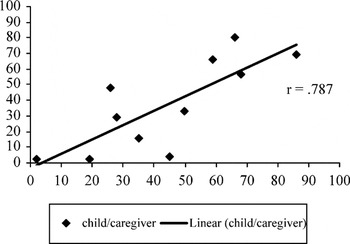
As well as an increase in use of the local form with age, Figure 2 suggests a correlation between the caregivers' use and the children's use. We now test this in order to see whether this is statistically significant. Figure 3 shows a 1-tailed Pearson's correlation test yielding a significant result (r = .787, df = 9, p < .005). In other words, there is a strong relationship between the caregivers and children. When the caregivers have higher rates of the local variant hoose, the children do too. This result is replicated in Kerswill and Williams (2005:1030) for the phonetic variable (ou) with 4-year-olds in Milton Keynes, suggesting that such correlations between caregiver and child may extend to other types of variables as well.

Correlation between children/caregivers.
Stylistic constraints on use
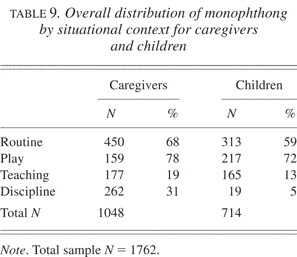
We now turn to the question of constraints, specifically, do children match their caregivers in terms of linguistic and social constraints on the variable use? We start by testing Labov's proposal that variation is transmitted to children by their caregivers along a stylistic continuum from formal to informal. To circumvent the problem of establishing a priori what is formal and informal, we divide the data into four contexts of use: Play as in (3a), Routine as in (3b), Teaching as in (3c), and Discipline as in (3d).8
It should be noted that these contexts of use are not unproblematic and overlap sometimes occurs. For example, there may be ambiguity between Play and Teaching, as teaching often is done through play in these early years. A set of guiding principles was adopted (e.g., if during Play a specific question was asked, such as “What colour is it?” then it was coded as Teaching). There were no cases of the child disciplining the caregiver. The child's utterance was coded as Discipline if it took place in the context of being disciplined by the caregiver.

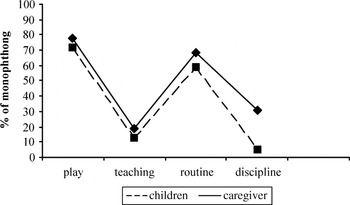
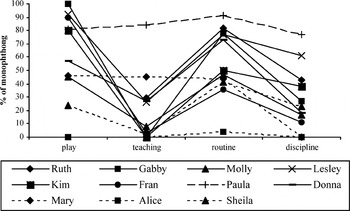
If Labov's predictions are right, we would expect to see higher rates of use of the local variant in Routine and Play and lower rates in Teaching and Discipline. Although the data are not continuous, we present the results in line graph format for illustration purposes only. Figure 4 shows the expected pattern of use, not only in the caregiver data but in the child data also. A 1-tailed Pearson's test yields a strong correlation (r =.963, df=2, p < .05). In fact, the consistent patterning of use is quite remarkable, given how young the children are. But is this pattern consistent across individual speakers? Do all caregivers have the constraint? Do all children? Figures 5 and 6 divide the data by individual speaker.

% of monophthong by situational context.

% of monophthong for children by situational context.

% of monophthong for caregivers by situational context.
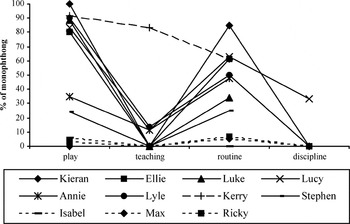
Figure 5 shows the use of the local variant by individual child. It shows that the youngest speakers—Isabel, Max and Ricky—have low rates across all contexts of use, as they use the diphthong nearly categorically. However, note the children who use both variants. All but one, Kerry, have acquired the stylistic constraints proposed by Labov, that is, higher rates of the local form in Routine and Play, lower rates in Teaching and Discipline. Kerry patterns completely differently. She has, for example, 83% use of the local variant in the formal Teaching context where all the other children have below 14%. Why this is the case becomes evident when we consider the caregivers' individual use. Figure 6 shows the results. Mary, Sheila, and Alice, the caregivers of the youngest, categorical children, shown with the broken lines, demonstrate rather idiosyncratic use of the local form. For example, Mary shows no differentiation between Routine, Teaching, or Play. The caregivers of the variable children, on the other hand, show the expected pattern of use. All that is, except one, Paula, who is Kerry's mother. This indicates the important role of input: Paula's use of the hoose variable is not stylistically stratified, and neither is her daughter's.
Lexical constraints on use
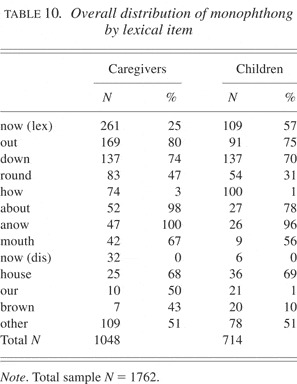
Recall that this variable is lexically conditioned in terms of where and how often the variants appear (e.g., Macafee, 1994). In other words, it has linguistic constraints on use. To test for these constraints in the caregiver/child data, we coded separately every word that appeared more than twenty times in the data set, as in (4)–(15). Note the lexical item now is divided into the discourse marker use, as in (15), lexical adverb use, as in (10), and its variant a-now (just now), as in (9). In these data, the categorical speakers, Ricky, Max, and Isabel, and the caregiver, Alice, are removed from the analysis, as their inclusion may “blur” the variable speakers results.

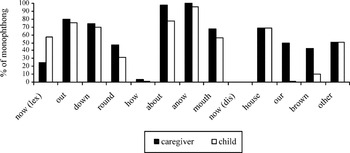
Figure 7 shows the results. Table 10 in the Appendix shows both the Ns and percentages of use. A number of observations can be made from this view of the data. First, the lexical item now is highly differentiated according to function: the local variant a-now, as in (9), has the highest rate of use, followed by the adverb now, as in (10). In contrast, the discourse marker now, as in (15), is categorically realized with the diphthong. This pattern of differentiation according to lexical function is matched in the child speech.

% of monophthong by lexical item.
Second, some lexical items show very high rates of the local form (e.g., out, down), whereas others show much lower rates (e.g., how, round). Again, the caregivers and children show similar rates across the individual lexical items. Compare, for example, out, down, and mouth. The only exceptions to these are the lexical items brown, our, and now (lex). The first two have very few tokens in the caregiver data (N = 7, N = 10), but after careful examination of the data, we have as yet no explanation for the much higher rates for now (lex) in the child data.
Thus, the children show a close match with the caregivers in terms of propensity of use of the local variant with certain lexical items and also show distinction in use according to function. In other words, they have acquired the internal constraints on use.9
Preceding and following phonological context were also coded for. However, as this variable is essentially part of a lexical set, analysis revealed major skewing in the data. For example, in the case of preceding segment /d/, 217 of the total 221 tokens were the lexical item ‘down’. Furthermore, for the preceding segment /b/, 77 out of the total 78 tokens were the lexical item ‘about’. For preceding segment /r/, 130 out of the total 181 tokens were the lexical item ‘round’. The same was true of following phonetic context. For this reason, phonetic context is not considered in this analysis.
Multivariate analysis
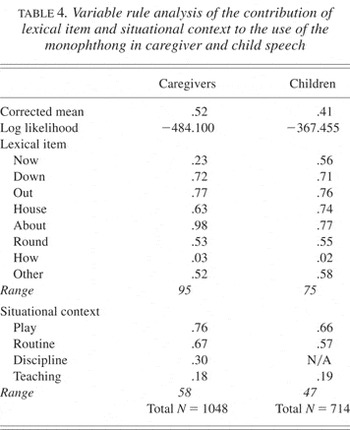
However, these influencing factors are not independent of each other. Thus, we now conduct a multivariate analysis of the contribution of lexical item and situational context to the probability of the monophthong in these contexts of use. This will allow us to determine which of these contextual factors contribute statistically significant effects to the appearance of the monophthong when both are considered simultaneously. Factor weights above .5 can be considered as favoring the local form and those below .5 as disfavoring. As usual, the data are divided into caregivers and children for comparison. The near categorical speakers noted earlier are excluded from the analysis. Lexical items that have less than 20 tokens in either caregiver or child data are collapsed into “other.” For the children, Discipline has been removed due to few contexts of use (N = 19).
Table 4 basically confirms what we have demonstrated in the distributional analyses. Note the very close matching between the caregiver and the child groups in terms of lexical item—again, if a word favors the local form in the caregivers, it does so with the children too. The only exception to this is with the adverb now. For situational context, across both groups, Play and Routine are favored, and Teaching disfavored. Discipline in the caregiver data also disfavors. Note too that the hierarchy of constraints is the same for both caregivers and children in this factor group: Play > Routine > (Discipline) > Teaching.
Variable rule analysis of the contribution of lexical item and situational context to the use of the monophthong in caregiver and child speech

Summary of findings for the hoose variable
In summary, a number of main points arise from the quantitative analysis of use of the hoose variable across caregiver, community, and child.
- Caregiver input differs from general community norms. There is much more use of the standard variant in caregiver talk.
- Children appear to start with one form only, the standard form.
- Caregivers use lower rates of the local variant with younger children.
- There is a significant correlation between caregivers and children with respect to frequency of use. Indeed, input appears to play a big role with this particular variable. This is highlighted by Kerry and Paula in Figures 5 and 6.
- Once the children start using both forms, they quickly acquire the external stylistic constraints on its use as suggested by Labov. The children also show evidence of acquisition of linguistic internal constraints (matching with lexical items and differentiation according to function in the case of now).
Thus the data suggest that most of the children have acquired (socio)linguistic competence with this variable at this early stage. We now turn to the second variable under analysis.
-s IN THIRD-PERSON-PLURAL CONTEXTS
The second variable is the use of -s in third-person-plural contexts.

This variable has been analyzed extensively in the sociolinguistic literature, as it occurs in many varieties of English worldwide (e.g., Cheshire, 1982; Clarke, 1997:229; Cukor-Avila, 1997; Fasold, 1972; Godfrey & Tagliamonte, 1999; Labov, Cohen, Robins, & Lewis, 1968; Poplack & Tagliamonte 1989, 2005; Schneider, 1983; Singler, 1991; Wolfram, 1969). For present purposes, we provide a brief summary only of findings from synchrony and diachrony.
Previous research on -s
The present indicative paradigm has changed substantially since Middle English. During this period, a number of surface inflections existed throughout the paradigm: -est, -eth, -s, and -en and these were geographically delimited (e.g., Barber, 1997:166–171; Denison, 1993:12/13; Fischer, van Keemenade, Koopman, & van der Wurff, 2000:70). By the 16th century, the northern form -s, circumscribed to third-person-singular contexts only, was the main inflection used.
In Scots and more northern varieties, inflection was not limited to third-person-singular contexts, but appeared in third-person plural, as well. Specifically, “when the subject is a noun, adjective, interrogative or relative pronoun, or when the verb and subject are separated by a clause, the verb takes the termination -s in all persons” (Murray, 1873:211). Thus, the split in use of -s is not between singular or plural, or person, but instead involves the type of subject and adjacency in these third-person-plural contexts. This pattern of use, referred to as the Northern Subject Rule, is in fact a relic dating back to the 13th century when expressions “such as, the men syts are not vulgar corruptions, but strictly grammatical in the Northern dialect” (Murray, 1873:212).
Despite this “rule” dating back more than seven hundred years, this very specific pattern of use is still found in present day dialects in which -s is used variably in plural noun phrases (NPs), but never or very rarely with the pronoun they (e.g., Hackenberg, 1972; Tagliamonte, Smith, & Lawrence, 2005; Wolfram & Christian, 1975). In fact, the categorical versus variable use is generally circumscribed to dialects that are either from more northern areas of the British Isles or speakers who are descendents of these peoples who have remained relatively immune to mainstream developments (e.g., Hackenberg, 1972; Montgomery, 1989; Wolfram & Christian, 1975).
Not surprisingly then, this is the pattern found in the Buckie dialect, at least in the adult-to-adult data (see e.g., Adger & Smith, in preparation). But, what about the children? How do they fare in the acquisition of this specific constraint on use? In the acquisition literature, it is reported that the particular standard inflection (i.e., on third-person-singular contexts) is acquired relatively late, as the child must “know” whether the subject is singular or plural; whether it is a first, second, or third person; and whether the event is in the present tense (e.g., Brown, 1973). Generally, “two and three year old children gradually go through a stage during which they sporadically omit … the third person singular present tense +s inflection on verbs, so alternating between e.g., Daddy wants one and Daddy want one” (Galasso, 2004:99). In Buckie, the children are faced with yet another constraint on use: the distinction between subject types in third-person plural. To further confound the acquisition process, they also have to learn that NP subjects appear variably with -s.
Social constraints may also be predicted to operate. Use of -s with plural NPs in other dialects is largely confined to the working classes (e.g., Wolfram & Christian, 1975), and despite it being “strictly grammatical in the Northern dialect,” it does go against the rules of Standard English.
Thus we are presented with yet another ideal situation in which to test the acquisition of (socio)linguistic norms. How do the caregivers treat these forms in interaction with their children, and how in turn do they respond? We now turn to the analysis.
Circumscribing the variable context
Only third-person-plural contexts of present indicative were included. The historic present was not included and neither were cases in which it is difficult to tell whether the statement refers to past or present (e.g., with the verbs put and cut).
Results
Overall distribution of use of -s
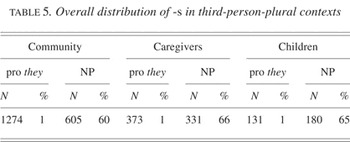
Table 5 shows the results for -s in third-person-plural contexts across community, caregiver, and child. Three points emerge from overall distribution of -s in Table 5. First, the constraint from the 13th century, when -s appears in full NP contexts but not pronominal they, remains intact today across all three groups of speakers, even the children. Thus, these young speakers have acquired this very specific categorical vs. variable rule from the start of the acquisition process. Second, unlike the hoose variable, the caregivers exhibit higher rates of nonstandard use compared to general community norms: compare 66% to 60%. Thus, the prediction that caregivers might actually use more standard variants when interacting with their offspring is not borne out with this particular variable. Third, the children match very closely their caregivers' frequency of use: compare 65% to 66%. In fact, we have a situation in which the children's speech mirrors the caregivers, who in turn mirror the community norms in terms of frequency of use.
Overall distribution of -s in third-person-plural contexts

We now concentrate on the variable contexts of use only, excluding the categorical contexts of pronominal they.
Individual speaker
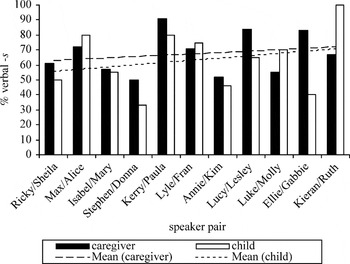
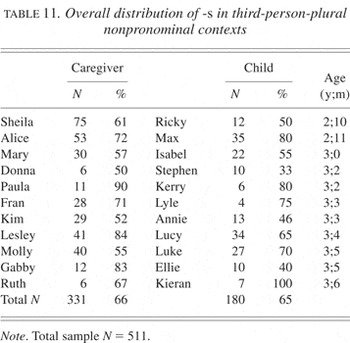
We begin by looking at individual speaker pairs. Figure 8 shows the results. Table 11 in the Appendix shows both the Ns and percentages of use. Recall that with the hoose variable, the youngest children had one form only, and it was the standard form. In sharp contrast to this, all children are variable in the use of -s with plural NPs, regardless of age. Moreover, all caregivers also use both forms, regardless of the age of their child. These trends are highlighted by the mean lines on Figure 8.

Overall distribution of verbal -s.
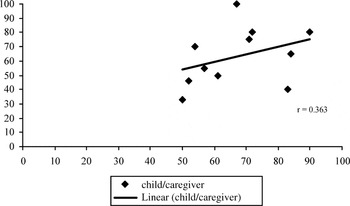
Recall that matching between caregiver and child was statistically significant for the hoose variable (see Figure 3). Figure 9 shows the results for verbal -s. Figure 9 shows a 1-tailed Pearson's correlation test that yields a nonsignificant result (r = .363, df = 9, p > .10). In other words, there is no significant matching between caregivers and their children as a group. We return to this point later.

Correlation of children/caregivers for verbal -s.
Stylistic constraints
As with the hoose variable, we examine when and where the nonstandard variant occurs, and again begin with the formality constraints proposed by Labov (2001:437).
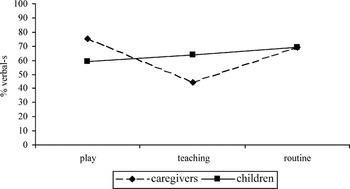
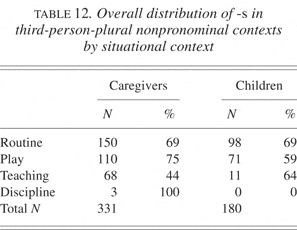
Figure 10 shows the use of -s in third-person plural NP contexts across different situational contexts. We have not included Discipline here because of small Ns (see Table 12 in Appendix).

% of verbal -s by situational context.
Figure 10 shows that there is a dip in Teaching with the caregivers, but nothing like as dramatic as for the hoose variable. The children show little or no differentiation in use across the three different styles.10
Because of small Ns, we cannot divide the data into individual speakers across the different contexts of use.
These constraints are not exhaustive. A number of others are reported in the literature, including copula versus auxiliary be, polarity, and NP configuration (e.g., Montgomery, 1997). However, because of bad data distribution (e.g., very small numbers of tokens in negative contexts and an abundance of copula constructions), we could not test for these constraints in the current study.
Linguistic constraints
Plural existentials, as in (17), show the highest rate of -s marking in all dialects studied and, in fact, use of -s in these contexts is reported in all social classes (e.g., Hay & Schreier, 2004).12
Two explanations are proposed to account for this. The first is that, as there is in subject position, no agreement is triggered (e.g., Meechan & Foley, 1994). The second is that there's is analyzed as a prefabricated unit, instead of a separate expletive + verb construction (e.g., Cheshire, 1999).

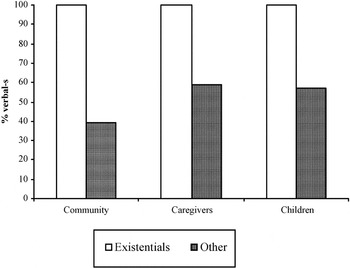
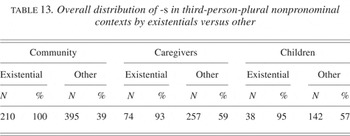
Figure 11 shows the results when these contexts are separated from other NP types. (Ns and % are shown in Table 13 in the Appendix). Note that the effect is consistent across community, caregiver, and child. There is almost categorical use of -s in existential contexts, but much lower rates in other types of syntactic structures. Moreover, this is not a “mistake,” with the full agreement pattern not yet acquired, instead, the children are following community norms of use. Given their near-categorical status, existentials are now removed from further analysis.

Distribution of verbal -s by subject type.
Perhaps not surprisingly, here in subject position in plural contexts, as in (18), is also nearly categorical—from a total of 16 tokens (children N = 4, caregivers N = 12), 15 (94%) appear with -s. This context is also excluded from analysis.

Another possible linguistic internal influence not reported in the literature is the use of the demonstrative pronouns this and that. In the Buckie dialect, these “singular” forms appear with plural subjects, in alternation with the standard forms these and those, as in (19).

In fact, this and that are the majority forms used in these plural contexts. From a total of 140 tokens of demonstrative pronouns, only 19 (14%) use the standard form those or these. In these 19 cases, only one appears with -s, as in (20), that is, they are categorically standard.

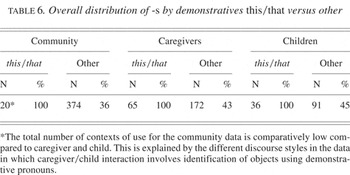
The opposite pattern is evident for this/that, however. Table 6 shows the results for use of -s in the 121 contexts in which these nonstandard demonstratives are used across the three groups of speakers. The results are conclusive—there is categorical use of -s with the demonstrative pronouns this and that across the three groups of speakers, but nearly categorical use of the standard form with these and those. Thus, the children have acquired yet another constraint on the use of -s in plural contexts—that/that triggers -s, these/those does not. Given the lack of variability in these contexts, all pronominal demonstratives—this, that, these and those—are removed from further analysis.
Overall distribution of -s by demonstratives this/that versus otherThe total number of contexts of use for the community data is comparatively low compared to caregiver and child. This is explained by the different discourse styles in the data in which caregiver/child interaction involves identification of objects using demonstrative pronouns.

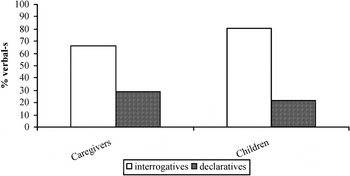
We now turn to the fully variable contexts of use. Given their syntactic structure, interrogatives, as in (21–22), may also show higher rates of -s marking in comparison to declaratives. In fact, use of -s in this context has a long history as Murray (1873:212) cited question forms as being an environment in which -s is permitted in northern dialects.

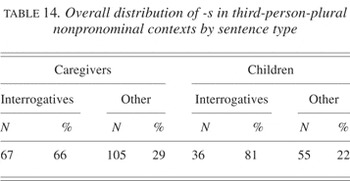
In the adult data, there are only 7 examples of interrogatives, too few to be used for comparison, thus we compare caregiver and children only. We include both yes/no interrogatives, as in (22), and wh-interrogatives, as in (21). Figure 12 shows the results (see Table 14 in the Appendix). Again, the effect is consistent across caregiver and child, that is, there are higher rates of -s in interrogative constructions.

Distribution of -s by sentence type.
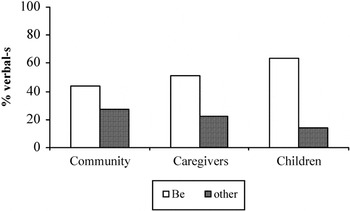
A last constraint reported in the literature is in the type of verb. Montgomery (1989:257) noted that Appalachian English has higher frequencies of -s marking on copula be, as in (23), when compared to main verbs, as in (24).13
Given their different syntactic status, it might be hypothesized that there would be a difference between main verbs, copula be, and auxiliary have, do, and be. However, in these data the split was between copula and auxiliary be versus other verbs across all groups, thus the data are grouped accordingly.

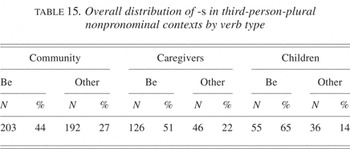
Figure 13 shows the results across the three different groups of speakers, with Ns and percentages shown in Appendix Table 15. The same picture emerges—higher rates of -s across the verb be when compared to other verbs across all groups. The community and caregivers do not treat these verbs equally, and neither do the children.

Distribution of -s by verb type.
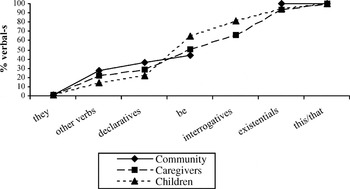
We have examined a number of internal constraints on the use of verbal -s across community, caregiver, and child. These reveal remarkable similarities, not only in terms of conditioning of use, but also with respect to frequencies across the different contexts. For comparative purposes, these are summarized graphically in Figure 14.

Summary of frequencies of use by linguistic constraints across community, caregiver and child.
Multivariate analysis
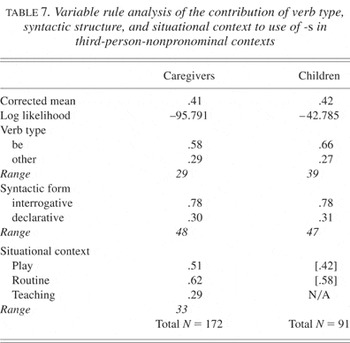
Having eliminated the (nearly) categorical contexts, we now evaluate the multivariate analysis of the use of -s in the fully variable contexts of use. Table 7 shows the results, which include be versus other verbs, questions versus declarative, and situational context. Teaching in the child data is removed because of small Ns (N = 3). We do not include the community data, as only one point of comparison could be made (verb type). Table 7 basically confirms the distributional analysis. The children have acquired the linguistic constraints on use, but not the stylistic constraints. Note too that in the caregiver data, whereas Teaching disfavors the nonstandard form, Play neither favors nor disfavors it.
Variable rule analysis of the contribution of verb type, syntactic structure, and situational context to use of -s in third-person-nonpronominal contexts

Summary of results for -s
In summary, for the morphosyntactic variable, we find the following.
- Caregiver input is very similar to general community norms in terms of rates of use of -s with NPs. In addition, they use roughly the same rate of verbal -s regardless of the age of the child.
- Children acquire the NP/pro constraint from the start of the acquisition process.
- In the variable contexts, children start both with forms with NPs (-s and no -s) at the outset.
- From the available data, children do not acquire the external stylistic constraints on its use, as suggested by Labov (i.e., formal speech variants used in formal contexts and informal speech variants in informal contexts). However, they do acquire a number of complex grammatical constraints, which are integral to both community and caregiver speech.
- Input again plays a big role with verbal –s, but only in terms of internal constraints.
THE RESEARCH QUESTIONS REVISITED
Having now looked in detail at a number of internal and external constraints across two variables, we are now in a position to return to our original questions.
(a) Does caregiver input differ from more general community norms across all linguistic variables?
Our results show that it depends on the linguistic variable under analysis. With the hoose variable, the community norm was to use the local variant nearly categorically. Caregivers differed quite considerably from this, using it only 43% of the time (Table 3). In other words, caregiver talk was highly modified towards the standard form. With the -s variable, on the other hand, caregiver speech showed the same rates of use as general community norms (Table 5), suggesting that there is no specific “caregiverese” with this variable.
(b) Are variable forms in evidence from the start of the acquisition process (i.e., learned at the same time as categorical forms?)
This, again, depends on the linguistic variable under analysis. With the hoose variable, the younger children had one form only, and it was the standard form (Figure 3). The older the children in the sample, the more use of the local form. We hypothesized from this that the children start with one categorical form and build on this. With verbal -s on the other hand, all children, regardless of age: (1) had acquired the variable versus categorical use of -s in third-person contexts, and (2) were variable in their use of -s with plural NP contexts (Table 5 and Figure 8).
(c) What effect does caregiver input have on the child's acquisition of forms, not only in terms of frequency of use, but also in terms of external and internal constraints on the variability?
Again, the answer differs depending on the variable. With the hoose variable, caregiver input had an undisputed effect, both in terms of lexical and stylistic constraints, and matching of frequencies of use (Figures 5, 6, and 7). In contrast with -s, there was no statistically significant matching of frequencies of use between caregiver and child (Figure 9), nor was there matching with stylistic constraints (Figure 10). However, analysis of linguistic constraints demonstrated acquisition of complex syntactic structures, and moreover, matching of frequencies of use within these differing contexts (Figures 11, 12, and 13).
(d) Is sociolinguistic competence acquired at the same time as grammatical competence?
With the hoose variable, yes, evidenced from the stylistic and lexical constraints the children had mastered. With -s, no. The children showed complex grammatical competence in use of the variable forms, but little evidence of sociolinguistic competence.
And the final question:
(e) Are all linguistic variables acquired at the same time and in the same way?
From the evidence presented above, no.
In summary, the results for these two variables provide support for some of the claims presented in the introduction regarding the acquisition of variation, but not for others. In only one of the two variables in these data are variable forms acquired at the same time as categorical forms; in only one of the two variables is variation transmitted on a stylistic dimension; in only one of the two variables is sociolinguistic competence acquired at the same time as grammatical competence.
Discussion
How can these highly differentiated results across two linguistic variables be explained? Recall Kerswill's (1996:199) suggestion that “exactly when a child acquires a feature of his or her first dialect depends on the linguistic level, the complexity of the conditioning, and the child's age.” Certainly this study demonstrates that not all variables are acquired in the same way or at the same time. But, are linguistic level, complexity of conditioning, and age the key factors in the acquisition process? Linguistic level differentiates the two variables under analysis in these data: one is morphosyntactic and the other is the alternation between two phonemes in a particular lexical set. Their complexity of conditioning also differs. With the hoose variable, the child has to learn which lexical items participate in this alternation. With verbal -s, the child has to learn, first, how to differentiate the type of subject in third-person-plural contexts, then, within the variable contexts, make a distinction between whether it is an interrogative, declarative, or existential, and which verb it occurs with. In other words, use of -s involves more complex linguistic configurations in comparison to the hoose variable. Because of this, it might be predicted that the child would acquire the “simpler” variable first and the more “complex” one later. However, the results show the opposite. With the morphosyntactic variable, the children have both forms -s and no -s—right from the start, whereas with the hoose variable, the youngest children start with one form only. Age and complexity do not go hand in hand. When we consider the issue of complexity within verbal -s only, the patterns of use for social constraints appear relatively straightforward; the standard form should be used in more formal contexts. In contrast, the set of linguistic constraints on use are more complex. However, the children acquire the internal constraints, but not the stylistic constraints. Thus, neither linguistic level, complexity, or age can fully explain the patterns of acquisition found in these data. What other explanations can be appealed to?
Foulkes et al. (2005:199) suggested that “it may be more enlightening to take a closer look at the full range of choices available to adults and assess the sociolinguistic meanings of those choices within the community.” From this, “the choices parents make serve to introduce children to socially structured linguistic alternatives.” We agree, but suggest further, that it may be whether or not the community has any (at least conscious) choice that influences the talk used by caregivers, and subsequently, how variation is acquired by the child. With these particular variables, the caregivers “know” that house has widespread, prestigious currency outside the community, whereas hoose is local and familiar. From this, they “know” when and where it is appropriate to use one variant or the other, and with this knowledge, they “teach” their children the sociolinguistic rules of use. Hence, we see not only much lower rates of the local monophthongal variant in caregiver talk when compared to community norms, but also stylistic switching. Following Foulkes et al. (2005) and Roberts (2002), we might also presume that, given this knowledge, the diphthong is given prominence in caregiver speech in order to “bias [children] toward the more positively evaluated variant” (Foulkes et al., 2005:199). This appears to be most extreme with the youngest children who use only the diphthong. In fact, use of the standard, as opposed to the local form, may provide an alternative scenario to more traditional accounts of caregiver talk, which serves to “simplify and enhance linguistically relevant cues” (Liu, Kuhl, & Tsao, 2003:3) in order to “assist the child's analysis of linguistic materials” (Garnica, 1977:81). Verbal –s, on the other hand, does not exhibit divergence from community norms in caregiver speech, nor does it show extreme stylistic shifting. The caregiver talks to the child in the same way as she would talk in adult-to-adult interaction. We suggest that the caregivers do not “modify” their linguistic behavior with this variable, as they are not consciously aware of the forms they are using in the first place. Thus, they are unable, at least overtly, to help the children acquire sociolinguistic competence. If the caregivers are not aware of the social impact of the variants, then the children are not either. In other words, we suggest that a guiding principle in the acquisition of (socio)linguistic competence may lie in whether the variable is a marker or an indicator (Labov, 1994:78) in the community in which the child is growing up.
However, in focusing on the “failure” to gain sociolinguistic competence in the use of -s, what should not be overlooked is the mastery of complex linguistic constraints from the earliest stages of the acquisition process, and the fact that the frequencies of use in the caregiver data are matched in almost every case by the child. We have not discussed here which mechanisms may give rise to the acquisition of these very dialect specific frequencies and forms, for example, whether the variability is within the grammar itself or the result of some extra-grammatical processes (cf. Henry et al., 1997). This is the subject of future research (Adger & Smith, in preparation). However, what we hope we have highlighted is the interdependence of community, caregiver, and child in the acquisition of a grammar that has variation at the source.
APPENDIX

Overall distribution of monophthong for caregiver and child pairs

Overall distribution of monophthong by situational context for caregivers and children

Overall distribution of monophthong by lexical item

Overall distribution of -s in third-person-plural nonpronominal contexts

Overall distribution of -s in third-person-plural nonpronominal contexts by situational context

Overall distribution of -s in third-person-plural nonpronominal contexts by existentials versus other

Overall distribution of -s in third-person-plural nonpronominal contexts by sentence type

Overall distribution of -s in third-person-plural nonpronominal contexts by verb type