Grapevine, Vitis vinifera (Vitaceae), is a high-value fruit crop that numerous viruses can attack, which can seriously affect the profitability of the grape industry. More than 60 different viruses can infect grapevines and affect their vigour and productivity and the quality of fruit and wine (Martelli Reference Martelli2014). In Québec, Canada, the last grapevine virus survey was performed in the 1990s (Mackenzie et al. Reference MacKenzie, Johnson and Warner1996). No study on grapevine viruses or their natural vectors has since been conducted in that province, although some yield-limiting grapevine viruses have been detected recently in Ontario and British Columbia, Canada (Poojari et al. Reference Poojari, Alabi, Fofanov and Naidu2013; Sudarshana et al. Reference Sudarshana, Perry and Fuchs2015).
Carisse et al. (Reference Carisse, Fall and Vincent2017) and Ben Moussa et al. (Reference Ben Moussa, Lemoyne and Fall2019) discuss biovigilance as an approach to mitigate potential viticulture threats before they become important problems. In the current study, a biovigilance approach was implemented to study the occurrence and diversity of potential insect vectors of plant viruses in Québec.
The largest class of plant virus–transmitting vectors are insects, but other vectors include mites, nematodes, and chytrid fungi (Dietzgen et al. Reference Dietzgen, Mann and Johnson2016). The best-characterised plant virus–insect vectors belong to the Hemiptera order, including aphids, leafhoppers, plant hoppers, and whiteflies (Bragard et al. Reference Bragard, Caciagli, Lemaire, Lopez-Moya, MacFarlane, Peters, Susi and Torrance2013). Moreover, grapevine red blotch, a newly emerging grapevine viral disease caused by grapevine red blotch virus (Geminiviridae) (Yepes et al. Reference Yepes, Cieniewcz, Krenz, McLane, Thompson, Perry and Fuchs2018), is known to be transmitted by leafhoppers in controlled environment (Poojari et al. Reference Poojari, Alabi, Fofanov and Naidu2013; Sudarshana et al. Reference Sudarshana, Perry and Fuchs2015). The disease was first detected in California, United States of America, and was more recently reported in Ontario and British Columbia. The presence in Canada of sap-feeding insects that are able to transmit grapevine red blotch virus is a serious risk for the Canadian viticulture industry (Poojari et al. Reference Poojari, Alabi, Fofanov and Naidu2013). For these reasons, this study gave special focus to hemipteran species.
The survey was conducted in 2018 in two vineyards located in southern Québec, in Frelighsburg (45.04972 N; −72.83305 W) and in Hemmingford (45.065852 N; −73.545871 W). Insects were monitored using yellow sticky traps (Horiver, 25 × 40 cm, Koppert Canada Limited, Scarborough, Ontario, Canada) and sweeping nets. Yellow sticky traps were placed at each cardinal point at the periphery and in the centre of each selected vineyard from mid-July to the end of September and were replaced weekly. A circular sweeping net (37 cm diameter) was used to collect adult insects weekly from randomly selected grapevine canopies and from the ground vegetation surrounding the vineyards (two sweeps per metre) because most of the hemipteran vectors prefer grassland as hosts (Bragard et al. Reference Bragard, Caciagli, Lemaire, Lopez-Moya, MacFarlane, Peters, Susi and Torrance2013). Locations and duration of net sweeps were chosen randomly because the aim of this part of the project was to screen the diversity of potential insect vectors occurring in vineyards, not to study temporal and spatial distribution. Net-captured insects were aspirated on site, placed in phials with 70% ethyl alcohol, and brought back to the laboratory for identification. The yellow sticky traps were also brought back to the laboratory for identification, where specimens were extracted from the tape using citrus oil.
In the laboratory, collected specimens were classified first into orders. Hemipteran individuals were morphologically classified into families and genera, then identified to species. Taxonomic classification was based on identification keys realised by Borror and White (Reference Borror and White1991), Della Giustina (Reference Della Giustina1989), and Holzinger et al. (Reference Holzinger, Kammerlander and Nickel2003). To confirm appropriate classification and to identify unknown species, insects collected by yellow stick tape and nets were sent to the National Identification Service at the Canadian National Collection of Insects, Arachnids and Nematodes (Agriculture and Agri-Food Canada, Ottawa, Ontario, Canada).
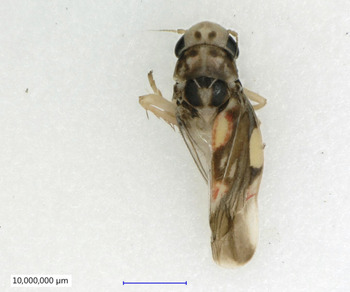
The results of this survey revealed the occurrence of 58 species, 55 genera, eight families, and 26 unclassified individuals. Among captured individuals, one adult of Rossmoneura tecta McAtee (Hemiptera: Cicadellidae) (Fig. 1) was identified and recorded by the National Identification Service, based on the identification key described in Dietrich and Dmitriev (Reference Dietrich and Dmitriev2006). Although this species has been previously reported in the United States of America, notably in Massachusetts, Pennsylvania, Illinois, and South Dakota (Dmitriev Reference Dmitriev2003), the specimen found in the Hemmingford vineyard represents the first report of R. tecta in Canada. Rossmoneura is a new genus of the leafhopper tribe Erythroneuri. Rossmoneura calva Beamer, R. carbonata McAtee, and R. tecta were previously included in the genus Erasmoneura. Subsequent phylogenetic analyses did not support the inclusion of these species in that genus, and Rossmoneura was classified as a new genus, with the type species being R. tecta, previously known as Erythroneura tecta McAtee (Dietrich and Dmitriev Reference Dietrich and Dmitriev2006).
Adult Rossmoneura tecta McAtee (Hemiptera: Cicadellidae). Photo by Pierre Lemoyne, Agriculture and Agri-Food Canada.

In the current study, two additional species belonging to the same tribe and one species belonging to the same family were identified for the first time in Québec. These additional species are, respectively, Erythroneura acuticephala Robinson (two adults), E. cymbium McAtee (one adult), and Empoasca vincula DeLong (one adult). The voucher specimens for these species and R. tecta are deposited at the Canadian National Collection of Insects, Arachnids and Nematodes in Ottawa, Ontario.
Most Erythroneura species prefer grapevine as a host and overwinter as adults on the lower surface of the leaves. The adults hibernate upon the approach of cold weather, primarily under fallen leaves, and are known to resist cold weather (Runner and Bliss Reference Runner and Bliss1923). Erythroneura species are the most numerous cicadellid species present in Ontario and Québec vineyards (Saguez et al. Reference Saguez, Olivier, Hamilton, Lowery, Stobbs, Lasnier, Galka, Chen, Maufette and Vincent2014). More importantly, Erythroneura ziczac Walch was previously reported as a potential vector of the grapevine red blotch virus in greenhouse experiments (Poojari et al. Reference Poojari, Alabi, Fofanov and Naidu2013; Fuchs et al. Reference Fuchs, Perry and Golino2016); however, the insect’s vectoring ability was not confirmed, whereas another hemipteran species, Spissistilus festinus (Say), was identified as a vector of the virus (Bahder et al. Reference Bahder, Zalom, Jayanth and Sudarshana2016). The original report and subsequent clarification of E. ziczac’s role as a vector of the virus may have been due to the fact that E. ziczac is a mesophyll feeder (Saguez et al. Reference Saguez, Vincent, Olivier and Giordanengo2011), while grapevine red blotch virus is phloem-limited (Sudarshana et al. Reference Sudarshana, Perry and Fuchs2015). Information on the biology and feeding behaviour of E. acuticephala and E. cymbium, the two additional Erythroneura species reported in Québec for the first in the current study, is lacking in the literature.
As for Empoasca species, E. stevensi (Young) and E. flavescens F., for example, are phloem feeders and known to be vectors of plant viruses (Jordović Reference Jordović1963; Haque and Parasram Reference Haque and Parasram1973). Moreover, Empoasca sp. was recently tested positive for the grapevine red blotch virus (Cieniewicz et al. Reference Cieniewicz, Flasco, Brunelli, Onwumelu, Wise and Fuchs2019).
The report of these four sap-feeding species in Québec and the first case of R. tecta in the Canadian region that is associated with the occurrence and emergence of grapevine viruses, especially Geminiviridae such as grapevine red blotch virus, represent a threat for grapevine growers and agricultural authorities. Further investigations are recommended to determine population dynamics of these Cicadellid species, determine their viromes, and evaluate their capacity for virus acquisition and transmission.
Acknowledgements
We thank Eric Maw from the National Identification Service, Agriculture and Agri-Food Canada, Ottawa, Canada, for the identification of the voucher insects. We also thank Sebastien Daoust for access to his vineyard. This work was financially supported by Agriculture and Agri-Food Canada (J-001792 – Sustainability northern grape production).