Introduction
Aphids (Hemiptera: Aphididae) are one of the most destructive agricultural pests which feed on a large number of crops such as fruits, vegetables, cereals, forest and ornamental plants, sucking up plant sap and secreting honeydew. In addition, aphids can transmit more than 270 phytopathogenic viruses to many agricultural crops (Katis et al., Reference Katis, Tsitsipis, Stevens, Powell, van Emden and Harrington2007; Dedryver et al., Reference Dedryver, Le Ralec and Fabre2010). From more than 5000 known aphid species, about 450 cause damage to crop plants and among them, approximately 100 species are considered key pests for agricultural crops worldwide (Blackman and Eastop, Reference Blackman, Eastop, van Emden and Harrington2007). In fruit orchards, aphids can cause damage such as a reduction of fruit size, deformation of fruit shape, premature fruit fall, leaf rolling, shoot twisting, chlorosis, sooty mould development on honeydew and decreased carbohydrates reserves (Van Emden et al., Reference Van Emden, Eastop, Hughes and Way1969; Filajdić et al., Reference Filajdić, Sutton, Walgenbach and Unrath1995; Hullé et al., Reference Hullé, Turpeau and Chaubet2006; Dedryver et al., Reference Dedryver, Le Ralec and Fabre2010; Zvereva et al., Reference Zvereva, Lanta and Kozlov2010). Also, it was demonstrated that the sucking of carbohydrates in host plants by sap-sucking insects including aphids led to falling carbohydrate reserves, which negatively affects the growth of the plant (Smith and Schowalter, Reference Smith and Schowalter2001). In the 21st century, chemical control involving the use of pesticides is still one of the most common control methods against many insect pests in agricultural production (Hashemi and Damalas, Reference Hashemi and Damalas2010; Simon-Delso et al., Reference Simon-Delso, Amaral-Rogers, Belzunces, Bonmatin, Chagnon, Downs, Furlan, Gibbons, Giorio, Girolami, Goulson, Kreutzweiser, Krupke, Liess, Long, McField, Mineau, Mitchell, Morrissey, Noome, Pisa, Settele, Stark, Tapparo, Van Dyck, Van Praagh, Van der Sluijs, Whitehorn and Wiemers2015). Considering the negative effects of pesticides used against aphid pests, such as pesticide resistance (Margaritopoulos et al., Reference Margaritopoulos, Skouras, Nikolaidou, Manolikaki, Maritsa, Tsamandani, Kanavaki, Bacandritsos, Zarpas and Tsitsipis2007; Wang et al., Reference Wang, Guo, Xia, Wang and Liu2007; Ahmad and Akhtar, Reference Ahmad and Akhtar2013; Ulusoy et al., Reference Ulusoy, Atakan and Dinçer2018) and the negative effects of pests (Rogers et al., Reference Rogers, Sharma, Stretton and Walker2011; Sabahi et al., Reference Sabahi, Rasekh and Michaud2011; Cheng et al., Reference Cheng, Lin, Yu, Sun and Jiang2021), the importance of alternative control methods, including biological control, is increasing day by day.
Many natural enemies such as predators from the family Coccinellidae (Coleoptera), Syrphidae (Diptera) and Chrysopidae (Neuroptera), parasitoids from the subfamily Aphidiinae (Braconidae) and the family Aphelinidae (Hymenoptera) and pathogens contribute to the success of the biological control of aphids (Völkl et al., Reference Völkl, Mackauer, Pell, Brodeur, van Emden and Harrington2007). Of these, parasitoid species such as Aphidius matricariae (Haliday) and Lysiphlebus testaceipes (Cresson) (Hymenoptera: Aphidiinae) can cause significant parasitism rates on some aphid species and they are successfully used in the biological control of aphid pests on agricultural crops (Boivin et al., Reference Boivin, Hance and Brodeur2012; Rezaei et al., Reference Rezaei, Talebi, Fathipour, Karimzadeh and Mehrabadi2019; Zhang et al., Reference Zhang, Zhao, Cheng, Liu and Yuan2020). Parasitoid species belonging to the subfamily Aphidiinae are solitary koinobiont endoparasitoids which lay a single egg into the soft body of aphids (Völkl and Mackauer, Reference Völkl and Mackauer2000) and the most significant and investigated groups due to their crucial role in biological control as the natural enemies of aphid pests. The subfamily is represented by more than 500 species belonging to 38 genera, about half of which belong to the group of strict specialists which attack only one aphid species, and most of them are distributed in the Holarctic region (Žikić et al., Reference Žikić, Lazarević and Milošević2017). Furthermore, Aphidiinae parasitoids are important agents used in the biological control of aphid pests, and have a rich biodiversity in orchards (Carroll and Hoyt, Reference Carroll and Hoyt1986; Monteiro et al., Reference Monteiro, Souza and Belli2004; Kavallieratos et al., Reference Kavallieratos, Tomanović, Starý and Bogdanović2008; Rakhshani, Reference Rakhshani2012; Alhmedi et al., Reference Alhmedi, Raymaekers, Tomanović, Bylemans and Beliën2018; Aparicio et al., Reference Aparicio, Gabarra, Riudavets, Starý, Tomanović, Kocić, Villar, Suay, Porta and Arnó2019).
The diversity of host plant species may have an effect on the population densities and species richness of aphids and parasitiods in both agricultural and non-agricultural areas (Petermann et al., Reference Petermann, Müller, Weigelt, Weisser and Schmid2010). The introduction of some companion plant species or the conservation of native vegetation have been effective in sustaining the diversity and density of parasitoids. In addition, such vegetation can attract some parasitoids in and around orchards or fields, and it also provides them with important refuge areas (Tomanović et al., Reference Tomanović, Kavallieratos, Starý, Stanisavljević, Ćetković, Stamenković, Jovanović and Athanassiou2009; Kishinevsky et al., Reference Kishinevsky, Keasar, Harari and Chiel2017; Aparicio et al., Reference Aparicio, Gabarra, Riudavets, Starý, Tomanović, Kocić, Villar, Suay, Porta and Arnó2019). Also, it is known that many host plant species in non-agricultural areas can provide reservoirs for both aphids and their parasitoids (Barczak et al., Reference Barczak, Bennewicz and Brochocka2014; Kök, Reference Kök2021). For example, Arundo donax L. (Poaceae), the summer host of Hyalopterus pruni (Geoffroy) (Hemiptera: Aphididae), which is a serious pest for plums and apricots, hosts some pest aphids as well as providing a reservoir for many natural enemies, including many parasitoid species (Askar et al., Reference Askar, El-Aw and Draz2013). On the other hand, the host plant diversity and presence of floral resources play an important role on the some biological features and biological control effectiveness of aphid parasitoids. Jado et al. (Reference Jado, Araj, Abu-Irmaileh, Shields and Wratten2019) revealed that the number of mummified aphids parasited by Aphidius colemani Viereck (Hymenoptera: Aphidiinae) on Fagopyrum esculentum Moench (Polygonaceae) flowers was the highest of all treatments. Also, the laboratory and field experiments proved that the presence of sugar resources and the proximity to floral resources significantly increased fecundity of parasitoids and their rates of parasitism on aphids (Tylianakis et al., Reference Tylianakis, Didham and Wratten2004). From agricultural fields, fruit orchards containing primary (PHP; fruit trees) and secondary host plants (SHP; herbaceous plants) can provide significant data on the interactions of aphids with heteroecious life cycles, which migrate between different host plants during the year. As an example of this, Alhmedi et al. (Reference Alhmedi, Raymaekers, Tomanović, Bylemans and Beliën2018) reported that non-crop plants (herbaceous or woody plants) showed a significant richness compared to fruit crop plants in terms of many biodiversity values, especially the species richness of both aphids and parasitoids.
In light of the above, we deemed that a detailed investigation of the interactions of aphids–parasitoids on PHP and SHP would contribute to the more effective use and success of parasitoids in biological control studies in fruit orchards. Consequently, the aim of this study was to discover the effect of PHP and SHP on the interactions and biodiversity of aphids and their parasitoids in fruit orchards.
Methods
Sampling site
Our sampling area consists of about 30 fruit orchards, each of which has an average size of 5–7 decares and is cultivated with one or mixed fruit varieties, in Bayramiç, Biga, Ezine, Lâpseki and the central districts of the Çanakkale province in the northwestern part of Mediterranean Turkey. The fruit production is carried out in an area of more than 160 thousand decares of fruit orchards in the Çanakkale province, located in the southern Marmara region of Turkey (TUIK, 2021). In the region, fruit varieties such as quince, apple, cherry and peach are widely produced. In our sampling area, in addition to that of fruit, olive, vegetable and grain production is also carried out, and these agricultural areas are intertwined with each other. There are also many non-agricultural areas with non-crop plants around the orchards.
Sampling and identification of parasitoids, host aphids and host plants
In order to discover the effect of PHP and SHP on the biodiversity of parasitoids and aphids, field sampling was carried out from numerous fruit trees such as quince, apple, cherry, peach, plum and herbaceous host plants in and around the fruit orchards in Çanakkale. The samplings were conducted by visiting as many orchards as possible once a week in the spring-autumn and every two weeks in the summer during 2020 and 2021. For fruit tree sampling, aphid-infested trees were selected to represent the orchards homogeneously. For herbaceous plants sampling, all herbaceous plants in and around (up to about five meters) the fruit orchards were visually checked and their aphid-infested ones were selected.
For the sampling of the parasitoid species, mummified aphids were collected from a number of host plants which included fruit trees as well as herbaceous host plants in and around the fruit orchards. The parasitoid specimens collected were brought to the laboratory in boxes and kept in colonies on the host plants in plastic bottles and kept in the laboratory conditions (22.5°C, 65% humidity, 16:8 L:D photoperiod) until the parasitoid emergence. Parasitoids were morphologically identified by the second author using several keys (Tomanović et al., Reference Tomanović, Rakhshani, Starý, Kavallieratos, Stanisavljević, Žikić and Athanassiou2007; Reference Tomanović, Petrović, Mitrović, Kavallieratos, Starý, Rakhshani, Rakhshanipour, Popović, Shukshuk and Ivanović2014; Reference Tomanović, Žikić and Petrović2021; Kos et al., Reference Kos, Trdan, Petrović, Starý, Kavallieratos, Petrović-Obradović and Tomanović2012).
For the sampling of host aphid species of parasitoids, apterous and alate host aphids from the colonies on the infested fruit trees and herbaceous host plants were transferred with a soft brush (#00) into Eppendorf tubes containing 70% ethyl alcohol and then brought to the laboratory for slide-preparation and identification. The preparation of the host aphid specimens was conducted according to the method of Hille Ris Lambers (Reference Hille Ris Lambers1950). The identification of the host aphids was done by the first author using a LEICA DM 2500 microscope with a mounted HD camera and LAS software (version 4.1) according to Blackman and Eastop (Reference Blackman and Eastop2006, Reference Blackman and Eastop2022). Also, the current taxonomic status and names of the identified host aphids were given as in Favret (Reference Favret2021). The specimens of the identified parasitoids were deposited in the Institute of Zoology, University of Belgrade, Faculty of Biology, Serbia, while those of the host aphids were deposited in the Department of Plant Protection, Faculty of Agriculture, Çanakkale Onsekiz Mart University, Turkey.
The PHP and SHP samples determined to be aphid hosts were prepared as herbarium specimens for identification. The host plants associated with aphids were identified by the third author.
Data analysis
In order to visualize the structural patterns of the tritrophic host-parasitoid- host-aphid plant network on the PHP and SHP in the fruit orchards, tripartite interaction graphs were constructed on the basis of the data on the parasitoid, aphid, and host plant relative abundances using the plotweb2 function in the bipartite package. To calculate the biodiversity values of the parasitoids and aphids separately on the PHP and SHP the diversityresult function in the BiodiversityR package (Kindt and Kindt, Reference Kindt and Kindt2019) was used, while the networklevel function in the bipartite package was used to reveal the biodiversity values, such as connectance, links per species, Shannon diversity of interactions, interaction evenness and H2 of the interactions of the parasitoid–aphid and host-aphid- plants on the PHP and SHP. Also, the nestedness (N) and modularity (M) were calculated for the interaction networks of the parasitoid–aphid and aphid-host plants on the PHP and SHP using the nested and metaComputeModules functions of in the bipartite R software package of (version 3.6.1) (Dormann et al., Reference Dormann, Fründ, Gruber, Beckett, Devoto, Felix, Iriondo, Opsahl, Pinheiro and Strauss2014; R Core Team, 2022).
Results
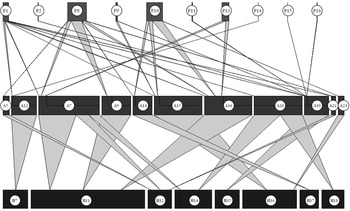
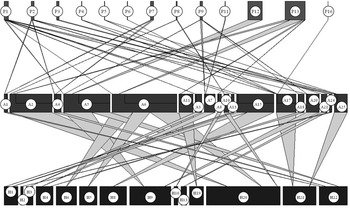
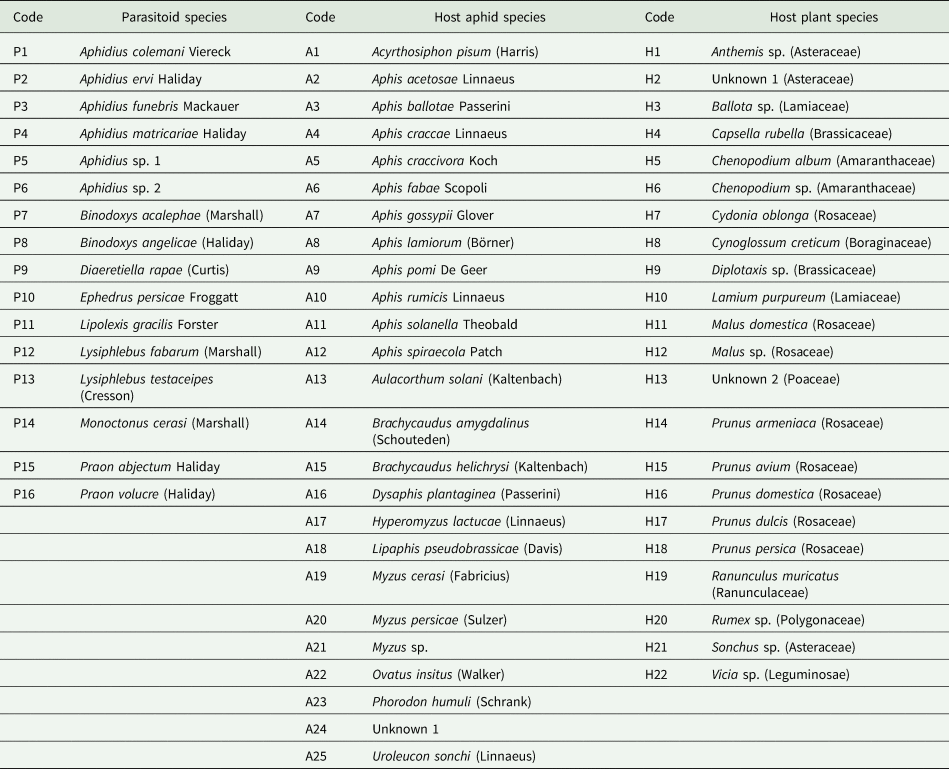
In this study, 16 parasitoid species belonging to eight genera from the subfamily Aphidiinae emerged from 25 aphid species on 22 host plants (table 1). A total of 67 tritrophic parasitoid–aphid-host plant interactions, including new records for Europe and Turkey, were determined from the fruit orchards. Of these, 30 aphid–parasitoid interactions were determined on the primary hosts and 37 interactions on the secondary hosts (figs 1 and 2).
The quantitative tripartite network of the interactions between parasitoids (top), aphids (middle), and PHP (bottom) in the fruit orchards in northwestern Turkey. The black bars represent the abundance of the species and the gray bars represent the interactions (the width of the bars indicates the intensity of the interactions).

The quantitative tripartite network of the interactions between parasitoids (top), aphids (middle), and SHP (bottom) in the fruit orchards in northwestern Turkey. The black bars represent the abundance of the species and the gray bars represent the interactions (the width of the bars indicates the intensity of the interactions).

Parasitoid, host aphid and host plant species determined in the fruit orchards

From the aphid–parasitoid- interactions presented in our study, the associations Monoctonus cerasi (Marshall) (Code: P14; table 1)- Aphis spiraecola Patch (A12) on the host plant Cydonia oblonga (Rosaceae) (H7), Binodoxys angelicae (Haliday) (P8)- Brachycaudus amygdalinus (Schouteden) (A14) on the host plant Prunus dulcis (Rosaceae) (H17), A. colemani Viereck (P1)- Aphis ballotae Passerini (A3) on the host plant Ballota sp. (Lamiaceae) (H3), and L. testaceipes (Cresson) (P13)- Aphis lamiorum (Börner) (A8) on the host plant Lamium purpureum (Lamiaceae) (H10) are new to Europe. Also, the associations Mo. cerasi (P14)-A. spiraecola (A12) on the host plant C. oblonga (H7), A. colemani (P1), Bi. angelicae (P8) and Ly. testaceipes (P13)- Dysaphis plantaginea (Passerini) (A16) on the host plant Malus domestica (Rosaceae) (H11), A. colemani (P1), Aphidius ervi Haliday (P2), Diaeretiella rapae (Curtis) (P9) and Praon abjectum Haliday (P15)- Myzus cerasi (Fabricius) (A19) on the host plant Prunus avium (Rosaceae) (H15), Bi. angelicae (P8)-Br. amygdalinus (A14) on the host plant P. dulcis (H17), A. colemani (P1)-A. ballotae (A3) on the host plant Ballota sp. (H3), Ly. testaceipes (P13)-A. lamiorum (A8) on the host plant L. purpureum (H10), Ly. testaceipes (P13)- Aphis solanella Theobald (A11) on the host plant Ranunculus muricatus (Ranunculaceae) (H19), Ly. testaceipes (P13) and Bi. angelicae (P8)- Aphis acetosae Linnaeus (A2) on the host plant Rumex sp. (Polygonaceae) (H20), and A. ervi (P2)- Hyperomyzus lactucae (Linnaeus) (A17) on the host plant Sonchus sp. (Asteraceae) (H21) were recorded for the first time in Turkey.
On the PHP, i.e. the fruit trees, A. colemani (P1) reared from seven aphid species and Bi. angelicae (P8) reared from six aphid species were the most common parasitoids. On the other hand, A. ervi (P2), Lipolexis gracilis Forster (P11), Mo. cerasi (P14), P. abjectum (P15) and Praon volucre (Haliday) (P16) visited only one aphid species on the primary hosts. From the aphids, Aphis pomi De Geer (A9) parasitized by six parasitoid species and Dy. plantaginea (A16) parasitized by four parasitoid species were the most preferred aphid species by parasitoids. From the PHP, M. domestica (H11) with eight parasitoid–aphid interactions and P. avium (H15) with six parasitoid–aphid interactions were the plants which hosted the most parasitoid–aphid interactions (fig. 1). On the secondary hosts, i.e. the herbaceous plants in and around the orchards, A. colemani (P1) reared from seven aphid species, and A. ervi (P2), Di. rapae (P9) and Ly. testaceipes (P13) reared from four aphid species were the most common parasitoids. However, Aphidius sp. (P5, P6), Li. gracilis (P11) and P. volucre (P16) targeted only one aphid species on the secondary hosts. As for aphids, H. lactucae (A17) parasitized by five parasitoid species, and Aphis craccivora Koch (A5) and Uroleucon sonchi (Linnaeus) (A25) parasitized by three parasitoid species were the most preferred aphid species by parasitoids. From the SHP, Sonchus sp. (H21) with eight parasitoid–aphid interactions and Rumex sp. (H20) with six parasitoid–aphid interactions were the plants which hosted the most parasitoid–aphid interactions (fig. 2).
In terms of the species richness of the parasitoids and aphids on the PHP and SHP in the fruit orchards, our results showed that the parasitoids on the aphids feeding on the SHP have higher species richness than the parasitoids on the aphids feeding on the PHP (S = 10 on PHP, S = 13 on SHP). Similarly, the species richness of the host aphids on the secondary hosts was higher than that of the aphids on the primary hosts (S = 11 on PHP, S = 18 on SHP). On the other hand, the abundance of both the parasitoids and aphids was higher on the primary hosts than on the secondary hosts (N = 414 on the PHP and N = 280 on the SHP for the parasitoids; N = 2574 on the PHP and N = 2120 on the SHP) (table 2). The Berger-Parker, Simpson and Shannon indices used to investigate the diversity of the parasitoids on the host aphids feeding on the PHP and SHP in the fruit orchards showed that the parasitoid biodiversity was higher on the secondary than on the PHP (DBP = 0.370, DSI = 0.733, H' = 1.533 on the PHP; DBP = 0.361, DSI = 0.798, H' = 1.918 on the SHP) (table 2). In parallel with this result, it was also determined that the aphids feeding on the secondary hosts had higher diversity than the primary hosts (DBP = 0.191, DSI = 0.871, H' = 2.167 on the PHP; DBP = 0.177, DSI = 0.918, H' = 2.705 on the SHP) (table 2). Also, the Shannon Evenness values proved that both the parasitoid and aphid diversity on the SHP were higher due to their high evenness values in the fruit orchards (E = 0.463 on the PHP and E = 0.524 on the SHP for the parasitoids; E = 0.794 on the PHP and E = 0.831 on the SHP for the aphids) (table 2).
The biodiversity of the parasitoids and aphids on the PHP and SHP in the fruit orchards

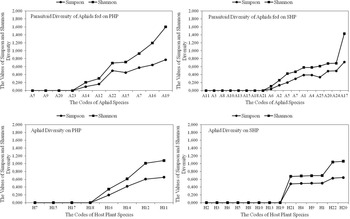
Considering both the parasitoid biodiversity on the aphid species and the aphid biodiversity on the host plant species, the highest parasitoid biodiversity on the primary hosts was determined on My. cerasi (A19) (DSI = 0.776, H' = 1.600), followed by Dy. plantaginea (A16) (DSI = 0.644, H' = 1.194) and Aphis gossypii Glover (A7) (DSI = 0.574, H' = 0.930). On the other hand, the highest parasitoid biodiversity on the secondary hosts was recorded for H. lactucae (A17) (DSI = 0.716, H' = 1.427), followed by an unknown aphid species (DSI = 0.494, H' = 0.687), and Myzus persicae (Sulzer) (A20) (DSI = 0.490, H' = 0.683). The highest values of aphid biodiversity on the primary hosts were determined on M. domestica (H11) (DSI = 0.653, H' = 1.079), Malus sp. (H12) (DSI = 0.605, H' = 1.011) and Prunus armeniaca (Rosaceae) (H14) (DSI = 0.418, H' = 0.609), while the highest values of aphid biodiversity on the secondary hosts were recorded for Rumex sp. (H20) (DSI = 0.644, H' = 1.061), Vicia sp. (Leguminosae) (H22) (DSI = 0.628, H' = 1.043) and Anthemis sp. (Asteraceae) (H1) (DSI = 0.500, H' = 0.693) (fig. 3).
The biodiversity of the parasitoids of aphids and the aphids on the PHP and SHP in the fruit orchards.

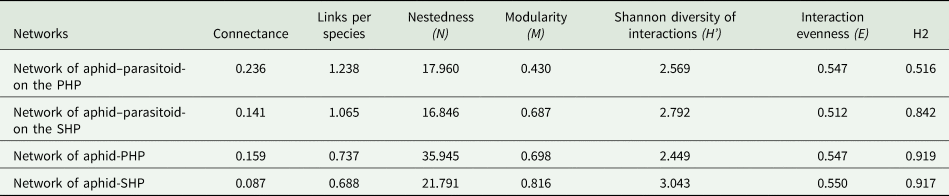
As for the biodiversity of the interactions of the aphid–parasitoid- network and the aphid-host plants network on the PHP and SHP in the fruit orchards, the connectance values for both the parasitoids and aphids were lower in the SHP compared to the PHP (table 3). Similarly, the number of links per species for both parasitoids and aphids was noticeably lower in the secondary than in the PHP. The calculated nestedness and modularity values clearly showed that the networks on the PHP were more nested than those on the SHP (N = 17.960 for the aphid–parasitoids- on the PHP and N = 35.945 for the aphids on the PHP; N = 16.846 for the aphid–parasitoids- on the SHP and N = 21.791 for the aphids on the SHP). In addition, the networks on the SHP were more modular than those on the PHP (M = 0.430 for the aphid–parasitoids- on the PHP and M = 0.698 for the aphids on the PHP; M = 0.687 for the aphid–parasitoids- on the SHP and M = 0.816 for the aphids on the SHP) (table 3). Considering the biodiversity of the interactions between the networks, it was determined that the interactions in both the networks of the aphid–parasitoids- and aphid-host plants on the secondary hosts (H' = 2.792 and H' = 3.043, respectively) showed higher diversity than those on the primary hosts (H' = 2.569 and H' = 2.449, respectively). It was also determined that the values of interaction evenness of the networks on both the PHP and SHP were partially similar. On the other hand, the H2 values calculated at the network-level showed that for both the networks of aphid–parasitoids- and aphid-host plants, the specialization was significantly higher in the secondary than in the PHP (table 3).
The biodiversity of the interactions of the aphid–parasitoids- and aphid-host plants in the fruit orchards.

Discussion
The diversity of the host plant species directly or indirectly affects the aphid–parasitoid interactions, the density and richness of the species, the parasitism rate, as well as the host preference and host specificity of parasitoids (Kavallieratos et al., Reference Kavallieratos, Athanassiou, Stathas and Tomanović2002; Petermann et al., Reference Petermann, Müller, Weigelt, Weisser and Schmid2010; Albittar et al., Reference Albittar, Ismail, Bragard and Hance2016; Monticelli et al., Reference Monticelli, Koutsovoulos, Lasserre, Amiens-Desneux, Lavoir, Harwood and Desneux2021; Peñalver-Cruz et al., Reference Peñalver-Cruz, Jaloux and Lavandero2021; Ward et al., Reference Ward, Umina, Macfadyen and Hoffmann2021). Considering that about 10% of aphids are heteroecious, spending the winter, spring and autumn on primary hosts including trees or shrubs and then migrating to secondary hosts including herbaceous plants during the summer (Blackman and Eastop, Reference Blackman and Eastop2022), it can be concluded that both the PHP and SHP influence the diversity of aphids and their parasitoids (Kök and Kasap, Reference Kök and Kasap2022).
Studies show that aphid–parasitoid interactions are highly diverse on fruit trees and herbaceous host plants in and around fruit orchards worldwide (Tizado and Nunez Perez, Reference Tizado, Nunez Perez, Nieto Nafría and Dixon1998; Kavallieratos et al., Reference Kavallieratos, Athanassiou, Stathas and Tomanović2002; Aslan and Karaca, Reference Aslan and Karaca2005; Rakhshani, Reference Rakhshani2012; Aslan, Reference Aslan2015; Alhmedi et al., Reference Alhmedi, Raymaekers, Tomanović, Bylemans and Beliën2018). In our study, 16 parasitoid species associated with 25 aphid species reported in the fruit orchards from Turkey contributed significantly to the diversity of the aphid–parasitoid interactions. Also, the four new aphid–parasitoid- interactions for Europe and 15 new interactions for Turkey presented in our study revealed both the positive effect of the PHP -SHP on the diversity of the aphid–parasitoid- interactions in the fruit orchards and the contribution of these interactions to biological control strategies in the fruit orchards. As a result, it is believed that these new interactions will make an important contribution to the biological control of fruit aphid pests by using parasitoids.
On the other hand, an important perspective obtained from our data is that when exploring the parasitoid diversity of aphids with heteroecious life cycles in agricultural areas, the PHP and the SHP should be examined separately. In this regard, Alhmedi et al. (Reference Alhmedi, Raymaekers, Tomanović, Bylemans and Beliën2018) revealed that the species richness of aphids and parasitoids on non-crop herbaceous plants and non-crop shrub and tree plants was higher than on fruit crop plants in fruit orchards, and they also reported the highest connectance on fruit crop plants (0.114 and 0.122 in 2014 and 2015, respectively) compared to non-crop herbaceous plants (0.074 and 0.063 in 2014 and 2015, respectively) and non-crop shrub and tree plants (0.070 and 0.083 in 2014 and 2015, respectively). The results of our study, which support the findings above, showed that the species richness for both parasitoids (10 on PHP and 13 on SHP) and aphids (11 on the PHP and 18 on the SHP) was highest on the SHP in the fruit orchards. Also, the connectance of parasitoids (0.236 on PHP and 0.141 on SHP) and aphids (0.159 on PHP and 0.087 on SHP) was lowest on the SHP. The results of our study and that of Alhmedi et al. (Reference Alhmedi, Raymaekers, Tomanović, Bylemans and Beliën2018) show that the level of specialization of parasitoids and aphids was relatively higher on the SHP in the fruit orchards. Also, the fact that the number of links per species was lower on the SHP for both the parasitoids and aphids in our study supports this result (table 3). One of the results of our study, referring to the specialization of both the parasitoids and aphids, was that the interactions of the aphid–parasitoids– and the aphid–host plants were more nested on the PHP than the SHP. On the other hand, these interactions were more modular on the SHP than on the PHP. In support of this, a study including the results on the interactions of ant-aphids and aphid-host plants in different habitats by Kök et al. (Reference Kök, Aktaç and Kasap2022) revealed that the specialization of ants and aphids in the uncultivated areas was higher than in cultivated and urban areas.
In light of the above, it should be taken into account that host selection of specialist and generalist parasitoids is associated with the interactions between aphids and their host plants in different habitats (Stilmant et al., Reference Stilmant, Van Bellinghen, Hance and Boivin2008). In this regard, the result we obtained in our study is that the diversity of both the parasitoids and aphids separately, and the aphid–parasitoid interactions in the fruit orchards were higher on the SHP with greater richness of aphids and host plants compared to the PHP (tables 2, 3). On the other hand, the diversity of aphid–parasitoid/predator- interactions on SHP including flowers, herbaceous plants, shrubs and trees in and around agricultural areas are important in terms of their contribution to the biological control of pest aphids (Gontijo et al., Reference Gontijo, Beers and Snyder2013; Aparicio et al., Reference Aparicio, Gabarra, Riudavets, Starý, Tomanović, Kocić, Villar, Suay, Porta and Arnó2019, Reference Aparicio, Riudavets, Gabarra, Agustí, Rodríguez-Gasol, Alins, Blasco-Moreno and Arnó2021). Also, many non-crop SHP in these areas are reservoirs for parasitoid species (Tomanovic et al., Reference Tomanović, Kavallieratos, Starý, Petrovic-Obradović, Tomanović and Jovanović2006, Reference Tomanović, Kavallieratos, Starý, Stanisavljević, Ćetković, Stamenković, Jovanović and Athanassiou2009; Kavallieratos et al., Reference Kavallieratos, Tomanović, Starý and Bogdanović2008; Barczak et al., Reference Barczak, Bennewicz and Brochocka2014; Satar et al., Reference Satar, Kavallieratos, Tüfekli, Satar, Athanassiou, Papanikolaou, Karacaoğlu, Özdemir and Starý2021; Kök and Kasap, Reference Kök and Kasap2022). On this basis, the results of our study showed that some parasitoid species such as A. colemani (P1), L. testaceipes (P13) and P. volucre (P16), important biological control agents and classified as polyphagous parasitoids (Kavallieratos et al., Reference Kavallieratos, Tomanović, Starý, Athanassiou, Sarlis, Petrović, Niketić and Veroniki2004; Boivin et al., Reference Boivin, Hance and Brodeur2012; Žikić et al., Reference Žikić, Lazarević and Milošević2017), emerged from both the PHP and SHP in the fruit orchards. As a result, it is considered that parasitoid species can survive using aphids on the SHP during the summer without the populations of aphids feeding on the primary host fruit trees during spring. Also, it is generally known that landscape heterogeneity in agricultural areas with a higher proportion and diversity of non-crop habitats positively effects aphid–parasitoid complexity and their species richness, and supports the biological control of pest aphids (Plećaš et al., Reference Plećaš, Gagić, Janković, Petrović-Obradović, Kavallieratos, Tomanović, Thies, Tscharntkee and Ćetković2014; Letourneau et al., Reference Letourneau, Bothwell Allen, Kula, Sharkey and Stireman2015), although some results do not support such findings (Hawro et al., Reference Hawro, Ceryngier, Tscharntke, Thies, Gagic, Bengtsson, Bommarco, Winqvist, Weisser, Clement, Japoshvili and Ulrich2015). In parallel with this, we argue that the higher diversity and complexity of aphid–parasitoid- interactions on the non-crop SHP, which we presented in our study, support this result, although there was no result showing the higher biological effectiveness of the parasitoids.
Also, we believe that the results of our study provided basic data on the use of flowering plants on the interactions of aphid–parasitoids and their possibilities for use in the biological control of fruit pest aphids. Furthermore, it is known that conservation biological control in agricultural areas can be supported by the use of non-crop plant species and preserving the wild vegetation including self-sowing plants in and around the agricultural areas. Moreover, many studies conducted in fruit orchards proved that some flowering plants, namely secondary herbaceous hosts, promote the increased effectiveness of parasitoids on pest aphids (Gontijo et al., Reference Gontijo, Beers and Snyder2013; Kishinevsky et al., Reference Kishinevsky, Keasar, Harari and Chiel2017; Aparicio et al., Reference Aparicio, Riudavets, Gabarra, Agustí, Rodríguez-Gasol, Alins, Blasco-Moreno and Arnó2021). Based on our results, it can be interpreted that Sonchus sp. (H21) with eight aphid–parasitoid- interactions, Rumex sp. (H20) with six aphid–parasitoid- interactions, and Vicia sp. (H22) with five aphid–parasitoid- interactions have significant potential for use as companion plants in agricultural areas such as fruit orchards.
In view of the fact that fruit pest aphids have a heteroecious life cycle using both the PHP and SHP, it is believed that a better understanding of the biodiversity of the parasitoids and aphids on these host plants and their interactions will provide important basic data for the biological control of aphids using parasitoids in fruit orchards. Also, the new interactions between the parasitoids and aphids in the fruit orchards of both Europe and Turkey presented in this study will contribute to the development of biological control strategies and a more meaningful interpretation of aphid–parasitoid- interactions. Our study clearly showed that the biodiversity of the parasitoids, aphids and aphid–parasitoid- interactions in the fruit orchards were more diverse on the SHP than the PHP. Based on our results, we suggest that the interactions of aphid–parasitoids- on both PHP and SHP in agricultural areas should be examined in more detail.
Acknowledgements
This study was supported by Çanakkale Onsekiz Mart University, the Scientific Research Coordination Unit (Project number: FBA-2019-3082). Contribution of ŽT was supported by grant the Ministry of Education, Science and Technological Development of the Republic of Serbia (Grant number 451-03-9/2021-14/ 200178).
Author contributions
All authors contributed to the study conception and design. ŞK collected the aphid, parasitoid and host plant samples, identified the aphid specimens, performed all statistical analyses, wrote the manuscript; ŽT performed the identification of parasitoid specimens; EK performed the identification of host plant species; İK collected the aphid, parasitoid and host plant samples. All authors reviewed and approved the final manuscript.
Financial support
This research was funded by Çanakkale Onsekiz Mart University, the Scientific Research Coordination Unit (Project number: FBA-2019-3082). Contribution of ZT was supported by grant the Ministry of Education, Science and Technological Development of the Republic of Serbia (Grant number 451-03-9/2021-14/ 200178).
Confict of interest
The authors declare that they have no confict of interest in this publication.
Data availability
The datasets analyzed during the current study are available from the corresponding author on reasonable request.
Consent to participate
All authors gave consent to participate.
Consent for publication
All authors gave consent for publication.