1. INTRODUCTION
For all but the simplest designs, designers in a wide variety of fields generate sketches of incomplete designs (showing the product, its context, functions or properties) for themselves or to share them with others, leaving out details and depicting features that are provisional, approximate, or qualitative. This paper looks at types of sketching in different design domains and analyzes the different roles a sketch can have.
The term sketch is often used in two related senses. First, sketch means to create a drawing on paper that depicts something in an informal way, where decisions are provisional and details approximate. Informality is relative: engineers reserve the word drawing for precise formal depictions with exact measurements; anything less formal is deemed a sketch, even precise-looking pictures that nonengineers would never call sketches. Second, by metaphorical extension, sketch means to describe something in a quick informal imprecise way, in which details are inexact, provisional, or missing.
As Henderson (Reference Henderson1991, Reference Henderson1999) points out, sketches are artifacts in their own right, not just depictions of potential or future artifacts. Sketches that are relatively informal in their information content can play important roles in structuring collaborative designing by teams. These roles, too, may be more or less formal. Some sketches are essential to the organization of the processes they are used in; we discuss an example of this in Section 1.3: knitwear designers' technical sketches. Conversely, more formal-looking and exact representations such as computer-aided design (CAD) models often play roles as illustrations and tentative proposals in more fluid and interactive social processes of joint designing in engineering. Sketches can range from the formal to informal for different contexts, domains, and uses: sometimes appearances can be deceptive to the uninitiated, with the apparently approximate having clear and precise meanings and the apparently precise being approximate and provisional. Some designers navigate these subtleties with impressive aplomb, whereas they cause misunderstandings and disrupt the design process for others.
Our observations of the variety of sketching behavior have led us to address two main questions: first, how sketches vary in real and apparent formality, and second, how designers can manage the formality of their “informal” representations to achieve effective communication. Answering these questions involves considering the formality of the roles the representations play as well as the formality of the representations themselves, and the mismatches that can arise among participants in the design process in how they understand the formality of both representation and role. These issues raise the further questions, what do the different participants think the sketch is doing in the design process and what do they use it for and what do they do to control what others use the sketch for?
1.1. Who reads sketches? Types of recipient
The recipients of sketches fall into distinct categories. First, many sketches are generated for the designer's own use: to capture ideas, to externalize thoughts and mental images, and to construct a visual understanding. The designer generates but also sees and reinterprets the sketch. The recipient is the self. Second, colleagues with similar expertise: sketching is often carried out in team activities, where a group of designers expresses, shares, and explores ideas. Colleagues who are members of a professional community sharing similar professional training and experience share knowledge of diagramming conventions as well as sets of concepts and thinking skills (what Bucciarelli, Reference Bucciarelli1994, calls an object world). Third, colleagues with different expertise: design teams can be heterogeneous, comprising individuals with very different training and experience; however, members of a design team have a certain degree of shared understanding and shared reference points. Sketches can function as boundary objects, that is, artifacts that convey information between people with different expertise, who may not fully appreciate the implications the information has for the others (Star & Griesemer, Reference Star and Griesemer1989). The role of boundary objects in design communication has been extensively discussed (Henderson, Reference Henderson1991, Reference Henderson1999; Bucciarelli, Reference Bucciarelli1994; see, for instance, Carlile, Reference Carlile2002; Boujut & Blanco, Reference Boujut and Blanco2003; Hendry, Reference Hendry2004). The fourth group of readers are outsiders, such as clients or the general public who engage with sketches, but who are not part of the design culture.
Most sketches are intended for a particular audience. The implications of a sketch to outsiders can be carefully constructed both to indicate commitment to a specific idea and a sense of precision, while also suggesting a controlled degree of vagueness.
1.2. Sketching as conversation
Sketching research has primarily been conducted from the viewpoint of a particular domain, so that the understanding of sketching is influenced by the particular domain and particular stage in the design process. For example, sketching has been intensively studied in early architectural design, where individual designers begin to develop the conceptual design for a building by sketching out a plan, elevation, or a view of the building. An extensive body of research on designers' use of sketches, notably by Goldschmidt (Reference Goldschmidt1991, Reference Goldschmidt1994, Reference Goldschmidt2003) and Goel (Reference Goel1995), has focused on how designers reinterpret elements of their sketches (for a review, see Purcell & Gero, Reference Purcell and Gero1998); most of this work has focused on architects and product designers. It seems that designers can readily find unintended configurations of sketch elements (Goldschmidt, Reference Goldschmidt1999), although this ordinarily requires active interest in new possibilities, usually triggered by dissatisfaction with the current design (McFadzean et al., Reference McFadzean, Cross and Johnson1999) or forgetting of context. As shown by Finke's (Reference Finke1990) findings on how preinventive forms can facilitate creativity, using chance forms to meet design goals is often a fruitful idea generation strategy. For reinterpretation leading to creative insight, ambiguity is a benefit, regarded as important by both researchers and practitioners.
Schön (Reference Schön1983) views this interaction with the sketches as a conversation: the designers see more in their sketches than they put in when they draw them, and these insights drive further designing; designers alternate between seeing as and seeing that (Schön & Wiggins, Reference Schön and Wiggins1992). Similarly Goldschmidt (Reference Goldschmidt1991) observed architects' conceptual designing as proceeding through an alternation between pictorial and nonpictorial reasoning. Although designers use a lot of standard symbols and idiosyncratic geometric forms as placeholders for concepts (McFadzean et al., Reference McFadzean, Cross and Johnson1999), the meanings of marks on paper can be fluid as sketches are adapted to serve new purposes (Neilson & Lee, Reference Neilson and Lee1994). This makes computer interpretation of design sketches a challenging problem. Although powerful systems for computer sketch interpretation can be built (see Do, Reference Do2002), they depend on graphic elements that can be recognized as conventional symbols with static meanings.
Sketching can be seen as a process of generation and interpretation, or as Schön (Reference Schön1983) puts it, a type of conversation with the medium and through the medium. In teams, generating and interpreting sketches collaboratively is a major source of creativity (Schön & Wiggins, Reference Schön and Wiggins1992; but see Minneman, Reference Minneman1991), but it is also a source of potential misunderstanding and problems when divergent interpretation is undesirable (Stacey & Eckert, Reference Stacey and Eckert2003). However, van der Lugt (Reference Van der Lugt2005) found little evidence of team members engaging in creative reinterpretation of sketches generated by others but highlighted the importance of sketches to store past ideas. Goldschmidt (Reference Goldschmidt, Cross, Christiaans and Dorst1996) reminded us that even designers working on their own can be seen as a “team of one,” conversing with themselves through external media. The success of conversation through sketches depends on the reader constructing appropriate interpretations, which can be problematic if creator and recipient disagree.
Engineers use and communicate with a wide variety of visual representations: Pei et al. (Reference Pei, Campbell and Evans2010, Reference Pei, Campbell and Evans2011) presented a taxonomy of 35 representations used to express different kinds of information in projects involving collaborations between industrial designers and engineering designers. For sketches they followed Ferguson (Reference Ferguson1992), who classified sketches as thinking sketches, which support individual thinking processes; talking sketches drawn to support group interaction; and prescriptive sketches, which express decisions; as well as storing sketches, drawn to retain ideas (see also Ullman et al., Reference Ullman, Wood and Craig1990; van der Lugt, 2005). Similarly Olofsson and Sjölén (Reference Olofsson and Sjölén2005) divided sketches into investigative sketches for problem definition, explorative sketches for generating and evaluating solutions, explanatory sketches that describe and communicate the design, and persuasive sketches that sell an idea.
Studies of sketching in engineering design have mainly concentrated on the use of sketches to develop designs jointly in meetings. Tang (Reference Tang1989, Reference Tang1991; Tang & Leifer, Reference Tang and Leifer1988), Bly (Reference Bly1988), Minneman (Reference Minneman1991), and Neilson and Lee (Reference Neilson and Lee1994) have observed that designers use speech, sketches, and gestures in combination, using each mode to explain and disambiguate the others. To fully understand a communication act the interaction of different media needs to be analyzed (see, e.g., Herold & Stahovich, Reference Herold and Stahovich2011). Studies of solitary engineering sketching (Pache, Reference Pache, Römer, Lindemann and Hacker2001) have seen a wide variety of different sketching behavior and ability, with evidence for the reinterpretation of ambiguous notation in only a small number of cases. A key challenge for many mechanical engineers lies in expressing and visualizing movement of multiple parts through sketches. Many studies have investigated the relationship between sketching and outcomes in engineering students' design projects; the pattern of results is complicated. For instance, Schütze et al. (Reference Schütze, Sachse and Römer2003) found that designers (of garden grills) did better when allowed to sketch than when they were not; Song and Agogino (Reference Song and Agogino2004) found significant correlations between sketch volumes and outcomes in a product design course, whereas Yang (Reference Yang2009) and Yang and Cham (Reference Yang and Cham2007) found more complex patterns, with the advantages of exploring lots of ideas balanced by the advantages of progressing to detailed design early.
1.3. An example of sketching and formality: Technical sketches in knitwear design
Some of the subtleties and pitfalls of communicating through sketches are illustrated by a field where we have analyzed the role of sketches in design communication in detail, namely, knitwear design (see Eckert, Reference Eckert2001).
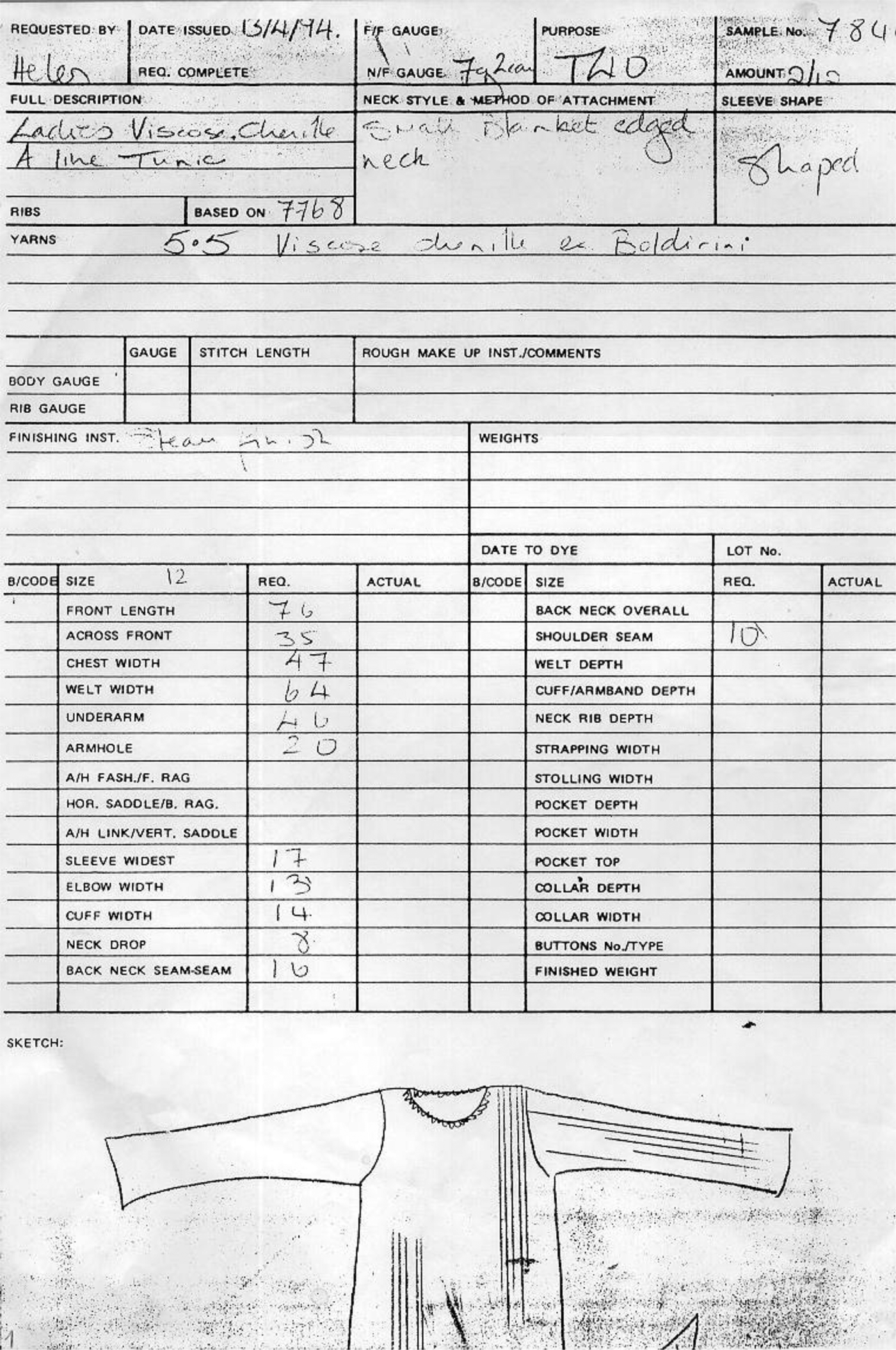
Figure 1 shows a technical sketch, which in knitwear design is the hand-over document between knitwear designers and knitwear technicians in colocated knitwear design processes. It is thus an example of sketch as boundary object. With the generation of these sketches the design becomes a distinct entity for the first time in the design process, a sample number is issued, and the design is recorded. These technical sketches are incomplete, inconsistent, and often contradictory (Eckert, Reference Eckert2001). This sketch is asymmetrical, some of the measurements clearly contradict the drawing, and much detail is missing. Still it is the only information that the technicians have to create a prototype garment. The designer's own understanding of the sketch is influenced by the inspirations and trends she has seen for the collection she is designing, whereas the technician interprets the sketch based on the garments she has seen and created in the past. The inherent ambiguity of the technical sketches often causes miscommunication and wasteful iteration in design processes (Eckert, Reference Eckert2001; see Stacey & Eckert, Reference Stacey and Eckert2003).
A knitwear designer's technical sketch.
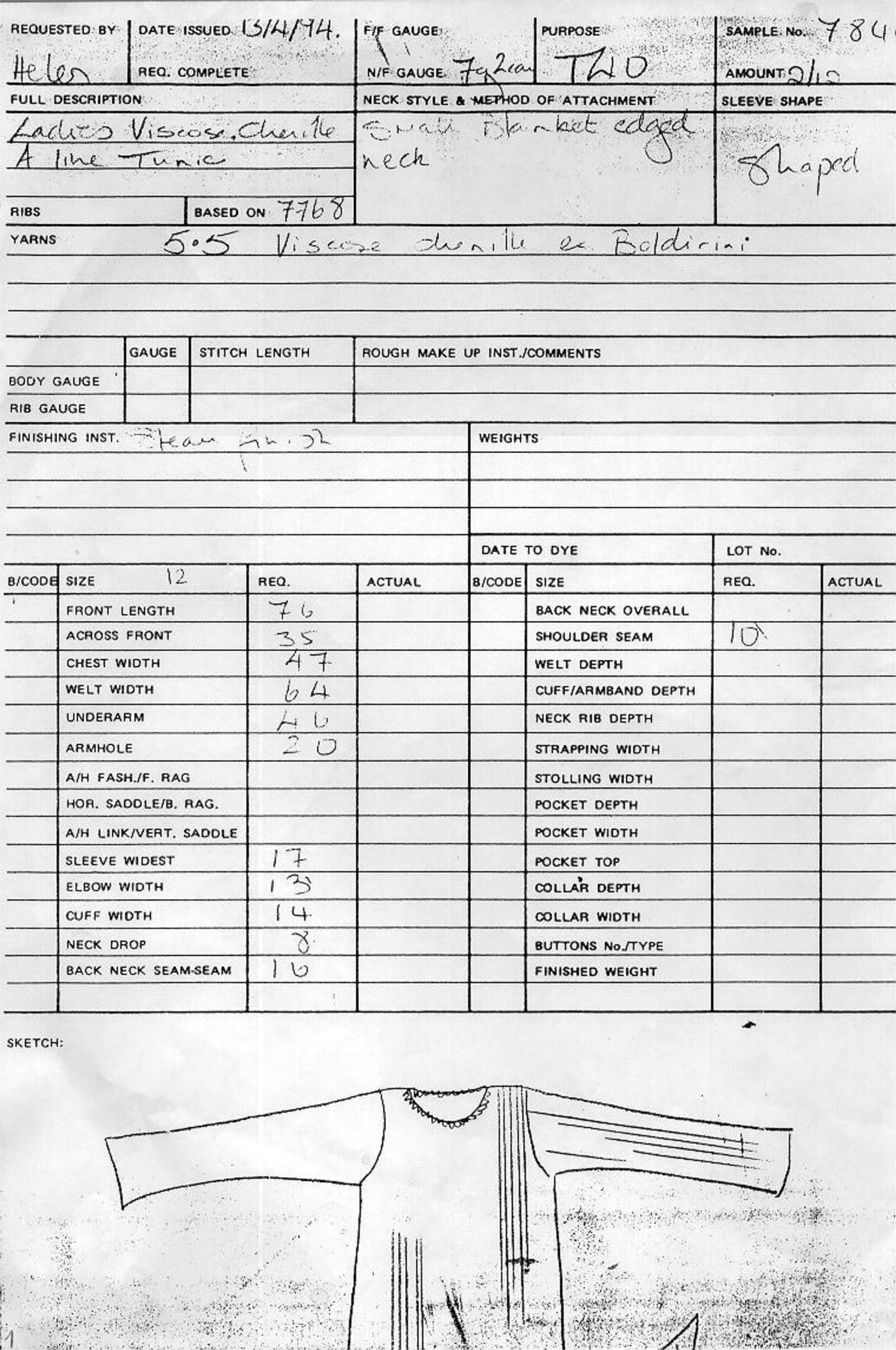
These sketches have a very formal role in the design process, but in themselves they do not give the appearance of formality. In interviews technicians claimed they ignored the pictorial sketches, because they were too inaccurate and imprecise, and worked solely from the verbal description and the measurements. This annoyed the designers, who had no way of providing complete and accurate measurements, because they felt vital information about the exact shape was ignored by the technicians. However, on closer inspection it appeared that the technicians drew information about the positioning of the pattern elements on the garment from the sketch, because there was no other source of information on this. The designers meanwhile thought of these technical sketches as a means to encourage the technicians to come and see them to have an informal conversation. Henderson (Reference Henderson1991, Reference Henderson1999) would view this as the designers using the technical sketches as conscription devices to control the behavior of their colleagues. However, the technicians interpreted the technical sketches as formal specifications and tried their best to work through them without “bothering” the designers. A divergent understanding of the formality of both the role and the content of the technical sketches causes problems in the knitwear design processes. There was also a disjunction between the formality of the role of the technical sketch and its informal appearance.
1.4. Outline
After a discussion of our methodology (Section 2) this paper looks into the nature of both sketches (Section 3) and formality (Section 4) and the role sketches have in creating (Section 5) and communicating (Section 6), before offering an approach to finding and analyzing mismatches in the understanding of sketches arising from different interpretations of their formality (Section 7).
2. METHODOLOGY
This paper takes an across-domain perspective to sketching. It draws on the authors' research across a wide range of subject areas and especially in the Across Design project, conducted between 2002 and 2004 as a collaboration between the University of Cambridge and MIT, which addressed comparisons among different design domains. This project serves as a canon of commonly shared reference examples among the authors to which we have related other experiences and research done both previously and subsequently.
2.1. The Across Design methodology
The original Across Design project, from which the research reported here was developed, consisted of a series of six 1-day research workshops between 2002 and 2004, each including between three and five professional designers (see Table 1) who were invited to report on a particular project of their choice. Eight of the designers were interviewed again after their presentation by two of the authors. They were seen as witnesses for their own fields, where each account is valued for its concrete specifics, rather than because it illustrates notions of typicality. Presentation and follow-up discussion lasted between 45 and 90 min. Each informant had at least 10 years of design experience (in one case of a new technology, only 5), although the majority had 20 or more years of professional experience. Rather than well-known “stars,” we sought to invite experts who were well respected by their peers without being regular spokespersons for their field in response to media attention.
Participant design disciplines in five workshops

aThese designers were reinterviewed after their presentation by two of the authors.
The participants were provided with a set of briefing notes and a framework of concepts, covering issues pertinent to design that the project team had provided prior to the workshops (see Eckert et al., Reference Eckert, Blackwell, Bucciarelli and Earl2010, for a discussion of the workshop methodology). However, most of the presenters confessed to largely ignoring the framework and telling a typically chronological story of a design project.
For the purpose of this paper the first author has systematically interrogated the completed transcripts and identified presentation and discussion of sketches or other forms of provisional information, in order to gain an overview of the issues that concerned sketching. The second author has collected material that was presented to the Across Design study and coded as relating to sketching during the workshops. In the analysis framework all issues of representation are pertinent to sketching.
The architects and planners we encountered in the Across Design project were observed to generate sketches to articulate ideas and views for a range of stakeholders especially clients and the public, as well as themselves. Mechanical engineers were primarily concerned with generating sketches for communication to peers and team members. Structural engineers presented a particular skill in interpreting sketch representations from architects, some of which appear rough whereas others are carefully rendered expressions of design ideas that are nevertheless imprecise in the sense that they are not necessarily realizable in a structurally integrated way. The wide range of projects in the Across Design study provided many examples of types, roles, and users of sketches. The diverse range of generators, recipients, and users of sketches in the Across Design study led us to frame an analysis of the different roles of sketches (in Section 5) in terms of (a) user/recipients and (b) the formal/informal nature of the sketch.
2.2. The approach to comparative design research
Whereas previous research on comparisons between design domains has often aimed to establish general criteria by which core concepts in design research and theory making can be related to designing and designs (see Raymen, Reference Reymen2001; Love, Reference Love2002), this project aimed to draw a rich picture of design as a shared phenomenon and to help designers to learn from each other. The theoretical motivation, facilitation procedure, and analytic approach are described in detail by Blackwell et al. (Reference Blackwell, Eckert, Bucciarelli and Earl2009). Drawing on procedures used in other comparative disciplines, the accounts of different practitioners, or witnesses as we referred to them in our reports (Blackwell et al., Reference Blackwell, Eckert, Bucciarelli and Earl2009), were collected and compared to understand the issues that are pertinent to them. It was their choice how they constructed their narrative and what illustrations they selected. The witnesses were asked clarifying questions after their presentation, often by their follow presenters. Some witnesses were followed up with in an interview to explore the wider context in which their companies work. Rather than being interviewed, the witnesses were encouraged to tell their own story. Topics they left out were as interesting as those included. If the participants did not respond to probing on a particular issue to, they were not pushed. Therefore, we do not have comments by all witnesses on each issue.
Illustrations were handled in a very similar way. We only have copies of the illustrations the designers chose to include in their presentations to illustrate their testimonies. They mentioned more illustrations during their presentations than they showed us. During the interviews the designers showed us other illustrations, but they did not provide copies of them.
Our aim was not to produce generic findings that applied to all cases of design in all circumstances, but rather to develop a rich understanding of recurring behaviors across different domains, even though these might not apply to every process. The aim was to be neither normative nor exhaustive, but to generate reference cases that serve as inspiration, examples, and counterexamples in other analyses.
2.3. The authors' wider experience
Following the conclusion of the Across Design project, the authors have continued their research on design practice in different domains in several projects. As the designer witnesses in the Across Design project have provided us with a limited range of sketches, or other representations that function as sketches, we draw on sketches we have analyzed in detail in other contexts as illustrations of points made in this paper. The methodology of how these materials were collected and analyzed can be found in the cited papers.
3. PROPERTIES OF SKETCHES
In this section we discuss some of the properties sketches can have, such as symbolic representation, imprecision, and ambiguity. These properties influence the actual or perceived formality discussed in the following section.
The notion that a sketch is a means of communication provides us with a framework to analyze the formality of sketches. Information based models of communication based on the work of Shannon and Weaver (who sought to conceptualize the operation of electronic devices; Reference Shannon and Weaver1949), which divide communication into a sender, channel, and receiver, have been applied to communication in social situations. However, Luhmann (1995) sees communication as a complex social process combining three aspects:
• information: the selected content of the communication act
• utterance: the form (mode and media) and reason for communication. The sketch itself, that is, the representation itself is part of the utterance.
• understanding: the interpretation of both the sender and the recipient.
3.1. Visual language: Marks on a surface
The traditional medium for sketching, and the medium we associate with the term, is pencil or pen on paper. However, the development of CAD systems and visual programming environments for a wide variety of different industries has changed the way many people design, as they use computer tools to explore provisional and skeletal ideas. The many different special-purpose computer tools available to designers of different kinds of products have different properties, making different kinds of operations easy or difficult. The properties of pencils are at one extreme of the range of variation: they make producing freeform marks and textual annotations extremely easy, producing regular geometric shapes rather harder, and duplicating elements of the image difficult and time consuming; modifying elements by addition is easy whereas modifying by distortion or substitution requires time and care; modifying lots of things at once is impossible. Pieces of paper cannot be resized, but if the physical environment permits they can be juxtaposed and overlaid.
Tools, such as CAD systems for producing, using, and modifying representations of complicated information structures, such as designs for artifacts or computer programs, differ along a number of cognitive dimensions. A cognitive dimension describes a way in which using a representation of a complex information structure may be easier or more difficult (Green, Reference Green, Sutcliffe and Macaulay1989; Green & Petre, Reference Green and Petre1996; Blackwell & Green, Reference Blackwell, Green and Carroll2003; for a list, see Blackwell et al., Reference Blackwell, Hewson, Green and Hollnagel2003). These dimensions influence the degree to which representations are or are perceived as formal. Cognitive dimensions important to sketching include viscosity (how easy it is to make local changes to previous work when they have effects on the rest of the design), provisionality (how easy is it to make marks when one is exploring possibilities without being committed to decisions), secondary notation (how easy is it to add annotations outside the syntax of the formalism), premature commitment (how much does the medium force one to make decisions in a particular order), ambiguity (how easily can one make marks that can be read in different ways), and specificity (how far the correspondence between marks and a specific interpretation is closely determined, requiring little investment in considering alternative readings). No tool can be good at everything: choosing one design tool (even a pencil) rather than another, or making a change to how a design tool works, implicitly involves making trade-offs between different dimensions, prioritizing some types of actions over others.
Some CAD systems construct representations whose elements have well-defined relationships to each other and to the product being defined, although humans may see meaning beyond the defined semantics of the notation. Tools that just create pictures, such as pencils, leave making these connections, the perception of meaning, to the eye of the beholder. Designers making and reading sketches employ a variety of correspondence conventions to relate marks to design features or characteristics, each of which can be more or less mathematically formal. Some mathematical relations correspond directly to plane geometry (containment in the plane, connected regions, Euclidean or Cartesian geometries), whereas others rely on mathematically informal interpretations, which might involve metaphor or connotation. In all cases, we can compile these various properties as indications of the degree of formality; if a greater number of formal correspondences are employed, then the degree of formality of the representation will also be greater.
More generally, the correspondence between marks on a surface and the ways in which those marks are to be interpreted allows analysis of the structure of visual and pictorial representations and provides an indication of how formal they are. Bertin (Reference Bertin and Berg1983) analyzed how the structure of a representation can be decomposed according to the partitioning of the plane, and the distribution of “ink” on that plane. Blackwell (Reference Blackwell2011) has developed Bertin's framework, drawing on the work of Engelhardt (Reference Engelhardt2002), considering the graphic resources of marks on the plane (their shape, size, texture, color, etc), the construction of symbols from basic marks (letters, icons, picture elements), and the arrangement of these into regions of a surface. Attributes of visual and pictorial representations including differentiation of marks, literal or figurative interpretations, topological containment and connection, metrical scale, and regional separation, all influence the degree of formality.
3.2. Symbols and shapes
A sketch (in its conventional sense) is a series of marks on paper. The meaning of a sketch lies in the combination of symbolic and geometric correspondences between sketch elements and their referent objects, that is, what the viewer interprets the sketch to depict. Sketches thus comprise dense symbols, whose interpretation depends both on the recognition of sketch elements as depicting particular types of things and on the exact details of their spatial structure (Goel, Reference Goel1995).
The symbolic meanings of sketch elements are defined by notational conventions and mediated by the recognition of abstract category memberships that set up correspondences between categories of mark combinations and categories of objects. Sketch elements may be icons or have shapes directly corresponding to the shapes of the object categories they represent. For some designers (McFadzean et al., Reference McFadzean, Cross and Johnson1999) these graphical symbols form a personal recurring set that expresses abstract attributes of a design. These personal notations are based on the standard drawing conventions of the domain, but they include idiosyncratic extensions and variations that influence the final form of the design. Designers have recurring, idiosyncratic procedures for constructing symbols in their sketches. For example, a designer might draw a particular curve to denote an arch, which is then reflected in the final design, whether that was originally intended or not (Stacey et al., Reference Stacey, Eckert and McFadzean1999).
Sketch elements can also have pictorial meanings, mapping the exact forms of the marks and the spatial relationships between them to corresponding shapes and spatial relationships of the depicted objects. This pictorial mapping is perceptual and nonsymbolic. We note that interpreting pictures in this way is to some extent a learned skill. Graphic notations can also provide direct mappings from their conventional shapes, conveying pictorial meaning even when only a category identifier is intended. Pictorial meanings involve recognizing and exploiting drawing conventions. Recognizing drawing conventions is especially important in understanding sketches of three-dimensional objects.
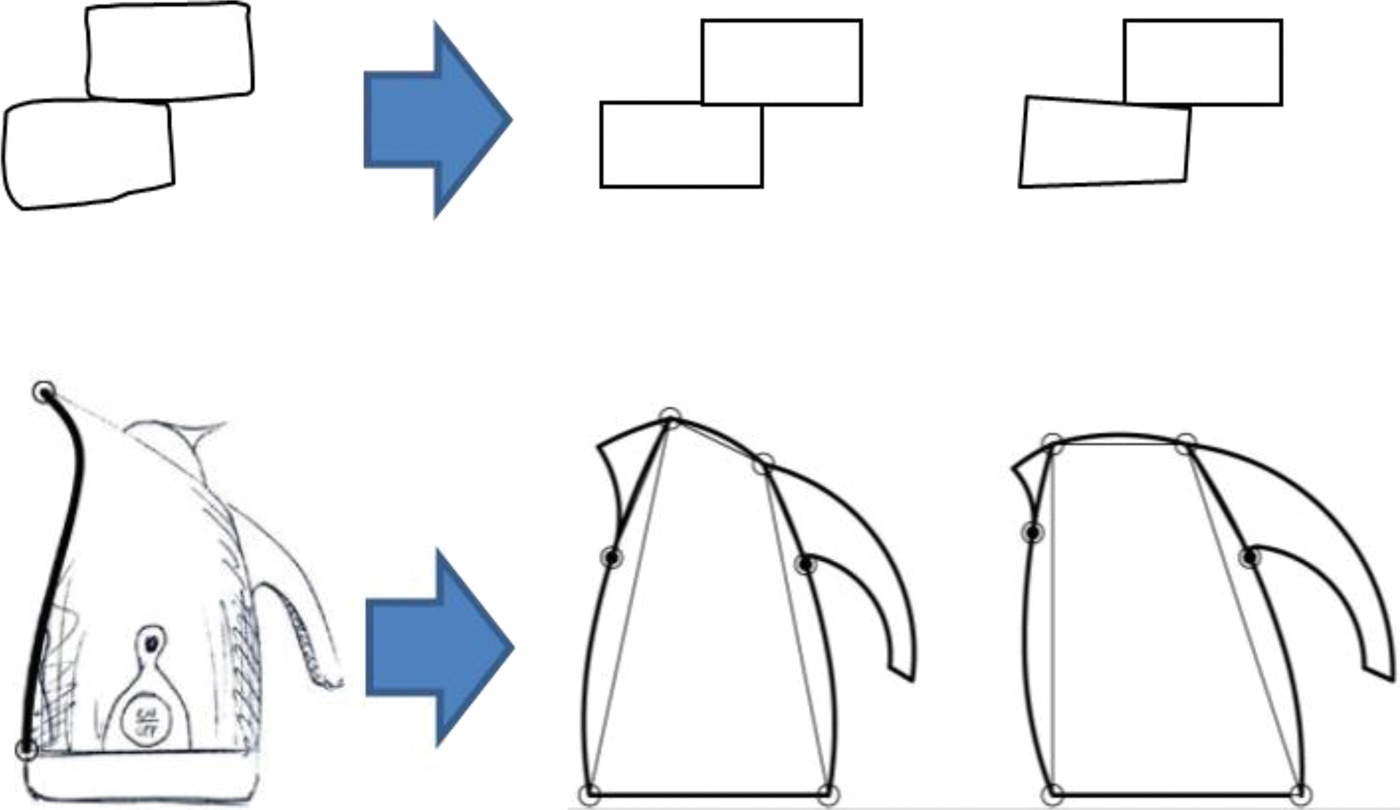
Viewers understand sketches by perceiving both the symbolic categories and the shapes of design elements, but shape perception depends on what symbols are seen. A sketch is ambiguous, as opposed to vague, when alternative ascriptions of symbols to sketch elements are possible (see Fig. 2). The top row in Figure 2 shows a sketch on the left that might be perceived as two abutting enclosed (four sided) figures. Identifying these two “symbols” plus the abutting spatial relationship allows viewers to make many interpretive assignments. A design example is shown below where a sketch of a kettle shape is shown alongside two formal interpretations parameterized according to ways that constituent elements are generated (Prats et al., Reference Prats, Earl, Garner and Jowers2006).
Sketch, on the left, and two possible interpretations on the right (lower figures from Prats et al., Reference Prats, Earl, Garner and Jowers2006). [A color version of this figure can be viewed online at http://journals.cambridge.org/aie]
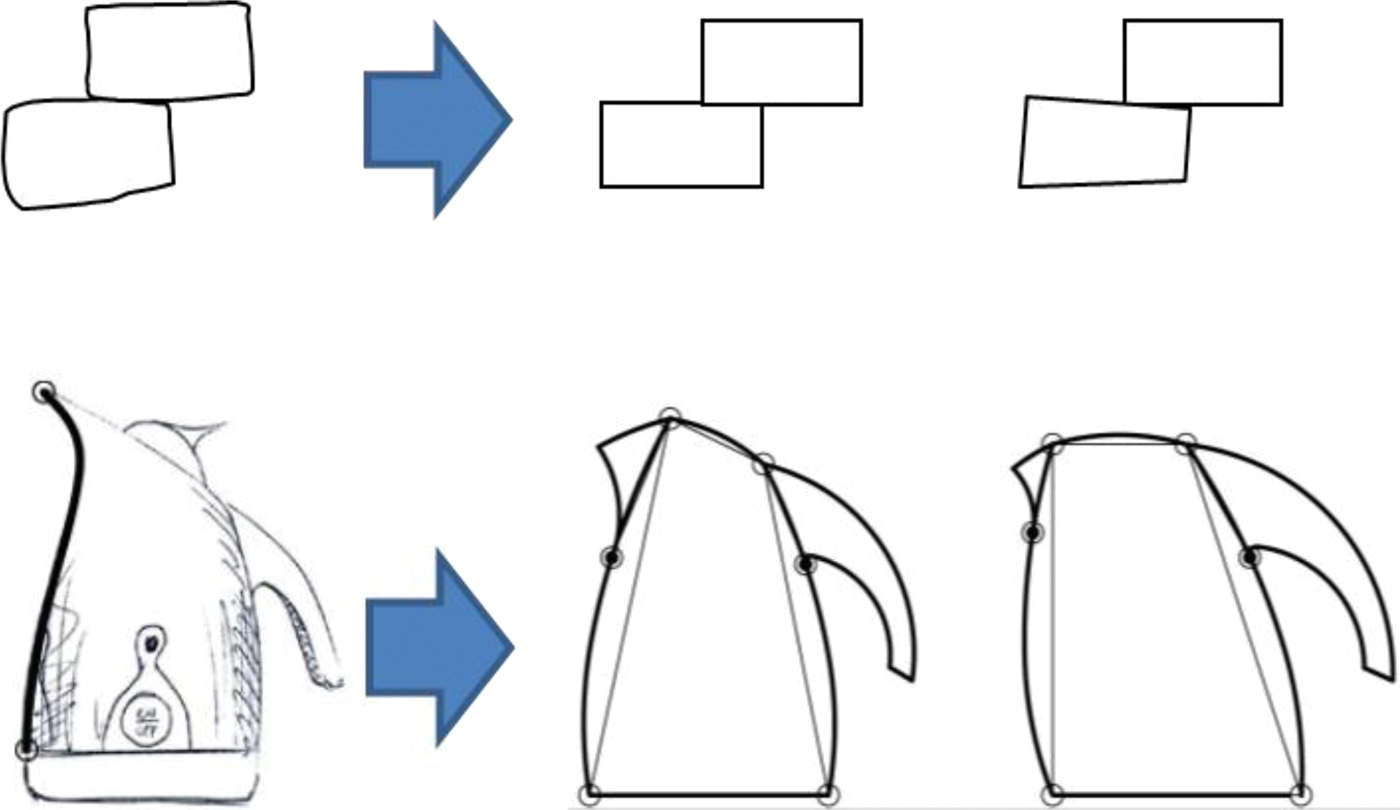
For each viewer, a design sketch has a perceptual interpretation space: its meaning is the range of designs that it perceptually affords. Beyond this, the sketch has a deductive interpretation space: this is the range of designs that the viewer reasons that it can cover. As sketched lines and elements have definite shapes and sizes, they suggest proportions and magnitudes. These interpretation spaces typically have centers, which is the interpretation that is most strongly suggested, and fuzzy boundaries. The scope and extent of the interpretation space is influenced by the roughness or informality of the sketch. The greater the appearance of roughness the wider and more qualitative is the perceptual interpretation space, unless the sketch element is seen as a conventional symbol for a standard design element. The example in Figure 2 illustrates the complex relationship between sketches and interpretation spaces. We now analyze key characteristics of this relationship, namely, imprecision and ambiguity, to help develop the roles that notions of formality play in producing, using, and modifying sketches.
3.3. Imprecision and ambiguity
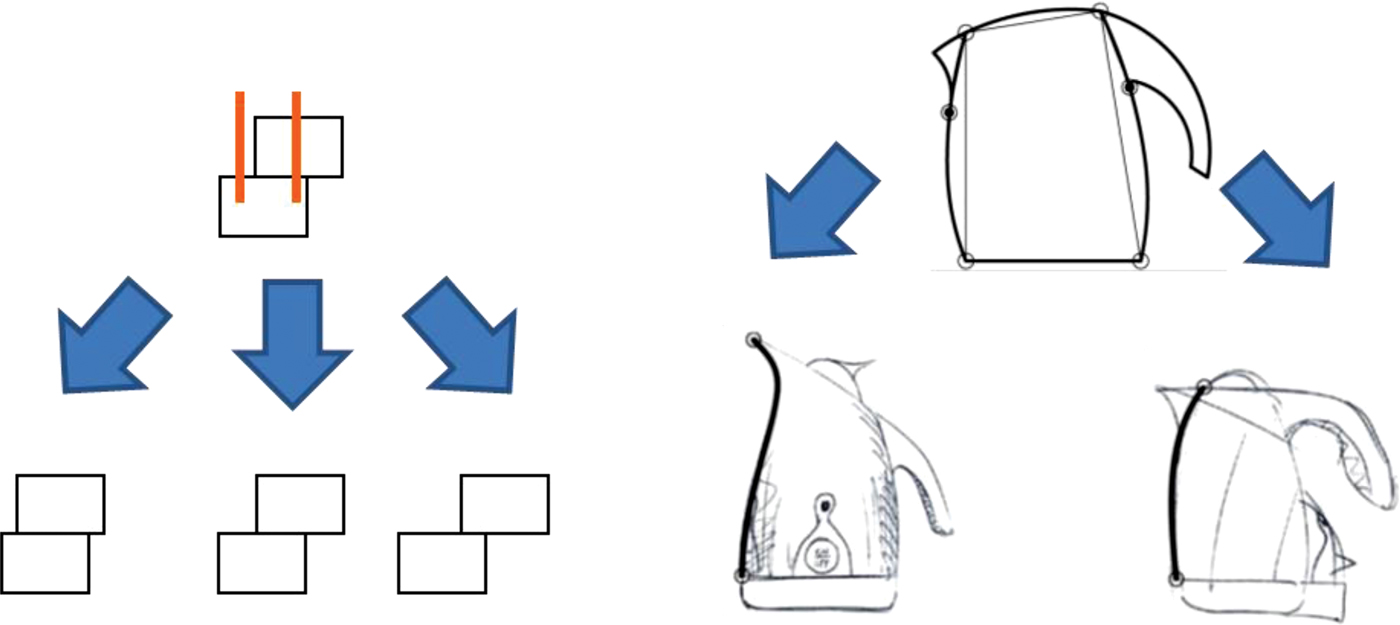
Designers typically sketch imprecise ideas with qualitative elements, covering a space of possible designs, with an imprecise mapping from the idea to the sketch. Such a design space is difficult to express in a pictorial form. However, designers often draw a typical instance or a range of instances, which can be typical of subcategories, that is, the “centers” referred to above, or can mark the edges of the design space that they represent. This strategy for indicating spaces can be applied equally to rough sketches and precise representations. The left side of Figure 3 shows two idealized sketches, right and left, which indicate extremes, and a central representative sketch for a simple spatial relation between two rectangles; the right side of Figure 3 shows two sketches for a range of kettle shapes that might represent the ends of the range of designs to be considered at a specific stage in the design process, with a representative idealized sketch that lies between these.
Sketch and its (left) intended scope of vagueness and (right) extreme and mean sketches (Prats et al., Reference Prats, Earl, Garner and Jowers2006). [A color version of this figure can be viewed online at http://journals.cambridge.org/aie]
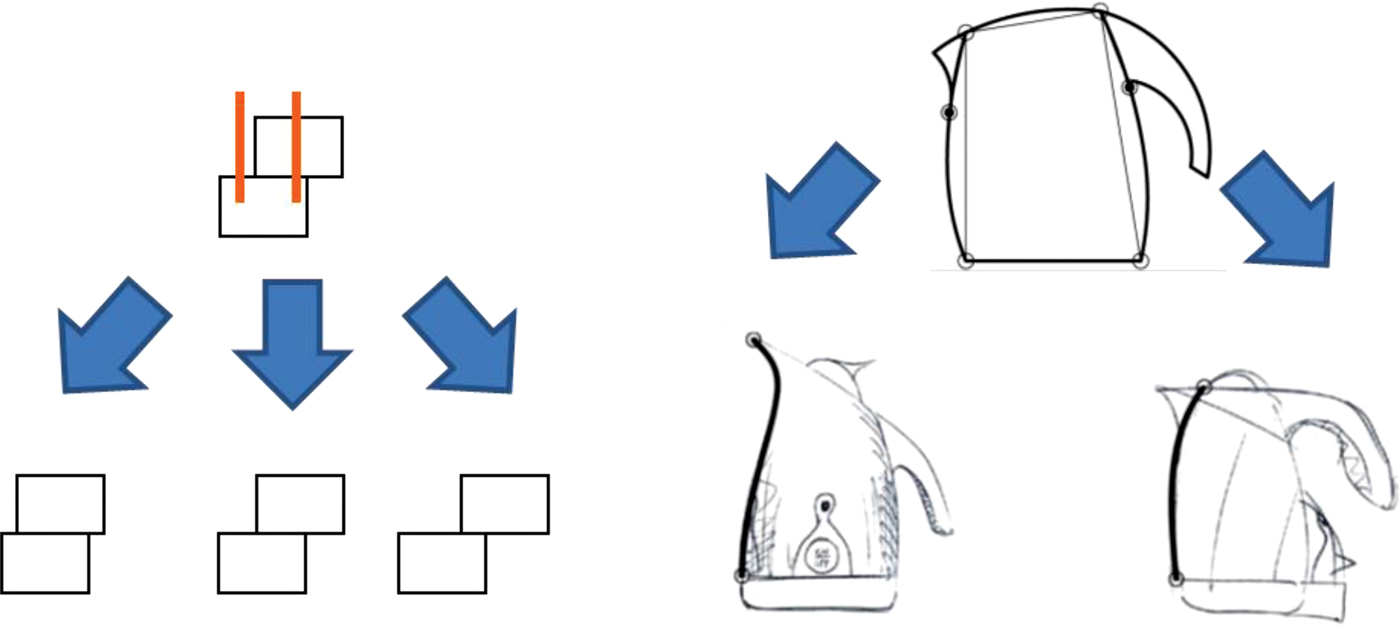
As design sketches are necessarily imprecise, they introduce ambiguity and inaccuracy into the transmission of meaning. Designers sketch their mental concepts with varying degrees of accuracy according to their own conventions and with a particular space of possible designs in mind. However, the sketches are often interpreted according to a viewer's conventions yielding a different space of possible designs.
A sketch may be ambiguous; that is, it affords alternative symbolic interpretations. This can happen when a sketch element is interpreted as a roughly drawn instance of one symbol or a more precisely drawn instance of another (such as a flared sleeve); is on a fuzzy boundary between two category symbols (for instance, a slightly flared sleeve); when marks can be grouped into symbols in different ways; or when the sketch is self-contradictory or when alternative notational conventions are in conflict (a common problem in interpreting sketches of three-dimensional objects). A sketch element can be quantitatively ambiguous when it is unclear whether it is purely a category symbol (e.g., enclosed space) or has a meaningful shape (e.g., a rectangular room in an architectural plan) or how wide the range of its geometric meaning should be in terms of parametric and geometric variation. The degree of apparent roughness in the sketch is a powerful signal of how wide the interpretation space should be, but the recipients might not easily distinguish between intentional roughness and poor drawing. This is especially the case for nonexperts, perhaps stakeholders, consulted at early design stages on design intentions that are represented by designers (and others) as sketches. Roughness appears to bias interpretation (for better or worse) toward simple shapes. Ambiguity and imprecision are displayed to various degrees across many forms of sketching, leaving sketches open to varying interpretation. This openness indicates the provisional character of sketches that we will discuss next, particularly in relation to hand and computer sketching.
3.4. Provisionality
In nearly all design processes designers need ways to express provisional and skeletal design ideas to both themselves and others to explore ideas and advance tentative decisions. Hand-drawn sketches not only support the rapid expression of spatial ideas but also can suggest that these ideas are provisional and can be modified or retracted.
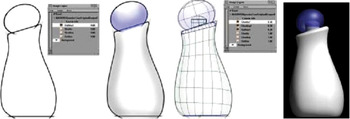
A constant theme in the Across Design workshops was concern with the way that younger members of the various design professions turn to computers too early in the design process, rather than working with pencil and paper. Figure 4 shows an example of computer sketching and representations from packaging design.
Sketch, computer sketch, and computer rendering. [A color version of this figure can be viewed online at http://journals.cambridge.org/aie]

At first this might be seen as an appeal to craft traditions. However, even design domains in which the computer itself is the traditional tool share this concern. Our software designer said that pencil and paper were essential to his work, and he was also concerned that this might be a generational effect.
Yes, very much a sketch. Obviously computers are very very important, but there's nothing better than the right pen and the right pad. And they have to be that soft pencil and you sit there and you smoke and … Well, we all have different ways of doing it. And you sit there and suddenly, and so, the younger designers we use don't do that, they use the computers and straight in 3-D. We all do it differently. (Product Designer)
Hand sketches have qualities that computer sketches do not have. They are easier to share and easier to grasp by others.
Sketching is crucial, and sometimes computer work is too private, because when you are sketching you become vulnerable. I've brought some sketches . . . They are just terrible things. (Architect)
A sketch does not have to be polished, yet it can have detail where a computer model would not have it.
And they are primitive but somehow there's detail there. You can just see three people, nobody else can see that. It's your own little reference. (Product Designer)
In many cases, the computer was seen as a device that destroys uncertainty and provisionality. A sketch maintains its provisional quality where a computer model looks more final, therefore conveying that the design might be more finalized than it really is. To recapture this uncertainty and provisionality, our graphic designer said that it was necessary to create many small pencil sketches, rather than turning too early to the computer, which she believed militated against creative work from her own graphic design students.
4. FORMALITY IN SKETCHES
The focus of analysis of the different types of visual and nonvisual sketches is the degree of formality that they have or imply. To develop a framework for analysis we need to interpret the concept of formality itself and identify relevant aspects in the context of sketches.
4.1. On the idea of formality
A formal representation is one for which we can say definitive things about its meaning, that is, that there is a definite correspondence between the representation and what the representation means. Formality is a crucial notion for mathematics, logic, and computer science. The same word is also used in nonmathematical contexts to describe a crucial notion for understanding social behavior and social situations. In the fields and situations where the idea of formality matters we have a reasonably good intuitive understanding of the word, but giving it an accurate and rigorous definition is trickier. Heylighen (Reference Heylighen1999), who is concerned with the formality of theories and models in science, characterizes the formality of an expression as invariance of meaning under changes of context, arguing that this can never be complete and that it depends on the reader interpreting the expression and the situation the reader is in. Here we aim for a provisional working definition of the formality of a representation that we can use to characterize the degree of formality of a sketch. This extends the approach initially explored in Blackwell et al. (Reference Blackwell, Church, Plimmer, Gray, Plimmer and Hammond2008).
In mathematics, what we want is to take some information expressed as a combination of symbols in a particular system of notation and apply a deterministic repeatable procedure to it to construct some new information and be absolutely certain that the new information is true whenever the original information is true. A formal system is, in essence, one that allows people, or machines, to do this. Mathematics and formal logic from Aristotle onward has developed increasingly more complex procedures for making guaranteed-correct inferences just from the symbols that state precisely defined relationships between other symbols, regardless of the meanings given to any symbols that refer to the world beyond the symbol system. However, we want to use mathematical symbol combinations to describe situations in the real world, and use mathematical symbol manipulation to learn new things about the world, by giving meanings to the symbols in our symbol combinations. For some purposes formal representations are not formal enough: formal semantics is the discipline and set of methods for defining mathematically which situations do and do not fit symbolic descriptions in formal systems.
The notion of formality that concerns us when we are putting on our gowns for a graduation ceremony seems at first sight to be rather distantly related. However, what makes a social event formal are strict rules and procedures that govern who does what when. For ceremonies like graduations, actions following these procedures create and transform meaning generating new social facts (such as a student being granted a degree and becoming a graduate). The essence of a formal occasion is that the important elements of the actions of the participants, and the meaning those actions are interpreted as having, do not depend on the identity of the people fulfilling particular roles, only on their meeting objectively defined criteria to be eligible to fulfill the roles. Scope for individuality within the rules is confined to actions that do not materially affect the creation of social facts. More mundane social situations and the behavior that is appropriate in them vary in how they are seen as formal or informal (see Morand, Reference Morand1995, who is concerned with the formality of working environments); more formal situations are characterized by defined and therefore learnable codes of behavior and by impersonality (the norm that good performance of a role should not be influenced by private opinions or private friendship, see Weber, Reference Weber, Henderson and Parsons1947) and are thus less dependent on the personal relationships between the participants.
What these notions of formality have in common is (a) that the syntactic rules governing the arrangement of the elements of the situation are crucial for the meaning and acceptability of the situation, (b) that the nature and roles of the elements of the situation are defined by the rules, (c) as is the set of possible actions and new situations that they may lead to, (d) the application of the rules is deterministic and does not vary according to who is interpreting them, and (e) that the set of rules is agreed and treated as objectively true by the community of users of or participants in the formal systems. (This characterization is skating very lightly over some deep issues in both sociology and the philosophy of mathematics.)
Formality is not a property of a representation or situation alone. It is a property of the relationship between the set of representations that can be expressed in the formalism and their meanings; this relationship assumes the competence in understanding and manipulating the representations assumed within a community of practice, such as logicians or control engineers. Different people with different competences may use and understand symbols or actions in different ways.
4.2. Sketches: Degrees of informality
Sketches are clearly not formal representations. There is probably no representation used by designers that is formal in a sense that would satisfy a strict mathematical definition; however, design representations do vary in their degree of formality or informality. We can identify in our design sketch examples cases in which mathematically formal properties do not apply to sketches:
• The sketch may not be reducible to a set of discrete symbols.
• The relative positions of the symbols may not have a defined syntax.
• There may not be a single meaning of the sketch.
• The meaning may not be describable symbolically.
• There may not be a single relation between the sketch and its meaning.
• There may not be a proof procedure for determining whether a sketch and meaning correspond.
Defining formality by mathematicians' criteria will not meet our needs: it is one extreme on a continuum that we want to explore. As an approach to a provisional working definition of formality, we can view it as a set of attributes that representations may possess, or possess to a greater degree than others. We do not have a complete set of attributes, but the following are crucial to our view of formality:
• a set of deterministic rules governing the mapping between a representation and its meaning and
• agreement on the set of rules within a community of practice.
4.3. Interpretation of formality
How is the interpretation of the representation related to the intention with which the representation was created? In a philosophy of language or semiotic context, we might refer to the overall conjunction of intention and interpretation in a representation as its “meaning” or constituting a process of “semiosis.” Sketches drawn collaboratively or given to others comprise parts of speech acts: efforts at communication intended to change others' beliefs and actions in particular ways. [Speech act theory (see Searle, Reference Searle1969) is concerned with what utterances do, and the relationship between their ostensible meanings and their purposes; Hisarciklar & Boujut (Reference Hisarciklilar and Boujut2009), argue that communication through annotations to design representations depends on the correct recognition of annotation acts.] Moreover, the formal meaning might not be the whole meaning: images of all sorts suggest connotations by association as well as imply by depiction (a lot of moodboards function primarily through connotation). This is particularly an issue in the interpretation of sketches drawn with CAD systems, where connotations of provisionality will not be picked up by the machine or be obvious to another human, but might be part of the designer's intention. A further conjunction of intention and interpretation that is not straightforwardly communicative is the case in which a designer is making a representation purely for her own use (e.g., as an external representation or thinking tool).
As the formality and our perception of it depends on the role that a sketch performs in the design process, we will now consider the different roles of sketches in detail.
5. SKETCHES TO CREATE DESIGNS
Sketches, as marks on paper in various degrees of refinement, have multiple roles in the design processes. They are a means to generate or communicate ideas not only about the product but also about the process itself. Some designers use sketches of design plans to do this, as illustrated by this web designer:
So, these steps in our phases, they came about initially at the planning workshop, I have a piece of paper somewhere where I sketched them by hand.
Here we will concentrate on sketches of products, where the same sketch can play multiple roles. In many design processes all these roles of sketches occur, although some are apparently missing in certain disciplines. In the following sections, we highlight several of these roles, summarizing previous research, followed by findings from our analysis of informants' contributions in Across Design.
5.1. The process of idea generation and recording
Sketches play an important role in visualizing and capturing ideas during early stages of the design process, not only when designers work alone but also in joint designing, when designers often draw on the same sheet of paper and can reinterpret each other's marks.
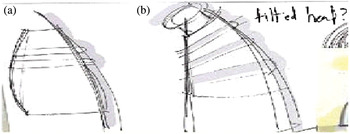
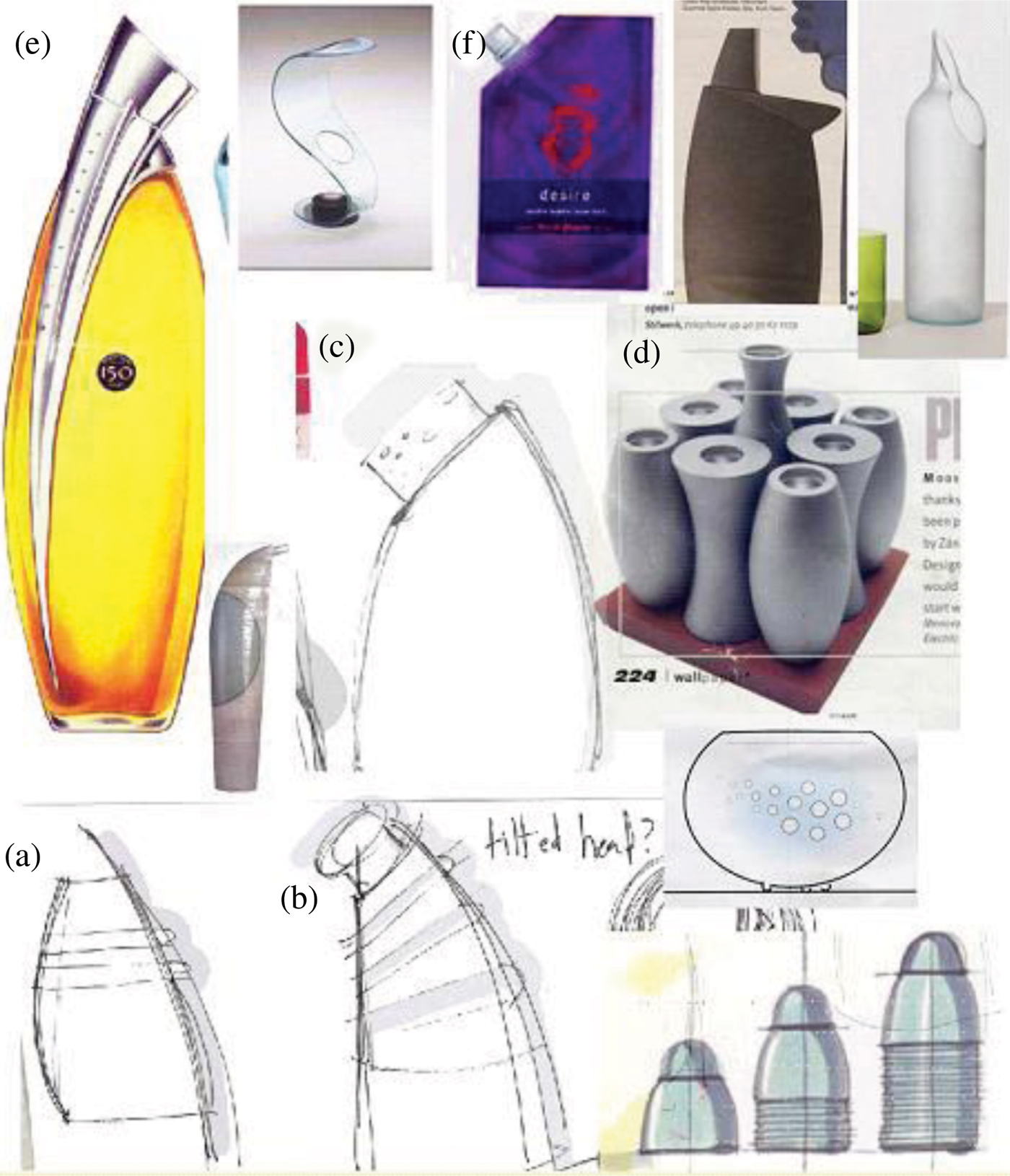
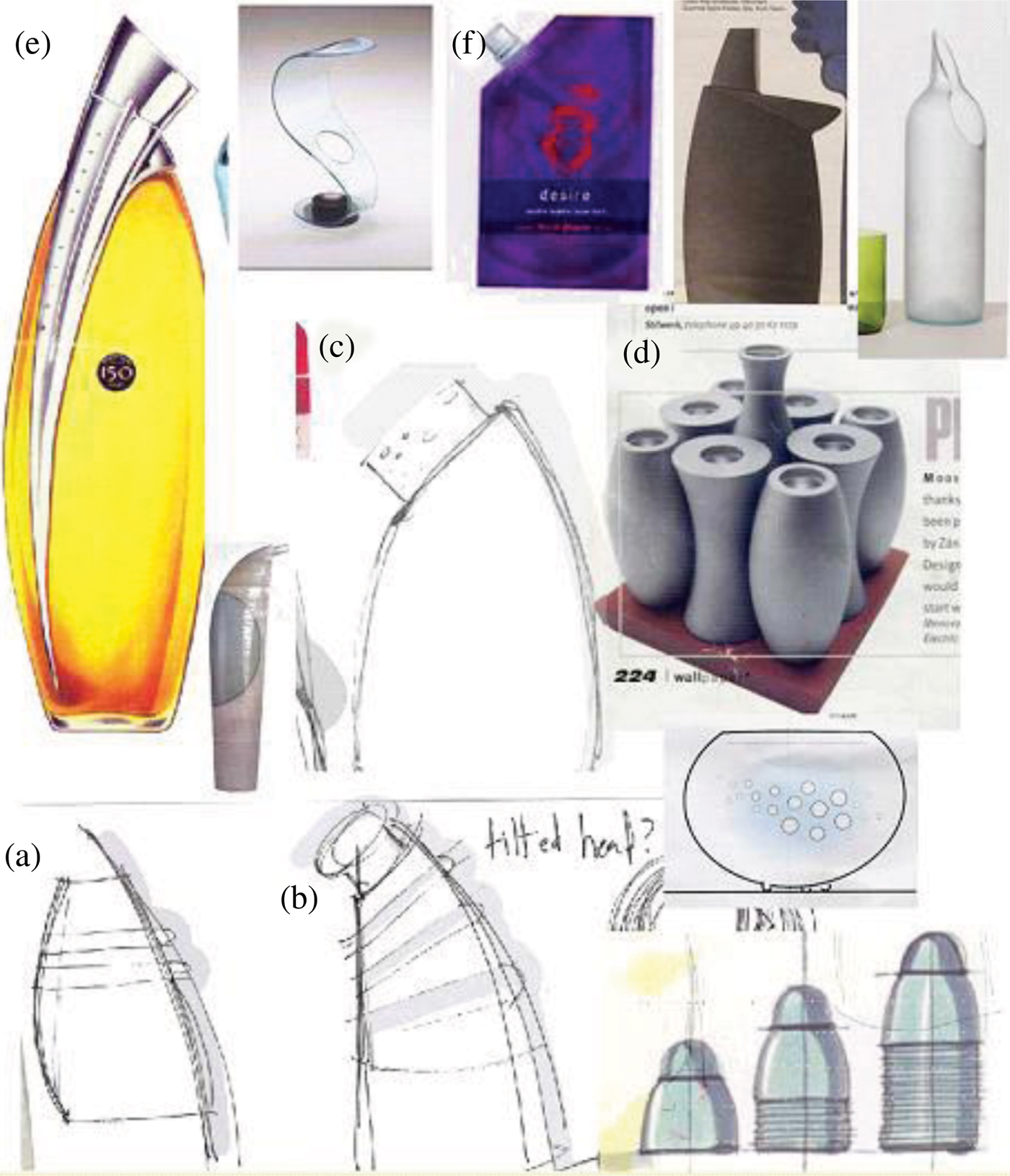
These sketches are often done very rapidly and not worked out in detail, but they enable designers to get a feeling for the design space and to compare and evaluate their own ideas. Figure 5 shows an example of such a rough sketch, presented as part of a mood board. In the illustration many lines are drawn over multiple times in proximity to indicate a range of potential solutions and signal provisionally and lack of commitment. These rough sketches are informal in themselves and typically play an informal role as one of many on a path toward a final design. However, the example in Figure 5 plays a formal role in a moodboard to show options and illustrate a thinking process.
Example of a rough sketch, included as part of the moodboard in Figure 11. [A color version of this figure can be viewed online at http://journals.cambridge.org/aie]

As one of our product designers put it, at the beginning of the design process:
We really need to get familiar with the product and that's done through those visits but also through understanding the products and brainstorms. And we will then start to initiate it here, the initial sketch freehand, and come up with quite a lot of ideas in three dimensions, drawings and sketches with a bit of color on.
Another of our informants put the emphasis on capturing design ideas as they are developed through sketching. A senior jet engine engineer commented:
I am a great believer in sketching as well. I believe that sketching itself, not only is it able to capture the concepts, but it is also a way of being creative. Let your fingers do the thinking if you like. So I am a great believer—and I watch my guys when they are working, they do use sketching, and I am sure at the time they are being creative as well as recording.
In many instances it is difficult to draw a line between sketching to generate ideas and sketching to communicate these ideas. This is illustrated by the sketches in the moodboard in a later figure as well as the quote from the jet engine designer above. Designers need to record their ideas in order to develop them.
It has been noted in the past that introspective reports of mental imagery or “visual thinking” are correlated with personal assessments of creativity (Katz, Reference Katz and Yuille1983). It is not certain in which direction the causal relation lies for these reports. Several of our informants described their own sketches as evidence for us of creative originality (in the case of fashion designers), as evidence for clients of the creative nature of the work (in the case of a product designer), or as a strategy for rejuvenating creative practice within a large corporation (in the cases of aerospace, automotive design, and packaging design). In these latter cases, the sketch is seen as a generator of creativity, or possibly an outcome of creativity, with the exact status uncertain. This is the same ambiguity with respect to causal relationships that has been found in reports of mental imagery.
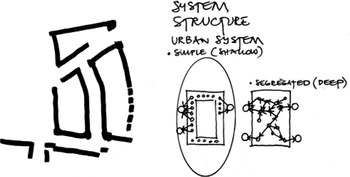
Therefore, to a peer group the formality can be quite low, when shapes are recognized as serving as qualitative symbols for a range of possibilities, whereas to an outsider this might not be evident and there may appear to be a higher degree of formality. Figure 6 illustrates the types of conventions that are often employed in sketches. Here an architectural sketch layout and a diagrammatic sketch with annotation are shown. The designers themselves or their colleagues know how to read a sketch, for example, dashed line on the left hand figure or the arrows on the right hand figure, but an outsider might not. These almost personal conversations can allow formal interpretation based on sketch conventions. An idea sketch does not appear formal; its form suggests loose interpretation; but the sketcher's peers, who have a more detailed knowledge of the graphic conventions it employs and the concepts it embodies may see it as a much more precise structure that clearly determines an exact reading. They know the scope of interpretation that the sketch affords and can interpret it in a quite formal way. The formality of interpretation seems to increase with familiarity and is greatest for self-communication and lowest for outsider communication.
Sketch of the arrangement of buildings.

5.2. Sketching beyond pictorial descriptions
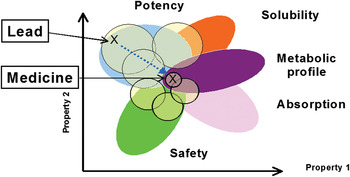
Thus far we have addressed pictorial sketches of two-dimensional or three-dimensional objects. However, designers often wish to express provisional properties of other concepts and objects. They generate sketches of abstract and nonphysical features or use other means of prototyping that have very sketchlike properties. Several of our informants work in domains where the relationship between the design parameters and the physical configuration of the product is extremely complex. In drug design, the relationship between the shape of a molecule and its physiological effects is hard to predict. In ice cream design, the microstructure of fats and emulsifiers contributing to mouth feel and visual appearance is also extremely subtle. In these domains, designers reported that they use an abstract multivariate design space to describe the desired properties of the end product. The drug designer specifically created sketches of desirable regions within these spaces (illustrated for explanation in Fig. 7). However, there is no direct relation between the abstract space and drawings of a molecule structure or micrographs of phase structure.
Computer drawn version of a problem space sketch, taken from our drug designer's presentation. [A color version of this figure can be viewed online at http://journals.cambridge.org/aie]

Similar visual representations of abstract design spaces are used in large organizations with highly quantified and parameterized iterative design processes such as aerospace and automotive design. Some of our informants were senior designers in these fields (vice president level), and their perspective on the design process was gradual change in a large number of performance parameters over successive model introductions. This multivariate space was more similar than might be expected to the property spaces considered in drug or food design, despite the physical dissimilarity between the products themselves. At this level of analysis, design managers make sketches of desirable regions within the abstract performance space that complement the sketches they might encounter presenting proposals for the physical form of new models.
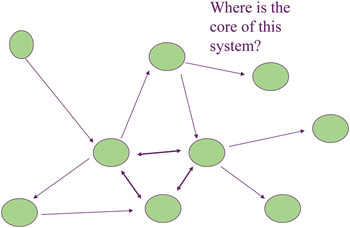
In the case of software design, the space is necessarily abstract. In these cases, it is configuration rather than form that is depicted and perceived in sketches. Our software designer described the way that interlinkages, when viewed within the Gestalt of an overall system design, can help the designer to reconceptualize the structural core of the design. Figure 8 shows a PowerPoint version of a bubble and stick diagram drawn by the software designer. Bubble and stick diagrams were used as standard representations in software development in the 1980s and early 1990s, but they have since been largely replaced with a set of more specific and formal diagramming conventions. However, this designer was pleased that this sketch formalism was completely free of prior semantic associations and continued using bubble and stick diagrams when they were no longer in fashion. He does not keep his sketches, as they are his personal ephemeral thinking aids.
When I'm designing software, I like to draw sequence diagrams with pencil and paper. . . . I couldn't find a piece of paper on my desk that didn't have a diagram on it.
These types of representations are sketchy in the sense that they are imprecise and tentative representations of aspects of the future product. They are indicative and invite a certain degree of interpretation. Like traditional sketches they can be put together quickly and invite multiple interpretations that for an individual or a team can increase understanding and insights into the product. There is a huge variation in the representations chosen for this purpose. The example in Figure 8 is a PowerPoint diagram. The software designer was referring to pen sketches on paper. In this case the formality of a sketch is obvious for the creator, but for the viewer it depends on an understanding of the conventions, in this case software engineering.
Bubble and stick diagram for software (reproduced by the designers as a PowerPoint slide). [A color version of this figure can be viewed online at http://journals.cambridge.org/aie]

Looking more generally at visualization of abstract properties, we observe that visualization depends critically on the domain and the particular representation used. Formality of intention, connotation, description, and interpretation can range from low to high across recipients, although tending to low for the designer's self-conversation where the sketch is aiding in determining the direction of design development rather than formulating precise prescriptions for product or process. As formality is a property of the mapping of the sketch to its meaning, in the case of abstract properties the formality depends on the implied formality of the meaning and the context in which it is deployed.
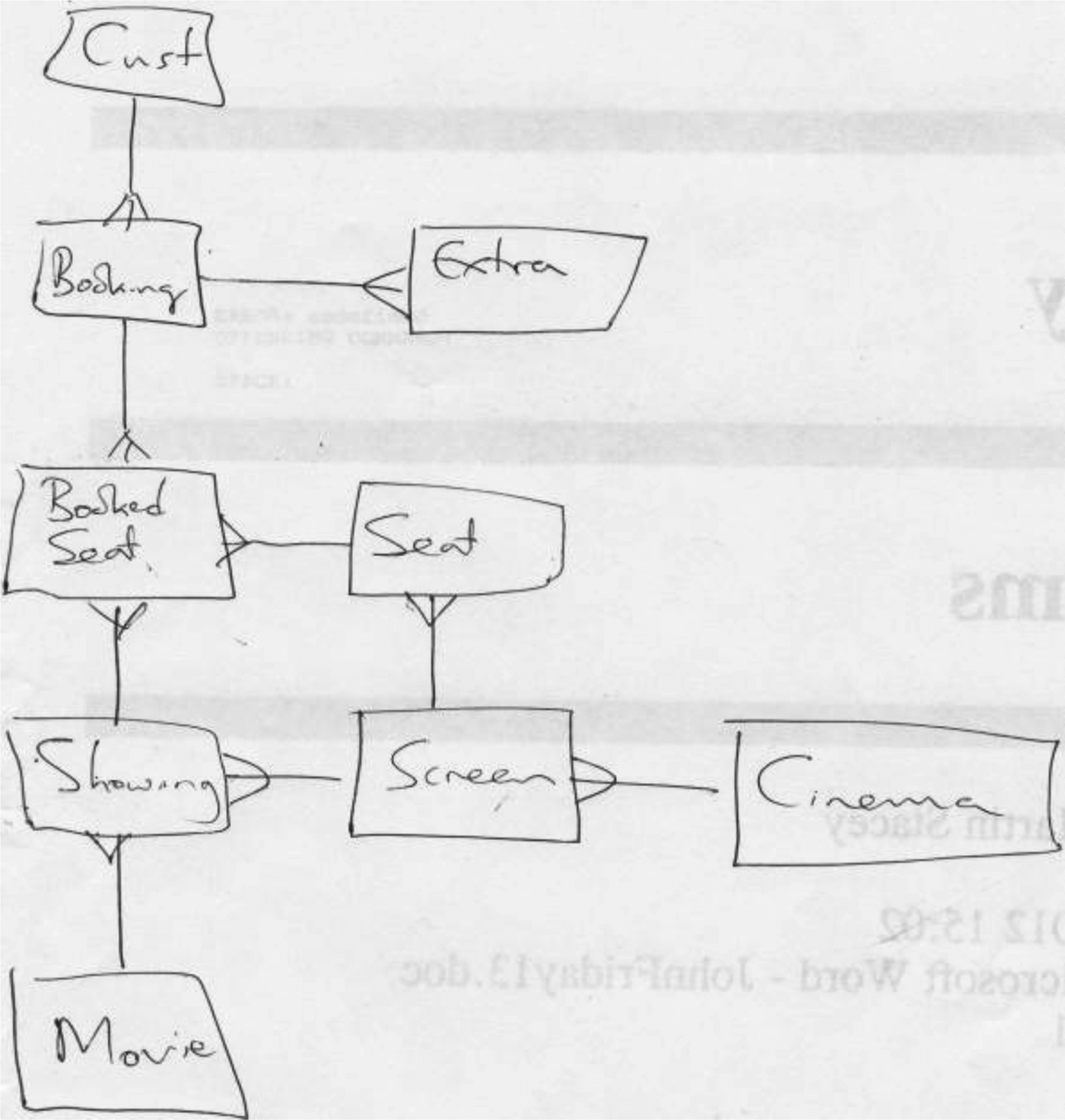
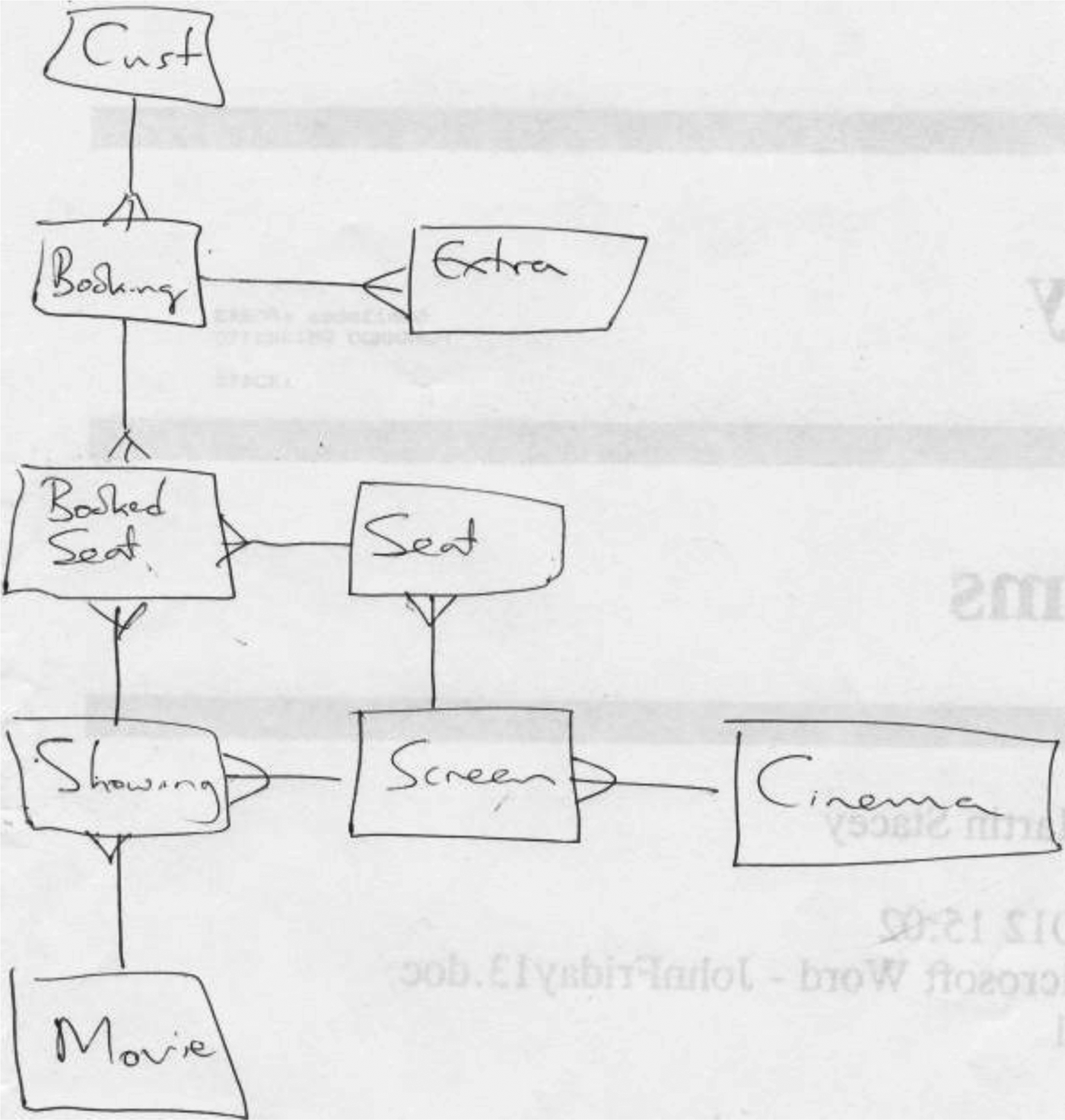
The software example illustrates another point. The informant was speaking here about his own programming days in the 1980s. In the meantime many more types of notation with defined meanings have appeared for diagramming aspects of software systems, and the set provided by UML is taught as the de facto standard. Symbolic conventions with standard semantics exist for the concepts for which he had used informal sketches. Some of these can be used for sketching: when software engineers think with precise concepts they need notations they can use quickly, but these can have an exact deterministic mapping to precisely defined concepts. Figure 9 shows an entity relationship diagram drawn for a student by one of the authors: it was a design sketch produced to record ideas as they were developed, but it was also an entirely formal if incomplete specification for a relational database.
Entity relationship diagram: a formal design sketch.
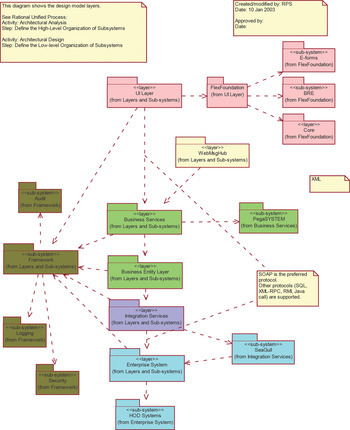
Diagrams are also generated at specific points of the software development process as part of a sequence of steps, giving them a formal context as well as formal elements. Computer-aided software engineering tools such as Rational Rose and Enterprise Architect provide drag and drop tools to draw the standard diagrams and turn diagrams directly into code. Figure 10 shows a software architecture model presented by a software designer working on a large information system project. His project uses computer tools to draw versions of the architecture, so that provisional and informal models are visually indistinguishable from final models apart from labels associated with the models.
Software architecture model. [A color version of this figure can be viewed online at http://journals.cambridge.org/aie]

5.3. A sketching language for dance
A recent study investigating exploratory design practices in the field of performing arts has allowed us to triangulate the role of formality in sketch representations beyond our main research corpus in the Across Design project. A case study resulted from a recent collaboration of two of the authors with the prominent choreographer Wayne McGregor and his company Random Dance. McGregor, who regularly applies scientific research in his creative process, had convened a workshop of leading cognitive scientists and artificial intelligence researchers to advise on the creation of a choreographic language agent (CLA). However, the final result was used by dancers, not as the expert advisory system initially envisaged by researchers but as a sketching tool for reasons that are highly instructive regarding the role of representations in creative processes (Church & Blackwell, Reference Church and Blackwell2011). The existing creative process at Random Dance is one of collaborative improvisation, from which McGregor selects and assembles the “raw material” of his stage works. He also requires all members of the company to maintain notebooks documenting the conceptual tasks via which they invent new types of movement. Although it is “notational,” the writing in notebooks kept by McGregor and his dancers has no resemblance to popular impressions of dance notation such as Laban or Benesh (deLahunta et al., Reference DeLahunta, McGregor and Blackwell2004). Instead, these are sketchbooks, supporting personal creative processes and communicating shared creative processes.
The CLA is a domain-specific visual end-user programming language (Ko et al., Reference Ko, Abraham, Beckwith, Blackwell, Burnett, Erwig, Lawrence, Lieberman, Myers, Rosson, Rothermel, Scaffidi, Shaw and Wiedenbeck2011) usable by dancers to define animations of arbitrary combinations of points and lines within a three-dimensional space. Implemented in Downie's field system (Downie, Reference Downie2008), the original intention was that CLA might display genuine intelligent “agency,” for example, offering dance suggestions or generating new movements. However, after a 3-day workshop where 10 dancers used the CLA prototype intensively in the dance studio, it is clear that they regarded it as a sketching system, not as a geometric modeler or generative tool. The best tool that a dancer has for creating models and generating ideas is his or her own body: contemporary dancers of the standard employed at Random Dance are highly skilled in proprioceptive control and recall (Holland et al., Reference Hollands, Wing and Daffertshofer2004). The purpose for which they used the CLA was instead to create three-dimensional structures that did not resemble bodies and did not directly specify body motion. Instead, the animations that they created represented problems that would require creative effort to translate into dance. It was essential that they were formal (in the sense that the computer would reliably render a given script in exactly the same way) but also informal (in the sense that they could be read in multiple interpretations, as the dancers developed actual body movements on the basis of the abstract geometries they saw on the screen). The system was a valuable creative tool, with capabilities far beyond those of the dancers' notebooks (e.g., the CLA sketches were three-dimensional, moving, editable, version controlled). Nevertheless, the system functioned as a computational notebook, not as an intelligent “agent.” The creativity, rather than being embedded in the system, was in the sketch interpretation processes that it facilitated.
In many ways, the informal aspects of this process were reinforced by the connotations of the visual design used in CLA. Rather than clearly distinguished monochrome or primary colors often used in CAD tools, the visual programming language of CLA is composed in shades of gray and subtle pastels. It uses curved lines instead of straight lines and annotations fade at the edges, rather than being sharply delineated by box boundaries. As a design tool case study, CLA demonstrates that technology can be successfully used for sketch purposes in social situations, if designed with this objective.
6. SKETCHES TO COMMUNICATE WITH OTHERS
Not all designers use sketches to generate ideas, but for many designers the most fundamental role of sketches is to communicate quickly with others, as expressed in this quote from one of our designers engaged in an architecture project.
When you draw you're trying to express something to somebody else. You're trying to reach across to someone else and to show them something. That quality of reaching across means that you can work with people who don't draw. I work with someone who draws really badly, awful. I'm embarrassed of his drawing, but he asks the right questions. He pushes the pen in a funny way and it's so ugly to look at, but his ideas are fantastic. So it's not about good sketching and bad sketching, it's about the quality of the vision to communicate and that's the crucial stage, of course you don't let them draw the picture for the client because that puts them off, but they know to share, is that true? There are lots of interesting different qualities of sharing in design. Very, very important.
Formality becomes both a powerful signifier and a potential source of problems when sketches are used in communication, because the creator and the recipient could interpret the formality differently.
6.1. Indicating spaces of possibilities
Figure 11 shows a moodboard with a combination of images that have played a role in the idea generation process or serve to express ideas that the designs invoke. The moodboard combines hand-drawn sketches and picture of other bottles with interesting features. The meaning of the moodboard arises from the combination and relation of individual sketches and pictures. The construction of a moodboard can be quite formal following conventions of arrangements. The viewer does not know about these origins. As authors and readers we are also outsiders in interpreting this moodboard. The moodboard is a combination of sketches, where the designers are exploring the shape of a detergent bottle, and images, for example, Figure 11d is a cutting from a magazine, used as a pointer to other objects with a similar shape and aesthetic. The designers are using objects here to define a potential space for designs (see Eckert & Stacey, Reference Eckert and Stacey2000). The sketches indicate the informal and tentative nature of the design intention at this early stage. The recipient needs to know the role that images of an object play in the design process at this stage to understand their implicit formality. The moodboard is a formal part of many design processes, where the research phase is summarized. In this case the peer group will be well versed in the conventions and understand what is implied. They understand which parts of the moodboard express design intention and which set its context. In contrast, an outsider such as a client or a member of a focus group might not understand all of these aspects. They might not recognize a moodboard as a formal document and pick up on the vagueness of the hand-drawn sketches. For them the moodboard would then have informal connotations as a set of images, because the images in themselves do not explicitly indicate what they are intended to communicate. For example, our interpretation would be that images Figure 11e points to the way the line is shaped and Figure 11f to a type of squeeze mechanism.
Moodboard for product design showing multiple sketches of the object and the sources of inspiration for it. Although we do not know the role for which the rough sketches were originally drawn, they give a good impression of an idea generation sketch in product design. [A color version of this figure can be viewed online at http://journals.cambridge.org/aie]
6.2. Consultation and concreteness
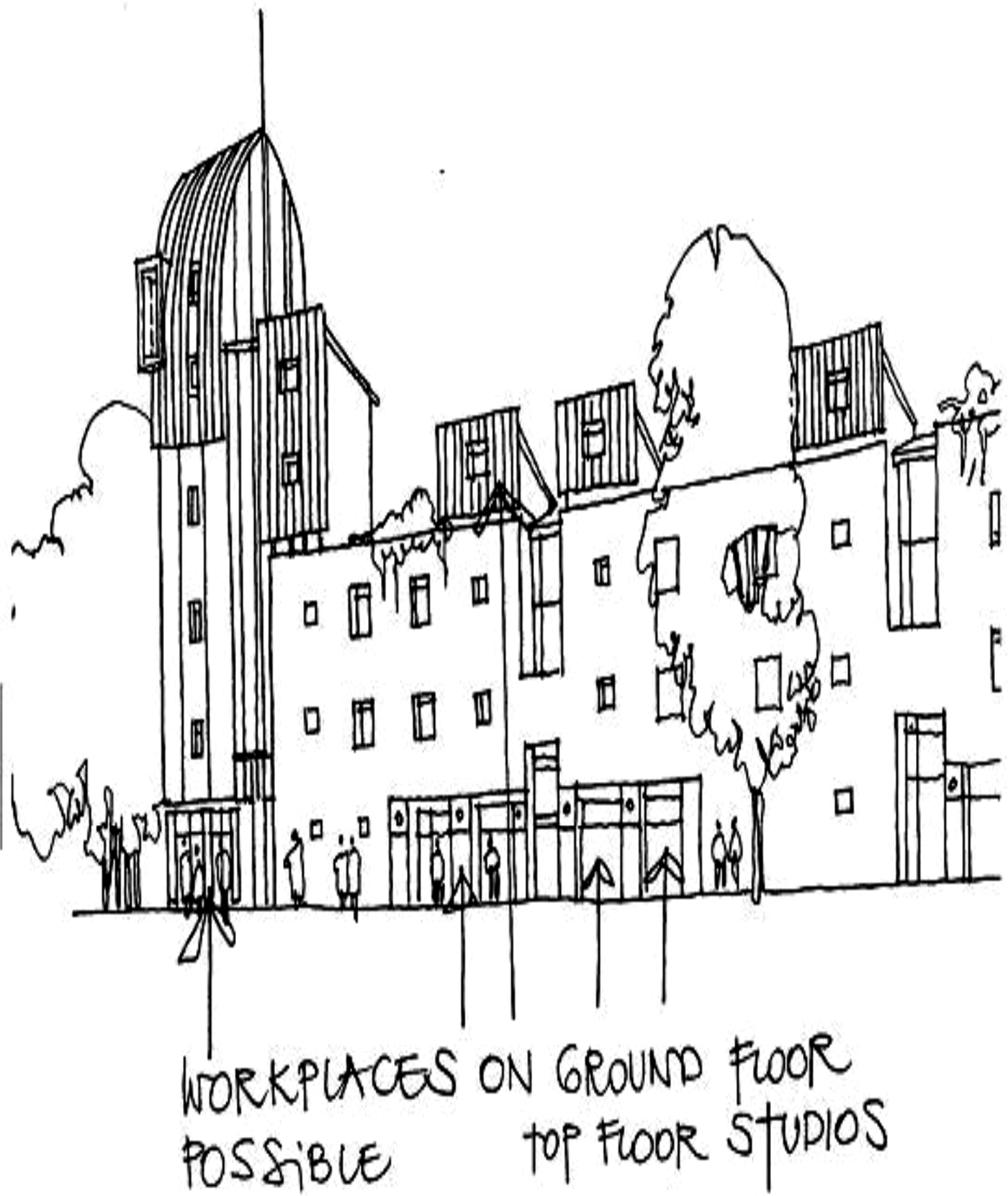
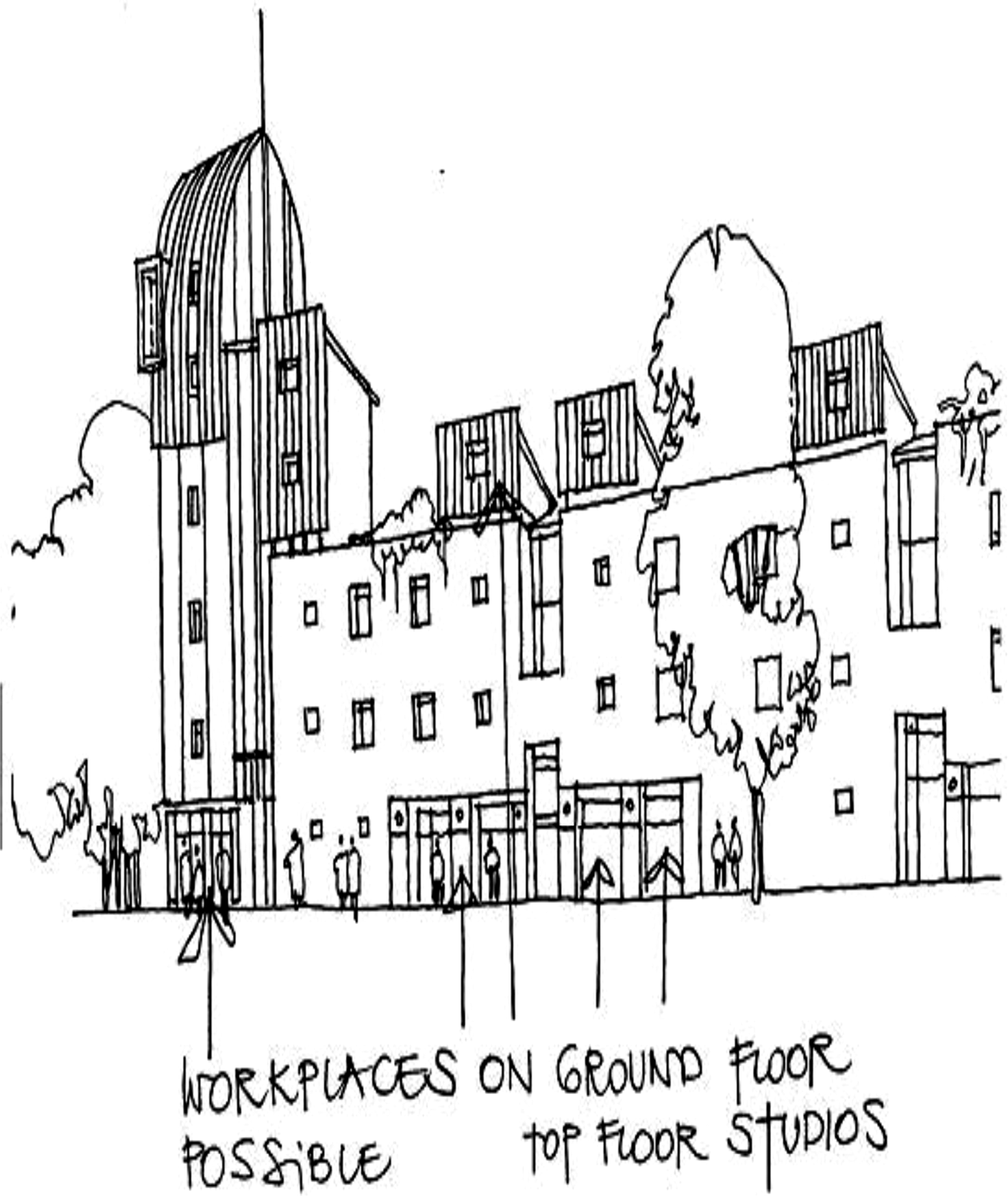
Sketches are often used as the intermediary objects in the communication between different groups of people. In the Across Design project, several designers were concerned that their clients or customers have difficulty in understanding formal product specifications, so they provide sketches and models to help achieve a concrete understanding of the design proposal. However, sketches can also help users relate to the product concept in their lives, as when an architect makes sketches of a development as it would appear at different seasons of the year, so that participants in a public consultation meeting can imagine how it would be manifest in their own lives (see Fig. 12).
Architectural sketch.
Architects often interact with official bodies, such as local councils, who have limited understanding of the process of designing buildings. Architects generate sketches for them throughout the design process to communicate, to establish credibility, and to document the process.
One of the things that happened—and I know this is very crucial in the design process, is we thought: ‘we won't draw anything yet’ but we actually we need to draw something really quickly—otherwise people don't believe you. It's no good drawing blobs and saying “it'll be lovely later.” They want to see what it's like right away. (Architect)
Here the architect used a sketch to convey meaning quickly and made use of the perceived informality of a sketch to avoid indicating an undue degree of commitment giving the impression that the design can still be influenced. [Macomber & Yang (Reference Macomber and Yang2011) found that members of the general public prefer clean realistic hand drawings (of product designs) to either rougher sketches or rendered CAD models; but liking is a separate issue from understanding the space of possibilities and degree of freedom to make changes.]
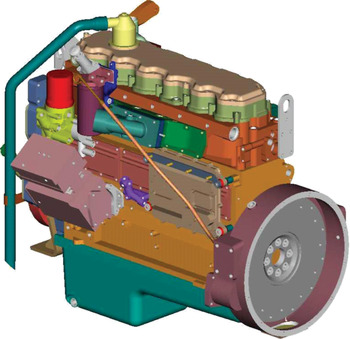
By contrast, the diesel engine designer commented that when they are discussing early ideas for solutions for option requests with customers, the new ideas are incorporated into CAD models of previous generations of the product. This provides a context for the new idea, serves to visualize how it would work, and assures the customers that the design is complete. Something that looks very much like a CAD model in a later figure could be used in the same way as a hands-drawn sketch (see Section 6.6).
In both cases the designers are deliberately using the perceived level of formality as a means to express an implicit message to the viewer. The engineering CAD models indicate that the engineers have the design problem under control and will develop a solution that can be integrated in a product. In the architecture case the visualization puts the architects in charge by moving from a discussion of needs and requirements to a concrete design, which, as the sketchiness indicates, can still be modified.
6.3. Consultation and fluidity
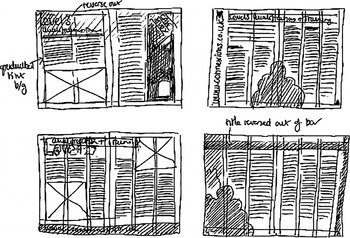
Our graphic designer used sketches to reinforce the fluidity of the design process when consulting with clients. She created pages of thumbnail-sized alternative renderings (produced using computer tools), bringing them to client meetings specifically so that she could “scribble” over her preparatory work. The packaging designer had experimented with this approach in a more formalized consultation process by bringing a visual designer to a market focus group and having that designer produce sketches “live” during the focus group meeting, so that participants directly appreciate the opportunity they have to modify the proposals being discussed. The graphic designer's sketches (Fig. 13) are informal, and this informality is clearly communicated through the process context.
Thumbnail sketches from a graphic designer.

6.4. Consultation and selection
Several designers in the Across Design workshops described the way that sketches can be used to engage customers or clients with the design process. Sketches play an important part in the selection of design concepts, and designers preselect their sketches so as to guide their customers to the designs that they favor. Our car designer cynically described the practice of some offices as a “snow job” in which a wide range of design sketches are displayed on the studio wall to clients who might be sufficiently impressed by creative diversity (or simply distracted by the colors) that they relax creative control. One of the product designers guided the customers strongly through his selection of sketches:
In our case, I tended to present maybe two or three designs, and I would normally know which one I wanted the client to buy and I had good reasons for wanting him to buy, and so I used that approach.
Another product designer was less restrictive and showed his customers a wide range of sketches:
We have hopefully created a vision for the product in terms of a lot of sketches. Clients choose one or two, which we then have to work on in more detail for them.
Even where the client is open-minded, it is possible to get them more engaged in the process (according to an industrial product designer) through the use of freehand sketches that illustrate a creative product vision. In this case the sketches play a particularly formal role in the design process, because they are presented in a selection meeting. The perceived level of formality can be a means to guide the recipients in their choices.
6.5. Joint designing
Designers routinely exchange sketches with their colleagues through the design process, as illustrated in a quote from a web designer:
The left-hand side shows the faxed sketches he sent to me. Once I had chosen one, middle black circle shows the worked-out image, also faxed, and then the last images show the final graphics.
In many cases this is part of a dual negotiation processes: negotiation for understanding and negotiation to reach agreement. If designers do not understand the sketch, they then discuss its meaning using gestures and speech to disambiguate the sketch (Bly, Reference Bly1988; Tang, Reference Tang1991). In doing so ideas are often developed further and designers gain new insights into the problem. Another form of negotiation occurs when people have different viewpoints that need to be resolved by a common compromise solution. Problems arise when different parties do not recognize that they have conflicting opinions and assume that others will be able to interpret design information as intended by its originator. Some of these issues are exemplified in the following quote from the graphic designer:
Questioner: “Do you find that people can interpret the sketches the way you would like them to interpret them or do you find that sometimes do they interpret them differently?”
People generally speaking don't understand drawings. If we want to redesign something then you have to then you get the right answers.
Questioner: But even your colleagues, would they?
If not, then they don't have a job. Well, I think when you work in a small team like that you understand each others' ways. With clients there are just so many decisions.
In the Across Design project, our software designer, our food designer, a fashion designer, and our architects referred to the development of a new language as part of the design process in interdisciplinary teams. Whereas designers working in teams need graphical conventions with both semantics and syntax, the definitional aspect of language development is in conflict with the pragmatics of sketching behavior. The meaning of graphical elements can change without warning as the designer reinterprets or reuses them (Neilson & Lee, Reference Neilson and Lee1994). Where sketches are often ambiguous with regard to possible interpretive syntax, the syntax of language is predetermined among native speakers. Word morphology determines function in a way that visual form need not, and lexical assignment must carry semantic associations in a way that abstract graphical elements can avoid. For these reasons, several designers stated that they tended to avoid verbalization during early stages of the creative process.
6.6. Communicating through CAD sketches: Modulating formality in the rhetoric of design
Black's (Reference Black1990) study of graphic design drew attention to the fact that design clients may be reluctant to criticize designs that look too finished. This is a well-known advantage of low-fidelity prototyping, which encourages users to offer feedback on designs that are clearly works in progress because they appear rough on the computer screen. This attribute of sketches has been described more generally by Bresciani et al. (Reference Bresciani, Blackwell and Eppler2008) as “Perceived Finishedness,” a generic usability dimension that can be chosen or adjusted in any visualization for collaborative work. An extreme solution to this problem is to take finished computational models and render them to look as though they have been created by hand, with uneven lines and approximate junctions. The results are “sketch renderers” that pretend to be unfinished, even though the underlying model could alternatively have been rendered using photorealistic ray tracing. Sketch renderers adjust the connotations of formality, without necessarily modifying the formality of the representation in any other respect.
In sketches for the designers' own use the intended formality and the perceived formality of the representations are the same, because the creator knows what level of formality he or she meant to imply. Within a peer group much of this can be covered by conventions familiar to the group. They know what degree of formality was intended. For outsiders the intended degree of formality in the sketch used for communication and the perceived degree of formality can differ widely. The degree of formality is not necessarily afforded by the representation and designers have their own reasons to represent ideas in a particular way.
The deliberate use of formality by designers in interacting with outsiders is illustrated by an example from diesel engine design, described by one of the engineer participants in the Across Design workshops in a follow-up interview and shown in Fig. 14. He had banned sketches from customer communication to avoid ambiguity and the appearance of provisionality in design handover. He instructed his designers to draw rough CAD models and use elements of past designs as placeholders for components that have not yet been designed. Diesel engines are mature products designed incrementally. However, new customers' requirements and changing legislation drive change and innovation. Customers often design their own products (off road vehicles in this case) in parallel with a new generation of engines. To facilitate this coordination of design processes, the design company shows the CAD sketches to their customers early in their design process, when many of the core components of the new engine generation are not yet finalized. They show the new components in the context of an existing design, so that the customers understand the role the new design plays in the product context. The chosen representation can appear highly formal to suggest finishedness and certainty about what is really an emerging and tentative design.
Engineering computer-aided design model. [A color version of this figure can be viewed online at http://journals.cambridge.org/aie]

This behavior can be seen across many different design domains where the rhetoric and associated representations tend to be formal and structured to suggest to customers that they are in control of their process. A critical implication of this perception of control is that customers may feel that they understand how to reduce risk. Artistic design domains, by contrast, like to suggest creativity and novelty and therefore often choose sketchy and informal looking representations. For example, the building in Fig. 12 could also be shown in a computer rendering with crisp lines, which would have looked much more formal but not invited the viewer to imagine or develop their own ideas around the sketch.
7. INTERPRETING MISMATCHES IN FORMALITY
The participants in a design process can view a sketch as being more or less formal in two ways: as an artifact playing a role in a social process and as an utterance or sequence of utterances conveying meaning in a conversation. Although the architects in our studies modulate the apparent formality of their sketches with an impressively sophisticated appreciation of the needs and expectations of their audience, designers we studied in other fields do not do this. They run into communication difficulties that stem at least partly from mismatches in how different participants and stakeholders in design processes interpret the formality of sketches. We contend that what the participants in design teams, especially people interacting through sketches and other documents across time and space, will benefit from a method for identifying and resolving such mismatches in expectations, along with an awareness of how to express and interpret uncertain and provisional proposals (see Stacey & Eckert, Reference Stacey and Eckert2003).
7.1. Dimensions of formality in sketches
As noted above, designers communicate through sketches with four types of readers: themselves; their peers in a professional community, who share professional training, sets of concepts, and sketch-reading skills; other participants in the design process; and outsiders. Communication with each reader involves the construction of different mappings between ideas and depictions that can have different degrees of formality.
Considering sketching as a kind of conversation with an intention that occurs in a context with connotations using a particular description language and being interpreted in a particular way, we arrive at the following four elements of formality for describing the nature of sketch representations, corresponding to four mappings from the sketch to aspects of its meaning. Because how people construct mappings between ideas and sketch elements depends on the knowledge and sketch-reading skills of the individual, all of these elements of formality are subject and situation dependent, not immutable intrinsic properties of the sketch itself.
• Formal intention: the extent to which there is a deterministic relationship between the sketcher's purpose and the representation the sketcher constructs. Intention encompasses both the aim to depict particular aspects of a design and to have the sketch understood as a particular kind of message creating beliefs, feelings, and intentions in the recipient, that is, as (or as part of) a speech act. (The intention may just be to depict a particular set of ideas so they can be reconstructed from the sketch later.) A high degree of formal intention requires a clear goal, which might be evoked by the requirements of the design process.
• Formal appearance: the extent to which a representation implies to the reader that it should be interpreted according to a strict application of socially agreed rules. This can be indicated by the representation itself or by the context in which it is situated. A representation can suggest formality through the medium by which it is generated or on which the marks are made, by the presence of notational elements belonging to standard formalisms, more subtle aspects of its appearance, such as careful drawing, or its cultural or contextual connotations.
• Formal description: the extent to which the representation has a determined exact context-independent mapping to a meaning. Particular types of representation follow a particular code specifying elements that are typically required for that type of representation and the relations these must have both with each other and their meanings. For example, the visual representation of this paper can certainly be described in terms of such formal elements. Each letter is clear and distinct, as are the words and their organization into sentences and paragraphs.
• Formal interpretation: a human recipient has many opportunities to interpret a representation according to different rules, possibly rules that the creator had not intended. This is the extent to which the representation is interpreted by the strict application of the conventions shared by a community of practice.
This allows us to analyze sketches in two dimensions: the types of recipient (self, peer, colleagues, outsiders) and the types of formality (Fig. 15). Few sketches are seen by all kinds of recipients, so that this matrix is rarely complete. There are many sketches that are created deliberately for a particular group of recipients.
We can draw another useful distinction, dividing each cell in Figure 15 along another dimension: between what the content of the sketch expresses through the mapping from depiction to meaning and its connotation. Put another way, this can be considered as the difference between the explicit inferences the reader can draw and what the sketch suggests by association. The power of association and suggestion is exploited by many moodboards that function largely through suggestion.
Framework for analysis of formality.

7.2. Identifying questions and issues for practice
It is difficult to measure formality along any of these four dimensions (intention, appearance, description, and interpretation) in any rigorous way, especially without a very tight and constraining definition of the criteria. However, a high degree of rigor in the analysis of how people use sketches is not needed to achieve usable practical results. Were it obtainable, it might be counterproductive. The primary aim of the consideration of the formality of sketches presented in this paper is finding ways to improve design practice by sharing insights and good practice across design domains.
To improve communication within a design process, the practitioners need first to see if they have a problem that can be ameliorated by a better understanding of how to communicate and then negotiate a clearer shared view with their colleagues of how to exchange ideas effectively. This involves discussion and negotiation on how they use representations. The final contribution of this paper is to propose some questions and issues that might be help to improve practice.
What are the types of sketches and other representations of design information used in the process?
For each type of representation: Who creates it and modifies it? Who are its primary recipients? Who else gets to see it? What official and unofficial roles does it play in the design process? How exactly and formally are these roles specified? How much do these roles vary according to circumstances? How far do the different stakeholders see it as having a formal purpose?
For everyone who creates or modifies a representation: What are the intended purposes of the representation? (Do different parts of the representation have different purposes?) Do the creators do different things for different recipients? Why? How exact and deterministic is the relationship between the creator's intention and the form of the representation? What influences this?
For each type of recipient of a representation (including the creator): When do people rely on it to give them information that they need? What information do they need to get out of it? How does the information or lack of it in the representation influence what people do? How can the producer control what is in the representation, or left out, to influence what people do with it, or how they interact with their colleagues?
For each type of component of the representation, for each recipient: What information about the design does it depict? How far does the exact form of the representation determine the exact form of the design? How much does this depend on context? How exact is the information? How strongly committed is the creator to the ideas represented? How clear is the level of commitment, and how is it signaled? How strongly does the representation itself indicate that it should be strictly and exactly interpreted? How far is it possible to interpret the representation as meaning something else? How far do the representations convey meaning by connotation rather than explicit content and implication?
Such a shared view of how to communicate effectively via sketches and other graphical representations may include an awareness of how to alter both their real and their apparent formality to signal degrees of uncertainty and degrees of provisionality and commitment.
8. CONCLUSIONS
This paper has drawn on several sources and studies of design processes. In two respects it brings a novel point of view to sketching research. First, it considers a wide range of design domains and a corresponding spectrum of types, properties, and roles of sketches. The comparative nature of this research, which has been reported elsewhere (Blackwell et al., Reference Blackwell, Eckert, Bucciarelli and Earl2009; Eckert et al., Reference Eckert, Blackwell, Bucciarelli and Earl2010), means that sketches have been examined generically in terms of types, properties, and roles, rather than through domain dependent characteristics.
The ability to modulate the formality of sketches to the role in which they are deployed varies significantly with domains. The architects were most conscious of how a particular recipient would react to a sketch and generated specific sketches and renditions for different audiences at different points in a process, in addition to sketches they create to develop their own ideas and sketches to share with their peer group. Other domains have a much less rich set of possible representations, where a sketch is the only representation before a computer model of the final thing is generated. Both graphic designers and knitwear designers use hand-drawn sketches to express their ideas to other people. Although these look very informal, they play formal roles and are created with formal intentions. This apparent informality is often mistaken for a lack of commitment to a design idea. Mechanical engineers and software developers sketch to generate ideas, but they communicate largely through representations in standard formalisms that express particular types of information, but allow little modulation of formality. Moreover, software engineers frequently sketch in well-defined formalisms in the course of idea generation.
Sketch representations do many things. They play many roles in design processes, from ephemeral notes to official functions in standard procedures. They express intent; they connote beyond intent; they describe by using specific elements in “language type” formations; they connote beyond what they explicitly say; they signal how they should be interpreted; and finally they impart meaning by how they are read in more or less defined ways by the variety of individuals who see them according to their differing knowledge of the individual design, the components and concepts used in the field, and the graphic conventions used to depict them.
In this paper we examine what appears to be one particular property of sketches, namely, their degree of formality, and discriminate along the four dimensions of formality referred to above, intention, appearance, description, and interpretation, arguing that they correspond to the formality of different types of mapping between meaning and depiction. Formality and perceptions of formality in sketches are inherently problematic, because sketches often elude formal description, they are constructed and discarded, and yet they can retain an iconic quality of meaning that continues to communicate about a design long after the design process has finished. Work remains to be done on developing a conception of formality subtle and differentiated enough to do justice to the complex and fluid meanings designers see and express through sketches.
Nonetheless, our provisional analysis suggests how design practitioners can examine the formality of their own representations to negotiate a clearer shared understanding of how to express skeletal, provisional, and uncertain design ideas while avoiding misunderstandings.
ACKNOWLEDGMENTS
The Across Design project was funded by the Cambridge MIT Institute (nmzh/013). We thank all of the participants in the Across Design workshops and our other informants for giving us their time with such productive enthusiasm. We also thank our colleagues at MIT and the University of Cambridge who participated in the Across Design project for many stimulating conversations. Blackwell and Church wish to thank their collaborators at Random Dance R-Research: Scott deLahunta, Marc Downie, and Nick Rothwell; and Wayne McGregor, the dancers, and staff of Random Dance.
Claudia Eckert is a Senior Lecturer in design at the Open University, the British distance education university, where she also carried out her doctoral research on design processes in the knitwear industry, before spending nearly 10 years at the University of Cambridge Engineering Design Centre. Her research interests are in understanding and supporting design processes, and in particular engineering change and process planning. She is also working on comparisons between design domains.
Alan Blackwell is a Reader in interdisciplinary design at the University of Cambridge Computer Laboratory, having prior qualifications in professional engineering, computing, and experimental psychology. He has 12 years of experience in designing industrial systems and electronic and software products. He has taught design courses and supervised postgraduate design research students in computing, architecture, psychology, languages, music, and engineering. He is a fellow of Darwin College.
Martin Stacey is a Senior Lecturer in computer science at De Montfort University in Leicester, UK. He studied psychology at Oxford (where he was a contemporary of Fox Mulder) and Carnegie Mellon before obtaining a PhD in artificial intel1igence at the University of Aberdeen and doing postdoctoral research on design support systems at The Open University. Since 1994 his research has focused on design thinking, design processes, and computer support for designers.
Chris Earl has been Professor of Engineering Design at The Open University since 2000, with main research interests in generative design, models of design processes and comparisons across design domains. Before that he held positions at Newcastle University, affiliated to the Engineering Design Centre in the Faculty of Engineering, where his research concentrated on the design and manufacture processes for large, complex, engineering to order products, particularly their planning and scheduling under uncertainty. Chris has a PhD in design from the Open University and works closely with a wide range of research groups in design and shape computation worldwide.
Luke Church is completing a PhD at the University of Cambridge Computer Laboratory, working with Alan Blackwell. He is investigating aesthetic and ethical approaches to programming languages and programming-like computational experiences. His overall concerns are with very large-scale computation experiences and with emergence as a property of computer systems.