


Health systems face a common broad policy challenge: how to deliver high-quality care at affordable cost in an equitable way. Reforms have proliferated in recent years to meet this challenge. They are defined as “deliberate changes to the structures and processes of public sector organisations with the objective of getting them (in some sense) to run better” (Pollitt and Bouckaert, Reference Pollitt and Bouckaert2017: 2). However, despite persistent attempts at improvement, stasis appears pervasive in many systems (Coiera, Reference Coiera2011; Saltman and Cahn, Reference Saltman and Cahn2013) and most reforms are marked by uncertainties and ambiguities that trigger multiple cycles of change and adjustment (Hunter, Reference Hunter2011; Cloutier et al., Reference Cloutier, Denis, Langley and Lamothe2015; Molloy et al., Reference Molloy, Martin, Gardner and Leatherman2016). Observers consider that cyclical reforms and reorganisations will continue, responding to the frustrations of stakeholders, including the public, with system functioning and results (Klein, Reference Klein2019). Health systems in Canada are no exception to this pattern, with repeated reforms, conditioned by predominant ideologies, initiated in response to pressing contingencies (Flood et al., Reference Flood, Marchildon and Paech2018). A special issue of this journal in 2018 explored some of the policy choices confronting Canada, with lessons from comparable health systems. A number of options are now on the table at the national level that will need to contend with the particular terrain that has evolved through each province's distinct approach to reform. At this juncture, it seems necessary, if we are to understand potential future scenarios, to look more deeply into the provincial reform efforts that have shaped their current systems.
Objective of this paper
This paper describes and compares the strategies undertaken by governments in seven Canadian provinces over the last two decades to transform their health systems. This study is in line with recent attempts in various jurisdictions to better grasp the initiatives taken by publicly funded health systems to adapt to increasing demands as an essential starting point to figuring out how efforts might become more effective (Braithwaite et al., Reference Braithwaite, Matsuyama, Mannion, Johnson, Bates and Hughes2016; Molloy et al., Reference Molloy, Martin, Gardner and Leatherman2016; Forest and Martin, Reference Forest and Martin2018). Canada provides fertile ground for this type of study, as a federated state where the basic premise of universal health care is embedded at the federal level, but where each province has full responsibility for designing its health system.
Our study also follows in the path of earlier research by Lazar and colleagues on health reforms in Canada. In their book ‘Paradigm Freeze’ (2013), Lazar et al. explore policy issues in the domains of governance, financing, delivery and programme content and conclude that the ‘fundamentals’ of Medicare (physician autonomy, the requirement of first dollar coverage only for physician and hospital care) remained virtually unchanged (Lazar et al., Reference Lazar, Lavis, Church and Forest2013: 8). We agree that significant change with regards to the Medicare package has not occurred. Our interest in this paper is to explore the transformative capacity of provincial health systems within these constraints, focusing on efforts since the turn of the millennium. Transformative capacities refer to a set of resources, levers and practices mobilised to bring about significant change. This paper seeks to present a fine-grained look at the policy work of these sub-national jurisdictions – at their efforts to meet challenges and extract the maximum from the system within the federal framework. As Ivers, Brown and Detsky suggest, undertaking improvement efforts within the existing structures may be more realistic than relying on fundamental policy reform (Ivers et al., Reference Ivers, Brown and Detsky2018).
Within the natural laboratory Canada provides, we assess convergences and divergences in the strategies adopted in various provinces. This exercise seeks to better understand emerging opportunities and dilemmas for reformers. Our guiding questions are therefore: Where have provincial governments invested their reform efforts in the last 20 years? What strategies have they employed? What lessons can reformers draw from these experiences?
The time period we explore extends Lazar et al.'s study. While they focused on policy issues seen in grey literature reports of the late-1980s and reforms responding to these reports extending until about 2003, we focus on initiatives appearing since the turn of the millennium. This period is characterised by new investments and new pan-Canadian collaborative improvement capacities. As well (and Lazar et al. point this out in their final chapter), doubts were emerging in the early 21st century about the policy priorities of earlier reports: did regionalisation actually serve to cut costs? Was eliminating fee-for-service really necessary to engage physicians in new models of care? These questions suggest that provinces were looking for alternate strategies to improve health system functioning.
As we explored the scientific and grey literature of more recent reforms, we noted growing heterogeneity in strategies, in line with the “constant monitoring and adaptation to new contexts” required of complex systems such as health care (Best et al., Reference Best, Greenhalgh, Lewis, Saul, Carroll and Bitz2012: 432). Our research approach therefore aimed to arrive at an overall picture that included “the multitude of approaches used to secure change” (Levesque and Sutherland, Reference Levesque and Sutherland2017: 4). Our presentation of empirical material in this paper is intentionally descriptive, constructing ‘viable narratives’ (Marchildon, Reference Marchildon2018: 251) of the history of recent reform efforts. We define reforms as deliberate efforts undertaken by policymakers at the provincial level and look at ‘patterns in streams of decision-making’ (Mintzberg, Reference Mintzberg1979: 582) over 20 years. We then try to understand what these patterns tell us about the nature and purpose of reform. Mintzberg (Reference Mintzberg1985) used the notion of a pattern in a stream of decisions as a way to operationalise the idea of ‘strategy’. Importantly, strategies may also be ‘emergent’, developed somewhat enigmatically and at some point recognised by decision-makers as having potential to contribute to a given objective (Mintzberg and McHugh, Reference Mintzberg and McHugh1985: 257).
Methodology
Through longitudinal case studies in each of seven provinces, we identify strategies adopted by governments and priority objectives they sought to address. The time period (roughly 2000 to early 2019) was marked by the emergence of new preoccupations (i.e. chronic disease) and possibilities (i.e. information technology) and a growing emphasis on safety, quality and performance. Response to these challenges, shared by many countries, is coloured by particular characteristics of the Canadian system. Federal legislation, the Canada Health Act, establishes first-dollar coverage for medically necessary care provided by physicians or in hospital. Provinces have greater discretion over the provision of services that fall outside this definition but have an important impact on demand for hospital and physician services.
Data collection
We purposefully selected seven provinces – Nova Scotia, Québec, Ontario, Manitoba, Saskatchewan, Alberta and British Columbia – as jurisdictions that have developed distinctive reform initiatives over the past two decades. For example, in Ontario we saw a cascading quality drive embodied in the Excellent Care for All Act; Saskatchewan undertook the world's largest health care implementation of Lean improvement and Québec brought about a rapid and massive centralisation of governance. We employed a sequenced approach to develop and validate case narratives of reform in each province. Initial narratives were constructed based on peer-review (studies of various initiatives or policies) and grey literature (legislation, annual reports of Ministries, agencies and organisations, meeting minutes, press, etc.). Appendix 1 provides details on the search strategy for documents and evidence. These data on reform objectives and strategies were used to construct a preliminary version of case narratives and timelines for each province. Case narratives were then completed and validated through interviews with key informants in each province (54 interviews total). Interviews enabled us to incorporate an experience-based perspective of reforms, what Molloy et al. call ‘testimony’ from system leaders (Molloy et al., Reference Molloy, Martin, Gardner and Leatherman2016: 16). Interview participants were selected as actors (government, agency, organisation and provider) in formal executive positions that afford a particular perspective on reforms: how and why they came about, the response and role of different groups in implementation, and their perceived importance to system functioning. These comprehensive narratives of reform in each province constitute the database used in analysis. The interviews serve to validate and complete the document review, and are, in this way, incorporated into the results section. They are also valuable in explaining some of the findings, and therefore figure in the discussion section of the paper.
Data analysis
Capturing the emerging set of reform strategies called for an inductive and inclusive approach. We therefore began by tracing reform activities in a descriptive manner, without categorising them into policy domains (Lazar et al., Reference Lazar, Lavis, Church and Forest2013), system/person focus (Molloy et al., Reference Molloy, Martin, Gardner and Leatherman2016) or health system component (i.e. primary care) (Breton et al., Reference Breton, Gray, Sheridan, Shaw, Parsons, Wankah, Kenealy, Baker, Belzile, Couturier and Denis2017). Our basic question: What was done to change the health system? From this, we inductively identify what government hoped to achieve with a given initiative. The overall portrait reveals the range and combination of strategies employed in each province and, through this, the priority objectives that retained their attention. This comprehensive view distinguishes our study from comparative studies that tend to focus on a particular initiative across jurisdictions in relative isolation from other health system developments. We do not, in this paper, attempt to associate these efforts with system outcomes. Our hope is to nourish questioning around why a particular effort was made in one province and not another, and prompt exploration of new potential actions. We are conscious that recent elections in some provinces herald further policy changes in health care; however, we desist from anticipating the impact of early steps taken by these new governments in our analysis.
Results
Inductive content analysis pointed to five health system objectives that have, to varying degrees, preoccupied reformers at the provincial level in recent decades in these seven provinces. These are:
(1) Addressing chronic disease: Chronic diseases and conditions impose a growing burden on health systems. Prevention and chronic disease management to avoid exacerbations and hospitalisations are seen as promising ways to control costs and improve outcomes.
(2) Aligning health system actors and resources with provincial objectives: Provincial governments seek effective ways to: ‘increase decision-making leverage over important financial and/or clinical aspects of the health system’. Governance reforms can involve structural ‘formal transfer of responsibility’ as well as nonstructural strategies like new incentive systems (Jakubowski and Saltman, Reference Jakubowski and Saltman2013: 2).
(3) Shifting from hospital to community-based care (de-institutionalisation): Provinces have sought ways to de-institutionalise care provision, emphasising ‘community-based’ or ‘ambulatory’ care. Reducing hospitalisations, repeat admissions and length of stay have been key objectives.
(4) Integrating physicians into the system: In Canada's system, physicians operate as independent professionals paid by government. Physician integration aims at strengthening primary care, as well as reducing wait times for specialist physician services.
(5) Developing capacities for improvement: The past few decades have seen a shift in health policy in favour of a ‘contract’ model (Tuohy, Reference Tuohy2003: 202) that focuses on managing micro-level relationships between purchasers (i.e. government) and providers. Seminal reports (Baker and Norton, Reference Baker and Norton2004) saw quality and safety concerns as a priority. New capacity to assess needs, define problems and priorities, and take action for improvement become more important.
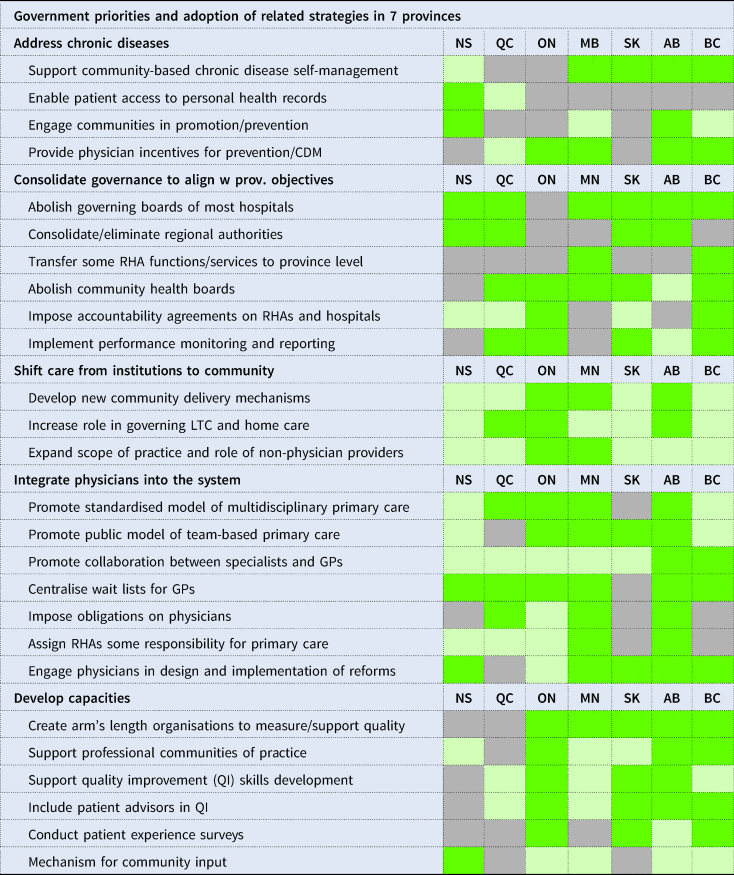
We then compare the strategies – expressed in policies, legislation, regulations and/or the creation and funding of initiatives and institutions, and validated by key informants – adopted to address these objectives. Our use of ‘strategies’ is equivalent to what Molloy et al. refer to as policy initiatives: “specific instruments or mechanisms through which policy levers (as a broad type of mechanism) exert challenge on the system to improve quality” (Molloy et al., Reference Molloy, Martin, Gardner and Leatherman2016: 28). Table 1 depicts the importance of different reform strategies within provincial efforts, classified under the five objectives mentioned above. It provides a visual summary of findings presented for each province in the sections below. Solid green indicates that the province has invested significant policy effort (legislation, creation or expansion of institutions and new impactful standards) in the strategy over the study period, and that it has been central to that province's pursuit of a given objective. Pale green indicates that the province has put limited (potentially due to resistance) or only very recent policy effort into a strategy. Grey shading indicates that the province has not invested significant effort into the strategy, or that earlier policy work has been reversed by, or neglected in, more recent reform strategies. Our focus is on the content of reformative templates that are clearly supported (mandate, funding and regulation) by government and have a significant impact on system configuration and/or the responsibilities of health system actors. We do not include ad-hoc or local/regional strategies. Appendix 2 details, as an example, the specific policy efforts in two provinces that inform Table 1. In the following sections, we first briefly summarise, for each province, the strategies and central tendencies in reform over the past two decades. Second, we compare provincial reform trajectories along two dimensions: the distribution of effort across these five objectives, and the diversity of strategies used to meet them. We conclude by identifying lessons learned for reformers.
Strategies implemented by provincial governments (through funding or legislation) to meet health system objectives

Patterns of reform strategies in seven provinces
Nova Scotia
As seen in Table 1, Nova Scotia used a relatively limited number of strategies to pursue two main objectives: addressing chronic disease and consolidating governance. Significant reform efforts focused on tackling very high rates of chronic disease with strategies to strengthen health promotion, including through Community Health Boards (CHB), and support for individual efforts with self-management programmes and, as of 2017, personal health records.
The province also saw a fairly untumultuous consolidation of governance: like the earlier transfer of governance from hospitals to district health authorities (1994), the consolidation in 2014 of regional governance structures into the Nova Scotia Health Authority (NHSA) was undertaken gradually. Key reasons for consolidation were administrative costs, role clarity (Auditor General of Nova Scotia, 2008; Fierlbeck, Reference Fierlbeck2019) and the failure of regionalisation to reduce urban/rural divides in health status and access. The province also took small steps to shift care out of institutions.
Only very recently has concerted effort been devoted to strengthening community-based care and integrating physicians into the system. Whereas the Primary Health Care Renewal plan of 2001 relied on voluntary initiatives, efforts starting in 2016–17 incentivised a Medical Home model and the integration of non-physicians. Physicians successfully resisted attempts to restrict their choice of practice setting. Capacity development focused mostly on recruitment and retention of health professionals, with capacity for performance improvement appearing as a greater priority following regional consolidation.
Overall, Nova Scotia undertook progressive changes to transform the health system, using extensive consultation with citizens and health system actors to guide governance and operational changes. More concerted and directive strategies were implemented following the consolidation of regional authorities.
Québec
Québec invested significant effort in a small number of strategies aimed primarily at consolidating governance and integrating physicians. What stands out in Table 1 is the number of strategies employed in other provinces that were not pursued over the past two decades in Québec, notably towards objectives of addressing chronic diseases, de-institutionalising care and developing capacities.
Following an earlier period of decentralised regional health authorities (RHA), reform strategies after 2000 involved consolidating governance with the objective of aligning actors and resources with provincial objectives, and shifting away from institutional care. A first wave of mergers in 2003 saw the Ministry appoint Board Chairs and CEOs of new consolidated structures and impose a standardised set of programmes and population-based responsibility (MSSS 2002; Bourque, Reference Bourque2009; Breton et al., Reference Breton, Lévesque, Pineault, Lamothe and Denis2009). In 2014–15, this was followed by dramatically greater consolidation under Bill 10, with the merger of 134 public health care organisations into 34 new establishments – Centre intégré (universitaire) de santé et de Services sociaux (CI(U)SSS) – with direct accountability to government. The challenge of de-institutionalising care delivery has been addressed primarily through this consolidation of governance, which is expected to facilitate resource shifting from hospital to community-based services.
To integrate physicians into the system, government promoted a standardised model of primary care – the Family Medicine Group (GMF) – after 2001, with more recent reforms increasing funding for GMFs to integrate non-physician providers, and using incentives and the threat of penalties to induce physician adherence (Bill 20, 2014). Physicians successfully contested the imposition of individual financial penalties, but regional enrolment targets remain.
The period between 2003 and 2015 saw some investment in capacity development, with the Health and Welfare Commissioner (CSBE) and Association of Health and Social Service Establishments (AQESSS) established to monitor and report on system performance and guide improvement work. Both were abolished after 2015 reforms. The CI(U)SSS were encouraged to pursue quality improvement projects with patient partners.
Québec's recent health system reforms were tumultuous and relied on structural governance changes, with a focus on increasing government control, reducing intra-provincial variation, integrating physicians within the system and developing structures and care pathways to integrate health and social services, both vertically and horizontally.
Ontario
Ontario's reform efforts addressed all five objectives with a wide variety of strategies and a focus on capacity development. As seen in Table 1, the approach to chronic diseases was physician-centric, with less concerted government attention to engaging communities and individuals in health promotion and disease management. Primary care physicians received financial incentives for specific and measurable prevention/disease management activities (Rosser et al., Reference Rosser, Colwill, Kasperski and Wilson2011).
The province invested significant and sustained policy effort after 2004 into increasing control over health care establishments, using strategies to cascade accountability agreements from the Ministry level down rather than alter governance structures. In contrast to other provinces, Ontario did not abolish independent hospital boards. The Excellent Care for All Act (ECFAA) of 2010 imposed accountability for wait times and other quality metrics, introduced reporting requirements and mandatory quality improvement plans on hospitals, linked executive compensation to quality and gradually (Key informant) introduced activity-based payments.
To de-institutionalise care, Ontario invested in new community-based delivery options such as nurse-practitioner (NP) clinics, mobile health services and telehealth.
Ontario adopted a voluntary, incentives-based approach to integrating physicians into the health system, promoting a Family Health Team (FHT) model starting in 2005. Family physicians formed group practices, received generous additional funding to incorporate other health providers and assumed ongoing care for rostered patients under a blended capitation model. Approval of new FHTs stalled after 2012, mainly for cost reasons (Rosser et al., Reference Rosser, Colwill, Kasperski and Wilson2011; Marchildon and Hutchison, Reference Marchildon and Hutchison2016). As regional bodies, Local Health Integration Networks (LHINs) created in 2006 were made responsible for coordinating care transitions and later (2016) for delivering home care and implementing Advanced HealthLinks, a voluntary care coordination model for high users.
Accountability models relied on significant investment in capacity for monitoring and improvement. The ECFAA created Health Quality Ontario to accelerate the uptake of best practices, building on existing informational capacities for monitoring and reporting system activity (Trypuc et al., Reference Trypuc, MacLeod and Hudson2006). As of 2013, the Ministry also required that FHTs, Community Health Centres and NP-run clinics report on performance.
Ontario's government developed reforms on a strong foundation of measurement and evidence, voluntary integration and practice improvement operating through the existing independent governance structures. However, mechanisms to ensure accountability and impose consequences on poor performers remained weak (Key informants). Structural governance changes (e.g. development of the LHINs) to promote system integration had difficulty exercising an appropriate role alongside the existing governance structures. Reforms relied heavily on physician collaboration, which lost momentum during arduous fee negotiations after 2015.
Manitoba
Manitoba gradually and cautiously implemented reforms focused on creating a wide array of non-institutional care options and aligning physician practice with provincial objectives. Government addressed chronic diseases through cross-departmental initiatives to integrate health and social services (2007), chronic disease self-management supports (including telecare) and incentives for primary care teams to manage chronic diseases, coordinate care for complex patients, and collaborate with community organisations (2010).
Governance of health care services was gradually transferred from (most) hospitals into first 13 RHAs (1997), then five RHAs in 2012. Commissioned reports (KPMG 2017; Peachey et al., Reference Peachey, Tait and Adams2017) recommended consolidation into a single provincial authority, however government decided instead to centralise some functions (2017), while preserving RHA responsibility for care delivery (Manitoba Health, Seniors and Active Living, 2017).
Policy strategies to integrate physicians into the system began with the 2002 Primary Care Policy Framework and intensified after 2010, relying on voluntary participation with incentives to form group practices. The MyHealthTeam model included other health professionals and co-governance with the RHA (Peckham et al., Reference Peckham, Kreindler and Church2018b), but did not attract enough physicians to achieve system impact (Kreindler et al., Reference Kreindler, Struthers, Metge, Charette, Harlos, Beaudin, Bapuji, Botting and Francois2019). A Home Clinic model achieved better uptake, though lacked strong accountability mechanisms, relying on physicians' self-report of providing comprehensive care. Persistent challenges with physician recruitment led to creation of an Office of Rural and Northern Health (ORNH) in 2002 (Witt, Reference Witt2017). A Provincial Medical Leadership Council (2012) provided leadership in planning clinical service delivery.
Initiatives to improve care in the community and reduce ED use included NP-run Quick Care Clinics, and Mobile Clinics in rural communities. In developing capacity for improvement, the Manitoba Center for Health Policy (MCHP), created in 1999, informed policy by documenting use of health care resources and making recommendations that had credibility with providers (Marchessault, Reference Marchessault2010).
Saskatchewan
In Saskatchewan, efforts focused on aligning actors and resources with provincial objectives, largely through strategies relying on performance measurement and improvement capacities.
Efforts in the early 2000s to increase primary care physician skills in chronic disease management lost momentum as later performance improvement efforts focused more on institutional settings (McIntosh, Reference McIntosh2016). Reforms sought to consolidate governance over health care establishments, using structural, but primarily performance management strategies. The number of regions was reduced in 2002, and, in 2017, RHAs were amalgamated into a single Saskatchewan Health Authority (SHA).
Only modest efforts towards deinstitutionalisation were made after 2000. Unlike other provinces, Saskatchewan did not promote a particular model of team-based primary care. Physicians were, however, involved in guiding system change. In 2016, a Physician Advisory Network worked with the Ministry on the transition to the SHA, which has physician and managerial co-leadership (Key informant).
Investments in capacity development supported the focus on performance. In 2002, Saskatchewan created Canada's first Health Quality Council (HQC). Between 2012 and 2016, government provided training in Lean methodology to all health sector staff to increase capacity for improvement in what was the world's largest health care Lean transformation (Marchildon, Reference Marchildon2013; Kinsman et al., Reference Kinsman, Rotter, Stevenson, Bath, Goodridge, Harrison, Dobson, Sari, Jeffery, Bourassa and Westhorp2014; Baker et al., Reference Baker, Judd, Fancott, Maika, Baker, Judd and Maika2016; McIntosh, Reference McIntosh2016). Lean skills and routines, and the incorporation of patient advisors in many change efforts, remain evident throughout the system (Key informant).
Alberta
Alberta's reforms over the past two decades pursued all five objectives in Table 1, with a distinct focus on integrating physicians into the health system.
Government strategies to address chronic disease included the development of performance indicators in primary care and provider incentives and skills-building in care planning and self-management support, along with a government sponsored Healthy Living Programme for community-based self-management (Delon, Reference Delon2009).
In 2008, Alberta became the first province to abolish RHAs, forming Alberta Health Services (AHS) (Philippon and Braithwaite, Reference Philippon and Braithwaite2008), with direct accountability to the Minister (Collier, Reference Collier2010).
Strategies to de-institutionalise care involved closer governance of home and long-term care as well as new models of community-based care. In 2017, Mobile Integrated Health Teams of community paramedics began delivering non-emergency services to people in their homes (Alberta Health, 2018). On the other hand, attempts to promote NP-run community clinics stalled.
Physician concerns over their exclusion from RHA boards in the 1990s led to the creation of a tripartite committee with the Ministry and RHAs in 1995 (Philippon and Wasylyshyn, Reference Philippon and Wasylyshyn1996). This was cemented in a trilateral agreement (2003) to create Primary Care Networks (PCNs) as voluntary physician-led multidisciplinary teams (Wranik et al., Reference Wranik, Haydt, Katz, Levy, Korchagina, Edwards and Bower2017) connected to RHA resources. The model proved both popular with physicians and durable following regional consolidation. Strategic Clinical Networks (SCN), led jointly by a physician and AHS manager, expanded quickly after 2012 to improve care trajectories around particular conditions or diseases (Wranik et al., Reference Wranik, Haydt, Katz, Levy, Korchagina, Edwards and Bower2017). SCNs serve as a form of community of practice that develops capacities through collaborative learning (with patient advisors), care redesign and spreading best practices (Alberta Health Services, 2019).
The Health Quality Council of Alberta was established in 2011 to monitor quality and safety through performance measurement, population surveys and clinical standards monitoring. A Patient/Family Safety Advisory Panel informs its work.
British Columbia
Recent health reforms in British Columbia (BC) were based on a deep partnership between government and physicians (formed following very difficult relations before 2002). Reforms were characterised by efforts to shift responsibility for health onto individuals within a general ethos of reducing the role of the state (Longhurst, Reference Longhurst2017; Key informant). BC invested more than any other province in supports to help people manage their health conditions, with resources to help navigate the system (Auditor General BC, 2012), and support for chronic disease self-management workshops delivered by trained community volunteers (McGowan, Reference McGowan2007; Self-management BC, 2019). Primary care physicians received incentives to provide preventive health services and support patients in developing health literacy and self-management skills (Self-management BC, 2007).
BC used a broader range of governance strategies than other provinces to align system activities with provincial objectives, combining structural governance changes with accountability arrangements. In 2002, government merged regional structures into five RHAs and a Provincial Health Services Authority (PHSA) responsible for delivering specialised health services province-wide. In 2010, certain logistical RHA functions were transferred to a Provincial Health Services Purchasing Organisation. Accountability mechanisms were also used to strengthen governance, with government signing performance agreements with the health authorities in 2002 (Vancouver Coastal Health, 2016), introducing a limited form of activity-based funding for hospitals in 2010 (Hellsten et al., Reference Hellsten, Liu and Yue2015), and public reporting in RHAs (e.g. Fraser Health 2018).
Strategies in BC to provide community-based alternatives to institutional care were weaker than in other provinces. Contributing factors included the government drive to reduce public service provision and acquiescence to physician objections to proposed autonomous NP practices (Prodan-Bhalla and Scott, Reference Prodan-Bhalla and Scott2016). The new government elected in 2017 was reinvesting in seniors' and mental health services that bore the brunt of earlier cuts.
To facilitate the engagement of physicians, a durable partnership was created between physicians, RHAs and government through a Joint Collaborative Committee structure. The General Practice Service Committee (GPSC) was formed in 2002 as a partnership between physician associations and government to improve primary care. Generous incentives, aligned with Ministry priorities, encouraged family physicians to undertake particular activities (Cavers et al., Reference Cavers, Tregillus and Micco2010; MacCarthy and Hollander, Reference MacCarthy and Hollander2014). The 2015 Physician Master Agreement included support for a Facility Engagement Initiative to address low morale (Webb, Reference Webb2015); a Physician Quality Improvement Initiative began the same year (Specialist Services Committee, 2018). Capacity for improvement of care was also pursued more widely through the efforts of the BC Patient Safety and Quality Council, created in 2008.
Discussion
As anticipated by Mechanic and Rochefort (Reference Mechanic and Rochefort1996) more than 30 years ago, health systems of high-income countries will face similar challenges but will respond differently depending on national or sub-national specificities. Recent studies looking at reform programmes in Canada, notably primary care (Hutchison et al., Reference Hutchison, Levesque, Strumpf and Coyle2011; Levesque et al., Reference Levesque, Haggerty, Hogg, Burge, Wong, Katz, Grimard, Weenink and Pineault2015; Breton et al., Reference Breton, Gray, Sheridan, Shaw, Parsons, Wankah, Kenealy, Baker, Belzile, Couturier and Denis2017; Katz et al., Reference Katz, Herpai, Smith, Aubrey-Bassler, Breton, Boivin, Hogg, Miedema, Pang, Wodchis and Wong2017; Suter et al., Reference Suter, Mallinson, Misfeldt, Boakye, Nasmith and Wong2017; Ivers et al., Reference Ivers, Brown and Detsky2018), find that provinces can learn from each other about strategies to bring about change. We can see in the narratives above that provinces are attentive to what their neighbours are doing: Alberta's move to a single health authority was watched closely, with Nova Scotia and Saskatchewan following suit, incorporating lessons learned in the interim by Alberta even as they adapted reforms to their particular terrain. Other provinces were attuned to the objectives sought in Alberta but adopted different approaches. Many of the strategies identified in our narrative are less prominent in inter-provincial discourse. Our research therefore provides an opportunity for system actors to look closely at these more subtle approaches and contemplate a wider range of reforms.
The experience of reforms in seven Canadian provinces summarised above shows a mix of contrasting and converging strategies to address health system objectives without necessarily altering Medicare fundamentals such as the scope of coverage or autonomy of physicians (Lazar et al., Reference Lazar, Lavis, Church and Forest2013). The challenges addressed by these strategies reflect priorities seen in many health systems and are expressed to varying extents in Ministry reports, frameworks and planning documents. In this paper, we are primarily concerned with the range of strategies enacted to address these challenges in each province. The type and diversity of strategies used to transform and improve Canadian health systems reveal the difficulty in operating deliberate large-scale reforms that significantly depart from the centre of gravity of the system – medical and hospital services – and from predominant interests and values (Lazar et al., Reference Lazar, Lavis, Church and Forest2013). It is in this context that a variety of effortful but piecemeal strategies to adapt health systems have emerged within the health system of each province.
We will now seek to identify emerging pathways of reform in these jurisdictions and lessons learned for reformers.
Strategies involve different sets of actors in addressing chronic disease
In addressing chronic disease and shifting resources to community-based care, provinces have attempted to move away from acute and emergency hospital care. A range of strategies have been mobilised focusing on structural changes to reduce hospital capacities and strengthen regional governance, adoption of accountability-based governance, investments in primary care models or networks, support for individuals and communities in disease prevention and management, telemedicine, and expansion of the role of non-physician providers (notably NPs and paramedics).
These strategies have not been used consistently or in an integrated manner across provinces. Interestingly, the two provinces to place the greatest emphasis on individual and community roles in chronic disease prevention and management are Nova Scotia, which has the highest number of disability days in the country, and BC with relatively low chronic disease. This hints that population need is not the only factor driving the priority. Nova Scotia's preservation of CHBs, disbanded in other provinces, provided ready partners in local health promotion efforts. BC's focus on disease self-management may have fit the Liberal government's political credo (2002–2017) of shrinking the state. However, the extensive network of programmes is now valued as a key strategy for addressing chronic diseases and is accompanied by training for physicians. The relationship between policy objective and specific initiatives is not one-to-one, and shifts over time.
Some provinces have addressed chronic disease prevention and management principally through primary care reform. BC, Alberta and Ontario provide incentives to primary care physicians for prevention/disease management activities. Other provinces, such as Québec, regard simple attachment to a primary care provider as a means of addressing chronic disease. The ability to incentivise disease prevention/management in primary care depends on measurement and reporting capacities that are not well developed in all provinces.
Non-physician providers are an important additional source of care in the community. Ontario has almost 3000 NPs and government funding for autonomous NP-run clinics. In contrast, community NP practice has been contested by provincial physician lobby groups, notably in BC and Alberta where government and physicians have formed tight partnerships. These difficulties are not unexpected given the position of physicians and medical care as the centre of gravity in the Canadian Medicare bargain. As Peckham et al. (Reference Peckham, Frances, Williams and Miller2018a) suggest, ‘longstanding tensions within and between subsectors’ make it difficult to rebalance health systems towards community-based care (p. 6).
Provinces are looking to governance arrangements and accountability regimes to have a broader impact on provider behaviour
Effective governance has been an enduring challenge across provinces throughout the study period. Recent analyses have stressed the centrality of governance in health system improvement capacity (Saltman and Duran, Reference Saltman and Duran2015; Denis and Usher, Reference Denis and Usher2016; Greer et al., Reference Greer, Wismar and Figueras2016). Although all provinces have sought stronger accountability relationships, they have adopted different strategies. Ontario, Manitoba and BC chose softer incentive- and target-based approaches to align the behaviours of providers with system goals. Ontario's strategy of cascading accountability agreements rested on a combination of highly developed capacities for measuring and reporting system activity, and periods of good collaboration among government, arm's length bodies and independently governed provider organisations and their associations to define and achieve system objectives. These relationships are fragile and may be difficult to maintain through changes in government. Manitoba's collaborative approach to governance likewise benefits from an arm's length agency providing performance information that has credibility with providers. In Manitoba and BC, governments engaged RHAs and providers together in setting and working towards system objectives.
The other provinces – Alberta, Nova Scotia, Québec and Saskatchewan – converged towards centralised governance structures, abolishing intermediary RHA levels. Saskatchewan's system-wide Lean implementation infused common goals, methods and vocabulary deeply and broadly, enabling system actors to ‘think and act as one’ before becoming ‘one’ through restructuring (multiple key informants). The evolution of governance structures in all seven provinces across the study period demonstrates the difficulty governments have in finding ways to satisfy their perceived need to increase control over the system. The recent trend towards command and control governance represents a major break with previous periods of reform where the perceived value of local capacities and input and decentralisation were seen as fundamental to improving the functioning and adaptation of health systems to needs.
Reconciling these two imperatives, solid accountability regimes and agility within the delivery side of the system, represents an enduring policy dilemma within provincial systems. Provinces with consolidated health authorities have found that local management presence is still needed. Alberta's AHS took a few years to develop service ‘zones’, a lesson incorporated into Nova Scotia's planning for its new consolidated structure: ‘the whole issue of having management zones to bring local decision-making (…) close to where the services are provided (is) one of the things that we learned from Alberta’ (Key informant). Key informants emphasise that ‘We plan provincially and we execute locally’ (Key informant). It also appears crucial to give emerging models of governance sufficient time to produce benefits or intended effects, which has not been the case in many provinces undertaking large-scale reorganisations. This appears symptomatic of the difficulties in multi-level governance arrangements of combining geopolitical entities with administrative levels in an effective way. It also appears that greater access to information and a call for accountability and transparency may not be sufficient to satisfy the perceived need of governments for increased control over the system.
Multiple efforts focus on aligning the agency of the medical profession with broader health system goals
Canadian health systems are built on a fundamental pact with the medical profession that assures their entrepreneurial status within publicly funded systems (Baker and Denis, Reference Baker and Denis2011). Much policy effort has been devoted to closer integration or alignment of physician activities and provincial system objectives while respecting this fundamental pact, both in Canada and in others jurisdictions (Spurgeon et al., Reference Spurgeon, Clark and Ham2017). Governments have invested in and promoted formalised models of physician-led primary care practice (group practices in Québec (GMFs), Ontario (FHTs) and NS (Medical Home), and primary care networks in Manitoba, Alberta and BC) to improve access, productivity and interdisciplinary collaboration. Some provinces have sought to expand public models of primary care, in which physicians are salaried alongside other providers, but early (Québec's CLSCs) and more recent (Alberta's Family Care Clinics) attempts have had only limited uptake. Coordinating primary care practices with services under health authority governance (variously hospitals, long-term care and home care) has likewise proven difficult. Manitoba's is the only model where administrators in regional bodies occupy formal co-leadership positions with physicians in primary care teams (Key informant), though the model has not been popular with physicians. In Ontario, Patients First legislation provided LHINs ‘control over some of the team-based models (of primary care) like community health centers, nurse practitioner run clinics and Family Health Teams…’ (Key informant). Attempts by the Nova Scotia Health Authority to bring community-based physicians under its planning authority were contested and eventually dropped (Key informants; Doucette, Reference Doucette2018). In Québec, CI(U)SSS managers have a responsibility to link with GMFs on their territory, and providers other than physicians working within GMFs remain employees of the CI(U)SSS. However, accountability and coordination mechanisms remain vague, awkward and difficult to enforce (Key informants).
Quality improvement is another strategy used to integrate physicians. In Ontario and Saskatchewan, quality councils have worked closely with medical associations and physician leaders to design and spread practice improvement. ‘Physicians listen to physicians; it's important to make them partners’ (Key informant). In Alberta's SCNs, physicians lead the design of service programmes, working with AHS co-leads to implement changes across care trajectories from community to highly specialised services and back again. Within recent governance consolidations, both Nova Scotia and Saskatchewan have given physicians leadership roles in restructuring. In Saskatchewan, ‘The Saskatchewan Medical Association was approached to assign two physicians to the transition committee towards the Saskatchewan Health Authority (SHA) and the SHA itself has a dyad leadership at the executive level’ (Key informant). In Québec, collaborative planning between government and physicians appears compromised by the prominent union function of the medical associations (Key informant).
Overall, various strategies have been used to engage physicians with broad health system goals. In the Canadian context, a broad set of factors and forces protect medicine's legacy and interests, thus favouring a more collaborative than adversarial approach between provincial governments and the medical profession. This is reflected in the creation of “increasingly closer and more formalized governance relations through joint-management committees” (Lazar et al., Reference Lazar, Lavis, Church and Forest2013: 278) between governments and physicians to settle policy issues and resolve quality and/or access gaps, recognising the crucial role of physicians in closing the quality gap in health care (Berwick, Reference Berwick2017).
Conclusion: dynamics of health reform in Canada
Looking at the Canadian health policy scene of the last 20 years, it is evident that, despite limitations and persistent difficulties, a variety of strategies have been mobilised to improve health system functioning and pursue some or all of five central objectives. Strategies adopted to pursue one objective have also come to be recognised as valuable contributors to other objectives. In Nova Scotia, CHBs created to fill a void in governance were found to be valuable in disease prevention and management; FHTs in Ontario were created to improve primary care but also enabled government to impose quality and performance reporting on community-based physicians; quality councils and improvement work, such as BC's Facility Improvement Initiative, also contribute to better integrating physicians. These instances (and there are surely others) reflect an ‘emergent’ dimension of health reforms where multiple strategies, often promulgated to respond to pressing issues, aggregate through time to create a unique pattern within each province. They also highlight the benefits of looking at how strategies serve objectives beyond the one that may have promoted their adoption in the first place.
Provinces have learned from each other in redesigning their governance structures. Beyond big-bang structural changes (reduction of capacities, mergers of health organisations and restructuring of governance structures), provinces have (however unevenly) paid increasing attention to less tumultuous approaches to reform, with an emerging focus on the development of capacities for collaboration and improvement. ‘People-oriented strategies’ that focus on the empowerment and self-management capacities of patients, and the expansion of provider roles and engagement, appear promising (Molloy et al., Reference Molloy, Martin, Gardner and Leatherman2016). A number of provinces have privileged the use of evidence and the mobilisation of providers and/or communities within the system to achieve improvements in effectiveness and efficiency. The creation, in a majority of Canadian provinces, of agencies to undertake measurement and reporting reveals a preoccupation with developing better performance measurement and mobilising research-based evidence for improvement, as well as a drive to increase the variety of levers for change (see recent report by Marchildon, Reference Marchildon2018). Evidence suggests that measurement and reporting can support improvement, but that they need to be coupled with initiatives that promote capacity to manage complex health problems and new professional roles (Molloy et al., Reference Molloy, Martin, Gardner and Leatherman2016). Establishing effective and productive connections between these agencies, relevant decision-making capacities (government and organisations) and the delivery side of the system appears crucial to get the pay-off of these organisations, but such coordination remains challenging. Looking at the situation in provincial governments in Canada, there are persistent ambiguities in the respective roles of Ministries of Health and arm's length bodies, and very little protection for these bodies against political shifts. Balancing the standardising force of performance measurement efforts with a degree of adaptation to local needs and expectations also remains challenging. As Molloy et al. found in England, when responsibility for quality is separated between various organisations, accountability becomes more difficult (Molloy et al., Reference Molloy, Martin, Gardner and Leatherman2016).
In health care, the generation of promising reformative templates requires sophisticated expertise at a very high level and in a very coordinated manner from a large number of scientific domains, from economics to epidemiology, biology to sociology (Brown et al., Reference Brown, Baker, Closson and Sullivan2012). Promising policies must also take into account elements of feasibility and political context that influence implementation and success (Majone, Reference Majone, Goodin and Klingemann1989). Implementation of reforms within delivery organisations presents further challenges (Cloutier et al., Reference Cloutier, Denis, Langley and Lamothe2015) given the ambiguity of many of these policy objectives, the degree of conflict surrounding objectives, and the multiplicity of agencies or networks involved. Health system challenges, and their potential consequences for governments, make it tempting to increase control and reduce pluralism in the system. The experience of Canadian provinces suggests that centralising governance will be disappointing without concurrent ‘people-focused’ strategies to build capacity, deliberate orchestration of efforts and clear leadership. “In complex adaptive systems such as health care, multiple levers are needed and multimodal approaches have been shown to have the biggest impact” (Levesque and Sutherland, Reference Levesque and Sutherland2017: 8). Centralising governance in large sparsely populated provinces presents an additional set of challenges (Saltman, Reference Saltman2018).
Overall, Canadian health systems have made significant efforts to achieve adaptation and improvements over time. These efforts have been driven by a wide array of political ideologies and configurations (Tuohy, Reference Tuohy2018). The impact of political context and cycles on the design and implementation of reform efforts by sub-national governments is beyond the scope of this paper and needs to be further analysed. Creating sufficient momentum to counter forces that reproduce the status quo requires a robust, powerful and articulated set of strategies that has been difficult to achieve in all jurisdictions. Our analysis suggests that the challenge for reformers is to create a balanced package of policies for health system adaptation and improvement that combines in a very deliberate and refined way stable and effective governance, defined and measurable accountability, capacity development, and autonomy at various levels of governance. The sediment of capacities and relationships developed over time among health system actors can create opportunities for reform, but can also impose limitations. Persistent problems with coordination of care and physician integration are symptomatic of systems that still have limited ability to adapt to the growing importance of long-term and complex conditions.
A limitation we recognise in this study is in the difficulty of clearly and consistently distinguishing between major and minor reforms. Our data collection strategy focussed on reforms that involved legislation, regulation and/or funding at provincial level – i.e. government efforts applied province-wide – and used interviews with key informants to validate that the reform was felt in the system. However, this strategy leaves out the plethora of regional and local projects initiated over the past 20 years that did not, or have not yet, been picked up by government for wider application.
In the years since Lazar et al.'s work, there has been growing recognition of the complexity of health systems and exploration of strategies that work with complex environments. These may be more subtle than the changes to the Canadian Medicare fundamentals of physician autonomy and programme content looked for at that time, but may also present more suitable pathways to change in 21st century publicly-funded health systems (Brown et al., Reference Brown, Baker, Closson and Sullivan2012; Molloy et al., Reference Molloy, Martin, Gardner and Leatherman2016; Saltman, Reference Saltman2018). In this paper, our focus has been on identifying these strategies as they appear in the reform efforts of seven provinces. Flood et al. (Reference Flood, Marchildon and Paech2018) consider that provincial experimentation can generate a body of evidence, while also ‘furthering political discourse, catalysing public support, and ultimately contributing to reform’. Rich and detailed comparative study to discover the enablers and impediments to this learning process would help identify means of better supporting the spread of beneficial policies and practices. Our findings provide a promising basis for future research on why differences appear and on how ideas and resources circulate between provinces to influence the choice of reform levers. In particular, the chronology of reforms warrants further comparative study to explore the sequencing, accumulation and cycling of reforms in different provinces. Finally, the comparative portrait presented here helps clarify what questions might be asked when looking to associate reform choices and trajectories with various system outcomes.
Supplementary material
The supplementary material for this article can be found at https://doi.org/10.1017/S1744133120000225
Acknowledgement
The authors would like to acknowledge the support of the Canadian Institutes of Health Research (grant 343064) and the Canada Research Chair on Health System Design and Adaptation that made this research possible.