


Policy drift illuminates the transformative effect of legislative inaction and the importance of postenactment politics by describing how policies may remain formally static but produce new outcomes due to a dynamic external environment (Hacker Reference Hacker2004). Although the gradual, subterranean process of policy drift is difficult to observe (Rocco and Thurston Reference Rocco and Thurston2014), its identification has helped explain the development of several important policies including the minimum wage, “self-insured” health care plans (Hacker Reference Hacker2004), Medicare Advantage (Kelly Reference Kelly2016), and the Fair Labor Standards Act (Galvin Reference Galvin2016). Drift has become a ubiquitous feature of American politics, as a polarized and gridlocked Congress fails to pass new legislation and maintain the efficacy of existing statutes (Binder Reference Binder2015; Galvin and Hacker Reference Galvin and Hacker2020; Lee Reference Lee2015; Mettler Reference Mettler2016).
Despite the importance of law and the outsized power of courts in the American political economy (Hacker et al. Reference Hacker, Hertel-Fernandez, Pierson and Thelen2021; Rahman and Thelen Reference Rahman, Thelen, Hacker, Pierson, Hertel-Fernandez and Thelen2021), most accounts of policy drift overlook the judiciary and focus on congressional inaction and veto points (Hacker and Pierson Reference Hacker and Pierson2010; Mahoney and Thelen Reference Mahoney, Thelen, Mahoney and Thelen2010), policy design (Hacker, Pierson, and Thelen Reference Hacker, Pierson, Thelen, Mahoney and Thelen2015), or bureaucratic authority (Hacker, Pierson, and Thelen Reference Hacker, Pierson, Thelen, Mahoney and Thelen2015). I argue that the Supreme Court acts as a powerful agent of policy drift through its statutory decision making by stripping the ambiguity from vague provisions, foreclosing policy-making venues outside Congress, and curtailing the discretion and authority of implementing and enforcing actors.
Jeb Barnes (Reference Barnes2008) has shown that judicial power may alleviate policy drift by converting open-ended legal principles to recognize new claims and spur innovation in policy domains undergoing drift. This article complements his analysis by showing how the judiciary may facilitate rather than alleviate drift. Therefore, drift may be an even more intractable feature of American politics than previously believed, as the judiciary acts as an additional institution that may work toward the perpetuation or acceleration of policy drift. Even when statutes are written with ambiguous language to allow for flexible implementation or when administrative agencies take positive action to alleviate drift, the Supreme Court may interpret statutory language to make the policy susceptible to drift or preclude ameliorative actions taken by other actors.
The Court’s potential to facilitate policy drift is derived from its institutional position in the U.S. political system. Not only does the Court avoid the barriers to collective action and prevalence of veto points that plague Congress; Congress has also strategically ceded policy-making authority to the judiciary. In some cases, Congress leaves important questions to the courts by intentionally writing laws with ambiguous provisions (Lovell Reference Lovell2003) or designs policies that use litigation as a central enforcement mechanism, further entrenching policy-making authority in the judiciary (Farhang Reference Farhang2010). Elected officials also welcome judicial intervention to address policy questions that internally divide their coalition or pose undesirable political risks (Graber Reference Graber1993).
The Court’s authority has only increased in an era of congressional polarization. Although Congress may be more productive than widely believed, congressional majorities have increasingly failed to enact their legislative priorities (Curry and Lee Reference Curry and Lee2020) and there is little doubt that partisan polarization has become a defining feature of American politics (Pierson and Schickler Reference Pierson and Schickler2020). Predictions of separation of powers scholars have come to fruition as congressional “overrides” of Supreme Court statutory cases have become increasingly rare since a flurry of legislation in the early 1990s (Gely and Spiller Reference Gely and Spiller1990; Hasen Reference Hasen2013; McCubbins, Noll, and Weingast Reference McCubbins, Noll and Weingast1989). Not only has Congress failed to maintain the operation of public policies (Mettler Reference Mettler2016); their inaction has further enabled the Supreme Court to shape policy development. Therefore, it is not just that veto points proliferate in the U.S. system of fragmented power, but access points also emerge from fragmentation that can be leveraged in subtle but important ways.
Given the success of the conservative legal movement and Federalist Society in building a durable, conservative majority on the Court (Hollis-Brusky Reference Hollis-Brusky2015; Teles Reference Teles2012), we should expect the Court to be especially active in maintaining and perpetuating policy drift in directions that favor conservative interests. As seen in the case study presented below, the lack of a strong congressional constraint has allowed the Court to facilitate the drift of labor law in a conservative direction, strengthening the hand of employers in industrial relations by curtailing the right to strike, blocking reform at the subnational level, and truncating the applicability of the The National Labor Relations Act (NLRA) more generally.
Of course, not every Supreme Court decision facilitates policy drift. In several cases, the Court has preserved bureaucratic authority in ways that facilitate innovation and combat drift. Notably, in Chevron v. NRDC (1984), the Court ruled that federal agencies are entitled to deference when they “reasonably” interpret ambiguous statutes. In practice, however, Chevron has been inconsistently applied (Eskridge and Baer Reference Eskridge and Baer2008; Kagan Reference Kagan2018), leading the Court to subsequently curtail bureaucratic discretion in several important policy domains, including labor law.
I apply this theory to the case of industrial relations, a defining policy domain in any country’s political economy (Hall and Soskice Reference Hall and Soskice2001). To illustrate and refine the theory, I investigate multiple Supreme Court interpretations of the NLRA (or Wagner Act), which has been the primary law governing labor relations in the United States since 1935. Leading scholars have labeled the development of the NLRA as a clear example of policy drift but not paid sufficient attention to the powerful role of the Court in facilitating its development (Galvin Reference Galvin2019; Galvin and Hacker Reference Galvin and Hacker2020; Hacker and Pierson Reference Hacker and Pierson2010). I find that although the Court has taken a rightward turn since the 1970s, it acted as an agent of drift decades before Republicans came to dominate judicial selection. Several cases that were contemporaneously viewed as liberal victories produced downstream policy outcomes that favored business interests once congressional conservatives successfully leveraged veto points to prevent formal amendment to the NLRA. From this perspective, the Court resembles a “bull in a china shop”—a powerful force whose seemingly minor, or even benign, decisions have profound downstream consequences for policy development. The Supreme Court’s role as arbiter of legal meaning, coupled with the many obstacles facing judicial “losers” seeking reprieve through legislative action—such as the Senate filibuster, a bicameral legislature, and the presidential veto—often enables the Court to set the policy status quo.
I argue that but for Supreme Court intervention, American labor law would operate in a profoundly different way (Whittington and Carpenter Reference Whittington and Carpenter2003). Workplace governance would look different—employees would find it easier to strike, class-action lawsuits would be more readily available, and employers would face harsher consequences when violating labor rights—and labor politics would also be different, as conservatives would have to win policy victories in Congress rather than relying on judicial action. In this way, not only has the Court moved the NLRA toward a more business-friendly operation; the Court has also shifted the burden of positive legislative action from the law’s opponents to its proponents. Those who are opposed to unions benefit from the law’s status quo—they “win” simply by blocking change—whereas those who seek to jump-start unionization face the burden of legislative action. Joining Jeb Barnes (Reference Barnes2007), who has called for “bringing the Court back in” to studies of politics and policy making, I would argue that any study of policy development that does not attend to the Court’s statutory role runs the risk of omitting an important explanatory variable in understanding the longitudinal trajectory of public policies. Although this article examines the development of labor law in the U.S. context, it may be of interest to scholars in other subfields—especially comparativists who study policy development and law (e.g., Mahoney and Thelen Reference Mahoney, Thelen, Mahoney and Thelen2010) and scholars of international political economy interested in labor relations (e.g., Hall and Soskice Reference Hall and Soskice2001).
The Supreme Court and Policy Drift
Contrary to descriptions of the Supreme Court as the “least dangerous branch” (Hamilton Reference Hamilton1788), the Court occupies a powerful position with respect to shaping policy development. First, the Court’s authority to interpret statutory meaning is well established. Second, statutes are oftentimes written with ambiguous provisions (Lovell Reference Lovell2003), eroding the textual constraint on legal decision making, thereby allowing the Court to credibly arrive at several different conclusions regarding statutory meaning. Third, as noted above, the legislative process is riddled with veto points, which constrains congressional action and protects the status quo (Krehbiel Reference Krehbiel1998), and these veto points have become even more insurmountable in the modern era of partisan polarization. Finally, policy contestation continues after legislative enactment as policy proponents seek a robust enforcement regime and work to ensure the policy is applied to new challenges while policy opponents work to undermine enforcement capacity and narrow the act’s applicability (Chinn Reference Chinn2014; Patashnik Reference Patashnik2008). Given barriers to legislative reform, political actors will turn to the courts to shape policy operation, providing the Supreme Court with several opportunities to interpret statutory meaning.
In this environment, the Court may act as an agent of drift in three ways: (1) The Court may strip vague provisions of ambiguity, rendering the policy more rigid and making it more susceptible to drift (Hacker, Pierson, and Thelen Reference Hacker, Pierson, Thelen, Mahoney and Thelen2015). Ambiguous policies are better positioned to avoid policy drift because vague language can be applied to dynamic circumstances, whereas unambiguous provisions are harder to credibly “stretch.” Furthermore, (2) the Court may foreclose alternate venues from policy innovation, removing an important strategy from actors who seek to alleviate policy drift in the face of a gridlocked Congress (Galvin and Hacker Reference Galvin and Hacker2020). As policies undergo drift, those who suffer as a result will seek venues outside Congress for policy updating when congressional action is a nonstarter, including state and local legislatures, federal bureaucracy, or even the judiciary (Barnes Reference Barnes2008; Galvin Reference Galvin2019; Galvin and Hacker Reference Galvin and Hacker2020). When the Court precludes these venues from policy making, those who suffer from drift may find it almost impossible to sufficiently counteract it. Finally, (3) the Court may curtail the discretion and authority of implementing actors, constraining them from creatively applying and rigorously enforcing the act (Hacker, Pierson, and Thelen Reference Hacker, Pierson, Thelen, Mahoney and Thelen2015). For instance, federal bureaucrats have been innovative actors across several temporal and institutional contexts (e.g., Carpenter Reference Carpenter2001; Moe Reference Moe1985; Potter Reference Potter2017). As agencies are charged with administering a policy, policy supporters will try to maintain the efficacy of that policy through expansive application and robust enforcement. In cases where the Court curtails the discretion and authority of implementing actors, they undermine the potential of those actors to alleviate policy drift. The Court has long acted as a powerful constraint on the bureaucracy because their decisions induce a high rate of compliance from federal agencies (e.g., Melnick Reference Melnick1983; Spriggs Reference Spriggs1997).
Applying these mechanisms to labor law, we see that its drift was the result of not only socioeconomic changes like manufacturing decline and technological advancements but also Supreme Court decisions. Since its enactment, the Court has interpreted the NLRA in ways that undercut protections for American workers and carved loopholes for businesses to exploit in labor relations (Estlund Reference Estlund2002; Klare Reference Klare1978; Pope Reference Pope2004), highlighting that drift is often an active process—political actors take positive action to facilitate an incongruence between a policy and its external environment.
Federal Labor Law
Passage of the NLRA was led by New Deal Democrats backed by organized labor. Much of the conservative wing of the Democratic Party eventually voted in favor of the act once household and agricultural workers were excluded from the bill, mitigating fears that Black workers would gain new rights under the law (Dubofsky Reference Dubofsky1994; Katznelson Reference Katznelson2013). Conservative Republicans and business organizations opposed the bill from the outset and quickly undermined support for the NLRA among Southern Democrats by leveraging their shared skepticism of federal power (Dubofsky Reference Dubofsky1994; Katznelson Reference Katznelson2013; Phillips-Fein Reference Phillips-Fein2009). Even the American Federation of Labor (AFL) temporarily opposed the NLRA after a series of early National Labor Relations Board (NLRB) rulings favored the Congress of Industrial Organizations (CIO), which fractured the American the labor movement. Growing opposition to the NLRA enabled conservatives to enact the business-friendly Taft-Hartley (1947) and Landrum-Griffin (1959) amendments and successfully block later efforts to expand labor protections. Taft-Hartley provided employees with the right to refrain from certain union activities, allowed states to enact “right-to-work” laws, and forbade certain labor tactics. The Landrum-Griffin Act targeted corruption among labor unions and tightened union reporting requirements, among other alterations.
Despite these revisions, the main tenets of the Wagner Act remained intact. Formal §7 guarantees ensuring the right of workers to join unions, bargain collectively, and undertake “concerted activities” to advance their general welfare were preserved (Galvin Reference Galvin2019). It also remained illegal for employers to interfere with the exercise of §7 rights and to discriminate against employees based on union status as prescribed by §8. The enforcement of these provisions was left to the NLRB, an independent, five-member, quasi-judicial agency whose members are nominated by the President and confirmed by the Senate to five-year terms. Although the formal language of the NLRA has remained static since 1959, both union membership and strike rates have plummeted.
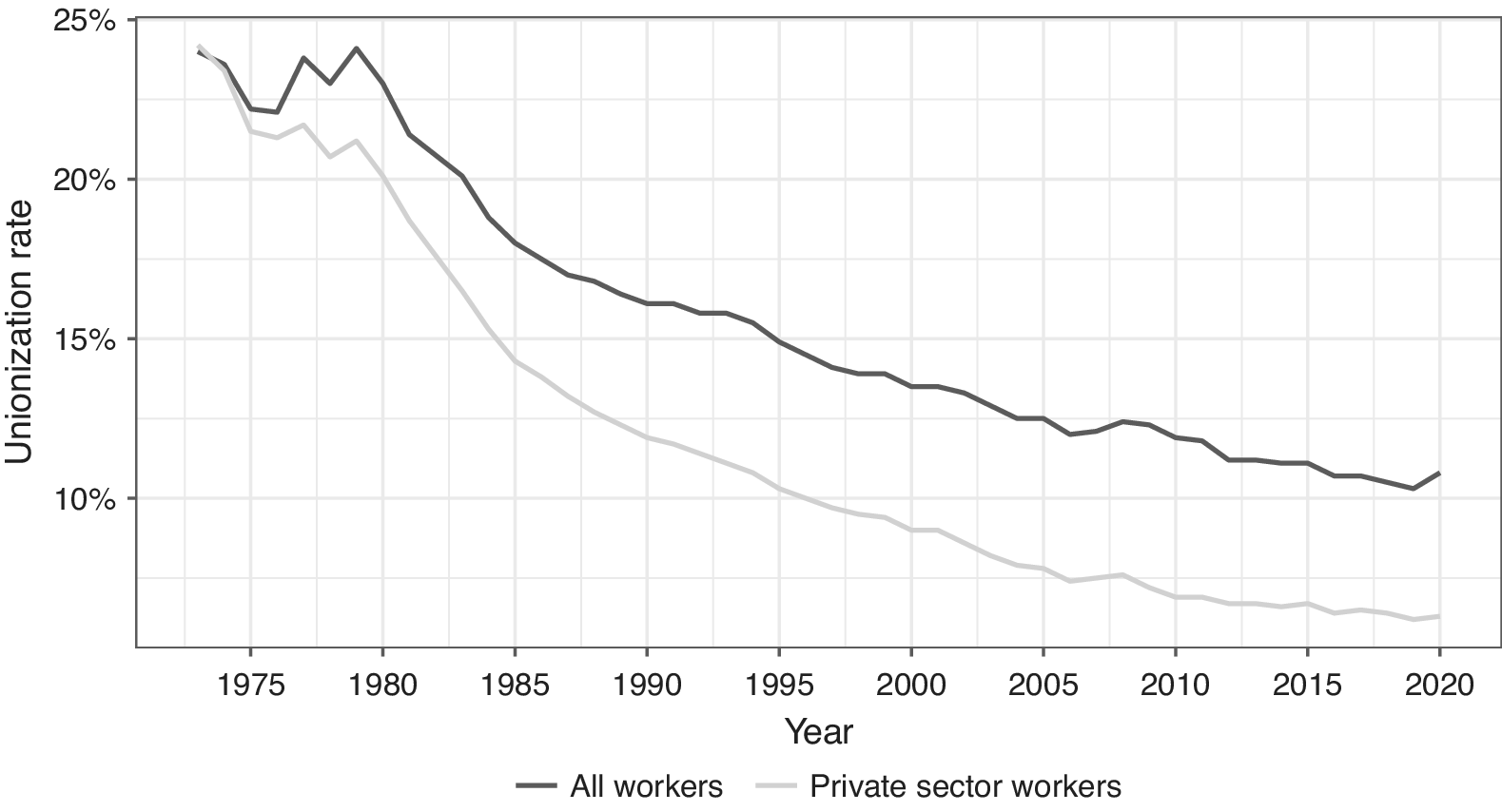
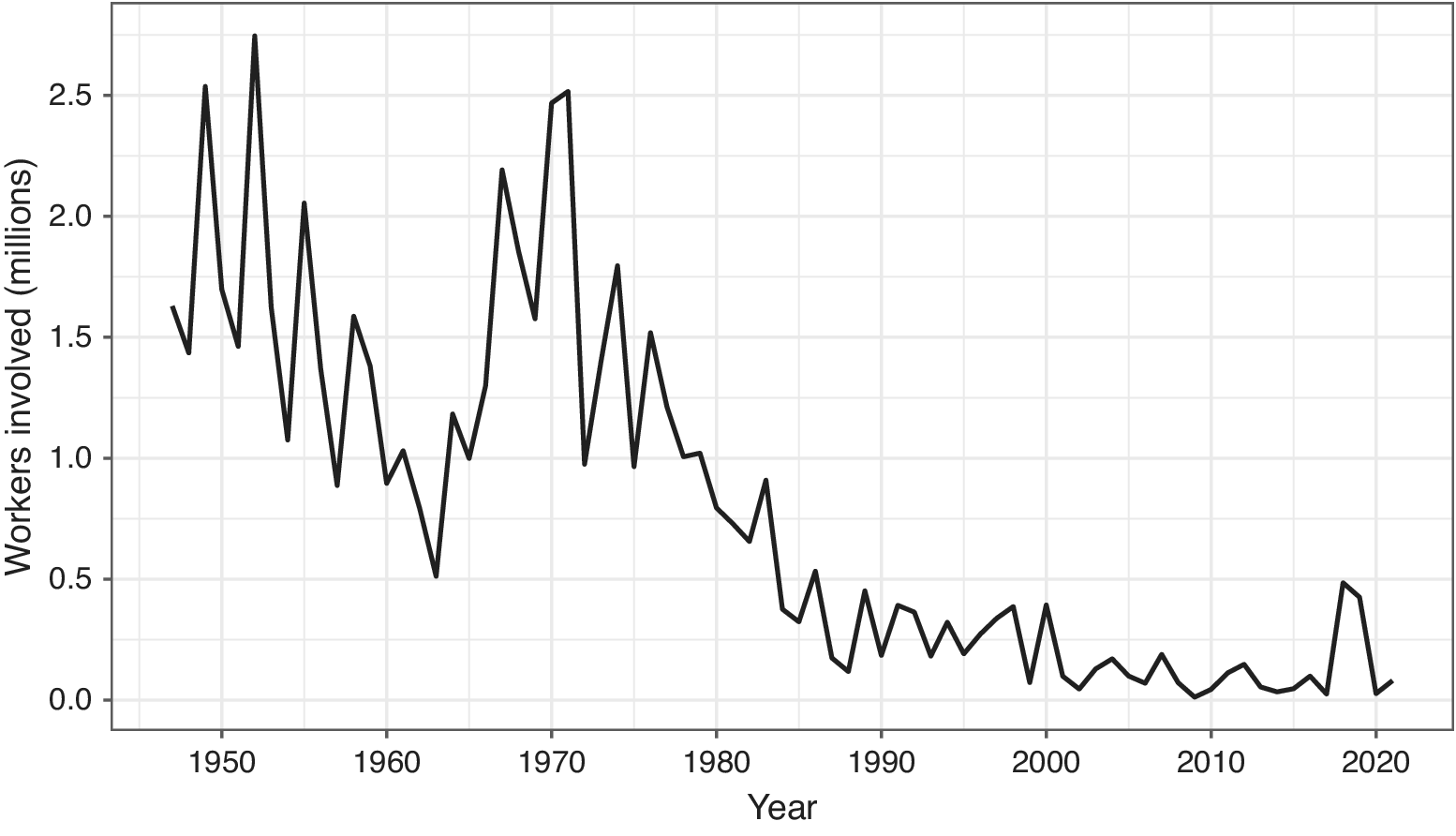
After the enactment of the NLRA, unionization rates exploded, growing from roughly 12% in 1935 to a high of about 35% in 1945 (Weiler Reference Weiler1983). Despite the passage of Taft-Hartley and Landrum-Griffin, union rates remained fairly stable through the 1960s. As seen in Figure 1, however, union density began a steady decline in the 1970s with private sector union rates cratering to under 10% by the twenty-first century. Participation in work stoppages has also decreased, as seen in Figure 2. As the NLRA was in part enacted to ensure “industrial peace,” declines in strike participation could be seen as evidence for labor law’s efficacy. However, as shown below, declining strike participation is due to a combination of the Court’s jurisprudence and socioeconomic changes that made striking workers more vulnerable to employer reprisal. Rising economic inequality serves as additional evidence that the relative bargaining power between labor and business has shifted in U.S. industrial relations. From 1980 to 2007, the richest 1% of Americans went from accumulating 10% of the national income per year to over 23% (Piketty and Saez Reference Piketty and Saez2003). And as of 2020, the richest 0.1% of Americans has the same amount of wealth as the bottom 90% (Hacker and Pierson 2020). For the realization of “industrial peace” to explain these trends, one would assume the economic status of workers would be converging with, not diverging from, America’s wealthiest. These changed outcomes, in conjunction with legislative stasis, provide evidence that U.S. labor law has undergone drift.
Union Membership, 1973–2020
Note: Figure 1 was compiled using data from Hirsch and Macpherson’s (Reference Hirsch and Macpherson2000–22) Union Membership and Coverage Database.


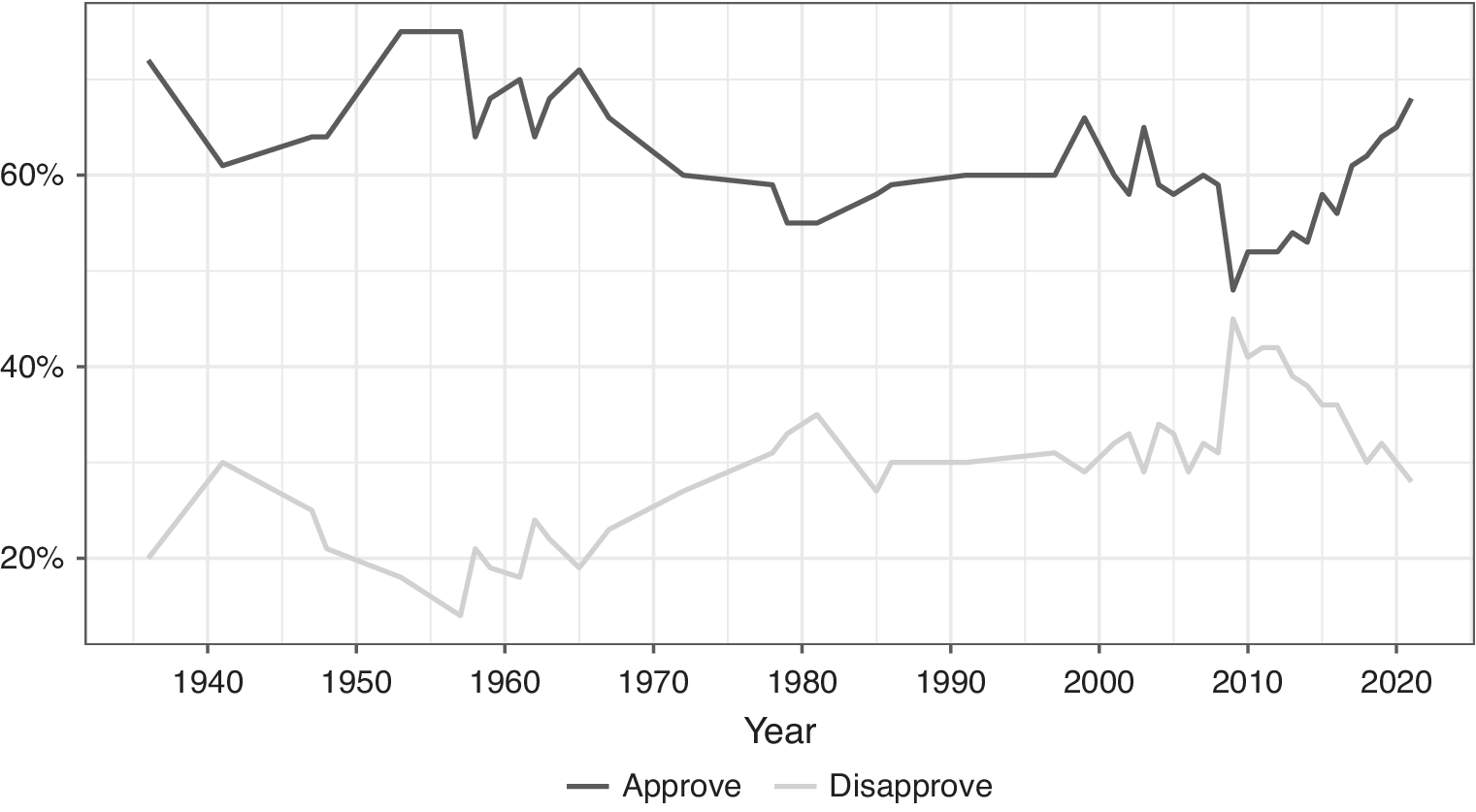
Despite the collapse of unionization in the United States, the erosion of strikes as a labor tactic, and the general approval of the public for labor unions, as shown in Figure 3, Congress has not ameliorated the disparity between the bargaining power of business and labor. It is not that these trends have gone unnoticed. Rather, the case of labor law appears to be one where policy drift is intentional—it has been maintained by conservatives who leverage veto points to block proposed updates, as seen during deliberation over reform bills in the late 1970s and early 1990s. Although the concept of “drift” insinuates passivity, it is important to remember that political players exercise agency in leveraging veto points, maintaining oppositional cohesion, and keeping amendments off the agenda (Hacker, Pierson, and Thelen Reference Hacker, Pierson, Thelen, Mahoney and Thelen2015; Streeck and Thelen Reference Streeck, Thelen, Streeck and Thelen2005). Paying close attention to the actors and institutions involved in policy drift will reveal the machinations of political players who use their authority to distort the operation of important policies.

Using four areas of the Court’s NLRA jurisprudence—the right to strike, federal preemption, NLRB enforcement authority, and NLRB discretion, I provide empirical support for the theoretical claim that the Court can act as an agent of policy drift. The goal of subsequent sections is not to provide a comprehensive account of all jurisprudence regarding the NLRA, nor is it to explain each piece of the causal puzzle as to why labor law underwent policy drift. Rather, the case analysis illuminates causal pathways between Supreme Court jurisprudence and policy drift, showing how statutory cases gradually moved U.S. labor law in a more business-friendly direction and also underscoring that rich theoretical insights that may be gleaned from a single case (Rueschemeyer Reference Rueschemeyer, Mahoney and Rueschemeyer2003).
The Right to Strike
The Supreme Court facilitated the drift of federal labor law by stripping the ambiguity from provisions guaranteeing the right to strike, thus narrowing workers’ rights and incentivizing firms to replace strikers. Strikes are addressed under the NLRA in §13, which states, “Nothing in this act … except as specifically provided for herein, shall be construed so as either to interfere with or impede or diminish in any way the right to strike,”Footnote 1 and §7, which provides a broader grant of power to labor by ensuring the right to undertake “other concerted activities for the purpose of collective bargaining or other mutual aid or protection.”Footnote 2 Despite these provisions, the Supreme Court found in NLRB v. Mackay Radio (1938) that employers did not violate the NLRA if they permanently replaced striking workers during bargaining disputes. As bargaining disputes became increasingly common in labor relations (Moberly Reference Moberly2001), the consequences of Mackay Radio took on even greater importance.
The controversy addressed in Mackay Radio began when the American Radio Telegraphists Association authorized a strike in October 1935 after failing to negotiate a contract with Mackay Radio. After the strike, four men were not rehired by Mackay Radio, leading to NLRB review. In adjudicating the matter, the NLRB found that in not rehiring these four workers, Mackay Radio had illegally discriminated against them based on union activity. The NLRB mandated that Mackay Radio stop discharging or threatening to discharge employees based on union membership or activity and ordered the company to reinstate the four men. Mackay Radio appealed the decision, and the controversy reached the Supreme Court in 1938. Writing for the unanimous Court, Justice Owen Roberts made several important points—the strike fell under NLRB jurisdiction, striking workers remained “employees” under the NLRA, the NLRB used proper procedures in adjudicating the dispute, and Mackay Radio had discriminated based on union activity. However, the opinion also contained important dicta that noted, “Nor was it an unfair labor practice to replace the striking employees with others in an effort to carry on the business … it does not follow than an employer, guilty of no act denounced by the statute, has lost the right to protect and continue his business by supplying places left vacant by strikers.”Footnote 3 In other words, Mackay Radio had illegally discriminated in this instance by not rehiring four of the striking workers but the use of strike replacements during bargaining disputes was not generally illegal if motivated by nondiscriminatory purposes. This interpretation constrained labor by narrowing their right to strike and the NLRB by curbing their authority to protect striking workers while also incentivizing firms to hire replacements.
Mackay Radio prohibited hiring permanent replacements during strikes that resulted from unfair labor practices but, as outlined in case dicta, permitted the hiring of replacement workers during economic strikes (which occur after business and labor negotiations break down). Focusing on the holding, commenters initially viewed the decision as a win for labor and NLRB authority (e.g., New York Times, May 17, 1938). In Congress, Senator Robert Wagner (D-NY), architect of the NLRA, noted, “This marks the eleventh straight victory for the Labor Board in the Supreme Court… .The Board’s orders have now been upheld in 33 out of 39 cases reviewed by the Courts” (Congressional Record, May 16, 1938). The Court later elevated the Mackay strike replacement dicta to legal doctrine and eventually expanded the decision in 1989 in Transworld Airlines v. Flight Attendants (TWA). In TWA, a 6-3 majority ruled that Transworld Airlines was not required to lay off junior employees to make way for more senior, striking workers after the conclusion of a strike, citing Mackay as precedent.
As employers adjusted to the new labor law regime, unfair-labor-practice strikes receded and economic strikes became more important. Employers relied on Mackay to hire permanent replacement workers, undermining the position of striking unions. Initially, the use of replacements was infrequent and confined to regions where unions were vulnerable and businesses had little trouble finding workers. The potential for Mackay to destabilize employer–employee relations became more evident in the 1970s because global economic competition incentivized employers to take a more aggressive posture against unions and technological developments made it easier for firms to operate without union labor. As a result, employers began hiring “strike management” consultants to curb union activity (Logan Reference Logan2008) even before the highly salient 1981 dismissal of air traffic control workers by President Reagan, which has been deemed a turning point in the use of replacements (McCartin Reference McCartin2011).
Efforts in the 1990s to counteract the use of strike replacements illustrate the difficulty of overcoming unfavorable legal developments through legislative action. Initially, Republican President George H. W. Bush appeared to be an insurmountable obstacle to reform, as proposed legislation failed to garner veto-proof majorities. After President Bush’s 1992 defeat to Democrat Bill Clinton, legislative reversal of Mackay and TWA seemed possible. However, proposed bills continued to fail. For instance, in 1994, a filibuster was sustained against S.55, a bill to forbid strike replacements, after a failed 53-46 cloture vote that fell largely along partisan lines. Throughout deliberations over strike replacements, there was bipartisan recognition that Mackay and TWA were fundamentally important in shaping the existing status quo, highlighting the Court’s outsized authority in making the US far less friendly to striking workers than were other advanced democracies (Doorey Reference Doorey2021).
Both Mackay and TWA were salient in congressional hearings and committee reports. The Senate Committee on Labor and Human Resources’ report on the Workplace Fairness Act frequently discusses “Mackay Radio” and notes, “In the last decade however, employers have significantly increased their use or threatened use of permanent replacements,” a right enshrined by Mackay Radio that “undermines the collective bargaining process.”Footnote 4 Republicans on the committee also viewed Mackay Radio as important, arguing that the decision “serves as an important market check on opportunistically high demands of unions.”Footnote 5 The attribution to Mackay of such a check is striking when compared with contemporaneous reactions to the decision, which largely missed its potential importance.
Private actors also emphasized Mackay. The 1991 strike replacement bill was a top legislative priority of the AFL-CIO, as the group’s president called it a “burning issue” (Eskey Reference Eskey1991). Secretary General of the AFL-CIO, Thomas Donahue, testified before Congress that Mackay Radio “threatens the very vitals of free and productive collective bargaining” and pointed to the increase of replacement workers at major firms across the US (Condo Reference Condo1991). In opposition, the Chamber of Commerce and National Association of Manufacturers argued that legislation barring the hiring of replacement workers would “disarm” management in labor relations (Roel and Mendels Reference Roel and Mendels1990).
Trans World Airlines was also prominent during congressional deliberations. Vicki Frankovich, president of the International Association of Flight Attendants testified before Congress in support of proposed legislation and detailed the union’s experience during the TWA strike in the mid-1980s. She testified that hardships usually end when a strike concludes but that due to strike replacements, “In our situation, the agonies lasted more than 3 years with people on the street … single mothers with children were forced to sell their homes and move back with parents; some lost their homes to foreclosure.”Footnote 6 In 1993, when Congress revisited the question of replacement workers, William Jolley, counsel for the International Association of Flight Attendants, decried strike replacements and described the injuries incurred by his clients as a result of the TWA strike.Footnote 7 Representatives of Midwest Motor Inc. opposed proposed legislation in the same hearing, bemoaning that it would overturn Mackay and TWA. Footnote 8
The development of strike replacements under the NLRA illustrates the expected contours of drift and shows how the Court played a primary role in facilitating the process. First, legislative winners (congressional liberals and labor unions) enacted a policy (the NLRA) that was not repealed by the law’s opponents (congressional conservatives and business). Second, the Court removed ambiguity surrounding the use of strike replacements under the law, incentivizing business to use replacements while constraining the NLRB in protecting striking workers. Third, gradual socioeconomic changes contributed to the law, producing new outputs (increasing use of strike replacements). Finally, proponents of the law sought legislative action where they were stymied by congressional minorities who leveraged veto points to block proposed legislation. As a result, the NLRA gradually became ineffective in protecting striking workers.
Federal Preemption
After stripping the ambiguity from NLRA provisions addressing the right to strike, the Court foreclosed policy making in venues outside Congress by interpreting the NLRA as preempting state and local labor laws. Preemption takes on heightened importance in the context of policy drift. When congressional action seems unlikely to counteract drift, proponents of a policy will seek alternate venues through which they can restore the efficacy of a particular policy arrangement, including subnational governments (Galvin and Hacker Reference Galvin and Hacker2020). Although labor advocates successfully achieved policy change through state and local employment law (e.g., wages, hours, and other work conditions) in the face of congressional inaction (Galvin Reference Galvin2019), subnational employment laws do not provide the same protections as does federal labor law, which guarantees collective bargaining rights, bolsters unionization, and more durably strengthens labor (Stone Reference Stone1992). Thus, in the case of the NLRA, the Court’s foreclosure of state and local action has benefitted employers and facilitated policy drift (Estlund Reference Estlund2002; Galvin Reference Galvin2019).
The balance of state and federal authority under the NLRA has been contested since its enactment. However, unlike issues such as voting rights and abortion, where conservatives prefer local control and liberals champion federal authority, in labor law, ideological preferences have been more fluid. Liberals initially celebrated the Court’s preemption of state and local labor laws in San Diego Building Trades Council v. Garmon (1959) and International Association of Machinists v. Wisconsin Employment Relations Commission (1976). But as labor law underwent drift and increasingly benefited employers, labor and their congressional allies began challenging the blanket of preemption established by these cases and conservatives embraced federal primacy.
Federal primacy in labor law was initially articulated by the Court in San Diego Building Trades Council v. Garmon when a majority comprised of the five most liberal justices agreed that the NLRA preempted any state and local policy making that regulates expressly prohibited activity (e.g., discriminating against employees based on union status) or activity that is protected (e.g., joining unions, bargaining collectively) by federal labor law. Justice Frankfurter’s opinion declared, “When it is clear … that activities which a state purports to regulate are protected by §7 of the National Labor Relations Act, or constitute an unfair labor practice under §8 … state jurisdiction must yield.”Footnote 9
The broader political landscape in which Garmon was decided illustrates how labor law preemption initially broke along expected twentieth-century cleavages, as liberals supported federal preemption and conservatives worked to preserve state and local authority. As Congress addressed labor law in the late 1950s, several failed proposals were advanced to boost state authority. Two years before Garmon was decided, Representative Howard Smith (D-VA), notorious Southern Democrat and segregationist, introduced legislation that received Chamber of Commerce support and instructed the judiciary not to assume that federal legislation superseded state laws unless such intent was explicitly stated.
During debate on Smith’s bill, Representative Holland (D-PA) argued “H.R. 3 was born in the states which have refused to recognize the worker on any higher plane than they did the slave … they will use this bill to destroy by State legislation the advances labor made over the years” (Congressional Record, July 17, 1958). Representative Celler (D-NY) noted the vehement opposition from the NAACP, who feared the bill would exacerbate racial discrimination, especially in the South (Congressional Record, July 17, 1958). The bill was reported out of the House Judiciary Committee, passed the House 241-155, but ultimately died in the Senate Judiciary Committee. The next year, H.R. 3 was once again favorably reported on by the House Judiciary Committee but not enacted into law. During debate, the Chamber of Commerce attacked Garmon, which is especially notable given their later support of preemption in Chamber of Commerce v. Brown (2008).Footnote 10
The reach of the NLRA was extended in Machinists v. Wisconsin Employment Commission where a 6-3 Court found that Congress intended conduct left unregulated by the NLRA “to be controlled by the free play of economic forces.”Footnote 11 In other words, Congress intended those actions not expressly permitted or expressly prohibited by the NLRA to be left unregulated. Taken together, Garmon and Machinists created a blanket of preemption that stifled nearly all innovation in labor relations at the state and local levels. As Congress remained gridlocked, states tried to address the imbalance of power between business and labor by attempting to assert power over both labor relations and employment law (as distinct from labor law). However, efforts to regulate labor relations were regularly rebuffed by the Courts’ earlier preemption cases. For instance, in the 1980s, Wisconsin sought to temporarily bar firms with a history of labor violations from state procurement but was rebuked by a unanimous Court.Footnote 12 In Illinois, a 2003 effort to strengthen labor protections was also prohibited on preemption grounds (Freeman Reference Freeman2006), as the 7th Circuit Court of Appeals found the legislation to be “starkly incompatible” with federal labor law and wondered how any “responsible” lawmaker could approve it (Higgins Reference Higgins2006). California’s Assembly Bill 1889 was then nullified by the Supreme Court in Chamber of Commerce v. Brown.
By the time Chamber of Commerce v. Brown was decided, business and labor had flipped positions on preemption, as organized labor began favoring subnational authority to pass labor reforms given congressional inaction. Chamber of Commerce addressed California’s Assembly Bill 1889, which prohibited certain employers receiving state funds from using those funds “to assist, promote, or deter union organizing.” In a sharp reversal from their robust support for local authority in the 1950s, the Chamber of Commerce led the charge against AB 1889. Other conservative actors such as the Right to Work Legal Defense Fund, The National Federation of Independent Business, and George W. Bush’s Justice Department filed amicus briefs supporting the Chamber. Briefs supporting California were filed by the AARP and several sympathetic states. The AFL-CIO acted as a respondent alongside the state of California.
In a 7-2 decision, the Court struck provisions of Assembly Bill 1889 on the grounds that, as in Machinists, the law regulated “a zone protected and reserved for market freedom.”Footnote 13 The decision also voided similar statutes across the United States (Savage Reference Savage2007) and confined labor policy to Congress where conservatives could play defense, leverage key veto points, and stifle legislative innovation. The constellation of statutory cases blocking local action in labor drew minimal attention of liberals in Congress. However, Representative John Conyers, Jr. (D-MI) did introduce a bill—“The State Public Funds Protection Act”Footnote 14 —on November 18, 2010, that would have reversed the Court’s decision in Chamber of Commerce, but the bill failed to advance beyond the House Committee on Education and Labor. As of 2021, Congress has not allocated new authority to states and localities in labor relations.
In conjunction with congressional gridlock, the Supreme Court actively facilitated the drift of labor law by preempting state and local actions through Garmon and Machinists. Despite preemption serving liberal interests when these cases were decided, as Congress gridlocked on the issue of labor relations, organized labor sought policy innovation at subnational levels but were rebuked by the Court’s existing precedents. Thus, in this instance, the Court’s facilitation of drift was the unintended consequence of a labor-friendly Court whose expansion of NLRA protections through preemption was later supported by conservative jurists once preemption was understood to favor business interests.
NLRB Enforcement
Despite congressional gridlock and federal preemption, the NLRB remained a potential antidote to policy drift. The NLRB could alleviate drift by applying the act to new contexts and vigorously enforcing its provisions. Under the NLRA, the NLRB was granted substantial authority in response to backlash against federal courts and their frequent issuance of strike injunctions in the late nineteenth and early twentieth centuries (Klare Reference Klare1978; Tomlins Reference Tomlins1979). Despite this design, the Court quickly undermined NLRB enforcement authority and in later years rebuked NLRB attempts to extend protections to new groups and labor tactics. Board authority was first curtailed in Republic Steel v. NRLB (1940) when the Court used dicta from Consolidated Edison v. NLRB (1938) to conclude that the NLRA grants only “remedial” but not “punitive” authority to the NLRB. Remedial action allows the NLRB to rectify the specific wrong caused by an unfair labor practice. This might include awarding back pay or ordering the reinstatement of an unfairly terminated employee. Punitive action remedies the specific wrong but also extracts additional concessions for violating the law. The potential of punitive action deters future violations compared with the threat of remedial action because the cost of committing violations is greatly increased under a punitive scheme.
The potential significance of the decisions stripping the NLRB of its punitive authority was overlooked by contemporary observers, especially after Consolidated Edison. Contemporaneous news coverage of Consolidated Edison, where the Board’s remedial authority was outlined in case dicta, focused almost exclusively on the ongoing rivalry between the AFL and CIO. Two years later, in Republic Steel, a 6-2 majority enshrined this dictum into law, finding that NLRB lacked the authority to mandate that Republic Steel reimburse work relief agencies for wages paid to striking workers.
By undermining the enforcement authority of the NLRB in Republic Steel (1940), the Court shaped both the downstream operation of the NLRA and legislative politics. The decision provided immediate incentives to businesses to use illegal tactics in labor relations (Bronfenbrenner Reference Bronfenbrenner2009) and shifted the political landscape in favor economic conservatives. Despite a large majority of support in the House, presidential backing, and a Senate majority in favor of reform, a business-friendly minority in the Senate, supported by the Chamber of Commerce, successfully used the filibuster to kill the 1977 Labor Law Reform Bill (Hacker and Pierson Reference Hacker and Pierson2010). The bill would have allowed the NLRB to award double back pay to victims of labor violations and bar employers who commit violations from federal contracts (Shelton Reference Shelton2017, 380). The final cloture vote failed 58-41, just two votes shy of advancement.
The 1970s political dynamics surrounding efforts to enhance NLRB enforcement authority mirror those of the 1990s and strike replacements and the political dynamics of drift more broadly. In both instances, the coalition aligned with earlier legislative “winners” faced the onus to update policy in Congress but ultimately failed to overcome veto points despite holding elected majorities. Thus, we see a clear example of how labor law might have developed in a far different way but for Supreme Court intervention. Even with large majorities in favor of reform in the 1970s, the Court’s Republic Steel decision remained the policy status quo given the substantial barrier to legislative revision. Due to favorable Court decisions and socioeconomic changes, the initial “losers” continued to accumulate advantages in policy operation and political contestation despite failing to amend primary provisions in Congress.
NLRB Discretion
In addition to curtailing the NLRB’s enforcement authority, the Court has curbed NLRB discretion by nullifying efforts to apply the NLRA to a broader array of workers and activities. The Court has limited the applicability of the NLRA on college campuses, incentivized employers to mistreat undocumented workers, and found class-action lawsuits to be outside §7 protection, accelerating the incongruence between the NLRA and evolving conceptions of the American worker and their advocacy tactics. In doing so, the Court not only rebuked NRLB decisions that would have alleviated the drift of labor law but also accelerated the conservative development of the NLRA.
In 1974, faculty from Yeshiva University sought NLRB intervention after university administration denied their petition to unionize. After the NLRB found in favor of the faculty, Yeshiva University filed suit in federal court. Ultimately, the issue came before the Supreme Court in NLRB v. Yeshiva University (1980) where a 5-4 Court reasoned that full-time faculty are not “employees” under the NLRA due to their roles in university decision making and—by extension—“managerial” status. Within two years of the decision, approximately 40 colleges and universities moved to end collective bargaining with their faculty based on the decision (Gray Reference Gray1982), perpetuating the weakness of American labor law by excluding thousands of professors from unionization despite the initial NLRB decision and some Republican support for faculty unionization, including Labor Secretary William Brock (Congressional Record, October 8, 1986). Nevertheless, no major effort was taken in Congress to reverse the Court’s decision. A bill to include faculty under the NLRA, H.R. 7619, was introduced by Rep. Frank Thompson (D-NJ) in June 1980, but it failed to advance beyond the committee stage and received no attention on the floor after its introduction.
Shortly after Yeshiva University, the Court was faced with questions over the extent to which undocumented workers were entitled to NLRA protection. Since 1995, undocumented labor in the U.S. workforce has grown from 3.6 million to a high of 8.3 million in 2009 and has since plateaued around 8 million (Passel and Cohn Reference Passel and Cohn2016). The steady increase of undocumented workers prompted no formal amendment to the NLRA, leaving the applicability of the NLRA to such workers in the hands of the NLRB and federal courts.
The Supreme Court initially applied the NLRA to undocumented workers in Sure-Tan Inc v. NLRB (1984), finding that undocumented workers were “employees” under the act, upholding an NLRB decision in favor of undocumented workers who had suffered an unfair labor practice. In 2002, however, the Court disrupted the NLRA’s protection of undocumented workers when adjudicating a dispute between Hoffman Plastics and the NLRB by ruling that the NLRB could not award back pay to undocumented workers given the Immigration Reform and Control Act of 1986 (ICRA). The ICRA made it unlawful for employers to knowingly hire undocumented workers and for employees to use fraudulent documents to establish work eligibility.
The Court’s decision in Hoffman Plastics v. NLRB (2002) was a narrow 5-4 split in which the Court expansively interpreted ICRA language to narrowly construe the labor rights of undocumented workers. Based on the Court’s opinion, the Court did not initially appear to be acting as an agent of drift because, according to the majority, the enactment of the 1986 ICRA updated the status quo for labor law regarding undocumented workers. Therefore, the Court’s decision could be read as merely reflecting policy change enacted by Congress. However, evidence from the enactment of the ICRA and positions of contemporaneous actors illustrate that the legal question before the Court was ambiguous and that the Court could have credibly ruled in either direction.
The congressional record shows no indication that the ICRA was intended to change the operation of existing labor statutes, including the NLRA. Indeed, the House Judiciary Committee report on the bill explicitly stated, “It is not the intention of the Committee that the employer sanctions provisions of the bill be used to undermine or diminish in any way labor protections of existing law, or to limit the powers of federal or state labor relations boards, labor standards agencies, or labor arbitrators, to remedy unfair labor practices committed against undocumented employees for exercising their rights before such agencies or for engaging in activities protected by existing law.”Footnote 15 Even the George W. Bush Department of Justice filed a brief defending the position of the NLRB.
The Court’s decision in Hoffman Plastics ultimately constrained the NLRB in their protection of undocumented workers and incentivized firms to mistreat undocumented labor knowing reprisal would be limited. Responding to the decision, Senator Ted Kennedy (D-MA) argued that although employers face “minimal penalties” for violating labor law, the situation is even more dire for “immigrant workers,” who, “after the Supreme Court’s decision in Hoffman Plastics … are left without any real means to exercise these fundamental [labor] rights.”Footnote 16 In a 2005 hearing, Representative Sheila Jackson Lee (D-TX) argued that Hoffman Plastics “made it possible for employers to fire undocumented workers for union activities with impunity.”Footnote 17
The majority opinion also noted that any “perceived deficienc[y] in the NLRA’s existing remedial arsenal,” must be addressed by congressional action, not the courts.Footnote 18 In response, leading liberals, including John Lewis (D-GA) and Ted Kennedy (D-MA), introduced legislation to amend existing immigration law to explicitly preclude it from infringing upon the awarding of back pay under the NLRA, most of which failed in the committee stage.Footnote 19 The 2013 Senate comprehensive immigration bill also included provisions to ensure workplace remedies were available to all workers regardless of immigration status, but it failed after Speaker Boehner found that it lacked support among a majority of House Republicans (Gibson Reference Gibson2013). Recent versions of the PRO Act—which passed the House in 2020 and 2021—include language reversing Hoffman Plastics but remain dead on arrival in the Senate given the filibuster and Republican opposition.
In addition to overturning NLRB determinations about who is protected by the NLRA, the Court also reversed NLRB decisions over how workers may advance their interests in labor relations. Firms have required employees to sign forced arbitration clauses at growing rates, precluding them from filing class-action lawsuits should a dispute with their employer arise (Colvin Reference Colvin2017; Staszak Reference Staszak2020; Stone Reference Stone2005). Businesses are advantaged in arbitration relative to class-action lawsuits given the power imbalance between the firm and individual employees (compared with that between the firm and a collection of employees). The advantages of employers in arbitration are evident given the sharp rise of arbitration in the twenty-first century (Staszak Reference Staszak2020) and subsequent challenges to such arrangements. Backlash against mandatory arbitration came before the Court in Epic Systems v. Lewis (2018) where the Court found that mandatory arbitration clauses did not violate §7 of the NLRA and were thus enforceable under the Federal Arbitration Act (FAA). The decision continued an ongoing trend of the Court endorsing arbitration as a dispute resolution mechanism, oftentimes by expansively interpreting the Federal Arbitration Act (Staszak Reference Staszak2015; Reference Staszak2020). For instance, the Court found that exemptions to arbitration requirements under the FAA applied only to transportation workers, not workers generally (Circuit City v. Adams 2001).
Epic Systems reflected partisan divergence on the issue of workplace arbitration. The Obama administration initially filed an amicus brief on behalf of Jacob Lewis before the Trump administration flipped positions. Justice Gorsuch, writing for the five-member majority, asserted, “It is unlikely that Congress wished to confer a right to class or collective litigation in §7, since those procedures were hardly known when the NLRA was adopted in 1935.”Footnote 20 The Court’s decision in Epic Systems (2018) altered the resources and incentives of both employers and employees. Employees have been constrained in bringing class-action suits against their employers in response to wage theft, workplace discrimination, and other illegal activities. As a result of Epic Systems (2018), businesses have an even greater incentive to make arbitration clauses a condition of employment and commit labor violations to save on labor costs because the risk of doing so is decreased given the lack of recourse provided to employees (Colvin Reference Colvin2017; Staszak Reference Staszak2020; Stone Reference Stone2005).
Once again, labor allies in Congress failed to override the Court. Representative Henry Johnson (D-GA) introduced the “Forced Arbitration Injustice Act” (FAIR),Footnote 21 which would overturn Epic Systems. The bill passed the Democratic Party-controlled House 225-186 largely along party lines in 2019, but it then stalled in the Senate Judiciary Committee. In the House Judiciary Committee Report on FAIR, the Republican minority argued the bill would restrict contractual rights and push disputants toward more costly legal proceedings.Footnote 22 Democrats continued to voice opposition to Epic Systems by including a call to end mandatory arbitration in their 2020 platform (Democratic Party 2020).
The aforementioned rulings—Yeshiva University (1980), Hoffman Plastics (2002), and Epic Systems (2018)—demonstrate how the Supreme Court may facilitate drift by constraining agency discretion to flexibly apply federal statutes. These decisions also “feed back” into the polity by shaping the resources and incentives of relevant actors (Pierson Reference Pierson1993). In these instances, we see the Court’s reversal of NLRB judgments resulting in further advantages to business at the expense of organized labor. Unionization rates in the United States were deflated by the Court’s decision in Yeshiva University, and undocumented workers were made even more vulnerable by Hoffman Plastics. Epic Systems enshrined employers with the right to mandate arbitration clauses and incentivized workplace malpractice by lowering the risk of a class-action lawsuit. By reversing the NLRB in these cases, the Court all but assured that labor law will favor employers for the foreseeable future, given continued congressional gridlock and lack of recourse in subnational politics.
The Court’s interpretation of the NLRA regarding replacement workers, federal preemption, and the curtailment of NLRB authority and discretion has shifted the burden of positive congressional action toward labor and their allies. Even when elected majorities favor reform, conservatives can successfully leverage veto points to prevent formal amendment, as seen in the 1970s and 1990s. This status quo has left only inferior patchwork solutions to improving the position of labor in the workplace. For instance, the policy drift of the NLRA has spurred the emergence of “tripartite lawmaking” (Sachs Reference Sachs2011), which relies on the inconsistent intervention of local governments into private arrangements and the proliferation of state and local employment law reforms, which include policies that raise the minimum wage and put ceilings on hours but face many problems and inequities in their administration (Galvin Reference Galvin2019). Although these actions may often benefit workers, they fail to match the consistent, comprehensive safeguards offered by a robust NLRA.
Implications and Conclusion
Previous scholarship has described several actions that may help avoid or alleviate policy drift including the reduction of veto points (Mahoney and Thelen Reference Mahoney, Thelen, Mahoney and Thelen2010), the allowance of bureaucratic discretion (Hacker, Pierson, and Thelen Reference Hacker, Pierson, Thelen, Mahoney and Thelen2015), and litigation (Barnes Reference Barnes2008). However, the case of federal labor law shows that to sufficiently combat drift, actors may also have to reckon with the Supreme Court’s powerful role as an agent of policy drift. Even in instances where legislation is written with ambiguity and provides implementing actors with discretion, the Court may exercise its powers of statutory interpretation to reshape policies in ways that make them more susceptible to drift. Drift may be even more intractable given that even “deferential” or seemingly “neutral” Supreme Court decisions that maintain the status quo may produce important downstream changes to policy operation.
The case of the NLRA illustrates how upholding the status quo facilitates (and possibly accelerates) policy drift. For instance, although class-action lawsuits were not salient when the NLRA was first enacted in 1935, truncating their availability in Epic Systems had profound effects given the imbalance of power between business and labor in arbitration and a dearth of other options for workplace advocacy. Although the Court did not remove an established right of employees, Epic Systems made the NLRA even more business friendly than the previous status quo.
Acting as an agent of drift through statutory interpretation allows the Court to reshape public policy with minimal public reprisal given the low salience of most statutory decisions and the “subterranean” way in which policy drift occurs. Previous research has shown the Court to be subject to several mechanisms of public control, whether through a direct constraint from public opinion (McCloskey and Levinson Reference McCloskey and Levinson2016), a long-standing hesitation to nullify acts of Congress (Whittington Reference Whittington2019), or a reluctance to violate the wishes of the dominant, elected majority (Dahl Reference Dahl1957; Tushnet Reference Tushnet, Kahn and Kersch2006; Whittington Reference Whittington2019). When acting as an agent of policy drift, however, the Court may produce transformative change with minimal public backlash. As seen in Figure 3, unions have remained popular throughout American history, only dipping below 50% approval once since 1936. In contrast to public support for labor, the Supreme Court has pursued aggressively antilabor interpretations of the NLRA over the last three decades—perpetuating the act’s drift and highlighting the undemocratic features of judicial authority. Given the continued dominance of conservative appointees on the Supreme Court, we should expect the Court’s antilabor stance to only intensify, despite recent upticks in union favorability and efforts among elected majorities to move labor law in a pro-worker direction.
How likely is the Court to abet policy drift in any given instance? How portable are the findings of the labor law case? Scholars have yet to develop predictive theories of when policy drift is likely to occur. But in this case, we can observe that labor law’s drift resulted from “liberal” Court decisions as well as “conservative” ones, it was a gradual process, and it became most apparent only after conservative majorities became entrenched on the Court. It is also notable that in this case the “winners” of labor law’s drift (businesses, economic conservatives) are well-organized and successful litigators (e.g., Epstein, Landes, and Posner Reference Epstein, Landes and Posner2013; Rahman and Thelen Reference Rahman, Thelen, Hacker, Pierson, Hertel-Fernandez and Thelen2021). The litigation success of business provides reason to assume these dynamics may occur in other policy domains. As repeat players litigate in any policy area, the returns on this strategy will likely increase over time, given the establishment of favorable precedent and opportunities to fine-tune legal frames and arguments (Barnes and Burke Reference Barnes and Burke2015; Galanter Reference Galanter1974; Pierson Reference Pierson2004; Silverstein Reference Silverstein2009). Thus, the nature of litigation itself incentivizes opponents of a policy arrangement to pursue policy drift through a long-term legal strategy. Finally, ongoing congressional gridlock on labor law since 1959 made the NLRA more susceptible to Court-induced drift, indicating that similar dynamics might occur in other gridlocked policy areas. Thus, we might speculate that Court-induced drift is more likely when the direction of drift matches the ideological preferences of the justices, when proponents of drift are well-resourced and successful litigators, and when Congress is gridlocked on the issue.
It is worth emphasizing that although Supreme Court decisions may produce unintended consequences that facilitate policy drift, the Court’s ideological commitments at a given time clearly affect the Court’s disposition toward drift. Because the modern Court has been a largely conservative institution, the Court may be especially likely to facilitate conservative-leaning policy drift in cases beyond labor. There is reason, then, to believe this phenomenon may become increasingly widespread in the U.S. context: the Court’s entrenched conservative majority is highly skeptical of bureaucratic authority, and Congress remains polarized and gridlocked on important issues. In such an environment, we should expect other regulatory and social policies to become subjected to Court-induced drift, as conservative actors pursue litigation strategies to truncate or retrench existing policies. Recently, the Court has interpreted §2 of the Voting Rights Act based on 1982 understandings of voter discrimination, effectively “freezing” the statute and making it inapplicable to contemporary innovations of voter suppression (Brnovich v. DNC 2021). Furthermore, the Court has rebuked agency decision making in the field of public health during the COVID-19 pandemic (NFIB v. DOL 2022) and in the domain of environmental regulation (Michigan v. EPA 2015; West Virginia v. EPA 2022).
Future research might investigate in what other policy areas and temporal contexts (both in the US and other countries) judicial power has facilitated or alleviated drift and other mechanisms through which this process may occur, in line with Mahoney and Thelen’s (Reference Mahoney, Thelen, Mahoney and Thelen2010) call for investigation of which agents drive gradual policy change. In expanding this inquiry, we can uncover fuller explanations about the prevalence of Court-induced drift, conditions under which policies undergo drift, and the effects of judicial power on public and private actors, regulatory statutes, and political economy.
In summary, this article has emphasized the importance of bringing the judiciary into examinations of policy development and its implications for politics and democracy. Scholars have shown the importance of judicial action in several issue areas (Frymer Reference Frymer2003; Melnick Reference Melnick1983; Reference Melnick2010; Reference Melnick2018), whereas Jeb Barnes (Reference Barnes2007) has forcefully advocated for “bringing the courts back in” to politics and policy making. The incorporation of the Supreme Court into studies of policy drift only reinforces that policy development cannot be fully understood without attention to the judiciary and that accounts of the judiciary are incomplete if they attend to only jurisprudential developments.
Supplementary Materials
To view supplementary material for this article, please visit http://doi.org/10.1017/S0003055422000685.
ACKNOWLEDGMENTS
This article greatly benefitted from insights provided by the APSR anonymous reviewers, Daniel Galvin, Chloe Thurston, Emily Zackin, Laurel Harbridge-Yong, Ben Page, Joanna Grisinger, Kathleen Thelen, Tonja Jacobi, Kumar Ramanathan, Shai Karp, and Calvin TerBeek. I am also grateful to members of the Northwestern APD Graduate Student Workshop and participants of the 2021 American Political Economy Summer School, 2021 MPSA Annual Meeting, 2021 SPSA Annual Meeting, 2021 WPSA Annual Meeting, and the 2021 Law & Society Conference for their suggestions and feedback.
CONFLICT OF INTEREST
The author declares no ethical issues or conflicts of interest in this research.
ETHICAL STANDARDS
The author affirms this research did not involve human subjects.




Comments
No Comments have been published for this article.