Introduction
Bryoria Brodo & D. Hawksw. is a lichenized ‘hair lichen’ genus (sensu Goward et al. Reference Goward, Gauslaa, Björk, Woods and Wright2022) in the alectorioid clade of the Parmeliaceae currently including c. 50 accepted species (Thell et al. Reference Thell, Crespo, Divakar, Kärnefelt, Leavitt, Lumbsch and Seaward2012). Its members are usually easily distinguished from other hair lichen genera (Alectoria Ach., Nodobryoria Common & Brodo, Sulcaria Bystrek, etc.) by their pale greyish to brownish or almost black thalli that are richly and finely branched and vary in habit from decumbent or erect to pendent. The genus is distributed mainly in boreal to north temperate regions of Eurasia and North America, but also occurs in the mountains of Africa, Australasia and South-East Asia (Brodo & Hawksworth Reference Brodo and Hawksworth1977).
Bryoria has been divided into several sections based on thallus anatomy, chemistry and morphology (Brodo & Hawksworth Reference Brodo and Hawksworth1977). Myllys et al. (Reference Myllys, Velmala, Holien, Halonen, Wang and Goward2011) published the first comprehensive phylogeny of the genus using three gene regions (nuclear ribosomal internal transcribed spacer region (ITS), partial glyceraldehyde 3-phosphate dehydrogenase gene (GAPDH) and small subunit of the mitochondrial ribosomal DNA (mtSSU) and accepted the four phenotypically defined sections, namely Bryoria, Divaricatae (Du Rietz) Brodo & D. Hawksw. Implexae (Gyeln.) Brodo & D. Hawksw. and Tortuosae (Bystrek) Brodo & D. Hawksw., although the circumscription of section Bryoria in particular differed markedly from the original. They further introduced the monotypic section Americanae Myllys & Velmala for Bryoria americana (Motyka) Holien. Subsequent studies based on different combinations of ITS, mtSSU and partial Mcm7 (minichromosome maintenance protein 7 gene) data have obtained slightly contradicting results. In Boluda et al. (Reference Boluda, Divakar, Hawksworth, Villagra and Rico2015) and Myllys et al. (Reference Myllys, Velmala, Pino-Bodas and Goward2016), section Bryoria was recovered as polyphyletic and split into three and two monophyletic groups, respectively. Furthermore, in the phylogenies of Myllys et al. (Reference Myllys, Velmala, Pino-Bodas and Goward2016) and Wang et al. (Reference Wang, Wang, Liu, Myllys, Shi, Zhang, Yang and Li2017), section Divaricatae was no longer monophyletic. This was because B. smithii (Du Rietz) Brodo & D. Hawksw. and closely related species fell outside the section. The discrepancies between the results obtained from different phylogenies are probably explained partly by the different sampling and combination of molecular loci used and partly by implementation of different phylogenetic reconstruction methods. Nevertheless, these studies clearly demonstrate the need for more than two or three loci to reliably resolve infrageneric relationships in this genus.
Bryoria is notorious as a taxonomically difficult genus. While phylogenetic analyses have supported the traditional circumscription of species such as B. furcellata (Fr.) Brodo & D. Hawksw., B. nadvornikiana (Gyeln.) Brodo & D. Hawksw. and B. simplicior (Vain.) Brodo & D. Hawksw., genetic mycobiont variation in other taxa is poorly aligned with morphological and chemical variation (Velmala et al. Reference Velmala, Myllys, Halonen, Goward and Ahti2009, Reference Velmala, Myllys, Goward, Holien and Halonen2014; Myllys et al. Reference Myllys, Velmala, Holien, Halonen, Wang and Goward2011), resulting in some previously recognized ‘species’ being proposed for synonymy (Velmala et al. Reference Velmala, Myllys, Halonen, Goward and Ahti2009; Boluda et al. Reference Boluda, Rico, Divakar, Nadyeina, Myllys, McMullin, Zamora, Scheidegger and Hawksworth2019). The lack of correlation between genotypes and phenotypes, reported also for other lichen-forming genera, viz. Alectoria Ach. (McMullin et al. Reference McMullin, Lendemer, Braid and Newmaster2016), Cladonia P. Browne (Fontaine et al. Reference Fontaine, Ahti and Piercey-Normore2010; Kotelko & Piercey-Normore Reference Kotelko and Piercey-Normore2010; Piercey-Normore et al. Reference Piercey-Normore, Ahti and Goward2010; Pino-Bodas et al. Reference Pino-Bodas, Burgaz, Martín, Ahti, Stenroos, Wedin and Lumbsch2015), Usnea Dill. ex Adans. (Mark et al. Reference Mark, Saag, Leavitt, Will-Wolf, Nelsen, Tõrra, Saag, Randlane and Lumbsch2016) and Xanthoparmelia (Vain.) Hale (Leavitt et al. Reference Leavitt, Johnson and St Clair2011), has been attributed to environmental factors (Velmala et al. Reference Velmala, Myllys, Halonen, Goward and Ahti2009; Piercey-Normore et al. Reference Piercey-Normore, Ahti and Goward2010) or differential selection pressures for morphotypes (Boluda et al. Reference Boluda, Rico, Divakar, Nadyeina, Myllys, McMullin, Zamora, Scheidegger and Hawksworth2019). Spribille et al. (Reference Spribille, Tuovinen, Resl, Vanderpool, Wolinski, Aime, Schneider, Tabentheiner, Toome-Heller and Thor2016) suggested that basidiomycete yeast abundance in the cortex of the B. tortuosa/B. fremontii complex correlates with the chemical variation of this taxon. Recent studies have shown that molecular data are essential for assessing species boundaries in groups with high levels of phenotypic homoplasy and intraspecific morphological plasticity (Pino-Bodas et al. Reference Pino-Bodas, Burgaz, Martín and Lumbsch2011, Reference Pino-Bodas, Burgaz, Martín, Ahti, Stenroos, Wedin and Lumbsch2015; Mark et al. Reference Mark, Saag, Leavitt, Will-Wolf, Nelsen, Tõrra, Saag, Randlane and Lumbsch2016). Species delimitation among closely related species with recent and rapid diversification can be especially difficult due to incomplete lineage sorting (ILS), slow mutation rates in some markers and disproportionate morphological divergence (Lumbsch & Leavitt Reference Lumbsch and Leavitt2011; Leavitt et al. Reference Leavitt, Esslinger, Divakar, Crespo and Lumbsch2016; Mark et al. Reference Mark, Saag, Leavitt, Will-Wolf, Nelsen, Tõrra, Saag, Randlane and Lumbsch2016; Zhao et al. Reference Zhao, Fernández-Brime, Wedin, Locke, Leavitt and Lumbsch2017; Lutsak et al. Reference Lutsak, Fernández-Mendoza, Kirika, Wondafrash and Printzen2020; Jorna et al. Reference Jorna, Linde, Searle, Jackson, Nielsen, Nate, Saxton, Grewe, Herrera-Campos and Spjut2021; Lücking et al. Reference Lücking, Leavitt and Hawksworth2021; Randlane & Mark Reference Randlane and Mark2021).
In contrast to these findings, recent molecular studies in Bryoria have also revealed the existence of previously unknown lineages, resulting in the recognition of several new species based on single to three-locus phylogenies but also supported by chemistry and morphology (Jørgensen et al. Reference Jørgensen, Myllys, Velmala and Wang2012; Boluda et al. Reference Boluda, Divakar, Hawksworth, Villagra and Rico2015; Myllys et al. Reference Myllys, Velmala, Pino-Bodas and Goward2016; Wang et al. Reference Wang, Wang, Liu, Myllys, Shi, Zhang, Yang and Li2017). The new species appear to have restricted distribution areas and are confined mainly to South-East Asia and/or western North America. Furthermore, Myllys et al. (Reference Myllys, Velmala, Holien, Halonen, Wang and Goward2011, Reference Myllys, Velmala, Pino-Bodas and Goward2016) and McCune et al. (Reference McCune, Arup, Breuss, Di Meglio, Di Meglio, Esslinger, Miadlikowska, Miller, Rosentreter and Schultz2020) reported unexpected genetic diversity in section Divaricatae but concluded that additional sampling was needed to test whether their samples represented cryptic species.
The main objective in the present study is to determine whether a broader sampling and the addition of further gene regions can result in a more resolved and better supported phylogeny of Bryoria as a whole, with particular emphasis on its diversification and infrageneric classification. At the same time, we also aim to resolve the taxonomic identity of unknown lineages discovered earlier in the B. bicolor/B. tenuis group in section Divaricatae. To achieve these objectives, we include additional material from South-East Asia and western North America and generate new sequences from six gene regions.
Materials and Methods
Taxon sampling
A total of 71 Bryoria specimens from North America, Europe and Asia were used in the molecular phylogenies (Table 1). Taxa from all five sections of Bryoria were included to examine infrageneric classification (see Myllys et al. Reference Myllys, Velmala, Pino-Bodas and Goward2016). Multiple samples from section Divaricatae were included to examine phylogeny and species delimitation in the Bryoria bicolor/B. tenuis group. Seven specimens, which formed a paraphyletic assemblage close to B. bicolor (Ehrh.) Brodo & D. Hawksw. and B. tenuis (E. Dahl) Brodo & D. Hawksw. but which did not group with either of the species in Myllys et al. (Reference Myllys, Velmala, Pino-Bodas and Goward2016), were included as Bryoria sp. (specimens L486, L490, L678, L693, L694, L695, L696). Furthermore, an additional five specimens that did not cluster with existing taxa based on morphology and fungal ITS barcode (see Schoch et al. Reference Schoch, Seifert, Huhndorf, Robert, Spouge, Levesque and Chen2012) were also included in our analyses. Four of these latter specimens are new (specimens L830, L879, L880, L1038) and one (specimen L168) was used in the phylogeny of Myllys et al. (Reference Myllys, Velmala, Holien, Halonen, Wang and Goward2011) where it was basal to the B. bicolor/B. tenuis group.
Details on taxa used in the phylogenetic analyses, including voucher information and GenBank Accession numbers. New species and sequences are in bold.

Additional herbarium specimens (ALA, CANL, H, KUN, O, TUR, UAAH and UBC) from section Divaricatae were examined for their morphology. These included 46 specimens filed under B. tenuis or Bryoria sp. at ALA, CANL, H, KUN, O, UAAH and UBC (Supplementary Material Table S1, available online).
Selected specimens examined for comparison
Bryoria bicolor. Canada: British Columbia: Queen Charlotte Islands, Moresby Island, Tasu Sound, c. 2 km SW of Tasu, NE slope of ‘Mine Mtn’, Tsuga heterophylla-Thuja plicata-Picea sitchensis forest (perhumid oroboreal zone), on tree, scarce, 700–800 m, 52°40ʹN, 132°03ʹW, 1980, T. Ahti 38973 (H H9237198).—Finland: Etelä-Häme: Janakkala, Hangastenmäki, on N-facing rock face, 9 vi 1993, T. Kontula s. n. (H H9216664; TLC, fumarprotocetraric and protocetraric acids; GenBank Accession no. (ITS): OR075140, extraction ID L140). Etelä-Savo: Taipalsaari, Haikkaanlahti, Vasainniemi, on NE-facing rock face at 2–2.5 m height, 61°9ʹN, 27°57ʹE, 10 x 1998, A. Puolasmaa s. n. (TUR 100956; GenBank Accession no. (ITS): GQ379166). Varsinais-Suomi: Lohja, Ojamo, Liessaari, on subinclinate N-facing granite rock face by Lohjanjärvi shore, 33–34 m, 2000, J. Pykälä 20134 (H H9216234; GenBank Accession no. (ITS): OR075141, extraction ID S316).
Bryoria fruticulosa Li S. Wang & Myllys. China: Yunnan: Lijiang Co., Laojunshan Mtn, on Abies sp., 4020 m, 26°37ʹN, 99°42ʹE, 2011, L. S. Wang & M. Liang 11-32088 (KUN; GenBank Accession no. (ITS): KU895855); Zhongdian Co., Geza Village, Daxueshan Mtn, on Rhododendron sp., 4200 m, 28°35ʹN, 99°51ʹE, 2004, L. S. Wang 04-23206 (KUN; GenBank Accession no. (ITS): DQ0070376 as Bryoria sp.). Sichuan: Xiangcheng Co., Daxueshan Mtn, on bushes of Rhododendron aganniphum, 4350 m, 28°34ʹN, 99°49ʹE, 2002, L. S. Wang 02-23521 (KUN—holotype).
Bryoria yunnanensis Li S. Wang & Xin Y. Wang. China: Yunnan: Dali Co., Cangshan Mtn, on branches of Abies delavayi, 3400 m, 25°40ʹN, 100°06ʹE, 2004, L. S. Wang 04–23414 (H—isotype, H9237166).
Morphology and chemistry
The specimens were tentatively identified based on morphological and chemical characters. As many Bryoria species tend to grow intermixed, it was often necessary to first lightly moisten the material with water. Once moist, the material was teased apart, sorted and examined for morphology under a Leica S4E StereoZoom microscope. Photographs were taken with a Nikon 810 camera equipped with an AF-S VR Micro-Nikkor 105 mm f/2.8 G IF-ED lens (Nikon, Japan), and attached to a Kaiser 5510: RS 1 camera stand with RA1 camera arm (Kaiser Fototechnik, Germany). Serial images were taken with digiCamControl (© 2014 Duka Istvan; http://digicamcontrol.com/), and stacked to a single image using Zerene Stacker (Zerene Systems, USA).
Secondary compound metabolites were studied using K (10% potassium hydroxide) and Pd (1,4-phenylenediamine) spot tests and with thin-layer chromatography (TLC) using solvents A and B (Orange et al. Reference Orange, James and White2001).
Molecular methods
Six markers (three ribosomal RNA-coding and three low-copy protein-coding) were used to infer the Bryoria phylogenies: 1) complete (c. 0.5 kb) ITS regions; 2) c. 0.4 kb region from the intergenic spacer of the nuclear rDNA (IGS); 3) c. 1 kb region from the mtSSU gene; 4) c. 0.6 kb region from the Mcm7 gene; 5) c. 1 kb from the GAPDH gene spanning three exons and three introns; 6) c. 0.6 kb region from the ribosome biogenesis protein (Tsr1). The first five markers were selected based on our previous studies of the genus Bryoria (i.e. Velmala et al. Reference Velmala, Myllys, Halonen, Goward and Ahti2009, Reference Velmala, Myllys, Goward, Holien and Halonen2014; Myllys et al. Reference Myllys, Velmala, Holien, Halonen, Wang and Goward2011, Reference Myllys, Velmala, Lindgren, Glavich, Carlberg, Wang and Goward2014, Reference Myllys, Velmala, Pino-Bodas and Goward2016). The Tsr1 region has been shown to have potential in resolving clades at both higher and lower taxonomic levels within the Parmeliaceae (Divakar et al. Reference Divakar, Crespo, Wedin, Leavitt, Hawksworth, Myllys, McCune, Randlane, Bjerke and Ohmura2015; Widhelm et al. Reference Widhelm, Egan, Bertoletti, Asztalos, Kraichak, Leavitt and Lumbsch2016).
Total DNA was extracted from a fragment of each thallus c. 0⋅5–4 cm long using the DNeasy Blood & Tissue Kit (Qiagen, Maryland, USA) as described in Myllys et al. (Reference Myllys, Velmala, Holien, Halonen, Wang and Goward2011). Specimens were extracted from the same material already used for the TLC analysis to avoid possible contamination from mixed collections. Polymerase chain reactions (PCRs) were prepared using PuReTaq Ready-To-Go PCR Beads (GE Healthcare, Chicago, Illinois, USA). Each 25 μl reaction volume contained 19–21 μl distilled water (dH2O), 1 μl of each primer (10 μM), and 2–4 μl extracted DNA. The annealing temperatures and primers used for amplification and sequencing are given in Table 2.
Primers and annealing conditions used for the PCR and sequencing.

PCR products were purified and sequenced by Macrogen Inc. (Amsterdam, The Netherlands; www.macrogen.com), or, alternatively, cleaned with ExoSAP (Affymetrix, Santa Clara, California, USA) and sequenced by FIMM Genomics (https://www2.helsinki.fi/en/infrastructures/genome-analysis/infrastructures/fimm-genomics). The resulting contig sequences of each specimen were assembled using the program Sequencher v. 5.1. (Gene Codes Corp., Ann Arbor, Michigan, USA).
Phylogenetic analyses
Our first aim in this study was to examine the infrageneric structure of the genus. For this we used specimens for which at least three gene regions out of six had been sequenced, since specimens with fewer gene regions have missing data and can potentially result in too few informative characters for clade support (Wiens Reference Wiens2006). One sample of each species or chemotype was selected except for section Divaricatae for which we included all available candidate specimens. The data set included 63 ingroup specimens. Usnea dasopoga (Ach.) Nyl. was used as an outgroup taxon and Gowardia arctica Halonen et al., Nodobryoria abbreviata (Müll. Arg.) Common & Brodo, N. oregana (Tuck.) Common & Brodo and Pseudephebe pubescens (L.) M. Choisy were included to confirm the monophyly of the ingroup.
To examine the phylogeny and species delimitation within the B. bicolor/B. tenuis group in section Divaricatae, we performed a separate analysis using a standard DNA barcode for fungi (i.e. ITS regions) (see Schoch et al. Reference Schoch, Seifert, Huhndorf, Robert, Spouge, Levesque and Chen2012), including all 42 available sequences of this section (see Table 1). Bryoria americana was used as an outgroup taxon based on the phylogenies by Myllys et al. (Reference Myllys, Velmala, Holien, Halonen, Wang and Goward2011, Reference Myllys, Velmala, Pino-Bodas and Goward2016). For comparison, the following Divaricatae data sets were analyzed from the remaining five gene loci using all the available sequences: 1) IGS data set with 30 ingroup specimens; 2) mtSSU data set with 30 ingroup specimens; 3) GAPDH data set with 27 ingroup specimens; 4) Mcm7 data set with 31 ingroup specimens; 5) Tsr1 data set with 15 ingroup specimens. Gene regions were aligned separately with MUSCLE v. 3.8.31 (Edgar Reference Edgar2004) using EMBL-EBI's freely available web service (http://www.ebi.ac.uk/Tools/msa/muscle/). The alignments have been deposited in Dryad (https://doi.org/10.5061/dryad.6djh9w15w).
For all seven data sets, we performed maximum parsimony, maximum likelihood and Bayesian analyses. Parsimony analyses were performed in TNT v. 1.1 for Windows (Goloboff et al. Reference Goloboff, Farris and Nixon2008) using the option ‘Traditional Search’ with the following settings: random addition of sequences with 100 replicates and TBR branch swapping algorithm. Ten trees were saved for each replicate. The bootstrapping method as implemented in TNT was used with 1000 replicates to estimate node support. Maximum likelihood analyses were performed with RAxML v. 8.1.15 (Stamatakis Reference Stamatakis2014) on the CSC-IT Center for Science server (https://www.csc.fi/). We divided the data set into 23 partitions: ITS1, 5.8S, ITS2, IGS, mtSSU, each three codon positions of Mcm7, GAPDH and Tsr1, and introns of GAPDH. These partitions were analyzed under the universal GTR-GAMMA model. Node support was estimated with 1000 bootstrap replicates using the rapid bootstrap algorithm.
For the Bayesian analyses, the optimal substitution model for each locus was calculated in jModelTest (Posada Reference Posada2008), using the Akaike information criterion (AIC). The models selected were: TrNef + G for ITS1, IGS, GAPDH; JC for 5.8S; K80 + G for ITS2; TrNef + I + G for Mcm7; SYM + I + G for mtSSU; SYM + G for Tsr1. The Bayesian analyses were run in MrBayes v. 3.2.6 (Ronquist et al. Reference Ronquist, Teslenko, van der Mark, Ayres, Darling, Höhna, Larget, Liu, Suchard and Huelsenbeck2012) on the CIPRES Science Gateway v. 3.1 (Miller et al. Reference Miller, Pfeiffer and Schwartz2010). For the concatenated analysis, 23 partitions were considered and the models selected by jModelTest were used. The posterior probabilities were approximated by sampling trees using Markov chain Monte Carlo (MCMC). Two simultaneous runs with 20 000 000 generations each, starting with a random tree and employing four simultaneous chains, were executed. Every 1000th tree was saved into a file. The first 25% of trees was deleted as burn-in. Convergence between chains was assessed in Tracer v. 1.7 (Rambaut et al. Reference Rambaut, Drummond, Xie, Baele and Suchard2018), plotting the likelihood versus generation number and the average standard deviation of split frequencies (≤ 0.01). Branches with posterior probabilities ≥ 0.95 and bootstrap values ≥ 70% were considered strongly supported.
Dating analyses
Due to the absence of Bryoria fossils, the divergence time of Bryoria was inferred using the substitution rate for ITS (3.4 × 10⁻³ subst./site/my) described for Melanohalea (Leavitt et al. Reference Leavitt, Esslinger, Divakar and Lumbsch2012) following Boluda et al. (Reference Boluda, Rico, Divakar, Nadyeina, Myllys, McMullin, Zamora, Scheidegger and Hawksworth2019). The analyses were implemented in *BEAST considering unlinking clock and tree models for each locus, using the GTR + G substitution model for each partition, a strict clock, Yule process, a piecewise linear and constant root. Two runs of 100 000 000 generations, sampled every 1000 generations, were executed. The convergence was assessed with ESS. LogCombiner was used to merge the runs after removing 10% of generations as burn-in. The tree was summarized with TreeAnnotator v. 1.8 (Rambaut & Drummond Reference Rambaut and Drummond2013) using the maximum clade credibility tree option for the target tree type.
Species delimitation analyses
Following an integrative taxonomy approach (Will et al. Reference Will, Mishler and Wheeler2005; Padial et al. Reference Padial, Castroviejo-Fisher, Koehler, Vila, Chaparro and De la Riva2009), we used several delimitation methods to assess species boundaries in section Divaricatae and compared the results with those from morphological data. Firstly, we used species delimitation methods without a priori information. By comparing the results of these with the phenotypic variation observed in the group, the most plausible species hypotheses were evaluated with a validation method (Bayes Factor), which requires the assignment of specimens to putative species.
We used three different prediction methods to assess species boundaries in section Divaricatae: 1) Assemble Species by Automatic Partitioning (ASAP) (Puillandre et al. Reference Puillandre, Brouillet and Achaz2021), 2) the Poisson Tree Processes (bPTP) method (Zhang et al. Reference Zhang, Kapli, Pavlidis and Stamatakis2013) and 3) the General Mixed Yule Coalescent (GMYC) method (Pons et al. Reference Pons, Barraclough, Gomez-Zurita, Cardoso, Duran, Hazell, Kamoun, Sumlin and Vogler2006). ASAP is a method based on pairwise genetic distances from single-locus sequence alignment (Puillandre et al. Reference Puillandre, Brouillet and Achaz2021) to identify the transition between intraspecific and interspecific genetic variation, and bPTP is a model that infers putative species boundaries on a given phylogenetic input tree (Zhang et al. Reference Zhang, Kapli, Pavlidis and Stamatakis2013). GMYC is similar to bPTP but requires an ultrametric tree as input (Fujisawa & Barraclough Reference Fujisawa and Barraclough2013; Zhang et al. Reference Zhang, Kapli, Pavlidis and Stamatakis2013). None of the methods require a prior hypothesis of the putative number of species used. Due to the low number of available sequences for Tsr1, species delimitation analyses were not conducted for this locus.
The outgroup was removed in order to improve the delimitation results. The online version of ASAP (https://bioinfo.mnhn.fr/abi/public/asap/#) was used. The analyses were implemented with three distance models (JC69, K80, p-distances). bPTP was run on the bPTP web server (https://species.h-its.org/ptp/) using the trees from the ML analyses as input. MCMC was run for 100 000 generations, using default values for the other parameters.
ML trees for each locus were transformed into ultrametric trees using the ape package (Paradis et al. Reference Paradis, Claude and Strimmer2004) and used as input for the GMYC analyses. GMYC was run with the splits package (http://r-forge.r-project.org/projects/splits/), using single and multiple thresholds.
*BEAST (Heled & Drummond Reference Heled and Drummond2010) implemented in BEAST v. 1.8 (Drummond et al. Reference Drummond, Suchard, Xie and Rambaut2012) was used to calculate marginal likelihoods with the Path Sampling and Stepping-Stone sampling algorithms, under a strict clock for each locus, Yule process model and constant population size. The MCMC chain was run for 50 000 000 generations and 100 steps. The different species delimitation hypotheses generated by different species delimitation methods were compared using Bayes Factor, calculated as 2× (marginal likelihood Model 1 – marginal likelihood Model 2). The hypotheses tested are listed below and in Table 3. Hypotheses 1 and 2 follow the current taxonomy and species concept used in this study and hypotheses 3–12 are obtained from species delimitation analyses. Species hypotheses that considered an unrealistic number of species (≥ 20 species) were not tested.
Hypothesis 1: current circumscription of the species with B. tenuis and B. tenuis s. lat. as separate species (14 species).
Hypothesis 2: current circumscription of the species but B. tenuis and B. tenuis s. lat. conspecific (13 species).
Hypothesis 3: hypothesis generated by ASAP for ITS, GAPDH and Mcm7 (two species; we tested if subclade I and subclade II represent two separate species).
Hypothesis 4: hypothesis generated by bPTP for GAPDH (three species; we tested if B. asiatica (Du Rietz) Brodo & D. Hawksw is a separate species in subclade II and if B. smithii in subclade I is not a distinct species).
Hypothesis 5: hypothesis generated by GMYC single for mtSSU (four species; we tested if B. asiatica and B. barbata Li S. Wang & Dong Liu are conspecific and the remaining species in subclade II form a separate species).
Hypothesis 6: hypothesis generated by bPTP for IGS (four species; we tested if B. asiatica, B. barbata and B. rigida P. M. Jørg. & Myllys are distinct species in subclade II).
Hypothesis 7: hypothesis generated by bPTP for Mcm7 (four species; we tested if B. confusa (D. D. Awasthi) Brodo & D. Hawksw., B. smithii and B. wui Li S. Wang in subclade I are conspecific, and if B. ahtiana sp. nov. is an independent species in subclade II).
Hypothesis 8: hypothesis generated by ASAP for mtSSU (four species; we tested if B. rigida is a distinct species, if B. asiatica and B. barbata in subclade II are conspecific and if B. confusa, B. smithii and B. wui in subclade I are conspecific).
Hypothesis 9: hypothesis generated by bPTP for mtSSU (five species; same as hypothesis 8 but B. rigida is divided into two species).
Hypothesis 10: hypothesis generated by GMYC single for GAPDH (11 species; we tested if B. ahtiana, B. asiatica, B. confusa and B. fruticulosa are all distinct species, if B. bicolor and B. smithii both represent two separate species and if B. tenuis and B. tenuis s. lat. are divided into three separate species, two of which contain specimens of both taxa).
Hypothesis 11: hypothesis generated by bPTP for ITS (12 species; we tested if B. asiatica, B. barbata, B. confusa, B. indonesica (P. M. Jørg.) Brodo & D. Hawksw., B. rigida, B. smithii, B. tenuis, B. wui and B. yunnanensis are all distinct species, if B. bicolor and B. fruticulosa are conspecific, if B. ahtiana and B. tenuis s. lat. are conspecific and if B. variabilis (Bystrek) Brodo & D. Hawksw. and B. nepalensis D. D. Awasthi are conspecific).
Hypothesis 12: hypothesis generated by GMYC multiple for GAPDH (13 species; we tested if B. ahtiana, B. asiatica, B. confusa and B. fruticulosa are all good species, if both B. bicolor and B. smithii are divided into two species and if B. tenuis and B. tenuis s. lat. are divided into five separate species, two of which contain specimens of both taxa).
Results obtained from species delimitation analyses in section Divaricatae. ah = B. ahtiana, as = B. asiatica, ba = B. barbata, bi = B. bicolor, co = B. confusa, fr = B. fruticulosa, in = B. indonesica, ne = B. nepalensis, ri = B. rigida, sm = B. smithii, te = B. tenuis, tl = B. tenuis s. lat., va = B. variabilis, wu = B. wui, yu = B. yunnanensis. Numbers before colon represent putative species delimited by each method. Letter and number combinations after species refer to specimen IDs. Species delimitations consistent with the current species concepts in Divaricatae subclade II are shown in bold. Hypothesis numbers 3 to 12 marked in the Table correspond to those tested using Bayes factor (see text and Table 5 for details).

Results
We generated 190 new sequences for this study: 20 ITS (including four sequences obtained from additional specimens), 54 IGS, 34 mtSSU, 19 Mcm7, 22 GAPDH and 41 Tsr1 sequences. The aligned data matrix contained 521 aligned nucleotide position characters in ITS, 440 in IGS, 657 in mtSSU, 987 in GAPDH, 587 in Mcm7, and 597 in Tsr1. The final alignment of the six-locus concatenated data set was 3789 positions in length, with 416 phylogenetically informative characters. Of these variable characters, 62 occurred in the ITS region, 80 in the IGS, 33 in the mtSSU, 50 in the Mcm7, 96 in the GAPDH and 95 in the Tsr1. The ITS Divaricatae data matrix included 502 characters, of which 86 (17%) were phylogenetically informative within the ingroup. The IGS data set included 423 characters, of which 36 (9%) were informative, the mtSSU data set 645/21 (3%) characters, the GAPDH data set 987/59 (6%), the Mcm7 data set 587/43 (7%) and the Tsr1 data set 597/34 (6%) characters. The overall amount of missing data in the genus phylogeny was c. 16%; the largest amount was in the Tsr1 and GAPDH data sets (40% and 25%, respectively), whereas ITS data were complete. Since the topologies of the Bayesian and maximum likelihood analyses did not show any strongly supported conflicts, only the trees obtained from the Bayesian analyses are shown (Figs 1 & 2). Maximum parsimony analyses yielded slightly differing results in section Divaricatae and are presented separately (Supplementary Material Figs S1 and S2, available online). The results obtained from parsimony analyses are discussed only if they conflicted with the phylogenies obtained from Bayesian and ML analyses.
Phylogeny of Bryoria based on six gene loci (GAPDH, ITS, IGS, Mcm7, mtSSU and Tsr1) resulting from the Bayesian analysis (−Lnl = 1.883884e + 04). This is a 50% majority-rule consensus tree. Posterior probabilities obtained from the Bayesian analysis and maximum likelihood bootstrap values obtained from the ML analysis are shown at nodes. In section Divaricatae, strongly supported infraspecific nodes are indicated with a circle for clarity. In colour online.

Single-locus Divaricatae phylogenies obtained from the Bayesian analyses (−Lnl value obtained from GAPDH analysis = 2.243487e + 03; IGS = 1.171037e + 03; ITS = 1.802841e + 03; Mcm7 = 1.341538e + 03; mtSSU = 1.158121e + 03; Tsr1 = 1.493921e + 03). These are 50% majority-rule consensus trees. Posterior probabilities obtained from the Bayesian analysis and maximum likelihood bootstrap values obtained from the ML analysis are shown at nodes. Morphotypes of Bryoria tenuis s. str. and B. tenuis s. lat. are indicated for each specimen in the ITS phylogeny: C = cobwebby, TIF = thickening-flexuose, TIS = thickening-spinulose, TRF = thread-flexuose, TRS = thread-spinulose; see also Fig. 5. Strongly supported infraspecific nodes in the ITS phylogeny are indicated with an open circle for clarity.

Six-locus phylogeny of the genus Bryoria
Overall, the analyses of the six-locus data set resulted in highly resolved phylogenies and strongly supported clades (Fig. 1). Section Bryoria sensu Myllys et al. (Reference Myllys, Velmala, Holien, Halonen, Wang and Goward2011) was recovered as polyphyletic and divided into two strongly supported groups. The first group (referred to here as Bryoria clade 1) includes B. alaskana Myllys & Goward, B. carlottae Brodo & D. Hawksw., B. divergescens (Nyl.) Brodo & D. Hawksw., B. fastigiata Li S. Wang & H. Harada, B. hengduanensis Li S. Wang & H. Harada, B. himalayensis (Motyka) Brodo & D. Hawksw., B. lactinea (Nyl.) Brodo & D. Hawksw. and B. perspinosa (Bystrek) Brodo & D. Hawksw., and was resolved as sister to B. americana with high confidence (PP = 1 in Bayesian analysis/100% in ML analysis). Section Tortuosae, consisting of B. fremontii (Tuck.) Brodo & D. Hawksw. only, appears as basal to this clade, although the relationship remains poorly supported (0.82/55%); it is chemically unique in the genus, containing the pulvinic acid derivative vulpinic acid. The second group of section Bryoria (Bryoria clade 2, supported by 1/99%), consisting of B. furcellata, B. irwinii Goward & Myllys, B. nadvornikiana, B. nitidula (Th. Fr.) Brodo & D. Hawksw., B. poeltii (Bystrek) Brodo & D. Hawksw., B. simplicior and B. trichodes (Michx.) Brodo & D. Hawksw., clustered with strongly supported (1/100%) section Implexae with high confidence (1/99%).
Section Divaricatae as defined in Myllys et al. (Reference Myllys, Velmala, Holien, Halonen, Wang and Goward2011) was recovered as monophyletic (0.99/86%) and consists of two strongly supported lineages, referred to here as subclades I and II. Subclade I includes B. confusa, B. smithii and B. wui, while subclade II encompasses B. asiatica (represented by one specimen), B. barbata (one specimen), B. bicolor, B. fruticulosa (one specimen), B. rigida, B. yunnanensis (one specimen) and one specimen collected on the Komi Peninsula in Russia (Bryoria sp. L168), with B. asiatica and B. barbata resolved as basal. Bryoria rigida (four specimens) and Bryoria bicolor (seven specimens) were both resolved as strongly supported lineages. Bryoria tenuis (five specimens) was not resolved as monophyletic, but grouped instead with eight North American Bryoria sp. specimens, referred to here as B. tenuis s. lat. This group was strongly supported in the Bayesian analysis (0.97) but poorly supported in the ML analysis (53%). In the parsimony analysis, B. bicolor and B. tenuis s. str. were not resolved as monophyletic but instead appeared in a poorly supported polytomy with single specimens of B. fruticulosa and B. yunnanensis together with eight B. tenuis s. lat. specimens (Supplementary Material Fig. S1).
Divergence time of Bryoria
Figure 3 shows the dating results of the genus Bryoria. Only the ages of supported clades are discussed. Our results indicate that Bryoria diverged 11.5 Mya (9.58-13.71 Mya) during the Miocene. Subclade I of Divaricatae, consisting of B. confusa, B. smithii and B. wui, did not form a monophyletic clade with the other species of the section. It originated 1.35 Mya (0.73–2.03 Mya), while the remaining Divaricatae species diverged sometime in the last 5 My: B. asiatica and B. barbata diverged 2.3 Mya (0.32–3.88 Mya), while B. tenuis s. str. and B. tenuis s. lat. were the most recent to diverge 0.31 Mya (0.08–0.55 Mya).
Phylogeny of Bryoria based on six loci as implemented in *BEAST. Nodes with posterior probability (PP) ≥ 0.95 support are indicated with a black dot. Mean age (million years) of the node and bars, showing the 95% highest posterior density (HPD) interval, are indicated on supported branches. In colour online.

Single gene phylogenies of section Divaricatae
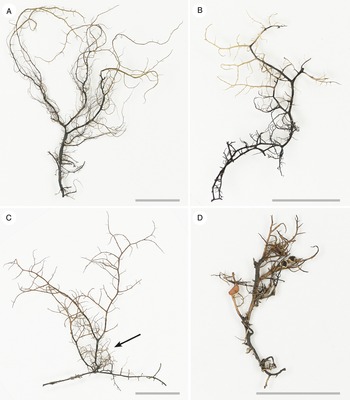
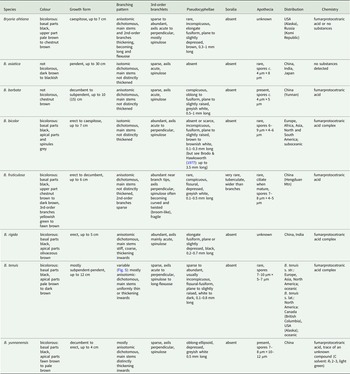
Based on the separate analysis of the ITS data set, subclade I is strongly supported (1/100%) and nested within paraphyletic subclade II (Fig. 2). Bryoria indonesica, B. nepalensis and B. variabilis are included in subclade I in addition to B. confusa, B. smithii and B. wui. In the parsimony analysis, the two subclades were both resolved as monophyletic (Supplementary Material Fig. S2, available online). In subclade II, the ITS sequence of a collection from Alaska (L880) was recovered in a strongly supported clade (1/95%) with the Komi Peninsula specimen (L168). This lineage is described below as the new species B. ahtiana (Fig. 4A, Table 4). All the currently recognized morphospecies represented by multiple samples were recovered as monophyletic and strongly supported in subclade II. The Chinese species B. fruticulosa and B. yunnanensis represented by three and two samples, respectively, formed monophyletic groups with high confidence (1/89% and 0.98/92%). Bryoria fruticulosa specimens typically have twisted and fragile third-order branchlets which are lacking in other species in this complex, while the two B. yunnanensis specimens have distinct main branches, lack third-order branchlets and are fertile (Fig. 4C & D, Table 4) (Wang et al. Reference Wang, Wang, Liu, Myllys, Shi, Zhang, Yang and Li2017). Seven B. bicolor specimens collected from various parts of the world (Canada, Finland, Russia, Sweden and the USA) formed a strongly supported group (0.97/85%) (Fig. 2). All specimens share the typical morphology of B. bicolor characterized by an erect growth form without distinct main branches, abundant second- and third-order branches and branchlets arising at right angles (Fig. 4B, Table 4). Likewise, five B. tenuis specimens collected in Alaska, USA, Finland and Sweden group together with high confidence (1/99%) (Fig. 2). Ten B. tenuis s. lat. specimens, all collected in western Canada and Alaska, form a monophyletic group within subclade II, separate from B. tenuis s. str (Fig. 2). In the Bayesian analysis, the clade was poorly supported, and in the ML analysis it was moderately strongly supported. The morphology of B. tenuis (including B. tenuis s. lat.) is discussed in more detail below, in the section ‘Morphology of Bryoria tenuis’.
General habits of Bryoria ahtiana sp. nov., B. bicolor, B. fruticulosa and B. yunnanensis. A, B. ahtiana (H—isotype) with mostly widely divergent branches including thick, distinctly tapering main stems and short, stiff third-order branchlets. B, B. bicolor (Kuusinen 1063 & Lampinen) with perpendicular second- and third-order branches and branchlets. C, B. fruticulosa (Wang 13-38482) with often dense and twisted third-order branchlets (shown with arrow). D, B. yunnanensis (H—isotype) with apothecia and poorly developed tertiary branches. Scales = 1 cm.

Comparison of the distinguishing characters of the species in subclade II, section Divaricatae. Information is based on herbarium material (ALA, CANL, H, KUN, O, TUR, UBC, UAAH and UPS) and literature (Bystrek Reference Bystrek1969; Jørgensen & Ryvarden Reference Jørgensen and Ryvarden1970; Jørgensen Reference Jørgensen1972; Brodo & Hawksworth Reference Brodo and Hawksworth1977; Wang & Harada Reference Wang and Harada2001; Hawksworth & Coppins Reference Hawksworth and Coppins2003; Kurokawa & Kashiwadani Reference Kurokawa and Kashiwadani2006; Jørgensen & Tønsberg Reference Jørgensen and Tønsberg2010; Jørgensen et al. Reference Jørgensen, Myllys, Velmala and Wang2012; Wang et al. Reference Wang, Wang, Liu, Myllys, Shi, Zhang, Yang and Li2017; Singh et al. Reference Singh, Singh and Sinha2018).

The number of specimens included in other single gene analyses was generally lower than in the ITS analyses and therefore the results are not directly comparable (Fig. 2). Bryoria rigida was strongly supported in all analyses (absent from the GAPDH and Tsr1 phylogenies) but otherwise resolution within subclade II often remained low and in some cases conflicted with the results obtained from ITS data. The IGS phylogeny mostly agrees with the results obtained from the ITS data: B. bicolor and B. tenuis s. str. were both monophyletic and B. tenuis s. lat. specimens were divided into two strongly supported groups. Bryoria ahtiana was not resolved as monophyletic since specimen L880 grouped with a single specimen of B. yunnanensis (0.99/91%) and specimen L168 was placed outside of this group. In the mtSSU phylogeny, B. bicolor was resolved as monophyletic (0.97/64%) and nested in a group containing all B. ahtiana, B. fruticulosa, B. tenuis, B. tenuis s. lat. and B. yunnanensis specimens; otherwise, relationships within this group remain unresolved. In the GAPDH phylogeny, B. bicolor was monophyletic and strongly supported (1/93%). Bryoria tenuis and B. tenuis s. lat. specimens clustered together with strong support (1/85%). The tree obtained from the Mcm7 data was inconsistent with the results obtained from ITS data: the monophyly of B. bicolor was not recovered as four specimens grouped instead with four B. tenuis and six B. tenuis s. lat. specimens in an unresolved polytomy with high confidence. One B. tenuis, three B. bicolor and three B. tenuis s. lat. specimens were left outside of this group. In the Tsr1 phylogeny, one B. bicolor specimen (S23) was placed outside of the strongly supported clade, which includes two B. bicolor specimens and single specimens of B. asiatica and B. ahtiana in addition to three B. tenuis and six B. tenuis s. lat. specimens. Within this group, two specimens representing B. tenuis formed a strongly supported clade and one B. tenuis specimen grouped with three B. tenuis s. lat. specimens with high confidence (1/100%).
Morphology of Bryoria tenuis
We examined the morphology of all specimens of B. tenuis s. str. and B. tenuis s. lat. included in our phylogenies, as well as material available at several herbaria (altogether 62 specimens) (Supplementary Material Table S1, available online). According to our results, B. tenuis appears to be a highly phenotypically plastic species, as illustrated in Fig. 5. Much of this plasticity is accounted for by variation in the main stems, which can be cobwebby (i.e. finely threadlike) and pliant (i.e. easily flexed) throughout (Fig. 5A), threadlike and pliant throughout (Fig. 5B), or else thickened and brittle in older parts (Fig. 5C). Also variable are the third-order branchlets which, as assessed in the terminal portions of the main stems, vary from short and rather stiff (Fig. 5B & C) to longer and more flexuous (Fig. 5D), with the latter state often correlated with a tendency for the main stems to weakly arc in their terminal portions (e.g. Fig. 5E). Taking these traits in combination results in five broadly defined, and possibly to some extent intergrading, thallus morphologies: cobwebby (Fig. 5A), threadlike-spinulose (Fig. 5B), threadlike-flexuose (Fig. 5E), thickening-spinulose (Fig. 5C), and thickening-flexuose (Fig. 5D). Two of these morphotypes (threadlike-flexuose and threadlike-spinulose) accounted for 42 of the 62 specimens examined by us, notwithstanding that the holotype of B. tenuis s. str. matches with the thickening-spinulose morphotype (Fig. 5F). No clear correlation was noted between thallus morphology and mycobiont phylogeny, with cobwebby, thickening-spinulose, threadlike-flexuose and threadlike-spinulose forms cropping up within both B. tenuis s. str. and B. tenuis s. lat. (Fig. 2).
Thallus morphologies of Bryoria tenuis, see text. A, cobwebby (finely threadlike) (B. tenuis s. lat. L980, UBC). B, threadlike-spinulose with short and rather stiff third-order branchlets (arrow) (B. tenuis s. lat. L1038, H). C, thickening-spinulose with short and rather stiff third-order branchlets (arrow) (B. tenuis s. str. L164, UPS). D, thickening-flexuose with longer and more flexuous third-order branchlets (arrow) (B. tenuis s. lat. L879, H). E, threadlike-flexuose with weakly arcing terminal branches (B. tenuis ALA L034794). F, holotype of B. tenuis (O) representing the (rather brittle) thickening-spinulose morphotype. Scales = 1 cm.

Species delimitation in section Divaricatae
The results obtained from species delimitation analyses are summarized in Table 3. The ASAP method based on genetic distances gave the smallest number of putative species while the two GMYC threshold analyses yielded the highest number. In general, none of the methods was fully consistent with the current taxonomy as the majority of partitions containing at least two samples were comprised of specimens identified as different species. Samples clustered in subclades I and II in the six-locus phylogeny were separated in all analyses. In subclade II, Bryoria tenuis s. str. was determined as a single species in the bPTP analysis of the ITS data set. None of the analyses identified the combination B. tenuis s. str. and B. tenuis s. lat. as a single species. Furthermore, none of the analyses recognized the B. tenuis s. lat. clade from the ITS phylogeny as a separate partition. Bryoria bicolor was recognized as a single species only in the GMYC multiple threshold analysis of the ITS data set, and B. rigida in the ASAP analyses of the IGS and mtSSU data sets as well as the bPTP analyses of the ITS and IGS data sets. Bryoria ahtiana was inferred as a distinct species in the GMYC single threshold analysis of the GAPDH data set and in the GMYC multiple threshold analyses of the ITS and GAPDH data sets. Bryoria fruticulosa was determined as a separate partition in the GMYC analyses of GAPDH data sets and B. yunnanenis in the GMYC multiple threshold analysis of the mtSSU data set and the bPTP analysis of the ITS data set. Bryoria asiatica and B. barbata were both inferred as separate partitions in several analyses.
The marginal likelihood for the species hypotheses tested and the Bayes factor results are shown in Table 5. The model that considers 14 species (Hypothesis 1) with the current circumscription was the best supported, followed by the model that considers 13 species (Hypothesis 2), with B. tenuis and B. tenuis s. lat. forming a single species.
Evaluation of different species hypotheses using Bayes factor in section Divaricatae. SS = marginal likelihood calculated using stepping-stone sampling; PS = marginal likelihood calculated using path sampling; BF = Bayes factor. Hypotheses 1 & 2 follow the species concept used in this study and hypotheses 3–12 are obtained from species delimitation analyses. The model that considers 14 species (Hypothesis 1) with the current circumscription is the best supported, followed by the model that considers 13 species (Hypothesis 2).

Discussion
Phylogeny of Bryoria
We used a six-locus dataset including three ribosomal (ITS, IGS, mtSSU) and three protein-coding markers (GAPDH, Mcm7, Tsr1) to examine infrageneric relationships in the genus Bryoria and to assess species delimitation in section Divaricatae. The addition of gene regions generally resulted in improved support values, especially for the backbone nodes. Our results confirm our previous findings (Myllys et al. Reference Myllys, Velmala, Lindgren, Glavich, Carlberg, Wang and Goward2014, Reference Myllys, Velmala, Pino-Bodas and Goward2016) that section Bryoria sensu Myllys et al. (Reference Myllys, Velmala, Holien, Halonen, Wang and Goward2011) is polyphyletic and divides into two separate entities. Bryoria clade 1 was resolved as a sister group to B. americana and is placed here in an emended section Americanae. No morphological characters were found to support the separation of section Bryoria into two groups, but the distributions of the two clades clearly differ. In their new circumscription, section Bryoria consists mostly of species with broad discontinuously circumpolar distributions while section Americanae, with the exception of the widely distributed B. americana, is restricted to western North America and the Himalayan region.
Our six-locus phylogeny confirmed the circumscription of section Divaricatae as presented in Myllys et al. (Reference Myllys, Velmala, Holien, Halonen, Wang and Goward2011). This is in contrast to the ITS + Mcm7 phylogeny of Myllys et al. (Reference Myllys, Velmala, Pino-Bodas and Goward2016) and the ITS phylogeny of Wang et al. (Reference Wang, Wang, Liu, Myllys, Shi, Zhang, Yang and Li2017), both of which excluded B. confusa, B. nepalensis, B. smithii, B. variabilis and B. wui (corresponding to subclade I in the present study) from this section. The conflicting results are probably due to low backbone resolution in those two- and single locus phylogenies, as well as to the long branch leading to these species. All the species in this subclade lack secondary substances while most of the species in subclade II, namely B. barbata, B. bicolor, B. fruticulosa, B. rigida, B. tenuis (including B. tenuis s. lat.) and B. yunnanensis, contain fumarprotocetraric acid. In our earlier study (Myllys et al. Reference Myllys, Velmala, Holien, Halonen, Wang and Goward2011), we suggested that the section can be regarded as morphologically well defined insofar as all species have a characteristic bicolorous thallus with blackened basal parts and greyish brown to olive-brown apical branches that bear spinulose third-order branchlets (see Jørgensen & Ryvarden Reference Jørgensen and Ryvarden1970; Jørgensen Reference Jørgensen1972, Reference Jørgensen1975; Brodo & Hawskworth Reference Brodo and Hawksworth1977). However, contrary to our definition, Wang et al. (Reference Wang, Wang, Liu, Myllys, Shi, Zhang, Yang and Li2017) noted that B. barbata and B. wui are uniform in colour, as had earlier been reported for B. asiatica (Wang & Harada Reference Wang and Harada2001; see also Table 4). Furthermore, based on our inspection of B. tenuis s. str. and B. tenuis s. lat. (e.g. specimens B. tenuis L681 and B. tenuis s. lat. L693), the colour difference between the basal and apical portions is not always clear since the latter are medium brown rather than pale brown. The differences in colour within these taxa are probably the result of differing ecological conditions and of no taxonomic significance. Furthermore, in some material of B. tenuis s. lat. specimens, pale and black parts are not always restricted to apical and basal parts but alternate on main branches (e.g. in specimens L225, L696 and L980).
Brodo & Hawksworth (Reference Brodo and Hawksworth1977) suggested that Divaricatae is an evolutionary ancient group but recent molecular phylogenies (Myllys et al. Reference Myllys, Velmala, Pino-Bodas and Goward2016; Wang et al. Reference Wang, Wang, Liu, Myllys, Shi, Zhang, Yang and Li2017) including this study (Fig. 3) show that this section is of recent origin and is currently undergoing diversification, especially in South-East Asia but also in western North America (Jørgensen et al. Reference Jørgensen, Myllys, Velmala and Wang2012; Myllys et al. Reference Myllys, Velmala, Pino-Bodas and Goward2016; Wang et al. Reference Wang, Wang, Liu, Myllys, Shi, Zhang, Yang and Li2017; McCune et al. Reference McCune, Arup, Breuss, Di Meglio, Di Meglio, Esslinger, Miadlikowska, Miller, Rosentreter and Schultz2020). High speciation rates have previously been reported in several Parmeliaceae taxa, including Bryoria section Implexae (Boluda et al. Reference Boluda, Rico, Divakar, Nadyeina, Myllys, McMullin, Zamora, Scheidegger and Hawksworth2019) and Usnea (Kraichak et al. Reference Kraichak, Divakar, Crespo, Leavitt, Nelsen, Lücking and Lumbsch2015; Mark et al. Reference Mark, Saag, Leavitt, Will-Wolf, Nelsen, Tõrra, Saag, Randlane and Lumbsch2016).
Our dating results are congruent with those of Boluda et al. (Reference Boluda, Rico, Divakar, Nadyeina, Myllys, McMullin, Zamora, Scheidegger and Hawksworth2019) but younger than those presented by Divakar et al. (Reference Divakar, Crespo, Kraichak, Leavitt, Singh, Schmitt and Lumbsch2017), probably an artefact of different methodologies. While we followed Boluda et al. (Reference Boluda, Rico, Divakar, Nadyeina, Myllys, McMullin, Zamora, Scheidegger and Hawksworth2019) and used the Melanohalea substitution rate (Leavitt et al. Reference Leavitt, Esslinger, Divakar and Lumbsch2012), Divakar et al. (Reference Divakar, Crespo, Kraichak, Leavitt, Singh, Schmitt and Lumbsch2017) used secondary calibrations based on a fossil-dated phylogeny (Amo de Paz et al. Reference Amo de Paz, Cubas, Divakar, Lumbsch and Crespo2011). However, as pointed out by Graur & Martin (Reference Graur and Martin2004), secondary calibration based on a single calibration point can produce errors. The origin of Bryoria coincides with the period of global cooling that occurred until the early Pliocene (Zachos et al. Reference Zachos, Pagani, Sloan, Thomas and Billups2001). This indicates that the diversification of the main Bryoria groups occurred in a cold period dominated by coniferous forests (Sanmartín et al. Reference Sanmartín, Enghoff and Ronquist2001).
Species delimitation in section Divaricatae
Whereas the topologies of our phylogenetic trees from ITS and IGS were mostly congruent and supported current species concepts in section Divaricatae, the remaining gene regions were less informative and produced more poorly resolved and partly conflicting phylogenetic trees (Fig. 2) and highly inconsistent species delimitation. We suggest that the lack of species monophyly in analyses of these latter loci, as well as the non-congruence of the species delimitation results, are related to the recent divergence of the species. A similar case has been reported in the B. fuscescens complex (Boluda et al. Reference Boluda, Rico, Divakar, Nadyeina, Myllys, McMullin, Zamora, Scheidegger and Hawksworth2019), where lack of genetic differentiation between the species is attributed to their recent divergence c. 1 Mya. Further similar cases have also been observed in other groups (McMullin et al. Reference McMullin, Lendemer, Braid and Newmaster2016; Pino-Bodas et al. Reference Pino-Bodas, Burgaz, Ahti and Stenroos2018; Jorna et al. Reference Jorna, Linde, Searle, Jackson, Nielsen, Nate, Saxton, Grewe, Herrera-Campos and Spjut2021; Asher et al. Reference Asher, Howieson and Lendemer2023), highlighting the difficulty of species delimitation in recently evolved groups with complex, recent phylogeographical histories.
Inconsistencies between different species delimitation methods have been widely discussed in the literature. In some cases, these may reflect a violation of the foundational assumptions of the methods (Carstens et al. Reference Carstens, Pelletier, Reid and Satler2013), while in others they may result from biases arising from the number of per-species haplotypes being analyzed, the geographical distance between intraspecific sampling locations, or the taxonomic range analyzed (Lohse Reference Lohse2009; Ahrens et al. Reference Ahrens, Fujisawa, Krammer, Eberle, Fabrizi and Vogler2016; Sukumaran & Knowles Reference Sukumaran and Knowles2017; Hofmann et al. Reference Hofmann, Nicholson, Luque-Montes, Köhler, Cerrato-Mendoza, Medina-Flores, Wilson and Townsend2019; Magoga et al. Reference Magoga, Fontaneto and Montagna2021). Such inconsistencies led Carstens et al. (Reference Carstens, Pelletier, Reid and Satler2013) to recommend an integrative taxonomy approach in which the results of several different species delimitation methods are compared with phenotypic and ecological data and distribution patterns (Dayrat Reference Dayrat2005; Maharachchikumbura et al. Reference Maharachchikumbura, Chen, Ariyawansa, Hyde, Haelewaters, Perera, Samarakoon, Wanasinghe, Bustamante and Liu2021) before taxonomic changes are introduced.
Incongruences among gene regions may also be linked to biological causes such as recombination, hybridization and incomplete lineage sorting. In the present case, we consider the last explanation most likely in the predominantly sterile species B. bicolor and B. tenuis, whereas recombination and hybridization may play a role in B. fruticulosa and B. yunnanensis, both of which regularly produce apothecia. Hybridization has been detected in other genera in the Parmeliaceae, most recently in Xanthoparmelia (Keuler et al. Reference Keuler, Jensen, Barcena-Peña, Grewe, Lumbsch, Huang and Leavitt2022). Incongruent results obtained from the Mcm7 gene may also reflect gene duplication and paralog formation as shown in Usnea (Lücking et al. Reference Lücking, Nadel, Araujo and Gerlach2020).
Inclusion of additional markers may either support the topology obtained from a single marker or increase resolution where a single marker such as ITS is not sufficient to provide adequate resolution to assess species boundaries (Lücking et al. Reference Lücking, Leavitt and Hawksworth2021). In the present study, however, the addition of other gene regions traditionally used in phylogenetic studies did not always increase phylogenetic resolution in section Divaricatae. Thus, in the ITS phylogeny both B. tenuis and B. tenuis s. lat. were resolved as monophyletic lineages, while in the multi-locus phylogeny, the B. tenuis clade was not resolved as monophyletic but grouped with B. tenuis s. lat. While B. tenuis s. str. was strongly supported in all analyses obtained from ITS data, the emended lineage in the multi-locus tree was strongly supported only in the Bayesian analysis. Furthermore, in the parsimony tree obtained from the combined data set (Supplementary Materials Fig. S1, available online), neither B. bicolor nor B. tenuis s. str. were resolved as monophyletic but appeared in a strongly supported, largely unresolved group with B. ahtiana, B. fruticulosa, B. tenuis s. lat. and B. yunnanensis, suggesting that all these taxa should be treated as conspecific. These results highlight the difficulty in separating closely related species using multi-locus approaches and illustrate that decisions regarding conspecificity should be made with caution (see Grewe et al. Reference Grewe, Lagostina, Wu, Printzen and Lumbsch2018).
According to current knowledge, most Bryoria species in section Divaricatae can be regarded as morphologically rather conservative, varying within a relatively narrow range of thallus morphologies. A notable exception is B. tenuis which, as circumscribed here, appears to be a highly morphologically plastic species (Fig. 5). Rather unexpectedly, both B. tenuis s. str. and B. tenuis s. lat. produce all five morphologies, which thus occur throughout the range of the species as a whole; however, whether they are under some form of genetic control or represent variation in ecotypic response is unknown. Initially we intended to recognize Bryoria tenuis s. lat. as a distinct species recently diverged from B. tenuis s. str., a treatment consistent with our ITS data and Bayes factor results, and further supported by its strictly western North American distribution (versus the more or less circumpolar-oceanic distribution of B. tenuis s. str.). Given, however, the lack of corroborating morphological evidence outlined in the present study, we feel that species recognition, if warranted at all, must await further study, including information on the identity of the photobionts. In the future, genome-scale data will potentially be useful in addressing species delimitation in Bryoria. RADseq approaches in particular have provided sufficient resolution to separate recently diverged species, including the species pair Usnea antarctica/U. aurantiacoatra (Grewe et al. Reference Grewe, Lagostina, Wu, Printzen and Lumbsch2018), the Rhizoplaca melanophthalma complex (Grewe et al. Reference Grewe, Huang, Leavitt and Lumbsch2017) and Pseudocyphellaria (Widhelm et al. Reference Widhelm, Rao, Grewe and Lumbsch2023). Furthermore, species partitions inferred from ITS in the genus Niebla Rundel & Bowler (Ramalinaceae) have been shown to coincide with clades inferred from RADseq markers (Jorna et al. Reference Jorna, Linde, Searle, Jackson, Nielsen, Nate, Saxton, Grewe, Herrera-Campos and Spjut2021).
Taxonomy
Bryoria ahtiana Myllys & Goward sp. nov.
MycoBank No.: MB 848936
Thallus hairlike, bicolorous with basal parts black and apical parts brown, branching predominantly anisotomic, main stems distinctly thick, gradually tapering towards tips, with few to many stiff, spinulose third-order branchlets; resembling B. tenuis but with thicker, more distinctly tapering main stems and shorter, stiffer third-order branchlets. Epiphytic or saxicolous.
Type: USA, Alaska, Kenai Peninsula Borough, Kenai Fjords National Park, N end of Harris Bay, near opening to Northwestern Lagoon, open alluvial flats with groves of young Picea, elevation 3 m, 59.7487°N, 149.8462°W, NAD83, on Picea snag, 8 July 2015, Bruce McCune et al. 36219 (OSC—holotype; H—isotype, H9214302). GenBank Accession nos: MN906272 (ITS), OR060816 (IGS).
(Fig. 4A)
Thallus caespitose, hair-like, up to 7 cm long, bicolorous, basal portions black, apical portions pale brown to chestnut brown. Branching anisotomic, giving rise to distinct, conspicuously thickened main stems and sparse secondary branches, main stems to 3 cm long and 0.7 mm wide, terminal portions mostly long and flexuous, rather shiny. Third-order branchlets sparse to abundant, mostly perpendicular, and spinulose; spinules 1–4 mm long. Pseudocyphellae rare, inconspicuous, brownish dark brown, elongate fusiform, plane or slightly depressed, c. 0.05 mm wide, 0.3–1 mm long. Soralia and isidia absent.
Apothecia and condiomata not seen.
Chemistry
Cortex and medulla Pd− or Pd+ red, secondary substances absent or containing fumarprotocetraric acid.
Etymology
Named in honour of Prof. Teuvo Ahti, the Finnish lichenologist, in recognition of his long interest in and outstanding contributions to lichenology in western North America, both through his taxonomic research (e.g. Ahti & Henssen Reference Ahti and Henssen1965; Goward & Ahti Reference Goward and Ahti1983, Reference Goward and Ahti1997; Brodo & Ahti Reference Brodo and Ahti1996; Ahti Reference Ahti2007) and his unstinting willingness to help and encourage up-and-coming lichenologists in the region.
Distribution and habitat
The new species is currently known from two specimens: one from Alaska, USA in the oceanic boreal region, and one from the Komi Republic of Russia in the low alpine.
Notes
Bryoria ahtiana is a non-sorediate hair lichen distinguished by its bicolorous, widely divergent thallus, conspicuously thickened main stems, well-developed secondary branches, and typically sparse third-order branchlets. It may be confused with the closely related B. tenuis, which is, however, more pendent and has thinner, less conspicuous main stems, usually with more numerous third-order branchlets. Also closely related are the bicolorous species B. bicolor, B. fruticulosa, B. rigida and B. yunnanensis, all of which differ from B. ahtiana in their habit and branching pattern: B. bicolor is erect to caespitose and has perpendicular second- and third-order branches and branchlets; B. fruticulosa, with usually sparse second-order branches, is erect to decumbent and has dense, fragile third-order branchlets; B. rigida is erect and has a stiff, coarse habit and short third-order branchlets; and B. yunnanensis is a small, often erect, usually fertile species with sparse third-order branchlets (Fig. 4, Table 4). While B. ahtiana is sympatric with B. bicolor in north-west North America, B. fruticulosa, B. rigida and B. yunnanensis are known only from South-East Asia (Jørgensen et al. Reference Jørgensen, Myllys, Velmala and Wang2012; Wang et al. Reference Wang, Wang, Liu, Myllys, Shi, Zhang, Yang and Li2017).
Fumarprotocetraric acid could not be detected in the type specimen, although this substance was present in small amounts in the Komi specimen (L168); this is consistent with Brodo & Hawksworth (Reference Brodo and Hawksworth1977), who reported that fumarprotocetraric acid in B. tenuis may be localized or present in low concentrations, and therefore easily overlooked in routine testing.
Additional specimen examined
Russia: Komi Republic: Troitsko-Pechorskii, Hrebet EbeĺIs, N slope and top, 21.5 km NW of Ust-Ljaga, saxicolous on small slate rocks at low alpine subzone, 600–720 m, 62°38ʹN, 58°45ʹE, 9 vi 2003, J. O. Hermansson 12625 (UPS L-132835).
Acknowledgements
We thank Emilia Piki, Emelie Winquist and Marijke Iso-Kokkila for help with laboratory work, Tuomas Kuusinen for technical assistance, Leena Helynranta for preparing Figs 4 and 5, Bruce McCune and Sarah Jovan for arranging fresh material, and Karen Dillman for kindly providing collection information for her specimens. We also thank two reviewers for their helpful comments on the manuscript and the curators of herbaria ALA, CANL, KUN, O, TUR, UAAH, UBC and UPS for providing material. The study was financially supported by the Academy of Finland (grant 323711 to LM). RPB was funded by the Talent Attraction program (ref. 2020-T1/AMB-19852, Comunidad de Madrid).
Author ORCIDs
Leena Myllys, 0000-0002-9566-9473; Raquel Pino-Bodas, 0000-0001-5228-5368; Saara Velmala, 0000-0002-9386-243X; Li-Song Wang, 0000-0003-3721-5956; Trevor Goward, 0000-0003-2655-9956.
Competing Interests
The authors declare none.
Supplementary Material
The Supplementary Material for this article can be found at https://doi.org/10.1017/S0024282923000555.