A key goal in the developmental psychopathology literature has been to describe and understand the etiology of mental health and behavioral problems as they develop during childhood and adolescence. Recent attention to developmental cascade models offers an important advance toward this goal because such models go beyond examining a set of predictors in relation to a set of outcomes by trying to map the mechanisms through which early risk factors affect subsequent outcomes over the course of development. Understanding of these mechanisms has the potential to inform interventions at key junctions to prevent future problems (Burt, Obradović, Long, & Masten, Reference Burt, Obradović, Long and Masten2008). Cascade models have been characterized as models that test “spill over” from one domain to multiple others, and they are best tested using data from at least three points of time on at least three constructs (Masten, Burt, & Coatsworth, Reference Masten, Burt, Coatsworth, Cicchetti and Cohen2006).
In the present study, we focus on a developmental cascade model that suggests relations among early peer rejection, social information processing (SIP) deficits, and aggressive behavior. The model posits that children's aggression is shaped by early rejection by the peer group and SIP deficits that bias children's cognition regarding social cues and increase the likelihood that children will behave aggressively in the future. The model also posits that SIP deficits and aggressive behavior increase the likelihood of future rejection by the peer group. In a series of reciprocal and mediated transactions over time, these three environmental (peer rejection), cognitive (SIP), and behavioral (aggression) factors compound and exacerbate one another.
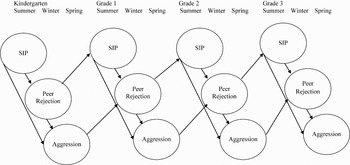
The conceptual model is shown in Figure 1. The extant literature provides considerable evidence regarding links between pairs of variables in the conceptual model (i.e., between peer rejection and aggression, between SIP and aggression, and between peer rejection and SIP). We first review the literature on each of these bivariate links, then review the literature examining SIP as a mediator of the link between peer rejection and aggression, and finally describe how a developmental cascade model advances understanding of the development of SIP and aggression in the context of peer rejection.
Conceptual and analytic developmental cascade model of social information processing (SIP), peer rejection, and aggression. Paths between constructs were constrained to be constant across time (e.g., kindergarten SIP to aggression path constrained to be equal to Grades 1–3 SIP to aggression paths) and were then systematically freed to test the plausibility of the time constraints. Ethnicity (African American vs. non-African American), sex, study site, study cohort, and socioeconomic status were modeled as exogenous covariates, predicting all study variables. Each study construct was modeled as predicting all subsequent measures of that construct (paths not shown).

Peer Rejection and Aggression
Many studies have demonstrated significant associations between peer rejection and aggression, indicating both that aggressive behavior leads to peer rejection and that peer rejection leads to subsequent aggression (Parker & Asher, Reference Parker and Asher1987). During elementary school, aggressive behavior is one of the best predictors of peer rejection (for a review, see Coie, Dodge, & Kupersmidt, Reference Coie, Dodge, Kupersmidt, Asher and Coie1990). Conceptually, it makes sense that children would not like and would actively dislike peers who behave aggressively.
Empirical studies have found that peer rejection is not only a consequence of a child's aggressive behavior but also a predictor of future aggression (e.g., Bierman, Smoot, & Aumiller, Reference Bierman, Smoot and Aumiller1993; Coie, Lochman, Terry, & Hyman, Reference Coie, Lochman, Terry and Hyman1992). Using data from two long-term longitudinal studies (one of which was The Child Development Project used in the present study), Dodge et al. (Reference Dodge, Lansford, Burks, Bates, Pettit, Fontaine and Price2003) found that peer rejection early in elementary school predicted subsequent teacher-reported aggression, even after controlling for prior teacher-reported aggression. Peer rejection has been found to predict even the persistence of aggressive criminal behavior into young adulthood (Rabiner, Coie, Miller-Johnson, Boykin, & Lochman, Reference Rabiner, Coie, Miller-Johnson, Boykin and Lochman2005). Given this pattern of longitudinal findings, one way to conceptualize peer rejection is as a major life stressor that can have long-term negative implications for children's adjustment, much as other life stressors such as exposure to harsh or abusive parenting do (e.g., Lansford et al., Reference Lansford, Miller-Johnson, Berlin, Dodge, Bates and Pettit2007). Peer relationships serve an important function in teaching children adaptive social behavior (Ladd, Reference Ladd1999); therefore, children who are deprived of these experiences because they are rejected by peers may not have the opportunity to learn important social skills, and instead, may perpetuate negative social interactions, including aggression (Dodge et al., Reference Dodge, Lansford, Burks, Bates, Pettit, Fontaine and Price2003).
SIP and Aggression
The research on links between peer rejection and aggression suggests that aggression may lead to peer rejection and that peer rejection may lead to aggression, but these associations do not explain the proximal factors that give rise to aggression in particular situations. That is, in real time, what determines whether a child will behave aggressively? Cognitive mechanisms described in SIP theory provide one answer to this important question. According to this theory, the way that children interpret a particular event influences whether they will respond aggressively to that situation (Crick & Dodge, Reference Crick and Dodge1994). Dodge and his colleagues (e.g., Dodge, Bates, & Pettit, Reference Dodge, Bates and Pettit1990; Dodge & Crick, Reference Dodge and Crick1990) have proposed five steps in a model of SIP: encoding, making attributions, generating responses, evaluating responses, and enacting responses.
First, encoding involves taking in information from social situations. Aggression is more likely when children have encoding problems characterized by hypervigilence to hostile cues, lack of attention to relevant nonhostile cues, or both (Dodge, Bates, et al., Reference Dodge, Bates and Pettit1990). Second, making attributions involves interpreting why other people behave in particular ways. Children who believe that other people have behaved with hostile intent are more likely to behave aggressively than are children who believe that other people have behaved with benign intent or that a negative interaction occurred by accident (Dodge, Price, Bachorowski, & Newman, Reference Dodge, Price, Bachorowski and Newman1990). Third, generating responses involves thinking of possible responses to use in a social situation. Children who generate fewer possible responses to social situations and who more readily generate possible aggressive responses are more likely to behave aggressively than are other children (Asarnow & Callan, Reference Asarnow and Callan1985). Fourth, evaluating responses involves assessing whether using a particular response would be associated with desired instrumental, interpersonal, and intrapersonal outcomes. Believing that aggression will lead to desired outcomes and having confidence in one's ability to behave aggressively are related to more aggressive behavior (Crick & Ladd, Reference Crick and Ladd1990; Dodge & Crick, Reference Dodge and Crick1990). Fifth, enacting responses is how a child actually behaves. Children who are skilled in behaving aggressively and less skilled in enacting nonaggressive responses are more likely to be aggressive (Dodge, McClaskey, & Feldman, Reference Dodge, McClaskey and Feldman1985).
Peer Rejection and SIP
During the course of social interactions, children develop cognitive schemas that influence their processing of information in subsequent social situations. Children who have been rejected by their peers may be denied opportunities for learning competent ways of processing social information, and instead, may be provided with experiences that contribute to deficits in SIP (Dodge et al., Reference Dodge, Lansford, Burks, Bates, Pettit, Fontaine and Price2003). For example, rejected children may have fewer social interactions in which they can learn to attend to relevant social cues and develop prosocial behavioral responses and may have more experiences that would lead them to believe that peers act with hostile intent (Trachtenberg & Viken, Reference Trachtenberg and Viken1994). This combination of lack of positive peer interactions and presence of negative peer interactions may contribute to the link between peer rejection and SIP deficits.
Empirically, children who have been rejected by their peers have been shown to have several deficits in processing social information. Peer rejection has been found to be associated with errors in encoding relevant social cues, inferring hostile intentions of other people in ambiguous or benign situations, and generating fewer and more hostile responses to hypothetical social situations (e.g., Dodge et al., Reference Dodge, Lansford, Burks, Bates, Pettit, Fontaine and Price2003; Waldman, Reference Waldman1996). Although a causal direction from peer rejection to SIP deficits has often been assumed, it is also plausible that SIP deficits lead to future peer rejection by virtue of making children less competent social partners. That is, children who are not able accurately to encode social cues, who misinterpret their peers’ intentions, who are not able to generate competent solutions to peer dilemmas, and who favorably evaluate noncompetent solutions to social problems are likely to behave in ways (aggressive or not) that make them less desirable social partners.
Cascade Models and the Present Study
Thus far, we have focused on bivariate links between peer rejection and aggression, SIP and aggression, and peer rejection and SIP. However, a multivariate framework has been proposed to account for links among these three constructs: SIP has been proposed as a cognitive mechanism accounting at least partly for the link between peer rejection and aggression. In a rigorous test of part of the cascade model proposed here, Dodge et al. (Reference Dodge, Lansford, Burks, Bates, Pettit, Fontaine and Price2003) found in two independent samples that SIP patterns partially mediated the effect of early rejection on subsequent aggression.
The strongest models to date have examined SIP at one point in time as a mediator of the link between prior peer rejection and subsequent aggressive behavior, controlling for prior aggressive behavior. Although this approach is valuable in demonstrating a key mechanism through which peer rejection affects later aggression, the approach treats each individual construct in a largely static, nondevelopmental way. In the course of children's development, however, it is likely that these constructs are not static but rather dynamic, each changing as a function of changes in the others. Once early peer rejection alters children's SIP about peer relationships and in turn increases their aggressive behavior, the cycle likely does not end there. Instead, this increase in aggressive behavior might predict future rejection by peers and further exacerbate SIP problems.
The present study addresses three gaps in the literature. First, we conceptualize SIP as being dynamic, developmental, and changing as a function of experiences over time rather than as a static, traitlike individual characteristic. Even studies that have incorporated SIP in longitudinal models typically have not investigated its evolution over time in conjunction with experiences and behavioral adjustment. Second, we examine peer social preference, SIP, and aggressive behavior in a series of cascade models that span 12 time points over 4 years. This advances the literature beyond a simple mediation approach to understanding the links among these constructs to considering how each construct might effect changes in the others in a snowballing cycle over time. Third, we control for prior levels of the same variables when conducting statistical tests. Thus, the findings can be interpreted as effects of one variable on the others, above and beyond continuity in the constructs over time.
This approach addressed two main research questions in understanding developmental cascades of peer rejection, SIP, and aggression. First, are there direct effects of SIP on peer rejection and aggression, direct effects of peer rejection on SIP and aggression, and direct effects of aggression on peer rejection? We hypothesized that all of these direct effects would be significant in a developmental cascade of exacerbating problems from kindergarten through Grade 3, even controlling for continuity in each construct over time. Second, are there indirect effects of SIP, peer rejection, and aggression on each construct through the other constructs? We hypothesized that each construct would have indirect effects on the others that would result in snowballing effects of risk over time.
Method
Participants
The families in the current investigation were participants in an ongoing, multisite longitudinal study of child development (Dodge, Bates, et al., Reference Dodge, Bates and Pettit1990). Participants were recruited in two cohorts when the children entered kindergarten in 1987 or 1988 at three sites: Knoxville and Nashville, TN, and Bloomington, IN. Parents were approached at random during kindergarten preregistration and asked if they would participate in a longitudinal study of child development. About 15% of children at the targeted schools did not preregister. These participants were recruited on the first day of school or by subsequent contact. Of those asked, approximately 75% agreed to participate. The sample consisted of 585 families at the first assessment. Males comprised 52% of the sample. Eighty-one percent (81%) of the sample were European American, 17% were African American, and 2% were from other ethnic groups. Follow-up assessments were conducted annually through Grade 3. Eighty-five percent of the original 585 families provided Grade 3 data for the present analyses. These children did not differ from nonparticipating children on child or family variables from the kindergarten assessment.
Procedures and measures
During the summer before each school year in kindergarten through third grade, SIP interviews were conducted with children in their homes. During the winter of each school year, children's peers completed sociometric interviews. During the spring of each school year, children's teachers completed ratings of children's aggressive behavior. This sequence describes the majority of our data, but there were some variations in the sequence in individual cases. This staggered interview schedule resulted in data from 12 time points that were used in the present analyses (three constructs each assessed at four time points).
SIP
Annually during the summer before kindergarten through Grade 3, children were presented with 24 video vignettes that depicted situations in which child protagonists attempted unsuccessfully to enter peer groups and encountered provocations from peers. In each vignette, children were told to imagine being the protagonist and were asked a series of questions after watching each vignette. Children were also presented with a series of cartoon pictures and brief verbal descriptions of the cartoon events and were asked questions to assess their processing of the cartoon stimuli. Interrater agreement on all open-ended SIP questions described below was good (κ > 0.80 in all instances; see Weiss, Dodge, Bates, & Pettit, Reference Weiss, Dodge, Bates and Pettit1992).
Encoding was assessed by asking children to describe what happened in each of the 24 video vignettes. Responses were coded according to how much relevant information the child encoded (1 = a fully relevant response with clear attention to appropriate cues, 2 = a partially relevant response, 3 = a nonrelevant response). Responses were averaged across vignettes to create a single encoding deficits score (α = 0.90–0.91).
Attributions were assessed by asking children why they thought the peers in eight cartoon stories behaved as they did in ambiguous situations. Each attribution was coded as hostile or nonhostile, and a composite hostile attributions score was created by taking the proportion of the stories in which children interpreted the peers’ intentions as hostile (α = 0.88, 0.84, 0.80, and 0.75 in kindergarten, Grade 1, Grade 2, and Grade 3, respectively).
Response generation was assessed by asking children how they would respond if each of the 24 video situations had happened to them. Each response was coded as being aggressive, withdrawn or inept, or assertive and competent. Children were separately presented with eight cartoon stimuli and asked to generate solutions to the problems depicted in the cartoons. The proportions of aggressive responses generated for the video vignettes and cartoon stimuli were calculated, and scores were standardized and combined to create a single variable reflecting aggressive response generation (α = 0.61–0.66).
After each video vignette, children were shown alternative strategies (competent, aggressive, and inept) for dealing with the situation. Response evaluation was assessed by asking children to rate whether each alternative strategy was a good or bad thing to say or do (1 = very bad, 2 = bad, 3 = good, 4 = very good). Aggressive response evaluation was scored as the average of this item following the aggressive response across the 24 vignettes (α = 0.86, 0.82, 0.71, and 0.63 in kindergarten, Grade 1, Grade 2, and Grade 3, respectively). Each of the four SIP variables (i.e., encoding deficits, hostile attributions, aggressive response generation, aggressive response evaluation) was created separately for each year (kindergarten through Grade 3), and higher scores indicated more SIP problems (for additional details, see Dodge, Bates, et al., Reference Dodge, Bates and Pettit1990; Dodge, Pettit, Bates, & Valente, Reference Dodge, Pettit, Bates and Valente1995). In a manner often used in the public health literature to create an index of risk variables by counting risk factors to use as a predictor, a final SIP variable in each year was created by taking the proportion of the four SIP steps in a given year on which the child scored 1 SD above the mean or greater.
Social preference
Sociometric interviews following the protocol described by Coie, Dodge, and Coppotelli (Reference Coie, Dodge and Coppotelli1982) were conducted during the winter of each school year in all classrooms in which at least 70% of children's parents gave consent. Children were shown pictures of their classmates (in kindergarten and first grade) or a class roster (in second and third grades for both cohorts and in fourth grade for Cohort 1 only) and were asked to rate how much they liked each other child on a 5-point scale. Children then named up to three peers they especially liked and up to three peers they especially disliked. A social preference score was created by taking the standardized difference between the standardized like most nomination score and the standardized dislike most nomination score. Given the analytic advantages of continuous variables, we decided to use the continuous social preference score rather than creating a categorical peer rejection variable.
Child aggression
In the Spring of each school year when the children were in kindergarten and Grades 1, 2, and 3, children's teachers completed the Teacher Report Form of the Child Behavior Checklist (Achenbach, Reference Achenbach1991). Teachers reported whether each item was not true (0), somewhat or sometimes true (1), or very or often true (2) of the child. Items on the aggression subscale were summed to create a 25-item composite in each year. The Aggression subscale includes items that are prototypically aggressive (e.g., gets in many fights; has a hot temper; cruelty, bullying, or meanness to others; threatens people) as well as items that are disruptive and uncooperative (e.g., explosive and unpredictable behavior; disturbs other pupils; argues a lot). The total score was divided by 10 for analytic purposes to reduce problems associated with rounding error.
Sample characteristics and missing data
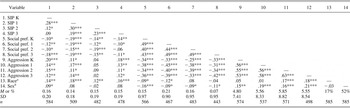
Table 1 presents means, standard deviations, and sample sizes of the study variables. Study site and study cohort were included as control variables in the models, but these variables were not systematically correlated with the other study variables and therefore are not included in Table 1. The tabled values are based on those respondents providing valid data for each variable. In subsequent analyses, models were estimated using the missing data facility in Mplus v.5.1 (Muthén & Muthén, Reference Muthén and Muthén2008); Mplus uses full information maximum likelihood estimation with missing data, which results in unbiased parameter estimates and appropriate standard errors when data are missing at random. Full information maximum likelihood estimates are generally superior to those obtained with listwise deletion or other ad hoc methods, even when the missing at random assumption is not fully met (Schafer & Graham, Reference Schafer and Graham2002).
Descriptive statistics and bivariate correlations

Note: SIP, social information processing; K, Kindergarten; 1–3, Grades 1–3.
aAfrican American = 1, non-African American = 0.
bBoy = 1, girl = 0.
*p < .05. **p < .01. ***p < .001.
Results
We constructed a path model to test our hypotheses of cascading influences among social preference, SIP, and aggression in the early school years. Because the measures of the three constructs were largely collected at different times of year, we were able to define the temporal sequence of measures (with the caveats of all correlational research).
The analytic model is presented in Figure 1. Five path coefficients were of greatest interest: the paths from Summer SIP to the following Winter social preference ratings and to the following Spring teacher-rated aggression; the paths from Winter social preference to Spring aggression and the following Summer SIP; and the path from Spring aggression to the following Winter social preference. In the model, each of these paths was constrained a priori to be constant across time, so only five values were estimated across the years of data collection. Imposing these constraints allows one to obtain more stable estimates of the paths by having more data contribute to each estimate. We subsequently tested the feasibility of these constraints, allowing us to verify (or disconfirm) the assumed stability of the cascade process. Ethnicity (African American vs. non-African American), sex, study site, study cohort, and socioeconomic status were modeled as exogenous covariates, predicting all study variables. Finally, each study construct was modeled as predicting all subsequent measures of that construct: all paths between the same construct over time were included. These paths were retained after exploratory analyses showed that they were necessary for adequate model fit. It may also be that this inclusion would underestimate the cascade effects, as some of the “looping” effects would be subsumed in the autoregressive coefficients; thus, we view this model as a conservative test of the cascade hypotheses. The model was estimated in Mplus 5.1 (Muthén & Muthén, Reference Muthén and Muthén2008). This path-modeling approach enabled us to test each hypothesized path in the context of the other variables in the model.
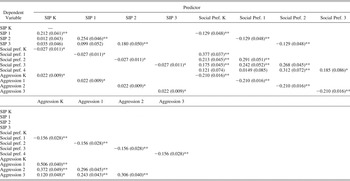
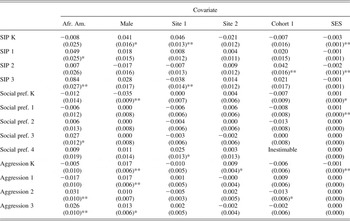
The hypothesized model yielded a significant chi-square test of goodness of fit for the overall model, χ2 (52, N = 585) = 95.7, p < .001, but showed adequate approximate fit indices, comparative fit index = 0.977, Tucker–Lewis index = 0.933, and a low estimated root mean square error of approximation (0.038, 95% confidence interval = 0.026–0.050). We deemed the model acceptable for interpretation. All path coefficients and associated standard errors from this model appear in Tables 2 and 3. All five key coefficients were statistically significant in the hypothesized directions: SIP problems predicted lower liking and higher aggression, lower liking predicted more SIP difficulties and more aggression, and aggression predicted lower liking. We tested the robustness of these findings by reestimating the model without the demographic covariates included; all five path coefficients remained significant in the same directions.
Path coefficients and standard errors for SIP, social preference, and aggression predictors
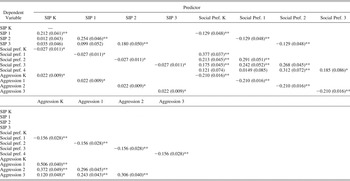
Note: Standard errors are in parentheses. SIP, social information processing; K, Kindergarten; 1–3, Grades 1–3.
*p < .05. **p < .01.
Path coefficients and standard errors for covariates

Note: Standard errors are in parentheses. Afr. Am., African American; SES, socioeconomic status; SIP, social information processing; K, Kindergarten; 1–3, Grades 1–3.
*p < 05. **p < .01.
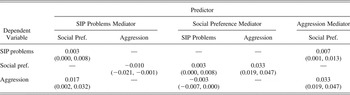
To test the specific cascade hypotheses, we constructed confidence intervals for each indirect effect of interest using the percentile bootstrap, as recommended by MacKinnon, Lockwood, Hoffman, West, and Sheets (Reference MacKinnon, Lockwood, Hoffman, West and Sheets2002). Based on the current literature on the subject, we estimated the mediated effect as the product of two path coefficients, which are the coefficient linking the temporally prior variable to the mediator and the coefficient linking the mediator to the temporally subsequent variable, with a confidence interval generated by the percentile bootstrap. Conventional confidence intervals (i.e., point estimate ±1.96 standard error) are inappropriate for indirect effects, as the distribution of a product of coefficients is rarely normal (Bollen & Stine, Reference Bollen, Stine and Clogg1990). The percentile bootstrap is a resampling method that results in empirical confidence intervals on the basis of a large number (in this case, 3,000) of bootstrap resamplings of the data set to generate a sampling distribution. The 95% confidence interval then is simply the central 95% of the observed values in the empirical sampling distribution. This method is completely nonparametric, making no assumptions about the sampling distribution, and can thus be used in a variety of contexts.
The indirect effects and 95% confidence limits are presented in Table 4. All hypothesized indirect effects were significant (or, in one case, marginal) in the expected direction. The adverse effect of SIP problems on aggression was partially mediated by social preference, and the adverse effect of SIP problems on liking was partially mediated by the heightened aggression. Conversely, the beneficial effect of social preference reducing aggression may have been partially mediated by lower SIP problems (one confidence limit was equal to zero, within rounding error). Further, the impact of aggression on SIP problems was mediated by lower liking (the direct effect was not estimated). Finally, all four “snowballing” effects were found to be significant or nearly so (two confidence limits were equal to zero, within rounding error): the progressions of SIP problems and aggression cascaded through lowered liking, and better SIP skills and lower aggression both facilitated the progress of peer liking, controlling for stability in the constructs over time.
Indirect effects and 95% confidence limits

Note: Confidence limits are in parentheses. All indirect effects are significant or the 95% confidence interval is on the boundary of zero (within rounding error). SIP, social information processing.
As a final step, we compared the model with the paths constrained to be constant across time to a model in which all of the paths were free to vary across time. Freeing all of the path constraints significantly improved fit, χ2 (14) = 26.24, p = .024. To understand the nature of the time-related differences, we freed the paths one by one, which showed significant improvement only for the SIP to aggression path, χ2 (3) = 11.11, p = .011. The SIP to aggression path was significant in kindergarten, marginal in Grade 1, and not significant in Grades 2 and 3. This relatively modest improvement in fit, although significant, suggests that the a priori constraint of stability over time is generally tenable.
Discussion
The present study advances understanding of peer rejection, SIP, and aggression in three key ways. First, we have modeled SIP in a dynamic, developmental way and demonstrated that SIP is not a static, traitlike individual characteristic but instead changes as a function of experiences and behavioral adjustment over time. Second, we have gone beyond a simple mediation approach to understanding links among social preference, SIP, and aggression to demonstrating that each construct effects changes in the others in a snowballing cycle over time. Third, we have demonstrated these effects after accounting for previous levels of each of the constructs.
Several studies have documented that stressful life experiences (e.g., peer rejection, physical abuse) are related to later biases in children's processing of social information (Dodge et al., Reference Dodge, Lansford, Burks, Bates, Pettit, Fontaine and Price2003; Dodge, Bates, et al., 1990), but previous studies have not often modeled changes in SIP over time as a function of social experiences and behavioral adjustment, controlling for previous SIP deficits. Our findings make a novel contribution to the literature in demonstrating that peer social preference incrementally predicts changes in SIP over time, above and beyond continuity in SIP biases. SIP was less stable over time than were social preference and aggression. In previous research, aggression has been estimated to be as highly stable over time as is intelligence. For example, Olweus (Reference Olweus1979) concluded from his review of 16 early longitudinal studies that the disattenuated stability correlation for aggression was .69 over a 5-year period and .60 over a 10-year period. Similarly, Huesmann, Eron, Lefkowitz, and Walder (Reference Huesmann, Eron, Lefkowitz and Walder1984) found in their 22-year longitudinal study that the most aggressive 8-year-olds in their sample continued to be the most aggressive 30-year-olds; they estimated that the stability of aggression over this 22-year period was 0.50 for boys and 0.35 for girls. Likewise, social standing in the peer group has been found in previous research to be moderately to highly stable over time (Jiang & Cillessen, Reference Jiang and Cillessen2005; Newcomb & Bukowski, Reference Newcomb and Bukowski1983). Our finding that SIP was less stable than social preference and aggression suggests that SIP might be an especially promising target for intervention because of its amenability to change. Interventions that attempt to reduce children's aggressive behavior by reducing deficits in their processing of social information hypothesize that one key mechanism through which children's aggressive behavior arises is through SIP. The present study provides a strong empirical test of that hypothesis by modeling changes in SIP in the context of developmental cascades over time.
Our findings were consistent with other studies that have demonstrated that peer rejection is related to aggression (Parker & Asher, Reference Parker and Asher1987) and SIP deficits (Dodge et al., Reference Dodge, Lansford, Burks, Bates, Pettit, Fontaine and Price2003), and that SIP deficits are related to aggression (Crick & Dodge, Reference Crick and Dodge1994). The present study extends findings from previous research by advancing understanding of the reciprocal nature of these associations and by testing both direct and indirect effects, controlling for continuity in a given construct over time. The findings were striking in their demonstration that it is not sufficient to conceptualize peer rejection, SIP, or aggressive behavior as only a predictor or as only an outcome because all three related to each of the others as both a predictor and outcome in a series of cascade effects over time.
The limitations of our study suggest directions for future research. We focused on children from kindergarten to Grade 3. There is some evidence that links between beliefs and behavior may change over the course of development. Researchers have described the age “5- to 7-year shift” (Sameroff & Haith, Reference Sameroff and Haith1986; White, Reference White, Lipsitt and Spiker1965), referring to important cognitive developments during this period that may have important implications for how well children's beliefs predict their subsequent behaviors. For example, Davis-Kean et al. (Reference Davis-Kean, Huesmann, Jager, Collins, Bates and Lansford2008) found that children's self-efficacy beliefs related to aggression became better predictors of aggressive behavior as children developed from early childhood to adolescence. Other studies also have found that after approximately age 8, beliefs become increasingly reliable predictors of future behaviors (Huesmann & Guerra, Reference Huesmann and Guerra1997; Parsons & Ruble, Reference Parsons and Ruble1977; Spencer & Bornholt, Reference Spencer and Bornholt2003). Our focus on cascades from kindergarten through Grade 3 did not enable us to test the hypothesis that the nature of the associations among SIP, peer rejection, and aggression would change after the age of 8; this will be an important direction for future research.
Another important developmental consideration is that research with adolescents shows that some aggressive adolescents are not rejected by their peers but instead are granted high status in the peer group (e.g., Rodkin, Farmer, Pearl, & VanAcker, Reference Rodkin, Farmer, Pearl and VanAcker2000). Therefore, the developmental cascade model that we have proposed may change from childhood to adolescence. Even prior to adolescence, there may be individual differences in the nature of associations between aggression and social preference. For example, Cairns, Cairns, Neckerman, Gest, and Gariépy (Reference Cairns, Cairns, Neckerman, Gest and Gariepy1988) found that aggressive fourth and seventh graders were less popular in the entire social network than were nonaggressive youths, but the aggressive and nonaggressive youths did not differ in their nominations as nuclear members of peer cliques, nominations by peers as being a best friend, or in the likelihood of having reciprocated friendships. Thus, rejection by the majority of peers in a social network may coincide with acceptance of aggressive behavior by a minority of peers who are friends or members of an aggressive child's clique. Therefore, we caution that there may be differences in developmental cascades that unfold over time for individual children.
Conclusion
Overall, our findings suggest the importance of early intervention in interrupting maladaptive cascades of problematic peer relationships, SIP deficits, and aggressive behavior that may otherwise ensue. Because children's problems in one domain were directly and indirectly related to problems in the other domains, this suggests several entry points for implementing interventions. For example, a curriculum such as Promoting Alternative Thinking Strategies (Greenberg, Kusche, Cook, & Quamma, Reference Greenberg, Kusche, Cook and Quamma1995), which focuses on teaching children to process social information in unbiased and nonhostile ways, may directly reduce their aggressive behavior and the likelihood that they will be rejected by peers and may indirectly reduce the likelihood that they will be rejected by peers by reducing their aggression. Behavior modification strategies to reduce children's aggressive behavior may also reduce children's experience of peer rejection (and thereby reduce their SIP problems and future aggression). Direct interventions to reduce peer rejection are likely not efficacious without attention to the cognitive and behavioral problems that lead to peer rejection in the first place. Nevertheless, once the cascade is set in motion, peer rejection becomes an important predictor of future SIP problems and aggression. Therefore, interventions that are able to interrupt these cascades from perpetuating over time have the potential to set children on a more positive trajectory characterized by less peer rejection, fewer SIP problems, and less aggressive behavior.