1. Introduction
Petroleum and source rock correlation is a classic tool for source rock identification. Geochemists use chemical biomarkers as indicators to correlate petroleum and source rocks. Palynomorphs can also be used as indicators for petroleum and source rock correlation, because the walls of spores and pollen are resistant to the thermal alteration in the process of petroleum genesis, as well as to the effects of petroleum migration. Moreover, palynomorphs can indicate the geological age and sedimentary environments of source rocks. Consequently, palynology is a useful scientific method in petroleum source research, especially in non-marine sediments.
There are several publications dealing with the identification of oil source rocks. The first was by Sanders (Reference Sanders1937), who extracted spores, algae and fungi from Cretaceous and Tertiary crude oil samples from Mexico, and Tertiary crude oil samples from Romania. Waldschmidt (Reference Waldschmidt1941) extracted diatom and plant fragments from Permian crude oils of Colorado, USA. Timofeev & Karimov (Reference Timofeev and Karimov1953) made palynological investigations on crude oils of Russia. De Jersey (Reference de Jersey1965) reported plant microfossils in crude oils of the Moonie oil field in Queensland, Australia. On the other hand, Hunt (Reference Hunt1979) documented that spores and pollen are too large to migrate along with liquid hydrocarbons, and he considered palynomorphs in petroleum to be in situ, deriving from the reservoir rocks themselves. However, Jiang & Yang (Reference Jiang and Yang1980) described Cretaceous spores and pollen from crude oils in Tertiary reservoirs and in Silurian metamorphic rocks of the Yumen oil field in the Jiuxi Basin, China. The presence of spores and pollen in the crude oils indicates that these can migrate along with petroleum. Hua & Lin (Reference Hua and Lin1989) suggested that microfissures resulting from abnormal pressures occurring in source rocks should constitute the important pathways of petroleum primary migration in the Jiuxi Basin. In addition, Jiang (Reference Jiang1990, Reference Jiang, Jansonius and McGregor1996) found Carboniferous and Permian miospores in crude oils from an igneous rock reservoir of the Junggar Basin, China. The discovery of these spores and pollen in the igneous reservoir may serve as a direct indication that they were expelled from source rocks and migrated along with petroleum into the reservoir. McGregor (Reference McGregor, Jansonius and McGregor1996) reviewed studies of palynomorphs in petroleum and considered that these studies merit wider attention, because the results and interpretations of researchers working on this subject have achieved credibility.
The Tarim Basin of Xinjiang, northwest China, is a continental petroliferous basin where some prospective large oil–gas fields have been found. Graham et al. (Reference Graham, Brassell, Carroll, Xiao, Demaison, McKnight, Liang, Chu and Hendrix1990) reported analyses of potential petroleum source rocks of the Xinjiang basins, and suggested that the Upper Triassic to Middle Jurassic sequences which were sufficiently buried comprise a potentially significant oil source in the northern Tarim Basin. Hendrix et al. (Reference Hendrix, Brassell, Carroll and Graham1995) provided a detailed organic geochemical database for organic-rich Lower and Middle Jurassic strata throughout central Xinjiang. They presented field and laboratory evidence demonstrating that organic-rich Lower and Middle Jurassic strata are dominated by terrestrial-derived type III kerogens, and concluded that Jurassic coaly strata have significant potential as petroleum source rocks in the northern Tarim, southern Junggar and Turpan basins. Hanson et al. (Reference Hanson, Zhang, Moldowan, Liang and Zhang2000) conducted organic geochemical analyses on a large suite of oils and source rocks extracted from the Tarim Basin. On the basis of statistical cluster analysis, they suggested that most of the oils originated from source rocks deposited in either the Middle–Upper Ordovician or the Upper Triassic to Lower–Middle Jurassic. Based on previous preliminary studies of spores and pollen in crude oils from several petroliferous provinces in the Tarim Basin, Jiang & Yang (Reference Jiang and Yang1983, Reference Jiang and Yang1986, Reference Jiang and Yang1992, Reference Jiang and Yang1996, Reference Jiang and Yang1999) suggested that the Triassic and Jurassic systems should contain favourable petroleum source rocks. This paper addresses a further method of correlation between petroleum and source rocks with palynomorphs from the non-marine Mesozoic deposits, presents analysis of additional material, and discusses the depositional environments of the petroleum source rocks as well as mechanisms of petroleum migration in the Tarim basin.
2. Geological background
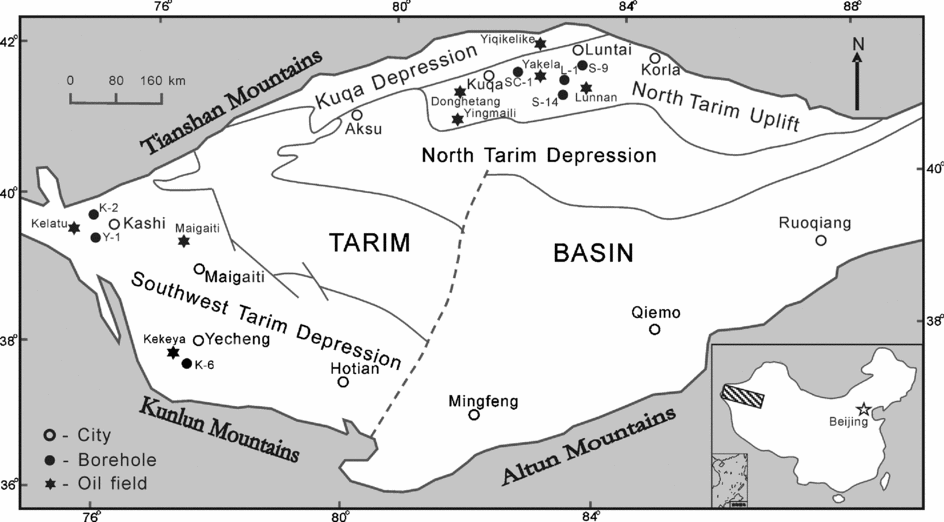
The Tarim Basin in the Xinjiang Uygur Autonomous Region of Northwestern China lies between 36 and 42° N latitude, and 74 and 90° E longitude (Fig. 1). The basin is bounded to the north by the Tianshan Mountain Range, to the southwest by the Kunlun Mountain Range, and to the southeast by the Altun Mountain Range. It is a large cratonic basin with a superimposed sedimentary thickness of 13 to 15 km. The Hercynian orogeny of Carboniferous to Permian age resulted in uplift of the Tianshan fold belt and the Kunlun fold belt, as well as evolution of the non-marine sedimentary basin (Zhou & Zheng, Reference Zhou and Zheng1990).
Sketch map showing tectonic subdivisions, and locations of oil fields and boreholes in the Tarim Basin, northwestern China.

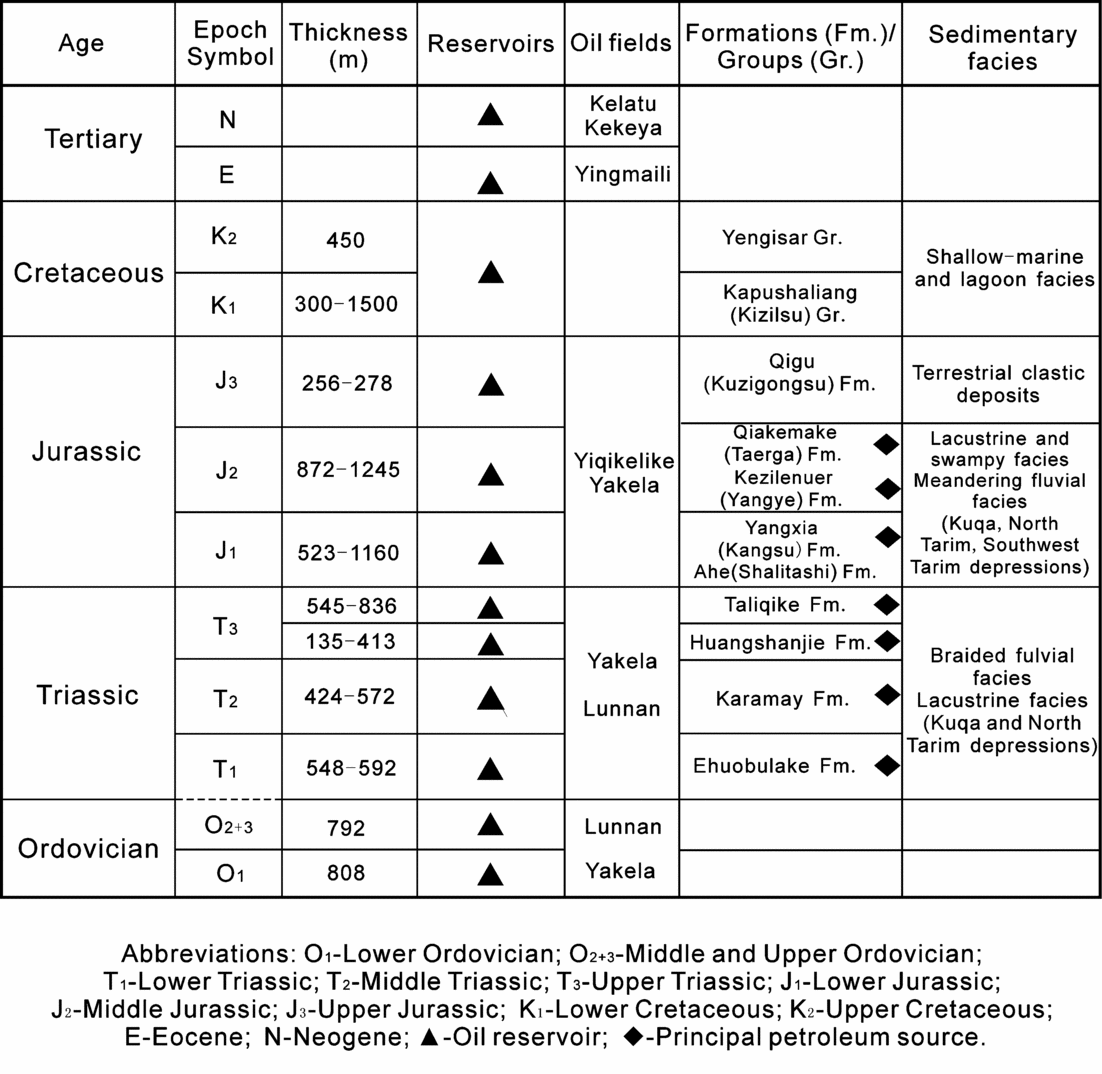
Mesozoic strata of the Tarim Basin are non-marine, with the exception of Upper Cretaceous shallow-marine strata in the western basin (Zhou & Chen, Reference Zhou and Chen1990; Zhou, Reference Zhou2001) (Fig. 2). During Triassic times, lacustrine sedimentary sequences developed in the Kuqa and the North Tarim depressions. The Lower Triassic Ehuobulake Formation consists primarily of greyish brown sandstones and conglomerates intercalated with greyish green and dark grey mudstones, with a total thickness reaching 548 to 592 m. The Middle Triassic Karamay Formation is mainly composed of dark grey, greenish grey and black mudstones and grey siltstones intercalated with greyish brown sandstones with a thickness of 424 to 572 m. The lower Upper Triassic Huangshanjie Formation consists of dark grey mudstones and black carbonaceous mudstones intercalated with greyish green fine-grained sandstones, grey argillo-calcareous rocks and coals; the thickness is 135 to 413 m. The uppermost Triassic Taliqike Formation includes grey sandstones, dark grey and greenish grey mudstones, grey argillo-calcareous rocks, black carbonaceous mudstones and coal beds with a thickness of 545 m to 836 m. The Ehobulake, Karamay, Huangshanjie and Taliqike formations contain various kinds of fossils, including plants, miospores, megaspores, acritarchs, charophytes and conchostracans (Zhou & Chen, Reference Zhou and Chen1990; Liu, Reference Liu2003). The Upper Triassic dark grey and black organic-rich mudstones probably represent lacustrine deposits (Ma & Wen, Reference Ma and Wen1991). In addition, an Upper Triassic braided fluvial facies was reported in the north Tarim basin (Hendrix et al. Reference Hendrix, Graham, Carroll, McKnight, Schulein and Wang1992) (Fig. 2).
A brief stratigraphic framework showing principal reservoirs, oil fields, major petroleum source rocks and their sedimentary facies in the Tarim Basin, Xinjiang, China.

During the Jurassic period, the lacustrine area further expanded, and both lacustrine and swampy sequences are well developed in the Kuqa Depression, the North Tarim Depression and the Southwest Tarim Depression. The Lower Jurassic Ahe (Shalitashi) and Yangxia (Kangsu) formations consist mainly of grey sandstones and dark grey mudstones intercalated with black carbonaceous mudstones and coals containing plants, miospores, megaspores and acritarchs (Liu, Reference Liu2003); the thickness varies from 523 to 1160 m. The Middle Jurassic Kezilenuer (Yangye) and Qiakemake (Taerga) formations include grey sandstones, dark grey and greenish grey mudstones, black carbonaceous mudstones, coal beds and oil shales containing miospores, megaspores, estherids, ostracods and bivalves; the thickness ranges from 872 to 1245 m (Liu, Reference Liu2003). Most Lower and Middle Jurassic strata in the basin consist of interbedded sandstone, siltstones, shales and coals, and were interpreted as meandering fluvial facies by Hendrix et al. (Reference Hendrix, Brassell, Carroll and Graham1995). The Upper Jurassic Qigu Formation consists of brown and brownish red mudstones intercalated with sandstones, and contains charophytes and bivalves, and the thickness is 256 to 278 m (Ma & Wen, Reference Ma and Wen1991) (Fig. 2).
The Lower Cretaceous Kapushaliang (Kizilsu) Group in the Tarim Basin consists of brownish red sandstone and conglomerate intercalated with greyish green siltstones and mudstones, containing ostracods, estherids, charophytes and miospores; the thickness is about 300 to 1500 m (Jiang, He & Dong, Reference Jiang, Fleet, Kelts and Talbot1988; Ma & Wen, Reference Ma and Wen1991; Li, Reference Li2000; Jiang et al. Reference Jiang, Wang, He, Dong, Ni and Tian2006, Reference Jiang, Wang, He and Dong2007). The Upper Cretaceous Yengisar Group in the western basin, dominated by shallow-marine, littoral and lagoonal deposits, and with a thickness of 450 m, carries a rich marine fauna of Tethyan forms (Huang & Chen, Reference Huang and Chen1987; Ma & Wen, Reference Ma and Wen1991). In addition, dinoflagellate cysts and acritarchs from the Yengisar Group were reported in Xinjiang (Yu & Zhang Reference Yu and Zhang1980) (Fig. 2).
It is noteworthy that tectonism in the Tarim Basin created four depressions, three uplifts, several stratigraphic angular unconformities, and many structural traps and faults (Zhou & Zheng, Reference Zhou and Zheng1990). The depressions are favourable for preservation of organic material and formation of petroleum; the uplifts provide favourable traps for accumulation of petroleum. Unconformable contacts and faults can act as available passages for migration of petroleum. Structural traps within a depression or within an uplift between two depressions are usually the targets of petroleum migration. In fact, commercial oil and gas fields have been found in the Kuqa Depression, the Southwest Tarim Depression, and the North Tarim Uplift located between the Kuqa Depression and the North Tarim Depression (Fig. 1). These depressions can provide sufficient petroleum sources for large oil and gas fields.
3. Material and methods
Thirty-eight crude oil samples collected from 22 petroleum reservoirs in seven oil fields in the Tarim Basin were investigated in our study. These oilfields include the Yiqikelike, Yakela, Lunnan, Yingmaili, Kelatu, Maigaiti and Kekeya oil fields (Fig. 1). In addition, 32 rock samples collected from Triassic and Jurassic strata that crop out near Kuqa, Aksu and Kashi, and 24 core samples collected from the boreholes SC-1, S-9, S-14, K-2 and K-6 in the basin (Fig. 1), were used for correlation between petroleum and source rocks.
The method described by Jiang (Reference Jiang1990) for extraction of spores and pollen from crude oil samples was adopted in this study to extract palynomorphs, including spores, pollen, algae and fungi from the petroleum. More than five litres of crude oil were used for each sample. The procedure of this method includes oil sample dilution with benzene or gasoline, oil sample filtration in a heater (70–75°C), insoluble organic matter (kerogen) extraction in a Soxhlet apparatus using benzene ether, ketone and alcohol, and fossil concentration by heavy liquid flotation. The rock samples, including those from outcrops and cores, were prepared by standard methods using 10% hydrochloric acid, 40% hydrofluoric acid and 5% potassium hydroxide. Gravity separation with a cadmium iodide–potassium iodide solution (CdI:KI:H2O=10:9:9) was used to concentrate palynomorphs from rocks. All the miospore fossils were mounted in glycerin jelly for study by light microscopy.
Assuming the palynomorphs found in the crude oils and in the rocks have been correctly identified, the palynomorphs recovered from the oils are used to determine the geological age of the rock that provided the sources of the oil. Correlations between palynomorphs in oils and those in rocks have been applied to determine geological ages and strato-horizons of petroleum source rocks. Thermal alteration index (TAI) based on spore/pollen colour was used to judge the maturity of petroleum source rocks (Traverse, Reference Traverse1988).
4. Palynomorphs in the Tarim Basin crude oils
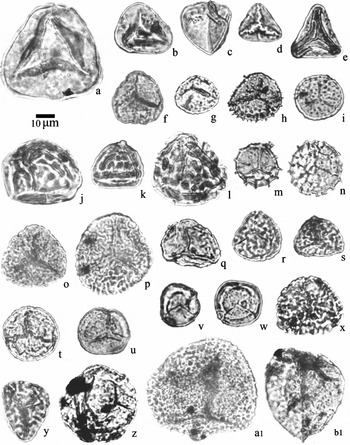
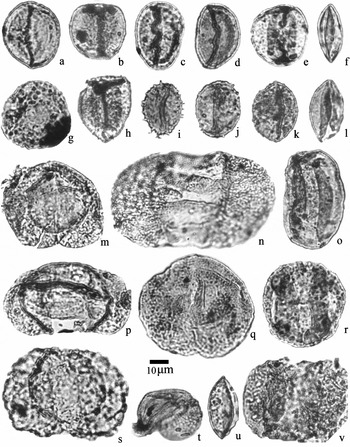
In the Tarim Basin, a total of 173 species of spores and pollen referred to 80 genera, and 27 species of algae and fungi referred to 16 genera, were identified. Most of the palynomorphs in crude oils are Triassic and Jurassic species (Figs 3, 4), and the rest are time-transitional palynomorphs.
Triassic and Jurassic miospores in crude oils from boreholes L-1, S-9, S-14, and K-6 in the Tarim Basin (see Fig. 1 for borehole location). (a) Cyathidites australis Couper (no. L1-146); (b) Cyathidites minor Couper (no. L1-16); (c) Dictyophyllidites harrisii Couper (no. K6-26); (d) Undulatisporites pflugii Pocock (no. S14-124); (e) Concavisporites toralis (Leschik) Nilsson (no. L1-4); (f) Granulatisporites jurassicus Pocock (no. L1-26); (g) Apiculatisporis parvispinosus (Leschik) Qu (no. S14-168); (h, i) Apiculatisporis spiniger (Leschik) Qu (h, no. L1-6: i, no. S14-80); (j) Duplexisporites amplectiformis (Kara-Murza) Playford & Dettmann (no. L1-23); (k) Duplexisporites anagrammensis (Kara-Murza) Playford & Dettmann (no. L1-169); (l) Duplexisporites scanicus (Nilsson) Playford & Dettmann (no. L1-1); (m) Lycopodiumsporites subrotundum (Kara-Murza) Pocock (no. L1-92); (n) Lycopodiumsporites paniculatoides Tralau (no. L1-105); (o) Lycopodiacidites rhaeticus Schulz (no. S9-21); (p, q) Lycopodiacidites kuepperi Klaus (p, no. S14-50; q, no. S14-40); (r, s) Lophotriletes corrugatus Ouyang & Li (r, no. L1-29; s, no. L1-1); (t) Retusotriletes mesozoicus Klaus (no. S9-32); (u) Lundbladispora subornata Ouyang & Li (no. S9-22); (v) Limatulasporites parvus Qu & Wang (no. S14-103); (w) Limatulasporites dalongkouensis Qu & Wang (no. S14-64); (x) Tigrisporites halleinis Klaus (no. S14-101); (y) Zebrasporites kahleri Klaus (no. S14-53); (z) Verrucosisporites contactus Clarke (no. S14-40); (a1) Verrucosisporites remyanus Madler (no. L1-111); (b1) Aratrisporites fischeri (Klaus) Playford & Dettmann (no. L1-1).

Triassic and Jurassic miospores in crude oils from Boreholes L-1, S-9, S-14, K-2, K-6 and Y-1 in the Tarim Basin (see Fig. 1 for borehole location). (a) Aratrisporites scabratus Klaus (no. S14-61); (b) Aratrisporites paenulatus Playford & Dettmann (no. L1-1); (c, d) Aratrisporites granulatus (Klaus) Playford & Dettmann (c, no. S14-119; d, no. S14-46); (e) Aratrisporites strigosus Playford (no. S14-144); (f) Cycadopites typicus (Mal.) Pocock (no. S14-134); (g) Cerebropollenites carlylensis Pocock (no. Y1-11); (h) Aratrisporites fischeri (Klaus) Playford & Dettman (no. L1-165); (i) Aratrisporites tenuispinosus Playford (no. L1-41); (j, k) Aratrisporites parvispinosus Leschik (j, no. L1-92; k, no. L1-191); (l) Cycadopites nitidus (Balme) Pocock (no. S14-3); (m) Chordasporites orientalis Ouyang & Li (no. L1-50); (n) Taeniaesporites pellucidus (Goubin) Balme (no. S9-9); (o) Bennettiteaepollenites lucifer (Thierg.) Potonié (no. L1-20); (p) Chordasporites singulichorda Klaus (no. S14-58); (q) Piceites pseudorotundiformis (Mal.) Pocock (no. L1-15); (r) Quadraeculina limbata Maljavkina (no. Y1-9); (s) Protopinus scanicus Nilsson (no. Y1-34); (t) Cedripites minor Pocock (no. K6-10); (u) Cycadopites subgranulosus (Couper) Clarke (no. S14-131); (v) Podocarpidites florinii Pocock (no. K2-4).

4.a. Triassic palynomorphs
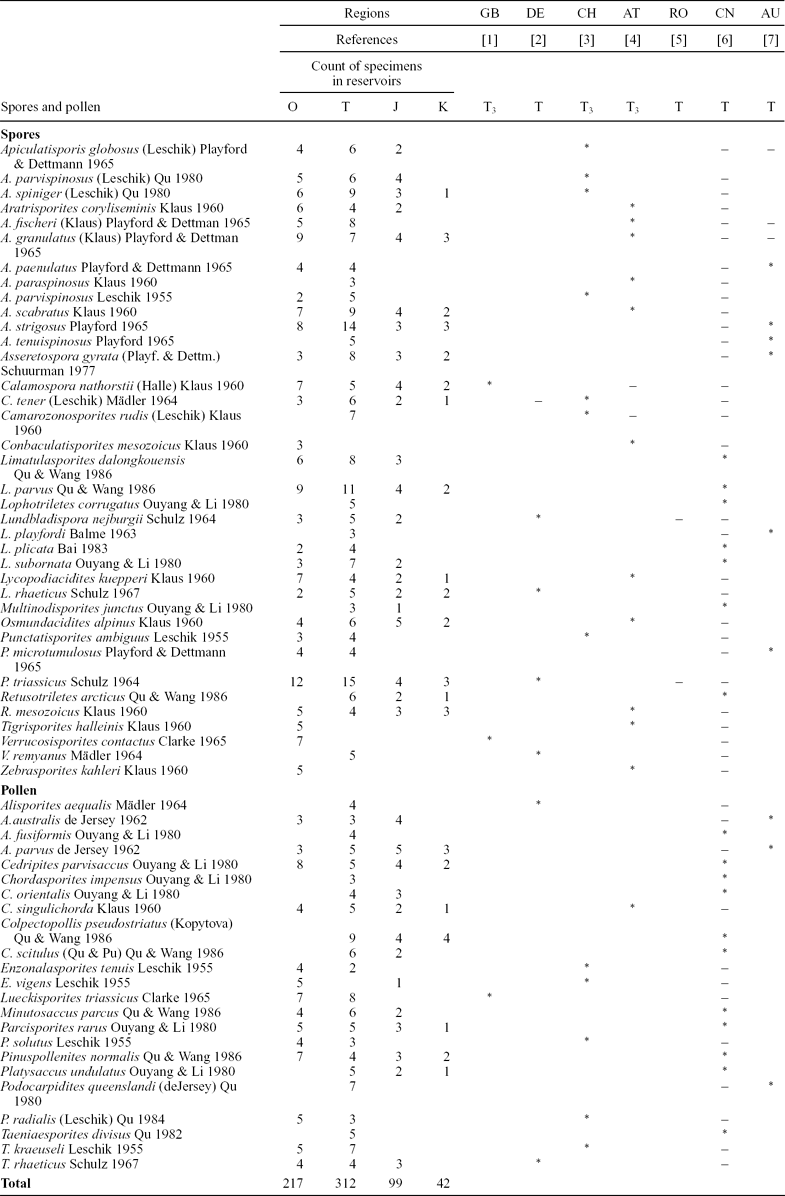
Our investigation demonstrates that Triassic palynomorphs are found in crude oils from every petroleum reservoir in the North Tarim Uplift. Sixty species of Triassic spores and pollen are identified in crude oils from the Ordovician, the Triassic and the Jurassic reservoirs of the Yakela oil field and the Lunnan oil field, as well as in the Cretaceous reservoir of the Yakela oil field in the North Tarim Uplift. It is noted that these miospores have previously been reported from the Keuper stage, or upper Triassic Rhaetion stage, or the Triassic in Europe, Australia and in Xinjiang, Shanxi and Yunnan provinces of China (Table 1).
Triassic spores and pollen in crude oils from reservoirs of different ages in the Tarim Basin and their distribution in the Triassic strata of Europe, Asia and Australia

Abbreviations: O – Ordovician; T – Triassic; T3 – Upper Triassic; J – Jurassic; K – Cretaceous; GB – Great Britain; DE – Germany, CH – Switzerland; AT – Austria; RO – Romania; CN – China; AU – Australia.
‘*’indicates the original stratigraphic horizon of a taxon that was first described in this locality; ‘–’ indicates other stratigraphic ranges of this taxon that were subsequently described (but not the first record).
References: [1] Clarke, Reference Clarke1965; Batten & Coppelhus, Reference Batten, Coppelhus, Jansonius and McGregor1996; [2] Schulz, Reference Schulz1967; Schulz, Reference Schulz1964; Mädler, Reference Mädler1964; [3] Leschik, Reference Leschik1955; [4] Klaus, Reference Klaus1960; [5] Venkatachala, Beju & Kar, Reference Venkatachala, Beju and Kar1968; [6] Yang et al. Reference Yang, Qu, Zhou, Cheng, Zhou, Hou, Li, Sun, Li, Zhang, Wu, Zhang and Wang1986; Qu, Reference Qu1982; Ouyang & Li, Reference Ouyang and Li1980; Liu, Reference Liu2003; [7] De Jersey, Reference de Jersey1962; Balme, Reference Balme1963; Playford, Reference Playford1965.
4.b. Jurassic palynomorphs
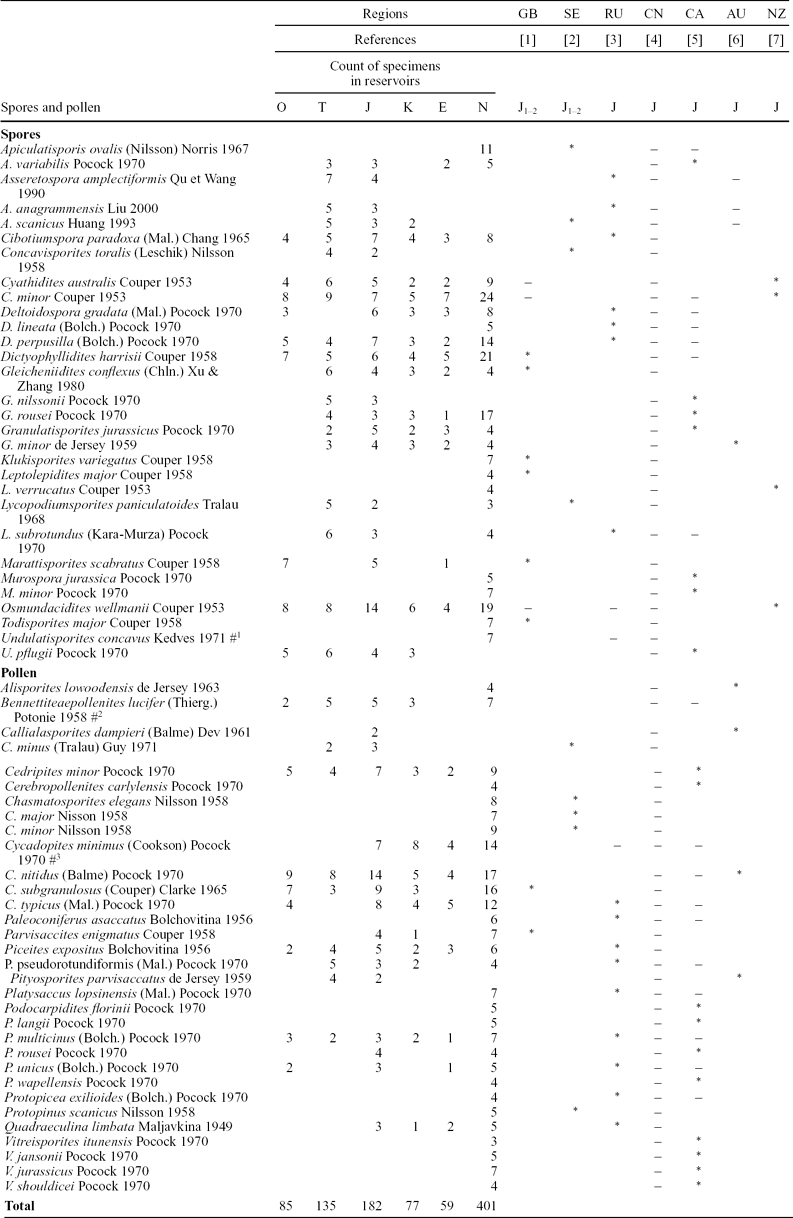
Jurassic palynomorphs are found in crude oils from the different petroleum reservoirs in the North Tarim Uplift, the Kuqa Depression and the Southwest Tarim Depression. Sixty-two species of Jurassic spores and pollen are found in crude oils from the Ordovician, Triassic, Jurassic, Cretaceous and Palaeogene reservoirs in the north Tarim, and Neogene reservoirs in the Southwest Tarim. These miospores are widely distributed in the Jurassic strata of Eurasia, North America and Australia (Table 2). Some of them were initially documented from the Lower to Middle Jurassic deposits covering different regions; others have been recorded ranging through the Jurassic sequences.
Jurassic spores and pollen in crude oils from reservoirs of different ages in the Tarim Basin and their distribution in the Jurassic strata of Eurasia, North America, Australia and New Zealand
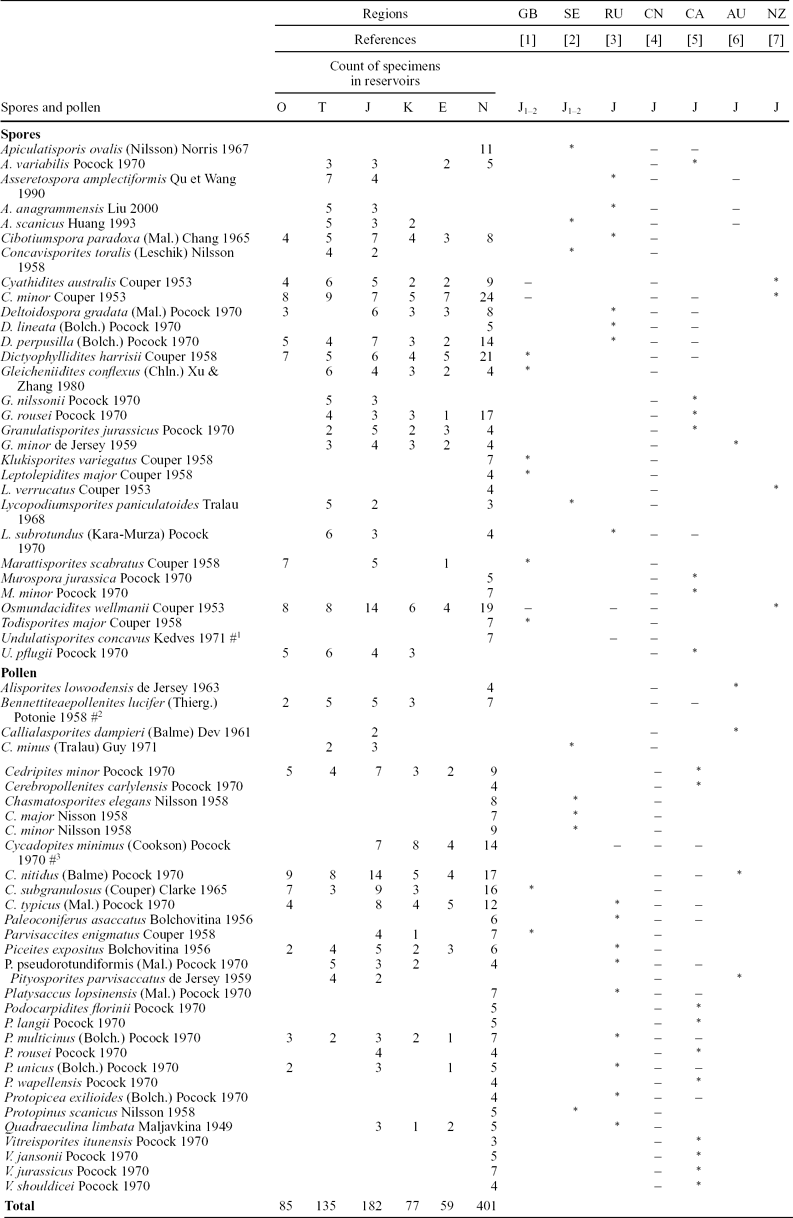
Abbreviations: O – Ordovician; T – Triassic; J1–2 – Lower and Middle Jurassic; J – Jurassic; K – Cretaceous; E – Eocene; N – Neogene; GB – Great Britain; SE – Sweden; RU – Russia; CN – China; CA – Canada; AU – Australia; NZ – New Zealand.
References: [1] Couper, Reference Couper1958; [2] Nilsson Reference Nilsson1958; Tralau, Reference Tralau1968; [3] Maljavkina, Reference Maljavkina1949; Bolchovitina, Reference Bolchovitina1956; [4] Sun, Reference Sun1989; Huang, Reference Huang1995; Liu, Reference Liu1982, Reference Liu2003; Jiang & Wang, Reference Jiang and Wang2002; [5] Pocock, Reference Pocock1970; [6] Balme, Reference Balme1963; De Jersey, Reference de Jersey1959, Reference de Jersey1963; [7] Couper, Reference Couper1953.
‘*’ indicates the original stratigraphic horizon of a taxon that was first described in this locality; ‘–’ indicates other stratigraphic ranges of this taxon that were subsequently described (but not the first record).
#1 Hungary (Potonié, Reference Potonié1958); #2Germany (Potonié, Reference Potonié1958); #3Madagascar (Cookson, Reference Cookson1947).
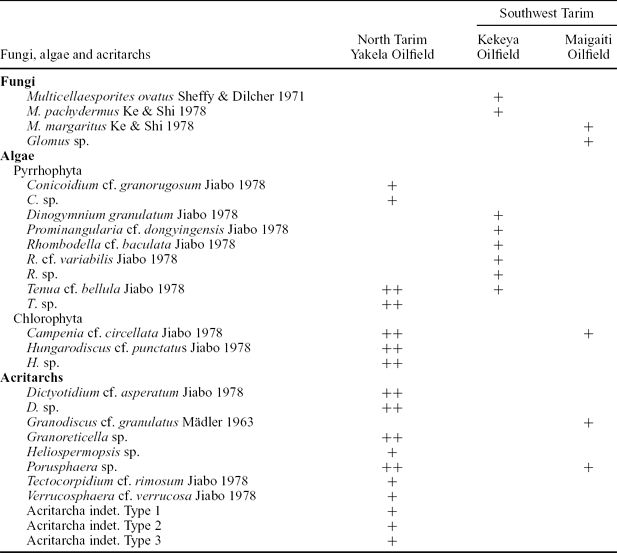
In addition, some fossil fungi, algae and acritarchs are found in crude oils from the Yakela oil field in the North Tarim, and from the Kekeya oil field and the Maigaiti oil field in the Southwest Tarim (Table 3). They are significant for indicating sedimentary environments of the petroleum source rocks.
Fungi, algae and acritarchs in crude oils of the Tarim Basin

See Figure 1 for locations. + rare, ++ common.
5. Identification of petroleum source rocks in the Tarim Basin
The miospores extracted from crude oils usually form a three-part assemblage that represents the source bed, carrier bed and reservoir bed, each of which is different in geological age. The reservoir rocks of an oil field are always known, so spores and pollen deriving from the reservoir bed itself can be easily separated from the three-part assemblage. The remainders of the assemblage are indicative for source and carrier beds. Generally, the oldest miospores in the assemblage indicate the source rocks, those of intermediate age indicate the carrier beds, and the youngest indicate the reservoir rocks (e.g. Jiang, Reference Jiang, He and Dong1988, Reference Jiang1990, Reference Jiang1991). Sometimes the three parts of the assemblage are coeval, indicating that the source rocks, carrier beds and reservoir rocks belong to the same formation (Jiang, Reference Jiang, He and Dong1988). Although the geological circumstances are often complicated, petroleum source rocks can be distinguished from non-source rocks by correlation of the palynological assemblages in crude oils and their supposed source rocks.
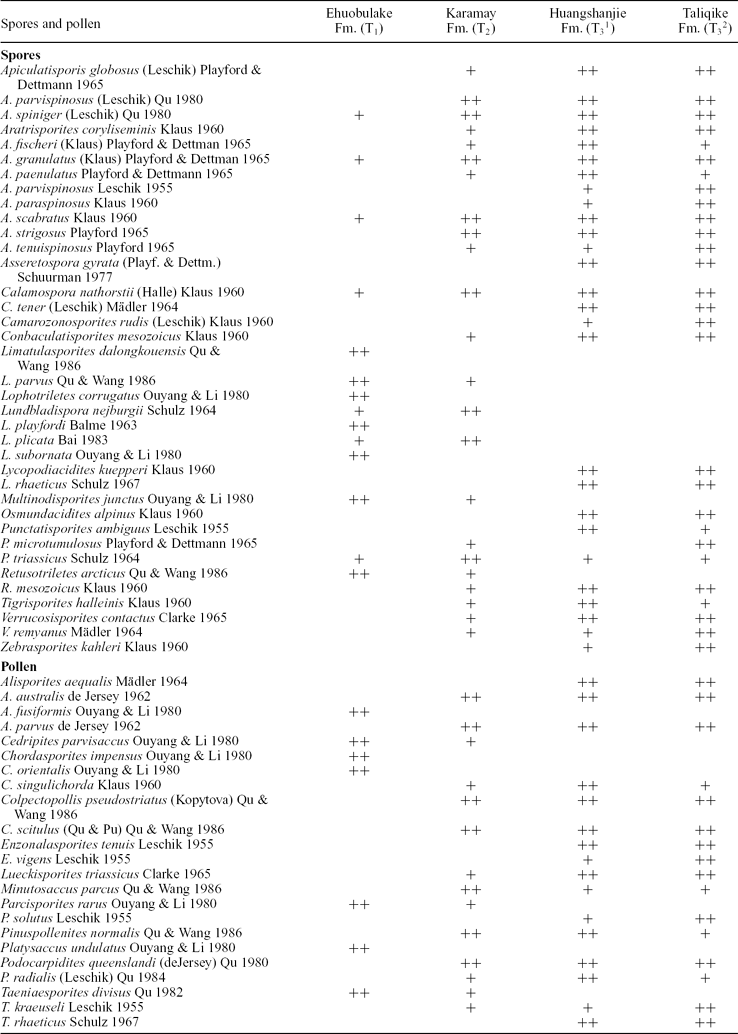
Triassic miospores in crude oils from the North Tarim Uplift are common in the Triassic deposit of the Tarim Basin. Twenty-one species of spores and pollen found in oils are also identified in the dark grey and black mudstone of the Lower Triassic Ehuobulake Formation; 37 miospore species identified in petroleum samples are found in the Middle Triassic Karamay Formation, and 44 species in petroleum samples are found in the dark grey and black mudstone of the Upper Triassic Huangshanjie and Taliqike formations (Table 4).
Distribution of important Triassic miospore taxa in crude oils of the Triassic strata in the Tarim Basin

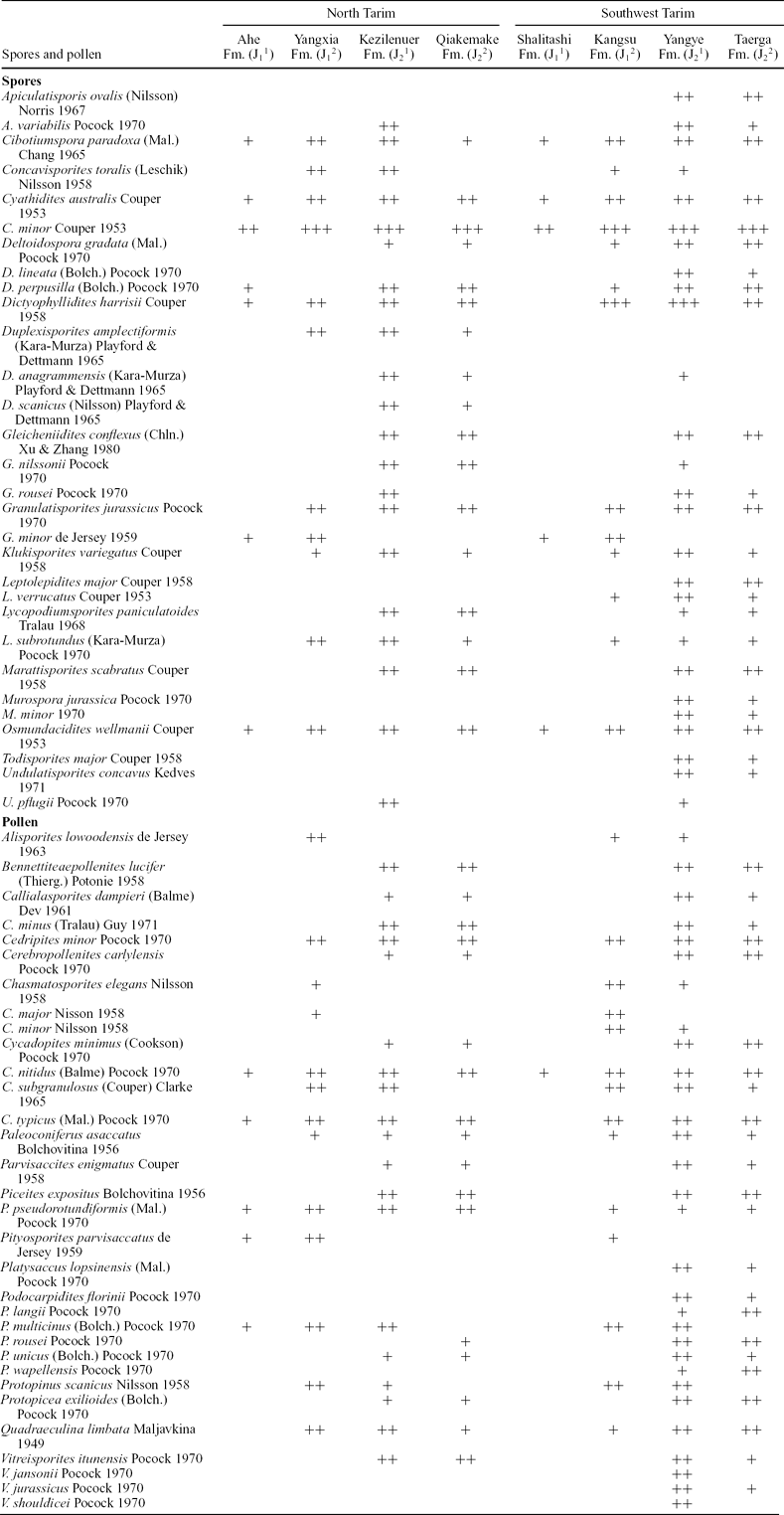
Jurassic miospores in crude oils from the North Tarim Uplift, the Kuqa Depression and the Southwest Tarim Depression are also common representatives in the Lower Jurassic and Middle Jurassic deposits of the basin. Forty-five species extracted from oils are also found in the dark grey and black mudstone of the Lower Jurassic Ahe and Yangxia formations, the Middle Jurassic Kezilenuer and Qiakemake formations in the North Tarim Uplift and the Kuqa Depression; 60 species found in oils are recorded in the dark grey and black mudstone of the Lower Jurassic Shalitashi and Kangsu formations, as well as the Middle Jurassic Yangye and Taerga formations in the Southwest Tarim Depression (Table 5).
Distribution of important Jurassic miospore taxa in crude oils of the Jurassic strata in the Tarim Basin

+ rare, ++ common, +++ abundant.
Abbreviations: Fm. – Formation; J11 – lower Lower Jurassic; J12 – middle Lower Jurassic; J21 – lower Middle Jurassic; J22 – middle Middle Jurassic.
The miospore assemblages identified in the crude oils are similar to those from the rocks of the Triassic and Jurassic successions. This indicates that the palynomorphs in the crude oils were derived from Triassic and Jurassic plants, were deposited and released from these formations during primary migration, and migrated into different reservoirs during secondary migration. The correlation results between oils and rocks with palynomorphs suggest that the Triassic and Lower to Middle Jurassic deposits are important contributors to the petroleum source in the Tarim Basin (Fig. 2).
The colour of the Triassic and Jurassic miospores is dark orange to brown, both in the petroleum and in the rocks. The thermal alteration index (TAI) based on colour of spore/pollen ranges between 2.8 and 3.4. This thermal maturity belongs to the mature main phase of liquid petroleum generation (Traverse, Reference Traverse1988), and consequently the Triassic and Jurassic petroleum source rocks of the Tarim Basin belong to the mature source rock type. These results are supported by the evidence from organic geochemical analyses made on crude oils and their putative source rocks in the Tarim Basin. Based on the bulk geochemical analyses and correlation between crude oils and their supposed source rock extracts, it was concluded that Mesozoic strata, particularly Lower and Middle Jurassic strata deposits, comprise a potentially significant non-marine petroleum source sequence. Tmax value of 429°C to 449°C and vitrinite reflectance (Ro) values of 0.47% to 0.67% indicate that these rocks are at or just below the threshold of oil generation, and samples collected within depocentre sections average higher Ro values (Ro = 0.75% for one Middle Jurassic rock sample) (Graham et al. Reference Graham, Brassell, Carroll, Xiao, Demaison, McKnight, Liang, Chu and Hendrix1990; Hendrix et al. Reference Hendrix, Brassell, Carroll and Graham1995). Analyses of coals and organic-rich shales show a dominance of terrestrial, higher plant components. Visual kerogen analysis indicates that vitrinite, inertinite and exinite are the dominant minerals, and elemental analysis characterizes most kerogen as type III (Hendrix et al. Reference Hendrix, Brassell, Carroll and Graham1995). Pyrolysis–gas chromatography results show the prominence of alkene/alkane doublets, and suggest that the Jurassic strata are capable of liquid hydrocarbon generation. Biomarker correlations show that three-quarters of the petroleum samples are consistent with derivation from the Jurassic strata. The high Pr/Ph ratios for most extracts and oil samples (generally >2.5) are consistent with a higher plant-dominated non-marine environment.
6. Environment of petroleum source rocks
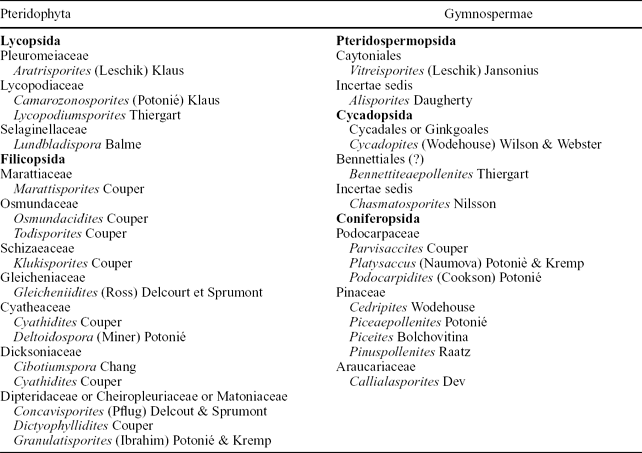
Additional data have been accumulated for improving our understanding of the potential botanical relationships of major dispersed miospore taxa, based upon in situ spores of the Mesozoic plants as well as their extant relatives. The closest relatives to the miospores identified in this study include a broad range of plants (Table 6). The extant relatives to most of these plants are humidogene thermophytes. For instance, lycophytes grow on acidic soils in humid climates; the marattialean ferns are large and tall plants, presently growing in the tropical or subtropical forests; the tree ferns (represented by Cyathidites, for example, in the spore record) are growing in temperate–tropical humid areas; and several ground fern taxa (Table 6) are distributed in the tropical and subtropical swamp/marsh lands as understory vegetation. The cycads are typical thermophytes, and so are several of the conifer taxa identified in the miospore assemblages. A case analysis on the Jurassic rock palynomorphs, their affinities, vegetation reconstruction and climatic implications was carried out in the Qaidam Basin, a giant petroliferous Mesozoic basin near the Tarim Basin, northwest China (Wang, Mosbrugger & Zhang, Reference Wang, Mosbrugger and Zhang2005). In summary, the ecological characteristics of the parent plants to which the spores and pollen in this study belong suggest that they grow in warm and humid climate conditions.
Botanical relationships of major dispersed spore/pollen genera identified in crude oils of the Tarim Basin

This summary is based upon comprehensive results of the in situ spore studies of the Mesozoic plants and their living relatives based on major references: e.g. Couper, Reference Couper1958; Nilsson, Reference Nilsson1958; Potonié, Reference Potonié1962; Townrow, Reference Townrow1962; Chang, Reference Chang1965; Helby & Martin, Reference Helby and Martin1965; Grauvogel-Stamm, Reference Grauvogel-Stamm1978; Van Konijnenburg-Van Cittert, Reference Van Konijnenburg-van Cittert1971, Reference Van Konijnenburg-van Cittert1975, Reference Van Konijnenburg-van Cittert1978, Reference Van Konijnenburg-van Cittert1981, Reference Van Konijnenburg-van Cittert1989, Reference Van Konijnenburg-van Cittert1993; Litwin, Reference Litwin1985; Traverse, Reference Traverse1988; Balme, Reference Balme1995; Wang, Reference Wang1999, Reference Jiang and Wang2002; Wang & Mei, Reference Wang and Mei1999; Wang et al. Reference Wang, Guignard, Lugardon and Barale2001; Abbink, Reference Abbink1998 and the studies on extant spores and pollen from living plants: e.g. Zhang et al. Reference Zhang, Xi, Zhang and Gao1976; Wang et al. Reference Wang, Chian, Zhang and Yang1995.
The algae in crude oils of the Tarim Basin (Table 3) are informative for interpreting the depositional environments of petroleum source rocks. Pyrrhophyta algae are related to the marine environment, and dinoflagellates usually indicate marine conditions. Chlorophyte algae are mostly produced in freshwater bodies, and Pediastrum indicates typical freshwater conditions. Neither dinoflagellates nor Pediastrum are found in the petroleum or source rocks of the basin, therefore the depositional environments of the petroleum source rocks are supposed to be neither brines of the marine environment nor typical freshwater. The ecological conditions reflected by the palynology show that the source rocks were probably formed in swamps in brackish to lacustrine environments during warm and humid climatic conditions.
The odd-carbon-chain n-paraffin and olefins are synthesized by marine plants primarily in the C15 to C21 range and by land plants primarily in the C27 to C35 range. Brackish-water plants synthesize in the intermediate range C19 to C27 (Hunt, Reference Hunt1979). Hendrix et al. (Reference Hendrix, Brassell, Carroll and Graham1995) reported that the dominant n-alkane is either n-C21, n-C23, or n-C25, and a slight to pronounced odd-over-even preference (OEP) is present in the Jurassic rock sample from the Tarim Basin. The dominance of n-alkane (n-C21 to n-C25) suggests that the source rocks were deposited in a brackish-water sedimentary environment.
7. Mechanisms of petroleum migration as shown by palynomorphs
Spore/pollen grains which were originally buried in the sediments have contributed their waxy, fatty and oily secretions to the formation of petroleum, leaving only their decay-resistant remains. These fossil spores and pollen could migrate along with liquid and gaseous hydrocarbons; some of them enter petroleum accumulations, and provide information about passage, direction and route of petroleum migration (Jiang, Reference Jiang1991; Jiang & Yang, Reference Jiang and Yang1994, Reference Jiang and Yang1999).
The primary migration means the migration of original petroleum from the petroleum source bed. Original petroleum could likely not exit through source rock pore networks, because the pore diameters of petroleum source rocks are generally less than 0.01 μm, and the oil droplet diameters are usually bigger than 1 μm (Tissot & Welte, Reference Tissot and Welte1978; Li, Reference Li2004). Palynomorphs in petroleum are generally larger than 15 μm in diameter and the pores of source rocks are too small for their passage. Therefore, the presence of miospores derived from petroleum source rocks in crude oils suggests that the possible pathways of petroleum primary migration could be via microfissures in the source rocks, not via pore space. Microfissures formed by abnormal high pressure during the process of diagenesis are common, and such microfissures are presumably available for initial migration and expulsion of petroleum (Tissot & Welte, Reference Tissot and Welte1978; Roehl, Reference Roehl1981; Hua & Lin, Reference Hua and Lin1989; Li, Reference Li2004). The width of the microfissures is generally less than 100 μm (Li, Reference Li2004). Hua & Lin (Reference Hua and Lin1989) reported that microfissures fields with bitumen can be observed under microscope in the Upper Jurassic to Lower Cretaceous mudstone from the Jiuxi Basin, China. This is evidence for microfissures serving as pathways of petroleum primary migration. Fossil miospores have the ability to pass through various migration pathways, as they are very thin and flexible. When the hydrocarbon fluid power is strong, the fossil spores and pollen can be pressed into wrinkles and pass through narrow pathways, and subsequently recover their original state when the space around them increases; this flexibility can be observed under the microscope (Jiang & Yang, Reference Jiang and Yang1992).
Pore networks associated with secondary migration, such as connected porous openings, interstratified openings, joint fissures, fault fissures and unconformity surfaces, all provide an avenue for migration of expelled spores and pollen away from the source rock. Larger structures (such as faults and unconformities) are also well developed in the Tarim Basin and as previously outlined, and crude oil samples collected from the wells near faults or unconformity surfaces contain numerous spores and pollen.
The phase state of petroleum migration depends in essence on the passages of petroleum migration. Because microfissures are wide enough for the passage of miospores, the passageways must be unblocked for the passage of oil droplets. It follows that the migration of petroleum in the liquid phase is fully possible in the course of primary migration. Liquid phase migration is also common in the course of secondary migration, because the passageways generally are much wider than microfissures.
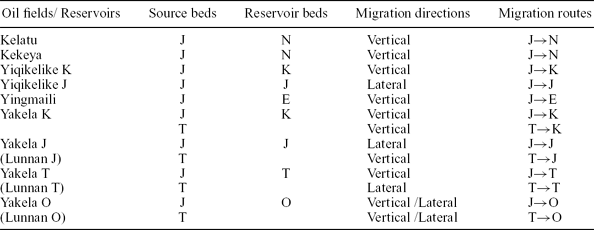
The palynological results indicate that the routes of petroleum migration in the Tarim Basin mainly are from the Triassic or Jurassic petroleum source rocks to the different petroleum reservoirs, such as the Ordovician, Triassic, Jurassic, Cretaceous and Tertiary reservoirs. Both vertical and lateral migrations are important in the course of petroleum migration in the Tarim Basin. Importantly, structural deformation could complicate the theory that the occurrence of older palynomorphs in younger reservoir strata requires vertical secondary migration. If structural deformation juxtaposes source rocks and reservoir rocks laterally, lateral migration may be more important. The later juxtaposition of source rocks and reservoir rocks as a consequence of structural deformation, such as Triassic or Jurassic source rocks and Ordovician reservoir rocks, is a possible scenario in the Tarim Basin. Based on the study of palynomorphs in petroleum, the directions and routes of petroleum migration are summarized in Table 7. The petroleum migration routes were complicated in the northern Tarim Basin and relatively simple in the southwestern Tarim Basin.
Directions and routes of petroleum migration in the Tarim Basin

Abbreviations: O – Ordovician; T – Triassic; J – Jurassic; K – Cretaceous; E – Eocene; N – Neogene.
8. Conclusions
The following conclusions may be drawn from the present study:
(1) The palynomorphs identified from crude oils and rocks in the Triassic and Jurassic of the Tarim Basin provide informative evidence for determining the potential petroleum source rocks. The results of this investigation indicate that dark-coloured argillaceous rocks of the Lower Triassic Ehuobulake Formation, the Middle Triassic Karamay Formation, the Upper Triassic Huangshanjie and Taliqike formations, the Lower Jurassic Yangxia Formation, and the Middle Jurassic Kezilenuer and Qiakemake formations are the probable petroleum source rocks in the northern Tarim Basin. The dark-coloured argillaceous rocks of the Lower Jurassic Kangsu Formation and the Middle Jurassic Yangye and Taerga formations are the probable petroleum source rocks in the southwestern Tarim Basin.
(2) The thermal alteration index (TAI) based on colour of spore/pollen indicates that the Triassic and Jurassic dark-coloured argillaceous rocks in the Tarim Basin are mature petroleum source rocks. This conclusion is supported by the results of organic geochemical analyses. The vitrinite reflectance (Ro) of the Jurassic rocks from the northern Tarim depocentre reaches 0.75%, within the oil window.
(3) The botanical affinities of the spores and pollen identified in crude oils of the Tarim Basin include mosses, ferns, cycads and conifers, and most of these plants prefer warm and humid climates. The ecological characteristics of the palaeoflora indicate that the Triassic and Jurassic petroleum source rocks were formed in brackish to lacustrine swamps during warm and humid climate conditions.
(4) Judging from the palynomorphs, it may be concluded that microfissures formed by abnormal high pressure during the diagenesis and catagenesis of petroleum source rocks could provide pathways for the primary migration of petroleum. Faults, unconformity surfaces, joints and other fissures could provide passages for the secondary migration of petroleum. The main direction of petroleum migration could be represented by either vertical migration or lateral migration for different reservoir types, and the routes of petroleum migration would be determined by different source beds and different reservoir beds.
Acknowledgements
This study was supported by the National Basic Research Program of China (grant no. 2006CB701401), National Science Foundation of China (nos 40472004, 40632010). The authors would like to thank Prof. Yang H. Q. for technical assistance, Prof. He Z. S. and Mr Dong K. L. for providing geological information and some samples, and Mr Sun F., Ms Du J. E., and Ms Lai C. Y. for collecting and preparing samples. Special thanks are due to Prof. Marc Hendrix (University of Montana, USA), Prof. Vivi Vajda (University of Lund, Sweden) and an anonymous referee for providing valuable suggestions and references, which greatly improved the manuscript. This is a contribution to International Geoscience Program – IGCP 506.