The Florence manuscript (Florence, Biblioteca Medicea Laurenziana, Plut.29.1, hereafter: F) is the most elaborate and extensive surviving source of late twelfth- and early thirteenth-century music from Paris. Edward Roesner described F as ‘the prime example of Parisian book production’, observing that ‘its importance cannot be overstated’.Footnote 1 Copied by a single text scribe and a single music notatorFootnote 2 in Paris in the 1240s,Footnote 3 F has two substantial fascicles devoted to the new genre of the motet. The first (fols. 381r–398v, fascicle 8, containing three-part monotextual motets) is consistently arranged according to the sequence of motet tenor chants in the Church calendar.Footnote 4 The ordering of the second (fols. 399r–414v, fascicle 9, containing two-voice and polytextual three-voice motets) is not strictly liturgical. This apparent break away from liturgical ordering principles, along with an increase in motets without surviving related clausulae or passages of discant within organa and the appearance of polytextual ‘double’ motets in the second motet fascicle, has encouraged the view that the collection in F enacts a gradual process of secularisation.Footnote 5
Yet connections between the two motet fascicles in F are closer than immediately apparent. Liturgical ordering is not simply ‘given up’ in fascicle 9:Footnote 6 an internal group of fifteen motets is essentially in calendric sequence. Furthermore, Wulf Arlt, in an unpublished paper delivered in 1985, argued that the second motet fascicle contains groups of pieces that correspond to a liturgical function, supplementing and expanding the ‘core’ (‘Grundbestand’) of motets for the main feasts of the year presented in fascicle 8.Footnote 7 No previous research, however, has uncovered underlying organisational principles for the motet fascicles of F other than those connected with the liturgical calendar and liturgical provision. This article undertakes a re-examination of the relationship between the two fascicles, investigating the potential for a closer alliance than is generally supposed, and reconsidering possible criteria for the ordering of motets in both fascicles.Footnote 8 It explores the consequences of these observations for the function(s) of motets recorded in F and for the status of F as a source.
Motets and their related materials in F
The vast majority of motets in F (fifty-six out of a total of sixty-nine) have related musical material present elsewhere in the manuscript in the form either of a clausula, or of a passage of discant preserved within an organum. Clausulae are gathered in separate liturgically ordered fascicles devoted to this musical type,Footnote 9 while passages of discant within organa are embedded in longer organal settings of a complete chant. Several scholars have regarded clausulae and passages of discant within organa as synonymous, employing ‘clausula’ as a catch-all term.Footnote 10 Admittedly, this distinction of musical type is not necessarily fixed across different manuscript sources: passages of discant preserved within organa in F, for example, may appear in an independent clausula fascicle in W1. Yet certain trends across the manuscripts W1, F and W2 suggest that particular material had quite a stable existence as one distinct type. W2, for instance, does not contain any independent clausulae (save a single four-voice clausula on MORS, fols. 5r–6r). Consequently, all discant passages are located within organa. The vast majority of these discant passages in W2 are also found within organa in F, rather than as independent clausulae.Footnote 11 Similarly, discant passages within organa in W1, are – when extant in F – almost always also presented within organa, rather than as clausulae.Footnote 12
It seems, therefore, that particular passages of discant were conventionally transmitted, not as independent clausulae, but within the context of organa.Footnote 13 While some musical material had a more fluid identity as one type or another, parallels evident across W1, F and W2 are sufficient to confirm this generic distinction as significant. The ordering of motets in F may also reflect an awareness of the particular type of related musical material recorded elsewhere in this manuscript.
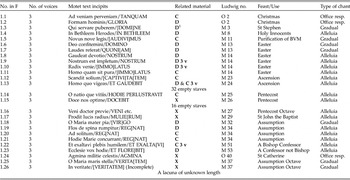
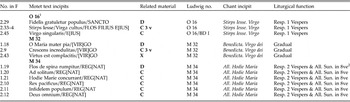
Table 1 shows the sequence of motets in the first motet fascicle of F. Ludwig's number for each motet in F is given, followed by the number of voice parts, the motet text incipits and the type of related material in F. C indicates a related clausula in F, D a passage of discant within an organum in F and X shows no extant clausula or discant material in W1, F or W2. Ludwig's numbers assigned to chants for the Office (O) and the Mass (M) are provided, in addition to the feast at which this chant is sung,Footnote 14 and the chant type (Office responsory, gradual responsory, or alleluia).Footnote 15
Motets in the eighth fascicle of F, fols. 381r-398v

1 This discant and motet are also related to the Benedicamus Domino cauda of the conductus Columbe simplicitas (F, fol. 329r).
The arrangement of motets in fascicle 8, which appear in the liturgical order of their tenor chants, was undertaken with care. At two junctures (fols. 387r–388v and fols. 389v–390r) a number of staves were left empty, presumably to be later filled with certain motets appropriate to this point in the sequence. The integration of blank staves within the fascicle suggests that the copyist placed much importance on the complete and comprehensive nature of this collection of monotextual motets, and on the order in which the pieces appeared.Footnote 16 The liturgical ordering of fascicle 8 is disturbed only at its conclusion: the final two motets (both on VERITATEM, M 37) should strictly have appeared slightly earlier in the fascicle, following other motets on Assumption tenors,Footnote 17 and the antepenultimate motet for the feast of St Catherine (on AGMINA, O 40) might also have been expected to precede motets for the common of saints (1.22 and 1.23).Footnote 18 It is striking that these final three motets (1.24–1.26) – all lacking related materials in W1, F or W2 – are instead grouped together at the point where the fascicle breaks off.Footnote 19 The only other motets in fascicle 8 lacking extant related materials are also presented in series (1.15–1.17).Footnote 20 Within the liturgical structure of this fascicle, motets associated with passages of discant within organa in F are, in the main, clustered together (e.g., motets 1.2–1.4, 1.6–1.10 and 1.18–1.19). Similarly, a motet with a corresponding clausula in F is most often found alongside another motet of this type (e.g., motets 1.11–1.14 and 1.20–1.22). This suggests that awareness of the presence and type of related material preserved in F played an additional role in establishing the order in which motets were recorded.
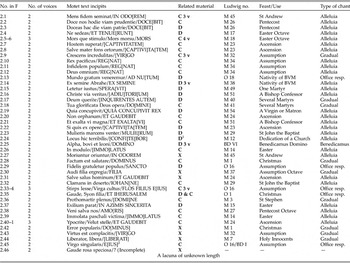
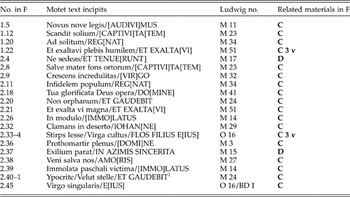
In comparison with the strictly liturgical sequence of the first motet fascicle, the second motet fascicle appears, at first sight, much less meticulously arranged (see Table 2).Footnote 21 Only a series of fifteen motets, 2.4–2.19, is internally ordered liturgically. This brief sequence begins part-way through the liturgical year, opening with a motet on a tenor chant for M 17 (2.4).
Motets in the ninth fascicle of F, fols. 399r–414v

1 2.24, on the tenor [CONFI]TE[BOR] for M 12, is related to a passage of discant in F (fol. 139v) on the tenor ET EXALTAVI, transmitted within an organum for M 51. This discant had a dual existence within M 12 and M 51, for it is transmitted within the context of both such organa in W2.
2 This motet is related to a two-voice clausula on DOMINO in F (located in a group of Benedicamus Domino clausulae). The tenor melisma for BD I is the same as the melisma on FLOS FILIUS EIUS, O 16. The motet tenor indication, ‘E’ must stand for ‘Eius’, and the motet text is highly appropriate for the Assumption.
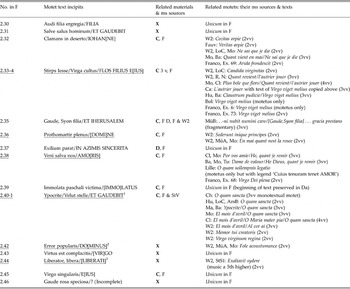
Yet, as in the first motet fascicle, the grouping of pieces might reflect an awareness of corresponding musical materials in F. Motets with no extant related clausulae or discant passages in W1, F or W2 are noticeably concentrated in the second half of fascicle 9 (the first such piece is 2.27), often appearing side by-side (e.g., motets 2.30–2.31 or 2.42–2.44). Likewise, motets with corresponding clausulae are clustered together throughout (e.g., motets 2.32–2.36 or 2.38–2.40–1), as are motets with related passages of discant within organa (e.g., motets 2.22–2.25). This is particularly evident in the early part of the fascicle: a sequence of seven clausula-related motets (from the double motet 2.5–6 to 2.12) is directly followed by a sequence of five motets with related discant transmitted within organa (2.13–2.17).
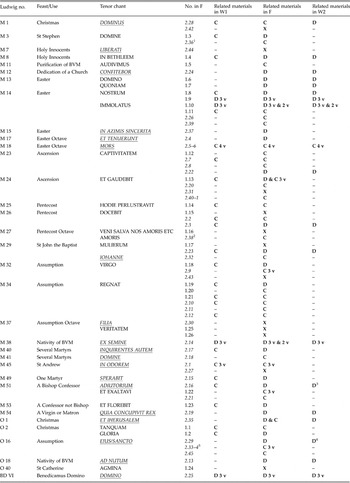
The two fascicles differ regarding related musical materials in F. Of the twenty-six motets in the first motet fascicle, eleven are related to passages of discant transmitted within organa in F, eight to clausulae in F, six have no related materials in F, and one is related to musical material preserved as both a clausula and a passage of discant in F. There is, therefore, a perceptible emphasis on motets with related materials recorded in F as passages of discant within organa, as opposed to independent clausulae. In the second motet fascicle, however, twenty-one of the forty-three motets are related to clausulae in F, fourteen to passages of discant within organa, seven have no related material, and one has related material found as both a clausula and a passage of discant within an organum.Footnote 22 The majority of motets in this later fascicle, then, have corresponding clausulae in the same source. A general progression from motets associated with passages of discant in F in fascicle 8 to those related to clausulae in F in fascicle 9 might also be perceptible on a more local, internal level. Table 3 presents in liturgical order all tenor chants employed in the eighth and ninth fascicles of F. Corresponding motets on each chant are indicated by their numbers and listed in the sequence in which they appear in F.Footnote 23 The presence and type of associated materials as found in W1, F and W2 is also shown, where a dash indicates no related material in W1 or W2. Motet numbers for the ninth fascicle and their related materials are italicised, and tenor chants first represented in fascicle 9 are italicised and underlined.
Motet tenors employed in F, their related motets in F, and related discant and clausula materials in W1, F, and W2

1 This motet has been proposed as a contrafactum of an earlier French motet, and the related clausula may represent a transcription of this motet rather than its source. See Fred Büttner, ‘Weltliche Einflüsse in der Notre-Dame-Musik? Überlegungen zu einer Klausel im Codex F’, Anuario musical, 57 (2002), 19–37.
2 This motet has been proposed as a contrafactum of an earlier French motet, and the related clausula may represent a transcription of this motet rather than its source. See Bradley, ‘The Earliest Motets’, 179–89.
3 The discant in W2 is on the text ADORABO, preserved within an organum for M 12.
4 This discant in W2 is on the text EIUS rather than SANCTO.
5 This motet has been proposed as a contrafactum of an earlier French motet, and the related clausula may represent a transcription of this motet rather than its source. See Bradley, ‘The Earliest Motets’, 202–17.
When a number of motets on the same tenor chant are recorded in fascicle 8, motets with corresponding clausulae in F invariably appear after a motet on the same tenor related to a passage of discant within an organum in F. Thus, 1.10 on the tenor [IMMO]LATUS (M 14) is associated with a passage of discant in F, and is followed by 1.11, on the same tenor, but with a corresponding clausula in F. Likewise, the two clausula-related motets on the tenor REG[NAT] (M 34), 1.20 and 1.21, follow a motet on this tenor, 1.19, associated with a passage of discant in F. This pattern is continued in fascicle 9, where motets related to clausulae are overwhelmingly on tenors for which fascicle 8 has already provided. Discant-related motets on the tenors REG[NAT] (M 34) and [IMMO]LATUS (M 14) appear in the first motet fascicle; the second provides a further three motets, all with related clausulae, on the Assumption tenor REG[NAT], and a further two motets, both with related clausulae, on the Easter tenor [IMMO]LATUS. Indeed, out of the twenty-one motets in fascicle 9 associated only with clausulae in F, just five (2.1, 2.5–6, 2.18, 2.28 and 2.32) are on tenor chants (for M 45, M 18, M 41, M 1 and M 29, respectively) that are neither represented in fascicle 8, nor already furnished with a discant-related motet in fascicle 9.
By contrast, twelve out of the fifteen motets in fascicle 9 with corresponding passages of discant within organa in F are on previously unrepresented tenors. Only three of these fifteen motets employ tenor chants already provided with motets in the eighth fascicle: 2.3, 2.22, and 2.23. Significantly, none of the fascicle 8 motets on these tenors (DOCEBIT, M 26; CAPTIVITATEM, M 23; MULIERUM, M 29; respectively) were associated with passages of discant within organa. Thus all fifteen of the discant-related motets in the ninth fascicle are on tenor chants for which no discant-related motet is recorded in the eighth fascicle. Furthermore, of the nineteen tenor chants making their first appearance in the second motet fascicle (shown in italics and underlined in Table 3), the majority (twelve) have corresponding passages of discant within organa. Just five of these tenors are first represented by motets with related clausulae, and only two (for M 7 and M 37) by motets with no clausulae or discant materials.
In summary, there is a predominance of motets related to passages of discant within organa in F in fascicle 8, while the majority of motets in fascicle 9 are related to clausulae in F. In addition, almost all of the motets related to passages of discant within organa in the ninth fascicle are on tenor chants unrepresented in the eighth. The motets in fascicle 9 for previously represented feasts, by contrast, usually have related clausulae in F. Of the forty different tenor chants employed in the motet fascicles of F, the majority (twenty-six) have at least one motet with a corresponding passage of discant within an organum in F.Footnote 24 On only two occasions (both in the second motet fascicle, on the tenors CAPTIVITATEM, M 23 and DOCEBIT, M 26) does a discant-related motet appear after a motet with an associated clausula presented earlier in the same fascicle. Most often, therefore, at least one motet related to a passage of discant within an organum in F is provided for each tenor chant, usually presented before any motets with corresponding clausulae in F or lacking related materials.
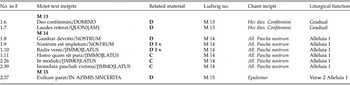
The progression from motets associated with passages of discant within organa in F to those with corresponding clausulae can be seen particularly clearly in the case of the two most heavily represented feasts in the motet fascicles of F: Easter and Assumption, both of the highest rank of annual feasts (along with Christmas and Pentecost) in the Notre Dame calendar.Footnote 25Tables 4 and 5 present the motets that could be sung at Mass on Easter Day, and at the Office and Mass on the feast of the Assumption respectively, grouping them under Ludwig's numbers for the Office and Mass chants in the order in which they are arranged in F.Footnote 26
Motets in F with chant tenors for Easter Day

Motets in F with chant tenors for the Office and Mass of the Feast of the Assumption
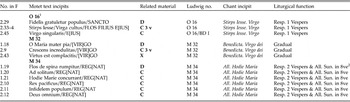
1 Tenor melismas on SANCTO, EIUS and DOMINO are identical, and the tenor texts of clausulae, passages of discant within organa and motets are subject to variation between sources.
2 See Wright, Music and Ceremony at Notre Dame, 253–4.
It appears that such patterns in the ordering of motets in F are not purely coincidental, but were deliberately created and cultivated by those compiling the motet collections in this manuscript. As already noted, the presentation of musical material in the form of either a passage of discant within an organum or a clausula can vary slightly between manuscript sources. If the motet fascicles of F are arranged with a view to the presence, absence and type of related material in the same manuscript, then the order in which the motets appear must be, to some extent, specific to this source. Were these pieces to have been copied from an existing motet collection already in this order, then it is unlikely that concordances with material which had the particular status of clausulae or passages of discant within organa in F should match up so neatly.Footnote 27
An arrangement of the motet fascicles accounting for related musical materials in the same source would be consonant with the state of the contents of F more generally, characterised by Roesner as ‘highly organized, with several modes of organization operating simultaneously’.Footnote 28 F avoids any duplication of material within or across the two motet fascicles, while in W2 (the four motet fascicles of which were the work of three different scribes) the same motet can reappear in a different guise in a new fascicle.Footnote 29 In F, it is striking that two two-voice motets on Pentecost tenors (2.2 and 2.3) – precisely the feast for which provision seems to have proved problematic in fascicle 8, where empty staves were left unfilled – are copied almost immediately at the beginning of fascicle 9.Footnote 30 This points towards an awareness of material across the motet fascicles. Given that the entire contents of F, unlike W2, were copied by a single music scribe, such consciousness of the motet collection as a whole is perhaps unsurprising. And it is plausible that this consciousness extended also to the manuscript as a whole, encompassing related musical materials in the form of both clausulae and passages of discant within organa.
A liturgical function for the motets in F?
The proposed arrangement of motets in F might prove revealing in terms of their possible function. Clearly, the organisation of motets according to the liturgical calendar alone need not necessarily indicate a liturgical performance context. What survives of the manuscript MüA, for example, demonstrates that the arrangement of its motets depended on their tenor chants. But the inclusion of both Latin and French motets within a liturgically ordered sequence suggests that the grouping of motets by tenor according to the Church calendar was, in this case, more an abstract organisational principle than evidence of liturgical performance.Footnote 31
The motet fascicles of F, largely arranged according to the liturgical calendar, betray other signs of possible liturgical influence. The initial twenty-three motets of fascicle 8 basically cover the church year, providing one motet for each tenor chant, and duplicating only motets on the tenors NOSTRUM, [IMMO]LATUS and REG[NAT], for two of the annual feasts, Easter and the Assumption respectively. Fascicle 9 supplements these important feasts, expanding the motets for Christmas and Pentecost, while also offering motets on tenors for lesser feasts absent from the eighth fascicle, and, in particular, for the Common of Saints (see the tenor chants first represented in the ninth fascicle, as highlighted in Table 3). The relatively small number of motets for the Christmas season (with just two motets for M 1, two for O 2 and two for the feast of St Stephen, M 3) might seem contrary to the liturgical importance of this time. However, this could easily be explained, as proposed by Arlt in his unpublished 1985 paper, by the suggestion that the need for such motets was limited, given the rich provision of music for Christmas and the feast of St Stephen elsewhere in the Magnus liber, including the famous four-voice Viderunt and Sederunt organa. Finally, the sheer number of different tenor chants represented in F (forty different tenors in sixty-nine motets) may indicate that the motet collection attempted to furnish quite a wide range of liturgical feasts with appropriate settings.
Given that organa and clausulae are thought to have been performed liturgically, a seeming preoccupation with their relationship to the motets in F might point towards the use of motets in the liturgy, and the precedence given to motets related to passages of discant in F could reflect a liturgical concern. It is generally accepted that clausulae were intended for substitution into organa, yet they must have had additional functions or performance contexts. There are, for example, a number of clausulae in F lacking host organa in the same source,Footnote 32 or on tenors drawn from the choral portions of responsory melismas that were not normally set polyphonically.Footnote 33 Liturgical usage seems unlikely for the famous NUSMIDO clausula (F, fol. 150v), which presents its DOMINUS tenor in retrograde, and might be more plausibly understood as an ingenious musical pun. Certain clausulae in F have, furthermore, been identified as transcriptions of French motets containing widely cited refrain melodies, casting doubt on their liturgical suitability, and raising questions about their purpose.Footnote 34 Thus, while there is little reason to doubt that passages of discant within organa were performed in a liturgical context, the liturgical status of clausulae is occasionally more ambiguous. The primary provision of motets with corresponding passages of discant within organa in F might, then, reflect the closer ties of this musical material to a liturgical context.
That motets could actually have been sung within organa, in place of passages of discant or of substitute clausulae, would further explain the ordering of the collection in F. Though there has been little detailed consideration of the practicalities of such a performance practice, it is generally accepted as a possibility.Footnote 35 Baltzer has drawn attention to the ‘sectionalized’ nature of organa, which encourages a ‘pasticcio treatment’, concluding that the substitution of a motet for a discant passage ‘would not have posed insurmountable difficulties to singers experienced in this repertory’.Footnote 36 An important piece of potential evidence to support the hypothesis is offered by the Copenhagen fragment (K), discovered in the 1980s. K contains a copy of an organum for the Easter Day Alleluia (M 14), with the words ‘Gaudeat devocio’ – the opening of the motet related to this passage of discant on NOSTRUM – copied at the beginning of the discant between the tenor and duplum staves (fol. 4r).Footnote 37
However, the evidence of this fragment and the likely performance of motets within organa are questionable on several counts. It is difficult to judge the extent to which K might represent a widespread practice, and the presence of a motet incipit within an organum could serve merely as an indication that there was a motet text associated with this music rather than a performance direction. Significantly, two motets recorded in F lack appropriate host organa in the same source. Motet 1.24, Agmina militie celestis/AGMINA (fols. 396v–397v) for the feast of St Catherine (O 40), employs a melisma from the responsory Virgo flagellator V. Sponsus amat that, as a non-soloistic part of the chant, is not furnished with polyphony in the three-voice organum setting of this responsory.Footnote 38 Similarly, motet 2.24, Locus hic terribilis/[CONFI]TE[BOR] (fols. 406v–407r, M 12) is associated with passage of discant in F, but one which is transmitted within a different organum (M 51), on the tenor ET EXALTAVI. In addition, Arlt observed that, for many of the Latin motets in F that are also recorded in W2, there is no suitable host organum preserved in W2.Footnote 39 It is also noteworthy that the majority of three-part motets in F lack corresponding three-part organa: of the twenty tenor chants employed in three-voice motets in F, only five (M 14, M 32, M 51, O 2 and O 16) receive three-voice organal settings.Footnote 40 There remains, moreover, the difficult question as to whether certain Latin motet texts can be considered suitable for liturgical use.Footnote 41
Conclusions about the liturgical performance of motets, potentially within the context of organa, must always remain speculative. Yet there is an additional explanation for the ordering of motets in F that need not rely solely upon a liturgical justification. The clustering together of clausula- and discant-related motets, and the precedence awarded to motets associated with passages of discant within organa, could also arise from an awareness of the relative dissemination or status of these related materials.Footnote 42 The decision to present certain discant passages within organa might reflect a perception of these passages as ‘older’ or more widely transmitted than the music of certain independent clausulae. Many of the independent clausulae in W1, for instance, are located within organa in F, perhaps confirming that discant within organa in F comprises an earlier layer of musical material than clausulae.Footnote 43
Of the twenty-seven passages of discant transmitted within organa related to motets in F, only two are unique to this manuscript. By contrast, a majority of the clausulae with corresponding motets in F – eighteen out of a total of thirty-one – are recorded only in F. Such patterns of dissemination are typical of F as a whole: clausulae are more often unique to this manuscript than passages of discant within organa. This is unsurprising, since F contains by far the largest collection of clausulae in any extant manuscript (with 462 clausulae in fascicle 5 alone). However, even allowing for the possible loss of other sources with similarly extensive collections of clausulae, patterns of transmission and dissemination for clausulae and discant evident across surviving thirteenth-century manuscripts are sufficiently pronounced to remain significant.
Patterns of dissemination: unica clausulae and the motets at the end of the ninth fascicle in F
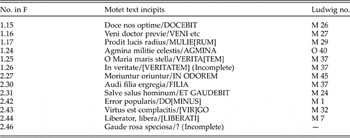
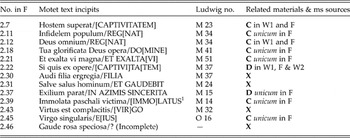
That the relative dissemination of musical materials could have influenced the organisation of motets in F is supported by closer examination, particularly of the pieces at the end of fascicle 9. Motets with related materials exclusive to F are often clustered together, and the majority appear late in the collection (see Table 6). Only four motets in the eighth fascicle have related materials unique to F, while in the ninth, sixteen have related materials found in F, but not in W1 or W2. This increase in motets with related materials recorded only in F towards the end of the ninth fascicle is accompanied by an increase in motets without surviving related materials (see Table 7). The motets towards the end of fascicle 9, then, often lack related materials or have related clausulae and discant unique to F. Significantly, many of these motets themselves are also unique to F. Not a single motet in the first motet fascicle of F is a unicum: the vast majority are also transmitted in W2 (sometimes in reduced-voice versions) and, less often, in Ma. The second motet fascicle, however, contains thirteen unica (see Table 8).
Motets with related clausulae and discant preserved in F, but not in W1 or W2

1 This clausula is also extant in StV, fols. 289v–290r, with the marginal incipit ‘Al cor ai une alegrance d'un fol dol enescurade’.
Motets without related materials in F

Motets that are unica in F

1 The beginning of text only of this motet is extant in Da, fol. 58v.
The correspondence between the dissemination of motets and the dissemination of their related materials apparent in Table 8 is striking. And the coincidence of motets unique to F with no related materials, or related materials also unique to F, is even more marked if one also considers the motets that are not strictly unica in F, but which appear in a particular texted version found only in this manuscript.Footnote 44 Amongst the final motets in F, before the ninth fascicle breaks off, are eight pieces of this type: motets with texts unique to F, but whose musical material is otherwise widely disseminated and, in three cases, cited in examples by the theorist Franco of Cologne.Footnote 45 These quasi-unica are interspersed with genuine unica at the end of fascicle 9, and almost all such motets have no related materials, or are related to clausulae (or, in just two instances, passages of discant) preserved in F, but not in W1 or W2. In fact, the specificity to F of the final fifteen motets in the ninth fascicle might allow these pieces to be considered as a distinct group,Footnote 46 the beginning of the group marked by the first appearance in the collection of a pair of motets unique to F with no extant related materials (Table 9).Footnote 47
All fifteen motets at the end of the ninth fascicle are either unique to F or appear in a particular version unique to F. Only two of these motets have related materials found outside F, and both are rather special cases. The clausula in F on ET GAUDEBIT, related to the double motet 2.40–1, is also transmitted, not in W1 or W2, but in the later ‘St Victor’ collection of clausulae copied with French motet incipits.Footnote 48 Similarly, for motet 2.35, the conclusion of the discant on ET IHERUSALEM in W2 differs substantially from the corresponding clausula and discant in F. In fact, motet 2.35 appears to have been created by conflating the clausula and discant versions of its related materials as they are preserved in F, and thus this unusual piece has a particular specificity to F.Footnote 49
The final fifteen motets of the ninth fascicle in F (possible contrafacta are underlined)

1 This motet was proposed as a contrafactum by Arlt, in ‘Zur frühen Geschichte der Motette’. Rebecca A. Baltzer did not take account of this hypothesis in her later article on this motet family, ‘The Polyphonic Progeny of an Et Gaudebit: Assessing Family Relations in a Thirteenth-Century Motet’, in Hearing the Motet: Essays on the Motet of the Middle Ages and Renaissance, ed. Dolores Pesce (New York and Oxford, 1997), 17–28.
2 Evidence for this motet as a contrafactum is provided in Bradley, ‘The Earliest Motets’, 152–64.
3 Evidence for this motet as a contrafactum is provided ibid., 283–95.
Caution must naturally be exercised when the presence or absence of motets and clausulae in certain sources is awarded significance: unica motets and clausulae could have been copied in manuscripts now lost, and widely transmitted motets may, owing to the vagaries of source survival, be documented in a single source only. Patterns of concordances for the motets in F and their related clausulae and discant, however, seem too pronounced simply to be coincidence. The concentration at the end of fascicle 9 of motets preserved in a form unique to F, either with no related materials or with related materials unique to F, stands in such stark contrast to fascicle 8 that it can hardly result from pure chance.
In terms of compositional method, the motets at the end of the ninth fascicle are a heterogeneous collection: several of them may be textings of pre-existent clausulae or passages of discant within organa. Some are contrafacta, while others do not seem to have borrowed any existing material, but may be ‘newly composed’. The interspersion of unica and very widely disseminated pieces at the end of fascicle 9 puzzled Darwin Scott, who admitted that he sought ‘in vain to discover any underlying method of organisation’.Footnote 50 Arlt, too, found the ordering of these final pieces in the motet collection of F difficult to reconcile, observing that their arrangement with regard to calendric ordering and liturgical provision appeared to be ‘arbitrary’.Footnote 51 The common specificity of these works and their related materials (where extant) to F might explain why such a seemingly disparate group of diverse pieces was clustered together at the end of the motet collection.
‘Old’ and ‘new’ in F
An organising principle reflecting the relative dissemination of musical textual materials is not unheard of in motet fascicles. Roesner has observed that ‘presentation by relative popularity seems to obtain in some of the individual motet fascicles in Montpellier H196’.Footnote 52 Similarly, Mary Wolinski has noted an analogous progression in the motet fascicles of W2, remarking that the ‘first alphabets of French and Latin motets in W2 contain the … most widely transmitted pieces, while the last alphabets have … unica and contrafacts’.Footnote 53 It seems plausible, then, that motets recognised at the time of copying as specific to F, and not considered to be widely disseminated or ‘popular’, might appear towards the end of the collection. Indeed, an awareness of the pieces at the end of the ninth fascicle as particular to F could further suggest that these motets may have been newly created and re-worked specifically for F. If this were the case, such motets might represent a separate layer of pieces which were not already in general circulation and perhaps more recent than motets presented earlier in the collection.
It would be appropriate that works relatively ‘new’ at the time when F was compiled should appear near the end of the collection. This has been noted already by Roesner:
There is also an overall progression from old to new, with the more recent genre of the motet appearing late in the manuscript (in fascicles 8 and 9) and, again, the presumably relatively modern refrain songs coming at the end (fascicle 11). Similarly, within the strictly liturgical section, the clausulae that for the most part represent reworkings of an earlier corpus of organa are placed after their respective repertories.Footnote 54
The association of motets at the end of fascicle 9 predominantly with independent clausulae – which apparently did not circulate widely outside F – rather than passages of discant transmitted within organa, could be further confirmation of their relative dissemination and novelty.
Lacunae in the motet fascicles of F
These observations about the nature of the motet collection in F might shed further light on the possible lacunae in this manuscript. Both fascicles 8 and 9 are incomplete, breaking off mid-motet at the end of the single gatherings that constitute each fascicle. The original foliation of F ends in the middle of fascicle 7, therefore it remains unknown how many further gatherings of motets, if any, may have been intended. As the extant contents of fascicle 8 span the entire liturgical year, would this cycle have simply broken down if the fascicle continued (as it seemingly begins to do at the end of the first gathering)? Or would there have been a second supplementary liturgical cycle of motets, in the same manner as the clausula cycles recorded in fascicle 5? And would a second gathering at the end of fascicle 9 have continued to present motets that were perhaps relatively recent or specific to F as a source? Roesner has also emphasised that F may conceivably be missing not only gatherings of motets but also entire fascicles, which would, he suggests, most likely have recorded Latin double motets and could even have contained motets with French texts.Footnote 55
It is arguable, however, that the motet collection as now extant in F is, in fact, essentially complete. Perhaps the scribe did not wish to waste an entire new gathering simply because the piece(s) intended for the end of these fascicles did not fit onto the final verso.Footnote 56 It is difficult to imagine how fascicle 8 could have continued: the idea of a second gathering that did not follow the liturgical calendar may be unlikely in view of the strict liturgical organisation of the first. From the evidence of surviving thirteenth-century sources, there are few monotextual motets not already included in F that could have made up such a second liturgical cycle. As Scott has noted, the eighth fascicle of F ‘uniquely preserves as an entity nearly the complete extant Parisian repertory of this type of motet’.Footnote 57 Norman Smith has also emphasised the comprehensive nature of the motet collection in F, observing that this manuscript records ‘all but seven of the first-mode Latin clausula-based repertory motets’.Footnote 58 Furthermore, if the motets at the end of fascicle 9 comprise a group of works specific to F, then their appearance at the end of the collection would be appropriate, and it is questionable whether another further gathering could have been filled with many more such pieces.
It seems also relatively improbable that fascicles of double or French motets may be missing from F. Had there been a gathering devoted to double motets, then the three pieces of this type recorded amongst the two-voice motets in fascicle 9 would surely have appeared here instead. F as a whole does not contain any vernacular texts and principally employs ordering systems more commonly associated with purely Latin liturgical sources. Indeed, the presence in F of a number of widely transmitted French motets in versions with unique Latin contrafacta might indicate that the better-known French texts were deliberately avoided in this manuscript. Such propositions necessarily remain hypothetical, but they are supported by the nature of F as a source, and the organisational conventions and patterns of transmission in its motet fascicles.
In conclusion, it appears that the two fascicles containing monotextual, two-voice and polytextual three-voice motets in F were ordered very carefully, under a number of shared organisational principles. Both motet fascicles exhibit the influence of the liturgical calendar, and both appear to reflect an awareness of the presence and type of related clausula or discant material recorded elsewhere in the manuscript. This could be interpreted as evidence of a liturgical function for the motets of F. Yet it might also be explained by the proposition that those compiling F were mindful of the relative age of musical material: of the motets themselves and their related passages of discant transmitted within organa or clausulae. Ideas of age and ‘popularity’ may, therefore, have further influenced the arrangement of the motet fascicles in F, which broadly enact an over-arching progression from old to new, from widely disseminated motets with widely disseminated related materials to those whose music and/or texts are specific to this source.
Such findings have considerable consequences for the study of thirteenth-century manuscripts preserving organa, clausulae and motets. They underline the importance of the generic distinction between clausulae and passages of discant within organa, and the association of concepts of relative age and dissemination with these different musical types. Sensitivity to chronological layers evident in the compilation of F also supports the generally accepted hypothesis that this manuscript post-dates much of the musical repertoire it contains:Footnote 59 the relative popularity of motets, clausulae and passages of discant within organa was evidently already established by the time F was created in the 1240s. It remains to be seen whether the remarkably assiduous arrangement of motets in F is particular to this source. The very fact that F was copied by a single music scribe sets it apart from W1 and W2, both products of multiple copyists.Footnote 60 Was such a high degree of organisation an idiosyncratic concern of those producing F? If so, this scribal care and consistency might reflect the importance and prestige of F, a consequence perhaps of its close connections with the cathedral of Notre Dame, or of its possible status as a Magnus liber organi.
Appendix: list of manuscript sigla
- Aba:
Aberdeen, University Library, King's College MS 2379/1
- ArsB:
Paris, Bibliothèque de l'Arsenal, 3517–3518
- Ba:
Bamberg, Staatsbibliothek, Lit. 115 (formerly Ed.IV.6)
- Ber:
Berlin, Staatsbibliothek, Preussischer Kulturbesitz, lat. 4o 523
- Bol:
Bologna, Civico Museo Bibliografico Musicale, Q11
- Ca:
Cambrai, Bibliothèque communale, A 410
- Ch:
Châlons-sur-Marne, Archives départementales, 3.J.250
- Cl:
Paris, Bibliothèque nationale de France, nouv. acq. fr. 13521, ‘Manuscrit La Clayette’
- Da:
Darmstadt, Hessische Landes- und Hochschulbibliothek, 521
- Fauv:
Paris, Bibliothèque nationale de France, fr. 146, ‘Roman de Fauvel’
- Hu:
Burgos, Monastario de Las Huelgas, 9 (formerly no shelf mark)
- K:
Copenhagen, Det kongelige Bibliotek, 1810 4o
- Lille:
Lille, Bibliothèque municipale, 316
- LoC:
London, British Library Add. 30091
- Ma:
Madrid, Biblioteca nacional, 20486 (formerly Hh 167)
- Mo:
Montpellier, Bibliothèque interuniversitaire, Section de médecine, H.196
- MüA:
Munich, Bayerische Staatsbibliothek, Mus.ms.4775 (gallo-rom.42) and fragments in Berlin, Staatsbibliothek zu Berlin, Musikabteilung 55 MS 14 (formerly in the private library of Johannes Wolf, Berlin)
- MüB:
Munich, Bayerische Staatsbibliothek, lat. 16444 (Musikfragmente E III 230–31)
- N:
Paris, Bibliothèque nationale de France, fr. 12615, ‘Noailles chansonnier’
- R:
Paris, Bibliothèque nationale de France, fr. 844, ‘Manuscrit du Roi’
- Si:
Silos, Santo Domingo de Silos, Biblioteca de Monasterio, Fragmentos Musicales 27
- StS1:
Stary Sącz, Konvent Swaty Kingy, D.2
- StV:
Paris, Bibliothèque nationale de France, lat. 15139, ‘Manuscrit St Victor’
- Tu:
Turin, Biblioteca Reale, vari 42
- W1:
Wolfenbüttel, Herzog August Bibliothek, Cod. Guelf. 628 Helmst. (Heinemann no. 677)
- W2:
Wolfenbüttel, Herzog August Bibliothek, Cod. Guelf. 1099 Helmst. (Heinemann no. 1206)