

Introduction
Shortages of social care workers within many parts of the United Kingdom (UK) are widely reported amid growing demand for social care (Department of Health, 2007; Wittenberg et al., Reference Wittenburg, Pickard, Malley, King, Comas-Herrera and Darton2008). The need for labour in the care sector is expanding with population ageing, high female employment, and greater survival of people with long-term health conditions and disabilities (Hussein and Manthorpe, Reference Hussein and Manthorpe2005; Redfoot and Houser, Reference Redfoot and Houser2008). Combined with lower birth rates and prolonged participation in education in developed countries, a care labour gap is evident. For these reasons, the social care sector has become an employment magnet for qualified and unqualified migrants across the developed world (Cunliffe and Bahiraey, Reference Cunliffe and Bahiraey2006). However, the drive, or need, for migrants to fill specific roles is not a new phenomenon within developed countries. Many countries in North America and Europe have experienced rapid rises in labour migration, often related to shortages of labour in health and social care sectors (Misra, Reference Misra2003; Elrick and Lewandowska, Reference Elrick and Lewandowska2008; Doyle and Timonen, Reference Doyle and Timonen2009); and the UK National Health Service (NHS) has a long history of recruitment from the former British Empire and the Commonwealth, more latterly recruiting from other parts of the world in 1998–2000, and again in 2006 (Young et al., Reference Young, Noble, Owen, Mahon, Grant, Hann, Swallow, Maxted, Grant and Sibbald2008).
In the 2010 UK government election, both migration and social care featured prominently in debates across political parties (BBC News, 2010). Given the significant role migrant care workers play in the provision of social care, the subjects of migration and of care overlap, but this intersection is rarely highlighted. This article aims to rectify this omission and to develop a more nuanced understanding of drivers or reasons for recruiting migrant care workers from the perspective of the English social care sector. The counterpart to these perspectives, namely how migrant care workers’ motivations to work in the English care sector are shaped and influenced by different factors, such as country of origin, gender and skills, is discussed elsewhere (Hussein et al., Reference Hussein, Stevens and Manthorpe2010a).
Migration to the UK occurs in a context of increasing globalisation, with labour mobility a significant element of this process (Yeates, Reference Yeates2009). Labour migration to the care workforce may either be a direct and purposive move into this sector or may follow arrival in the UK. Early ‘neoclassical economic’ theories (e.g. Sjaastad, Reference Sjaastad1962; Todaro, Reference Todaro1969), sought to explain how the global supply and demand for labour are associated with international migration by focusing on migrants’ wish to utilise their skills and capital. These portrayed employers in destination countries as seeking to maximise their profits by recruiting people willing to accept relatively poor working conditions (Rees and Stillwell, Reference Rees and Stillwell1982). There have since developed more nuanced understandings of the complexities of migration decisions, going beyond seeing them as purely economically based. Nonetheless, characteristics specific to the care sector (female dominated, low pay, demanding work and generally poor image) apparently confirm the ‘segmented labour-market’ theory (Piore, Reference Piore1979), which argues that migrants are recruited to fill jobs that are necessary for the overall economy but are often avoided by the indigenous population due to the poor working conditions with which they are associated. However, critiques, as developed by Gordon (Reference Gordon1995), have challenged segmented labour market theories to take account of wider processes, issues of power and the role of employers. These include, for example, over-supply of professionals in some states, power and authority related to migration rules, historical dimensions and two-way labour flows and employer influences over workforce strategies. Among these factors, the role of gender has been seen as critical (Kilkey et al., Reference Kilkey, Lutz and Palenga-Mollenbeck2010).
Care work remains highly gendered, with some researchers arguing that low wages are associated with the feminine nature of care work and its ‘natural’ attraction to women (England et al., Reference England, Allison and Wu2007; Lappalaine and Motevasel, Reference Lappalaine and Motevasel2007). Such association can be theorised to operate simultaneously in two directions: either a ‘devaluation’ view, where employers perceive predominantly female occupations as ‘less valuable’ or a competitive market process, referred to as the ‘queuing’ view (Reskin and Roos, Reference Reskin and Roos1990). In this latter view, although both men and women compete for well-paid occupations, women are only able to secure work that men do not want. However, Yeates (Reference Yeates2009) has argued that the new international division of reproductive labour, of which social care work is part, needs to acknowledge that the export of female labour is not simply an individual matter, but may be condoned or encouraged by governments. Female emigration in reproductive labour not only serves the interests of receiving states, but may be an important resource for their own families, communities and as the ‘overseas income’ for their home countries (see Williams, Reference Williams2010). The focus of these debates is generally global, multi-continent, and few studies have focused on the impact of the wider European Union (EU) on migrant care work and the potential effects on non-EU migrants.
In the UK, migration policies related to the care sector are subject to continued changes, partly because the policy and political atmosphere related to migration and care remains highly contested (Ruhs and Anderson, Reference Ruhs and Anderson2010). However, the main change has been the opening up of the UK to free movement of labour from the EU. Immigration from outside the EU is still possible through a number of measures, including work permits and points systems, for example, in areas of specific shortages. These include some areas of social care, generally senior care staff and children's social workers (see Moriarty, Reference Moriarty, Ruhs and Anderson2010).
At this intersection of migration policy and social care, it is important to capture a wide range of views and experiences in order to understand the detail of decision making about labour flows into the care sector, and their relationship to national migration policy, from the perspective of employers. This article reports on research undertaken by the authors commissioned by the Department of Health, which aimed to investigate the contribution made by migrant social care workers in England to the adult care sector. This study sought to provide wider perspectives on issues of migration and recruitment to the sector than those generally presented by obtaining multiple and first-hand accounts and to set these in the context of the sector, which itself is undergoing major restructuring (HM Government, Reference Government2009). It is, of course, important to consider social care in the larger labour migration context within and outside the EU, and not specifically as a UK phenomenon. As this article outlines, the sector is a prime example of an industry with long-standing specific labour shortages (Eborall and Griffiths, Reference Eborall and Griffiths2008). While, there have been many recruitment, retention and workforce strategies (most latterly, DH, 2009), the sector itself has combated these shortages by augmenting global recruitment with the recruitment of migrants who have moved to the UK.
Methods
Given the scarcity of multiple perspectives reflecting wider processes of migration, especially from the perspective of large employers, a collective qualitative research study approach was adopted (Yin, Reference Yin1994; Stake, Reference Stake1995; Tellis, Reference Tellis1997). This was combined with analysis of national statistics related specifically to the social care workforce in England (see Hussein et al., Reference Hussein, Stevens and Manthorpe2010a for full details of the study design).
Six English local authority areas were purposively sampled as research sites using maximum variation sampling. The sites included ‘extreme’ cases, areas known to be very diverse and attractive to migrant populations in general, and other areas with less ethnically diverse populations, as well as areas reflecting general English population profiles. Sites were anonymised and confidentiality was assured to participants. The design of the study, with multiple sources of information and methods, allowed for the possibility of data triangulation (Tashakkori and Teddlie, Reference Tashakkori and Teddie2003), where the same topics are explored among different groups: in this case, migrant workers, their colleagues, people using care services and employers, working within the same settings in the same local areas.
Data analysis
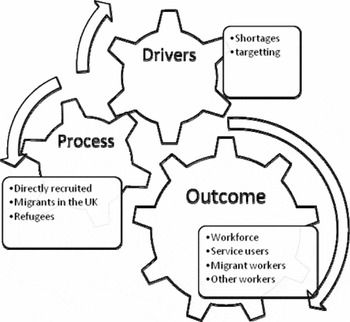
Two separate but interacting theoretical frameworks of the flow of recruiting and integrating migrant workers in the UK care sector were identified. The first reflects employers’ perspectives, the second reflects the perspective of individuals who decide to move to the UK and work in social care. These two frameworks are an attempt to capture some of the ‘laws of migration’ that may be specific to the care sector in England, as originally identified by Ravenstein (Reference Ravenstein1889), and reformulated later by Everett Lee (Reference Lee1966). Adopting the concept of the ‘push–pull’ process, we aim here to investigate and identify the ‘pull’ factors or favourable conditions in the external location (England and the care sector). The conceptual framework also draws on neoclassical economic theory (Sjaastad, Reference Sjaastad1962; Todara, Reference Todaro1969), relating international migration to the global demand for, and supply of, labour. The conceptual framework for demand, presented in Figure 1, identifies two separate main drivers.
Conceptual framework of analysis for recruiting migrant workers: English social care sector perspective.

Addressing shortages in the care sector due to current shortages in the workforce
This is based in the dual or segmented labour market theory (Berger and Piore, Reference Berger and Piore1980), hypothesising the social care workforce sector as a secondary or undesired segment of the labour force, with low wages and poor working conditions, despite its importance to society. Given the conditions of the social care sector, it can be difficult to recruit from the indigenous population in many areas; particularly when the demand for workers in the sector is increasing and alternatives are available. In many developed countries, migrants, predominantly women, have filled jobs in secondary labour markets for more than a century (Collins, Reference Collins1991; Castles and Miller, Reference Castles and Miller2003). The pivotal role of migrant workers in meeting shortages in the provision of UK long-term care mirrors the situation in other developed countries, such as the United States (US), Japan and Australia (Virag, Reference Virag2008; Howe, Reference Howe2009; Martin et al., Reference Martin, Lowell, Gozdiak, Breeding and Bump2009).
Targeting a specific group of staff for a specific purpose
This theme theorises the need to address labour shortages by seeking staff with certain characteristics, such as the ability to meet personal care needs among care recipients in culturally diverse societies. Targeting can be in relation to caring experience, health-related skills, specific languages or cultural competence. Prioritising these characteristics or attributes may result in preferences for certain groups of migrants over others (Massey et al., Reference Massey, Arango, Hugo, Kouaouci, Pellegrino and Taylor1993).
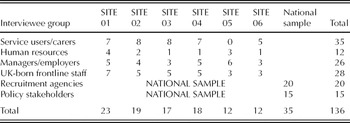
The qualitative analysis tested this framework and identified its stronger and weaker elements. In this article, we focus on the analysis of interviews with 101 employers, human resource managers, UK-born frontline workers and care recipients in the six study sites, in relation to the recruiting of migrant workers to the sector. The findings are set in context of the results of 35 interviews seeking perspectives from policy makers, sector representatives and recruitment agencies (Hussein et al., Reference Hussein, Manthorpe and Stevens2010b and Manthorpe et al., Reference Manthorpe, Hussein, Charles, Rapaport, Stevens and Nagendran2010) as well as emerging research on migrant care workers. Table 1 provides a breakdown by participant group of the interviews included in the current analysis.
Interview participants included in the current analysis by site and group (n = 136)

Findings
Addressing shortages in the care sector
In all the study sites, interviews with human resources (HR) managers and employers revealed that the main drive for recruiting migrant workers was to address workforce shortages, whether through specific recruitment campaigns outside the UK or through the employment of newly arrived migrants seeking work. These views concur with other research in this field (Cangiano et al., Reference Cangiano, Shutes, Spencer and Leeson2009) obtained through a survey of employers. According to employers participating in this study, UK-born individuals were frequently unwilling to work in social care and often personally unsuitable:
I suppose the obvious one [benefit for recruiting migrant workers] is the reason they are employed, because of their skills. The gap that's there amongst the English workers. The lack of local staff with knowledge and skills and motivation wanting to do that sort of work, social care work . . . The benefits are more diverse work and they bring lots of experience and skills. (Site 01, HR – 123)
Most employers and HR managers, whether in local authority or private home care or care home services, highlighted the importance of migrant workers to the viability of their services. They confirmed the continuing shortages of staff in several arenas, including both less-qualified staff in home care, and more qualified staff, such as occupational therapists and social workers. Specific recruitment drives overseas (generally undertaken through recruitment agencies, although they were sometimes carried out directly) were, however, only undertaken by a minority of employers. Migrants were generally recruited after arrival in the UK through responses to general advertisements. This meant that they were likely to be EU citizens with permission to work in the UK. No specific immigration processes, such as the seeking of work permits, were therefore required, although proof of identity and ability to work in the UK were part of general employment practices.
However, there was little enthusiasm about the possible benefits and advantages of migrant workers among participants in one site (01). The general population of this site was less diverse than the others and it had a long history of high unemployment and deprivation. It stood out in this respect, and the views expressed by respondents were in contrast and more overtly expressed compared to those obtained from other sites, for example:
That [recruiting migrant workers] was because, at that time, we just couldn't get carers (staff). We couldn't get decent carers. Now, of course, we are heading for a recession, it's not going to be so difficult to recruit at all. (Site 01, HR – 124)
Similar views were expressed by care recipients from the same site, and some local frontline staff felt that employers should not be actively recruiting staff from abroad, and that the local population deserved to be targeted first. When asked about overseas recruitment, some felt this was unjust:
I found that unfair. Because then there is local people who are maybe brilliant at this type of work and they are not given an opportunity. (Site 01, Frontline staff – 111)
In addition to meeting shortages, a number of sub-drivers motivating the recruitment of migrant workers were identified by participants from all groups and in all sites, relating to the perceived attributes and qualities of migrant workers. These are discussed in some detail here and are organised by the relative importance of each theme as identified by participants. However, these factors should not be viewed separately as they both interacted and overlapped; participants often discussed more than one characteristic concurrently.
Work ethic and valuing employment
One of the attributes of migrant workers most frequently referred to by employers and HR managers (of larger care providers) in the study sites was being ‘hard-working’ in comparison to local staff. Moreover, some racial or ethnic groups were perceived to be more hard-working or at least more likely to stay in a job than others. Some participants felt that workers from the EU accession countries (A8) were more likely to change jobs than others; for example, workers who were subject to immigrations rules and required a visa, such as those from the Philippines or countries in Africa, were seen as less mobile and to work even harder, not only to keep their job but also to reimburse recruitment or placing agencies. These views were consistent with those of national recruitment agencies and policy stakeholders (see Hussein et al., Reference Hussein, Manthorpe and Stevens2010b and Manthorpe et al., Reference Manthorpe, Hussein, Charles, Rapaport, Stevens and Nagendran2010) confirming research related to other labour migrants (Wills, Reference Wills, May, Datta, Evans, Herbert and McIlwaine2009).
In the study sites interviews, more than 100 references were made (in around seventy-five separate interviewees, across various participant groups) to the effect that migrant workers were ‘hard-working’. HR managers and employers were aware of migrant workers’ need for job security and argued that this was expressed positively in their work ethic and attitudes when compared to local workers. Other related attributes included a willingness to accept shift work or to work in unpopular settings. Attributes such as ‘keen to work’, ‘very reliable’, ‘very honest’ were repeatedly mentioned by many interviewees, usually in contrast to UK-born workers:
The actual professionalism and work ethic is, quite often, a lot stronger. They are quite different to a number of the people we've recruited not from abroad, in the sense that they are very often a much more driven workforce. (Site 05, HR – 526)
Even among interviews from Site 01, where there was less enthusiasm about migrant social care workers (see above), employers and HR managers felt that these workers were generally hard-working. Many UK-born frontline workers shared similar views and regarded migrant workers as hard-working, polite and appreciative of employment:
Yes [they are team players], they work well and are very obliging and very willing. Nothing is too much trouble. Probably sometimes more polite than your English person. You shouldn't compare, I know. They seem more grateful of having a job, sometimes. (Site 05, Frontline worker – 524)
Employers and HR managers perceived that migrants generally valued their jobs and worked hard to keep them, despite the relatively low wages (a minimum wage applies in the UK) and status. However, there was also a sense that they might only be willing to stay in social care until other opportunities arose. Frontline colleagues thought that many migrant workers had frequently been unable to secure employment other than in social care and were mindful that social care work was a stepping-stone for some migrants, who, generally unlike themselves, might have greater career ambitions.
Caring approach
Another commonly mentioned attribute of migrant care workers was their respectful attitude towards older people and other service users. Many participants, both in the national and study site samples, ascribed such attitudes to the migrants’ home cultures, where ‘they still respect older people’ (Service Director, PS09) and where the perceived norm was held to be family care of older people. Some noted that care work itself enjoyed a better image in many of the workers’ home countries than in the UK, a view which was thought to impact on staff attitudes and work behaviour in UK employment. This theme was evident among different groups of participants, including service users and other frontline workers who reported their observations and experiences. Many made statements like: ‘They are genuine carers. They do care about people’ (Site 05, Frontline worker – 524). ‘They've been very, very caring staff members’ (Site 04, Employer – 405). ‘[Migrant workers need] Empathy. Understanding. Caring. . .’ (Site 04, Service user – 408). These comments were made about most migrant workers; however, there was greater emphasis on them in relation to workers from the Far East and countries in Africa, consistent with other research findings in relation to those from the Philippines (Anderson, Reference Anderson2007). Only two participants discussed the possibility of conflict in relation to understandings of person-centered care, which place particular emphasis on empowering service users, in contrast to the clinical or medical models of care that might be more common in other cultures. However, they reported that migrants were generally willing to understand and apply new concepts if these were explained.
Higher qualification levels
Another positive attribute identified was that migrant workers tended to be better qualified (usually in health sector terms) than individuals recruited locally. Interviews with migrant workers themselves revealed that many had been working as nurses in their home countries and a small number had been medically trained (twenty of the ninety-six possessed health qualifications from their own countries). In most cases, employers regarded these higher qualifications and training levels as an asset to their businesses:
We found that a lot of people who were qualified nurses who are care assistants, so we got very qualified, very well qualified people being care assistants. (Site 02, Employer – 213)
Employers acknowledged the difficulty recent arrivals to England encountered in finding work equivalent to that for which they felt they were qualified, and suggested that social care work often acted as an entry point, because it was easy to enter and had high vacancies. Having a nurse as a care worker was also appreciated by some people using services as indicating competence. However, over-qualification sometimes posed a dilemma for employers. One employer had employed a consultant surgeon as a care assistant and another was reluctant to make an offer to an applicant who was medically qualified, fearful of affecting his career prospects, but at the same time wanted to offer him the opportunity of work. Additionally, over-qualification was regarded by some local frontline workers as frustrating for migrant workers and posed some challenges in interactions between colleagues. One frontline care worker working with colleagues who had been nurses in their home countries felt that ‘they are mostly bossy. . . maybe because they are in a lower position here’ (Site 02, Frontline care worker – 216).
Transferable and wider range of skills
Transferable skills were also amongst the benefits reported from the employment of migrant staff. In some cases, this was one of the reasons for recruiting a particular group from certain countries in that nursing skills seemed easily adaptable to residential care work (where the boundary between the two fields is fluid). However, this was not widely mentioned, possibly reflecting the culturally specific nature of social care (Chamberlayne and King, Reference Chamberlayne and King2000), making cross-national skills transfer less than straightforward. Only a few recruitment agencies and policy stakeholders thought that migrant social care workers offered ‘new talent and skills and a fresh way of doing things’ (Recruitment consultant, PS02). In the study sites, transferability of skills was viewed often in its narrower form, where migrant workers could transfer their informal care experiences into their work in the UK. Nevertheless, in a few cases a range of previous skills was highlighted:
They bring a different flavour to the services, some training they have done is superior to ours so can end up with a clinician with a broader skill set at an earlier age. (Site 05, Employer – 525)
Targeting specific workers
The second main recruitment drive identified in the theoretical framework of analysis was ‘targeting of specific groups to meet specific needs’. The analysis of the qualitative interviews showed that this recruitment driver exists in the care sector but to a much lesser degree than the need to meet shortages. The analysis identified forty-five references made by different participants to this specific recruitment driver. Three main themes arise in relation to targeting specific groups: one related to language skills; the second to specific knowledge of the culture of minority groups; and the, third, general cultural exchange.
When employers talked about targeting a specific group, this usually related to particular severe shortages, such as occupational therapists or senior care workers who had been recruited specifically (Hussein et al., Reference Hussein, Manthorpe and Stevens2010b). However, a minority of employers had addressed the need for a diverse workforce to meet the needs of the local community. Some perceived migrant workers, whether directly recruited from their home countries or from existing groups in England, as enhancing workforce ethnic or racial diversity. In some areas, with low black and minority ethnic (BME) populations, a small number of employers stated that demand for ethnically diverse workers to meet the local community needs and profiles had yet to materialise but might be anticipated due to population ageing:
A time will come in the not too distant future when we've got more of an overseas population that we actually care for. At that point, it will be interesting to see where we stand. But mostly most of the overseas people over here don't require care. They are still of a particular age. (Site 02, Employer – 229)
These targeting strategies rested on two main pivots: language skills and cultural competence. Some employers/HR managers (13) identified additional language skills among workers as a welcome side effect of recruiting migrants, valuable when working with specific groups. Closely associated was cultural competence. However, unlike language, very few employers identified the benefit of workers from a particular culture who could understand diverse cultures. The exception was when members of the client group and workers themselves were refugees. This was not expressed as an active recruitment strategy, but as a lucky opportunity.
Discussion and conclusion
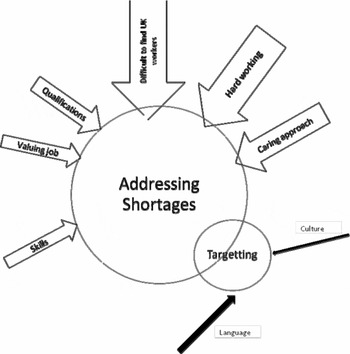
The analysis of interviews with employers and other stakeholders in this study indicates that by far the main driver for recruiting migrant social care workers in England has been to address staff shortages. HR managers and employers reported their difficulties in finding willing local recruits, highlighting the secondary position of social care in the labour market and the importance of considering the structure of the labour market overall. In a smaller number of instances, employers were actively recruiting from outside the EU, usually to meet specific professional shortages. However, in addition to filling vacancies, participants identified a number of attributes associated with migrant workers, bringing added value for employers and users. Figure 2 visualises the interactions of different factors thought to influence the demand for migrant workers as identified by the analysis, where the size of each shape is roughly proportionate to the identified theme. The most commonly mentioned benefit was the belief that migrant workers are ‘hard workers’, followed by a perception that such workers offered a ‘caring approach’. These two attributes were considered integral to care services, where work may be both emotionally and physically demanding (Dyre et al., Reference Dyre, McDowell and Batnitzky2008). Many employers held the view that migrants valued their jobs, and were thus easier to retain, but simultaneously recognised that care work for many might be temporary or a stepping stone, particularly among those with no or few immigration restrictions, such as workers from the EU.
English social care sector's drives for recruiting migrant social care workers, as identified by participants.

Many migrants in the developed world are highly skilled (Jasso et al., Reference Jasso, Massy, Rosenxwig and Smith2000) and in many situations their educational capital is the only available vehicle for the action of migration (Massey et al., Reference Massey, Arango, Hugo, Kouaouci, Pellegrino and Taylor1993; Haupt and Janeba, Reference Haupt and Janeba2009). Owing to a number of factors, their education and skills may be underutilised in the host country (Reitz, Reference Reitz2005; Alcobendas and Rodriguez-Planas, Reference Alcobendas and Rodriguez-Planas2009). Consistent with such research, only a handful of employers in our study had experience of maximising transferable skills to add to the capacity of the care setting.
The theoretical framework identified the targeting of specific groups of workers to meet the needs of local BME service users as another potential driver. However, this was mentioned by a small proportion of participants (mainly those representing the English social care sector rather than direct employers), mostly as a subcategory when discussing the main driver, the need to address staff shortages. Possession of language skills and cultural knowledge were the main positive secondary benefits of such targeting, in the opinion of employers.
The findings contribute to the evidence supporting the characterisation of the care sector in England as a secondary labour market, where migrants are needed to meet labour shortages created by the unwillingness of the local population to take up care work. However, the perceived benefits of recruiting migrant workers were far from just meeting shortages and filling gaps: a considerable number of positive characteristics were attributed to migrant workers in the sector. Such attributes may be particularly valuable in care settings where human interaction and relationship-based care are important quality indicators (Nolan et al., Reference Nolan, Brown, Davies, Nolan and Keady2006). However, consistent with other research in the US (Rodriguez, Reference Rodriguez2004), the main reason why the English care sector recruits migrants is their willingness to do work that may be seen as unattractive by the local population. This appears to be more important than other attributes, such as being hard-working and possessing high-level skills. While the latter benefits were highly valued, filling gaps appeared to be the primary driver. Furthermore, some important characteristics, such as skills and educational capital, seem to be underutilised in the sector. Consequently, in terms of the theoretical model, the research suggests that gap filling is the main ‘pull’ factor operating in terms of initiatives from employers. The mainly positive experiences of other workers and service users may be thought of as by-products of narrowing the labour gap.
The demand for care workers in the developed world, including the UK, is set to increase (HM Government, Reference Government2009). Due to the position of the social care sector in the labour market, as a secondary market, migrant workers are likely to continue to form a significant part of this workforce, whether directly recruited as care workers or domestic workers or recruited following arrival in the UK (Anderson, Reference Anderson2007; Doyle and Timonen, 2008). At the time of writing, migrant workers from outside the EU still constitute a considerable minority of the UK adult social care workforce; however, given that most migrant care workers are recruited from within the UK, it is likely that their proportion will decline due to new immigration restrictions (Ruhs and Anderson, Reference Ruhs and Anderson2010). Moreover, analysis of workforce data related to social workers in England, as part of this project, reveals a slow increase in the numbers and proportion of EU-qualified social workers in England (Hussein et al., Reference Hussein, Stevens, Manthorpe and Moriarty2011), and motivations to migrate and join the wider care sector also varied by country of birth and other characteristics. This research suggests that migrant workers from within and outside the EU may bring added value to their care work, including a range of skills and positive work ethic, which may need to be recognised and nurtured if they are to have direct positive impact on the quality of care and services.
At this stage, it is not clear how changes in UK migration strategies affecting non-EU labour, the profiles of EU migrants or changing employment levels in the UK will affect the characteristics, quality and stability of the social care workforce. Any changes in migration regulations are likely to limit the numbers of migrant workers from outside the EU. However, as Pemberton and Stevens (Reference Pemberton and Stevens2010) argue, it may be that non-EU migrants remaining in the UK will be better qualified overall than their UK colleagues. Given that the UK care sector has historically depended on labour from outside the EU, current immigration policies may be at odds with efforts to improve the quality of the workforce and its practices. The health-related expertise attributed to Filipino care workers, for example, may be hard to replace. Difficulties of qualification recognition and the tendency not to make maximum use of migrant skills and educational capital are also likely to persist even for EU migrants. Guidance and action from regulating bodies, such as the General Social Care Council and the Care Quality Commission, may be of value in promoting changing practice in this regard.
Acknowledgments
This paper draws on a study funded by the Department of Health Social Care Workforce Initiative. The views presented here are those of the authors only and do not necessarily reflect those of the Department of Health. We are most grateful for the support of the Initiative Co-ordinator, Prof Hazel Qureshi, and thank all participants and data collectors in the study sites.