Introduction
In the late Avar period, spanning the eighth and part of the ninth century ad, vast quantities of uniformly made utilitarian artefacts produced in series in the Carpathian Basin were widely disseminated, a phenomenon unattested since the end of the Roman period. The distribution of these articles is a reflection not only of the region's dense settlement pattern but also reveals how these artefacts were distributed. We can reasonably assume that craftsmen specialized in the manufacture of these artefacts of little value, whose form and production techniques were essentially identical. We can also postulate that these items were distributed through a relatively dense network, but its nature still largely eludes us.
The artefacts that can be assigned to this category of goods include pottery turned on a fast or slow wheel; copper-alloy clothing accessories, such as belt fittings (see below); jewellery items, including earrings and bracelets (Čilinská, Reference Čilinská1975; Garam, Reference Garam1995: 263–304; Pásztor, Reference Pásztor1983; Balogh & Pásztor, Reference Balogh, Pásztor, Türk, Balogh and Major2015), glass beads (Pásztor, Reference Pásztor, Varga and Szentpéteri2018); and various artefacts made from animal bone. The present study focuses on the latter.
Unlike metal, pottery, and glass, the possible existence of a specialized production of artefacts made of bone and their distribution beyond a particular micro-region has hardly been considered. Researchers of this period tend to subscribe to the view that these carved bone articles are merely examples of pastoralist art, which can be conveniently attributed to stockbreeding nomadic groups. The ethnoarchaeological direction in Avar studies, mainly pioneered by Gyula László, was strongly linked in the 1930s–1940s to the theory of the population's origin in the steppe. This blended nineteenth-century ideas of ‘pastoral culture’, ‘people’, ‘folk art’, and a view of the material culture of a population of steppic origin, while simultaneously arguing for the ancient roots of Hungarian ‘folk culture’ going back to the Hungarian Conquest (tenth century ad). László envisioned a continuity in material culture and ‘folk art’, part of the legacy of the ‘Finno-Ugrian peoples’, a view that is no longer held; an example is provided by his reconstruction of needle cases (László, Reference László1940). His ideas regarding Tiszafüred-type saddles (László, Reference László1943) illustrate how he often retrojected ethnographic examples into the Conquest period. László's many students followed his lead (e.g. Erdélyi, Reference Erdélyi1958: 57–58; recently Garam, Reference Garam2019: 229–45; see Bollók, Reference Bollók2015: 49–55); but László's tenets were also criticized for being incompatible with the Marxist ideology of the communist regime (see Bartha & Erdélyi, Reference Bartha and Erdélyi1961) as well as from a scholarly perspective (Harmatta, Reference Harmatta1956; Kovrig, Reference Kovrig1956).
Early medieval workshops specializing in the production of antler and bone items are known from Gepid (Dumitraşcu, Reference Dumitraşcu1982) and Carolingian (Szőke, Reference Szőke1982, Reference Szőke2014: 85–86; Schulze-Dörrlamm, Reference Schulze-Dörrlamm2001) contexts, as well as from various other regions beyond the Carpathian Basin (e.g. Merovingian and Carolingian central and western Europe and the Baltic; Biermann, Reference Biermann, Henning and Ruttkay1998: 98–101, Reference Biermann and Melzer2008). Given that the locations of the workshops specialized in the production of metalwork such as belt fittings remain unknown (Szenthe, Reference Szenthe2012: 68–71), we should retain the possibility that the virtually complete lack of direct evidence for craft activities can largely be attributed to the nature of the period's settlement patterns rather than to any shortcomings in research; indeed, the lack of evidence for workshops is typical of most early medieval industries in the Carpathian Basin, except for ironworking (Gömöri, Reference Gömöri2000: 221–29). For the Avar period, few settlements are published and there is hardly any evidence for a settlement hierarchy or for settlements combining several functions and acting as central places. Thus, any analysis of regional hierarchies, of production and distribution systems, can by necessity only be based on the distribution of artefacts known largely from funerary contexts.
The nature of the mechanism behind the archaeologically visible distribution of bone artefacts can hardly be equated with a workshop or workshop circle model, which is generally invoked for explaining the distribution patterns of metalwork. The ‘technological determinism’ of twentieth-century traditional scholarship, according to which the available technology shaped the material culture and the activity of craftsmen had a similarly decisive impact on what form that material culture took, was influential in central European research in the mid-twentieth century (e.g. the ‘workshop circle’ maps in Fancsalszky, Reference Fancsalszky2007: 160–61, maps 30–31; Stadler, Reference Stadler, Friesinger and Daim1990: map 4). Florin Curta has pointed out that the research angle he labels ‘technology fetishism’ was little more than a positivist ‘materialism substitute’ to compensate for the decline in Marxist ideology (Curta, Reference Curta, Preiser-Kapeller, Reinfandt and Stouraitis2020: 121), although it should be borne in mind that what he is actually referring to is vulgar Marxism, a misunderstanding or downright misconstruction of Marxist theory. The study of technologies, of technological traits, and of the formal traits derived from them, can hardly be correlated with the research orientation that Curta criticized, since researchers currently engaged in technological studies focusing on the study of cultural traits are fully aware that culture is an independent variable, even if they draw from the research tradition that has prevailed in central Europe (see Daim, Reference Daim and Daim2000, Reference Daim, Entwistle and Adams2010; Herold, Reference Herold2009: 111–13; Szenthe, Reference Szenthe, Bollók, Csiky and Vida2016). In this sense, technology is a ‘subjective’ element, alongside the formal elements making up the cultural package that created the overall corpus of material culture.
The presence of specialized craftsmen is an essentially cultural phenomenon, which, although hardly unusual in early medieval cultural milieus, can nevertheless be an indicator of social complexity through the nature and degree of specialization. At the same time, the nature and degree of specialization remain unknown; for example, it seems likely that the respective craftsmen who produced the saddles and the quivers each also produced the carved bone mounts for those items. The distribution system(s) are ultimately culturally determined (Clarke, Reference Clarke2015: 426–60) but, in the case of the Avars, there is barely any information on this dimension. In addition to the cultural aspect, the nature of distribution is influenced by the intensity of demand, which in turn hinges on the social milieu, as illustrated by Ian Hodder: the smith of the Baringo area in Kenya variously works part- or full-time (leaving farming and the tending of the animals to his family or, conversely, doing his share of the work), takes to the road with his wares (peddling them or visiting fairs and markets) or stays at home and serves his customers there, depending on the situation (Hodder, Reference Hodder1982: 60–63). Each of these scenarios, none of which excludes the other, can be conceptualized in the Avar milieu.
We have no way of knowing to what extent the distribution of various goods was influenced or determined by the central power among the Avars, whose social organization was quite certainly more complex than that of Bantu society. A direct control of redistribution by elites seems unlikely. It is possible, in the case of ceremonial belts, that a networked redistribution system relying on a prestige chain determined by the established communication patterns of the Avar social and political system played a role in distribution. In contrast, a market-based exchange resembling the barter system of the Bantu was probably the principal method for exchanging artefacts such as pottery and needle cases (or rather, needles), due to regional distributional patterns, as we argue below.
Some formal categories of carved bone artefacts made in larger series will be discussed here, in the hope of gaining fresh insights into distribution networks and inscribing them into the broader context of the distribution of other artefact types. The comparative analysis of the regional and chronological groups undertaken in this study aims to shed light on the nature of the social and economic networks of the late Avar period.
Among the middle and late Avar-period bone artefacts, quiver mounts represent an early group, while needle cases are a later group. Even though their use and cultural contexts differ, important insights can nevertheless be gained regarding their production and distribution, which can be set against and complemented by observations drawn from similar studies of pottery and metalwork.
The Seventh-Century Distribution System
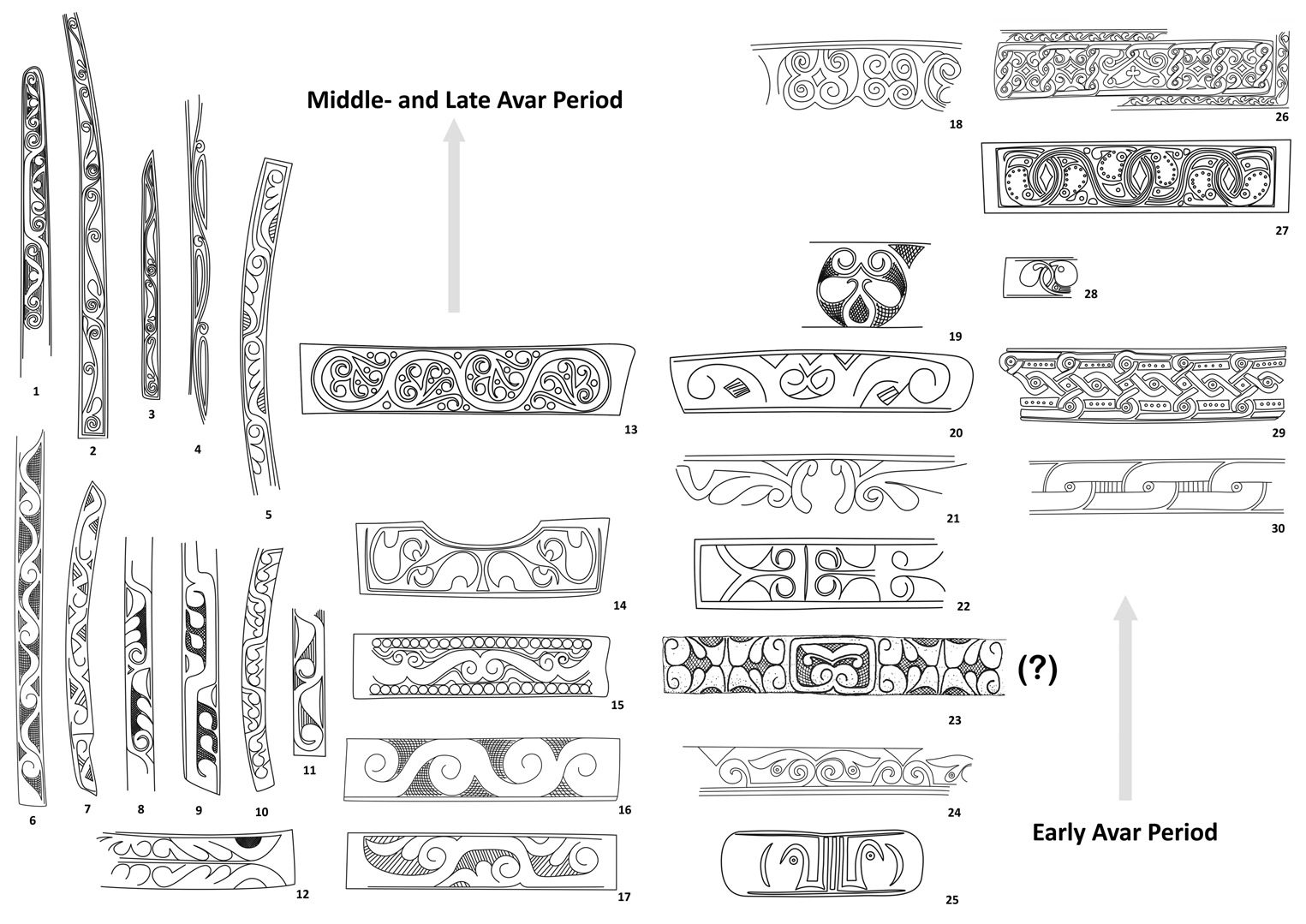
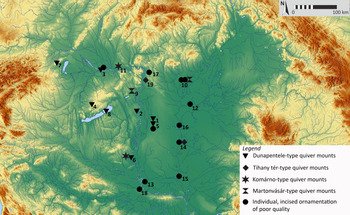
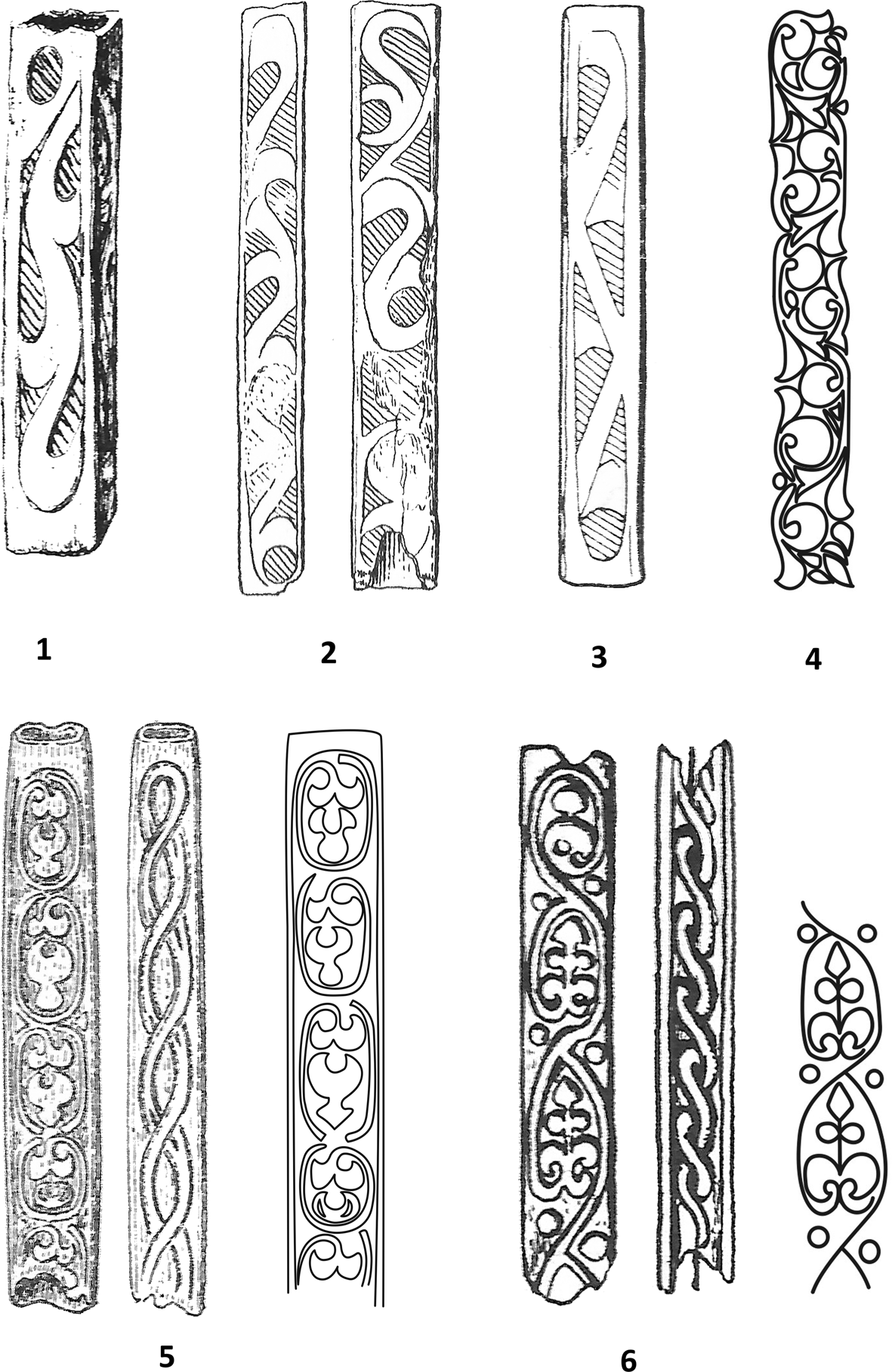
Quiver mounts of the Avar period (Figure 1)—leaving aside their typology (Kiss, Reference Kiss1996–1997; Straub, Reference Straub1997; Szenthe, Reference Szenthe2020: 254–59) and their relatively diverse ornamentation in the second half of the seventh century—can be classed into two basic technical types. The first is represented by virtually identical pieces with deeply carved, precise designs with clear-cut details, represented by two or more pieces (Dunapentele type: Figure 1, no. 13 and Tihany tér type: Figure 1, no. 29), that are principally known from Transdanubian sites (Figure 2) (Szenthe, Reference Szenthe2020: 262–63). The other main type is characterized by shallow, carelessly and haphazardly incised palmette or scrollwork designs. The latter were principally recovered from a few cemeteries in the Tisza region. Yet, the Danube, which marks the ‘boundary’ between the two groups, was by no means impermeable since several clumsily made bone quiver mounts are also found in Transdanubia (at the Győr-Téglavető-dűlő burial ground; Figure 2), while finely made exemplars are attested in the Szeged area. Nevertheless, the overall distribution of these mounts indicates the presence of a distinct group in Transdanubia, with a focus in its more southerly regions. This can most probably be taken as an indication of where these artefacts had been produced: there is a visible concentration of more or less identical articles in southern Transdanubia. The significance of this region is reflected by the exceptionally high number of sites as well as their size, attested from the early Avar periods and continuing to flourish up to and during the late Avar period (see Szentpéteri, Reference Szentpéteri2002: maps F3, F4, G3, G4).
Selected ornamented bone quiver mounts with vegetal, interlace, and chain interlace designs of the middle Avar period. 1: Kölked-Feketekapu B, Grave 541; 2: Szeged-Fehértó B, Grave 44; 3: Komárno-Lodeníce, Grave 119; 4. Čoka, Grave 47; 5: Čoka, Grave 47; 6: Zamárdi-Rétiföldek, Grave 186; 7: Jászapáti-Nagyállás út, Grave 68; 8: Szarvas-Grexa-téglagyár, Grave 324; 9: Halimba-Belátó-domb, Grave 485; 10: Jászapáti-Nagyállás út, Grave 84; 11: Jászapáti-Nagyállás út, Grave 284; 12: Jászapáti-Nagyállás út, Grave 84; 13: Dunapentele type; 14: Öcsöd, burial find; 15: Hajdúdorog-Városkert utca; 16: Zamárdi-Rétiföldek, Grave 186; 17: Jászapáti-Nagyállás út, Grave 208; 18: Felgyő-Ürmös-tanya, Grave 197; 19: Martonvásár, burial find; 20: Győr-Téglavető-dűlő, Grave 792; 21: Jászapáti-Nagyállás út, Grave 29; 22: Čoka, Grave 47; 23: Várpalota-Únió-homokbánya, Grave 2; 24: Szeged-Fehértó B, stray find; 25: Halimba-Belátó-domb, Grave 85; 26: Bogojevo; 27: Kölked-Feketekapu B, Grave 210; 28: Komárno-Lodeníce, Grave 119; 29: Budapest-Tihany tér, Grave 8; 30. Bóly-Siebert-puszta, Grave 55.

Distribution of middle Avar-period ornamented bone quiver mounts. 1: Csengőd; 2: Dunapentele; 3: Győr-Téglavető-dűlő; 4: Halimba-Belátó-domb; 5: Kiskőrös-Pohibuj, Makó-dűlő; 6: Kölked-Feketekapu B; 7: Leobersdorf; 8: Zamárdi-Rétiföldek; 9: Martonvásár-Gyermekotthon; 10: Jászapáti-Nagyállás út; 11: Komárno-Lodeníce; 12: Öcsöd; 13: Bogojevo; 14: Szeged-Fehértó B; 15: Čoka-Kremenjak; 16: Felgyő; 17: Váchartyán; 18: Vukovar; 19: Budapest-Tihany tér.

In addition to the distribution patterns, the postulated existence of a pottery production centre in south-eastern Transdanubia undoubtedly guided our train of thought, particularly knowing that east of the Danube ‘there are no traces in the early Avar period of a more sophisticated level of pottery production’ (Vida, Reference Vida1999: 186, translated from the German). The analogy is all the more striking because the distribution of finely made quiver mounts on the Hungarian Plain resembles the clustering of the grey ware originating in southern Transdanubia.
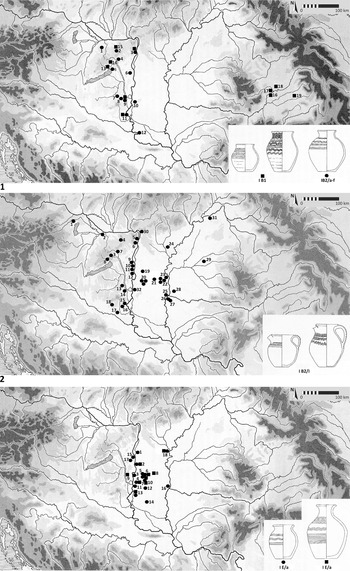
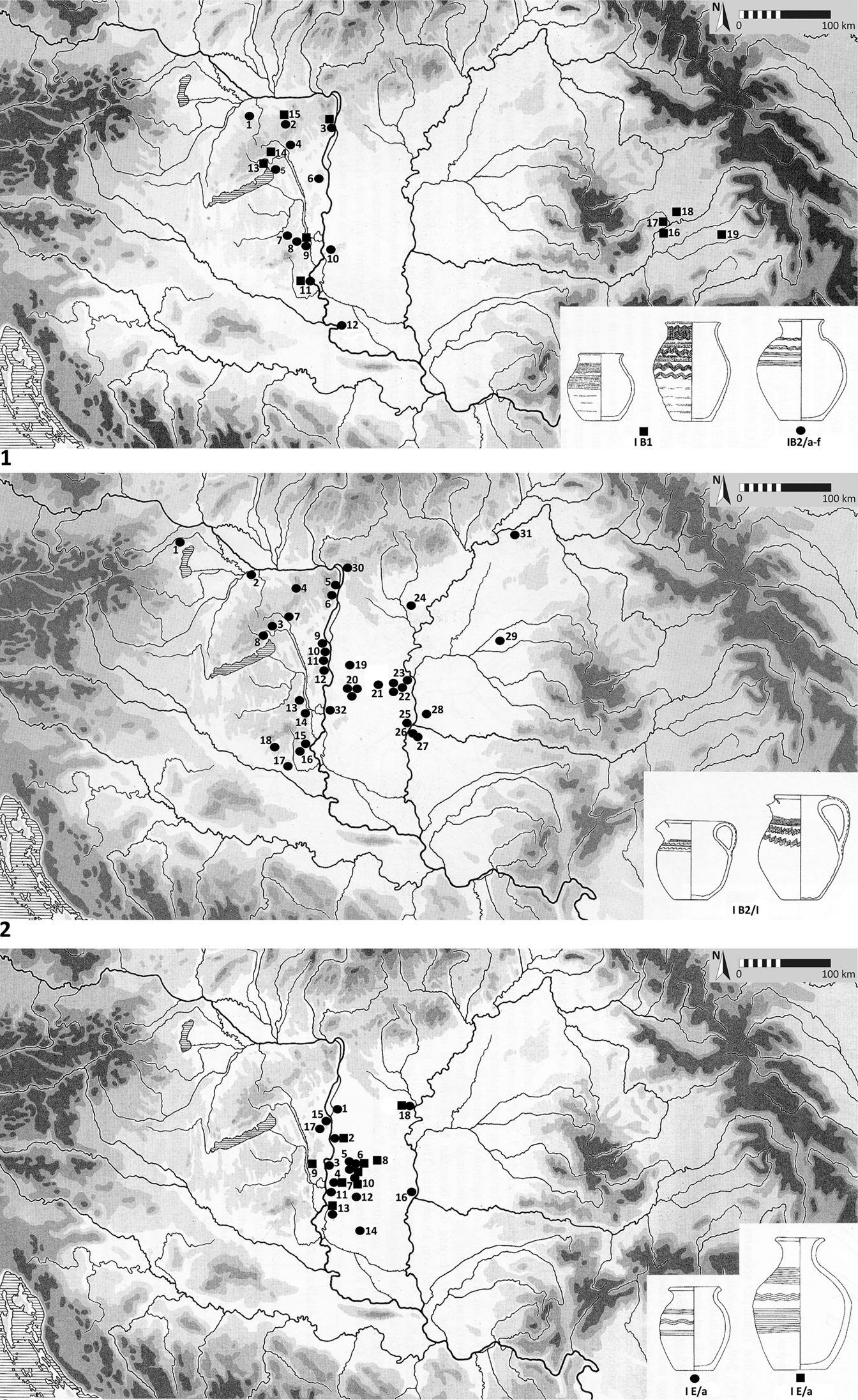
The much greater frequency, compared to bone artefacts, of early and middle Avar-period wheel-turned ceramic types—particularly grey ware—shows far more clearly that workshops engaged in the mass production of ceramics in specialized potteries were active in southern Transdanubia. While the distribution of their products was visibly restricted to Transdanubia during the early Avar period (earlier seventh century; Figure 3, no. 1), there appears to have been a definite upswing in the distribution of these wares east of the Danube from the later seventh century (Figure 3, no. 2). The sites on the Hungarian Plain would suggest a definite growth in the circulation of wheel-turned pottery during the middle Avar period, while the appearance of a ‘grey ware’ with yellowish hues distinctive of the Hungarian Plain (Figure 3, no. 3) seems to indicate the onset of specialized pottery production in this region too in the later seventh century (Vida, Reference Vida1999: 190–91).
Distribution of seventh-century grey ware in the Carpathian Basin. 1: early grey ware (earlier seventh century); 2: grey ware of the later seventh century; 3: yellow ware of the Danube-Tisza interfluve (re-drawn after Vida, Reference Vida1999: figs. 8, 10, and 24).
Crafts and the Transformation of the Distribution System in the Late Avar Period
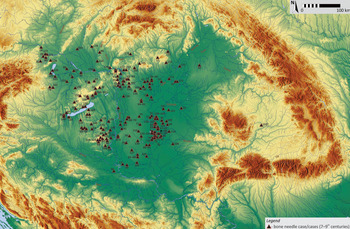
Of the bone artefacts of the late Avar period, needle cases are found in sufficiently high quantities to potentially allow similar insights. Appearing in the middle Avar period, but becoming a typical artefact type in the late Avar period, the majority of lathe-turned round needle cases were undoubtedly produced locally (Figure 4). These articles are attested among the grave goods in virtually every cemetery until the close of the Avar period, suggesting that practically the entire territory of the Carpathian Basin was densely settled and that it was enmeshed in a dense communications system that allowed for shared cultural practices.
Distribution of lathe-turned and simple bone needle cases in the Carpathian Basin during the Avar period (for sites and references to the finds, see Szenthe et al., Reference Szenthe, Gáll, H. Tóth and Horváthin prep.).

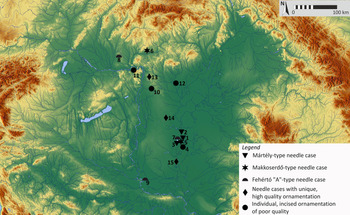
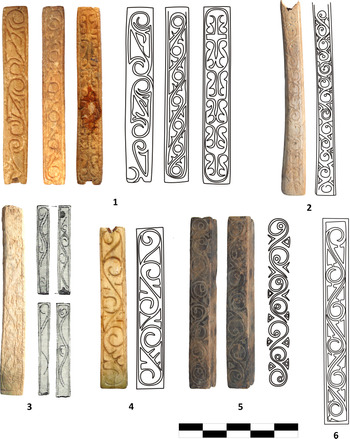
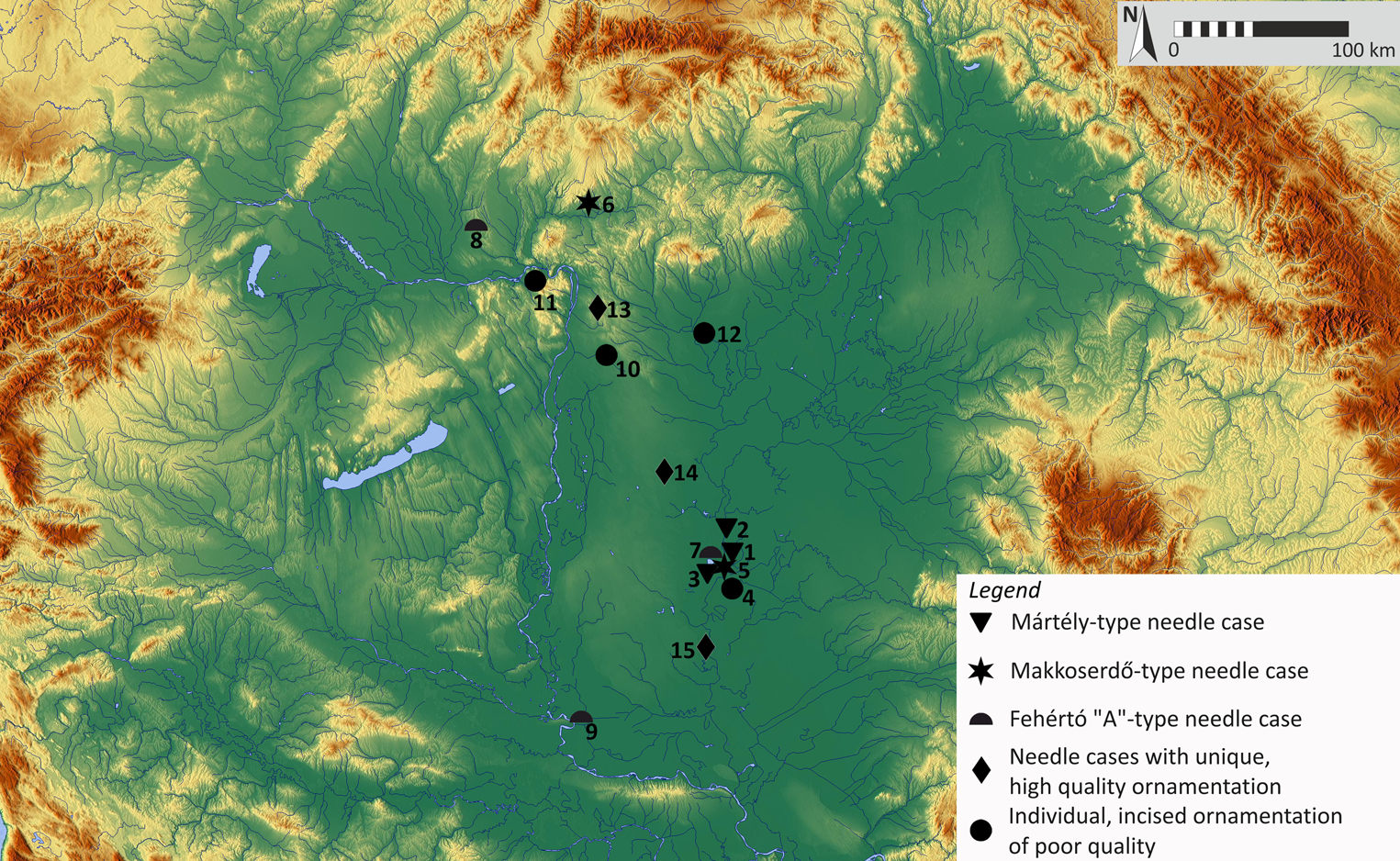
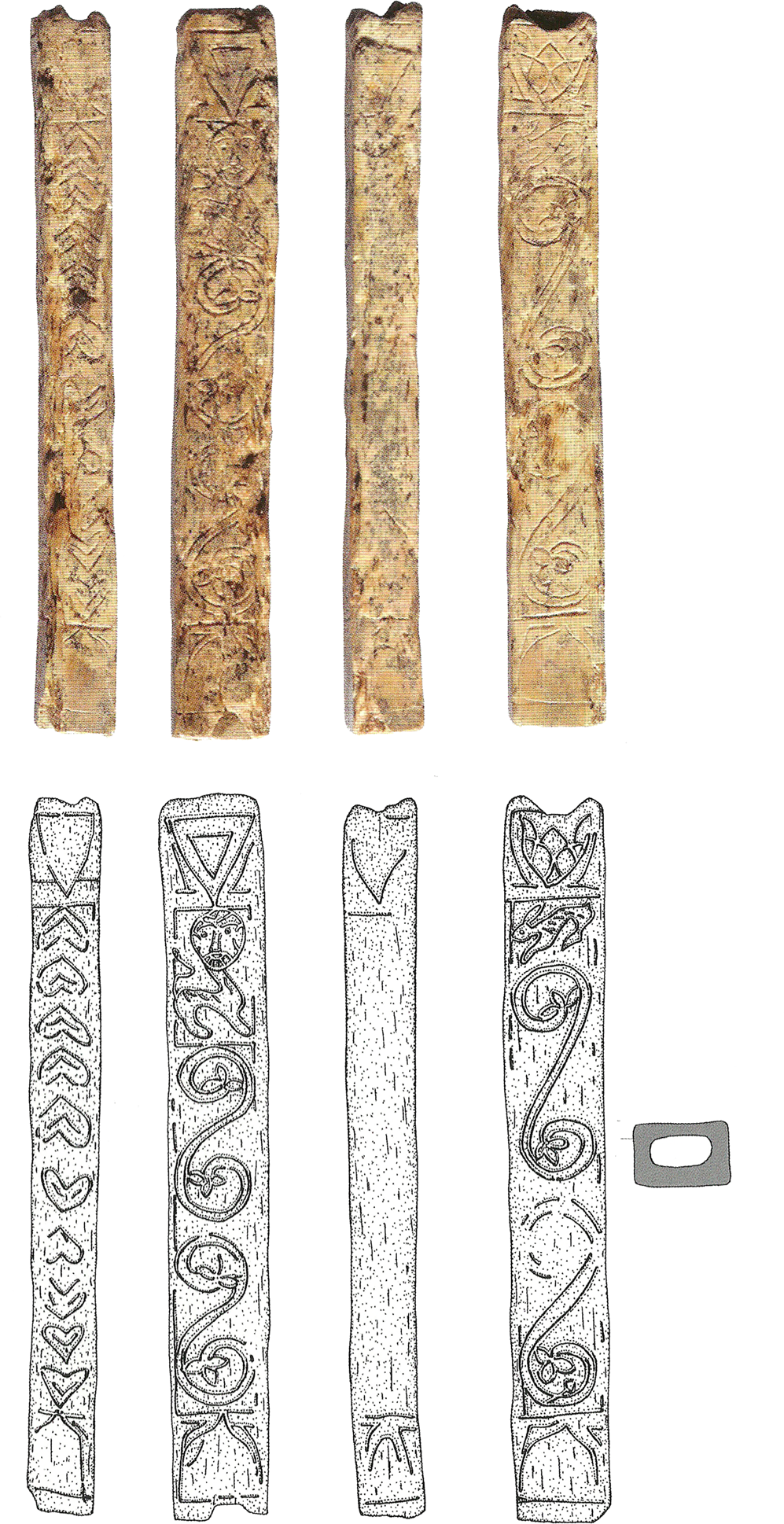
A variant of needle cases represented by quadrangular pieces has a somewhat different distribution, being found mainly on the Hungarian Plain and in the central and northern regions of the Carpathian Basin (Figure 5). Here, we discuss the finely crafted exemplars with an engraved or incised design, given that a typology is available (Erdélyi, Reference Erdélyi1958: 60–68; decorated items: Szenthe, Reference Szenthe2020: 296–304). Like quiver mounts, needle cases can be divided into pieces bearing various poorly made incised designs and technically identical exemplars indicating production in specialized workshops in larger series (e.g. Figure 6, nos. 2–3, 5), the only difference being that the proportion of good-quality, unique pieces (e.g. Figure 6, no. 1; Figure 8; Figure 9, no. 3) is much higher than among the quiver mounts. We can, however, draw no far-reaching conclusions from this, given the small number of finds.
Distribution of bone needle cases with carved and incised ornamentation. 1: Mártély; 2: Csongrád-Felgyő; 3: Szeged-Fehértó B; 4: Maroslele; 5: Szeged-Makkoserdő; 6: Želovce; 7: Szeged-Fehértó A; 8: Nové Zámki; 9: Bogojevo; 10: Üllő I-Disznójárás; 11: Pilismarót-Basaharc; 12: Alattyán-Tulát; 13: Gödöllő; 14: Kunszállás-Fülöpjakab; 15: Nadrljan.
Carved bone needle cases. 1: Gödöllő (HNM inv. no. 57.5.1); 2: Üllő I-Disznójárás, Grave 188 (HNM inv. no. 27/1931.53); 3: Pilismarót-Basaharc, Grave 76 (HNM inv. no. 69.4.199, after Fettich, Reference Fettich1965: 39, fig. 59.22); 4: Pilismarót-Basaharc, Grave 130 (HNM inv. no. 70.1.83, after Fettich, Reference Fettich1965: 47, fig. 75.7); 5: Alattyán-Tulát, Grave 646 (HNM inv. no. 13/1939.45); 6: Szeged-Fehértó B, Grave 106 (re-drawn after Madaras, Reference Madaras1995: pl. 19) (not to scale). 1–5 reproduced by permission of the Hungarian National Museum, Budapest.
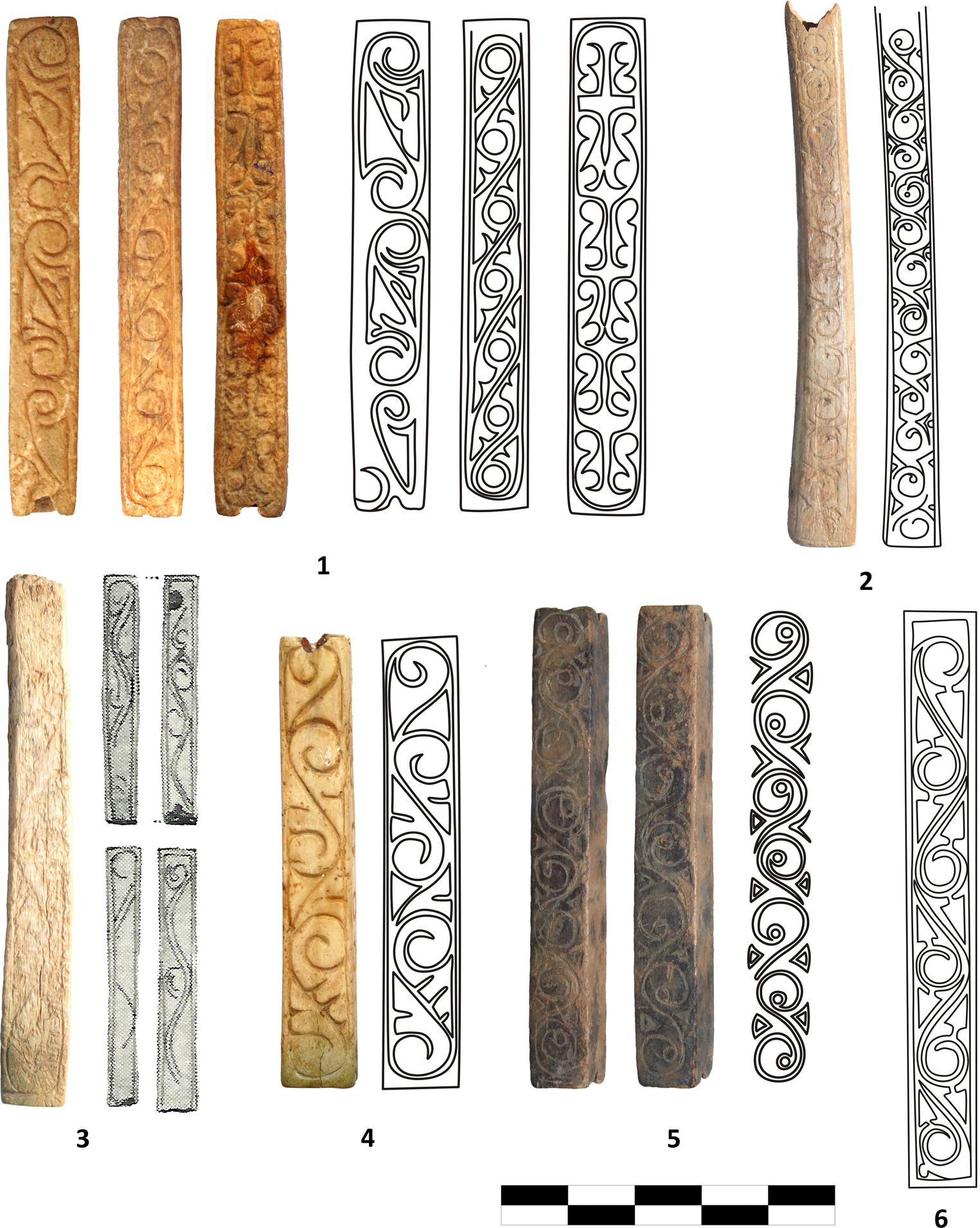
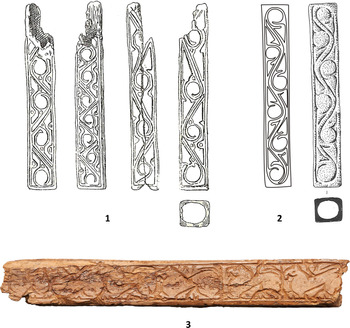
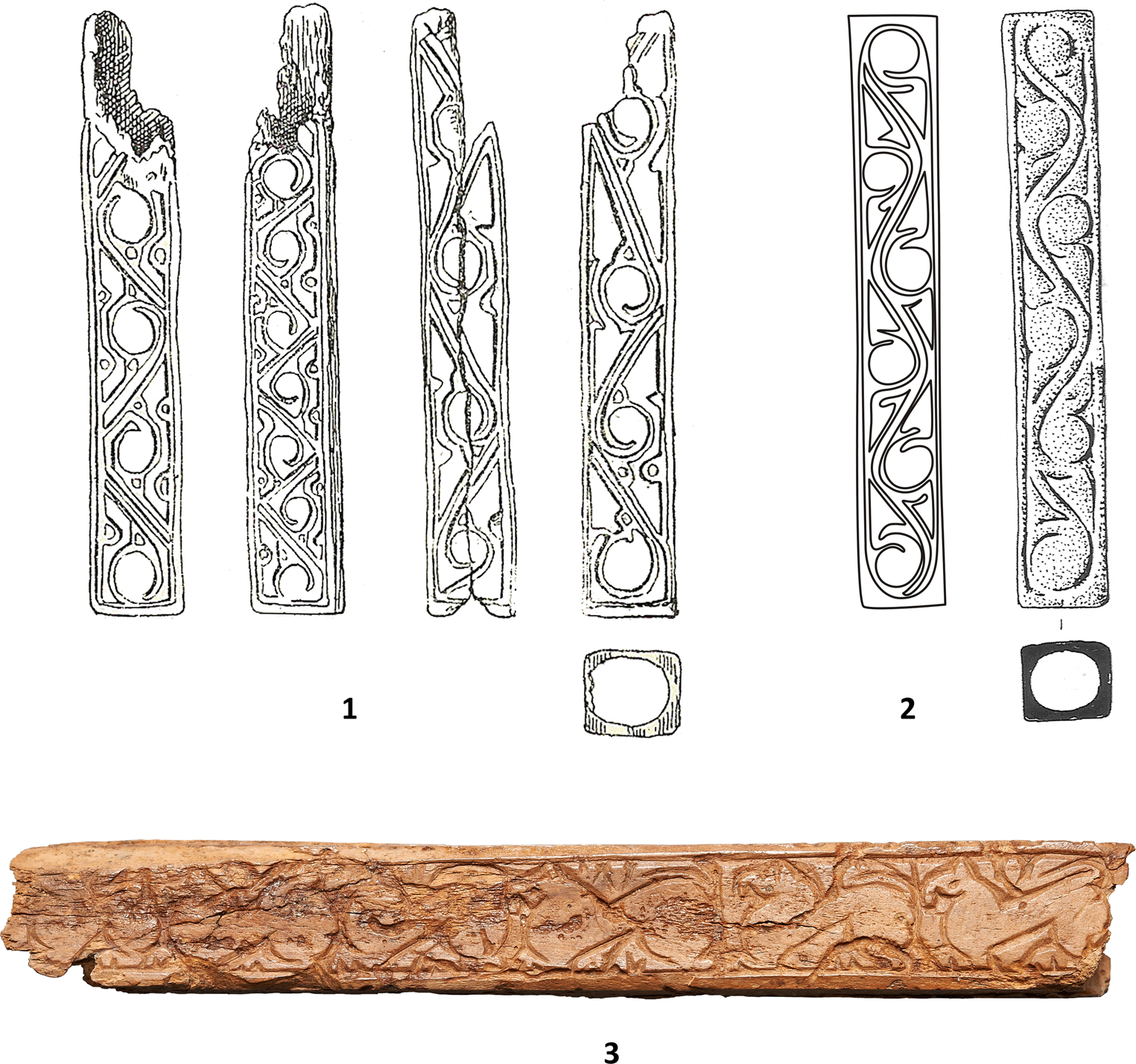
The distribution of needle cases (Figure 5) shows a distinctive concentration on the Hungarian Plain, with a clear clustering in the Szeged area, where each variant and basic ornamental design is attested. The various types, i.e. technically identical pieces, have a differential distribution: the Mártély type (Figure 6; Figure 7, nos. 1–2) is restricted to a particular area, while the Szeged-Zsély type (Figure 9, nos. 1–3) and the Szeged-Érsekújvár type (Figure 9, nos. 5–6) can be found across the entire distribution area. Technically identical pieces can thus be found in areas lying far from each other. The distribution extends from the main cluster in the Szeged region across the Hungarian Plain to the Danube Bend, and thence north of the river to the north-western fringes of the Carpathian Basin, clearly bypassing Transdanubia.
Carved bone needle cases. 1: Mártély-Csanyi part, Grave 8 (HNM inv. no. 15.1892.76); 2: Felgyő-Ürmös tanya, Grave 177 (re-drawn after Balogh, Reference Balogh, Balogh and Fischl2010: 213, fig. 72); 3: Kunszállás-Fülöpjakab (KJM inv. no. 78.2.36). 1 reproduced by permission of the Hungarian National Museum, Budapest; 3 reproduced by permission of the Katona József Museum, Kecskemét.
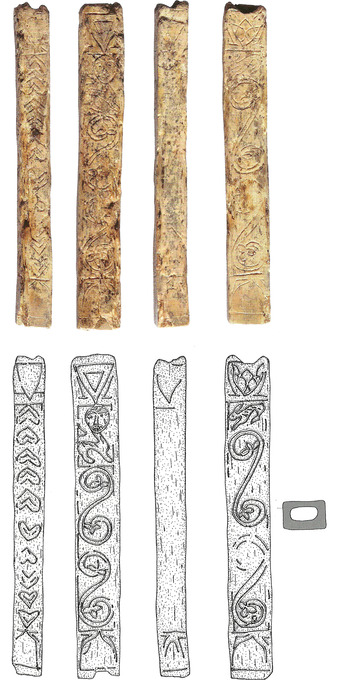
Carved bone needle case from Maroslele, Grave 29 (after Pópity et al., Reference Pópity, Kovács, Paja and Kvassay2012: 394–95, figs 2 and 5) (not to scale). Reproduced by permission of Dániel Pópity, Móra Ferenc Museum, Szeged.
Carved bone needle cases. 1: Szeged-Fehértó A, Grave 61 (re-drawn after Madaras, Reference Madaras1995: pl. 11); 2: Nové Zámky, Grave 418 (re-drawn after Čilinská, Reference Čilinská1973: pl. 62); 3: Bogojevo, Grave 42 (re-drawn after Dimitriević et al., Reference Dimitriević, Kovačević and Vinski1962: 40, fig. 18); 4: Nadrljan, Grave 20 (re-drawn after Dimitriević et al., Reference Dimitriević, Kovačević and Vinski1962: 51, pl. 29.1); 5: Želovce, Grave 682 (re-drawn after Čilinská, Reference Čilinská1973: 155–56, pl. 106); 6: Szeged-Makkoserdő, Grave 242 (re-drawn after Salamon, Reference Salamon1995: 130, pl. 17).

In sum, the imbalance in the distribution of the bone articles of the early Avar period disappeared by the late Avar period. Moreover, a pronounced cluster is located north and south of the Maros-Tisza confluence, particularly on the left bank of the Tisza, in which localized types appear alongside exemplars typical of the entire Carpathian Basin. It would, therefore, seem that, in addition to a population cluster postulated in this area, we can also identify a new, independent production centre here. The distribution in the Transylvanian Basin remains largely unknown, probably owing to a dearth of archaeological investigation.
It is, therefore, hardly surprising that the distribution of pottery matches that of the bone artefacts. For the late Avar period, the distinctive ceramic type whose distribution can be mapped for comparison with the early Avar period is the so-called yellow ware, a wheel-turned pottery type. In contrast to seventh-century grey ware, pronounced groups of equal standing can be noted in the Tisza and Maros regions (more specifically, the Tisza and ancient bed of the Maros, the Szárazér) alongside the pottery production centre located in southern Transdanubia presented earlier. However, as Katalin Bognár (Reference Bognár2016: 23) rightly pointed out, given the lack of pottery workshops, we can at best only infer the existence of production centres from the distributions. The restricted distribution of the painted variety of yellow ware in the Tisza region is particularly instructive from this perspective (Garam, Reference Garam1969: 233; Bognár, Reference Bognár2016: 24) for it highlights that needle cases were not the only type distinguished by their greater visual diversity and ornamentation from their counterparts in Transdanubia. This trend included other artefact types too in the Tisza-Maros confluence area. However, during the late Avar period, the production system seems to be even more complex. As Éva Garam (Reference Garam1969: 235) suggested, beside the two previously discussed production sites, several production centres of yellow ware can be assumed. This is also the case for other artefact categories found in high numbers, such as the widely distributed belt fittings, ceramics made on a slow wheel, beads and iron tools. Yet, identifying where these series were made, using a uniform and very simple technology, seems virtually impossible.
As noted for the lathe-turned needle cases, for the widely used belt fittings a more dispersed production system appears to have operated (Szenthe, Reference Szenthe2013, Reference Szenthe, Heinrich-Tamáska, Herold, Straub and Vida2015, Reference Szenthe, Rácz, Koncz and Gulyás2018, Reference Szenthe2020; Bálint, Reference Bálint2019: 51, fig. 19, 2–4), as it did for the pottery turned on a slow wheel (Skriba, Reference Skriba2013). The potential production areas of bone artefacts and wheel-turned pottery seem to overlap. Bearing in mind the distribution patterns of artefacts produced in large series as well as the two major concentrations noted for the bone objects discussed here, we may assume the existence of several distribution networks with a micro-regional range in the Carpathian Basin.
The distribution of different artefact types can hardly be explained by a single model. Be that as it may, a correlation between a higher population density and the probable presence of craft production can be demonstrated in southern Transdanubia and along the southern reaches of the Tisza and the lower Maros. Changing settlement patterns, an eastward population shift, and the emergence of a second settlement aggregation along the more southerly course of the river Tisza are indicated by the eastward shift in the pollen distribution of cerealia from the later seventh century (Törőcsik & Sümegi, Reference Törőcsik and Sümegi2019: 251, 254, fig. 5). Compared to this model, patterns in the distribution of craft products constitute a strong argument for the importance of the settlements emerging in the area of present-day Szeged in the late Avar period.
Central zones, Social hierarchies, Focal Points, and the Elite
The location and nature of our two major micro-regional centres raise a series of questions. At the same time as settlement began to aggregate between Szeged and Szentes, a northward shift can be noted in the settlement pattern of the late Avar period (see Samu & Blay, Reference Samu, Blay, Balogh, Szentpéteri and Wicker2019). The burial grounds, characterized by burials accompanied by horses and weapons, suggest a new, strategically important zone in the northern half of the Carpathian Basin, reflecting the northward re-orientation of the Avar khaganate's connections, the will to integrate into the emerging medieval continental communications system, and the need to control the roads leading out of the macro-region as well as its gateways (see Szenthe, Reference Szenthe2019). The people associated with the elaborate burials are traditionally identified as forming the late Avar elite (see Dugonjić & Rapan Papeša, Reference Dugonjić and Rapan Papeša2019; Bálint, Reference Bálint2019: 50); however, this is not as straightforward as it might appear.
The location of population and production centres in the southerly regions of the Avar territory in the Carpathian Basin show that the social organization of the late Avar period was complex and that the distribution of cemeteries with human burials containing horses, weapons, and prestige articles is, in itself, insufficient for even broadly reconstructing social centres. Just as the population and the associated production centres of the late Avar period were not exclusive to the fringe regions, the identification of the elite's presence calls for a subtler approach.
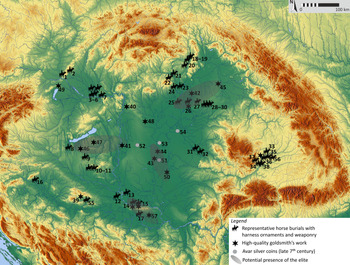
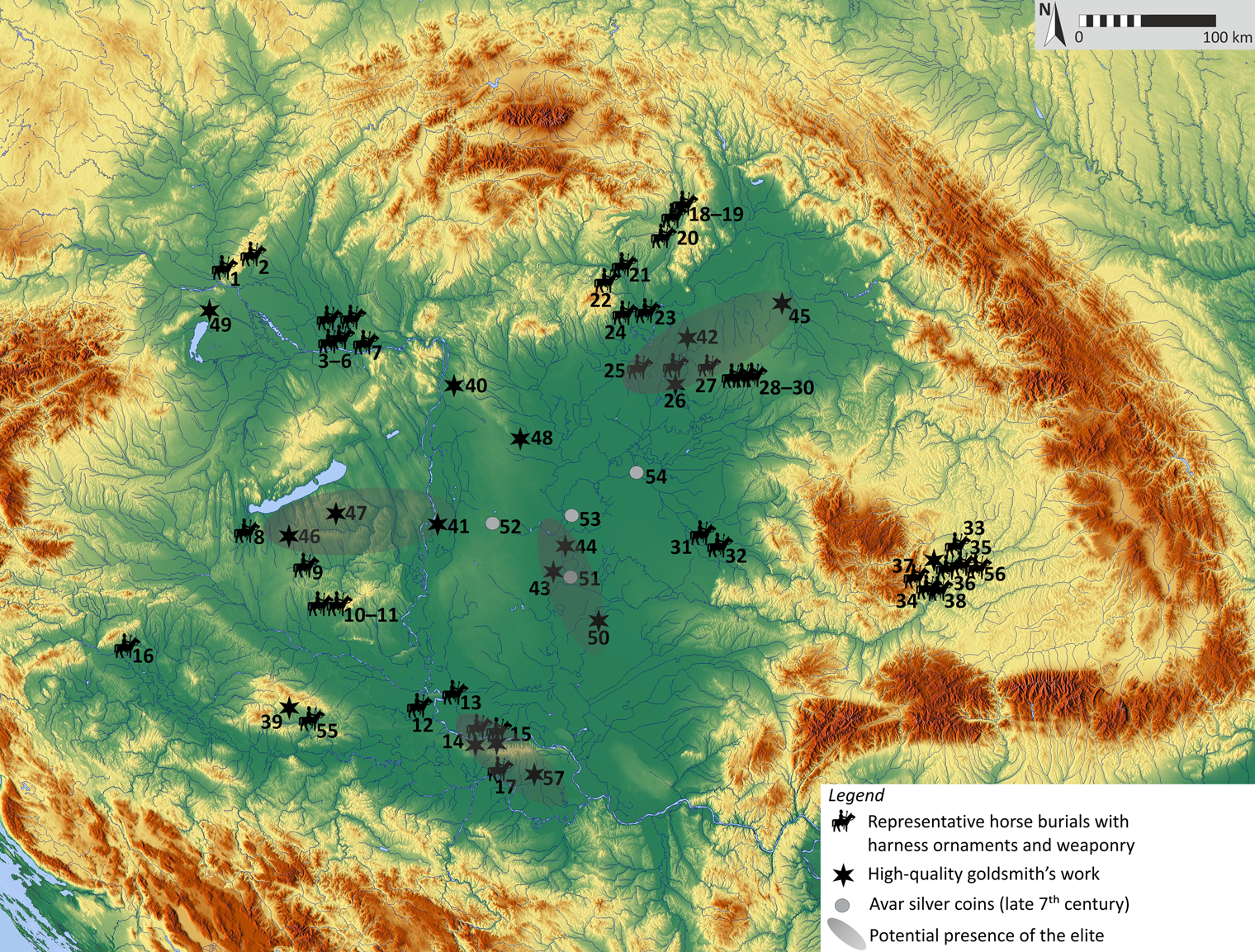
For the identification of a late Avar elite, we are forced to rely on a handful of high-quality jewellery mostly made of gold, but also silver, reflecting the impact of a supra-regional elite culture. Importantly, most of these are surface finds, hence their distribution was not influenced by different norms of funerary representation (see Szenthe, Reference Szenthe, Heinrich-Tamáska, Herold, Straub and Vida2015). The distribution of the few magnificent pieces of metalwork of the late Avar period would suggest the presence of an elite in several areas (Figure 10). A detailed discussion of this issue would exceed the scope of this study (but see Szenthe, Reference Szenthe2020: 78–81). The overall image of these areas is largely based on artefacts of superb quality, combined with an analysis of other factors, including distinguishing between funerary assemblages and stray finds, calculating the number of artefacts in a particular cemetery, and establishing their chronological position. Among these, the areas signposted by the sites of Tab-Osztopán-Dunapataj, Mártély-Kiskundorozsma-Nagyszentmiklós, Mátészalka-Hajdúsámson-Hortobágy, and Čelarevo-Bačka Palanka-Donji Petrovci appear to be more prominent (Figure 10: on that figure the finds of the third group date largely to the end of the late Avar period and the fourth group dates exclusively to that period.) Of these four areas, the Transdanubian and the broader Szeged areas are relevant for our study.
Spatial patterns in the distribution of special burial finds and other finds of the late Avar period, reflecting the presence of a central power. 1. Richly furnished human burials with horses, harness ornaments, and/or weaponry; 2: high-quality goldwork; 3: silver coins of the Avar period minted in the Carpathian Basin (after Szenthe, Reference Szenthe2019, updated)—1. Devínská nova Ves; 2. Gajary; 3. Komárno-Lodeníce; 4. Komárno-Gombaiho/Františkánov; 5. Komárno-Váradiho; 6. Komárno-Hadovce; 7. Radvan nad Dunajom, Žitavska Ton; 8. Vörs-Papkert; 9. Kaposvár-Toponár, Fészerlakpuszta; 10. Kővágószőlős-Kece-völgy; 11. Kővágószőlős-Tüskési-dűlő; 12. Ada; 13. Bogojevo; 14. Bačka Palanka; 15. Čelarevo; 16. Zagreb-Kruge; 17. Sremská Mitrovica (former Sirmium), Site 29; 18. Košice-Šebastovce; 19. Valaliki-Všechsvätých; 20. Hranícna pri Hornáde; 21. Edelény; 22. Sajószentpéter; 23. Bőcs; 24. Sajópetri; 25. Egyek; 26. Balmazújváros, Hortobágy-Árkus; 27. Balmazújváros, Hortobágy-Sóshát; 28. Debrecen-Tócóskert; 29. Debrecen-Bellegelő; 30. Debrecen-Haláp; 31. Gyula-Lencsési út; 32. Socodor; 33. Câmpia Turzii; 34. Geoagiu de Sus; 35. Heria; 36. Lopadea Nouă; 37. Măgina; 38. Aiudul de Sus; 39. Brestovac: ornate belt and jewellery; 40. Budapest-Rákos, clasp; 41. Dunapataj, clasp; 42. Hajdúsámson, horse harness fitting; 43. Kiskundorozsma; 44. Mártély; 45. Mátészalka; 46. Osztopán; 47. Tab; 48. Tápiószele; 49. Weiden am See; 50. Nagyszentmiklós (our day: Sânnicolau Mare); 51. Szeged, stray find; 52. Kiskőrös-Pohibuj, Mackó-dűlő; 53. Szegvár-Sápoldal; 54. Endrőd-Öregszőlők; 55: Brodski Drenovac (Vinski-Gasparini & Ercegović, Reference Vinski-Gasparini and Ercegović1958); 56: Șpălnaca (Cosma, Reference Cosma2018a: pl. 2.15); 57: Donji Petrovci (Bálint, Reference Bálint2010: fig. 289).
The Transdanubian region lies far from the population centre in southern Transdanubia. It is one of the most sparsely settled areas in Transdanubia, whose finds are among the poorest-quality artefacts (see Szentpéteri, Reference Szentpéteri2002: distribution maps E3, D3). The presence of small and poorly furnished burial places, the lack of settlement remains, and the pottery indicate that the cultural micro-regions of eastern Transdanubia and the Mezőföld extended across the Danube during the late Avar period (Takács, Reference Takács and Tobias2012, Reference Takács, Sekelj, Tkalčec, Krznar and Belai2017: 6–7). The late Avar-period elite of Transdanubia thus appears to be occupying an almost uninhabited area rather than a population and production centre; the stray finds of exquisite metalwork would suggest an elite group with a way of life that is largely invisible in the archaeological record, a group that appears to exclude other groups in the area. A subsistence economy based on stockbreeding and a more or less mobile lifestyle can be assumed here. A similar situation can be posited in the northeast for the equally sparsely settled, intermittently water-covered region extending from the Hortobágy and Hajdúhát regions to the Mátészalka area (Mesterházy, Reference Mesterházy, Gáll, Juhász and Sümegi2005).
By contrast, the settlement aggregation in the Szeged area shows the presence of an elite, attested not only by the finds from the Kiskundorozsma cemeteries (Daim et al., Reference Daim, Chameroy, Greiff, Patscher, Stadler, Tobias, Daim and Drauschke2010), but also by the sites in the Szeged-Öthalom area (the helmet plate found there being unusual among the material of the late Avar period: Hampel, Reference Hampel1905: 113, pl. 192). The Nagyszentmiklós (Sânnicolau Mare) hoard lies beyond the dense settlement cluster but, since it is a hoard, it does not necessarily imply that the elite had segregated itself from the densely settled areas as it did in Transdanubia and the northern Great Plain. The location of the hoard may instead be associated with the circumstances of its concealment and the well-known practice of depositing assemblages of this type on the fringes of an inhabited territory (Fontijn, Reference Fontijn2002: 265–70; Bradley, Reference Bradley2017: 160–80).
Thus, even though the presence of an elite can be demonstrated in the densely settled Szeged area, it would appear that it was rather an exception and that the social and production centres of the late Avar period did not generally coincide with the areas where an elite presence seems likely. The finds and phenomena associated with the latter do not cluster in the population centres, but in their broader area at the most, and more generally in areas left unoccupied.
This pattern has two main implications. First, that the elite did not apparently exploit, at least not systematically, the production being carried out in the emerging early medieval population and production centres. Second, that the period's elite appears to have been an intrusive element in a settlement system made up of a network of rural settlements (for Avar settlements, see Szentpéteri, Reference Szentpéteri2002, vol. 2). It therefore seems highly doubtful that a multi-tiered settlement hierarchy existed in the late Avar period: the elite and the population represented by the village communities seem to have existed separately. One prerequisite for the emergence of genuine central places would have been a systemic meshing of the two, principally through the catalysing role played by long-distance trade. Yet there is virtually no evidence of the latter during the late Avar period. Even if there were trade routes leading through the Carpathian Basin, these can at best only be identified in written sources dating from the turn of the ninth to the tenth century onwards and giving the first indications of such an east-west trade (see Polgár, Reference Polgár2019; also map in McCormick, Reference McCormick2001: 549–57).
Clear evidence for long-distance (or at least for inter-regional) trade in the broader area of the Carpathian Basin can only be cited for the emerging settlement centres in the Morva Valley from the eighth century onward (Macháček, Reference Macháček2010: 454–61). It seems to us that the concentration of warrior communities, the prominent presence of power in the north-western and possibly the north-eastern fringes of the Carpathian Basin, was the khaganate's response to these lines of communication. However, in the late Avar khaganate of the Carpathian Basin, signs pointing to the emergence of a system of central places in the sense defined by Härke and Arzhantseva (Reference Härke and Arzhantseva2016) are absent; even the southern Tisza region lacks such indicators (for regional studies in the area, see Szalontai, Reference Szalontai, Balogh, Szentpéteri and Wicker2019). What we see are indications of the rise of central zones rather than central places, particularly in the settlement aggregation around the Tisza-Maros confluence, where a population concentration, the presence of an elite, and major routes passing through the area converge. It seems likely that the most decisive factor was the area's role as an important hub in east-west communications towards Transdanubia along the Maros and the north-south traffic along the Tisza. The nature and location of occupation in the Transylvanian Basin and the presence of warrior communities suggest that the salt deposits along the Maros were being exploited (Horedt, Reference Horedt1958: fig. 9; Gáll, Reference Gáll and Cociş2014: 306‒08, fig. 5, pl. 1/B; Cosma, Reference Cosma2018b), while the fording place across the Tisza in the Szeged area occupied a prominent position in the salt trade to more westerly regions. However, given the sparse archaeological coverage of the Transylvanian Basin, it remains uncertain whether this system extended eastwards, and, if so, how far.
Conclusion
The extensive distribution of certain artefact types over large geographic areas can be taken as a reflection of specialized production as well as of intensive communication. The more sophisticated products in the Transdanubian material and the wide circulation of some types of artefacts in the early Avar period suggest a distribution system and the activity of craftsmen; such phenomena are not attested on the Hungarian Plain, at least not before the middle Avar period.
This system underwent a radical transformation in the late Avar period. The burial assemblages of the late Avar-period cemeteries indicate that the Transdanubian centre continued to flourish but at the same time a wholly independent system of distribution emerged on the Hungarian Plain, which ensured the movement of artefacts made in local specialized workshops. While this communication system maintained contacts with southern Transdanubia through the Danube-Tisza interfluve, its main thrust was northwards, as its products moved along the Tisza to the Danube Bend and then north of the Danube. The distribution of the needle cases—and of yellow ware among the ceramics—suggests that one major production centre most probably lay in the southern Hungarian Plain, in the Szeged-Csongrád-Szentes population centre. However, the manufacture sites of most artefact types could have been anywhere within the range of the network.
The two major population and production foci of the late Avar-period khaganate lay in the south, in the Tisza-Maros confluence zone and in the Transdanubian micro-region. In addition to the presence of artefacts made in large series and distributed across the entire Carpathian Basin, several types specific to the settlement aggregation by the Tisza-Maros confluence can be distinguished, indicating that it was culturally separate from southern Transdanubia: some of the artefacts made here, including the carved bone articles and the painted pottery, reflect a visually richer world. At present, we can only speculate whether this visual richness and diversity perhaps also indicated the higher prestige of the centre in the southern Hungarian Plain. Given the demonstrable presence of an elite, a striking difference compared to southern Transdanubia, a positive answer seems likely (for an example for the importance of style and visual traits in social display, see Roe, Reference Roe, Carr and Neitzel1995).
No more than a tentative hypothesis can be proposed for the reasons underlying the emergence of a concentration of settlement and its associated economic potential in the Tisza-Maros confluence area. The presence of an elite and the area's role in inter-regional communication and trade are factors generally regarded as key criteria for the emergence of a centre in a particular region.
The communications network in the Carpathian Basin underwent a significant transformation between the early and late Avar period: the major nodes of this network can be identified with the population centres that contributed to moulding a social and cultural milieu that enabled specialized craftsmen to operate, but they cannot be automatically equated with the centres of the elite. The previous system, with its single centre in southern Transdanubia, was supplanted by a system with multiple centres by the late Avar period. A sub-system linked to the centre on the Hungarian Plain appears to have been more significant, judging from its size and the nature of its cemeteries.
The bipolar system of settlement concentrations in the southern part of the Carpathian Basin, which seems to have emerged around ad 700, reflects a radically new trend in the settlement history of the wider region, with the Great Hungarian Plain region beginning to play an equal, if not dominant, role in the Carpathian Basin at this time.
Acknowledgements
Gergely Szenthe acknowledges with thanks the support of the Thematic Excellence Programme of Hungary (NKFIH-832-15/2019).