


Psychiatric classification influences the practice of, thinking about and external perceptions of psychiatry. It is therefore understandable that considerable effort is expended by many senior figures in psychiatry on making periodic reviews of the major systems of psychiatric classification in an attempt to take account of new knowledge and concepts. However, all changes come at substantial costs to the users of the classification – be they clinicians, patients, researchers, managers, administrators or politicians (Reference Craddock and OwenCraddock 2007). Apart from the time and money required for training, there is the potential for confusion and for communication difficulty that may lead to problems in making comparisons across time. Thus, it is desirable that an appropriately high threshold is set when judging the advance in knowledge that is deemed necessary to justify each change. In this regard, it is important to be dispassionate and cautious in evaluating the strength and relevance of the increment in knowledge since previous classifications.
As Professor Reference GoldbergGoldberg (2010, this issue) points out, there are many shortcomings in the current classifications (ICD–10 and DSM–IV), which have a bewildering array of descriptive categories, several of which may apply to any particular patient. Undoubtedly, many of these categories have found their way into the classifications as a result of impassioned support by eminent and influential psychiatrists during earlier DSM and/ or ICD committee meetings, rather than because of robust, relevant and compelling evidence. In his article, Professor Goldberg asks whether research advances ‘might not impose some natural limits on the nature of the system, so that instead of becoming progressively more complex, a simpler classification might emerge’. This is an extremely important question and it is timely to address this issue now that the classifications are being considered.
What do clinicians need from a diagnostic classification?
The main clinical aims of diagnosis include the optimisation of treatments and allowing useful prognostic statements to be made (Reference KendellKendell 1975; Reference Craddock and OwenCraddock 2007). Clinicians benefit from the simplest, most user-friendly model that is clinically useful. The history of medicine teaches us that therapeutic and prognostic decision-making are usually facilitated, often greatly, as classifications move closer to the underlying biological mechanisms. For this reason it is desirable to move towards a classification that maps the expression of illness onto the underlying workings of the brain (Reference Zielasek and GaebelZielasek 2008; Reference Bullmore, Fletcher and JonesBullmore 2009a; Reference Craddock and OwenCraddock 2010). It is not yet clear whether this will be most usefully achieved by using multiple overlapping ‘categorical’ domains of psychopathology or multiple dimensions (Reference Craddock and OwenCraddock 2007, Reference Craddock and Owen2010; Reference van Os and Kapurvan Os 2009).
We have entered a period of unprecedentedly rapid progress in our understanding of mental illness. While ensuring that the needs of our patients are at the forefront of thinking and planning, we need to prepare ourselves to move towards more complex and biologically plausible models of illness rather than clinging on to the biology-free models based on clinical empiricism that have been the tradition of psychiatry (Reference Bullmore and SpornsBullmore 2009b).
We can certainly expect that over the coming generation psychiatry can move towards a classification that is informed by understanding of the normal workings of the brain and is based on the common dysfunctions that give rise to the experiences of patients with psychiatric illness (Reference Craddock and OwenCraddock 2010). That said, it is likely to take at least 5–10 years before the state of understanding may be sufficiently mature to justify major changes to classification. In other words, although we can be more certain than ever before of the shortcomings of our current classification, we cannot yet specify with confidence the most useful structure and content for the future. As mentioned, this future is likely to require a willingness to use both categorical and dimensional approaches. Further, like all medical classifications, it is likely to involve a pragmatic mix of approaches that reflect the differing levels of understanding of each diagnostic entity (Reference Craddock and OwenCraddock 2007).
What should we do now? There seems no justification for major changes to existing categories before the emergence of a solid evidence base on which to determine the biological and clinical validity and usefulness of each entity, as well as the biological relationship between the entities.
Structural questions
What about Professor Goldberg's suggestion that there be major groupings of disorders into (for example): neurocognitive disorders, neurodevelopmental disorders, psychoses, emotional disorders and externalising disorders? The idea of a few major groupings that have common properties is very appealing and it is surely the direction in which psychiatry must aim to progress. Such a classification would help in the teaching of psychiatry, in reassuring those outside the discipline of its logical and scientific foundation and it would be of great benefit in clinical practice. However, although the suggested categories have some clinical plausibility, they do not seem to be grounded in sufficient empirical evidence to justify their introduction. For example, a great deal of work is ongoing to understand the complex relationship between mood disturbance and psychosis (Reference Craddock, O'Donovan and OwenCraddock 2009). Much remains to be discovered but there is already substantial evidence for a complex overlap in the underlying pathogenesis of major mood and psychotic syndromes (Reference Craddock and OwenCraddock 2010). Thus, it does not seem like a very good idea to draw what is likely to be an arbitrary distinction between ‘emotional disorders’ and ‘psychoses’. Similarly, if schizophrenia is shown to be a ‘neurodevelopmental disorder’, which category does it go in? It seems too early to set out broad categories, which may actually hamper progress over the coming years. Rather, it seems preferable to wait until changes can be made that are driven by robust neuroscientific data and proven clinical utility, rather than the current appearance of clinical plausibility.
What about dimensions? At least for mood and psychotic disorders, we already know that there is a major overlap between underlying biology and we also know that dimensional approaches can provide useful clinical information over and above current diagnostic categories (Reference Dikeos, Wickham and McDonaldDikeos 2006). Hence, it is likely to be useful to encourage use of dimensional descriptions of psychopathology alongside the current categories.
In summary
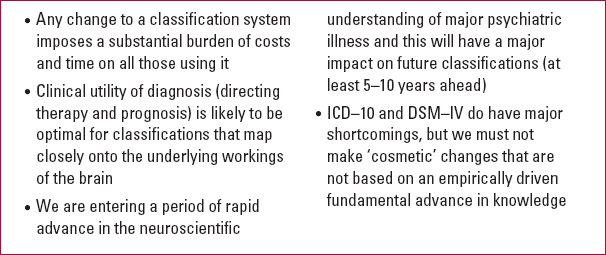
The neuroscientific understanding of major psychiatric illness is advancing rapidly and can be expected to provide a rational basis for future psychiatric classifications that will have greatly increased clinical usefulness. We need to be fully aware of the problems and limitations of our current classification and start thinking in earnest about the future – but we are not there yet. Major changes should be justified by robust evidence and proven clinical utility. While we are awaiting the evidence over the coming decade or two, we should be cautious in any changes that are made and realistic in our evaluation of our current evidence base (Key points). Introducing descriptive dimensions alongside categories makes sense. Wholesale change of categories does not.
|




eLetters
No eLetters have been published for this article.