Implications
A key factor that has received very little attention in the field of porcine embryo transfer (ET) is the selection of embryo donors. Results hereby showed that donor parity (2 to 7), season (fall, winter or spring) and weaning-to-estrus interval (WEI) (3 to 4 days) does not influence embryo quantity or quality. The ability to use donor sows with a wide range of parity and over a long period of time simplifies the application of the ET programs in donor farms, as these types of sows are highly available in nucleus farms.
Introduction
Important landmarks achieved over the last decade on short- and long-term embryo storage in combination with new procedures for non-surgical ET now allow for the commercial utilization of ET by the pig industry. Although different factors affecting donors, recipients, embryo storage and ET protocols have recently been evaluated (reviewed in Martinez et al., Reference Martinez, Cuello, Parrilla, Martinez, Nohalez, Vazquez, Vazquez, Roca and Gil2016), many others that could influence the success and final cost and, therefore, the establishment of an ET program, have yet to be addressed. One of these factors is the selection of donors, which has received little attention in the field of porcine ET.
In addition to genetic considerations, selection of donor sows is usually based on good body condition, health status and an adequate breeding history. However, other individual factors, such as parity, can play an important role in the efficiency of embryo production and consequently in the overall effectiveness of ET. It is widely assumed that parity influences fertility and prolificacy after insemination, with farrowing rates and litter sizes of primiparous sows being usually lower than those in multiparous sows. The highest reproductive performance is apparently reached at parity 3 (Koketsu et al., Reference Koketsu and Dial1999; Hughes and Varley, Reference Hughes and Varley2003), remaining unaltered until parity 7 (Flowers and Alhusen, Reference Flowers and Alhusen1992; Hughes, Reference Hughes1998). In addition, primiparous sows have a longer WEI than multiparous sows (Clark et al., Reference Clark, Komkov and Tribble1986; Koketsu and Dial, Reference Koketsu, Takahashi and Akachi1997), which has been associated with differences in length of estrus and timing of ovulation (Soede and Kemp, Reference Soede and Kemp1997). Despite the fact that differences between primiparous and multiparous sows may have important consequences for the schedule of ET protocols, primiparous or multiparous sows have been – throughout available literature – arbitrarily selected as donors without a proper screening of the effect of parity on the number and quality of embryos collected at days 5 to 6 after insemination (Brüssow et al., Reference Brüssow, Torner, Kanitz and Rátky2000; Beebe et al., Reference Beebe, Bouwman, McIlfatrick and Nottle2011; Martinez et al., Reference Martinez, Martinez, Nohalez, Sanchez-Osorio, Vazquez, Roca, Parrilla, Gil and Cuello2015).
Most weaned sows exhibit a fertile estrus between 3 and 5 days post-weaning, with >90% exhibiting estrus within 7 post-weaning (Belstra et al., Reference Belstra, Flowers and See2004; Behan and Watson, Reference Behan and Watson2005). The WEI plays an important role in the reproductive performance of sows because it has an inverse relationship with length of estrus and time of ovulation (Soede and Kemp, Reference Soede and Kemp1997; Belstra et al., Reference Belstra, Flowers and See2004). A WEI longer than 6 days increases the probability of post-ovulatory inseminations, and consequently decreases reproductive performance of sows (Soede and Kemp, Reference Soede and Kemp1997; Poleze et al., Reference Poleze, Bernardi, Amaral Filha, Wentz and Bortolozzo2006). Moreover, reduced fertility and prolificacy have also been reported in sows with very short WEIs (0 to 2 days; Poleze et al., Reference Poleze, Bernardi, Amaral Filha, Wentz and Bortolozzo2006). For practical reasons, ET programs only use donor sows with a specific WEI (3, 4 or 5 days). These differences in WEI could still influence the duration of estrus and the timing of ovulation. As a consequence, the number of non-transferable embryos at collection could increase due to the presence of uncompacted morulae (late ovulations) or hatched blastocysts (early ovulations), which are not advisable for ET because of their poor efficiency after transfers or by sanitary reasons, respectively. Moreover, when dealing with the WEI-issue, sows exhibiting estrus between 3 and 5 days post-weaning are usually grouped and not examined independently, which strongly limits our information on relevant embryo parameters.
The influence of season on the reproductive performance of sows is well known. Compared with other times of the year, a longer WEI and lower fertility in summer is common in commercial swine production. Although a parity×season interaction has been also reported for estrus characteristics and ovulation in weaned sows (Knox and Rodriguez Zas, Reference Knox and Rodriguez Zas2001), information is yet unavailable on how season affects embryo production in donor sows.
This experiment evaluated effects of parity, season and WEI on reproductive and embryonic parameters at day 6 after insemination of donor sows superovulated at post-weaning estrus.
Material and methods
All experimental procedures were performed in a pig nucleus company (Selección Batallé S.A., Girona, Spain), in accordance with the 2010/63/EU EEC Directive for experimental animals and were previously reviewed and approved by the Ethical Committee for Experimentation with Animals of the University of Murcia, Spain (research code: 638/2012). The herd was located in the northeast of Spain (41°49'N latitude and 2°43'E longitude). The within-year variation in outdoor temperature is relatively high in this region, ranging from a minimum of −8.1°C in winter to a maximum of 37.8°C in summer during the period of the study.
Animals and farm management
Purebred Duroc sows (2 to 7 parity), with a lactation period of 21 to 23 days, were selected at weaning and used as embryo donors. Females were allocated into individual crates in a mechanically ventilated confinement facility. The semen donors were sexually mature Duroc boars (2 to 3 years of age), of proven fertility, undergoing regular semen collection for artificial insemination using liquid semen. The animals had access to water ad libitum and were fed commercial diets according to their nutritional requirements.
Estrus detection in donors and recipients
The donor sows were superovulated by intramuscular administration of 1000 IU equine chorionic gonadotropin (eCG; Foligon, Intervet, Boxmeer, The Netherlands) at 24 h post-weaning. Estrus detection was performed by experienced personnel twice per day (0700 and 1700 h) beginning 2 days after weaning by allowing snout-to-snout contact with a mature boar and application of backpressure for confirmation of standing estrus. Sows with clear signs of estrus 48 to 72 h post–eCG were immediately intramuscularly administered 750 IU of human chorionic gonadotropin (Veterin Corion, Divasa, Farmavic S.A., Barcelona, Spain).
Artificial insemination, embryo recovery and evaluation
Sows were post-cervically inseminated at 0, 24 and 36 h after the onset of estrus. The insemination doses (1.5×10⁹ spermatozoa in 45 ml) were prepared from the sperm-rich fraction of the ejaculates, extended in Beltsville thawing solution extender (Pursel and Johnson, 1975) and stored for a maximum of 72 h at 18°C.
Donor sows were subjected to mid-ventral laparotomy on day 6 of the estrous cycle (day 0: onset of estrus). Surgeries and embryo recovery were performed as described previously (Martinez et al., Reference Martinez, Martinez, Nohalez, Sanchez-Osorio, Vazquez, Roca, Parrilla, Gil and Cuello2015). After exposure of the genital tract, ovarian corpus luteum, and the presence and number of follicular cysts (ovarian structures filled with a transparent liquid, without ovulation signs, and with a diameter >2 cm at the moment of laparotomy) were counted in each donor sow. The collected embryos were morphologically evaluated to verify their developmental stage and quality grade according the following criteria: one-cell eggs and poorly developed embryos were classified as oocytes and degenerate embryos, respectively. The remaining embryos, exhibiting appropriate morphology according to the criteria determined by the International Embryo Transfer Society for bovine embryos (Wright et al., Reference Wright1998), were considered as potentially viable. Viable embryos at the stage of compacted morulae and unhatched blastocysts were considered transferable. The recovery rate was defined as the ratio of the number of embryos and oocytes and degenerate embryos recovered to the number of corpus luteum present. The fertilization rate was defined as the ratio of the number of viable embryos to the total number of embryos and oocytes and degenerate embryos collected. The transferable embryo rate was defined as the ratio of the number of transferable embryos to the total number of viable embryos collected. The embryo developmental stage was considered to be linear for the purposes of statistical analysis as previously described (Macháty et al., Reference Macháty, Day and Prather1998) and scored according to the following classes: 0.5, pre-compacted morula; 1, compacted morula; 1.5, early blastocyst (blastocyst with an incipient visible blastocoele); 2, full blastocyst (blastocyst with a well-defined blastocoele, inner cell mass and trophoblast totally discernible); 2.5, expanded blastocyst (blastocyst with increased overall diameter and zona pellucida thinned); and 3, hatching or hatched blastocyst (blastocyst with broken zona pellucida or without zona pellucida).
Experimental design
The experiment was conducted over a 3-year period in 18 trials using a total of 221 Duroc donor sows, with a lactation length of 21.8±0.1 days. In each trial, only sows with a WEI of 3 to 4 days were selected as donors. Donor sows were selected at weaning from March 20 to June 20 (spring), from September 23 to December 20 (fall) and from December 21 to March 19 (winter), with two trials per season and per year. The selection of donor sows was also based on their reproductive history (average fertility and litter sizes >90% and 10 piglets, respectively), body condition (body condition score 2.75 to 3.25 on a five-point scale on the day of weaning) and parity (from 2 to 7).
Statistical analysis
The data were analyzed using IBM SPSS 19 Statistics (SPSS, Chicago, IL, USA). The effects of season (winter, spring and fall), parity at weaning (having had 2 to 3, 4 to 5 and 6 to 7 litters), and WEI (estrus in 3 or 4 days), and their interactions on the number of corpus luteum, cysts in sows with cysts, number and quality of viable and transferable embryos, embryo developmental stage and recovery and fertilization rates were evaluated using linear mixed effects models. The Kolmogorov–Smirnov test was used to assess normality of the data. The model included the random effect of the replicate, and the rest of the terms in the model were considered as fixed effects. Multivariable logistic regression analysis with the presence or absence of cysts on ovaries as the dependent variable was used to evaluate the odds ratios (ORs) and the corresponding 95% confidence intervals (CIs) for the independent variables of parity, season and WEI. Two-way interaction terms among independent variables were also considered. One class in each variable was considered as the reference, and significantly higher (or lower) than 1 OR for any other class of this variable implies an increased (or reduced) risk of ovarian cyst when compared with the reference class. The final model was diagnosed for goodness-of-fit using the Hosmer–Lemeshow test. The threshold for significance was set at P<0.05. Results are expressed as percentages and least square mean±SEM.
Results
Of all superovulated donor sows (n=221), 82.8% (n=183) showed estrus at days 3 or 4 after weaning (42.1% and 40.7%, respectively). The rest of the sows (17.2%) showed estrus after day 4 of weaning and were not used in the study. Of 183 donor sows, 179 (97.8%) had embryos on day 6 post-insemination, and just 4 (2.2%) had only oocytes after flushing. The proportion of donor sows with ovarian cysts was 23.0%, with an average of 3.5±0.2 cysts per sow. The mean ovulation rate was 23.8±0.4 corpus luteum (ranging from 6 to 40 corpus luteum, CV=24.0%). The recovery and fertilization rates were 90.8±0.8% and 96.3±0.9%, respectively, and the mean number of viable embryos, oocytes or degenerate embryos obtained in the pregnant sows was 20.8±0.4 and 1.0±0.1, respectively. The proportion of transferable embryos in relation to the number of viable embryos was 94.3±1.4%. The total number of transferable embryos collected from the inseminated donor sows (n=183) was 3508.
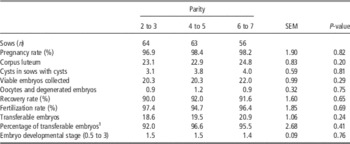
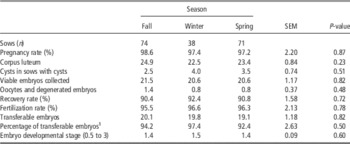
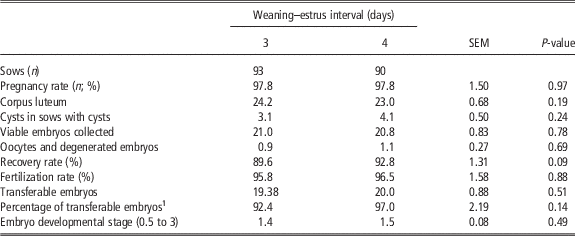
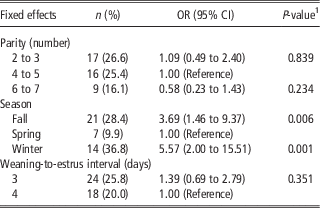
There were no significant effects of parity, season, WEI or their interactions on pregnancy, number of cysts in sows with cysts or examined embryo parameters. Tables 1 to 3 show the least square means of each variable by parity, season and WEI, respectively. Table 4 shows the risk estimates of season, parity and WEI in relation to the development of ovarian cysts in embryo donor sows. The multivariable logistic regression analysis showed that parity and WEI were not associated with ovarian cyst rates. In contrast, season was significantly associated with ovarian cysts with a 3.5- to 5.5-fold increased risk of having cysts on ovaries in fall (OR=3.69, 95% CI 1.46 to 9.37) and winter (OR=5.57, 95% CI 2.00 to 15.51), respectively, compared to spring. No interaction terms were found to be significant.
Effects of donor parity on reproductive parameters in donor sows

1 In relation to the number of viable embryos collected.
Effects of season on reproductive variables in donor sows

1 In relation to the number of viable embryos collected.
Effects of weaning–estrus interval on reproductive variables in donor sows

1 In relation to the number of viable embryos collected.
Results of multivariable logistic regression analysis of ovarian cysts in donor sows

CI=confidence interval; OR=odds ratio.
1 Compared with the respective reference group.
Discussion
This is – to the best of our knowledge – the first study demonstrating that parity (2 to 7) does not influence the reproductive parameters of donor sows in terms of pregnancy rate, ovulatory response, fertilization rate, or percentages of viable and transferable embryos. The results from this experiment also provide evidence that season (fall to spring) and WEI (3 or 4 days) do not affect these reproductive variables. The relevance of these results is enhanced because this experiment was performed under field conditions with a large number of laparotomies (n=183).
In the present study, we only used weaned sows from 2 to 7 parity as donors for several reasons. Unlike in sows (Angel et al., Reference Angel, Gil, Cuello, Sanzhez-Osorio, Gomis, Parrilla, Vila, Colina, Diaz, Reixach, Vazquez, Vazquez, Roca and Martinez2014; Martinez et al., Reference Martinez, Angel, Cuello, Sanchez-Osorio, Gomis, Parrilla, Vila, Colina, Diaz, Reixach, Vazquez, Vazquez, Roca and Gil2014), superovulation treatments in prepubertal gilts and synchronized mature gilts yield high proportions (25% to 50%) of unfertilized oocytes and degenerated embryos (Guthrie et al., Reference Guthrie, Henricks and Handlin1974; Holt and Schlieper, Reference Holtz and Schlieper1991; Wallenhorst and Holtz, Reference Wallenhorst and Holtz2002; Ziecik et al., Reference Ziecik, Biallowicz, Kaczmarek, Demianowicz, Rioperez, Wasielak and Bogacki2005), which makes the use of this these females as embryo donors inadvisable. We had only selected multiparous sows due to their high accessibility on-farm and because they usually have farrowing rates and litter sizes higher than those in primiparous sows. Moreover, primiparous sows have longer WEIs than multiparous sows (Hurtgen et al., Reference Hurtgen, Leman and Crabo1980; Clark et al., Reference Clark, Komkov and Tribble1986; Koketsu and Dial, Reference Koketsu, Takahashi and Akachi1997), which has been associated with differences in duration of estrus and timing of ovulation (Soede and Kemp, Reference Soede and Kemp1997). Differences in these parameters between primiparous and multiparous sows may be large enough to have important implications for the scheduling of ET protocols. On the other hand, we only selected donor sows with a WEI of 3 or 4 days because >80% of the superovulated donor sows started estrus within that period and, therefore, the surgeries (which were performed in all cases at day 6 after onset of estrus) could be concentrated in only two consecutive days in each trial. Finally, the summer season was excluded from the study because it is already recognized that high ambient temperature adversely affects the outcome of embryo collection and increases the risk of mortality during and shortly after surgery.
There were no significant effects of parity on the reproductive and evaluated embryonic parameters. This finding was expected because it is widely assumed that the highest levels of fertility and prolificacy are reached starting at parity 3 (Koketsu et al., Reference Koketsu and Dial1999; Hughes and Varley, Reference Hughes and Varley2003) and remain unchanged until the parity 7, when they begin to decrease again (Flowers and Alhusen, Reference Flowers and Alhusen1992; Hughes, Reference Hughes1998). There were no differences in the reproductive parameters of donor sows between the three periods of the year, and the interaction parity×season was also not significant. Knox and Rodriguez Zas (Reference Knox and Rodriguez Zas2001) observed a parity×season interaction for estrus, with the lowest expression of estrus in parity 1 and 2 sows in fall, compared with ⩾parity 3 sows, and ovulation, with parity 1 and 2 sows less likely to ovulate after expressing estrus in fall and spring compared with sows of parity 3 or greater. In our study, parity 2 sows were grouped together with parity 3 sows because no differences in any of our evaluated parameters were detected between both types of females. We also did not observe any differences in the expression of estrus between parity 2 sows and sows with greater parity (data not shown). Finally, all parity 2 sows ovulated during the estrus period and the time of ovulation was similar to that of females from other parity levels, as evidenced by the stage of embryo development by day 6. Although the causes are not clear, a plausible explanation for the differences between the study of Knox and Rodriguez Zas (Reference Knox and Rodriguez Zas2001) and the present one could be that the superovulation treatment hereby used overcame the deficiencies of parity 2 sows to express estrus and to ovulate as indicated by Knox and Rodriguez Zas (Reference Knox and Rodriguez Zas2001) in absence of superovulation.
In the present study, similar pregnancy rates and embryo quality parameters were obtained in sows showing estrus 3 or 4 days after weaning, regardless of parity or season. Moreover, the stage of development of the embryos collected was also similar, which indicates that there were no differences in the time of ovulation between both groups of sows. These results clearly show that multiparous sows with a WEI between 3 and 4 days are suitable as embryo donors.
Regardless of parity and WEIs used in the present study, a high proportion of donor sows (24.0%) had follicular cysts on their ovaries. It is known that the presence of ovarian cysts can affect the return to estrus rates, farrowing rates, and number of anestrual sows (Castagna et al., Reference Castagna, Peixoto, Bortolozzo, Wentz, Neto and Ruschel2004). However, in the present study, the normal reproductive history of the donor sows and the excellent quality of the embryos collected indicate that the follicular cysts were non-functional, thus causing no interference with the reproductive cycle, as has been previously reported for single cysts (Ryan and Raeside, Reference Ryan and Raeside1991). A greater risk of having cysts on ovaries was observed in fall and winter, compared with spring, which agrees with results reported from Italy (Gherpelli and Tarocco, Reference Gherpelli and Tarocco1996). In contrast, studies from Brazil indicated that the time of year had no influence on the incidence of ovarian cysts (Castagna et al., Reference Castagna, Peixoto, Bortolozzo, Wentz, Neto and Ruschel2004). Moreover, in Canada the incidence of cysts was greater in spring than in fall (Liptrap and Doble, Reference Liptrap and Doble1981). What factors might had contributed to these dissimilar studies are unclear, but variations in temperature and photoperiod in different locations and times of the year should be taken into account. In addition, as the formation of ovarian cysts is multifactorial, many factors such as stress, nutrition, genetics and WEI may contribute to such differences.
In conclusion, this study clearly demonstrates that pregnancy and fertilization rates and the number and quality of 6-day-old embryos were not affected by the parity of multiparous sows used as embryo donors for ET, regardless of the time of the year (from fall to spring) or WEI (3 or 4 days). The possibility of using donor sows with a wide range of parity and during a wide period of time eases the application of the ET programs in the donor farms, due to the high availability of this type of sows in the genetic farms.
Acknowledgments
The authors are grateful to Juan Orengo for his assistance with statistical analysis. This work was supported by Centro para el Desarrollo Tecnológico e Industrial (CDTI/Selección Batallé; IDI-20090686), Madrid, Spain; MINECO-FEDER (AGL2012-38621 and AGL2015-69735-R), Madrid, Spain; and the Fundación Séneca (19892/GERM/15), Murcia, Spain. The authors thank MINECO for its grant-based support to CA Martinez and A Nohalez (BES-2013-064087 and BES-2013-064069, respectively).