INTRODUCTION
Work on hydroids from India is scanty, and the distribution of hydroids in India is therefore largely unknown. Thornely (Reference Thornely and Hornell1916) recorded 17 species of hydroids from Gujarat State. Mammen (Reference Mammen1963, Reference Mammen1965a, Reference Mammenb) contributed taxonomic information on almost 126 species of hydroids from southern India. Venugopalan & Wagh (Reference Venugopalan and Wagh1986) carried out work on benthic hydroids with ten records from the Maharashtra coast.
Among hydroids, the widespread genus Eudendrium in particular is infrequently reported from India. Mammen (Reference Mammen1963) reported Eudendrium capillare Alder, 1856 from southern India, the only known record of this genus from India. Eudendrium carneum Clarke, 1882 is a new species record in Indian waters from Poshitra, Gujarat. The present record thus assumes significance.
MATERIALS AND METHODS
The present paper is a part of a study carried out by the authors on the inter-tidal fauna of the Gulf of Kutch, Gujarat State, India. The field trips were conducted in studies of the population ecology of hydroids and opisthobranchs of Poshitra (22.240715°N 69.122858°E–22.240033°N 69.123372°E) on the coast of Gujarat's Jamnagar district from November 2011 to May 2012. The study was primarily focused on Poshitra, located at the edge of Poshitra Bay in the Marine National Park (Figure 1B). This area is dominated by coral reefs. Small and shallow rock pools are scattered over many parts of this reef, forming an important habitat for hydroids (Figure 1E).
Study area: (A) map of India showing location of study site at Gujarat, Gulf of Kutch; (B–D) stations at the Marine National Park, Poshitra Bay; (E) reef habitat.

Five small hydroid colonies were collected manually from the intertidal zone of the reef during low tide. The hydroid colonies were preserved directly in 4% formalin in seawater and specimens were deposited in collections of the Bombay Natural History Society (BNHS). Hydroid morphology and specific characters such as male and female gonophores were studied under a stereomicroscope (Leica EZ4 D). Nematocysts were studied using a simple squash preparation method (Östman, Reference Östman2000) under a compound microscope (Leica DM750).
RESULTS
SYSTEMATICS
Family EUDENDRIIDAE L. Agassiz, 1862
Genus Eudendrium Ehrenberg, 1834
Eudendrium carneum Clarke, 1882
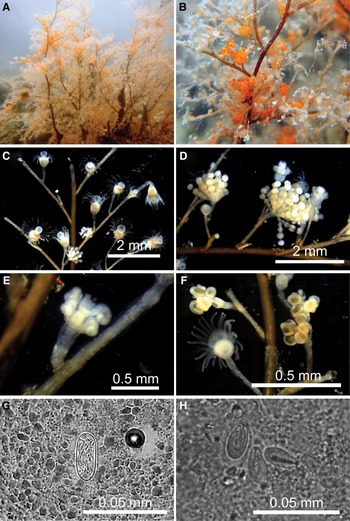
(Figure 2)
Eudendrium ramosum: McCrady, 1859; A. Agassiz, 1865; Fraser, 1912
Eudendrium carneum Clarke, 1882
Eudendrium cunninghami: Kirkpatrick, 1910
MATERIAL EXAMINED
BNHS-HY-GJ-0019.
DESCRIPTION
Hydroids located primarily in upper and mid-littoral zones of coral reefs, with some found in shallow rock pools. Colonies bushy, up to 10 cm high arising from a creeping hydrorhiza.
Hydrocaulus erect, polysiphonic, branched; hydrocladia alternate, irregularly branched (Figure 2C), usually smooth but sometimes annulated at base; pedicels annulated. Hydranths urn-shaped, with a single whorl of about 21–24 filiform tentacles; hypostome large, knob-shaped. Colonies reddish-orange in colour (Figure 2A).
Eudendrium carneum Clarke, 1882: (A) colony; (B) female gonophores; (C) hydrocladial arrangement, after preservation; (D) male gonophores; (E&F) female gonophores; (G) heterotrichous anisorhiza; (H) heterotrichous microbasic eurytele. Scale bars: C, D, 2 mm; E, F, 0.5 mm; G, H, 0.05 mm.

Hydroids fertile, with male and female gonophores on different colonies (Vervoort, Reference Vervoort1968); gonophores fixed sporosacs. Male gonophores with 3–4 bulbous chambers in a linear series (Figure 2D), borne on short pedicels arising from a reduced hydranth on annulated pedicel; spadix of female gonophore bifid, curving over a single egg (Figure 2E, F); orange when alive, fading to yellow after preservation.
Nematocysts: two types of nematocysts were observed. Some nematocysts were undischarged and some were partially discharged (Figure 2G, H).
-
1. Heterotrichous microbasic euryteles in hydranth (8.40 µm–9.37 µm × 3.83 µm–4.56 µm);
-
2. Heterotrichous anisorhizas in male gonophores (24.1 µm–26.6 µm × 10.7 µm–12.6 µm).
EXTRALIMITAL DISTRIBUTION
This species is known from the Atlantic coast of North America (Fraser, Reference Fraser1944), Pacific coast of North America (Fraser, Reference Fraser1948), South Africa (Millard, Reference Millard1975), Bermuda (Calder, Reference Calder1988; Marques et al., Reference Marques, Mergner, Höinghaus, Santos and Vervoort2000) and Brazil (Marques, Reference Marques1993; Kelmo & de Santa Isabel, Reference Kelmo and de Santa Isabel1998). Generally it is circumglobal in tropical and temperate waters (Schuchert, Reference Schuchert2008; Calder, Reference Calder2010).
ACKNOWLEDGEMENTS
The authors are grateful to the Ministry of Environment and Forests, Government of India for providing financial support under AICOPTAX. We are thankful to the Department of Forest and Environment, Government of Gujarat and especially to Mr Pradeep Khanna, IFS PCCF for their cooperation in obtaining the necessary permissions to visit the Marine National Park. We are thankful to Mr Kamboj, IFS CCF & Director and Mr P.H. Sata, Dy C F, who were very supportive regarding permissions. They also provided encouragement and useful suggestions as and when required.
The authors thank the Director of Bombay Natural History Society for his unstinting support for the studies. We acknowledge Ms Amruta Prasade, Mr Bhavik Patel and Mr Rajesh Parmar for their contribution during field expeditions. We are very grateful to Mr Vishal Bhave for the preparation of maps and plates. We take this opportunity to thank two anonymous referees for valuable comments and editorial inputs.