Introduction
Injury is the fourth leading cause of global death; the World Health Organization estimates a further 40% increase in trauma deaths by 2030. Almost 90% of injury deaths occur in low- and middle-income countries.Reference Wisborg, Montshiva and Mock1 Each year, more than 5 million deaths and more than 100 million disabilities are related to injuries. Injury is the first cause of years of life lost (YLL) in developing countries such as Iran. According to a burden of diseases and injuries study, 28% of YLL in Iran are attributed to injuries.Reference Naghavi, Abolhassani and Pourmalek2, Reference Naghavi and Jafari3
Emergency Medical Technicians (EMTs) are trained to provide Basic Life Support (BLS) to trauma patients and EMT paramedics provide Advanced Life Support (ALS) interventions such as intravenous fluid therapy and endotracheal intubation.Reference Modaghegh, Roudsari and Sajadehchi4, Reference Roudsari, Nathens and Arreola-Risa5 Improvements in prehospital trauma care might decrease trauma mortality during the first few hours after injury by preventing irreversible changes that could otherwise lead to death. Prehospital care might also decrease long-term mortality and morbidity from trauma.Reference Demetriades, Kimbrell and Salim6, Reference Sasser, Varghese, Kellermann and Lormand7
At present, 40% of Iranian trauma patients are transported to a hospital by Emergency Medical Services (EMS).Reference Fazel, Fakharian, Mahdian, Mohammadzadeh, Salehfard and Ramezani8 It has been reported that 60% of deaths from trauma in Iran occur at the accident scene or on the way to the hospital.Reference Naghavi, Jaafari and Alaeddini9
The objective of this study was to determine the effect of prehospital response times and ALS interventions for trauma patients transported to a single Iranian trauma center.
Methods
This was a retrospective, cross-sectional study conducted at a major trauma center in the central part of Iran that treats approximately 9,000 trauma cases a year. All trauma patients above the age of 14 years admitted from April 2010 through March 2011 were included in the study. Trauma patients enrolled in the study were transported by EMS and hospitalized more than 24 hours. Excluded from the study were patients transferred from other hospitals, and those who were not transported by EMS. Patients without vital signs on arrival also were excluded. Burn category patients and those discharged from the hospital in less than 24 hours were excluded. ALS interventions of interest included endotracheal intubation, insertion of intravenous lines and administration of medications and fluids.
The study received approval by the Ethics Board of the Trauma Research Division of the study center and the requirement for informed consent was waived.
Data were retrieved from the trauma research center data bank and EMS trauma admission forms. A standardized questionnaire designed by the Ministry of Health and Medical Education in Iran was used in this study. Data recorded in the questionnaire included demographic information including name, sex and age, disease or external cause of injury, as well as information about time of services including time of emergency call, time of ambulance departure to the scene, time of arrival at the scene, time of patients’ transportation, and time of arrival at hospital. Also included was geographical location of the injury scene (in cities or on interurban roads), as well as distance covered by the ambulance from the depot to the accident location, from the accident scene to the hospital, and return from hospital to depot.
Emergency Medical Services ambulance personnel record standard information about patients or injury victims transported. Data collected by EMS personnel were entered by a trained data technician into a central computer located at the ambulance site dispatch center. Demographic and injury characteristics were obtained, including patient demographics, place of accident, damaged organs, injury mechanism, injury severity score (Revised Trauma Score), prehospital times (response, scene, transport), prehospital interventions and in-hospital outcome. The principle measure of patient outcome was in-hospital death. The prehospital times were defined as the total sum of dispatch to hospital arrival time that included: response interval (time from alarm activation to arrival of first responding vehicle on the scene), on-scene interval (time arrival of first EMS responding vehicle on the scene until leaving the scene) and transport interval (time leaving the scene to vehicle arrival to the hospital).
Variables were expressed as number of cases and percentage for categorical data and as means with standard deviations for numerical data. The prehospital times and interventions were set as independent variables. Dependent variables were the classification into the groups of survivors or nonsurvivors. Associations were analyzed using Chi-square tests. Odds ratios and their corresponding 95% confidence intervals were used to compare data in survivors and nonsurvivors. SPSS version 13.00 (SPSS Inc, Chicago, Illinois USA) was used for data analysis. A P value < .05 was considered significant.
Results
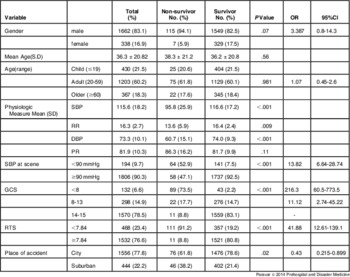
Two thousand patients met the inclusion criteria from April 2010 through March 2011. The average age of patients was 36.3(SD = 20.8) years (range 14-94 years) and most were male (83.1%). Thirty-six percent (n = 720) of trauma cases occurred between noon and 6:00 pm. The mechanisms of injury were motor vehicle accidents (MVAs) in 85.4%, falling in 11.9%, and others (2.7%). Upper and lower extremities were mostly commonly injured (51.1%), as well as the head and neck (48.7%). The mean systolic blood pressure of all patients was 115.6 (SD = 18.22) mmHg. Four hundred and thirty cases (21.5%) had Glasgow Coma Score (GCS) <13. There were 1,532 cases (76.6%) involving a Revised Trauma Score (RTS) ≥ 7.84 (Table 1). The mean RTS for all patients was 7.48 (SD = -0.83). The mean length of hospital stay was 5.4 days (range 2-52).
Characteristics of Study Patients

Abbreviations: DBP, diastolic blood pressure; GCS, Glascow Coma Score; PR, pulse rate; RR, respiration rate; RTS, Revised Trauma Score; SBP, systolic blood pressure.
One hundred and twenty patients (6.1%) died during hospitalization. Fifty-three percent of patients who died were hypotensive (SBP <90 mmHg) at the scene, while only 7.5% of patients who survived had SBP <90 mmHg. The risk of dying in patients with SBP <90 mmHg at the scene of the accident was 13.81 (OR = 13.81; 95% CI, 6.64-28.74). There was a significant relation between SBP <90 mmHg at the scene and mortality (P = .001). Seventy-three percent of those dying had head injuries with GCS <8 (P = .001). Patients with severe head trauma (GCS <8) were more likely to die (OR = 216.3; 95% CI, 60.5-773.5). The mean RTS for survivors and nonsurvivors was 7.6 (SD = 0.55) and 5.2 (SD = 1.6), respectively. The adjusted odds ratio for RTS between the survivors and nonsurvivors was 41.88 (OR = 41.88; 95% CI, 12.61-139.1) (Table 1).
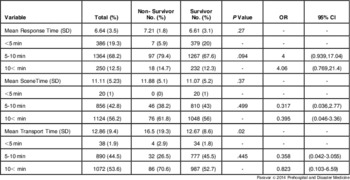
The mean response time, at scene time, and transport time in all patients were 6.6 (SD = 3), 11.1(SD = 5.2), and 12.8(SD = 9.4) respectively. There was a significant relation between transport time and survival outcome (P = .02). Transport time >10 minutes was associated with a trend toward mortality (OR: 0.8; 95% CI, 0.1 -6.59). Table 2 shows prehospital time for survivors and nonsurvivors.
Prehospital Time (minutes)

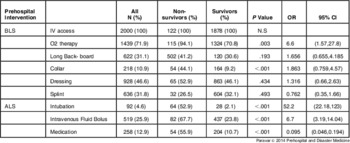
Six hundred and seventy-four patients (33.7%) received ALS intervention in addition to BLS. Patients who received ALS had more severe injuries and ALS intervention was associated with longer on-scene and transport times. Ninety- two patients underwent airway intubation (4.6%). Intubation was performed on 67.4% of patients with severe head trauma and on 70.4% of those with respiratory disorders (RR >30/min or RR <9/min). Table 3 shows prehospital interventions. Forty-four percent of patients in outlying suburban areas who received ALS interventions survived. There was a positive association for survival when ALS interventions were applied in outlying suburban areas (P = .001).
Prehospital Interventions

Abbreviations: ALS, Advanced Life Support; BLS, Basic Life Support; NS, not significant.
Limitations
An important potential limitation is that this study was retrospectively designed. Use of a pre-existing database that may not have been validated could have caused potential confounding and undetected bias in results. Missing and inappropriate coding of original data elements entered into the study databases may have skewed results. This study was conducted at a single trauma center in Iran and the results may lack external validity.
Discussion
Outcome following injury is affected by the magnitude of injuries, the early care at the scene and transport to the hospital. Prehospital trauma care includes out-of-hospital trauma care providers, trauma information systems, and transport and communication systems.10 Prehospital trauma care providers provide out-of-hospital care for trauma patients using either basic life support (BLS) or ALS techniques to stabilize and prepare a patient for transport to the hospital. BLS (or “scoop and run”) consists of non-invasive interventions such as wound dressing, immobilization, fracture splinting, oxygen administration, and non-invasive cardiopulmonary resuscitation. Advanced Life Support encompasses all of these BLS techniques in addition to invasive procedures, including intubation, initiation of IV access with fluid replacement, administration of medications, and, in rare cases, application of pneumatic anti-shock garments.
Although The American College of Surgeons strongly encourages rapid transport to a trauma center and minimization of on-scene time for trauma patients,11 some studies have shown that the systematic implementation of prehospital ALS decreases mortality and morbidity among major trauma victims.Reference Bøtker, Bakke and Christensen12 Generally, in this study, ALS interventions were applied more often for severely injured patients who had a higher mortality, but when considering ALS intervention with longer transport times (out of city roads and suburban locations), ALS was associated with positive trauma survival trends . According to the National Association of Emergency Medical Technicians (US), ALS interventions such as intubation that require more time to be performed in locations with longer transport times may be more beneficial than no intubation.13
Most developed and some developing countries have well-organized emergency response systems including prehospital care, with response time, scene time, and transport time in trauma cases being relatively short and usually in minutes.Reference Ringburg, Spanjersberg and Frankema14–Reference Carr, Brachet and David16 In Iran, the prehospital transportation time is within an accepted range and an organized emergency response system is available in every major city and on every major road and such services can provide timely care in the trauma setting.
The relationship between duration of scene time and outcome in trauma is still unclear. The finding of this study was that scene time was not associated with increased mortality rate. It seems that scene interventions by trained personnel are an accepted option for the Iranian EMS system. A study to evaluate the potential effect of transport times on outcome in trauma showed that longer transport time is associated with a poor outcome.Reference Newgard, Schmicker and Hedges17 However, Sloan et alReference Sloan, Callahan and Duda18 found that although transport times to trauma centers were longer for patients bypassing other local facilities, longer transport times were not associated with adverse outcomes. Response and transport time intervals are affected by road traffic and sociocultural aspects of a community. Scene time appears to be most likely the only interval for early adjustment to affect outcome for patients with severe head trauma and those with profound hypotension. This has been shown by a Stiell et alReference Stiell, Nesbitt and Pickett19 who found that during the ALS phase, mortality was greater among patients with GCS <9. However, Newgard et al failed to demonstrate a relationship between shorter out-of-hospital time and outcome.Reference Newgard, Schmicker and Hedges17 It is possible that other factors such as unmeasured confounders and heterogeneity in the populations preclude the ability to compare the results of studies. In- hospital care and management vary among centers, and outcome may be attributed to in-hospital variables.
Conclusion
This study showed that for an Iranian Trauma Center, in-hospital mortality was more common for patients with severe injuries and a long prehospital transport times. While more severely injured patients received ALS interventions and died, these interventions were associated with positive survival trends when conducted in suburban and out-of-city road locations with long transport times.