Introduction
Readers familiar with the history of Cultural Studies will detect an oblique reference to one of its founding scholars, Richard Hoggart, in the title of this article. This was not arrived at by accident. Hoggart's The Uses of Literacy (Reference Hoggart1957) has achieved iconic status and in this respect the argument I set out here cannot help but be influenced by the interdisciplinary approach of Cultural Studies and by Hoggart's insistence, albeit arguably a romanticised one, on attributing value to working-class cultural practices.
Hoggart's legacy is relevant to the argument I wish to make in another sense: his experience as a scholarship boy of the post-war era. In Hoggart's account of his acquisition of educational capital he captures the ambiguities that self-reinvention – often a necessary survival strategy in the educational sphere for working-class boys – gives rise to.Footnote 1 To quote Hoggart,
He [scholarship boy] both wants to go back and yet thinks he has gone beyond his class, feels himself weighted with knowledge of his own and their situation, which hereafter forbids him the simpler pleasures of his father and mother. And this is only one of his temptations to self-dramatisation. (Hoggart, quoted in Segal Reference Segal, Chapman and Rutherford1988, p. 83)
Lynne Segal (Reference Segal, Chapman and Rutherford1988) has read Hoggart's references to self-consciousness as emblematic of the rise of the ‘angry young man’ of the 1950s. For Segal, the frustrations of these working-class aspirants can be read through the prism of sexual relations. They are young men, often from working- or lower-middle-class households, who project onto women their frustration at not being able to rise as quickly as they would like through the classed ranks of British society. Their repressed rage at the stifling effects of the class structure is displaced onto women.
While Segal's hypothesis is persuasive, I want to consider the question of the relation between resentment and mobility in a slightly different context, but one that still wishes to make sense of social mobility via an engagement with questions of masculinity, education and gender identity. In this article I examine how these categories are negotiated and made sense of via the consumption of popular music.
I propose that a particular formation in the history of British popular music – glam rock – can be viewed not only as a moment in which essentialist ideas about male gendered identity were rendered problematic, but also as a moment in which this destabilising of normative codes of masculinity helps explain how social mobility was negotiated by working-class male youth at this historical moment. It is my contention, then, that one of glam's political legacies is its facilitation of the expression of difference – or a need, as Hoggart articulates it, for self-dramatisation – by an educationally aspirant section of the male working-class, which identified with the self-conscious performance of a more feminised masculinity it located in this cultural formation.
Before I explore this reading, it would be apposite to summarise briefly the established reading of glam that I have alluded to. Taylor and Wall (Reference Taylor, Wall, Mungham and Pearson1976) are the first to deal explicitly with glam and they argued that its commercial packaging was indicative of the decline of counter-cultural politics: a return to the show business values and artifice of the 1950s after the radicalism of the 1960s. Dick Hebdige (Reference Hebdige1979) adopted a contrary view and in doing so anticipated much contemporary analysis of identity politics when he proposed that David Bowie, as glam's chief orchestrator, did incorporate an alternative politics, albeit a nihilistic and obliquely racist one, in his foregrounding of the artificial construction of identity. As he contends, ‘[Bowie's] entire aesthetic was predicated upon a deliberate avoidance of the “real” world and the prosaic language in which that world was habitually described, experienced and reproduced’ (Hebdige Reference Hebdige1979, p. 61).
This reading of glam – as politically subversive in its anti-foundationalist ontology – has been repeated more or less unproblematically ever since. Philip Auslander's (Reference Auslander2006) monograph on glam, for example, suggests that its self-consciously theatrical approach to performance, which challenged the prevailing narrative of authenticity in rock music, was its most interesting feature. One of Auslander's significant points of departure from Hebdige is to contest the latter's division between the art school end of glam (Bowie, Roxy Music, Sparks and Cockney Rebel) and the more ‘manufactured’ acts such as the Sweet, Slade, Mud and, lying somewhere in between, Marc Bolan's T.Rex.
Hebdige categorised this division as one between ‘mainstream glitter bands’ and ‘more esoteric artists’ (Hebdige Reference Hebdige1979, p. 62) but Auslander (Reference Auslander2006) has argued that this dichotomy is problematic in that it falls prey to clichéd binary oppositions. He proposes that it would be a critical mistake to identify distinctions between ‘high’ and ‘low’ glam, when none occurred in practice: all glam artists were fundamentally beholden to the commercial demands of the industry they operated within (Auslander Reference Auslander2006, p. 52).
While I would not wish to argue per se against this point in respect of the avaricious drive for popularity by glam artists, the research I undertook for this article regarding the relationship between glam and its working-class fans suggests that the division Hebdige identifies does make sense when one shifts the focus away from commercial distinctions onto the competing aesthetic positions taken up by art school glam artists and their fans on the one hand and what I will subsequently refer to as rock’n’ roll glam artists and their fans on the other.
Accepting that this demarcation cannot entirely evade Auslander's charge of binarism, my research data nonetheless reveal that the appeal of art school glam lay in its rejection of an aesthetic in which the corporeal experience of music is privileged. Bourdieu et al.'s (Reference Bourdieu1990) mapping of aesthetics in class terms is instructive here. In their work on how a particular aesthetic sensibility historically came to define photography as a middle-brow art form, the authors point to how the application of aesthetic judgement is, in fact, exercised in relation to all practices, even those functional ones that are not accorded artistic status and thus are rendered largely invisible in middle-class discourses on art appreciation. Thus a working-class aesthetic may be defined as functional rather than aestheticist but isn't any less complex because of that distinction. As Bourdieu argues,
The most banal tasks always include actions which owe nothing to the pure and simple quest for efficiency, and the actions most directly geared towards practical ends may elicit aesthetic judgements, inasmuch as the means of attaining desired ends can always be the object of a specific valuation: there are beautiful ways of ploughing or trimming a hedge, just as there are beautiful mathematical solutions or beautiful rugby manoeuvres. Thus, most of society can be excluded from the universe of legitimate culture without being excluded from the universe of aesthetics. (Bourdieu et al. Reference Bourdieu, Boltanski, Castel, Chamboredon and Schnapper1990, pp. 7–8)
This conceptual mapping of aesthetics allows us to theorise why the music produced by Slade, the Sweet and Mud, for example, largely failed to appeal to the younger selves of the working-class men in my study. In their youth they rejected this strain of glam because, as I go on to argue below, in their view it lacked artistic merit. Further, they equated it with a particular code of masculinity, which they associated with their educationally less privileged, and therefore ‘unmodern’, peers. These fans devalued rock ’n’ roll glam because it did not aspire to the status they attributed to art school glam, which they read, in aesthetic terms, as promoting complex, creative ideas. Bowie and Roxy Music – as examples of the latter category – were perceived to be more artistically challenging: their output required critical distance in order to be appreciated. And it was this distance which imbued these artists with an artistic self-importance that in turn increased their claims for distinction. In so doing, art school glam positioned itself at the summit of the hierarchy of taste that I have attributed to glam rock's two distinct factions.
Before I draw on the accounts presented by my interviewees, I will provide a brief textual reading of the music produced by some of glam's key artists in order to illustrate this argument.Footnote 2
Glam music: the return of pop?
For some writers (Hoskyns Reference Hoskyns1998; Savage Reference Savage1998), glam has been understood as a reaction against the popular music genres and movements that immediately preceded it: against the seriousness and snobbishness of the album-orientated rock artists of the late 1960s and against the sincerity and claims for authenticity of the early 1970s singer/songwriters. This view of glam, as a youthful antidote to aloofness, distance and introspection, was picked up on by Nick Logan as early as February 1972, when he noted,
Lately we've had the T.Rex, Faces and Slade mini phenomena … I've lumped these three together for other reasons … all three have tapped a considerable hunk of the public that has hitherto either been catered for by the excesses of the 20-minute album trackers, or, more simply, been at school up to now. In the latter case, these are the kids getting their first influential taste of rock music: the young brothers and sisters of Stones, Dylan and even Zeppelin fans; the kids who haven't been programmed by the ‘accepted’ norms of snob rock behaviour. (Logan Reference Logan1972, pp.15–16)
I want to suggest that the music created by the key proponents of glam did, for the most part, capture this sense of immediacy. In this sense glam's stars were returning to the pop values of the late 1950s and early 1960s, even if some dressed like galactic androgynes on a mission to free their audiences from the drudgery and monotony of working-class life. Therefore, as Auslander notes (Reference Auslander2006, pp. 50–51), the music of glam was for the most part lacking in innovation. This explains, perhaps, its commercial appeal.Footnote 3
Artists and artisans: glam factions
The following singles all reached either number one or two in the official British music charts between 1972 and 1974: Slade's ‘Cum on Feel the Noize’ (Polydor, Reference Slade1973); T.Rex's ‘Metal Guru’ (MARC, Reference Rex1972); the Sweet's ‘Blockbuster’ (RCA, 1972); Bowie's ‘The Jean Genie’ (RCA, 1972); Gary Glitter's ‘Rock-n-Roll parts 1 and 2′ (Bell, Reference Gary1972) and Mud's ‘Tiger Feet’ (RAK, Reference Mud1973). There are various music motifs linking these songs, which suggest glam's penchant for immediacy. The rhythm of each track is dictated by the drums, which are used to create an urgency and sense of excitement, achieved by the use of floor tom-toms in preference to cymbals. The treble on the lead guitar is often pitched high, while repetitive handclaps and vocal chanting are incorporated. The overall effect, most evident in ‘Cum on Feel the Noize’ and ‘Metal Guru’, is a Phil Spector-like wall of sound in which reverberation is used on backing vocals to create an almost overpowering presence. But if this version of glam revelled in its immediacy and repetitiveness, it wasn't the only version.
At the polar opposite, residing in what might arguably be referred to as the progressive rock end of glam, Roxy Music, in keeping with the aestheticist aesthetic they had aligned themselves with, nurtured an altogether more multi-layered sound in which a vaster range of instruments were made use of.Footnote 4 Andy Mackay's training as a classical musician meant that the band were able to utilise his expertise, with an oboe part being incorporated in the introduction to ‘Ladytron’ (from Roxy Music, Island, Reference Roxy1972). In the same album's track, ‘Re-make Re-model’, the band's relative musical virtuosity is both displayed and mocked with each player performing a solo as a kind of affectionate parody of the big band era. What is important here is that band and audience ‘get the joke’ with critical distance being favoured over wall of noise immediacy, knowledge over sensation. The same is true of the instrumental interlude during ‘Grey Lagoons’ (For Your Pleasure) in which a treated harmonica solo acts as a bridge between the song's changing tempos. Brian Eno's manipulation of Roxy Music's sound via tape machines and treated synthesisers meant that the sonic effect was far from the foot stomping of Slade and others. ‘Beauty Queen’ and ‘In Every Dream Home a Heartache’, both from Roxy Music's second album (For Your Pleasure, Island, Reference Roxy1973), receive Brian Eno synthesiser treatments that endow them with an eerie sonic quality.
Yet while I am seeking to argue that Roxy Music's sound was indeed a self-consciously complex one, it would be misleading to suggest that this idea, as a principle of their existence, came ready formed. Rather, the idea of distancing themselves from the authoritative musical styles of the day – of which blues-derived rock music was the most visible – was as much to do with insecurity as with mission statements. As Mackay notes when commenting on the creation of Roxy Music's sound,
It was much more a kind of survival thing. I wasn't a rock musician from my teens. Whereas I could see 18-year olds playing blues guitar in bands. I suppose that made me feel slightly insecure. That's why we mixed genres … [so] we won't get accused of not being able to play. We had a lot of ideas to throw in the pot. Bryan Ferry listened to music I was totally unaware of … jazz … La Monte Young. (Mackay, interview with the author, 2009)
In between the melodic, rhythmic rock of Slade and others, and the avant-garde posturing of Roxy Music, another strain of glam music can be discerned: the music produced by glam-era Bowie, Sparks, Cockney Rebel, Queen and Wizzard steered a middle course in which familiar melodies and conventional verse/chorus structures were utilised alongside stylistic deviations, or what might be identified pejoratively as ‘calculated mutations’, which lay claim to the ‘pretence of individualism’ (Adorno Reference Adorno and Bernstein1991, p. 35; Adorno and Horkheimer Reference Adorno and Horkheimer1997, p. 129). Thus, Bowie's ‘Starman’ (RCA, Reference Roxy1972) shares melodic similarities with the Judy Garland standard, ‘Over the Rainbow’, and Cockney Rebel's ‘Make Me Smile (Come Up and See Me)’ (EMI, 1975) includes a vocal refrain that is one of pop's most familiar. Meanwhile Bowie's track ‘Aladdin Sane’ (from the album, Aladdin Sane, RCA, Reference Roxy1973) incorporates a piano part provided by the classically trained avant-garde musician Mike Garson, and Sparks dispense with a chorus and incorporate extraneous sounds in their biggest glam hit, ‘This Town Ain't Big Enough for Both of Us’ (Island, Reference Sparks1974).
Notwithstanding important areas of overlap, then, the application of contrasting aesthetic sensibilities can be located in glam's two factions: musical innovation (art school glam) is set against a return to pre-psychedelic, rhythm-and-blues- inspired rock (rock ’n’ roll glam). In the remainder of this article I explore what appeal these competing aesthetic positions held for divergent sections of British working-class youth in the early 1970s. I thus consider how the purchase of educational capital leads to both a desire for social distinction and the embracing of a more feminised masculinity.
Likely lads and ‘ear'oles’: working-class masculinities
Perhaps the most influential scholarly study of British working-class male youth in the 1970s is Paul Willis’ account (Reference Willis1977). I do not need to retrace Willis’ argument here but I do want to recall the distinction Willis’ lads made between themselves and the ‘ear'oles’, a division that Willis himself hardly refuted at the time of publication. Indeed, when invited some 30 years later to reflect on his fieldwork with ‘the lads’, Willis’ recollections are illuminative in respect of the gendering of educational experience. He describes how as a schoolboy himself he excelled at rugby, a very masculine form of sport. Here we might speculate that Willis displayed an unconscious desire to reproduce the masculinity of his father, a building inspector by trade, and in Willis’ own words, the patriarch of a family unit, which conveyed a ‘very masculine ambience’. A particular version of masculinity is being valued here. And Willis is surely right to suggest in Learning to Labour that this type of masculinity – hard, physical, emotionally restrained – was the predominant form of masculine identity valued in working-class cultures during this period. But as Willis’ own success as a ‘scholarship boy’ indicates, other more feminised masculinities were also in play. He observes that while he undertook science subjects at A level, in line with many of his rugby-playing peers, he contemporaneously immersed himself in the arts, particularly poetry – a subject, he goes on to note, that it was ‘definitely sissy to be interested in’ (Mills and Gibb Reference Mills, Gibb, Dolby, Dimitriadis and Willis2004, p. 200).
While such labelling of youth is clearly problematic – the complexity of human experience is erased when individuals are categorised as either ‘lads’ or ‘ear-’oles’ – there is a sense in which the social and cultural experiences of the latter group have been neglected in the sociological imagination. These are, after all, like Hoggart and Raymond Williams before them, studious working-class youths who typically attended either grammar schools or the newly formed comprehensives. In the latter sector they were often streamed in respect of academic achievement after their first year of study.
It is the aspirations and values of this category of male working-class youth that I wish to draw attention to in this article. In particular I want to focus on how these youth remodelled their self-identity through an engagement with glam rock and how such engagement was affectively experienced. My contention is that this group resisted the overwhelmingly negative representation of working-class masculinity that they were confronted with. I therefore want to accept Leon Hunt's account of how working-class subjects during the early 1970s were usually represented in popular culture as essentially unmodern. They are portrayed as either blissfully impervious to the radical discourses of the late 1960s or as seeing in the permissive age only opportunities for sexual adventure (Hunt Reference Hunt1998).
In order to interrogate this reading of glam in relation to its working-class male audience, I carried out a fieldwork study between 2006 and 2009 in which I interviewed a number of men who identified themselves as fans in the early 1970s. This study was necessary given the paucity of scholarly literature available on glam fandom.Footnote 5 The self-narrated accounts it elicited, which I draw on below, suggest that, in contrast to the ‘unmodern’ representation of working-class masculinity alluded to by Hunt, a more socially mobile, modern self-identity was valued by my interviewees. First, I outline the methodological approach I adopted in the study.
Research methodology: valuing experience
The success of my study depended on recruiting a sufficient number of participants and negotiating the conceptual problem of how to make sense of their testimonies concerning their experiences in the early 1970s. This meant recognising, for example, that such accounts always run the risk of both lapsing into an under-theorised romanticism and failing to acknowledge the mediated role memory plays.
In order to maximise the number of respondents, I placed an advertisement in Record Collector, a monthly music periodical available nationwide, which regularly incorporates features on historical popular music formations and attracts a readership whose age is broadly commensurate with that of my interviewees. I also contacted several fan-based websites and secured a number of interviews via a contact at Universal Records. I interviewed a total of 29 fans in addition to several musicians, writers and artists whose work connects in some way to glam rock. I made initial contact by phone where possible and in most cases I was able to follow this up with email exchanges and interviews in person. A questionnaire was sent to all respondents in the first instance.
I employed an interpretative phenomenological analysis method when conducting the interviews and comprehending the resulting transcripts. This qualitative approach allowed me to account for each interviewee's testimony as a unique self-reflexive examination of their lived experience, without losing sight of the structuring influences of class and gender. In order to ensure the anonymity of my interviewees I allocated a pseudonym to each.
Finally, in terms of establishing the class status of my interviewees, both in the 1970s and now – a task central to the success of my study – the questionnaire requested information regarding their educational and employment histories, family structure and leisure interests in the 1970s as well as the appeal of glam rock itself. Upon receipt of the questionnaire, I clarified where necessary the former and current class status during the interview process. Of the 29 people interviewed, 25 identified themselves as working class in the 1970s and the remaining four as middle class; categorisations which were supported by the data provided in the returned questionnaires. In respect of how my interviewees defined their class status now, the picture is more complex as my subsequent analysis attests: class is read as a contingent category, open to negotiation, depending on the audience being addressed. Only 10 of my interviewees during the course of our exchanges described themselves now as unproblematically middle class.Footnote 6
Audience reception: glam and its working-class male fans
The presentation of my interview data in this section is thematic. I start by exploring the appeal of glam rock for my interviewees and, as a consequence of their responses, examine why they prioritised the visual elements of glam. I then link these findings to glam's disrupting of gender norms and argue that such analysis must be understood through the filter of social class. Here I discuss the emphasis on securing educational capital for my interviewees and assess how they read this as a necessary survival strategy in their dialogic relationship with their less scholastically aspirant peers. At this point I explore how the educational experiences of my interviewees are in many ways echoed in the experiences of glam artists themselves. I then argue that the acquisition of educational capital and the resulting preoccupation with demonstrating it through the display of cultural capital raises important questions about how identities in transition are negotiated and self-regulated. Finally, I discuss why my interviewees subordinated their corporeal responses to glam in their accounts.
In undertaking this thematic approach I draw primarily on the theories of Pierre Bourdieu, as his work draws attention to the structural inequalities of class and how it is internalised by subjects through learnt dispositions. I also derive inspiration from Bourdieu's insistence on drawing on the strengths of phenomenology in accounting for working-class lives; his attention to the role of social status in motivating cultural preferences offers the most suitable theoretical framework. In this respect my position shares some similarities to that adopted by Sarah Thornton (Reference Thornton1995) in her ground-breaking critique of club cultures but, unlike her, I wish to retain Bourdieu's emphasis on the stratification of social classes and explore more critically the psychological effect acquiring cultural capital has on working-class subjects.
The appeal of glam
The initial responses to the early glam hits by the fans I interviewed focus very much on glam's perceived newness. This is typified by Steve's comment that, ‘when Bolan sang ‘Hot Love’ on TOTP it was like a thunderbolt. I mean, the colours and everything. It all seemed so bright and modern … like nothing that had happened before I suppose’ (Steve, 2007). Glam also marked for them a more self-conscious approach to the making and performing of popular music, as John's recollection makes clear, ‘Bowie was so “knowing” and we knew this even then … especially when he was being interviewed … saying things like he was a plastic pop star and stuff like that … he was so ahead of his time …’ (John, 2007).
Indeed, what is especially significant about the recollections of my interviewees is the central focus they place on glam as a visual phenomenon. This point is illustrated by Gavin's comment that, ‘Everyone goes on about it now but for me, as a thirteen year old, seeing T.Rex on the telly was a major revelation. I'd never seen anything like him in my life. It was just so new and exciting’ (Gavin, 2006).
Dandies in the underworld: glam and gender
It is the degree to which my interviewees invested emotionally in glam's attention to self-image which registered most forcefully during my fieldwork. More specifically, they were attracted to the deconstruction of gender identity by stars such as Bowie and Bolan. As Tom's account suggests, glam's visual appeal lay in its rejection of a traditional code of masculine attire, in favour of a more camp visual androgyny. It was a look which appealed to fans even if they felt unable to emulate it, ‘those TOTP performances were great: Bolan with his glitter and Bowie wearing those weird costumes. I loved all that. Never would have been seen dead in it myself mind’ (Tom, 2007).
The question of what constitutes masculinity was never directly invoked by any of my interviewees in response to questions about glam's appeal and yet frequently it became a focal point whereby the androgyny of glam was constantly framed within a broader discussion, in which the parameters of a normative male sexuality were reasserted. Tom, for example, read my reference to the visualisation of this androgyny by some glam artists as an opportunity to reassert his heterosexuality, thus wrongly conflating the performance of masculinity with sexual orientation,
I mean, they [glam stars] looked great but none of us were gay or anything … they [Bolan and Bowie] had loads of girlfriends so I personally think the whole gay thing was just a marketing scam. (Tom, 2007)
Children of the revolution: masculinity, class and educational capital
In many cases masculinity was referenced obliquely through the filter of class antagonisms: one of the attractions of glam was the idea of ‘glamour’ itself, which was viewed as synonymous with sophistication, as a way of distinguishing oneself from others,
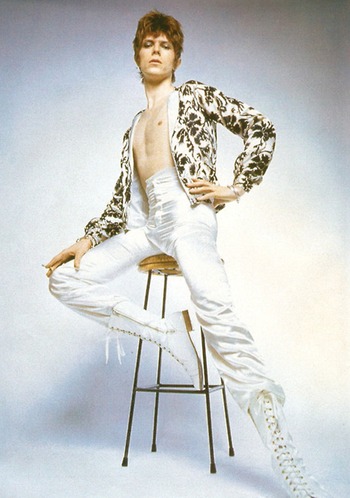
Me and a couple of friends used to get hassle in the playground … Oh, he likes that queer bloke [Bowie] … It was always the ones from the CSE classes that were doing the name-calling. We had streaming in our school and all the thick kids were weeded out pretty early on … as soon as we reached the sixth form we knew that it would be us that would succeed. … At that point liking Bowie became really cool. He just seemed really sophisticated. … I mean, that photo of him staring down sitting on a pedestal [Figure 1]. That was just so cool. (Adam, 2008)
David Bowie: working-class aspirant (Brian Ward, 1972).

I would argue that social distinctions are being articulated here via the performance of masculinity. Academically successful boys define themselves as socially superior – ‘we knew that it would be us that would succeed’ – in relation to the ‘thick kids’ for whom mocking perceived effeminacy in others, and displaying one's own physical prowess, seemed to be the only way of asserting authority, acquiring respect through association with a more traditional notion of working-class masculinity. This sense of social superiority was reinforced in my interviewees’ engagement with the educational curriculum itself. Through such engagement they were able to assert their educational capital, which they drew on as a source of pleasure in respect of their enthusiasm for glam. In James's account of being a glam fan, for example, the sense of scholastic satisfaction and competency he derived from decoding texts and familiarising himself with canonical authors in his English Literature classes finds echoes in the appeal glam held for him. ‘I can't begin to list all the people I got into through glam … I certainly wouldn't have read Genet or Burroughs or known who Richard Hamilton or Andy Warhol were if it wasn't for Bowie and Ferry’ (James, 2006).
For James, the idea of reading things on different levels is what appealed to him in his classes and thus he, ‘liked the fact that I understood references and things like that. Knowing that Jean Genie was a pun and who Twig the Wonder Kid was.Footnote 7 All that stuff’ (James, 2006).
This sense of fulfilment, achieved as a consequence of ‘getting’ the references, oblique or otherwise, was alluded to by a number of my interviewees, who identified a degree of satisfaction in their younger selves in making sense of the representations offered to them. They had begun the process of acquiring the aesthetic dispositions required to succeed. As James put it, ‘we were part of a club’ (James, 2006).
Just like you: glam's working-class artists
This remaking of an authentic masculinity in the light of educational experience was undertaken also by many of glam's stars and was often negotiated with a similar sense of ambivalence as that experienced by my interviewees. Bowie's negotiation of classed masculinities, for example, is highlighted in a revealing interview he gave following his first commercial success, ‘Space Oddity’ (Mercury, 1969). While being interviewed by Chris Welch for Melody Maker, he made the following pronouncements regarding his newly formed ‘Arts Lab’:
I run an arts lab which is my chief occupation … and I think it's the best in the country. There isn't one pseud involved. All the people are real – like labourers or bank clerks. … We've got a few greasers who come and a few skinheads, who are just as enthusiastic. I think a lot of skinheads are better than hippies and the hippie cult is so obviously middle-class and snobbish, which is why the skinheads don't like them. (Bowie, quoted in Welch Reference Welch1969, p. 22)
Bowie's concerns here – championing the creative potential of a formal arts environment as well as expressing a desire not to appear pretentious and out of touch with ‘real’ people – are entirely in keeping with the subtle shifts in habitus that his ambition necessitated. He is resentful of hippie culture's elitism but mindful of its cultural capital. This sense of feeling out of place was echoed in many of the comments made by my interviewees. Michael, for example, made reference in one exchange to the self-consciousness he felt when negotiating the boundaries of social class in respect of his extended working-class family:
… I'm the only one who went to college. … My wife's always telling me that I change my accent depending on whom I'm talking to … You know, dropping my ‘hs’ and adding a few ‘gor-blimeys’ when I'm with … family. My sister really mocked me. … She couldn't believe the airs and graces I was putting on. But the truth is I feel both versions of me are valid. When I'm feeling positive I see this as an asset but it also makes me feel insecure on the occasions when I feel that I don't quite belong anywhere. Mocked from above for my aspirations and despised from below for being aloof. (Michael, 2008)
Roxy Music's key members, Ferry, Eno and Mackay, immersed themselves, like Bolan and Bowie, in the counter-culture of the 1960s. However, it should be noted that the trio's engagement with it differed in important respects and this points to the influence of their educational trajectiories in shaping their aesthetic outlook: while all five individuals were from working-class backgrounds, Bolan and Bowie acquired only limited formal educations, with the former leaving a secondary modern school without qualifications and the latter acquring one O level, having attended technical college. Ferry, Eno and Mackay, on the other hand, all attended their local grammar school, having passed their 11-plus exam.
As Bracewell's (Reference Bracewell2007) cultural biography of Roxy Music notes, this meant that Ferry and Eno came under the influence of key pop artists such as Richard Hamilton and Mark Lancaster (at Newcastle) and Roy Ascott (at Ipswich), while Mackay's attendance at Reading meant that he was invariably mixing with art students studying on one of the few available fine art degree courses in Britain at the time which engaged with pop art ideas. As Mackay suggests, his journey from the then working-class district of Pimlico, London to Reading University, via the local grammar school, was symptomatic of the social upheavals of the 1960s:
The whole art school/liberal arts education side of things: my grammar school would have expected only a handful of us to have gone to university. The majority of people expected to leave with a decent education but go into something like … training in a chain of department stores or become engineers. More respectable jobs. Not to be too ambitious. But in the ‘60s … we assumed we would go to university and that we were going to carry on, not particularly learning anything. School didn't really cope with that. They didn't even suggest I went to university. (Mackay, interview with the author, 2009)
Mackay's arrival at Reading meant that, like Ferry and Eno, one consequence of his mobility was that he was mixing in more socially diverse circles in which, I would argue, he was able to reshape his habitus during the process of absorbing influences from different class strata. As he states,
Reading was when I encountered people from public schools. I'd never done before. Most of them were in the art department. I was amazed at this sophistication of the people who had been at Marlborough [College] or Bedales. One learnt quickly. One of the great things about the ’60s was … [young] people didn't look different [in class terms]. (Mackay, interview with the author, 2009)
Moreover, one medium in which this perceived blurring of social classes was played out was popular music, both in its construction and reception. As Mackay contends,
Rock-n-roll by then [mid-sixties] was something that was coming across. Bands like the Rolling Stones and the Who. They were clearly a mixture of working-class boys and grammar school. You suddenly realised that you could move [socially] pretty much where you wanted. Whereas five years before or two years before it would have been pretty difficult. And it would have been slightly posey for posh people to be in pop groups. I wasn't aware of any class distinctions really. (Mackay, interview with the author, 2009)
One of the effects of a grammar school and university education on working-class boys is to instil a sense of perceived social superiority and to encourage a full engagement with the rules of the game, as Bourdieu would articulate it, in order to reap the greatest rewards. Further, this process necessarily becomes naturalised, in order to render invisible the structures that frame it, so that the ‘rules’ aren't even acknowledged as such, hence, I would argue, Mackay's blurring of social classes and rejection of the visibility of class distinctions at Reading. This naturalisation of the acquisition of a new set of aesthetic dispositions is captured in one of my interviewees’ comments when he alludes to his appreciation of music: ‘I always had what you might call good taste. My choices have always been eclectic. It just comes naturally’ (Andy, 2006).
Even those who failed to gain access to these institutions were very well aware of their transformative role. As one of the interviewees in David Robins’ sociological account of disaffected youth, We Hate Humans (Reference Robins1984), comments: ‘at school I really tried hard to be better than I actually was. I was really disappointed when I failed my 11-plus. I ended up going to a secondary school, and I felt common and I felt cheap: common and cheap because I was taught that secondary school was no good – all the other kids off our council estate went there’ (Robins Reference Robins1984, p. 35). This sense of perceived failure was alluded to by Larry, one of my interviewees, when he spoke of the pressure he felt under to negotiate successfully the hierarchies embedded in supposedly comprehensive schools:
At the end of my second year I was identified as one of three kids who might drop down into the lower stream. … I managed to avoid the humiliation and after that bucked my ideas up a bit … I just remember thinking that if I went down to the lower class that'd be my life ruined. … (Larry, 2008)
Larry's candid revelation regarding his fear of educational failure contrasts with the accounts of educational experience proffered by glam's artists. Bryan Ferry's observations, for example, when recalling his motivations for studying at Newcastle University, imply a self-assuredness that belies his class background:
I think I have probably always been interested in elites. I remember when I left school very much wanting to go to university rather than art college – and at that time there was quite a difference. There were only about three universities you could go to, to study fine art, and you felt you were going to be with people who were more interested in the thought and theory of it. Whereas if you went to art school you'd be with people who were good at drawing rather than good at thinking. That's how it seemed to be. It was more difficult to get into university, but I suppose that you'd meet ‘a better class of person’. I guess I had a fairly elitist view of what I was interested in. So I suppose I've always been a bit stuck up. … (Ferry, quoted in Bracewell Reference Bracewell2007, p. 165)
For the son of a mineworker, these observations are revealing, even if one allows Ferry a degree of ironic detachment, itself a form of recuperation. They are illuminating not only in terms of the social aspiration they point to but also the degree to which Ferry very early on recognised the different capitals – understood in a Bourdieusian sense – that a university education bestows upon individuals.
If the accounts proffered by Mackay and Ferry on how they reworked their social identities in order to acquire mobility imply a seamless transition, my interviewees’ testimonies suggest that the attainment of educational capital and the attendant reshaping of masculinity produced a more pronounced sense of feeling ‘out of place’ during their youth and early adulthood. Not quite ‘belonging’, while emblematic of all lived experience in late modernity to varying degrees, emerged as a central theme in their accounts, best summed up by Michael's reference to his insecurity vis-à-vis his self-identity noted above.
Aladdin Sane: identities in transition
It is this sense of negotiating different forms of masculinity and the acquirement of educational capital that I want to explore a little further here. It is clear from my study that different forms of masculinity were being engaged with by my interviewees vis-à-vis the parameters of social class: firstly, in relation to distinctions between working-class and middle-class kids and, secondly, between different fractions within the working class itself. In undertaking this negotiation they tended to attribute essentialised characteristics to particular classed bodies in order to fix them, with the working-class male body signifying physical ‘hardness’ and the middle-class male body signifying physical frailty and, by association, femininity. Here I would propose that a Cartesian duality between body and mind is invoked unconsciously in order to racialise class fractions: modern working-class aspirants associate themselves with a conception of white identity in which the mind is privileged; this reading is shared, but denigrated, by working-class unmodern youth who are read, and read themselves, as defined by their physical prowess. But it is not clear that this process of reshaping their identities was ever fully resolved by many of my interviewees.
Thus not all of them shared the sense of self-assuredness that one might expect to flow from a self-identification with this modern, cognitively alert self. Indeed, it was invariably the interviewees who had travelled the furthest in social terms from their original class position who often felt an acute sense of anxiety, with the inscriptions of class never quite being relinquished. This is made clear in William's extended account:
… I do recall going for a social drink with a friend of mine from work and he was one of the few graduates who worked at our place … we were good friends and he took me along to one of his get-togethers with his old university friends. I didn't tell him this but I was incredibly nervous about meeting them. He was the only graduate I knew well and so they just seemed like such an exotic bunch of people. So self-assured and full of confidence … when we got there [the pub] I just literally froze. I couldn't speak … It got so bad that when a few of us went to the loo I couldn't even take a piss! I ended up making an excuse and left the pub. (William, 2008)
In registering the degree of social inferiority William felt, and experienced corporeally, it is possible to recognise how class distinctions operate. And this sense of inferiority is so marked, I would contend, because the desire to fit in, to join the club as it were, is so pronounced. William went on to say that, ‘in hindsight I think I was envious. They were everything I aspired to be’ (William, 2008). In William's account, the power to make judgements resides solely with the educated graduates he has been introduced to. He projects onto them a degree of cultural capital that is in marked contrast to his own. They are everything he is not. In another telling example of how he felt inferior, he noted,
I remember an occasion much later, after I'd completed my own degree, when I met up with friends of friends who'd been to traditional universities, not a poly like me, and once again I was still very self-conscious. So much so that I mispronounced a word and I was immediately picked up on it. Perhaps the person who did it didn't mean to but I felt very embarrassed and humiliated. (William, 2008)
A reading of William's account which draws on Bourdieu's work, would have much to say about how working-class subjects – particularly, I would argue, those who aspire to mobility – are, from their earliest experiences of schooling, always seeking to embody, through the acquisition of new forms of language, the dominant discourses of the official culture. As Bourdieu (Reference Bourdieu1992) argues, the compulsion to accumulate ‘linguistic capital’ always results in symbolic violence being silently imposed on dominated groups. This violence is at once both ideological, in that it requires a renunciation of one's working-class habitus, and embodied in the sense that subjects must endeavour to master the physical skills that ‘speaking correctly’ requires. He states:
… it [silent violence] is never more manifest than in all the corrections, whether ad hoc or permanent, to which dominated speakers, as they strive desperately for correctness, consciously or unconsciously subject stigmatised aspects of their pronunciation, their diction (involving various forms of euphemism) and their syntax, or in the disarray which leaves them ‘speechless’, ‘tongue-tied’, ‘at a loss for words’, as if they were suddenly dispossessed of their own language. (Bourdieu Reference Bourdieu1992, p. 52)
For Bourdieu, the failure of subjects to register this symbolic violence, a viewpoint he refers to as a ‘doxic attitude’, means that the subject submits to conditions that are misunderstood as being legitimate rather than contingent.Footnote 8 In the scenario outlined by William above, we can register the consequences of such violence for the psychic wellbeing of the subject. What I want to capture here is the way in which William's desire for recognition expresses itself: he clearly ascribes the authority required to pass judgement to those he perceives to be socially superior. His aspirations are defined by the middle-class other.
How does it feel? Glam's sonic resonance
In concluding my data analysis, I will address the important issue of the sound of glam in relation to my interviewees’ accounts, not least because they were so reluctant to discuss this aspect of their fandom. This is perhaps not surprising given the relative ease with which visual codes can resonate with particular claims for cultural capital and, conversely, the relative difficulty in laying claim to the distinctive value of particular sounds. The framing of my questions too may, of course, have inadvertently emphasised particular themes. The sound of glam is referenced by my interviewees then, but in spite of my prompting, often only in passing.
This reticence might also reflect a lack of confidence in respect of mastering a vocabulary with which to adequately describe the sonic resonance of popular music, as Roland Barthes (Reference Barthes1977, p. 179) proposed. It follows that I do not want to dismiss an account of the sound of glam as illegitimate or of secondary importance. Indeed, one strand of contemporary cultural studies has sought to shift emphasis away from that field's concern with what might be crudely summarised as the politics of representation, by arguing that a consideration of the materiality of sound, and how this is gendered at particular historical moments, must be central to any analysis which seeks to register the effects music generates in the listener. Gilbert and Pearson (Reference Gilbert and Pearson1999), for example, develop such an argument in their critique of dance music culture, in which they call into question what they regard as phallocentric arguments about the central position meaning-formation holds for particular audiences (invariably white and male) with regard to popular music formations.
What these authors favour instead is recognition of how dance music is embodied as a collective experience, whereby rigid categories of sexuality and gender potentially dissolve (Gilbert and Pearson Reference Gilbert and Pearson1999, pp. 44–52). Here we might acknowledge the work of Reynolds and Press (Reference Reynolds and Press1995), from which Gilbert and Pearson draw. They make a convincing case, taking their lead from Frith and McRobbie (Reference Frith, McRobbie, Frith and Goodwin1990), for the need to read rock music as a highly gendered genre: one that is both masculinised (‘cock rock’) and feminised (‘oceanic rock’) at particular historical moments and for particular audiences. It is beyond the scope of this article to pursue this line of thinking in respect of glam, although I have engaged with such an argument elsewhere and have proposed that, in keeping with glam's preoccupation with androgyny, a gendered account of its sound suggests that it should be coded as masculine and feminine (Branch Reference Branch2010). For now, I'd like to register how incredibly important the early glam tracks were in terms of their sound and how it contrasted with prevailing trends in contemporaneous rock music. As Jon Savage's account of this period makes clear,
It [glam] was part of a reaction against the excesses of the hippie era that, at least musically, was reaching a cul-de-sac. There was a stark moment in autumn 1972 when I took along records by Lou Reed, David Bowie and the MC5 along to a student party and played ‘Vicious’, ‘Queen Bitch’ and ‘Teenage Lust’ back to back to howls of outrage. (Savage, interview with the author, 2009)
What is important to note for the purpose of this article is why my interviewees rejected the sensual and immediate in favour of the abstract and cultivated. I would suggest this is because in their taking up of the aestheticised, rather than functional, aesthetic they detected in glam, they subordinated their corporeal response to it. It is important to register here that this reading of glam often incorporated an incipient racism, whereby ‘cerebral’ white rock is contrasted with ‘depthless’ black dance music.Footnote 9 Here dance music, and by implication black culture, is equated with a functional aesthetic because it is not seen to hold currency by my interviewees at this specific juncture.Footnote 10 This is evidenced in the following quotes from Steve and Peter, when discussing Bowie's move from glam to his Young Americans (RCA, Reference Roxy1975) disco-era soul phase:
All that soul and dance stuff just reminded me of school discos and everyone dancing in formation like sheep. All the thickos in my school were into soul. Tamla and Stax and all that. Bowie brought something to it. Made it hip. He made you think about things. (Steve, 2007)
Bowie was cool because he was so different. Black music was all the same. Dance music's never appealed to me. It's so mindless. All of them doing the same dance. (Peter, 2007, emphasis added)
Conclusion: twentieth-century boys
As I noted earlier, the testimonies drawn on in this article are not unmediated, irrefutable truth claims. Moreover, my interviewees’ status as committed fans of glam raises several issues regarding the question of self-selection, a problem Ian Maxwell (Reference Maxwell, Hesmondhalgh and Negus2002) has addressed. However, as Les Back (Reference Back2007, p. 164) has persuasively argued, by treating such testimonies as ‘moral tales’ they tell us much about the values of the teller and in this respect I would argue they are an invaluable resource.
I should state also at this point that while I have been indebted to Bourdieu's particular sociological viewpoint in this article, my interpretation of the data produced in my study suggests that his theoretical framework is not without limitation. Thus, unlike Bourdieu, I do not wish to undervalue what might be called the politics of pleasure in relation to glam; clearly many of my interviewees drew inspiration from this music formation in respect of reimagining their self-identities and this is a process that cannot be singularly reduced to a quest by them for social status. I am also perhaps more positive than Bourdieu was on the capacity for subjects to reflexively rework their habitus and thus become ‘the troublemakers who often make history’ that he speaks of (Bourdieu Reference Bourdieu1993, p. 47). However, as I will argue in a moment, for many of my interviewees this reworking came at the price of subduing their attachment to working-class culture.
In evaluating the accounts drawn on in this article, then, I have sought to demonstrate that, for a section of the male working-class aspiring to social mobility via educational improvement, glam offered a way of viewing the world which allowed this group to read itself, within an historical context, as modern and progressive in its performance of masculinity. It should not be surprising that calling into question normative assumptions regarding the gendering of identity was so central to glam's manifesto as many of the musicians who aligned themselves to this popular music formation were working-class artists who had, within the context of the social upheavals of the 1960s, aestheticised their own adolescent experiences in order to articulate the difference they felt. They aspired to become members of the new petite bourgeoisie discussed by Bourdieu (Reference Bourdieu2003, pp. 354–65).
In a revealing extract from his study, Bourdieu (Reference Bourdieu2003, p. 360) draws on his ethnographic data to argue that what is particularly interesting about some of the members of this new class fraction is their ambivalence towards education and how this manifests itself in an attraction to popular cultural forms that test the boundaries of legitimate culture. The appeal of such forms for these individuals is, Bourdieu argues, their status as potential bearers of symbolic capital. In short, new, innovative cultural forms – one thinks of glam here – are attributed value by those seeking to extract symbolic and cultural capital from their investments in such forms. What is initially celebrated as marginal and on the periphery of ‘legitimate culture’, that is to say ‘underground’, is subsequently consecrated as artistically valid and therefore mainstream.
In his study Bourdieu is referring to those individuals originating from the upper classes, but I think his analysis is still broadly applicable, in a British context, to the aspirant, upwardly mobile working-class subjects that have inhabited this article. Since their youth, many of my interviewees have aspired to become the new cultural intermediaries identified by Bourdieu and have sought to secure their middle-class status by, as Featherstone (Reference Featherstone1991) argues in his analysis of consumer cultures, aestheticising lived experience. In so doing they have been able to recognise which aspects of their identities hold exchange value. This awareness has led many of them to retain a preoccupation with how difference is embodied, with the body itself utilised in order to signal a particular sensibility; in this regard glam rock remains a formative influence on them. As one commented when considering glam's appeal, ‘Bowie and Ferry were excellent role models because they showed that you could be whoever you wanted to be and change your look accordingly … you just had to have the right attitude’ (James, 2006).
My interviewees remain highly attuned to which forms of cultural knowledge possess currency and here their youthful enthusiasm for the bourgeois individualism embraced by social aspirants, like Bowie and Ferry in particular, has functioned as a source of inspiration. As Steve, one of my interviewees, comments, ‘with Ferry and Bowie and Sparks you had artists who valued individuality above everything else. Pop stars that weren't afraid to be different’ (Steve, 2007). In this sense, art school glam's artists and fans exemplify the ‘calculating hedonists’ that Featherstone describes (Featherstone Reference Featherstone1991, p. 91).
There is a national dimension to the identity of this modern self, informed by questions of cultural geography, to consider here too. If this new class fraction was self-reflexively in thrall to the idea of the possibilities that self-reinvention gives rise to, it was also acutely aware of the limitations of realising this process within a British context. If Britain seemed grey, dreary and in economic turmoil in the 1970s, America was, by contrast, idealised as the promised land of adventure and opportunity. Colin MacCabe comments on this opposition in his analysis of the closing scene in Performance (Warner Bros, 1968), the film directed by Donald Cammell and Nicolas Roeg at the apex of the British counter-culture's visibility in the 1960s. MacCabe notes how in Cammell's preferred ending, rejected by Warner Brothers, the ‘merged’ subject of Chas/Turner was originally scripted to flee the confines of stifled England and ‘escape’ – both physically and psychically – to New York:
The fact that the final moment of the liberation breaks national boundaries is no surprise in the film: England and Englishness are finished within the world of Performance; frozen in a variety of social and personal fetishes. Turner's cosmopolitanism needs to break out of the house into the street but he lacks the energy which only Chas can give him. (MacCabe Reference MacCabe1998, pp. 80–81)
Glam rock's own cosmopolitans, most especially Bowie and the key members of Roxy Music, fixated on America too. Bowie, for example, repeatedly referred to his most commercially successful glam-era album – Aladdin Sane (RCA, Reference Roxy1973) – as ‘Ziggy goes to America’ and he physically relocated there from 1974 until 1976. He was also, like Roxy Music's Ferry and Eno, heavily indebted to American artists such as Warhol, Iggy Pop and Lou Reed in respect of their creative influence. The heightened modernity of America, with its vast landscapes and metropolises, offered an allure that Britain lacked.
Although my interviewees’ aspirations for mobility were necessarily more parochial, this did not prevent them from seeking to acquire new forms of cultural knowledge in their reading of glam. They sought to utilise this in order to re-position themselves as socially distinct from their working-class peers, whom they regarded as not possessing or desiring the same commitment to educational attainment. But I have shown also, by retaining a Bourdieusian reading of how these fans engaged with glam that, for working-class subjects, aestheticising one's life could be a problematic process. One's habitus is not so easily shaken off and the affective investment in improving oneself socially can be a painful, anxiety-inducing experience. Viewing oneself as set free from the determining structures of the relational categories of social class and gender – and thus able to re-imagine the self as a project to be forever re-made and re-modelled – was experienced as simultaneously liberating and destabilising. And as Richards et al. note, for those of us interested in the psychic wellbeing of individuals, this concern with the formation of self-identity in relation to the incessant change and dynamism of late Western modernity is a deep rooted one (Richards et al. Reference Richards, MacRury and Botterill2000, p. 101).
If my interviewees demonstrated what Bourdieu (Reference Bourdieu1998, p. 76) termed illusio – by making investments in the ‘game’ of social mobility and subscribing to its rules – I would argue that such investments were consistently undermined by the ‘plausibility structure’ that framed their actions. This is the phrase Skeggs (Reference Skeggs2004, p. 139) uses to identify the self-imposed limits on an agent's field of vision, on what they are entitled to and, crucially, what they feel they are capable of realising. Here I would recall Bourdieu's (Reference Bourdieu1990, p. 155) paradox: when dominated groups resist processes of domination by acts of ressentiment, can resistance really be talked of? Equally, when the dominated seek to escape domination by appropriating the particularities of the dominant class fraction, is this something other than submission?
It is for these reasons that glam rock is significant in the history of British popular music cultures. Its incubation of oppositional politics, especially in the field of identity, meant that for a male working-class audience seeking social mobility, it offered a utopian vision in which masculinity was re-imagined as a malleable aesthetic identity to be remoulded at will. However, if we recall the testimonies of people like Michael and William, who spoke eloquently about the difficulties of becoming middle class, for many of my interviewees this process of social reinvention required the suppression of their emotional attachment to working-class culture. The attraction of this new identity was its distinctiveness, a quality that allowed for fantasies of uniqueness and moral superiority. As one of my interviewees noted, ‘he [Bowie] just made me feel powerful in a way but not physically, more sort of mentally. Listening to Ziggy made me feel I could conquer the world, that I was above everyone else’ (George, 2007).