Introduction
There is considerable evidence that providing care for older family members can be a burden to caregivers. Caregiver burden is defined as the subjective assessment of stress and anxiety which may result from the perception that external caregiving demands exceed available resources (Chumbler et al., Reference Chumbler, Grimm, Cody and Beck2003; Bruce et al., Reference Bruce, McQuiggan, Williams, Westervelt and Tremont2008). Burden is related to various caregivers’ and the care-recipients’ attributes, as well as the caregiving context (Di Mattei et al., Reference Di Mattei, Prunas, Novella, Marcone, Cappa and Sarno2008).
One aspect of this context is the care recipient's out-of-home mobility. Out-of-home mobility refers to the physical ability to move and the actual behavior of moving about outside the home, whether by foot or by any other means of transportation (Mollenkopf et al., Reference Mollenkopf, Marcellini, Ruoppila, Szeman and Tacken2005). Out-of-home mobility of older people is usually measured by proxy reports based on subjective impressions. Recently, researchers have begun to use Global Positioning Systems (GPS) to measure various aspects of the out-of-home mobility of older persons, with considerable precision and reliability (Shoval et al., Reference Shoval2011). This allows us to better assess the relationship between the older persons’ mobility and caregivers’ burden. The goal of this study was to determine the contribution of out-of-home mobility of older care-recipients to explaining caregiver burden among older Israelis with varying levels of cognitive decline.
Caregiver characteristics
Caregiver burden is related to various attributes of the caregivers themselves. These include demographic, health, and emotional variables. For example, women generally report higher levels of caregiving burden as do older caregivers and those with less education (Di Mattei et al., Reference Di Mattei, Prunas, Novella, Marcone, Cappa and Sarno2008).
Spouses and children of care-recipients report higher levels of burden compared to other family caregivers (Chumbler et al., Reference Chumbler, Grimm, Cody and Beck2003). Some studies have indicated that caregivers who live closer or together with the care recipient experience greater burden, particularly with care-recipients with dementia (Bruce et al., Reference Bruce, McQuiggan, Williams, Westervelt and Tremont2008).
The caregiver's emotional state has also been found to be related to the caregiver burden. For example, studies have pointed to high levels of depression and anxiety among caregivers which are, in turn, related to caregiving burden (Chumbler et al., Reference Chumbler, Grimm, Cody and Beck2003). Additionally, caregivers who face greater health difficulties of their own, have been found to hold greater feelings of burden (Di Mattei et al., Reference Di Mattei, Prunas, Novella, Marcone, Cappa and Sarno2008).
Characteristics of the care recipient
Burden has been found to be associated with care recipient's cognitive impairment, particularly dementia (Son et al., Reference Son, Erno, Shea, Femia, Zarit and Stephens2007). As dementia progresses, care-recipients become more dependent on their caregivers and the latter's roles and responsibilities increase along with their burden (Fauth et al., Reference Fauth, Zarit, Femia, Hofer and Stephens2006). However, studies have shown that the care recipient's functional ability is also an important factor in explaining caregiving burden (Miyamoto et al., Reference Miyamoto, Ito, Otsuka and Kurita2002). When care-recipients’ functional ability is impaired, caregivers spend more time caring (Andrieu et al., Reference Andrieu2007) resulting in increased burden.
Equally important are the behavioral manifestations of dementia. Abnormal behavior of the care recipient (e.g. restlessness, irritability, aggression, sleep problems, and aberrant night time behaviors) is associated with higher levels of caregiver burden (Fauth et al., Reference Fauth, Zarit, Femia, Hofer and Stephens2006; Bruce et al., Reference Bruce, McQuiggan, Williams, Westervelt and Tremont2008).
Out-of-home mobility
The relationship between care-recipients’ out-of-home mobility and caregivers’ burden is complex. On the one hand, mobility is generally beneficial both for the care recipient and for the caregiver. People who are more mobile report less loneliness and stronger feelings of community integration (Mollenkopf et al., Reference Mollenkopf, Marcellini, Ruoppila, Szeman and Tacken2005). In one study of people with mild and moderate dementia, out-of-home activity was found to impact positively on their enjoyment, feelings of integration, satisfaction, and sense of autonomy and identity (Phinney et al., Reference Phinney, Chaudhury and O'Connor2007). On the other hand, when the care recipient has dementia, out-of-home mobility may increase caregiving burden. Caregivers may worry that care-recipients will endanger themselves, or wander away, get lost or injured (Miyamoto et al., Reference Miyamoto, Ito, Otsuka and Kurita2002).
Despite the importance of out-of-home mobility to healthy aging and caregiving, there are notable gaps in the literature. First, most studies focus on healthy older persons or older persons with severe cognitive impairment (Miyamoto et al., Reference Miyamoto, Ito, Otsuka and Kurita2002; Mollenkopf et al., Reference Mollenkopf, Marcellini, Ruoppila, Szeman and Tacken2005; Andrieu et al., Reference Andrieu2007). We know much less about out-of-home mobility in the early and intermediate stages of cognitive decline. Second, many studies focus on care-recipients in institutions rather than the community (Algase et al., Reference Algase, Antonakos, Beattie, Beel-Bates and Yao2009). Third, most studies depend solely on self-reports from caregivers or other indirect measures (e.g. Miyamoto et al., Reference Miyamoto, Ito, Otsuka and Kurita2002).
In the last decade, tracking technologies have been developed that can gather high-resolution spatial and temporal data on outdoor mobility (Shoval et al., Reference Shoval2011). Small, passive tracking devices are available that are unobtrusive and neither disrupt nor influence the actions of the user. These devices allow researchers and service providers to obtain the exact location of the individual being tracked, as well as his or her walking speed, distance traveled, and mode of travel (walking or using other means of transport). In a preliminary study, the current authors found that older persons are able to comply with the research protocol and utilize GPS-based systems to a very high degree (84% of the time). Level of cooperation was not associated with any background characteristics (Auslander et al., Reference Auslander, Werner, Shoval, Isaccson, Landau and Heinik2010).
The aim of the current study was to examine the relationship between out-of-home mobility of care-recipients with varying levels of cognitive impairment and the subjective burden of their caregivers, taking into account the cognitive status, functional capabilities, and emotional status of the care-recipient as well as those of their caregivers. Three main hypotheses were examined:
-
1. Female caregivers, older caregivers, and caregivers with limited functional health will report greater burden.
-
2. Caregivers of care-recipients with lower cognitive functioning, limited functional health, more depressive symptoms, and more behavioral disturbances and symptoms will report greater burden.
-
3. The care-recipients’ out-of-home mobility will be related to caregiver burden. However, we cannot predict the direction of that relationship, due to lack of previous research.
Design and methods
This study is part of SenTra, an interdisciplinary project involving researchers in Israel and Germany. Activity patterns of cognitively impaired persons as well as unimpaired controls were assessed over a period of one month, with repeated measures one and two years later. This report focuses on data collected in the first year in Israel.
The study was approved by the Helsinki Committee of the Tel-Aviv Medical Center prior to beginning this project (NIH registration number NCT00743418). A geriatric psychologist screened potential care-recipients and caregivers in the Center's psychogeriatric clinic, explained the goals and procedures of the study, and obtained written informed consent from the care-recipient. The study focused on individuals with mild dementia, at worst, who were capable of providing informed consent.
Participants
Seventy-six community-dwelling dyads (care-recipients and caregivers or potential caregivers) were recruited. Care-recipients were aged 63 years and over (36 male and 40 female) belonging to three groups: 26 unimpaired controls, 34 with mild cognitive impairment (MCI), and 16 with mild dementia. Exclusion criteria included: Mini-Mental State Examination (MMSE) score < 21, severe motor and mobility disorders (e.g. Parkinson disease) as established within the diagnostic evaluation at the psychogeriatric clinic, sensory impairment, a history of substance abuse, and major psychiatric and somatic illness or lack of Hebrew language skills, as determined by the head of the clinic.
Instruments and procedures
Following diagnostic evaluation at the psychogeriatric clinic, care-recipients and their caregivers were interviewed separately at the care-recipients’ homes by specially trained social workers. After the interview, they were provided with a GPS location kit (see out-of-home mobility measure below). Interviewers contacted participants and/ or their caregivers by phone at least once a week with additional contacts if problems arose with participation and use of the device in order to ensure most complete data collection.
Dependent variable
Caregiver burden
The Zarit Burden Interview Short Form (Bedard et al., Reference Bedard, Molloy, Squire, Dubois, Lever and O'Donnell2001) with scores ranging from 0 to 48 assesses the stress experienced by family caregivers (higher number indicating greater burden). Caregivers were asked to indicate how often they felt each of 12 items, from 0 = never to 4 = nearly always. The scale has been translated into Hebrew and validated in Israel (Bachner and Ayalon, Reference Bachner and Ayalon2010). Cronbach's α = 0.91.
Independent variables
Demographic variables
Demographic variables included care recipient's and caregiver's age, sex, years of education and living arrangements, and caregiver's relationship to the care-recipient.
Cognitive status
Cognitive status was measured by the Mini-Mental State Examination (MMSE) (Folstein et al., Reference Folstein, Folstein and McHugh1975), the Cambridge Cognitive Examination-Revised (CAMCOG-R) (Roth et al., Reference Roth, Huppert, Tym and Mountjoy1998), and the Clock Drawing Test – Modified and Integrated Approach (CDT-MIA) (Heinik et al., Reference Heinik2004). A psychogeriatrician classified care-recipients as unimpaired controls, MCI or mild dementia of the Alzheimer's or mixed type, using the DSM-4 operational criteria for dementia (American Psychiatric Association, 1994), and Petersen et al. (Reference Petersen2004) and Winblad et al. (Reference Winblad2004) criteria for MCI.
Functional health
Both care-recipients and caregivers completed six of the eight subscales of the SF-36 questionnaire (Ware and Sherbourne, Reference Ware and Sherbourne1992) (physical functioning; role limitations due to physical health; role limitations due to emotional problems; social functioning; pain and general health). Scores on each subscale ranged from 0 to 100, with higher scores indicating better functional health. The scales have been validated in Israel (Lewin-Epstein et al., Reference Lewin-Epstein, Sagiv-Schifter, Shabtai and Shmueli1998). Cronbach's α ranged from 0.70 to 0.92, except for the general health subscale of the care-recipient α = 0.60. Care recipient's perceived independence was measured by a single item on a scale from 0 = completely dependent to 10 = completely independent.
Behavioral/emotional state
Behavioral/emotional state was measured by four instruments. The first two were administered in the clinic, and the second two were administered in the home interview:
-
1. Depressive symptoms: Care recipient's depression was assessed in the clinic using the Geriatric Depression Scale (GDS) (Yesavage et al., Reference Yesavage1982–1983). This scale includes 15 items rated as 0 = no or 1 = yes. The total score can range from 0 to 15, with a higher score indicating greater depression. Previous studies have reported the scale to have very good reliability (Cronbach α = 0.94) (Yesavage et al., 1982–1983).
-
2. Neuro-Psychiatric Inventory (NPI) (Cummings et al., Reference Cummings, Mega, Gray, Rosenberg-Thompson, Carusi and Gornbein1994) – Caregivers rated problem behavior on 12 domains (e.g. agitation, delusions, apathy, irritability, anxiety). Each domain is rated on a 4-point scale for frequency (ranging from 1 = occasionally to 4 = very frequently) and on a 3-point scale for severity (ranging from 1 = mild to 3 = severe). The total score is generated by adding the product of frequency X severity in each domain, with a higher score indicating a greater degree of problematic behavior. Previous studies have reported the scale to have good reliability (Cronbach α = 0.88) (Cummings et al., Reference Cummings, Mega, Gray, Rosenberg-Thompson, Carusi and Gornbein1994). In Israel, interrater reliability has been found to be maximal (κ = 1.0) and test–retest reliability was very high (κ = 0.88) (Zalsman et al., Reference Zalsman, Aizenberg, Sigler, Nahshoni and Weizman1998).
-
3. Positive and Negative Affect Schedule (PANAS, Watson et al., Reference Watson, Clark and Carey1988) assesses emotional well-being. Caregivers and care-recipients rated 18 items from 1 = not at all to 5 = very frequently. These are summed into two independent scores for negative and positive affect, each ranging from 9 to 45 (with higher numbers indicating greater positive and negative affect). The scale has been validated in Israel (Ben-Zur, Reference Ben-Zur2002). Cronbach's α = 0.75–0.82 for both the positive and negative affect scales among care-recipients and caregivers.
-
4. Life satisfaction – a single item ranging from 0 = very unsatisfied to 10 = very satisfied, rated by both the care recipient and caregiver.
Out-of-home mobility
Out-of-home mobility was measured by three measures:
-
1. Caregivers were asked to report if their care-recipient ever exhibited wandering behavior.
-
2. Caregivers assessed their care-recipients’ walking behaviors using the Algase Wandering Scale (AWS; Algase et al., Reference Algase, Beattie, Song, Milke, Duffield and Cowan2004) that includes 37 items rated from 1 = never to 5 = always. These items are summed into five subscales representing different aspects of troublesome walking behavior: namely, persistent walking, eloping behavior, repetitive walking, spatial disorientation, and negative outcome as well as one overall wandering score. The questionnaire was translated into Hebrew and back-translated into English for the purpose of this study. Cronbach's α for the overall scale was found to be good (α = 0.80). As it was added to the study protocol after data collection had commenced, we include the results for descriptive and comparative purposes only.
-
3. The focal point of this study was the inclusion of out-of-home mobility measures based on GPS technology. Following the interview, care-recipients received a three-piece location kit: 1) a portable unit containing a GPS receiver, GSM (Global System for Mobile Communication) modem, and an RF (radio-frequency) receiver; 2) a wristwatch incorporating an RF transmitter and sensors that detect whether the watch is being worn on the body; and 3) a stationary home unit that repeats the RF signal, allowing participants to walk freely around the house without carrying the portable unit. When the care recipient was outside the home, the GPS receiver obtained locations every 10 seconds. Data were sent by General Packet Radio Service (GPRS) to the project's server, enabling researchers to monitor movement in real time. Care-recipients were expected to wear the wristwatch at all times and take the portable unit with them for a period of four weeks whenever they left home.
Out-of-home mobility was measured daily, as well as in shorter segments. These segments were delineated by stopping points lasting 5 minutes or more, termed “nodes” that were later identified by the care-recipients. Pathways between nodes were termed “tracks.” Numerous variables were calculated from data collected with the GPS. We focus here on average time spent out-of-home in a 24-h period, average time spent walking per day, average number of visited nodes, average number of walking tracks per day, average duration of each walking track, average walking distance, and average walking speed.
Statistical analyses
The statistical analysis was conducted in three stages. First, the distributions of the main study variables were determined. Second, correlations were computed to analyze the relationship between burden and cognitive, health, emotional/behavioral, and mobility variables. Third, multiple regressions were carried out to determine the contribution of the independent variables to explaining the variance in caregivers’ burden. To reduce the number of variables in the regression, we first computed separate regressions for each group of variables (cognitive, behavioral, etc.) to identify the most important variables in each group (data available from authors). Those that were significant were included in the final regression. Variables were forced into the equation in six blocks: (1) background variables, (2) cognitive variables; (3) care-recipients’ functional health and behavioral/emotional variables; (4) caregiver's functional health and emotional variables; and (5) out-of-home mobility variables. After observing differences in the bivariate relationship between mobility measures and burden according to the level of cognitive impairment (see Results), we included an interaction variable (cognitive status × mobility) in the sixth block of the regression.
Results
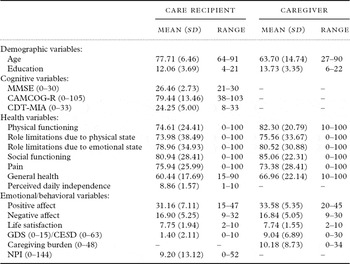
Table 1 shows the distribution of the care-recipients’ and caregivers’ background characteristics as well as the other variables employed in the study. Care-recipients’ mean age was 77.7 years and they had a mean of 12.1 years of education. Most of the caregivers were women (70%), younger (M = 63.7 years), and educated (M = 13.7 years). In terms of functional health, both care-recipients and caregivers rated above 70 (out of 100) on all subscales except for general health. Life satisfaction scores were similar for both care-recipients and caregivers (M = 7.7), and caregiving burden was found to be relatively low (M = 10.2).
Distribution of main study variables

MMSE, Mini-Mental State Examination; CAMCOG-R, Cambridge Cognitive Examination – Revised; CDT-MIA, Clock Drawing Test – Modified and Integrated Approach; GDS, Geriatric Depression Scale; NPI, Neuro-Psychiatric Inventory.
There were several differences between the care-recipients in the three cognitive groups. Care-recipients with mild dementia were somewhat older (M = 81.69, SD = 5.61) than unimpaired controls (M = 74.96, SD = 6.93; F(2,73) = 6.16, p = 0.003) with care-recipients with MCI between the two other groups (M = 78.29, SD = 5.63). The difference by sex between the three cognitive groups was not significant (χ 2(2) = 1.43, p > 0.05; unimpaired 38.50% male; MCI 50.00% male; mild dementia 56.30% male). Unimpaired controls were more highly educated (M = 13.96 years, SD = 3.43) than care-recipients with mild dementia (M = 11.38, SD = 3.03) or MCI (M = 10.46, SD = 3.84; F(2, 73) = 7.37, p = 0.001).
Correlation between demographic variables and caregiver burden
Neither care-recipients’ nor caregivers’ age was related to caregiver burden (r = 0.17; r = 0.03). Likewise, education was not related to caregiver burden (care-recipients: r = −0.04; caregivers: r = 0.04). Caregivers of male care-recipients tended to report more burden (M = 12.22, SD = 9.86) than caregivers of female care-recipients (M = 8.48, SD = 7.31; t(74) = 1.86, p = 0.067). As expected, female caregivers reported higher levels of burden (M = 11.55, SD = 9.41) compared to male caregivers (M = 7.26, SD = 6.23; t(74) = 2.34, p = 0.02). There were no difference in burden between spouses versus children of the care-recipients (t(68) = 1.50, p > 0.05) nor between caregivers who were living with the care-recipients versus those living in a different household (t(74) = 0.98, p > 0.05).
Correlation between caregiver burden and cognitive, functional health, and emotional variables
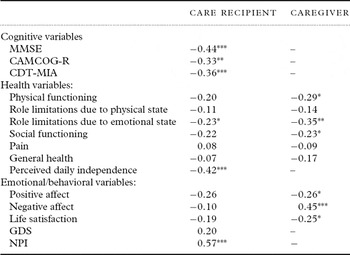
Levels of burden varied by care-recipients’ cognitive ability (F(2,73) = 14.99, p = 0.000) with greater burden among caregivers of care-recipients with dementia (M = 18.75, SD = 7.92), as compared to caregivers of unimpaired controls (M = 5.85, SD = 5.02) and those with MCI (M = 9.62, SD = 8.71). Additional correlations between cognitive, health, and emotional and background variables and burden are shown in Table 2. As seen in the table, a higher level of burden was reported by caregivers of care-recipients with lower Mini-Mental scores, CamCog-R, and CDT scores.
Correlations between caregiver burden and cognitive, health, and emotional variables

* p < 0.05.
** p < 0.01.
*** p < 0.001.
MMSE, Mini-Mental State Examination; CAMCOG-R, Cambridge Cognitive Examination – Revised; CDT-MIA, Clock Drawing Test – Modified and Integrated Approach; GDS, Geriatric Depression Scale; NPI, Neuro-Psychiatric Inventory.
In terms of functional health, caregiver's feelings of burden were negatively correlated with care-recipients’ role limitation due to their emotional state as well as the caregiver's physical functioning, role limitation due to emotional state, and social functioning. Care-recipients’ daily independence was also negatively correlated with caregiver's burden. Caregiver's burden was positively correlated with care-recipients’ problem behavior, as measured by the Neuropsychiatric Inventory. Further, higher negative affect, lower positive affect, and lower perceived life satisfaction of the caregiver were all related to higher burden.
Distribution of mobility and correlation between out-of-home mobility and caregiver burden
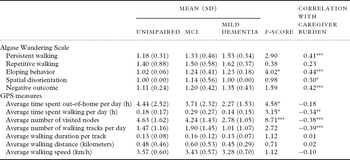
Only three care-recipients had previously exhibited wandering behavior, according to caregivers’ report. Mean scores on the AWS ranged from 1.06 to 1.48 for the five factors, indicating low levels of wandering or troublesome walking behaviors.
Table 3 shows the difference in the AWS measures and the out-of-home mobility variables collected by the use of the GPS tracking kit between the three cognitive groups. As seen in the table, minor differences existed between the three cognitive groups in terms of wandering behaviors. According to the GPS data, unimpaired controls spent more time out-of-home and visited more nodes, while care-recipients with MCI spent more time walking than the other two cognitive groups.
Distribution of mobility variables and their correlation with caregiver burden

* p < 0.05.
** p < 0.01.
*** p < 0.001.
Table 3 also shows the correlations of wandering and mobility variables with caregiver burden. Problematic walking patterns, as measured by the AWS, were correlated with greater caregiving burden. Further, burden was negatively correlated with average time spent walking per day, number of visited nodes, and number of walking tracks, so that overall, for care-recipients who had more out-of-home activity, their caregivers reported lower levels of burden.
We further examined the correlation between mobility variables and caregiving burden within each of the three cognitive groups. Among caregivers of unimpaired care-recipients and those with MCI there was no association between mobility and burden. However, among caregivers of care-recipients with mild dementia, there was a strong negative correlation between burden and a number of mobility variables: average number of visited nodes (r = −0.50, p = 0.05), average time spent walking (r = −0.67, p = 0.005), and average number of walking tracks per day (r = −0.60, p = 0.014). This indicates that greater mobility is related to lower burden among caregivers of care-recipients with mild dementia.
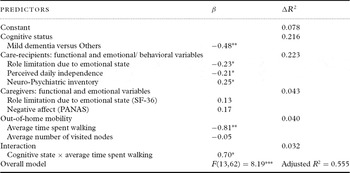
Table 4 reports the results of the multiple regression analysis assessing the relationship between the independent variables and caregiver burden, controlling for age and sex for both caregivers and care-recipients. As shown in the table, the strongest predictors of burden were the care-recipients’ cognitive status and the average time spent walking. These were followed by care-recipients’ role limitation due to emotional state and perceived independence. Further, care-recipients’ sex (male) (β = −0.27, not shown in table) was significantly predictive of burden. These variables explained 56.8% of the variance in caregiver burden.
Regression analysis predicting caregiver burden (N = 76) a

* p < 0.05.
** p < 0.01.
a Controlling for care-recipients’ and caregivers’ age and sex.
PANAS, Positive and Negative Affect Schedule.
The interaction between the cognitive status (dementia vs. no dementia) and average time spent walking per day explained another 3.2% of the variance in caregiver burden. Figure 1 illustrates this interaction, showing the relationship between average time spent walking per day and caregiver burden separately for both cognitive groups. Controlling for all other variables, among care-recipients with dementia greater caregiving burden was associated with less out-of-home walking time, whereas such an association was not found among caregivers of care-recipients without dementia.
Relationship between average walking time and caregiver burden by cognitive group.

As the AWS was missing for 16 care-recipients, it was not included in the regression presented here. However, when AWS scores were inserted into the regression (available from author), it was not found to be a significant predictor of burden.
Discussion
This study examined the relative importance of older care-recipients’ out-of-home mobility, caregiver characteristics, and care recipient characteristics in relation to caregiver burden among older Israelis in the early stages of cognitive decline. The study is innovative in the use of GPS technology to track the care-recipients’ out-of-home mobility and measure their out-of-home behavior. Overall results showed that greater caregiving burden was associated with lower cognitive status, and poor behavioral/emotional status among the care-recipients. Caregivers of care-recipients who spent less time walking out-of-home reported greater burden. Further, greater burden was reported by caregivers of care-recipients who had more problematic walking patterns as measured by the AWS. Of particular note is the finding of an interaction between mobility and cognitive status. Specifically, in the mild dementia group, caregiver burden was much higher when care-recipients spent less time out of the home. This correlation was not found among the MCI or healthy control groups. The implications of these variables are discussed later.
Mobility is an important element in quality of life, especially in old age (Schaie, Reference Schaie, Schaie, Wahl, Mollenkopf and Oswald2003). Less is known about the importance of older persons’ mobility on the well-being of their family caregivers. This study showed that higher mobility was associated with less subjective burden among caregivers, particularly among those of care-recipients with mild dementia. Other studies show that older persons who maintain their activities outside the home, in spite of their impairment, have better health and well-being. They feel less lonely and take part in meaningful everyday activities. These outcomes, in turn, are related to lower caregiving burden (Schaie, Reference Schaie, Schaie, Wahl, Mollenkopf and Oswald2003; Phinney et al., Reference Phinney, Chaudhury and O'Connor2007). The result in the current study strengthens these results by the use of GPS technology that allows for objective measures of out-of-home activities. On the one hand, the results highlight the importance of promoting the out-of-home mobility among care-recipients with mild dementia. Of course, it is also possible that caregivers who experience less burden are better able to motivate and encourage the care-recipient to increase their out-of-home mobility. Both interpretations are feasible, but the design of this study does not allow us to determine causability or the direction of the relationship between mobility and burden.
It is important to emphasize that the current study excluded individuals with severe impairment, due to the constraints of obtaining informed consent. Patterns of out-of-home mobility are likely different among care-recipients with more severe cognitive impairments and the relationship between out-of-home mobility and caregiving burden may not be linear. It is likely that when care-recipients are independent and not a source of worry, caregiver burden remains low, particularly when the care-recipients maintain their routine activity. However, as out-of-home mobility becomes problematic, such as occurs in advanced cognitive decline and in instances of wandering, caregivers likely worry about care-recipients’ safety and restrict their whereabouts (Alzheimer's Society – UK, 2007) as is supported by the data on wandering reported here.
As expected, cognitive impairment was associated with caregiver burden. This finding is consistent with previous studies (Son et al., Reference Son, Erno, Shea, Femia, Zarit and Stephens2007) and likely reflects the increased need for help from the family caregiver (Perkins et al., Reference Perkins, Lynn, Haley, Nelson and Algase2007). In addition, behavioral/emotional and functional health variables contributed 22% of the explained variance in caregiver burden. Caregivers of care-recipients with more limited functioning due to their emotional state, who manifested abnormal behaviors, and who were more dependent reported more burden. These findings support the growing body of evidence that it is not only the diagnosis of dementia, but also its negative behavioral manifestations that lead to burden (Fauth et al., Reference Fauth, Zarit, Femia, Hofer and Stephens2006; Bruce et al., Reference Bruce, McQuiggan, Williams, Westervelt and Tremont2008).
How can we explain the importance of these variables, beyond the contribution of diagnosis? Symptoms of dementia may manifest themselves in different ways in different care-recipients (Fauth et al., Reference Fauth, Zarit, Femia, Hofer and Stephens2006). Additionally, caregivers may interpret or react to behaviors differently. Specific behaviors or emotions may be more distressing to some caregivers than others. Caregivers also have different coping resources and styles that allow them to deal with these behaviors (Di Mattei et al., Reference Di Mattei, Prunas, Novella, Marcone, Cappa and Sarno2008). Clearly, we need to take into account the behavioral manifestations of dementia within the context of patient–caregiver dyadic context to explain caregiver burden.
The findings of this study should be considered in the context of its limitations, the main one being that data on all functional and emotional variables were collected on the same day that GPS data collection commenced. Further, the study utilized aggregate mobility measures, showing average variables for data collected over a period of one month, which do not take into account daily fluctuations. We should also note the small non-probability sample and the uneven distribution between the study groups. Further, the study was limited to mobile older persons who resided in the Greater Tel Aviv area, limiting the generalizability of the findings. No information related to mood or enjoyment while out of the home, as well as previous activity level, were collected in the study. In a future study, we intend to examine the specific types of activities performed on their outings. Additionally, future studies should take into concern if out-of-home mobility was taken by the care-recipient on their own if they were accompanied by a caregiver. Nevertheless, the strength of this study is that it involves reports of both care-recipients and caregivers. Additionally, this study is one of the first to employ measures of real-time mobility via advanced tracking technologies.
These results have several implications for practice. First, it is important to allow care-recipients in the early stages of cognitive decline to maintain their out-of-home activities, hopefully impacting positively on their well-being and that of their caregiver's. In terms of services, when care-recipients’ outdoor mobility becomes worrisome or dangerous, solutions should be found to allow them to maintain their activities as long as possible. Advanced tracking technologies, such as those used in the current study, may provide caregivers with a feeling of safety, thereby extending the care-recipients autonomy.
Future studies should examine the contribution of tracking devices to caregiver's well-being and quality of life. Longitudinal designs will allow for examining whether use of such devices help reduce caregiver stress and increase well-being. Additionally, beyond examining the length of time that a care-recipient spends out-of-home, it would be interesting to map the range of activities in which the care-recipient takes part. Research can examine if specific activities (i.e. sports, leisure, entertainment, meeting with friends) may be related to increased well-being in the care-recipients and decreased caregiving stress.
Conflict of interest
None.
Description of authors’ roles
S. Werner supervised data collection, conducted data analyses, and wrote the paper. G. Auslander designed the study, supervised data collection, conducted data analyses, and wrote the paper. N. Shoval was responsible for the geographic mobility data collection and analyses. T. Gitlitz collected data and conducted data analyses. R. Landau assisted with the research and writing of the paper. J. Heinik was responsible for data collection within the psychogeriatric clinic.
Acknowledgments
Support of this project was provided by the German Federal Ministry of Education and Research (BMBF) within the framework of German–Israeli Project Cooperation (DIP).