Introduction
Microdissectors are used routinely in nasal surgery. They employ a combination of a rotating blade and suction to remove tissue. Two groupsReference Ferguson, DiBiase and D'Amico1, Reference Dave, Polak and Casiano2 have published quantitative studies comparing the in vitro efficacy of different microdissector and blade combinations. Both selected a specific oscillation speed for their experiments.
Our study aimed to determine the efficacy of our unit's Gyrus diego® microdissector at varying oscillation speeds, using soft and firm tissue models.
Methods
A Gyrus diego® microdissector with new, 4 mm, straight blades was used. This was set up with the suction passing through a ‘sputum trap’ on a digital weighing scale, to allow the weight of tissue aspirated to be measured. Irrigation was not used. Uncooked blocks of jelly and cow's liver were used to simulate polyps and muscle plus connective tissue, respectively, with water used as a control. Previous studies used oysters to represent polyps, but financial restraints required a more economical model. Jelly was felt to be a good substitute for the compressible, homogenous nature of polyps, whilst liver, with its highly vascular connective tissue structure, represented turbinate and other nasal tissues.
Preliminary experiments established the optimum microdissector configuration and the likely variation in aspirated tissue with changing speed. Repeat measurements were then taken of the weight of tissue aspirated over a period of time (10 seconds for water and jelly, 30 seconds for liver), at blade rotation speeds of 1000, 2000, 3000, 4000 and 5000 rpm. Two blades were used for each tissue model and the blades were changed halfway through testing. Increasing speeds were used for the first blade and decreasing speeds for the second blade.
The data collected were analysed using linear bivariate regression.
Results
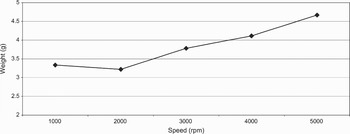
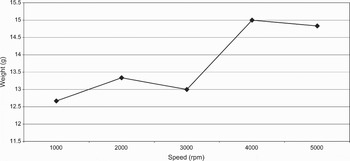
The results showed significant linear trends, in the cases of liver and jelly, between blade oscillation speed and aspirated tissue volume. Faster cutter speeds were associated with higher aspiration rates, up to the maximum speed of 5000 rpm. The values for t (refers to the outcome value for the student's t-test) and P > t (refers to the probability of this result being statistically significant) shown in Tables I and II indicate that this linear trend is very unlikely to have occurred by chance.
Regression table for liver

SE=standard error; t=outcome value for the student's t-test; P=probability of this result being statistically significant; CI=confidence intervals; x=cutter speed/1000; _cons=constant used in the calculation of regresion table
Regression table for jelly

SE=standard error; t=outcome value for the student's t-test; P=probability of this result being statistically significant; CI=confidence intervals; x=cutter speed/1000; _cons=constant used in the calculation of regresion table
Water was used as a control in order to assess any difference in aspiration attributable to the relative suction port opening time, at differing oscillation speeds. No change was seen, comparing 1000 with 5000 rpm.
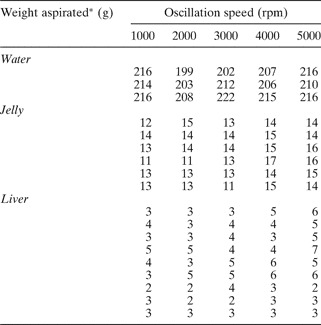
The results are shown in Figures 1 and 2 and Tables I to III.
Mean weight of liver aspirate, by microdissector oscillation speed.

Mean weight of jelly aspirate, by microdissector oscillation speed.

Tissue weight aspirated at varying microdissector speeds

* Results are shown for repeated measurements of aspirate weight, at the five oscillation speeds.
Discussion
Our study found a linear relationship between blade oscillation speed and aspirated tissue volume, for the tissue models used. Faster cutter speeds were associated with higher aspiration rates, up to the maximum speed of 5000 rpm.
The first quantitative analysis of microdissectors used in endoscopic nasal surgery was reported by Ferguson et al. in 1999.Reference Ferguson, DiBiase and D'Amico1 These authors reported preliminary tests to determine the optimal oscillation speed for each microdissector. They then compared microdissectors at their respective optimal oscillation speeds; however, they did not include oscillation speed data in the published paper.
Dave et al. Reference Dave, Polak and Casiano2 compared two microdissectors, using a combination of blade types. Both microdissectors were run at the manufacturers' recommended oscillation speed (5000 rpm) with 70 per cent irrigation. These authors developed an aspiration efficiency score incorporating tissue aspiration, clog frequency and clearance time. They found no clogging problems with straight blades, using an oyster model, but some clogging occurred when curved blades or a scallop model were used.
In our experiment, we did not experience any problems with clogging. This may be due to our use of straight blades and different tissue models.
• This study aimed to determine the efficacy of the Gyrus diego® microdissector at increasing speeds of oscillation, using an in vitro tissue model
• Using liver and jelly as in vitro tissue models, faster oscillation speeds were associated with higher aspiration rates
• These findings suggest that faster oscillation speeds may be more efficient during clinical use of micro-debriders in endoscopic nasal surgery
In our experience, two schools of thought exist with regard to optimal microdissector oscillation speed. One theory is that slower speeds allow more tissue to be aspirated and removed per blade oscillation. The other is that a faster moving blade allows more tissue to be removed. In our study, we found that faster speeds resulted in the removal of more tissue, for both tissue models. There is no reason why these results should not recur in vivo. There may be an indication for using slower speeds in areas of high risk or during sinus surgery training. It is possible that other microdissectors may give different results; a plateau effect is particularly possible for those capable of higher speeds.