Introduction
A diagnosis of advanced cancer engenders physical, social, and spiritual pain as well as psychological trauma among patients (Diaz-Frutos et al., Reference Diaz-Frutos, Baca-Garcia and García-Foncillas2016; Bovero et al., Reference Bovero, Botto and Adriano2019). Impairments in daily life activities caused by the advanced cancer may lead to adverse psychological consequences including depression, death-related anxiety, demoralization, and existential distress (Akechi, Reference Akechi2012). Such psychological distress could lead to a reduced quality of life (QoL) and a desire for early death (Caruso et al., Reference Caruso, Nanni and Rodin2020; Henson et al., Reference Henson, Edmonds and Johnston2020). The aim of modern palliative care is to improve the patient's QoL from diagnosis through the treatment process (Rodin et al., Reference Rodin, Lo and Rydall2018).
Humans are essentially spiritual beings. Meaning is the main component of spiritual attributes and is regarded as the core thought content during a period of change. Discovering the hidden meaning and purpose of life alleviates existential distress, promotes spiritual well-being and inner peace, and develops endurance among advanced cancer patients (Costas-Muñiz et al., Reference Costas-Muñiz, Torres-Blasco and Castro-Figueroa2020). In addition, finding meaning is a motivational force in overcoming one's suffering (Frankl, Reference Frankl1984).
Various psychological interventions have also been attempted for cancer patients, including patients who are approaching the end of their lives. Various psychological interventions, such as emotion and symptom-focused engagement (EASE) intervention, meaning-centered interventions (MCI), managing cancer and living meaningfully (CALM) therapy, and dignity therapy (DT), aim to improve a patient's positive attitude, hope, and sense of meaning, and reduce existential distress (Ando et al., Reference Ando, Morita and Akechi2010; Chochinov et al., Reference Chochinov, Kristjanson and Breitbart2011; Breitbart et al., Reference Breitbart, Rosenfeld and Pessin2018; Wise et al., Reference Wise, Marchand and Roberts2018; Rodin et al., Reference Rodin, Malfitano and Rydall2020a; Sethi et al., Reference Sethi, Rodin and Hales2020). Furthermore, studies have demonstrated the effectiveness of these psychological interventions in relieving physical and emotional symptoms in advanced cancer patients and reinforcing the discovery of positive meaning (Henry et al., Reference Henry, Cohen and Lee2010; Applebaum et al., Reference Applebaum, Stein and Lord-Bessen2012; Campbell and Campbell, Reference Campbell and Campbell2012; Mok et al., Reference Mok, Lau and Lai2012; Nissim et al., Reference Nissim, Freeman and Lo2012; Li et al., Reference Li, Richardson and Speck2014; Lo et al., Reference Lo, Hales and Jung2014; Breitbart et al., Reference Breitbart, Pessin and Rosenfeld2015, Reference Breitbart, Rosenfeld and Pessin2018; Hales et al., Reference Hales, Lo and Rodin2015; Okuyama et al., Reference Okuyama, Akechi and Mackenzie2017; Rosenfeld et al., Reference Rosenfeld, Saracino and Tobias2017; Caruso et al., Reference Caruso, Nanni and Rodin2020; Rodin et al., Reference Rodin, Malfitano and Rydall2020a, Reference Rodin, An and Shnall2020b).
However, questions have been raised about the cultural acceptance of psychological interventions (Costas-Muñiz et al., Reference Costas-Muñiz, Torres-Blasco and Castro-Figueroa2020). Patient perceptions and meaning-making differ by culture, influencing how patients make meaning of their illness, respond to symptoms, make decisions about healthcare choices, and express affect related to the cancer experience (Cormack and Mazanec, Reference Cormack and Mazanec2019; Costas-Muñiz et al., Reference Costas-Muñiz, Torres-Blasco and Castro-Figueroa2020). For example, in Korean culture, the relationship between family and significant others has a greater impact on QoL compared to Western cultures (Yang et al., Reference Yang, Choi and Choi2020). Therefore, it is crucial to understand cultural influences on how patients make meaning of their illness before implementing previously developed psychological interventions. As no prior study has examined cultural differences in life's meaning experience, it is necessary to understand these characteristics in terms of Korean culture. These findings can help in the development of optimal strategies to integrate specialized psychological interventions into oncological and palliative care in Korea.
For the cultural adaptation of psychological interventions, this study investigated the perceptions of meaning of life among Korean patients living with advanced cancer.
Methods
Study design
This descriptive study used a mixed-methods design to identify perceptions of the meaning of life among Korean patients with advanced cancer (Figure 1). The analysis employed an exploratory sequential approach (Creswell et al., Reference Creswell, Klassen and Plano Clark2011; Bishop, Reference Bishop2015). This study applied a qualitative approach for the primary analysis and a quantitative approach as a supplementary method. The data collection process began with the qualitative approach, after which the quantitative approach was applied.
Study design: an exploratory sequential mixed methods.

Ethical considerations
Ethical approval for this study was granted by the institutional review board (IRB) of Ulsan University Hospital (IRB No. UUH IRB No.2019-08-012). The voluntary participation, anonymity, and confidentiality of participants’ data were ensured. All participants were informed about the study's purpose as well as about their right to withdraw at any time. Written permissions were subsequently obtained from each participant.
Qualitative study
Participants and data collection
Data were collected twice from July to August 2020. Participants were selected from a group of patients receiving chemotherapy. The inclusion criteria were as follows: (1) a physician's diagnosis of advanced cancer (stage III or IV), (2) the ability to understand and answer the oncologist's pre-interview research questions, and (3) provision of written informed consent. Sixteen patients participated in two in-depth interviews conducted two weeks apart. The first interview consisted of semi-structured, open-ended questions and lasted between 60 and 80 min. It was conducted in a quiet hospital meeting room and the audio was recorded. The second interview clarified the content through supplemental questions. Data collection was terminated after confirming that theoretical saturation, where no new categories were found, had been reached. For each interview, transportation expenses were compensated for participation.
The two interviewers were experienced, expert qualitative researchers and authors and performed the entire interview process, transcription, and primary analysis. To minimize differences between the interviewers and ensure consistency in the interview process, the key interview questions and procedures were specified at two prior meetings. During the first interview, a psycho-oncologist from the research team participated in the interview process of two patients assigned to each interviewer to confirm the interview's progression consistency. Consequently, discussions and reflections were held on the order of interview questions according to the situation and the application of a homogeneous blanketing method.
Research questions
To explore the perception of meaning of life in Korean patients with advanced cancer, this study formulated research questions based on both the concept of meaning as a motivational force in life (Frankl, Reference Frankl1984) and a sub-dimension of the MLQ, namely, the existence of meaning and will to meaning (Won et al., Reference Won, Kim and Kwon2005). The main interview question was “What is your motivation to live during the difficult treatment process for advanced cancer?” (Figure 1).
The interviewers focused on identifying the Korean participants’ reasons for living (existence of meaning) and their will to find an optimistic meaning in life (will to meaning). Furthermore, they were asked questions about their motivation to live, how they overcame difficult times during the treatment, and their meaning of life after the diagnosis.
Data analysis
The collected data were analyzed by subdividing the stages based on the phenomenological approach suggested by Colaizzi (Reference Colaizzi, Valle and King1978). Two researchers analyzed the data with repeated discussions to derive unbiased results. Agreement between the researchers exceeded 90%, indicating high reliability. The final results were arrived at through consensus among all the researchers.
Research rigor and reliability
The qualitative analysis was based on the qualitative data evaluation criteria of Lincoln and Guba (Reference Lincoln and Guba1985). To increase the trust value, the interview content was recorded with the participants’ consent. Furthermore, consistency was verified between the transcribed interview content, analysis results, and the original content. To ensure neutrality, the nature of the research's purpose was clarified by reviewing personal prejudice, judgment, and pre-understanding of the research prior to the interview.
The final categorization was conducted through discussions with other research members, oncologists, and a psycho-oncologist. To enhance applicability, data were collected until the participants’ statements reached theoretical saturation.
Quantitative study
Participants and data collection
A quantitative approach was adopted as a complementary method to the qualitative approach. After the interview, the research assistant administered a survey with the written consent of the participants.
Instruments
-
The Meaning in Life Questionnaire (MLQ). The MLQ-Korean version (Won et al., Reference Won, Kim and Kwon2005) comprises 10 questions that assess both the existence of meaning and will to meaning using a seven-point Likert-type scale. Higher scores indicate greater levels of meaning in life. Cronbach's alpha in this study was 0.889.
-
The Purpose in Life (PIL) scale. The PIL-Korean version (Kim et al., Reference Kim, Jung and Ko2001) comprises 20 items that assess attitude, purpose, and initiative regarding a life with values using a seven-point Likert-type scale. Higher scores indicate greater levels of purpose in life. Cronbach's alpha in this study was 0.923.
-
The Functional Assessment of Chronic Illness Therapy-Spiritual Well-Being (FACIT-Sp) scale. The Korean version of the FACIT-Sp (www.facit.org ) comprises 12 items (Peterman et al., Reference Peterman, Fitchett and Brady2002) rated on a five-point Likert-type scale. Higher scores indicate advanced respondent spiritual well-being. Cronbach's alpha in this study was 0.786.
-
The Patient Health Questionnaire (PHQ-9). The PHQ-Korean version (Lee et al., Reference Lee, Huh and Kim2014) comprises nine items that assess depression using a four-point Likert-type scale. Higher scores indicate higher levels of depression. Cronbach's alpha in this study was 0.823.
Data analysis
A quantitative data analysis was performed using SPSS version 25.0 (IBM Corp., Armonk, NY, USA). Descriptive statistics, the Mann–Whitney U test, the Kruskal–Wallis test, and Spearman's ρ correlation were used.
Results
Participants’ background characteristics
The demographic and disease-related participant characteristics are presented in Table 1. Participant ages ranged from 40 to 70 (M = 60.69, SD = 8.72) years. All participants were at stages III or IV of cancer, 10 of the 16 participants had experienced relapse.
Participants’ background characteristics and differences in outcome variables (N = 16)

ECOG-PS, Eastern Cooperative Oncology Group Performance Status; MLQ, Meaning in Life Questionnaire; PIL, Purpose in Life; FACIT-Sp, Functional Assessment of Chronic Illness Therapy-Spiritual Well-being; PHQ, Patient Health Questionnaire.
a Median/range.
b Mann–Whitney U test, p-value.
c Kruskal–Wallis test, p-value.
Qualitative results
The meaning of life of patients with advanced cancer
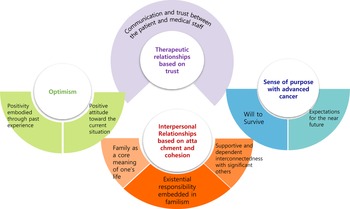
The meaning of life, as experienced by advanced cancer patients, was derived from 425 main statements from the original data collected through in-depth interviews. In the process of continuously assessing the relevance to the topic, four categories were organized into 8 themes consisting of 27 subthemes (Table 2, Figure 2).
A provisional model: the meaning of life among patients with advanced cancer in South Korea.

The meaning of life according to advanced cancer patients in Korea

Category 1. Interpersonal relationships based on attachment and cohesion
Category 1 consisted of “Family as the core meaning of one's life,” “Supportive and dependent interconnectedness with significant others,” and “Existential responsibility embedded in familism.”
Theme 1. Family as the core meaning of one's life. As represented in the three sub-themes (“Social achievement and economic stability of children,” “Strong bond with family,” and “Family (children) as a reason for enduring a difficult illness”), for advanced cancer patients the family was included in the core meaningful experiences of their lives.
Now, the kids have their own families and children [offspring] … I feel relieved that they are leading their independent lives without any problems in particular. (Participant (P) 5, sub-theme 1-1)
The children have successfully grown up to assume their own burden. (P 9, sub-theme 1-1)
This year, they bought an apartment in Seoul, and live there now … Naturally, I feel extremely grateful. (P 2, 5, 9, sub-theme 1-1)
I would consider giving up if I did not have my family. My family is everything to me … and I keep thinking that I should live for my family. (P 4, sub-themes 1-2,1-3)
The youngest one … [is] the joy of my life. (P 1, sub-theme 1-2)
I should get over everything to see my grandson growing up. I only have children and nothing else in my life. Thus, I often get preoccupied with them. (P 12, sub-theme 1-3)
Theme 2. Supportive and dependent interconnectedness with significant others. Advanced cancer patients gained the strength to survive by factors evinced through two sub-themes: “Sustained family support and consolation” and “Significant other's interest and interconnectedness.”
I always get nervous, but my children comfort me. They say “Do not worry dad, you will get better. Even if something goes wrong, we can try another treatment.” I am always grateful for my children. (P 6, sub-theme 2-1)
I really love when my friends tell me, “I am sure that you will get through this. You are doing well, that is enough.” This makes me reflect on myself and motivates me to keep working hard. (P 15, sub-theme 2-2)
Theme 3. Existential responsibility embedded in familism. The existential responsibility stemming from strong familism, prevalent in Korean culture, was expressed in two sub-themes: “Sense of responsibility for one's own role and willingness to sacrifice all for family” and “Recognition of the value of one's existence by family members.” Being recognized for the value of their existence created a desire to care for their family to the best of their ability. Experiencing existential responsibility for their role was seen in both male and female cancer patients; however, the context of experiencing responsibility differed by gender.
My sense of responsibility [from the fact] that I am the pillar of the whole family is the one thing that makes me endure everything … Every fall, the ancestors’ graveyard needs weeding … I should fulfill at least some of my duties toward my family and ancestors. (P 4, sub-theme 3-1)
I should carry on living so that when they need me as a mother, I can lend them my shoulder to rely on. (P 15, sub-theme 3-1)
My child recognizes my hard work. I am rewarded when my child acknowledges my existence and says “I respect my mom and dad the most.” (P 9, sub-theme 3-2)
Category 2. Therapeutic relationships based on trust
Category 2 consisted of one theme “Communication and trust between the patient and medical staff.”
“Adequate communication with healthcare provider” and “Trust in the medical staff who do their best” were identified as two sub-themes. Adequate and sympathetic communication with the medical staff and the new drugs and treatment methods administered by the medical staff gave advanced cancer patients the active will to fight the disease during the treatment process.
There was a slight difference between doctors from Seoul and (doctors from) the countryside. When I felt that I was able to communicate with a doctor about my health status, I was encouraged. (P 13, sub-theme 4-1)
Thanks to the kind medical staff, I was able to stand. All the doctors and nurses work hard in their position, and I really appreciate it. (P 3, sub-theme 4-2)
Category 3. Optimism
Category 3 consisted of “positivity embodied through past life” and “positive attitude toward the current situation.”
Theme 1. Positivity embodied through past experiences. Positivity embodied through the past experiences of advanced cancer patients was expressed in the following seven sub-themes: “Pride about one's (past and current) life,” “Spirit of equilibrium (compassion) gained through life,” “Optimistic personality,” “Resilience cultivated through life,” “Religious spirit (sense),” “The wonders of life from nature,” and “Reflection and insight on life.” An approach of positivity enabled patients to recollect their past experiences and reflect on life. These characteristics were found in both males and females.
Well, I am proud of myself that I have come this far. I survived cancer and even dialysis! For me, it is important to keep my dignity as a human being. (P 5; P 16, sub-themes 5-1, 5-2)
I am a positive thinker; hence, I was able to respond positively when hard work came along. (P 2, sub-theme 5-3)
After that moment passed, I thought that chemotherapy would not work like this again, but thank you for allowing me to do it again. (P 10, sub-theme 5-4)
I thought that God was in control of everything, and I prayed to God. There were times when I cried and prayed for my life. (P 7, sub-theme 5-5)
When I get closer to nature, I feel like there is no such thing as greed. My emotions are clearer; I feel better, and I feel more energetic. (P 4, sub-theme 5-6)
It is time for me to organize my life, and when I get organized (worries … ), I want to save my body now. I will work hard for myself. (P 8,14, sub-theme 5-7)
Theme 2. Positive attitude toward the current situation. A positive attitude toward the current situation allowed advanced cancer patients to accept cancer and the process of cancer treatment as part of life. It was expressed in five sub-themes: “Overcoming the obsession with life,” “Facing and accepting cancer as part of life,” “A positive change in the perception of fighting a disease,” “Cherishing everyday life,” and “The gratitude and joy of living.”
This has to be me. I have to do this, I have to do this too. I put a lot of it down now. (P 15, sub-themes 6-1, 6-2)
I was comfortable when I changed my mind. I feel relaxed after accepting. (P 3, sub-themes 6-2, 6-3)
I think we should face the treatment. Being alive is worth it and has great significance to me. (P 5, sub-themes 6-4, 6-5)
I lived to be thankful for small blessings. (P 7, sub-themes 6-4, 6-5)
Category 4. A sense of purpose with advanced cancer
Category 4 consisted of “Will to survive” and “Expectations for the near future.”
Theme 1. Will to survive. Advanced cancer patients had experienced a sense of purpose through the “Will to survive.” There were four sub-themes: “Fight to beat cancer,” “Attachment to life,” “Choices and actions that satisfy and please oneself,” and “Choosing to fight the disease.”
After being diagnosed with cancer, I am trying to eat well and live with energy from day to day. Every day is a fight with death. I feel relieved now because I am receiving treatment as much as I can on a given path. (P 5; P 7, sub-themes 7-1, 7-4)
If I do my best while I am still alive, I will die with no regrets. That is the goal of my life and how I live currently. (P 14, sub-themes 7-2, 7-3)
Theme 2. Expectations for the near future. During cancer treatment, advanced cancer patients found their meaning via “Expectations for the near future.” It was clarified in two sub-themes: “A small plan that makes me feel excited now (wanting to eat, to meet friends, to travel, etc.)” and “Desire to continue spending time with loved ones.”
I made a bucket list and you know, there is a hope or expectation that I can achieve my bucket list. (P 6, sub-theme 8-1)
For my friends and lover, the only thing I can do is receive treatment and prolong my life. (P 16, sub-theme 8-2)
The essence of the meaning of life experience of Korean advanced cancer patients
The structure of the nature of the meaning of life experiences among Korean cancer patients explored in this study is schematically illustrated in Figure 2. The meaning of life on the vertical axis (interpersonal relationships based on attachment with cohesion and therapeutic relationships based on trust) was the basis of the cancer patients’ active will to live to fight the disease. The meaning of life (optimism and a sense of purpose with advanced cancer), expressed on the horizontal axis, was an externally expressed force.
Quantitative results
The degree and differences in outcome variables according to participants’ background characteristics
The mean scores of MLQ, PIL, FACIT-Sp, and PHQ were 5.25 (SD = 1.34), 5.28 (SD = 0.83), 3.62 (SD = 0.61), and 1.67 (SD = 0.49), respectively. Based on the demographic and disease-related characteristics, these scores were generally homogeneous. Only the period after recurrence (p = 0.041) in MLQ and the family monthly income (p = 0.050) in PIL showed statistical differences (Table 1).
Correlations among outcome variables
The total mean score of PHQ showed significant negative correlations with both MLQ-PM (r = −0.781, p = 0.041) and PIL-Initiative (PIL-I) (r = −0.684, p = 0.041). The total mean scores of the MLQ (r = 0.553, p = 0.026) and the PIL (r = 0.692, p = 0.003) showed a significant positive correlation with FACIT-Sp (Table 3).
Correlations among outcome variables (N = 16)

MLQ, Meaning in Life Questionnaire; MLQ-PM, Presence of Meaning; MLQ-SM, Search for Meaning; PIL, Purpose in Life; PIL-A, Attitude about Life; PIL-P, Purpose of Life; PIL-I, Initiative; PIL-V, Value about being; FACIT-Sp, Functional Assessment of Chronic Illness Therapy-Spiritual well-being; FACIT-Sp-MP, Meaning/Peace; FACIT-Sp-F, Faith; PHQ, Patient Health Questionnaire.
* p < 0.05.
** p < 0.01.
Discussion
The study results highlight the meaning of life experience based on the unique cultural characteristics of Korea. Studies have found that inherent cultural differences in patients with advanced cancer should be considered during treatment interventions (Yu et al., Reference Yu, Hong and Seetoo2003; Surbone, Reference Surbone2008; Yu and Ha, Reference Yu and Ha2015). In the current study, an exploratory sequential approach was employed through primary qualitative analysis (core analysis) and posterior quantitative analyses (Supplementary analysis) to identify the factors associated with meaning of life in cancer patients (Creswell et al., Reference Creswell, Klassen and Plano Clark2011).
In the “Interpersonal relationships based on attachment and cohesion” category, the “Family as the core meaning of one's life” theme was a strong motivating force, which boosted morale among both men and women. Since Middle Eastern and Asian cultures are more family-centered (Su et al., Reference Su, Yeh and Chang2017; Ashrafian et al., Reference Ashrafian, Feizollahzadeh and Rahmani2018), the impact of family attachment on cancer patients is greater than in Western cultures (Su et al., Reference Su, Yeh and Chang2017; Lee and Yun, Reference Lee and Yun2018). In Korean culture, the younger generation's family values are changing. However, traditional family values are still strongly influenced by the Confucian culture and by related sociocultural factors such as the concept of “filial duty,” men's status regarded as higher than women's, and a stronger bond with children than with one's spouse (Choi, Reference Choi2018). The average age of the participants was 61 years, thus representing a sample with traditional Korean family values. The results surrounding children's social success and economic stability as contributing to the meaning of their lives reflects an instrumental familism (Lee et al., Reference Lee, Song and Lee2012) that is immersed in their children's success. Moreover, the family-centered values of Korean culture, which emphasize blood ties, were expressed as a reason for strong bonds with the family and fighting the disease. Cohesion, defined as emotional bonding between family members, is a major structural dimension affecting family functioning. This also affects togetherness among family members (Turkdogan et al., Reference Turkdogan, Duru and Balkis2019). The Korean family culture, which has strong cohesive characteristics, has certain negative aspects such as family selfishness, but it can also function as a source of strength, allowing advanced cancer patients and their families to overcome crisis situations. Prior studies have reported that the medical staff's awareness of cancer patients’ family attachments supported their assessment of patient needs (Holwerda et al., Reference Holwerda, Sanderman and Pool2013; Nicholls et al., Reference Nicholls, Hulbert-Williams and Bramwell2014; Vehling et al., Reference Vehling, Tian and Malfitano2019). Therefore, considering the importance of family in the treatment process in Korean culture, by focusing on identifying the family support system and gathering helpful resources, is crucial (Leng et al., Reference Leng, Lui and Chen2018; Scheffold et al., Reference Scheffold, Philipp and Vehling2019).
“Supportive and dependent interconnectedness with significant others” was another theme that gave patients meaning and enriched their lives in the treatment process. Previous studies suggested that sympathetic support from family and friends significantly affects the patient's QoL, will to fight the disease, and depression levels (Fang et al., Reference Fang, Chang and Shu2015; Viitala et al., Reference Viitala, Saukkonen and Lehto2018; Yang et al., Reference Yang, Xiao and Cao2018; Han et al., Reference Han, Kim and Lee2019). Previous studies reported that cancer patients with stable interpersonal relationships maintained positive emotional well-being, similarly, in both Eastern and Western cultures (Hunter et al., Reference Hunter, Davis and Tunstall2006; Nicholls et al., Reference Nicholls, Hulbert-Williams and Bramwell2014). In addition, this study's participants shared their difficulties with those close to them and reported gaining strength to live when provided with necessary information. These characteristics reflect the role of intimate human relations when coping with crisis situations in Korean culture (Shim and Shin, Reference Shim and Shin2019; Lee et al., Reference Lee, Chin and Sung2020).
The participants’ sense of “Existential responsibility embedded in familism” was reinforced when families recognized the value of their existence. The influence of this factor was greater among females, possibly because their contribution to the family is more immediate and visible than that of males. The care and sacrifice of female cancer patients for the home was also seen in some Western cultures (Emslie et al., Reference Emslie, Browne and MacLeod2009; Radina et al., Reference Radina, Armer and Stewart2014). However, regarding the sense of existential responsibility, while Western patients tend to focus on their own existence, Asian and Middle Eastern patients focused on their family (Lee and Loiselle, Reference Lee and Loiselle2012; Ahmadi et al., Reference Ahmadi, Park and Kim2016). In Korea, the family is a group that takes precedence over the individual. This family value also influences how one copes with serious disease and one's decision-making regarding health problems (Lee et al., Reference Lee, Song and Lee2012). Despite their illness, both male and female participants in this study responsibly served their family and ancestors’ graves and respectively fulfilled crucial caregiver roles, which contributed to their meaning of life. Male patients displayed a keen sense of responsibility toward their family, whereas female patients showed a strong sense of care for their family. Therefore, in approaching meaning-based therapy for cancer patients in Korea, it is necessary to reflect on the meaningful experiences of both males and females (Wessels et al., Reference Wessels, de Graeff and Wynia2010). Moreover, family support and acknowledgment motivated and empowered advanced cancer patients to continue treatment. Thus, medical staff must include family support for cancer patients in the patient treatment process.
The qualitative analysis process found differences in the meaning of life by gender. However, owing to the small sample size, this study could not confirm gender-based statistical differences through quantitative analysis. A mixed-method analysis can be useful in materializing gender differences in the meaning of life in cancer patients in detail, which could not be identified through quantitative analysis. Both male and female subjects who participated in in-depth interviews in this study repeatedly mentioned their gender-specific existential responsibility for the family within their Korean culture. They strived to assume their existential responsibilities until the end of their lives. According to the quantitative analysis, gender differences in terms of existential responsibility were limited to respondents’ roles within their families. Male participants attested meaning to economic aspects and headed the household duties, and female participants attached meaning to nurturing and caring duties for their families. However, it is necessary to reinvestigate these factors with more data samples and premises in future studies to identify gender differences related to the meaning of life in Korean culture.
In the category of “Therapeutic relationships based on trust of medical staff,” the present study confirmed that establishing and maintaining a cooperative therapeutic relationship with medical staff is important in caring for Korean advanced cancer patients. In a study of Asian cancer patients, the demand for active communication with medical staff increased, which is consistent with the results of this study (Ho et al., Reference Ho, Krishna and Goh2013; Liu et al., Reference Liu, Yang and Huo2018).
“Optimism” is a factor that must be strengthened to increase Korean cancer patients’ psychosocial adaptation and foster positive changes in their perception of fighting disease. In the quantitative analysis, the degree of depression showed negative correlations with the existence of meaning in life as well as the pursuit of meaning. The key to various psychological approaches for cancer patients is discovering meaning with optimism and positivity (Chochinov et al., Reference Chochinov, Hack and Hassard2005, Reference Chochinov, Kristjanson and Breitbart2011; Breitbart et al., Reference Breitbart, Pessin and Rosenfeld2015, Reference Breitbart, Rosenfeld and Pessin2018; Rosenfeld et al., Reference Rosenfeld, Saracino and Tobias2017; Rodin et al., Reference Rodin, Lo and Rydall2018). Prior studies reported that optimism improved the QoL of cancer patients regardless of their cultural background (Applebaum et al., Reference Applebaum, Stein and Lord-Bessen2014; Finck et al., Reference Finck, Barradas and Zenger2018); it also led to improvements in treatment outcomes and enabled effective coping with the disease (Malouff and Schutte, Reference Malouff and Schutte2017; Finck et al., Reference Finck, Barradas and Zenger2018).
In the category “Sense of purpose,” according to the quantitative analysis, meaning of life and purpose in life scores showed a significant positive correlation with spiritual well-being. Based on psycho-spiritual interventions (DT, CALM therapy, MCI, etc.), the fact that advanced cancer patients had a strong “Pursuit of purpose” and an intense “Will of life” can be considered as core factors in their treatment process (Chochinov et al., Reference Chochinov, Kristjanson and Breitbart2011; Breitbart et al., Reference Breitbart, Pessin and Rosenfeld2015; Lo et al., Reference Lo, Hales and Rydall2015; Vuksanovic et al., Reference Vuksanovic, Green and Dyck2017; Caruso et al., Reference Caruso, Nanni and Rodin2020). These results are similar to those of studies published in Asia, including Korea, as they show a strong willingness to fight the disease among advanced cancer patients (Miyashita et al., Reference Miyashita, Kawakami and Kato2015; Kim and Kim, Reference Kim and Kim2019).
Quantitative research was performed to determine the consistency of the results with those obtained from qualitative research. The existing meaning of life tools (MLQ, PIL) were used to confirm the consensus among research participants regarding meaning of life in Korea. The depression tool (PHQ), signifying a concept that is in contrast to the meaning of life in previous research, was administered after the qualitative analysis. The meaning of life was found to be related to palliating the sense of negativity experienced by participants (Simonelli et al., Reference Simonelli, Fowler and Maxwell2008; Hedayati and Khazaei, Reference Hedayati and Khazaei2014; Nam et al., Reference Nam, Nam and Lee2019). The qualitative analysis revealed that participants expressed their meaning of life, which was quantitatively confirmed by a normal range PHQ score and negative correlations with both the MLQ-PM and the PIL-Initiative, indicating low depression.
Study limitations
This study is limited as it does not represent all advanced cancer patients in Korea. Only a few patients with advanced cancer, aged above 40 years, and from a single province participated in this study. The perception of the meaning of life in young advanced cancer patients under 40 years of age was not identified. Future studies involving larger sample sizes with more male and female participants from all regions of the country, young adult age groups, and participants with varied types of cancer, are needed.
Conclusion
This study revealed that finding meaning during the treatment process acts as an internal motivation for patients with advanced cancer to have the will to survive; moreover, it facilitates effective coping. In the Korean cultural context, the relational dynamic with family and medical staff was the core axis that enriched their lives. Due to the familial culture, which prioritizes the family over the individual, the support and empathy of the family has become a driving force for advanced cancer patients’ survival. The family provided a sense of existential responsibility and meaning to cancer patients, and the family culture that was centered on the idea of filial piety and patriarchal familism created a contextual difference in existential responsibility of men and women. Based on interpersonal and therapeutic relationships, cancer patients experienced the meaning of life while having an optimistic attitude and a sense of purpose for life. These results suggest that the exploration of the meaning of life, reflecting Korean cultural differences, should be considered in improving the quality of care for patients with advanced cancer. This study provides evidence to promote awareness regarding the importance of meaning and cultural considerations for improving the quality of patient-centered medical care. Furthermore, to improve the health-related QoL and effective treatment of advanced cancer patients, interventions should not only focus on physical aspects but also help patients find meaning during their struggle against the disease.
Supplementary material
The supplementary material for this article can be found at https://doi.org/10.1017/S1478951522000979.
Acknowledgments
The authors wish to thank all patients with advanced cancer who participated in the in-depth interviews in this study, even during their chemotherapy periods.
Funding
This research was supported by the National Cancer Center Grant (NCC-1911270-2, NCC-1911276-2).
Conflict of interest
The authors declare no conflicts of interest.