Introduction
Olfactory identification deficits (OID) have been observed in patients with schizophrenia (Reference Hurwitz, Kopala, Clark and Jones1–Reference Moberg, Arnold, Doty, Gur, Balderston, Roalf, Gur, Kohler, Kanes, Siegel and Turetsky4). OIDs are present in neuroleptic naíve psychosis patients, are stable (Reference Brewer, Pantelis, Anderson, Velakoulis, Singh, Copolov and McGorry2–Reference Moberg, Arnold, Doty, Gur, Balderston, Roalf, Gur, Kohler, Kanes, Siegel and Turetsky4) and are associated with negative symptoms, diminished emotional responsiveness Reference Schneider, Habel, Reske, Toni, Falkai and Shah(5), deficiencies in verbal memory Reference Compton, McKenzie Mack, Esterberg, Bercu, Kryda, Quintero, Weiss and Walker(6) and prolonged duration of the illness Reference Moberg, Doty, Turetsky, Arnold, Mahr, Gur, Bilker and Gur(3).
It remains unclear whether OIDs found in patients with schizophrenia are associated with the illness itself or susceptibility to the disorder. Studies examining adult first or second degree family members at high risk for schizophrenia (HR-S) Reference Kopala, Good, Morrison, Bassett, Alda and Honer(7) and monozygotic unaffected twin brothers of patients with schizophrenia Reference Ugur, Weisbrod, Franzek, Pfuller and Sauer(8) suggest that OIDs may be associated with the familial susceptibility to the illness, and may represent useful intermediate phenotypes. However, relatively few studies focus on adolescent non-psychotic relatives of patients with schizophrenia, who represent a high risk population for the disorder.
Previous literature has shown that olfactory deficits are associated with cognitive deficits and negative symptoms in schizophrenia patients Reference Brewer, Pantelis, Anderson, Velakoulis, Singh, Copolov and McGorry(2,Reference Compton, McKenzie Mack, Esterberg, Bercu, Kryda, Quintero, Weiss and Walker6). Brewer et al. Reference Brewer, Wood, McGorry, Francey, Phillips, Yung, Anderson, Copolov, Singh, Velakoulis and Pantelis(9) reported that impairment in olfactory identification ability in ultra-high-risk subjects (defined clinically by the presence of prodromal symptoms) predicted later emergence of a schizophrenia spectrum disorder. However, few previous studies have examined the relationship between OID abnormalities and severity of prodromal symptoms in the genetic high risk populations.
From an ongoing study of young first degree relatives at risk for schizophrenia, we studied OIDs in HR-S subjects using the University of Pennsylvania Smell Identification Test (UPSIT). In this preliminary report, we examined the prevalence of OIDs in HR-S subjects, and the relation between UPSIT scores and prodromal symptoms of schizophrenia in these subjects.
Methods
Subjects
A group of 50 adolescent and young adult high-risk first degree relatives (HR-S; 39 offspring and 11 siblings) were recruited in this study from outpatient clinics at the Western Psychiatric Institute and Clinic (WPIC), Pittsburgh. An age-matched healthy control (HC) group of 42 subjects were recruited from the same communities as where the HR subjects were drawn using flyers posted in community settings and by word of mouth. HR-S subjects were required to have at least one first degree family member with a DSM-IV diagnosis of a schizophrenia (n = 41) or schizoaffective disorder (n = 9; subtype not documented). Affected family members were ascertained by Structured Clinical Interview for DSM-IV Axis I Disorders (SCID) verified by clinical consensus diagnosis. Clinical evaluation of the HR subjects was conducted by using the structured clinical interview for DSM IV Axis I disorders (SCID-I), supplemented by the Behavioral Disorders sections of the Kiddie-Schedule for Affective Disorders and Schizophrenia (K-SADS) Reference Kaufman, Birmaher, Brent, Rao, Flynn, Moreci, Williamson and Ryan(10).
HR-S subjects with a DSM-IV diagnosis of a schizophrenia spectrum disorder, mental retardation, significant head injury, significant history of or current medical or neurological illness were excluded from the study. All subjects were presented with a description of the study and provided written informed consent in accordance with guidelines provided by the Institutional Review Board (IRB) of the University of Pittsburgh. Subjects less than 18 years of age were required to have a parent or guardian give informed written consent for the study.
Assessments
Subjects were assessed for aptitude in odor identification using UPSIT Reference Doty, Shaman, Kimmelman and Dann(11), a standardised 40-item forced choice test of olfactory identification. The olfactory stimuli were embedded in ’scratch and sniff’ microcapsules that were fixed and positioned on strips at the bottom of each page. There were four response alternatives for each item, located above the odorant strip. The subjects were asked to scratch the microencapsulated strip on the bottom on the page, smell the area and then choose the response choice which best described the odor.
IQ was measured using either the Ammon's Quick IQ test Reference Otto and McMenemy(12) or the Peabody Picture Vocabulary Test Reference Dunn, Dunn, Robertson and Eisenberg(13), or the average of these two, when both test data were available in the same subjects. The Structured Interview for Prodromal Syndromes (SIPS) and the Scale of Prodromal Symptoms (SOPS) scale was used to assess prodromal symptoms Reference Miller, McGlashan, Rosen, Somjee, Markovich, Stein and Woods(14); these data were available in the 41 HR-S subjects only. The SOPS scale has four subscales: positive, negative, disorganisation and general symptoms.
Analysis of Covariance (ANCOVA) using gender and age as covariates (given the fact that these two variables may be modifying variables for olfactory function) was used to examine overall group differences between the HR-S subjects and controls. We also conducted an analysis of covariance to examine the effect of IQ on these differences. The relations between UPSIT scores and the SOPS measures were analysed using partial correlations with IQ, and age as covariates. Statistica software (version 8) was used in data analyses.
Results
The study included HR-S subjects (n = 50; 26 males; age 16.36 + 3.50 years), and HCs (n = 42; 15 males; age 17.17 + 3.14 years). The groups did not differ in age (t = 1.11; DF = 90; p = 0.27) or gender (Mann Whitney U = 879; p = 0.18) but the HR-S subjects, compared to controls, had significantly lower IQ (104.27±15.2 vs. 114.24±10.7; t = 3.56; p < 0.001).
ANCOVA with age and gender as covariates revealed that compared to HC subjects (33.91 + 2.6), reductions of UPSIT scores were seen in HR-S subjects (31.79; +5.15) (Wald = 3.76; DF = 1; p = 0.05). No significant gender effects or gender by group interactions were seen. When IQ was additionally used as a covariate, the difference between HR-S and HC subjects was no longer significant (Wald = .65; p = 0.42). When the analysis was repeated including only HR-S subjects with parents diagnosed with schizophrenia, the results remained the same.
Since it is possible that siblings may differ from offspring with regard to the degree of risk for schizophrenia Reference Varma, Zain and Singh(15), we examined the OIDs in the offspring only versus HC subjects, again with age, gender and IQ as covariates. The UPSIT scores did not significantly differ with this comparison.
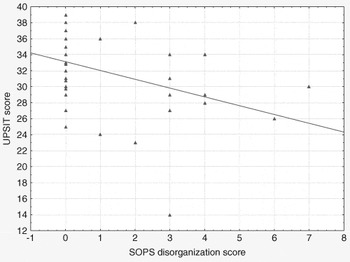
We carried out correlational analyses in the HR-S subjects (n = 43) between UPSIT scores and prodromal measures after partialing out the effects of age and IQ. UPSIT scores were inversely correlated with SOPS disorganised symptoms (Partial r = −0.47; p = 0.002) (Fig. 1) but not with the SOPS positive (Partial r = −0.14; p = 0.38), negative (Partial r = −0.19; p = 0.25) or general (Partial r = −0.21; p = 0.18) symptoms. The relation between SOPS disorganised symptoms and UPSIT scores was significant when the analysis was confined to the offspring only (n = 35; partial r = −0.43; p = 0.013).
Partial correlation (age and IQ partialled out) between UPSIT scores and SOPS disorganisation symptoms in HR-S subjects (n = 43).

Discussion
We observed a modest reduction in UPSIT scores in HR-S subjects that were nonsignificant after covarying out the effects of age, gender and IQ. This result is perhaps related to the fact that OIDs have been shown to be related to cognitive abilities in some (Reference Compton, McKenzie Mack, Esterberg, Bercu, Kryda, Quintero, Weiss and Walker6, Reference Stedman and Clair16, Reference Saoud, Hueber, Mandran, Dalery and D’Amato17). though not all previous studies of schizophrenia patients Reference Seidman, Talbot, Kalinowski, McCarley, Faraone, Kremen, Pepple and Tsuang(18). This observation underlines the importance of addressing the potential confounding effect of cognitive deficits while investigating OID deficits. An alternative view is that cognitive impairment is not a confound, but essentially a co-morbid condition. It is also to be kept in mind that olfactory identification abnormalities, being examined in this study, are more likely to be associated with broader cognitive deficits, in comparison with olfactory discrimination tasks that directly target olfactory perceptual processes.
Previous research has shown that OIDs are associated with the severity of symptoms in Schizophrenia Reference Moberg, Arnold, Doty, Gur, Balderston, Roalf, Gur, Kohler, Kanes, Siegel and Turetsky(4) as well as in prodromal patients Reference Brewer, Wood, McGorry, Francey, Phillips, Yung, Anderson, Copolov, Singh, Velakoulis and Pantelis(9). Therefore, we hypothesised that olfactory deficits will be greater in HR individuals with prodromal psychopathology, especially as they emerge during late adolescence, proximal to the typical age of onset of schizophrenia. As predicted, olfactory deficits were correlated with prodromal disorganisation symptoms, though not with other prodromal symptoms. This finding suggests that olfactory deficits may be a marker of risk for the emergence of prodromal symptoms, and perhaps may have predictive value for later emergence of psychotic symptoms.
The strengths of our study include the investigation of a unique, well characterised group of HR-S subjects. A larger pool of data as well as follow-up will shed more light on the predictive value of olfactory deficits in schizophrenia for the emergence of serious psychopathology during early adulthood.
Acknowledgements
This study was supported by NIMH grants MH 64023 and 01180 and an Established Investigator Award from NARSAD (MSK) and a NARSAD young Investigator award (VAD).