Cow's milk naturally contains somatic cells in addition to proteins, sugars, fats and minerals. The concentration of cells (somatic cell count, SCC) is an indicator of udder health as the number increases in response to infection or trauma. The main functions of many of the cell types in milk are as part of the immune defences of the udder. The composition and technological properties of dairy products are influenced by cell count and type (Sánchez-Macías et al. Reference Sánchez-Macías, Morales-dela Nuez, Torres, Hernández-Castellano, Jiménez-Flores, Castro and Argüello2013).
A high SCC usually indicates mastitis, an inflammation of the mammary gland. Milking time hygiene and antimicrobial drugs control new intramammary infections well but sustainable control is sought by developing vaccines and breeding more naturally resistant animals with enhanced immune defences. Opportunities are available if the immune defences can be better understood (Oviedo-Boyso et al. Reference Oviedo-Boyso, Valdez-Alarcón, Cajero-Juárez, Ochoa-Zarzosa, López-Meza, Bravo-Patiño and Baizabal-Aguirre2007).
Recently, the genes involved in the innate immune response have been indicated as strong candidates in determining animal resistance (Oviedo-Boyso et al. Reference Oviedo-Boyso, Valdez-Alarcón, Cajero-Juárez, Ochoa-Zarzosa, López-Meza, Bravo-Patiño and Baizabal-Aguirre2007; Fonseca et al. Reference Fonseca, Antunes, Paiva, Lange, Guimarães and Martins2011). These affect the cellular immune system, for instance leucocytes and epithelial cells (EP) produce inflammatory mediators, such as cytokines (Griesbeck-Zilch et al. Reference Griesbeck-Zilch, Meyer, Kühn, Schwerin and Wellnitz2008), and these cells may recognise the invading microorganisms via Toll-like receptors (TLRs) (Pietrocola et al. Reference Pietrocola, Arciola, Rindi, Di Poto, Missineo, Montanaro and Speziale2011). Also, anti-microbial peptides are produced by macrophages or by neutrophils and EP and they work as natural antibiotics (Si-Tahar et al. Reference Si-Tahar, Touqui and Chignard2009). Thus, it is important to study subpopulations of milk cells to better clarify the regulation of target genes involved in mastitis-resistance.
Flow cytometry allows the study of subpopulations of milk cells. In particular, flow cytometry-cell sorting technologies distinguish and separate different cells with a precise detection (Albenzio & Caroprese, Reference Albenzio and Caroprese2011). Although this analysis is a very sensitive method, it is expensive. Based on this premise, the aim of this study was to develop an easy and cheap method to separate the different subpopulation of cells using an immunomagnetic procedure followed by flow cytometry analysis, RNA extraction and gene expression analyses by qPCR to study the expression of some TLRs, cytokines and antimicrobial peptides.
Materials and methods
Experimental design
Forty-one dairy cows were randomly selected from one commercial farm. The animals were divided into two groups: group A comprised 17 healthy cows, and group B 24 animals diagnosed with clinical mastitis. Milk samples from each quarter were collected for bacteriological examination by the Laboratorio Analisi Veterinarie, Controllo Acque e Alimenti – Associazione Provinciale Allevatori di Cuneo (Italy) using their internal methods. The tests confirmed infection due to Staphylococcus aureus for all cows in group B whereas all cows in group A appeared free from infection. Further, milk samples from group A had a SCC of less than 200 000 cells/ml.
Cell isolation
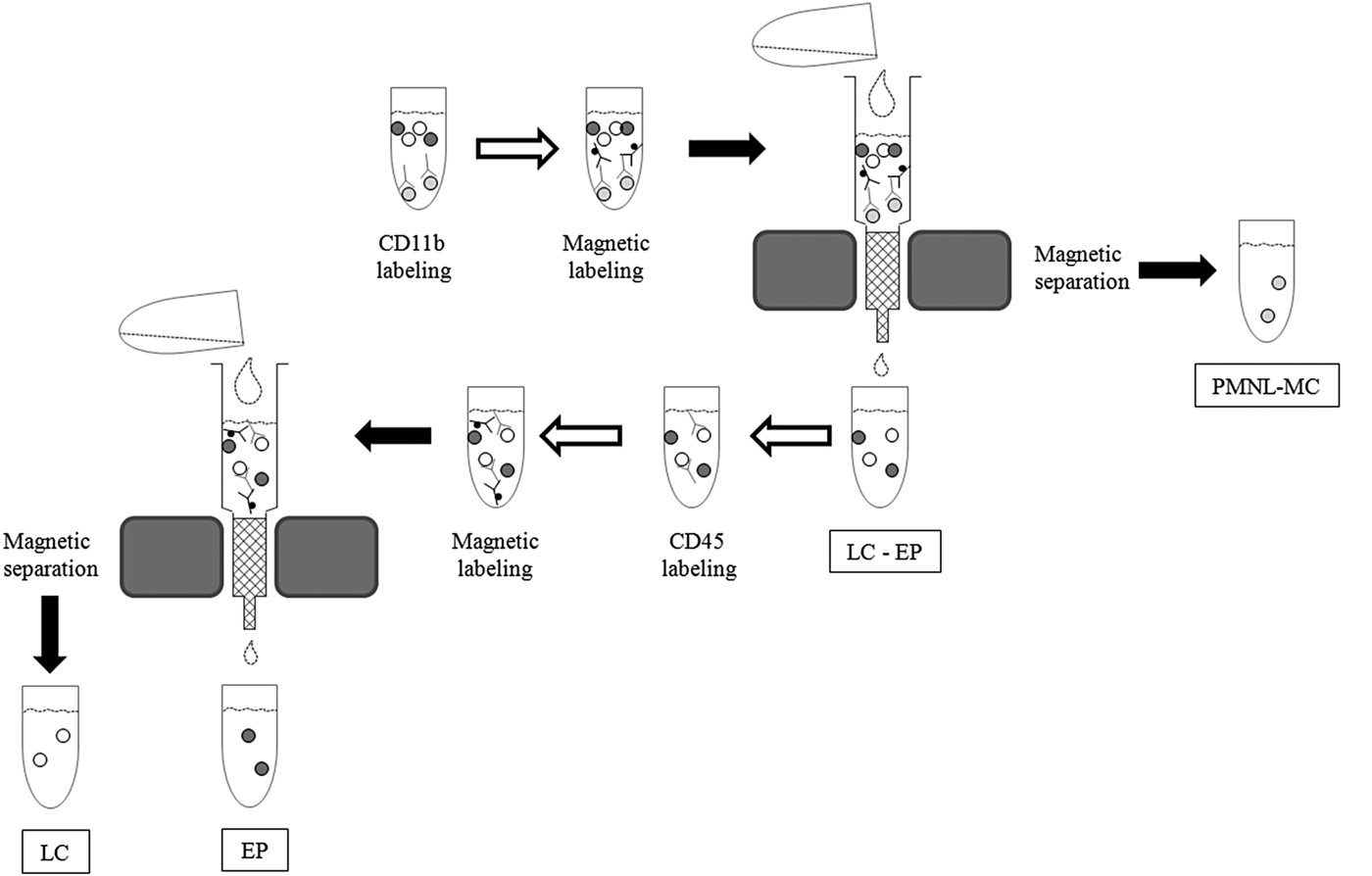
The procedure is illustrated diagrammatically in Fig. 1. About 700 ml of milk were collected from a single udder quarter of each animal into sterile tubes. Milk samples from animals with mastitis were collected from the udder quarter prior to any treatment. 700 µl of 0·5 M EDTA, pH 8·0, was added to each sample, which was centrifuged at 1500 g for 10 min at 4 °C and skim milk was removed. The cell pellet was washed twice in PBS and 0·5 mm EDTA and, after a final centrifugation, the cell pellet was resuspended in 1 ml PBS and 0·5 mM EDTA and filtered through a 30 µm pre-separation filter. Total cells were counted in a Neubauer chamber and no more than 108 cells were used for immunomagnetic separation (MACS Miltenyi Biotec, Bergisch Gladbach, D). The methodology is based on the assumption that CD11b is a marker of granulocytes and monocytes while CD45 is exposed on all leucocytes. Therefore, a two-step protocol can produce three different populations: polymorphonuclear neutrophilic leucocytes (PMNL) and monocytes (MC) (CD11b+ cells), lymphocytes (LC; CD11b− CD45+ cells) and EP (CD11b− CD45− cells) (Fig. 1). Cells were centrifuged at 1500 g for 10 min at 4 °C and the pellet was incubated for 45 min at 4 °C with anti-CD11b:FITC monoclonal antibody (isotype IgG2b, clone CC126) diluted 1 : 10 in PBS. Cells were washed by adding 1·7 ml of degassed buffer (PBS, 0·5% BSA and 2 mM EDTA) and centrifuged at 1500 g for 10 min at 4 °C.
Schematic diagram of the optimised immunomagnetic separation of PMNL-MC, LC and EP from bovine milk.

They were then incubated with anti-mouse IgG Microbeads (130-048-401; MACS Miltenyi Biotec) diluted 1 : 5 in PBS, for 15 min at 4 °C. Cells were washed by adding 1·7 ml of buffer, centrifuged at 1500 g for 10 min at 4 °C and resuspended in 500 µl of buffer. The sample was loaded on a column placed in the magnetic field and rinsed with 500 µl of buffer. The unlabelled CD11b− cells were collected in the flow-through whereas the magnetically labelled CD11b+ cells were eluted in a separate tube after removing the column from the magnetic field. The unlabelled CD11b− cells were than centrifuged at 1500 g for 10 min at 4 °C and incubated with anti-CD45:RPE monoclonal antibody (isotype IgG1, clone 1·11·32) diluted 1 : 10 in PBS for 45 min at 4 °C. Cells were washed by adding 1·7 ml of buffer and centrifuged at 1500 g for 10 min at 4 °C. Cells were then incubated with anti-mouse IgG Microbeads (130-048-401; MACS Miltenyi Biotec) diluted 1 : 5 in PBS, for 15 min at 4 °C. Cells were washed by adding 1·7 ml of buffer, centrifuged at 1500 g for 10 min at 4 °C and resuspended in 500 µl of buffer. The samples were loaded on a column placed in the magnetic field and rinsed with 500 µl of buffer. The unlabelled CD11b−CD45− cells were collected in the flow-through whereas the magnetically labelled CD11b− CD45+ cells were eluted in a separate tube after removing the column from the magnetic field (Fig. 1). After the separation, all the samples were centrifuged at 1500 g for 10 min at 4 °C. An aliquot of each sample was immediately used for total RNA extraction whereas another part was acquired by flow cytometry to verify the quality and purity of each cell fraction. The species reactivity of labelled antibody (anti-CD11b and anti-CD45) used to select each subpopulation of SCs, was previously tested on bovine leucocytes by flow cytometry (Koess and Hamann, Reference Koess and Hamann2008; Spalenza et al. Reference Spalenza, Girolami, Bevilacqua, Riondato, Rasero, Nebbia, Sacchi and Martin2011; Pilla et al. Reference Pilla, Malvisi, Snel, Schwarz, Konig, Czerny and Piccinini2013). Both monoclonal antibodies were purchased from AbD Serotec, BioRad, Hercules, CA.
Flow cytometry
Purity of sorted populations was evaluated by flow cytometry using a BD Accuri C6 instrument and C6Flow Plus software (Becton Dickinson, Franklin Lakes, NJ). A morphological gate was constructed on a FSC vs. SSC plot to exclude platelets and debris.
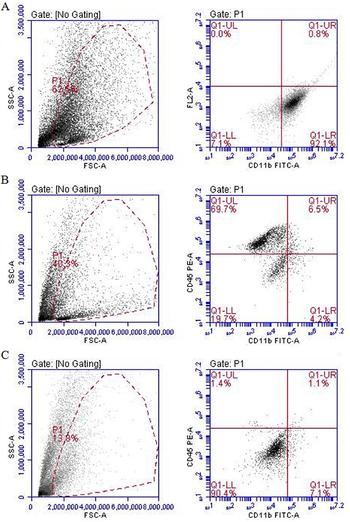
Purity of sorted populations was calculated as percentage of gated CD11b+ events in the CD11b+ enriched tube (Fig. 2a), of CD45 + CD11b− events in the CD11b+ depleted/CD45+ enriched tube (Fig. 2b), and of CD45− CD11b− events in the CD11b+ depleted/CD45+ depleted tube (Fig. 2c), respectively. Cytospins of total somatic cells, CD45+ enriched and CD45− CD11b − fractions were produced and stained with May–Grunwald–Giemsa to confirm the presence of mixed population, LC and EP, respectively.
Flow cytometric analysis of separated populations (representative cytograms). A: Enrichment of CD11b+ cells. Morphological gate (left) and purity of isolated population (right; Q1-LR: CD11b+ events). B: Enrichment of CD45+ cells after depletion of CD11b+ cells. Morphological gate (left) and purity of separated population (right; Q1-UL: CD45 + CD11b− events). C: Depletion of CD45+ cells on CD11b+ depleted population. Morphological gate (left) and purity of identified population (right; Q1-LL: CD45− CD11b− events)

RNA extraction and qPCR
Total RNA from each cell type was extracted using TRI Reagent (Sigma, St Louis, MO, USA), according to the manufacturer's protocol. The RNA concentration was determined by UV-Visible spectrophotometry and the RNA integrity (RNA Quality Indicator – RQI) was verified by an automated gel electrophoresis system (Experion Instrument, Bio-Rad, Hercules, CA, USA) by the standard-sensitivity RNA analysis kit, according to the manufacturer's instructions (Bio-Rad). RQI values from 10 to 5 indicate good and medium quality of RNA. The cDNAs were synthesised from 1 µg of the total RNA using the QuantiTect Reverse Transcription Kit (Qiagen, Hilden, D), which included a DNA digestion step by DNase, according to the manufacturer's protocol.
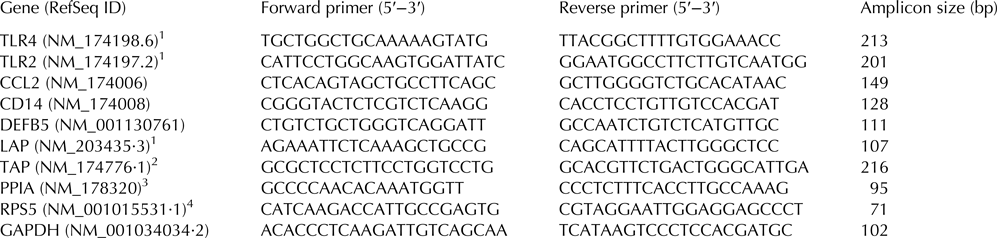
The relative amounts of specific transcripts as Toll-like receptor 2 (TLR2) and 4 (TLR4), chemokine (C-C motif) ligand 2 (CCL2) and CD14 molecule (CD14), defensin beta 5 (DEFB5), lingual antimicrobial peptide (LAP), and tracheal antimicrobial peptide (TAP) were subjected to qPCR using the IQ5 detection system (Bio-Rad) and the IQ SYBR Green Supermix (Bio-Rad). The primer sequences were designed using Primer-BLAST (Ye et al. Reference Ye, Coulouris, Zaretskaya, Cutcutache, Rozen and Madden2012), except for some genes for which the primers were based on the literature (Table 1). 5–10 ng of cDNA were subjected to qPCR, using the following protocol: 95 °C for 30 s, 40 cycles at 95 °C for 5 s and 60 °C for 30 s. A melting curve (from 65 °C to 95 °C) was performed at the end of each run to detect the dissociation of PCR products. The amplification efficiency (E) of each set of oligonucleotides was assessed using appropriate serial dilutions of a pooled sample.
Primer sequences for qPCR

1 Sorg et al. (Reference Sorg, Danowski, Korenkova, Rusnakova, Küffner, Zimmer, Meyer and Kliem2013).
2 Yang et al. (Reference Yang, Fu, Liu, Zhou, Liu, Song, Li and Zhang2013).
Gene expression levels were recorded by Pfaffl method (Pfaffl, Reference Pfaffl2001) using E, and the relative quantity (RQ) was calculated setting the highest relative expression level at 1. The RQ geometric mean (normalised factor, NF) of the three reference genes (n), peptidylprolyl isomerase A (PPIA), ribosomal protein S5 (RPS5) e glyceraldehyde-3-phosphate dehydrogenase (GAPDH) was calculated for the reference index and used to obtain the normalised relative quantity (NRQ) (geNorm algorithm, Vandesompele et al. Reference Vandesompele, De Preter, Pattyn, Poppe, Van Roy, De Paepe and Speleman2002) of target gene in each sample.
 $$E = 10^{ - 1/{\rm slope}}$$
 $$RQ_{{\rm sample}} = E^{\lpar {{\rm MIN\;} \,{\rm Cq} - {\rm Cq\;} \,{\rm sample}} \rpar }$$
 $$NF_n = \root n \of {\mathop \prod \limits_{i = 1}^n E^{\lpar {{\rm MIN}\,{\rm \; Cq} - {\rm Cq}\,{\rm sample}} \rpar }} $$
 $$NRQ = \displaystyle{{RQ_{{\rm target\;} \,{\rm gene}}} \over {NF_{{\rm reference\;} \,{\rm genes}}}}$$
Statistical analysis
All statistical analyses were performed using the GraphPad Prism 4 (vers. 4·03) software (GraphPad Inc., San Diego, CA, USA). Normal distribution was tested by the Kolmogorov–Smirnov test. ROUT's test was used to determine and exclude potential outliers. In the qPCR experiments the results were expressed as NRQ and unpaired t-test or Mann–Witney test were applied. P < 0·05 was considered significant.
Results
Cell isolation and flow cytometry
The immunomagnetic cell binding technique using anti-CD11b and anti-CD45 antibodies and microbeads technology was applicable for specific binding of PMNL-MC, LC and EP in fresh milk both on healthy and mastitic samples. The quantity of extracted mRNA (≥1 µg) was sufficient for reverse transcription and gene expression study. A RQI mean of 7·8 ± 2·7 was calculated on a sub-set of samples (n = 12).
Flow cytometry analysis revealed that the mean purity of CD11b+ (PMNL-MC), CD11b− CD45+ (LC) and CD11b− CD45− (EP) sorted populations was 90% (82–97%), 83% (70–91%) and 84% (75–92%), respectively (Fig. 2). Cytospin evaluation confirmed that cells in the sorted populations were those expected (online Supplementary File Fig. S1).
Reference genes analysis
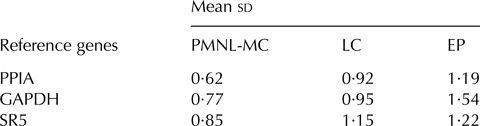
In Table 2, stability ranking of the selected reference genes (PPIA, RPS5 and GAPDH) is reported. Based on the expression stability, the data suggested that PPIA would be the most suitable reference gene to be used in all the selected cell types; the average standard deviations were 0·62, 0·92 and 1·19 for PMNL-MC, LC and EP respectively. Nevertheless, according to the MIQE guidelines (Bustin et al. Reference Bustin, Benes, Garson, Hellemans, Huggett, Kubista, Mueller, Nolan, Pfaffl, Shipley, Vandesompele and Wittwer2009), the use of between two and five stably expressed reference genes for normalisation is recommended. Therefore, each sample was normalised against all the three reference genes.
Stability ranking of reference genes analysed by ΔCq approach in each SCs subpopulation

sd, standard deviation.
Target gene expression
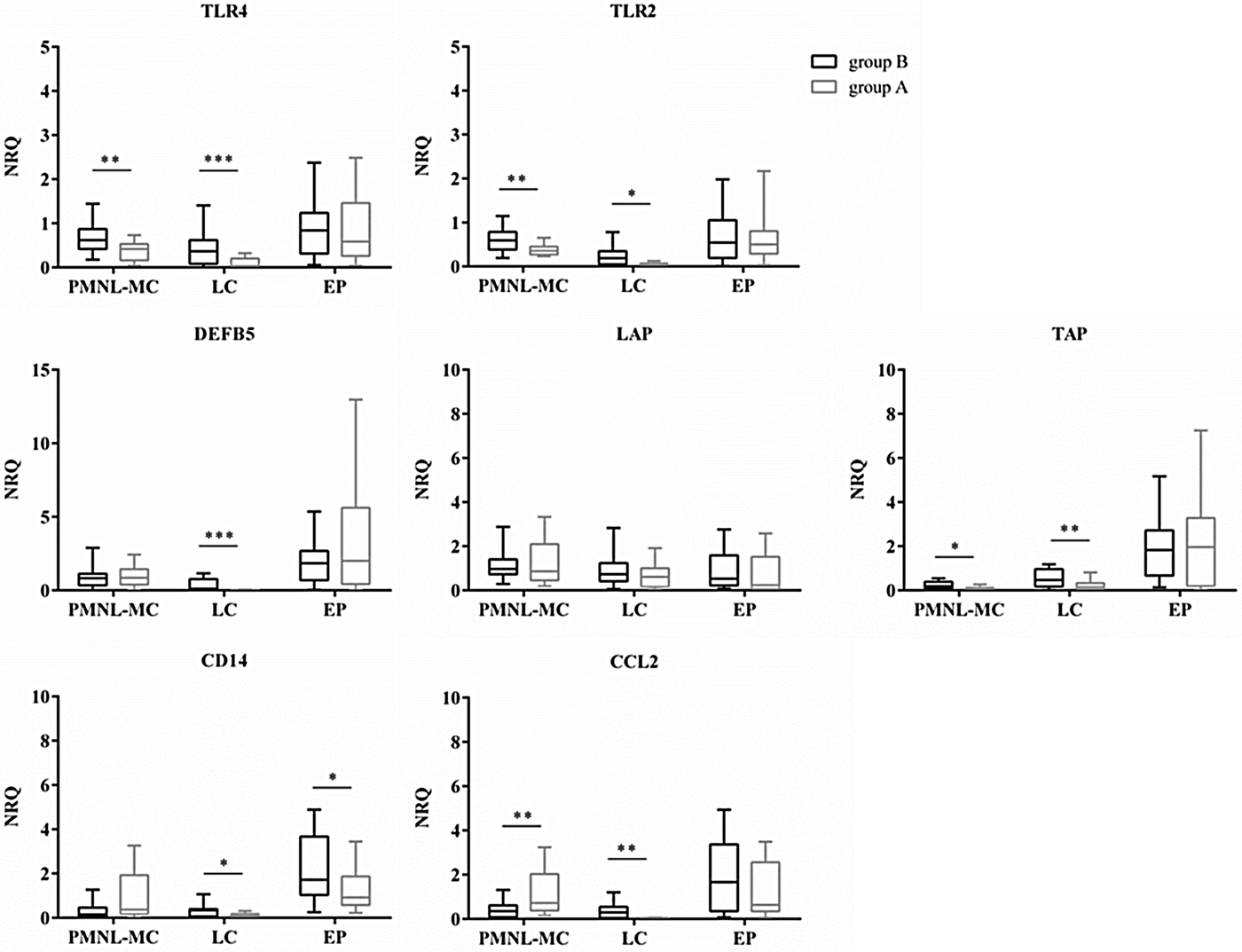
The target gene regulation was expressed as NRQ and the main genes involved in innate immunity were regulated in animals with S. aureus positive mastitis (Fig. 3). In particular, the regulation due to mastitis was significantly positive for TLR genes. In PMNL-MC the up-regulation was about 1·9- and 1·6-fold for TLR4 and TLR2, respectively. In LC the up-regulation was 4·9- and 2·8-fold for TLR4 and TLR2, respectively. In LC, CCL2 and CD 14 TLR2 and TLR4 were over expressed 10·5- and 2·8-fold respectively in samples with mastitis. Also, genes codifying for antimicrobial peptides were up regulated in S. aureus positive milk samples, in particular 18·2-fold for DEFB5 and 2·5- fold for TAP in LC. TAP was also over expressed of 1·75-fold in PMNL-MC subpopulation of SCs derived from mastitic milk. In EP only CD14 was significantly up regulated of 1·7-fold. Unexpectedly CCL2 was down regulated during mastitis in PMNL-MC, by 3·2-fold.
Normalised relative quantity (NRQ) of A: toll-like receptors genes (TLR2, TLR4). B: antimicrobial peptides genes (DEFB5, LAP, TAP). C: cytokines genes (CD14, CCL2). These target genes were normalised to three reference genes (PPIA, GAPDH, RPS5). NRQs are shown as box and whisker plots. The statistical difference between cells derived from group A (cows free of infection) and group B (cows showing clinical mastitis signs) is indicated as *P < 0·05, **P < 0·01 and ***P < 0·001.

Discussion
Several methods have been developed to discriminate cells in milk, among which cytological methods are used to identify the main cell types (Baumert et al. Reference Baumert, Bruckmaier and Wellnitz2009), and enzyme-linked immunosorbent assay to detect and quantify cells (O'Sullivan et al. Reference O'Sullivan, Joyce, Sloan and Shattock1992). To separate cells by type, flow cytometry-cell sorting technology could be applied (Albenzio & Caroprese, Reference Albenzio and Caroprese2011). Normally, sorting is not destructive and the process has no effects on cell viability and function. Therefore, sorted cells can be a starting point for cellular and molecular investigations. However, this technology is expensive and requires highly skilled staff. There is a need for the development of new techniques which could simplify the study of milk cell subpopulations.
Immunomagnetic separation has previously been applied to isolate EP and MC from bovine milk (Boutinaud et al. Reference Boutinaud, Herve and Lollivier2015; Lewandowska-Sabat et al. Reference Lewandowska-Sabat, Boman, Downing, Talbot, Storset and Olsaker2013), and PMNL and MC from sheep milk (Albenzio et al. Reference Albenzio, Santillo, Caroprese, D'Angelo, Marino and Sevi2009; Caroprese et al. Reference Caroprese, Marzano, Schena and Sevi2008). However, until now, this technique was applied to obtain one single cell subpopulation at a time. The present study describes a two-step immunomagnetic separation for the recovery of three cell type subpopulations. In online Supplementary Fig. S1 figure the progressive elimination of each separate cell population from the cytospin is evident. In the first step an anti-CD11b antibody was used to separate PMNL and MC fraction; the residual LC and EP populations were sorted in the second step using an anti-CD45 antibody. The method has been developed using milk derived from cows free from infection and cows affected by S. aureus mastitis. Despite the low cell count of healthy cow's milk (less than 200 000 cells/ml), flow cytometric analysis showed that the two-step immunomagnetic separation allowed a good enrichment of the different milk subpopulations and morphologic evaluation confirmed the expected cell lineage.
On all separated populations it was possible to detect, by qPCR, the main genes involved in innate immunity and to quantify the effect of mastitis on these genes in dairy cows. To identify the stability of reference genes in three milk cell subpopulations, a comparative ΔCq approach was used. Genes with a lower average standard deviation are usually associated with high expression stability. PPIA was revealed to be the most stable reference gene, but the common practise of using a single reference gene for normalisation is associated with possible errors (Vandesompele et al. Reference Vandesompele, De Preter, Pattyn, Poppe, Van Roy, De Paepe and Speleman2002). Thus, a multi-reference approach was applied to minimise deviations.
qPCR results showed a general up-regulation of the target genes tested (for TLRs, antimicrobial peptides and cytokines involved in innate immunity), in particular in the LC subpopulation.
In conclusion, we have developed an immunomagnetic method to purify cell subpopulations from milk that can improve understanding of the mechanisms involved in immunological reactions to mammary gland infection. Since the resistance to mastitis is a complex process, it is important to identify genes involved in the immune response, because they could be crucial in the selection of resistant animals (Fonseca et al. Reference Fonseca, Antunes, Paiva, Lange, Guimarães and Martins2011). The expression of TLRs and antimicrobial peptide genes as potential markers will be ascertained in different cell subpopulations, to verify the possible correlation between mastitis resistance and gene expression.
Supplementary material
The supplementary material for this article can be found at https://doi.org/10.1017/S002202991800050X
This research was financially supported by Fondazione Cassa di Risparmio di Cuneo (CRC), Project ‘MIGLIORLAT – Miglioramento della qualità e dello sviluppo competitive della filiera latte piemontese’, Bando Ricerca Scientifica 2011. The authors are grateful to dr Maurizio Chialva, free practitioner, dr Mauro Coppa, University of Turin, Department of Agricultural, Forest and Food Sciences (DISAFA), and Domenico Palmerini and Alessandra Sereno for their technical support.