In 1996, Mexico challenged a U.S. safeguard measure under the provisions of the North American Free Trade Agreement (NAFTA). While few were surprised that Mexico filed this case, many were puzzled by Mexico's decision not to bring it, instead, to the World Trade Organization (WTO).1
See, for example, de Mestral 2005.
See, for example, Reif 2001.
Black's Law Dictionary defines forum shopping as “when a party attempts to have his action tried in a particular court or jurisdiction where he feels he will receive the most favorable judgment or verdict.” The importance of forum shopping in domestic litigation is discussed in Clermont and Eisenberg 1995, while its importance in Canada–U.S. trade is discussed in Howse 1998.
I argue that a complainant's choice of forum depends on whether it prefers to set a regional or multilateral precedent, or no precedent at all. Setting precedent means adding to an institution's body of case law concerning the obligation(s) in dispute. The incentive for a complainant to do this is that, in addition to curbing the defendant's protectionism, a precedent can facilitate future litigation, and encourage more ex ante settlement,4
Setting a precedent can encourage subsequent disputes to end in a negotiated settlement before the panel rules, or deter protectionist practices from arising in the first place. In other words, there is nothing about this argument that suggests that all later disputes will necessarily result in a legal verdict.
Using a two-dimensional spatial model, I show that this decision depends on two variables: (1) the complainant's preference concerning the outcome of the dispute, which I define as being more or less “liberal,” or free-trade oriented, than the status quo policies of the defendant, other trade partners, and the likely verdicts of the regional and multilateral institutions; and (2) the complainant's expectation concerning the future value of the precedent set, by which I mean the likelihood that the complainant will use the resulting case law in future litigation against other members, more than other members will use it against the complainant. These variables combine to show that the complainant choice of forum is not simply a function of which institution is likely to come the closest to its ideal ruling against the defendant, but where the resulting precedent will be more useful, facilitating litigation against other members, as opposed to inviting litigation against itself. In particular, an illiberal complainant is more likely to file regionally, and a liberal one multilaterally, even if they expect a more decisive legal victory over the defendant at the other institution. Yet, both will reverse their choice of forum if the expected value of future regional litigation is higher, an illiberal complainant because it will be less fearful of being sued by its more liberal multilateral trade partners, and a liberal one because it will be less concerned about suing its less liberal multilateral trade partners.
Forum shopping has broader implications for studying institutions. First, it sheds light on the rational design literature, notably with respect to its treatment of membership. As Koremonos, Lipson, and Snidal put it, membership “is an endogenous design choice” that can later emerge as an exogenous constraint on the use of an institution.5
Koremenos, Lipson, and Snidal 2001, 777.
As I explain below, the Eurasian Economic Community and the Central Asian Cooperation Organization have merged, while the Common Market for Eastern and Southern Africa and the African Economic Community are scheduled to do so.
Second, forum shopping also speaks to more general questions about institutional design, notably with respect to the trade-off between “rigidity” and “stability.” Echoing Goldstein and Martin's argument that too much legalization may undermine trade liberalization at the WTO,7
Goldstein and Martin 2000.
Rosendorff 2005.
World Intellectual Property Organization 1990.
This article proceeds as follows. The first section elaborates the puzzle of forum shopping. The second section develops the argument of this article. The third section probes the usefulness of the argument in explaining the safeguard and periodicals disputes. The fourth section concludes with a discussion of implications for institutional theory.
The Puzzle
Why do complainants file some disputes regionally, others multilaterally, and still others not at all? The most obvious answer would be that institutional rules predetermine where complainants file. The purpose of this section is to show that there is ample opportunity for forum shopping, not least because, as with most other trade agreements, the WTO and NAFTA permit it. The WTO is less forthcoming than NAFTA on this point. On the one hand, the WTO claims “compulsory jurisdiction” over those disputes that arise among its members. On the other hand, the WTO approves preferential trade agreements under Article XXIV of the General Agreement on Tariffs and Trade (GATT), taking into account that many have dispute settlement mechanisms of their own, thus inviting forum shopping. For example, in reviewing the Canada–U.S. Free Trade Agreement (FTA), which preceded NAFTA, a GATT Working Group asked representatives of both countries what would happen “if the conclusions of the bilateral dispute settlement proceedings … and those reached under the multilateral dispute settlement proceedings were different or even contradictory… ?”10
GATT Basic Instruments and Selected Documents 1995, suppl. 38.
For its part, NAFTA's main dispute settlement mechanism, Chapter 20, explains that “disputes regarding any matter arising under both this Agreement and the General Agreement on Tariffs and Trade, any agreement negotiated thereunder, or any successor agreement … may be settled in either forum at the discretion of the complaining Party.”11
Article 2005:1. Under the FTA, this was Article 1801:2.
Indeed, in reviewing the texts of all trade agreements containing a formal dispute settlement chapter, as listed in the Dartmouth Tuck Trade Agreement Database, I found only a few exceptions that, like the CARICOM–Colombia agreement, make no mention of the opportunity for forum shopping. See Tuck School of Business at Dartmouth, Tuck Trade Agreements Database. Available at 〈http://cibresearch.tuck.dartmouth.edu/trade_agreements_db/〉. Accessed 21 March 2007.
In particular, there is no equivalent of Article 104 under the WTO, and while Chapters 7 and 9 had no formal equivalent under GATT, they do under the WTO (that is, the Agreement on the Application of Sanitary and Phytosanitary Measures, and the Agreement on Technical Barriers to Trade).
Marceau 2001, 1111.
Another key consideration would be differences in law. There clearly are differences in law across the WTO and NAFTA, for example, but there is also a marked degree of convergence in many areas, not least because successive rounds of multilateral obligations have been ratified domestically. As a result, disputes are typically “actionable” under either forum. Indeed, NAFTA directly incorporates various WTO provisions and has been called on to adjudicate these where the law overlaps. For example, in the safeguard dispute, Mexico not only argued that the main legal issues arose under both agreements, but that NAFTA “necessarily [had] jurisdiction to dispose of all overlapping GATT issues involved in that dispute.”15
NAFTA Doc. USA-97-2008-01, para. 28. All NAFTA documents are available from the NAFTA Secretariat Web site: 〈http://www.nafta-sec-alena.org〉.
A third factor would be the timeliness of proceedings. On this count there is little variation: both fora set out similar timelines, from the duration of consultations to the issuance of an interim and final report. That said, if the timeliness of justice were a main determinant of the choice of forum, complainants might be expected to prefer arbitration to formal dispute settlement (that is, alternative dispute resolution mechanisms under NAFTA or DSU Article 25 arbitration under the WTO), and yet they almost never do.16
Three cases have gone for DSU 25 arbitration at the multilateral level, two under GATT and one under the WTO, although the latter was conducted as a DSU 22.6 proceeding on authorization to retaliate, such that it can hardly be counted as a case of arbitration, as per the spirit of this provision. Nonetheless, recourse to arbitration under NAFTA or DSU 25 still hinges on a prior decision to file regionally or multilaterally, bringing it within reach of my argument. Indeed, as in the case of DSU 25, these decisions are fully backed by DSU 21 (on compliance) and 22 (retaliation), such that concern for precedent should be no less pressing in these disputes.
A fourth factor would be the adoption of panel reports, and appellate review. The FTA/NAFTA never permitted defendants to block panel reports, a feature that compared favorably to GATT, but has been woven into the WTO. Even under GATT, there was far less blocking of reports than of panel requests; but in any case, Canada and the United States had no history of denying the other a legal victory. Appellate review is another feature that distinguishes the WTO from NAFTA, although the trade-off is that WTO verdicts are “binding,” whereas NAFTA rulings are not, such that this feature of the DSU is not as germane to regional dispute settlement.
Following from this, a fifth factor would be the availability of remedies at the end of a dispute. The WTO and NAFTA outline similar procedures whereby a wronged complainant might seek redress, though NAFTA provisions, on occasion, allow for more direct compensation, notably the “cultural industries exception” discussed in the case study on Canada—Periodicals. Otherwise, complainants at either forum must wait out the defendant's (prospective) compliance. If this is not forthcoming in a timely manner, the complainant can request authorization to suspend “equivalent” benefits to the defendant. Few such requests have been made at either the WTO or NAFTA, and fewer still have been acted upon,17
Authorization to retaliate has been granted in only seven WTO disputes, and acted upon in four of these.
This discussion suggests that there is ample opportunity for forum shopping: both NAFTA and the WTO recognize that this can (and will) occur, and their rules and procedures are rarely so different as to prejudge the complainant's choice of “court.” This, in turn, begs the obvious question: why not file at both institutions? NAFTA, for one, explicitly discourages this: Article 2005, paragraph 6, says that “the forum selected shall be used to the exclusion of the other… .”18
The article further states that “unless a Party makes a request pursuant to paragraphs 3 or 4,” which invoke the special claims of jurisdiction on the environment, sanitary and phytosanitary measures, and standards, although these paragraphs also insist on pursuing the matter “solely under this Agreement.”
At NAFTA, disputes over antidumping and countervailing duties are taken up under Chapter 19, which gives the complainant (including firms, who have private standing) “binational” tribunals as an alternative to seeking relief in domestic courts. In this sense, Chapter 19 is not considered comparable to WTO dispute settlement.
In other words, this was not an example of the same case being filed twice, but a second dispute arising over the outcome of the first dispute.
Marceau 2001, 1081.
The Argument
The complainant's choice of forum depends on whether it prefers to set a regional or multilateral precedent, or no precedent at all. By setting a precedent, I mean adding to an institution's body of case law that is followed by its judicial bodies when ruling on subsequent disputes. This definition is not controversial; observers widely subscribe to the view that, as Palmeter and Mavroidis explain, “parties will continue to cite prior reports to panels, and panels will continue to take them into account by adopting their reasoning—in effect, following precedent.”22
Palmeter and Mavroidis 2004, 56. See also Davey 1998, 79; Jackson 1998, 83; Komuro 1995, 37; Petersmann 1994, 1175; Huntington 1993, 435; and Van Bael 1988, 69.
Steinberg 2004, 254.
Bhala 1999b, 3–4.
Ibid., 9.
WTO Doc. WT/DS58/AB/RW, para. 107. All WTO documents are available at 〈http://www.wto.org〉. Accessed 12 June 2007.
NAFTA Doc. USA-97-2008-01, para. 44.
WTO 2003.
Bhala 1999a, 850–51.
Since de facto stare decisis is followed for extra- and quasi-legal reasons, including custom and habit, and not as a matter of legal requirement, it could be argued that precedents from one institution might constrain or shape the rulings of another, making it hard to disentangle different bodies of jurisprudence, and thus to engage in forum shopping. This concern is unwarranted, both in theory and in practice. For its part, the WTO has not cited a single ruling by NAFTA (or any other regional institution),31
In my effort to survey WTO reports and trade law experts on citations to NAFTA case law, I was unable to turn up a single example.
WTO Doc. WT/DS8/AB/R, 14.
See Mavroidis, Howse, and Bermann forthcoming, 63.
WTO Doc. WT/DS241/R, para. 7.41. Likewise, in EC—Biotech Products, the panel explains that both the Convention on Biological Diversity and the Biosafety Protocol are “not applicable” for this same reason. WTO Doc. WT/DS291/R, para. 7.75.
Pauwelyn 2006, 202.
In a few NAFTA disputes, on the other hand, GATT/WTO decisions have been referenced by panels, not least because the agreement incorporates certain WTO articles. Even here, however, these references have simply been of suggestive value to the panel, much like at the U.S. Supreme Court, where, as in Lawrence v. Texas, decisions by the European Court of Human Rights were cited, despite the fact that these have no bearing on the high court's de jure stare decisis.36
See Joan Biskupic, “Supreme Court Citing More Foreign Cases,” USA Today. 7 July 2003, available at 〈http://www.usatoday.com/news/washington/2003-07-07-foreign-usat_x.htm〉, accessed 18 April 2007; and Jeffrey Toobin, “Swing Shift: How Anthony Kennedy's Passion for Foreign Law Could Change the Supreme Court,” New Yorker, 12 September 2005, available at 〈http://www.newyorker.com/archive/2005/09/12/050912fa_fact〉, accessed 18 April 2007.
NAFTA Doc. USA-97-2008-01, para. 50.
WTO Doc. WT/DS308/R, para. 7.15.
In short, one can speak meaningfully about separate bodies of de facto stare decisis at the WTO and NAFTA.39
In discussing the model, and Figure 1, in particular, I will show that, even if there were some unanticipated spillover of precedent from the WTO to NAFTA, the complainant would still engage in forum shopping to discriminate among memberships, and would be more inclined to file at NAFTA as a result.
It is logical that the complainant will file in whichever court is most likely to come closest to its “ideal” ruling. Indeed, if the complainant cared only about winning a legal victory over the defendant, this would be the end of the story. The problem, however, is that precedent ensures that a legal victory does not just apply to the complainant's trade with the defendant, but also to its trade with other members of the institution in which the resulting case law was set. Here, precedent can be a double-edged sword: it can make it easier for the complainant to bring litigation against these other members of the institution, but it can also help these other members bring litigation against the complainant. Thus, forum shopping involves discriminating among institutional memberships, the logic being that, on a given measure(s), some complainants will prefer a precedent that bears only on a subset of their trade relations, others a precedent that bears on all their trade relations, while still others will prefer not to set a precedent at all. To generate specific hypotheses, I focus on two variables: (1) the complainant's preference concerning the outcome of the dispute, which I define as being more or less liberal, or free-trade oriented, than the status quo policies of the defendant, other trade partners, and the likely verdicts of the regional and multilateral institutions; and (2) the complainant's expectation concerning the future value of the precedent set, by which I mean the likelihood that the complainant will use the resulting case law in future litigation against other members more than other members will use it against the complainant.
First, to say that the complainant is liberal (illiberal) is simply to say that it prefers a ruling on the disputed measure that is more free-trade oriented (protectionist). For example, the complainant might favor a ruling that advances a fuller interpretation of a member's rights, a stricter understanding of its obligations, or one that otherwise clarifies principles of nondiscrimination in a given issue area. Since the complainant has no incentive to file if it prefers a less liberal outcome than the defendant's status quo policy, the real question is how liberal the complainant is in relation to other trade partners, the anticipated rulings of NAFTA and the WTO, and the expected value of future regional or multilateral litigation on similar matters. I thus model two sets of disputes that are the most generalizable: the first involving an illiberal complainant, the second a liberal one. The model predicts that both “types” of complainants will sometimes choose the regional forum, and at other times choose the multilateral forum. It also predicts that an illiberal complainant, who is nonetheless more liberal than the defendant, may prefer not to file at all.
Second, complainants are likely to differently weight the expected value of setting a regional or multilateral precedent. A precedent is of value precisely because it is “binding” in the future, but the anticipated returns to setting a regional versus a multilateral one will depend on whether the complainant is more likely to use it against others, as opposed to having it used against itself. The less (more) the complainant expects that the resulting case law will help it litigate others, the more focused it will be on setting a regional (multilateral) precedent, or no precedent at all, simply because of membership. In this sense, the weights reflect the complainant's subjective estimate of the present discounted value of its future litigation, both as a filer, and target, of subsequent disputes.
This discussion of how complainants are likely to weight regional versus multilateral litigation accords with the argument that, under trade agreements, only governments have standing to file disputes, so that they can filter which cases to file, looking to maximize political support.41
See Sykes 2005; and Trachtman and Moremen 2003. As noted in n. 19, NAFTA gives firms private standing to file cases concerning antidumping and countervailing duties (as well as investor relations disputes), although these fall outside the main dispute settlement mechanism. Otherwise, private standing is a rarity in trade agreements.
The Model
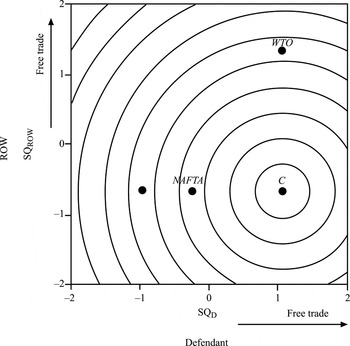
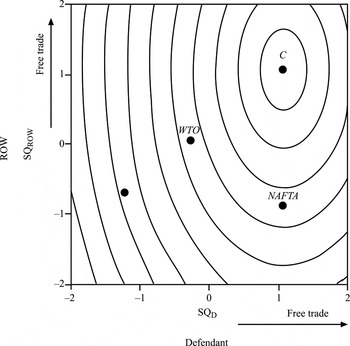
To predict why the complainant, C, files regionally or multilaterally, or not at all, I develop a two-dimensional spatial model with weighted Euclidean distance. As in Figure 1, there are two policy dimensions, one pertaining to C's trade relations with the defendant, D, and the other to C's trade relations with its multilateral partners, which I refer to as “rest of world,” or ROW. If C was only concerned about winning a legal victory against D, a one-dimensional model would be sufficient. But because C is also concerned about how, in defeating D, the resulting precedent also bears on its other trade partners, ROW, it is necessary to use a two-dimensional model (that is, the second dimension is C's relations with ROW). First, C's relations with D are plotted along the x-axis, with D's status quo policy at SQD. Second, C's relations with ROW are plotted along the y-axis, with the median multilateral trade partner's status quo policy at SQROW. Movement out from the origin represents a gain in trade liberalization in both dimensions.

Illiberal complainant, equal weights on future regional and multilateral litigation
On Figure 1, the points NAFTA and WTO are the expected rulings these institutions would hand down in this case, thereby setting precedent. The crucial difference, on this count, is that a NAFTA ruling has no bearing on C's multilateral trade partners and thus has no influence on SQROW (that is, filing at NAFTA leaves this policy in place). As a first cut, I follow Goldstein's lead in making the simplifying assumption that NAFTA splits the difference between C and SQD, given the political process of appointing panelists.42
Goldstein 1996, 549.
Last, preferences are assumed to be separable and decreasing in weighted Euclidean distance.43
The use of weighted Euclidean distance is appropriate in this case because there is a common metric with respect to the two dimensions, as evidenced by the 45 degree WTO line, in particular, and stated in the text.
C's decision rule is to file with whichever institution offers the greatest utility, or alternatively (and by this same calculation), to let stand the status quo policies of D and ROW by not filing at all. Utility is increasing in negative distance: the closer C is to NAFTA than to WTO, for example, the greater its utility from filing regionally, as opposed to multilaterally. As noted above, while complainants generally do not file at multiple fora, the model anticipates the circumstances under which C might be tempted to do so.
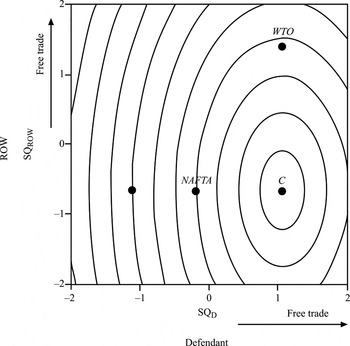
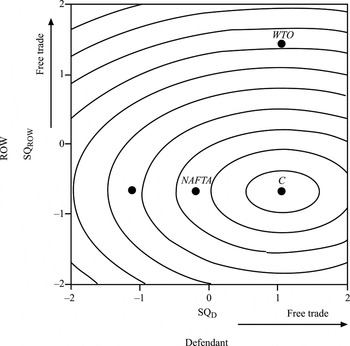
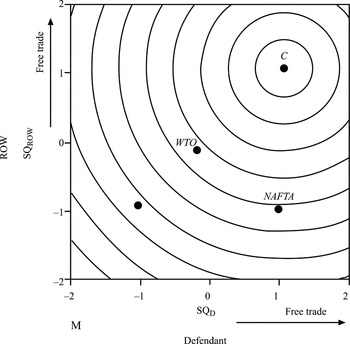
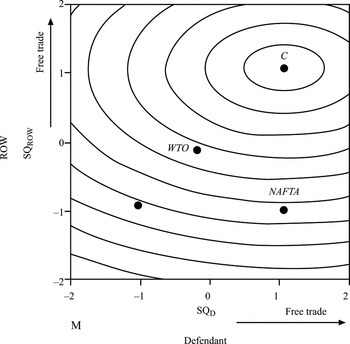
Figures 1, 2, and 3 set out contour maps of C's indifference curves for three weighting schemes of wD and wROW: (1) the expected value of future litigation is the same at both institutions; (2) the expected value of future litigation at the regional institution is three times greater; and (3) the expected value of future litigation at the multilateral institution is three times greater. The point is not that, empirically, either weight is likely to be three times greater than the other, but rather to show how the weights make C's indifference curves elliptical, rather than circular, and thus how, intuitively, a greater concern for future regional or multilateral litigation can lead the complainant to choose the opposite forum, holding preferences constant. In particular, where wD = wROW, C's indifference curves are circular, as in Figures 1 and 4, but where wD and wROW are different, C's indifference curves are elliptical, as in Figures 2, 3, 5, and 6. This is important because, where the indifference curves are elliptical, larger distances in one or the other policy dimension yield greater differences in utility,44
The influence of wD and wROW can readily be seen in the C's utility, which is formally written as follows:


An Illiberal Complainant
In Figure 1, C prefers a more liberal ruling on the disputed measure(s) along the x-axis than D, and C prefers a more liberal ruling than the one expected from NAFTA. Yet, C prefers a less liberal outcome along the y-axis than ROW, and WTO is, in both dimensions, more liberal than D and ROW. In other words, C wants a more decisive legal victory over D than might be expected from NAFTA, but a less liberal precedent than what might be expected from the WTO (given stronger disciplines, for example), since it is less free-trade oriented with respect to the disputed measure(s) than ROW.45
In other words, this is the type of dispute most observers have in mind in arguing that complainants will file regionally to “hide” from more liberal members of the WTO. C is more liberal than D but less liberal than ROW, and while both NAFTA and the WTO would rule against D, the WTO's more liberal ruling would be accessible to C's more liberal multilateral trade partners.
Here, it is worth asking what would happen if WTO precedents (unpredictably) spilled over to NAFTA. As I explain earlier, this, as a practical matter, does not happen at either the WTO or NAFTA. But what if NAFTA's few references to WTO case law—the WTO has never referenced NAFTA (or other regional) rulings—did prove influential? In Figure 1, which is the most interesting case in this regard (since this would be of most consequence to an illiberal complainant), the answer is that, where such a spillover made NAFTA more liberal (as seems reasonable), C's incentive to file regionally would be greater still. Indeed, if this spillover made NAFTA just as liberal as WTO, this would only help C realize a more decisive legal victory over D, without the fear of future litigation by ROW that would come with filing multilaterally. In other words, even if the precedents were the same, C would still engage in forum shopping, looking to discriminate among these two institutional memberships. This speaks to the robustness of my argument; the reality is that, as I note above, WTO and NAFTA precedents do not spill over to the other institution.
Now consider the exact same setup with respect to D and ROW, but allow for C to differently weight the expected value of its future regional and multilateral litigation. In Figure 2, for example, wD is three times greater than wROW, so that C incurs greater disutility with distance from its ideal point along the x-axis. Here, C files against D at the WTO, not at NAFTA. Why this reversal in C's choice of forum? The reason is that C's greater concern about future regional litigation outweighs its previous concern for SQROW, enabling it to pursue a more liberal ruling at the WTO against D. In other words, because C is less concerned about being sued by its multilateral trade partners with this precedent, it files multilaterally to obtain a more decisive legal victory against D, the irony being that, here, a greater emphasis on regional litigation leads C to file at the WTO.

Illiberal complainant, more weight on future regional litigation
Finally, in Figure 3, wROW is three times greater than wD, meaning that C places more emphasis on future multilateral litigation. Just like in Figure 1, C files against D at NAFTA under these circumstances. There is, however, an important twist in the story. Notice, more specifically, that if C had no regional forum in which to file this case (that is, there was no NAFTA), it would not take this case to the WTO, whereas in Figure 1, it would take this case to the WTO. What explains this difference? In Figure 3, the emphasis that C places on its future multilateral litigation is such that it would prefer to let SQROW stand, rather than set a precedent that might be used against it by ROW. Thus, C's concern for setting a liberal precedent that could be used by its more liberal multilateral trade partners determines not only where it files this case, but whether it files at all.

Illiberal complainant, more weight on future multilateral litigation
To sum up, this illiberal complainant is more likely to file at NAFTA, even though it expects a more decisive legal victory over the defendant at the WTO. It would take this case to the WTO, however, if it placed greater weight on its expected future litigation at NAFTA. Indeed, if this complainant was less concerned about how its more liberal multilateral trade partners would use the resulting precedent, it would seek a more decisive legal victory over the defendant at the WTO.
A Liberal Complainant
Relaxing the assumption that NAFTA splits the difference between C and D, consider Figure 4. Here, C prefers a more liberal outcome on the disputed measure than D along the x-axis, and ROW and WTO along the y-axis.46
I assume that C is also more liberal than the third member of NAFTA, whose preferences would only be of interest in this case if it were more liberal than C, D, ROW, NAFTA and WTO, which is hard to justify.
For example, NAFTA had stronger disciplines on traded services than GATT, and the U.S.–Singapore bilateral has (in some regards) stronger disciplines on intellectual property than the WTO, such that it is not difficult to imagine a regional institution being more liberal than the multilateral institution, especially as the former increasingly tackles the so-called “new age” issues, including traded service and intellectual property.

Liberal complainant, equal weights on future regional and multilateral litigation
Compare this to Figure 5, where wD is three times greater than wROW. Here, C, instead, files against D at NAFTA. The reason is that, where C is more concerned about future regional, as opposed to multilateral, litigation, it can pursue the more decisive legal victory against D that NAFTA is poised to deliver, whereas above, its unwillingness to let SQROW stand leads it to file at the WTO.

Liberal complainant, more weight on future regional litigation
If, on the other hand, C weights wROW even slightly more than wD, this only serves to reinforce the decision it reaches in Figure 4, which is to file this case at the WTO, as in Figure 6. Indeed, a greater concern for ROW will only encourage C to file multilaterally, looking to strike down not only SQD, but SQROW as well. The key here is that this choice of forum is robust to the fact that NAFTA would give C more of what it wants in its dispute with D alone (that is, in this one dimension).

Liberal complainant, more weight on future multilateral litigation
In sum, this complainant is more likely to file multilaterally, even though it expects a more decisive legal victory over the defendant at NAFTA. It would take this case to NAFTA, however, if it put less weight on its expected future litigation at the WTO. Indeed, if this complainant was less concerned about being able to influence its (illiberal) multilateral trade partners, it would seek the more decisive legal victory over the defendant at NAFTA.
The Case Studies
To assess the usefulness of the model's predictions, I revisit the safeguard and periodicals disputes in this section. Other scholars have also argued that precedent looms large in these cases, and I draw on their work. The original contribution of this article is that I specify, and seek to empirically substantiate, not only the precise circumstances under which precedent should be expected to matter, but at which dispute settlement institution.
Broom Corn Brooms
This dispute had all the markings of a case destined for the WTO. Indeed, the U.S. safeguard affected other members besides Mexico, one of which filed on its own in Geneva, and seemed to center on aspects of WTO law. Nonetheless, Mexico filed, instead, at NAFTA. Why?
The United States undertook safeguard actions to protect its domestic corn broom manufacturers in 1996. The U.S. International Trade Commission (ITC) conducted three investigations, two global and one bilateral, and, having reached affirmative injury determinations in all three, slapped duties on Mexican broom corn brooms through December 1998. Interestingly, while many U.S. trade partners were exempt from these duties, including large suppliers such as Honduras, Hungary, Panama, and even Canada, the other U.S. NAFTA partner, Colombia was not, nor shy about taking this dispute to the WTO.48
Colombia requested consultations with the United States at the WTO. See WTO Doc. WT/DS78/1.
de Mestral 2005, 9.
Reif 2001, 14.
Mexico clearly reasoned that the dispute could be “brought in either a NAFTA or a GATT/WTO forum.”51
NAFTA Doc. USA-97-2008-01, para. 28.
Ibid., para. 36.
Ibid., para. 27.
Mexico's policy orientation on safeguards has not been substantially more liberal than the United States or others. It has notified eighteen safeguards to NAFTA, but only one to the WTO, which suggests it has sought to manage its safeguard actions regionally. Of course, much of this pattern owes to NAFTA's special agricultural provisions on safeguards, but this is precisely the point: when Mexico has used safeguards, it has been to relieve more costly adjustments than the WTO generally accommodates. Indeed, Mexico's recent proposal on how to reform the WTO's handling of safeguards to help countries solve deeper problems, within the rule of law, speaks to this concern.54
WTO Doc. MTN.GNG/NG9/W/18.
To date, all safeguards adjudicated by panels have been found to be in violation of WTO obligations.
According to this setup, Figure 1 should help explain Mexico's choice of forum in this dispute. Mexico was more liberal on this measure than the United States, though not (generally speaking) more so than third parties, weighted wD and wROW (at least) equally, and could have expected a tougher stance against the defendant at the WTO than at NAFTA. Under these conditions, then, Figure 1 predicts that Mexico would file at NAFTA, even though the WTO is expected to give it more of what it wants in its trade relations with the United States, and this because of concern for setting an overly liberal precedent at the multilateral forum.
Gantz lends weight to this interpretation of Mexico's choice of forum, arguing that “[p]erhaps either or both countries were mindful that a decision based on GATT Article XIX or the WTO Safeguards Agreement would create a precedent that might be relied upon in the future by a WTO panel; whereas, a decision based solely on NAFTA Chapter 8 could have repercussions only for future safeguards disputes under NAFTA.”56
Gantz 1999, 1071.
Periodicals
There has been some speculation that Canada—Periodicals might have been better handled at NAFTA, but even among those who agree that the WTO was the more appropriate court to hear this case, there is little agreement on why. The case involved a variety of Canadian restrictions on so-called “split-run” periodicals from the United States. These U.S. magazines competed for Canadian advertising dollars but had included little domestic content. While the value of the advertising revenue at stake was low (by some estimates just several hundred thousand Canadian dollars), and the legal issues straightforward, this dispute became a test case of “cultural industry” protection, which is the interesting aspect of this example. On the one hand, Canada had an exemption concerning cultural industries under NAFTA (Article 2106), grandfathered in from the FTA (Article 2005). On the other hand, the exemption also calls on Canada to compensate the United States for using it, potentially making it easier for the complainant to seek damages. As a result, the cultural industry exception figures prominently in the debate over how the United States shopped fora in this dispute.
Gantz, for example, explains that the United States went to the WTO to argue about national treatment, whereas NAFTA's cultural industry exception might have precluded such arguments.57
Ibid., 1077.
Reif 2001, 16.
Acheson and Maule 1999, 201.
Marceau 2001, 1110.
Canada is an important market for U.S. “cultural” products such as periodicals, television shows, and film. Since the interwar period, as Acheson and Maule explain, the United States has championed a free-trade agenda in these cultural products, over the opposition of Canada, Europe, and others. Indeed, screen quotas were exempted from the GATT because of political pressure from these countries, a cleavage that also formed over commercial television when, in the 1950s, the United States sought to amend the multilateral rules to remedy restrictions on programming.61
Acheson and Maule 1999, 56–59.
This setup suggests that this periodicals case should be interpreted through the lenses of Figure 6: the United States, which weighted wROW more heavily than wD, was far more free-trade oriented than the defendant, other trade partners, and either dispute settlement forum on the issues at stake, and thus should have had a strong preference for filing at the multilateral, as opposed to the regional institution, looking to set a precedent that would bind members other than Canada. This interpretation is endorsed by Acheson and Maule, who submit that, “[b]y placing the dispute before the WTO, the United States was able to test its views on cultural policies in a forum where, if it won, it could use the precedent as a lever to alter similar policies of both Canada and other countries, such as France and Australia.”62
Ibid., 201.
NAFTA Statement of Administrative Action 1993, 221–22.
See Krikorian 2005.
The competing explanation, of course, is that the United States was deterred from filing at NAFTA by the cultural industry exception. This is less persuasive, but the reason why illustrates the importance of the article's argument. In particular, NAFTA Article 2106, which builds on the FTA's Article 2005, is widely regarded to permit the United States to retaliate for a measure taken to protect Canadian cultural industries that would otherwise not be permitted. To be sure, U.S. industries have rallied around this “notwithstanding” interpretation of the exception, rooted in the wording from the FTA, and have signaled their clear willingness to retaliate.65
U.S. Trade Representative Carla Hills testified before the Senate Finance Committee that “[t]he Canadians have taken a cultural derogation just as they took a cultural derogation in the Canadian free trade agreement…. We for our government have said, if we suffer any economic harm as a result of their exercising any rights pursuant to that cultural derogation, we reserve the right to retaliate”; U.S. Senate 1992. See also Hedley 1995, 687.
Conclusions
Dispute settlement institutions are springing up across the landscape of the global economy. As a result, an increasing number of countries have an alternative to the multilateral rules and procedures of the WTO. This gives rise to opportunities for forum shopping, in that complainants can select among overlapping institutions in deciding where (if at all) to argue their case. The key, in this regard, is that, through precedent, a legal victory against the defendant also bears on the complainant's relations with other members of the same institution. I argue that whether the complainant prefers to set a regional or multilateral precedent (or not file at all) thus depends on two variables: (1) the complainant's preference concerning the outcome of the dispute, which I define as being more or less liberal, or free-trade oriented, than the status policies of the defendant, other trade partners, and the likely verdicts of the regional and multilateral institutions; and (2) the complainant's expectation concerning the future value of the precedent set, by which I mean the likelihood that the complainant will use the resulting case law in future litigation against other members more than others will use it against the complainant. These variables combine to show that the complainant choice of forum is not simply a function of which institution is likely to come the closest to its ideal ruling against the defendant, but where the resulting precedent will be more useful, facilitating litigation against other members, as opposed to inviting litigation against itself. Forum shopping is thus about discriminating among overlapping memberships: by filing its dispute regionally or multilaterally (if at all), the complainant chooses which members will be affected by the precedent it establishes.
Forum shopping thus has implications for the study of institutions more generally. First, it engages the discussion in the rationalist design literature about membership. This approach sees membership as an outcome to be explained but also observes that the decision on who is permitted to join an institution can later emerge as a constraint on its use, since membership determines “which actors will have standing in subsequent institutional negotiations.”66
Koremenos, Lipson, and Snidal 2001, 778.
In particular, while some institutions choose to accommodate overlapping memberships, others have made different design choices. On the one hand, for example, Chile has bilateral agreements with all three NAFTA members but is not, itself, a member of this institution. On the other hand, the Eurasian Economic Community and the Central Asian Cooperation Organization have decided to merge, rather than overlap, as has the Common Market for Eastern and Southern Africa and the African Economic Community.67
In the latter case, this merger is proposed for a future date in Article 178:1(c) of the Common Market's treaty.
Second, forum shopping offers insights into broader questions of institutional design. The debate over the greater legalization of international relations stands out in this regard.68
As Rosendorff explains, while a more legalized dispute settlement system may promote greater compliance, more flexible ones that allow for “efficient breach” under conditions of severe domestic political pressure are likely to be more stable, and thus attract and retain a wider variety of members.69Rosendorff 2005.
Schwartz and Sykes 2002.
Rosendorff 2005.
Not surprisingly, there is variation in the rules on forum shopping across institutions. For example, the Israel–Turkey bilateral and the South Asian Association for Regional Cooperation agreement make no formal provisions for forum shopping, while the Chile–El Salvador and European Communities–South Africa accords leave the choice of forum to the complainant. The draft text of the Free Trade Area of the Americas has an entire article on forum shopping, in which it says that members can file regionally or at the WTO, although there is considerable debate over whether they can file at other regional institutions.72
More specifically, Article 8.1 of the dispute settlement chapter stipulates that: “Disputes within the scope of application of this Chapter that are also eligible for submission to the dispute settlement system of the World Trade Organization [or that of a regional agreement to which the Parties to the dispute are Party,] may be submitted to any of these fora, at the discretion of the complaining Party.” The brackets indicate that would-be members disagree on the provision concerning forum shopping across regional trade agreements. See Free Trade Agreement of the Americas (FTAA), Draft Agreement: Chapter XXIII Dispute Settlement. Available at 〈http://www.ftaa-alca.org/FTAADraft03/ChapterXXIII_e.asp〉. Accessed 19 April 2007.
First, since most institutions allow forum shopping, this suggests a strong preference for stability over rigidity in the design of trade agreements. Indeed, if provisions of this sort are, as I have argued, an investment in flexibility, the striking feature of some of the recent trade agreements, such as the Central American Free Trade Agreement–Dominican Republic–U.S. accord, is that they invest substantially in laying out opportunities for forum shopping.73
See Article 20.3 of the CAFTA-DR-US accord. Available at 〈http://cibresearch.tuck.dartmouth.edu/trade_agreements_db/〉.
Second, where forum shopping is possible, this may help explain why some dispute settlement institutions are more legalistic than others. For example, Smith argues that these institutions are likely to be more legalistic where the economic power of members is more symmetrical, and where they aspire to closer integration.74
Smith 2000.
In fact, McCall Smith hints at this explanation but notes that it is beyond the scope of this theory. See ibid., 171.